







生物技术通报 ›› 2026, Vol. 42 ›› Issue (2): 17-29.doi: 10.13560/j.cnki.biotech.bull.1985.2025-0997
• 厌氧微生物专题(专题主编:承磊 研究员) • 上一篇 下一篇
周瑾洁( ), 李猛()
收稿日期:2025-09-18
出版日期:2026-02-26
发布日期:2026-03-17
通讯作者:
李猛,男,博士,教授,研究方向 :古菌生物学;E-mail: limeng848@szu.edu.cn作者简介:周瑾洁,女,博士,副研究员,研究方向 :产甲烷古菌;E-mail: jinjiezhou@szu.edu.cn
基金资助:
ZHOU Jin-jie(), LI Meng()
Received:2025-09-18
Published:2026-02-26
Online:2026-03-17
摘要:
乙酸营养型产甲烷古菌是自然界甲烷生成的主要驱动力,约贡献全球生物甲烷的三分之二。本文系统综述了两类乙酸营养型产甲烷古菌——甲烷八叠球菌(Methanosarcina)和甲烷丝菌(Methanothrix)的生理及形态特征、底物谱与代谢途径、电子传递链与能量耦合机制;综合比较了两类古菌在乙酸活化策略、辅酶再生通路和能量合成方式的异同,揭示其在不同环境条件下的代谢适应性与生态位分化;进一步总结了甲烷八叠球菌与甲烷丝菌胞外电子传递的研究进展,涵盖种间电子传递、微生物电腐蚀、胞外呼吸等微生物过程,阐明代谢通路和能量耦合机制。文章为全面理解乙酸营养型产甲烷古菌的代谢网络与电子流调控提供整合性视角,并为未来研究其环境适应策略与代谢调控机制奠定理论基础。
周瑾洁, 李猛. 甲烷八叠球菌和甲烷丝菌的能量代谢与胞外电子传递[J]. 生物技术通报, 2026, 42(2): 17-29.
ZHOU Jin-jie, LI Meng. Energy Metabolism and Extracellular Electron Transfer of Methanosarcina and Methanothrix[J]. Biotechnology Bulletin, 2026, 42(2): 17-29.
项目 Item | Ⅰ型甲烷八叠球菌 Type Ⅰ Methanosarcina | Ⅱ型甲烷八叠球菌 Type Ⅱ Methanosarcina | 甲烷丝菌 Methanothrix | |
|---|---|---|---|---|
| 形态 | 不规则球形,直径0.8-4.0 μm,常形成多细胞团聚体 | 杆形,长2.0-6.0 μm,宽0.8-1.3 μm,包裹于管状鞘结构中 | ||
| 底物 | 乙酸,甲基化合物,H2/CO2,甲基化合物/H2 | 乙酸,甲基化合物 | 乙酸 | |
| 乙酸亲和力 | 低 | 低 | 高 | |
| 生长速率 | 快 | 快 | 慢 | |
| 乙酸降解关键酶 | Ack, Pta | Ack, Pta | Acs | |
| 电子传递系统组成 | Ech, Frh, Vht, Fpo, Hdr, Mtr | Rnf, MmcA, Fpo, Hdr, Mtr | Fpo, Hdr, Mtr | |
| 胞外电子传递 | ||||
| 吸收电子 | DIET | + | + | + |
| Fe(0) | + | + | + | |
| 316L stainless steel | + | NA1 | + | |
| 释放电子 | Fe(Ⅲ) | + | + | NA1 |
| AQDS | + | + | NA1 | |
| 代表种 | M. barkeri | M. acetivorans | Mx. soehngenii | |
表1 乙酸营养产甲烷古菌生理与代谢特征
Table 1 Physiological and metabolic characteristics of aceticlastic methanogens
项目 Item | Ⅰ型甲烷八叠球菌 Type Ⅰ Methanosarcina | Ⅱ型甲烷八叠球菌 Type Ⅱ Methanosarcina | 甲烷丝菌 Methanothrix | |
|---|---|---|---|---|
| 形态 | 不规则球形,直径0.8-4.0 μm,常形成多细胞团聚体 | 杆形,长2.0-6.0 μm,宽0.8-1.3 μm,包裹于管状鞘结构中 | ||
| 底物 | 乙酸,甲基化合物,H2/CO2,甲基化合物/H2 | 乙酸,甲基化合物 | 乙酸 | |
| 乙酸亲和力 | 低 | 低 | 高 | |
| 生长速率 | 快 | 快 | 慢 | |
| 乙酸降解关键酶 | Ack, Pta | Ack, Pta | Acs | |
| 电子传递系统组成 | Ech, Frh, Vht, Fpo, Hdr, Mtr | Rnf, MmcA, Fpo, Hdr, Mtr | Fpo, Hdr, Mtr | |
| 胞外电子传递 | ||||
| 吸收电子 | DIET | + | + | + |
| Fe(0) | + | + | + | |
| 316L stainless steel | + | NA1 | + | |
| 释放电子 | Fe(Ⅲ) | + | + | NA1 |
| AQDS | + | + | NA1 | |
| 代表种 | M. barkeri | M. acetivorans | Mx. soehngenii | |
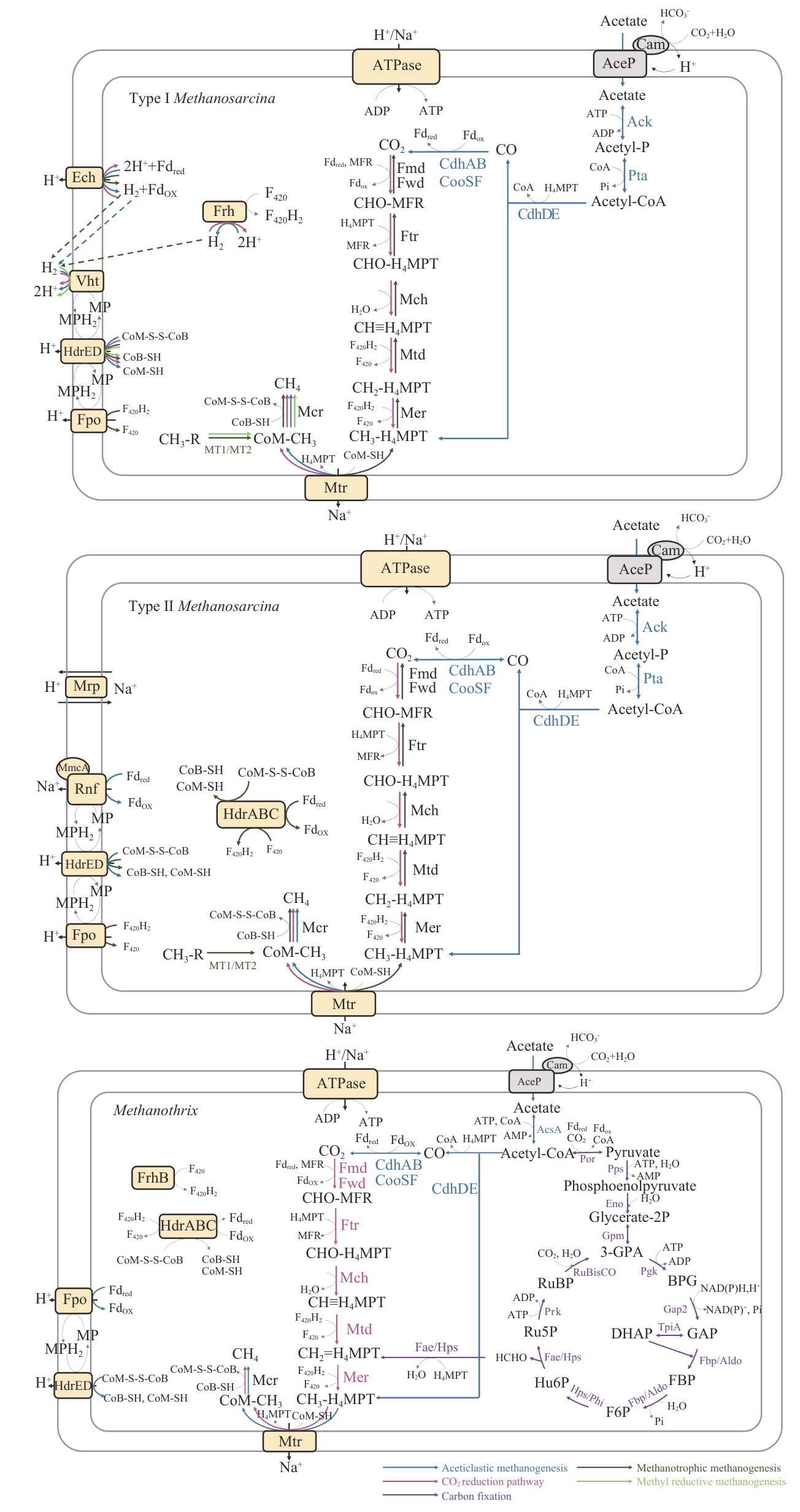
图1 甲烷八叠球菌与甲烷丝菌的代谢及电子传递
Fig. 1 Metabolism and electron transfer of Methanosarcina and Methanothrix
产甲烷古菌 Methanogen | 电子供体细菌 Electro-donating bacteria | 电子供体 Electron donor | 产甲烷古菌DIET关键蛋白 Key protein DIET of methanogenic archaeon | 参考文献 Reference |
|---|---|---|---|---|
| Type Ⅰ Methanosarcina | ||||
| M. barkeri | Geobacter metallireducens Geobacter grbiciae Rhodoferax ferrireducens Rhodopseudomonas palustris1 | Ethanol Ethanol Glucose Light, thiosulfate | Fpo, HdrABC NA2 NA2 Ech, Vht, HdrED, Fpo | [ [ [ [ |
| M. mazei | G. metallireducens | Ethanol | NA2 | [ |
| Type Ⅱ Methanosarcina | ||||
| M. acetivorans | G. metallireducens | Ethanol | Fpo, MmcA, Rnf, HdrED | [ |
| M. horonobensis | G. metallireducens | Ethanol | NA2 | [ |
| Methanothrix | ||||
| Mx. harundinacea | G. metallireducens Geobacter hydrogenophilus Rhodoferax ferrireducens | Ethanol, propanol, butanol Ethanol Glucose | HdrED NA2 NA2 | [ [ [ |
| Mx. thermoacetophila | G. metallireducens | Ethanol | MspA, Sqp, Fpo, HdrED, HdrABC | [ |
| Mx. soehngenii | G. metallireducens | Ethanol | NA2 | [ |
表2 乙酸营养产甲烷古菌依赖直接种间电子传递还原CO2产甲烷
Table 2 Summary of aceticlastic methanogen relying on direct interspecies electron transfer for CO2 reduction to methane
产甲烷古菌 Methanogen | 电子供体细菌 Electro-donating bacteria | 电子供体 Electron donor | 产甲烷古菌DIET关键蛋白 Key protein DIET of methanogenic archaeon | 参考文献 Reference |
|---|---|---|---|---|
| Type Ⅰ Methanosarcina | ||||
| M. barkeri | Geobacter metallireducens Geobacter grbiciae Rhodoferax ferrireducens Rhodopseudomonas palustris1 | Ethanol Ethanol Glucose Light, thiosulfate | Fpo, HdrABC NA2 NA2 Ech, Vht, HdrED, Fpo | [ [ [ [ |
| M. mazei | G. metallireducens | Ethanol | NA2 | [ |
| Type Ⅱ Methanosarcina | ||||
| M. acetivorans | G. metallireducens | Ethanol | Fpo, MmcA, Rnf, HdrED | [ |
| M. horonobensis | G. metallireducens | Ethanol | NA2 | [ |
| Methanothrix | ||||
| Mx. harundinacea | G. metallireducens Geobacter hydrogenophilus Rhodoferax ferrireducens | Ethanol, propanol, butanol Ethanol Glucose | HdrED NA2 NA2 | [ [ [ |
| Mx. thermoacetophila | G. metallireducens | Ethanol | MspA, Sqp, Fpo, HdrED, HdrABC | [ |
| Mx. soehngenii | G. metallireducens | Ethanol | NA2 | [ |
| [1] | Laboratory NGM. The NOAA Annual Greenhouse Gas Index (AGGI) [R]. Colorado, USA: NOAA Global Monitoring Laboratory, 2024. |
| [2] | EPA U. Overview of Greenhouse Gases [R]. Washington, DC: USA: U.S. Environmental Protection Agency, 2025. |
| [3] | Lyu Z, Shao NN, Akinyemi T, et al. Methanogenesis [J]. Curr Biol, 2018, 28(13): R727-R732. |
| [4] | Wu KJ, Zhou L, Tahon G, et al. Isolation of a methyl-reducing methanogen outside the euryarchaeota [J]. Nature, 2024, 632(8027): 1124-1130. |
| [5] | Kohtz AJ, Petrosian N, Krukenberg V, et al. Cultivation and visualization of a methanogen of the Phylum Thermoproteota [J]. Nature, 2024, 632(8027): 1118-1123. |
| [6] | Holmes DE, Smith JA. Biologically produced methane as a renewable energy source [M]//Advances in Applied Microbiology. Amsterdam: Elsevier, 2016: 1-61. |
| [7] | Thauer RK, Kaster AK, Seedorf H, et al. Methanogenic archaea: ecologically relevant differences in energy conservation [J]. Nat Rev Microbiol, 2008, 6(8): 579-591. |
| [8] | Zhou Z, Zhang CJ, Liu PF, et al. Non-syntrophic methanogenic hydrocarbon degradation by an archaeal species [J]. Nature, 2022, 601(7892): 257-262. |
| [9] | Mayumi D, Mochimaru H, Tamaki H, et al. Methane production from coal by a single methanogen [J]. Science, 2016, 354(6309): 222-225. |
| [10] | Evans PN, Boyd JA, Leu AO, et al. An evolving view of methane metabolism in the Archaea [J]. Nat Rev Microbiol, 2019, 17(4): 219-232. |
| [11] | Wolfe RS. An historical overview of methanogenesis [M]//Methanogenesis. Boston, MA: Springer US, 1993: 1-32. |
| [12] | Zhou JJ, Holmes DE, Tang H-Y, et al. Correlation of key physiological properties of Methanosarcina isolates with environment of origin [J]. Appl Environ Microbiol, 2021, 87(13): e00731-21. |
| [13] | Wagner D. Methanosarcina [M]// Bergey’s Manual of Systematics of Archaea and Bacteria. New York: John Wiley & Sons, Inc, 2020: 1-23. |
| [14] | Rotaru AE, Gharib G, Jabaley A, et al. Cell surface differences within the genus Methanosarcina shape interactions with the extracellular environment [J]. J Bacteriol, 2025, 207(8): e00112-25. |
| [15] | Parte AC, Sardà Carbasse J, Meier-Kolthoff JP, et al. List of prokaryotic names with standing in nomenclature (LPSN) moves to the DSMZ [J]. Int J Syst Evol Microbiol, 2020, 70(11): 5607-5612. |
| [16] | Huser BA, Wuhrmann K, Zehnder AJB. Methanothrix soehngenii gen. nov. sp. nov., a new acetotrophic non-hydrogen-oxidizing methane bacterium [J]. Arch Microbiol, 1982, 132(1): 1-9. |
| [17] | Smith KS, Ingram-Smith C. Methanosaeta, the forgotten methanogen? [J]. Trends Microbiol, 2007, 15(4): 150-155. |
| [18] | Akinyemi TS, Shao N, Whitman WB. Methanothrix [M]// Bergey’s Manual of Systematics of Archaea and Bacteria. New York: John Wiley & Sons, Inc, 2020: 1-12. |
| [19] | Carr SA, Schubotz F, Dunbar RB, et al. Acetoclastic Methanosaeta are dominant methanogens in organic-rich Antarctic marine sediments [J]. ISME J, 2018, 12(2): 330-342. |
| [20] | Romanowicz KJ, Crump BC, Kling GW. Rainfall alters permafrost soil redox conditions, but meta-omics show divergent microbial community responses by tundra type in the Arctic [J]. Soil Syst, 2021, 5(1): 17. |
| [21] | Lynes MM, Krukenberg V, Jay ZJ, et al. Diversity and function of methyl-coenzyme M reductase-encoding Archaea in Yellowstone hot springs revealed by metagenomics and mesocosm experiments [J]. ISME Commun, 2023, 3(1): 22. |
| [22] | Cecilia M Chiriac AB. Microbial composition and diversity patterns in deep hyperthermal aquifers from the western plain of Romania [J]. Microb Ecol, 2018, 75(1): 38-51. |
| [23] | Khomyakova MA, Merkel AY, Slobodkin AI, et al. Phenotypic and genomic characterization of the first alkaliphilic aceticlastic methanogens and proposal of a novel genus Methanocrinis gen.nov. within the family Methanotrichaceae [J]. Front Microbiol, 2023, 14: 1233691. |
| [24] | Schlegel K, Welte C, Deppenmeier U, et al. Electron transport during aceticlastic methanogenesis by Methanosarcina acetivorans involves a sodium-translocating Rnf complex [J]. FEBS J, 2012, 279(24): 4444-4452. |
| [25] | Ribas D, Soares-Silva I, Vieira D, et al. The acetate uptake transporter family motif "NPAPLGL(M/S)" is essential for substrate uptake [J]. Fungal Genet Biol, 2019, 122: 1-10. |
| [26] | Ferry JG. Methanosarcina acetivorans: a model for mechanistic understanding of aceticlastic and reverse methanogenesis [J]. Front Microbiol, 2020, 11: 1806. |
| [27] | Jetten MSM, Stams AJM, Zehnder AJB. Methanogenesis from acetate: a comparison of the acetate metabolism in Methanothrix soehngenii and Methanosarcina spp. [J]. FEMS Microbiol Lett, 1992, 88(3/4): 181-197. |
| [28] | Rohlin L, Gunsalus RP. Carbon-dependent control of electron transfer and central carbon pathway genes for methane biosynthesis in the Archaean, Methanosarcina acetivorans strain C2A [J]. BMC Microbiol, 2010, 10(1): 62. |
| [29] | Zhu JX, Zheng HJ, Ai GM, et al. The genome characteristics and predicted function of methyl-group oxidation pathway in the obligate aceticlastic methanogens, Methanosaeta spp [J]. PLoS One, 2012, 7(5): e36756. |
| [30] | Downing BE, Nayak DD. Innovations in the electron transport chain fuel archaeal methane metabolism [J]. Trends Biochem Sci, 2025, 50(5): 425-437. |
| [31] | Guss AM, Kulkarni G, Metcalf WW. Differences in hydrogenase gene expression between Methanosarcina acetivorans and Methanosarcina barkeri [J]. J Bacteriol, 2009, 191(8): 2826-2833. |
| [32] | Bao JC, Somvanshi T, Tian YF, et al. Nature AND nurture: enabling formate-dependent growth in Methanosarcina acetivorans [J]. FEBS J, 2025, 292(9): 2251-2271. |
| [33] | Zinder SH, Anguish T. Carbon monoxide, hydrogen, and formate metabolism during methanogenesis from acetate by thermophilic cultures of Methanosarcina and Methanothrix strains [J]. Appl Environ Microbiol, 1992, 58(10): 3323-3329. |
| [34] | Guss AM, Mukhopadhyay B, Zhang JK, et al. Genetic analysis of mch mutants in two Methanosarcina species demonstrates multiple roles for the methanopterin-dependent C-1 oxidation/reduction pathway and differences in H2 metabolism between closely related species [J]. Mol Microbiol, 2005, 55(6): 1671-1680. |
| [35] | Kono T, Mehrotra S, Endo C, et al. A RuBisCO-mediated carbon metabolic pathway in methanogenic Archaea [J]. Nat Commun, 2017, 8: 14007. |
| [36] | Zhou JJ, Smith JA, Li M, et al. Methane production by Methanothrix thermoacetophila via direct interspecies electron transfer with Geobacter metallireducens [J]. mBio, 2023, 14(4) |
| [37] | Goenrich M, Thauer RK, Yurimoto H, et al. Formaldehyde activating enzyme (Fae) and hexulose-6-phosphate synthase (Hps) in Methanosarcina barkeri: a possible function in ribose-5-phosphate biosynthesis [J]. Arch Microbiol, 2005, 184(1): 41-48. |
| [38] | Buan NR, Metcalf WW. Methanogenesis by Methanosarcina acetivorans involves two structurally and functionally distinct classes of heterodisulfide reductase [J]. Mol Microbiol, 2010, 75(4): 843-853. |
| [39] | Gottschalk G, Thauer RK. The Na+-translocating methyltransferase complex from methanogenic Archaea [J]. Biochim Biophys Acta Bioenerg, 2001, 1505(1): 28-36. |
| [40] | Kulkarni G, Mand TD, Metcalf WW. Energy conservation via hydrogen cycling in the methanogenic archaeon Methanosarcina barkeri [J]. mBio, 2018, 9(4): e01256-18. |
| [41] | Lovley DR. The hydrogen economy of Methanosarcina barkeri: life in the fast lane [J]. J Bacteriol, 2018, 200(20). |
| [42] | Meuer J, Kuettner HC, Zhang JK, et al. Genetic analysis of the archaeon Methanosarcina barkeri Fusaro reveals a central role for Ech hydrogenase and ferredoxin in methanogenesis and carbon fixation [J]. Proc Natl Acad Sci U S A, 2002, 99(8): 5632-5637. |
| [43] | Welte C, Krätzer C, Deppenmeier U. Involvement of Ech hydrogenase in energy conservation of Methanosarcina mazei [J]. FEBS J, 2010, 277(16): 3396-3403. |
| [44] | Welte C, Deppenmeier U. Bioenergetics and anaerobic respiratory chains of aceticlastic methanogens [J]. Biochim Biophys Acta Bioenerg, 2014, 1837(7): 1130-1147. |
| [45] | Thauer RK, Kaster AK, Goenrich M, et al. Hydrogenases from methanogenic Archaea, nickel, a novel cofactor, and H2 storage [J]. Annu Rev Biochem, 2010, 79: 507-536. |
| [46] | Noguera DR, Brusseau GA, Rittmann BE, et al. A unified model describing the role of hydrogen in the growth of Desulfovibrio vulgaris under different environmental conditions [J]. Biotechnol Bioeng, 1998, 59(6): 732-746. |
| [47] | Kulkarni G, Kridelbaugh DM, Guss AM, et al. Hydrogen is a preferred intermediate in the energy-conserving electron transport chain of Methanosarcina barkeri [J]. Proc Natl Acad Sci U S A, 2009, 106(37): 15915-15920. |
| [48] | Holmes DE, Ueki T, Tang HY, et al. A membrane-bound cytochrome enables Methanosarcina acetivorans to conserve energy from extracellular electron transfer [J]. mBio, 2019, 10(4). |
| [49] | Holmes DE, Zhou JJ, Ueki T, et al. Mechanisms for electron uptake by Methanosarcina acetivorans during direct interspecies electron transfer [J]. mBio, 2021, 12(5) |
| [50] | Prakash D, Iyer PR, Suharti S, et al. Structure and function of an unusual flavodoxin from the domain Archaea [J]. Proc Natl Acad Sci U S A, 2019, 116(51): 25917-25922. |
| [51] | Jasso-Chávez R, Diaz-Perez C, Rodríguez-Zavala JS, et al. Functional role of MrpA in the MrpABCDEFG Na+/H+ antiporter complex from the archaeon Methanosarcina acetivorans [J]. J Bacteriol, 2017, 199(2). |
| [52] | Bäumer S, Ide T, Jacobi C, et al. The F420H2 dehydrogenase fromMethanosarcina mazei is a redox-driven proton pump closely related to NADH dehydrogenases [J]. J Biol Chem, 2000, 275(24): 17968-17973. |
| [53] | Welte C, Deppenmeier U. Membrane-bound electron transport in Methanosaeta thermophila [J]. J Bacteriol, 2011, 193(11): 2868-2870. |
| [54] | Gao KL, Lu YH. Putative extracellular electron transfer in methanogenic archaea [J]. Front Microbiol, 2021, 12: 611739. |
| [55] | Summers ZM, Fogarty HE, Leang C, et al. Direct exchange of electrons within aggregates of an evolved syntrophic coculture of anaerobic bacteria [J]. Science, 2010, 330(6009): 1413-1415. |
| [56] | Liu FH, Rotaru AE, Shrestha PM, et al. Promoting direct interspecies electron transfer with activated carbon [J]. Energy Environ Sci, 2012, 5(10): 8982-8989. |
| [57] | Rotaru AE, Shrestha PM, Liu FH, et al. A new model for electron flow during anaerobic digestion: direct interspecies electron transfer to Methanosaeta for the reduction of carbon dioxide to methane [J]. Energy Environ Sci, 2014, 7(1): 408-415. |
| [58] | Huang LY, Liu X, Zhang ZS, et al. Light-driven carbon dioxide reduction to methane by Methanosarcina barkeri in an electric syntrophic coculture [J]. ISME J, 2022, 16(2): 370-377. |
| [59] | Yee MO, Rotaru AE. Extracellular electron uptake in Methanosarcinales is independent of multiheme c-type cytochromes [J]. Sci Rep, 2020, 10: 372. |
| [60] | Rotaru AE, Shrestha PM, Liu FH, et al. Direct interspecies electron transfer between Geobacter metallireducens and Methanosarcina barkeri [J]. Appl Environ Microbiol, 2014, 80(15): 4599-4605. |
| [61] | Deng PB, Wang LL, Li X, et al. Geobacter grbiciae—a new electron donor in the formation of co-cultures via direct interspecies electron transfer [J]. Microbiol Res, 2023, 14(4): 1774-1787. |
| [62] | Yee MO, Snoeyenbos-West OL, Thamdrup B, et al. Extracellular electron uptake by two Methanosarcina species [J]. Front Energy Res, 2019, 7: 29. |
| [63] | Wang LY, Nevin KP, Woodard TL, et al. Expanding the diet for DIET: electron donors supporting direct interspecies electron transfer (DIET) in defined co-cultures [J]. Front Microbiol, 2016, 7: 236. |
| [64] | Holmes DE, Rotaru AE, Ueki T, et al. Electron and proton flux for carbon dioxide reduction in Methanosarcina barkeri during direct interspecies electron transfer [J]. Front Microbiol, 2018, 9: 3109. |
| [65] | Zheng SL, Zhang HX, Li Y, et al. Co-occurrence of Methanosarcina mazei and Geobacteraceae in an iron (III)-reducing enrichment culture [J]. Front Microbiol, 2015, 6: 941. |
| [66] | Holmes DE, Shrestha PM, Walker DJF, et al. Metatranscriptomic evidence for direct interspecies electron transfer between Geobacter and Methanothrix species in methanogenic rice paddy soils [J]. Appl Environ Microbiol, 2017, 83(9): e00223-17. |
| [67] | Akram J, Song C, El Mashad HM, et al. Advances in microbial community, mechanisms and stimulation effects of direct interspecies electron transfer in anaerobic digestion [J]. Biotechnol Adv, 2024, 76: 108398. |
| [68] | Zhao ZQ, Li Y, Zhang YB, et al. Sparking anaerobic digestion: promoting direct interspecies electron transfer to enhance methane production [J]. iScience, 2020, 23(12): 101794. |
| [69] | Xu DK, Gu TY, Lovley DR. Microbially mediated metal corrosion [J]. Nat Rev Microbiol, 2023, 21(11): 705-718. |
| [70] | Holmes DE, Tang HY, Woodard T, et al. Cytochrome-mediated direct electron uptake from metallic iron by Methanosarcina acetivorans [J]. mLife, 2022, 1(4): 443-447. |
| [71] | Holmes DE, Woodard TL, Smith JA, et al. Electrobiocorrosion by microbes without outer-surface cytochromes [J]. mLife, 2024, 3(1): 110-118. |
| [72] | Prakash D, Chauhan SS, Ferry JG. Life on the thermodynamic edge: Respiratory growth of an acetotrophic methanogen [J]. Sci Adv, 2019, 5(8): eaaw9059. |
| [73] | Gupta D, Chen KY, Elliott SJ, et al. MmcA is an electron conduit that facilitates both intracellular and extracellular electron transport in Methanosarcina acetivorans [J]. Nat Commun, 2024, 15(1): 3300. |
| [74] | Song YX, Huang R, Li L, et al. Humic acid-dependent respiratory growth of Methanosarcina acetivorans involves pyrroloquinoline quinone [J]. ISME J, 2023, 17(11): 2103-2111. |
| [75] | Yang Z, Lu YH. Coupling methanogenesis with iron reduction by acetotrophic Methanosarcina mazei zm-15 [J]. Environ Microbiol Rep, 2022, 14(5): 804-811. |
| [76] | Timmers PHA, Welte CU, Koehorst JJ, et al. Reverse methanogenesis and respiration in methanotrophic archaea [J]. Archaea, 2017, 2017(1): 1654237. |
| [77] | Wang FP, Zhang Y, Chen Y, et al. Methanotrophic Archaea possessing diverging methane-oxidizing and electron-transporting pathways [J]. ISME J, 2014, 8(5): 1069-1078. |
| [78] | Yan Z, Joshi P, Gorski CA, et al. A biochemical framework for anaerobic oxidation of methane driven by Fe(Ⅲ)-dependent respiration [J]. Nat Commun, 2018, 9: 1642. |
| [79] | Yan Z, Du KF, Yan YF, et al. Respiration-driven methanotrophic growth of diverse marine methanogens [J]. Proc Natl Acad Sci USA, 2023, 120(39): e2303179120. |
| [80] | Berger S, Welte C, Deppenmeier U. Acetate activation in Methanosaeta thermophila: characterization of the key enzymes pyrophosphatase and acetyl-CoA synthetase [J]. Archaea, 2012, 2012(1): 315153. |
| [81] | Kohler PRA, Metcalf WW. Genetic manipulation of Methanosarcina spp. [J]. Front Microbiol, 2012, 3: 259. |
| [82] | Zhu P, Somvanshi T, Bao JC, et al. CRISPR/Cas12a toolbox for genome editing in Methanosarcina acetivorans [J]. Front Microbiol, 2023, 14: 1235616. |
| [83] | Nayak DD, Metcalf WW. Cas9-mediated genome editing in the methanogenic archaeon Methanosarcina acetivorans [J]. Proc Natl Acad Sci U S A, 2017, 114(11): 2976-2981. |
| [1] | 欧阳建平;陈新华;. 氧化亚铁硫杆菌亚铁氧化系统的研究进展[J]. , 2009, 0(03): 46-49. |
| [2] | . 能源上的应用[J]. , 1987, 0(08): 105-106. |
| [3] | . 能源上的应用[J]. , 1986, 0(11): 98-100. |
| [4] | . 能源上的应用[J]. , 1985, 0(01): 110-114. |
| 阅读次数 | ||||||
|
全文 |
|
|||||
|
摘要 |
|
|||||
