







生物技术通报 ›› 2026, Vol. 42 ›› Issue (5): 89-100.doi: 10.13560/j.cnki.biotech.bull.1985.2025-1426
• 微生物组学专题 • 上一篇
阳涛1,2( ), 曾繁城1,2, 曾宇笑2, 陶瑞岩2, 薛志红1,2, 陶茜2, 仲阳2, 江帆2, 熊兴耀1,2(), 程旭1,2()
收稿日期:2025-12-26
出版日期:2026-05-26
发布日期:2026-06-10
通讯作者:
熊兴耀,男,教授,研究方向 :作物育种与栽培;E-mail: xiongxingyao@caas.cn作者简介:阳涛,男,硕士研究生,研究方向 :植物与微生物互作;E-mail: youngtao1015@163.com
基金资助:
YANG Tao1,2(), ZENG Fan-cheng1,2, ZENG Yu-xiao2, TAO Rui-yan2, XUE Zhi-hong1,2, TAO Qian2, ZHONG Yang2, JIANG Fan2, XIONG Xing-yao1,2(), CHENG Xu1,2()
Received:2025-12-26
Published:2026-05-26
Online:2026-06-10
摘要:
目的 构建促生复合菌群,系统评估其对马铃薯的促生效应及田间应用潜力。 方法 以促生效果优良的2株皮氏罗尔斯顿菌(Ralstonia pickettii CX15, Rp.CX15; R. pickettii CX18, Rp.CX18)为核心菌株,联合具有促生功能(Serratia marcescens P2A12, Sm.P2A12;Pseudomonas sp. CX02, Ps.sp.CX02)、耐盐功能(Pseudomonas sp. P3A2, Ps.sp.P3A2)和对病原菌有拮抗功能(P. chlororaphis P1E11, Pc.P1E11)的菌株构建复合菌群。通过代谢物与菌液共培养及平板对峙实验评估菌株间的兼容性;在盆栽体系下对构建的14组复合菌群进行测试,比较单菌株与复合菌群的促生效果;在自然土盆栽体系下测试复合菌群的促生能力,并比较2种接种方式对其促生效果的影响;在大田环境中评估复合菌群对马铃薯单株薯块重量的影响。 结果 共筛选出B2(Rp.CX18 + Ps.sp.CX02)、B4(Rp.CX18 + Pc.P1E11)、B6(Rp.CX18 + Ps.sp.P3A2)和C4(Rp.CX18 + Ps.sp.CX02 + Ps.sp.P3A2)4组具有促生能力的复合菌群。其中,B2使马铃薯幼苗的茎粗、地上和地下部干重分别增加50.37%、97.92%和117.85%。在接种方式方面,基质接种+苗期接种(SSI)显著优于单一基质接种(SI)。大田试验结果表明,B2和B6使二倍体马铃薯单株薯块重量分别提高12.71%和12.77%。 结论 以Rp.CX18为核心构建的复合菌群B2和B6能显著提高马铃薯幼苗的生物量,并在田间能够增加马铃薯单株薯块重量,为复合菌群在马铃薯及其他作物中的应用提供参考。
阳涛, 曾繁城, 曾宇笑, 陶瑞岩, 薛志红, 陶茜, 仲阳, 江帆, 熊兴耀, 程旭. 复合菌群的构建及其对马铃薯生长的影响[J]. 生物技术通报, 2026, 42(5): 89-100.
YANG Tao, ZENG Fan-cheng, ZENG Yu-xiao, TAO Rui-yan, XUE Zhi-hong, TAO Qian, ZHONG Yang, JIANG Fan, XIONG Xing-yao, CHENG Xu. Construction of Efficient Microbial Consortia and Their Effects on Potato Growth[J]. Biotechnology Bulletin, 2026, 42(5): 89-100.
菌群编号 Consortium ID | 核心菌株 Core strains | 其他功能菌株 Additional functional strains | 菌株总数 Total number of strains |
|---|---|---|---|
| B1 | Rp.CX15 | Ps.sp.CX02 | 2 |
| B3 | Rp.CX15 | Pc.P1E11 | 2 |
| B5 | Rp.CX15 | Ps.sp.P3A2 | 2 |
| C1 | Rp.CX15 | Ps.sp.CX02 + Pc.P1E11 | 3 |
| C3 | Rp.CX15 | Ps.sp.CX02 + Ps.sp.P3A2 | 3 |
| C5 | Rp.CX15 | Pc.P1E11 + Ps.sp.P3A2 | 3 |
| D1 | Rp.CX15 | Ps.sp.CX02 + Pc.P1E11 + Ps.sp.P3A2 | 4 |
| B2 | Rp.CX18 | Ps.sp.CX02 | 2 |
| B4 | Rp.CX18 | Pc.P1E11 | 2 |
| B6 | Rp.CX18 | Ps.sp.P3A2 | 2 |
| C2 | Rp.CX18 | Ps.sp.CX02 + Pc.P1E11 | 3 |
| C4 | Rp.CX18 | Ps.sp.CX02 + Ps.sp.P3A2 | 3 |
| C6 | Rp.CX18 | Pc.P1E11 + Ps.sp.P3A2 | 3 |
| D2 | Rp.CX18 | Ps.sp.CX02 + Pc.P1E11 + Ps.sp.P3A2 | 4 |
表1 复合菌群的组成信息
Table 1 Composition information of microbial consortia
菌群编号 Consortium ID | 核心菌株 Core strains | 其他功能菌株 Additional functional strains | 菌株总数 Total number of strains |
|---|---|---|---|
| B1 | Rp.CX15 | Ps.sp.CX02 | 2 |
| B3 | Rp.CX15 | Pc.P1E11 | 2 |
| B5 | Rp.CX15 | Ps.sp.P3A2 | 2 |
| C1 | Rp.CX15 | Ps.sp.CX02 + Pc.P1E11 | 3 |
| C3 | Rp.CX15 | Ps.sp.CX02 + Ps.sp.P3A2 | 3 |
| C5 | Rp.CX15 | Pc.P1E11 + Ps.sp.P3A2 | 3 |
| D1 | Rp.CX15 | Ps.sp.CX02 + Pc.P1E11 + Ps.sp.P3A2 | 4 |
| B2 | Rp.CX18 | Ps.sp.CX02 | 2 |
| B4 | Rp.CX18 | Pc.P1E11 | 2 |
| B6 | Rp.CX18 | Ps.sp.P3A2 | 2 |
| C2 | Rp.CX18 | Ps.sp.CX02 + Pc.P1E11 | 3 |
| C4 | Rp.CX18 | Ps.sp.CX02 + Ps.sp.P3A2 | 3 |
| C6 | Rp.CX18 | Pc.P1E11 + Ps.sp.P3A2 | 3 |
| D2 | Rp.CX18 | Ps.sp.CX02 + Pc.P1E11 + Ps.sp.P3A2 | 4 |
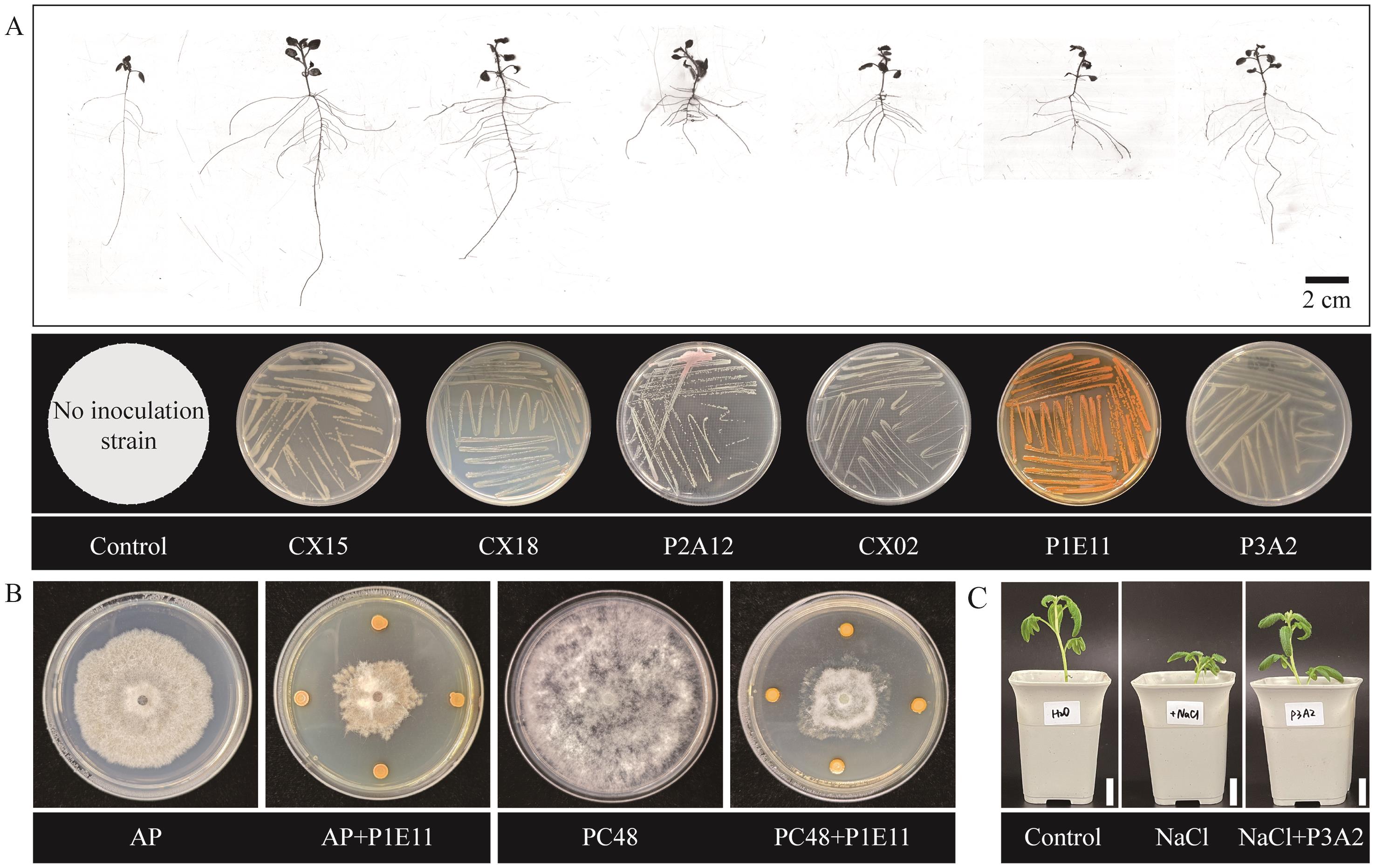
图1 供试单菌株的菌落形态、促生效能及抗病耐盐潜力验证A:1/2 TSA培养基上各单菌株的菌落形态及接种马铃薯实生种子3周后的幼苗表型;B:Pc.P1E11与致病菌(AP;PC48)的平板对峙实验结果;C:在200 mmol/L NaCl条件下,Ps.sp.P3A2对马铃薯幼苗生长的表型验证
Fig. 1 Colony morphology, growth-promoting effects, and validation of the disease-suppressive and salt-tolerant potential of the tested strainsA: Colony morphologies of individual strains on 1/2 TSA medium and phenotypes of potato seedlings at three weeks post-inoculation. B: Results of the dual-culture assay between strain Pc.P1E11 and the pathogen (AP; PC48). C: Phenotypic validation of the effect of strain Ps.sp.P3A2 on potato seedling growth under 200 mmol/L NaCl stress
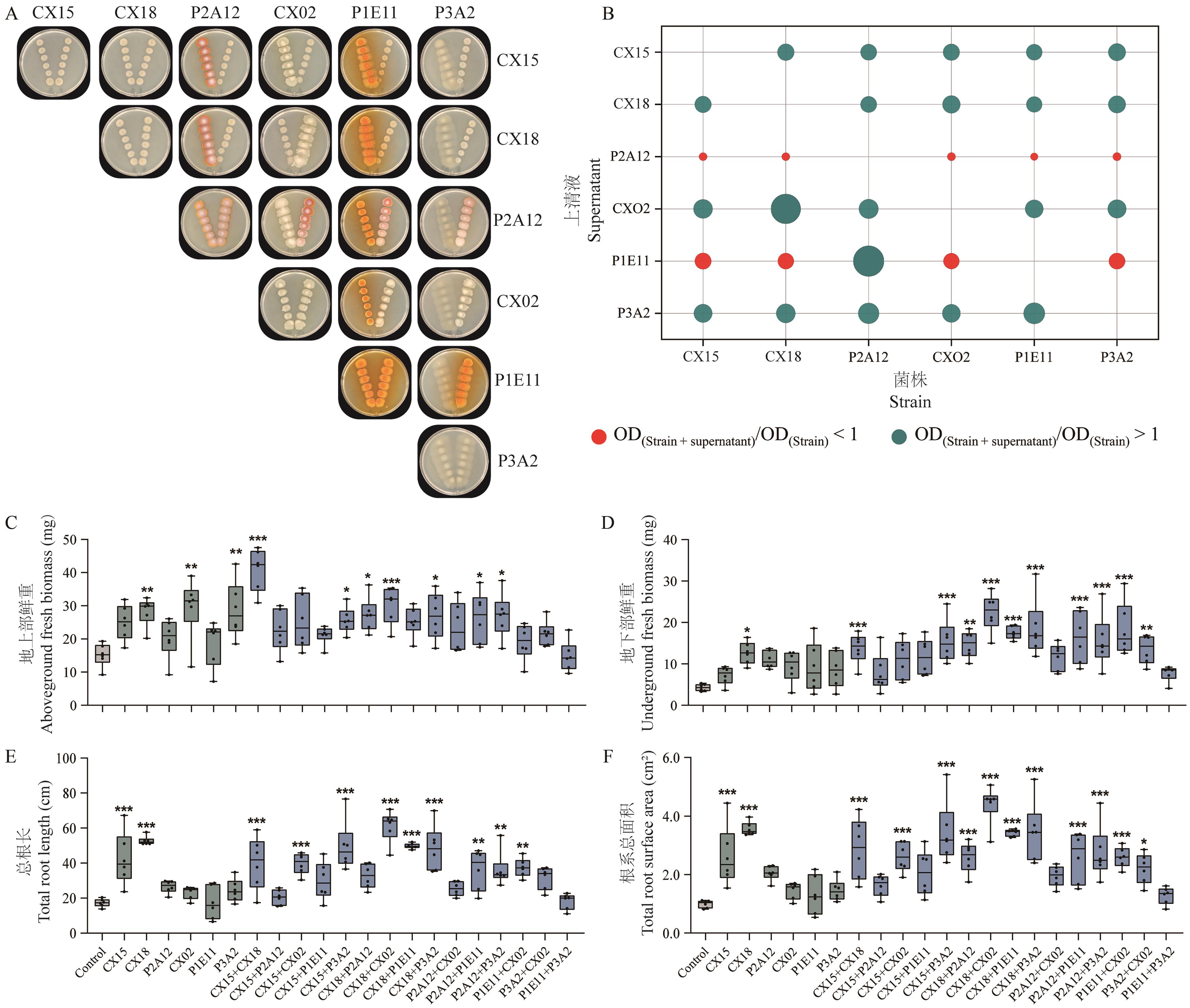
图2 不同菌株间相互作用评估及菌株组合对二倍体马铃薯促生效应的验证A:1/2 TSA 培养基上两两菌株对峙实验结果;B:上清液处理下各菌株的生长情况,圆圈表示比值 (OD600_菌株+上清液 / OD600_菌株);C-F:不同处理对马铃薯幼苗地上部鲜重、地下部鲜重、总根长和根系总面积的影响(n=6),箱线图误差线为标准差。未标注者表示差异不显著(ns),显著性分析采用独立样本t检验,*P<0.05, **P<0.01, ***P<0.001。下同
Fig. 2 Evaluation of interactions among different strains and verification of the growth-promoting effects of strain combinations on diploid potatoA: Results of pairwise confrontation assays of strains on 1/2 TSA medium. B: Growth performance of each strain under supernatant treatment, where circles indicate the ratio (OD₆₀₀_strain + supernatant/OD₆₀₀_strain). C-F: Effects of different treatments on the aboveground fresh weight, underground fresh weight, total root length, and total root area of potato seedlings (n=6). Error bars in box plots indicate standard deviation. ns denotes no significant difference (independent-sample t-test, *P<0.05, **P<0.01, ***P<0.001), the same below
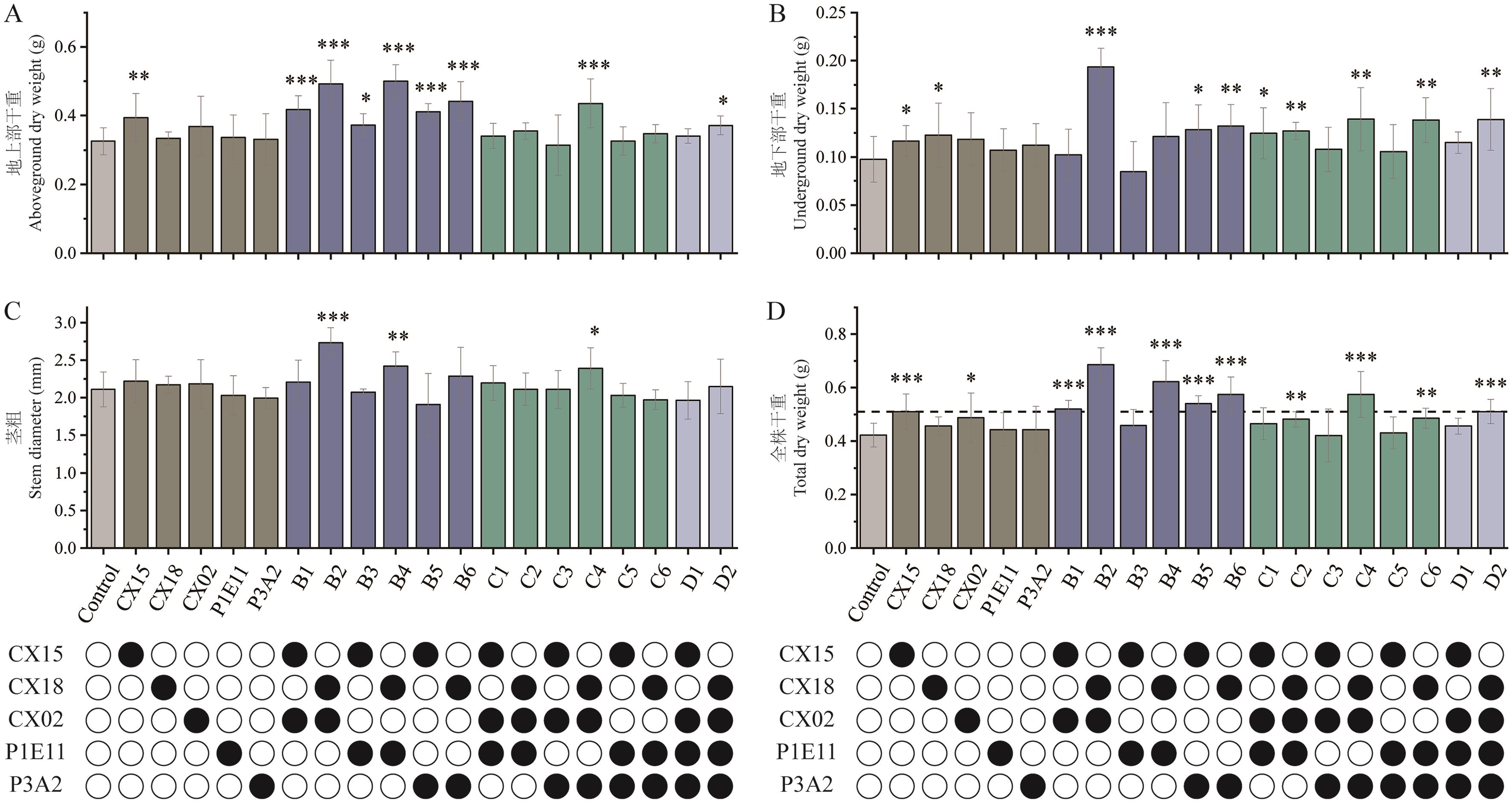
图3 不同菌株组合对马铃薯幼苗生长指标的影响A-D:分别为地上部干重、地下部干重、茎粗、全株干重;柱状图中误差线为标准差(n=4)。图例为各组合中菌株的存在情况(实心圆点表示存在)
Fig. 3 Effects of different strain combinations on growth indicators of potato seedlingsA-D: Aboveground dry weight, underground dry weight, stem diameter, and total plant dry weight, respectively. Error bars in the bar charts indicate the standard deviation (n=4). The legend indicates the presence of strains in each combination (solid dots indicate presence)
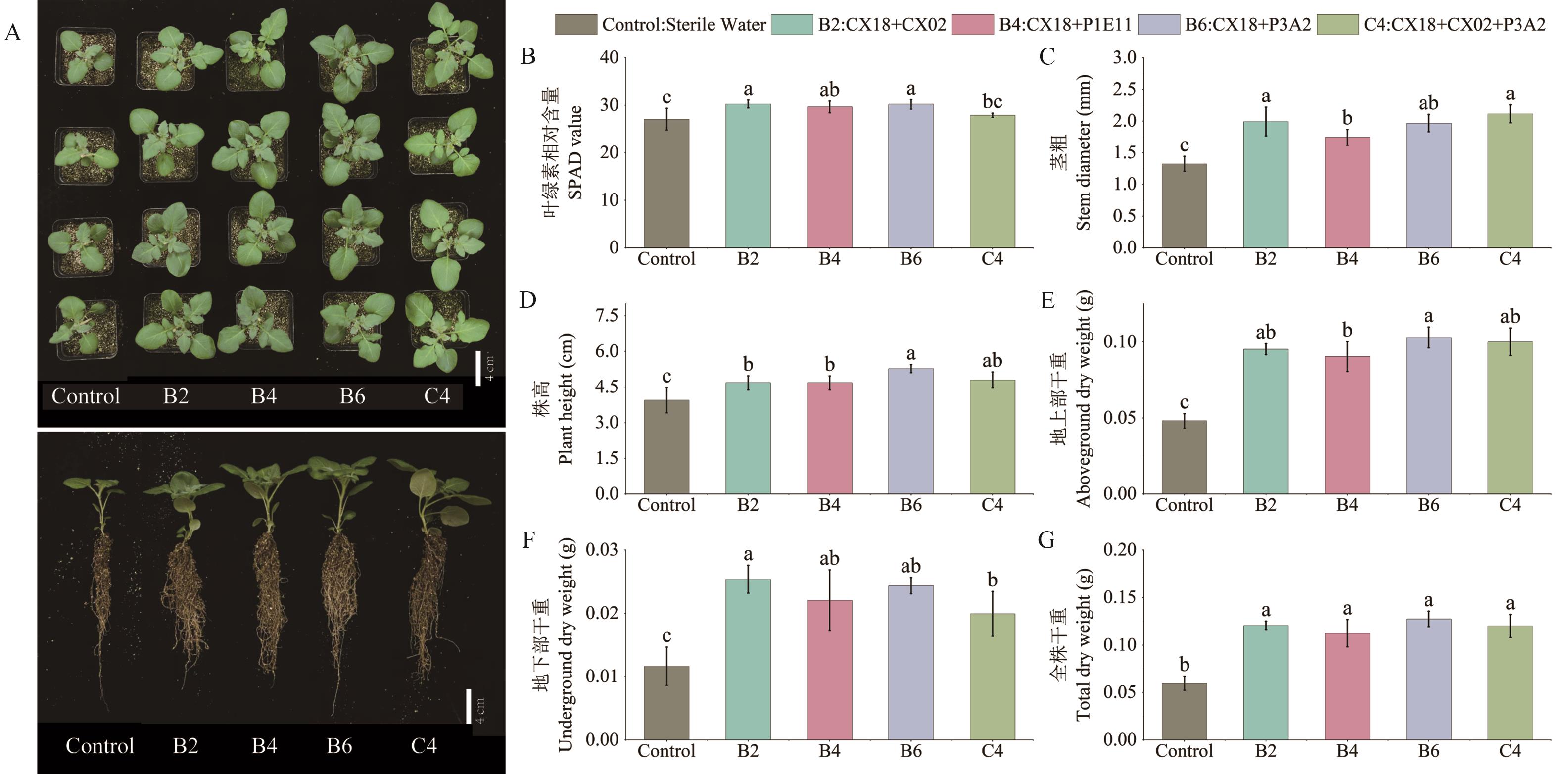
图4 复合菌群在自然土壤条件下的促生效果评估A:植株生长表型;B-G:叶绿素相对含量、茎粗、株高、地上部干重、地下部干重、全株干重的测定结果(n=4),不同处理组间的差异采用单因素方差分析检验,不同小写字母表示差异显著(P<0.05)
Fig. 4 Evaluation of growth-promoting effects of microbial consortia under natural soil conditionsA: Plant growth phenotypes. B-G: Relative chlorophyll content, stem diameter, plant height, aboveground dry weight, underground dry weight, and total plant dry weight (n=4). Differences among different treatment groups were tested using one-way analysis of variance. Different lowercase letters indicate significant differences (P<0.05)
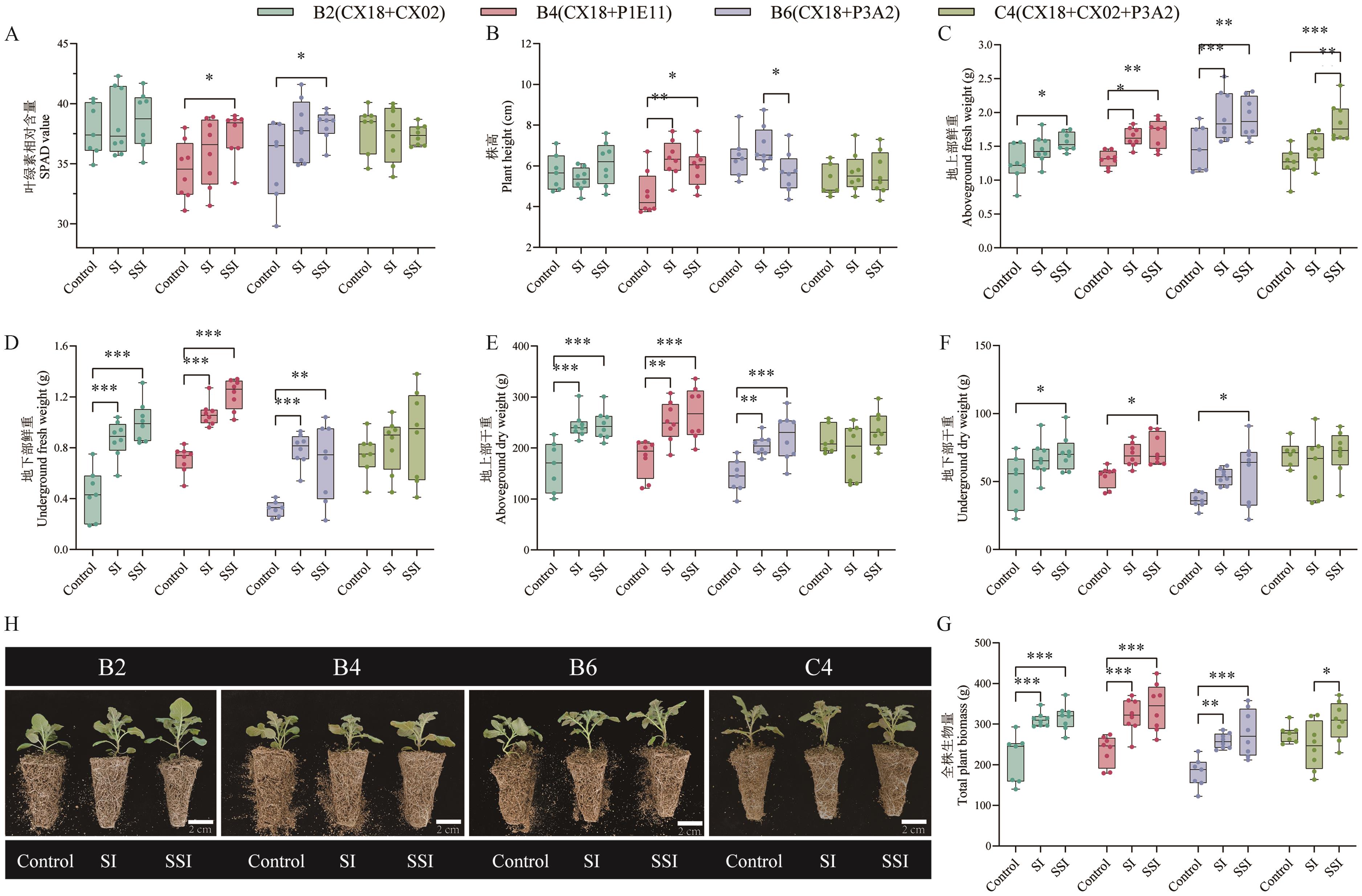
图5 不同接种方式下复合菌群对马铃薯实生苗生长的影响A:叶绿素相对含量;B:株高;C:地上部鲜重;D:地下部鲜重;E:地上部干重;F:地下部干重;G:总生物量;H:不同处理下幼苗的形态表现。SI表示基质接种处理,SSI表示基质接种联合幼苗接种处理。图中使用不同颜色来区分B2、B4、B6、C4四个复合菌群处理组(n=8)
Fig. 5 Effects of different inoculation methods on the growth-promoting efficacy of microbial consortia on potato seedlingsA: Relative chlorophyll content. B: Plant height. C: Aboveground fresh weight. D: Underground fresh weight. E: Aboveground dry weight. F: Underground dry weight. G: Total biomass. H: Phenotypic performance of seedlings under different treatments. SI: Substrate inoculation treatment. SSI: Substrate inoculation combined with seedling inoculation treatment. Different colors in the figure are used to distinguish the four microbial consortia treatment groups (B2, B4, B6, and C4) (n=8)
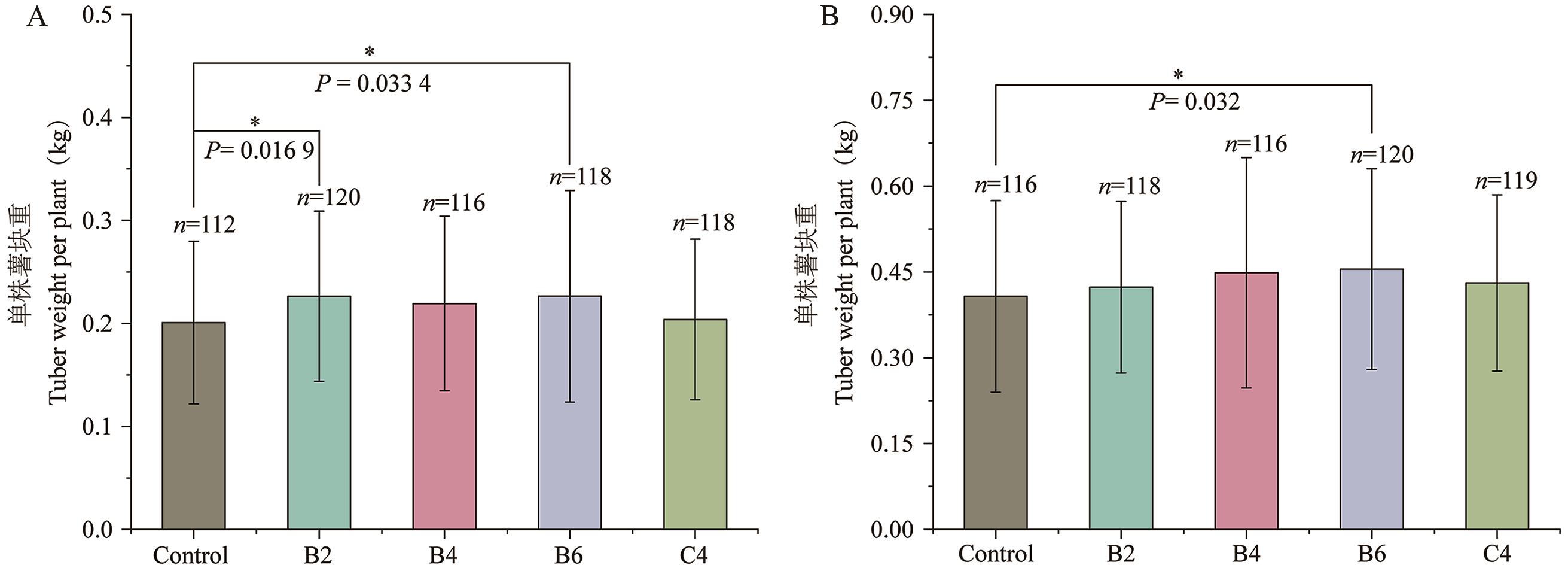
图6 复合菌群对马铃薯田间单株薯块重量的影响A:二倍体马铃薯(YS3品系)单株薯块重量;B:四倍体马铃薯(费乌瑞它)单株薯块重量
Fig. 6 Effect of microbial consortia on tuber weight per plant of potato under field conditionsA: Tuber weight per plant of diploid potato (YS3 line). B: Tuber weight per plant of tetraploid potato (Favorita)
| [1] | Philippot L, Chenu C, Kappler A, et al. The interplay between microbial communities and soil properties [J]. Nat Rev Microbiol, 2024, 22(4): 226-239. |
| [2] | Kapoor D, Sharma P, Sharma MMM, et al. Exploring soil microbiota and their role in plant growth, stress tolerance, disease control and nutrient immobilizer [J]. Biocatal Agric Biotechnol, 2024, 61: 103358. |
| [3] | Wei XP, Xie BK, Wan C, et al. Enhancing soil health and plant growth through microbial fertilizers: mechanisms, benefits, and sustainable agricultural practices [J]. Agronomy, 2024, 14(3): 609. |
| [4] | Yu J, Goodarzi H, Shokat K. Microbes: next-generation fertilizers [J]. Nat Biotechnol, 2024, 42: 1164. |
| [5] | Jansson JK, McClure R, Egbert RG. Soil microbiome engineering for sustainability in a changing environment [J]. Nat Biotechnol, 2023, 41(12): 1716-1728. |
| [6] | 马莹, 曹梦圆, 石孝均, 等. 植物促生菌的功能及在可持续农业中的应用 [J]. 土壤学报, 2023, 60(6): 1555-1568. |
| Ma Y, Cao MY, Shi XJ, et al. Functions of plant growth-promoting bacteria and their application in sustainable agriculture [J]. Acta Pedol Sin, 2023, 60(6): 1555-1568. | |
| [7] | Xu XM, Dinesen C, Pioppi A, et al. Composing a microbial symphony: synthetic communities for promoting plant growth [J]. Trends Microbiol, 2025, 33(7): 738-751. |
| [8] | Zhou YY, Yang Z, Liu JG, et al. Crop rotation and native microbiome inoculation restore soil capacity to suppress a root disease [J]. Nat Commun, 2023, 14: 8126. |
| [9] | Qiu W, Kang J, Ye ZM, et al. Arbuscular mycorrhizal fungi build a bridge for soybeans to recruit Pseudomonas putida [J]. New Phytol, 2025, 246(3): 1276-1292. |
| [10] | Zhong Y, Xun WB, Wang XH, et al. Root-secreted bitter triterpene modulates the rhizosphere microbiota to improve plant fitness [J]. Nat Plants, 2022, 8(8): 887-896. |
| [11] | Liu Y, Jia BL, Ren Y, et al. Bacterial social interactions in synthetic Bacillus consortia enhance plant growth [J]. iMeta, 2025, 4(4): e70053. |
| [12] | Zhou SP, Ke X, Jin LQ, et al. Sustainable management and valorization of biomass wastes using synthetic microbial consortia [J]. Bioresour Technol, 2024, 395: 130391. |
| [13] | Roell GW, Zha J, Carr RR, et al. Engineering microbial consortia by division of labor [J]. Microb Cell Fact, 2019, 18: 35. |
| [14] | Du JF, Li Y, Ur-Rehman S, et al. Synergistically promoting plant health by harnessing synthetic microbial communities and prebiotics [J]. iScience, 2021, 24(8): 102918. |
| [15] | Coyte KZ, Schluter J, Foster KR. The ecology of the microbiome: Networks, competition, and stability [J]. Science, 2015, 350(6261): 663-666. |
| [16] | Zvinavashe AT, Lim E, Sun H, et al. A bioinspired approach to engineer seed microenvironment to boost germination and mitigate soil salinity [J]. Proc Natl Acad Sci U S A, 2019, 116(51): 25555-25561. |
| [17] | Poppeliers SW, Sánchez-Gil JJ, de Jonge R. Microbes to support plant health: understanding bioinoculant success in complex conditions [J]. Curr Opin Microbiol, 2023, 73: 102286. |
| [18] | Jin RT, Song J, Liu C, et al. Synthetic microbial communities: Novel strategies to enhance the quality of traditional fermented foods [J]. Comp Rev Food Sci Food Safe, 2024, 23(4): e13388. |
| [19] | Jiang YJ, Wu RF, Zhang WM, et al. Construction of stable microbial consortia for effective biochemical synthesis [J]. Trends Biotechnol, 2023, 41(11): 1430-1441. |
| [20] | Ragland CJ, Shih KY, Dinneny JR. Choreographing root architecture and rhizosphere interactions through synthetic biology [J]. Nat Commun, 2024, 15: 1370. |
| [21] | Schmitz L, Yan ZC, Schneijderberg M, et al. Synthetic bacterial community derived from a desert rhizosphere confers salt stress resilience to tomato in the presence of a soil microbiome [J]. ISME J, 2022, 16(8): 1907-1920. |
| [22] | Yang XX, Yuan RW, Yang SY, et al. A salt-tolerant growth-promoting phyllosphere microbial combination from mangrove plants and its mechanism for promoting salt tolerance in rice [J]. Microbiome, 2024, 12: 270. |
| [23] | Li DP, Qi ZH, Guo JY, et al. Study on the screening of high-efficiency salt and alkali-tolerant microbial agents and their roles and mechanisms in enhancing saline-alkaline soil remediation [J]. J Clean Prod, 2025, 519: 145992. |
| [24] | Kaur S, Egidi E, Qiu ZG, et al. Synthetic community improves crop performance and alters rhizosphere microbial communities [J]. J Sust Agri & Env, 2022, 1(2): 118-131. |
| [25] | Rojas Padilla J, Chaparro Encinas LA, Robles Montoya RI, et al. Promoción de crecimiento en trigo (Triticum turgidum L. subsp. durum) por la co-inoculación de cepas nativas de Bacillus aisladas del Valle del Yaqui, México [J]. N Sci, 2020, 12(24). |
| [26] | Santoyo G, Guzmán-Guzmán P, Parra-Cota FI, et al. Plant growth stimulation by microbial consortia [J]. Agronomy, 2021, 11(2): 219. |
| [27] | Xun WB, Ren Y, Yan H, et al. Sustained inhibition of maize seed-borne Fusarium using a Bacillus-dominated rhizospheric stable core microbiota with unique cooperative patterns [J]. Adv Sci, 2023, 10(5): 2205215. |
| [28] | Chai YN, Ge YF, Stoerger V, et al. High-resolution phenotyping of sorghum genotypic and phenotypic responses to low nitrogen and synthetic microbial communities [J]. Plant Cell Environ, 2021, 44(5): 1611-1626. |
| [29] | Yang N, Nesme J, Røder HL, et al. Emergent bacterial community properties induce enhanced drought tolerance in Arabidopsis [J]. NPJ Biofilms Microbiomes, 2021, 7: 82. |
| [30] | Wang ZH, Wang S, He Q, et al. Ecological design of high-performance synthetic microbial communities: from theoretical foundations to functional optimization [J]. ISME Commun, 2025, 5(1): ycaf133. |
| [31] | Ruan ZP, Chen K, Cao WM, et al. Engineering natural microbiomes toward enhanced bioremediation by microbiome modeling [J]. Nat Commun, 2024, 15: 4694. |
| [32] | Jing JY, Garbeva P, Raaijmakers JM, et al. Strategies for tailoring functional microbial synthetic communities [J]. ISME J, 2024, 18(1): wrae049. |
| [33] | Shayanthan A, Ordoñez PAC, Oresnik IJ. The role of synthetic microbial communities (SynCom) in sustainable agriculture [J]. Front Agron, 2022, 4: 896307. |
| [34] | Wei Z, Huang JF, Tan SY, et al. The congeneric strain Ralstonia pickettii QL-A6 of Ralstonia solanacearum as an effective biocontrol agent for bacterial wilt of tomato [J]. Biol Control, 2013, 65(2): 278-285. |
| [35] | Jiang HJ, Zhang XY, Ma CY, et al. Endophytic colonization of Phomopsis liquidambaris recruits rhizospheric Ralstonia by inducing acetic acid secretion to facilitate phosphorus uptake by Arachis hypogaea L. in continuously cropped soil [J]. Plant Soil, 2025, 508(1/2): 255-274. |
| [36] | Kumar V, Kumari A, Pandey M, et al. Molecular mechanism of radio-resistance and heavy metal tolerance adaptation in microbes [M]//Microbial Extremozymes. Amsterdam: Elsevier 2022: 275-293. |
| [37] | Kailasan N S, Vamanrao V B. Isolation and characterization of ralstonia pickettii-a novel phosphate solubilizing bacterium from pomegranate rhizosphere from western india [J]. Int J Life Sci Biotechnol Pharma Res, 2015, 4(1): 1. |
| [38] | 李婧璇, 薛娇, 王世梅, 等. 生物有机肥与茎部注射有益菌联合高效防控番茄土传青枯病 [J]. 土壤, 2024, 56(3): 480-487. |
| Li JX, Xue J, Wang SM, et al. Combination of bio-organic fertilizer and stem injection of beneficial bacteria effectively control soil-borne bacterial wilt of tomato [J]. Soils, 2024, 56(3): 480-487. | |
| [39] | Monteux S, Keuper F, Fontaine S, et al. Carbon and nitrogen cycling in Yedoma permafrost controlled by microbial functional limitations [J]. Nat Geosci, 2020, 13(12): 794-798. |
| [40] | Wang W, Xia YW, Zhang PP, et al. Narrow-spectrum resource-utilizing bacteria drive the stability of synthetic communities through enhancing metabolic interactions [J]. Nat Commun, 2025, 16: 6088. |
| [41] | Gonçalves OS, Creevey CJ, Santana MF. Designing a synthetic microbial community through genome metabolic modeling to enhance plant-microbe interaction [J]. Environ Microbiome, 2023, 18: 81. |
| [42] | Sibanyoni NR, Piater LA, Kerchev P, et al. Metabolomic insights into cross-feeding interactions between priestia megaterium PM and Pseudomonas fluorescens NO4: unveiling microbial communication in plant growth-promoting rhizobacteria [J]. Microb Ecol, 2025, 88: 76. |
| [43] | Wang DY, Hunt KA, Candry P, et al. Cross-feedings, competition, and positive and negative synergies in a four-species synthetic community for anaerobic degradation of cellulose to methane [J]. mBio, 2023, 14(2): e03189-e03122. |
| [44] | Li Q, Li HC, Yang Z, et al. Plant growth-promoting rhizobacterium Pseudomonas sp. CM11 specifically induces lateral roots [J]. New Phytol, 2022, 235(4): 1575-1588. |
| [45] | Jiang XL, Shen TL, Han ML, et al. Aluminum-tolerant, growth-promoting rhizosphere bacteria improve growth and alleviate aluminum stress in tea plants [J]. Hortic Plant J, 2025. |
| [46] | Wu JD, Liu SJ, Zhang HY, et al. Flavones enrich rhizosphere Pseudomonas to enhance nitrogen utilization and secondary root growth in Populus [J]. Nat Commun, 2025, 16: 1461. |
| [47] | Li YJ, Li RR, Liu R, et al. A simplified SynCom based on core-helper strain interactions enhances symbiotic nitrogen fixation in soybean [J]. J Integr Plant Biol, 2025, 67(6): 1582-1598. |
| [48] | Li L, Cheng KX, Du Y, et al. Rhizosphere microbes From Populus euphratica Conferred salt stress resistance to Populus alba × Populus glandulosa [J]. Plant Cell Environ, 2025, 48(12): 8743-8755. |
| [49] | Dong H, Wang YY, Di YC, et al. Plant growth-promoting rhizobacteria Pseudomonas aeruginosa HG28-5 improves salt tolerance by regulating Na+/K+ homeostasis and ABA signaling pathway in tomato [J]. Microbiol Res, 2024, 283: 127707. |
| [50] | 邵嘉朱, 吕雯, 廖鑫琳, 等. 大豆根际促生菌的分离、鉴定及其耐盐促生作用 [J]. 中国农业科学, 2024, 57(21): 4248-4263. |
| Shao JZ, Lü W, Liao XL, et al. Isolation and identification of soybean rhizosphere growth-promoting bacteria and their salt tolerance and growth-promoting effects [J]. Sci Agric Sin, 2024, 57(21): 4248-4263. | |
| [51] | Zhou YY, Liu DH, Li FQ, et al. Superiority of native soil core microbiomes in supporting plant growth [J]. Nat Commun, 2024, 15: 6599. |
| [52] | Hong S, Yuan XF, Yang JM, et al. Selection of rhizosphere communities of diverse rotation crops reveals unique core microbiome associated with reduced banana Fusarium wilt disease [J]. New Phytol, 2023, 238(5): 2194-2209. |
| [53] | Zheng YF, Cao XW, Zhou YN, et al. Purines enrich root-associated Pseudomonas and improve wild soybean growth under salt stress [J]. Nat Commun, 2024, 15: 3520. |
| [54] | Qian JJ, Akçay E. The balance of interaction types determines the assembly and stability of ecological communities [J]. Nat Ecol Evol, 2020, 4(3): 356-365. |
| [1] | 彭善麟, 廖卓诚, 王涛, 刘志宇, 刘海忆, 王婷婷, 杨琴, 王哲, 邰欢欢. 不同玉米茎腐病抗性品种根际微生物群落多样性及功能差异[J]. 生物技术通报, 2026, 42(5): 76-88. |
| [2] | 张理, 李凯旋, 马志远, 姜美彤, 张佳宝, 梁玉婷. 合成微生物组在农田土壤健康调控中的研究进展[J]. 生物技术通报, 2026, 42(5): 16-26. |
| [3] | 何莛莛, 李玲娟. 合成微生物群落增强植物抗旱性的研究进展[J]. 生物技术通报, 2026, 42(5): 51-62. |
| [4] | 孙卓, 雷梦苑, 林红梅, 吕泽良, 韩忠明, 杨利民. 根际微生物组防控药用植物病害研究进展[J]. 生物技术通报, 2026, 42(5): 37-50. |
| [5] | 陈静欢, 房国楠, 朱文豪, 叶广继, 苏旺, 贺苗苗, 杨生龙, 周云. 马铃薯种质资源淀粉表征及相关基因表达分析[J]. 生物技术通报, 2026, 42(1): 170-183. |
| [6] | 巩慧玲, 邢玉洁, 马俊贤, 蔡霞, 冯再平. 马铃薯LAC基因家族的鉴定及盐胁迫下表达分析[J]. 生物技术通报, 2025, 41(9): 82-93. |
| [7] | 卢瑶, 袁平平, 金鑫, 毛向红, 范向斌, 白小东. 基于SSR标记的马铃薯野生种和地方种遗传多样性分析和指纹图谱构建[J]. 生物技术通报, 2025, 41(9): 94-104. |
| [8] | 黄丹丹, 吴云翼, 邹建华, 俞婷, 朱炎辉, 杨梅宏, 董文丽, 高冬丽. 马铃薯StPTST2a基因的克隆及互作分析[J]. 生物技术通报, 2025, 41(7): 172-180. |
| [9] | 李霞, 张泽伟, 刘泽军, 王楠, 郭江波, 辛翠花, 张彤, 简磊. 马铃薯转录因子StMYB96的克隆及功能研究[J]. 生物技术通报, 2025, 41(7): 181-192. |
| [10] | 罗稷林, 栗锦烨, 贾玉鑫. 马铃薯中重力响应调节基因鉴定及功能分析[J]. 生物技术通报, 2025, 41(6): 109-118. |
| [11] | 许慧珍, SHANTWANA Ghimire, RAJU Kharel, 岳云, 司怀军, 唐勋. 马铃薯SUMO E3连接酶基因家族分析及StSIZ1基因的克隆与表达模式分析[J]. 生物技术通报, 2025, 41(6): 119-129. |
| [12] | 段永红, 杨欣, 于冠群, 夏俊俊, 宋陆帅, 白小东, 彭锁堂. 125份马铃薯种质资源遗传多样性及主成分分析[J]. 生物技术通报, 2025, 41(6): 130-143. |
| [13] | 陈才锭, 宋云洁, 田梦青. 四大主粮作物不同生育期根际微生物菌群变化研究进展[J]. 生物技术通报, 2025, 41(6): 49-60. |
| [14] | 宋慧洋, 苏宝杰, 李京昊, 梅超, 宋倩娜, 崔福柱, 冯瑞云. 马铃薯StAS2-15基因的克隆及盐胁迫下功能分析[J]. 生物技术通报, 2025, 41(5): 119-128. |
| [15] | 叶柳健, 蒙健宗, 覃福方, 何双, 朱绮霞, 王小虎, 韦圣博, 周礼芹. 古茶树林菌株D2的鉴定、酶学特性及基因组学分析[J]. 生物技术通报, 2025, 41(5): 267-279. |
| 阅读次数 | ||||||
|
全文 |
|
|||||
|
摘要 |
|
|||||
