







生物技术通报 ›› 2026, Vol. 42 ›› Issue (2): 3-16.doi: 10.13560/j.cnki.biotech.bull.1985.2025-1100
• 厌氧微生物专题(专题主编:承磊 研究员) • 上一篇 下一篇
赵雨婷( ), 喻航()
收稿日期:2025-10-16
出版日期:2026-02-26
发布日期:2026-03-17
通讯作者:
喻航,男,博士,研究员,研究方向 :环境微生物;E-mail: yuhanghank@pku.edu.cn作者简介:赵雨婷,女,博士研究生,研究方向 :厌氧甲烷氧化微生物;E-mail: ytzhao@stu.pku.edu.cn
基金资助:
ZHAO Yu-ting(), YU Hang()
Received:2025-10-16
Published:2026-02-26
Online:2026-03-17
摘要:
厌氧甲烷氧化(AOM)是全球碳循环中的关键过程,对遏制甲烷排放和缓解气候变化具有重要作用。该过程一类主要执行者为厌氧甲烷氧化古菌(ANME),它直接或与细菌协同,将AOM与不同还原电位的最终电子受体,如硫酸盐、腐殖质、金属氧化物以及硝酸盐等耦合反应。其中,AOM与硫酸盐还原耦合反应的吉布斯自由能变化极低(ΔG°' = -17 kJ/mol),且所获得的能量需要与其共生硫酸盐还原细菌(SRB)进行有效分配,因此ANME与SRB之间的高效能量转移机制自1999年ANME发现以来一直是研究核心。本文综述了AOM及其关键微生物的研究历程,重点探讨了ANME与SRB之间的3种共生模式假说(可扩散化学中间体、零价硫、直接种间电子传输),并总结了通过环境观测或富集培养发现的ANME及其共生或伴生伙伴的系统发育多样性与潜在互作方式。这些研究不仅加深了对AOM这一关键生物地球化学过程的认识,也为全面揭示其种间互作机制并拓展其应用潜力提供了参考。
赵雨婷, 喻航. 厌氧甲烷氧化古菌共生机制的研究进展[J]. 生物技术通报, 2026, 42(2): 3-16.
ZHAO Yu-ting, YU Hang. Advances in the Symbiotic Mechanisms of Anaerobic Methanotrophic Archaea[J]. Biotechnology Bulletin, 2026, 42(2): 3-16.
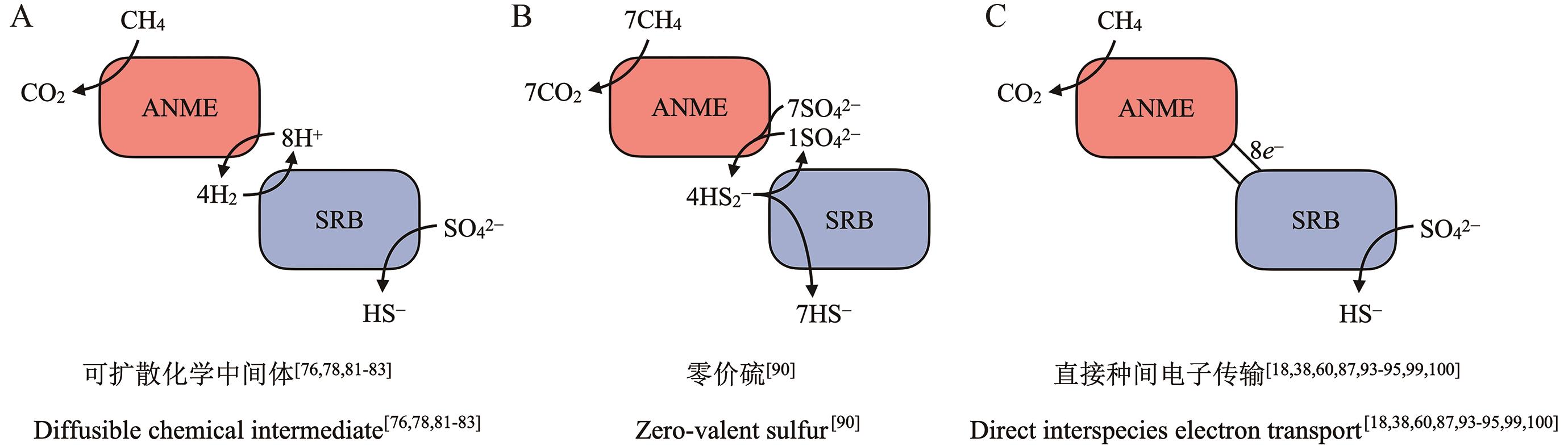
图1 ANME与SRB共生模式
Fig. 1 Symbiotic mechanisms between ANME and SRB
厌氧甲烷氧化古菌 Anaerobic methanotrophic archaea (ANME) | 共生/伴生微生物 Symbiotic/Associated microorganism | 电子受体/代谢特征 Electron acceptor/Metabolic characteristics | 参考文献 Reference |
|---|---|---|---|
| ANME-1 (Candidatus Methanophagaceae) | Desulfobacteraceae (Desulfosarcina/Desulfococcus) (DSS) | SO42- | [ |
| SEEP-SRB1 (ETH-SRB1) | Fe(Ⅲ)、Mn(Ⅳ)/潜在金属还原 | [ | |
| SEEP-SRB1a (Candidatus Syntrophophila) | SO42- | [ | |
| SEEP-SRB2 (Candidatus Desulfomithrium) | SO42- | [ | |
| Candidatus Desulfofervidus | SO42- | [ | |
| Candidatus Desulfaltia | SO42- | [ | |
| ANME-1 (Guaymas cluster) | HotSeep-1 (Candidatus Desulfofervidus auxilia) | SO42- | [ |
| ANME-1a (Candidatus Methanophagaceae) | HotSeep-1 (Candidatus Desulfofervidus auxilia) | SO42- | [ |
| SEEP-SRB2 (Candidatus Desulfomithrium) | SO42- | [ | |
| Verrucomicrobia | 可能利用细胞分泌的有机渗出物或胞外聚合物 | [ | |
| ANME-1b (Candidatus Methanophagaceae) | SEEP-SRB2 (Candidatus Desulfomithrium) | SO42- | [ |
| ANME-2 (Unknown subgroup) | Desulfobacteraceae (Desulfosarcina/Desulfococcus) (DSS) | SO42- | [ |
| Desulfobulbaceae (DSB) | SO42- | [ | |
| SEEP-SRB1a (Candidatus Syntrophophila) | SO42- | [ | |
| SEEP-SRB2 (Candidatus Desulfomithrium) | SO42- | [ | |
| Candidate division JS-1 (Atribacterota) | 可能受益于AOM过程或相关代谢物 | [ | |
| ANME-2a (Candidatus Methanocomedens) | Desulfobacteraceae (Desulfosarcina/Desulfococcus) (DSS) | SO42- | [ |
| SEEP-SRB1 | SO42- | [ | |
| SEEP-SRB1a (Candidatus Syntrophophila) | SO42- | [ | |
| Methanococcoides,Anaerolineales | 可能依赖体系内有机物降解获取能量 | [ | |
| ANME-2b (Candidatus Methanomarinus) | SEEP-SRB1a (Candidatus Syntrophophila) | SO42- | [ |
| SEEP-SRB1g (Candidatus Desulfomellonium) | SO42- | [ | |
| ANME-2c (Candidatus Methanogasteraceae) | Desulfobacteraceae (Desulfosarcina/Desulfococcus) (DSS) | SO42- | [ |
| SEEP-SRB1 (ETH-SRB1) | Fe(Ⅲ)、Mn(Ⅳ)/潜在金属还原 | [ | |
| SEEP-SRB1a (Candidatus Syntrophophila) | SO42- | [ | |
| SEEP-SRB2 (Candidatus Desulfomithrium) | SO42- | [ | |
| Desulfobulbaceae (seepDBB/unknown subgroup) | SO42- | [ | |
| Betaproteobacteria | 可能提供了新的氮代谢途径 | [ | |
| ANME-2c or ANME-2b | non-SEEP-SRB1a Deltaproteobacteria | SO42- | [ |
| ANME-2d (Candidatus Methanoperedens) | Geobacteraceae | 生物阳极、生物炭、腐殖质/介导电子传递 | [ |
| ANME-2d (Candidatus Methanoperedens nitroreducens) | Candidatus Methylomirabilis oxyfera Candidatus Kuenenia stuttgartiensis | NO3-/能够将亚硝酸盐还原为氮气 | [ [ |
| ANME-3 (Candidatus Methanovorans) | Desulfobulbus (DBB) | SO42- | [ |
| SEEP-SRB1a (Candidatus Syntrophophila) | SO42- | [ |
表1 厌氧甲烷氧化古菌与其共生/伴生微生物类型
Table 1 Types of anaerobic methanotrophic archaea and their symbiotic/associated microorganism
厌氧甲烷氧化古菌 Anaerobic methanotrophic archaea (ANME) | 共生/伴生微生物 Symbiotic/Associated microorganism | 电子受体/代谢特征 Electron acceptor/Metabolic characteristics | 参考文献 Reference |
|---|---|---|---|
| ANME-1 (Candidatus Methanophagaceae) | Desulfobacteraceae (Desulfosarcina/Desulfococcus) (DSS) | SO42- | [ |
| SEEP-SRB1 (ETH-SRB1) | Fe(Ⅲ)、Mn(Ⅳ)/潜在金属还原 | [ | |
| SEEP-SRB1a (Candidatus Syntrophophila) | SO42- | [ | |
| SEEP-SRB2 (Candidatus Desulfomithrium) | SO42- | [ | |
| Candidatus Desulfofervidus | SO42- | [ | |
| Candidatus Desulfaltia | SO42- | [ | |
| ANME-1 (Guaymas cluster) | HotSeep-1 (Candidatus Desulfofervidus auxilia) | SO42- | [ |
| ANME-1a (Candidatus Methanophagaceae) | HotSeep-1 (Candidatus Desulfofervidus auxilia) | SO42- | [ |
| SEEP-SRB2 (Candidatus Desulfomithrium) | SO42- | [ | |
| Verrucomicrobia | 可能利用细胞分泌的有机渗出物或胞外聚合物 | [ | |
| ANME-1b (Candidatus Methanophagaceae) | SEEP-SRB2 (Candidatus Desulfomithrium) | SO42- | [ |
| ANME-2 (Unknown subgroup) | Desulfobacteraceae (Desulfosarcina/Desulfococcus) (DSS) | SO42- | [ |
| Desulfobulbaceae (DSB) | SO42- | [ | |
| SEEP-SRB1a (Candidatus Syntrophophila) | SO42- | [ | |
| SEEP-SRB2 (Candidatus Desulfomithrium) | SO42- | [ | |
| Candidate division JS-1 (Atribacterota) | 可能受益于AOM过程或相关代谢物 | [ | |
| ANME-2a (Candidatus Methanocomedens) | Desulfobacteraceae (Desulfosarcina/Desulfococcus) (DSS) | SO42- | [ |
| SEEP-SRB1 | SO42- | [ | |
| SEEP-SRB1a (Candidatus Syntrophophila) | SO42- | [ | |
| Methanococcoides,Anaerolineales | 可能依赖体系内有机物降解获取能量 | [ | |
| ANME-2b (Candidatus Methanomarinus) | SEEP-SRB1a (Candidatus Syntrophophila) | SO42- | [ |
| SEEP-SRB1g (Candidatus Desulfomellonium) | SO42- | [ | |
| ANME-2c (Candidatus Methanogasteraceae) | Desulfobacteraceae (Desulfosarcina/Desulfococcus) (DSS) | SO42- | [ |
| SEEP-SRB1 (ETH-SRB1) | Fe(Ⅲ)、Mn(Ⅳ)/潜在金属还原 | [ | |
| SEEP-SRB1a (Candidatus Syntrophophila) | SO42- | [ | |
| SEEP-SRB2 (Candidatus Desulfomithrium) | SO42- | [ | |
| Desulfobulbaceae (seepDBB/unknown subgroup) | SO42- | [ | |
| Betaproteobacteria | 可能提供了新的氮代谢途径 | [ | |
| ANME-2c or ANME-2b | non-SEEP-SRB1a Deltaproteobacteria | SO42- | [ |
| ANME-2d (Candidatus Methanoperedens) | Geobacteraceae | 生物阳极、生物炭、腐殖质/介导电子传递 | [ |
| ANME-2d (Candidatus Methanoperedens nitroreducens) | Candidatus Methylomirabilis oxyfera Candidatus Kuenenia stuttgartiensis | NO3-/能够将亚硝酸盐还原为氮气 | [ [ |
| ANME-3 (Candidatus Methanovorans) | Desulfobulbus (DBB) | SO42- | [ |
| SEEP-SRB1a (Candidatus Syntrophophila) | SO42- | [ |
| [1] | Pachauri R K, Mayer L, Intergovernmental Panel on Climate Change. Climate change 2014: synthesis report[M]. Geneva, Switzerland: Intergovernmental Panel on Climate Change, 2015. |
| [2] | Saunois M, Stavert AR, Poulter B, et al. The Global methane budget 2000-2017 [J]. Earth System Science Data, 2020, 12(3): 1561-1623. |
| [3] | Zhang XQ, Yuan ZG, Hu SH. Anaerobic oxidation of methane mediated by microbial extracellular respiration [J]. Environ Microbiol Rep, 2021, 13(6): 790-804. |
| [4] | Bhattarai S, Cassarini C, Lens PNL. Physiology and distribution of archaeal methanotrophs that couple anaerobic oxidation of methane with sulfate reduction [J]. Microbiol Mol Biol Rev, 2019, 83(3): e00074-18. |
| [5] | Knittel K, Boetius A. Anaerobic oxidation of methane: progress with an unknown process [J]. Annu Rev Microbiol, 2009, 63: 311-334. |
| [6] | Reeburgh WS. Oceanic methane biogeochemistry [J]. Chem Rev, 2007, 107(2): 486-513. |
| [7] | Lawton TJ, Rosenzweig AC. Biocatalysts for methane conversion: big progress on breaking a small substrate [J]. Curr Opin Chem Biol, 2016, 35: 142-149. |
| [8] | Kalyuzhnaya MG, Gomez OA, Murrell JC. The methane-oxidizing bacteria (methanotrophs) [M]//Taxonomy, Genomics and Ecophysiology of Hydrocarbon-Degrading Microbes. Cham: Springer International Publishing, 2018: 1-34. |
| [9] | Ettwig KF, Butler MK, Le Paslier D, et al. Nitrite-driven anaerobic methane oxidation by oxygenic bacteria [J]. Nature, 2010, 464(7288): 543-548. |
| [10] | Yao XW, Wang JQ, He MY, et al. Methane-dependent complete denitrification by a single Methylomirabilis bacterium [J]. Nat Microbiol, 2024, 9(2): 464-476. |
| [11] | Timmers PHA, Welte CU, Koehorst JJ, et al. Reverse methanogenesis and respiration in methanotrophic Archaea [J]. Archaea, 2017, 2017: 1654237. |
| [12] | Evans PN, Boyd JA, Leu AO, et al. An evolving view of methane metabolism in the Archaea [J]. Nat Rev Microbiol, 2019, 17(4): 219-232. |
| [13] | Boetius A, Ravenschlag K, Schubert CJ, et al. A marine microbial consortium apparently mediating anaerobic oxidation of methane [J]. Nature, 2000, 407(6804): 623-626. |
| [14] | Orphan VJ, House CH, Hinrichs KU, et al. Methane-consuming Archaea revealed by directly coupled isotopic and phylogenetic analysis [J]. Science, 2001, 293(5529): 484-487. |
| [15] | Raghoebarsing AA, Pol A, van de Pas-Schoonen KT, et al. A microbial consortium couples anaerobic methane oxidation to denitrification [J]. Nature, 2006, 440(7086): 918-921. |
| [16] | Beal EJ, House CH, Orphan VJ. Manganese- and iron-dependent marine methane oxidation [J]. Science, 2009, 325(5937): 184-187. |
| [17] | Haroon MF, Hu SH, Shi Y, et al. Anaerobic oxidation of methane coupled to nitrate reduction in a novel archaeal lineage [J]. Nature, 2013, 500(7464): 567-570. |
| [18] | Scheller S, Yu H, Chadwick GL, et al. Artificial electron acceptors decouple archaeal methane oxidation from sulfate reduction [J]. Science, 2016, 351(6274): 703-707. |
| [19] | Ettwig KF, Zhu BL, Speth D, et al. Archaea catalyze iron-dependent anaerobic oxidation of methane [J]. Proc Natl Acad Sci U S A, 2016, 113(45): 12792-12796. |
| [20] | Cai C, Leu AO, Xie GJ, et al. A methanotrophic archaeon couples anaerobic oxidation of methane to Fe(III) reduction [J]. ISME J, 2018, 12(8): 1929-1939. |
| [21] | Leu AO, Cai C, McIlroy SJ, et al. Anaerobic methane oxidation coupled to manganese reduction by members of the Methanoperedenaceae [J]. ISME J, 2020, 14(4): 1030-1041. |
| [22] | Xiao X, Luo M, Zhang CW, et al. Metal-driven anaerobic oxidation of methane as an important methane sink in methanic cold seep sediments [J]. Microbiol Spectr, 2023, 11(2): e05337-22. |
| [23] | Whiticar MJ. The biogeochemical methane cycle [M]//Hydrocarbons, Oils and Lipids: Diversity, Origin, Chemistry and Fate. Cham: Springer International Publishing, 2020: 669-746. |
| [24] | Valentine DL. Biogeochemistry and microbial ecology of methane oxidation in anoxic environments: a review [J]. Antonie Van Leeuwenhoek, 2002, 81(1): 271-282. |
| [25] | Hinrichs KU, Boetius A. The anaerobic oxidation of methane: new insights in microbial ecology and biogeochemistry [M]//Ocean Margin Systems. Berlin, Heidelberg: Springer, 2002: 457-477. |
| [26] | Conrad R. The global methane cycle: recent advances in understanding the microbial processes involved [J]. Environ Microbiol Rep, 2009, 1(5): 285-292. |
| [27] | Christopher S Martens RAB. Methane production in the interstitial waters of sulfate-depleted marine sediments [J]. Science, 1974, 185(4157): 1167-1169. |
| [28] | Valentine DL, Reeburgh WS. New perspectives on anaerobic methane oxidation [J]. Environ Microbiol, 2000, 2(5): 477-484. |
| [29] | Hinrichs KU, Hayes JM, Sylva SP, et al. Methane-consuming archaebacteria in marine sediments [J]. Nature, 1999, 398(6730): 802-805. |
| [30] | Hallam SJ, Putnam N, Preston CM, et al. Reverse methanogenesis: testing the hypothesis with environmental genomics [J]. Science, 2004, 305(5689): 1457-1462. |
| [31] | Scheller S, Goenrich M, Boecher R, et al. The key nickel enzyme of methanogenesis catalyses the anaerobic oxidation of methane [J]. Nature, 2010, 465(7298): 606-608. |
| [32] | Thauer RK. Anaerobic oxidation of methane with sulfate: on the reversibility of the reactions that are catalyzed by enzymes also involved in methanogenesis from CO2 [J]. Curr Opin Microbiol, 2011, 14(3): 292-299. |
| [33] | Nauhaus K, Albrecht M, Elvert M, et al. In vitro cell growth of marine archaeal-bacterial consortia during anaerobic oxidation of methane with sulfate [J]. Environ Microbiol, 2007, 9(1): 187-196. |
| [34] | Krüger M, Meyerdierks A, Glöckner FO, et al. A conspicuous nickel protein in microbial mats that oxidize methane anaerobically [J]. Nature, 2003, 426(6968): 878-881. |
| [35] | Girguis PR, Cozen AE, DeLong EF. Growth and population dynamics of anaerobic methane-oxidizing Archaea and sulfate-reducing bacteria in a continuous-flow bioreactor [J]. Appl Environ Microbiol, 2005, 71(7): 3725-3733. |
| [36] | Orphan VJ, Turk KA, Green AM, et al. Patterns of 15N assimilation and growth of methanotrophic ANME-2 Archaea and sulfate-reducing bacteria within structured syntrophic consortia revealed by FISH-SIMS [J]. Environ Microbiol, 2009, 11(7): 1777-1791. |
| [37] | Meulepas RJW, Jagersma CG, Khadem AF, et al. Effect of environmental conditions on sulfate reduction with methane as electron donor by an eckernförde bay enrichment [J]. Environ Sci Technol, 2009, 43(17): 6553-6559. |
| [38] | Wegener G, Krukenberg V, Riedel D, et al. Intercellular wiring enables electron transfer between methanotrophic Archaea and bacteria [J]. Nature, 2015, 526(7574): 587-590. |
| [39] | Wegener G, Krukenberg V, Ruff SE, et al. Metabolic capabilities of microorganisms involved in and associated with the anaerobic oxidation of methane [J]. Front Microbiol, 2016, 7: 46. |
| [40] | Yu H, Speth DR, Connon SA, et al. Community structure and microbial associations in sediment-free methanotrophic enrichment cultures from a marine methane seep [J]. Appl Environ Microbiol, 2022, 88(11): e02109-21. |
| [41] | Scheller S, Orphan VJ, Yu H. Methane oxidation methods and compositions: US10011813B2 [P]. 2018-07-03. |
| [42] | Zhang CW, Peng YY, Liu XY, et al. Deep-sea microbial genetic resources: new frontiers for bioprospecting [J]. Trends Microbiol, 2024, 32(4): 321-324. |
| [43] | Wegener G, Laso-Pérez R, Orphan VJ, et al. Anaerobic degradation of alkanes by marine Archaea [J]. Annu Rev Microbiol, 2022, 76: 553-577. |
| [44] | Laso-Pérez R, Wu FB, Crémière A, et al. Evolutionary diversification of methanotrophic ANME-1 Archaea and their expansive virome [J]. Nat Microbiol, 2023, 8(2): 231-245. |
| [45] | Woods PH, Speth DR, Laso-Pérez R, et al. Identification of key steps in the evolution of anaerobic methanotrophy in Candidatus Methanovorans (ANME-3) Archaea [J]. Sci Adv, 2025, 11(25): eadq5232. |
| [46] | Ruff SE, Biddle JF, Teske AP, et al. Global dispersion and local diversification of the methane seep microbiome [J]. Proc Natl Acad Sci U S A, 2015, 112(13): 4015-4020. |
| [47] | Feng D, Qiu JW, Hu Y, et al. Cold seep systems in the South China Sea: an overview [J]. J Asian Earth Sci, 2018, 168: 3-16. |
| [48] | Chen Y, Dong XY, Sun ZL, et al. Potential coupling of microbial methane, nitrogen, and sulphur cycling in the Okinawa Trough cold seep sediments [J]. Microbiol Spectr, 2024, 12(6): e03490-23. |
| [49] | Niu MY, Fan XB, Zhuang GC, et al. Methane-metabolizing microbial communities in sediments of the Haima cold seep area, northwest slope of the South China Sea [J]. FEMS Microbiol Ecol, 2017,93(9). |
| [50] | Zhai XY, Shi XC, Cheng HJ, et al. Horizontal and vertical heterogeneity of sediment microbial community in Site F cold seep, the South China Sea [J]. Front Mar Sci, 2022, 9: 957762. |
| [51] | Liang JZ, Feng JC, Kong J, et al. Microbial communities and mineral assemblages in sediments from various habitats at the Haima Cold Seep, South China Sea [J]. Front Mar Sci, 2023, 10: 1254450. |
| [52] | Liang Q, Liu X, Wang J, et al. Microbial succession, community assembly and adaptation over five years in a newly discovered deep-sea cold seep [PP/OL]. bioRxiv, 2024. . |
| [53] | Han YC, Zhang CW, Zhao ZM, et al. A comprehensive genomic catalog from global cold seeps [J]. Sci Data, 2023, 10: 596. |
| [54] | Dong XY, Peng YY, Wang MH, et al. Evolutionary ecology of microbial populations inhabiting deep sea sediments associated with cold seeps [J]. Nat Commun, 2023, 14: 1127. |
| [55] | Teske A, Hinrichs KU, Edgcomb V, et al. Microbial diversity of hydrothermal sediments in the Guaymas Basin: evidence for anaerobic methanotrophic communities [J]. Appl Environ Microbiol, 2002, 68(4): 1994-2007. |
| [56] | Holler T, Widdel F, Knittel K, et al. Thermophilic anaerobic oxidation of methane by marine microbial consortia [J]. ISME J, 2011, 5(12): 1946-1956. |
| [57] | Biddle JF, Cardman Z, Mendlovitz H, et al. Anaerobic oxidation of methane at different temperature regimes in Guaymas Basin hydrothermal sediments [J]. ISME J, 2012, 6(5): 1018-1031. |
| [58] | Kallmeyer J, Boetius A. Effects of temperature and pressure on sulfate reduction and anaerobic oxidation of methane in hydrothermal sediments of Guaymas basin [J]. Appl Environ Microbiol, 2004, 70(2): 1231-1233. |
| [59] | McKay L, Klokman VW, Mendlovitz HP, et al. Thermal and geochemical influences on microbial biogeography in the hydrothermal sediments of Guaymas Basin, Gulf of California [J]. Environ Microbiol Rep, 2016, 8(1): 150-161. |
| [60] | Krukenberg V, Riedel D, Gruber-Vodicka HR, et al. Gene expression and ultrastructure of meso- and thermophilic methanotrophic consortia [J]. Environ Microbiol, 2018, 20(5): 1651-1666. |
| [61] | Niemann H, Lösekann T, de Beer D, et al. Novel microbial communities of the Haakon Mosby mud volcano and their role as a methane sink [J]. Nature, 2006, 443(7113): 854-858. |
| [62] | Bhattarai S, Zhang Y, Lens PNL. Effect of pressure and temperature on anaerobic methanotrophic activities of a highly enriched ANME-2a community [J]. Environ Sci Pollut Res, 2018, 25(30): 30031-30043. |
| [63] | Vigneron A, Cruaud P, Pignet P, et al. Archaeal and anaerobic methane oxidizer communities in the Sonora Margin cold seeps, Guaymas Basin (Gulf of California) [J]. ISME j, 2013, 7(8): 1595-1608. |
| [64] | Roalkvam I, Jørgensen SL, Chen YF, et al. New insight into stratification of anaerobic methanotrophs in cold seep sediments: Sedimentary stratification of methanotrophs [J]. FEMS Microbiol Ecol, 2011, 78(2): 233-243. |
| [65] | Victoria J Orphan CHH. Multiple archaeal groups mediate methane oxidation in anoxic cold seep sediments [J]. Proc Natl Acad Sci U S A, 2002, 99(11): 7663-7668. |
| [66] | Michaelis W, Seifert R, Nauhaus K, et al. Microbial reefs in the black sea fueled by anaerobic oxidation of methane [J]. Science, 2002, 297(5583): 1013-1015. |
| [67] | Knittel K, Boetius A, Lemke A, et al. Activity, distribution, and diversity of sulfate reducers and other bacteria in sediments above gas hydrate (Cascadia margin, Oregon) [J]. Geomicrobiol J, 2003, 20(4): 269-294. |
| [68] | Knittel K, Lösekann T, Boetius A, et al. Diversity and distribution of methanotrophic Archaea at cold seeps [J]. Appl Environ Microbiol, 2005, 71(1): 467-479. |
| [69] | Wegener G, Shovitri M, Knittel K, et al. Biogeochemical processes and microbial diversity of the Gullfaks and Tommeliten methane seeps (Northern North Sea) [J]. Biogeosciences, 2008, 5(4): 1127-1144. |
| [70] | Ruff SE, Kuhfuss H, Wegener G, et al. Methane seep in shallow-water permeable sediment harbors high diversity of anaerobic methanotrophic communities, Elba, Italy [J]. Front Microbiol, 2016, 7: 374. |
| [71] | Lösekann T, Knittel K, Nadalig T, et al. Diversity and abundance of aerobic and anaerobic methane oxidizers at the Haakon Mosby mud volcano, Barents sea [J]. Appl Environ Microbiol, 2007, 73(10): 3348-3362. |
| [72] | Takeuchi M, Yoshioka H, Seo Y, et al. A distinct freshwater-adapted subgroup of ANME-1 dominates active archaeal communities in terrestrial subsurfaces in Japan [J]. Environ Microbiol, 2011, 13(12): 3206-3218. |
| [73] | Ino K, Hernsdorf AW, Konno U, et al. Ecological and genomic profiling of anaerobic methane-oxidizing Archaea in a deep granitic environment [J]. ISME J, 2018, 12(1): 31-47. |
| [74] | Lloyd KG, Alperin MJ, Teske A. Environmental evidence for net methane production and oxidation in putative ANaerobic MEthanotrophic (ANME) Archaea [J]. Environ Microbiol, 2011, 13(9): 2548-2564. |
| [75] | Beulig F, Røy H, McGlynn SE, et al. Cryptic CH4 cycling in the sulfate-methane transition of marine sediments apparently mediated by ANME-1 Archaea [J]. ISME J, 2019, 13(2): 250-262. |
| [76] | Hoehler TM, Alperin MJ, Albert DB, et al. Field and laboratory studies of methane oxidation in an anoxic marine sediment: Evidence for a methanogen-sulfate reducer consortium [J]. Glob Biogeochem Cycles, 1994, 8(4): 451-463. |
| [77] | Meulepas RJW, Jagersma CG, Khadem AF, et al. Effect of methanogenic substrates on anaerobic oxidation of methane and sulfate reduction by an anaerobic methanotrophic enrichment [J]. Appl Microbiol Biotechnol, 2010, 87(4): 1499-1506. |
| [78] | Alperin MJ, Hoehler TM. Anaerobic methane oxidation by Archaea/sulfate-reducing bacteria aggregates: 1. Thermodynamic and physical constraints [J]. Am J Sci, 2009, 309(10): 869-957. |
| [79] | Scheller S, Ermler U, Shima S. Catabolic pathways and enzymes involved in anaerobic methane oxidation [M]//Anaerobic Utilization of Hydrocarbons, Oils, and Lipids. Cham: Springer International Publishing, 2020: 31-59. |
| [80] | Orcutt B, Meile C. Constraints on mechanisms and rates of anaerobic oxidation of methane by microbial consortia: process-based modeling of ANME-2 Archaea and sulfate reducing bacteria interactions [J]. Biogeosciences, 2008, 5(6): 1587-1599. |
| [81] | Moran JJ, Beal EJ, Vrentas JM, et al. Methyl sulfides as intermediates in the anaerobic oxidation of methane [J]. Environ Microbiol, 2008, 10(1): 162-173. |
| [82] | Meyerdierks A, Kube M, Kostadinov I, et al. Metagenome and mRNA expression analyses of anaerobic methanotrophic Archaea of the ANME-1 group [J]. Environ Microbiol, 2010, 12(2): 422-439. |
| [83] | Wang FP, Zhang Y, Chen Y, et al. Methanotrophic Archaea possessing diverging methane-oxidizing and electron-transporting pathways [J]. ISME J, 2014, 8(5): 1069-1078. |
| [84] | Yang SS, Lv YX, Liu XP, et al. Genomic and enzymatic evidence of acetogenesis by anaerobic methanotrophic Archaea [J]. Nat Commun, 2020, 11: 3941. |
| [85] | Nauhaus K, Boetius A, Krüger M, et al. In vitro demonstration of anaerobic oxidation of methane coupled to sulphate reduction in sediment from a marine gas hydrate area [J]. Environ Microbiol, 2002, 4(5): 296-305. |
| [86] | Nauhaus K, Treude T, Boetius A, et al. Environmental regulation of the anaerobic oxidation of methane: a comparison of ANME-I and ANME-II communities [J]. Environ Microbiol, 2005, 7(1): 98-106. |
| [87] | Chadwick GL, Skennerton CT, Laso-Pérez R, et al. Comparative genomics reveals electron transfer and syntrophic mechanisms differentiating methanotrophic and methanogenic Archaea [J]. PLoS Biol, 2022, 20(1): e3001508. |
| [88] | He XJ, Chadwick G, Kempes C, et al. Microbial interactions in the anaerobic oxidation of methane: model simulations constrained by process rates and activity patterns [J]. Environ Microbiol, 2019, 21(2): 631-647. |
| [89] | Treude T, Orphan V, Knittel K, et al. Consumption of methane and CO2 by methanotrophic microbial mats from gas seeps of the anoxic black sea [J]. Appl Environ Microbiol, 2007, 73(7): 2271-2283. |
| [90] | Milucka J, Ferdelman TG, Polerecky L, et al. Zero-valent sulphur is a key intermediate in marine methane oxidation [J]. Nature, 2012, 491(7425): 541-546. |
| [91] | Yu H, Susanti D, McGlynn SE, et al. Comparative genomics and proteomic analysis of assimilatory sulfate reduction pathways in anaerobic methanotrophic Archaea [J]. Front Microbiol, 2018, 9: 2917. |
| [92] | Yu H, Skennerton CT, Chadwick GL, et al. Sulfate differentially stimulates but is not respired by diverse anaerobic methanotrophic Archaea [J]. ISME J, 2022, 16(1): 168-177. |
| [93] | Yu H, Xu S, Jangir Y, et al. Redox conduction facilitates direct interspecies electron transport in anaerobic methanotrophic consortia [J]. Sci Adv, 2025, 11(34): eadw4289. |
| [94] | He XJ, Chadwick GL, Kempes CP, et al. Controls on interspecies electron transport and size limitation of anaerobically methane-oxidizing microbial consortia [J]. mBio, 2021, 12(3): e03620-20. |
| [95] | McGlynn SE, Chadwick GL, Kempes CP, et al. Single cell activity reveals direct electron transfer in methanotrophic consortia [J]. Nature, 2015, 526(7574): 531-535. |
| [96] | Krukenberg V, Harding K, Richter M, et al. Candidatus Desulfofervidus auxilii, a hydrogenotrophic sulfate-reducing bacterium involved in the thermophilic anaerobic oxidation of methane [J]. Environ Microbiol, 2016, 18(9): 3073-3091. |
| [97] | Reguera G, McCarthy KD, Mehta T, et al. Extracellular electron transfer via microbial nanowires [J]. Nature, 2005, 435(7045): 1098-1101. |
| [98] | Zarath M Summers HEF. Direct exchange of electrons within aggregates of an evolved syntrophic coculture of anaerobic bacteria [J]. Science, 330(6009): 1413-1415. |
| [99] | White RH, Allen KD, Wegener G. Identification of a redox active thioquinoxalinol sulfate compound produced by an anaerobic methane-oxidizing microbial consortium [J]. ACS Omega, 2019, 4(27): 22613-22622. |
| [100] | Allen KD, Wegener G, Matthew Sublett D, et al. Biogenic formation of amorphous carbon by anaerobic methanotrophs and select methanogens [J]. Sci Adv, 2021, 7(44): eabg9739. |
| [101] | Cai C, Ni GF, Xia J, et al. Response of the anaerobic methanotrophic archaeon candidatus “Methanoperedens nitroreducens” to the long-term ferrihydrite amendment [J]. Front Microbiol, 2022, 13: 799859. |
| [102] | Ouboter HT, Berben T, Berger S, et al. Methane-dependent extracellular electron transfer at the bioanode by the anaerobic archaeal methanotroph “Candidatus Methanoperedens” [J]. Front Microbiol, 2022, 13: 820989. |
| [103] | Zhang XQ, Joyce GH, Leu AO, et al. Multi-heme cytochrome-mediated extracellular electron transfer by the anaerobic methanotroph ‘Candidatus Methanoperedens nitroreducens’ [J]. Nat Commun, 2023, 14: 6118. |
| [104] | Ouboter HT, Mesman R, Sleutels T, et al. Mechanisms of extracellular electron transfer in anaerobic methanotrophic Archaea [J]. Nat Commun, 2024, 15: 1477. |
| [105] | Leu AO, McIlroy SJ, Ye J, et al. Lateral gene transfer drives metabolic flexibility in the anaerobic methane-oxidizing archaeal family Methanoperedenaceae [J]. mBio, 2020, 11(3) |
| [106] | Zhang XQ, Xia J, Pu JY, et al. Biochar-mediated anaerobic oxidation of methane [J]. Environ Sci Technol, 2019, 53(12): 6660-6668. |
| [107] | Bai YN, Wang XN, Wu J, et al. Humic substances as electron acceptors for anaerobic oxidation of methane driven by ANME-2d [J]. Water Res, 2019, 164: 114935. |
| [108] | Orphan VJ, Hinrichs KU, Ussler W III, et al. Comparative analysis of methane-oxidizing Archaea and sulfate-reducing bacteria in anoxic marine sediments [J]. Appl Environ Microbiol, 2001, 67(4): 1922-1934. |
| [109] | Kleindienst S, Ramette A, Amann R, et al. Distribution and in situ abundance of sulfate-reducing bacteria in diverse marine hydrocarbon seep sediments [J]. Environ Microbiol, 2012, 14(10): 2689-2710. |
| [110] | Schreiber L, Holler T, Knittel K, et al. Identification of the dominant sulfate-reducing bacterial partner of anaerobic methanotrophs of the ANME-2 clade [J]. Environ Microbiol, 2010, 12(8): 2327-2340. |
| [111] | Skennerton CT, Chourey K, Iyer R, et al. Methane-fueled syntrophy through extracellular electron transfer: uncovering the genomic traits conserved within diverse bacterial partners of anaerobic methanotrophic Archaea [J]. mBio, 2017, 8(4). |
| [112] | Murali R, Yu H, Speth DR, et al. Physiological potential and evolutionary trajectories of syntrophic sulfate-reducing bacterial partners of anaerobic methanotrophic Archaea [J]. PLoS Biol, 2023, 21(9): e3002292. |
| [113] | Mayr MJ, Parra SA, Connon SA, et al. Distinct microbial communities within and on seep carbonates support long-term anaerobic oxidation of methane and divergent pMMO diversity [J]. ISME J, 2025, 19(1): wraf153. |
| [114] | Annelie Pernthaler AED. Diverse syntrophic partnerships from deep-sea methane vents revealed by direct cell capture and metagenomics [J]. Proc Natl Acad Sci U S A, 2008, 105(19): 7052-7057. |
| [115] | Anne E Dekas RSP. Deep-sea Archaea fix and share nitrogen in methane-consuming microbial consortia [J]. Science, 2009, 326(5951): 422-426. |
| [116] | Dekas AE, Chadwick GL, Bowles MW, et al. Spatial distribution of nitrogen fixation in methane seep sediment and the role of the ANME Archaea [J]. Environ Microbiol, 2014, 16(10): 3012-3029. |
| [117] | Metcalfe KS, Murali R, Mullin SW, et al. Experimentally-validated correlation analysis reveals new anaerobic methane oxidation partnerships with consortium-level heterogeneity in diazotrophy [J]. ISME j, 2021, 15(2): 377-396. |
| [118] | Green-Saxena A, Dekas AE, Dalleska NF, et al. Nitrate-based niche differentiation by distinct sulfate-reducing bacteria involved in the anaerobic oxidation of methane [J]. ISME j, 2014, 8(1): 150-163. |
| [119] | Fumio Inagaki TN. Biogeographical distribution and diversity of microbes in methane hydrate-bearing deep marine sediments on the Pacific Ocean margin [J]. Proc Natl Acad Sci U S A, 2006, 103(8): 2815-2820. |
| [120] | Roland Hatzenpichler SAC. Visualizing in situ translational activity for identifying and sorting slow-growing archaeal-bacterial consortia [J]. Proc Natl Acad Sci U S A, 2016, 113(28): E4069-E4078. |
| [121] | Peng JX, Liu XY, Wang JN, et al. Diverse quorum sensing systems regulate microbial communication and biogeochemical processes in deep-sea cold seeps [J]. Microbiome, 2026, 14: 16. |
| [122] | Girguis PR, Orphan VJ, Hallam SJ, et al. Growth and methane oxidation rates of anaerobic methanotrophic Archaea in a continuous-flow bioreactor [J]. Appl Environ Microbiol, 2003, 69(9): 5472-5482. |
| [123] | Deusner C, Meyer V, Ferdelman TG. High-pressure systems for gas-phase free continuous incubation of enriched marine microbial communities performing anaerobic oxidation of methane [J]. Biotechnol Bioeng, 2010, 105(3): 524-533. |
| [124] | Zhang Y, Henriet JP, Bursens J, et al. Stimulation of in vitro anaerobic oxidation of methane rate in a continuous high-pressure bioreactor [J]. Bioresour Technol, 2010, 101(9): 3132-3138. |
| [125] | Aoki M, Ehara M, Saito Y, et al. A long-term cultivation of an anaerobic methane-oxidizing microbial community from deep-sea methane-seep sediment using a continuous-flow bioreactor [J]. PLoS One, 2014, 9(8): e105356. |
| [126] | Meulepas RJW, Jagersma CG, Gieteling J, et al. Enrichment of anaerobic methanotrophs in sulfate-reducing membrane bioreactors [J]. Biotechnol Bioeng, 2009, 104(3): 458-470. |
| [127] | Timmers PHA, Gieteling J, Aura Widjaja-Greefkes HC, et al. Growth of anaerobic methane-oxidizing Archaea and sulfate-reducing bacteria in a high-pressure membrane capsule bioreactor [J]. Appl Environ Microbiol, 2015, 81(4): 1286-1296. |
| [128] | Bhattarai S, Cassarini C, Rene ER, et al. Enrichment of ANME-2 dominated anaerobic methanotrophy from cold seep sediment in an external ultrafiltration membrane bioreactor [J]. Eng Life Sci, 2018, 18(6): 368-378. |
| [129] | Bhattarai S, Cassarini C, Rene ER, et al. Enrichment of sulfate reducing anaerobic methane oxidizing community dominated by ANME-1 from Ginsburg Mud Volcano (Gulf of Cadiz) sediment in a biotrickling filter [J]. Bioresour Technol, 2018, 259: 433-441. |
| [130] | Zhang Y, Maignien L, Zhao XX, et al. Enrichment of a microbial community performing anaerobic oxidation of methane in a continuous high-pressure bioreactor [J]. BMC Microbiol, 2011, 11(1): 137. |
| [1] | 祝传静, 李柳青, 黄建洪, 田森林, 胡学伟. 气体作为电子供体的硫酸盐还原菌研究进展[J]. 生物技术通报, 2019, 35(9): 53-60. |
| [2] | 韩斯琴;李百广;孙绮;史荣久;李慧;徐慧;张颖;. 微生物对油田污水-聚丙烯酰胺体系粘度的影响[J]. , 2008, 0(S1): 362-365. |
| [3] | . 环境保护及农业废物利用[J]. , 1996, 0(01): 110-115. |
| [4] | 孙国凤;. 利用硫酸盐还原菌进行矿山废水处理的研究进展[J]. , 1986, 0(12): 13-14. |
| 阅读次数 | ||||||
|
全文 |
|
|||||
|
摘要 |
|
|||||
