







生物技术通报 ›› 2026, Vol. 42 ›› Issue (11): 81-91.doi: 10.13560/j.cnki.biotech.bull.1985.2025-1413
• 技术与方法 • 上一篇
张津慎1, 余永涛2( ), 戚姣姣3, 何海洋1
收稿日期:2025-12-24
出版日期:2026-11-26
发布日期:2026-11-03
通讯作者:
余永涛yyt1211@163.com基金资助:
ZHANG Jin-shen1, YU Yong-tao2(), QI Jiao-jiao3, HE Hai-yang1
Received:2025-12-24
Published:2026-11-26
Online:2026-11-03
摘要:
病原体感染呈现多样性和复杂性的趋势,给动物疾病诊断和防治带来了严峻挑战。在病原体多重检测的过程中,传统核酸检测方法如聚合酶链式反应、等温扩增技术和全基因组测序存在操作复杂、成本高昂、依赖专业设备和人员等局限,因而迫切需要一种准确、快捷、便携的病原体多重检测技术。CRISPR-Cas系统是存在于许多原核生物中的适应性免疫系统。而基于CRISPR-Cas的反式切割技术,是一种能精准靶向和切割核酸的新型检测技术,该技术无需专业设备,即可在现场实现amol/L水平的检测。本文通过梳理近5年来CRISPR-Cas系统相关的研究进展,重点对CRISPR-Cas反式切割系统的分类,CRISPR-Cas反式切割技术在动物病原检测中的研究成果和应用现状,以及CRISPR-Cas反式切割系统的信号富集策略进行综述,并进一步阐述CRISPR-Cas技术在动物多重病原检测中的优势和发展前景,以期为进一步发展基于CRISPR-Cas反式切割系统的多重核酸检测技术提供参考。
张津慎, 余永涛, 戚姣姣, 何海洋. CRISPR-Cas反式切割技术在动物病原体多重核酸检测中的应用进展[J]. 生物技术通报, 2026, 42(11): 81-91.
ZHANG Jin-shen, YU Yong-tao, QI Jiao-jiao, HE Hai-yang. Application Advances of CRISPR-Cas Trans-cleavage Technology in Multiplex Nucleic Acid Detection of Animal Pathogens[J]. Biotechnology Bulletin, 2026, 42(11): 81-91.
效应蛋白类型 Effector protein type | 基因命名法 Gene nomenclature | 分子量大小 Mw (aa) | 最佳作用温度 Optimum temperature (℃) | 核酸内切酶活性结构域 Endonuclease active domain | 引导RNA Guide RNA | 靶基因 Target gene | 靶基因识别位点 Target gene recognition site | 反式切割底物 Trans-cleavage substrate | 参考文献 References |
|---|---|---|---|---|---|---|---|---|---|
Ⅴ型效应 蛋白 | Cas12a (Cpf1) | 1 223 | 37 | RuvC | crRNA | (ds/ss)DNA | PAM | ssDNA | [ |
| Cas12b (C2c1) | 1 129 | 48 | RuvC | tracrRNA+ crRNA | (ds/ss)DNA | PAM | ssDNA | ||
| Cas12f1 (Cas14a) | 422 | 45-55 | RuvC | tracrRNA+ crRNA | dsDNA | PAM | ssRNA | ||
Ⅵ型效应 蛋白 | Cas13a (C2c2) | 1 250 | 37 | HEPN | crRNA | ssRNA | PFS | ssRNA | [ |
| Cas13b | 1 150 | 55 | HEPN | crRNA | ssRNA | PFS | ssRNA |
表1 具有反式切割活性的Cas蛋白的主要特征
Table 1 Main features of Cas proteins with trans-cleavage activity
效应蛋白类型 Effector protein type | 基因命名法 Gene nomenclature | 分子量大小 Mw (aa) | 最佳作用温度 Optimum temperature (℃) | 核酸内切酶活性结构域 Endonuclease active domain | 引导RNA Guide RNA | 靶基因 Target gene | 靶基因识别位点 Target gene recognition site | 反式切割底物 Trans-cleavage substrate | 参考文献 References |
|---|---|---|---|---|---|---|---|---|---|
Ⅴ型效应 蛋白 | Cas12a (Cpf1) | 1 223 | 37 | RuvC | crRNA | (ds/ss)DNA | PAM | ssDNA | [ |
| Cas12b (C2c1) | 1 129 | 48 | RuvC | tracrRNA+ crRNA | (ds/ss)DNA | PAM | ssDNA | ||
| Cas12f1 (Cas14a) | 422 | 45-55 | RuvC | tracrRNA+ crRNA | dsDNA | PAM | ssRNA | ||
Ⅵ型效应 蛋白 | Cas13a (C2c2) | 1 250 | 37 | HEPN | crRNA | ssRNA | PFS | ssRNA | [ |
| Cas13b | 1 150 | 55 | HEPN | crRNA | ssRNA | PFS | ssRNA |
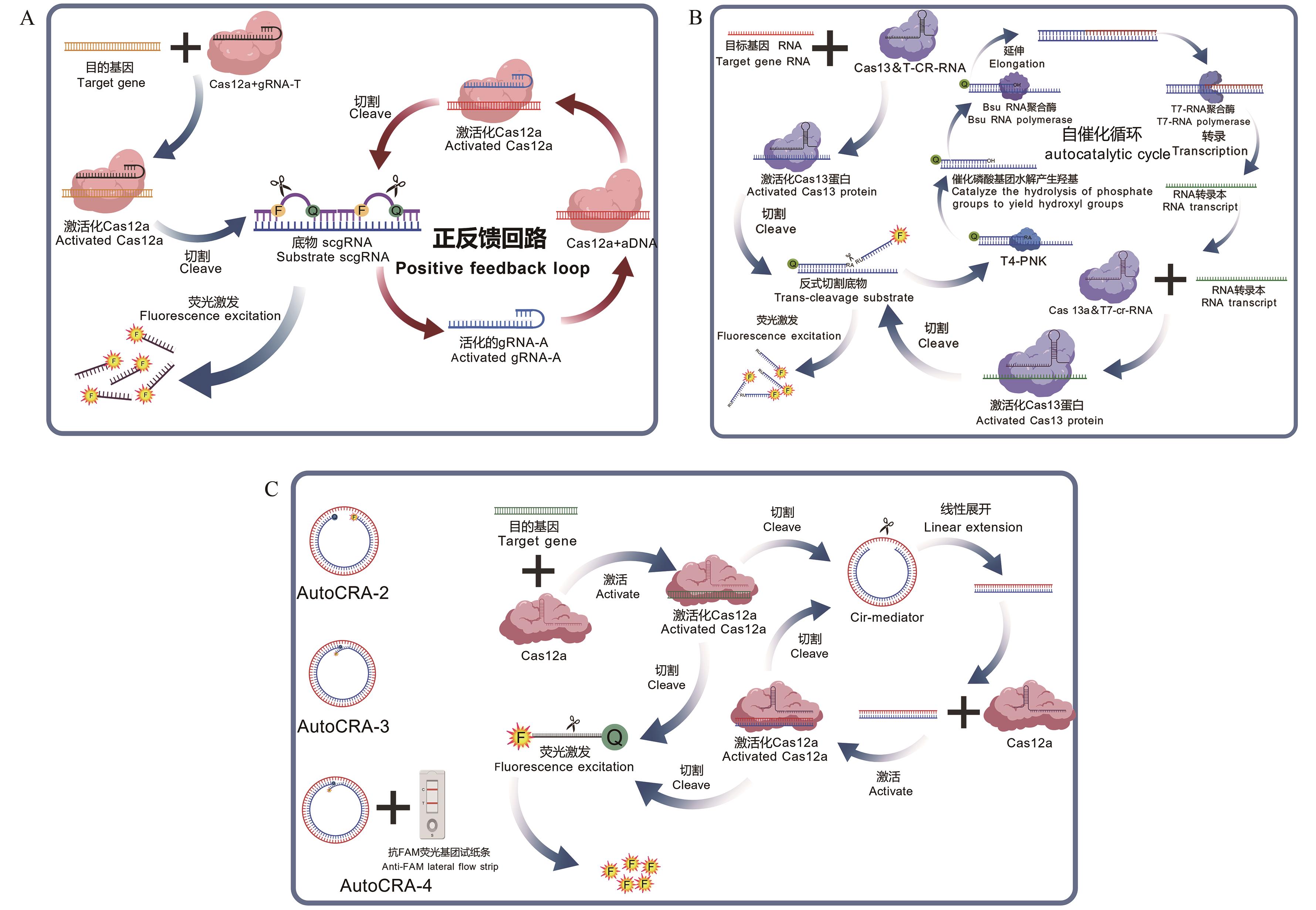
图1 基于CRISPR-Cas系统的自催化级联放大原理图A:CONAN自催化核酸回路原理图;B:CRISPR-Cas13a自催化系统原理图;C:AutoCAR原理图。该图使用BioGDP.com生成,下同
Fig. 1 Schematic diagram of the autocatalytic cascade amplification based on the CRISPR-Cas systemA: Schematic diagram of the CONAN autocatalytic nucleic acid circuit. B: Schematic diagram of the CRISPR-Cas13a autocatalytic system. C: Schematic diagram of AutoCAR. The figure was created with BioGDP.com, the same below
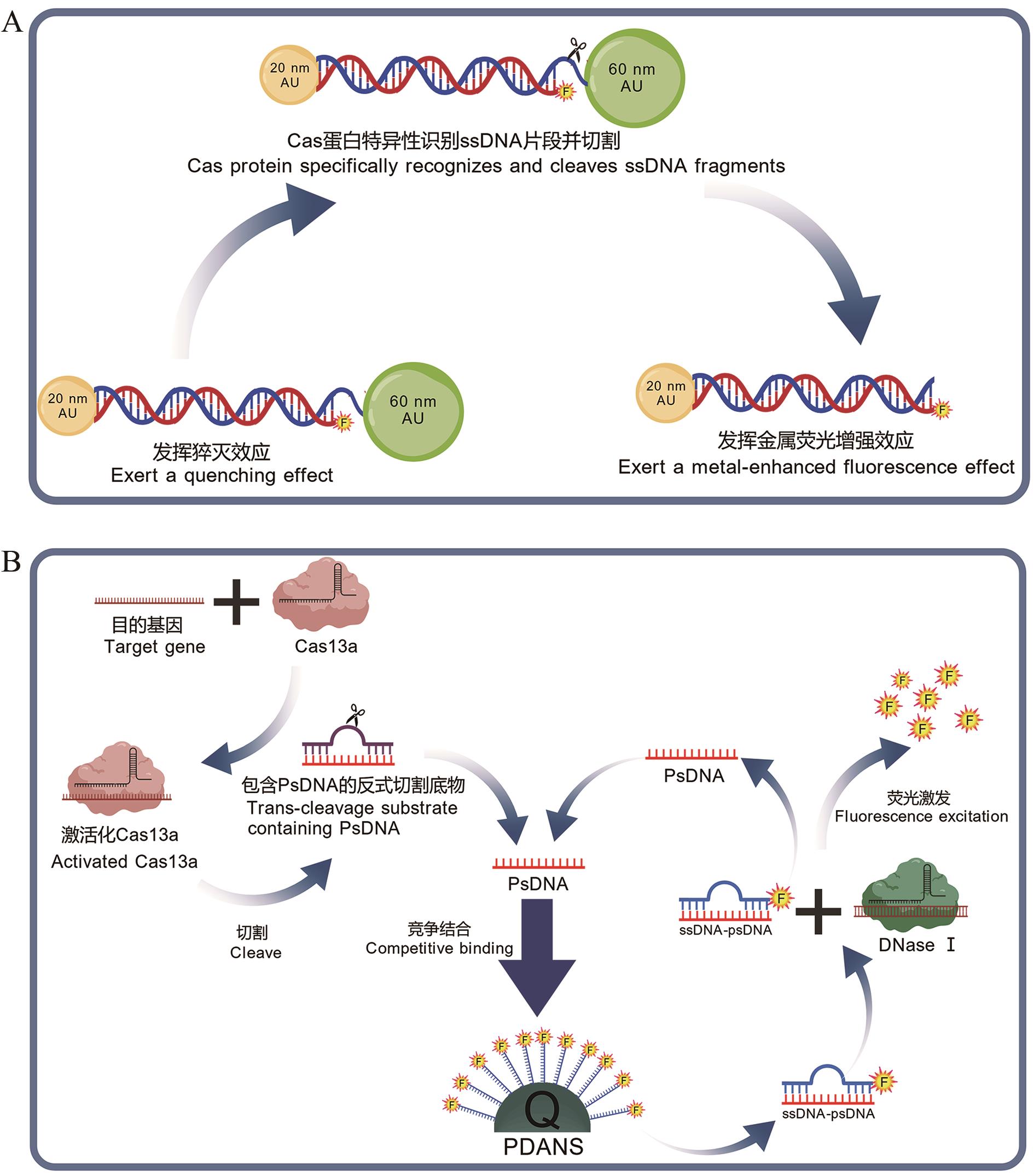
图2 利用纳米材料FRET效应优化信号相对强度的原理图A:基于AuNPs实现荧光信号增强的原理;B:基于PDNAS的CRISPR报告系统原理
Fig. 2 Schematic diagram of optimizing relative signal intensity using the FRET effect of nanomaterialsA: Principle of fluorescence signal enhancement based on AuNPs. B: Principle of the CRISPR reporting system based on PDNAS
特性 Characteristics | 扩增目的基因 Target gene amplification | 构建级联放大反应 Cascade amplification system | 改造反式切割底物 Engineering of trans-cleavage substrate |
|---|---|---|---|
| 基本原理 | 通过复制实现靶基因数量增加 | 通过一系列串联反应,实现信号逐级放大 | 通过设计新型底物,实现高强度信号释放 |
| 操作便捷性 | 高 | 高 | 高 |
| 设备依赖性 | 较高 | 较低 | 低 |
| 灵敏度 | 极高 | 极高 | 高 |
| 检测限 | aM | aM | fM |
| 成本 | 高 | 较高 | 中 |
| 优点 | 灵敏度高,技术成熟 | 操作简单且有较高灵敏度 | 操作简单 |
| 局限性 | 需要精确的温度控制 | 体系设计难度大 | 易受样品杂质干扰,影响实验的准确性 |
表2 不同信号富集方法的特性对比
Table 2 Comparison of characteristics of different signal enrichment methods
特性 Characteristics | 扩增目的基因 Target gene amplification | 构建级联放大反应 Cascade amplification system | 改造反式切割底物 Engineering of trans-cleavage substrate |
|---|---|---|---|
| 基本原理 | 通过复制实现靶基因数量增加 | 通过一系列串联反应,实现信号逐级放大 | 通过设计新型底物,实现高强度信号释放 |
| 操作便捷性 | 高 | 高 | 高 |
| 设备依赖性 | 较高 | 较低 | 低 |
| 灵敏度 | 极高 | 极高 | 高 |
| 检测限 | aM | aM | fM |
| 成本 | 高 | 较高 | 中 |
| 优点 | 灵敏度高,技术成熟 | 操作简单且有较高灵敏度 | 操作简单 |
| 局限性 | 需要精确的温度控制 | 体系设计难度大 | 易受样品杂质干扰,影响实验的准确性 |
| [1] | Penrith ML. Current status of African swine fever [J]. CABI Agric Biosci, 2020: 11. |
| [2] | Wang Q, Sun YX, Li ZJ, et al. Are we prepared for the next pandemic: Monitor on increasing human and animal H5N1 avian influenza infection [J]. Chin Med J, 2024, 137(23): 2776-2781. |
| [3] | Simancas-Racines A, Reytor-González C, Toral M, et al. H5N1 avian influenza: a narrative review of scientific advances and global policy challenges [J]. Viruses, 2025, 17(7): 927. |
| [4] | Bayang HN, Mouiche Mouliom MM, Mpouam SE, et al. Evaluation of direct economic losses due to foot and mouth disease reported by the epidemiological surveillance system in Cameroon from 2009 to 2023 [J]. Vet Med Sci, 2025, 11(6): e70681. |
| [5] | 张亚男, 许建成. 分子诊断即时检验的研究进展 [J]. 检验医学与临床, 2025, 22(20): 2875-2880. |
| Zhang YN, Xu JC. Research progress of point-of-care testing in molecular diagnostics [J]. Lab Med Clin, 2025, 22(20): 2875-2880. | |
| [6] | 张羽, 马爱进, 高利芬, 等. 微生物资源分子鉴定技术的研究进展 [J]. 中国工程科学, 2021, 23(5): 86-93. |
| Zhang Y, Ma AJ, Gao LF, et al. Research progress in molecular identification technology for microbial resources [J]. Strateg Study CAE, 2021, 23(5): 86-93. | |
| [7] | 王玉静, 陆梓涔, 陈俊煜, 等. 高通量测序技术的发展及其在临床检测中的应用 [J]. 厦门大学学报: 自然科学版, 2021, 60(5): 811-820. |
| Wang YJ, Lu ZC, Chen JY, et al. Development of the high-throughput sequencing technology and its application in clinical detection [J]. J Xiamen Univ Nat Sci, 2021, 60(5): 811-820. | |
| [8] | 王晓艳, 秦朗, 马琳莎, 等. CRISPR/Cas系统在核酸检测中的研究进展 [J]. 基因组学与应用生物学, 2025, 44(7): 647-667, 785. |
| Wang XY, Qin L, Ma LS, et al. Recent advances in CRISPR/cas-based nucleic acid detection [J]. Genom Appl Biol, 2025, 44(7): 647-667, 785. | |
| [9] | Zhou ZW, Cho IH, Kadam US. CRISPR-Cas-based diagnostics in biomedicine: principles, applications, and future trajectories [J]. Biosensors, 2025, 15(10): 660. |
| [10] | Yuan Z. From origin to the present: establishment, mechanism, evolutions and biomedical applications of the CRISPR/Cas-based macromolecular system in brief [J]. Molecules, 2025, 30(4): 947. |
| [11] | Chen LJ, Li J, Chen J, et al. Advances in CRISPR-based gene editing technology and its application in nucleic acid detection [J]. Biocell, 2025, 49(1): 21-43. |
| [12] | Kun D, Qinlong Z, Mingjun J, et al. CRISPR/Cas12a-based biosensing: advances in mechanisms and applications for nucleic acid detection [J]. Biosensors, 2025, 15(6): 360. |
| [13] | Shihong Gao D, Zhu XD, Lu BF. Development and application of sensitive, specific, and rapid CRISPR-Cas13-based diagnosis [J]. J Med Virol, 2021, 93(7): 4198-4204. |
| [14] | Xianglin X, Jing S, Haoran C, et al. Recent advances in clustered regularly interspaced short palindromic repeats/CRISPR-associated proteins system-based biosensors [J]. Biosensors, 2025, 15(3): 155. |
| [15] | Wang XY, He S, Zhao N, et al. Development and clinical application of a novel CRISPR-Cas12a based assay for the detection of African swine fever virus [J]. BMC Microbiol, 2020, 20: 282. |
| [16] | Liu HW, Xu L, Xiu Y, et al. A CRISPR/Cas13a-assisted precise and portable test for Brucella nucleic acid detection [J]. Front Cell Infect Microbiol, 2025, 15: 1545953. |
| [17] | Fan J, Huang LY, Chen JH, et al. Highly sensitive field detection technology for Anthrax based on the CRISPR/Cas13a system [J]. Microb Biotechnol, 2025, 18(11): e70240. |
| [18] | 李百涛, 郑越. CRISPR-Cas核酸酶家族的系统分类及挖掘方法研究进展 [J]. 基因组学与应用生物学, 2025, 44(7): 668-682. |
| Li BT, Zheng Y. Recent advances in classification and methodology of mining CRISPR-Cas nuclease family [J]. Genom Appl Biol, 2025, 44(7): 668-682. | |
| [19] | 艾力非热·艾尼瓦尔, 宁雅婷, 徐英春, 等. 基于CRISPR/Cas系统的病原体核酸检测技术研究进展 [J]. 国际检验医学杂志, 2025, 46(19): 2408-2414, 2420. |
| Ailifeire·ANWE, Ning YT, Xu YC, et al. Research progress in pathogen nucleic acid detection technology based on the CRISPR/Cas system [J]. Int J Lab Med, 2025, 46(19): 2408-2414, 2420. | |
| [20] | 戴永进, 孙静, 张莫然, 等. 反式切割CRISPR/Cas技术在食源致病微生物检测方面的原理及应用 [J]. 食品科学, 2024, 45(22): 351-360. |
| Dai YJ, Sun J, Zhang MR, et al. Principle and application of trans-cleavage CRISPR/cas technology for the detection of foodborne pathogenic microorganisms [J]. Food Sci, 2024, 45(22): 351-360. | |
| [21] | Xiao R. Structural and functional studies of type V CRISPR-Cas effectors [D]. West Lafayette: Purdue University, 2024. |
| [22] | Yang H, Patel DJ. Structures, mechanisms and applications of RNA-centric CRISPR-Cas13 [J]. Nat Chem Biol, 2024, 20(6): 673-688. |
| [23] | Chen SJ, Rai CI, Wang SC, et al. Point-of-care testing for infectious diseases based on class 2 CRISPR/Cas technology [J]. Diagnostics, 2023, 13(13): 2255. |
| [24] | 赵振兴, 范奇璇, 王思元, 等. 辣椒轻斑驳病毒RT-RAA-CRISPR/Cas12a可视化检测方法的建立 [J]. 河南农业科学, 2024, 53(9): 80-87. |
| Zhao ZX, Fan QX, Wang SY, et al. Establishment of RT-RAA-CRISPR/Cas12a based visual detection method for pepper mild mottle virus [J]. J Henan Agric Sci, 2024, 53(9): 80-87. | |
| [25] | 何逸昕. 基于CRISPR/Cas12a的生物传感器检测大米中重金属砷的研究 [D]. 武汉: 湖北大学, 2024. |
| He YX. “aptamer-locker” DNA coupling with CRISPR/Cas12a-guided biosensing for the heavy metal arsenic in rice analysis [D]. Wuhan: Hubei University, 2024. | |
| [26] | 乐翔云, 冯之航, 樊彦莉, 等. 基于RAA-CRISPR/Cas13a的禽流感病毒检测方法的建立 [J]. 中国兽医学报, 2024, 44(10): 2153-2158, 2171. |
| Le XY, Feng ZH, Fan YL, et al. Detection of avian influenza virus by RAA-CRISPR/Cas13a [J]. Chin J Vet Sci, 2024, 44(10): 2153-2158, 2171. | |
| [27] | Xie SL, Yue YH, Yang F. Recent advances in CRISPR/Cas system-based biosensors for the detection of foodborne pathogenic microorganisms [J]. Micromachines, 2024, 15(11): 1329. |
| [28] | Yang YH, Wang DD, Lü P, et al. Research progress on nucleic acid detection and genome editing of CRISPR/Cas12 system [J]. Mol Biol Rep, 2023, 50(4): 3723-3738. |
| [29] | Wu WY, Adiego-Pérez B, van der Oost J. Biology and applications of CRISPR-Cas12 and transposon-associated homologs [J]. Nat Biotechnol, 2024, 42(12): 1807-1821. |
| [30] | Xuan QB, Wang JJ, Nie YQ, et al. Research progress and application of miniature CRISPR-Cas12 system in gene editing [J]. Int J Mol Sci, 2024, 25(23): 12686. |
| [31] | Gunitseva N, Evteeva M, Korzhenkov A, et al. A new RNA-dependent Cas12g nuclease [J]. Int J Mol Sci, 2023, 24(23): 17105. |
| [32] | Perčulija V, Lin JY, Zhang B, et al. Functional features and current applications of the RNA-targeting type VI CRISPR-Cas systems [J]. Adv Sci, 2021, 8(13): 2004685. |
| [33] | Kavuri NR, Ramasamy M, Qi YP, et al. Applications of CRISPR/Cas13-Based RNA Editing in Plants [J]. Cells. 2022, 11(17): 2665. |
| [34] | Shi PG, Wu XB. Programmable RNA targeting with CRISPR-Cas13 [J]. RNA Biol, 2024, 21(1): 575-583. |
| [35] | Ackerman CM, Myhrvold C, Thakku SG, et al. Massively multiplexed nucleic acid detection with Cas13 [J]. Nature, 2020, 582(7811): 277-282. |
| [36] | Welch NL, Zhu ML, Hua C, et al. Multiplexed CRISPR-based microfluidic platform for clinical testing of respiratory viruses and identification of SARS-CoV-2 variants [J]. Nat Med, 2022, 28(5): 1083-1094. |
| [37] | Xu ZC, Chen DJ, Li T, et al. Microfluidic space coding for multiplexed nucleic acid detection via CRISPR-Cas12a and recombinase polymerase amplification [J]. Nat Commun, 2022, 13: 6480. |
| [38] | Roh YH, Lee CY, Lee S, et al. CRISPR-enhanced hydrogel microparticles for multiplexed detection of nucleic acids [J]. Adv Sci, 2023, 10(10): 2206872. |
| [39] | Gootenberg JS, Abudayyeh OO, Kellner MJ, et al. Multiplexed and portable nucleic acid detection platform with Cas13, Cas12a, and Csm6 [J]. Science, 2018, 360(6387): 439-444. |
| [40] | Tian T, Qiu ZQ, Jiang YZ, et al. Exploiting the orthogonal CRISPR-Cas12a/Cas13a trans-cleavage for dual-gene virus detection using a handheld device [J]. Biosens Bioelectron, 2022, 196: 113701. |
| [41] | Zhu YT, Xing C, Yang L, et al. Dual-gene detection in a single-tube system based on CRISPR-Cas12a/Cas13a for severe fever thrombocytopenia syndrome virus [J]. Front Microbiol, 2022, 13: 977382. |
| [42] | Zheng X, Li YK, Yuan MZ, et al. Rapid detection of HPV16/18 based on a CRISPR-Cas13a/Cas12a dual-channel system [J]. Anal Methods, 2022, 14(48): 5065-5075. |
| [43] | Rananaware SR, Vesco EK, Shoemaker GM, et al. Programmable RNA detection with CRISPR-Cas12a [J]. Nat Commun, 2023, 14: 5409. |
| [44] | Li JC, Luo T, He Y, et al. Discovery of the Rnase activity of CRISPR-Cas12a and its distinguishing cleavage efficiency on various substrates [J]. Chem Commun, 2022, 58(15): 2540-2543. |
| [45] | Nguyen LT, Macaluso NC, Rakestraw NR, et al. Harnessing noncanonical crRNAs to improve functionality of Cas12a orthologs [J]. Cell Rep, 2024, 43(2): 113777. |
| [46] | Zhang JY, Li ZY, Guo C, et al. Intrinsic RNA targeting triggers indiscriminate DNase activity of CRISPR-Cas12a [J]. Angew Chem Int Ed, 2024, 63(20): e202403123. |
| [47] | Ghouneimy A, Ali Z, Aman R, et al. CRISPR-based multiplex detection of human papillomaviruses for one-pot point-of-care diagnostics [J]. ACS Synth Biol, 2024, 13(3): 837-850. |
| [48] | Wu Q, Yi ZF, Li HR, et al. Harnessing noncanonical trans-cleavage characteristics of Cas12 and Cas13a to enhance CRISPR-based diagnostics [J]. Commun Biol, 2024, 7: 1312. |
| [49] | Chen JS, Ma EB, Harrington LB, et al. CRISPR-Cas12a target binding unleashes indiscriminate single-stranded DNase activity [J]. Science, 2018, 360(6387): 436-439. |
| [50] | Kellner MJ, Koob JG, Gootenberg JS, et al. SHERLOCK: nucleic acid detection with CRISPR nucleases [J]. Nat Protoc, 2019, 14(10): 2986-3012. |
| [51] | Li SY, Cheng QX, Wang JM, et al. CRISPR-Cas12a-assisted nucleic acid detection [J]. Cell Discov, 2018, 4: 20. |
| [52] | Broughton JP, Deng XD, Yu GX, et al. CRISPR-Cas12-based detection of SARS-CoV-2 [J]. Nat Biotechnol, 2020, 38(7): 870-874. |
| [53] | Patchsung M, Jantarug K, Pattama A, et al. Clinical validation of a Cas13-based assay for the detection of SARS-CoV-2 RNA [J]. Nat Biomed Eng, 2020, 4(12): 1140-1149. |
| [54] | Shao FC, Park JS, Zhao GJ, et al. Elucidating the role of CRISPR/Cas in single-step isothermal nucleic acid amplification testing assays [J]. Anal Chem, 2023, 95(7): 3873-3882. |
| [55] | Liu HY, Yin H, Xiu LS, et al. One-pot isothermal nucleic acid amplification assisted CRISPR/Cas detection technology: challenges, strategies, and perspectives [J]. Adv Sci, 2025, 12(37): e06716. |
| [56] | Lu SH, Tong XH, Han Y, et al. Fast and sensitive detection of SARS-CoV-2 RNA using suboptimal protospacer adjacent motifs for Cas12a [J]. Nat Biomed Eng, 2022, 6(3): 286-297. |
| [57] | Zheng WG, Tang HM, Ye BC, et al. Fast, portable and sensitive detection of group B Streptococcus DNA using one-pot MIRA-CRISPR system with suboptimal PAM [J]. Talanta, 2024, 279: 126574. |
| [58] | Tong XH, Zhang K, Han Y, et al. Fast and sensitive CRISPR detection by minimized interference of target amplification [J]. Nat Chem Biol, 2024, 20(7): 885-893. |
| [59] | Jiang H, Li Y, Lv XF, et al. Recent advances in cascade isothermal amplification techniques for ultra-sensitive nucleic acid detection [J]. Talanta, 2023, 260: 124645. |
| [60] | Shi K, Xie SY, Tian RY, et al. A CRISPR-Cas autocatalysis-driven feedback amplification network for supersensitive DNA diagnostics [J]. Sci Adv, 2021, 7(5): eabc7802. |
| [61] | He YG, Du K, Liu ZH, et al. One-tube target amplification-free CRISPR-Cas13 autocatalytic system [J]. Microchem J, 2024, 206: 111498. |
| [62] | Deng F, Li Y, Yang BY, et al. Topological barrier to Cas12a activation by circular DNA nanostructures facilitates autocatalysis and transforms DNA/RNA sensing [J]. Nat Commun, 2024, 15: 1818. |
| [63] | Arshad F, Yee BJ, Ting KP, et al. Nanomaterials as signal amplifiers in CRISPR/Cas biosensors: a path toward multiplex point-of-care diagnostics [J]. Microchem J, 2024, 207: 111826. |
| [64] | Huang D, Xu CT, Jiang CH, et al. Advances and challenges of signal readout systems in CRISPR-based biosensors for point-of-care testing of nucleic acid [J]. Trac Trends Anal Chem, 2024, 178: 117856. |
| [65] | Choi JH, Lim J, Shin M, et al. CRISPR-Cas12a-based nucleic acid amplification-free DNA biosensor via Au nanoparticle-assisted metal-enhanced fluorescence and colorimetric analysis [J]. Nano Lett, 2021, 21(1): 693-699. |
| [66] | Cheng XX, Yan YR, Chen XP, et al. CRISPR/Cas12a-Modulated fluorescence resonance energy transfer with nanomaterials for nucleic acid sensing [J]. Sens Actuat B Chem, 2021, 331: 129458. |
| [67] | Huang D, Shen PJ, Xu CT, et al. Dual nucleases-assisted cyclic amplification using polydopamine nanospheres-based biosensors for one-pot detection of microRNAs [J]. Biosens Bioelectron, 2023, 222: 114957. |
| [68] | Guo YQ, Zhou YF, Duan H, et al. CRISPR/Cas-mediated “one to more” lighting-up nucleic acid detection using aggregation-induced emission luminogens [J]. Nat Commun, 2024, 15: 8560. |
| [69] | Yang YJ, Kong XX, Yang JL, et al. Rapid nucleic acid detection of Listeria monocytogenes based on RAA-CRISPR Cas12a system [J]. Int J Mol Sci, 2024, 25(6): 3477. |
| [70] | Wei J, Li YN, Cao YL, et al. Rapid and visual detection of porcine parvovirus using an ERA-CRISPR/Cas12a system combined with lateral flow dipstick assay [J]. Front Cell Infect Microbiol, 2022, 12: 879887. |
| [71] | Wang XF, Cheng M, Yang SQ, et al. CRISPR/Cas12a combined with RPA for detection of T. gondii in mouse whole blood [J]. Parasites Vectors, 2023, 16: 256. |
| [72] | Smith CW, Kachwala MJ, Nandu N, et al. Recognition of DNA target formulations by CRISPR-Cas12a using a dsDNA reporter [J]. ACS Synth Biol, 2021, 10(7): 1785-1791. |
| [73] | Zhang WS, Pan JB, Li F, et al. Reverse transcription recombinase polymerase amplification coupled with CRISPR-Cas12a for facile and highly sensitive colorimetric SARS-CoV-2 detection [J]. Anal Chem, 2021, 93(8): 4126-4133. |
| [74] | Zhang DC, Yan YR, Que HY, et al. CRISPR/Cas12a-mediated interfacial cleaving of hairpin DNA reporter for electrochemical nucleic acid sensing [J]. ACS Sens, 2020, 5(2): 557-562. |
| [75] | Huang D, Ni DS, Fang MJ, et al. Microfluidic ruler-readout and CRISPR Cas12a-responded hydrogel-integrated paper-based analytical devices (μReaCH-PAD) for visible quantitative point-of-care testing of invasive fungi [J]. Anal Chem, 2021, 93(50): 16965-16973. |
| [76] | Feng SQ, Chen HJ, Hu ZA, et al. Ultrasensitive detection of miRNA via CRISPR/Cas12a coupled with strand displacement amplification reaction [J]. ACS Appl Mater Interfaces, 2023, 15(24): 28933-28940. |
| [77] | Ghouneimy A, Mahas A, Marsic T, et al. CRISPR-based diagnostics: challenges and potential solutions toward point-of-care applications [J]. ACS Synth Biol, 2023, 12(1): 1-16. |
| [78] | Wang XJ, Shang XY, Huang XX. Next-generation pathogen diagnosis with CRISPR/Cas-based detection methods [J]. Emerg Microbes Infect, 2020, 9(1): 1682-1691. |
| [79] | Son H. Harnessing CRISPR/cas systems for DNA and RNA detection: principles, techniques, and challenges [J]. Biosensors, 2024, 14(10): 460. |
| [80] | Kaur R, Gupta S, Chauhan A, et al. Harnessing the power of clustered regularly interspaced short palindromic repeats (CRISPR) based microfluidics for next-generation molecular diagnostics [J]. Mol Biol Rep, 2024, 51: 896. |
| [81] | Mumtaz Z, Rashid Z, Ali A, et al. Prospects of microfluidic technology in nucleic acid detection approaches [J]. Biosensors, 2023, 13(6): 584. |
| [82] | de Puig H, Lee RA, Najjar D, et al. Minimally instrumented SHERLOCK (miSHERLOCK) for CRISPR-based point-of-care diagnosis of SARS-CoV-2 and emerging variants [J]. Sci Adv, 2021, 7(32): eabh2944. |
| [83] | Chandrasekaran SS, Agrawal S, Fanton A, et al. Rapid detection of SARS-CoV-2 RNA in saliva via Cas13 [J]. Nat Biomed Eng, 2022, 6(8): 944-956. |
| [84] | Huang Z, Lyon CJ, Wang J, et al. CRISPR assays for disease diagnosis: progress to and barriers remaining for clinical applications [J]. Adv Sci, 2023, 10(20): 2301697. |
| No related articles found! |
| 阅读次数 | ||||||
|
全文 |
|
|||||
|
摘要 |
|
|||||
