







生物技术通报 ›› 2026, Vol. 42 ›› Issue (5): 340-352.doi: 10.13560/j.cnki.biotech.bull.1985.2025-1300
• 研究报告 • 上一篇
张初署1( ), 曹世宁1, 王发明2, 周海翔1, 胡晓君2, 唐月异1, 周晓燕2, 王冕1, 陈静1, 张建成1()
收稿日期:2025-11-29
出版日期:2026-05-26
发布日期:2026-06-10
通讯作者:
张建成,男,研究员,研究方向 :花生营养安全;E-mail: jianch-zh@hotmail.com作者简介:张初署,女,助理研究员,研究方向 :花生营养与应用;E-mail: peanutzhangchushu@163.com
基金资助:
ZHANG Chu-shu1(), CAO Shi-ning1, WANG Fa-ming2, ZHOU Hai-xiang1, HU Xiao-jun2, TANG Yue-yi1, ZHOU Xiao-yan2, WANG Mian1, CHEN Jing1, ZHANG Jian-cheng1()
Received:2025-11-29
Published:2026-05-26
Online:2026-06-10
摘要:
目的 探究保加利亚乳杆菌PS-1与嗜热链球菌PS-3发酵改善花生衣品质的代谢机制,解析其降低涩味、提升抗氧化活性的内在原因。 方法 以花生衣提取物(peanut skin extract, PSE)为原料,分别接种PS-1和PS-3菌株,采用非靶向代谢组学技术,结合多变量统计分析,对两种乳酸菌在不同时间点(0、12、24、36、48 h)发酵产物进行检测,筛选显著差异代谢物,并分析其通路富集与变化趋势。 结果 乳酸菌发酵能显著改变花生衣提取物的代谢谱,保加利亚乳杆菌和嗜热链球菌分别筛选到49种和88种显著差异代谢物;KEGG分析表明,代谢物显著富集于酪氨酸代谢、黄酮类降解与生物合成及嘌呤代谢等通路;发酵实现了酚类物质的生物转化,保加利亚乳杆菌发酵过程中,二氢杨梅素、原花青素B2及二氢山柰酚等含量显著降低,而辛弗林、1-脱氧野尻霉素、富马酸及丙酮酸等含量显著增加;嗜热链球菌发酵中,白藜芦醇、原花青素A2、黄芩素及槲皮素等物质含量下降,棉花皮苷、木犀草素苷及异荭草素等物质含量显著上升;两种菌对酚类物质的生物转化作用均发生在发酵12-24 h段。 结论 乳酸菌发酵实现花生衣酚类物质的生物转化,促进了抗氧化、减脂及降糖等相关功能代谢物的积累,同时有效降低了潜在涩味物质含量。
张初署, 曹世宁, 王发明, 周海翔, 胡晓君, 唐月异, 周晓燕, 王冕, 陈静, 张建成. 乳酸菌发酵花生衣提取物过程中的代谢物特征分析[J]. 生物技术通报, 2026, 42(5): 340-352.
ZHANG Chu-shu, CAO Shi-ning, WANG Fa-ming, ZHOU Hai-xiang, HU Xiao-jun, TANG Yue-yi, ZHOU Xiao-yan, WANG Mian, CHEN Jing, ZHANG Jian-cheng. Analysis of Metabolite Characteristics during Lactic Acid Bacteria Fermentation of Peanut Skin Extract[J]. Biotechnology Bulletin, 2026, 42(5): 340-352.
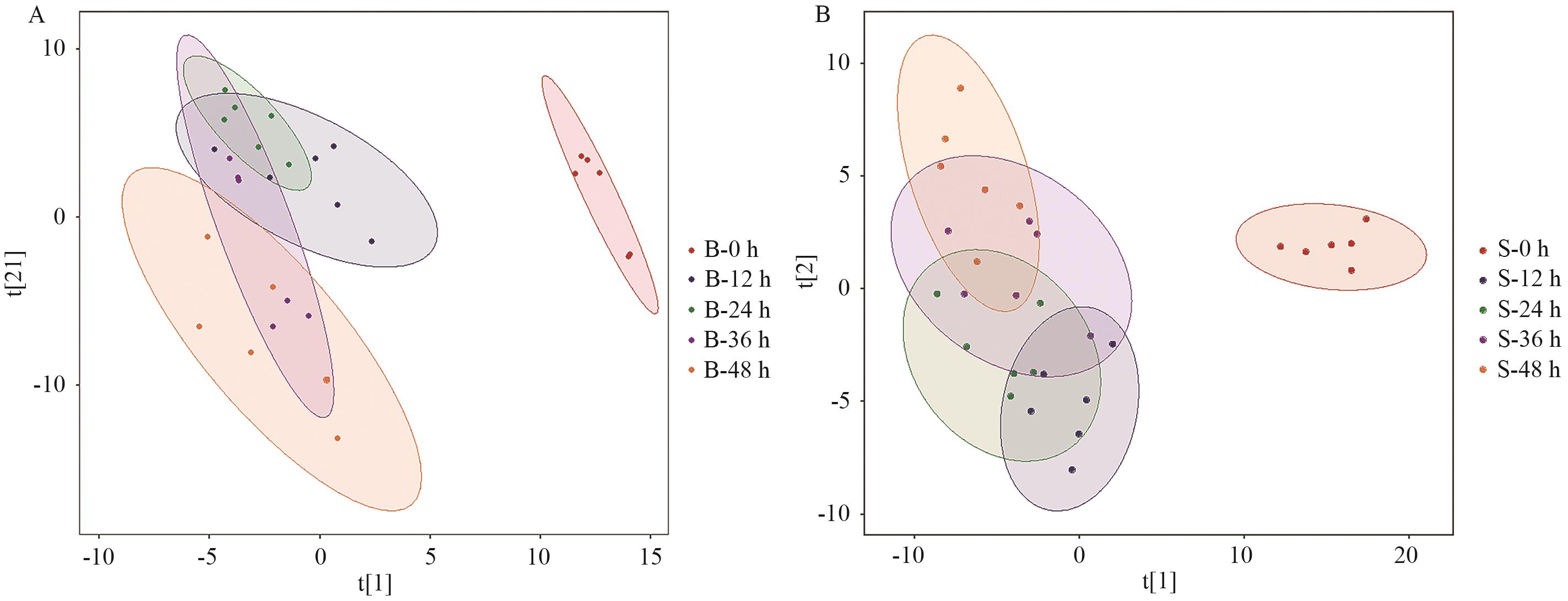
图1 不同发酵阶段发酵液的PLS-DA图A:保加利亚乳杆菌PS-1;B:嗜热链球菌PS-3;B-0 h、B-12 h、B-24 h、B-36 h、B-48 h表示保加利亚乳杆菌PS-1发酵0、12、24、36、48 h;S-0 h、S-12 h、S-24 h、S-36 h、S-48 h表示嗜热链球菌PS-3发酵0、12、24、36、48 h
Fig. 1 PLS-DA plot of fermentation broths at different fermentation stagesA: Lactobacillus bulgaricus PS-1. B: Streptococcus thermophilus PS-3;B-0, B-12 h, B-24 h, B-36 h, and B-48 h refer to the fermentation time points (0, 12, 24, 36, and 48 h) of L. bulgaricus PS-1; S-0 h, S-12 h, S-24 h, S-36 h, and S-48 h indicatethe fermentation time points (0, 12, 24, 36, and 48 h) of S. thermophilus PS-3
代谢物类别 Metabolite class (Super class) | 显著差异代谢物 Number of significantly differential metabolites | 占比 Proportion (%) | 代谢物类别 Metabolite class | 上调 Up-regulated | 下调 Down-regulated |
|---|---|---|---|---|---|
| 有机杂环化合物 | 12 | 24.49 | 吲哚及其衍生物 | 3 | 0 |
| 嘌呤核苷 | 0 | 2 | |||
| 哌啶类 | 2 | 0 | |||
| 苯并恶嗪 | 1 | 0 | |||
| 羟基酸及其衍生物 | 0 | 1 | |||
| 喹啉及其衍生物 | 1 | 0 | |||
| 内酯 | 0 | 1 | |||
| 苯丙烷和聚酮 | 9 | 18.37 | 黄酮类化合物 | 1 | 4 |
| 香豆素及其衍生物 | 2 | 0 | |||
| 肉桂酸及其衍生物 | 1 | 0 | |||
| 异黄酮类 | 0 | 1 | |||
| 有机酸及其衍生物 | 8 | 16.33 | 羧酸及其衍生物 | 5 | 1 |
| 鞘磷脂 | 1 | 0 | |||
| 有机膦酸及其衍生物 | 0 | 1 | |||
| 脂质和类脂分子 | 7 | 14.29 | 脂肪酰基 | 0 | 4 |
| 酮酸及其衍生物 | 1 | 1 | |||
| 类固醇和类固醇衍生物 | 0 | 1 | |||
| 苯环型化合物 | 7 | 14.29 | 苯及其取代衍生物 | 2 | 3 |
| 酚类 | 1 | 1 | |||
| 有机含氧化合物 | 5 | 10.20 | 有机氧化合物 | 2 | 3 |
| 核苷、核苷酸和类似物 | 1 | 2.04 | 嘌呤核苷酸 | 1 | 0 |
表1 保加利亚乳杆菌PS-1发酵前后差异代谢物种类与变化情况
Table 1 Categories and changes of differential metabolites before and after fermentation with L. bulgaricus PS-1
代谢物类别 Metabolite class (Super class) | 显著差异代谢物 Number of significantly differential metabolites | 占比 Proportion (%) | 代谢物类别 Metabolite class | 上调 Up-regulated | 下调 Down-regulated |
|---|---|---|---|---|---|
| 有机杂环化合物 | 12 | 24.49 | 吲哚及其衍生物 | 3 | 0 |
| 嘌呤核苷 | 0 | 2 | |||
| 哌啶类 | 2 | 0 | |||
| 苯并恶嗪 | 1 | 0 | |||
| 羟基酸及其衍生物 | 0 | 1 | |||
| 喹啉及其衍生物 | 1 | 0 | |||
| 内酯 | 0 | 1 | |||
| 苯丙烷和聚酮 | 9 | 18.37 | 黄酮类化合物 | 1 | 4 |
| 香豆素及其衍生物 | 2 | 0 | |||
| 肉桂酸及其衍生物 | 1 | 0 | |||
| 异黄酮类 | 0 | 1 | |||
| 有机酸及其衍生物 | 8 | 16.33 | 羧酸及其衍生物 | 5 | 1 |
| 鞘磷脂 | 1 | 0 | |||
| 有机膦酸及其衍生物 | 0 | 1 | |||
| 脂质和类脂分子 | 7 | 14.29 | 脂肪酰基 | 0 | 4 |
| 酮酸及其衍生物 | 1 | 1 | |||
| 类固醇和类固醇衍生物 | 0 | 1 | |||
| 苯环型化合物 | 7 | 14.29 | 苯及其取代衍生物 | 2 | 3 |
| 酚类 | 1 | 1 | |||
| 有机含氧化合物 | 5 | 10.20 | 有机氧化合物 | 2 | 3 |
| 核苷、核苷酸和类似物 | 1 | 2.04 | 嘌呤核苷酸 | 1 | 0 |
代谢物类别 Metabolite class (Super class) | 显著差异代谢物 Number of significantly differential metabolites | 占比 Proportion (%) | 代谢物类别 Metabolite class | 上调 Up-regulated | 下调 Down-regulated |
|---|---|---|---|---|---|
| 苯丙烷和聚酮 | 23 | 26.14 | 黄酮类化合物 | 8 | 11 |
| 肉桂酸及其衍生物 | 2 | 0 | |||
| 香豆素及其衍生物 | 0 | 1 | |||
| 芪类 | 0 | 1 | |||
| 有机含氧化合物 | 14 | 15.91 | 有机氧化合物 | 5 | 9 |
| 有机杂环化合物 | 14 | 15.91 | 苯骈吡喃 | 2 | 1 |
| 二氮杂苯 | 1 | 1 | |||
| 吡啶及其衍生物 | 1 | 1 | |||
| 吲哚及其衍生物 | 1 | 0 | |||
| 噻吩 | 0 | 1 | |||
| 内酯 | 0 | 1 | |||
| 咪唑并嘧啶类 | 0 | 1 | |||
| 恶嗪类 | 0 | 1 | |||
| 吡咯吡嗪类 | 0 | 1 | |||
| 苯并噻嗪类 | 0 | 1 | |||
| 有机酸及其衍生物 | 11 | 12.50 | 羧酸及其衍生物 | 1 | 7 |
| 有机硫酸及其衍生物 | 1 | 0 | |||
| 有机硫代磷酸及其衍生物 | 1 | 0 | |||
| 苯环型化合物 | 10 | 11.36 | 酮酸及其衍生物 | 0 | 1 |
| 酚类 | 1 | 1 | |||
| 萘类 | 1 | 0 | |||
| 脂质和类脂分子 | 9 | 10.23 | 脂肪酰基 | 1 | 5 |
| 甘油磷酯 | 0 | 2 | |||
| 类固醇和类固醇衍生物 | 0 | 1 | |||
| 核苷、核苷酸和类似物 | 4 | 4.55 | 嘌呤核苷酸 | 1 | 0 |
| 嘌呤核苷 | 0 | 1 | |||
| 吡啶核苷酸 | 0 | 1 | |||
| (3'->5')-二核苷酸和类似物 | 1 | 0 | |||
| 有机氮化合物 | 2 | 2.27 | 有机氮化合物 | 1 | 1 |
| 生物碱及其衍生物 | 1 | 1.14 | 哈马拉生物碱 | 0 | 1 |
表2 嗜热链球菌PS-3发酵前后差异代谢物种类与变化情况
Table 2 Categories and changes of differential metabolites before and after fermentation with S. thermophilus PS-3
代谢物类别 Metabolite class (Super class) | 显著差异代谢物 Number of significantly differential metabolites | 占比 Proportion (%) | 代谢物类别 Metabolite class | 上调 Up-regulated | 下调 Down-regulated |
|---|---|---|---|---|---|
| 苯丙烷和聚酮 | 23 | 26.14 | 黄酮类化合物 | 8 | 11 |
| 肉桂酸及其衍生物 | 2 | 0 | |||
| 香豆素及其衍生物 | 0 | 1 | |||
| 芪类 | 0 | 1 | |||
| 有机含氧化合物 | 14 | 15.91 | 有机氧化合物 | 5 | 9 |
| 有机杂环化合物 | 14 | 15.91 | 苯骈吡喃 | 2 | 1 |
| 二氮杂苯 | 1 | 1 | |||
| 吡啶及其衍生物 | 1 | 1 | |||
| 吲哚及其衍生物 | 1 | 0 | |||
| 噻吩 | 0 | 1 | |||
| 内酯 | 0 | 1 | |||
| 咪唑并嘧啶类 | 0 | 1 | |||
| 恶嗪类 | 0 | 1 | |||
| 吡咯吡嗪类 | 0 | 1 | |||
| 苯并噻嗪类 | 0 | 1 | |||
| 有机酸及其衍生物 | 11 | 12.50 | 羧酸及其衍生物 | 1 | 7 |
| 有机硫酸及其衍生物 | 1 | 0 | |||
| 有机硫代磷酸及其衍生物 | 1 | 0 | |||
| 苯环型化合物 | 10 | 11.36 | 酮酸及其衍生物 | 0 | 1 |
| 酚类 | 1 | 1 | |||
| 萘类 | 1 | 0 | |||
| 脂质和类脂分子 | 9 | 10.23 | 脂肪酰基 | 1 | 5 |
| 甘油磷酯 | 0 | 2 | |||
| 类固醇和类固醇衍生物 | 0 | 1 | |||
| 核苷、核苷酸和类似物 | 4 | 4.55 | 嘌呤核苷酸 | 1 | 0 |
| 嘌呤核苷 | 0 | 1 | |||
| 吡啶核苷酸 | 0 | 1 | |||
| (3'->5')-二核苷酸和类似物 | 1 | 0 | |||
| 有机氮化合物 | 2 | 2.27 | 有机氮化合物 | 1 | 1 |
| 生物碱及其衍生物 | 1 | 1.14 | 哈马拉生物碱 | 0 | 1 |
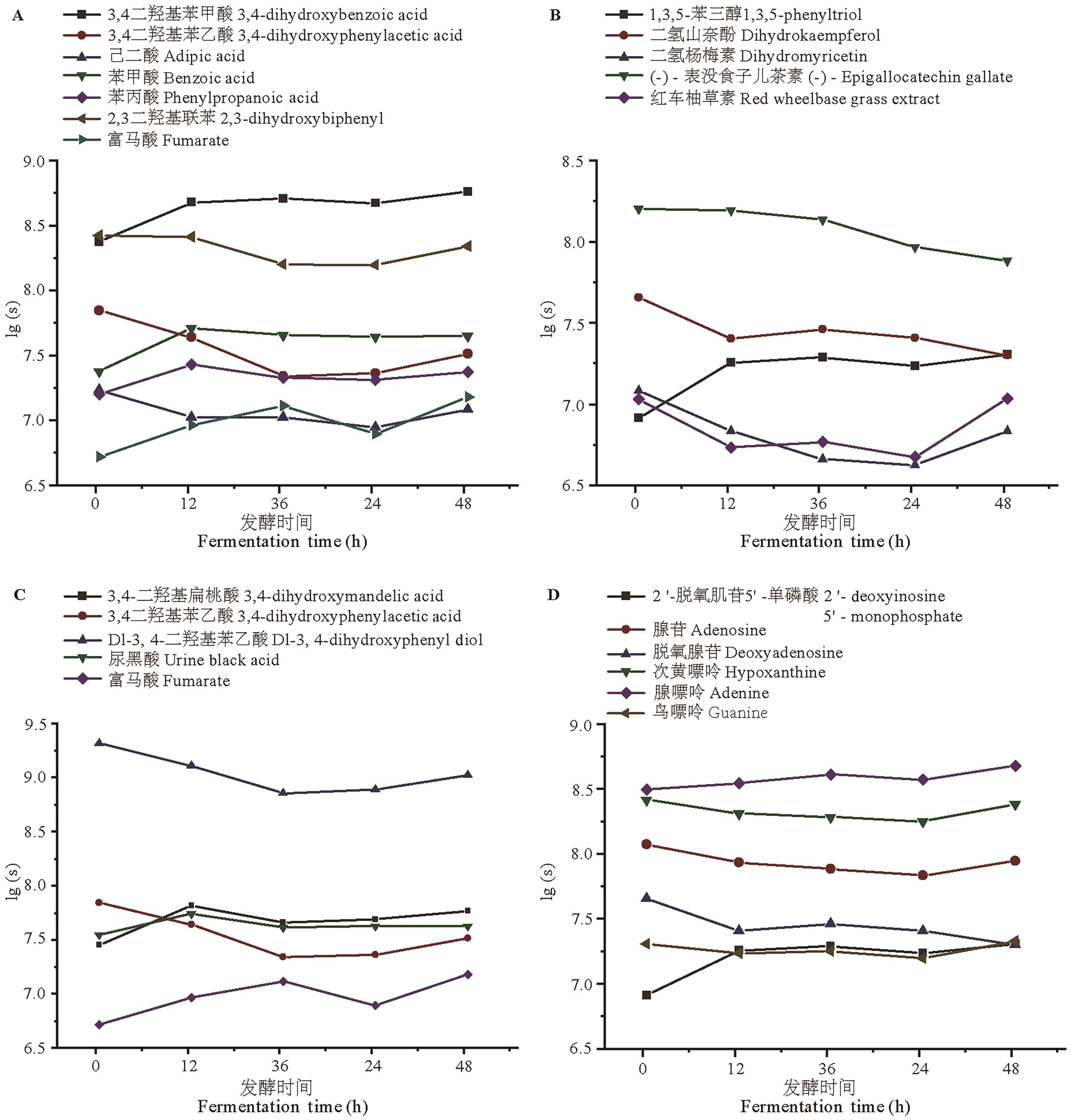
图2 保加利亚乳杆菌PS-1发酵过程中主要通路的化合物变化趋势A:芳香族化合物降解通路;B:类黄酮化合物的降解与合成通路;C:酪氨酸代谢通路;D:嘌呤代谢通路。Lg(S)表示峰面积的对数值(以10为底)
Fig. 2 Change trends of compounds in the key pathways during L. bulgaricus PS-1 fermentationA: Aromatic compound degradation pathway. B: Flavonoid biosynthesis and degradation pathway. C: Tyrosine metabolism pathway. D: Purine metabolism pathway. Lg(S) indicates the logarithm of the peak area (with base 10)

图3 嗜热链球菌PS-3发酵过程中主要代谢通路中化合物变化趋势A:核苷酸糖生物合成通路;B:类黄酮化合物降解/合成通路;C:酪氨酸代谢通路;lg(S)表示峰面积的对数值(以10为底)
Fig. 3 Change trends of compounds in the key pathways during S. thermophilus PS-3 fermentationA: Nucleotide sugar biosynthesis pathway. B: Flavonoid biosynthesis and degradation pathway. C: Tyrosine metabolism pathway. lg(S) indicates the logarithm of the peak area (with base 10)
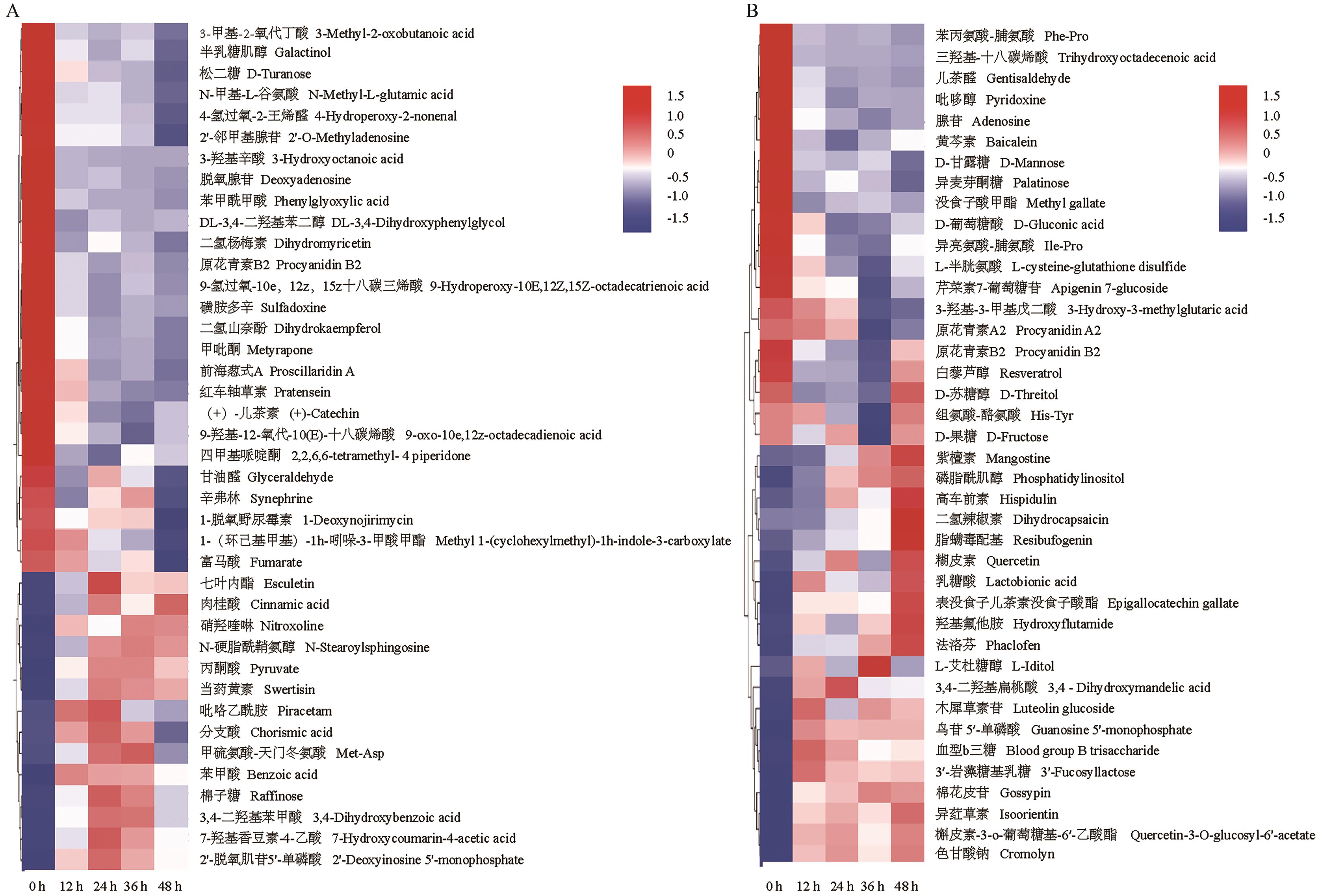
图4 乳酸菌发酵过程中代谢物含量变化热图A:保加利亚乳杆菌PS-1;B:嗜热链球菌PS-3
Fig. 4 Heat map of metabolite changes during lactic acid bacteria fermentationA: L. bulgaricus PS-1; B: S. thermophilus PS-3
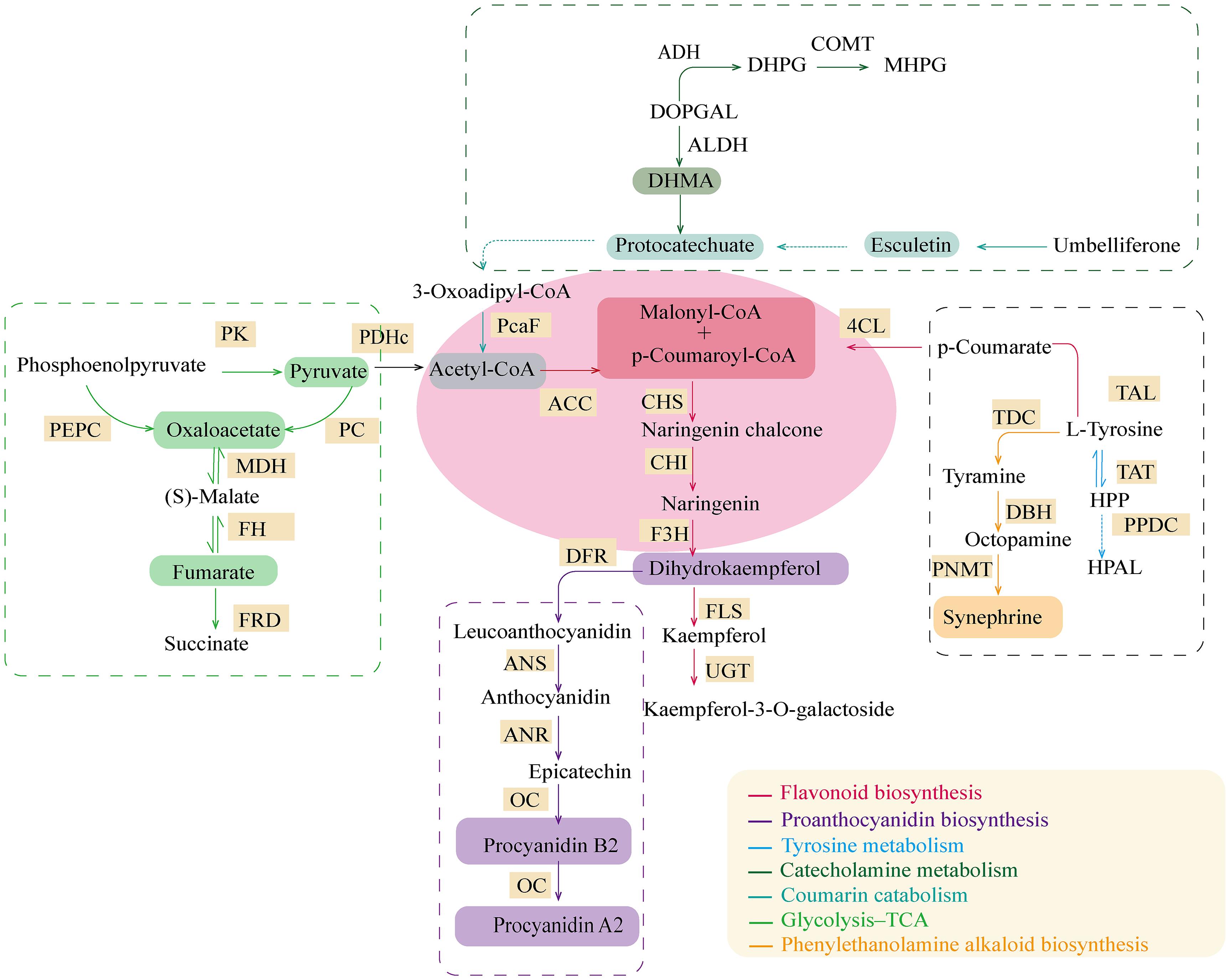
图5 保加利亚乳杆PS-1发酵花生衣提取物过程中代谢网络分析COMT: Catechol-O-methyltransferase. ADH: Alcohol dehydrogenase. ALDH: Aldehyde dehydrogenase. PcaF: Protocatechuate 3,4-dioxygenase (beta subunit). PK: Pyruvate kinase. PDHc: Pyruvate dehydrogenase complex. ACC: Acetyl-CoA carboxylase. 4CL: 4-Coumarate: CoA ligase. PEPC: Phosphoenolpyruvate carboxylase. PC: Pyruvate carboxylase. MDH: Malate dehydrogenase. FH: Fumarate hydratase. FRD: Fumarate reductase. CHS: Chalcone synthase. CHI: Chalcone isomerase. F3H: Flavanone 3-hydroxylase. DFR: Dihydroflavonol 4-reductase. FLS: Flavonol synthase. ANS: Anthocyanidin synthase. UGT: UDP-glucose: Flavonoid glycosyltransferase. ANR: Anthocyanidin reductase. OC: Oxidase/Cyclase. TDC: Tyrosine decarboxylase. DBH: Dopamine beta-hydroxylase. PNMT: Phenylethanolamine N-methyltransferase. TAL: Tyrosine ammonia-lyase. TAT: Tyrosine aminotransferase. PPDC: 4-Hydroxyphenylpyruvate dioxygenase. MHPG: 3-methoxy-4-hydroxyphenylglycol. DHPG: 3,4-Dihydroxyphenylglycol. DOPGAL: 3,4-Dihydroxyphenylglycolaldehyde. DHMA: 3,4-Dihydroxymandelic acid. HPP: 4-Hydroxyphenylpyruvate. HPAL: 4-Hydroxyphenylacetaldehyde
Fig. 5 Metabolic network analysis during the fermentation of peanut skin extract by L. bulgaricus PS-1
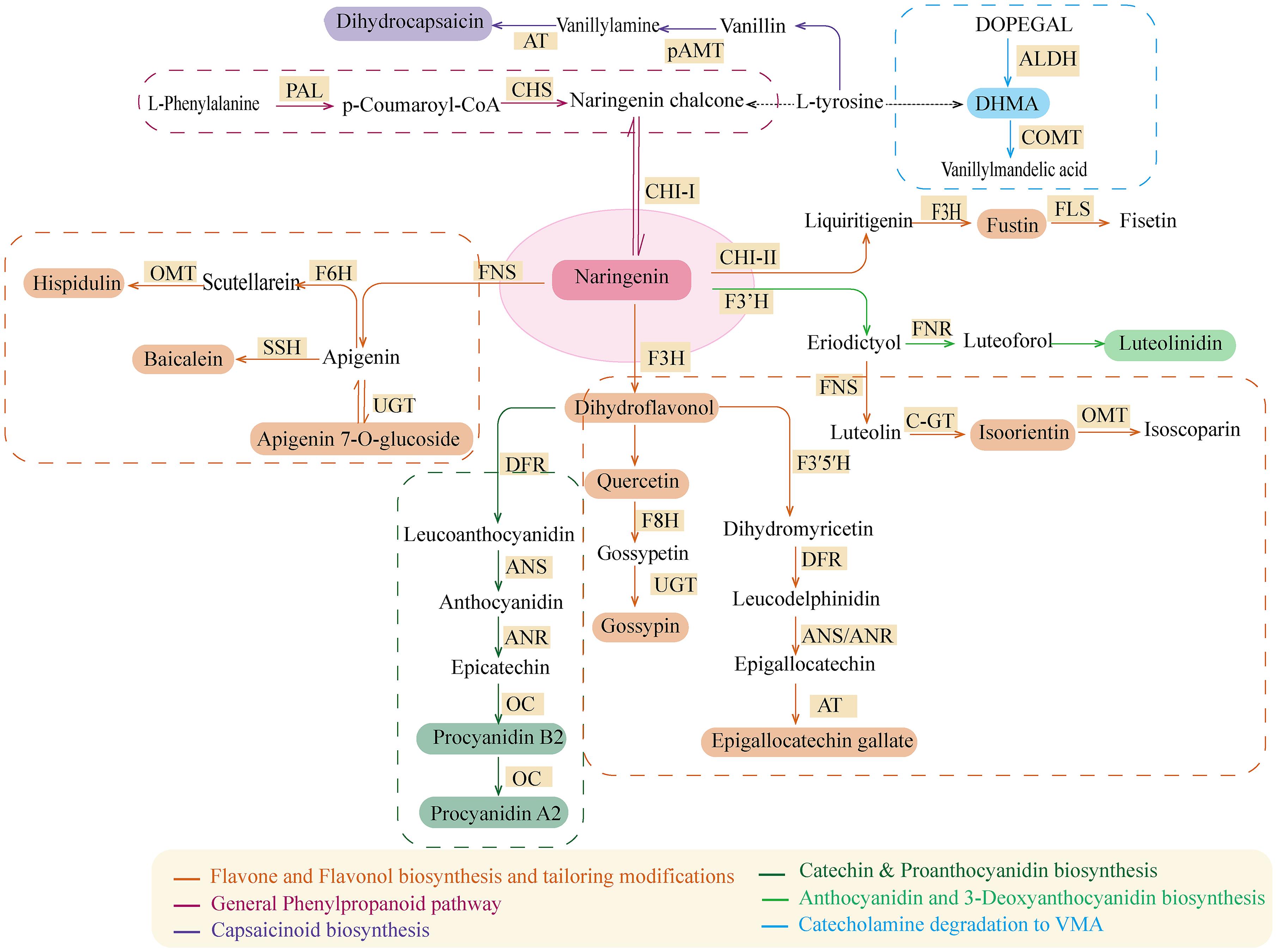
图6 嗜热链球菌PS-3发酵花生衣提取物过程中代谢网络分析AT: AcylTransferase. pAMT: Putative aminotransferase. PAL: Phenylalanine ammonia-lyase. CHS: Chalcone synthase. ALDH: Aldehyde dehydrogenase. COMT: Catechol-O-methyltransferase. CHI: Chalcone isomerase. F3H: Flavanone 3-hydroxylase. F3'H: Flavonoid 3'-hydroxylase. FLS: Flavonol synthase. F3'5'H: Flavonoid 3',5'-hydroxylase. ANS: Anthocyanidin synthase. ANR: Anthocyanidin reductase. OC: Oxidase/Cyclase. DFR: Dihydroflavonol 4-reductase. F8H: Flavonoid 8-hydroxylase. UGT: UDP-glycosyltransferase. FNR: Flavonoid NADPH reductase. FNS: Flavone synthase. C-GT: C-glycosylTransferase. OMT: O-Methyltransferase. SSH: Scutellaria-specific hydroxylase. F6H: Flavone 6-hydroxylase. DHMA: 3,4-Dihydroxymandelic acid. DOPGAL: 3,4-Dihydroxyphenylglycolaldehyde
Fig. 6 Metabolic network analysis during the fermentation of peanut skin extract by S. thermophilus PS-3
| [1] | 岳开妍, 毛丙永, 唐鑫, 等. 乳酸菌发酵对花生衣抗糖化缓解皮肤衰老功能的影响 [J]. 上海理工大学学报, 2024, 46(4): 364-374. |
| Yue KY, Mao BY, Tang X, et al. The effects of lactic acid bacteria fermentation on peanut skin’s anti-glycation and alleviation of skin aging functions [J]. J Univ Shanghai Sci Technol, 2024, 46(4): 364-374. | |
| [2] | Bodoira R, Cecilia Cittadini M, Velez A, et al. An overview on extraction, composition, bioactivity and food applications of peanut phenolics [J]. Food Chem, 2022, 381: 132250. |
| [3] | Zhao L, Zhu XL, Yu Y, et al. Comprehensive analysis of the anti-glycation effect of peanut skin extract [J]. Food Chem, 2021, 362: 130169. |
| [4] | 张初署, 王明清, 于丽娜, 等. 单宁酶对花生衣提取液涩味脱除及滋味品质改善研究 [J]. 花生学报, 2021, 50(2): 50-56. |
| Zhang CS, Wang MQ, Yu LN, et al. Study on the removal of astringency and quality improvement of peanut testa extract by tannase [J]. J Peanut Sci, 2021, 50(2): 50-56. | |
| [5] | Chen L, Wang HJ, Ye Y, et al. Structural insight into polyphenol oxidation during black tea fermentation [J]. Food Chem X, 2023, 17: 100615. |
| [6] | 丁嘉伟, 苏新堯, 尹薪项, 等. 微生物发酵青蒿叶和叶渣的研究 [J]. 生物技术通报, 2021, 37(2): 63-70. |
| Ding JW, Su XY, Yin XX, et al. Study on microbial fermentation of Artemisia annua leaves and leaf residues [J]. Biotechnol Bull, 2021, 37(2): 63-70. | |
| [7] | Lv MS, Liu XL, Liu RQ, et al. Untargeted metabolomics reveals flavor and metabolic changes in mixed Lactobacillus-fermented black mulberry juice [J]. Food Chem X, 2025, 27: 102367. |
| [8] | Wang HX, Sakda P, Chen L, et al. Characterizing metabolites and biotransformation in lactic acid bacteria fermented Millennium cherry tomato juice using integrated analytical tools [J]. Food Chem, 2025, 492: 145447. |
| [9] | Liang B, Bai X, Wang YF, et al. Effect of five lactic acid bacteria on the flavor quality of fermented sweet potato juice [J]. Food Chem X, 2024, 24: 102023. |
| [10] | Wang YX, Wang CX, Shi JL, et al. Effects of derivatization and probiotic transformation on the antioxidative activity of fruit polyphenols [J]. Food Chem X, 2024, 23: 101776. |
| [11] | 张初署, 周海翔, 唐月异, 等. 乳酸菌发酵花生红衣饮料研究 [J]. 花生学报, 2023, 52(4): 101-110. |
| Zhang CS, Zhou HX, Tang YY, et al. Study on the fermentation technology of peanut red skin beverage with lactic acid bacteria [J]. J Peanut Sci, 2023, 52(4): 101-110. | |
| [12] | 张初署, 张建成, 曹世宁, 等. 嗜热链球菌PS-3及其在发酵花生红衣脱除涩味、提高功能活性的应用: CN117229947B [P]. 2025-03-25. |
| Zhang CS, Zhang JC, Cao SN, et al. Streptococcus thermophilus PS-3 and its application in fermenting peanut skins to remove astringency and enhance functional activity: CN117229947B [P]. 2025-03-25. | |
| [13] | 张初署, 张建成, 周海翔, 等. 保加利亚乳杆菌PS-1及其在发酵改善花生红衣滋味品质中的应用: CN117004536B [P]. 2025-03-14. |
| Zhang CS, Zhang JC, Zhou HX, et al. Lactobacillus bulgaricus PS-1 and its application in fermentation for improving the taste quality of peanut skins: CN117004536B [P]. 2025-03-14. | |
| [14] | Zhao YS, Wu C, Zhu Y, et al. Metabolomics strategy for revealing the components in fermented barley extracts with Lactobacillus plantarum Dy-1 [J]. Food Res Int, 2021, 139: 109808. |
| [15] | 胡明珍, 刘慧燕, 潘琳, 等. 基于非靶向代谢组学分析副干酪乳杆菌发酵枸杞汁各阶段代谢差异 [J]. 食品科学, 2022, 43(8): 142-149. |
| Hu MZ, Liu HY, Pan L, et al. Non-targeted metabolomics analysis of differential metabolite profiles of Goji juice fermented by Lactobacillus paracasei [J]. Food Sci, 2022, 43(8): 142-149. | |
| [16] | Ji GY, Liu GP, Li B, et al. Influence on the aroma substances and functional ingredients of apple juice by lactic acid bacteria fermentation [J]. Food Biosci, 2023, 51: 102337. |
| [17] | Zhao Y, Jiang CQ, Lu JY, et al. Research progress of proanthocyanidins and anthocyanidins [J]. Phytother Res, 2023, 37(6): 2552-2577. |
| [18] | Liu J, Xie J, Lin JZ, et al. The material basis of astringency and the deastringent effect of polysaccharides: a review [J]. Food Chem, 2023, 405: 134946. |
| [19] | Paliwal P, Dash D, Krishnamurthy S. Pharmacokinetic study of piracetam in focal cerebral ischemic rats [J]. Eur J Drug Metab Pharmacokinet, 2018, 43(2): 205-213. |
| [20] | Zhou FQ. Pyruvate as a potential beneficial anion in resuscitation fluids [J]. Front Med, 2022, 9: 905978. |
| [21] | Sun JH, Wang ZD, Chen L, et al. Hypolipidemic effects and preliminary mechanism of Chrysanthemum flavonoids, its main components luteolin and luteoloside in hyperlipidemia rats [J]. Antioxidants, 2021, 10(8): 1309. |
| [22] | Luo TW, Jiang S, Zhou B, et al. Protective effect of isoorientin on oleic acid-induced oxidative damage and steatosis in rat liver cells [J]. Front Pharmacol, 2022, 13: 818159. |
| [23] | Zhang LS, Li AP, Liu HM, et al. Effects of lactic acid bacteria fermentation on the release and biotransformation of bound phenolics in ma bamboo shoots (Dendrocalamus latiflorus Munro) [J]. Foods, 2025, 14(15): 2573. |
| [24] | 刘晶晶, 邓高文, 胡嘉亮, 等. 基于非靶向代谢组学的不同菌种强化发酵浏阳豆豉的代谢差异分析 [J]. 食品科学, 2024, 45(1): 42-49. |
| Liu JJ, Deng GW, Hu JL, et al. Non-targeted metabolomics analysis of metabolic differences among Liuyang Douchi fermented by different strains [J]. Food Sci, 2024, 45(1): 42-49. | |
| [25] | Li J, Dai QY, Zhu YY, et al. Low-calorie bulk sweeteners: Recent advances in physical benefits, applications, and bioproduction [J]. Crit Rev Food Sci Nutr, 2024, 64(19): 6581-6595. |
| [26] | Ruiz-Moreno C, Del Coso J, Giráldez-Costas V, et al. Effects of p-synephrine during exercise: a brief narrative review [J]. Nutrients, 2021, 13(1): 233. |
| [27] | Wang NN, Zhu FF, Chen KP. 1-deoxynojirimycin: sources, extraction, analysis and biological functions [J]. Nat Prod Commun, 2017, 12(9): 1934578X1701200934. |
| [28] | Chang SC, Lee I, Ting H, et al. Parapyruvate, an impurity in pyruvate supplements, induces senescence in human fibroblastic Hs68 cells via inhibition of the α-ketoglutarate dehydrogenase complex [J]. J Agric Food Chem, 2018, 66(28): 7504-7513. |
| [29] | Wang CM, Li J, Zhou T, et al. Transcriptional regulation of proanthocyanidin biosynthesis pathway genes and transcription factors in Indigofera stachyodes Lindl. roots [J]. BMC Plant Biol, 2022, 22: 438. |
| [30] | Feng J, Jin RY, Cheng SS, et al. Establishing an artificial pathway for the biosynthesis of octopamine and synephrine [J]. ACS Synth Biol, 2024, 13(6): 1762-1772. |
| [31] | Isogai S, Tominaga M, Kondo A, et al. Plant flavonoid production in bacteria and yeasts [J]. Front Chem Eng, 2022, 4: 880694. |
| [32] | Yamamoto E, Watanabe R, Tooyama E, et al. Effect of fumaric acid on the growth of Lactobacillus delbrueckii ssp. bulgaricus during yogurt fermentation [J]. J Dairy Sci, 2021, 104(9): 9617-9626. |
| [33] | Han SI, Lee J, Kim MS, et al. Molecular cloning and characterization of a flavonoid glucosyltransferase from Byungkyool (Citrus platymamma hort. ex Tanaka) [J]. Appl Biol Chem, 2017, 60(1): 49-55. |
| [34] | Jiang XL, Liu YJ, Wu YH, et al. Analysis of accumulation patterns and preliminary study on the condensation mechanism of proanthocyanidins in the tea plant (Camellia sinensis) [J]. Sci Rep, 2015, 5: 8742. |
| [35] | Fu YH, Zhang FC. Changes in isoflavone glucoside and aglycone contents of chickpea yoghurt during fermentation by Lactobacillus Bulgaricus and Streptococcus Thermophilus: isoflavone glucoside and aglycone contents of chickpea yoghurt [J]. J Food Process Preserv, 2013, 37(5): 744-750. |
| [36] | Gao Y, Zhou HZ, Wang Y, et al. Insights into fermentation with lactic acid bacteria on the flavonoids biotransformation of alfalfa silage [J]. Chem Biol Technol Agric, 2024, 11: 73. |
| [37] | Tian T, Cui JD. Microbial phenylalanine ammonia lyase: recent advances and emerging applications [J]. J Agric Food Chem, 2025, 73(52): 32935-32956. |
| [38] | Hiraga Y, Shimada N, Nagashima Y, et al. Identification of a flavin monooxygenase-like flavonoid 8-hydroxylase with gossypetin synthase activity from Lotus japonicus [J]. Plant Cell Physiol, 2021, 62(3): 411-423. |
| [39] | Marchitti SA, Deitrich RA, Vasiliou V. Neurotoxicity and metabolism of the catecholamine-derived 3,4-dihydroxyphenylacetaldehyde and 3,4-dihydroxyphenylglycolaldehyde: the role of aldehyde dehydrogenase [J]. Pharmacol Rev, 2007, 59(2): 125-150. |
| [40] | Nam G, Hong M, Lee J, et al. Multiple reactivities of flavonoids towards pathological elements in Alzheimer’s disease: structure-activity relationship [J]. Chem Sci, 2020, 11(37): 10243-10254. |
| [1] | 王雅南, 魏立民, 王峰, 晁哲, 任钰为, 刘海隆, 黄丽丽, 孙瑞萍. 基于代谢组学筛选五指山猪与杜长大猪脂肪沉积差异代谢物的比较研究[J]. 生物技术通报, 2026, 42(2): 325-337. |
| [2] | 李德海, 殷丽, 周才雪, 王泽童, 孙常雁. 具有抑制蓝靛果致腐真菌生长的乳酸菌筛选、鉴定及保鲜研究[J]. 生物技术通报, 2025, 41(8): 289-299. |
| [3] | 赵睿萌, 王梦雨, 吕国英, 宋婷婷, 张作法. 药用真菌桑黄中多酚类成分药用机理研究进展[J]. 生物技术通报, 2024, 40(11): 3-13. |
| [4] | 周嫒婷, 彭睿琦, 王芳, 伍建榕, 马焕成. 生防菌株DZY6715在不同生长期的代谢差异分析[J]. 生物技术通报, 2023, 39(9): 225-235. |
| [5] | 赵佳, 赵飞燕, 沈馨, 高广琦, 孙志宏. 乳酸菌抗氧化活性及其应用研究进展[J]. 生物技术通报, 2023, 39(11): 182-190. |
| [6] | 田静, 张建国. 植物表面乳酸菌分布研究进展[J]. 生物技术通报, 2021, 37(9): 3-10. |
| [7] | 徐进益, 那彬彬, 刘顺, 陈超, 孙红, 郑玉龙. 青贮饲料的优良乳酸菌及其应用[J]. 生物技术通报, 2021, 37(9): 39-47. |
| [8] | 黄元霞, 彭传海, 丁宁, 邱忠平, 李星, 邹美慧. 一种三联乳酸菌的体外降胆固醇和抗氧化能力研究[J]. 生物技术通报, 2020, 36(12): 113-120. |
| [9] | 刘洋儿, 郭明璋, 杜若曦, 贺晓云, 黄昆仑, 许文涛. 乳酸菌在合成生物学中的研究现状及展望[J]. 生物技术通报, 2019, 35(8): 193-204. |
| [10] | 黄湘湄, 吴雅茜, 刘颖, 梁嘉烨, 苏伟明. 海洋源乳酸菌AI-2类群体感应抑制剂对单增李斯特菌抑制效果研究[J]. 生物技术通报, 2019, 35(4): 36-42. |
| [11] | 毛沛琪, 李厚华, 李嫒, 曹志秀, 韩美玲, 张延龙. 硝酸银对‘凤丹’牡丹愈伤组织褐变过程中酚类物质合成及相关基因表达的影响[J]. 生物技术通报, 2018, 34(8): 101-107. |
| [12] | 吕晓萌, 胡彤, 俞婷, 崔艳华. 细菌异源表达抗菌肽的研究进展[J]. 生物技术通报, 2014, 30(5): 37-44. |
| [13] | 何轶群, 雷赵民, 吴润, 万学瑞, 刁小龙, 艾文娜. 青贮饲料中优良乳酸菌的分离鉴定及其生物学特性研究[J]. 生物技术通报, 2013, 0(5): 177-183. |
| [14] | 张禹, 毛淑红, 路福平, 聂实践 . 原生质体融合技术选育分解草酸乳酸菌菌株的研究[J]. 生物技术通报, 2013, 0(1): 186-190. |
| [15] | 热娜·米吉提;乌斯满·依米提;周秀文;麦热姆妮萨·艾麦尔;李越中;买尔哈巴·艾合买提;古丽斯玛依·艾拜都拉;. 饲料乳酸菌的分离鉴定及优良菌株筛选[J]. , 2012, 0(06): 166-173. |
| 阅读次数 | ||||||
|
全文 |
|
|||||
|
摘要 |
|
|||||
