







生物技术通报 ›› 2025, Vol. 41 ›› Issue (8): 322-334.doi: 10.13560/j.cnki.biotech.bull.1985.2025-0422
• 研究报告 • 上一篇
张茹( ), 李一鸣, 张桐溪, 孙占斌, 任清(), 潘寒姁()
收稿日期:2025-04-22
出版日期:2025-08-26
发布日期:2025-08-14
通讯作者:
任清,男,博士,副教授,研究方向 :生物工程;E-mail: renqing@th.btbu.edu.cn作者简介:张茹,女,硕士研究生,研究方向 :微生物发酵;E-mail: 13975091985@163.com
ZHANG Ru(), LI Yi-ming, ZHANG Tong-xi, SUN Zhan-bin, REN Qing(), PAN Han-xu()
Received:2025-04-22
Published:2025-08-26
Online:2025-08-14
摘要:
目的 为明确厚朴“发汗”过程中微生物群落与厚朴品质的相关性,探究关键微生物对厚朴中厚朴酚及和厚朴酚积累的影响机制。 方法 采用传统培养分离技术结合高效液相色谱分析方法,系统分离和筛选厚朴“发汗”过程中的关键功能菌株。通过分子生物学技术对目标菌株进行鉴定,并构建系统发育树分析其进化地位和亲缘关系。采用单因素试验结合Box-Behnken响应面法对菌株HP3“发汗”工艺参数进行优化。 结果 从“发汗”厚朴样本中分离纯化出48株菌,经筛选发现有9株能够显著提升厚朴酚与和厚朴酚产量的菌株,其中HP3菌株效果最佳,经鉴定HP3菌株为贝莱斯芽胞杆菌(Bacillus velezensis);对HP3菌株的“发汗”工艺参数优化发现,其最佳“发汗”工艺参数为发汗温度31.84 ℃、发汗时间1.9 d、水煮时间6.37 min、干燥温度80 ℃,在此条件下,厚朴酚与和厚朴酚总量高达5.149%,较未“发汗”样品提升62.67%。 结论 从厚朴“发汗”过程中分离鉴定出一株菌株HP3,该菌株可显著提高厚朴“发汗”过程中厚朴酚与和厚朴酚的总含量。此外,通过响应面优化试验确定了菌株HP3的最佳“发汗”工艺条件。研究揭示了厚朴“发汗”过程中与品质密切相关的细菌类群,为厚朴药材的微生物资源开发提供了重要依据。
张茹, 李一鸣, 张桐溪, 孙占斌, 任清, 潘寒姁. 厚朴中1株高产厚朴酚与和厚朴酚菌株的分离鉴定及其“发汗”工艺优化[J]. 生物技术通报, 2025, 41(8): 322-334.
ZHANG Ru, LI Yi-ming, ZHANG Tong-xi, SUN Zhan-bin, REN Qing, PAN Han-xu. Isolation and Identification of a High-yielding Magnolol and Honokiol Strain from Magnolia officinalis and Optimization of the “Sweating” Process[J]. Biotechnology Bulletin, 2025, 41(8): 322-334.
| 属 Genus | 筛选培养基 Screening medium | 稀释梯度 Dilution gradient | 数量 Number |
|---|---|---|---|
| Bordetella(鲍特氏菌属) | TSA | 10-3 | 1 |
| Alcaligenes(产碱杆菌属) | TSA/BHI | 10-4/10-5 | 4 |
| Brevundimonas(短波单胞菌属) | TSA/BHI | 10-4/10-5 | 3 |
| Brucella(布鲁氏菌属) | TSA | 10-4 | 1 |
| Stenotrophomonas(黄单胞菌属) | NA/TSA/BHI/R2A | 10-4/10-5 | 5 |
| Acinetobacter(不动杆菌属) | NA/TSA/BHI/R2A | 10-4/10-5 | 4 |
| Pseudomonas(假单胞菌属) | NA/BHI | 10-4 | 3 |
| Enterobacter(肠杆菌属) | R2A | 10-4 | 1 |
| Klebsiella(克雷伯氏菌属) | R2A | 10-4/10-5/10-6 | 4 |
| Leclercia(勒克氏菌属) | NA | 10-4 | 1 |
| Curtobacterium(短小杆菌属) | NA/TSA | 10-4/10-5 | 3 |
| Georgenia(乔治菌属) | NA/TSA/BHI | 10-3/10-4/10-5 | 5 |
| Brevibacterium(短杆菌属) | NA/TSA/BHI | 10-3/10-4/10-5 | 4 |
| Streptomyces(链霉菌属) | TSA | 10-4 | 1 |
| Chryseobacterium(金黄杆菌属) | NA | 10-4 | 1 |
| Staphylococcus(葡萄球菌属) | NA | 10-4 | 1 |
| Lysinibacillus(赖氨酸芽胞杆菌属) | NA/TSA | 10-4 | 2 |
| Sporosarcina(八叠球菌属) | TSA | 10-4 | 1 |
| Oceanobacillus(大洋芽胞杆菌属) | TSA | 10-5 | 1 |
| Bacillus(芽胞杆菌属) | TSA/BHI | 10-3 | 2 |
表1 筛选菌株信息
Table 1 Information of screening strain
| 属 Genus | 筛选培养基 Screening medium | 稀释梯度 Dilution gradient | 数量 Number |
|---|---|---|---|
| Bordetella(鲍特氏菌属) | TSA | 10-3 | 1 |
| Alcaligenes(产碱杆菌属) | TSA/BHI | 10-4/10-5 | 4 |
| Brevundimonas(短波单胞菌属) | TSA/BHI | 10-4/10-5 | 3 |
| Brucella(布鲁氏菌属) | TSA | 10-4 | 1 |
| Stenotrophomonas(黄单胞菌属) | NA/TSA/BHI/R2A | 10-4/10-5 | 5 |
| Acinetobacter(不动杆菌属) | NA/TSA/BHI/R2A | 10-4/10-5 | 4 |
| Pseudomonas(假单胞菌属) | NA/BHI | 10-4 | 3 |
| Enterobacter(肠杆菌属) | R2A | 10-4 | 1 |
| Klebsiella(克雷伯氏菌属) | R2A | 10-4/10-5/10-6 | 4 |
| Leclercia(勒克氏菌属) | NA | 10-4 | 1 |
| Curtobacterium(短小杆菌属) | NA/TSA | 10-4/10-5 | 3 |
| Georgenia(乔治菌属) | NA/TSA/BHI | 10-3/10-4/10-5 | 5 |
| Brevibacterium(短杆菌属) | NA/TSA/BHI | 10-3/10-4/10-5 | 4 |
| Streptomyces(链霉菌属) | TSA | 10-4 | 1 |
| Chryseobacterium(金黄杆菌属) | NA | 10-4 | 1 |
| Staphylococcus(葡萄球菌属) | NA | 10-4 | 1 |
| Lysinibacillus(赖氨酸芽胞杆菌属) | NA/TSA | 10-4 | 2 |
| Sporosarcina(八叠球菌属) | TSA | 10-4 | 1 |
| Oceanobacillus(大洋芽胞杆菌属) | TSA | 10-5 | 1 |
| Bacillus(芽胞杆菌属) | TSA/BHI | 10-3 | 2 |

图1 部分纯培养菌株菌落图
Fig. 1 Colony diagrams of some purebred strains
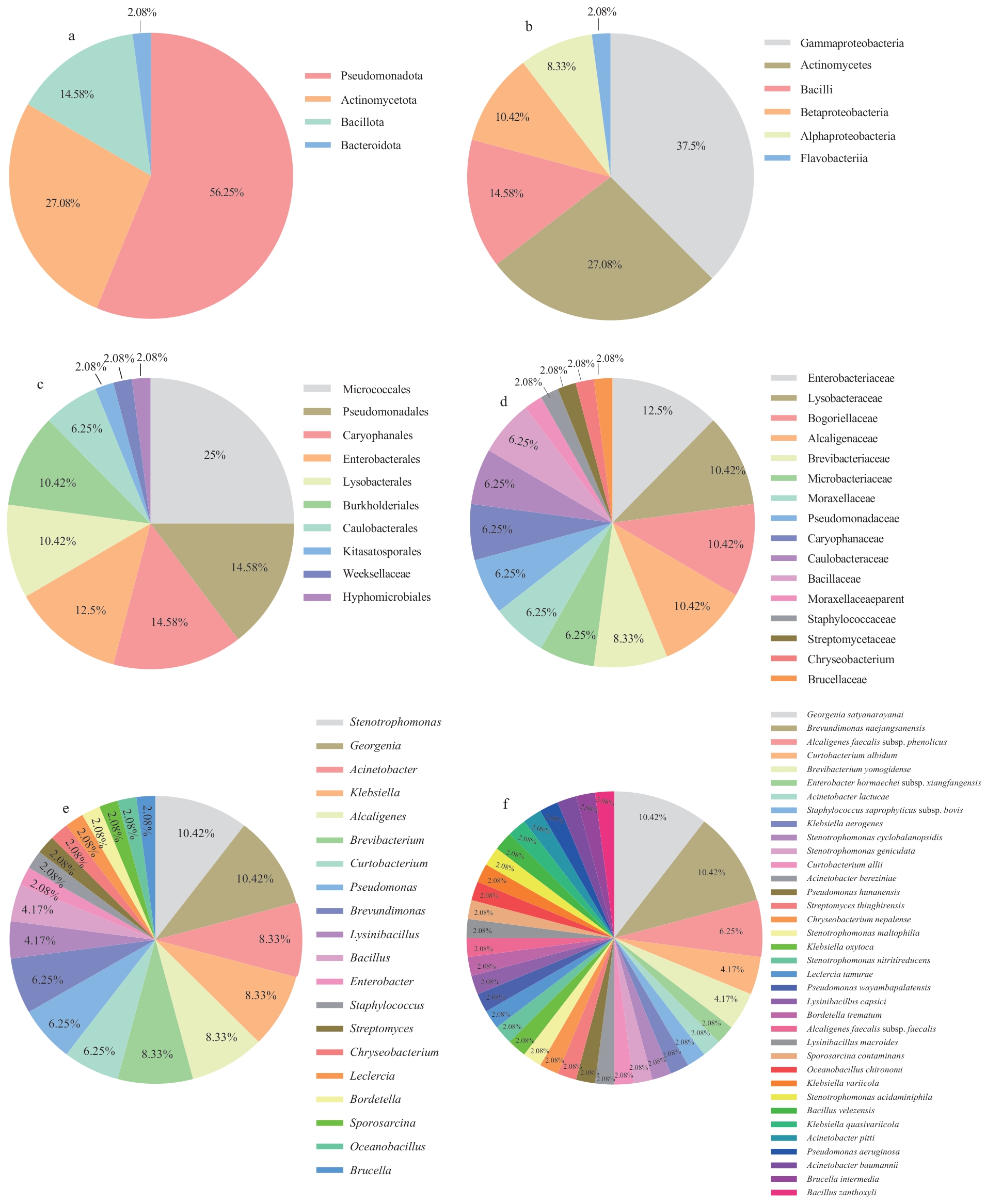
图2 筛选测序结果物种相对丰度a:门水平;b:纲水平;c:目水平;d:科水平;e:属水平;f:种水平
Fig. 2 Relative abundances of species in the screening sequencing resultsa: Phylum. b: Class. c: Order. d: Family. e: Genus. f: Species

图3 厚朴酚与和厚朴酚对照品(a)及供试品(b,c)的HPLC图
Fig. 3 HPLC diagram of magnolol and magnolol reference substances (a) and the test sample (b, c)

图4 厚朴酚、和厚朴酚标准曲线图
Fig. 4 Standard curves of magnolol and honokiol

图5 不同菌株处理厚朴后厚朴酚与和厚朴酚增长率图
Fig. 5 Growth rates of magnolol and honokiol contents in Magnolia officinalis treated with different strains
样品 Sample | 和厚朴酚峰面积 Honokiol peak area | 厚朴酚峰面积 Magnolol peak area | 和厚朴酚含量 Honokiol content (%) | 厚朴酚含量 Magnolol content (%) | 总量 Total content (%) | 平均值 Average value | 标准偏差 SD | 相对标准偏差 RSD (%) |
|---|---|---|---|---|---|---|---|---|
| Con1 | 32.3 | 403.4 | 0.142 8 | 1.792 4 | 1.935 1 | 1.928 0 | 0.006 541 | 0.339 2 |
| Con2 | 31.9 | 400.9 | 0.141 0 | 1.781 3 | 1.922 2 | |||
| Con3 | 32.6 | 401.2 | 0.144 1 | 1.782 6 | 1.926 7 |
表2 空白对照液相液相结果
Table 2 Blank control liquid chromatography results
样品 Sample | 和厚朴酚峰面积 Honokiol peak area | 厚朴酚峰面积 Magnolol peak area | 和厚朴酚含量 Honokiol content (%) | 厚朴酚含量 Magnolol content (%) | 总量 Total content (%) | 平均值 Average value | 标准偏差 SD | 相对标准偏差 RSD (%) |
|---|---|---|---|---|---|---|---|---|
| Con1 | 32.3 | 403.4 | 0.142 8 | 1.792 4 | 1.935 1 | 1.928 0 | 0.006 541 | 0.339 2 |
| Con2 | 31.9 | 400.9 | 0.141 0 | 1.781 3 | 1.922 2 | |||
| Con3 | 32.6 | 401.2 | 0.144 1 | 1.782 6 | 1.926 7 |

图6 菌株HP3的16S rRNA 进化树
Fig. 6 16S rRNA evolutionary tree of strain HP3
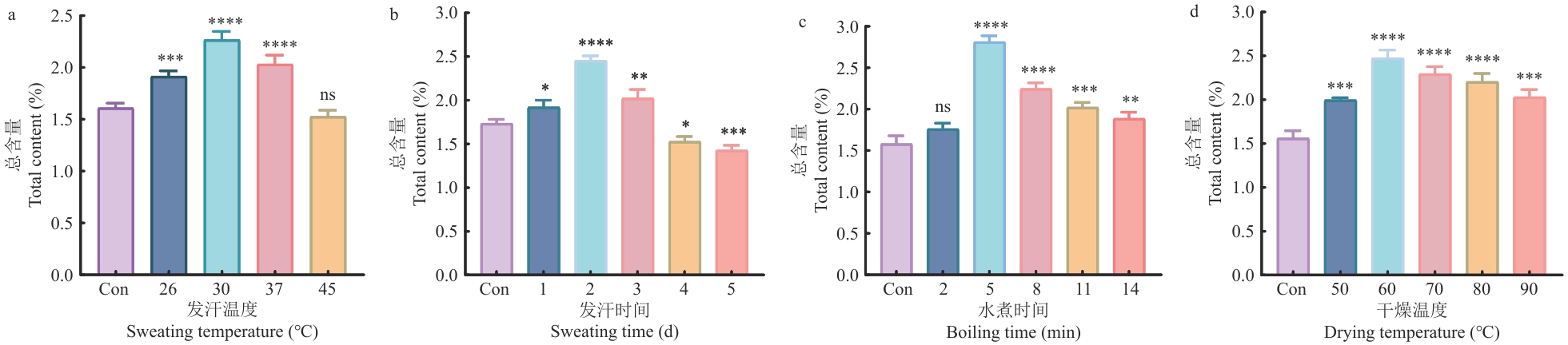
图7 各因素对厚朴酚与和厚朴酚总量的影响a:发汗温度;b:发汗时间;c:水煮时间;d:干燥温度
Fig. 7 Effects of various factors on the total contents of magnolol and honokiola: Sweating temperature; b: sweating time; c: boiling time; d: drying temperature. *P<0.05; **P<0.01; ***P<0.001; ****P<0.0001; ns: P>0.05
| 水平 Level | 因素 Factor | |||
|---|---|---|---|---|
| A (℃) | B (d) | C (min) | D (℃) | |
| -1 | 26 | 1 | 2 | 60 |
| 0 | 30 | 2 | 5 | 70 |
| 1 | 37 | 3 | 8 | 80 |
表3 菌株HP3 Box-behnken设计因素水平表
Table 3 Design factor level table of strain HP3 Box-behnken
| 水平 Level | 因素 Factor | |||
|---|---|---|---|---|
| A (℃) | B (d) | C (min) | D (℃) | |
| -1 | 26 | 1 | 2 | 60 |
| 0 | 30 | 2 | 5 | 70 |
| 1 | 37 | 3 | 8 | 80 |
编号 Number | A (℃) | B (d) | C (min) | D (℃) | HG与MG总量 Total HG and MG content (%) |
|---|---|---|---|---|---|
| 1 | 26 | 1 | 5 | 70 | 2.907 59 |
| 2 | 37 | 1 | 5 | 70 | 3.139 94 |
| 3 | 26 | 3 | 5 | 70 | 3.412 43 |
| 4 | 37 | 3 | 5 | 70 | 3.402 1 |
| 5 | 30 | 2 | 2 | 60 | 3.860 73 |
| 6 | 30 | 2 | 8 | 60 | 3.854 63 |
| 7 | 30 | 2 | 2 | 80 | 3.425 49 |
| 8 | 30 | 2 | 8 | 80 | 5.239 62 |
| 9 | 26 | 2 | 5 | 60 | 3.555 42 |
| 10 | 37 | 2 | 5 | 60 | 4.092 13 |
| 11 | 26 | 2 | 5 | 80 | 3.678 26 |
| 12 | 37 | 2 | 5 | 80 | 4.717 56 |
| 13 | 30 | 1 | 2 | 70 | 3.071 76 |
| 14 | 30 | 3 | 2 | 70 | 3.845 79 |
| 15 | 30 | 1 | 8 | 70 | 3.304 56 |
| 16 | 30 | 3 | 8 | 70 | 4.791 15 |
| 17 | 26 | 2 | 2 | 70 | 3.173 95 |
| 18 | 37 | 2 | 2 | 70 | 3.568 03 |
| 19 | 26 | 2 | 8 | 70 | 3.492 61 |
| 20 | 37 | 2 | 8 | 70 | 4.105 06 |
| 21 | 30 | 1 | 5 | 60 | 3.197 37 |
| 22 | 30 | 3 | 5 | 60 | 4.118 85 |
| 23 | 30 | 1 | 5 | 80 | 3.809 2 |
| 24 | 30 | 3 | 5 | 80 | 3.531 73 |
| 25 | 30 | 2 | 5 | 70 | 5.103 93 |
| 26 | 30 | 2 | 5 | 70 | 5.001 94 |
| 27 | 30 | 2 | 5 | 70 | 4.334 28 |
表4 响应曲面优化HG与MG总量实验设计与结果
Table 4 Experimental design and results of response surface methodology optimization for total HG and MG content
编号 Number | A (℃) | B (d) | C (min) | D (℃) | HG与MG总量 Total HG and MG content (%) |
|---|---|---|---|---|---|
| 1 | 26 | 1 | 5 | 70 | 2.907 59 |
| 2 | 37 | 1 | 5 | 70 | 3.139 94 |
| 3 | 26 | 3 | 5 | 70 | 3.412 43 |
| 4 | 37 | 3 | 5 | 70 | 3.402 1 |
| 5 | 30 | 2 | 2 | 60 | 3.860 73 |
| 6 | 30 | 2 | 8 | 60 | 3.854 63 |
| 7 | 30 | 2 | 2 | 80 | 3.425 49 |
| 8 | 30 | 2 | 8 | 80 | 5.239 62 |
| 9 | 26 | 2 | 5 | 60 | 3.555 42 |
| 10 | 37 | 2 | 5 | 60 | 4.092 13 |
| 11 | 26 | 2 | 5 | 80 | 3.678 26 |
| 12 | 37 | 2 | 5 | 80 | 4.717 56 |
| 13 | 30 | 1 | 2 | 70 | 3.071 76 |
| 14 | 30 | 3 | 2 | 70 | 3.845 79 |
| 15 | 30 | 1 | 8 | 70 | 3.304 56 |
| 16 | 30 | 3 | 8 | 70 | 4.791 15 |
| 17 | 26 | 2 | 2 | 70 | 3.173 95 |
| 18 | 37 | 2 | 2 | 70 | 3.568 03 |
| 19 | 26 | 2 | 8 | 70 | 3.492 61 |
| 20 | 37 | 2 | 8 | 70 | 4.105 06 |
| 21 | 30 | 1 | 5 | 60 | 3.197 37 |
| 22 | 30 | 3 | 5 | 60 | 4.118 85 |
| 23 | 30 | 1 | 5 | 80 | 3.809 2 |
| 24 | 30 | 3 | 5 | 80 | 3.531 73 |
| 25 | 30 | 2 | 5 | 70 | 5.103 93 |
| 26 | 30 | 2 | 5 | 70 | 5.001 94 |
| 27 | 30 | 2 | 5 | 70 | 4.334 28 |
来源 Source | 离差平方和 Sum of squared | 自由度 Freedom | 均方 Mean | F值 F value | P值 P value | 显著性 Significance |
|---|---|---|---|---|---|---|
| 模型 Model | 9.55 | 14 | 0.682 4 | 5.39 | 0.002 9 | Significant |
| A | 0.655 5 | 1 | 0.655 5 | 5.17 | 0.042 1 | Significant |
| B | 0.922 5 | 1 | 0.922 5 | 7.28 | 0.019 4 | Significant |
| C | 1.16 | 1 | 1.160 | 9.12 | 0.010 7 | Significant |
| D | 0.307 2 | 1 | 0.307 2 | 2.42 | 0.145 5 | |
| AB | 0.032 1 | 1 | 0.032 1 | 0.253 6 | 0.623 7 | |
| AC | 0.002 5 | 1 | 0.002 5 | 0.019 7 | 0.890 6 | |
| AD | 0.072 1 | 1 | 0.072 1 | 0.568 7 | 0.465 3 | |
| BC | 0.126 9 | 1 | 0.126 9 | 1.00 | 0.336 7 | |
| BD | 0.359 4 | 1 | 0.359 4 | 2.84 | 0.118 0 | |
| CD | 0.828 3 | 1 | 0.828 3 | 6.54 | 0.025 2 | Significant |
| A2 | 3.19 | 1 | 3.190 | 25.13 | 0.000 3 | Significant |
| B2 | 3.51 | 1 | 3.510 | 27.67 | 0.000 2 | Significant |
| C2 | 0.899 5 | 1 | 0.899 5 | 7.10 | 0.020 6 | Significant |
| D2 | 0.312 9 | 1 | 0.312 9 | 2.47 | 0.142 1 | |
| 残差 Residual | 1.52 | 12 | 0.126 7 | |||
| 失拟项 Lack of fit | 1.17 | 10 | 0.117 1 | 0.670 2 | 0.729 0 | Non-significant |
| 纯误差 Pure error | 0.349 5 | 2 | 0.174 8 | |||
| 总和 Total sum | 11.07 | 26 | ||||
| R2=0.862 7 | ||||||
表5 回归系数的回归分析结果
Table 5 Regression analysis results of regression coefficient
来源 Source | 离差平方和 Sum of squared | 自由度 Freedom | 均方 Mean | F值 F value | P值 P value | 显著性 Significance |
|---|---|---|---|---|---|---|
| 模型 Model | 9.55 | 14 | 0.682 4 | 5.39 | 0.002 9 | Significant |
| A | 0.655 5 | 1 | 0.655 5 | 5.17 | 0.042 1 | Significant |
| B | 0.922 5 | 1 | 0.922 5 | 7.28 | 0.019 4 | Significant |
| C | 1.16 | 1 | 1.160 | 9.12 | 0.010 7 | Significant |
| D | 0.307 2 | 1 | 0.307 2 | 2.42 | 0.145 5 | |
| AB | 0.032 1 | 1 | 0.032 1 | 0.253 6 | 0.623 7 | |
| AC | 0.002 5 | 1 | 0.002 5 | 0.019 7 | 0.890 6 | |
| AD | 0.072 1 | 1 | 0.072 1 | 0.568 7 | 0.465 3 | |
| BC | 0.126 9 | 1 | 0.126 9 | 1.00 | 0.336 7 | |
| BD | 0.359 4 | 1 | 0.359 4 | 2.84 | 0.118 0 | |
| CD | 0.828 3 | 1 | 0.828 3 | 6.54 | 0.025 2 | Significant |
| A2 | 3.19 | 1 | 3.190 | 25.13 | 0.000 3 | Significant |
| B2 | 3.51 | 1 | 3.510 | 27.67 | 0.000 2 | Significant |
| C2 | 0.899 5 | 1 | 0.899 5 | 7.10 | 0.020 6 | Significant |
| D2 | 0.312 9 | 1 | 0.312 9 | 2.47 | 0.142 1 | |
| 残差 Residual | 1.52 | 12 | 0.126 7 | |||
| 失拟项 Lack of fit | 1.17 | 10 | 0.117 1 | 0.670 2 | 0.729 0 | Non-significant |
| 纯误差 Pure error | 0.349 5 | 2 | 0.174 8 | |||
| 总和 Total sum | 11.07 | 26 | ||||
| R2=0.862 7 | ||||||

图8 发汗温度(A)、发汗时间(B)、水煮时间(C)、干燥温度(D)的交互作用
Fig. 8 Interaction effects of (A) sweating temperature, (B) sweating duration, (C) boiling time, and (D) drying temperature
样品 Sample | 和厚朴酚峰面积 Honokiol peak area | 厚朴酚峰面积 Magnolol peak area | 和厚朴酚含量 Honokiol content (%) | 厚朴酚含量 Magnolol content (%) | 总量 Total content (%) | 平均值 Average value | 标准偏差 SD | 相对标准偏差 RSD (%) |
|---|---|---|---|---|---|---|---|---|
| Y1 | 92.7 | 615.3 | 0.426 8 | 2.734 | 3.160 6 | 3.165 3 | 0.015 17 | 0.479 3 |
| Y2 | 88.5 | 621.6 | 0.391 1 | 2.761 8 | 3.153 0 | |||
| Y3 | 91.6 | 625.1 | 0.404 8 | 2.777 4 | 3.182 2 |
表6 空白对照液相液相结果
Table 6 Blank control liquid chromatography results
样品 Sample | 和厚朴酚峰面积 Honokiol peak area | 厚朴酚峰面积 Magnolol peak area | 和厚朴酚含量 Honokiol content (%) | 厚朴酚含量 Magnolol content (%) | 总量 Total content (%) | 平均值 Average value | 标准偏差 SD | 相对标准偏差 RSD (%) |
|---|---|---|---|---|---|---|---|---|
| Y1 | 92.7 | 615.3 | 0.426 8 | 2.734 | 3.160 6 | 3.165 3 | 0.015 17 | 0.479 3 |
| Y2 | 88.5 | 621.6 | 0.391 1 | 2.761 8 | 3.153 0 | |||
| Y3 | 91.6 | 625.1 | 0.404 8 | 2.777 4 | 3.182 2 |
样品 Sample | 和厚朴酚峰面积 Honokiol peak area | 厚朴酚峰面积 Magnolol peak area | 和厚朴酚含量 Honokiol content (%) | 厚朴酚含量 Magnolol content (%) | 总量 Total content (%) | 平均值 Average value | 标准偏差 SD | 相对标准偏差 RSD (%) |
|---|---|---|---|---|---|---|---|---|
| 1 | 113.5 | 999.2 | 0.522 5 | 4.439 6 | 4.962 1 | 4.986 0 | 0.020 8 | 0.417 3 |
| 2 | 117.4 | 1 008.5 | 0.518 9 | 4.480 9 | 4.999 8 | |||
| 3 | 114.9 | 1 010.2 | 0.507 8 | 4.488 4 | 4.996 3 |
表7 工艺验证结果
Table 7 Process verification results
样品 Sample | 和厚朴酚峰面积 Honokiol peak area | 厚朴酚峰面积 Magnolol peak area | 和厚朴酚含量 Honokiol content (%) | 厚朴酚含量 Magnolol content (%) | 总量 Total content (%) | 平均值 Average value | 标准偏差 SD | 相对标准偏差 RSD (%) |
|---|---|---|---|---|---|---|---|---|
| 1 | 113.5 | 999.2 | 0.522 5 | 4.439 6 | 4.962 1 | 4.986 0 | 0.020 8 | 0.417 3 |
| 2 | 117.4 | 1 008.5 | 0.518 9 | 4.480 9 | 4.999 8 | |||
| 3 | 114.9 | 1 010.2 | 0.507 8 | 4.488 4 | 4.996 3 |
| [1] | Chen YH, Huang PH, Lin FY, et al. Magnolol: a multifunctional compound isolated from the Chinese medicinal plant Magnolia officinalis [J]. Eur J Integr Med, 2011, 3(4): e317-e324. |
| [2] | Kim H, Lim CY, Chung MS. Magnolia officinalis and its honokiol and magnolol constituents inhibit human norovirus surrogates [J]. Foodborne Pathog Dis, 2021, 18(1): 24-30. |
| [3] | 国家药典委员会. 中华人民共和国药典-三部: 2020年版 [M]. 北京: 中国医药科技出版社, 2020. |
| National Pharmacopoeia Commission. People's republic of China (PRC) pharmacopoeia-part III: 2020 edition [M]. Beijing: China Medical Science Press, 2020. | |
| [4] | 贾音, 任晨曦, 夏悠楠, 等. 厚朴酚的药理作用研究现状 [J]. 生物化工, 2023, 9(3): 170-174. |
| Jia Y, Ren CX, Xia YN, et al. Research status of pharmacological action of magnolol [J]. Biol Chem Eng, 2023, 9(3): 170-174. | |
| [5] | 王颖, 陈文强, 邓百万, 等. 厚朴酚与和厚朴酚的药理作用及提取合成研究进展 [J]. 陕西理工大学学报: 自然科学版, 2018, 34(2): 58-64, 78. |
| Wang Y, Chen WQ, Deng BW, et al. Advances in pharmacological effects, extraction and synthesis of magnolol and honokiol [J]. J Shaanxi Univ Technol Nat Sci Ed, 2018, 34(2): 58-64, 78. | |
| [6] | Sarrica A, Kirika N, Romeo M, et al. Safety and toxicology of magnolol and honokiol [J]. Planta Med, 2018, 84(16): 1151-1164. |
| [7] | Xu JW, Xu H. Magnolol: chemistry and biology [J]. Ind Crops Prod, 2023, 205: 117493. |
| [8] | Sciacca C, Cardullo N, Pulvirenti L, et al. Evaluation of honokiol, magnolol and of a library of new nitrogenated neolignans as pancreatic lipase inhibitors [J]. Bioorg Chem, 2023, 134: 106455. |
| [9] | Yuan Y, Zhou XC, Wang YY, et al. Cardiovascular modulating effects of magnolol and honokiol, two polyphenolic compounds from traditional Chinese medicine-Magnolia officinalis [J]. Curr Drug Targets, 2020, 21(6): 559-572. |
| [10] | Ranaware AM, Banik K, Deshpande V, et al. Magnolol: a neolignan from the Magnolia family for the prevention and treatment of cancer [J]. Int J Mol Sci, 2018, 19(8): 2362. |
| [11] | Yu CP, Li PY, Chen SY, et al. Magnolol and honokiol inhibited the function and expression of BCRP with mechanism exploration [J]. Molecules, 2021, 26(23): 7390. |
| [12] | Lovecká P, Svobodová A, Macůrková A, et al. Decorative Magnolia plants: a comparison of the content of their biologically active components showing antimicrobial effects [J]. Plants, 2020, 9(7): 879. |
| [13] | Stefanache A, Ignat M, Peptu C, et al. Development of a prolonged-release drug delivery system with magnolol loaded in amino-functionalized mesoporous silica [J]. Appl Sci, 2017, 7(3): 237. |
| [14] | Konoshima T, Kozuka M, Tokuda H, et al. Studies on inhibitors of skin tumor promotion, IX. Neolignans from Magnolia officinalis [J]. J Nat Prod, 1991, 54(3): 816-822. |
| [15] | Wang LQ, Wang D, Yuan SZ, et al. Transcriptomic insights into the antifungal effects of magnolol on the growth and mycotoxin production of Alternaria alternata [J]. Toxins, 2020, 12(10): 665. |
| [16] | Cai XY, Jiang XQ, Zhao M, et al. Identification of the target protein and molecular mechanism of honokiol in anti-inflammatory action [J]. Phytomedicine, 2023, 109: 154617. |
| [17] | Lü JL, Zhao J, Duan JN, et al. Quality evaluation of Angelica sinensis by simultaneous determination of ten compounds using LC-PDA [J]. Chromatographia, 2009, 70(3): 455-465. |
| [18] | 李亚霏, 杜伟锋, 姜东京, 等. 续断产地加工“发汗” 前后总皂苷及常春藤皂苷元的含量测定 [J]. 甘肃中医药大学学报, 2016, 33(2): 51-54. |
| Li YF, Du WF, Jiang DJ, et al. Content determination of total saponins and hederagenin in Radix dipsaci before and after processing [J]. J Gansu Univ Chin Med, 2016, 33(2): 51-54. | |
| [19] | 刘畅, 王潇, 刘芳, 等. “发汗” 前后厚朴质量标志物的预测分析 [J]. 中国中药杂志, 2021, 46(11): 2686-2690. |
| Liu C, Wang X, Liu F, et al. Q-marker prediction of Magnoliae Officinalis Cortex before and after “sweating” [J]. China J Chin Mater Med, 2021, 46(11): 2686-2690. | |
| [20] | 陈佩东, 薛露, 严辉, 等. 厚朴“发汗” 工艺的研究 [J]. 中成药, 2015, 37(11): 2469-2472. |
| Chen PD, Xue L, Yan H, et al. “Fahan” technology of Magnolia officinalis [J]. Chin Tradit Pat Med, 2015, 37(11): 2469-2472. | |
| [21] | 刘芳, 卫莹芳, 胡慧玲. 厚朴“发汗”的研究现状与思考 [J]. 实用医院临床杂志, 2013, 10(3): 191-192. |
| Liu F, Wei YF, Hu HL. Research states and thinking on sweating process for Magnolia officinalis [J]. Pract J Clin Med, 2013, 10(3): 191-192. | |
| [22] | 杨红兵, 詹亚华, 陈科力, 等. 发汗与去皮对厚朴中酚类成分含量的影响 [J]. 中药材, 2007, 30(1): 22-23. |
| Yang HB, Zhan YH, Chen KL, et al. Effects of sweating and peeling on the content of phenolic compounds in Magnolia officinalis [J]. J Chin Med Mater, 2007, 30(1): 22-23. | |
| [23] | 余盛贤, 张春霞, 陈承瑜, 等. “发汗” 对厚朴质量的影响 [J]. 中国中药杂志, 2010, 35(14): 1831-1835. |
| Yu SX, Zhang CX, Chen CY, et al. Effects of primary processing on quality of cortex Magnolia officinalis [J]. China J Chin Mater Med, 2010, 35(14): 1831-1835. | |
| [24] | 刘畅, 王潇, 刘芳, 等. 基于多指标质量差异关键属性优化厚朴产地加工“发汗”工艺 [J]. 中草药, 2021, 52(3): 677-684. |
| Liu C, Wang X, Liu F, et al. Optimization of “sweating” process in producing area for Magnoliae Officinalis Cortex based on multi-index determinant attributes of quality difference [J]. Chin Tradit Herb Drugs, 2021, 52(3): 677-684. | |
| [25] | 朱林峰, 张媛, 冯紫薇, 等. “发汗”对厚朴药材质量影响的研究及其工艺的建立 [J]. 中国现代中药, 2019, 21(11): 1551-1556, 1563. |
| Zhu LF, Zhang Y, Feng ZW, et al. Effect of primary processing method “Sweating” on quality of cortex magnoliae officinals [J]. Mod Chin Med, 2019, 21(11): 1551-1556, 1563. | |
| [26] | Wu Q, Wei D, Dong LL, et al. Variation in the microbial community contributes to the improvement of the main active compounds of Magnolia officinalis Rehd. et Wils in the process of sweating [J]. Chin Med, 2019, 14: 45. |
| [27] | 朱兴龙, 卢丽洁, 吴清华, 等. 基于成分变化研究厚朴“发汗”过程中颜色与酶促反应的关系 [J]. 中国中药杂志, 2022, 47(5): 1262-1272. |
| Zhu XL, Lu LJ, Wu QH, et al. Composition changes reveal relationship between color and enzymaticreaction of Magnoliae Officinalis Cortex during “sweating” process [J]. China J Chin Mater Med, 2022, 47(5): 1262-1272. | |
| [28] | 李玉平, 严春兰, 骆进程, 等. 中药厚朴发汗过程中微生物群落结构及特征的分析 [J]. 云南中医中药杂志, 2022, 43(7):78-84. |
| Li YP, Yan CL, Luo JC, et al. Analysis of the Microbial Community structure and Characteristics during the Sweating Process of the Traditional Chinese medicine Magnolia Officinalis [J]. Yunnan Journal of Traditional Chinese Medicine and Materia Medica, 2022, 43(7):78-84. | |
| [29] | 张佳旭, 黄成凤, 朱兴龙, 等. 基于CRITIC结合Box-Behnken响应面法的厚朴产地趁鲜加工与炮制一体化工艺研究 [J]. 中草药, 2023, 54(17): 5560-5567. |
| Zhang JX, Huang CF, Zhu XL, et al. Research on integration of fresh processing and processing process of Magnolia officinalis origin based on CRITIC combined with Box-Behnken responsesurface method [J]. Chin Tradit Herb Drugs, 2023, 54(17): 5560-5567. | |
| [30] | 陈茹, 陈成, 杨兴鑫, 等. 中药“发汗”炮制法的现代研究进展 [J]. 中草药, 2018, 49(2): 489-493. |
| Chen R, Chen C, Yang XX, et al. Modern research progress of Chinese materia Medica diaphoretic processing method [J]. Chin Tradit Herb Drugs, 2018, 49(2): 489-493. | |
| [31] | 王晓宇, 张松林, 王颖, 等. 基于高通量测序中江丹参“发汗”过程中优势微生物群落与主要药效成分相关性研究 [J]. 中草药, 2024, 55(2): 420-433. |
| Wang XY, Zhang SL, Wang Y, et al. Correlation between dominant microbial communities and major medicinal compositions in Salvia miltiorrhiza from Zhongjiang processed by “sweating” based on high-throughput sequencing [J]. Chin Tradit Herb Drugs, 2024, 55(2): 420-433. | |
| [32] | 周旭香, 田家瑛, 陈漂洋, 等. 基于“饮片-标准汤剂-药效”探讨“发汗”对茯苓质量的影响 [J]. 中草药, 2025, 56(7): 2330-2343. |
| Zhou XX, Tian JY, Chen PY, et al. Exploring effect of “sweating” on quality of Poria based on “decoction piecestandard decoction-efficacy” [J]. Chin Tradit Herb Drugs, 2025, 56(7): 2330-2343. | |
| [33] | 魏担, 吴清华, 刘钰萍, 等. 基于高通量测序研究厚朴“发汗” 过程中微生物群落多样性及其特征 [J]. 中国中药杂志, 2019, 44(24): 5405-5412. |
| Wei D, Wu QH, Liu YP, et al. Microbial community diversity and its characteristics in Magnolia Officinalis Cortex “sweating” process based on high-throughput sequencing [J]. China J Chin Mater Med, 2019, 44(24): 5405-5412. | |
| [34] | Shi XD, Yang LS, Gao JH, et al. Deep sequencing of Magnoliae officinalis reveals upstream genes related to the lignan biosynthetic pathway [J]. J For Res, 2017, 28(4): 671-681. |
| [35] | Yang Y, Li ZH, Zong H, et al. Identification and validation of magnolol biosynthesis genes in Magnolia officinalis [J]. Molecules, 2024, 29(3): 587. |
| [1] | 项波卡, 周钻钻, 冯佳卉, 夏琛, 李奇, 陈春. 一株烟叶霉变真菌的分离鉴定及其致霉因素研究[J]. 生物技术通报, 2025, 41(2): 321-330. |
| [2] | 张亚亚, 李盼盼, 高惠惠, 贾晨波, 徐春燕. 基于根表真菌群落与病原菌鉴定探究‘宁杞5号’枸杞根腐病的发生机制[J]. 生物技术通报, 2024, 40(9): 238-248. |
| [3] | 王芳, 于璐, 齐泽铮, 周长军, 于吉东. 大豆镰刀菌根腐病拮抗菌的筛选及生防效果[J]. 生物技术通报, 2024, 40(7): 216-225. |
| [4] | 王璐, 刘梦雨, 张富源, 纪守坤, 王云, 张英杰, 段春辉, 刘月琴, 严慧. 瘤胃源粪臭素降解菌的分离鉴定及其降解特性研究[J]. 生物技术通报, 2024, 40(3): 305-311. |
| [5] | 饶紫环, 谢志雄. 一株Olivibacter jilunii 纤维素降解菌株的分离鉴定与降解能力分析[J]. 生物技术通报, 2023, 39(8): 283-290. |
| [6] | 游子娟, 陈汉林, 邓辅财. 鱼皮生物活性肽的提取及功能活性研究进展[J]. 生物技术通报, 2023, 39(7): 91-104. |
| [7] | 车永梅, 郭艳苹, 刘广超, 叶青, 李雅华, 赵方贵, 刘新. 菌株C8和B4的分离鉴定及其耐盐促生效果和机制[J]. 生物技术通报, 2023, 39(5): 276-285. |
| [8] | 王凤婷, 王岩, 孙颖, 崔文婧, 乔凯彬, 潘洪玉, 刘金亮. 耐盐碱土曲霉SYAT-1的分离鉴定及抑制植物病原真菌特性研究[J]. 生物技术通报, 2023, 39(2): 203-210. |
| [9] | 李莹, 宋新颖, 何康, 郭志青, 于静, 张霞. 贝莱斯芽孢杆菌ZHX-7的分离鉴定及抑菌促生效果[J]. 生物技术通报, 2023, 39(12): 229-236. |
| [10] | 董怡华, 王凌潇, 任涵雪, 陈峰. 一株耐低温异养硝化-好氧反硝化菌的分离鉴定及其脱氮特性[J]. 生物技术通报, 2023, 39(12): 237-249. |
| [11] | 祖雪, 周瑚, 朱华珺, 任佐华, 刘二明. 枯草芽孢杆菌K-268的分离鉴定及对水稻稻瘟病的防病效果[J]. 生物技术通报, 2022, 38(6): 136-146. |
| [12] | 王春艳, 腊贵晓, 苏秀红, 李萌, 董诚明. 地黄不同时期内生促生细菌的筛选及其促生特性分析[J]. 生物技术通报, 2022, 38(4): 242-252. |
| [13] | 张功友, 王一涵, 郭敏, 张婷婷, 王兵, 刘红美. 重楼中一株产纤维素酶内生真菌的分离及鉴定[J]. 生物技术通报, 2022, 38(2): 95-104. |
| [14] | 牛鸿宇, 舒倩, 杨海君, 颜智勇, 谭菊. 一株十二烷基硫酸钠高效降解菌的分离鉴定、降解特性及代谢途径研究[J]. 生物技术通报, 2022, 38(12): 287-299. |
| [15] | 崔欣雨, 李荣荣, 蔡瑞, 王妍, 郑猛虎, 徐春城. 苜蓿青贮中乳酸降解菌的分离、鉴定及降解性能研究[J]. 生物技术通报, 2021, 37(9): 58-67. |
| 阅读次数 | ||||||
|
全文 |
|
|||||
|
摘要 |
|
|||||
