







生物技术通报 ›› 2026, Vol. 42 ›› Issue (8): 60-71.doi: 10.13560/j.cnki.biotech.bull.1985.2025-1088
扶超, 黎育颖, 侯振平( ), 石鹏君
收稿日期:2025-10-16
出版日期:2026-08-26
发布日期:2026-08-17
通讯作者:
侯振平houzhenping@caas.cn基金资助:
FU Chao, LI Yu-ying, HOU Zhen-ping(), SHI Peng-jun
Received:2025-10-16
Published:2026-08-26
Online:2026-08-17
摘要:
青贮是畜牧业青绿饲料保存的核心技术,其品质直接决定反刍动物的生产性能。芽胞杆菌作为青贮添加剂,可通过调控微生物群落结构,促进有机酸积累并抑制腐败菌繁殖,进而改善青贮发酵品质。枯草芽胞杆菌(Bacillus subtilis, BS)与地衣芽胞杆菌(Bacillus licheniformis, BL)是当前青贮领域应用最广泛的两种芽胞杆菌,但二者应用效果存在显著差异。本文系统综述了BS与BL在青贮饲料生产中的应用特性,从生物学特性、作用机制、发酵效果、原料适应性及实际应用等方面开展对比分析,并整合分析二者在相同试验条件下的研究数据。结果表明,BS在快速降低青贮体系pH值、降解非结构性碳水化合物及分泌高活性蛋白酶等方面优势显著;BL则在提升青贮有氧稳定性、抑制霉菌毒素及降解结构性碳水化合物方面表现更优。二者协同应用可实现功能互补,显著提升青贮品质并降低生产成本。本文可为青贮添加剂的科学选择与高效应用提供坚实理论依据。
扶超, 黎育颖, 侯振平, 石鹏君. 枯草芽胞杆菌与地衣芽胞杆菌在青贮中的不同作用及应用研究进展[J]. 生物技术通报, 2026, 42(8): 60-71.
FU Chao, LI Yu-ying, HOU Zhen-ping, SHI Peng-jun. Research Progress on the Diverse Functions and Application of Bacillus subtilis and Bacillus licheniformis in Silage[J]. Biotechnology Bulletin, 2026, 42(8): 60-71.
生物学特性指标 Biological characteristic indicators | 枯草芽胞杆菌 Bacillus subtilis (BS) | 地衣芽胞杆菌 Bacillus licheniformis (BL) | 数据来源 Data reference |
|---|---|---|---|
| 代谢类型 | 严格好氧菌 | 兼性厌氧菌 | [ |
| 最适生长温度 | 37 ℃ | 45 ℃ | [ |
| pH耐受范围 | 6.0-7.5 | 5.0-9.0 | [ |
| pH 5.0条件下存活率 | 45% | 78% | [ |
| 2%接种量下蛋白酶活性(U/mL) | 87.19 | 29.07 | [ |
| 2%接种量下淀粉酶活性(U/mL) | 685.13 | 57.59 | [ |
| 纤维素酶活性(U/mL) | 12.52 | 12.00 | [ |
| 黄曲霉毒素B1降解率 | 40% | 94.7% | [ |
| 核心优势底物降解类型 | 非结构性碳水化合物、蛋白质、脂肪等 | 结构性碳水化合物(纤维素、半纤维素等) | [ |
表1 枯草芽胞杆菌与地衣芽胞杆菌生物学特性比较
Table 1 Comparison of biological characteristics between Bacillus subtilis and Bacillus licheniformis
生物学特性指标 Biological characteristic indicators | 枯草芽胞杆菌 Bacillus subtilis (BS) | 地衣芽胞杆菌 Bacillus licheniformis (BL) | 数据来源 Data reference |
|---|---|---|---|
| 代谢类型 | 严格好氧菌 | 兼性厌氧菌 | [ |
| 最适生长温度 | 37 ℃ | 45 ℃ | [ |
| pH耐受范围 | 6.0-7.5 | 5.0-9.0 | [ |
| pH 5.0条件下存活率 | 45% | 78% | [ |
| 2%接种量下蛋白酶活性(U/mL) | 87.19 | 29.07 | [ |
| 2%接种量下淀粉酶活性(U/mL) | 685.13 | 57.59 | [ |
| 纤维素酶活性(U/mL) | 12.52 | 12.00 | [ |
| 黄曲霉毒素B1降解率 | 40% | 94.7% | [ |
| 核心优势底物降解类型 | 非结构性碳水化合物、蛋白质、脂肪等 | 结构性碳水化合物(纤维素、半纤维素等) | [ |
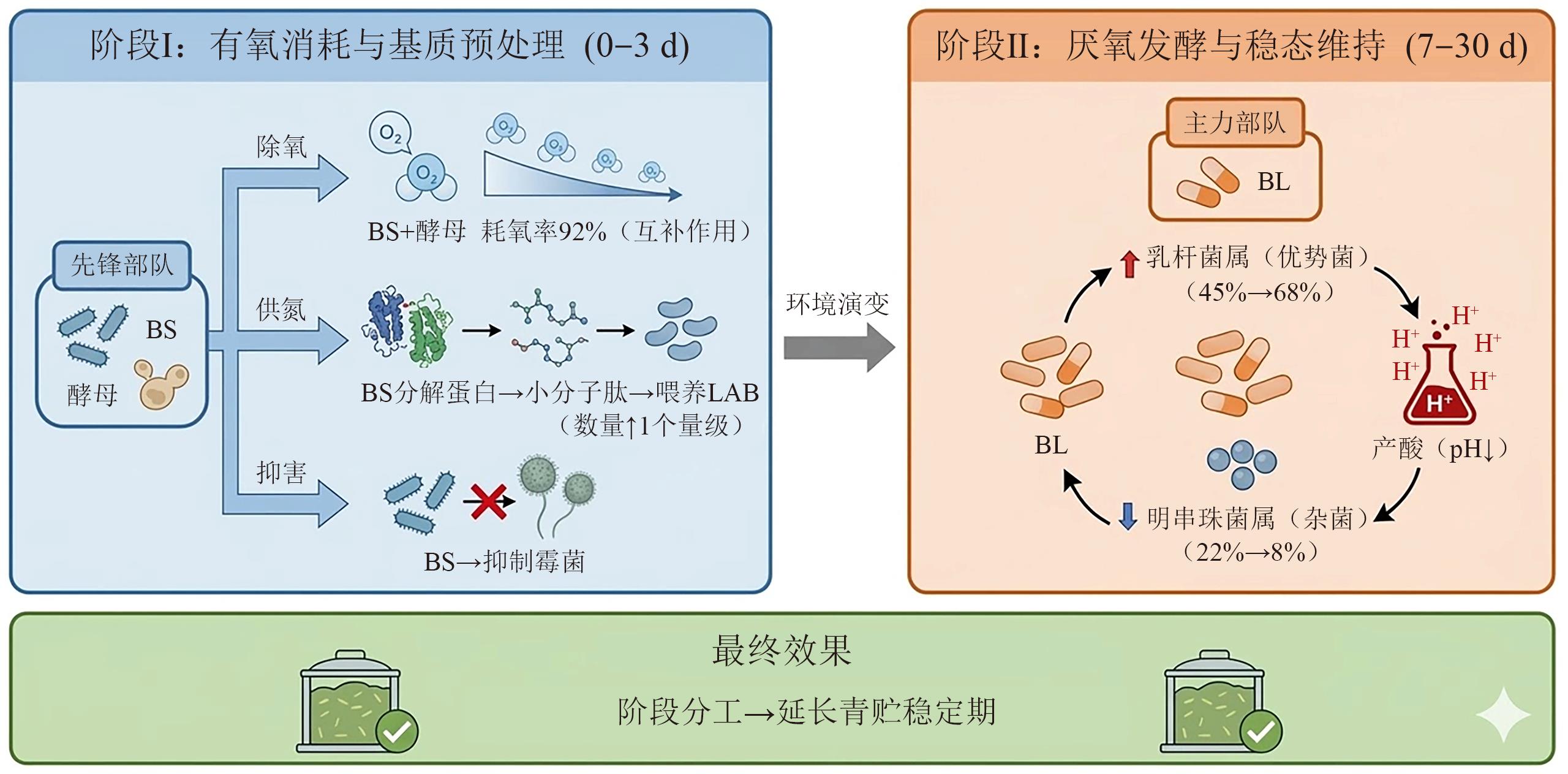
图1 青贮中枯草芽胞杆菌与地衣芽胞杆菌的群落调控阶段
Fig. 1 Community regulation phase of B. subtilis and B. licheniformis in silage
发酵品质指标 Fermentation quality indicators | 枯草芽胞杆菌 Bacillus subtilis (BS) | 地衣芽胞杆菌 Bacillus licheniformis (BL) | 试验条件 Test conditions | 数据来源 Data reference |
|---|---|---|---|---|
| pH降至4.2以下所需时间 | 3 d内 | 5-7 d内 | 玉米青贮/桑叶青贮 | [ |
| 乳酸含量提升幅度 | 24.38%-25.00% | 15%-20% | 玉米秸秆青贮 | [ |
| 乙酸含量提升幅度 | 24.38%-25.00% | 292.87%-338.52% | 玉米秸秆青贮 | [ |
| NH3/TN值降低幅度 | 10.62%-14.74% | 降至8%-12% | 玉米秸秆青贮 | [ |
| 有氧稳定性 | 9-21 d | 14-21 d | 玉米秸秆/全株玉米青贮 | [ |
| 有氧暴露14 d pH上升值 | 较高(pH>5) | 仅上升0.3 | 玉米秸秆/全株玉米青贮 | [ |
表2 相同试验条件下的枯草芽胞杆菌与地衣芽胞杆菌发酵品质关键指标对比
Table 2 Comparison of key fermentation quality indicators between B. subtilis and B. licheniformis under the same experimental conditions
发酵品质指标 Fermentation quality indicators | 枯草芽胞杆菌 Bacillus subtilis (BS) | 地衣芽胞杆菌 Bacillus licheniformis (BL) | 试验条件 Test conditions | 数据来源 Data reference |
|---|---|---|---|---|
| pH降至4.2以下所需时间 | 3 d内 | 5-7 d内 | 玉米青贮/桑叶青贮 | [ |
| 乳酸含量提升幅度 | 24.38%-25.00% | 15%-20% | 玉米秸秆青贮 | [ |
| 乙酸含量提升幅度 | 24.38%-25.00% | 292.87%-338.52% | 玉米秸秆青贮 | [ |
| NH3/TN值降低幅度 | 10.62%-14.74% | 降至8%-12% | 玉米秸秆青贮 | [ |
| 有氧稳定性 | 9-21 d | 14-21 d | 玉米秸秆/全株玉米青贮 | [ |
| 有氧暴露14 d pH上升值 | 较高(pH>5) | 仅上升0.3 | 玉米秸秆/全株玉米青贮 | [ |
联用组合 Combined use | 研究对象 Research subject | 核心效果 Core effects | 数据来源 Data reference |
|---|---|---|---|
| BS+LP+LB | 辣木青贮 | 利于乳酸积累,提高自由基清除率,保留较多CP,降解更多CF和单宁 | [ |
| BS+LP+黑曲霉 | 柠条青贮 | 显著提高CP含量,半纤维素和木质纤维素降解率分别达4.97%和21.15%,提高体外消化率,优化微生物菌群结构 | [ |
| BL+LP | 稻草(微贮) | 显著降低pH值,提高OMD和ME,增加乳酸杆菌属、酵母菌属相对丰度,降低明串珠菌属、魏斯氏菌属、泛菌属相对丰度 | [ |
| LP+BS | 玉米青贮 | 显著提高饲料NDF消化率、DM采食量及肉羊生长性能,提高瘤胃VFA浓度,降低瘤胃pH | [ |
| CT+BS+LB | 甘蔗尾青贮 | 乙酸含量显著上升,DMR显著降低,CP含量和有氧稳定性显著升高 | [ |
表3 枯草芽胞杆菌、地衣芽胞杆菌与其他菌制剂协同效应相关研究
Table 3 Related studies on synergistic effects of B. subtilis, B. licheniformis, and other bacterial preparations
联用组合 Combined use | 研究对象 Research subject | 核心效果 Core effects | 数据来源 Data reference |
|---|---|---|---|
| BS+LP+LB | 辣木青贮 | 利于乳酸积累,提高自由基清除率,保留较多CP,降解更多CF和单宁 | [ |
| BS+LP+黑曲霉 | 柠条青贮 | 显著提高CP含量,半纤维素和木质纤维素降解率分别达4.97%和21.15%,提高体外消化率,优化微生物菌群结构 | [ |
| BL+LP | 稻草(微贮) | 显著降低pH值,提高OMD和ME,增加乳酸杆菌属、酵母菌属相对丰度,降低明串珠菌属、魏斯氏菌属、泛菌属相对丰度 | [ |
| LP+BS | 玉米青贮 | 显著提高饲料NDF消化率、DM采食量及肉羊生长性能,提高瘤胃VFA浓度,降低瘤胃pH | [ |
| CT+BS+LB | 甘蔗尾青贮 | 乙酸含量显著上升,DMR显著降低,CP含量和有氧稳定性显著升高 | [ |
联用组合 Combined use | 研究对象 Research subject | 核心效果 Core effects | 数据来源 Data reference |
|---|---|---|---|
| 复合菌(BS、乳杆菌)+外源复合酶(纤维素酶、半纤维素酶、漆酶复合酶等) | 水稻秸秆 | 显著降低秸秆青贮中NDF、ADF含量;提高各挥发性脂肪酸和总挥发性脂肪酸含量 | [ |
| 复合菌(BS、LP、黑曲霉)+糖蜜或纤维素酶 | 玉米秸秆 | 显著提高青贮CP、Ash、NDF、ADF含量,菌酶协同处理组NH3-N和乙酸含量最高,芽胞杆菌相对丰度最高 | [ |
| BL+LP+假丝酵母菌+葡萄糖氧化酶 | 玉米秸秆 | 提高DM、CP、钙等营养成分含量,降低CF、NDF、ADF含量,促进纤维降解,改善瘤胃微生物环境,提高营养物质消化率 | [ |
| 纤维素酶+复合益生菌(酵母菌、BS、乳酸菌)(酶菌比例8:20最佳) | 荞麦秸秆、稻草、苜蓿干草混合粗饲料 | 极显著降低NDF和ADF含量,增加酵母菌、乳酸菌数量,减少霉菌和AFB1,改善滩羊瘤胃发酵参数和微生物环境,促进消化吸收 | [ |
| BS+LP+纤维素酶 | 甜高粱 | 显著提高甜高粱青贮的感官评定总分及CP含量,显著降低NDF含量 | [ |
表4 枯草芽胞杆菌、地衣芽胞杆菌与酶(菌)制剂协同效应相关研究
Table 4 Related researches on the synergistic effects of B. subtilis, B. licheniformis and enzyme (bacterial) preparations
联用组合 Combined use | 研究对象 Research subject | 核心效果 Core effects | 数据来源 Data reference |
|---|---|---|---|
| 复合菌(BS、乳杆菌)+外源复合酶(纤维素酶、半纤维素酶、漆酶复合酶等) | 水稻秸秆 | 显著降低秸秆青贮中NDF、ADF含量;提高各挥发性脂肪酸和总挥发性脂肪酸含量 | [ |
| 复合菌(BS、LP、黑曲霉)+糖蜜或纤维素酶 | 玉米秸秆 | 显著提高青贮CP、Ash、NDF、ADF含量,菌酶协同处理组NH3-N和乙酸含量最高,芽胞杆菌相对丰度最高 | [ |
| BL+LP+假丝酵母菌+葡萄糖氧化酶 | 玉米秸秆 | 提高DM、CP、钙等营养成分含量,降低CF、NDF、ADF含量,促进纤维降解,改善瘤胃微生物环境,提高营养物质消化率 | [ |
| 纤维素酶+复合益生菌(酵母菌、BS、乳酸菌)(酶菌比例8:20最佳) | 荞麦秸秆、稻草、苜蓿干草混合粗饲料 | 极显著降低NDF和ADF含量,增加酵母菌、乳酸菌数量,减少霉菌和AFB1,改善滩羊瘤胃发酵参数和微生物环境,促进消化吸收 | [ |
| BS+LP+纤维素酶 | 甜高粱 | 显著提高甜高粱青贮的感官评定总分及CP含量,显著降低NDF含量 | [ |
| [1] | 王田田. 单独或混合添加不同乳酸菌与枯草芽胞杆菌对辣木青贮发酵品质的动态变化影响 [D]. 南宁: 广西大学, 2020. |
| Wang TT. Effects of different Lactobacillus and Bacillus subtilis on the silage fermentation quality [D]. Nanning: Guangxi University, 2020. | |
| [2] | Bai J, Ding ZT, Ke WC, et al. Different lactic acid bacteria and their combinations regulated the fermentation process of ensiled alfalfa: ensiling characteristics, dynamics of bacterial community and their functional shifts [J]. Microb Biotechnol, 2021, 14(3): 1171-1182. |
| [3] | 宋琦, 王茜. 不同微生物添加剂对构树青贮感官评分、营养成分、发酵品质及有氧稳定性的影响 [J]. 饲料研究, 2025, 48(8): 122-126. |
| Song Q, Wang X. Effects of different microbial additives on sensory score, nutritional components, fermentation quality, and aerobic stability of Broussonetia papyrifera silage [J]. Feed Res, 2025, 48(8): 122-126. | |
| [4] | 任永军, 雷岷, 邝良德, 等. 复合芽胞杆菌制剂对肉兔肠道发育和免疫功能的影响 [J]. 动物营养学报, 2014, 26(1): 144-152. |
| Ren YJ, Lei M, Kuang LD, et al. A composite Bacillus preparation: effects on intestinal development and immune function of meat rabbits [J]. Chin J Anim Nutr, 2014, 26(1): 144-152. | |
| [5] | 赵佳霓, 岳淑英, 罗正, 等. 枯草芽胞杆菌PB6制剂对产蛋后期蛋鸡生产性能、蛋品质、抗氧化能力和肠道菌群的影响 [J]. 中国畜牧杂志, 2024, 60(6): 298-302. |
| Zhao JN, Yue SY, Luo Z, et al. Effects of Bacillus subtilis PB6 preparation on production performance, egg quality, antioxidant capacity and intestinal flora of laying hens in late laying period [J]. Chin J Anim Sci, 2024, 60(6): 298-302. | |
| [6] | 张关锋, 杨泰, 宋先凡, 等. 枯草芽胞杆菌的生理功能及其在畜禽生产中的应用 [J]. 中国畜牧兽医, 2024, 51(4): 1511-1519. |
| Zhang GF, Yang T, Song XF, et al. Physiological functions of Bacillus subtilis and its application in livestock and poultry production [J]. China Anim Husb Vet Med, 2024, 51(4): 1511-1519. | |
| [7] | 彭文文, 张美婷, 徐灏铖, 等. 地衣芽胞杆菌对大肠杆菌攻毒感染肉鸡免疫、抗氧化性能和肠道健康的影响 [J]. 畜牧兽医学报, 2025, 56(7): 3344-3356. |
| Peng WW, Zhang MT, Xu HC, et al. Effects of Bacillus licheniformis on immunity, antioxidant performance and intestinal health of broiler chickens challenged by Escherichia coli [J]. Acta Vet Zootechnica Sin, 2025, 56(7): 3344-3356. | |
| [8] | Lastochkina O, Pusenkova L, Garshina D, et al. The effect of endophytic bacteria Bacillus subtilis and salicylic acid on some resistance and quality traits of stored Solanum tuberosum L. tubers infected with Fusarium Dry rot [J]. Plants, 2020, 9(6): 738. |
| [9] | 韩雪林, 张磊, 张娟, 等. 枯草芽胞杆菌在青贮饲料中的应用 [J]. 家畜生态学报, 2023, 44(11): 81-86. |
| Han XL, Zhang L, Zhang J, et al. Application of Bacillus subtilis in silage [J]. Acta Ecol Animalis Domastici, 2023, 44(11): 81-86. | |
| [10] | 王睿, 何金童, 程雨辰, 等. 地衣芽胞杆菌对玉米青贮发酵品质的调控研究 [J]. 中国畜牧兽医, 2025, 52(3): 1070-1079. |
| Wang R, He JT, Cheng YC, et al. Study on regulating the fermentaiton quality of corn silage by Bacillus licheniformis [J]. China Anim Husb Vet Med, 2025, 52(3): 1070-1079. | |
| [11] | Kovács ÁT. Bacillus subtilis [J]. Trends Microbiol, 2019, 27(8): 724-725. |
| [12] | Dai CH, Hou YZ, Xu HN, et al. Effect of solid-state fermentation by three different Bacillus species on composition and protein structure of soybean meal [J]. J Sci Food Agric, 2022, 102(2): 557-566. |
| [13] | 王欣宇. 地衣、枯草芽胞杆菌产酶能力分析及在辣木叶发酵中的应用 [D]. 广州: 华南农业大学, 2018. |
| Wang XY. Enzyme production capacity of Bacillus licheniformis and Bacillus subtilis and its application in the fermentation of Moringa oleifera leaves [D]. Guangzhou: South China Agricultural University, 2018. | |
| [14] | Khota W, Pholsen S, Higgs D, et al. Natural lactic acid bacteria population of tropical grasses and their fermentation factor analysis of silage prepared with cellulase and inoculant [J]. J Dairy Sci, 2016, 99(12): 9768-9781. |
| [15] | Li DX, Ni KK, Zhang YC, et al. Influence of lactic acid bacteria, cellulase, cellulase-producing Bacillus pumilus and their combinations on alfalfa silage quality [J]. J Integr Agric, 2018, 17(12): 2768-2782. |
| [16] | 付雪, 张启航, 刘周靓, 等. 枯草芽胞杆菌在动物生产中的应用与作用机制 [J]. 饲料研究, 2024, 47(8): 150-155. |
| Fu X, Zhang QH, Liu ZL, et al. Application and mechanism of Bacillus subtilis in animal production [J]. Feed Res, 2024, 47(8): 150-155. | |
| [17] | Rabelo CHS, Valente ALS, Barbero RP, et al. Performance of finishing beef cattle fed diets containing maize silages inoculated with lactic-acid bacteria and Bacillus subtilis [J]. Anim Prod Sci, 2019, 59(2): 266-276. |
| [18] | 高传庆, 潘康成, 张钧利. 饲用枯草芽胞杆菌的研究及应用 [C]//第四届第十次全国学术研讨会暨动物微生态企业发展战略论坛论文集. 沧州, 2010: 44-48. |
| Gao CQ, Pan KC, Zhang JL. Research and application of feed grade Bacillus subtilis [C]// Proceedings of the 10th National Academic Symposium of the 4th session and the forum on the development strategy of animal microecological enterprises. Changzhou, 2010: 44-48. | |
| [19] | 白海, 刘丽敏, 张效生, 等. 枯草芽胞杆菌在反刍动物生产中的应用研究进展 [J]. 中国饲料, 2020(9): 26-29. |
| Bai H, Liu LM, Zhang XS, et al. Research progress on application of Bacillus subtilis in ruminants production [J]. China Feed, 2020(9): 26-29. | |
| [20] | Yeoman CJ, Chia N, Jeraldo P, et al. The microbiome of the chicken gastrointestinal tract [J]. Anim Health Res Rev, 2012, 13(1): 89-99. |
| [21] | Bai J, Franco M, Ding ZT, et al. Effect of Bacillus amyloliquefaciens and Bacillus subtilis on fermentation, dynamics of bacterial community and their functional shifts of whole-plant corn silage [J]. J Animal Sci Biotechnol, 2022, 13: 7. |
| [22] | 黄峰, 张露, 周波, 等. 青贮微生物及其对青贮饲料有氧稳定性影响的研究进展 [J]. 动物营养学报, 2019, 31(1): 82-89. |
| Huang F, Zhang L, Zhou B, et al. Research process in silage microorganism and its effect on silage aerobic stability [J]. Chin J Anim Nutr, 2019, 31(1): 82-89. | |
| [23] | Pattnaik P, Kaushik JK, Grover S, et al. Purification and characterization of a bacteriocin-like compound (Lichenin) produced anaerobically by Bacillus licheniformis isolated from water buffalo [J]. J Appl Microbiol, 2001, 91(4): 636-645. |
| [24] | Zhu YC, Xiong HM, Wen ZY, et al. Effects of different concentrations of Lactobacillus plantarum and Bacillus licheniformis on silage quality, in vitro fermentation and microbial community of hybrid Pennisetum [J]. Animals, 2022, 12(14): 1752. |
| [25] | Chen YC, Yu YH. Bacillus licheniformis-fermented products improve growth performance and the fecal microbiota community in broilers [J]. Poult Sci, 2020, 99(3): 1432-1443. |
| [26] | Feng SY, Meng C, Hao ZK, et al. Bacillus licheniformis reshapes the gut microbiota to alleviate the subhealth [J]. Nutrients, 2022, 14(8): 1642. |
| [27] | Ling LJ, Cheng WT, Jiang KL, et al. The antifungal activity of a serine protease and the enzyme production of characteristics of Bacillus licheniformis TG116 [J]. Arch Microbiol, 2022, 204(10): 601. |
| [28] | Raksha Rao K, Vipin AV, Hariprasad P, et al. Biological detoxification of aflatoxin B1 by Bacillus licheniformis CFR1 [J]. Food Control, 2017, 71: 234-241. |
| [29] | 朱沛霁. 枯草芽胞杆菌对雪山鸡生产性能、肠道健康和免疫机能的影响及机制 [D]. 扬州: 扬州大学, 2017. |
| Zhu PJ. Effects of dietary supplementation of Bacillus subtilis on growth performance, intestinal health and immune functional responses of Xueshan broiler [D]. Yangzhou: Yangzhou University, 2017. | |
| [30] | 郭晓军, 郭威, 周贤, 等. 产有机酸芽胞杆菌对玉米秸秆青贮品质及有氧稳定性的影响 [J]. 江苏农业科学, 2017, 45(8): 163-165. |
| Guo XJ, Guo W, Zhou X, et al. Effects of Bacillus producing organic acids on the quality and aerobic stability of corn straw silage [J]. Jiangsu Agric Sci, 2017, 45(8): 163-165. | |
| [31] | Caulier S, Nannan C, Gillis A, et al. Overview of the antimicrobial compounds produced by members of the Bacillus subtilis group [J]. Front Microbiol, 2019, 10: 302. |
| [32] | Akhtar N, Cai HY, Kiarie EG, et al. A novel Bacillus sp. with rapid growth property and high enzyme activity that allows efficient fermentation of soybean meal for improving digestibility in growing pigs [J]. J Appl Microbiol, 2022, 133(1): 3-17. |
| [33] | 王晶, 戴东, 武书庚, 等. 鸡肠道微生物演替与早期定植的研究进展 [J]. 生物技术通报, 2020, 36(2): 1-8. |
| Wang J, Dai D, Wu SG, et al. Advances in successional development and early establishment of the chicken intestinal microbiota [J]. Biotechnol Bull, 2020, 36(2): 1-8. | |
| [34] | Lewton JR, Woodward AD, Moser RL, et al. Effects of a multi-strain Bacillus subtilis-based direct-fed microbial on weanling pig growth performance and nutrient digestibility [J]. Transl Anim Sci, 2021, 5(3): txab058. |
| [35] | 孙彦恒, 许佳瑶, 岳昭汝, 等. 枯草芽胞杆菌菌株Z-14的抑菌活性及其对玉米秸秆青贮发酵的影响 [J]. 河北农业大学学报, 2025, 48(3): 81-90, 106. |
| Sun YH, Xu JY, Yue ZR, et al. The antimicrobial activity of Bacillus subtilis strain Z-14 and its influence on the silage fermentation of corn stover [J]. J Hebei Agric Univ, 2025, 48(3): 81-90, 106. | |
| [36] | 朱佳文, 李峪鹏, 许祯莹, 等. 添加枯草芽胞杆菌对桑青贮发酵品质的研究 [J]. 中国饲料, 2020(3): 82-86. |
| Zhu JW, Li YP, Xu ZY, et al. Research on fermentation quality of mulberry silage of adding Bacillus subtyilis [J]. China Feed, 2020(3): 82-86. | |
| [37] | 彭爱铭, 佟建明, 崔建云, 等. 地衣芽孢杆菌TS-01胞外多糖功能的研究 [J]. 食品科学, 2004, 25(S1): 158-162. |
| Peng AM, Tong JM, Cui JY, et al. Study on the extracellular polysaccharide function of Bacillus licheniformis TS-01 [J]. Food Sci, 2004, 25(S1): 158-162. | |
| [38] | 曹月, 邓岳, 徐小芳, 等. 自然发酵酱油酱醅中产香芽胞杆菌的筛选及其产酶性能研究 [J]. 中国测试, 2021, 47(8): 58-64. |
| Cao Y, Deng Y, Xu XF, et al. Screening of flavor-producing Bacillus from naturally fermented soy sauce moromi and its enzyme production capacity [J]. China Meas Test, 2021, 47(8): 58-64. | |
| [39] | 唐喜仁, 肖苏杭, 梁雨. 地衣芽胞杆菌对畜禽的研究及前景 [J]. 吉林畜牧兽医, 2020, 41(12): 123, 125. |
| Tang XR, Xiao SH, Liang Y. Research and prospect of Bacillus licheniformis on livestock and poultry [J]. Jilin Anim Husb Vet Med, 2020, 41(12): 123, 125. | |
| [40] | Wang X, Tian Z, Azad MAK, et al. Dietary supplementation with Bacillus mixture modifies the intestinal ecosystem of weaned piglets in an overall beneficial way [J]. J Appl Microbiol, 2021, 130(1): 233-246. |
| [41] | 石子墨, 肖晴, 玉柱. 全株玉米青贮有氧稳定性研究进展 [J]. 饲料工业, 2022, 43(23): 14-19. |
| Shi ZM, Xiao Q, Yu Z. Advances in aerobic stability of whole plant corn silage [J]. Feed Ind, 2022, 43(23): 14-19. | |
| [42] | Dong ZH, Zhao J, Chen SF, et al. Effects of different additives on fermentation quality and aerobic stability of a total mixed ration prepared with local feed resources on Tibetan Plateau [J]. Anim Sci J, 2020, 91: e13482. |
| [43] | He Q, Zhou W, Chen XY, et al. Chemical and bacterial composition of Broussonetia papyrifera leaves ensiled at two ensiling densities with or without Lactobacillus plantarum [J]. J Clean Prod, 2021, 329: 129792. |
| [44] | Yin H, Zhao MR, Yang R, et al. Effect of regulation of whole-plant corn silage inoculated with Lactobacillus buchneri or Bacillus licheniformis regarding the dynamics of bacterial and fungal communities on aerobic stability [J]. Plants, 2024, 13(11): 1471. |
| [45] | Guo YP, Qin XJ, Tang Y, et al. CotA Laccase, a novel aflatoxin oxidase from Bacillus licheniformis, transforms aflatoxin B1 to aflatoxin Q1 and epi-aflatoxin Q1 [J]. Food Chem, 2020, 325: 126877. |
| [46] | Sun F, Yu DZ, Zhou HY, et al. CotA laccase from Bacillus licheniformis ZOM-1 effectively degrades Zearalenone, aflatoxin B1 and alternariol [J]. Food Control, 2023, 145: 109472. |
| [47] | Guo YP, Wang YN, Liu YR, et al. Detoxification of the mycoestrogen Zearalenone by Bacillus licheniformis spore CotA Laccase and application of immobilized laccase in contaminated corn meal [J]. LWT, 2022, 163: 113548. |
| [48] | Zhao MR, Zhang HY, Pan G, et al. Effect of exogenous microorganisms on the fermentation quality, nitrate degradation and bacterial community of sorghum-sudangrass silage [J]. Front Microbiol, 2022, 13: 1052837. |
| [49] | 冯丽丽. 枯草芽胞杆菌在养殖生产中的应用及对动物肠道健康的影响研究进展 [J]. 河南农业科学, 2025, 54(5): 1-9. |
| Feng LL. Research progress on application in livestock, poultry and aquaculture production of Bacillus subtilis and its effect on intestinal health of animals [J]. J Henan Agric Sci, 2025, 54(5): 1-9. | |
| [50] | 中华人民共和国农业农村部. 中华人民共和国农业农村部公告第921号 [EB]. 2025-06-20. |
| Ministry of Agriculture and Rural Affairs of the People’s Republic of China. Announcement No. 921 of the ministry of agriculture and rural affairs of the people’s republic of China [EB]. 2025-06-20. | |
| [51] | 朱佳文, 邱时秀, 李峪鹏, 等. 复合芽胞杆菌对桑叶发酵品质的影响 [J]. 中国饲料, 2021(3): 122-125. |
| Zhu JW, Qiu SX, Li YP, et al. Effect of Bacillus mixture on the fermentation quality of mulberry [J]. China Feed, 2021(3): 122-125. | |
| [52] | 任鑫茹, 赵宏璐, 李雅静, 等. 混菌低温发酵对玉米秸秆黄贮饲料品质的影响 [J]. 生物技术通报, 2025, 41(3): 330-342. |
| Ren XR, Zhao HL, Li YJ, et al. Impact of low-temperature fermentation with mixed microbial agent on the quality of corn straw yellow silage feeds [J]. Biotechnol Bull, 2025, 41(3): 330-342. | |
| [53] | 史金红. 复合发酵菌群对柠条青贮饲料品质及木质纤维素降解的影响 [D]. 银川: 宁夏大学, 2024. |
| Shi JH. Construction of complex fermentation flora and its effect on lignocellulose degradation of Caragana [D]. Yinchuan: Ningxia University, 2024. | |
| [54] | Wu JW, Wang ZL, An W, et al. Bacillus subtilis simultaneously detoxified aflatoxin B1 and Zearalenone [J]. Appl Sci, 2024, 14(4): 1589. |
| [55] | Subagia R, Schweiger W, Kunz-Vekiru E, et al. Detoxification of aflatoxin B1 by a Bacillus subtilis spore coat protein through formation of the main metabolites AFQ1 and epi-AFQ1 [J]. Front Microbiol, 2024, 15: 1406707. |
| [56] | Yang PZ, Wu WJ, Zhang DF, et al. AFB1 microbial degradation by Bacillus subtilis WJ6 and its degradation mechanism exploration based on the comparative transcriptomics approach [J]. Metabolites, 2023, 13(7): 785. |
| [57] | Bertuzzi T, Leni G, Bulla G, et al. Reduction of mycotoxigenic fungi growth and their mycotoxin production by Bacillus subtilis QST 713 [J]. Toxins, 2022, 14(11): 797. |
| [58] | Watanakij N, Visessanguan W, Petchkongkaew A. Aflatoxin B1-degrading activity from Bacillus subtilis BCC 42005 isolated from fermented cereal products [J]. Food Addit Contam Part A, 2020, 37(9): 1579-1589. |
| [59] | 任文义, 李娅楠, 杨双鸣, 等. 植物乳杆菌与地衣芽胞杆菌复合微贮稻草发酵早期菌群结构变化及功能分析 [J]. 饲料研究, 2023, 46(8): 78-83. |
| Ren WY, Li YN, Yang SM, et al. Structural changes and functional analysis of microflora of Lactobacillus plantarum combined with Bacillus licheniformis in early fermentation of microstorage straw [J]. Feed Res, 2023, 46(8): 78-83. | |
| [60] | 李顺意, 于秋香, 向腊, 等. 真菌毒素玉米赤霉烯酮生物降解的研究进展 [J]. 生物工程学报, 2018, 34(4): 489-500. |
| Li SY, Yu QX, Xiang L, et al. Progress in bio-degradation of mycotoxin Zearalenone [J]. Chin J Biotechnol, 2018, 34(4): 489-500. | |
| [61] | 牛化欣, 常杰, 胡宗福, 等. 青贮微生物的发掘及其应用的研究进展 [J]. 动物营养学报, 2018, 30(11): 4279-4285. |
| Niu HX, Chang J, Hu ZF, et al. Research progress on discovery and utilization of silage microbes [J]. Chin J Anim Nutr, 2018, 30(11): 4279-4285. | |
| [62] | Si HZ, Liu HL, Li ZP, et al. Effect of Lactobacillus plantarum and Lactobacillus buchneri addition on fermentation, bacterial community and aerobic stability in lucerne silage [J]. Anim Prod Sci, 2019, 59(8): 1528-1536. |
| [63] | Li FH, Ding ZT, Chen XZ, et al. The effects of Lactobacillus plantarum with feruloyl esterase-producing ability or high antioxidant activity on the fermentation, chemical composition, and antioxidant status of alfalfa silage [J]. Anim Feed Sci Technol, 2021, 273: 114835. |
| [64] | 朱振宇, 杨成, 王明根, 等. 添加屎肠球菌对4种饲料原料发酵效果的影响 [J]. 塔里木大学学报, 2023, 35(2): 67-73. |
| Zhu ZY, Yang C, Wang MG, et al. Effect of Enterococcus faecium on the fermentation effect of four feed materials [J]. J Tarim Univ, 2023, 35(2): 67-73. | |
| [65] | Li YB, da Silva EB, Li JC, et al. Effect of Homo-fermentative lactic acid bacteria inoculants on fermentation characteristics and bacterial and fungal communities in alfalfa silage [J]. Fermentation, 2022, 8(11): 621. |
| [66] | Kaewpila C, Khota W, Gunun P, et al. Strategic addition of different additives to improve silage fermentation, aerobic stability and in vitro digestibility of Napier grasses at late maturity stage [J]. Agriculture, 2020, 10(7): 262. |
| [67] | 余俊洋, 张玉琳, 王旭哲, 等. 植物乳杆菌和屎肠球菌对杂交构树青贮发酵品质及细菌群落的影响 [J]. 动物营养学报, 2025, 37(8): 5617-5630. |
| Yu JY, Zhang YL, Wang XZ, et al. Effects of lactiplantibacillus plantarum and Enterococcus faecium on fermentation quality and bacterial community of hybrid Broussonetia papyrifera silage [J]. Chin J Anim Nutr, 2025, 37(8): 5617-5630. | |
| [68] | Wang YL, Wang WK, Wu QC, et al. The effect of different lactic acid bacteria inoculants on silage quality, phenolic acid profiles, bacterial community and in vitro rumen fermentation characteristic of whole corn silage [J]. Fermentation, 2022, 8(6): 285. |
| [69] | Zhao C, Wang LH, Ma GM, et al. Cellulase interacts with lactic acid bacteria to affect fermentation quality, microbial community, and ruminal degradability in mixed silage of soybean residue and corn stover [J]. Animals, 2021, 11(2): 334. |
| [70] | 郭阳, 汪雅婷, 穆麟, 等. 枯草芽胞杆菌与不同类型乳酸菌复配对五节芒青贮品质的影响研究 [J]. 草地学报, 2025, 33(12): 4212-4221. |
| Guo Y, Wang YT, Mu L, et al. Effects of Bacillus subtilis combined with different types of lactic acid bacteria on the quality of miscabthus floridulus silage [J]. Acta Agrestia Sin, 2025, 33(12): 4212-4221. | |
| [71] | Shi C, Zhang Y, Yin Y, et al. Amino acid and phosphorus digestibility of fermented corn-soybean meal mixed feed with Bacillus subtilis and Enterococcus faecium fed to pigs1 [J]. J Anim Sci, 2017, 95(9): 3996-4004. |
| [72] | 王伟, 周天荣, 肖燕子, 等. 添加剂对天然牧草青贮品质的影响 [J]. 中国草地学报, 2023, 45(6): 143-148. |
| Wang W, Zhou TR, Xiao YZ, et al. Effects of additives on quality of natural grass silage [J]. Chin J Grassland, 2023, 45(6): 143-148. | |
| [73] | Anokhina E, Obraztsova S, Tolkacheva A, et al. Development of a lactic bacteria starter for amaranth silage and investigation of its influence on silage quality [J]. Agriculture, 2023, 13(8): 1534. |
| [74] | Pan LY, Harper K, Queiroz O, et al. Effects of a Bacillus-based direct-fed microbial on in vitro nutrient digestibility of forage and high-starch concentrate substrates [J]. Trans Anim Sci, 2022, 6(2): txac067. |
| [75] | Zhao SS, Yang FY, Wang Y, et al. Dynamics of fermentation parameters and bacterial community in high-moisture alfalfa silage with or without lactic acid bacteria [J]. Microorganisms, 2021, 9(6): 1225. |
| [76] | 任文义, 程雨辰, 何金童, 等. 地衣芽胞杆菌的生物学功能及其作为青贮饲料添加剂的应用潜力 [J]. 动物营养学报, 2023, 35(10): 6269-6276. |
| Ren WY, Cheng YC, He JT, et al. Biological functions of Bacillus licheniformis and its potential application as silage additive [J]. Chin J Anim Nutr, 2023, 35(10): 6269-6276. | |
| [77] | 程凤琦, 马露, 卜登攀, 等. 枯草芽胞杆菌-地衣芽胞杆菌复合菌剂对泌乳奶牛饲料消化利用及生产性能的影响 [J]. 中国畜牧兽医, 2025, 52(11): 5100-5109. |
| Cheng FQ, Ma L, Bu DP, et al. Effect of Bacillus subtilis-Bacillus licheniformis compound bacteria agent on the feed digestion, utilization and production performance of lactating dairy cows [J]. China Anim Husb Vet Med, 2025, 52(11): 5100-5109. | |
| [78] | Guo W, Guo XJ, Xu LN, et al. Effect of whole-plant corn silage treated with lignocellulose-degrading bacteria on growth performance, rumen fermentation, and rumen microflora in sheep [J].Animal, 2022, 16(7): 100576. |
| [79] | 唐振华, 陈月丽, 邹彩霞, 等. 热带假丝酵母、枯草芽胞杆菌与乳酸菌组合对甘蔗尾青贮品质和有氧稳定性的影响 [J]. 中国畜牧兽医, 2015, 42(12): 3217-3225. |
| Tang ZH, Chen YL, Zou CX, et al. Effect of Candida tropicalis, Bacillus subtilis and Lactobacillus combination on quality and aerobic stability of sugarcane tops silage [J]. China Anim Husb Vet Med, 2015, 42(12): 3217-3225. | |
| [80] | 张现东, 李靖, 肖海翔, 等. 不同菌酶处理对水稻秸秆青贮品质和体外发酵特性的影响 [J]. 草地学报, 2025, 33(7): 2380-2387. |
| Zhang XD, Li J, Xiao HX, et al. Effects of different microbial enzyme treatments on silage quality and in vitro fermentation characteristics of rice straw [J]. Acta Agrestia Sin, 2025, 33(7): 2380-2387. | |
| [81] | 马向东, 撒多文, 刘会越, 等. 菌酶协同对玉米秸秆青贮品质及微生物群落的影响 [J]. 草地学报, 2026, 34(6): 2306-2315. |
| Ma XD, Sa DW, Liu HY, et al. Effects of bacteria enzyme synergy on silage quality and microbial community of corn straw [J]. 2026, 34(6): 2306-2315. | |
| [82] | 任亚琼, 张巧娥, 陶然, 等. 菌酶协同处理对玉米秸秆饲用价值的影响 [J]. 中国畜牧杂志, 2023, 59(5): 247-252. |
| Ren YQ, Zhang QE, Tao R, et al. Effect of synergistic treatment of bacteria and enzyme on feeding value of corn stalk [J]. Chin J Anim Sci, 2023, 59(5): 247-252. | |
| [83] | 姜碧薇. 酶菌混合处理粗饲料对其纤维结构及滩羊生长性能和瘤胃菌群的影响 [D]. 银川: 宁夏大学, 2021. |
| Jiang BW. Effects of enzyme bacteria mixed treatment of roughage on fiber structure, growth performance and rumen microflora of Tan sheep [D]. Yinchuan: Ningxia University, 2021. | |
| [84] | 王子苑, 王茜, 吉玉玉, 等. 枯草芽胞杆菌、植物乳杆菌和纤维素酶单独或联合添加对甜高粱青贮品质和微生物多样性的影响 [J]. 动物营养学报, 2025, 37(10): 7143-7156. |
| Wang ZY, Wang Q, Ji YY, et al. Effects of single or combined addition of Bacillus subtilis, Lactobacillus plantarum and cellulase on quality and microbial diversity of sweet sorghum silage [J]. Chin J Anim Nutr, 2025, 37(10): 7143-7156. |
| [1] | 邱宇洁, 王茜, 曾琳, 侯虹吉, 苟玉梅, 邹兰, 黄晶. 枯草芽胞杆菌JY-7-2L对乌头根腐病的生防能力及其潜在作用机制解析[J]. 生物技术通报, 2026, 42(8): 298-311. |
| [2] | 彭海燕, 刘佳鑫, 史禹涵, 李宪臻, 郭小宇, 袁悦. 持续性内切纤维素酶BvCel5的异源表达及酶学性质研究[J]. 生物技术通报, 2026, 42(7): 351-360. |
| [3] | 林宝妹, 李珊珊, 李海明, 洪佳敏, 张帅, 吴妙鸿, 吴维坚, 吴水金. 香蕉枯萎病拮抗菌的筛选鉴定与生防作用[J]. 生物技术通报, 2026, 42(4): 272-286. |
| [4] | 梁成刚, 汪燕, 李天, 大杉立, 青木直大. SP1调控碳水化合物分配对穗形态的影响[J]. 生物技术通报, 2023, 39(5): 152-159. |
| [5] | 王军强, 王连国, 郭荣君, 马桂珍, 李世东. 枯草芽胞杆菌B006产表面活性素的培养条件优化[J]. 生物技术通报, 2017, 33(4): 214-221. |
| [6] | 徐丽香, 王作镇, 舒正玉, 武海龙, 刘艳如, 李欣, 黄建忠. 细菌脂肪酶在大肠杆菌细胞表面的功能性展示[J]. 生物技术通报, 2014, 30(6): 192-198. |
| [7] | 王璋瑜;. 欧洲农业将使微生物用量增加两倍[J]. , 1990, 0(06): 17-17. |
| [8] | 朱遐;. Finnsugar公司买进酶制造公司[J]. , 1989, 0(09): 21-22. |
| [9] | 李银心;. 威尔士生物技术公司的成就[J]. , 1989, 0(03): 14-15. |
| [10] | 郝慧斌;. BioTechnica公司为Pioneer Hi-Breed公司的微生物作鉴别标记[J]. , 1987, 0(01): 12-13. |
| 阅读次数 | ||||||
|
全文 |
|
|||||
|
摘要 |
|
|||||
