







Biotechnology Bulletin ›› 2026, Vol. 42 ›› Issue (2): 41-50.doi: 10.13560/j.cnki.biotech.bull.1985.2026-0012
Previous Articles Next Articles
LI Liu-xue( ), CHENG Yan-fen()
Received:2026-01-06
Online:2026-02-26
Published:2026-03-17
Contact:
CHENG Yan-fen
E-mail:liliuxue1@163.com;yanfencheng@njau.edu.cn
LI Liu-xue, CHENG Yan-fen. Advances in Mechanisms and Applications of Fiber Degradation by Anaerobic Fungi[J]. Biotechnology Bulletin, 2026, 42(2): 41-50.
属 Genus | 代表性种 Species | 主要形态特征 Main characteristics | 宿主来源 Host source | 参考文献 References |
|---|---|---|---|---|
| Neocallimastix | N. frontalis | 多鞭毛、单中心、丝状假根。孢子囊呈椭球形、梨形或卵球形,偶有分枝 | 绵羊瘤胃 | [ |
| Caecomyces | C. communis | 单鞭毛、单中心、球形假根。内源性孢子囊主要为球形和卵球形 | 绵羊瘤胃 | [ |
| Piromyces | P. dumbonicus | 单鞭毛、单囊型、丝状假根。孢子囊包括球形、卵球形、梨形、椭球形和长线状 | 绵羊瘤胃 | [ |
| Orpinomyces | O. joyonii | 多鞭毛、多中心。菌丝通常表现为不规则间隔的多重收缩 | 牛瘤胃 | [ |
| Anaeromyces | A. mucronatus | 单鞭毛、多中心。游动孢子通常较小,呈球形,始终为单鞭毛 | 牛瘤胃 | [ |
| Cyllamyces | C. aberensis | 单鞭毛、多中心、球状假根。每个菌体能产生多达 12 个孢子囊 | 牛粪 | [ |
| Buwchfawromyces | B. eastonii | 单鞭毛、单中心。游动孢子相对较大,具有较长的单鞭毛 | 水牛粪 | [ |
| Oontomyces | O. anksri | 单鞭毛、单中心。偶见卵形至亚卵形假根肿胀 | 骆驼前胃 | [ |
| Pecoramyces | P. ruminantium | 单鞭毛、单中心。游动孢子较大,排出后孢子囊壁保持完整 | 牛粪 | [ |
| Feramyces | F. austinii | 多鞭毛、单中心。同时具有宽、窄菌丝,前者有不规则的多个收缩 | 羊和鹿瘤胃/粪便 | [ |
| Liebetanzomyces | L. polymorphus | 单鞭毛、单中心。孢子囊形态多样,包括球形、椭球形和不规则状等 | 山羊瘤胃 | [ |
| Agriosomyces | A. longus | 单鞭毛、单中心。孢子囊在肿胀的孢子囊末端发育,孢子囊颈缩窄 | 羊和鹿的瘤胃/粪便 | [ |
| Aklioshbomyces | A. papillatum | 单鞭毛、单中心、丝状假根。内生和外生的孢子囊呈乳突状,有一个或两个乳突 | 羊和鹿的瘤胃/粪便 | [ |
| Capellomyces | C. elongatus | 单鞭毛、单中心、丝状假根。内生孢子囊呈椭圆形和卵形。孢子囊无分枝 | 羊和鹿的瘤胃/粪便 | [ |
| Ghazallomyces | G. constrictus | 多鞭毛、单中心、丝状假根。内源性孢子囊显示出紧缩的颈部和狭窄的端口 | 羊和鹿的瘤胃/粪便 | [ |
| Joblinomyces | J. apicalis | 单鞭毛、单中心、丝状假根。内生孢子囊在球形、亚球形、卵形和倒卵形中变化 | 羊和鹿的瘤胃/粪便 | [ |
| Khoyollomyces | K. ramosus | 单鞭毛、单中心、丝状假根。内源性孢子囊近球形,外源性孢子囊形态丰富 | 羊和鹿的瘤胃/粪便 | [ |
| Tahromyces | T. munnarensis | 单鞭毛、单中心、丝状假根。成熟孢子囊基底部有隔膜形成 | 羊和鹿的瘤胃/粪便 | [ |
| Aestipascuomyces | A.dupliciliberans | 多鞭毛、单中心、丝状假根。游动孢子有 7-20 根鞭毛,通过顶孔或孢子囊壁释放 | 绵羊瘤胃与羊驼粪便 | [ |
| Paucimyces | P. polynucleatus | 单鞭毛、多中心、丝状假根。菌丝尖端膨胀形成球形小泡,从中产生多个孢子囊 | 羚羊粪便 | [ |
| Testudinimyces | T. gracilis | 单鞭毛、多中心、丝状假根。在纤维二糖液体培养基中形成致密的颗粒状菌体 | 龟粪便 | [ |
| Astrotestudinimyces | A. divisus | 单鞭毛、多中心、丝状假根。成熟的孢子囊通常是球形或近球形 | 龟粪便 | [ |
Table 1 Morphological characteristics of currently identified anaerobic fungal genera
属 Genus | 代表性种 Species | 主要形态特征 Main characteristics | 宿主来源 Host source | 参考文献 References |
|---|---|---|---|---|
| Neocallimastix | N. frontalis | 多鞭毛、单中心、丝状假根。孢子囊呈椭球形、梨形或卵球形,偶有分枝 | 绵羊瘤胃 | [ |
| Caecomyces | C. communis | 单鞭毛、单中心、球形假根。内源性孢子囊主要为球形和卵球形 | 绵羊瘤胃 | [ |
| Piromyces | P. dumbonicus | 单鞭毛、单囊型、丝状假根。孢子囊包括球形、卵球形、梨形、椭球形和长线状 | 绵羊瘤胃 | [ |
| Orpinomyces | O. joyonii | 多鞭毛、多中心。菌丝通常表现为不规则间隔的多重收缩 | 牛瘤胃 | [ |
| Anaeromyces | A. mucronatus | 单鞭毛、多中心。游动孢子通常较小,呈球形,始终为单鞭毛 | 牛瘤胃 | [ |
| Cyllamyces | C. aberensis | 单鞭毛、多中心、球状假根。每个菌体能产生多达 12 个孢子囊 | 牛粪 | [ |
| Buwchfawromyces | B. eastonii | 单鞭毛、单中心。游动孢子相对较大,具有较长的单鞭毛 | 水牛粪 | [ |
| Oontomyces | O. anksri | 单鞭毛、单中心。偶见卵形至亚卵形假根肿胀 | 骆驼前胃 | [ |
| Pecoramyces | P. ruminantium | 单鞭毛、单中心。游动孢子较大,排出后孢子囊壁保持完整 | 牛粪 | [ |
| Feramyces | F. austinii | 多鞭毛、单中心。同时具有宽、窄菌丝,前者有不规则的多个收缩 | 羊和鹿瘤胃/粪便 | [ |
| Liebetanzomyces | L. polymorphus | 单鞭毛、单中心。孢子囊形态多样,包括球形、椭球形和不规则状等 | 山羊瘤胃 | [ |
| Agriosomyces | A. longus | 单鞭毛、单中心。孢子囊在肿胀的孢子囊末端发育,孢子囊颈缩窄 | 羊和鹿的瘤胃/粪便 | [ |
| Aklioshbomyces | A. papillatum | 单鞭毛、单中心、丝状假根。内生和外生的孢子囊呈乳突状,有一个或两个乳突 | 羊和鹿的瘤胃/粪便 | [ |
| Capellomyces | C. elongatus | 单鞭毛、单中心、丝状假根。内生孢子囊呈椭圆形和卵形。孢子囊无分枝 | 羊和鹿的瘤胃/粪便 | [ |
| Ghazallomyces | G. constrictus | 多鞭毛、单中心、丝状假根。内源性孢子囊显示出紧缩的颈部和狭窄的端口 | 羊和鹿的瘤胃/粪便 | [ |
| Joblinomyces | J. apicalis | 单鞭毛、单中心、丝状假根。内生孢子囊在球形、亚球形、卵形和倒卵形中变化 | 羊和鹿的瘤胃/粪便 | [ |
| Khoyollomyces | K. ramosus | 单鞭毛、单中心、丝状假根。内源性孢子囊近球形,外源性孢子囊形态丰富 | 羊和鹿的瘤胃/粪便 | [ |
| Tahromyces | T. munnarensis | 单鞭毛、单中心、丝状假根。成熟孢子囊基底部有隔膜形成 | 羊和鹿的瘤胃/粪便 | [ |
| Aestipascuomyces | A.dupliciliberans | 多鞭毛、单中心、丝状假根。游动孢子有 7-20 根鞭毛,通过顶孔或孢子囊壁释放 | 绵羊瘤胃与羊驼粪便 | [ |
| Paucimyces | P. polynucleatus | 单鞭毛、多中心、丝状假根。菌丝尖端膨胀形成球形小泡,从中产生多个孢子囊 | 羚羊粪便 | [ |
| Testudinimyces | T. gracilis | 单鞭毛、多中心、丝状假根。在纤维二糖液体培养基中形成致密的颗粒状菌体 | 龟粪便 | [ |
| Astrotestudinimyces | A. divisus | 单鞭毛、多中心、丝状假根。成熟的孢子囊通常是球形或近球形 | 龟粪便 | [ |
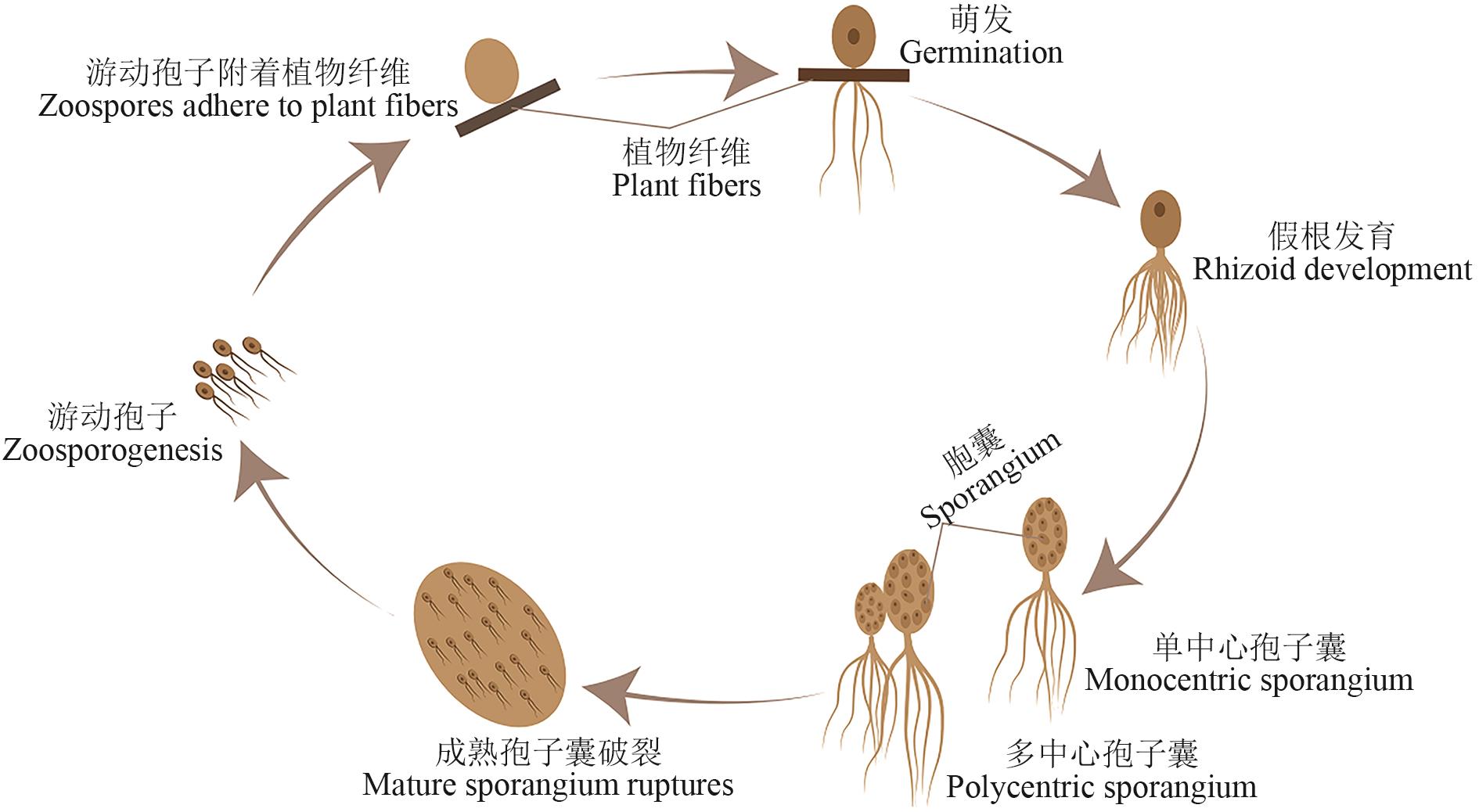
Fig. 1 Life cycle of anaerobic fungi
| [1] | Bauchop T. Rumen anaerobic fungi of cattle and sheep [J]. Appl Environ Microbiol, 1979, 38(1): 148-158. |
| [2] | Bauchop T. The rumen anaerobic fungi: colonizers of plant fibre [J]. Ann Rech Vet, 1979, 10(2-3): 246-248. |
| [3] | Müller M, Mentel M, van Hellemond JJ, et al. Biochemistry and evolution of anaerobic energy metabolism in eukaryotes [J]. Microbiol Mol Biol Rev, 2012, 76(2): 444-495. |
| [4] | Orpin CG. Studies on the rumen flagellate Neocallimastix frontalis [J]. J Gen Microbiol, 1975, 91(2): 249-262. |
| [5] | Hibbett DS, Binder M, Bischoff JF, et al. A higher-level phylogenetic classification of the fungi [J]. Microbiol Res, 2007, 111(5): 509-547. |
| [6] | McAllister TA, Thomas KD, Gruninger RJ, et al. International symposium on ruminant physiology: rumen fungi, Archaea, and their interactions [J]. J Dairy Sci, 2025, 108(7): 7545-7566. |
| [7] | Tedersoo L, Sánchez-Ramírez S, Kõljalg U, et al. High-level classification of the Fungi and a tool for evolutionary ecological analyses [J]. Fungal Divers, 2018, 90(1): 135-159. |
| [8] | Heath IB, Bauchop T, Skipp RA. Assignment of the rumen anaerobe Neocallimastix frontalis to the Spizellomycetales (Chytridiomycetes) on the basis of its polyflagellate zoospore ultrastructure [J]. Can J Bot, 1983, 61(1): 295-307. |
| [9] | Gold JJ, Brent Heath I, Bauchop T. Ultrastructural description of a new chytrid genus of Caecum anaerobe, Caecomyces equi gen. nov., sp. nov., assigned to the Neocallimasticaceae [J]. Biosystems, 1988, 21(3-4): 403-415. |
| [10] | Barr DJS, Kudo H, Jakober KD, et al. Morphology and development of rumen fungi: Neocallimastix sp., Piromyces communis, and Orpinomyces bovis gen.nov., sp. nov [J]. Can J Bot, 1989, 67(9): 2815-2824. |
| [11] | Breton A, Bernalier A, Dusser M, et al. Anaeromyces mucronatus nov. gen., nov. sp. A new strictly anaerobic rumen fungus with polycentric thallus [J]. FEMS Microbiol Lett, 1990, 58(2): 177-182. |
| [12] | Ozkose E, Thomas BJ, Davies DR, et al. Cyllamyces aberensis gen.nov. sp. nov., a new anaerobic gut fungus with branched sporangiophores isolated from cattle [J]. Can J Bot, 2001, 79(6): 666-673. |
| [13] | Griffith GW, Callaghan TM, Podmirseg SM, et al. Buwchfawromyces eastonii gen. nov., sp. nov.: a new anaerobic fungus (Neocallimastigomycota) isolated from buffalo faeces [J]. MycoKeys, 2015, 9: 11-28. |
| [14] | Dagar SS, Kumar S, Griffith GW, et al. A new anaerobic fungus (Oontomyces anksri gen. nov., sp. nov.) from the digestive tract of the Indian camel (Camelus dromedarius) [J]. Fungal Biol, 2015, 119(8): 731-737. |
| [15] | Hanafy RA, Elshahed MS, Liggenstoffer AS, et al. Pecoramyces ruminantium, gen. nov., sp. nov., an anaerobic gut fungus from the feces of cattle and sheep [J]. Mycologia, 2017, 109(2): 231-243. |
| [16] | Hanafy RA, Elshahed MS, Youssef NH. Feramyces austinii, gen. nov., sp. nov., an anaerobic gut fungus from rumen and fecal samples of wild Barbary sheep and fallow deer [J]. Mycologia, 2018, 110(3): 513-525. |
| [17] | Joshi A, Lanjekar VB, Dhakephalkar PK, et al. Liebetanzomyces polymorphus gen. et sp. nov., a new anaerobic fungus (Neocallimastigomycota) isolated from the rumen of a goat [J]. MycoKeys, 2018, 40: 89-110. |
| [18] | Stabel M, Hanafy RA, Schweitzer T, et al. aestipascuomyces dupliciliberans gen. nov, sp. nov., the first cultured representative of the uncultured SK4 clade from Aoudad Sheep and Alpaca [J]. Microorganisms, 2020, 8(11): 1734. |
| [19] | Hanafy RA, Youssef NH, Elshahed MS. Paucimyces polynucleatus gen. nov, sp. nov., a novel polycentric genus of anaerobic gut fungi from the faeces of a wild blackbuck Antelope [J]. Int J Syst Evol Microbiol, 2021, 71(6): 1-8. |
| [20] | Pratt CJ, Chandler EE, Youssef NH, et al. Testudinimyces gracilis gen. nov, sp. nov. and Astrotestudinimyces divisus gen. nov, sp. nov., two novel, deep-branching anaerobic gut fungal Genera from tortoise faeces [J]. Int J Syst Evol Microbiol, 2023, 73(5): 1-14. |
| [21] | Theodorou MK, Mennim G, Davies DR, et al. Anaerobic fungi in the digestive tract of mammalian herbivores and their potential for exploitation [J]. Proc Nutr Soc, 1996, 55(3): 913-926. |
| [22] | Hess M, Paul SS, Puniya AK, et al. Anaerobic fungi: past, present, and future [J]. Front Microbiol, 2020, 11: 584893. |
| [23] | 张亚伟, 王月红, 张元庆, 等. 厌氧真菌系统发育分类及多样性研究进展 [J]. 动物营养学报, 2022, 34(2): 700-709. |
| Zhang YW, Wang YH, Zhang YQ, et al. Advances in phylogenetic classification and diversity of anaerobic fungi [J]. Chin J Anim Nutr, 2022, 34(2): 700-709. | |
| [24] | Wubah DA, Kim DSH. Chemoattraction of anaerobic ruminai fungi zoospores to selected phenolic acids [J]. Microbiol Res, 1996, 151(3): 257-262. |
| [25] | Edwards JE, Kingston-Smith AH, Jimenez HR, et al. Dynamics of initial colonization of nonconserved perennial ryegrass by anaerobic fungi in the bovine rumen: Initial colonization of forage by ruminal anaerobic fungi [J]. FEMS Microbiol Ecol, 2008, 66(3): 537-545. |
| [26] | Hanafy RA, Dagar SS, Griffith GW, et al. Taxonomy of the anaerobic gut fungi (Neocallimastigomycota): a review of classification criteria and description of current taxa [J]. Int J Syst Evol Microbiol, 2022, 72(7): 1-38. |
| [27] | Orpin CG. The rumen flagellate Piromonas communis: its life-history and invasion of plant material in the rumen [J]. J Gen Microbiol, 1977, 99(1): 107-117. |
| [28] | Milne A, Theodorou MK, Jordan MGC, et al. Survival of anaerobic fungi in feces, in saliva, and in pure culture [J]. Exp Mycol, 1989, 13(1): 27-37. |
| [29] | Benchimol M. Hydrogenosomes under microscopy [J]. Tissue Cell, 2009, 41(3): 151-168. |
| [30] | Roger A. Reconstructing early events in eukaryotic evolution [J]. Am Nat, 1999, 154(S4): S146-S163. |
| [31] | Ma J, Zhong P, Li YQ, et al. Hydrogenosome, pairing anaerobic fungi and H(2)-utilizing microorganisms based on metabolic ties to facilitate biomass utilization [J]. J Fungi, 2022, 8(4): 338. |
| [32] | Lindmark DG, Müller M. Hydrogenosome, a cytoplasmic organelle of the anaerobic flagellate Tritrichomonas foetus, and its role in pyruvate metabolism [J]. J Biol Chem, 1973, 248(22): 7724-7728. |
| [33] | Williams K, Lowe PN, Leadlay PF. Purification and characterization of pyruvate: ferredoxin oxidoreductase from the anaerobic protozoon Trichomonas vaginalis [J]. Biochem J, 1987, 246(2): 529-536. |
| [34] | Boxma B, de Graaf RM, van der Staay GWM, et al. An anaerobic mitochondrion that produces hydrogen [J]. Nature, 2005, 434(7029): 74-79. |
| [35] | Bernalier A, Fonty G, Gouet P. Cellulose degradation by two rumen anaerobic fungi in monoculture or in coculture with rumen bacteria [J]. Anim Feed Sci Technol, 1991, 32(1-3): 131-136. |
| [36] | Li YF, Jin W, Mu CL, et al. Indigenously associated methanogens intensified the metabolism in hydrogenosomes of anaerobic fungi with xylose as substrate [J]. J Basic Microbiol, 2017, 57(11): 933-940. |
| [37] | Li YF, Jin W, Cheng YF, et al. Effect of the associated methanogen Methanobrevibacter thaueri on the dynamic profile of end and intermediate metabolites of anaerobic fungus Piromyces sp. F1 [J]. Curr Microbiol, 2016, 73(3): 434-441. |
| [38] | Wolfe RS. Unusual coenzymes of methanogenesis [J]. Trends Biochem Sci, 1985, 10(10): 396-399. |
| [39] | Orpin CG. Invasion of plant tissue in the rumen by the flagellate Neocallimastix frontalis [J]. J Gen Microbiol, 1977, 98(2): 423-430. |
| [40] | Akin DE, Lyon CE, Windham WR, et al. Physical degradation of lignified stem tissues by ruminal fungi [J]. Appl Environ Microbiol, 1989, 55(3): 611-616. |
| [41] | Windham WR, Akin DE. Rumen fungi and forage fiber degradation [J]. Appl Environ Microbiol, 1984, 48(3): 473-476. |
| [42] | Butkovich LV, Leggieri PA, Lillington SP, et al. Separation of life stages within anaerobic fungi (Neocallimastigomycota) highlights differences in global transcription and metabolism [J]. Fungal Genet Biol, 2025, 176: 103958. |
| [43] | Kovács E, Szűcs C, Juhász-Erdélyi A, et al. Anaerobic fungi: effective warriors in lignocellulosic biomass degradation and fermentation [J]. FEMS Microbiol Ecol, 2025, 101(11): fiaf108. |
| [44] | Henske JK, Gilmore SP, Knop D, et al. Transcriptomic characterization of Caecomyces churrovis: a novel, non-rhizoid-forming lignocellulolytic anaerobic fungus [J]. Biotechnol Biofuels, 2017, 10: 305. |
| [45] | Lillington SP, Chrisler W, Haitjema CH, et al. Cellulosome localization patterns vary across life stages of anaerobic fungi [J]. mBio, 2021, 12(3): e00832-e00821. |
| [46] | Gilmore SP, Henske JK, O'Malley MA. Driving biomass breakdown through engineered cellulosomes [J]. Bioengineered, 2015, 6(4): 204-208. |
| [47] | Kumar R, Singh S, Singh OV. Bioconversion of lignocellulosic biomass: biochemical and molecular perspectives [J]. J Ind Microbiol Biotechnol, 2008, 35(5): 377-391. |
| [48] | Kameshwar AKS, Qin WS. Genome wide analysis reveals the extrinsic cellulolytic and biohydrogen generating abilities of neocallimastigomycota fungi [J]. J Genomics, 2018, 6: 74-87. |
| [49] | Hebraud M, Fevre M. Characterization of glycoside and polysaccharide hydrolases secreted by the rumen anaerobic fungi Neocallimastix frontalis, Sphaeromonas communis and Piromonas communis [J]. Microbiology, 1988, 134(5): 1123-1129. |
| [50] | Teunissen MJ, Op den Camp HJ, Orpin CG, et al. Comparison of growth characteristics of anaerobic fungi isolated from ruminant and non-ruminant herbivores during cultivation in a defined medium [J]. J Gen Microbiol, 1991, 137(6): 1401-1408. |
| [51] | Hagen LH, Brooke CG, Shaw CA, et al. Proteome specialization of anaerobic fungi during ruminal degradation of recalcitrant plant fiber [J]. ISME J, 2021, 15(2): 421-434. |
| [52] | Saha BC. Alpha-L-arabinofuranosidases: biochemistry, molecular biology and application in biotechnology [J]. Biotechnol Adv, 2000, 18(5): 403-423. |
| [53] | Cheng YF, Shi QC, Sun RL, et al. The biotechnological potential of anaerobic fungi on fiber degradation and methane production [J]. World J Microbiol Biotechnol, 2018, 34(10): 155. |
| [54] | Dashtban M, Schraft H, Qin WS. Fungal bioconversion of lignocellulosic residues; opportunities & perspectives [J]. Int J Biol Sci, 2009, 5(6): 578-595. |
| [55] | Shallom D, Shoham Y. Microbial hemicellulases [J]. Curr Opin Microbiol, 2003, 6(3): 219-228. |
| [56] | Shetty D, Joshi A, Dagar SS, et al. Bioaugmentation of anaerobic fungus Orpinomyces joyonii boosts sustainable biomethanation of rice straw without pretreatment [J]. Biomass Bioenergy, 2020, 138: 105546. |
| [57] | Solomon KV, Haitjema CH, Henske JK, et al. Early-branching gut fungi possess a large, comprehensive array of biomass-degrading enzymes [J]. Science, 2016, 351(6278): 1192-1195. |
| [58] | Ximenes E, Kim Y, Mosier N, et al. Deactivation of cellulases by phenols [J]. Enzyme Microb Technol, 2011, 48(1): 54-60. |
| [59] | Dumond L, Lam LPY, van Erven G, et al. Termite gut microbiota contribution to wheat straw delignification in anaerobic bioreactors [J]. ACS Sustainable Chem Eng, 2021, 9(5): 2191-2202. |
| [60] | McSweeney CS, Dulieu A, Katayama Y, et al. Solubilization of lignin by the ruminal anaerobic fungus Neocallimastix patriciarum [J]. Appl Environ Microbiol, 1994, 60(8): 2985-2989. |
| [61] | Lankiewicz TS, Choudhary H, Gao Y, et al. Lignin deconstruction by anaerobic fungi [J]. Nat Microbiol, 2023, 8(4): 596-610. |
| [62] | Lamed R, Setter E, Bayer EA. Characterization of a cellulose-binding, cellulase-containing complex in Clostridium thermocellum [J]. J Bacteriol, 1983, 156(2): 828-836. |
| [63] | Wilson C, Wood T. The anaerobic fungus Neocallimastix frontalis: isolation and properties of a cellulosome-type enzyme fraction with the capacity to solubilize hydrogen-bond-ordered cellulose [J]. Appl Microbiol Biotechnol, 1992, 37(1): 125-129. |
| [64] | Artzi L, Bayer EA, Moraïs S. Cellulosomes: bacterial nanomachines for dismantling plant polysaccharides [J]. Nat Rev Microbiol, 2017, 15(2): 83-95. |
| [65] | Haitjema CH, Gilmore SP, Henske JK, et al. A parts list for fungal cellulosomes revealed by comparative genomics [J]. Nat Microbiol, 2017, 2: 17087. |
| [66] | Steenbakkers PJM, Li XL, Ximenes EA, et al. Noncatalytic docking domains of cellulosomes of anaerobic fungi [J]. J Bacteriol, 2001, 183(18): 5325-5333. |
| [67] | Nagy T, Tunnicliffe RB, Higgins LD, et al. Characterization of a double dockerin from the cellulosome of the anaerobic fungus Piromyces equi [J]. J Mol Biol, 2007, 373(3): 612-622. |
| [68] | Dijkerman R, Op den Camp HJ, Van der Drift C, et al. The role of the cellulolytic high molecular mass (HMM) complex of the anaerobic fungus Piromyces sp. strain E2 in the hydrolysis of microcrystalline cellulose [J]. Arch Microbiol, 1997, 167(2/3): 137-142. |
| [69] | Vanderstraeten J, da Fonseca MJM, De Groote P, et al. Combinatorial assembly and optimisation of designer cellulosomes: a galactomannan case study [J]. Biotechnol Biofuels Bioprod, 2022, 15(1): 60. |
| [70] | Gilmore SP, Lillington SP, Haitjema CH, et al. Designing chimeric enzymes inspired by fungal cellulosomes [J]. Synth Syst Biotechnol, 2020, 5(1): 23-32. |
| [71] | Hartinger T, Fliegerová K, Zebeli Q. Suitability of anaerobic fungi culture supernatant or mixed ruminal fluid as novel silage additives [J]. Appl Microbiol Biotechnol, 2022, 106(19-20): 6819-6832. |
| [72] | Lee SM, Guan LL, Eun JS, et al. The effect of anaerobic fungal inoculation on the fermentation characteristics of rice straw silages [J]. J Appl Microbiol, 2015, 118(3): 565-573. |
| [73] | Wang DD, Zhao CC, Liu SM, et al. Effects of Piromyces sp. CN6 CGMCC 14449 on fermentation quality, nutrient composition and the in vitro degradation rate of whole crop maize silage [J]. AMB Expr, 2019, 9: 121. |
| [74] | Gordon GLR, Phillips MW. Removal of anaerobic fungi from the rumen of sheep by chemical treatment and the effect on feed consumption and in vivo fibre digestion [J]. Lett Appl Microbiol, 1993, 17(5): 220-223. |
| [75] | Lee SS, Ha JK, Cheng KJ. Influence of an anaerobic fungal culture administration on in vivo ruminal fermentation and nutrient digestion [J]. Anim Feed Sci Technol, 2000, 88(3-4): 201-217. |
| [76] | Sehgal J, Jit D, Puniya A, et al. Influence of anaerobic fungal administration ongrowth, rumen fermentation and nutrient digestionin female buffalo calves [J]. J Anim Feed Sci, 2008, 17(4): 510-518. |
| [77] | Liu MR, Wei YQ, Leng XY. Improving biogas production using additives in anaerobic digestion: a review [J]. J Clean Prod, 2021, 297: 126666. |
| [78] | Akyol Ç, Ince O, Bozan M, et al. Fungal bioaugmentation of anaerobic digesters fed with lignocellulosic biomass: What to expect from anaerobic fungus Orpinomyces sp. [J]. Bioresour Technol, 2019, 277: 1-10. |
| [79] | Aydin S, Yıldırım E, Ince O, et al. Rumen anaerobic fungi create new opportunities for enhanced methane production from microalgae biomass [J]. Algal Res, 2017, 23: 150-160. |
| [1] | CHU Yin-di, SU Xiao-yun. Research Progresses on Lignocellulose Degradation by a Thermophilic Anaerobic Bacterium Caldicellulosiruptor bescii [J]. Biotechnology Bulletin, 2017, 33(10): 33-39. |
| [2] | Tian Yu, Wang Yiqiang, Wang Qiye. Research Progress of Isobutanol Biosynthesis [J]. Biotechnology Bulletin, 2013, 0(5): 40-44. |
| Viewed | ||||||
|
Full text |
|
|||||
|
Abstract |
|
|||||
