







YAN Jun, MAO Shi-ya, YANG Jing, LOU Yu-xuan, WANG Wen-ying, WANG Xiang-feng( )
)
Received:2026-05-06
Online:2026-07-07
Contact:
WANG Xiang-feng
E-mail:xwang@cau.edu.cn
YAN Jun, MAO Shi-ya, YANG Jing, LOU Yu-xuan, WANG Wen-ying, WANG Xiang-feng. Principles and Applications of bioPROTAC for Targeted Protein Degradation in Plants[J]. Biotechnology Bulletin, doi: 10.13560/j.cnki.biotech.bull.1985.2026-0505.
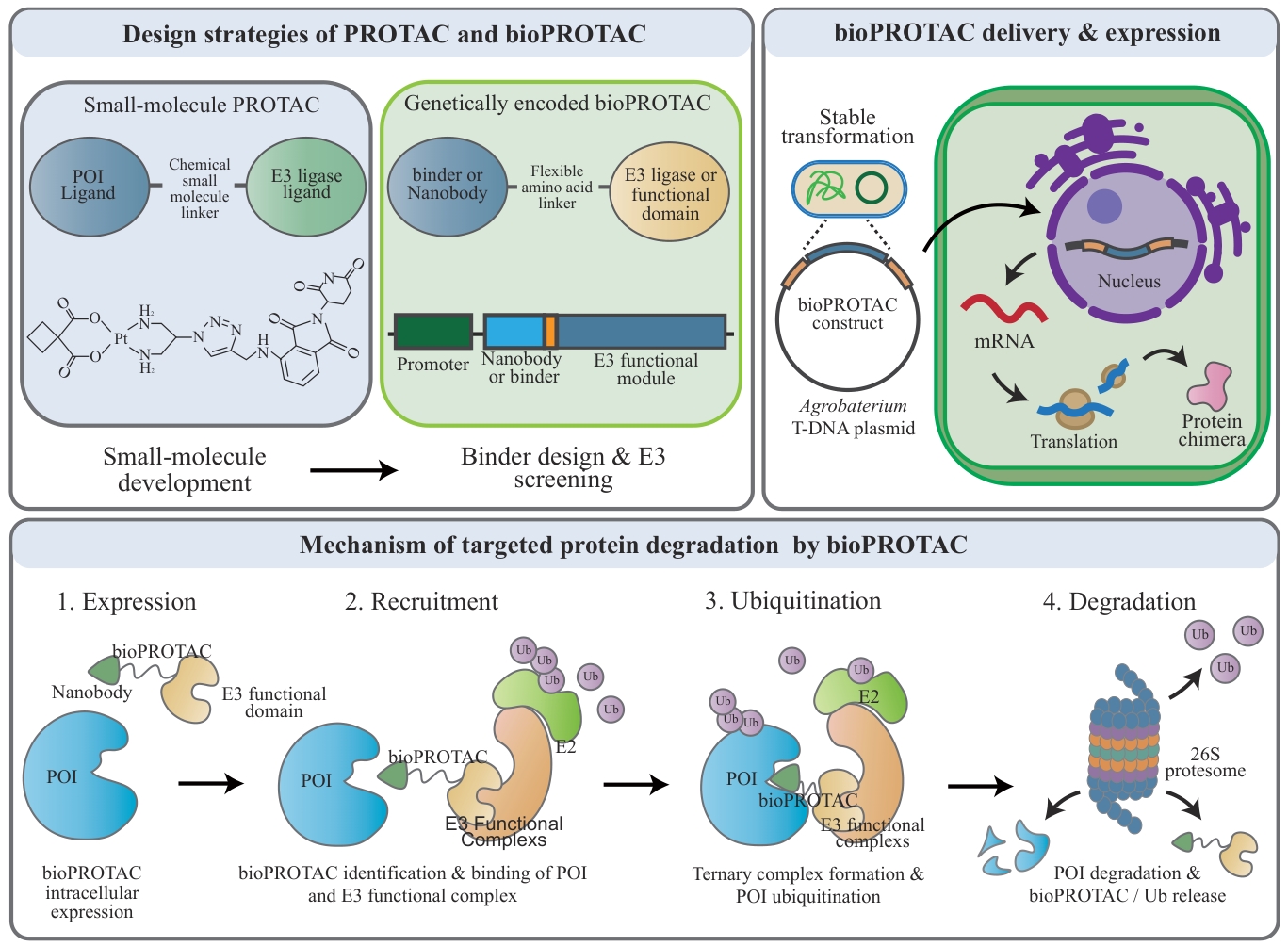
Fig. 1 Schematic illustration of the design concept, delivery and expression, and targeted degradation mechanism of bioPROTAC in plant cellsThe upper-left panel shows a comparison of the design principles of PROTACs and bioPROTACs. Traditional PROTACs contain one target protein ligand, a chemical linker and one endogenous E3 ligand, as small molecules; bioPROTACs normally contain one target-binding module, a flexible amino acid linker and one E3 enzyme (or its functional domain), as gene-encoded constructs. The upper-right panel shows the delivery of a gene-encoded bioPROTAC construct into plant cells by Agrobacterium-mediated stable transformation, after which, upon transcription and translation, it forms a chimera and performs its functions. The lower section shows the working process of bioPROTAC in plant cells: the bioPROTAC is expressed in plant cell, recognizes the target protein, and further promotes ubiquitination of the target protein; ultimately, the target protein is degraded by the 26S proteasome, and the bioPROTAC molecule is released
| 对比维度 Comparison dimensions | CRISPR/Cas9 | RNAi | bioPROTAC |
|---|---|---|---|
作用层面 Functional level | DNA水平(基因组编辑) | mRNA(转录后调控) | 蛋白质(翻译后调控) |
作用原理 Mechanism | 利用gRNA引导Cas9对DNA序列制造DSBs,实现基因敲除 | 利用siRNA 等特异识别并结合目标mRNA,抑制翻译 | 劫持内源UPS,靶向蛋白降解 |
作用效果 Functional effect | 基因敲除 | 基因表达水平下调 | 蛋白质降解 |
技术优势 Technical advantages | 永久遗传修饰,高效率,可遗传,多重编辑 | 可逆性,不改变基因组,定量下调 | 模块化特征;高度可逆和可诱导;干预直接,响应迅速 |
应用局限 Limitations | 脱靶风险,递送难度大,PAM序列限制,胚胎致死 | 时间分辨率低,抑制不彻底,脱靶效应 | 潜在的脱靶效应;大多依赖转基因/融合标签 |
Table 1 Comparison of three different targeting technologies
| 对比维度 Comparison dimensions | CRISPR/Cas9 | RNAi | bioPROTAC |
|---|---|---|---|
作用层面 Functional level | DNA水平(基因组编辑) | mRNA(转录后调控) | 蛋白质(翻译后调控) |
作用原理 Mechanism | 利用gRNA引导Cas9对DNA序列制造DSBs,实现基因敲除 | 利用siRNA 等特异识别并结合目标mRNA,抑制翻译 | 劫持内源UPS,靶向蛋白降解 |
作用效果 Functional effect | 基因敲除 | 基因表达水平下调 | 蛋白质降解 |
技术优势 Technical advantages | 永久遗传修饰,高效率,可遗传,多重编辑 | 可逆性,不改变基因组,定量下调 | 模块化特征;高度可逆和可诱导;干预直接,响应迅速 |
应用局限 Limitations | 脱靶风险,递送难度大,PAM序列限制,胚胎致死 | 时间分辨率低,抑制不彻底,脱靶效应 | 潜在的脱靶效应;大多依赖转基因/融合标签 |
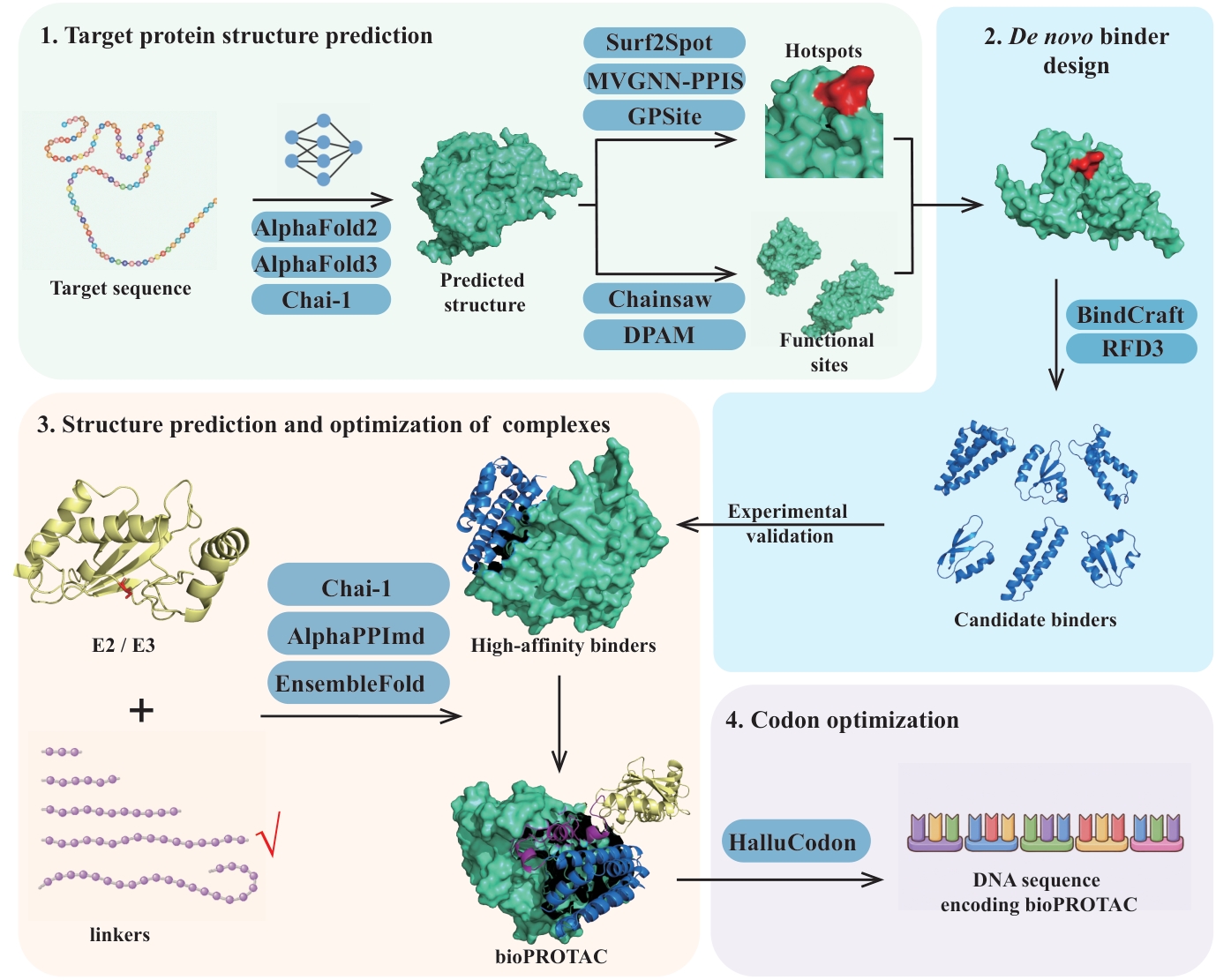
Fig. 2 Schematic diagram of the AI-driven bioPROTAC design workflowFor the design and optimisation of bioPROTACs using artificial intelligence tools, the main workflow is shown in the figure. In step 1, we obtain the target protein sequence and predict target protein structure; with the target protein amino acid sequence, tools such as AlphaFold2, AlphaFold3 or Chai-1 are used to predict its three-dimensional structure. Then, Surf2Spot, MVGNN-PPIS or GPSite are used to predict possible interaction hotspot residues of target proteins. Chainsaw or DPAM are applied to decouple the structural domains containing those hotspot residues on the surface of target proteins. For step 2, de novo design and screening of binding proteins, we centre on the interaction hotspots on the surface of the target protein and use such tools as BindCraft or RFD3 to design candidate binding proteins and screen them by experiments. Step 3 is conformation sampling and screening of bioPROTAC ternary complex conformation; candidate binding protein, E2 and E3 proteins, and linker of different lengths are mixed, and then the conformation of the complex is predicted and sampled by using tools like Chai-1, AlphaPPImd or EnsembleFold, and screened to identify bioPROTAC molecules able to form a ternary complex capable of attaining ubiquitination. Step 4 is codon optimization and output of encoding sequence; according to the result of bioPROTAC molecular design, codon is optimized by using tools such as HalluCodon to form an encoding nucleic acid sequence which can be used in different expression systems. The process reveals that AI plays an synergistic role in different stages (such as the target finding stage, the binding protein designing stage, the ternary complex conformation sampling stage and codon optimization stage), which shows a new technical route to realize the efficient preparation of plant-based bioPROTACs
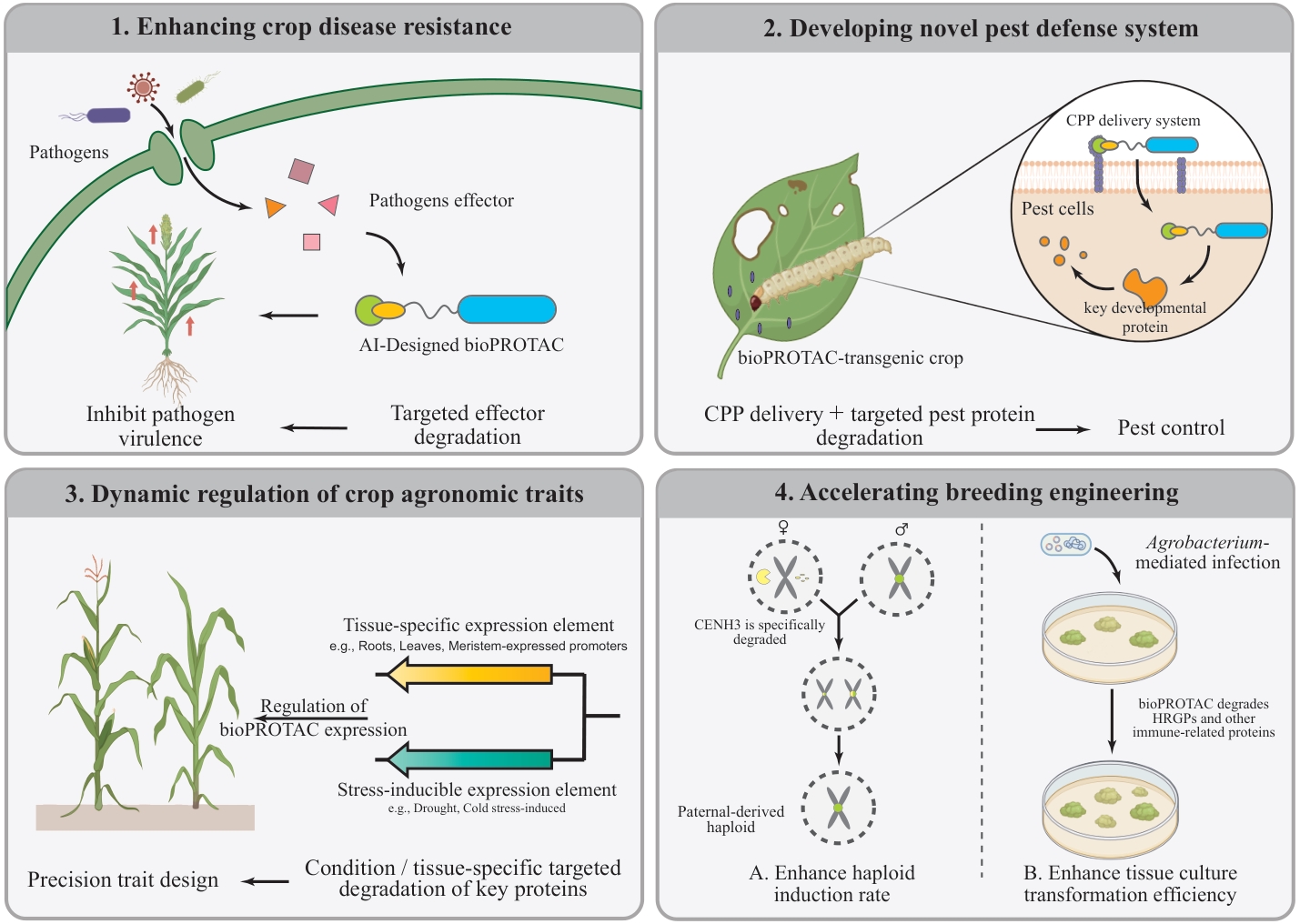
Fig. 3 Prospects for the application of AI-designed bioPROTACs in crop breedingThe given figure depicts four possible application contexts of AI-created bioPROTACs in the area of crop breeding. The top-left portion focuses on improving crop disease resistance through targeting and degrading of pathogen effectors or host proteins that are linked to disease susceptibility, which would reduce the virulence of the pathogen and increase the resistance of the crop. The top-right portion deals with imparting pest-resistance to crops; this requires adding delivery components (cell-penetrating peptides) to bioPROTAC molecules to allow them access to the pest body and destroy important proteins of the pest development or life cycle, therefore suppressing pest growth or even pest death. Bottom-left section discusses exact trait design, which can be facilitated using tissue-specific expression elements or stress-inducible elements to guide the degradation of the critical regulatory proteins of particular tissues, stages of development or environmental conditions, allowing the precise regulation of agronomic traits like yield, quality and stress tolerance. Bottom-right section emphasizes the facilitation of breeding engineering; this is done by targeting and degrading key proteins in haploid induction to increase the efficiency of induction or by targeting proteins related to plant cellular immunity and regeneration barriers to increase the efficiency of transformation of tissue cultures, thus offering new molecular techniques to contemporary plant breeding systems
| [1] | Balch WE, Morimoto RI, Dillin A, et al. Adapting proteostasis for disease intervention [J]. Science, 2008, 319(5865): 916-919. |
| [2] | Zhao L, Zhao J, Zhong KH, et al. Targeted protein degradation: mechanisms, strategies and application [J]. Sig Transduct Target Ther, 2022, 7: 113. |
| [3] | Sadanandom A, Bailey M, Ewan R, et al. The ubiquitin-proteasome system: central modifier of plant signalling [J]. New Phytol, 2012, 196(1): 13-28. |
| [4] | Niu RX, Luo M, Wen Q, et al. Targeted protein and protein-condensate degradation in plant science research and crop breeding [J]. Mol Plant, 2025, 18(8): 1270-1283. |
| [5] | Fan G, Chen SL, Zhang QP, et al. Proteolysis-targeting Chimera (PROTAC): current applications and future directions [J]. MedComm, 2025, 6(10): e70401. |
| [6] | Sakamoto KM, Kim KB, Kumagai A, et al. Protacs: Chimeric molecules that target proteins to the Skp1-Cullin-F box complex for ubiquitination and degradation [J]. Proc Natl Acad Sci U S A, 2001, 98(15): 8554-8559. |
| [7] | Leon RG, Bassham DC. PROTAC for agriculture: learning from human medicine to generate new biotechnological weed control solutions [J]. Pest Manag Sci, 2024, 80(2): 262-266. |
| [8] | Rojas-Pierce M, Bednarek SY. Manipulation of targeted protein degradation in plant biology [J]. Biochem Soc Trans, 2025, 53(2): 409-418. |
| [9] | Lim S, Khoo R, Peh KM, et al. bioPROTACs as versatile modulators of intracellular therapeutic targets including proliferating cell nuclear antigen (PCNA) [J]. Proc Natl Acad Sci U S A, 2020, 117(11): 5791-5800. |
| [10] | Dauparas J, Anishchenko I, Bennett N, et al. Robust deep learning-based protein sequence design using ProteinMPNN [J]. Science, 2022, 378(6615): 49-56. |
| [11] | Jumper J, Evans R, Pritzel A, et al. Highly accurate protein structure prediction with AlphaFold [J]. Nature, 2021, 596(7873): 583-589. |
| [12] | Senior AW, Evans R, Jumper J, et al. Improved protein structure prediction using potentials from deep learning [J]. Nature, 2020, 577(7792): 706-710. |
| [13] | Watson JL, Juergens D, Bennett NR, et al. De novo design of protein structure and function with RFdiffusion [J]. Nature, 2023, 620(7976): 1089-1100. |
| [14] | Luh LM, Scheib U, Juenemann K, et al. Prey for the proteasome: targeted protein degradation-a medicinal chemist’s perspective [J]. Angew Chem Int Ed, 2020, 59(36): 15448-15466. |
| [15] | Henley MJ, Koehler AN. Advances in targeting ‘undruggable’ transcription factors with small molecules [J]. Nat Rev Drug Discov, 2021, 20(9): 669-688. |
| [16] | Hopkins AL, Groom CR. The druggable genome [J]. Nat Rev Drug Discov, 2002, 1(9): 727-730. |
| [17] | Cao S, Ma L, Liu YL, et al. Proteolysis-targeting Chimera (PROTAC) modification of dovitinib enhances the antiproliferative effect against FLT3-ITD-positive acute myeloid leukemia cells [J]. J Med Chem, 2021, 64(22): 16497-16511. |
| [18] | Sun YH, Ding N, Song YQ, et al. Degradation of Bruton’s tyrosine kinase mutants by PROTACs for potential treatment of ibrutinib-resistant non-Hodgkin lymphomas [J]. Leukemia, 2019, 33(8): 2105-2110. |
| [19] | Ciechanover A, Heller H, Elias S, et al. ATP-dependent conjugation of reticulocyte proteins with the polypeptide required for protein degradation [J]. Proc Natl Acad Sci U S A, 1980, 77(3): 1365-1368. |
| [20] | Livneh I, Kravtsova-Ivantsiv Y, Braten O, et al. Monoubiquitination joins polyubiquitination as an esteemed proteasomal targeting signal [J]. BioEssays, 2017, 39(6): 1700027. |
| [21] | Awan AB, Ali Osman MJ, Khan OM. Ubiquitination enzymes in cancer, cancer immune evasion, and potential therapeutic opportunities [J]. Cells, 2025, 14(2): 69. |
| [22] | Bard JAM, Goodall EA, Greene ER, et al. Structure and function of the 26S proteasome [J]. Annu Rev Biochem, 2018, 87: 697-724. |
| [23] | Paez Valencia J, Goodman K, Otegui MS. Endocytosis and endosomal trafficking in plants [J]. Annu Rev Plant Biol, 2016, 67: 309-335. |
| [24] | Shimada T, Takagi J, Ichino T, et al. Plant vacuoles [J]. Annu Rev Plant Biol, 2018, 69: 123-145. |
| [25] | Zhou PB, Bogacki R, McReynolds L, et al. Harnessing the ubiquitination machinery to target the degradation of specific cellular proteins [J]. Mol Cell, 2000, 6(3): 751-756. |
| [26] | Colas P, Cohen B, Ferrigno PK, et al. Targeted modification and transportation of cellular proteins [J]. Proc Natl Acad Sci U S A, 2000, 97(25): 13720-13725. |
| [27] | Bondeson DP, Mares A, Smith IED, et al. Catalytic in vivo protein knockdown by small-molecule PROTACs [J]. Nat Chem Biol, 2015, 11(8): 611-617. |
| [28] | Krönke J, Fink EC, Hollenbach PW, et al. Lenalidomide induces ubiquitination and degradation of CK1α in del(5q) MDS [J]. Nature, 2015, 523(7559): 183-188. |
| [29] | Cotton AD, Nguyen DP, Gramespacher JA, et al. Development of antibody-based PROTACs for the degradation of the cell-surface immune checkpoint protein PD-L1 [J]. J Am Chem Soc, 2021, 143(2): 593-598. |
| [30] | Li ZY, Zhu CG, Ding Y, et al. ATTEC: a potential new approach to target proteinopathies [J]. Autophagy, 2020, 16(1): 185-187. |
| [31] | Takahashi D, Moriyama J, Nakamura T, et al. AUTACs: cargo-specific degraders using selective autophagy [J]. Mol Cell, 2019, 76(5): 797-810.e10. |
| [32] | Banik SM, Pedram K, Wisnovsky S, et al. Lysosome-targeting chimaeras for degradation of extracellular proteins [J]. Nature, 2020, 584(7820): 291-297. |
| [33] | Schreiber SL. The rise of molecular glues [J]. Cell, 2021, 184(1): 3-9. |
| [34] | Huang LZ, Rojas-Pierce M. Rapid depletion of target proteins in plants by an inducible protein degradation system [J]. Plant Cell, 2024, 36(9): 3145-3161. |
| [35] | Taxis C, Stier G, Spadaccini R, et al. Efficient protein depletion by genetically controlled deprotection of a dormant N-degron [J]. Mol Syst Biol, 2009, 5: MSB200925. |
| [36] | Su L, Li AN, Li HL, et al. Direct modulation of protein level in Arabidopsis [J]. Mol Plant, 2013, 6(5): 1711-1714. |
| [37] | Zhang JB, Yin KQ, Sun J, et al. Direct and tunable modulation of protein levels in rice and wheat with a synthetic small molecule [J]. Plant Biotechnol J, 2018, 16(2): 472-481. |
| [38] | Faden F, Ramezani T, Mielke S, et al. Phenotypes on demand via switchable target protein degradation in multicellular organisms [J]. Nat Commun, 2016, 7: 12202. |
| [39] | Nishimura K, Fukagawa T, Takisawa H, et al. An auxin-based degron system for the rapid depletion of proteins in nonplant cells [J]. Nat Methods, 2009, 6(12): 917-922. |
| [40] | Yesbolatova A, Saito Y, Kitamoto N, et al. The auxin-inducible degron 2 technology provides sharp degradation control in yeast, mammalian cells, and mice [J]. Nat Commun, 2020, 11: 5701. |
| [41] | Baudisch B, Pfort I, Sorge E, et al. Nanobody-directed specific degradation of proteins by the 26S-proteasome in plants [J]. Front Plant Sci, 2018, 9: 130. |
| [42] | Caussinus E, Kanca O, Affolter M. Fluorescent fusion protein knockout mediated by anti-GFP nanobody [J]. Nat Struct Mol Biol, 2012, 19(1): 117-121. |
| [43] | Ma YF, Miotk A, Šutiković Z, et al. WUSCHEL acts as an auxin response rheostat to maintain apical stem cells in Arabidopsis [J]. Nat Commun, 2019, 10: 5093. |
| [44] | Luo M, Zhu ST, Dang H, et al. Genetically-encoded targeted protein degradation technology to remove endogenous condensation-prone proteins and improve crop performance [J]. Nat Commun, 2025, 16: 1159. |
| [45] | Ma XL, Zhu QL, Chen YL, et al. CRISPR/Cas9 platforms for genome editing in plants: developments and applications [J]. Mol Plant, 2016, 9(7): 961-974. |
| [46] | Koh HY, Zheng YZ, Yang M, et al. AI-driven protein design [J]. Nat Rev Bioeng, 2025, 3(12): 1034-1056. |
| [47] | Li GT, An LN, Yang WN, et al. Integrated biotechnological and AI innovations for crop improvement [J]. Nature, 2025, 643(8073): 925-937. |
| [48] | Lou YX, Wu TH, Xia F, et al. AI-enabled protein design facilitates future plant research and crop breeding [J]. Plant Physiol, 2026, 200(4): kiag147. |
| [49] | Xia YQ, Sun GZ, Xiao JH, et al. AlphaFold-guided redesign of a plant pectin methylesterase inhibitor for broad-spectrum disease resistance [J]. Mol Plant, 2024, 17(9): 1344-1368. |
| [50] | Fei HY, Li YJ, Liu YJ, et al. Advancing protein evolution with inverse folding models integrating structural and evolutionary constraints [J]. Cell, 2025, 188(17): 4674-4692.e19. |
| [51] | Lin MT, Salihovic H, Clark FK, et al. Improving the efficiency of Rubisco by resurrecting its ancestors in the family Solanaceae [J]. Sci Adv, 2022, 8(15): eabm6871. |
| [52] | Sumida KH, Núñez-Franco R, Kalvet I, et al. Improving protein expression, stability, and function with ProteinMPNN [J]. J Am Chem Soc, 2024, 146(3): 2054-2061. |
| [53] | Wang JZ, Chen TY, Zhang ZD, et al. Remodelling autoactive NLRs for broad-spectrum immunity in plants [J]. Nature, 2025, 645(8081): 737-745. |
| [54] | Vázquez Torres S, Benard Valle M, Mackessy SP, et al. De novo designed proteins neutralize lethal snake venom toxins [J]. Nature, 2025, 639(8053): 225-231. |
| [55] | Fu R, Jiang S, Wu TH, et al. AI-driven protein engineering: a new paradigm for plant trait design [J]. Mol Plant, 2026, 19(6): 1172-1190. |
| [56] | Pacesa M, Nickel L, Schellhaas C, et al. One-shot design of functional protein binders with BindCraft [J]. Nature, 2025, 646(8084): 483-492. |
| [57] | Li XQ, Zhang SJ, Wang CY, et al. Efficient in situ epitope tagging of rice genes by nuclease-mediated prime editing [J]. Plant Cell, 2025, 37(2): koae316. |
| [58] | Vats S, Kumar J, Sonah H, et al. Prime editing in plants: prospects and challenges [J]. J Exp Bot, 2024, 75(17): 5344-5356. |
| [59] | Vu TV, Nguyen NT, Kim J, et al. Prime editing: Mechanism insight and recent applications in plants [J]. Plant Biotechnol J, 2024, 22(1): 19-36. |
| [60] | Li J, Ding J, Zhu JY, et al. Prime editing-mediated precise knockin of protein tag sequences in the rice genome [J]. Plant Commun, 2023, 4(3): 100572. |
| [61] | Butcher J, Krishna R, Mitra R, et al. De novo design of all-atom biomolecular interactions with RFdiffusion3 [PP/OL]. bioRxiv, 2025. DOI:10.1101/2025.09.18.676967 . |
| [62] | Kong XZ, Jiao R, Lin HW, et al. Peptide design through binding interface mimicry with PepMimic [J]. Nat Biomed Eng, 2025. . |
| [63] | Peng XG, Guo RH, Guo FL, et al. Unified modeling of 3D molecular generation via atomic interactions with PocketXMol [J]. Cell, 2026, 189(7): 1904-1922.e28. |
| [64] | Wang RB, Wu FD, Gao XY, et al. IgGM: a generative model for functional antibody and nanobody design [PP/OL]. bioRxiv, 2025. DOI:10.1101/2024.09.19.613838 . |
| [65] | Wu TH, Wang ZX, Zhao Aw, et al. PhytoNB: AI-enabled nanobody design in plants [J]. Maize Sci, 2026. DOI: 10.2738/MS.2026.0004 . |
| [66] | Abramson J, Adler J, Dunger J, et al. Accurate structure prediction of biomolecular interactions with AlphaFold 3 [J]. Nature, 2024, 630(8016): 493-500. |
| [67] | Discovery C, Boitreaud J, Dent J, et al. Chai-1: Decoding the molecular interactions of life [PP/OL]. bioRxiv, 2024. DOI:10.1101/2024.10.10.615955 . |
| [68] | Chen LT, Quinn Z, Dumas M, et al. Target sequence-conditioned design of peptide binders using masked language modeling [J]. Nat Biotechnol, 2025. DOI: 10.1038/s41587-025-02761-2 . |
| [69] | Crowe C, Nakasone MA, Chandler S, et al. Mechanism of degrader-targeted protein ubiquitinability [J]. Sci Adv, 2024, 10(41): eado6492. |
| [70] | Wang JM, Wang X, Chu YY, et al. Exploring the conformational ensembles of protein-protein complex with transformer-based generative model [J]. J Chem Theory Comput, 2024, 20(11): 4469-4480. |
| [71] | Wuyun Q, Liu QC, Ni WT, et al. Alternative conformation prediction using deep learning with multi-MSA strategy and structural clustering in CASP16 [J]. Proteins Struct Funct Bioinform, 2026, 94(1): 348-361. |
| [72] | Stewart MD, Ritterhoff T, Klevit RE, et al. E2 enzymes: more than just middle men [J]. Cell Res, 2016, 26(4): 423-440. |
| [73] | Taylor JD, Barrett N, Martinez Cuesta S, et al. Targeted protein degradation using chimeric human E2 ubiquitin-conjugating enzymes [J]. Commun Biol, 2024, 7: 1179. |
| [74] | Lin ZM, Akin H, Rao R, et al. Evolutionary-scale prediction of atomic-level protein structure with a language model [J]. Science, 2023, 379(6637): 1123-1130. |
| [75] | Lou YX, Mao SY, Wu TH, et al. HalluCodon enables species-specific codon optimization using multimodal language models [PP/OL]. bioRxiv, 2026. DOI: https://doi.org/10.64898/2026.03.31.715573 . |
| [76] | Shen T, Hu ZH, Sun SQ, et al. Accurate RNA 3D structure prediction using a language model-based deep learning approach [J]. Nat Methods, 2024, 21(12): 2287-2298. |
| [77] | Wells J, Hawkins-Hooker A, Bordin N, et al. Chainsaw: protein domain segmentation with fully convolutional neural networks [J]. Bioinformatics, 2024, 40(5): btae296. |
| [78] | Zhao AW, Li Y, Wu TH, et al. Surf2Spot: A surface-informed geometry-aware model for predicting binder and nanobody design hotspots [PP/OL]. bioRxiv, 2026. DOI: https://doi.org/10.64898/2026.01.23.700806 . |
| [79] | Haley OC, Tibbs-Cortes L, Hayford RK, et al. Why do some predicted protein structures fold poorly? Benchmarking AlphaFold, ESMFold, and Boltz in maize [PP/OL]. bioRxiv, 2025. DOI:10.1101/2025.07.05.663230 . |
| [80] | Hijazi M, Velasquez SM, Jamet E, et al. An update on post-translational modifications of hydroxyproline-rich glycoproteins: toward a model highlighting their contribution to plant cell wall architecture [J]. Front Plant Sci, 2014, 5: 395. |
| [81] | Meyer AJ, Dreyer A, Ugalde JM, et al. Shifting paradigms and novel players in Cys-based redox regulation and ROS signaling in plants - and where to go next [J]. Biol Chem, 2021, 402(3): 399-423. |
| [82] | Shahidi F, Dissanayaka CS. Phenolic-protein interactions: insight from in-silico analyses-a review [J]. Food Prod Process And Nutr, 2023, 5: 2. |
| [83] | Deng R, Zhang CB, Fernie AR, et al. AIfor plant protein-protein interactions prediction [J]. Plant J, 2026, 126: e70867. |
| [84] | Liu J, Chen H, Zhang Y. A paired sequence language model for protein-protein interaction modeling [J]. Nat Commun, 2026, 17: 3733. |
| [85] | Zhang J, Humphreys IR, Pei JM, et al. Predicting protein-protein interactions in the human proteome [J]. Science, 2025, 390(6771): eadt1630. |
| [86] | Yu H, Bai SW, Li JY. Towards Breeding 5.0: Smart variety by intelligent breeding [J]. Chin Sci Bull, 2024, 69(32): 4687-4690. |
| [87] | Savary S, Willocquet L, Pethybridge SJ, et al. The global burden of pathogens and pests on major food crops [J]. Nat Ecol Evol, 2019, 3(3): 430-439. |
| [88] | Mao RH, Liu DS, Liu YL, et al. Current advances in mechanisms of antiviral immunity [J]. Chin Sci Bull, 2026, 71(3): 739-755. |
| [89] | Jones JDG, Dangl JL. The plant immune system [J]. Nature, 2006, 444(7117): 323-329. |
| [90] | Morgan GL, Dickson H, Ford B, et al. Pioneering protein degradation for agricultural applications [J]. Commun Biol, 2025, 8: 591. |
| [91] | Jia MR, Luo N, Meng XB, et al. OsMPK4 promotes phosphorylation and degradation of IPA1 in response to salt stress to confer salt tolerance in rice [J]. J Genet Genom, 2022, 49(8): 766-775. |
| [92] | Liao H, Zhao XY, Ren KY, et al. Rewiring an E3 ligase enhances cold resilience and phosphate use in maize [J]. Nature, 2026, 653(8115): 831-839. |
| [93] | Li TY, Wang CL, Pan JW, et al. Exploring potential strategies for haploid induction based on double fertilization in plants [J]. Plant Biotechnol J, 2025, 23(9): 4000-4016. |
| [94] | Jiang CL, Sun J, Li R, et al. A reactive oxygen species burst causes haploid induction in maize [J]. Mol Plant, 2022, 15(6): 943-955. |
| [95] | Ravi M, Chan SWL. Haploid plants produced by centromere-mediated genome elimination [J]. Nature, 2010, 464(7288): 615-618. |
| [96] | Zhong Y, Chen BJ, Li MR, et al. A DMP-triggered in vivo maternal haploid induction system in the dicotyledonous Arabidopsis [J]. Nat Plants, 2020, 6(5): 466-472. |
| [97] | Singh B, Yun S, Gil Y, et al. The role of colchicine in plant breeding [J]. Int J Mol Sci, 2025, 26(14): 6743. |
| [98] | Somasundaram S, Yaşar S, Fuchs J, et al. Targeted CENH3 protein depletion in egg cells enables highly efficient haploid induction [J]. Plant Commun, 2026, 7(5): 101837. |
| [99] | Wang YC, Yu MD, Shih PY, et al. Stable pH suppresses defense signaling and is the key to enhance Agrobacterium-mediated transient expression in Arabidopsis seedlings [J]. Sci Rep, 2018, 8: 17071. |
| [100] | Zipfel C, Kunze G, Chinchilla D, et al. Perception of the bacterial PAMP EF-Tu by the receptor EFR restricts Agrobacterium-mediated transformation [J]. Cell, 2006, 125(4): 749-760. |
| [101] | Liu M, Yang Y, Liang TH, et al. Dynamic transcriptome and GWAS uncover a hydroxyproline-rich glycoprotein that suppresses Agrobacterium-mediated transformation in maize [J]. Mol Plant, 2025, 18(5): 747-764. |
| [102] | Wang JY, Patel P, Bhat P, et al. Systemic delivery of functional proteins into plants using an engineered membrane translocation domain [J]. Plant Biotechnol J, 2026, 24(6): 3939-3952. |
| [103] | Ali MA, Ahmed T, Ibrahim E, et al. A review on mechanisms and prospects of endophytic bacteria in biocontrol of plant pathogenic fungi and their plant growth-promoting activities [J]. Heliyon, 2024, 10(11): e31573. |
| [104] | Chlebek D, Pinski A, Żur J, et al. Genome mining and evaluation of the biocontrol potential of Pseudomonas fluorescens BRZ63, a new endophyte of oilseed rape (Brassica napus L.) against fungal pathogens [J]. Int J Mol Sci, 2020, 21(22): 8740. |
| [105] | Abrahamian P, Hammond RW, Hammond J. Plant virus-derived vectors: applications in agricultural and medical biotechnology [J]. Annu Rev Virol, 2020, 7: 513-535. |
| [1] | CHANG Xue-rui, WANG Tian-tian, WANG Jing. Identification and Analysis of E2 Gene Family in Pepper(Capsicum annuum L.) [J]. Biotechnology Bulletin, 2024, 40(6): 238-250. |
| Viewed | ||||||
|
Full text |
|
|||||
|
Abstract |
|
|||||
