







Biotechnology Bulletin ›› 2025, Vol. 41 ›› Issue (9): 62-70.doi: 10.13560/j.cnki.biotech.bull.1985.2025-0268
Previous Articles Next Articles
HU Xin1,2( ), LUO Zheng-ying3, LIU Xin-long1,2, WU Cai-wen1,2, WU Zhuan-di1,2()
Received:2025-03-13
Online:2025-09-26
Published:2025-09-24
Contact:
WU Zhuan-di
E-mail:sugarhuxin@163.com;wzd@yaas.org.cn
HU Xin, LUO Zheng-ying, LIU Xin-long, WU Cai-wen, WU Zhuan-di. Elimination Technology of Sugarcane Streak Mosaic Virus in Chewing Cane[J]. Biotechnology Bulletin, 2025, 41(9): 62-70.

Fig. 1 Flowchart of the bud-tips culture technique of chewing caneA: Hot water treatment. B: Removing bud scales. C: Extracting bud tip. D: Inoculation of bud-tip onto MS medium. E: Differentiation of bud-tip into seedlings. F: Subculture of seedlings into clumping seedlings
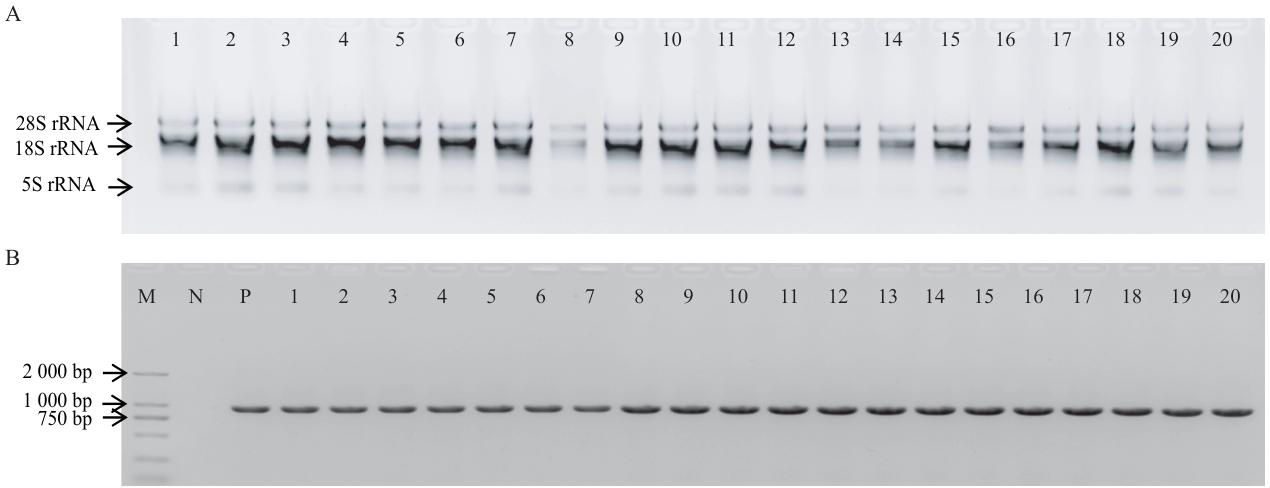
Fig. 2 RNA extraction and molecular detection of SCSMV in chewing caneA: Extraction of total RNA from chewing cane leaves. B: PCR detection of SCSMV virus. M indicates the DNA molecular marker, N is the negative control using sterile water, P is the positive control carrying SCSMV virus, and samples are numbered 1‒20

Fig. 3 Homology analysis of PCR product sequences
编号 No. | 温水处理条件 Hot water treatment conditions | 茎尖组织培养 Shoot-tip culture | 芽尖组织培养 Bud-tip culture | |||||||
|---|---|---|---|---|---|---|---|---|---|---|
| 出芽率Germination rate (%) | 茎尖成活率Survival rate of stem tips (%) | 污染率 Contamination rate (%) | 芽苗状态 Emergence of seedlings | 芽尖成活率 Survival rate of bud-tips (%) | 污染率 Contamination rate (%) | 芽苗状态 Emergence of seedlings | ||||
| A | 未处理 | 86.3 | 81.8 | 15.7 | 丛生芽,长势良好 | 87.0 | 11.9 | 丛生芽,长势良好 | ||
| B | 50 ℃ 2 h | 37.5 | 89.3 | 10.0 | 丛生芽,长势良好 | 95.2 | 5.0 | 丛生芽,长势良好 | ||
| C | 50 ℃ 3 h | 23.8 | 85.7 | 13.2 | 丛生芽,长势良好 | 90.9 | 5.6 | 丛生芽,长势良好 | ||
| D | 52 ℃ 3 h | 12.9 | 84.6 | 15.0 | 丛生芽,长势良好 | 90.9 | 3.1 | 丛生芽,长势良好 | ||
| E | 54 ℃ 3 h | 0 | - | - | 83.3 | 2.3 | 丛生芽,长势良好 | |||
| F | 58 ℃ 1 h | 0 | - | - | 76.9 | 0 | 丛生芽,长势良好 | |||
Table 1 Effects of different hot water treatment conditions on the survival rates of stem buds
编号 No. | 温水处理条件 Hot water treatment conditions | 茎尖组织培养 Shoot-tip culture | 芽尖组织培养 Bud-tip culture | |||||||
|---|---|---|---|---|---|---|---|---|---|---|
| 出芽率Germination rate (%) | 茎尖成活率Survival rate of stem tips (%) | 污染率 Contamination rate (%) | 芽苗状态 Emergence of seedlings | 芽尖成活率 Survival rate of bud-tips (%) | 污染率 Contamination rate (%) | 芽苗状态 Emergence of seedlings | ||||
| A | 未处理 | 86.3 | 81.8 | 15.7 | 丛生芽,长势良好 | 87.0 | 11.9 | 丛生芽,长势良好 | ||
| B | 50 ℃ 2 h | 37.5 | 89.3 | 10.0 | 丛生芽,长势良好 | 95.2 | 5.0 | 丛生芽,长势良好 | ||
| C | 50 ℃ 3 h | 23.8 | 85.7 | 13.2 | 丛生芽,长势良好 | 90.9 | 5.6 | 丛生芽,长势良好 | ||
| D | 52 ℃ 3 h | 12.9 | 84.6 | 15.0 | 丛生芽,长势良好 | 90.9 | 3.1 | 丛生芽,长势良好 | ||
| E | 54 ℃ 3 h | 0 | - | - | 83.3 | 2.3 | 丛生芽,长势良好 | |||
| F | 58 ℃ 1 h | 0 | - | - | 76.9 | 0 | 丛生芽,长势良好 | |||

Fig. 4 SCSMV molecular detection in tissue-cultured seedlings of chewing cane under different treatment conditionsA: Non-hot water treatment group. B: The 50 ℃ 2 h hot water treatment group. C: The 50 ℃ 3 h hot water treatment group. D: The 52 ℃ 3 h hot water treatment group. E: The 54 ℃ 3 h treatment group. F: The 58 ℃ 1 h treatment group. A‒D: Samples 1‒10 are from stem-tip culture seedlings, and samples 11‒20 are from bud-tip culture seedlings. E‒F: Sample 1‒20 were from bud tip culture seedlings. M: DNA molecular marker. N: Sterile water negative control. P: Positive control with SCSMV virus cDNA

Fig. 5 Symptoms of mosaic disease and agronomic traits of virus-infected and virus-free chewing cane
材料 Material | 株高 Plant height (cm) | 茎径 Stem diameter (cm) | 节间长度 Internode length (cm) | 有效茎 Effective stems (Stems/pot) | ingle stem weight (kg) 单茎重 S | 锤度 Brix (%) | 蔗糖分 Sucrose content (%) |
|---|---|---|---|---|---|---|---|
非脱毒果蔗 Virus-infected chewing cane | 125±10.58a | 2.97±0.28a | 5.46±1.11a | 1.70±0.67a | 1.15±0.32a | 12.85±1.02a | 5.47±0.35a |
脱毒果蔗 Virus-free chewing cane | 179.4±6.07b | 3.30±0.30a | 8.38±0.82b | 2.00±0.67a | 1.92±0.17b | 14.45±0.56b | 7.11±0.32b |
Table 2 Comparison of agronomic traits between virus-infected and virus-free chewing cane
材料 Material | 株高 Plant height (cm) | 茎径 Stem diameter (cm) | 节间长度 Internode length (cm) | 有效茎 Effective stems (Stems/pot) | ingle stem weight (kg) 单茎重 S | 锤度 Brix (%) | 蔗糖分 Sucrose content (%) |
|---|---|---|---|---|---|---|---|
非脱毒果蔗 Virus-infected chewing cane | 125±10.58a | 2.97±0.28a | 5.46±1.11a | 1.70±0.67a | 1.15±0.32a | 12.85±1.02a | 5.47±0.35a |
脱毒果蔗 Virus-free chewing cane | 179.4±6.07b | 3.30±0.30a | 8.38±0.82b | 2.00±0.67a | 1.92±0.17b | 14.45±0.56b | 7.11±0.32b |
| [1] | 张莉娟, 吴凤, 李今朝, 等. 中国糖料蔗和果蔗品种发展历史 [J]. 农业研究与应用, 2023, 36(6): 79-86. |
| Zhang LJ, Wu F, Li JZ, et al. Development history of industrial cane and chewing cane varieties in China [J]. Agric Res Appl, 2023, 36(6): 79-86. | |
| [2] | Wang KL, Deng QQ, Chen JW, et al. Physiological and molecular mechanisms governing the effect of virus-free chewing cane seedlings on yield and quality [J]. Sci Rep, 2020, 10(1): 10306. |
| [3] | 齐永文, 劳方业, 樊丽娜, 等. 广州果蔗产业发展探讨 [J]. 甘蔗糖业, 2017, 46(5): 61-63. |
| Qi YW, Lao FY, Fan LN, et al. Prospect on the development of chewing cane in Guangzhou [J]. Sugarcane Canesugar, 2017, 46(5): 61-63. | |
| [4] | 王继华, 曹干, 张剑亮, 等. 我国果蔗产业的现状与可持续发展 [J]. 甘蔗糖业, 2013, 42(5): 56-61. |
| Wang JH, Cao G, Zhang JL, et al. The production situation and sustainable development of fruit cane in China [J]. Sugarcane Canesugar, 2013, 42(5): 56-61. | |
| [5] | 黄应昆, 李文风, 卢文洁, 等. 云南蔗区甘蔗花叶病流行原因及控制对策 [J]. 云南农业大学学报, 2007, 22(6): 935-938. |
| Huang YK, Li WF, Lu WJ, et al. The causes of sugarcane mosaic disease eepidemic in Yunnan sugarcane area and the control strategy [J]. J Yunnan Agric Univ, 2007, 22(6): 935-938. | |
| [6] | Zhang RY, Li WF, Huang YK, et al. Genetic diversity and population structure of Sugarcane streak mosaic virus in Yunnan province, China [J]. Trop Plant Pathol, 2018, 43(6): 514-519. |
| [7] | Luo Q, Ahmad K, Fu HY, et al. Genetic diversity and population structure of sorghum mosaic virus infecting Saccharum spp. hybrids [J]. Ann Appl Biol, 2016, 169(3): 398-407. |
| [8] | 迟惠荣, 毛碧增. 植物病毒检测及脱毒方法的研究进展 [J]. 生物技术通报, 2017, 33(8): 26-33. |
| Chi HR, Mao BZ. Research advances on plant virus detection and virus-elimination methods [J]. Biotechnol Bull, 2017, 33(8): 26-33. | |
| [9] | 唐红琴, 淡明, 李松, 等. 黑皮果蔗花叶病茎尖脱毒技术研究 [J]. 安徽农业科学, 2011, 39(25): 15345-15346. |
| Tang HQ, Dan M, Li S, et al. Shoot-tip virus-free techniques of black sugarcane mosaic disease [J]. J Anhui Agric Sci, 2011, 39(25): 15345-15346. | |
| [10] | Mishra S, Rao GP. Regeneration of sugarcane yellow leaf virus free sugarcane plantlets through meristem culture[J]. J South Agric, 2011, 1: 1-5. |
| [11] | 沈万宽, 陈仲华, 杨湛端, 等. 热水处理防治甘蔗宿根矮化病的效果及对再生植株影响研究 [J]. 云南农业大学学报, 2008, 23(4): 474-478. |
| Shen WK, Chen ZH, Yang ZD, et al. Studies on control effect of hot water treatment on sugarcane ratoon stunting disease by and its influence on regenerative plants [J]. J Yunnan Agric Univ, 2008, 23(4): 474-478. | |
| [12] | 王凯莉, 邓权清, 窦志敏, 等. 果蔗脱毒种苗甘蔗花叶病、黄叶病和宿根矮化病分子检测 [J]. 植物保护, 2018, 44(3): 163-167, 181. |
| Wang KL, Deng QQ, Dou ZM, et al. Molecular detection of sugarcane mosaic disease, sugarcane yellow leaf disease and ratoon stunting disease in virus-free seedlings of fruit cane [J]. Plant Prot, 2018, 44(3): 163-167, 181. | |
| [13] | 武媛丽, 王俊刚, 蔡文伟, 等. 不同热处理对甘蔗蔗茎脱毒效果的影响 [J]. 广东农业科学, 2016, 43(11): 14-21, 2. |
| Wu YL, Wang JG, Cai WW, et al. Effects of different treatments on efficiency of virus-free seed-stems of sugarcane [J]. Guangdong Agric Sci, 2016, 43(11): 14-21, 2. | |
| [14] | 许莉萍, 陈如凯, 李跃平. 利用愈伤组织培养和茎尖培养去除甘蔗花叶病毒 [J]. 福建农业大学学报, 1994, 23(3): 253-256. |
| Xu LP, Chen RK, Li YP. Elimination of sugarcane mosaic virus by callus tissue culture and apical culture[J]. J Fujian Agric For Univ Nat Sci Ed, 1994, 23(3): 253-256. | |
| [15] | Damayanti TA, Putra LK, Giyanto. Hot water treatment of cutting-cane infected with sugarcane streak mosaic virus (SCSMV)[J]. J ISSAAS, 2010, 16(2): 17-25. |
| [16] | Subba RCV, Sreenivasulu P. Generation of sugarcane streak mosaic virus-free sugarcane (Saccharum spp. hybrid) from infected plants by in vitro meristem tip culture [J]. Eur J Plant Pathol, 2011, 130(4): 597-604. |
| [17] | 吴转娣, 赵培方, 杨洪昌, 等. 高糖新品种云蔗1640花叶病原的检测与脱毒种苗生产 [J]. 中国糖料, 2024, 46(2): 1-8. |
| Wu ZD, Zhao PF, Yang HC, et al. Detection of mosaic disease and propagation of virus-free seedlings for high sugar new sugarcane variety Yunzhe 1640 [J]. Sugar Crops China, 2024, 46(2): 1-8. | |
| [18] | 单红丽, 陈都, 王晓燕, 等. 对甘蔗线条花叶病毒存在抗性差异的2个甘蔗品种中eIF4E基因序列分析 [J]. 植物病理学报, 2023, 53(4): 624-632. |
| Shan HL, Chen D, Wang XY, et al. Sequence analysis of eukaryotic translation initiation factor eIF4E from two varieties of sugarcane with differential resistance to sugarcane streak mosaic virus [J]. Acta Phytopathol Sin, 2023, 53(4): 624-632. | |
| [19] | 李文凤, 单红丽, 张荣跃, 等. 我国新育成甘蔗品种(系)对甘蔗线条花叶病毒和高粱花叶病毒的抗性评价 [J]. 植物病理学报, 2018, 48(3): 389-394. |
| Li WF, Shan HL, Zhang RY, et al. Screening for resistance to sugarcane streak mosaic virus and sorghum mosaic virus in new elite sugarcane varieties/clones from China [J]. Acta Phytopathol Sin, 2018, 48(3): 389-394. | |
| [20] | Elveborg S, Monteil VM, Mirazimi A. Methods of inactivation of highly pathogenic viruses for molecular, serology or vaccine development purposes [J]. Pathogens, 2022, 11(2): 271. |
| [21] | 李恒锐, 卢美瑛, 邱文武, 等. 不同温烫脱毒处理对甘蔗萌芽率的影响 [J]. 中国热带农业, 2013(6): 58-59. |
| Li HR, Lu MY, Qiu WW, et al. Effects of different warm scalding and detoxification treatments on germination rate of sugarcane [J]. China Trop Agric, 2013(6): 58-59. | |
| [22] | 韦玖贤, 韦秋玲, 黄英宽. 甘蔗茎尖脱毒组织培养技术研究 [J]. 现代农业科技, 2016(1): 101-102. |
| Wei JX, Wei QL, Huang YK. Study on virus-free tissue culture technology of sugarcane shoot tip [J]. Mod Agric Sci Technol, 2016(1): 101-102. | |
| [23] | 梁丽君. 黑皮果蔗Badila组织培养与脱毒研究 [D]. 桂林: 广西师范大学, 2018. |
| Liang LJ. Study on tissue culture and detoxification of sugarcane badila [D]. Guilin: Guangxi Normal University, 2018. | |
| [24] | 周丰静, 黄诚华, 李正文, 等. 广西蔗区甘蔗花叶病病毒种群分析 [J]. 南方农业学报, 2015, 46(4): 609-613. |
| Zhou FJ, Huang CH, Li ZW, et al. Analysis of the virus population causing sugarcane mosaic virus disease in sugarcane growing area of Guangxi [J]. J South Agric, 2015, 46(4): 609-613. | |
| [25] | Su XL, Mai ZY, Wei KJ, et al. Complete genomic sequence analysis of a sugarcane streak mosaic virus isolate from Yunnan province of China [J]. Genes, 2023, 14(9): 1713. |
| [26] | 沈林波, 吴楠楠, 冯小艳, 等. 52个甘蔗品种在广西受病毒侵染情况 [J]. 热带作物学报, 2020, 41(1): 116-126. |
| Shen LB, Wu NN, Feng XY, et al. Virus infection situation of fifty-two sugarcane varieties in Guangxi [J]. Chin J Trop Crops, 2020, 41(1): 116-126. | |
| [27] | 林垠孚. 中国果蔗病毒类型及分布研究 [D]. 南宁: 广西大学, 2021. |
| Lin YF. Study on the types and distribution of chewing cane infected viruses in China [D]. Nanning: Guangxi University, 2021. | |
| [28] | 冯小艳, 王文治, 沈林波, 等. 甘蔗线条花叶病毒研究进展 [J]. 生物技术通报, 2017, 33(7): 22-28. |
| Feng XY, Wang WZ, Shen LB, et al. Research advances on sugarcane streak mosaic virus [J]. Biotechnol Bull, 2017, 33(7): 22-28. | |
| [29] | 谢静, 常海龙, 刘壮, 等. 果蔗脱毒种茎苗对农艺性状和品质的影响 [J/OL]. 分子植物育种, 2024. . |
| Xie J, Chang HL, Liu Z, et al. Effects of virus-free seedling of chewing cane on agronomic traits and quality [J/OL]. Mol Plant Breed, 2024. . | |
| [30] | 陈培华, 鲍涵, 陈培寿, 等. 果蔗健康种苗田间效果评价 [J]. 中国农学通报, 2022, 38(16): 1-5. |
| Chen PH, Bao H, Chen PS, et al. Field effect evaluation of healthy seed canes of chewing cane [J]. Chin Agric Sci Bull, 2022, 38(16): 1-5. | |
| [31] | 劳方业, 何慧怡, 樊丽娜, 等. 果蔗脱毒种苗主要经济性状表现分析 [J]. 甘蔗糖业, 2021, 50(3): 37-42. |
| Lao FY, He HY, Fan LN, et al. Analysis of the main economic characters of chewing cane virus-free seedlings [J]. Sugarcane Canesugar, 2021, 50(3): 37-42. | |
| [32] | 庞法松, 王玉坤, 庞华强, 等. 果蔗品种的种植表现与综合评价 [J]. 中国糖料, 2019, 41(2): 37-41. |
| Pang FS, Wang YK, Pang HQ, et al. Filed performance and comprehensive evaluation on chewing cane varieties [J]. Sugar Crops China, 2019, 41(2): 37-41. |
| No related articles found! |
| Viewed | ||||||
|
Full text |
|
|||||
|
Abstract |
|
|||||
