







Biotechnology Bulletin ›› 2026, Vol. 42 ›› Issue (6): 77-86.doi: 10.13560/j.cnki.biotech.bull.1985.2026-0247
Previous Articles Next Articles
LI Jian-gong( ), DENG Yi-tong, ZHAO Lu-kuan, WANG Yao, CAO Qing-he()
Received:2026-03-01
Online:2026-06-26
Published:2026-07-11
Contact:
CAO Qing-he
E-mail:15863131721@163.com;caoqinghe@jaas.ac.cn
LI Jian-gong, DENG Yi-tong, ZHAO Lu-kuan, WANG Yao, CAO Qing-he. Optimization of Flow Cytometry and Its Application in Ploidy Identification of Sweetpotato[J]. Biotechnology Bulletin, 2026, 42(6): 77-86.
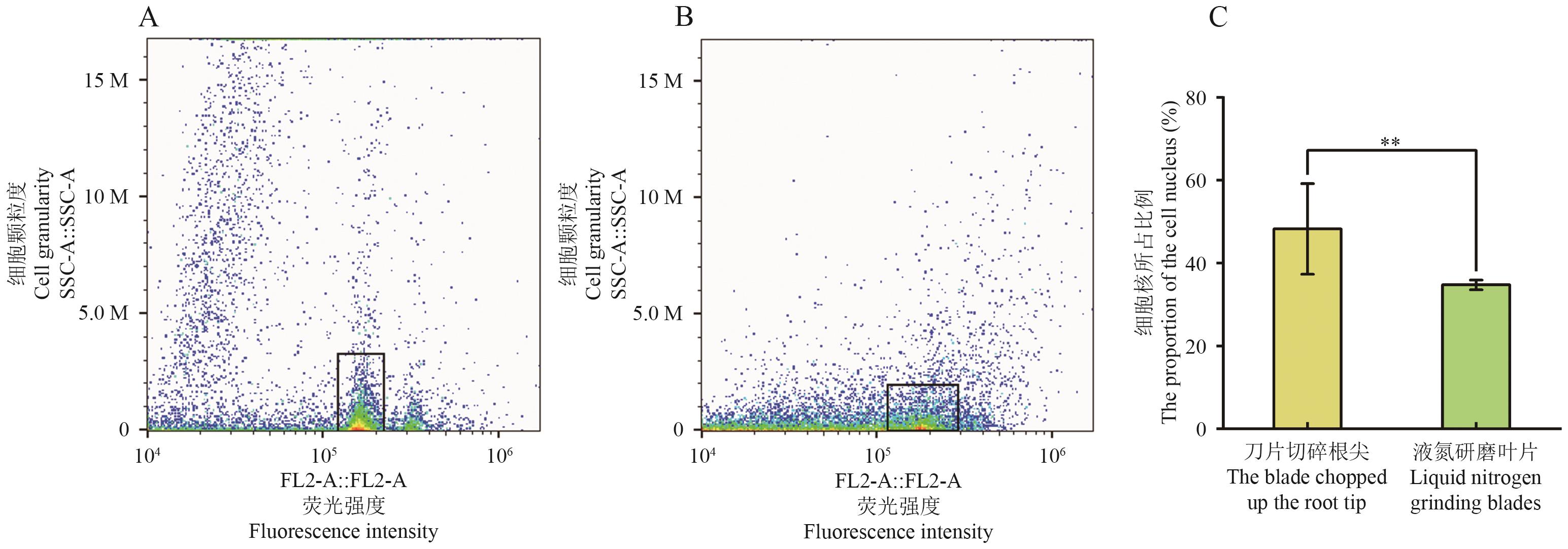
Fig. 1 Proportion of cell nuclei in the nuclear suspension obtained by the two sample preparation methodsA: Scatter plot of the blade-chopped root tip method. B: Scatter plot of the liquid nitrogen-ground leaf method. C: Proportion of cell nuclei. A t-test was used to analyze significant differences; ** indicates P0.01; n=9
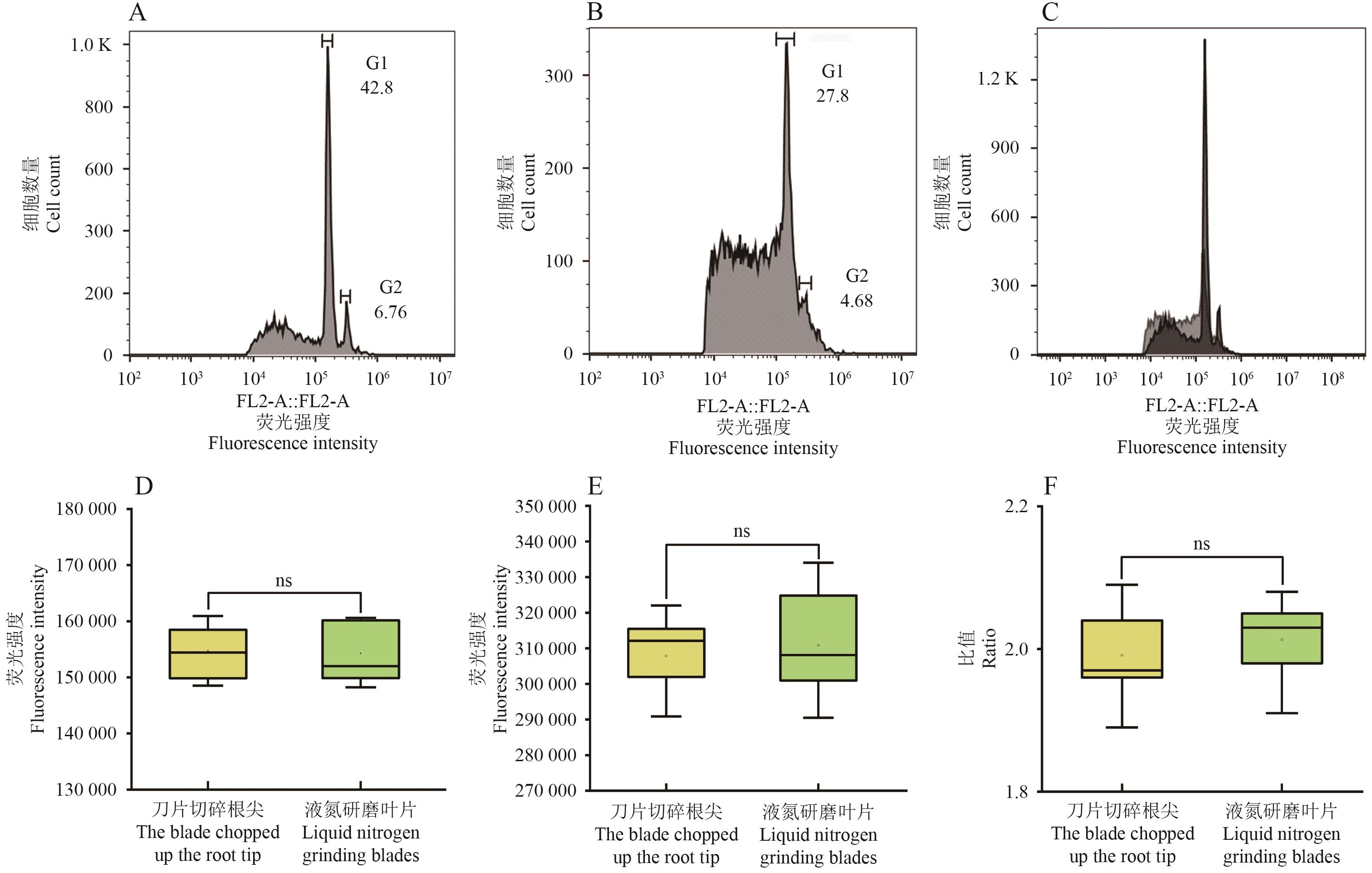
Fig. 2 Histograms of nuclear DNA content in nuclear suspension obtained by the two sample preparation methodsA: Histogram of the blade-chopped root tip method. B: Histogram of the liquid nitrogen-ground leaf method. C: Comparison of G1 fluorescence intensity between the two methods. D: G1 peak fluorescence intensity of the two methods. E: G2 peak fluorescence intensity of the two methods. F: Ratio of G2/G1 peak of the two methods. A t-test was performed to analyze significant differences; ns indicates no statistically significant difference; n=9
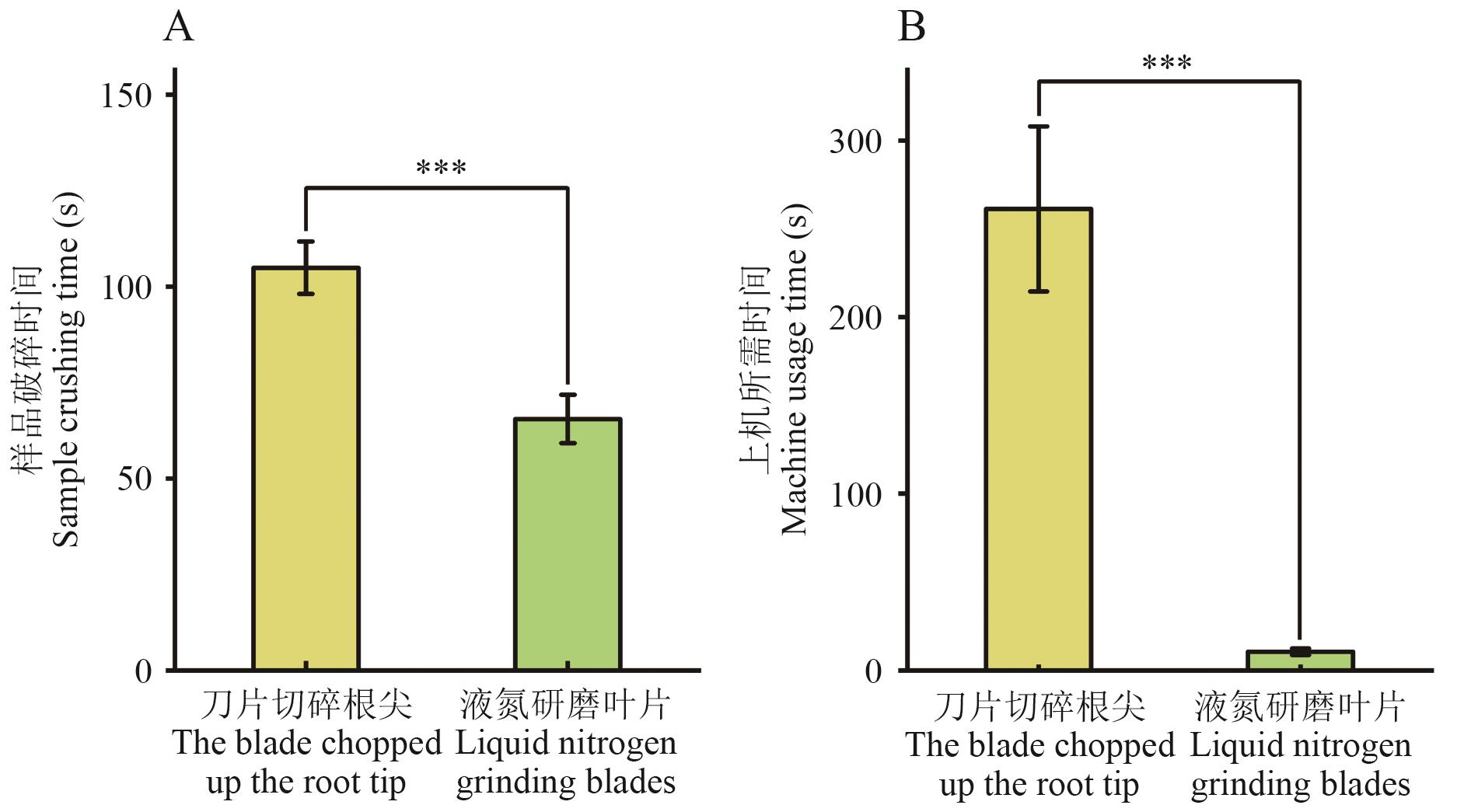
Fig. 3 Comparison of the time required by the two methodsA: Comparison of sample crushing time for the two methods. B: Comparison of on-machine detection time of the two methods; *** indicates P0.001; n=9
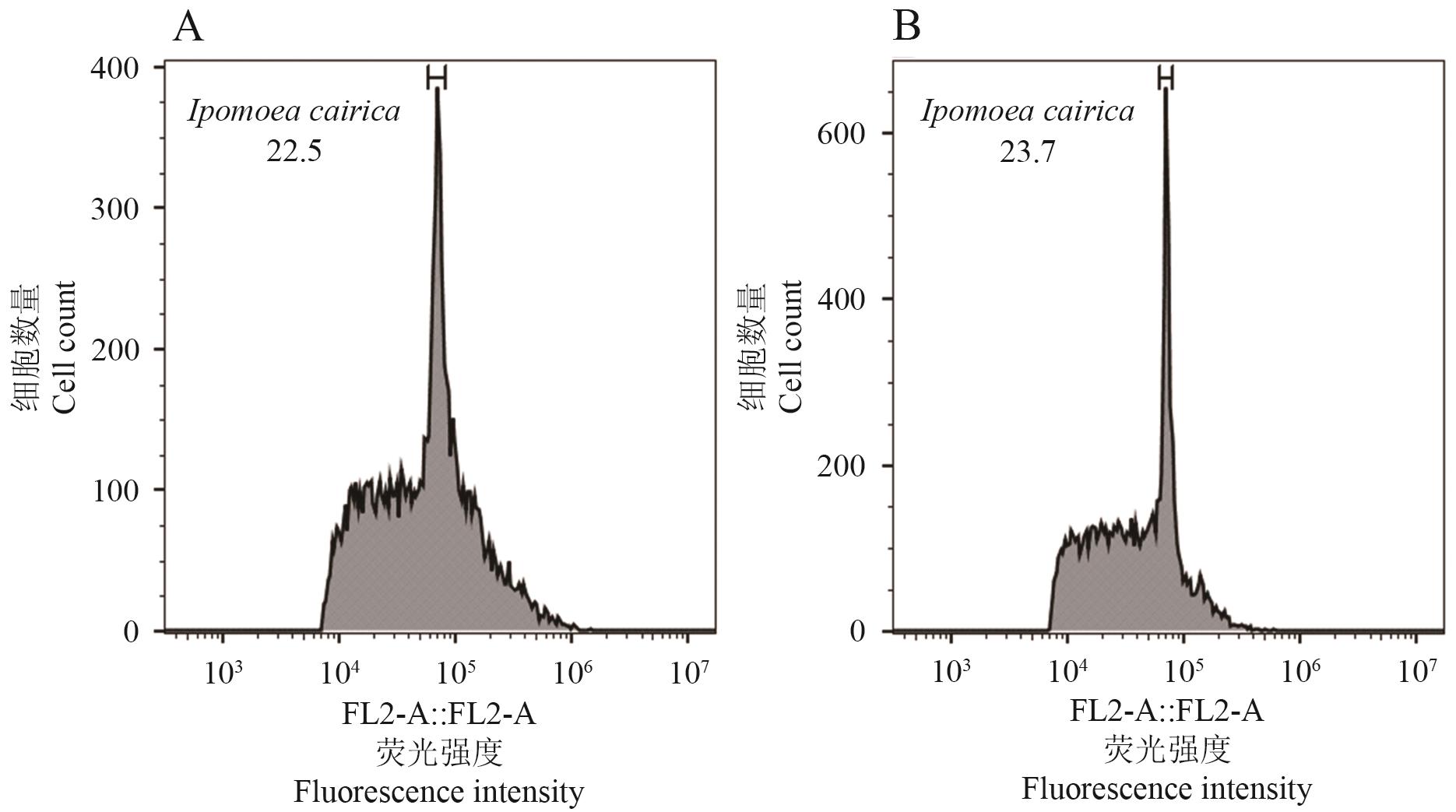
Fig. 4 Comparison of the effects of two lysis buffersA: Histogram of samples treated with traditional lysis buffer. B: Histogram of samples treated with modified lysis buffer
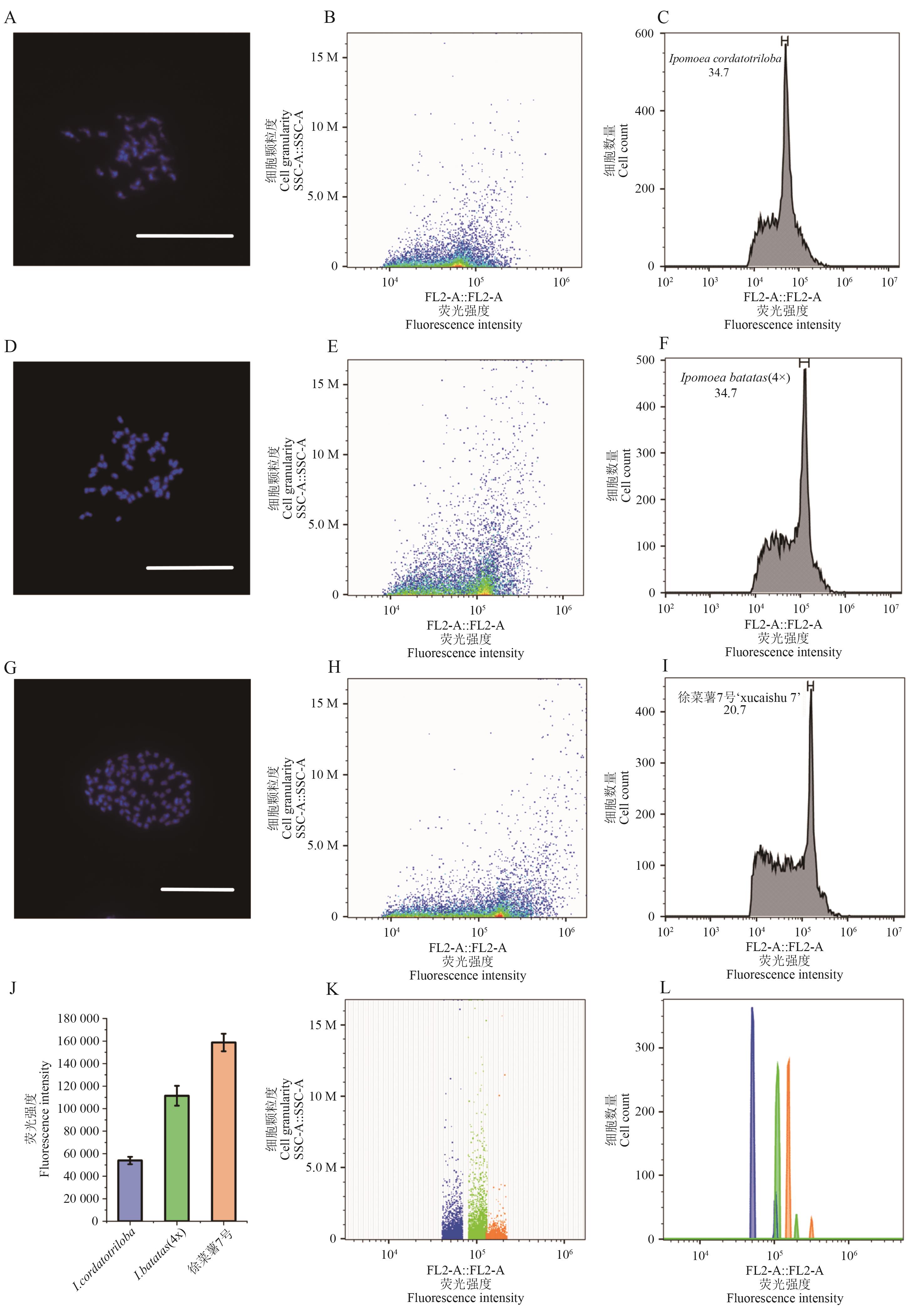
Fig. 5 Chromosome number, scatter plots, and histogram of I. cordatotriloba, I. batatas (4x) and ‘Xucaishu 7’A: Chromosome number of I. cordatotriloba. B: Scatter plot of I. cordatotriloba. C: Histogram of I. cordatotriloba. D: Chromosome number of I. batatas (4x). E: Scatter plot of I. batatas (4x). F: Histogram of I. batatas (4x). G: Chromosome number of ‘Xucaishu7’. H: Scatter plot of ‘Xucaishu7’. I: Histogram of ‘Xucaishu7’. J: Statistical graph of fluorescence intensity of three different ploidy materials. K: Scatter plot of nuclear aggregation regions of three different ploidy materials. L: Histogram of nuclear aggregation regions for cells of three different ploidy materials. Scale bar=10 μm
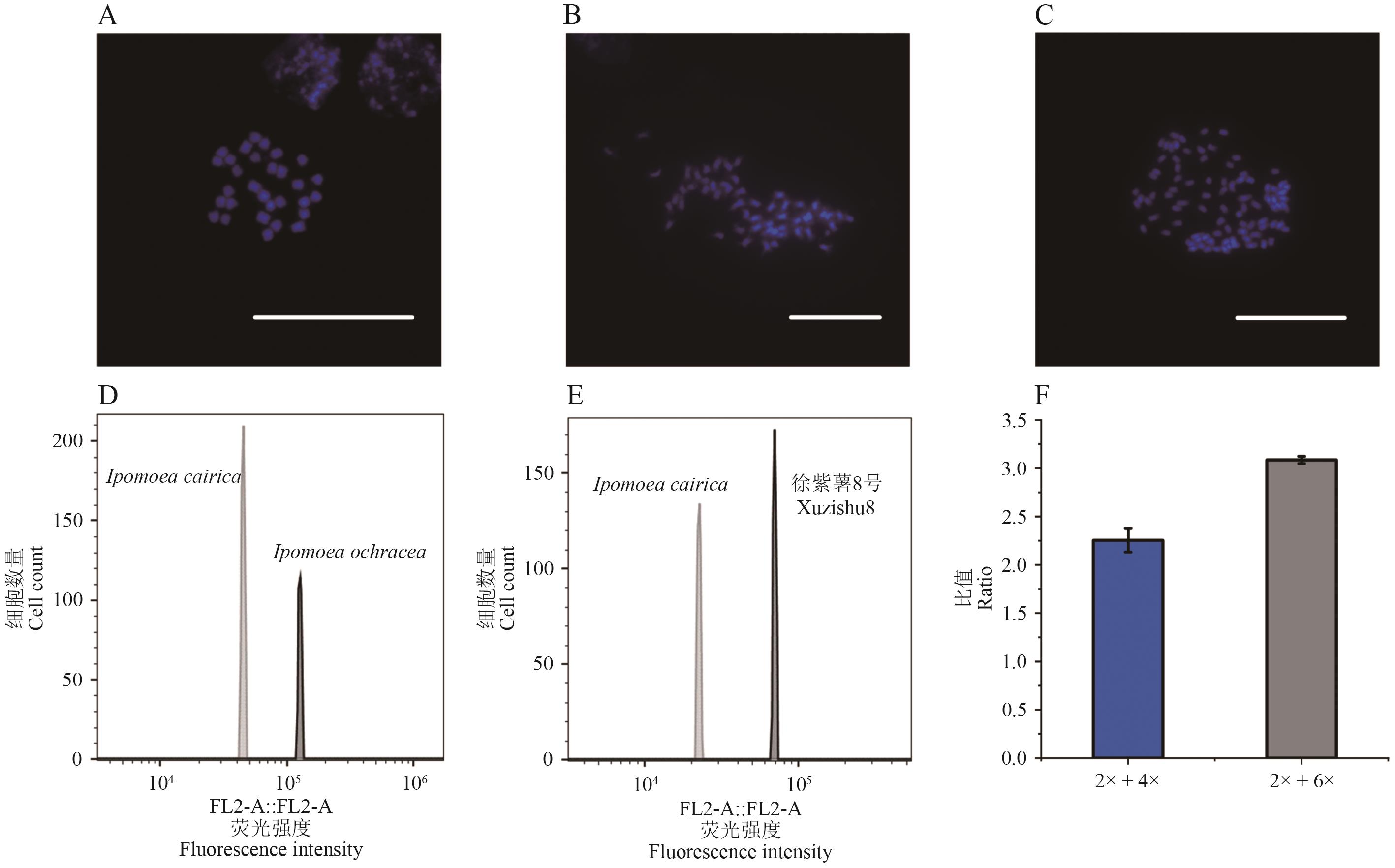
Fig. 6 Chromosome numbers and histogram of I. cairica, I. ochracea and ‘Xuzishu 8’A: Chromosome number of I. cairica. B: Chromosome number of I. ochracea. C: Chromosome number of ‘Xuzishu8’. D: Histogram of the mixed detection of I. cairica and I. ochracea. E: Histogram of the mixed detection of I. cairica and ‘Xuzishu8’. F: Statistical graph of ploidy ratio. Scale bar=10 μm
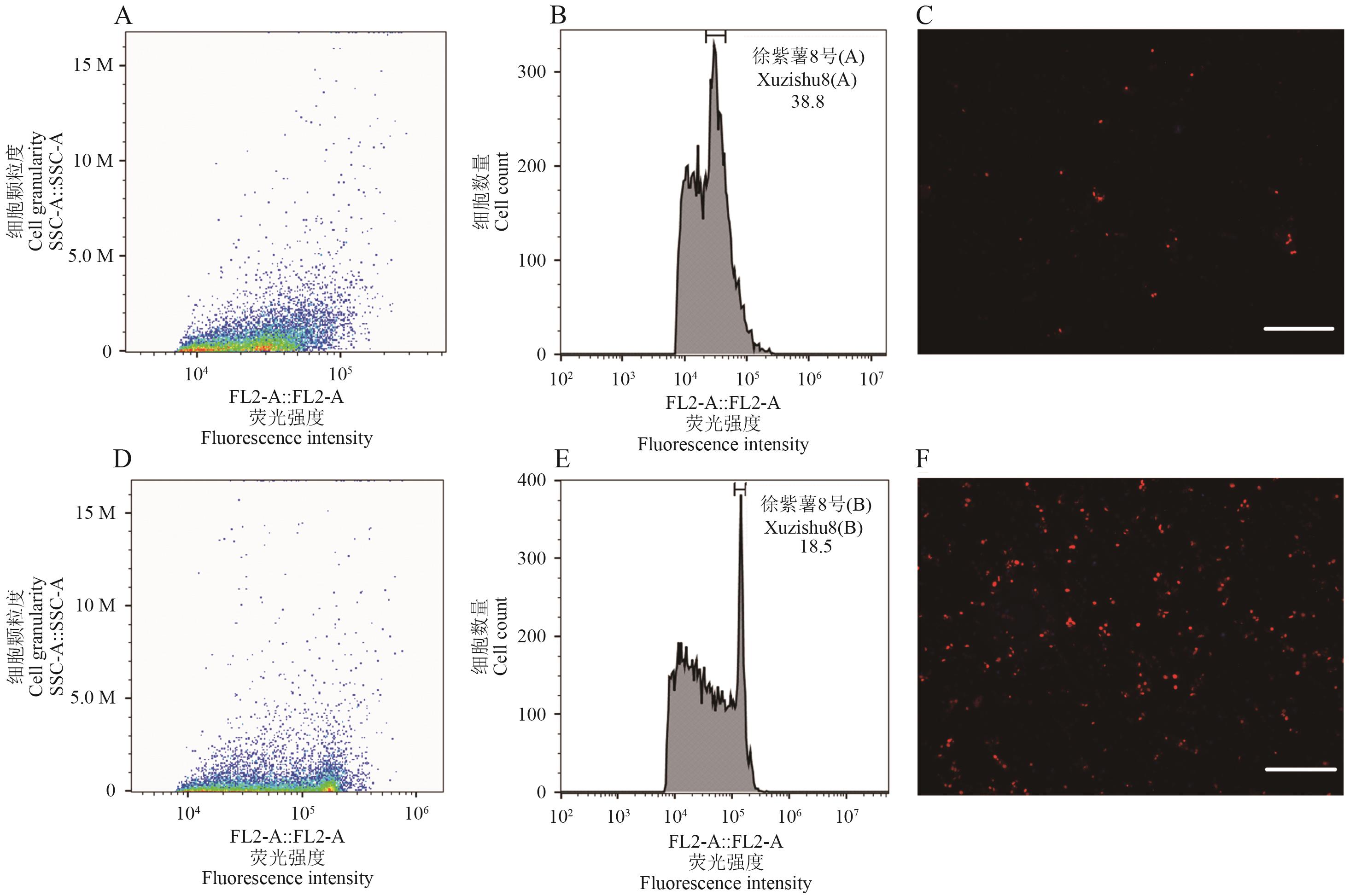
Fig. 7 Scatter plot, histograms, and microscopic observation of samples treated with lysis buffer A and BA: Scatter plot of lysate A. B: Histogram of lysate A. C: Number of stained nuclei of samples treated with lysis buffer A under a microscope. D: Density plot of lysate B. E: Histogram of lysate B. F: Number of stained nuclei of samples treated with lysis buffer B under a microscope. Scale bar=200 μm
| [1] | 罗密, 尹旺, 邓仁菊, 等. 基于主成分分析和聚类分析对不同品种甘薯淀粉与粉条品质的综合评价 [J]. 食品工业科技, 2025, 46(4): 246-257. |
| Luo M, Yin W, Deng RJ, et al. Comprehensive evaluation of starch and noodles quality of different sweet potato varieties based on principal component analysis and cluster analysis [J]. Sci Technol Food Ind, 2025, 46(4): 246-257. | |
| [2] | 张秀南, 贾亚娟, 孙阳阳, 等. 甘薯生物活性成分功能特性研究进展 [J]. 中国粮油学报, 2023, 38(4): 195-202. |
| Zhang XN, Jia YJ, Sun YY, et al. Research progress on functional properties of sweet potato bioactive components [J]. J Chin Cereals Oils Assoc, 2023, 38(4): 195-202. | |
| [3] | 李强, 赵海, 靳艳玲, 等. 中国甘薯产业助力国家粮食安全的分析与展望 [J]. 江苏农业学报, 2022, 38(6): 1484-1491. |
| Li Q, Zhao H, Jin YL, et al. Analysis and perspectives of sweetpotato industry contributing to national food security in China [J]. Jiangsu J Agric Sci, 2022, 38(6): 1484-1491. | |
| [4] | 王欣, 李强, 曹清河, 等. 中国甘薯产业和种业发展现状与未来展望 [J]. 中国农业科学, 2021, 54(3): 483-492. |
| Wang X, Li Q, Cao QH, et al. Current status and future prospective of sweetpotato production and seed industry in China [J]. Sci Agric Sin, 2021, 54(3): 483-492. | |
| [5] | 吉士东, 王丽, 胡启国, 等. 甘薯近缘野生资源的染色体倍性研究 [J]. 种子, 2022, 41(4): 121-125. |
| Ji SD, Wang L, Hu QG, et al. Research on chromosome number of a sweet potato wild species Ipomoea trifida [J]. Seed, 2022, 41(4): 121-125. | |
| [6] | 翁宗宽. 番薯属Ipomoea tabascana(4x)与Ipomoea trifida (2x)种间杂种鉴定和分析 [D]. 北京: 中国农业科学院, 2024. |
| Weng ZK. Identification and analysis of interspecific hybrids between Ipomoea tabascana (4x) and Ipomoea trifida (2x) of genus ipomoea [D]. Beijing: Chinese Academy of Agricultural Sciences, 2024. | |
| [7] | Srisuwan S, Sihachakr D, Martín J, et al. Change in nuclear DNA content and pollen size with polyploidisation in the sweet potato (Ipomoea batatas, Convolvulaceae) complex [J]. Plant Biol J, 2019, 21(2): 237-247. |
| [8] | 齐嫣然, 王英平, 郝小丽, 等. DNA流式细胞术及其在植物基因组大小与倍性检测中的研究与应用 [J]. 分子植物育种, 2022, 20(7): 2279-2285. |
| Qi YR, Wang YP, Hao XL, et al. DNA flow cytometry and its application in the detection of plant genome size and ploidy [J]. Mol Plant Breed, 2022, 20(7): 2279-2285. | |
| [9] | Motsa MM, Bester C, Slabbert MM, et al. Flow cytometry: a quick method to determine ploidy levels in honeybush (Cyclopia spp.) [J]. Genet Resour Crop Evol, 2018, 65(6): 1711-1724. |
| [10] | 李建建, 王浩然, 张源, 等. 基于荧光原位杂交(FISH)技术的假俭草染色体鉴定和核型分析 [J]. 植物资源与环境学报, 2025, 34(1): 33-41. |
| Li JJ, Wang HR, Zhang Y, et al. Chromosome identification and karyotype analysis of Eremochloa ophiuroides based on fluorescence in situ hybridization (FISH) technology [J]. J Plant Resour Environ, 2025, 34(1): 33-41. | |
| [11] | 张献芳, 聂刚, 黄思源, 等. 基于SSR标记的象草F1代杂种分子鉴定及表型变异分析 [J]. 草业学报, 2025, 34(11): 114-124. |
| Zhang XF, Nie G, Huang SY, et al. Identification of hybrids and analysis of phenotypic variation in the F1 generation of Pennisetum purpureum based on SSR markers [J]. Acta Prataculturae Sin, 2025, 34(11): 114-124. | |
| [12] | 程志芳, 李丽, 史艳艳, 等. 辣椒花药培养再生植株倍性鉴定方法的比较 [J]. 中国瓜菜, 2025, 38(8): 77-82. |
| Cheng ZF, Li L, Shi YY, et al. Comparison of ploidy identification methods for regenerated plants from pepper anther culture [J]. China Cucurbits Veg, 2025, 38(8): 77-82. | |
| [13] | 金亮, 徐伟韦, 李小白, 等. DNA流式细胞术在植物遗传及育种中的应用 [J]. 中国细胞生物学学报, 2016, 38(2): 225-234. |
| Jin L, Xu WW, Li XB, et al. Application of DNA flow cytometry to plant genetics and breeding [J]. Chin J Cell Biol, 2016, 38(2): 225-234. | |
| [14] | 陈林, 宋丽. 流式细胞术的发展及在植物研究中的应用 [J]. 生物工程学报, 2023, 39(2): 472-487. |
| Chen L, Song L. Development of flow cytometry and its application in plant research [J]. Chin J Biotechnol, 2023, 39(2): 472-487. | |
| [15] | Dolezel J. Plant DNA flow cytometry and estimation of nuclear genome size [J]. Ann Bot, 2005, 95(1): 99-110. |
| [16] | 弓娜, 田新民, 周香艳, 等. 流式细胞术在植物学研究中的应用——检测植物核DNA含量和倍性水平 [J]. 中国农学通报, 2011, 27(9): 21-27. |
| Gong N, Tian XM, Zhou XY, et al. Applications of flow cytometry in plant research—analysis of nuclear DNA content and ploidy level in plant cells [J]. Chin Agric Sci Bull, 2011, 27(9): 21-27. | |
| [17] | 青梦瑶, 田林, 李迎超, 等. 基于流式细胞仪鉴定树莓倍性方法的建立及应用 [J]. 生物技术通报, 2025, 41(11): 228-235. |
| Qing MY, Tian L, Li YC, et al. Establishment and application of a method for identifying raspberry ploidy based on flow cytometry [J]. Biotechnol Bull, 2025, 41(11): 228-235. | |
| [18] | 邵雪花, 李桂兰, 肖维强, 等. 基于流式细胞仪鉴定番石榴倍性方法的建立及应用 [J]. 生物技术通报, 2024, 40(2): 48-54. |
| Shao XH, Li GL, Xiao WQ, et al. Establishment and application of ploidy method for the identification of Psidium guajava by flow cytometry [J]. Biotechnol Bull, 2024, 40(2): 48-54. | |
| [19] | 王娅丽, 周利利, 王娜, 等. 利用流式细胞仪快速鉴定棉花倍性的方法比较 [J]. 生物技术通报, 2022, 38(12): 144-148. |
| Wang YL, Zhou LL, Wang N, et al. Comparison of methods for rapid determination of cotton ploidy by flow cytometry [J]. Biotechnol Bull, 2022, 38(12): 144-148. | |
| [20] | 张艳艳, 彭冶, 林峰, 等. 基于流式细胞术对观赏海棠品种的基因组大小测定 [J]. 植物科学学报, 2024, 42(3): 359-365. |
| Zhang YY, Peng Y, Lin F, et al. Genome size determination of ornamental crabapple cultivars based on flow cytometry [J]. Plant Sci J, 2024, 42(3): 359-365. | |
| [21] | 刘彪, 杨霖, 夏雨, 等. 基于流式细胞术和Survey分析马梅基因组大小评估 [J/OL]. 分子植物育种, 2025: 1-8. . |
| Liu B, Yang L, Xia Y, et al. Genome size estimation of Prunus mume based on flow cytometry and survey analysis [J/OL]. Mol Plant Breed, 2025: 1-8. . | |
| [22] | 周美君, 尹月, 张永洪. 基于流式细胞术和基因组Survey检测黄连木基因组大小 [J]. 亚热带植物科学, 2024, 53(6): 495-502. |
| Zhou MJ, Yin Y, Zhang YH. Estimation of genome sizes of Pistacia chinensis by flow cytometry and genome survey [J]. Subtrop Plant Sci, 2024, 53(6): 495-502. | |
| [23] | Gostinčar K, Osterc G, Štajner N, et al. Genetic characterization of Slovenian pear germplasm by microsatellite markers and flow cytometry [J]. Sci Hortic, 2025, 345: 114091. |
| [24] | 钟玲安, 邹璇, 李珂清, 等. 凉粉草不同种质的染色体倍性与基因组大小研究 [J]. 中药材, 2023, 46(3): 548-553. |
| Zhong LA, Zou X, Li KQ, et al. Study on the chromosomal ploidy and genome size of different germplasms of Mesona chinensis [J]. J Chin Med Mater, 2023, 46(3): 548-553. | |
| [25] | 许竹溦, 邓逸桐, 雷俊, 等. 文成糯米山药染色体核型分析及基因组大小预估 [J]. 中国瓜菜, 2025, 38(4): 67-72. |
| Xu ZW, Deng YT, Lei J, et al. Chromosome karyotype analysis and genome size estimation of Wencheng glutinous rice yam [J]. China Cucurbits Veg, 2025, 38(4): 67-72. | |
| [26] | 苏一钧, 王珧, 戴习彬, 等. 25份甘薯登记品种基因组大小测定 [J]. 江苏师范大学学报: 自然科学版, 2019, 37(3): 31-34. |
| Su YJ, Wang Y, Dai XB, et al. Genome size estimation of 25 registered sweetpotato varieties [J]. J Jiangsu Norm Univ Nat Sci Ed, 2019, 37(3): 31-34. | |
| [27] | 王珧, 邓逸桐, 戴习彬, 等. 甘薯近缘种Ipomoea cordatotriloba基因组大小测定及高通量调查测序 [J]. 热带作物学报, 2020, 41(6): 1154-1159. |
| Wang Y, Deng YT, Dai XB, et al. DNA amount estimation and genome survey of sweetpotato wild relatives Ipomoea cordatotriloba [J]. Chin J Trop Crops, 2020, 41(6): 1154-1159. | |
| [28] | 袁兰, 黄娅楠, 张贝妮, 等. 基于流式细胞仪鉴定马铃薯倍性的高通量样品制备方法 [J]. 生物技术通报, 2024, 40(9): 141-147. |
| Yuan L, Huang YN, Zhang BN, et al. High-throughput sample preparation method for the identification of potato ploidy using flow cytometry [J]. Biotechnol Bull, 2024, 40(9): 141-147. | |
| [29] | Song WP, Zhu YX, Zheng JY, et al. Haploid induction in sweet potato by activating the AP2/ERF family transcription factor IbBBM [J]. Plant Biotechnol J, 2025, 23(8): 3113-3115. |
| [30] | 王珧. 甘薯及其近缘野生种基因组大小及倍性鉴定 [D]. 海口: 海南大学, 2020. |
| Wang Y. Genome size and ploidy of sweetpotato and its wild relatives [D]. Haikou: Hainan University, 2020. | |
| [31] | 郑英转, 吕燕, 杨东旭, 等. 基于液氮研磨法的流式细胞术检测马铃薯倍性的研究 [J]. 生物技术通报, 2021, 37(1): 282-288. |
| Zheng YZ, Lü Y, Yang DX, et al. Study on the identification of potato ploidy using flow cytometry based on liquid nitrogen grinding method [J]. Biotechnol Bull, 2021, 37(1): 282-288. | |
| [32] | 沙红, 高燕, 董心久, 等. 利用流式细胞术检测甜菜染色体倍性和DNAC-值 [J]. 新疆农业科学, 2021, 58(5): 822-828. |
| Sha H, Gao Y, Dong XJ, et al. Identification of chromosomal ploidy and DNAC-value in sugar beet by flow cytometry [J]. Xinjiang Agric Sci, 2021, 58(5): 822-828. | |
| [33] | 吴栋, 王瑀, 周希希, 等. 基于流式细胞术和SNP分型的猕猴桃倍性鉴定分析 [J]. 西北植物学报, 2023, 43(8): 1276-1285. |
| Wu D, Wang Y, Zhou XX, et al. Ploidy identification analysis of kiwifruit based on flow cytometry and SNP typing [J]. Acta Bot Boreali Occidentalia Sin, 2023, 43(8): 1276-1285. | |
| [34] | 邹天才, 李媛媛, 洪江, 等. 贵州稀有濒危种子植物物种多样性保护与利用的研究 [J]. 广西植物, 2021, 41(10): 1699-1706. |
| Zou TC, Li YY, Hong J, et al. Species diversity conservation and utilization of Guizhou rare and endangered spermatophyta [J]. Guihaia, 2021, 41(10): 1699-1706. | |
| [35] | 郭文龙, 梁云涛, 罗翠婷, 等. 广西野生稻种质资源的抢救性调查收集及其抗病性初步鉴定 [J]. 植物遗传资源学报, 2024, 25(9): 1441-1453. |
| Guo WL, Liang YT, Luo CT, et al. Rescue collection and preliminary identification of disease resistance of wild rice germplasm resources in Guangxi [J]. J Plant Genet Resour, 2024, 25(9): 1441-1453. |
| [1] | QING Meng-yao, TIAN Lin, LI Ying-chao, SHI Rui-ji, ZHANG Rui-jie, ZHENG Yi-chen, SUN Quan, LI Han, GU Yu-hong. Establishment and Application of a Method for Identifying Raspberry Ploidy Based on Flow Cytometry [J]. Biotechnology Bulletin, 2025, 41(11): 228-235. |
| [2] | YUAN Lan, HUANG Ya-nan, ZHANG Bei-ni, XIONG Yu-meng, WANG Hong-yang. High-throughput Sample Preparation Method for the Identification of Potato Ploidy Using Flow Cytometry [J]. Biotechnology Bulletin, 2024, 40(9): 141-147. |
| [3] | SHAO Xue-hua, LI Gui-lan, XIAO Wei-qiang, LAI Duo, ZHUANG Qing-li, QIN Jian. Establishment and Application of Ploidy Method for the Identification of Psidium guajava by Flow Cytometry [J]. Biotechnology Bulletin, 2024, 40(2): 48-54. |
| [4] | GAO Kai-yue, GUO Yu-ting, DU Yi-mou, ZHENG Xiao-mei, MA Xin-rong, ZHAO Wei, ZHENG Ping, SUN Ji-bin. A Quantitative Detection Approach for Glucose Uptake in Aspergillus niger: A Case Study of Glucose Transporter MstC [J]. Biotechnology Bulletin, 2023, 39(12): 71-80. |
| [5] | LIU Jin-sheng, CHEN Zhen-ya, HUO Yi-xin, GUO Shu-yuan. Application of FACS Technology in the Directed Evolution of Enzyme [J]. Biotechnology Bulletin, 2023, 39(10): 93-106. |
| [6] | WANG Ya-li, WANG Na, CHENG Hong-mei. Comparison of Methods for Rapid Determination of Cotton Ploidy by Flow Cytometry [J]. Biotechnology Bulletin, 2022, 38(12): 144-148. |
| [7] | ZHENG Ying-zhuan, LÜ Yan, YANG Dong-xu, LI Guo-wei, WANG Hong-yang, LI Can-hui. Study on the Identification of Potato Ploidy Using Flow Cytometry Based on Liquid Nitrogen Grinding Method [J]. Biotechnology Bulletin, 2021, 37(1): 282-288. |
| [8] | MI Liang-bo, ZENG Wei-zhu, HUANG Ke-xue, WANG De-ming, DU Guo-cheng, ZHOU Jing-wen, CHEN Jian. High-throughput Screening High-yield Bacitracin Strain from Bacillus licheniformis DW2 [J]. Biotechnology Bulletin, 2020, 36(7): 90-96. |
| [9] | CHEN Lin, PAN Zhen-zhi, DAI Yi, SONG Li. Screening and Application of the Nuclear Dissociation Solutions of Soybeans Suitable for Flow Cytometry Analysis [J]. Biotechnology Bulletin, 2020, 36(11): 230-237. |
| [10] | WANG Ya-nan, WEN Hai-ruo, WANG Xue. Establishment and Preliminary Exploration of in vitro Pig-a Gene Mutation Assay Based on L5178Y Cells [J]. Biotechnology Bulletin, 2020, 36(1): 220-228. |
| [11] | LI Yan-wei, SONG Xing-hui, WANG Jia-jia, LIU Li, HUANG Ying-ying, GUO Chun. Establishment of the Real-time and Label-free Screening System for Tumor Cell Apoptosis [J]. Biotechnology Bulletin, 2019, 35(10): 220-226. |
| [12] | HE Shuo-kang, LUO Ze-wei. Development and Phenotypic Analysis of Tetraploid Arabidopsis thaliana with QUARTET Mutation [J]. Biotechnology Bulletin, 2018, 34(7): 119-125. |
| [13] | LU Jia, DENG Qiu-ping, REN Wen-hua. Mechanism of Antimicrobial Peptide Scolopin 2-NH2 Isolated from Scolopendra subspinipes mutilans [J]. Biotechnology Bulletin, 2018, 34(11): 179-190. |
| [14] | SUN Wen, ZHENG Feng. Molecular Cloning of Gene for Enolase in Highly Virulent Strains from Streptococcus suis serotype 2 and Its Protein Biological Function [J]. Biotechnology Bulletin, 2017, 33(4): 222-230. |
| [15] | Han Yawei, Wang Xihua, Chen Liping, Shi Guiqin, Sun Liping, Zhou Wenshan. Toxic Effects of NNK on NCTC 1469 Cells [J]. Biotechnology Bulletin, 2015, 31(9): 218-223. |
| Viewed | ||||||
|
Full text |
|
|||||
|
Abstract |
|
|||||
