







Biotechnology Bulletin ›› 2026, Vol. 42 ›› Issue (2): 317-324.doi: 10.13560/j.cnki.biotech.bull.1985.2025-0792
Previous Articles Next Articles
WANG Ting-ting1( ), HE Meng-ya1, SHENG Jia-shun1, GAO Chen2, CAI Han-fang1, FU Tong1, SUN Yu1, GAO Teng-yun1(), ZHANG Tian-liu1()
Received:2025-07-23
Online:2026-02-26
Published:2026-03-17
Contact:
GAO Teng-yun, ZHANG Tian-liu
E-mail:16696736731@163.com;Dairyfarm@163.com;zhangtianliu@henau.edu.cn
WANG Ting-ting, HE Meng-ya, SHENG Jia-shun, GAO Chen, CAI Han-fang, FU Tong, SUN Yu, GAO Teng-yun, ZHANG Tian-liu. Preparation of NCAPG Knockout Bovine Fibroblast Cell Lines Using CRISPR/Cas9 Technology[J]. Biotechnology Bulletin, 2026, 42(2): 317-324.
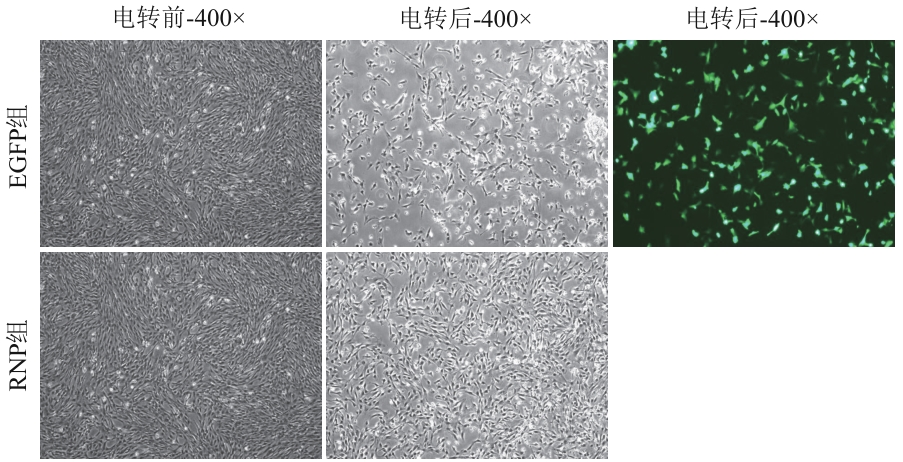
Fig. 1 Electroporation transfection of fibroblast (400×)
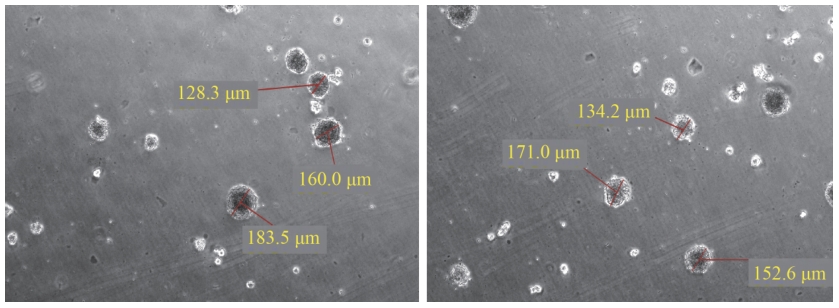
Fig. 2 ClonePlusTM technology for monoclonal culture and screening
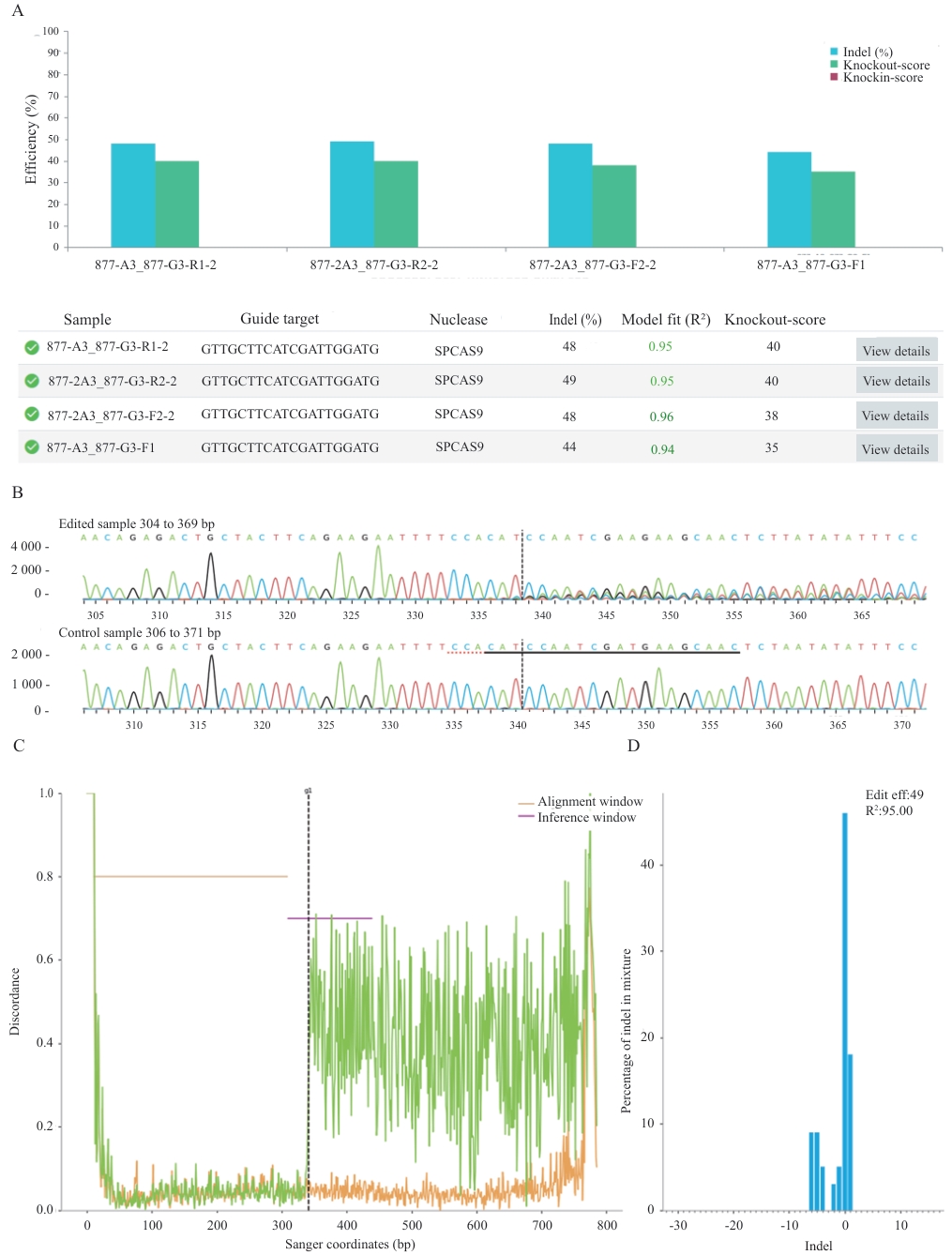
Fig. 3 Analysis of sgRNA editing efficiency using ICE softwareA: The cutting efficiency of sgRNA in different monoclonal cell lines. B: Sanger sequence view, respectively representing the edited and wild-type sequences. The sgRNA target sequence is annotated with a black underline; the PAM sequence is marked with a red dashed line; and a vertical dashed line indicates the predicted Cas9 cleavage site. C: Trace discrepancy analysis, showing the misalignment between the sequencing traces of the edited sample (green) and the control sample (orange). D: Indel type statistics: Displays the size of insertions and deletions (Insert/Deletion) and their relative frequency
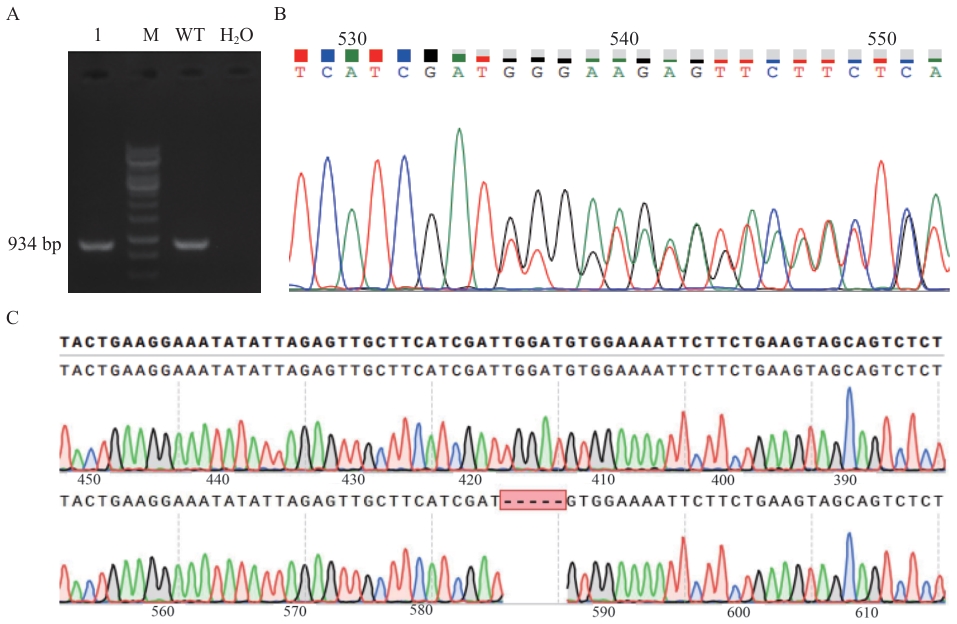
Fig. 4 Identification of NCAPG knockout genotypesA: Agarose gel electrophoresis of PCR amplified products of NCAPG gene knockout target sites. M: DL10000 DNA marker. 1: PCR amplified results of NCAPG gene knockout target sites. WT: Wild type control. H2O: Negative control. B: Sequencing peak map of positive cell clones. C: Sequencing alignment results after TA cloning
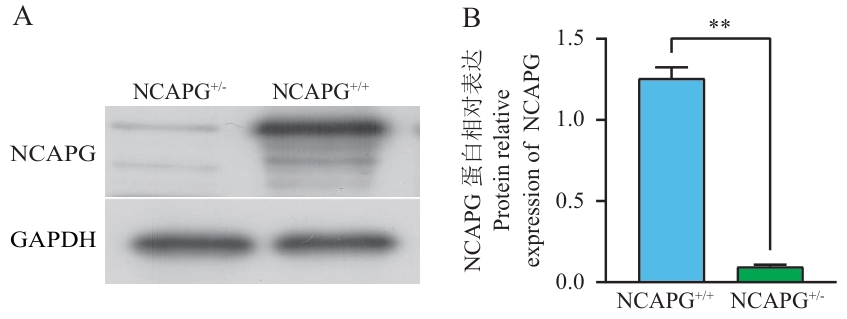
Fig. 5 Expression of NCAPG protein detected using Western blottingA: Western blot analysis of NCAPG expression in wild-type and knockout cells; B: Quantitative densitometric analysis of NCAPG protein levels. NCAPG+/+: Wild type fibroblasts. NCAPG+/-: Fibroblasts with gene knockout; GAPDH was used as a loading control. *P<0.01, the same below
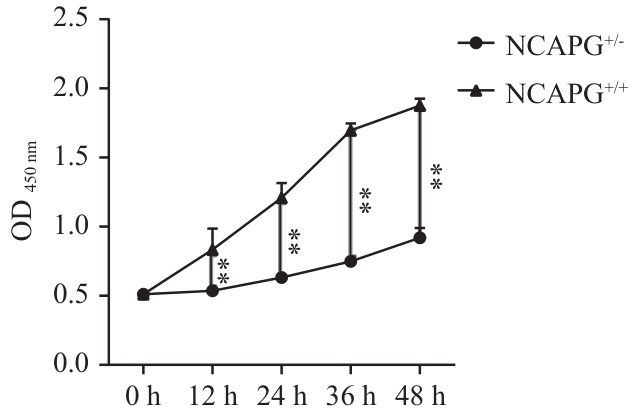
Fig. 6 Results of CCK-8 assay
| [1] | 郭佳俊, 崔励柏, 卢美轩, 等. 黄牛经济性状主效基因研究进展 [J]. 中国牛业科学, 2024, 50(1): 58-64. |
| Guojia J, Cui LB, Lu MX, et al. Research progress on major genes of economic traits in cattle [J]. China Cattle Sci, 2024, 50(1): 58-64. | |
| [2] | Li ZQ, Liu HY, Wang J, et al. Retrospect and prospect: reproductive technologies in beef cattle [J]. Mol Biol Rep, 2025, 52(1): 251. |
| [3] | Hoshiba H, Setoguchi K, Watanabe T, et al. Comparison of the effects explained by variations in the bovine PLAG1 and NCAPG genes on daily body weight gain, linear skeletal measurements and carcass traits in Japanese Black steers from a progeny testing program [J]. Anim Sci J, 2013, 84(7): 529-534. |
| [4] | Liu Y, Duan XY, Chen S, et al. NCAPG is differentially expressed during longissimus muscle development and is associated with growth traits in Chinese Qinchuan beef cattle [J]. Genet Mol Biol, 2015, 38(4): 450-456. |
| [5] | Altmann S, Murani E, Schwerin M, et al. Maternal dietary protein restriction and excess affects offspring gene expression and methylation of non-SMC subunits of condensin I in liver and skeletal muscle [J]. Epigenetics, 2012, 7(3): 239-252. |
| [6] | Ma XC, Ying F, Li ZD, et al. New insights into the genetic loci related to egg weight and age at first egg traits in broiler breeder [J]. Poult Sci, 2024, 103(5): 103613. |
| [7] | Yuan ZH, Ge L, Su PW, et al. NCAPG regulates myogenesis in sheep, and SNPs located in its putative promoter region are associated with growth and development traits [J]. Animals, 2023, 13(20): 3173. |
| [8] | Jabbar A, Zulfiqar F, Mahnoor M, et al. Advances and perspectives in the application of CRISPR-Cas9 in livestock [J]. Mol Biotechnol, 2021, 63(9): 757-767. |
| [9] | Wang ST, Qu ZX, Huang QY, et al. Application of gene editing technology in resistance breeding of livestock [J]. Life, 2022, 12(7): 1070. |
| [10] | Gim GM, Kwon DH, Eom KH, et al. Production of MSTN-mutated cattle without exogenous gene integration using CRISPR-Cas9 [J]. Biotechnol J, 2022, 17(7): 2100198. |
| [11] | Tian HB, Niu HM, Luo J, et al. Knockout of stearoyl-CoA desaturase 1 decreased milk fat and unsaturated fatty acid contents of the goat model generated by CRISPR/Cas9 [J]. J Agric Food Chem, 2022, 70(13): 4030-4043. |
| [12] | Burkard C, Lillico SG, Reid E, et al. Precision engineering for PRRSV resistance in pigs: Macrophages from genome edited pigs lacking CD163 SRCR5 domain are fully resistant to both PRRSV genotypes while maintaining biological function [J]. PLoS Pathog, 2017, 13(2): e1006206. |
| [13] | Yang H, Pu LL, Li RB, et al. NCAPG is transcriptionally regulated by CBX3 and activates the Wnt/β-catenin signaling pathway to promote proliferation and the cell cycle and inhibit apoptosis in colorectal cancer [J]. J Gastrointest Oncol, 2023, 14(2): 900-912. |
| [14] | Zhang Q, Su RX, Shan C, et al. Non-SMC condensin I complex, subunit G (NCAPG) is a novel mitotic gene required for hepatocellular cancer cell proliferation and migration [J]. Oncol Res, 2018, 26(2): 269-276. |
| [15] | Setoguchi K, Watanabe T, Weikard R, et al. The SNP c.1326T>G in the non-SMC condensin Ⅰ complex, subunit G (NCAPG) gene encoding a p.Ile442Met variant is associated with an increase in body frame size at puberty in cattle [J]. Anim Genet, 2011, 42(6): 650-655. |
| [16] | 闵奇, 刘益丽, 蒋梦娟, 等. 调控牛体型大小的信号通路及候选基因研究进展 [J]. 黑龙江畜牧兽医, 2024(3): 22-30. |
| Min Q, Liu YL, Jiang MJ, et al. Research progress on signaling pathways and candidate genes for regulating body size in cattle (Bos Taurus) [J]. Heilongjiang Anim Sci Vet Med, 2024(3): 22-30. | |
| [17] | Zhang WG, Li JY, Guo Y, et al. Multi-strategy genome-wide association studies identify the DCAF16-NCAPG region as a susceptibility locus for average daily gain in cattle [J]. Sci Rep, 2016, 6: 38073. |
| [18] | Niu QH, Zhang TL, Xu L, et al. Identification of candidate variants associated with bone weight using whole genome sequence in beef cattle [J]. Front Genet, 2021, 12: 750746. |
| [19] | Widmann P, Reverter A, Weikard R, et al. Systems biology analysis merging phenotype, metabolomic and genomic data identifies non-SMC condensin Ⅰ complex, subunit G (NCAPG) and cellular maintenance processes as major contributors to genetic variability in bovine feed efficiency [J]. PLoS One, 2015, 10(4): e0124574. |
| [20] | Hu X, Xing YS, Fu X, et al. NCAPG dynamically coordinates the myogenesis of fetal bovine tissue by adjusting chromatin accessibility [J]. Int J Mol Sci, 2020, 21(4): 1248. |
| [21] | Seipold S, Priller FC, Goldsmith P, et al. Non-SMC condensin I complex proteins control chromosome segregation and survival of proliferating cells in the zebrafish neural retina [J]. BMC Dev Biol, 2009, 9(1): 40. |
| [22] | 刘思远, 易国强, 唐中林, 等. 基于CRISPR/Cas9系统在全基因组范围内筛选功能基因及调控元件研究进展 [J]. 遗传, 2020, 42(5): 435-443. |
| Liu SY, Yi GQ, Tang ZL, et al. Progress on genome-wide CRISPR/Cas9 screening for functional genes and regulatory elements [J]. Hereditas, 2020, 42(5): 435-443. | |
| [23] | Hsu PD, Scott DA, Weinstein JA, et al. DNA targeting specificity of RNA-guided Cas9 nucleases [J]. Nat Biotechnol, 2013, 31(9): 827-832. |
| [24] | 朱娜娜. 利用CRISPR/Cas9构建OCT4-EGFP-PuroR双报告功能的巴马猪胎儿成纤维细胞 [D]. 合肥: 安徽农业大学, 2023. |
| Zhu NN. Construction of OCT4-EGFP-PuroR dual-reporter functional Bama pig fetal fibroblasts using CRISPR/Cas9 [D]. Hefei: Anhui Agricultural University, 2023. | |
| [25] | Conant D, Hsiau T, Rossi N, et al. Inference of CRISPR edits from Sanger trace data [J]. CRISPR J, 2022, 5(1): 123-130. |
| [26] | Jiang FG, Doudna JA. CRISPR-Cas9 structures and mechanisms [J]. Annu Rev Biophys, 2017, 46: 505-529. |
| [27] | 苏楠, 吴正红, 祁小乐. CRISPR/Cas9系统RNP体内递送的挑战与解决策略 [J]. 沈阳药科大学学报, 2023, 40(7): 964-976. |
| Su N, Wu ZH, Qi XL. Challenges and strategies for in vivo delivery of CRISPR/Cas9-RNP [J]. J Shenyang Pharm Univ, 2023, 40(7): 964-976. | |
| [28] | 张雪萍, 刘嘉仪, 王彦芳, 等. 利用CRISPR/Cas9编辑系统构建ACTA1基因敲除的PEFs细胞系 [J]. 中国畜牧兽医, 2024, 51(6): 2273-2284. |
| Zhang XP, Liu JY, Wang YF, et al. Construction of ACTA1 gene knockout PEFs cell lines by CRISPR/Cas9 editing system [J]. China Anim Husb Vet Med, 2024, 51(6): 2273-2284. | |
| [29] | Sun HH, Zhang H, Yan Y, et al. NCAPG promotes the oncogenesis and progression of non-small cell lung cancer cells through upregulating LGALS1 expression [J]. Mol Cancer, 2022, 21(1): 55. |
| [30] | Zinshteyn B, Sinha NK, Enam SU, et al. Translational repression of NMD targets by GIGYF2 and EIF4E2 [J]. PLoS Genet, 2021, 17(10): e1009813. |
| [31] | Gim GM, Eom KH, Kwon DH, et al. Generation of double knockout cattle via CRISPR-Cas9 ribonucleoprotein (RNP) electroporation [J]. J Anim Sci Biotechnol, 2023, 14(1): 103. |
| No related articles found! |
| Viewed | ||||||
|
Full text |
|
|||||
|
Abstract |
|
|||||
