







Biotechnology Bulletin ›› 2026, Vol. 42 ›› Issue (6): 128-138.doi: 10.13560/j.cnki.biotech.bull.1985.2025-1190
GUO Wei( ), GENG Yue, LIANG Xiao, LIU Ying, WU Chun-ling, CHEN Qing()
Received:2025-11-04
Online:2026-06-26
Published:2026-07-11
Contact:
CHEN Qing
E-mail:gwei19513@163.com;chqingztq@163.com
GUO Wei, GENG Yue, LIANG Xiao, LIU Ying, WU Chun-ling, CHEN Qing. Effects of Insect-resistant and Insect-susceptible Cassava Varieties on the Expression of Wax Biosynthesis Genes in Phenacoccus manihoti[J]. Biotechnology Bulletin, 2026, 42(6): 128-138.
基因名 Gene name | 引物序列 Primer sequence (5′-3′) | 退火温度 Tm (℃) | 产物大小 Product size (bp) |
|---|---|---|---|
| FAR1 | F: CTTGATGATGCTGGTGGA R: TGGTTCTTTAGCCGATGA | 51.8 51.6 | 190 |
| FAR2 | F: ATGATAACAGCGGCTTGGA R: TTGTTGCCCTATTTCTACC | 56.3 50.2 | 126 |
| FAD1 | F: GATGGCGTTAGGCGAAGGA R: AATGCGGTCGTCGTGTTAG | 60.9 56.7 | 102 |
| FAD2 | F: CTTCCAGTATTAGTTCCCGTAT R: CGTGGTGGTAGTTGTGCC | 53.1 54.5 | 223 |
| FAS2 | F: GGTGGTCTTGGTGGTTTC R: CCTCCTTGTTGCCATCTT | 52.2 52.6 | 137 |
| FAS1 | F: GTAGAGGAAACGCAGGAC R: CCACTCAATAGCCAAAGC | 49.5 50.9 | 107 |
| ACC | F: AGCATTACCGACCTCCA R: CTCGTCCATCGCTTCTA | 50.7 48.7 | 193 |
| ELO1 | F: CACGGTCCGAGAATGAT R: TTCCGAGCCACTGAGGT | 50.5 53.3 | 177 |
| ELO2 | F: CGTGCTGAGAAAGAAGGA R: TAGCGTTTGGCAAGATGA | 51.0 52.8 | 332 |
| 18S rRNA | F: GAAAGGGAAGTTGAAGGC R: CAAGCAAGCGAACAGAGT | 51.7 51.2 | 131 |
Table 1 Primers for genes related to wax synthesis of Phenacoccus manihoti
基因名 Gene name | 引物序列 Primer sequence (5′-3′) | 退火温度 Tm (℃) | 产物大小 Product size (bp) |
|---|---|---|---|
| FAR1 | F: CTTGATGATGCTGGTGGA R: TGGTTCTTTAGCCGATGA | 51.8 51.6 | 190 |
| FAR2 | F: ATGATAACAGCGGCTTGGA R: TTGTTGCCCTATTTCTACC | 56.3 50.2 | 126 |
| FAD1 | F: GATGGCGTTAGGCGAAGGA R: AATGCGGTCGTCGTGTTAG | 60.9 56.7 | 102 |
| FAD2 | F: CTTCCAGTATTAGTTCCCGTAT R: CGTGGTGGTAGTTGTGCC | 53.1 54.5 | 223 |
| FAS2 | F: GGTGGTCTTGGTGGTTTC R: CCTCCTTGTTGCCATCTT | 52.2 52.6 | 137 |
| FAS1 | F: GTAGAGGAAACGCAGGAC R: CCACTCAATAGCCAAAGC | 49.5 50.9 | 107 |
| ACC | F: AGCATTACCGACCTCCA R: CTCGTCCATCGCTTCTA | 50.7 48.7 | 193 |
| ELO1 | F: CACGGTCCGAGAATGAT R: TTCCGAGCCACTGAGGT | 50.5 53.3 | 177 |
| ELO2 | F: CGTGCTGAGAAAGAAGGA R: TAGCGTTTGGCAAGATGA | 51.0 52.8 | 332 |
| 18S rRNA | F: GAAAGGGAAGTTGAAGGC R: CAAGCAAGCGAACAGAGT | 51.7 51.2 | 131 |
基因 Gene | 目标序列ID Subject_id | 相似性 Identity(%) | 得分 Score | 期望值 E_value |
|---|---|---|---|---|
| FAR1 | ANN23959.1 | 90.7 | 989.2 | 1.2E-285 |
| FAR2 | ANN23960.1 | 90.9 | 933.7 | 5.1E-269 |
| FAD1 | QBM20313.1 | 98.9 | 758.1 | 4.7E-216 |
| FAD2 | QBM20314.1 | 90.3 | 678.3 | 2.8E-192 |
| ACC | QGZ00537.1 | 80.0 | 3 805.4 | 0.00E+00 |
| FAS1 | UEV87819.1 | 67.9 | 3 359.3 | 0.00E+00 |
| FAS2 | XP_025208386.1 | 66.8 | 2 933.3 | 0.00E+00 |
| ELO1 | QAX90474.1 | 74.6 | 444.5 | 9E-122 |
| ELO2 | XP_018327719.1 | 74.7 | 436.4 | 1.6E-119 |
Table 2 The results of blastx search for wax synthesis-related genes in NR database
基因 Gene | 目标序列ID Subject_id | 相似性 Identity(%) | 得分 Score | 期望值 E_value |
|---|---|---|---|---|
| FAR1 | ANN23959.1 | 90.7 | 989.2 | 1.2E-285 |
| FAR2 | ANN23960.1 | 90.9 | 933.7 | 5.1E-269 |
| FAD1 | QBM20313.1 | 98.9 | 758.1 | 4.7E-216 |
| FAD2 | QBM20314.1 | 90.3 | 678.3 | 2.8E-192 |
| ACC | QGZ00537.1 | 80.0 | 3 805.4 | 0.00E+00 |
| FAS1 | UEV87819.1 | 67.9 | 3 359.3 | 0.00E+00 |
| FAS2 | XP_025208386.1 | 66.8 | 2 933.3 | 0.00E+00 |
| ELO1 | QAX90474.1 | 74.6 | 444.5 | 9E-122 |
| ELO2 | XP_018327719.1 | 74.7 | 436.4 | 1.6E-119 |
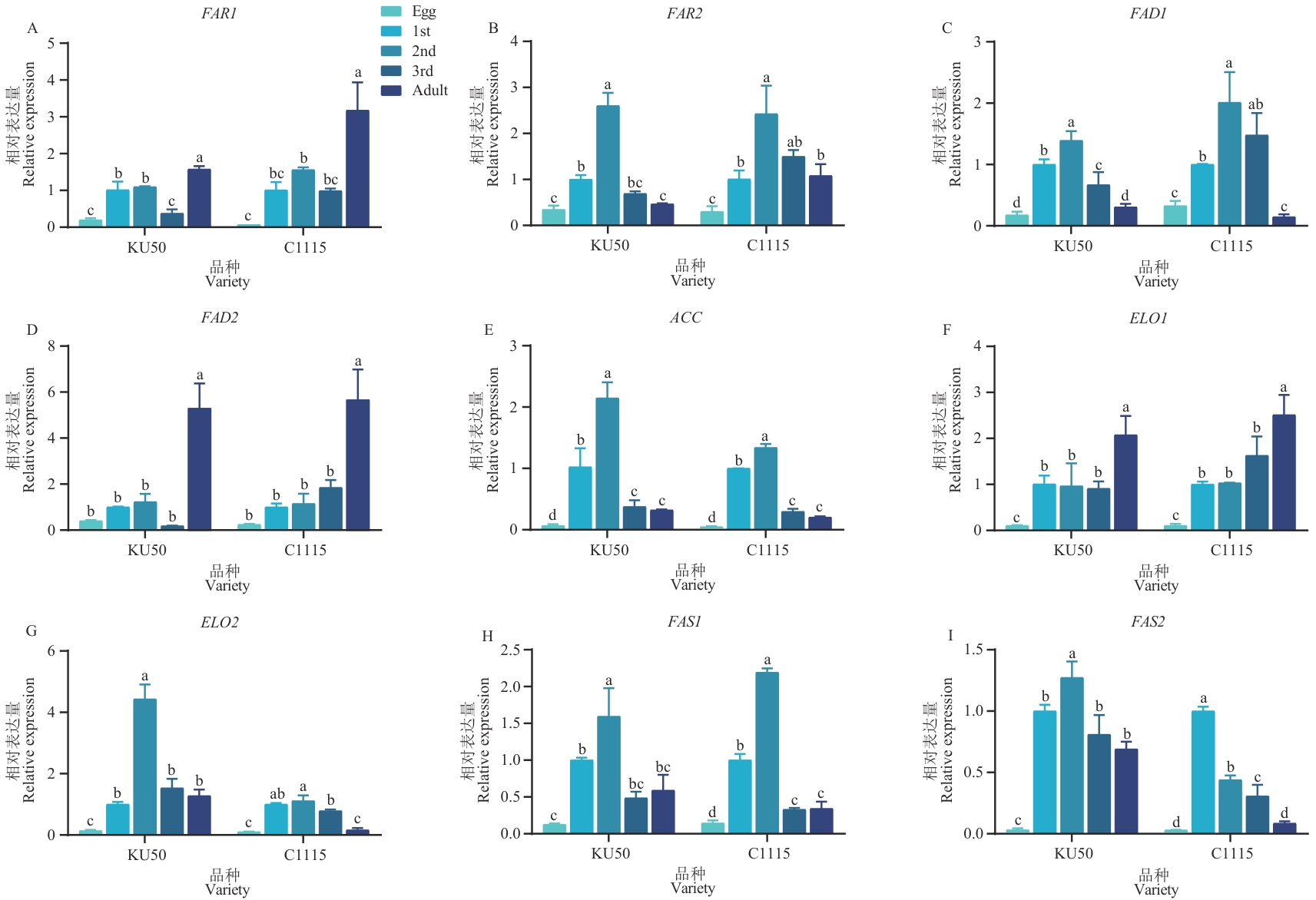
Fig. 1 Effects of insect-resistant and insect-susceptible cassava varieties on the expression of wax biosynthesis genes in different nymphal stages of P. manihotiDifferent lowercase letters indicate significant differences in expression levels (P0.05). The same below
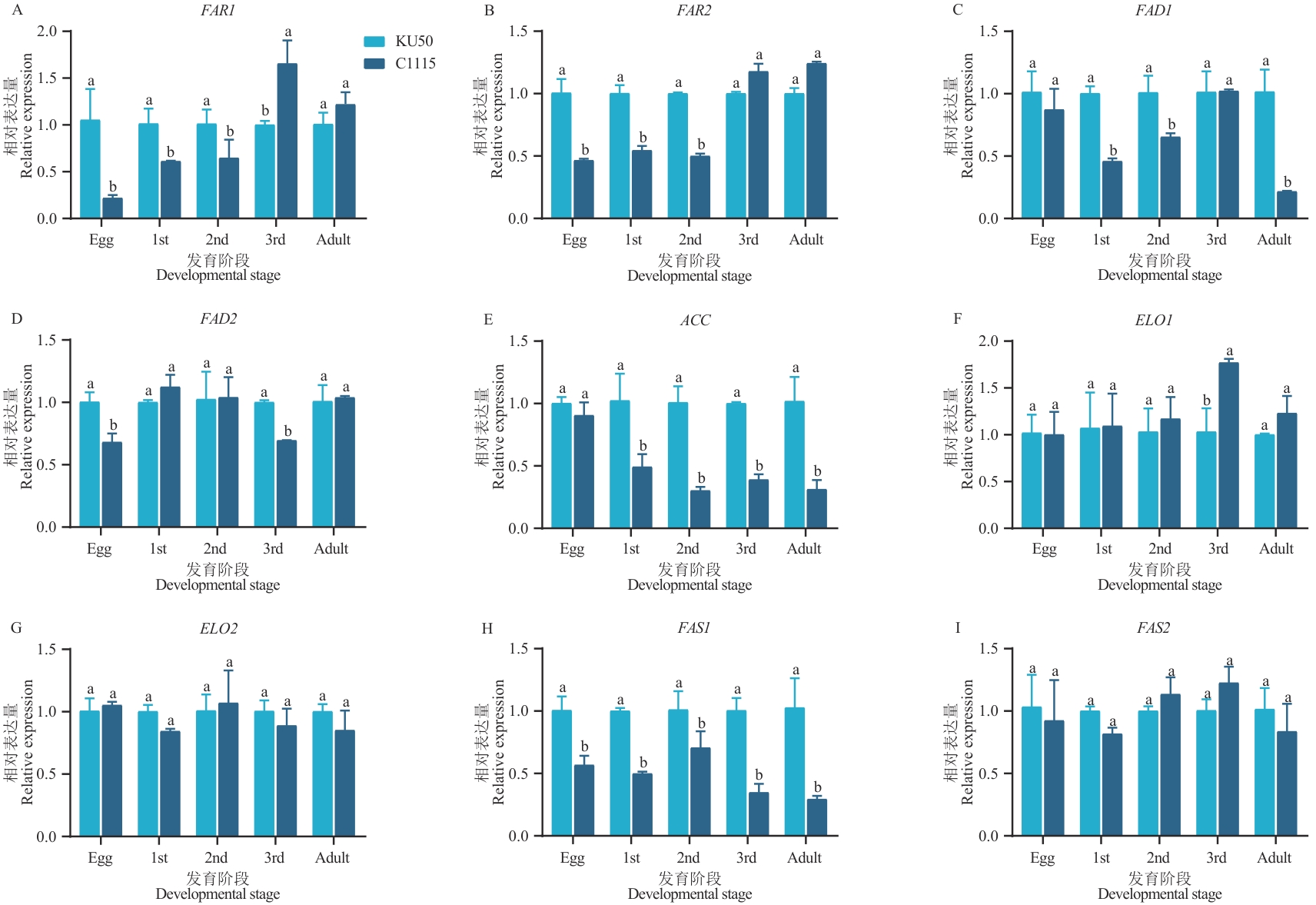
Fig. 2 Variation in expressions of wax biosynthesis genes in P. manihoti at different nymphal stages after feeding on insect-resistant and insect-susceptible cassava varieties
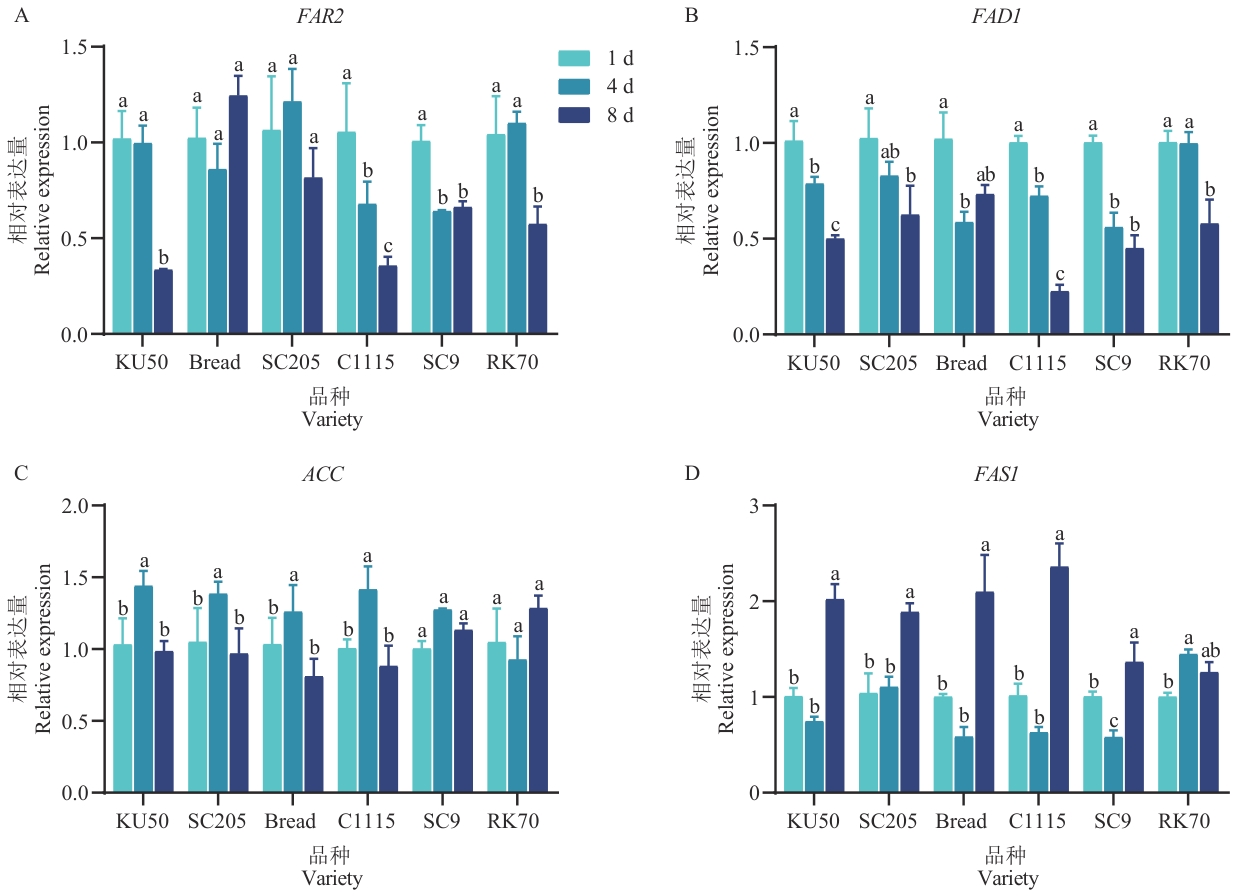
Fig. 3 Effects of insect-resistant and insect-susceptible cassava varieties on the expression of wax biosynthesis candidate genes in P. manihoti
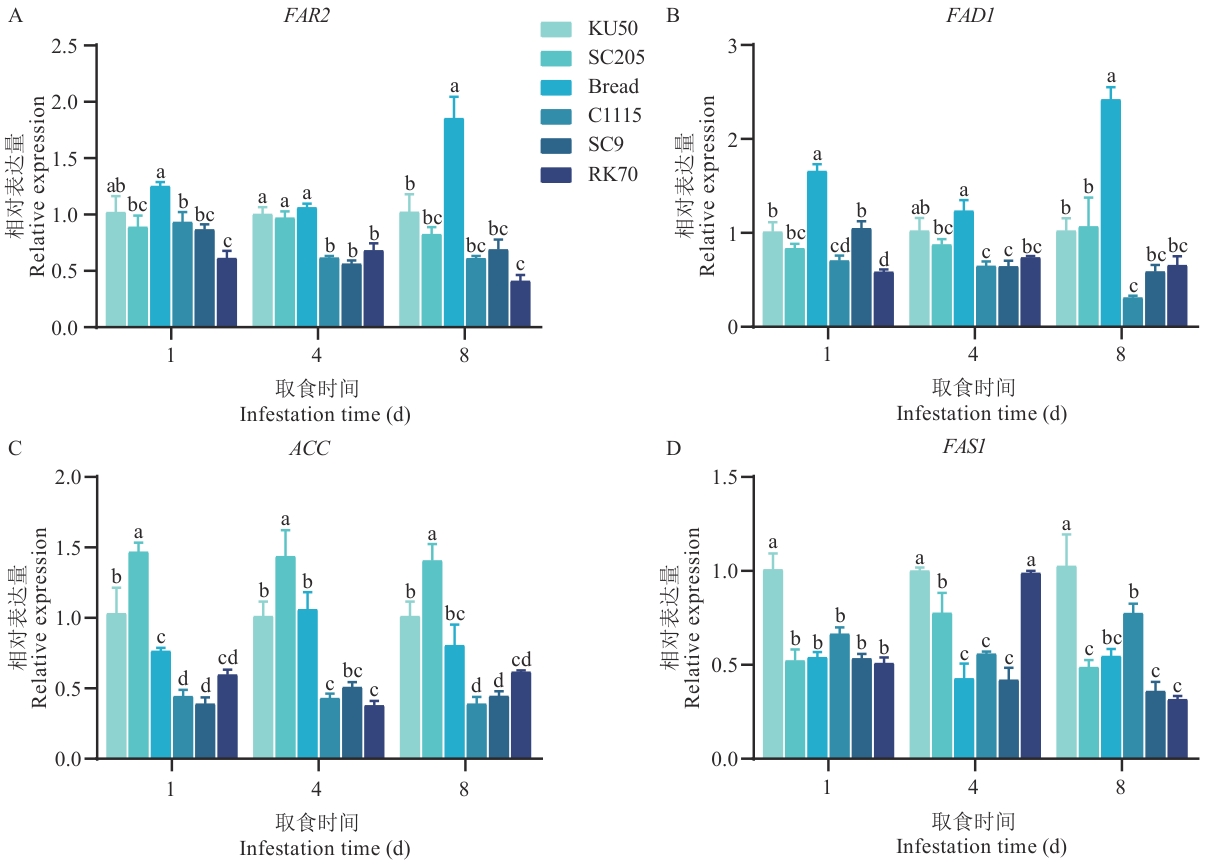
Fig. 4 Variation in expression of wax biosynthesis candidate genes in P. manihoti after feeding on insect-resistant and insect-susceptible cassava varieties
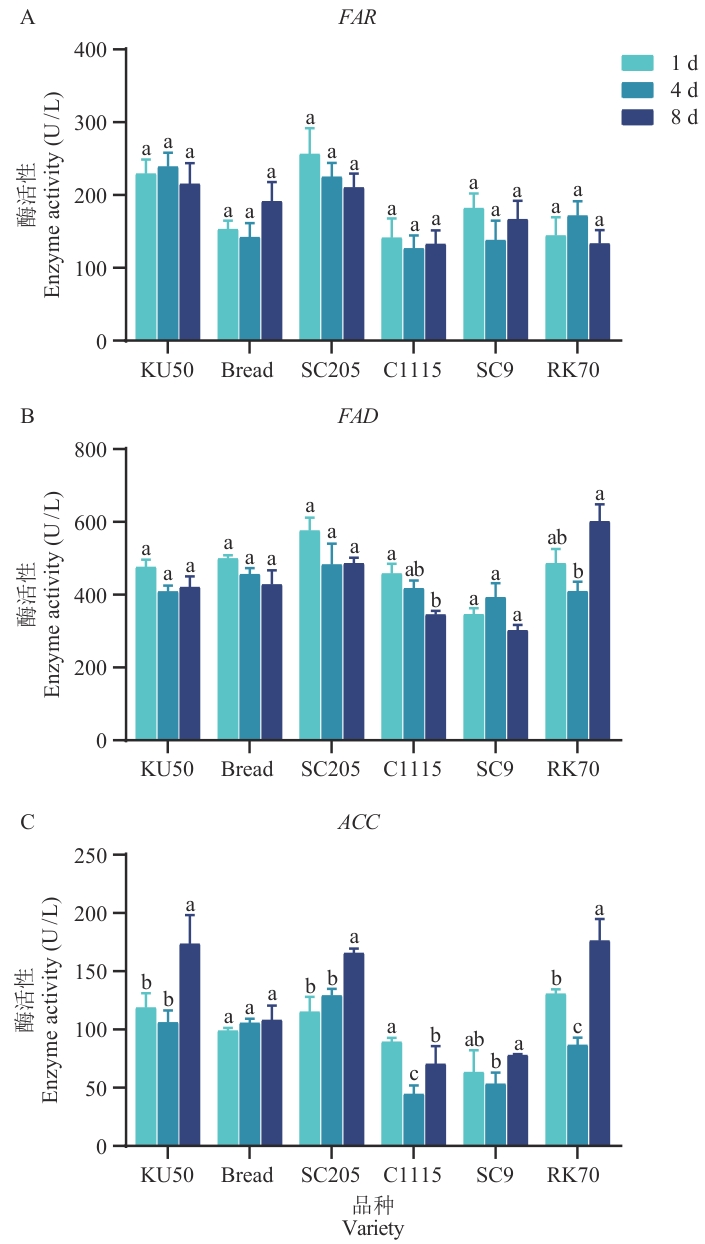
Fig. 5 Variation in total enzyme activities of FAR, FAD, and ACC in P. manihoti after feeding on insect-resistant and insect-susceptible cassava varieties
| [1] | Chen Q, Liang X, Wu CL, et al. Density threshold-based acaricide application for the two-spotted spider mite Tetranychus urticae on cassava: from laboratory to the field [J]. Pest Manag Sci, 2019, 75(10): 2634-2641. |
| [2] | 欧文军, 韦卓文, 梁海波, 等. 推动中非木薯科技合作服务国家“一带一路”战略 [J]. 中国热带农业, 2016(4): 9-12. |
| Ou WJ, Wei ZW, Liang HB, et al. Promoting China-Africa cassava science and technology cooperation to serve the national "Belt and Road" strategy [J]. China Trop Agric, 2016(4): 9-12. | |
| [3] | Parmar A, Sturm B, Hensel O. Crops that feed the world: Production and improvement of cassava for food, feed, and industrial uses [J]. Food Sec, 2017, 9(5): 907-927. |
| [4] | 卢赛清, 宋恩亮, 雷开文, 等. 生物有机肥对食用木薯品质与产量的影响 [J]. 南方农机, 2023, 54(4): 5-8. |
| Lu SQ, Song EL, Lei KW, et al. Effect of bio-organic fertilizer on quality and yield of edible cassava [J]. China South Agric Mach, 2023, 54(4): 5-8. | |
| [5] | Ceballos H, Iglesias CA, Pérez JC, et al. Cassava breeding: opportunities and challenges [J]. Plant Mol Biol, 2004, 56(4): 503-516. |
| [6] | Hillocks RJ, Thresh JM. Cassava: biology, production and utilization [M]. UK: CABI Publishing, 2002. |
| [7] | 梁宏合, 陈显双, 杜国冬, 等. 中国木薯主要病虫害研究进展 [J]. 安徽农业科学, 2012, 40(22): 11270-11273. |
| Liang HH, Chen XS, Du GD, et al. Research progress on main diseases and insect pests of cassava in China [J]. J Anhui Agric Sci, 2012, 40(22): 11270-11273. | |
| [8] | 武三安, 王艳平. 警惕木薯绵粉蚧入侵我国 [J]. 环境昆虫学报, 2011, 33(1): 122-125. |
| Wu SA, Wang YP. Precaution of cassava mealybug, Phenacoccus manihoti Matile-Ferrero in China [J]. J Environ Entomol, 2011, 33(1): 122-125. | |
| [9] | Cox JM, Pearce MJ. Wax produced by dermal pores in three species of mealybug (Homoptera: Pseudococcidae) [J]. Int J Insect Morphol Embryol, 1983, 12(4): 235-248. |
| [10] | Gołębiowski M, Boguś MI, Paszkiewicz M, et al. Cuticular lipids of insects as potential biofungicides: methods of lipid composition analysis [J]. Anal Bioanal Chem, 2011, 399(9): 3177-3191. |
| [11] | Huang J, Zhang J, Yu YM, et al. Biological characteristics and chemical control of the invasive mealybug, Phenacoccus solenopsis (Hemiptera: Pseudococcidae) on tomato in the laboratory [J]. J Kans Entomol Soc, 2012, 85(3): 179-185. |
| [12] | Ulusoy S, Kahya D, Bilgin MG, et al. The effectiveness of wax secretion on chemical control in some mealybug species [J]. J Asia Pac Entomol, 2022, 25(3): 101954. |
| [13] | Tong HJ, Wang Y, Wang SP, et al. Fatty acyl-CoA reductase influences wax biosynthesis in the cotton mealybug, Phenacoccus solenopsis Tinsley [J]. Commun Biol, 2022, 5: 1108. |
| [14] | Howard RW, Blomquist GJ. Ecological, behavioral, and biochemical aspects of insect hydrocarbons [J]. Annu Rev Entomol, 2005, 50: 371-393. |
| [15] | Chung H, Carroll SB. Wax, sex and the origin of species: Dual roles of insect cuticular hydrocarbons in adaptation and mating [J]. BioEssays, 2015, 37(7): 822-830. |
| [16] | Cohen E, Moussian B. Extracellular Composite Matrices in Arthropods [M]. Cham: Springer International Publishing, 2016. |
| [17] | Finet C, Slavik K, Pu J, et al. Birth-and-death evolution of the fatty acyl-CoA reductase (FAR) gene family and diversification of cuticular hydrocarbon synthesis in Drosophila [J]. Genome Biol Evol, 2019, 11(6): 1541-1551. |
| [18] | Wang ZN, Pu J, Richards C, et al. Evolution of a fatty acyl-CoA elongase underlies desert adaptation in Drosophila [J]. Sci Adv, 2023, 9(35): eadg0328. |
| [19] | Li M, Yan S, Feng XY, et al. An upstream signaling gene calmodulin regulates the synthesis of insect wax via activating fatty acid biosynthesis pathway [J]. Insect Biochem Mol Biol, 2024, 169: 104126. |
| [20] | Ahmad A, Kundu A, Dey D. Wax glands ultrastructure and chemical composition of wax of giant mealybug Drosicha stebbingii (Green) (Hemiptera: Monophlebidae) [J]. J Asia-Pacific Entomol, 2020, 23(2): 546-553. |
| [21] | Wei HX, Geng T, Wu HZ, et al. Study on wax secretion and wax-secreting system of mulberry pest Paurocephala sauteri enderlein (Hemiptera: Psyllidae) [J]. J Appl Entomol, 2025, 149(3): 340-349. |
| [22] | Tayal M, Somavat P, Rodriguez I, et al. Polyphenol-rich purple corn pericarp extract adversely impacts herbivore growth and development [J]. Insects, 2020, 11(2): 98. |
| [23] | Singh S, Kariyat RR. Exposure to polyphenol-rich purple corn pericarp extract restricts fall armyworm (Spodoptera frugiperda) growth [J]. Plant Signal Behav, 2020, 15(9): 1784545. |
| [24] | De Moraes CM, Lewis WJ, Paré PW, et al. Herbivore-infested plants selectively attract parasitoids [J]. Nature, 1998, 393(6685): 570-573. |
| [25] | War AR, Sharma HC, Paulraj MG, et al. Herbivore induced plant volatiles: Their role in plant defense for pest management[J]. Plant Signal Behav, 2011, 6(12): 1973-1978. |
| [26] | 耿越, 陈青, 梁晓, 等. 类黄酮合成通路介导的木薯对木薯绵粉蚧的防御机理 [J]. 热带作物学报, 2023, 44(12): 2449-2460. |
| Geng Y, Chen Q, Liang X, et al. Flavonoid synthesis pathway-mediate defense mechanism of cassava against Phenacoccus manihoti [J]. Chin J Trop Crops, 2023, 44(12): 2449-2460. | |
| [27] | Livak KJ, Schmittgen TD. Analysis of relative gene expression data using real-time quantitative PCR and the 2-ΔΔCT method [J]. Methods, 2001, 25(4): 402-408. |
| [28] | Li DT, Chen X, Wang XQ, et al. The fatty acid elongase gene family in the brown planthopper, Nilaparvata lugens [J]. Insect Biochem Mol Biol, 2019, 108: 32-43. |
| [29] | Duan CX, Yu JJ, Bai JY, et al. Induced defense responses in rice plants against small brown planthopper infestation [J]. Crop J, 2014, 2(1): 55-62. |
| [30] | Veronico P, Paciolla C, Pomar F, et al. Changes in lignin biosynthesis and monomer composition in response to benzothiadiazole and root-knot nematode Meloidogyne incognita infection in tomato [J]. J Plant Physiol, 2018, 230: 40-50. |
| [31] | 林晓敏, 谭晓荣, 王连铮, 等. 抗感大豆品种接种胞囊线虫后根部异黄酮含量变化 [J]. 中国油料作物学报, 2016, 38(4): 495-501. |
| Lin XM, Tan XR, Wang LZ, et al. Root isoflavone content after cyst nematode infection in different soybean varieties [J]. Chin J Oil Crop Sci, 2016, 38(4): 495-501. | |
| [32] | Yang LH, Zhou Y, Guo LJ, et al. The effect of banana rhizosphere chemotaxis and chemoattractants on Bacillus velezensis LG14-3 root colonization and suppression of banana Fusarium wilt disease [J]. Sustainability, 2023, 15(1): 351. |
| [33] | 王娇. 桑树重要害虫桑螟与斜纹夜蛾及其寄生蜂的脂质合成研究 [D]. 镇江: 江苏科技大学, 2021. |
| Wang J. Studies on lipid biosynthesis of the major pest of mulberry trees, Glyphodes pyloalis, Spodoptera litura and their parasitoid wasp [D]. Zhenjiang: Jiangsu University of Science and Technology, 2021. | |
| [34] | Luo J, Liang SJ, Li JY, et al. A transgenic strategy for controlling plant bugs (Adelphocoris suturalis) through expression of double-stranded RNA homologous to fatty acyl-coenzyme A reductase in cotton [J]. New Phytol, 2017, 215(3): 1173-1185. |
| [35] | Hu YH, Chen XM, Yang P, et al. Characterization and functional assay of a fatty acyl-CoA reductase gene in the scale insect, Ericerus pela Chavannes (Hemiptera: Coccoidae) [J]. Arch Insect Biochem Physiol, 2018, 97(4): e21445. |
| [1] | GUO Miao, XU Jia-jia, SUN Tian-guo, CAI Can, CAO Wan-di, BAO Ji-xing, SHA Wei, ZHANG Mei-juan, PENG Yi-fang, MA Tian-yi. Overexpression of RcOLEO1 Enhanced the Tolerance of Arabidopsis thaliana toDrought and High-temperature Stress [J]. Biotechnology Bulletin, 2026, 42(5): 312-322. |
| [2] | JIANG Xin-hua, FANG Tian-yu, ZHANG Jing-jing, LI Xiang-yuan, ZHANG Bang-yue, LIAO Xiao-shan, RONG Duo-yan. Identification and Functional Analysis of the MpPP2A-C Gene in Marchantia polymorpha [J]. Biotechnology Bulletin, 2026, 42(4): 216-226. |
| [3] | LI Tian-yuan, QI Xin-liang, LIU Shan, ZHANG Jian-cheng, WANG Peng-fei, ZHANG Shuai, JIA Lu-ting, MU Xiao-peng. Identification of Cerasus humilisSPL Gene Family and Expression Analysis during Fruit Development [J]. Biotechnology Bulletin, 2026, 42(3): 362-373. |
| [4] | XU Ze, ZHOU Chen-ping, KUANG Rui-bin, WU Xia-ming, YANG Min, LIU Chuan-he, HE Han, WEI Yue-rong. Identification of PG Gene Family and Their Roles in Papaya Fruit Softening [J]. Biotechnology Bulletin, 2026, 42(3): 349-361. |
| [5] | CHEN Chang-lu, YANG Zhi-fang, CAO Song-xiao, LI Yang-qing, YE Jing-feng, LYU Hai-yan, CHEN Shan-shan, CHEN Hao. Mechanism of Abscisic Acid and Ethylene Collaboratively Regulating the Softening of Oriental Melon Fruits [J]. Biotechnology Bulletin, 2026, 42(3): 302-311. |
| [6] | LIU Bao-cai, HU Xue-bo, ZHANG Wu-jun, ZHAO Yun-qing, HUANG Ying-zhen, CHEN Jing-ying. Screening of Internal Reference Gene for Pholidota chinensis and Their Applications [J]. Biotechnology Bulletin, 2026, 42(2): 158-168. |
| [7] | NI Ying, LI Lei, WANG Jin-xuan, MA Bo, MENG Xin, LENG Ping-sheng, WU Jing, HU Zeng-hui. Cloning and Functional Analysis of So4CL Gene in Syringa oblata [J]. Biotechnology Bulletin, 2026, 42(1): 139-149. |
| [8] | CHEN Jing-huan, FANG Guo-nan, ZHU Wen-hao, YE Guang-ji, SU Wang, HE Miao-miao, YANG Sheng-long, ZHOU Yun. Starch Characterization and Related Gene Expression Analysis of Potato Germplasm Resources [J]. Biotechnology Bulletin, 2026, 42(1): 170-183. |
| [9] | CHEN Qiang, YU Ying-fei, ZHANG Ying, ZHANG Chong. Regulatory Effect of Methyl Jasmonate on Postharvest Chilling Injury in Oriental Melon ‘Emerald’ [J]. Biotechnology Bulletin, 2025, 41(9): 105-114. |
| [10] | CHENG Xue, FU Ying, CHAI Xiao-jiao, WANG Hong-yan, DENG Xin. Identification of LHC Gene Family in Setaria italica and Expression Analysis under Abiotic Stresses [J]. Biotechnology Bulletin, 2025, 41(8): 102-114. |
| [11] | REN Rui-bin, SI Er-jing, WAN Guang-you, WANG Jun-cheng, YAO Li-rong, ZHANG Hong, MA Xiao-le, LI Bao-chun, WANG Hua-jun, MENG Ya-xiong. Identification and Expression Analysis of GH17 Gene Family of Pyrenophora graminea [J]. Biotechnology Bulletin, 2025, 41(8): 146-154. |
| [12] | ZENG Dan, HUANG Yuan, WANG Jian, ZHANG Yan, LIU Qing-xia, GU Rong-hui, SUN Qing-wen, CHEN Hong-yu. Genome-wide Identification and Expression Analysis of bZIP Transcription Factor Family in Dendrobium officinale [J]. Biotechnology Bulletin, 2025, 41(8): 197-210. |
| [13] | HAN Yi, HOU Chang-lin, TANG Lu, SUN Lu, XIE Xiao-dong, LIANG Chen, CHEN Xiao-qiang. Cloning and Preliminary Functional Analysis of HvERECTA Gene in Hordeum vulgare [J]. Biotechnology Bulletin, 2025, 41(7): 106-116. |
| [14] | QU Shan, ZHAO Yue, LI Ya-hua, ZHENG Gui-ling, XIAN Hong-quan. A Study on the Interaction between Transcriptional Factor and Protein of Tachi2 Chitinase Gene in Trichoderma asperellum [J]. Biotechnology Bulletin, 2025, 41(5): 310-319. |
| [15] | LIU Zhuo-jun, CHAI Wen-ting, REN Yi-le, WANG Xin-yu, ZHU Li-xun, ZHAO Shan-shan, YANG Bo-hui, FAN Jia-li, LI Xin-feng, ZHAO Wei-jun, LYU Jin-hui, ZHANG Chun-lai. Analysis on Expression and DNA Variation of TGA Genes in Sorghum (Sorghum bicolor) in Response to Sporisorium reilianum Infection [J]. Biotechnology Bulletin, 2025, 41(5): 90-103. |
| Viewed | ||||||
|
Full text |
|
|||||
|
Abstract |
|
|||||
