









CRISPR-Cas(clustered regularly interspaced short palindromic repeats and associated proteins)是广泛存在于古菌和细菌中的适应性免疫系统,能够提供序列特异性的保护来抵御外源DNA或RNA[1]。CRISPR-Cas发挥免疫功能分为3个阶段:(1)适应。由适应性模块中的Cas1和Cas2组成的复合物识别外源核酸,将其加工整合至CRISPR阵列中,以提供感染的记忆[2];(2)crRNA生成。CRISPR基因座被转录成pre-crRNA,随后被加工为成熟crRNA[3];(3)干扰。crRNA引导Cas核酸酶靶向并切割外源入侵DNA/RNA[4-5]。这种由RNA引导的靶位点切割具有高度灵活的可编程特性,通过改变RNA设计靶向位点,进一步利用宿主同源重组和非同源末端连接修复机制,可以实现基因的定点编辑[6-7]。目前,CRISPR-Cas系统已经被开发为多种强大的工具,可满足基因插入/敲除[6,8]、转录激活[9]、转录抑制[10]、碱基编辑[11]、RNA编辑[12]、DNA/RNA检测[13-14]等多种应用场景。在细菌多重基因组编辑应用中,利用CRISPR-Cas产生双链断裂的编辑效率受到宿主同源重组修复能力的限制[15],这意味着同时对工程细胞的多位点进行高效编辑仍十分困难。
转座子是能够在基因组上从一个位置移动到另一个位置的移动遗传元件[16],最早由Barbara McClintock在玉米中发现,她的研究揭示玉米染色体上的激活因子能够控制解离因子从基因组上解离和在基因组随机位置上整合[17-18]。这一发现颠覆了人们“基因在染色体上是固定的”的认知,是遗传学发展史及基因编辑工具开发进程中重要的里程碑,而转座子及相关转座酶至今仍被用作真核/原核生物的突变体筛选及基因整合工具[16]。根据转座机制的不同,转座可分为复制型转座(copy and paste)和剪切型转座(cut and paste)[16],少部分转座子通过滚环式复制方式[19]和自我合成的复制方式转座[20]。Tn7转座子是剪切型转座的代表,能够在5种蛋白TnsA、TnsB、TnsC、TnsD、TnsE介导下进行位点特异性转座[21],其原理是TnsB识别转座子两端的末端序列,并与TnsA结合,二者分别切割供体序列的3'端和5'端并与其形成复合物。TnsD/E是序列特异性DNA结合蛋白,负责靶点选择,分别以高频率引导转位到染色体上保守的attTn7位点和质粒。靶位点选择和TnsAB复合物之间的通信由ATP水解蛋白TnsC介导,TnsC通过与两个靶点选择器(TnsD或TnsE)之一的相互作用,协调转座酶募集并将供体序列插入至靶位点[22⇓-24]。转座子介导整合的特性使其成为天然的DNA载体,能够有效地进行基因组插入,已经被开发为DNA定点和随机整合工具[25],但存在靶序列特异性差、插入位点不可编程的问题,极大地限制了它们在定点基因整合上的应用。
最近发现CRISPR元件在进化过程中被Tn7转座子劫持[26],这种协同进化衍生出了CRISPR相关转座酶系统,能够在RNA的引导下介导DNA转座,被部署为位点可编程的基因整合工具[27-28]。CRISPR相关转座酶(CRISPR-associated transposases, CASTs)系统由(1)CRISPR元件,Cas12k或Cascade和RNA;(2)转座元件,转座酶TnsB、ATP水解蛋白TnsC和TniQ,部分系统含有TnsA;(3)嵌在转座子末端序列(left end/right end, LE/RE)之间的供体DNA三部分组成[29],但缺乏原型CRISPR-Cas系统中的适应性模块(Cas1、Cas2)和核酸酶活性[30]。其介导DNA整合的原理是crRNA引导单效应元件Cas12k或Cascade以PAM依赖或不依赖的方式靶向靶标位点,招募转座元件TniQ、TnsC、TnsB或TnsAB复合物将带有转座酶识别末端的供体DNA片段整合至靶标位点下游(图1),整个过程中不产生双链断裂,因此基于CASTs开发的基因整合技术同时克服了CRISPR-Cas系统受同源重组效率限制和转座子位点不可编程的缺点,标志着基因组编辑工具的重大进步。
图1
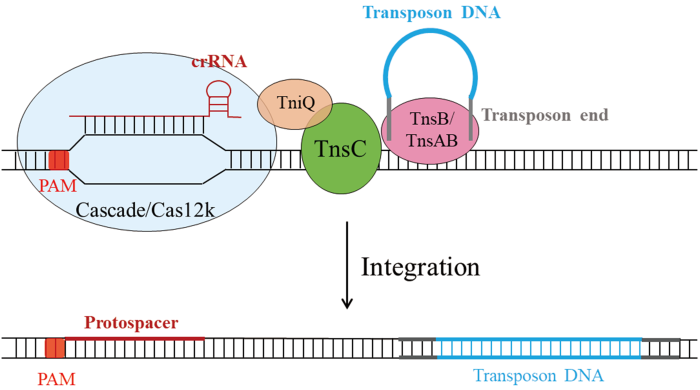
图1
CRISPR相关转座酶介导定点转座原理
Fig. 1
Mechanism of site-specific transposition mediated by CRISPR-associated transposases
1 CASTs的发现
2014年,Krupovic等[32]通过生物信息学分析发现了一种新型的古菌和细菌移动元件超家族,并命名为casposon,它们编码与古菌和细菌的CRISPR-Cas适应性免疫系统相关的Cas1内切酶,与Polinton/Maverick类的自合成真核DNA转座子具有几个共同特征,包括末端倒置重复序列和B族DNA聚合酶的基因,该研究首次发现利用Cas1内切酶插入宿主基因组并从中切除的移动遗传元件群体,暗示了CRISPR-Cas系统和转座子的共进化过程。
2017年,研究人员在使用I-F型系统中最保守的Cas7f作为探针进行PSI-BLAST以全面鉴别I-F型 Cas基因座时,发现了含有最小I-F型和I-B型CRISPR-Cas系统的类Tn7转座子,无核酸酶和转座子定位所需的tnsE,这种基因组成意味着它们能够进行pre-crRNA的处理以产生成熟crRNA和靶标结合,但不发生靶向切割,提示存在RNA引导的转座,转座子编码的CRISPR-Cas系统在同源DNA位点形成R环,将转座子靶向这些位点,从而促进它们通过质粒和噬菌体传播[26]。
2 CASTs的分类
CASTs目前尚无全面系统的分类标准,通常以捕获的Cas效应蛋白为特征,从CRISPR-Cas的分类方法,目前发现和预测的有I-F、I-B、I-C、I-E、IV和V-K共6种类型(图2)[30,33],其中只有I-F、I-B与V-K型的活性已经得到表征。I-F型CASTs由类Tn7元件捕获最小I-F型CRISPR-Cas得到,在所有发现的亚型中具有最大的多样性。该亚型系统通常由仅包含2段间隔序列的最小CRISPR阵列、Cas6f、Cas7f、Cas5f-Cas8f融合蛋白和转座酶元件TnsA、TnsB、TnsC和TniQ组成(图1)[30]。I-F型CASTs目前已表征具有活性的有21种[28,34⇓ -36]。I-B亚型系统最早在蓝藻中发现,具有与I-F亚型相似的特征,不同在于,I-B亚型包含有2个TniQ/TnsD同源蛋白,其中一个介导靶向基因组某些特定位点(如glmS和tRNA-Val),这一过程称为归巢[37]。目前已表征具有活性的I-B亚型CASTs有3种[37-38]。Rybarski等[33]通过宏基因组分析预测了9个非冗余I-C亚型CASTs,但其缺乏CRISPR阵列。在链霉菌科家族中发现的I-E亚型系统包含一个明显活跃的效应核酸酶和典型的CRISPR阵列,并包含Tn7转座通常所需要的两个基因:tnsB和tnsC,但是未识别到这些基因邻近的顺式作用末端结构,这提示它们不是活性转座子,相反的,可能与CRISPR系统招募Cas1转座酶类似,与Tn7相关的基因可能被I-E亚型CRISPR-Cas系统作为一个替代适应模块招募[30]。IV型系统是I类CRISPR-Cas系统的简化版本,由于IV型系统的Cas蛋白序列与其他系统的同源物之间的差异巨大而被划分为一个单独的类型[1]。IV型系统有两种变体IV-A亚型和IV-B亚型,都含有高度分化的Cas5(Csf3)、Cas7(Csf2)和Cas8样大亚基(Csf1)的效应模块基因,IV-A亚型还编码DinG解旋酶家族[30]。Özcan等[39]解析了IV-A亚型系统的效应复合体的结构,发现其在结构和在所有可能的功能上都类似于由类Tn7转座子编码的最小的I型系统,似乎是I型系统极其发散的衍生物。IV-B亚型与I-C亚型一样,缺乏CRISPR阵列,可能通过远端来自其他活性CRISPR-Cas系统的CRISPR阵列发挥作用[33]。除了以上含有多Cas效应蛋白的CASTs外,含有单个Cas效应蛋白的II类CRISPR系统也劫持了Tn7转座子。V-K型CASTs编码单Cas效应元件Cas12k,这是一种TnpB同源物,结构预测表明这是一种失活的核酸酶,也不具备参与干扰的各种功能[30],它与I型CASTs最主要的区别是缺乏TnsA,只能在供体片段的3'端发生切割,从而介导复制型转座而非I型CASTs中的剪切型转座[40]。目前已经表征的V-K型CASTs也有3种[27,41]。
图2
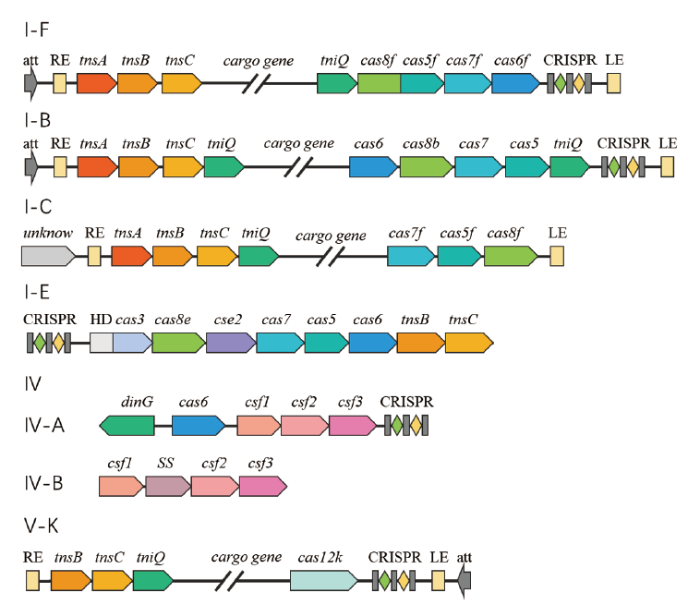
Rybarski等[33]对宏基因组数据库进行生物信息学分析,发现了1 476个高置信度的CASTs,包括含有融合tniQ-cas8/5、分裂cas7和分裂cas5基因的I-F型系统,含有介导归巢过程的crRNA的I-B型系统以及Cas12相关的重组促进核酸酶/转座酶(recombination-promoting nuclease/transposase, Rpn)家族转座酶,这些发现提示了CRISPR相关转座酶的巨大多样性仍未被完全认识。随着演化的推进以及宏基因组数据库和生物信息学检测管道的不断改进,会有更加多样的系统不断被发现,这些新型的系统或许能为开发新的合成生物学使能工具提供思路。
3 CASTs介导转座的机制模型
在所有类型的CASTs中,由于组成简单,V-K型CASTs是研究结构和机制的良好模型,其介导转座机制已经得到较多解析。在V-K型CASTs中,转座酶TnsB聚合成一个C2四聚体,通过非特异性和序列特异性相互作用识别同源供体DNA末端序列,形成配对供体复合物[42]。单Cas效应蛋白Cas12k在向导RNA的引导下被定位至靶标位点,靶标处DNA发生扭曲形成一个R环,具有与Tn7中TnsD相同结构域的锌指蛋白TniQ与向导RNA/Cas效应蛋白直接/间接相互作用并将靶位点信息传递给ATP水解蛋白TnsC,TnsC在DNA上随机聚合成螺旋细丝,并不断延伸直到遇到TniQ时停止延伸,招募前述配对供体复合物,供体复合物中的TnsB触发TnsC的ATP酶活性,在ATP存在下促进TnsC螺旋解聚至仅剩2圈螺旋,并将供体DNA插入至靶位点下游,在这一过程中,TnsC和TniQ、TnsB的相互作用导致TnsC螺旋向内凹陷,这种不对称的螺旋构象使得TnsC无法被TnsB完全解聚,剩余的TnsC螺旋数决定了插入位点与靶向位点的间距及其浮动范围(图3)[43⇓-45]。
图3
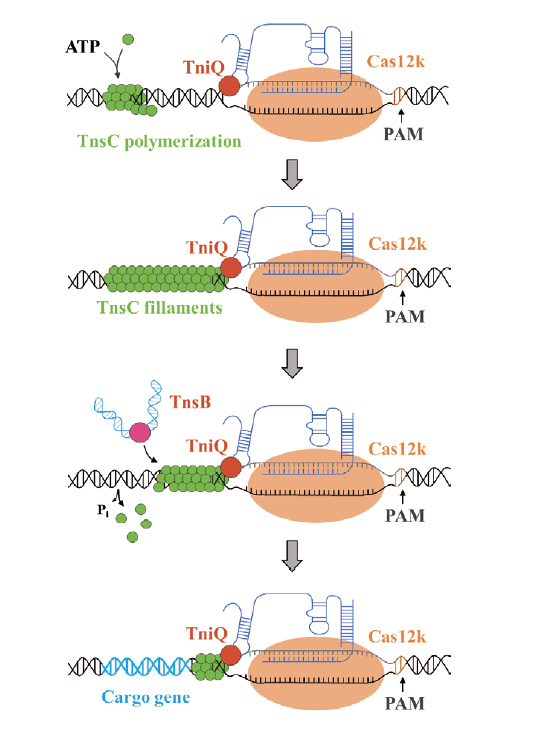
图3
V-K型CASTs介导转座机制模型
Fig. 3
Mechanistic model of V-K CASTs-mediated transp-osition
有趣的是,Schmitz等[46]在解析ShCAST的结构时意外发现了与TniQ一起纯化出来的大肠杆菌核糖体蛋白S15能够提升转座效率,晶体学结构揭示S15和Cas12k、sgRNA的tracrRNA部分存在相互作用。大肠杆菌的S15蛋白通过静电相互作用和π-π堆积作用与tracrRNA的顶环产生形状互补的相互作用,暗示S15能够通过稳定tracrRNA的顶环促进TniQ的招募,这一发现为提升CASTs的转座活性提供了一个方向。
相比之下,I-F型CASTs的机制解析较少,目前仅对TniQ-Cascade复合物的结构获得了较多的认识,而对于CASTs如何招募转座元件TnsA、TnsB、TnsC仍知之甚少。在TniQ-Cascade复合物中,Cas6和Cas8/5分别与crRNA的3'茎环和5'尾部结合,Cas8/5、Cas7、Cas6以1∶6∶1的比例组装成Cascade级联复合物,TniQ以二聚体的形式,通过与Cas6和Cas7.1的相互作用被招募并锚定在级联上[47⇓⇓-50]。最近的一篇研究发现,在I-F型CASTs形成转座复合物的过程中,TniQ-Cascade复合物的DNA靶向是高度混杂的,能够结合广泛的脱靶位点,但所有靶向位点中只有其中的一部分能够招募TnsC和TnsB。研究人员猜测在脱靶位点中,PAM远端的错配使级联复合物的构象和/或R环结构不利于TnsC结合。这种TnsC的选择性招募增强了CASTs的保真性,是转座的关键检查点,但在其他Tn家族转座子中是否有类似的校对机制仍然未知[51]。与V-K型CASTs不同的是,I-F型VchCAST中的TnsC并未形成螺旋细丝,而是以单/双/三个堆叠七聚体的形态存在,说明了两种亚型CASTs之间转座机制的差异[43,51]。
4 CASTs的细菌基因组编辑应用
CASTs作为一种转座酶的天然变体,在被开发为基因整合工具上具有与生俱来的优势。来自霍乱弧菌的I-F亚型CASTs最早被开发为基因整合工具,并被部署于大肠杆菌中。研究人员进一步将所有元件构建在一个All-in-one质粒中,得到了一个优化系统,能够在细菌中以接近100%的效率实现10 k碱基的高精度和无标记DNA整合[28,41]。V-K和I-B亚型也相继被表征并开发为基因整合工具(表1)。相比较而言,V-K型CASTs比I型CASTs具有更明显的技术优势,因为它们的编码尺寸更小,具有更少的组件且单向插入[27-28]。然而,V-K型CRISPR相关转座酶系统由于缺乏TnsA,其转座受到复制型转座机制的限制,导致生成不需要的供体质粒共整合产物。将归巢内切酶与TnsB融合并对供体质粒进行修饰而开发的HELIX技术能够使V-K型CASTs实现类似I型CASTs的剪切型转座机制[59]。
表1 不同亚型CASTs在细菌中的部署
Table 1
| 亚型 Subtype | 缩写或转座子编号 Abbreviation or transposon No. | 来源 Source | 底盘 Chassis | 最高效率 Highest efficiency | 参考文献 Reference |
|---|---|---|---|---|---|
| I-F | VchCAST | Vibrio cholerae Tn6677 | Escherichia coli | ~100% | [41] |
| Tatumella citrea | ~100% | [60] | |||
| Klebsiella oxytoca | N.D.* | [41] | |||
| Pseudomonas putida | N.D.* | [41] | |||
| Klebsiella michiganensis | ~0.010 | [64] | |||
| Pseudomonas simiae | ~0.003 | [64] | |||
| Ralstonia sp. UNC404CL21Col | ~0.001 | [64] | |||
| PtrCAST | Pseudoalteromonas translucida KMM520 | Escherichia coli | ~100% | [34] | |
| AsaCAST | Aeromonas salmonicidaS44 | Escherichia coli | 33.4% **&*** | [35] | |
| Tn7000 | Vibrio cholerae 4874 | Escherichia coli | ~1% | [36] | |
| Tn7001 | Photobactenium iliopiscarium NCIMB 13355 | Escherichia coli | ~1% | [36] | |
| Tn7002 | Vibrio sp.F12 | Escherichia coli | ~0.2% | [36] | |
| Tn7003 | Vibrnio parahaemolyticusFORC 071 | Escherichia coli | ~2% | [36] | |
| Tn7004 | Vibrio sp.16 | Escherichia coli | ~0.05% | [36] | |
| Tn7005 | Vibrio cholerae M1517 | Escherichia coli | ~45% | [36] | |
| Tn7006 | Vibrio splendidus UCD-SED10 | Escherichia coli | ~0.4% | [36] | |
| Tn7007 | Alivibrio wodanis06/09/160 | Escherichia coli | ~40% | [36] | |
| Tn7008 | Alivibrio sp.1S175 | Escherichia coli | ~0.13% | [36] | |
| Tn7009 | Parashewanella spongiaeHJ039 | Escherichia coli | ~50% | [36] | |
| Tn7010 | Photobacterium ganghwense JCM 12487 | Escherichia coli | ~0.4% | [36] | |
| Tn7011 | Pseudoalteromonas sp.P1-25 | Escherichia coli | ~48% | [36] | |
| Tn7012 | Pseudoalteromonas ruthenica S3245 | Escherichia coli | ~5% | [36] | |
| Tn7013 | Vibrio cholerae OYP7G04 | Escherichia coli | ~0.1% | [36] | |
| Tn7014 | Vibnio diazotrophicus60.6F | Escherichia coli | ~30% | [36] | |
| Tn7015 | Shewanella sp.UCD-KL21 | Escherichia coli | ~6% | [36] | |
| Tn7016 | Pseudoalteromonassp.S983 | Escherichia coli | ~80% | [36] | |
| Tn7017 | Endozoicomonas ascidicolaAVMARTO5 | Escherichia coli | ~16% | [36] | |
| I-B | AvCAST | Anabaena variabilis | Escherichia coli | 2.50% | [37] |
| PmcCAST | Peltigera membranacea cyanobiont 210A | Escherichia coli | 0.85% | [37] | |
| RoCAST | Rippkaea orientalis | Escherichia coli | N.D.* | [38] | |
| V-K | ShCAST | Scytonema hofmanni | Escherichia coli | 80% | [27] |
| Sinorhizobium meliloti | ~100% | [62] | |||
| Shewanella oneidensis MR-1 | 100% | [61] | |||
| Burkholderia thailandensis | ~100% ** | [63] | |||
| Pseudomonas putida | ~100% ** | [63] | |||
| Agrobacterium fabrum Anabaena | 40% ** N.D.* | [63] [65] | |||
| ShoCAST | Scytonema hofmannii PCC 7110 | Escherichia coli | 40% | [41] | |
| AcCAST | Anabaena cylindrica | / | N.D.* | [27] | |
| ShHELIX | Scytonema hofmanni | Escherichia coli | ~80% | [59] | |
| ShoHELIX | Scytonema hofmannii PCC 7110 | Escherichia coli | ~50% | [59] | |
| AcHELIX | Anabaena cylindrica | Escherichia coli | ~90% | [59] |
注:* 转座效率未定量;** 测试转座效率时使用了抗性筛选,因此实际测得的效率是上靶/脱靶比率;*** 此转座效率是用含有非典型重复序列的非典型crRNA进行测试的
Note: * The transposition efficiency is not determined. ** Resistance screening is used to test transposition efficiency, thus the measured efficiency is actually on/off target ratio. *** The transposition efficiency is measured with a typical crRNA containing a typical repeats
目前,CASTs已被部署至大肠杆菌(Escherichia coli)[28]、柠檬塔特姆氏菌(Tatumella citrea)[60]、恶臭假单胞菌(Pseudomonas putida)[41]、产酸克雷伯氏菌(Klebsiella oxytoca)[41]、希瓦氏菌(Shewanella oneidensis MR-1)[61]、苜蓿中华根瘤菌(Sinorhizobium meliloti)[62]、伯克霍尔德菌(Burkholderia thailande-nsis)[63]、法布氏农杆菌(Agrobacterium fabrum)[63]、蓝藻(Anabaena)[64]中用于基因整合(表1)。Rubin等[65]将基于CASTs的DART(DNA-editing all-in-one RNA-guided CRISPR-Cas transposase)系统与具有评估微生物群落中单个物种获取和整合外源DNA能力的ET-Seq(environmental transformation sequencing)结合,能够对微生物群体中的单个物种进行特定位点的基因组编辑,研究利用该技术在合成土壤群落中鉴定出了密歇根克雷伯氏菌(Klebsiella michiganensis)、猴假单胞菌(Pseudomonas simiae)、罗尔斯通菌(Ralstonia sp. UNC404CL21Col)3种遗传可及的物种。这一技术对于微生物群体中未培养微生物的定点编辑具有变革性意义。
由于不依赖于同源重组,CASTs在大片段多重基因整合上有巨大的潜力。2020年,Zhang等[60]开发了基于CRISPR转座酶的多拷贝基因组整合工具MUCICAT(multicopy chromosomal integration using CRISPR-associated transposases)。其原理是使用单crRNA靶向基因组上重复序列,实现多拷贝位点的整合,或使用crRNA阵列,实现同时靶向不同位点进行基因整合(图4-A),使用该系统生成酶基因拷贝文库,能够确定酶拷贝数的最优剂量(图4-B)。研究人员使用该系统生成葡萄糖脱氢酶基因的拷贝文库,最终获得了比pET-24a表达量增加2.6倍的菌株[60]。进一步使用该系统对菌株进行代谢工程改造,经过两轮整合,在多重目标位点引入终止子从而敲除了N-乙酰葡糖胺降解基因簇,并对N-乙酰葡糖胺合成基因簇中mglmS和ScGNA1基因的拷贝数进行了优化,整个过程仅花费8 d[66]。2021年,Yang等[34]挖掘出来自半透明假交替单胞菌(Pseudoal-teromonas translucida KMM520)的高活性I-F型PtrCAST,与VchCAST组成正交CASTs,分别能够以约100%的效率将相应的货物基因插入各自的2个和5个位点,而不会相互干扰。使用正交CASTs,将基因靶向整合至代谢通路中竞争途径基因和其他位点,能够一步实现多*多拷贝整合*多基因中断(图4-C),这些工具的开发大大加速了代谢工程菌株的构建进程。
图4
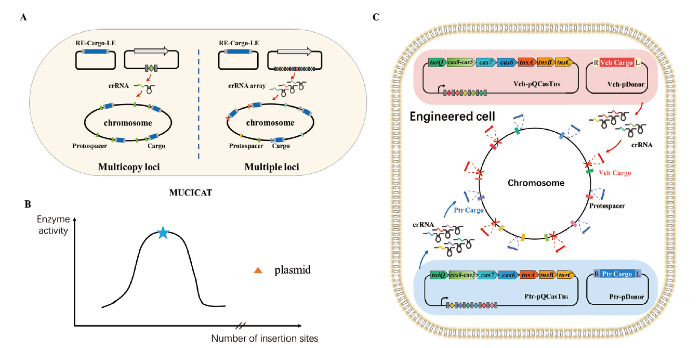
图4
MUCICAT的原理(A)及其在酶剂量优化(B)和代谢工程菌株改造(C)上的应用
Fig. 4
Mechanism of MUCICAT(A)and its application of enzyme dosage optimization(B)and modification(C)of metabolically engineered strain
5 总结与展望
近年来,多种CRISPR相关转座酶被相继挖掘,与现有基因编辑工具相比,由于不依赖于宿主DNA双链修复,CASTs能够实现基因的多靶点定点插入[60]和两正交多重编辑[34],是多靶整合的有力工具,并且能够高效插入大片段DNA[41],为大片段基因整合工具提供了一个新的选择,是一种十分有潜力的基因编辑工具。目前,CASTs已经被部署至多种革兰氏阴性菌和厌氧菌中,而CASTs能否在革兰氏阳性菌中发挥转座活性,目前尚无研究报道。尽管基于CASTs的基因整合工具已经能够实现大片段和多重基因整合和/或敲除,但其仍然存在一些问题,正交CASTs中两个CAST之间重复序列的相似性可能导致交叉反应性[34]以及CASTs系统存在类似于CRISPR-Cas系统中的脱靶效应,这些问题的存在提出了对CASTs系统进一步深入研究和优化的要求。未来,挖掘新型CASTs,并对其进行理性或非理性改造,或许能将CASTs拓展至更多的细菌及真核细胞中,进一步发挥其大片段基因整合与多重编辑特性。
参考文献
An updated evolutionary classification of CRISPR-Cas systems
[J].
DOI:10.1038/nrmicro3569
PMID:26411297
[本文引用: 3]

The evolution of CRISPR-cas loci, which encode adaptive immune systems in archaea and bacteria, involves rapid changes, in particular numerous rearrangements of the locus architecture and horizontal transfer of complete loci or individual modules. These dynamics complicate straightforward phylogenetic classification, but here we present an approach combining the analysis of signature protein families and features of the architecture of cas loci that unambiguously partitions most CRISPR-cas loci into distinct classes, types and subtypes. The new classification retains the overall structure of the previous version but is expanded to now encompass two classes, five types and 16 subtypes. The relative stability of the classification suggests that the most prevalent variants of CRISPR-Cas systems are already known. However, the existence of rare, currently unclassifiable variants implies that additional types and subtypes remain to be characterized.
Proteins and DNA elements essential for the CRISPR adaptation process in Escherichia coli
[J].
DOI:10.1093/nar/gks216
PMID:22402487
[本文引用: 1]
The clustered regularly interspaced short palindromic repeats and their associated proteins (CRISPR/Cas) constitute a recently identified prokaryotic defense mechanism against invading nucleic acids. Activity of the CRISPR/Cas system comprises of three steps: (i) insertion of alien DNA sequences into the CRISPR array to prevent future attacks, in a process called 'adaptation', (ii) expression of the relevant proteins, as well as expression and processing of the array, followed by (iii) RNA-mediated interference with the alien nucleic acid. Here we describe a robust assay in Escherichia coli to explore the hitherto least-studied process, adaptation. We identify essential genes and DNA elements in the leader sequence and in the array which are essential for the adaptation step. We also provide mechanistic insights on the insertion of the repeat-spacer unit by showing that the first repeat serves as the template for the newly inserted repeat. Taken together, our results elucidate fundamental steps in the adaptation process of the CRISPR/Cas system.
Cas6 is an endoribonuclease that generates guide RNAs for invader defense in prokaryotes
[J].
DOI:10.1101/gad.1742908
URL
[本文引用: 1]
An RNA-based gene silencing pathway that protects bacteria and archaea from viruses and other genome invaders is hypothesized to arise from guide RNAs encoded by CRISPR loci and proteins encoded by the cas genes. CRISPR loci contain multiple short invader-derived sequences separated by short repeats. The presence of virus-specific sequences within CRISPR loci of prokaryotic genomes confers resistance against corresponding viruses. The CRISPR loci are transcribed as long RNAs that must be processed to smaller guide RNAs. Here we identified Pyrococcus furiosus Cas6 as a novel endoribonuclease that cleaves CRISPR RNAs within the repeat sequences to release individual invader targeting RNAs. Cas6 interacts with a specific sequence motif in the 5′ region of the CRISPR repeat element and cleaves at a defined site within the 3′ region of the repeat. The 1.8 angstrom crystal structure of the enzyme reveals two ferredoxin-like folds that are also found in other RNA-binding proteins. The predicted active site of the enzyme is similar to that of tRNA splicing endonucleases, and concordantly, Cas6 activity is metal-independent. cas6 is one of the most widely distributed CRISPR-associated genes. Our findings indicate that Cas6 functions in the generation of CRISPR-derived guide RNAs in numerous bacteria and archaea.
CRISPR interference directs strand specific spacer acquisition
[J].
C2c2 is a single-component programmable RNA-guided RNA-targeting CRISPR effector
[J].
DOI:10.1126/science.aaf5573
URL
[本文引用: 1]
Almost all archaea and about half of bacteria possess clustered regularly interspaced short palindromic repeat (CRISPR)–CRISPR-associated genes (Cas) adaptive immune systems, which protect microbes against viruses and other foreign DNA. All functionally characterized CRISPR systems have been reported to target DNA, with some multicomponent type III systems also targeting RNA. The putative class 2 type VI system, which has not been functionally characterized, encompasses the single-effector protein C2c2, which contains two Higher Eukaryotes and Prokaryotes Nucleotide-binding (HEPN) domains commonly associated with ribonucleases (RNases), suggesting RNA-guided RNA-targeting function.
RNA-guided human genome engineering via Cas9
[J].
DOI:10.1126/science.1232033
PMID:23287722
[本文引用: 2]
Bacteria and archaea have evolved adaptive immune defenses, termed clustered regularly interspaced short palindromic repeats (CRISPR)/CRISPR-associated (Cas) systems, that use short RNA to direct degradation of foreign nucleic acids. Here, we engineer the type II bacterial CRISPR system to function with custom guide RNA (gRNA) in human cells. For the endogenous AAVS1 locus, we obtained targeting rates of 10 to 25% in 293T cells, 13 to 8% in K562 cells, and 2 to 4% in induced pluripotent stem cells. We show that this process relies on CRISPR components; is sequence-specific; and, upon simultaneous introduction of multiple gRNAs, can effect multiplex editing of target loci. We also compute a genome-wide resource of ~190 K unique gRNAs targeting ~40.5% of human exons. Our results establish an RNA-guided editing tool for facile, robust, and multiplexable human genome engineering.
A programmable dual-RNA-guided DNA endonuclease in adaptive bacterial immunity
[J].
DOI:10.1126/science.1225829
PMID:22745249
[本文引用: 1]
Clustered regularly interspaced short palindromic repeats (CRISPR)/CRISPR-associated (Cas) systems provide bacteria and archaea with adaptive immunity against viruses and plasmids by using CRISPR RNAs (crRNAs) to guide the silencing of invading nucleic acids. We show here that in a subset of these systems, the mature crRNA that is base-paired to trans-activating crRNA (tracrRNA) forms a two-RNA structure that directs the CRISPR-associated protein Cas9 to introduce double-stranded (ds) breaks in target DNA. At sites complementary to the crRNA-guide sequence, the Cas9 HNH nuclease domain cleaves the complementary strand, whereas the Cas9 RuvC-like domain cleaves the noncomplementary strand. The dual-tracrRNA:crRNA, when engineered as a single RNA chimera, also directs sequence-specific Cas9 dsDNA cleavage. Our study reveals a family of endonucleases that use dual-RNAs for site-specific DNA cleavage and highlights the potential to exploit the system for RNA-programmable genome editing.
Genome engineering using the CRISPR-Cas9 system
[J].
DOI:10.1038/nprot.2013.143
PMID:24157548
[本文引用: 1]
Targeted nucleases are powerful tools for mediating genome alteration with high precision. The RNA-guided Cas9 nuclease from the microbial clustered regularly interspaced short palindromic repeats (CRISPR) adaptive immune system can be used to facilitate efficient genome engineering in eukaryotic cells by simply specifying a 20-nt targeting sequence within its guide RNA. Here we describe a set of tools for Cas9-mediated genome editing via nonhomologous end joining (NHEJ) or homology-directed repair (HDR) in mammalian cells, as well as generation of modified cell lines for downstream functional studies. To minimize off-target cleavage, we further describe a double-nicking strategy using the Cas9 nickase mutant with paired guide RNAs. This protocol provides experimentally derived guidelines for the selection of target sites, evaluation of cleavage efficiency and analysis of off-target activity. Beginning with target design, gene modifications can be achieved within as little as 1-2 weeks, and modified clonal cell lines can be derived within 2-3 weeks.
Genome-scale transcriptional activation by an engineered CRISPR-Cas9 complex
[J].DOI:10.1038/nature14136 [本文引用: 1]
Repurposing CRISPR as an RNA-guided platform for sequence-specific control of gene expression
[J].
DOI:10.1016/j.cell.2013.02.022
PMID:23452860
[本文引用: 1]
Targeted gene regulation on a genome-wide scale is a powerful strategy for interrogating, perturbing, and engineering cellular systems. Here, we develop a method for controlling gene expression based on Cas9, an RNA-guided DNA endonuclease from a type II CRISPR system. We show that a catalytically dead Cas9 lacking endonuclease activity, when coexpressed with a guide RNA, generates a DNA recognition complex that can specifically interfere with transcriptional elongation, RNA polymerase binding, or transcription factor binding. This system, which we call CRISPR interference (CRISPRi), can efficiently repress expression of targeted genes in Escherichia coli, with no detectable off-target effects. CRISPRi can be used to repress multiple target genes simultaneously, and its effects are reversible. We also show evidence that the system can be adapted for gene repression in mammalian cells. This RNA-guided DNA recognition platform provides a simple approach for selectively perturbing gene expression on a genome-wide scale.Copyright © 2013 Elsevier Inc. All rights reserved.
Programmable editing of a target base in genomic DNA without double-stranded DNA cleavage
[J].DOI:10.1038/nature17946 [本文引用: 1]
RNA editing with CRISPR-cas13
[J].
DOI:10.1126/science.aaq0180
PMID:29070703
[本文引用: 1]
Nucleic acid editing holds promise for treating genetic disease, particularly at the RNA level, where disease-relevant sequences can be rescued to yield functional protein products. Type VI CRISPR-Cas systems contain the programmable single-effector RNA-guided ribonuclease Cas13. We profiled type VI systems in order to engineer a Cas13 ortholog capable of robust knockdown and demonstrated RNA editing by using catalytically inactive Cas13 (dCas13) to direct adenosine-to-inosine deaminase activity by ADAR2 (adenosine deaminase acting on RNA type 2) to transcripts in mammalian cells. This system, referred to as RNA Editing for Programmable A to I Replacement (REPAIR), which has no strict sequence constraints, can be used to edit full-length transcripts containing pathogenic mutations. We further engineered this system to create a high-specificity variant and minimized the system to facilitate viral delivery. REPAIR presents a promising RNA-editing platform with broad applicability for research, therapeutics, and biotechnology.Copyright © 2017, American Association for the Advancement of Science.
Two distinct RNase activities of CRISPR-C2c2 enable guide-RNA processing and RNA detection
[J].DOI:10.1038/nature19802 [本文引用: 1]
CRISPR-Cas12a target binding unleashes indiscriminate single-stranded DNase activity
[J].
DOI:10.1126/science.aar6245
PMID:29449511
[本文引用: 1]
CRISPR-Cas12a (Cpf1) proteins are RNA-guided enzymes that bind and cut DNA as components of bacterial adaptive immune systems. Like CRISPR-Cas9, Cas12a has been harnessed for genome editing on the basis of its ability to generate targeted, double-stranded DNA breaks. Here we show that RNA-guided DNA binding unleashes indiscriminate single-stranded DNA (ssDNA) cleavage activity by Cas12a that completely degrades ssDNA molecules. We find that target-activated, nonspecific single-stranded deoxyribonuclease (ssDNase) cleavage is also a property of other type V CRISPR-Cas12 enzymes. By combining Cas12a ssDNase activation with isothermal amplification, we create a method termed DNA endonuclease-targeted CRISPR trans reporter (DETECTR), which achieves attomolar sensitivity for DNA detection. DETECTR enables rapid and specific detection of human papillomavirus in patient samples, thereby providing a simple platform for molecular diagnostics.Copyright © 2018 The Authors, some rights reserved; exclusive licensee American Association for the Advancement of Science. No claim to original U.S. Government Works.
Current and future prospects for CRISPR-based tools in bacteria
[J].
DOI:10.1002/bit.25851
PMID:26460902
[本文引用: 1]
CRISPR-Cas systems have rapidly transitioned from intriguing prokaryotic defense systems to powerful and versatile biomolecular tools. This article reviews how these systems have been translated into technologies to manipulate bacterial genetics, physiology, and communities. Recent applications in bacteria have centered on multiplexed genome editing, programmable gene regulation, and sequence-specific antimicrobials, while future applications can build on advances in eukaryotes, the rich natural diversity of CRISPR-Cas systems, and the untapped potential of CRISPR-based DNA acquisition. Overall, these systems have formed the basis of an ever-expanding genetic toolbox and hold tremendous potential for our future understanding and engineering of the bacterial world.© 2015 Wiley Periodicals, Inc.
DNA transposition at work
[J].
DOI:10.1021/acs.chemrev.6b00003
PMID:27187082
[本文引用: 3]
DNA transposons are defined segments of DNA that are able to move from one genomic location to another. Movement is facilitated by one or more proteins, called the transposase, typically encoded by the mobile element itself. Here, we first provide an overview of the classification of such mobile elements in a variety of organisms. From a mechanistic perspective, we have focused on one particular group of DNA transposons that encode a transposase with a DD(E/D) catalytic domain that is topologically similar to RNase H. For these, a number of three-dimensional structures of transpososomes (transposase-nucleic acid complexes) are available, and we use these to describe the basics of their mechanisms. The DD(E/D) group, in addition to being the largest and most common among all DNA transposases, is the one whose members have been used for a wide variety of genomic applications. Therefore, a second focus of the article is to provide a nonexhaustive overview of transposon applications. Although several non-transposon-based approaches to site-directed genome modifications have emerged in the past decade, transposon-based applications are highly relevant when integration specificity is not sought. In fact, for many applications, the almost-perfect randomness and high frequency of integration make transposon-based approaches indispensable.
Barbara McClintock and the discovery of jumping genes
[J].DOI:10.1073/pnas.1219372109 PMID:23236127 [本文引用: 1]
The discovery and characterization of transposable elements. The collected papers of Barbara McClintock
[J].DOI:10.1016/0092-8674(88)90481-3 URL [本文引用: 1]
Rolling-circle transposons in eukaryotes
[J].
DOI:10.1073/pnas.151269298
PMID:11447285
[本文引用: 1]
All eukaryotic DNA transposons reported so far belong to a single category of elements transposed by the so-called "cut-and-paste" mechanism. Here, we report a previously unknown category of eukaryotic DNA transposons, Helitron, which transpose by rolling-circle replication. Autonomous Helitrons encode a 5'-to-3' DNA helicase and nuclease/ligase similar to those encoded by known rolling-circle replicons. Helitron-like transposons have conservative 5'-TC and CTRR-3' termini and do not have terminal inverted repeats. They contain 16- to 20-bp hairpins separated by 10--12 nucleotides from the 3'-end and transpose precisely between the 5'-A and T-3', with no modifications of the AT target sites. Together with their multiple diverged nonautonomous descendants, Helitrons constitute approximately 2% of both the Arabidopsis thaliana and Caenorhabditis elegans genomes and also colonize the Oriza sativa genome. Sequence conservation suggests that Helitrons continue to be transposed.
Self-synthesizing DNA transposons in eukaryotes
[J].
DOI:10.1073/pnas.0600833103
PMID:16537396
[本文引用: 1]
Eukaryotes contain numerous transposable or mobile elements capable of parasite-like proliferation in the host genome. All known transposable elements in eukaryotes belong to two types: retrotransposons and DNA transposons. Here we report a previously uncharacterized class of DNA transposons called Polintons that populate genomes of protists, fungi, and animals, including entamoeba, soybean rust, hydra, sea anemone, nematodes, fruit flies, beetle, sea urchin, sea squirt, fish, lizard, frog, and chicken. Polintons from all these species are characterized by a unique set of proteins necessary for their transposition, including a protein-primed DNA polymerase B, retroviral integrase, cysteine protease, and ATPase. In addition, Polintons are characterized by 6-bp target site duplications, terminal-inverted repeats that are several hundred nucleotides long, and 5'-AG and TC-3' termini. Analogously to known transposable elements, Polintons exist as autonomous and nonautonomous elements. Our data suggest that Polintons have evolved from a linear plasmid that acquired a retroviral integrase at least 1 billion years ago. According to the model of Polinton transposition proposed here, a Polinton DNA molecule excised from the genome serves as a template for extrachromosomal synthesis of its double-stranded DNA copy by the Polinton-encoded DNA polymerase and is inserted back into genome by its integrase.
Tn7: a target site-specific transposon
[J].The bacterial transposon Tn7 is an unusual mobile DNA segment. Most transposable elements move at low-frequency and display little target site-selectivity. By contrast, Tn7 inserts at high-frequency into a single specific site in the chromosomes of many bacteria. In the absence of this specific site, called attTn7 in Escherichia coli where Tn7 has been most extensively studied, Tn7 transposes at low-frequency and inserts into many different sites. Much has recently been learned about Tn7 transposition from both genetic and biochemical studies. The Tn7 recombination machinery is elaborate and includes a large number of Tn7-encoded proteins, probably host-encoded proteins and also rather large cis-acting transposition sequences at the transposon termini and at the target site. Dissection of the Tn7 transposition mechanism has revealed that the DNA strand breakage and joining reactions that underlie the translocation of Tn7 have several unusual features.
A panel of Tn7-based vectors for insertion of the gfp marker gene or for delivery of cloned DNA into Gram-negative bacteria at a neutral chromosomal site
[J].
DOI:10.1016/s0167-7012(01)00246-9
PMID:11348676
[本文引用: 1]
The use of Tn7-based systems for site-specific insertion of DNA into the chromosome of Gram-negative bacteria has been limited due to the lack of appropriate vectors. We therefore developed a flexible panel of Tn7 delivery vectors. In one group of vectors, the miniTn7 element, which is inserted into the chromosome, contains a multiple cloning site (MCS) and the kanamycin, streptomycin or gentamicin resistance markers. Another group of vectors intended for tagging with green fluorescent protein (GFP) carries the gfpmut3* gene controlled by the modified lac promoter PA1/04/03, several transcriptional terminators, and various resistance markers. These vectors insert Tn7 into a specific, neutral intergenic region immediately downstream of the gene encoding glucosamine-6-phosphate synthetase (GlmS) in the tested fluorescent Pseudomonas strains. The gfp-tagging vector containing a gentamicin-resistance marker is useful for tagging strains carrying a Tn5 transposon. Tn5 transposons often carry kanamycin-resistance-encoding genes and are frequently used to generate bacterial mutants and to deliver reporter constructions in gene expression studies. To demonstrate the utility of a dual marker/reporter system, the Tn7-gfp marker system was combined with a Tn5-delivered luxAB reporter system in Pseudomonas fluorescens. The system allowed detection of gfp-tagged cells in the barley rhizosphere, while expression of the Tn5-tagged locus could be determined by measuring bioluminescence.
Tn7: smarter than we thought
[J].
Structural basis of transposon end recognition explains central features of Tn7 transposition systems
[J].
DOI:10.1016/j.molcel.2022.05.005
PMID:35654042
[本文引用: 1]
Tn7 is a bacterial transposon with relatives containing element-encoded CRISPR-Cas systems mediating RNA-guided transposon insertion. Here, we present the 2.7 Å cryoelectron microscopy structure of prototypic Tn7 transposase TnsB interacting with the transposon end DNA. When TnsB interacts across repeating binding sites, it adopts a beads-on-a-string architecture, where the DNA-binding and catalytic domains are arranged in a tiled and intertwined fashion. The DNA-binding domains form few base-specific contacts leading to a binding preference that requires multiple weakly conserved sites at the appropriate spacing to achieve DNA sequence specificity. TnsB binding imparts differences in the global structure of the protein-bound DNA ends dictated by the spacing or overlap of binding sites explaining functional differences in the left and right ends of the element. We propose a model of the strand-transfer complex in which the terminal TnsB molecule is rearranged so that its catalytic domain is in a position conducive to transposition.Copyright © 2022 The Author(s). Published by Elsevier Inc. All rights reserved.
Targeting IS608 transposon integration to highly specific sequences by structure-based transposon engineering
[J].
DOI:10.1093/nar/gky235
PMID:29635476
[本文引用: 1]
Transposable elements are efficient DNA carriers and thus important tools for transgenesis and insertional mutagenesis. However, their poor target sequence specificity constitutes an important limitation for site-directed applications. The insertion sequence IS608 from Helicobacter pylori recognizes a specific tetranucleotide sequence by base pairing, and its target choice can be re-programmed by changes in the transposon DNA. Here, we present the crystal structure of the IS608 target capture complex in an active conformation, providing a complete picture of the molecular interactions between transposon and target DNA prior to integration. Based on this, we engineered IS608 variants to direct their integration specifically to various 12/17-nt long target sites by extending the base pair interaction network between the transposon and the target DNA. We demonstrate in vitro that the engineered transposons efficiently select their intended target sites. Our data further elucidate how the distinct secondary structure of the single-stranded transposon intermediate prevents extended target specificity in the wild-type transposon, allowing it to move between diverse genomic sites. Our strategy enables efficient targeting of unique DNA sequences with high specificity in an easily programmable manner, opening possibilities for the use of the IS608 system for site-specific gene insertions.
Recruitment of CRISPR-Cas systems by Tn7-like transposons
[J].
RNA-guided DNA insertion with CRISPR-associated transposases
[J].
DOI:10.1126/science.aax9181
PMID:31171706
[本文引用: 7]
CRISPR-Cas nucleases are powerful tools for manipulating nucleic acids; however, targeted insertion of DNA remains a challenge, as it requires host cell repair machinery. Here we characterize a CRISPR-associated transposase from cyanobacteria (ShCAST) that consists of Tn7-like transposase subunits and the type V-K CRISPR effector (Cas12k). ShCAST catalyzes RNA-guided DNA transposition by unidirectionally inserting segments of DNA 60 to 66 base pairs downstream of the protospacer. ShCAST integrates DNA into targeted sites in the genome with frequencies of up to 80% without positive selection. This work expands our understanding of the functional diversity of CRISPR-Cas systems and establishes a paradigm for precision DNA insertion.Copyright © 2019 The Authors, some rights reserved; exclusive licensee American Association for the Advancement of Science. No claim to original U.S. Government Works.
Transposon-encoded CRISPR-Cas systems direct RNA-guided DNA integration
[J].DOI:10.1038/s41586-019-1323-z [本文引用: 6]
Transposon-associated CRISPR-cas system: a powerful DNA insertion tool
[J].
DOI:10.1016/j.tim.2021.01.017
PMID:33612399
[本文引用: 1]
The transposon-associated CRISPR-Cas system is emerging as a powerful tool for targeted genetic manipulation. Using this system, targeted genomic knockins and knockouts can be achieved, independently of the host-cell repair machinery, thereby significantly improving our ability to perform genome editing in a wider variety of cell types.Copyright © 2021 Elsevier Ltd. All rights reserved.
CRISPR-Cas in mobile genetic elements: counter-defence and beyond
[J].
DOI:10.1038/s41579-019-0204-7
PMID:31165781
[本文引用: 7]
The principal function of CRISPR-Cas systems in archaea and bacteria is defence against mobile genetic elements (MGEs), including viruses, plasmids and transposons. However, the relationships between CRISPR-Cas and MGEs are far more complex. Several classes of MGE contributed to the origin and evolution of CRISPR-Cas, and, conversely, CRISPR-Cas systems and their components were recruited by various MGEs for functions that remain largely uncharacterized. In this Analysis article, we investigate and substantially expand the range of CRISPR-Cas components carried by MGEs. Three groups of Tn7-like transposable elements encode 'minimal' type I CRISPR-Cas derivatives capable of target recognition but not cleavage, and another group encodes an inactivated type V variant. These partially inactivated CRISPR-Cas variants might mediate guide RNA-dependent integration of the respective transposons. Numerous plasmids and some prophages encode type IV systems, with similar predicted properties, that appear to contribute to competition among plasmids and between plasmids and viruses. Many prokaryotic viruses also carry CRISPR mini-arrays, some of which recognize other viruses and are implicated in inter-virus conflicts, and solitary repeat units, which could inhibit host CRISPR-Cas systems.
Modulating the Cascade architecture of a minimal Type I-F CRISPR-Cas system
[J].
DOI:10.1093/nar/gkw469
PMID:27216815
[本文引用: 1]
Shewanella putrefaciens CN-32 contains a single Type I-Fv CRISPR-Cas system which confers adaptive immunity against bacteriophage infection. Three Cas proteins (Cas6f, Cas7fv, Cas5fv) and mature CRISPR RNAs were shown to be required for the assembly of an interference complex termed Cascade. The Cas protein-CRISPR RNA interaction sites within this complex were identified via mass spectrometry. Additional Cas proteins, commonly described as large and small subunits, that are present in all other investigated Cascade structures, were not detected. We introduced this minimal Type I system in Escherichia coli and show that it provides heterologous protection against lambda phage. The absence of a large subunit suggests that the length of the crRNA might not be fixed and recombinant Cascade complexes with drastically shortened and elongated crRNAs were engineered. Size-exclusion chromatography and small-angle X-ray scattering analyses revealed that the number of Cas7fv backbone subunits is adjusted in these shortened and extended Cascade variants. Larger Cascade complexes can still confer immunity against lambda phage infection in E. coli Minimized Type I CRISPR-Cas systems expand our understanding of the evolution of Cascade assembly and diversity. Their adjustable crRNA length opens the possibility for customizing target DNA specificity.© The Author(s) 2016. Published by Oxford University Press on behalf of Nucleic Acids Research.
Casposons: a new superfamily of self-synthesizing DNA transposons at the origin of prokaryotic CRISPR-Cas immunity
[J].
DOI:10.1186/1741-7007-12-36
PMID:24884953
[本文引用: 1]
Background: Diverse transposable elements are abundant in genomes of cellular organisms from all three domains of life. Although transposons are often regarded as junk DNA, a growing body of evidence indicates that they are behind some of the major evolutionary innovations. With the growth in the number and diversity of sequenced genomes, previously unnoticed mobile elements continue to be discovered. Results: We describe a new superfamily of archaeal and bacterial mobile elements which we denote casposons because they encode Cas1 endonuclease, a key enzyme of the CRISPR-Cas adaptive immunity systems of archaea and bacteria. The casposons share several features with self-synthesizing eukaryotic DNA transposons of the Polinton/Maverick class, including terminal inverted repeats and genes for B family DNA polymerases. However, unlike any other known mobile elements, the casposons are predicted to rely on Cas1 for integration and excision, via a mechanism similar to the integration of new spacers into CRISPR loci. We identify three distinct families of casposons that differ in their gene repertoires and evolutionary provenance of the DNA polymerases. Deep branching of the casposon-encoded endonuclease in the Cas1 phylogeny suggests that casposons played a pivotal role in the emergence of CRISPR-Cas immunity. Conclusions: The casposons are a novel superfamily of mobile elements, the first family of putative self-synthesizing transposons discovered in prokaryotes. The likely contribution of capsosons to the evolution of CRISPR-Cas parallels the involvement of the RAG1 transposase in vertebrate immunoglobulin gene rearrangement, suggesting that recruitment of endonucleases from mobile elements as ready-made tools for genome manipulation is a general route of evolution of adaptive immunity.
Metagenomic discovery of CRISPR-associated transposons
[J].
DOI:10.1073/pnas.2112279118
URL
[本文引用: 5]
CRISPR-Cas systems confer bacteria and archaea with adaptive immunity against mobile genetic elements. These systems also participate in other cellular processes. For example, CRISPR-associated Tn7 transposons (CASTs) have co-opted nuclease-inactive CRISPR effector proteins to guide their transposition. We bioinformatically survey metagenomic databases to uncover CASTs, including systems with new architectures and ones that use distinct CRISPR subtypes. We also describe a putative non-Tn7 CAST that co-opts Cas12. Our findings propose mechanisms for vertical and horizontal CAST targeting and shed light on how CASTs have coevolved with CRISPR-Cas systems.
Orthogonal CRISPR-associated transposases for parallel and multiplexed chromosomal integration
[J].
DOI:10.1093/nar/gkab752
PMID:34478496
[本文引用: 5]
Cell engineering is commonly limited to the serial manipulation of a single gene or locus. The recently discovered CRISPR-associated transposases (CASTs) could manipulate multiple sets of genes to achieve predetermined cell diversity, with orthogonal CASTs being able to manipulate them in parallel. Here, a novel CAST from Pseudoalteromonas translucida KMM520 (PtrCAST) was characterized without a protospacer adjacent motif (PAM) preference which can achieve a high insertion efficiency for larger cargo and multiplexed transposition and tolerate mismatches out of 4-nucleotide seed sequence. More importantly, PtrCAST operates orthogonally with CAST from Vibrio cholerae Tn6677 (VchCAST), though both belonging to type I-F3. The two CASTs were exclusively active on their respective mini-Tn substrate with their respective crRNAs that target the corresponding 5 and 2 loci in one Escherichia coli cell. The multiplexed orthogonal MUCICAT (MUlticopy Chromosomal Integration using CRISPR-Associated Transposases) is a powerful tool for cell programming and appears promising with applications in synthetic biology.© The Author(s) 2021. Published by Oxford University Press on behalf of Nucleic Acids Research.
Guide RNA categorization enables target site choice in Tn7-CRISPR-cas transposons
[J].
DOI:10.1016/j.cell.2020.11.005
PMID:33271061
[本文引用: 2]
CRISPR-Cas defense systems have been coopted multiple times in nature for guide RNA-directed transposition by Tn7-like elements. Prototypic Tn7 uses dedicated proteins for two targeting pathways: one targeting a neutral and conserved attachment site in the chromosome and a second directing transposition into mobile plasmids facilitating cell-to-cell transfer. We show that Tn7-CRISPR-Cas elements evolved a system of guide RNA categorization to accomplish the same two-pathway lifestyle. Multiple mechanisms allow functionally distinct guide RNAs for transposition: a conventional system capable of acquiring guide RNAs to new plasmid and phage targets and a second providing long-term memory for access to chromosomal sites upon entry into a new host. Guide RNAs are privatized to be recognized only by the transposon-adapted system via sequence specialization, mismatch tolerance, and selective regulation to avoid toxic self-targeting by endogenous CRISPR-Cas defense systems. This information reveals promising avenues to engineer guide RNAs for enhanced CRISPR-Cas functionality for genome modification.Copyright © 2020 Elsevier Inc. All rights reserved.
Evolutionary and mechanistic diversity of type I-F CRISPR-associated transposons
[J].
DOI:10.1016/j.molcel.2021.12.021
PMID:35051352
[本文引用: 19]
Canonical CRISPR-Cas systems utilize RNA-guided nucleases for targeted cleavage of foreign nucleic acids, whereas some nuclease-deficient CRISPR-Cas complexes have been repurposed to direct the insertion of Tn7-like transposons. Here, we established a bioinformatic and experimental pipeline to comprehensively explore the diversity of Type I-F CRISPR-associated transposons. We report DNA integration for 20 systems and identify a highly active subset that exhibits complete orthogonality in transposon DNA mobilization. We reveal the modular nature of CRISPR-associated transposons by exploring the horizontal acquisition of targeting modules and by characterizing a system that encodes both a programmable, RNA-dependent pathway, and a fixed, RNA-independent pathway. Finally, we analyzed transposon-encoded cargo genes and found the striking presence of anti-phage defense systems, suggesting a role in transmitting innate immunity between bacteria. Collectively, this study substantially advances our biological understanding of CRISPR-associated transposon function and expands the suite of RNA-guided transposases for programmable, large-scale genome engineering.Copyright © 2021 Elsevier Inc. All rights reserved.
Dual modes of CRISPR-associated transposon homing
[J].
DOI:10.1016/j.cell.2021.03.006
PMID:33770501
[本文引用: 4]
Tn7-like transposons have co-opted CRISPR systems, including class 1 type I-F, I-B, and class 2 type V-K. Intriguingly, although these CRISPR-associated transposases (CASTs) undergo robust CRISPR RNA (crRNA)-guided transposition, they are almost never found in sites targeted by the crRNAs encoded by the cognate CRISPR array. To understand this paradox, we investigated CAST V-K and I-B systems and found two distinct modes of transposition: (1) crRNA-guided transposition and (2) CRISPR array-independent homing. We show distinct CAST systems utilize different molecular mechanisms to target their homing site. Type V-K CAST systems use a short, delocalized crRNA for RNA-guided homing, whereas type I-B CAST systems, which contain two distinct target selector proteins, use TniQ for RNA-guided DNA transposition and TnsD for homing to an attachment site. These observations illuminate a key step in the life cycle of CAST systems and highlight the diversity of molecular mechanisms mediating transposon homing.Copyright © 2021 Elsevier Inc. All rights reserved.
Rapid cell-free characterization of multi-subunit CRISPR effectors and transposons
[J].
DOI:10.1016/j.molcel.2022.01.026
PMID:35216669
[本文引用: 2]
CRISPR-Cas biology and technologies have been largely shaped to date by the characterization and use of single-effector nucleases. By contrast, multi-subunit effectors dominate natural systems, represent emerging technologies, and were recently associated with RNA-guided DNA transposition. This disconnect stems from the challenge of working with multiple protein subunits in vitro and in vivo. Here, we apply cell-free transcription-translation (TXTL) systems to radically accelerate the characterization of multi-subunit CRISPR effectors and transposons. Numerous DNA constructs can be combined in one TXTL reaction, yielding defined biomolecular readouts in hours. Using TXTL, we mined phylogenetically diverse I-E effectors, interrogated extensively self-targeting I-C and I-F systems, and elucidated targeting rules for I-B and I-F CRISPR transposons using only DNA-binding components. We further recapitulated DNA transposition in TXTL, which helped reveal a distinct branch of I-B CRISPR transposons. These capabilities will facilitate the study and exploitation of the broad yet underexplored diversity of CRISPR-Cas systems and transposons.Copyright © 2022 Elsevier Inc. All rights reserved.
Type IV CRISPR RNA processing and effector complex formation in Aromatoleum aromaticum
[J].DOI:10.1038/s41564-018-0274-8 [本文引用: 1]
Unbiased profiling of CRISPR RNA-guided transposition products by long-read sequencing
[J].
DOI:10.1186/s13100-021-00242-2
[本文引用: 1]
Bacterial transposons propagate through either non-replicative (cut-and-paste) or replicative (copy-and-paste) pathways, depending on how the mobile element is excised from its donor source. In the well-characterized E. coli transposon Tn7, a heteromeric TnsA-TnsB transposase directs cut-and-paste transposition by cleaving both strands at each transposon end during the excision step. Whether a similar pathway is involved for RNA-guided transposons, in which CRISPR-Cas systems confer DNA target specificity, has not been determined. Here, we apply long-read, population-based whole-genome sequencing (WGS) to unambiguously resolve transposition products for two evolutionarily distinct transposon types that employ either Cascade or Cas12k for RNA-guided DNA integration. Our results show that RNA-guided transposon systems lacking functional TnsA primarily undergo copy-and-paste transposition, generating cointegrate products that comprise duplicated transposon copies and genomic insertion of the vector backbone. Finally, we report natural and engineered transposon variants encoding a TnsAB fusion protein, revealing a novel strategy for achieving RNA-guided transposition with fewer molecular components.
CRISPR RNA-guided integrases for high-efficiency, multiplexed bacterial genome engineering
[J].
DOI:10.1038/s41587-020-00745-y
PMID:33230293
[本文引用: 10]
Existing technologies for site-specific integration of kilobase-sized DNA sequences in bacteria are limited by low efficiency, a reliance on recombination, the need for multiple vectors, and challenges in multiplexing. To address these shortcomings, we introduce a substantially improved version of our previously reported Tn7-like transposon from Vibrio cholerae, which uses a Type I-F CRISPR-Cas system for programmable, RNA-guided transposition. The optimized insertion of transposable elements by guide RNA-assisted targeting (INTEGRATE) system achieves highly accurate and marker-free DNA integration of up to 10 kilobases at ~100% efficiency in bacteria. Using multi-spacer CRISPR arrays, we achieved simultaneous multiplexed insertions in three genomic loci and facile, multi-loci deletions by combining orthogonal integrases and recombinases. Finally, we demonstrated robust function in biomedically and industrially relevant bacteria and achieved target- and species-specific integration in a complex bacterial community. This work establishes INTEGRATE as a versatile tool for multiplexed, kilobase-scale genome engineering.
Mechanistic details of CRISPR-associated transposon recruitment and integration revealed by cryo-EM
[J].
DOI:10.1073/pnas.2202590119
URL
[本文引用: 1]
\n CRISPR-associated transposons (CASTs) are Tn7-like elements that are capable of RNA-guided DNA integration. Although structural data are known for nearly all core transposition components, the transposase component, TnsB, remains uncharacterized. Using cryo-electron microscopy (cryo-EM) structure determination, we reveal the conformation of TnsB during transposon integration for the type V-K CAST system from\n Scytonema hofmanni\n (ShCAST). Our structure of TnsB is a tetramer, revealing strong mechanistic relationships with the overall architecture of RNaseH transposases/integrases in general, and in particular the MuA transposase from bacteriophage Mu. However, key structural differences in the C-terminal domains indicate that TnsB’s tetrameric architecture is stabilized by a different set of protein–protein interactions compared with MuA. We describe the base-specific interactions along the TnsB binding site, which explain how different CAST elements can function on cognate mobile elements independent of one another. We observe that melting of the 5′ nontransferred strand of the transposon end is a structural feature stabilized by TnsB and furthermore is crucial for donor–DNA integration. Although not observed in the TnsB strand-transfer complex, the C-terminal end of TnsB serves a crucial role in transposase recruitment to the target site. The C-terminal end of TnsB adopts a short, structured 15-residue “hook” that decorates TnsC filaments. Unlike full-length TnsB, C-terminal fragments do not appear to stimulate filament disassembly using two different assays, suggesting that additional interactions between TnsB and TnsC are required for redistributing TnsC to appropriate targets. The structural information presented here will help guide future work in modifying these important systems as programmable gene integration tools.\n
Structural basis for target site selection in RNA-guided DNA transposition systems
[J].
DOI:10.1126/science.abi8976
URL
[本文引用: 2]
\n Exciting genomic engineering possibilities exist for natural integration systems called transposons, which have co-opted CRISPR/Cas systems. An unexplained feature of these systems involves how they direct insertions in a single orientation at a precise distance from the programmed target sequence. Park\n et al\n. show that orientation information is communicated to the transposase, TnsB, using the unidirectional growth of a helical filament made up of an AAA+ protein, TnsC. ATP hydrolysis trims the filament to a minimal unit that is marked by TniQ and defined by the Cas12k protein to provide spacing information. This finding may help future engineering of these systems for therapeutic applications. —DJ\n
Target site selection and remodelling by type V CRISPR-transposon systems
[J].DOI:10.1038/s41586-021-04030-z [本文引用: 1]
Structures of the holo CRISPR RNA-guided transposon integration complex
[J].DOI:10.1101/2022.10.12.511933 [本文引用: 1]
Structural basis for RNA-mediated assembly of type V CRISPR-associated transposons
[J].DOI:10.1101/2022.06.17.496590 [本文引用: 1]
Structure-function insights into the initial step of DNA integration by a CRISPR-Cas-Transposon complex
[J].DOI:10.1038/s41422-019-0272-2 PMID:31925391 [本文引用: 1]
Structural basis of a Tn7-like transposase recruitment and DNA loading to CRISPR-Cas surveillance complex
[J].DOI:10.1038/s41422-020-0274-0 PMID:31913359 [本文引用: 1]
Cryo-EM structure of a type I-F CRISPR RNA guided surveillance complex bound to transposition protein TniQ
[J].DOI:10.1038/s41422-019-0268-y PMID:31900425 [本文引用: 1]
Structural basis of DNA targeting by a transposon-encoded CRISPR-Cas system
[J].DOI:10.1038/s41586-019-1849-0 [本文引用: 1]
Selective TnsC recruitment enhances the fidelity of RNA-guided transposition
[J].DOI:10.1038/s41586-022-05059-4 [本文引用: 2]
CRISPR-associated transposase system can insert multiple copies of donor DNA into the same target locus
[J].
DOI:10.1089/crispr.2021.0019
PMID:34847728
[本文引用: 1]
The CRISPR-associated transposase system enables site-specific DNA integration on the genome independent of homologous recombination. Previous studies have demonstrated that the type V-K CRISPR-associated Tn7-like transposase system from and the type I-F system from have strong target immunity like Tn7, and therefore two or more copies of the donor DNA would not be inserted into the same target location in theory. In this paper, we report that the type I-F system can insert multiple donor copies into one site, which was identified and confirmed by single-strain identification and high-throughput sequencing. This result is beneficial for our application of multicopy chromosomal integration by CRISPR-associated transposases, allowing more donor insertions into the chromosome. This unexpected result shows that the target immunity mechanism of this system has not been fully understood. Attention should be paid to the possibility of multiple insertions and their effects in related research.
Multigene editing in the Escherichia coli genome via the CRISPR-Cas9 system
[J].
DOI:10.1128/AEM.04023-14
URL
[本文引用: 1]
\n An efficient genome-scale editing tool is required for construction of industrially useful microbes. We describe a targeted, continual multigene editing strategy that was applied to the\n Escherichia coli\n genome by using the\n Streptococcus pyogenes\n type II CRISPR-Cas9 system to realize a variety of precise genome modifications, including gene deletion and insertion, with a highest efficiency of 100%, which was able to achieve simultaneous multigene editing of up to three targets. The system also demonstrated successful targeted chromosomal deletions in\n Tatumella citrea\n, another species of the\n Enterobacteriaceae\n, with highest efficiency of 100%.\n
CRISPR/Cas9 assisted multiplex genome editing technique in Escherichia coli
[J].
Targeted DNA transposition in vitro using a dCas9-transposase fusion protein
[J].
DOI:10.1093/nar/gkz552
URL
[本文引用: 1]
Homology-directed genome engineering is limited by transgene size. Although DNA transposons are more efficient with large transgenes, random integrations are potentially mutagenic. Here we present an in vitro mechanistic study that demonstrates efficient Cas9 targeting of the mariner transposon Hsmar1. Integrations were unidirectional and tightly constrained to one side of the sgRNA binding site. Further analysis of the nucleoprotein intermediates demonstrated that the transposase and Cas9 moieties can bind their respective substrates independently or in concert. Kinetic analysis of the reaction in the presence of the Cas9 target–DNA revealed a delay between first and second strand cleavage at the transposon end. This step involves a significant conformational change that may be hindered by the properties of the interdomainal linker. Otherwise, the transposase moiety behaved normally and was proficient for integration in vitro and in Escherichia coli. Specific integration into the lacZ gene in E. coli was obscured by a high background of random integrations. Nevertheless, Cas9 is an attractive candidate for transposon-targeting because it has a high affinity and long dwell-time at its target site. This will facilitate a future optogenetic strategy for the temporal control of integration, which will increase the ratio of targeted to untargeted events.
An engineered cas-transposon system for programmable and site-directed DNA transpositions
[J].
DOI:10.1089/crispr.2019.0030
PMID:31742433
[本文引用: 1]
Efficient site-directed insertion of heterologous DNA into a genome remains an outstanding challenge. Recombinases that can integrate kilobase-sized DNA constructs are difficult to reprogram to user-defined loci, while genomic insertion using CRISPR-Cas methods relies on inefficient host DNA repair machinery. Here, we describe a Cas-Transposon (CasTn) system for genomic insertions that uses a Himar1 transposase fused to a catalytically dead dCas9 nuclease to mediate programmable, site-directed transposition. Using cell-free assays, we demonstrated that the Himar-dCas9 fusion protein increased the frequency of transposon insertion at a single targeted TA dinucleotide by >300-fold compared to a random transposase, and that site-directed transposition is dependent on target choice while robust to log-fold variations in protein and DNA concentrations. We also showed that Himar-dCas9 mediates directed transposition into plasmids in. This work highlights CasTn as a new modality for host-independent, programmable, site-directed DNA insertions.
Efficient, footprint-free human iPSC genome editing by consolidation of Cas9/CRISPR and piggyBac technologies
[J].
DOI:10.1038/nprot.2016.152
PMID:27929521
[本文引用: 2]
Genome editing of human induced pluripotent stem cells (hiPSCs) offers unprecedented opportunities for in vitro disease modeling and personalized cell replacement therapy. The introduction of Cas9-directed genome editing has expanded adoption of this approach. However, marker-free genome editing using standard protocols remains inefficient, yielding desired targeted alleles at a rate of ∼1-5%. We developed a protocol based on a doxycycline-inducible Cas9 transgene carried on a piggyBac transposon to enable robust and highly efficient Cas9-directed genome editing, so that a parental line can be expeditiously engineered to harbor many separate mutations. Treatment with doxycycline and transfection with guide RNA (gRNA), donor DNA and piggyBac transposase resulted in efficient, targeted genome editing and concurrent scarless transgene excision. Using this approach, in 7 weeks it is possible to efficiently obtain genome-edited clones with minimal off-target mutagenesis and with indel mutation frequencies of 40-50% and homology-directed repair (HDR) frequencies of 10-20%.
Enhancing site-specific DNA integration by a Cas9 nuclease fused with a DNA donor-binding domain
[J].
DOI:10.1093/nar/gkaa779
PMID:32986839
[本文引用: 1]
The CRISPR/Cas system is widely used for genome editing. However, robust and targeted insertion of a DNA segment remains a challenge. Here, we present a fusion nuclease (Cas9-N57) to enhance site-specific DNA integration via a fused DNA binding domain of Sleeping Beauty transposase to tether the DNA segment to the Cas9/sgRNA complex. The insertion was unidirectional and specific, and DNA fragments up to 12 kb in length were successfully integrated. As a test of the system, Cas9-N57 mediated the insertion of a CD19-specific chimeric antigen receptor (CD19-CAR) cassette into the AAVS1 locus in human T cells, and induced intrahepatic cholangiocarcinoma in mice by simultaneously mediating the insertion of oncogenic KrasG12D into the Rosa26 locus and disrupting Trp53 and Pten. Moreover, the nuclease-N57 fusion proteins based on AsCpf1 (AsCas12a) and CjCas9 exhibited similar activity. These findings demonstrate that CRISPR-associated nuclease-N57 protein fusion is a powerful tool for targeted DNA insertion and holds great potential for gene therapy applications.© The Author(s) 2020. Published by Oxford University Press on behalf of Nucleic Acids Research.
Cut-and-paste DNA insertion with engineered type V-K CRISPR-associated transposases
[J].DOI:10.1101/2022.01.07.475005 [本文引用: 4]
Multicopy chromosomal integration using CRISPR-associated transposases
[J].
DOI:10.1021/acssynbio.0c00073
PMID:32551502
[本文引用: 5]
Controlling the copy number of gene expression cassettes is an important strategy to engineer bacterial cells into high-efficiency biocatalysts. Current strategies mostly use plasmid vectors, but multicopy plasmids are often genetically unstable, and their copy numbers cannot be precisely controlled. The integration of expression cassettes into a bacterial chromosome has advantages, but iterative integration is laborious, and it is challenging to obtain a library with varied gene doses for phenotype characterization. Here, we demonstrated that multicopy chromosomal integration using CRISPR-associated transposases (MUCICAT) can be achieved by designing a crRNA to target multicopy loci or a crRNA array to target multiple loci in the genome. Within 5 days without selection pressure, strains carrying cargos with successively increasing copy numbers (up to 10) were obtained. Recombinant MUCICAT containing genomic multicopy glucose dehydrogenase expression cassettes showed 2.6-fold increased expression of this important industrial enzyme compared to harboring the conventional protein-expressing plasmid pET24a. Successful extension of MUCICAT to further demonstrated that MUCICAT may be generally applied to many bacterial species.
Repurposing CRISPR RNA-guided integrases system for one-step, efficient genomic integration of ultra-long DNA sequences
[J].
DOI:10.1093/nar/gkac554
URL
[本文引用: 2]
Genomic integration techniques offer opportunities for generation of engineered microorganisms with improved or even entirely new functions but are currently limited by inability for efficient insertion of long genetic payloads due to multiplexing. Herein, using Shewanella oneidensis MR-1 as a model, we developed an optimized CRISPR-associated transposase from cyanobacteria Scytonema hofmanni (ShCAST system), which enables programmable, RNA-guided transposition of ultra-long DNA sequences (30 kb) onto bacterial chromosomes at ∼100% efficiency in a single orientation. In this system, a crRNA (CRISPR RNA) was used to target multicopy loci like insertion-sequence elements or combining I-SceI endonuclease, thereby allowing efficient single-step multiplexed or iterative DNA insertions. The engineered strain exhibited drastically improved substrate diversity and extracellular electron transfer ability, verifying the success of this system. Our work greatly expands the application range and flexibility of genetic engineering techniques and may be readily extended to other bacteria for better controlling various microbial processes.
A versatile Cas12k-based genetic engineering toolkit(C12KGET)for metabolic engineering in genetic manipulation-deprived strains
[J].
DOI:10.1093/nar/gkac655
URL
[本文引用: 2]
The genetic modification of microorganisms is conducive to the selection of high-yield producers of high-value-added chemicals, but a lack of genetic tools hinders the industrialization of most wild species. Therefore, it is crucial to develop host-independent gene editing tools that can be used for genetic manipulation-deprived strains. The Tn7-like transposon from Scytonema hofmanni has been shown to mediate homologous recombination-independent genomic integration after heterologous expression in Escherichia coli, but the integration efficiency of heterologous sequences larger than 5 kb remains suboptimal. Here, we constructed a versatile Cas12k-based genetic engineering toolkit (C12KGET) that can achieve genomic integration of fragments up to 10 kb in size with up to 100% efficiency in challenging strains. Using C12KGET, we achieved the first example of highly efficient genome editing in Sinorhizobium meliloti, which successfully solved the problem that industrial strains are difficult to genetically modify, and increased vitamin B12 production by 25%. In addition, Cas12k can be directly used for transcriptional regulation of genes with up to 92% efficiency due to its naturally inactivated nuclease domain. The C12KGET established in this study is a versatile and efficient marker-free tool for gene integration as well as transcriptional regulation that can be used for challenging strains with underdeveloped genetic toolkits.
Broad-host-range mutagenesis with CRISPR-associated transposase
[J].DOI:10.1101/2022.01.19.475551 [本文引用: 5]
Towards genome-engineering in complex cyanobacterial communities: RNA-guided transposition in Anabaena
[J].DOI:10.1101/2022.09.18.508393 [本文引用: 4]
Species- and site-specific genome editing in complex bacterial communities
[J].DOI:10.1038/s41564-021-01014-7 [本文引用: 2]
Programming cells by multicopy chromosomal integration using CRISPR-associated transposases
[J].
DOI:10.1089/crispr.2021.0018
PMID:34152213
[本文引用: 1]
Directed evolution and targeted genome editing have been deployed to create genetic variants with usefully altered phenotypes. However, these methods are limited to high-throughput screening methods or serial manipulation of single genes. In this study, we implemented multicopy chromosomal integration using CRISPR-associated transposases (MUCICAT) to simultaneously target up to 11 sites on the chromosome for multiplex gene interruption and/or insertion, generating combinatorial genomic diversity. The MUCICAT system was improved by replacing the isopropyl-beta-D-thiogalactoside (IPTG)-dependent promoter to decouple gene editing and product synthesis and truncating the right end to reduce the leakage expression of cargo. We applied MUCICAT to engineer and optimize the N-acetylglucosamine (GlcNAc) biosynthesis pathway in to overproduce the industrially important GlcNAc in only 8 days. Two rounds of transformation, the first round for disruption of two degradation pathways related gene clusters and the second round for multiplex integration of the GlcNAc gene cassette, would generate a library with 1-11 copies of the GlcNAc cassette. We isolated a best variant with five copies of GlcNAc cassettes, producing 11.59 g/L GlcNAc, which was more than sixfold than that of the strain containing the pET-GNAc plasmid. Our multiplex approach MUCICAT has potential to become a powerful tool of cell programing and can be widely applied in many fields such as synthetic biology.


