







生物技术通报 ›› 2026, Vol. 42 ›› Issue (4): 65-71.doi: 10.13560/j.cnki.biotech.bull.1985.2025-0382
区琦1( ), 冯瑶1, 韦柳婷1, 庄站伟1, 赵云翔1,2, 陈富美1,2()
收稿日期:2025-04-12
出版日期:2026-04-26
发布日期:2026-04-30
通讯作者:
陈富美,女,博士,助理教授,研究方向 :猪的繁殖生理与繁殖生物技术;E-mail: fumeichen@gxu.edu.cn作者简介:区琦,女,硕士研究生,研究方向 :猪的繁殖生理与繁殖生物技术;E-mail: ouqi1215@163.com
基金资助:
OU Qi1(), FENG Yao1, WEI Liu-ting1, ZHUANG Zhan-wei1, ZHAO Yun-xiang1,2, CHEN Fu-mei1,2()
Received:2025-04-12
Published:2026-04-26
Online:2026-04-30
摘要:
母猪的繁殖性状在现代养猪业中占据着至关重要的地位,繁殖性状主要包括产仔数、产活仔数、断奶仔猪数、初生窝重、断奶窝重以及母猪使用年限等一系列关键指标。不仅直接决定了生产效率,还深刻影响着整个养猪产业链的效益与竞争力。然而母猪的繁殖表现为典型的复杂性状,其遗传力通常较低,遗传机制涉及大量基因及其相互作用,包括加性效应、上位效应以及潜在的表观遗传调控等,同时深受环境、管理水平及饲养条件(如营养、温度、湿度、饲养密度、应激状况和健康管理)等非遗传因素的影响,因此对其遗传改良一直是动物育种研究中的一大挑战。随着全基因组关联分析(genome-wide association study, GWAS)方法的不断发展,研究者能够借助高通量基因分型平台,在全基因组范围内筛选与目标表型相关的遗传位点,从而实现对复杂性状的精准解析。本文旨在系统综述GWAS技术的发展概况,包括其统计原理、方法学的演进以及检测效能的提升。进而重点阐述该技术在母猪关键繁殖性状遗传解析中的应用进展,总结已发现的重要遗传信号及其生物学功能。最后探讨GWAS在母猪繁殖性状研究中面临的挑战及对未来研究方向进行展望,例如整合多组学数据以深入阐释因果突变和调控网络,利用大数据和人工智能优化育种值估计,为实现高繁母猪的培育提供参考。
区琦, 冯瑶, 韦柳婷, 庄站伟, 赵云翔, 陈富美. 全基因组关联分析(GWAS)在母猪繁殖性状研究中的应用进展[J]. 生物技术通报, 2026, 42(4): 65-71.
OU Qi, FENG Yao, WEI Liu-ting, ZHUANG Zhan-wei, ZHAO Yun-xiang, CHEN Fu-mei. Application Status of Genome-wide Association Study (GWAS) in the Study of Reproductive Traits in Sow[J]. Biotechnology Bulletin, 2026, 42(4): 65-71.
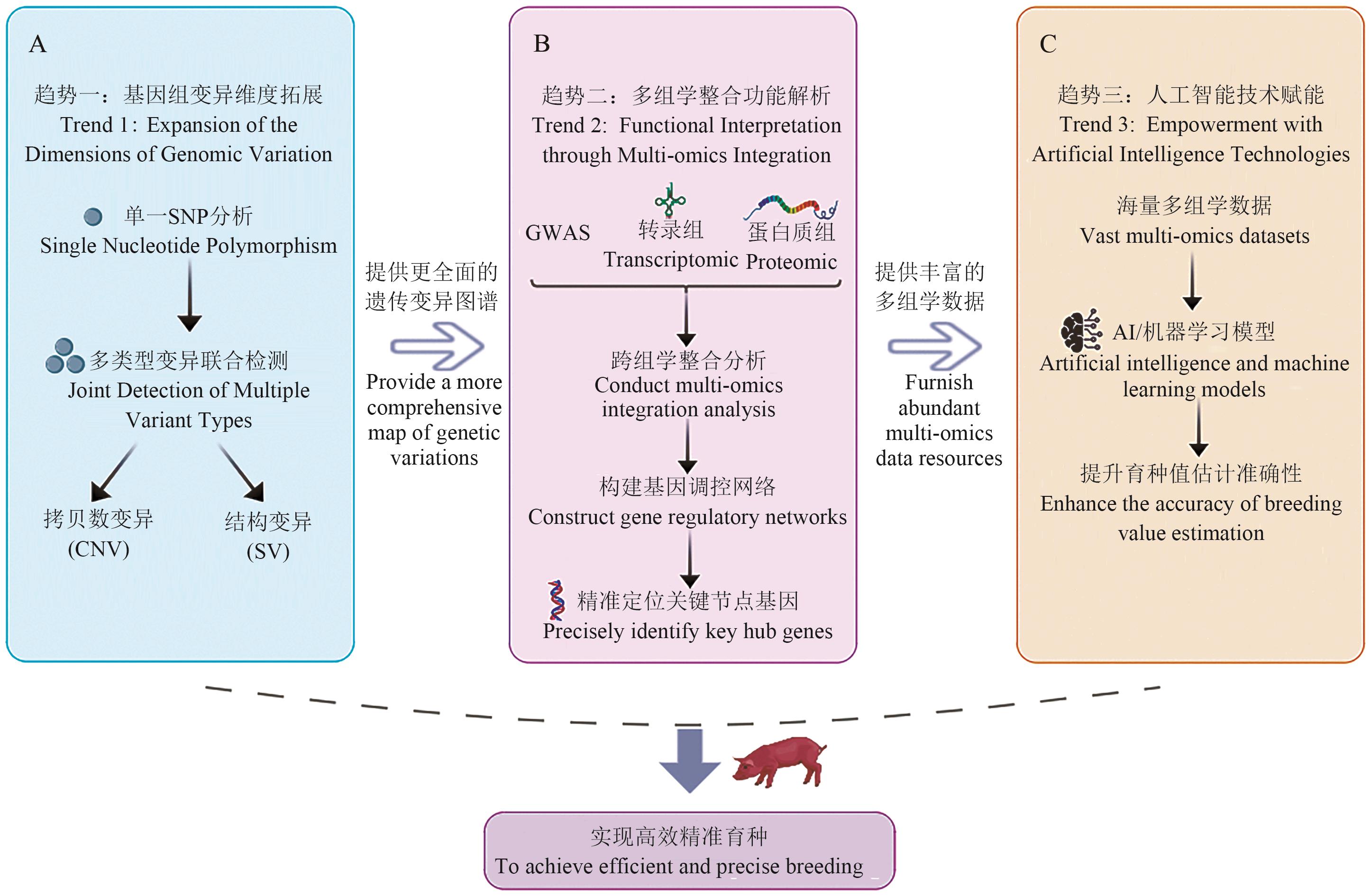
图1 GWAS在猪繁殖性状研究中的发展趋势
Fig. 1 Development trend of GWAS in the study of swine reproductive traits
繁殖性状 Reproductive traits | 候选基因名称 Candidate genes | 参考文献 Reference |
|---|---|---|
| 总产仔数 Total number of born piglets | JARID2, PDIA6, FLRT2, DICER1 | [ |
| SMAD4, RPS6KA2, CAMK2A, NDST1, ADCY5 | [ | |
| CLCN3, CBR4, HPF1, FAM174A, SCP2, CLIC1, NKAIN2, ZFYVE9 | [ | |
| SCC7 | [ | |
| 产活仔数 Number of alive born piglets | LIF | [ |
| IL17RA | [ | |
| SPATA33, KIF5C, EPC2 | [ | |
| SOSTDC1 | [ | |
| 断奶仔数 Number of weaned piglets | DGCR8 | [ |
| METTL23 | [ | |
| 妊娠期长度 Gestation period length | EGFR | [ |
| GSK3B, DLX4, DLX3, RGS18 | [ | |
| 产活窝重 Litter weight born alive | GABRA2, GABRA4, SPATA33 | [ |
| 死胎数 Piglets born dead | PRKD1 | [ |
表1 基于GWAS技术筛选的猪繁殖性状相关候选基因
Table 1 Candidate genes related to reproductive traits in pigs screened based on GWAS technology
繁殖性状 Reproductive traits | 候选基因名称 Candidate genes | 参考文献 Reference |
|---|---|---|
| 总产仔数 Total number of born piglets | JARID2, PDIA6, FLRT2, DICER1 | [ |
| SMAD4, RPS6KA2, CAMK2A, NDST1, ADCY5 | [ | |
| CLCN3, CBR4, HPF1, FAM174A, SCP2, CLIC1, NKAIN2, ZFYVE9 | [ | |
| SCC7 | [ | |
| 产活仔数 Number of alive born piglets | LIF | [ |
| IL17RA | [ | |
| SPATA33, KIF5C, EPC2 | [ | |
| SOSTDC1 | [ | |
| 断奶仔数 Number of weaned piglets | DGCR8 | [ |
| METTL23 | [ | |
| 妊娠期长度 Gestation period length | EGFR | [ |
| GSK3B, DLX4, DLX3, RGS18 | [ | |
| 产活窝重 Litter weight born alive | GABRA2, GABRA4, SPATA33 | [ |
| 死胎数 Piglets born dead | PRKD1 | [ |
| [1] | Jianfe L. The 9p21 chromosome polymorphism and coronary artery disease: a research progress [J]. China Mod Dr. 2014 |
| [2] | Fathoni A, Boonkum W, Chankitisakul V, et al. Integrating genomic selection and a genome-wide association study to improve days open in Thai dairy Holstein cattle: a comprehensive genetic analysis [J]. Animals, 2025, 15(1): 43. |
| [3] | Bhat JA, Adeboye KA, Ahmad Ganie S, et al. Genome-wide association study, haplotype analysis, and genomic prediction reveal the genetic basis of yield-related traits in soybean (Glycine max L.) [J]. Front Genet, 2022, 13: 953833. |
| [4] | 宋志芳. 利用GWAS对深县猪繁殖性状的研究 [D]. 保定: 河北农业大学, 2018. |
| Song ZF. Study on the reproductive traits of Shenxian pig by using GWAS [D]. Baoding: Hebei Agricultural University, 2018. | |
| [5] | 邓政. 上杭槐猪繁殖性状全基因组关联分析 [J]. 中国畜牧杂志, 2024, 60(8): 205-210. |
| Deng Z. Genome-wide association study, reproductive trait of Shanghang Huai pig [J]. Chin J Anim Sci, 2024, 60(8): 205-210. | |
| [6] | Wen YJ, Zhang HW, Ni YL, et al. Methodological implementation of mixed linear models in multi-locus genome-wide association studies [J]. Brief Bioinform, 2018, 19(4): 700-712. |
| [7] | Giambartolomei C, Vukcevic D, Schadt EE, et al. Bayesian test for colocalisation between pairs of genetic association studies using summary statistics [J]. PLoS Genet, 2014, 10(5): e1004383. |
| [8] | Du ZQ, Eisley CJ, Onteru SK, et al. Identification of species-specific novel transcripts in pig reproductive tissues using RNA-seq [J]. Anim Genet, 2014, 45(2): 198-204. |
| [9] | Kang JH, Lee EA, Hong KC, et al. Regulatory gene network from a genome-wide association study for sow lifetime productivity traits [J]. Anim Genet, 2018, 49(3): 254-258. |
| [10] | Zheng XR, Zhao PJ, Yang KJ, et al. CNV analysis of Meishan pig by next-generation sequencing and effects of AHR gene CNV on pig reproductive traits [J]. J Anim Sci Biotechnol, 2020, 11(1): 42. |
| [11] | Hosseinzadeh S, Rafat SA, Fang LZ. Integrated TWAS GWAS and RNAseq results identify candidate genes associated with reproductive traits in cows [J]. Sci Rep, 2025, 15: 1932. |
| [12] | Wang JB, Zhang J, Hao WJ, et al. An interpretable integrated machine learning framework for genomic selection [J]. Smart Agric Technol, 2025, 12: 101138. |
| [13] | Lee MS, Choe YC. Forecasting sow’s productivity using the machine learning models [J]. J Agric Ext, 2009, 16: 939-965. |
| [14] | Sun JC, Xiao JH, Jiang YF, et al. Genome-wide association study on reproductive traits using imputation-based whole-genome sequence data in Yorkshire pigs [J]. Genes, 2023, 14(4): 861. |
| [15] | Onteru SK, Ross JW, Rothschild MF. The role of gene discovery, QTL analyses and gene expression in reproductive traits in the pig [J]. Proc, 2009, 66: 87-102. |
| [16] | Tam V, Patel N, Turcotte M, et al. Benefits and limitations of genome-wide association studies [J]. Nat Rev Genet, 2019, 20(8): 467-484. |
| [17] | Zhang SW, Chen B. Genetic variation of progesterone receptor gene and its association with reproductive traits in pig: Genetic variation of progesterone receptor gene and its association with reproductive traits in pig [J]. J Hunan Agric Univ, 2013, 39(1): 58-62. |
| [18] | Kumchoo T, Mekchay S. Association of NR4A1 and GNB2L1 genes with reproductive traits in commercial pig breeds [J]. Genet Mol Res, 2015, 14(4): 16276-16284. |
| [19] | Wang Y, Ding X, Tan Z, et al. Genome-wide association study for reproductive traits in a Large White pig population [J]. Anim Genet, 2018, 49(2): 127-131. |
| [20] | Uzzaman MR, Park JE, Lee KT, et al. A genome-wide association study of reproductive traits in a Yorkshire pig population [J]. Livest Sci, 2018, 209: 67-72. |
| [21] | Zhang LG, Zhang SY, Yuan M, et al. Genome-wide association studies and runs of homozygosity to identify reproduction-related genes in Yorkshire pig population [J]. Genes, 2023, 14(12): 2133. |
| [22] | Duan DD, Zhou SP, Wang ZY, et al. Genome-wide association study pinpoints novel candidate genes associated with the gestation length of the first parity in French large white sows [J]. Animals, 2025, 15(3): 447. |
| [23] | Zhang Z, Chen ZT, Ye SP, et al. Genome-wide association study for reproductive traits in a duroc pig population [J]. Animals, 2019, 9(10): 732. |
| [24] | Yin H, Du X, Li QQ, et al. Variants in BMP7 and BMP15 3'-UTRs associated with reproductive traits in a large white pig population [J]. Animals, 2019, 9(11): 905. |
| [25] | Sato S, Kikuchi T, Uemoto Y, et al. Effect of candidate gene polymorphisms on reproductive traits in a Large White pig population [J]. Anim Sci J, 2016, 87(12): 1455-1463. |
| [26] | Li TT, Wan PC, Lin Q, et al. Genome-wide association study meta-analysis elucidates genetic structure and identifies candidate genes of teat number traits in pigs [J]. Int J Mol Sci, 2024, 25(1): 451. |
| [27] | Jiang Y, Tang SQ, Xiao W, et al. A genome-wide association study of reproduction traits in four pig populations with different genetic backgrounds [J]. Asian-Australas J Anim Sci, 2020, 33(9): 1400-1410. |
| [28] | Sun J, Wei J, Pan Y, et al. Improving genomic prediction accuracy of pig reproductive traits based on genotype imputation using preselected markers with different imputation platforms [J]. animal, 2025, 19(1): 101387. |
| [29] | Zhao YX, Gao GX, Zhou Y, et al. Genome-wide association studies uncover genes associated with litter traits in the pig [J]. animal, 2022, 16(12): 100672. |
| [30] | Verardo LL, Silva FF, Varona L, et al. Bayesian GWAS and network analysis revealed new candidate genes for number of teats in pigs [J]. J Appl Genet, 2015, 56(1): 123-132. |
| [31] | Laplana M, Ros-Freixedes R, Estany J, et al. Whole-genome analysis of resilience based on the stability of reproduction performance during a porcine reproductive and respiratory syndrome virus outbreak in sows [J]. animal, 2024, 18(9): 101290. |
| [32] | Tiezzi F, Brito LF, Howard J, et al. Genomics of heat tolerance in reproductive performance investigated in four independent maternal lines of pigs [J]. Front Genet, 2020, 11: 629. |
| [33] | Chen JM, Wu ZY, Chen RX, et al. Identification of genomic regions and candidate genes for litter traits in French large white pigs using genome-wide association studies [J]. Animals, 2022, 12(12): 1584. |
| [34] | Zhang Y, Lai JH, Wang XY, et al. Genome-wide single nucleotide polymorphism (SNP) data reveal potential candidate genes for litter traits in a Yorkshire pig population [J]. Arch Anim Breed, 2023, 66(4): 357-368. |
| [35] | Sell-Kubiak E, Knol EF, Lopes M. Evaluation of the phenotypic and genomic background of variability based on litter size of Large White pigs [J]. Genet Sel Evol, 2022, 54(1): 1. |
| [36] | Norseeda W, Liu GS, et al. Effect of leukemia inhibitory factor polymorphism on litter size traits in Thai commercial pig breeds [J]. Vet Integr Sci, 2020, 19(2): 185-196. |
| [37] | Norseeda W, Liu GS, et al. Association of a non-synonymous SNP of IL17RA gene with litter size traits in Large White and Landrace pigs [J]. Vet Integr Sci, 2021, 19(3): 391-405. |
| [38] | Sell-Kubiak E, Dobrzanski J, Derks MFL, et al. Meta-analysis of SNPs determining litter traits in pigs [J]. Genes, 2022, 13(10): 1730. |
| [39] | 孙敬春. 基于基因组变异信息鉴定大白猪繁殖性状关键候选基因的研究 [D]. 杨凌: 西北农林科技大学, 2023. |
| Sun JC. Identification of key candidate genes for reproductive traits in large white pigs based on genomic variation information [D]. Yangling: Northwest A & F University, 2023. | |
| [40] | Sun J, Wang CY, Wu Y, et al. Association analysis of METTL23 gene polymorphisms with reproductive traits in kele pigs [J]. Genes, 2024, 15(8): 1061. |
| [41] | Liu ZZ, Yang J, Li H, et al. Identifying candidate genes for short gestation length trait in Chinese Qingping pigs by whole-genome resequencing and RNA sequencing [J]. Front Genet, 2022, 13: 857705. |
| [42] | Zhang ZP, Xing SY, Qiu A, et al. The development of a porcine 50K SNP panel using genotyping by target sequencing and its application [J]. J Integr Agric, 2025, 24(5): 1930-1943. |
| [43] | Konte AF, Belous AA, Volkova VV, et al. Estimation of breeding value of large white pigs based on the application of a mixed model [J]. Pig-Breeding, 2024(3): 9-13. |
| [44] | Lopes MS, Bovenhuis H, Son MV, et al. Using markers with large effect in genetic and genomic predictions [J]. J Anim Sci, 2017, 95(1): 59-71. |
| [45] | Mészárosová M. Linkage disequilibrium, genomic inbreeding and effective populations size to unravel population history [J]. Acta Fytotechn Zootechn, 2021, 24(2): 161-166. |
| [46] | Liu X, Wang LG, Liang J, et al. Genome-wide association study for certain carcass traits and organ weights in a large white × Minzhu intercross porcine population [J]. J Integr Agric, 2014, 13(12): 2721-2730. |
| [47] | Tong XK, Chen D, Hu JC, et al. Accurate haplotype construction and detection of selection signatures enabled by high quality pig genome sequences [J]. Nat Commun, 2023, 14: 5126. |
| [48] | Utsunomiya YT, do Carmo AS, Carvalheiro R, et al. Genome-wide association study for birth weight in Nellore cattle points to previously described orthologous genes affecting human and bovine height [J]. BMC Genet, 2013, 14: 52. |
| [49] | Onteru SK, Fan B, Nikkilä MT, et al. Whole-genome association analyses for lifetime reproductive traits in the pig [J]. J Anim Sci, 2011, 89(4): 988-995. |
| [50] | Tang ZS, Xu JY, Yin LL, et al. Genome-wide association study reveals candidate genes for growth relevant traits in pigs [J]. Front Genet, 2019, 10: 302. |
| [51] | Luo WZ, Cheng DX, Chen SK, et al. Genome-wide association analysis of meat quality traits in a porcine large white × Minzhu intercross population [J]. Int J Biol Sci, 2012, 8(4): 580-595. |
| [1] | 王尚封, 程斌, 王若若, 丁延庆, 徐建霞, 曹宁, 高旭, 李文贞, 张立异. 基于BSA-seq的高粱开花时间基因定位及候选基因预测[J]. 生物技术通报, 2026, 42(2): 197-206. |
| [2] | 吴夏明, 周陈平, 杨敏, 徐泽, 邝瑞彬, 刘传和, 贺涵, 魏岳荣. 基于BSA-seq的番木瓜株高候选基因定位[J]. 生物技术通报, 2025, 41(9): 54-61. |
| [3] | 刘泽洲, 段乃彬, 岳丽昕, 王清华, 姚行浩, 高莉敏, 孔素萍. 大蒜叶片蜡质成分分析及蜡质缺失基因Ggl-1筛选[J]. 生物技术通报, 2025, 41(9): 219-231. |
| [4] | 霍贯中, 张欣濡, 田士军, 李君. CRISPR/Cas12a基因编辑技术在植物中的研究进展[J]. 生物技术通报, 2025, 41(6): 1-11. |
| [5] | 孙志勇, 杜怀东, 刘阳, 马嘉欣, 于雪然, 马伟, 姚鑫杰, 王敏, 李培富. 水稻籽粒γ-氨基丁酸含量的全基因组关联分析[J]. 生物技术通报, 2024, 40(8): 53-62. |
| [6] | 侯文婷, 孙琳, 张艳军, 董合忠. 基因编辑技术在棉花种质创新和遗传改良中的应用[J]. 生物技术通报, 2024, 40(7): 68-77. |
| [7] | 杨帅朋, 屈子啸, 朱向星, 唐冬生. DNA碱基编辑技术的研究进展及在猪基因修饰中的应用[J]. 生物技术通报, 2024, 40(1): 127-144. |
| [8] | 徐建霞, 丁延庆, 冯周, 曹宁, 程斌, 高旭, 邹桂花, 张立异. 基于Super-GBS的高粱株高和节间数QTL定位[J]. 生物技术通报, 2023, 39(7): 185-194. |
| [9] | 符勇耀, 易德燕, 杨先茂, 蔡莉, 梁渝华, 雷美艳, 杨利平. 卷丹新种质JD-h-15的形态特征与遗传变异分析[J]. 生物技术通报, 2022, 38(11): 140-150. |
| [10] | 邹坤, 崔红艳, 薛缘, 张少伟, 路丽丽, 赵志辉, 苏瑛. 雷州黑鸭FSHR和ESR1与繁殖性状关联分析[J]. 生物技术通报, 2019, 35(8): 118-126. |
| [11] | 周岩;张洁;袁重要;马俊;. 紫花苜蓿转基因技术及其应用的研究进展[J]. , 2012, 0(08): 17-23. |
| [12] | 张婧敏;陈宏;张春雷;杜毓;石秀英;房兴堂;. 奶牛乳房炎抗性候选基因的研究进展[J]. , 2010, 0(05): 43-46. |
| [13] | 时广红;王彦珍;魏建华;. eIF-5A与DHS功能研究及应用进展[J]. , 2009, 0(05): 21-26. |
| [14] | 陈慧勇;吴珍芳;. BF、DRB、DQB、TAP1和IFN-γ基因作为猪抗病育种分子标记的可行性初步分析[J]. , 2009, 0(01): 103-106. |
| [15] | 宋万坤;于妍;高运来;姜威;刘春燕;孙殿君;陈庆山;胡国华;. 大豆饱和脂肪酸组分改良研究进展[J]. , 2008, 0(S1): 18-21. |
| 阅读次数 | ||||||
|
全文 |
|
|||||
|
摘要 |
|
|||||
