







生物技术通报 ›› 2025, Vol. 41 ›› Issue (11): 14-21.doi: 10.13560/j.cnki.biotech.bull.1985.2025-0691
• 未来食品工程专题 • 下一篇
白帆( ), 周雍进()
收稿日期:2025-06-30
出版日期:2025-11-26
发布日期:2025-12-09
通讯作者:
周雍进,男,博士,研究员,研究方向 :甲醇生物转化;E-mail: zhouyongjin@dicp.ac.cn作者简介:白帆,女,博士,助理研究员,研究方向 :甲醇生物转化;E-mail: baifan1215@dicp.ac.cn
基金资助:
BAI Fan(), ZHOU Yong-jin()
Received:2025-06-30
Published:2025-11-26
Online:2025-12-09
摘要:
蛋白质是构成有机体重要的营养素之一,随着社会不断发展和人口持续增长,消费者对优质、多元化蛋白产品的需求越来越高。依靠动物和植物获取蛋白资源的传统方式严重受土地资源制约和气候的影响,导致蛋白质资源供应紧张。而微生物可以利用廉价生物质进行高密度生长,获得的菌体蛋白质不仅含量高,而且富含人体所需的必需氨基酸,被视为未来理想的蛋白质来源。因此,为挖掘优质蛋白替代资源,利用微生物“细胞工厂”生产的单细胞蛋白质有望成为高质量蛋白质生物制造新路线,缓解我国蛋白资源紧缺难题。本文聚焦酵母单细胞蛋白的发展和应用,总结利用酵母细胞生产的单细胞蛋白作为饲料蛋白添加剂和功能性蛋白食品的应用现状和前景,同时,还介绍了利用酵母为“细胞工厂”结合合成生物学策略定向合成蛋白质的相关研究,以及未来酵母“细胞工厂”单细胞蛋白在食品工业领域应用所面临的潜在安全性问题,为我国拓展新型蛋白质资源的研究和发展提供研究策略和参考。
白帆, 周雍进. 酵母单细胞蛋白助力食品工业发展与应用[J]. 生物技术通报, 2025, 41(11): 14-21.
BAI Fan, ZHOU Yong-jin. Yeast Single-cell Proteins Promote the Development and Application of Food Industry[J]. Biotechnology Bulletin, 2025, 41(11): 14-21.
菌种 Species | 发酵底物 Fermentation substrate | 蛋白质含量 Protein content (%) | 参考文献 Reference |
|---|---|---|---|
| S. cerevisiae | 橙浆和废谷物 | 38.5 | [ |
| D. hansenii | 啤酒厂废谷物 | 31.8 | [ |
| K. marxianus | 橙浆、废谷物、马铃薯片等 | 33.7 | [ |
| 干酪乳清 | 43.4 | [ | |
| Y. lipolytica | 食品工业废物 | 38.8 | [ |
| C. utilis | 马铃薯淀粉工业废物 | 46.1 | [ |
| K. phaffii | 甲醇 | 50.6 | [ |
| 甲醇 | 67.2 | [ |
表1 酵母细胞利用不同食品和工业废物生产单细胞蛋白
Table 1 Production of single-cell proteins using various food and industrial wastes by yeast cells
菌种 Species | 发酵底物 Fermentation substrate | 蛋白质含量 Protein content (%) | 参考文献 Reference |
|---|---|---|---|
| S. cerevisiae | 橙浆和废谷物 | 38.5 | [ |
| D. hansenii | 啤酒厂废谷物 | 31.8 | [ |
| K. marxianus | 橙浆、废谷物、马铃薯片等 | 33.7 | [ |
| 干酪乳清 | 43.4 | [ | |
| Y. lipolytica | 食品工业废物 | 38.8 | [ |
| C. utilis | 马铃薯淀粉工业废物 | 46.1 | [ |
| K. phaffii | 甲醇 | 50.6 | [ |
| 甲醇 | 67.2 | [ |
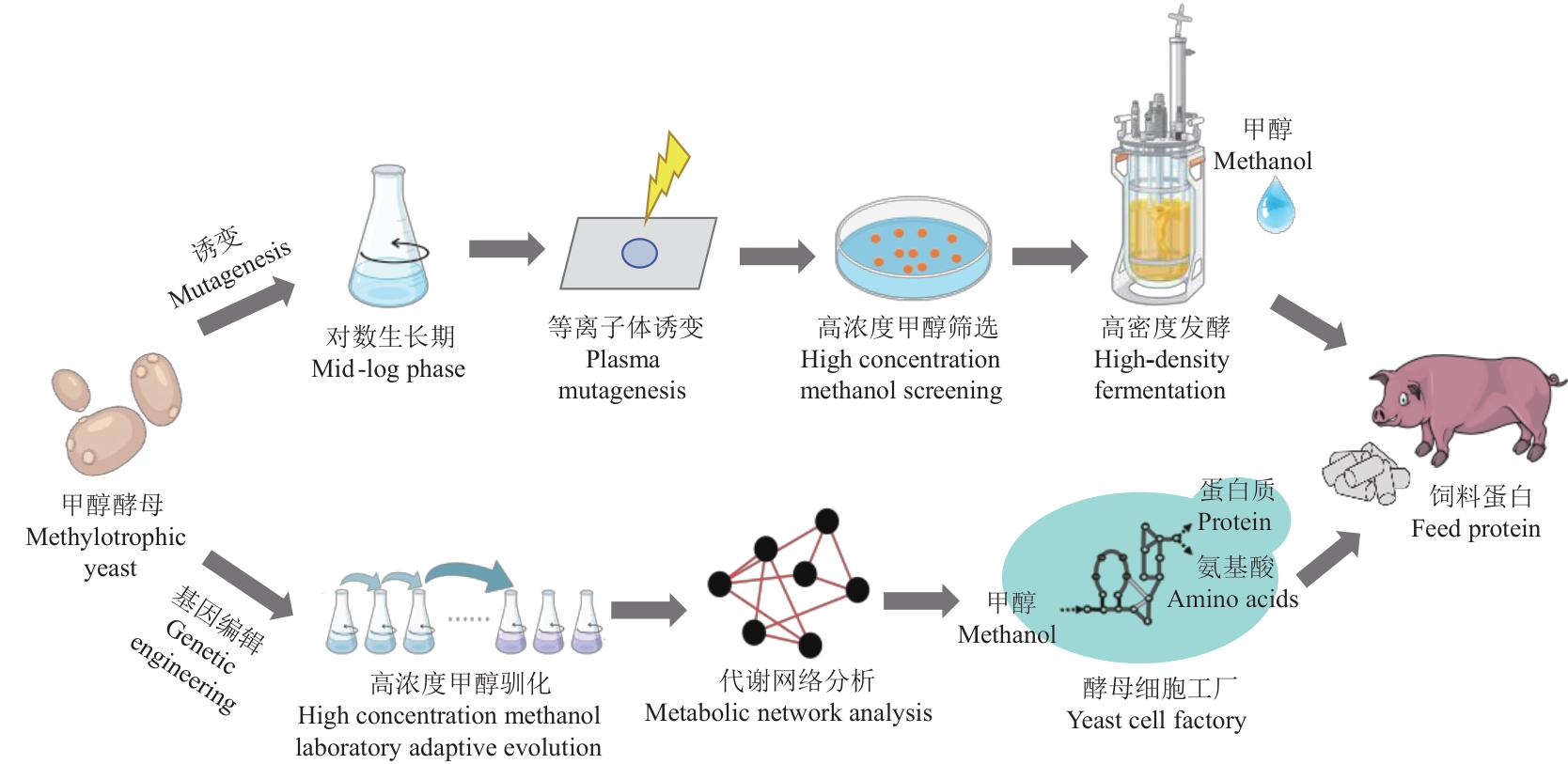
图1 甲醇酵母生产单细胞蛋白策略利用非传统酵母高效生物转化甲醇生产单细胞蛋白的两种策略,一种是传统诱变方法,通过对甲醇酵母细胞进行诱变处理,并在含有高浓度甲醇的平板上进行筛选,最终获得可以利用高浓度甲醇的突变菌株进行高密度发酵生产单细胞蛋白作为饲料蛋白添加剂;另一种方法是基因编辑策略,通过对甲醇酵母进行高浓度甲醇的实验室适应性驯化,并系统分析驯化菌株的代谢网络差异,挖掘可以提高甲醇利用的靶点基因并进行代谢工程改造,最终获得高效利用甲醇生产蛋白质的工程菌株用于生产单细胞蛋白
Fig. 1 Strategy of producing single-cell proteins by methylotrophic yeastThere are two strategies of bioconversion methanol to produce single-cell proteins by unconventional yeast species, one is traditional mutagenesis method, methylotrophic yeast was mutagenized and screened on high methanol concentration plate, and the mutated strains utilizing high concentration methanol are selected and performed industrial fermentation to produce single-cell proteins as feed protein additives. Another strategy is genetic editing, methylotrophic yeasts are proceeded through high-concentration methanol of laboratory adaptive evolution, the discrepancy of metabolic network are systematically analyzed in methanol-evolved strain, the potential methanol utilization genes target are explored, and modification of metabolic engineering is conducted, and finally the engineering strains efficiently utilizing methanol to produce proteins are used for producing single-cell proteins
菌株 Species | 改造方式 Modifying methods | 改造应用 Modifing application | 参考文献 References |
|---|---|---|---|
| S. pastorianus | UV诱变 | 减少乙醛生产 | [ |
| UV/EMS诱变 | 提高对高重力麦芽汁发酵 | [ | |
| EMS诱变 | 提高对热击耐受 | [ | |
| 干扰MET10、SKP2表达,过表达HOM3 | 提高SO2生产,减少H2S生产 | [ | |
| 过表达AGT1 | 提高麦芽糖利用 | [ | |
| S. cerevisiae | EMS诱变 | 提高对乙醇耐受 | [ |
| UV诱变 | 减少H2S生产,提高谷胱甘肽生产 | [ | |
| 过表达FLO1、FLO5、FLO11 | 增强絮凝 | [ | |
| 干扰PEP4表达 | 提高泡沫稳定性 | [ | |
| 表达异源基因 | 增加香草醛风味 | [ | |
| 表达异源基因 | 增加树莓酮风味 | [ | |
| K. phaffii | 表达异源基因 | 生产血红素类蛋白 | [ |
| 增加LegH拷贝数 | 生产大豆血红蛋白 | [ |
表2 不同改造方式丰富酵母单细胞蛋白功能
Table 2 Enriching the functions of yeast single-cell proteins by different modifing methods
菌株 Species | 改造方式 Modifying methods | 改造应用 Modifing application | 参考文献 References |
|---|---|---|---|
| S. pastorianus | UV诱变 | 减少乙醛生产 | [ |
| UV/EMS诱变 | 提高对高重力麦芽汁发酵 | [ | |
| EMS诱变 | 提高对热击耐受 | [ | |
| 干扰MET10、SKP2表达,过表达HOM3 | 提高SO2生产,减少H2S生产 | [ | |
| 过表达AGT1 | 提高麦芽糖利用 | [ | |
| S. cerevisiae | EMS诱变 | 提高对乙醇耐受 | [ |
| UV诱变 | 减少H2S生产,提高谷胱甘肽生产 | [ | |
| 过表达FLO1、FLO5、FLO11 | 增强絮凝 | [ | |
| 干扰PEP4表达 | 提高泡沫稳定性 | [ | |
| 表达异源基因 | 增加香草醛风味 | [ | |
| 表达异源基因 | 增加树莓酮风味 | [ | |
| K. phaffii | 表达异源基因 | 生产血红素类蛋白 | [ |
| 增加LegH拷贝数 | 生产大豆血红蛋白 | [ |

图2 酵母单细胞蛋白食品工业多功能应用
Fig. 2 Multi-functional application of yeast single-cell proteins in food industry
| [1] | Pereira AG, Fraga-Corral M, Garcia-Oliveira P, et al. Single-cell proteins obtained by circular economy intended as a feed ingredient in aquaculture [J]. Foods, 2022, 11(18): 2831. |
| [2] | Lapeña D, Kosa G, Hansen LD, et al. Production and characterization of yeasts grown on media composed of spruce-derived sugars and protein hydrolysates from chicken by-products [J]. Microb Cell Fact, 2020, 19(1): 19. |
| [3] | Meng J, Liu SF, Gao L, et al. Economical production of Pichia pastoris single cell protein from methanol at industrial pilot scale [J]. Microb Cell Fact, 2023, 22(1): 198. |
| [4] | Liu KY, Huang SY, Zhang L, et al. Efficient production of single cell protein from biogas slurry using screened alkali-salt-tolerant Debaryomyces hansenii [J]. Bioresour Technol, 2024, 393: 130119. |
| [5] | Bratosin BC, Darjan S, Vodnar DC. Single cell protein: a potential substitute in human and animal nutrition [J]. Sustainability, 2021, 13(16): 9284. |
| [6] | Zhao Y, Han ZW, Zhu XC, et al. Yeast proteins: proteomics, extraction, modification, functional characterization, and structure: a review [J]. J Agric Food Chem, 2024, 72(34): 18774-18793. |
| [7] | 黄庆生. 我国粮食安全战略下饲料粮保供策略思考 [J]. 中国饲料, 2023, 1(22): 15-25. |
| Huang QS. Thoughts on feed grain supply assurance strategies under China’s food security strategy [J]. China Feed, 2023, 1(22): 15-25. | |
| [8] | Lambo MT, Ma HK, Zhang HS, et al. Mechanism of action, benefits, and research gap in fermented soybean meal utilization as a high-quality protein source for livestock and poultry [J]. Anim Nutr, 2024, 16: 130-146. |
| [9] | 吴信, 张会会, 杨旭东, 等. 新型单细胞蛋白饲料资源开发利用进展 [J]. 饲料工业, 2024, 45 (20): 1-8. |
| Wu X, Zhang HH, Yang XD, et al. Progress in the development and utilization of new feed resources of single cell protein [J]. Feed Industry, 2024, 45 (20): 1-8. | |
| [10] | 张博, 杨晓伟, 康志勇,等. 饲用豆粕减量替代背景下杂粕型饲料蛋白资源开发应用研究进展 [J]. 中国饲料, 2025, (9): 146-160. |
| Zhang B, Yang XW, Kang ZY, et al. Research progress on development and application of miscellaneous meal feed protein resources under the background of soybean meal reduction substitution [J]. China Feed, 2025, (9): 146-160. | |
| [11] | Zhang QL, Liang HL, Longshaw M, et al. Effects of replacing fishmeal with methanotroph (Methylococcus capsulatus, Bath) bacteria meal (FeedKind®) on growth and intestinal health status of juvenile largemouth bass (Micropterus salmoides) [J]. Fish Shellfish Immunol, 2022, 122: 298-305. |
| [12] | Zhuang ZK, Wan GY, Lu XC, et al. Metabolic engineering for single-cell protein production from renewable feedstocks and its applications [J]. Adv Biotechnol, 2024, 2(4): 35. |
| [13] | Jach ME, Serefko A, Ziaja M, et al. Yeast protein as an easily accessible food source [J]. Metabolites, 2022, 12(1): 63. |
| [14] | Anderson A, Van der Mijnsbrugge A, Cameleyre X, et al. From yeast screening for suitability as single cell protein to fed-batch cultures [J]. Biotechnol Lett, 2024, 46(5): 827-842. |
| [15] | 侯文义, 李相前. 酵母蛋白新食品原料研究进展及应用展望 [J]. 工业微生物, 2024, 54 (4): 51-56. |
| Hou WY, Li XQ. Research progress and application prospects of yeast protein as a novel food ingredient [J]. Industrial Microbiology, 2024, 54 (4): 51-56. | |
| [16] | Aggelopoulos T, Katsieris K, Bekatorou A, et al. Solid state fermentation of food waste mixtures for single cell protein, aroma volatiles and fat production [J]. Food Chem, 2014, 145: 710-716. |
| [17] | Duarte LC, Carvalheiro F, Lopes S, et al. Yeast biomass production in brewery’s spent grains hemicellulosic hydrolyzate [J]. Appl Biochem Biotechnol, 2008, 148(1/2/3): 119-129. |
| [18] | Yadav JSS, Bezawada J, Ajila CM, et al. Mixed culture of Kluyveromyces marxianus and Candida krusei for single-cell protein production and organic load removal from whey [J]. Bioresour Technol, 2014, 164: 119-127. |
| [19] | Yang R, Chen Z, Hu P, et al. Two-stage fermentation enhanced single-cell protein production by Yarrowia lipolytica from food waste [J]. Bioresour Technol, 2022, 361: 127677. |
| [20] | Liu BN, Song JZ, Li Y, et al. Towards industrially feasible treatment of potato starch processing waste by mixed cultures [J]. Appl Biochem Biotechnol, 2013, 171(4): 1001-1010. |
| [21] | Gao L, Meng J, Dai WL, et al. Deciphering cell wall sensors enabling the construction of robust P. pastoris for single-cell protein production [J]. Biotechnol Biofuels Bioprod, 2023, 16(1): 178. |
| [22] | Johnson EA. Biotechnology of non-Saccharomyces yeasts—the ascomycetes [J]. Appl Microbiol Biotechnol, 2013, 97(2): 503-517. |
| [23] | 姜岷, 章文明, 马江锋,等. 一株利用甲醇制备高赖氨酸单细胞蛋白的多形汉逊酵母菌及其应用: CN105861343B [P]. 2019-05-07. |
| Jiang M, Zhang WM, Ma JF, et al. Application of Hansenula polymorpha yeast strain for preparing high lysine single-cell protein using methanol: CN105861343B [P]. 2019-05-07. | |
| [24] | Gorter de Vries AR, Pronk JT, Daran JG. Lager-brewing yeasts in the era of modern genetics [J]. FEMS Yeast Res, 2019, 19(7): foz063. |
| [25] | Stanley D, Fraser S, Chambers PJ, et al. Generation and characterisation of stable ethanol-tolerant mutants of Saccharomyces cerevisiae [J]. J Ind Microbiol Biotechnol, 2010, 37(2): 139-149. |
| [26] | Yu ZM, Zhao HF, Li HP, et al. Selection of Saccharomyces pastorianus variants with improved fermentation performance under very high gravity wort conditions [J]. Biotechnol Lett, 2012, 34(2): 365-370. |
| [27] | James TC, Usher J, Campbell S, et al. Lager yeasts possess dynamic genomes that undergo rearrangements and gene amplification in response to stress [J]. Curr Genet, 2008, 53(3): 139-152. |
| [28] | Shen N, Wang JJ, Liu CF, et al. Domesticating brewing yeast for decreasing acetaldehyde production and improving beer flavor stability [J]. Eur Food Res Technol, 2014, 238(3): 347-355. |
| [29] | Chen YF, Yang X, Zhang SJ, et al. Development of Saccharomyces cerevisiae producing higher levels of sulfur dioxide and glutathione to improve beer flavor stability [J]. Appl Biochem Biotechnol, 2012, 166(2): 402-413. |
| [30] | Liu XF, Wang ZY, Wang JJ, et al. Expression of GAI gene and disruption of PEP4 gene in an industrial brewer’s yeast strain [J]. Lett Appl Microbiol, 2009, 49(1): 117-123. |
| [31] | Brochado AR, Matos C, Møller BL, et al. Improved vanillin production in baker’s yeast through in silico design [J]. Microb Cell Fact, 2010, 9: 84. |
| [32] | Lee DN, Lloyd NDR, Pretorius IS, et al. Heterologous production of raspberry ketone in the wine yeast Saccharomyces cerevisiae via pathway engineering and synthetic enzyme fusion [J]. Microb Cell Fact, 2016, 15: 49. |
| [33] | Xue JK, Zhou JW, Li JH, et al. Systematic engineering of Saccharomyces cerevisiae for efficient synthesis of hemoglobins and myoglobins [J]. Bioresour Technol, 2023, 370: 128556. |
| [34] | Blieck L, Toye G, Dumortier F, et al. Isolation and characterization of brewer’s yeast variants with improved fermentation performance under high-gravity conditions [J]. Appl Environ Microbiol, 2007, 73(3): 815-824. |
| [35] | Huuskonen A, Markkula T, Vidgren V, et al. Selection from industrial lager yeast strains of variants with improved fermentation performance in very-high-gravity worts [J]. Appl Environ Microbiol, 2010, 76(5): 1563-1573. |
| [36] | Hansen J, Kielland-Brandt MC. Inactivation of MET10 in brewer’s yeast specifically increases SO2 formation during beer production [J]. Nat Biotechnol, 1996, 14(11): 1587-1591. |
| [37] | Yoshida S, Imoto J, Minato T, et al. Development of bottom-fermenting Saccharomyces strains that produce high SO2 levels, using integrated metabolome and transcriptome analysis [J]. Appl Environ Microbiol, 2008, 74(9): 2787-2796. |
| [38] | Vidgren V, Huuskonen A, Virtanen H, et al. Improved fermentation performance of a lager yeast after repair of its AGT1 maltose and maltotriose transporter genes [J]. Appl Environ Microbiol, 2009, 75(8): 2333-2345. |
| [39] | Voordeckers K, Kominek J, Das A, et al. Adaptation to high ethanol reveals complex evolutionary pathways [J]. PLoS Genet, 2015, 11(11): e1005635. |
| [40] | Govender P, Domingo JL, Bester MC, et al. Controlled expression of the dominant flocculation genes FLO1, FLO5 and FLO11 in Saccharomyces cerevisiae [J]. Appl Environ Microbiol, 2008, 74(19): 6041-6052. |
| [41] | Hansen EH, Møller BL, Kock GR, et al. De novo biosynthesis of vanillin in fission yeast (Schizosaccharomyces pombe) and baker’s yeast (Saccharomyces cerevisiae) [J]. Appl Environ Microbiol, 2009, 75(9): 2765-2774. |
| [42] | Beekwilder J, van der Meer IM, Sibbesen O, et al. Microbial production of natural raspberry ketone [J]. Biotechnol J, 2007, 2(10): 1270-1279. |
| [43] | Yu F, Zhao XR, Zhou JW, et al. Biosynthesis of high-active hemoproteins by the efficient heme-supply Pichia pastoris chassis [J]. Adv Sci, 2023, 10(30): e2302826. |
| [44] | Shao YR, Xue CL, Liu WQ, et al. High-level secretory production of leghemoglobin in Pichia pastoris through enhanced globin expression and heme biosynthesis [J]. Bioresour Technol, 2022, 363: 127884. |
| [45] | Flight MH, Tait J, Chronopoulos T, et al. Analysing responsible innovation along a value chain-a single-cell protein case study [J]. Eng Biol, 2024, 8(1): 16-29. |
| [46] | Hadi J, Brightwell G. Safety of alternative proteins: technological, environmental and regulatory aspects of cultured meat, plant-based meat, insect protein and single-cell protein [J]. Foods, 2021, 10(6): 1226. |
| [47] | 王宇灵, 覃瑞, 刘虹, 等. 单细胞蛋白应用于食品工业的现状和展望 [J]. 中国食物与营养, 2019, 25 (10): 29-32. |
| Wang YL, Qin R, Liu H, et al. Current status and prospects of single cell protein application in food industry [J]. Food and Nutrition in China, 2019, 25 (10): 29-32. | |
| [48] | Anupama, Ravindra P. Value-added food: single cell protein [J]. Biotechnol Adv, 2000, 18(6): 459-479. |
| [49] | Onyeaka H, Anumudu CK, Okpe C, et al. Single cell protein for foods and feeds: a review of trends [J]. Open Microbiol J, 2022, 16: e187428582206160. |
| [50] | Weber S, Grande PM, Blank LM, et al. Insights into cell wall disintegration of Chlorella vulgaris [J]. PLoS One, 2022, 17(1): e0262500. |
| [1] | 顾蕾, 张誉露, 唐尚睿, 于浩月, 李辰. 基于质谱的单细胞蛋白质组学技术的发展及应用[J]. 生物技术通报, 2024, 40(11): 125-141. |
| [2] | 李林辉;徐春;. 固态发酵技术在提升工农业副产品价值中的应用[J]. , 2006, 0(05): 72-75. |
| [3] | 蒋勤. 《农业与环境生物技术文摘》[J]. , 2000, 0(06): 52-52. |
| [4] | . 食品上的应用[J]. , 1995, 0(01): 95-102. |
| [5] | . 食品上的应用[J]. , 1992, 0(10): 84-87. |
| [6] | . 食品上的应用[J]. , 1992, 0(09): 76-81. |
| [7] | . 食品上的应用[J]. , 1992, 0(04): 85-90. |
| [8] | . 食品上的应用[J]. , 1992, 0(03): 85-88. |
| [9] | . 食品上的应用[J]. , 1992, 0(02): 85-92. |
| [10] | . 食品上的应用[J]. , 1992, 0(01): 77-84. |
| [11] | . 食品上的应用[J]. , 1991, 0(11): 95-101. |
| [12] | . 食品上的应用[J]. , 1991, 0(10): 97-102. |
| [13] | . 食品上的应用[J]. , 1991, 0(09): 103-107. |
| [14] | . 食品上的应用[J]. , 1991, 0(08): 100-106. |
| [15] | . 食品上的应用[J]. , 1991, 0(07): 101-105. |
| 阅读次数 | ||||||
|
全文 |
|
|||||
|
摘要 |
|
|||||
