







生物技术通报 ›› 2026, Vol. 42 ›› Issue (7): 246-256.doi: 10.13560/j.cnki.biotech.bull.1985.2025-1065
• 研究报告 • 上一篇
曹婉笛, 鲍薇, 孙天国, 梁舒婷, 秦旭洋, 张梅娟, 沙伟, 彭疑芳, 马天意( )
)
收稿日期:2025-10-08
出版日期:2026-07-26
发布日期:2026-07-20
通讯作者:
马天意tyma@qqhru.edu.cn基金资助:
CAO Wan-di, BAO Wei, SUN Tian-guo, LIANG Shu-ting, QIN Xu-yang, ZHANG Mei-juan, SHA Wei, PENG Yi-fang, MA Tian-yi()
Received:2025-10-08
Published:2026-07-26
Online:2026-07-20
摘要:
目的 探究砂藓(Racomitrium canescens)中早期光诱导蛋白(early light-induced proteins, ELIPs)基因RcELIP1在植物抗旱、抗高温胁迫中的功能并探究其抗逆机制。 方法 利用实时荧光定量PCR检测RcELIP1在砂藓脱水、复水及45 ℃高温处理中的表达变化,通过生物信息学方法预测其编码蛋白质特性,克隆RcELIP1的编码序列构建过表达载体并将其转化到拟南芥(Arabidopsis thaliana)中,获取RcELIP1过表达转基因拟南芥株系,对比转基因株系与野生型拟南芥在干旱、高温胁迫下的表型差异,并测定胁迫下各项生理生化指标。 结果 实时荧光定量PCR结果证实RcELIP1在砂藓脱水、高温胁迫中显著差异表达。RcELIP1含216个氨基酸残基,预测具有叶绿素a/b结合域,为亲水性不稳定跨膜蛋白,定位于叶绿体。RcELIP1过表达转基因拟南芥在干旱、高温下存活率显著高于野生型植株,转基因株系能维持更高的叶绿素和脯氨酸含量及抗氧化酶活性,以及较低的丙二醛水平。 结论 过量表达的RcELIP1可能通过保护叶绿体功能、增强渗透调节以及抗氧化能力,提高植物对干旱和高温胁迫的适应能力。
曹婉笛, 鲍薇, 孙天国, 梁舒婷, 秦旭洋, 张梅娟, 沙伟, 彭疑芳, 马天意. 过表达砂藓RcELIP1提高转基因拟南芥耐旱性及耐高温性[J]. 生物技术通报, 2026, 42(7): 246-256.
CAO Wan-di, BAO Wei, SUN Tian-guo, LIANG Shu-ting, QIN Xu-yang, ZHANG Mei-juan, SHA Wei, PENG Yi-fang, MA Tian-yi. Overexpression of RcELIP1 from Racomitrium canescens Enhances the Tolerance to Drought and High Temperature in Transgenic Arabidopsisthaliana[J]. Biotechnology Bulletin, 2026, 42(7): 246-256.
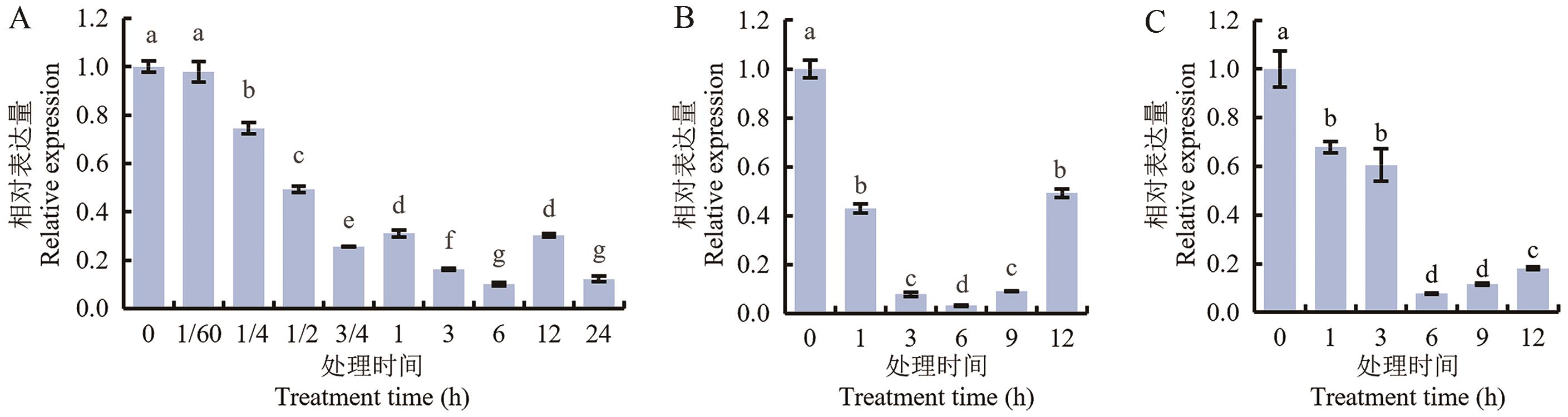
图1 RcELIP1在砂藓复水、脱水及高温处理过程中的表达变化分析A:干燥砂藓复水处理;B:脱水处理;C:45 ℃高温胁迫处理。误差线表示标准偏差,不同字母表示差异显著(P<0.05),下同
Fig. 1 Analysis of RcELIP1 expression changes in Racomitrium canescens during rehydration, dehydration, and high-temperature treatmentsA: Desiccated R. canescens under rehydration treatments. B: Dehydration treatments. C: 45 ℃ high-temperature treatments. The error bars indicate the standard deviation, the different letters indicate that the difference is significant (P<0.05), the same below
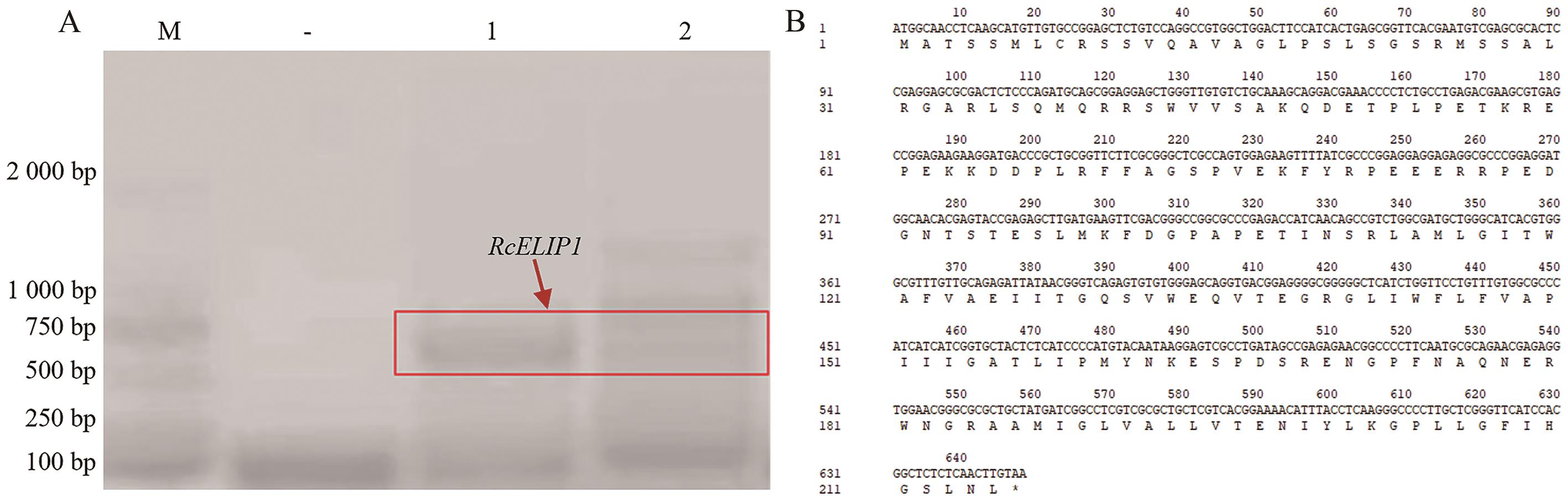
图2 RcELIP1编码序列的克隆及序列信息A:RcELIP1编码序列的PCR扩增结果(M:DL 2000 DNA marker;-:水对照;1,2:RcELIP1编码序列);B:RcELIP1的核苷酸序列与编码的氨基酸序列
Fig. 2 Cloning of the coding sequence and the sequence information of RcELIP1A: PCR amplification results of RcELIP1 coding sequence (M: DL 2000 DNA marker; -: water control; 1,2: RcELIP1 coding sequence). B: The nucleotide sequence and the encoded amino acid sequence of RcELIP1
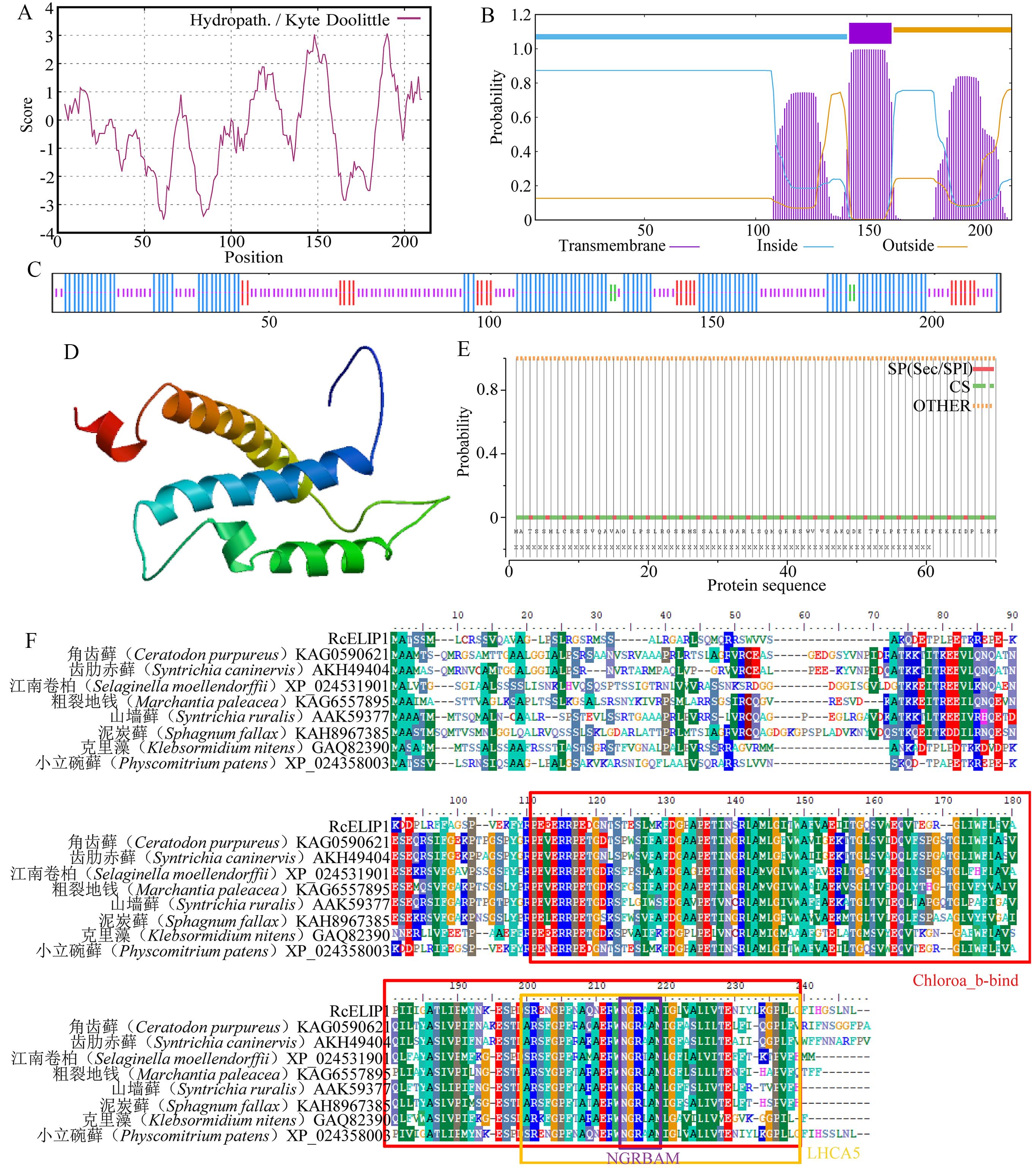
图3 RcELIP1的生物信息学预测分析A. 亲/疏水性预测;B. 跨膜结构预测;C. 蛋白质二级结构预测,蓝色:α螺旋,绿色:β折叠,红色:无规则卷曲,紫色:延伸链;D. 蛋白质三级结构预测;E. 信号肽预测;F. RcELIP1与同源蛋白质的序列比对
Fig. 3 Bioinformatics prediction analysis of RcELIP1A. Prediction of hydrophilicity and hydrophobicity. B. Transmembrane structure prediction. C. Protein secondary structure prediction; blue: alpha helix, green: beta turn, red: random coil, purple: extended strand. D. Protein tertiary structure prediction. E. Signal peptide prediction. F. Sequence alignment of RcELIP1 and homologous proteins
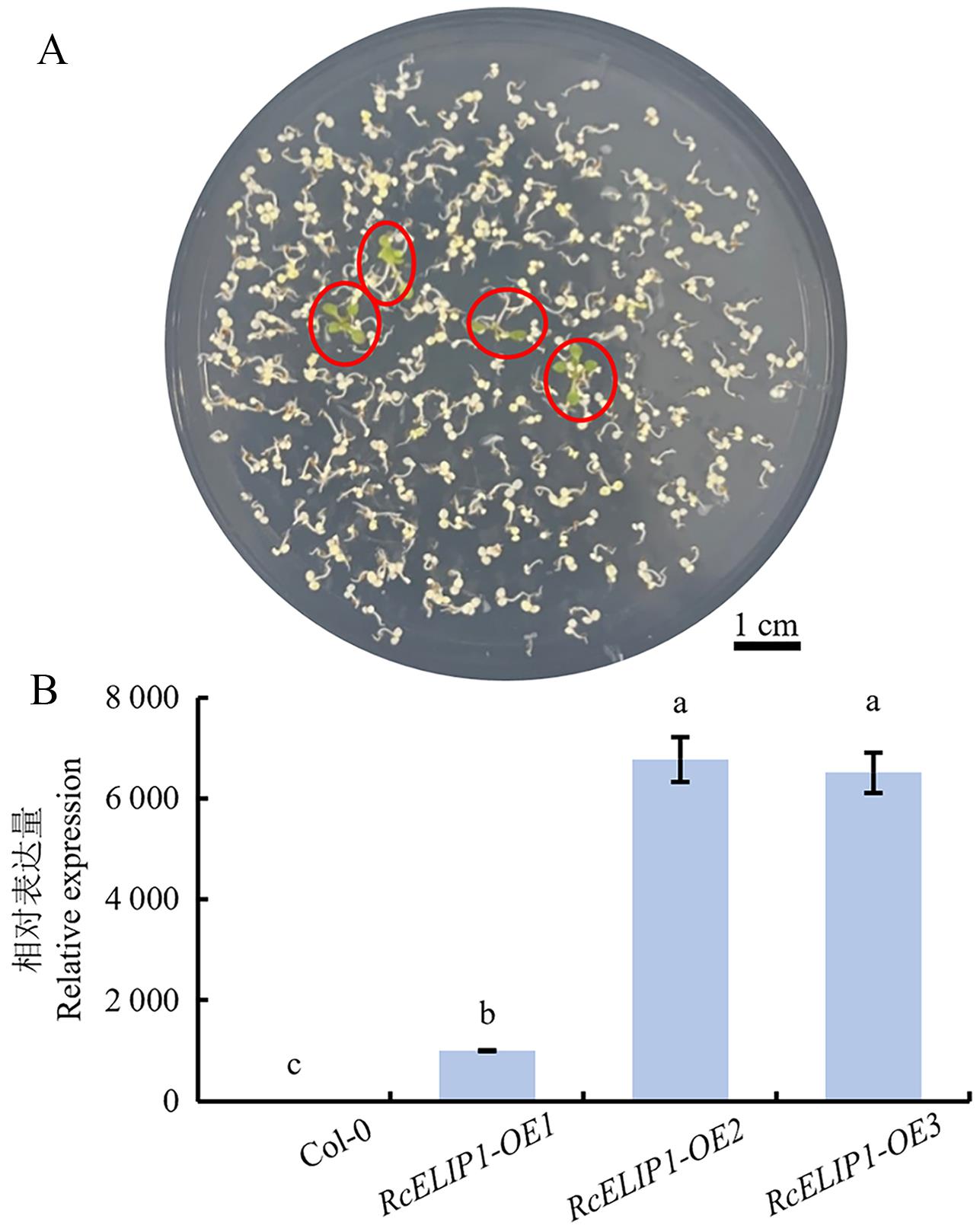
图4 RcELIP1过表达转基因拟南芥植株的筛选及鉴定A:T1代RcELIP1过表达转基因拟南芥植株的抗生素筛选,红圈内为成功筛选出的T1代植株;B:RcELIP1过表达转基因拟南芥T2代植株中RcELIP1的表达量分析
Fig. 4 Screening and identification of transgenic RcELIP1-overexpressed transgenic A.thaliana plantsA: Antibiotic screening of RcELIP1 overexpressed transgenic Arabidopsis thaliana plants, the red circles indicate the successfully screened RcELIP1 T1 generation plants; B: Expression analysis of RcELIP1 in T2 generation RcELIP1-overexpressedtransgenic A. thaliana plants
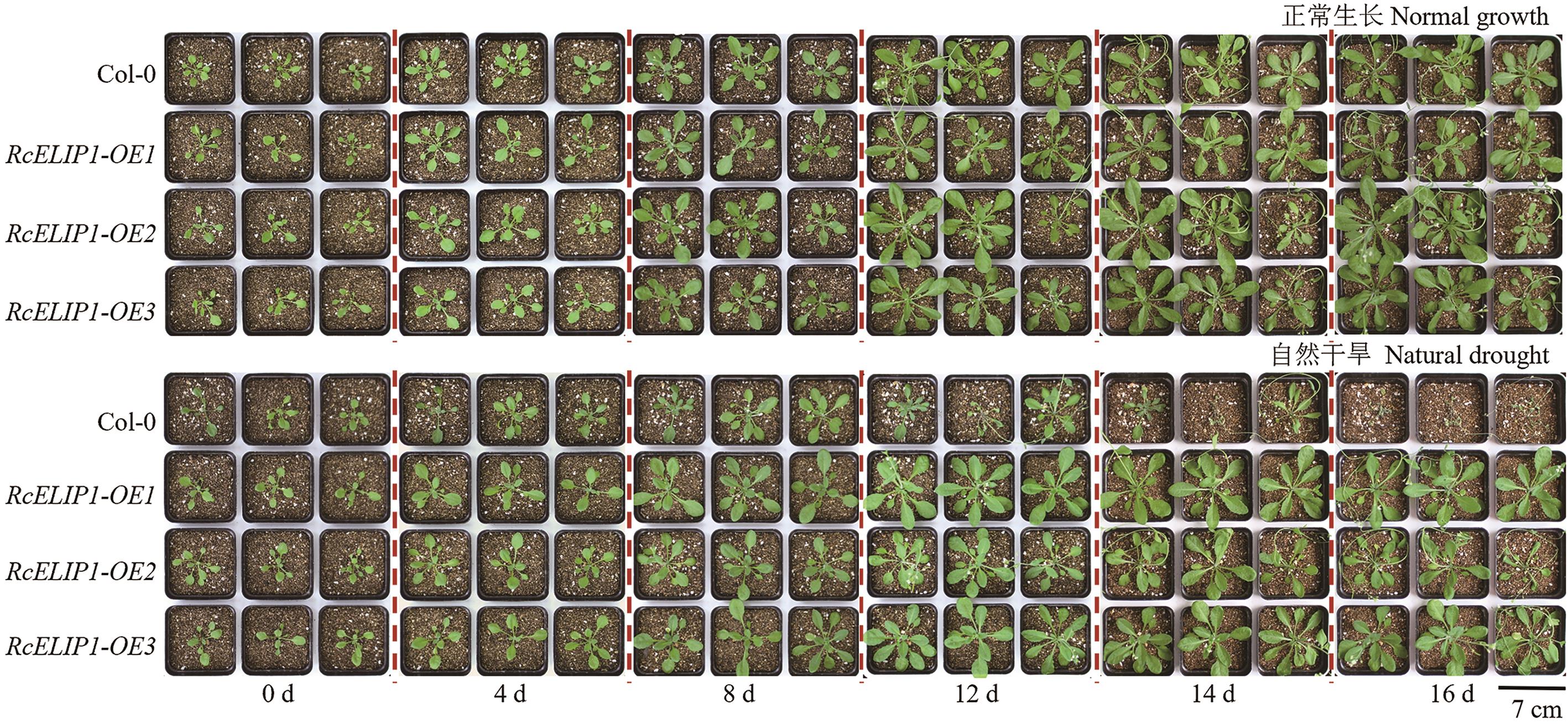
图5 干旱胁迫下RcELIP1过表达转基因拟南芥植株的表型
Fig. 5 Phenotypes performance of RcELIP1-overexpressed transgenic A.thaliana plants under drought stress
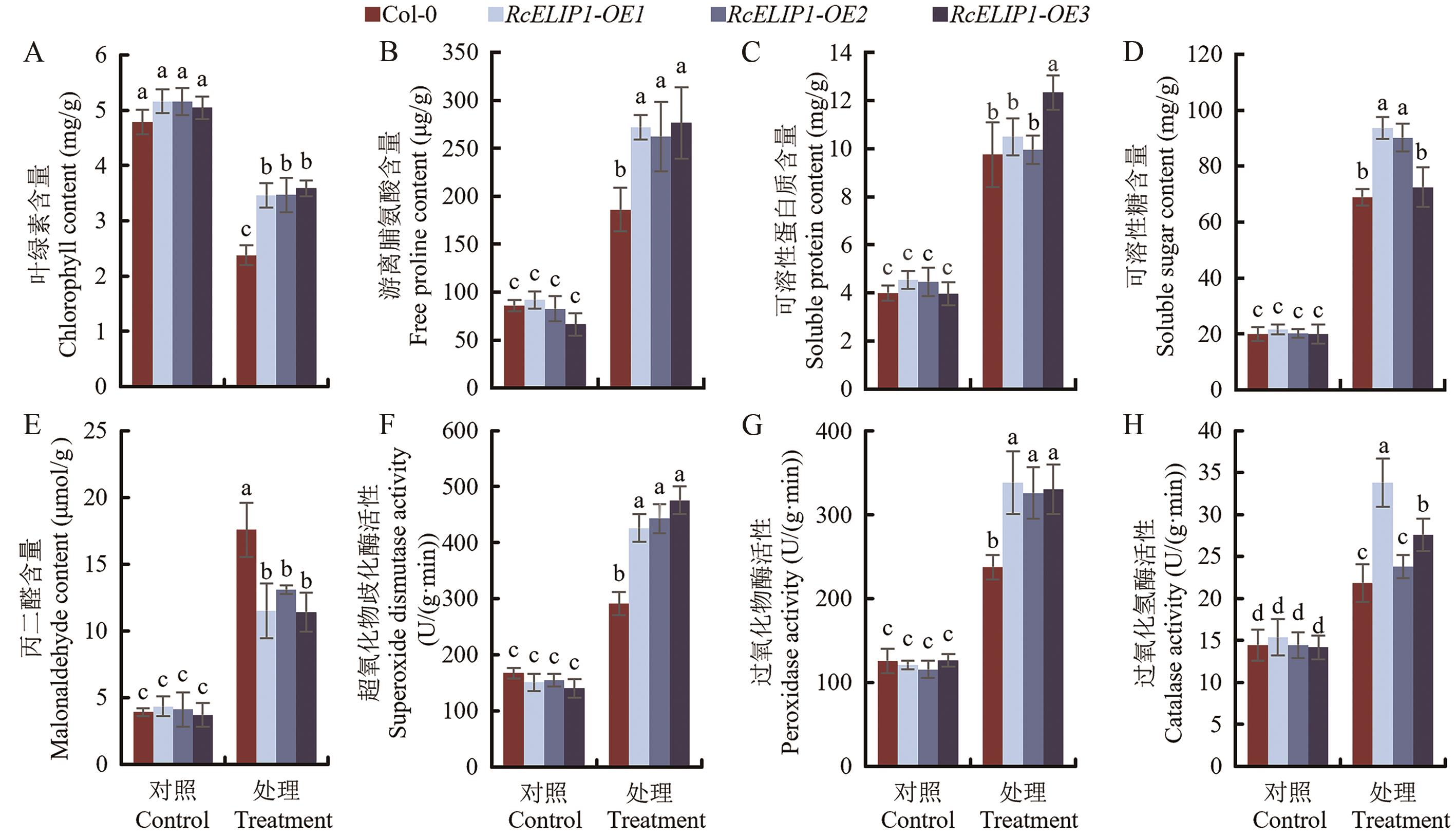
图6 干旱胁迫下野生型及RcELIP1过表达转基因拟南芥植株生理生化指标的变化
Fig. 6 Changes in physiological and biochemical indexes of wild-type and RcELIP1-overexpressed transgenic A. thaliana under drought stress
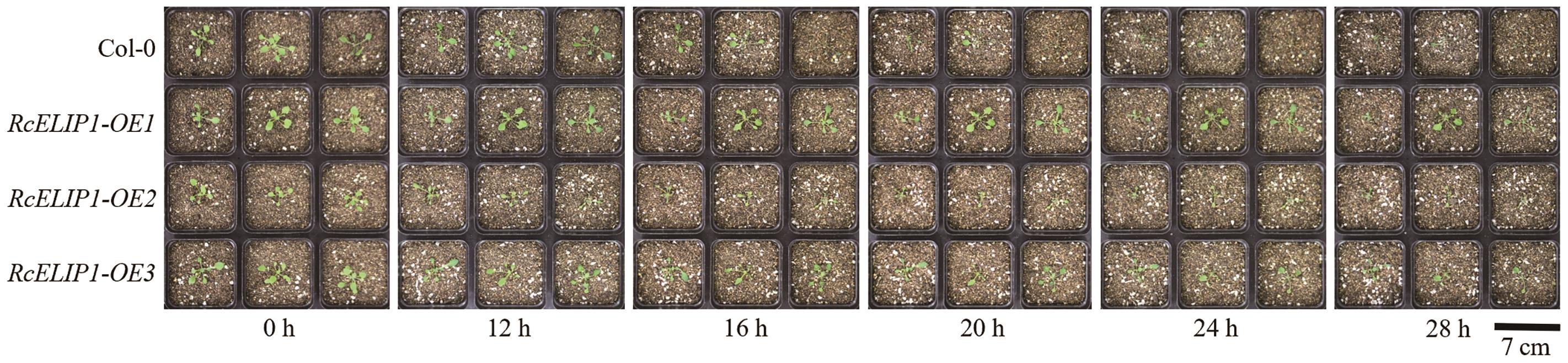
图7 45 ℃高温处理下RcELIP1过表达转基因拟南芥的表型
Fig. 7 Phenotypes of RcELIP1-overexpressed transgenic A. thaliana under 45 ℃ high-temperature treatments
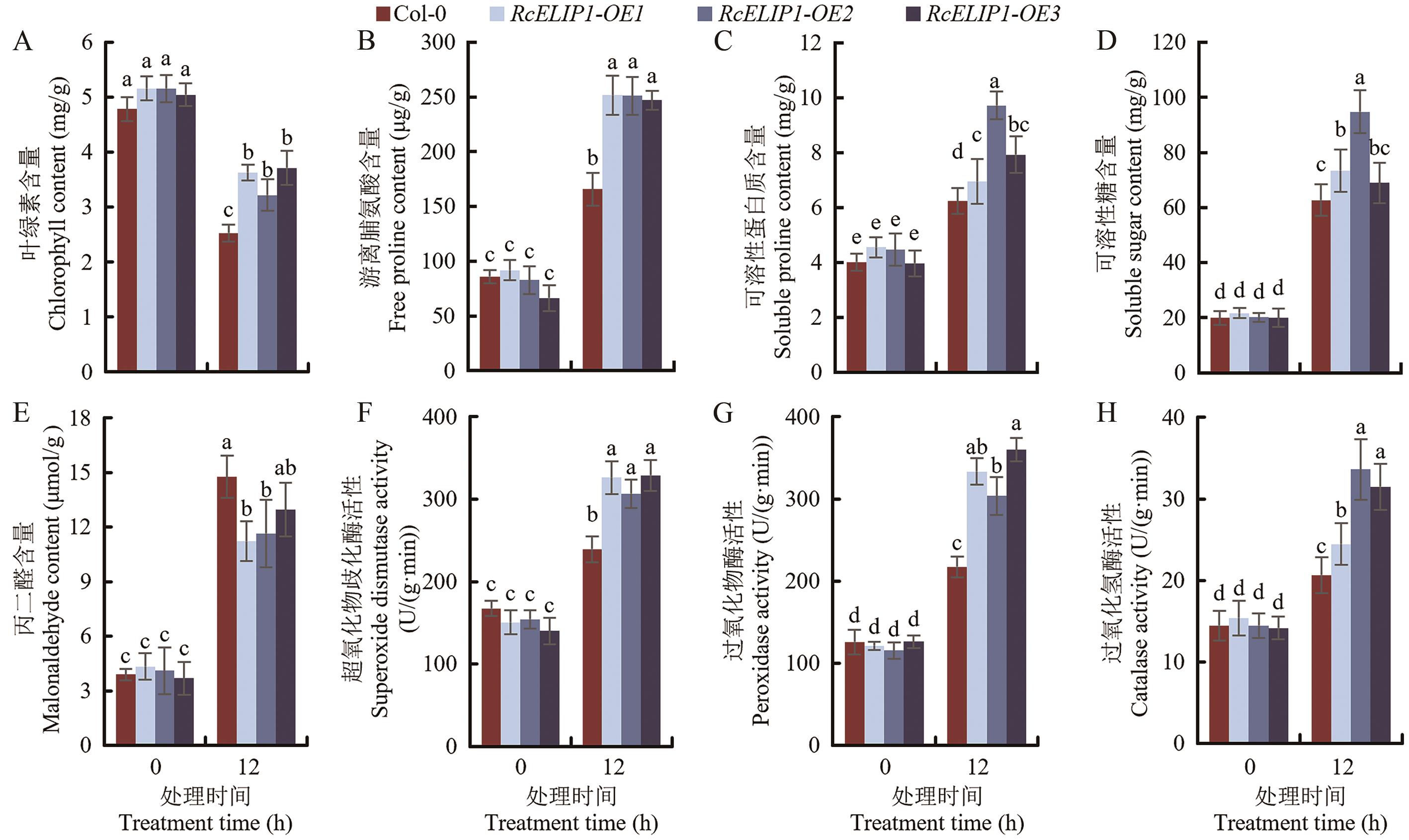
图8 45 ℃高温处理下野生型及RcELIP1过表达转基因拟南芥生理生化指标的变化
Fig. 8 Changes in physiological and biochemical indexes of wild-type and RcELIP1-overexpressed transgenic A. thaliana under 45 ℃ high-temperature treatments
| [1] | 刘丹. 植物对环境胁迫的生理响应研究进展 [J]. 农家参谋, 2020(20): 97. |
| Liu D. Research progress on physiological response of plants to environmental stress [J]. Farmers Consult, 2020(20): 97. | |
| [2] | Arora NK. Impact of climate change on agriculture production and its sustainable solutions [J]. Environ Sustain, 2019, 2(2): 95-96. |
| [3] | 史勇, 郑兰杰, 王晨, 等. 植物耐高温机制的研究进展 [J]. 河南农业大学学报, 2023, 57(5): 713-725. |
| Shi Y, Zheng LJ, Wang C, et al. Research progress on mechanisms of high temperature tolerance in plants [J]. J Henan Agric Univ, 2023, 57(5): 713-725. | |
| [4] | 齐学礼, 赵明忠, 尹文生, 等. 小麦耐高温特性的生理机制与基因挖掘研究进展 [J]. 南方农业学报, 2022, 53(10): 2885-2893. |
| Qi XL, Zhao MZ, Yin WS, et al. Physiological mechanism and gene discovery for high temperature tolerance of wheat: a review [J]. J South Agric, 2022, 53(10): 2885-2893. | |
| [5] | 刘琴, 孙辉, 何道文. 干旱和高温对植物胁迫效应的研究进展 [J]. 西华师范大学学报: 自然科学版, 2005, 26(4): 364-368. |
| Liu Q, Sun H, He DW. Plant responses to the high temperature and moisture stress [J]. J China West Norm Univ Nat Sci, 2005, 26(4): 364-368. | |
| [6] | 吴玉环, 黄国宏, 高谦, 等. 苔藓植物对环境变化的响应及适应性研究进展 [J]. 应用生态学报, 2001, 12(6): 943-946. |
| Wu YH, Huang GH, Gao Q, et al. Research advance in response and adaptation of bryophytes to environmental change [J]. Chin J Appl Ecol, 2001, 12(6): 943-946. | |
| [7] | 沙伟, 王欢, 师帅. 旱后复水对东亚砂藓生理生化指标的影响 [J]. 武汉植物学研究, 2010(2): 246-249. |
| Sha W, Wang H, Shi S. Effects of rewatering on the physio-biochemical indexes of Racomitrium japonicum in long-time drought [J]. J Wuhan Bot Res, 2010(2): 246-249. | |
| [8] | 王晶晶, 白玉, 蔡璨, 等. 砂藓属植物抗逆特性及相关功能基因研究进展 [J]. 高师理科学刊, 2024, 44(5): 87-92. |
| Wang JJ, Bai Y, Cai C, et al. Advances in studies on stress resistance characteristics and the related functional genes of Racomitrium plants [J]. J Sci Teach Univ, 2024, 44(5): 87-92. | |
| [9] | 沙伟, 王鑫, 张梅娟, 等. 砂藓抗高温相关基因RcDAPDC的克隆及表达分析 [J]. 分子植物育种, 2020, 18(24): 8092-8098. |
| Sha W, Wang X, Zhang MJ, et al. Cloning and expression analysis of high-temperature resistance related gene RcDAPDC in Racomitrium canescens [J]. Mol Plant Breed, 2020, 18(24): 8092-8098. | |
| [10] | 周雅, 张道远. 植物早期光诱导蛋白的结构、功能及表达模式研究进展 [J]. 基因组学与应用生物学, 2015, 34(6): 1339-1346. |
| Zhou Y, Zhang DY. The research progress of early light induced protein in plant [J]. Genom Appl Biol, 2015, 34(6): 1339-1346. | |
| [11] | Pinto F, Berti M, Olivares D, et al. Leaf development, temperature and light stress control of the expression of early light-inducible proteins (ELIPs) in Vitis vinifera L. [J]. Environ Exp Bot, 2011, 72(2): 278-283. |
| [12] | Heddad M, Adamska I. Light stress-regulated two-helix proteins in Arabidopsis thaliana related to the chlorophyll a/b-binding gene family [J]. Proc Natl Acad Sci U S A, 2000, 97(7): 3741-3746. |
| [13] | Berti M, Pinto M. Expression of early light induced protein in grapevine and pea, under different conditions and its relation with photoinhibition [J]. Chilean J Agric Res, 2012, 72(3): 371-378. |
| [14] | Shimosaka E, Sasanuma T, Handa H. A wheat cold-regulated cDNA encoding an early light-inducible protein (ELIP): its structure, expression and chromosomal location [J]. Plant Cell Physiol, 1999, 40(3): 319-325. |
| [15] | Peng YF, Ma TY, Wang X, et al. Proteomic and transcriptomic responses of the desiccation-tolerant moss Racomitrium canescens in the rapid rehydration processes [J]. Genes, 2023, 14(2): 390. |
| [16] | 鲍薇, 王晶晶, 沙伟, 等. 砂藓SMPD基因的克隆及对干旱和高温胁迫响应分析 [J]. 广西植物, 2025, 45(8): 1530-1542. |
| Bao W, Wang JJ, Sha W, et al. Cloning of SMPD in Racomitrium canescens and analysis of its responses to drought and high-temperature stresses [J]. Guihaia, 2025, 45(8): 1530-1542. | |
| [17] | 马天意, 许家佳, 路文婧, 等. ‘金小童’大白菜BrcGASA3基因在盐碱胁迫下的表达分析及抗性鉴定 [J]. 生物技术通报, 2025, 41(2): 127-138. |
| Ma TY, Xu JJ, Lu WJ, et al. Expression analysis and resistance identification of BrcGASA3 in Chinese cabbage ‘Jinxiaotong’ Cultivar under saline-alkali stress [J]. Biotechnol Bull, 2025, 41(2): 127-138. | |
| [18] | 刘博. 毛尖紫萼藓抗旱相关基因的克隆与功能分析 [D]. 齐齐哈尔: 齐齐哈尔大学, 2015. |
| Liu B. Cloning and function analysis of three articles of drought resistance related genes from Grimmia pilifera [D]. Qiqihar: Qiqihar University, 2015. | |
| [19] | 信雨萌, 沙伟, 张梅娟, 等. 砂藓抗旱相关转录因子基因RcbZIP1的克隆与表达分析 [J]. 基因组学与应用生物学, 2018, 37(7): 2949-2957. |
| Xin YM, Sha W, Zhang MJ, et al. Cloning and expression analysis of drought-resistant related transcription factor gene RcbZIP1 from Racomitrium canescens [J]. Genom Appl Biol, 2018, 37(7): 2949-2957. | |
| [20] | 马天意, 张时通, 朱巍巍, 等. 砂藓RcPLD基因的抗旱功能分析 [J]. 西北植物学报, 2021, 41(7): 1091-1100. |
| Ma TY, Zhang ST, Zhu WW, et al. Analysis of drought-resistance function of RcPLD gene from Racomitrium canescens [J]. Acta Bot Boreali Occidentalia Sin, 2021, 41(7): 1091-1100. | |
| [21] | 杨帆, 苗灵凤, 胥晓, 等. 植物对干旱胁迫的响应研究进展 [J]. 应用与环境生物学报, 2007, 13(4): 586-591. |
| Yang F, Miao LF, Xu X, et al. Progress in research of plant responses to drought stress [J]. Chin J Appl Environ Biol, 2007, 13(4): 586-591. | |
| [22] | Zhuo CL, Cai JL, Guo ZF. Overexpression of early light-induced protein (ELIP) gene from Medicago sativa ssp. falcata increases tolerance to abiotic stresses [J]. Agron J, 2013, 105(5): 1433-1440. |
| [23] | 刘秀瑾, 闫振, 张道远. 齿肋赤藓早期光诱导蛋白基因ScELIPs响应非生物胁迫的功能鉴定 [J]. 植物生理学报, 2021, 57(8): 1679-1689. |
| Liu XJ, Yan Z, Zhang DY. Functional analysis of Syntrichia caninervis early light-induced protein genes ScELIPs in response to abiotic stresses [J]. Plant Physiol Commun, 2021, 57(8): 1679-1689. | |
| [24] | Hutin C, Nussaume L, Moise N, et al. Early light-induced proteins protect Arabidopsis from photooxidative stress [J]. Proc Natl Acad Sci U S A, 2003, 100(8): 4921-4926. |
| [25] | Kufryk G, Kieselbach T, Vermaas W, et al. ELIP/CAB-type proteins associated with photosystem Ⅱ during normal growth of Cyanobacterium synechocystis sp. PCC 6803 [M]//Photosynthesis. Energy from the Sun. DordrechtSpringer Netherlands 2008: 723-727. |
| [26] | Casazza AP, Rossini S, Rosso MG, et al. Mutational and expression analysis of ELIP1 and ELIP2 in Arabidopsis thaliana [J]. Plant Mol Biol, 2005, 58(1): 41-51. |
| [27] | Adamska I, Kruse E, Kloppstech K. Stable insertion of the early light-induced proteins into etioplast membranes requires chlorophyll a [J]. J Biol Chem, 2001, 276(11): 8582-8587. |
| [28] | Niu QQ, Zhao LY, Dang YX, et al. Bryophyte ELIPs as evolutionary guardians: engineering chloroplast resilience and ABA-enhanced drought tolerance in crops [J]. Plant Cell Environ, 2025, 48(11): 7948-7960. |
| [29] | Noman M, Jameel A, Qiang WD, et al. Overexpression of GmCAMTA12 enhanced drought tolerance in Arabidopsis and soybean [J]. Int J Mol Sci, 2019, 20(19): 4849. |
| [30] | Liu WP, Zhao BG, Chao Q, et al. The maize AP2/EREBP transcription factor ZmEREB160 enhances drought tolerance in Arabidopsis [J]. Trop Plant Biol, 2020, 13(3): 251-261. |
| [31] | Hachiya T, Inaba J, Wakazaki M, et al. Excessive ammonium assimilation by plastidic glutamine synthetase causes ammonium toxicity in Arabidopsis thaliana [J]. Nat Commun, 2021, 12: 4944. |
| [32] | Tao L, Zeba N, Ashrafuzzaman M, et al. Heavy metal stress-inducible early light-inducible gene CaELIP from hot pepper (Capsicum annuum) shows broad expression patterns under various abiotic stresses and circadian rhythmicity [J]. Environ Exp Bot, 2011, 72(2): 297-303. |
| [33] | 李玉红, 林荣呈. 叶绿素合成调控研究进展 [J]. 生命科学, 2024, 36(9): 1141-1148. |
| Li YH, Lin RC. Advances in the regulation mechanism of chlorophyll synthesis [J]. Chin Bull Life Sci, 2024, 36(9): 1141-1148. | |
| [34] | 钟思彤, 张亚真, 孔祥瑞, 等. 高等植物捕光叶绿素a/b结合蛋白的研究进展 [J]. 农业生物技术学报, 2024, 32(2): 444-457. |
| Zhong ST, Zhang YZ, Kong XR, et al. Advances of light-harvesting chlorophyll a/b binding protein (CAB) in higher plants [J]. J Agric Biotechnol, 2024, 32(2): 444-457. | |
| [35] | 王娟, 李德全. 逆境条件下植物体内渗透调节物质的积累与活性氧代谢 [J]. 植物学通报, 2001, 18(4): 459-465. |
| Wang J, Li DQ. The accumulation of plant osmoticum and activated oxygen metabolism under stress [J]. Chin Bull Bot, 2001, 18(4): 459-465. | |
| [36] | Chen Z, An YY, Wang LJ. ALA reverses ABA-induced stomatal closure by modulating PP2AC and SnRK2.6 activity in apple leaves [J]. Hortic Res, 2023, 10(6): uhad067. |
| [37] | 赵天宏, 孙加伟, 付宇. 逆境胁迫下植物活性氧代谢及外源调控机理的研究进展 [J]. 作物杂志, 2008(3): 10-13. |
| Zhao TH, Sun JW, Fu Y. Advances of research on metabolism of plant reactive oxygen species and exogenous regulation under abiotic stresses [J]. Crops, 2008(3): 10-13. | |
| [38] | 周丽, 粱新乐, 励建荣. 类胡萝卜素抗氧化作用研究进展 [J]. 食品研究与开发, 2003, 24(2): 21-23. |
| Zhou L, Liang XL, Li JR. Research progress on antioxidant effect of carotenoids [J]. Food Res Dev, 2003, 24(2): 21-23. | |
| [39] | Sun TH, Zhou F, Huang XQ, et al. ORANGE represses chloroplast biogenesis in etiolated Arabidopsis cotyledons via interaction with TCP14 [J]. Plant Cell, 2019, 31(12): 2996-3014. |
| [1] | 郭苗, 许家佳, 孙天国, 蔡璨, 曹婉笛, 包纪星, 沙伟, 张梅娟, 彭疑芳, 马天意. 过表达砂藓RcOLEO1基因增强拟南芥的耐旱性及耐高温性[J]. 生物技术通报, 2026, 42(5): 312-322. |
| [2] | 刘奎, 李兴芬, 杨沛欣, 仲昭晨, 曹一博, 张凌云. 青杄转录共激活因子PwMBF1c的功能研究与验证[J]. 生物技术通报, 2023, 39(5): 205-216. |
| [3] | 杨茂, 林宇丰, 戴阳朔, 潘素君, 彭伟业, 严明雄, 李魏, 王冰, 戴良英. OsDIS1通过抗氧化途径负调控水稻耐旱性[J]. 生物技术通报, 2023, 39(2): 88-95. |
| [4] | 陈宏艳, 李小二, 李忠光. 糖信号及其在植物响应逆境胁迫中的作用[J]. 生物技术通报, 2022, 38(7): 80-89. |
| [5] | 周志豪, 王月, 闵雄, 李忠光. 硫化氢信号与其它信号交互作用调控植物的耐旱性[J]. 生物技术通报, 2017, 33(6): 1-9. |
| [6] | 苏艳, 张亦弛, 胡德活, 郑会全. 杉木无性系耐旱分析及SRAP种质鉴别[J]. 生物技术通报, 2016, 32(10): 212-218. |
| [7] | 郭利娜, 张锐, 孙国清, 孟志刚, 周焘, 郭三堆. cyFBPase基因过表达提高转基因烟草的抗旱性[J]. 生物技术通报, 2013, 29(11): 63-68. |
| [8] | 金人一;. 普杜大学从原生质体再生水稻[J]. , 1989, 0(10): 14-15. |
| 阅读次数 | ||||||
|
全文 |
|
|||||
|
摘要 |
|
|||||
