







生物技术通报 ›› 2026, Vol. 42 ›› Issue (7): 97-104.doi: 10.13560/j.cnki.biotech.bull.1985.2025-1162
周韬, 李亚强, 何慧娟, 虎海防, 陈同森, 潘越( ), 王天斌()
收稿日期:2025-10-30
出版日期:2026-07-26
发布日期:2026-07-20
通讯作者:
潘越18690187637@163.com基金资助:
ZHOU Tao, LI Ya-qiang, HE Hui-juan, HU Hai-fang, CHEN Tong-seng, PAN Yue(), WANG Tian-bin()
Received:2025-10-30
Published:2026-07-26
Online:2026-07-20
摘要:
目的 建立高效的文冠果毛状根遗传转化体系,为文冠果基因功能验证和通过分子育种技术定向培育稳产高产优良品种提供技术支持与研究基础。 方法 以4种优异文冠果种质萌发幼苗的下胚轴和5种发根农杆菌为材料,采用切-浸-芽法诱导转基因毛状根至2 cm以上,通过表型观察、PCR及测序技术来评估本技术体系基因的表达和编辑效率。 结果 以RUBY基因作为报告基因,筛选出最适发根农杆菌菌株为K599,其转基因毛状根的植株诱导率达81.67%,阳性率达51.64%以上,并通过PCR扩增和RT-qPCR分析,检测RUBY基因成功整合到文冠果毛状根基因组中。以GUS-GFP基因作为报告基因,转基因毛状根经GUS染色变蓝并在显微镜下观测到明显的绿色荧光,进一步证实本技术体系可用于基因的表达和功能定位研究。此外,构建XsPDS3基因的CRISPR/Cas9基因编辑载体,经测序检测其靶点编辑效率为20%,证明了该系统在基因编辑方面的潜力。 结论 建立了简单高效的文冠果毛状根遗传转化体系,为文冠果的基因功能验证提供了关键技术平台,并有望通过根再生建立文冠果遗传转化体系用于遗传改良。
周韬, 李亚强, 何慧娟, 虎海防, 陈同森, 潘越, 王天斌. 发根农杆菌介导文冠果(Xanthoceras sorbifolium)毛状根遗传转化体系的建立[J]. 生物技术通报, 2026, 42(7): 97-104.
ZHOU Tao, LI Ya-qiang, HE Hui-juan, HU Hai-fang, CHEN Tong-seng, PAN Yue, WANG Tian-bin. Establishment of Hairy Root Genetic Transformation System in Xanthoceras sorbifolium Mediated by Agrobacterium rhizogenes[J]. Biotechnology Bulletin, 2026, 42(7): 97-104.
| 引物名称 Primer name | 引物序列 Primer sequence (5′-3′) | 用途 Usage |
|---|---|---|
RUBY-PF RUBY-PR | AGACACTCCGCCTCCATCC | RUBY基因片段扩增 |
| TTCTACATCACCTGCCTGCTT | ||
RUBY-RT-PF RUBY-RT-PR | ACGCATGAAGGTGAAGAAACA | RUBY基因表达检测 |
| CCATCCGCAGTGGGTGAG | ||
| XsPDS3-T1 | TTTCGAGGGAGTGAATCCATGGG | 靶点序列 |
F2-tgRNA1-T1 R2-tgRNA1-T1 | tgcagTTTCGAGGGAGTGAATCCAT | 基因编辑载体构建 |
| aaacATGGATTCACTCCCTCGAAAC | ||
T1-PF T1-PR | GTCGGAGATGATGGTGATGAAT | 靶点片段扩增 |
| AGTCCAGGCAAACAACCTGATA |
表1 引物序列
Table 1 Primer sequences
| 引物名称 Primer name | 引物序列 Primer sequence (5′-3′) | 用途 Usage |
|---|---|---|
RUBY-PF RUBY-PR | AGACACTCCGCCTCCATCC | RUBY基因片段扩增 |
| TTCTACATCACCTGCCTGCTT | ||
RUBY-RT-PF RUBY-RT-PR | ACGCATGAAGGTGAAGAAACA | RUBY基因表达检测 |
| CCATCCGCAGTGGGTGAG | ||
| XsPDS3-T1 | TTTCGAGGGAGTGAATCCATGGG | 靶点序列 |
F2-tgRNA1-T1 R2-tgRNA1-T1 | tgcagTTTCGAGGGAGTGAATCCAT | 基因编辑载体构建 |
| aaacATGGATTCACTCCCTCGAAAC | ||
T1-PF T1-PR | GTCGGAGATGATGGTGATGAAT | 靶点片段扩增 |
| AGTCCAGGCAAACAACCTGATA |
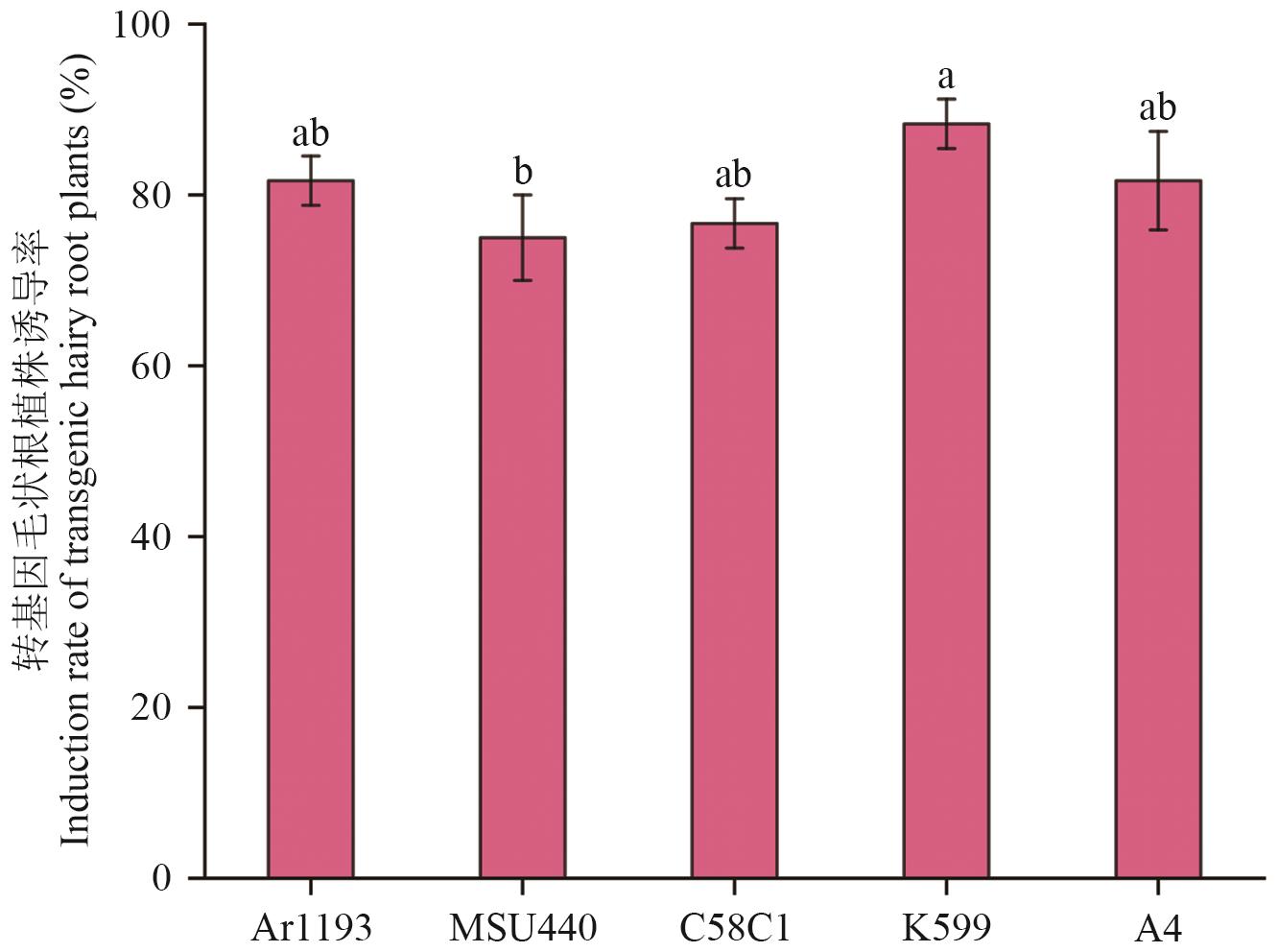
图1 农杆菌菌株对文冠果毛状根转化效率的影响不同字母表示差异显著(P<0.05),下同
Fig. 1 Influence of Agrobacterium strain types on the transformation efficiency of hairy roots in X. sorbifoliumDifferent letters indicate significant difference (P<0.05). The same below

图2 文冠果毛状根转化技术流程
Fig. 2 Process of hairy root transformation technology for X. sorbifolium
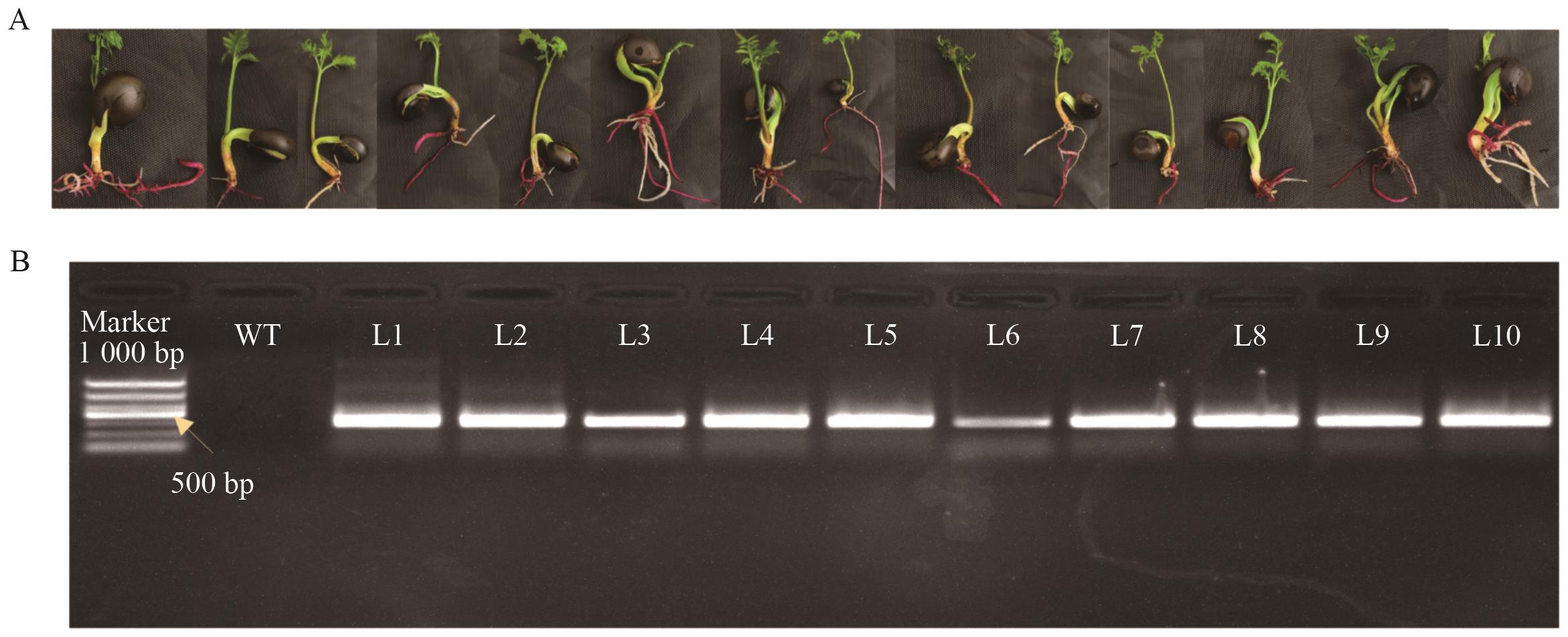
图3 文冠果红色转基因根表型和PCR检测A:转RUBY基因产生红色转基因毛状根表型;B:RUBY基因的PCR扩增电泳鉴定
Fig. 3 Phenotype and PCR detection of red transgenic roots in X. sorbifoliumA: Transforming the RUBY gene to produce a red transgenic hairy root phenotype. B: PCR amplification and electrophoresis identification of RUBY gene
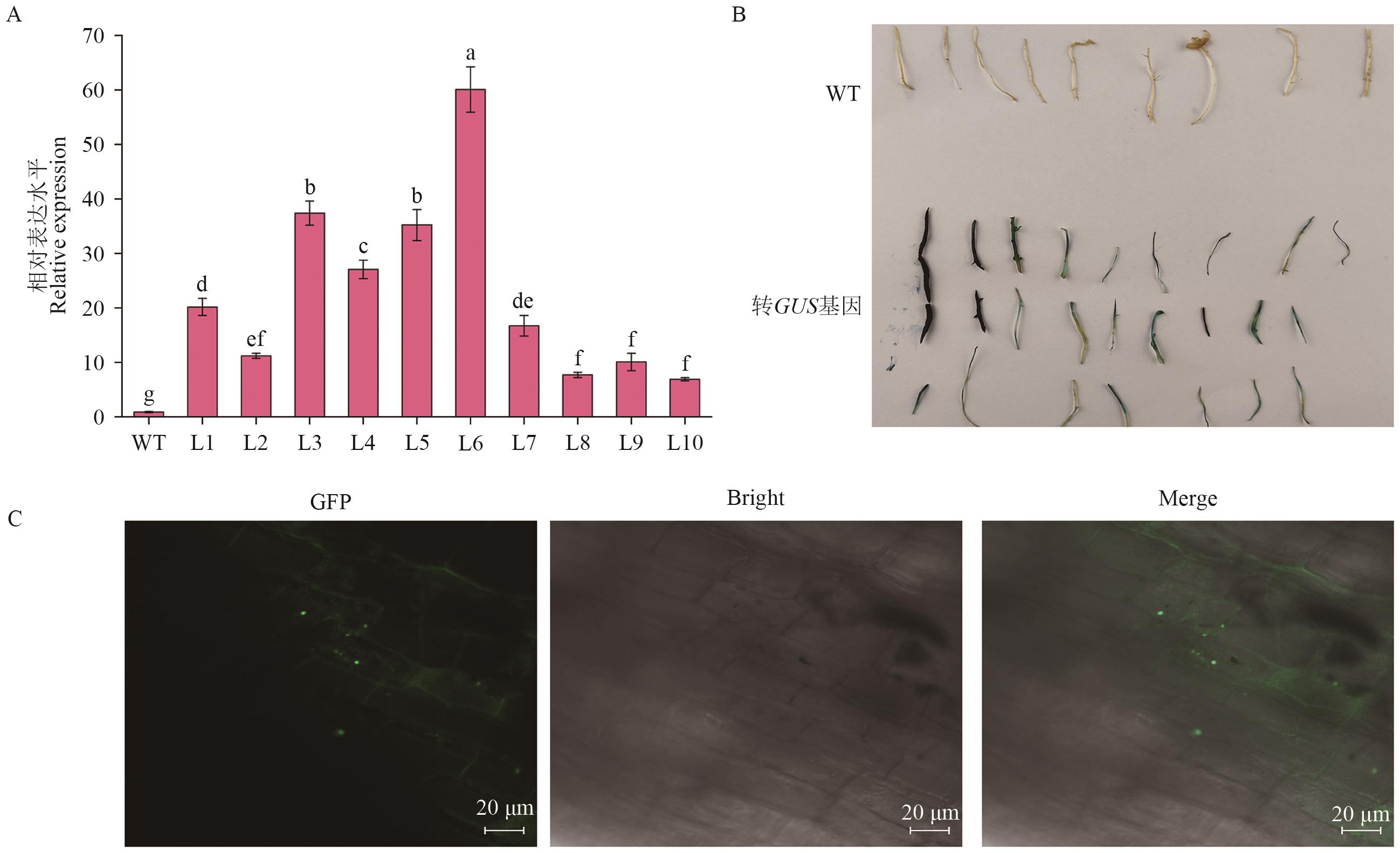
图4 文冠果红色转基因根的表达检测A:RT-qPCR表达水平检测;B:GUS染色检测;C:GFP荧光信号检测
Fig. 4 Transgenic expression detection of red transgenic roots of X. sorbifoliumA: Detection of RT-qPCR expression level. B: Detection of GUS staining. C: Detection of GFP fluorescence signal
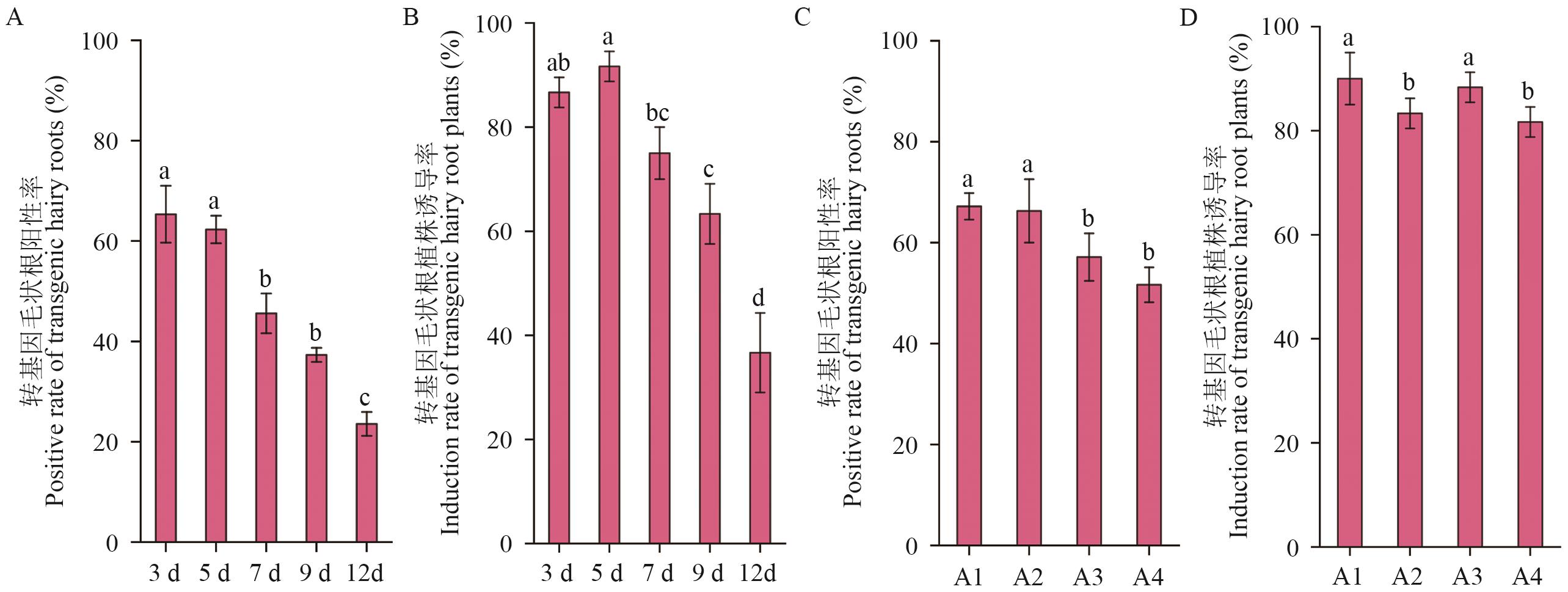
图5 转基因毛状根诱导效率的优化A:不同幼苗萌发时间的转基因毛状根阳性率;B:不同幼苗萌发时间的转基因毛状根植株诱导效率;C:不同品种的转基因毛状根阳性率;D:不同品种的转基因毛状根植株诱导效率
Fig. 5 Optimization of induction efficiency of transgenic hairy rootsA: Positive rate of transgenic hairy roots at different seedling germination times. B: Induction efficiency of transgenic hairy root at different seedling germination times. C: Positive rate of transgenic hairy roots across different varieties. D: Induction efficiency of transgenic hairy root across different varieties
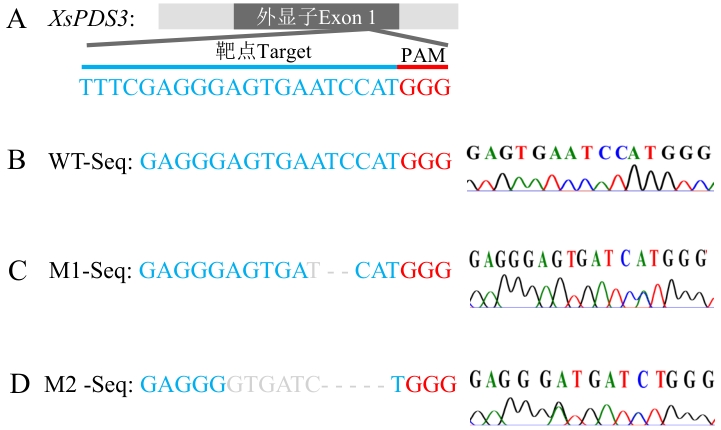
图6 文冠果毛状根的CRISPR-Cas9基因编辑A:XsPDS3的基因结构和选定的靶点,蓝色字符表示sgRNA,红色字符表示PAM序列;B:WT为野生型测序结果;C:M1为靶点基因突变类型1的测序结果;D:M2为靶点序列突变类型2的测序结果
Fig. 6 CRISPR-Cas9 gene editing of X. sorbifolium hairy rootsA: The gene structure and selected targets of XsPDS3, with blue characters for sgRNA and red characters for PAM sequences. B: WT is wild-type sequencing result. C: Sequencing results of M1 as the target gene mutation type 1. D: M2 is the sequencing result of target sequence mutation type 2
| [1] | 敖妍, 韩墨, 赵磊磊, 等. 主要分布区文冠果类型的划分 [J]. 西北林学院学报, 2015, 30(3): 100-106, 119. |
| Ao Y, Han M, Zhao LL, et al. Type classification of Xanthoceras sorbifolia in main distribution areas [J]. J Northwest For Univ, 2015, 30(3): 100-106, 119. | |
| [2] | 杨丽. 文冠果研究进展概述 [J]. 中国药物经济学, 2025, 20(8): 113-117. |
| Yang L. Overview of the progress in Xanthoceras sorbifolium bunge [J]. China J Pharm Econ, 2025, 20(8): 113-117. | |
| [3] | 许佳敏, 佟祎鑫, 王菊花, 等. 文冠果油的营养成分及功能活性研究进展 [J]. 中国油脂, 2022, 47(10): 77-80, 81, 82. |
| Xu JM, Tong YX, Wang JH, et al. Research progress on nutritional ingredients and functional activities of Xanthoceras sorbifolia Bunge oil [J]. China Oils Fats, 2022, 47(10): 77-80, 81, 82. | |
| [4] | 梁子龙, 陆健康, 张春兰, 等. 文冠果食药资源的开发与应用研究进展 [J]. 食品安全质量检测学报, 2024, 15(5): 157-164. |
| Liang ZL, Lu JK, Zhang CL, et al. Research progress in the development and application of Xanthoceras sorbifolia Bung’s food and drug resources [J]. J Food Saf Qual, 2024, 15(5): 157-164. | |
| [5] | Bi QX, Zhao Y, Du W, et al. Pseudomolecule-level assembly of the Chinese oil tree yellowhorn (Xanthoceras sorbifolium) genome [J]. Gigascience, 2019, 8(6): giz070. |
| [6] | Zhao ZQ, Liang CJ, Zhang W, et al. Genome-wide association analysis identifies a candidate gene controlling seed size and yield in Xanthoceras sorbifolium Bunge [J]. Hortic Res, 2024, 11(1): uhad243. |
| [7] | Xing QQ, He HJ, Wang ZJ, et al. Genome-wide characterization of FAD gene family in Xanthoceras sorbifolium Bunge and germplasm assessment [J]. PLoS One, 2025, 20(3): e0318900. |
| [8] | Liu Y, Chen YJ, Ren ZZ, et al. Two haplotype-resolved telomere-to-telomere genome assemblies of Xanthoceras sorbifolium [J]. Sci Data, 2025, 12: 791. |
| [9] | Zhou QY, Cai Q. The superoxide dismutase genes might be required for appropriate development of the ovule after fertilization in Xanthoceras sorbifolium [J]. Plant Cell Rep, 2018, 37(5): 727-739. |
| [10] | Li LK, Liang CJ, Zhang W, et al. 3-ketoacyl-CoA synthase 7 from Xanthoceras sorbifolium seeds is a crucial regulatory enzyme for nervonic acid biosynthesis [J]. Plant Sci, 2024, 347: 112184. |
| [11] | Mehrotra S, Srivastava V, Rahman LU, et al. Hairy root biotechnology—indicative timeline to understand missing links and future outlook [J]. Protoplasma, 2015, 252(5): 1189-1201. |
| [12] | Fan YL, Zhang XH, Zhong LJ, et al. One-step generation of composite soybean plants with transgenic roots by Agrobacterium rhizogenes-mediated transformation [J]. BMC Plant Biol, 2020, 20: 208. |
| [13] | 宋倩娜, 宋陆帅, 段永红, 等. 马铃薯CRISPR/Cas9介导的毛状根高效基因编辑体系的建立 [J]. 园艺学报, 2025, 52(7): 1758-1768. |
| Song QN, Song LS, Duan YH, et al. Establishment a system to obtain CRISPR/Cas9 genome editing plants based on hairy root transformation in potatoes [J]. Acta Hortic Sin, 2025, 52(7): 1758-1768. | |
| [14] | 李函, 赵雅琦, 朱仕心, 等. 发根农杆菌介导的红麻毛状根诱导体系的建立 [J]. 福建农林大学学报: 自然科学版, 2026, 55(3): 301-308. |
| Li H, Zhao YQ, Zhu SX, et al. Establishment of a hairy root induction system in kenaf mediated by Agrobacterium rhizogenes [J]. J Fujian Agric for Univ Nat Sci Ed, 2026, 55(3): 301-308. | |
| [15] | Liu L, Qu JH, Wang CY, et al. An efficient genetic transformation system mediated by Rhizobium rhizogenes in fruit trees based on the transgenic hairy root to shoot conversion [J]. Plant Biotechnol J, 2024, 22(8): 2093-2103. |
| [16] | Ramasamy M, Dominguez MM, Irigoyen S, et al. Rhizobium rhizogenes-mediated hairy root induction and plant regeneration for bioengineering Citrus [J]. Plant Biotechnol J, 2023, 21(9): 1728-1730. |
| [17] | Cao XS, Xie HT, Song ML, et al. Cut-dip-budding delivery system enables genetic modifications in plants without tissue culture [J]. Innovation, 2023, 4(1): 100345. |
| [18] | Fan D, Liu TT, Li CF, et al. Efficient CRISPR/Cas9-mediated targeted mutagenesis in Populus in the first generation [J]. Sci Rep, 2015, 5: 12217. |
| [19] | Lin CS, Hsu CT, Yang LH, et al. Application of protoplast technology to CRISPR/Cas9 mutagenesis: from single-cell mutation detection to mutant plant regeneration [J]. Plant Biotechnol J, 2018, 16(7): 1295-1310. |
| [20] | Nakayasu M, Akiyama R, Lee HJ, et al. Generation of α-solanine-free hairy roots of potato by CRISPR/Cas9 mediated genome editing of the St16DOX gene [J]. Plant Physiol Biochem, 2018, 131: 70-77. |
| [21] | 陶娜, 李茂兴, 郭华春. 发根农杆菌介导的甘薯遗传转化体系优化 [J]. 生物技术通报, 2023, 39(10): 175-183. |
| Tao N, Li MX, Guo HC. Optimization of sweet potato genetic transformation system mediated by Agrobacterium rhizogenes [J]. Biotechnol Bull, 2023, 39(10): 175-183. | |
| [22] | 屈阿艳, 曹佳琰, 王惠玉, 等. 发根农杆菌介导的叶用莴苣毛状根转化体系的建立 [J]. 北京农学院学报, 2025, 40(2): 21-27. |
| Qu AY, Cao JY, Wang HY, et al. Establishment of a system for Agrobacterium rhizogenes-mediated hairy root transformation of leaf lettuce [J]. J Beijing Univ Agric, 2025, 40(2): 21-27. | |
| [23] | 刘宁, 王悦, 曲云, 等. 四种发根农杆菌对波斯菊不同外植体的诱导探究 [J/OL]. 分子植物育种, 2023: 1-9. (2023-12-25). . |
| Liu N, Wang Y, Qu Y, et al. Induction of different explants of Cosmos by four Agrobacterium rhizogenes [J/OL]. Mol Plant Breed, 2023: 1-9. (2023-12-25). . | |
| [24] | 谢晓婷, 黄巧宇, 温广超, 等. 非组培依赖的发根农杆菌介导的薄壳山核桃转化体系构建 [J]. 果树学报, 2022, 39(1): 131-140. |
| Xie XT, Huang QY, Wen GC, et al. Construction of Agrobacterium rhizogenes-mediated transformation system of Carya illinoinensis without dependence on tissue culture [J]. J Fruit Sci, 2022, 39(1): 131-140. | |
| [25] | 曹庆丰. 发根农杆菌K599侵染黄瓜形成转基因毛状根的初步研究及orf14基因的克隆 [D]. 杭州: 杭州师范大学, 2012. |
| Cao QF. Preliminary analysis on transgeneic hairy root induced from cucumber by Agrobacterium rhizogenes K599 and cloning of Orf14 gene [D]. Hangzhou: Hangzhou Normal University, 2012. | |
| [26] | 豆硕, 丁若羲, 孙星, 等. 一种可视化筛选转基因通用载体pCamRUBY的构建和应用研究 [J]. 生物技术通报, 2025, 41(12): 66-73. |
| Dou S, Ding RX, Sun X, et al. Construction and application study of a general vector pCamRUBY for visual screening of transgenes [J]. Biotechnol Bull, 2025, 41(12): 66-73. | |
| [27] | 王晨雨, 刘孟军, 王立新, 等. CRISPR/Cas9技术研究进展及其在园艺植物中的应用进展 [J]. 园艺学报, 2024, 51(7): 1439-1454. |
| Wang CY, Liu MJ, Wang LX, et al. Research progress of CRISPR/Cas9 technology and its application in horticultural plants [J]. Acta Hortic Sin, 2024, 51(7): 1439-1454. | |
| [28] | Pacesa M, Pelea O, Jinek M. Past, present, and future of CRISPR genome editing technologies [J]. Cell, 2024, 187(5): 1076-1100. |
| [29] | 邹凯. 植物毛状根研究及应用 [J]. 生物技术进展, 2024, 14(3): 341-348. |
| Zou K. Research and application of plant hairy root [J]. Curr Biotechnol, 2024, 14(3): 341-348. | |
| [30] | He YB, Zhang T, Sun H, et al. A reporter for noninvasively monitoring gene expression and plant transformation [J]. Hortic Res, 2020, 7: 152. |
| [31] | 王艺林, 刘贤德, 边彪, 等. 干旱荒漠区文冠果扦插繁殖技术研究 [J]. 安徽农业科学, 2014, 42(32): 11363-11365. |
| Wang YL, Liu XD, Bian B, et al. Study on cutting propagation technology of Xanthoceras sorbifolia bunge in arid desert area [J]. J Anhui Agric Sci, 2014, 42(32): 11363-11365. | |
| [32] | 莫保儒, 王多锋, 戚建莉, 等. 文冠果不同营养器官扦插繁殖试验研究 [J]. 甘肃林业科技, 2014, 39(1): 18-21, 55. |
| Mo BR, Wang DF, Qi JL, et al. Study on the experiment of cutting propagation in different vegetative organs for Xanthoceras sorbifolia [J]. J Gansu For Sci Technol, 2014, 39(1): 18-21, 55. |
| [1] | 赵文娟, 李辉, 杨雪莹, 王朝露, 祝建波. 马铃薯‘新疆2号’遗传转化体系的建立[J]. 生物技术通报, 2026, 42(6): 87-97. |
| [2] | 宗建伟, 邓海芳, 蔡沅原, 常雅雯, 朱雅琦, 杨雨华. AM真菌对干旱胁迫下文冠果根系形态和叶片结构耦合的影响[J]. 生物技术通报, 2025, 41(6): 167-178. |
| [3] | 宋慧洋, 苏宝杰, 李京昊, 梅超, 宋倩娜, 崔福柱, 冯瑞云. 马铃薯StAS2-15基因的克隆及盐胁迫下功能分析[J]. 生物技术通报, 2025, 41(5): 119-128. |
| [4] | 宋倩娜, 武诗云, 曹时瑾, 段永红, 冯瑞云. 通过马铃薯毛状根体系快速鉴定StHKT1基因的功能[J]. 生物技术通报, 2025, 41(10): 233-241. |
| [5] | 李思琪, 张文臣, 杨柳, 付庆新, 洪新, 张海旺. 基于SSR标记的文冠果遗传多样性分析及指纹图谱构建[J]. 生物技术通报, 2024, 40(5): 74-83. |
| [6] | 陶娜, 李茂兴, 郭华春. 发根农杆菌介导的甘薯遗传转化体系优化[J]. 生物技术通报, 2023, 39(10): 175-183. |
| [7] | 张秀民, 马绍英, 杨洁, 包金玉, 张晓玲, 田鹏, 路亚琦, 李胜. 以次生代谢物产量为目标的西兰花毛状根培养技术体系优化[J]. 生物技术通报, 2021, 37(8): 75-84. |
| [8] | 赵阳阳, 郭雨潇, 张凌云. 文冠果果实转录组测序及分析[J]. 生物技术通报, 2019, 35(6): 24-31. |
| [9] | 熊丙全, 刘冬青, 廖相建, 郑雪莲. 茉莉酸甲酯对丹参毛状根有效成分含量的影响[J]. 生物技术通报, 2018, 34(7): 81-84. |
| [10] | 陈婉琪, 张鸿, 王进峰, 陈俊杰, 林晓文, 罗结华, 许源, 陈艳芳, 陆幸妍. 冬凌草毛状根的优化培养及其提取物的肿瘤细胞增殖抑制活性检测[J]. 生物技术通报, 2018, 34(10): 122-128. |
| [11] | 李伟, 翟羽佳, 李鹏程, 王昌禄. 农杆菌介导的蓖麻转化体系优化[J]. 生物技术通报, 2015, 31(5): 140-145. |
| [12] | 孙威,许奕,许桂莺,孙佩光,宋顺,常胜合. 病毒诱导的基因沉默及其在植物研究中的应用[J]. 生物技术通报, 2015, 31(10): 105-110. |
| [13] | , 崔倩, 李洁, 刘晓光. 根癌农杆菌介导的赭曲霉遗传转化体系的建立[J]. 生物技术通报, 2014, 30(6): 199-204. |
| [14] | 姚庆收, 姜吉刚, 武玉永, 梁乘榜. 培养基种类对花生毛状根株系生物量和白藜芦醇含量的影响[J]. 生物技术通报, 2014, 30(5): 174-178. |
| [15] | 张焕, 郑佳, 阚丹丹, 樊金萍. 农杆菌介导亚洲百合转化体系的建立及转GsZFP1基因研究[J]. 生物技术通报, 2014, 0(2): 91-96. |
| 阅读次数 | ||||||
|
全文 |
|
|||||
|
摘要 |
|
|||||
