






生物技术通报 ›› 2026, Vol. 42 ›› Issue (10): 37-46.doi: 10.13560/j.cnki.biotech.bull.1985.2025-1369
• 技术与方法 • 上一篇
陈文燕1, 周瑞1,2, 吴慧昊1, 李耀东1, 杨婕1, 臧荣鑫1( ), 徐红伟1()
收稿日期:2025-12-15
出版日期:2026-10-26
发布日期:2026-10-15
通讯作者:
臧荣鑫rxzang2000@163.com基金资助:
CHEN Wen-yan1, ZHOU Rui1,2, WU Hui-hao1, LI Yao-dong1, YANG Jie1, ZANG Rong-xin1(), XU Hong-wei1()
Received:2025-12-15
Published:2026-10-26
Online:2026-10-15
摘要:
目的 高木质素秸秆因酸性洗涤木质素(acid detergent lignin, ADL)含量高导致饲料化利用率低。构建白腐真菌-枯草芽胞杆菌-毕赤酵母的复合菌发酵工艺,探究其协同降解玉米芯效果。 方法 以分离自香菇的白腐真菌BF-1为核心功能菌,搭配枯草芽胞杆菌、毕赤酵母构建三菌复合发酵体系(菌体量1∶1∶1),设BF-1单菌发酵为对照,均以玉米芯为基质。通过单因素试验(温度28-32 ℃、含水量40%-50%、接种量1%-5%)比较ADL降解效果,再用响应面法优化三菌体系发酵条件;结合扫描电镜观察玉米芯形态变化,测定粗蛋白(crude protein, CP)、中性洗涤纤维(neutral detergent fiber, NDF)、酸性洗涤纤维(acid detergent fiber, ADF)等指标,评价相对饲用价值(relative feed value, RFV)和相对饲用品质(relative feed quality, RFQ)。 结果 单因素试验表明,两种体系均在温度30 ℃、含水量45%、接种量3%时ADL降解效果最优,单菌发酵ADL降解率为42.29%,三菌发酵ADL降解率为58.83%,且三菌发酵降解效果显著优于单菌发酵(P<0.01)。响应面法优化三菌发酵最佳条件为温度29.8 ℃、含水量45.2%、接种量3.1%,此时ADL降解率达63.42%。发酵过程中,其Lac、MnP和LiP活性随时间持续升高。扫描电镜结果显示,三菌发酵后玉米芯表面结构破坏更明显,呈松散多孔特征;发酵21 d后,三菌体系玉米芯CP含量显著提升1.43%(P<0.01),NDF和ADF含量显著降低(P<0.01),其降解率分别为22.12%,33.97%,RFQ和RFV分别提高82.80%、17.21%。 结论 三菌协同发酵可高效降解玉米芯木质素,ADL降解率达63.42%,粗蛋白提升1.43%,纤维显著降解,相对饲用品质提高82.80%,饲用价值大幅提升,为玉米芯饲料化利用提供技术支撑。
陈文燕, 周瑞, 吴慧昊, 李耀东, 杨婕, 臧荣鑫, 徐红伟. 基于复合菌的玉米芯发酵工艺构建与优化[J]. 生物技术通报, 2026, 42(10): 37-46.
CHEN Wen-yan, ZHOU Rui, WU Hui-hao, LI Yao-dong, YANG Jie, ZANG Rong-xin, XU Hong-wei. Construction and Optimization of Corncob Fermentation Process Using Composite Microbial Inoculum[J]. Biotechnology Bulletin, 2026, 42(10): 37-46.
| 因素 Factor | 水平 Level | ||
|---|---|---|---|
| 温度 Temperature (℃) | 28 | 30 | 32 |
| 含水量 Moisture content (%) | 40 | 45 | 50 |
| 接种量 Inoculum size (%) | 1 | 3 | 5 |
表1 Box-Behnken 设计的因素与水平
Table 1 Factors and levels of Box-Behnken design
| 因素 Factor | 水平 Level | ||
|---|---|---|---|
| 温度 Temperature (℃) | 28 | 30 | 32 |
| 含水量 Moisture content (%) | 40 | 45 | 50 |
| 接种量 Inoculum size (%) | 1 | 3 | 5 |
因素 Factor | 水平 Level | 对照组 Control group | 单菌处理组 Single-bacteria treatment group | 三菌处理组 Three-bacteria treatment group | P-value | ||
|---|---|---|---|---|---|---|---|
| ADL含量 | ADL含量 | ADL降解率 | ADL含量 | ADL降解率 | |||
| 温度 | 28 ℃ | 5.77±0.41A | 4.9±0.22B | 15.02±3.86b | 4.65±0.1B | 19.35±1.8a | <0.01 |
| 30 ℃ | 5.77±0.41A | 3.33±0.11B | 42.29±1.93b | 2.69±0.1B | 53.4±1.72a | <0.01 | |
| 32 ℃ | 5.77±0.41A | 5.14±0.09B | 10.98±1.57b | 4.31±0.1B | 25.31±1.69a | <0.01 | |
| 含水量 | 40% | 5.77±0.41A | 5.34±0.12BC | 7.45±2b | 3.74±0.6B | 32.29±1.15a | <0.01 |
| 45% | 5.77±0.41A | 4.42±0.2B | 23.34±3.49b | 2.38±0.07B | 58.83±1.24a | <0.01 | |
| 50% | 5.77±0.41A | 5.27±0.14B | 8.61±2.47b | 4.14±0.67B | 36.24±1.78a | <0.01 | |
| 接种量 | 1% | 5.77±0.41A | 5.16±0.17B | 10.63±2.86b | 4.7±0.17B | 18.48±2.91a | <0.01 |
| 3% | 5.77±0.41A | 3.36±0.16B | 41.83±2.8b | 2.57±0.09C | 55.42±1.54a | <0.01 | |
| 5% | 5.77±0.41A | 4.46±0.23B | 22.76±3.95b | 3.88±0.07C | 32.78±1.27a | <0.01 | |
表2 单菌/复合菌对ADL含量及降解率的影响
Table 2 Effects of single/composite bacteria on ADL content and degradation rate (%)
因素 Factor | 水平 Level | 对照组 Control group | 单菌处理组 Single-bacteria treatment group | 三菌处理组 Three-bacteria treatment group | P-value | ||
|---|---|---|---|---|---|---|---|
| ADL含量 | ADL含量 | ADL降解率 | ADL含量 | ADL降解率 | |||
| 温度 | 28 ℃ | 5.77±0.41A | 4.9±0.22B | 15.02±3.86b | 4.65±0.1B | 19.35±1.8a | <0.01 |
| 30 ℃ | 5.77±0.41A | 3.33±0.11B | 42.29±1.93b | 2.69±0.1B | 53.4±1.72a | <0.01 | |
| 32 ℃ | 5.77±0.41A | 5.14±0.09B | 10.98±1.57b | 4.31±0.1B | 25.31±1.69a | <0.01 | |
| 含水量 | 40% | 5.77±0.41A | 5.34±0.12BC | 7.45±2b | 3.74±0.6B | 32.29±1.15a | <0.01 |
| 45% | 5.77±0.41A | 4.42±0.2B | 23.34±3.49b | 2.38±0.07B | 58.83±1.24a | <0.01 | |
| 50% | 5.77±0.41A | 5.27±0.14B | 8.61±2.47b | 4.14±0.67B | 36.24±1.78a | <0.01 | |
| 接种量 | 1% | 5.77±0.41A | 5.16±0.17B | 10.63±2.86b | 4.7±0.17B | 18.48±2.91a | <0.01 |
| 3% | 5.77±0.41A | 3.36±0.16B | 41.83±2.8b | 2.57±0.09C | 55.42±1.54a | <0.01 | |
| 5% | 5.77±0.41A | 4.46±0.23B | 22.76±3.95b | 3.88±0.07C | 32.78±1.27a | <0.01 | |
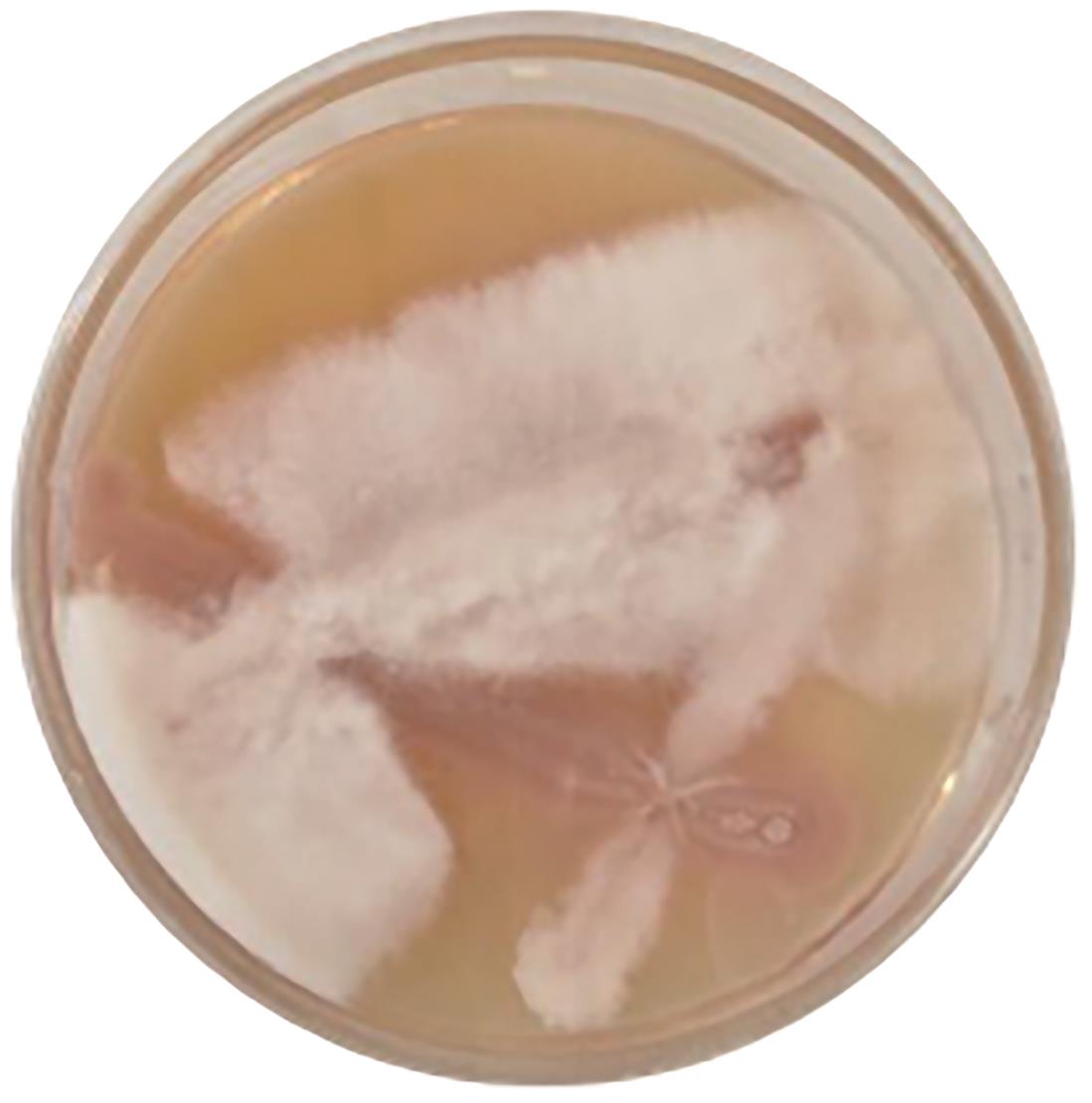
图1 菌株间相容性检测
Fig. 1 Compatibility test between strains
试验号 Test number | 温度 Temperature (℃) | 含水量 Water content (%) | 接种量 Inoculum concentration (%) | ADL降解率 ADL degradation rate (%) |
|---|---|---|---|---|
| 1 | 32 | 40 | 3 | 31.715 8 |
| 2 | 28 | 45 | 1 | 19.041 0 |
| 3 | 30 | 40 | 1 | 17.758 5 |
| 4 | 32 | 50 | 3 | 32.697 9 |
| 5 | 30 | 45 | 3 | 58.555 7 |
| 6 | 32 | 45 | 1 | 8.798 38 |
| 7 | 32 | 45 | 5 | 27.695 0 |
| 8 | 30 | 40 | 5 | 46.314 3 |
| 9 | 28 | 40 | 3 | 45.782 8 |
| 10 | 30 | 50 | 1 | 30.202 2 |
| 11 | 30 | 45 | 3 | 65.719 2 |
| 12 | 30 | 45 | 3 | 62.224 1 |
| 13 | 30 | 50 | 5 | 45.574 8 |
| 14 | 28 | 45 | 5 | 43.599 1 |
| 15 | 30 | 45 | 3 | 62.911 6 |
| 16 | 28 | 50 | 3 | 46.915 1 |
| 17 | 30 | 45 | 3 | 55.742 3 |
表3 响应面法试验结果
Table 3 Results of response surface methodology experiment
试验号 Test number | 温度 Temperature (℃) | 含水量 Water content (%) | 接种量 Inoculum concentration (%) | ADL降解率 ADL degradation rate (%) |
|---|---|---|---|---|
| 1 | 32 | 40 | 3 | 31.715 8 |
| 2 | 28 | 45 | 1 | 19.041 0 |
| 3 | 30 | 40 | 1 | 17.758 5 |
| 4 | 32 | 50 | 3 | 32.697 9 |
| 5 | 30 | 45 | 3 | 58.555 7 |
| 6 | 32 | 45 | 1 | 8.798 38 |
| 7 | 32 | 45 | 5 | 27.695 0 |
| 8 | 30 | 40 | 5 | 46.314 3 |
| 9 | 28 | 40 | 3 | 45.782 8 |
| 10 | 30 | 50 | 1 | 30.202 2 |
| 11 | 30 | 45 | 3 | 65.719 2 |
| 12 | 30 | 45 | 3 | 62.224 1 |
| 13 | 30 | 50 | 5 | 45.574 8 |
| 14 | 28 | 45 | 5 | 43.599 1 |
| 15 | 30 | 45 | 3 | 62.911 6 |
| 16 | 28 | 50 | 3 | 46.915 1 |
| 17 | 30 | 45 | 3 | 55.742 3 |
方差来源 Variance source | 平方和 Sum of squares | 自由度 Degree of freedom | 均方差 Mean square | F值 F value | P-value | 显著性 Significance |
|---|---|---|---|---|---|---|
| 模型Model | 4 614.81 | 9 | 512.76 | 49.08 | <0.000 1 | ** |
| A-温度 | 124.81 | 1 | 124.81 | 11.95 | 0.010 6 | * |
| B-含水量 | 90.19 | 1 | 90.19 | 8.63 | 0.021 8 | * |
| C-接种量 | 155.13 | 1 | 155.13 | 14.85 | 0.006 3 | ** |
| AB | 0.005 6 | 1 | 0.005 6 | 0.000 5 | 0.982 1 | |
| AC | 8.01 | 1 | 8.01 | 0.767 0 | 0.410 2 | |
| BC | 43.45 | 1 | 43.45 | 4.16 | 0.080 8 | |
| A2 | 1 073.31 | 1 | 1 073.31 | 102.73 | <0.000 1 | ** |
| B2 | 141.00 | 1 | 141.00 | 13.50 | 0.007 9 | ** |
| C2 | 1 731.93 | 1 | 1 731.93 | 165.78 | <0.000 1 | ** |
| 残差 | 73.13 | 7 | 10.45 | |||
| 失拟项 | 12.09 | 3 | 4.03 | 0.264 2 | 0.848 5 | no significance |
| 纯误差 | 61.04 | 4 | 15.26 | |||
| 总变异 | 4 687.94 | 16 | ||||
| R2 | 0.984 4 | |||||
| R2Adj | 0.964 3 | |||||
| R2Pre | 0.938 4 | |||||
| Adeq precision | 21.201 5 | |||||
| CV (%) | 7.84 |
表4 木质素降解率回归模型分析
Table 4 Regression model analysis of lignin degradation rate
方差来源 Variance source | 平方和 Sum of squares | 自由度 Degree of freedom | 均方差 Mean square | F值 F value | P-value | 显著性 Significance |
|---|---|---|---|---|---|---|
| 模型Model | 4 614.81 | 9 | 512.76 | 49.08 | <0.000 1 | ** |
| A-温度 | 124.81 | 1 | 124.81 | 11.95 | 0.010 6 | * |
| B-含水量 | 90.19 | 1 | 90.19 | 8.63 | 0.021 8 | * |
| C-接种量 | 155.13 | 1 | 155.13 | 14.85 | 0.006 3 | ** |
| AB | 0.005 6 | 1 | 0.005 6 | 0.000 5 | 0.982 1 | |
| AC | 8.01 | 1 | 8.01 | 0.767 0 | 0.410 2 | |
| BC | 43.45 | 1 | 43.45 | 4.16 | 0.080 8 | |
| A2 | 1 073.31 | 1 | 1 073.31 | 102.73 | <0.000 1 | ** |
| B2 | 141.00 | 1 | 141.00 | 13.50 | 0.007 9 | ** |
| C2 | 1 731.93 | 1 | 1 731.93 | 165.78 | <0.000 1 | ** |
| 残差 | 73.13 | 7 | 10.45 | |||
| 失拟项 | 12.09 | 3 | 4.03 | 0.264 2 | 0.848 5 | no significance |
| 纯误差 | 61.04 | 4 | 15.26 | |||
| 总变异 | 4 687.94 | 16 | ||||
| R2 | 0.984 4 | |||||
| R2Adj | 0.964 3 | |||||
| R2Pre | 0.938 4 | |||||
| Adeq precision | 21.201 5 | |||||
| CV (%) | 7.84 |
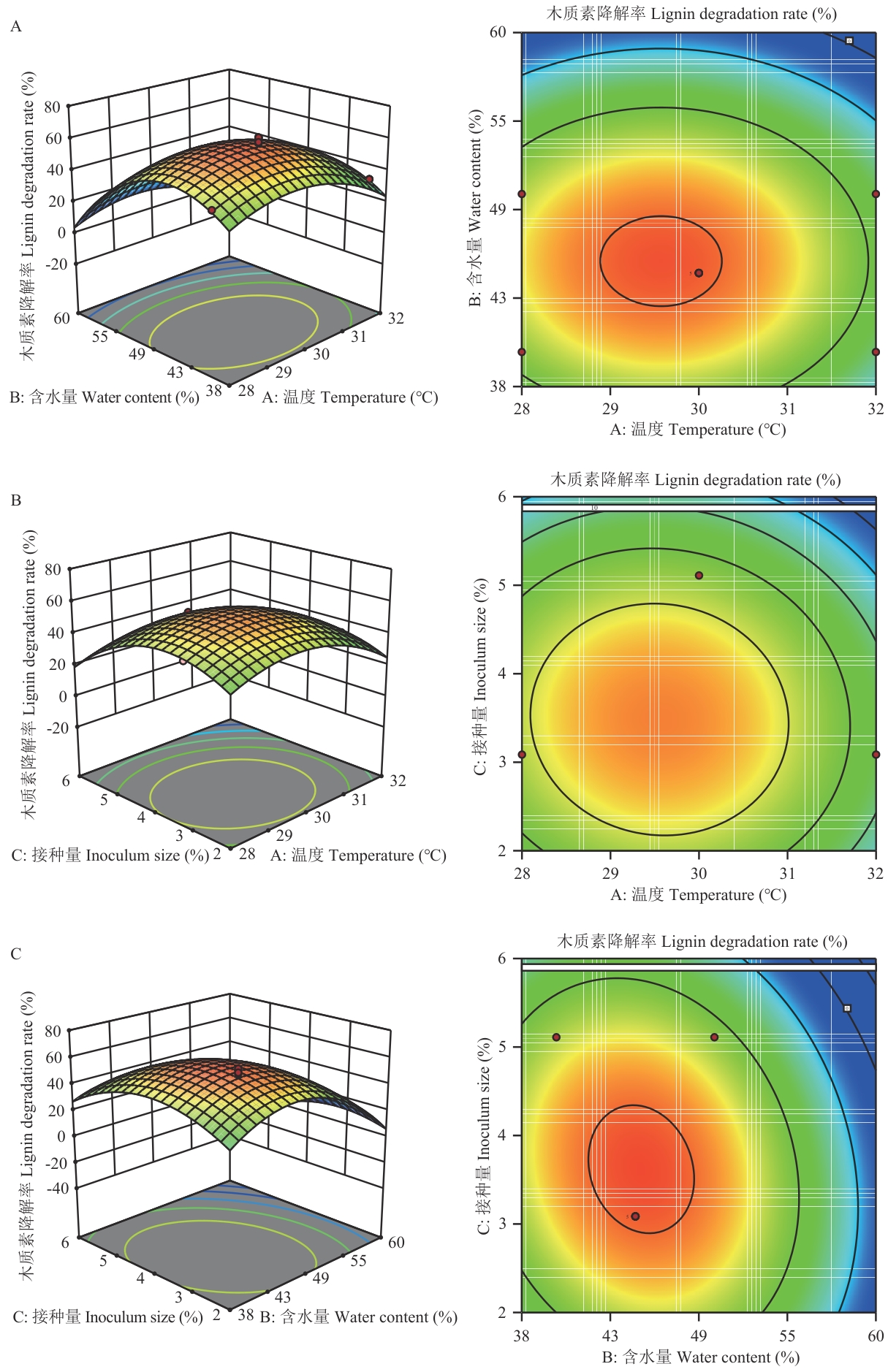
图2 两因素交互影响木质素降解率的响应面
Fig. 2 Response surface for the interactive effects of two factors on the lignin degradation rate
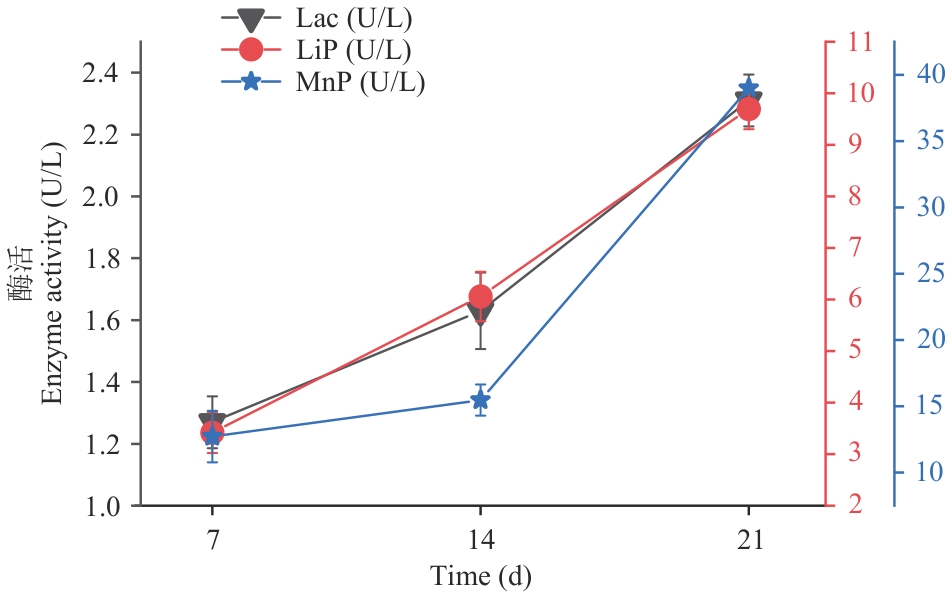
图3 反应时间对木质素降解酶活性变化的影响
Fig. 3 Influence of reaction time on changes in lignin-degrading enzyme activities
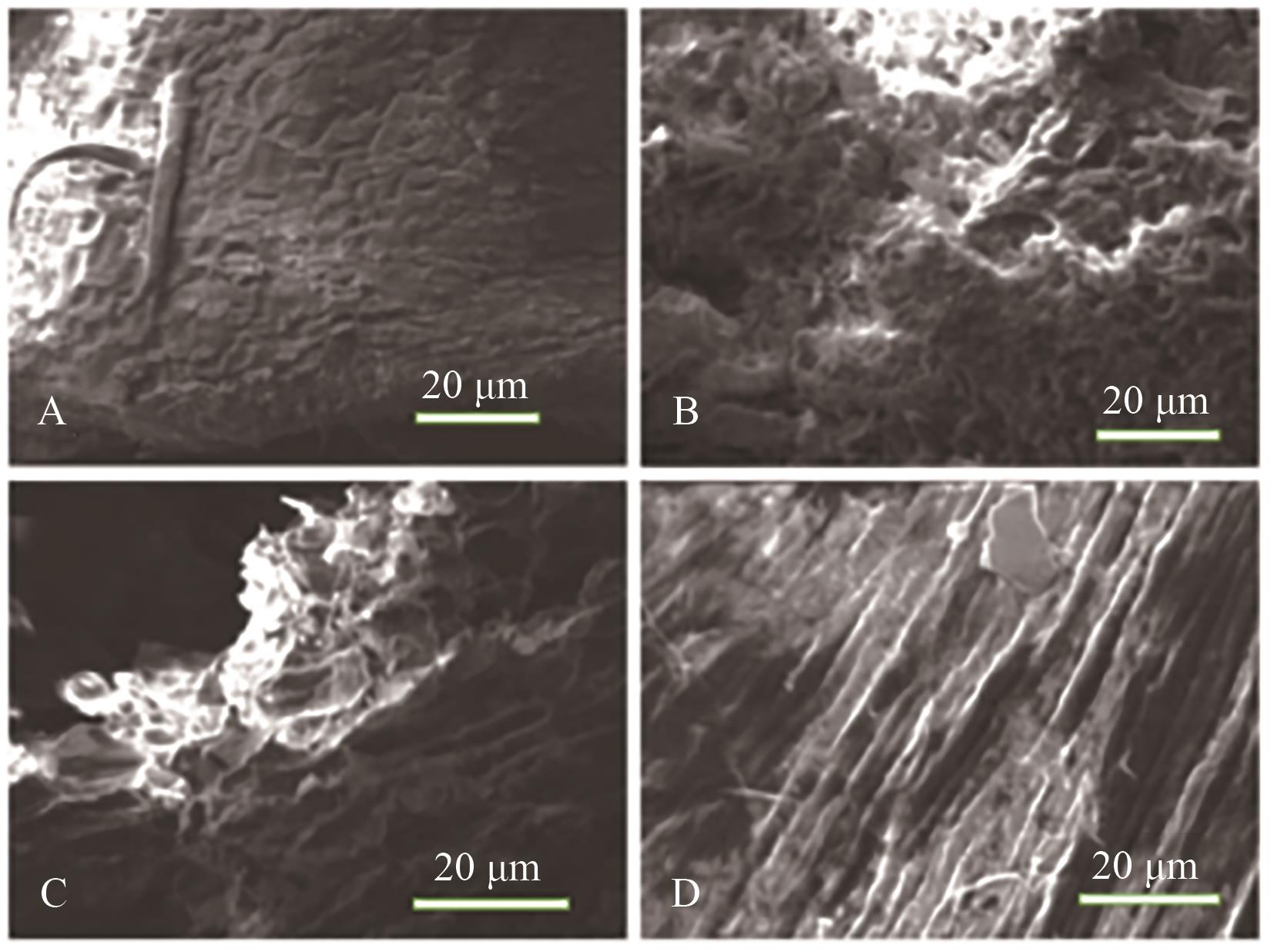
图4 发酵前后的玉米芯扫描电镜结果A:玉米芯原料;B:玉米芯发酵20 d;C:玉米芯发酵45 d;D:玉米芯发酵60 d
Fig. 4 Scanning electron microscopy results of corn cobs before and after fermentationA: Raw corncob; B: corncob fermented for 20 days; C: corncob fermented for 45 days; D: corncob fermented for 60 days
组别 Group | 对照组 Control group | 发酵时间 Fermentation time (d) | P-value | ||
|---|---|---|---|---|---|
| 7 | 14 | 21 | |||
| 粗蛋白(CP) | 2.8±1.14C | 4.69±0.62B | 5.95±0.29A | 6.79±0.44A | <0.001 |
| CP增长率 | 0.68±0.22C | 1.13±0.1B | 1.43±0.16A | <0.001 | |
| 酸性洗涤纤维(ADF) | 43.57±1.16A | 38.19±0.4B | 35.67±1.98C | 28.77±1.08D | <0.001 |
| ADF降解率 | 12.36±0.92C | 18.13±4.55B | 33.97±2.47A | <0.001 | |
| 中性洗涤粗纤维(NDF) | 78.31±1.37A | 68.13±1.36B | 66.56±0.51B | 60.99±1.83C | <0.001 |
| NDF降解率 | 13.01±1.73C | 15.01±0.65B | 22.12±2.33A | <0.001 | |
| 相对饲用品质(RFQ) | 56.22±2.7D | 74.55±0.76C | 81.07±4.06B | 102.77±3.5A | <0.001 |
| 相对饲用价值(RFV) | 41.07±0.73B | 40.7±1.44B | 42.79±2.38B | 48.14±2.04A | <0.001 |
表5 发酵时间对玉米芯营养指标及饲用价值的影响
Table 5 Effects of fermentation time on nutritional indices and feed value of corncob (%)
组别 Group | 对照组 Control group | 发酵时间 Fermentation time (d) | P-value | ||
|---|---|---|---|---|---|
| 7 | 14 | 21 | |||
| 粗蛋白(CP) | 2.8±1.14C | 4.69±0.62B | 5.95±0.29A | 6.79±0.44A | <0.001 |
| CP增长率 | 0.68±0.22C | 1.13±0.1B | 1.43±0.16A | <0.001 | |
| 酸性洗涤纤维(ADF) | 43.57±1.16A | 38.19±0.4B | 35.67±1.98C | 28.77±1.08D | <0.001 |
| ADF降解率 | 12.36±0.92C | 18.13±4.55B | 33.97±2.47A | <0.001 | |
| 中性洗涤粗纤维(NDF) | 78.31±1.37A | 68.13±1.36B | 66.56±0.51B | 60.99±1.83C | <0.001 |
| NDF降解率 | 13.01±1.73C | 15.01±0.65B | 22.12±2.33A | <0.001 | |
| 相对饲用品质(RFQ) | 56.22±2.7D | 74.55±0.76C | 81.07±4.06B | 102.77±3.5A | <0.001 |
| 相对饲用价值(RFV) | 41.07±0.73B | 40.7±1.44B | 42.79±2.38B | 48.14±2.04A | <0.001 |
| [1] | Zeko-Pivač A, Bošnjaković A, Planinić M, et al. Improvement of the nutraceutical profile of brewer's spent grain after treatment with Trametes versicolor [J]. Microorganisms, 2022, 10(11): 2295. |
| [2] | 李森, 罗霄天, 秦心儿, 等. 高粱秸秆栽培大球盖菇的品质、产量与优势分析 [J]. 生物资源, 2024, 46(1): 32-38. |
| Li S, Luo XT, Qin XE, et al. Analysis of quality, yield and advantages of Stropharia rugosoannulata cultivated with sorghum straw [J]. Biotic Resour, 2024, 46(1): 32-38. | |
| [3] | Nazar M, Tian JP, Wang X, et al. Effect of biological lignin depolymerization on rice straw enzymatic hydrolysis, anerobic fermentation characteristics and in vitro ruminal digestibility [J]. Int J Biol Macromol, 2025, 305: 141664. |
| [4] | Liu WX, Zhao MY, Li MX, et al. Laccase activities from three white-rot fungal species isolated from their native habitat in North China using solid-state fermentation with lignocellulosic biomass [J]. BioResources, 2022, 17(1): 1533-1550. |
| [5] | Ahmad Khan N, Khan M, Sufyan A, et al. Biotechnological processing of sugarcane bagasse through solid-state fermentation with white rot fungi into nutritionally rich and digestible ruminant feed [J]. Fermentation, 2024, 10(4): 181. |
| [6] | 杨莉, 杨义, 郑碧君, 等. 木质素降解菌的筛选及其对酒糟的预处理研究 [J]. 生物质化学工程, 2024, 58(5): 45-52. |
| Yang L, Yang Y, Zheng BJ, et al. Screening of lignin-degrading fungal strain and its pretreatment of distillers' grains [J]. Biomass Chem Eng, 2024, 58(5): 45-52. | |
| [7] | Singh J, Mandal A, Nandabalan YK. Synergistic effect on lignolytic enzyme production through co-culturing of white rot fungi during solid state fermentation of agricultural residues [J]. Bull Natl Res Cent, 2025, 49: 3. |
| [8] | Campos AO, Asevedo EA, Souza Filho PF, et al. Extraction of cellulases produced through solid-state fermentation by Trichoderma reesei CCT-2768 using green coconut fibers pretreated by steam explosion combined with alkali [J]. Biomass, 2024, 4(1): 92-106. |
| [9] | Zhu DC, Zhang PP, Xie CX, et al. Biodegradation of alkaline lignin by Bacillus ligniniphilus L1 [J]. Biotechnol Biofuels, 2017, 10: 44. |
| [10] | Naranjo CA, Jivan AD, Vo MN, et al. Role of BGS13 in the secretory mechanism of Pichia pastoris [J]. Appl Environ Microbiol, 2019, 85(24): e01615-e01619. |
| [11] | Arora D, Sharma A, Singh S, et al. The Bacterial degradation of lignin—a Review [J]. Crit Rev Biotechnol, 2010, 30(4): 326-341. |
| [12] | Hardianto D, Safarrida A, Prayoga GS, et al. Increasing the production of insulin glargine in Pichia pastoris through medium modification [J]. BIO Web Conf, 2024, 127: 06001. |
| [13] | 李强, 吴晓青, 张新建. 微生物降解秸秆木质素的研究进展 [J]. 微生物学报, 2023, 63(11): 4118-4132. |
| Li Q, Wu XQ, Zhang XJ. Research progress in microbial degradation of straw lignin [J]. Acta Microbiol Sin, 2023, 63(11): 4118-4132. | |
| [14] | Cui TW, Yuan B, Guo HW, et al. Enhanced lignin biodegradation by consortium of white rot fungi: microbial synergistic effects and product mapping [J]. Biotechnol Biofuels, 2021, 14: 162. |
| [15] | Jiménez-Barrera D, Chan-Cupul W, Fan ZL, et al. Fungal co-culture increases ligninolytic enzyme activities: statistical optimization using response surface methodology [J]. Prep Biochem Biotechnol, 2018, 48(9): 787-798. |
| [16] | 司欣雨, 李佳琪, 周梦含, 等. 多功能复合菌剂的构建及盐碱胁迫下促生效果 [J]. 农业工程学报, 2024, 40(21): 82-90. |
| Si XY, Li JQ, Zhou MH, et al. Constructing multifunctional composite microbial agents for promoting crop growth under saline-alkali stress [J]. Trans Chin Soc Agric Eng, 2024, 40(21): 82-90. | |
| [17] | 杨斌, 殷引, 张浩博, 等. 洗涤剂法测定烟草及烟草制品中中性洗涤纤维、酸性洗涤纤维、酸性洗涤木质素的研究 [J]. 中国烟草学报, 2012, 18(3): 10-15. |
| Yang B, Yin Y, Zhang HB, et al. Determination of NDF, ADF and ADL in tobacco and tobacco products with detergent method [J]. Acta Tabacaria Sin, 2012, 18(3): 10-15. | |
| [18] | 王光荣, 高世霞, 于晓锋, 等. 改性玉米芯对Zn2+和Cu2+的吸附性能研究 [J]. 轻工学报, 2019, 34(2): 56-62. |
| Wang GR, Gao SX, Yu XF, et al. Research of modified corn cob on the adsorption properties of Zn2+, Cu2+ [J]. J Light Ind, 2019, 34(2): 56-62. | |
| [19] | 刘宽庆, 张以恒. 木质素的生物降解和生物利用 [J]. 合成生物学, 2024, 5(6): 1264-1278. |
| Liu KQ, Zhang YH. Biological degradation and utilization of lignin [J]. Synth Biol J, 2024, 5(6): 1264-1278. | |
| [20] | 杨航, 宋福超, 王诗涛, 等. 固态发酵平菇-青稞秸秆菌糠饲料化利用研究 [J]. 草地学报, 2025, 33(4): 1289-1298. |
| Yang H, Song FC, Wang ST, et al. Research on the utilization of solid-state fermented oyster mushroom-highland barley straw fungus-bran as feed [J]. Acta Agrestia Sin, 2025, 33(4): 1289-1298. | |
| [21] | 罗俊杰, 肖燕子, 侯美玲, 等. 不同添加剂对苜蓿与羊草混合青贮品质及维生素含量的影响 [J]. 草地学报, 2025, 33(3): 992-1000. |
| Luo JJ, Xiao YZ, Hou ML, et al. Effects of different additives on quality and vitamin content of mixed silage of alfalfa and Leymus chinensis [J]. Acta Agrestia Sin, 2025, 33(3): 992-1000. | |
| [22] | 郝迎辰, 黄钰, 张洪瑞, 等. 品种和添加剂对三江源区燕麦青贮品质和CNCPS蛋白组分的影响 [J]. 草地学报, 2025, 33(4): 1274-1280. |
| Hao YC, Huang Y, Zhang HR, et al. Effects of varieties and additives on silage quality and CNCPS protein fractions of oats in the Sanjiangyuan area [J]. Acta Agrestia Sin, 2025, 33(4): 1274-1280. | |
| [23] | 梁文斌, 尹国丽, 陈三冬, 等. 全株玉米青贮过程中品质及真菌群落组成特征 [J]. 草地学报, 2024, 32(12): 3722-3732. |
| Liang WB, Yin GL, Chen SD, et al. Characteristics of quality and fungal community composition during whole-plant corn silage [J]. Acta Agrestia Sin, 2024, 32(12): 3722-3732. | |
| [24] | Sun Y, Liu WC, Shi X, et al. Inducing secondary metabolite production of Aspergillus sydowii through microbial co-culture with Bacillus subtilis [J]. Microb Cell Fact, 2021, 20: 42. |
| [25] | Datsomor O, Yan Q, Opoku-Mensah L, et al. Effect of different inducer sources on cellulase enzyme production by white-rot basidiomycetes Pleurotus ostreatus and Phanerochaete chrysosporium under submerged fermentation [J]. Fermentation, 2022, 8(10): 561. |
| [26] | Yang J, Zhao J, Jiang JC, et al. Isolation and characterization of Bacillus sp. capable of degradating alkali lignin [J]. Front Energy Res, 2021, 9: 807286. |
| [27] | Chen KJ, Tang JC, Xu BH, et al. Degradation enhancement of rice straw by co-culture of Phanerochaete chrysosporium and Trichoderma viride [J]. Sci Rep, 2019, 9: 19708. |
| [28] | Niu C, Sun LN, Tang R. Preparation of a bacterial consortium for straw degradation and optimization of conditions for its return to the field [J]. Agronomy, 2025, 15(8): 1947. |
| [29] | Zhang SZ, Duan Y, Teng CC, et al. Fast and selective degradation of biomass for xylose, glucose and lignin under mild conditions [J]. Molecules, 2023, 28(8): 3306. |
| [30] | 蔡吉, 陈文聪, 刘军, 等. 基于两步法制备生物发酵蛋白工艺的研究 [J]. 中国酿造, 2022, 41(10): 207-212. |
| Cai J, Chen WC, Liu J, et al. Preparation technology of bio-fermented protein based on two-step method [J]. China Brew, 2022, 41(10): 207-212. | |
| [31] | 夏欣欣, 林海, 杨谷良, 等. 混菌固态发酵米糠产谷维素的工艺及抗氧化活性评估 [J]. 食品与机械, 2023, 39(9): 154-161. |
| Xia XX, Lin H, Yang GL, et al. Process study on mixed bacterial solid-state fermentation of rice bran for the preparation of oryzanol and evaluation of its antioxidant activity [J]. Food Mach, 2023, 39(9): 154-161. | |
| [32] | Xu XQ, Xu ZQ, Shi S, et al. Lignocellulose degradation patterns, structural changes, and enzyme secretion by Inonotus obliquus on straw biomass under submerged fermentation [J]. Bioresour Technol, 2017, 241: 415-423. |
| [33] | Xu QQ, Zhao MJ, Yu ZZ, et al. Enhancing enzymatic hydrolysis of corn cob, corn stover and sorghum stalk by dilute aqueous ammonia combined with ultrasonic pretreatment [J]. Ind Crops Prod, 2017, 109: 220-226. |
| [34] | Tuyen DV, Phuong HN, Cone JW, et al. Effect of fungal treatments of fibrous agricultural by-products on chemical composition and in vitro rumen fermentation and methane production [J]. Bioresour Technol, 2013, 129: 256-263. |
| [35] | 杜云龙, 潘金石, 冯鑫, 等. 基于体外产气法的吉林省食用菌菌糠的营养价值评定 [J]. 中国畜牧兽医, 2024, 51(4): 1520-1529. |
| Du YL, Pan JS, Feng X, et al. Evaluation of nutritional value of fungus bran in Jilin Province based on in vitro gas production method [J]. China Anim Husb Vet Med, 2024, 51(4): 1520-1529. |
| [1] | 徐重新, 仲建锋, 高美静, 卢莉娜, 刘贤金, 沈燕. 植物内生菌在食用农产品质量安全与营养品质调控中的研究进展[J]. 生物技术通报, 2022, 38(5): 215-227. |
| [2] | 王豪, 唐禄鑫, 马鸿飞, 钱坤, 司静, 崔宝凯. 东方栓孔菌漆酶的固定化及其对不同类型染料的脱色作用[J]. 生物技术通报, 2021, 37(11): 142-157. |
| [3] | 郭晓丹娜,郭夏丽. 白腐真菌共培养对磺胺二甲基嘧啶降解的影响[J]. 生物技术通报, 2017, 33(5): 197-202. |
| [4] | 刘家扬,焦国宝,有小娟,廖祥儒,孙利鹏. 真菌漆酶的性质、生产及应用研究进展[J]. 生物技术通报, 2016, 32(4): 24-33. |
| [5] | 李科;孙彦平;蔡小波;赵海;. 黄曲霉产木聚糖酶条件优化及酶解产物初步分析[J]. , 2009, 0(S1): 348-351. |
| [6] | . 发酵工程[J]. , 1991, 0(07): 43-47. |
| [7] | . 环境保护上的应用[J]. , 1989, 0(07): 124-127. |
| [8] | 李银心;. 新技术开辟由rDNA产生优良作物的新途径[J]. , 1989, 0(03): 21-22. |
| [9] | 彭乙冬;. 含有木质素酶的重组菌能对付污染[J]. , 1988, 0(01): 18-18. |
| [10] | . 能源上的应用[J]. , 1987, 0(06): 114-115. |
| [11] | . 环境保护上的应用[J]. , 1986, 0(03): 114-115. |
| [12] | 王振江;. 降解木质素的真菌在降解有毒废物方面表现出希望[J]. , 1985, 0(12): 5-6. |
| [13] | . 其它[J]. , 1985, 0(01): 77-78. |
| 阅读次数 | ||||||
|
全文 |
|
|||||
|
摘要 |
|
|||||
