







• 技术与方法 • 下一篇
黄玉辉, 黄如葵, 冯诚诚, 琚茜茜, 黄熊娟, 梁家作, 刘杏连, 陈小凤( )
)
收稿日期:2026-02-10
出版日期:2026-08-31
通讯作者:
陈小凤Xiaochen310310@163.com基金资助:
HUANG Yu-hui, HUANG Ru-kui, FENG Cheng-cheng, JU Xi-xi, HUANG Xiong-juan, LIANG Jia-zuo, LIU Xing-lian, CHEN Xiao-feng()
Received:2026-02-10
Published:2026-08-31
摘要:
目的 苦瓜全雌系在高效杂交育种中起着重要作用,为提高全雌系材料的选择效率,通过定位苦瓜全雌性状调控基因,开发与其紧密连锁的分子标记,为开展苦瓜全雌系分子育种提供理论依据与技术支撑。 方法 以苦瓜全雌自交系MC52及雌雄同株自交系K8为试材,构建F2分离群体,调查其F1、F2等世代的花型分化情况,并进行遗传规律分析;根据F2分离群体构建极端性状混池,通过BSA-seq重测序和精细定位,对调控苦瓜全雌性状基因进行定位;基于定位区间内两亲本间的变异位点,开发与全雌性状紧密连锁的分子标记并验证该标记的准确性和通用性。 结果 MC52与K8进行杂交,其F2分离符合3∶1孟德尔遗传规律;成功将调控全雌性状基因gy1-1定位在分子标记G-8和G-9之间,区域大小约176 kb,区间共包含21个编码基因;开发了GY-KASP分子标记并对F2群体进行基因型鉴定,与苦瓜花性型表型鉴定结果相比较,准确率达到100%;进一步利用GY-KASP对54份苦瓜自交系材料进行基因型检测,其中全雌材料表现为C:C型,雌雄同株材料表现为G:G或G:C型。 结论 苦瓜全雌性状由隐性单基因控制,命名为gy1-1,定位在1号染色体上约176 kb的物理区间;开发的GY-KASP标记能准确高效鉴定苦瓜全雌系和雌雄同株系,提高良种选择效率,降低育种成本,加快育种进程。
黄玉辉, 黄如葵, 冯诚诚, 琚茜茜, 黄熊娟, 梁家作, 刘杏连, 陈小凤. 苦瓜全雌性KASP标记的开发与应用[J]. 生物技术通报, doi: 10.13560/j.cnki.biotech.bull.1985.2026-0205.
HUANG Yu-hui, HUANG Ru-kui, FENG Cheng-cheng, JU Xi-xi, HUANG Xiong-juan, LIANG Jia-zuo, LIU Xing-lian, CHEN Xiao-feng. Development and Application of KASP Markers for Gynoecy in Bitter Gourd[J]. Biotechnology Bulletin, doi: 10.13560/j.cnki.biotech.bull.1985.2026-0205.
世代 Generation | 雌雄同株植株 Monoecious plants | 全雌植株 Gynoecious plants | 分离比 Segregation ratio | χ2 | χ2(0.05) |
|---|---|---|---|---|---|
| P1(MC52) | 0 | 20 | |||
| P2(K8) | 20 | 0 | |||
| F1(P1×P2) | 30 | 0 | |||
| F2(F1(P1×P2)) | 371 | 134 | 3∶1 | 0.59 | 3.84 |
表1 苦瓜全雌性状遗传规律
Table 1 Inheritance of the gynoecious trait in bitter gourd
世代 Generation | 雌雄同株植株 Monoecious plants | 全雌植株 Gynoecious plants | 分离比 Segregation ratio | χ2 | χ2(0.05) |
|---|---|---|---|---|---|
| P1(MC52) | 0 | 20 | |||
| P2(K8) | 20 | 0 | |||
| F1(P1×P2) | 30 | 0 | |||
| F2(F1(P1×P2)) | 371 | 134 | 3∶1 | 0.59 | 3.84 |
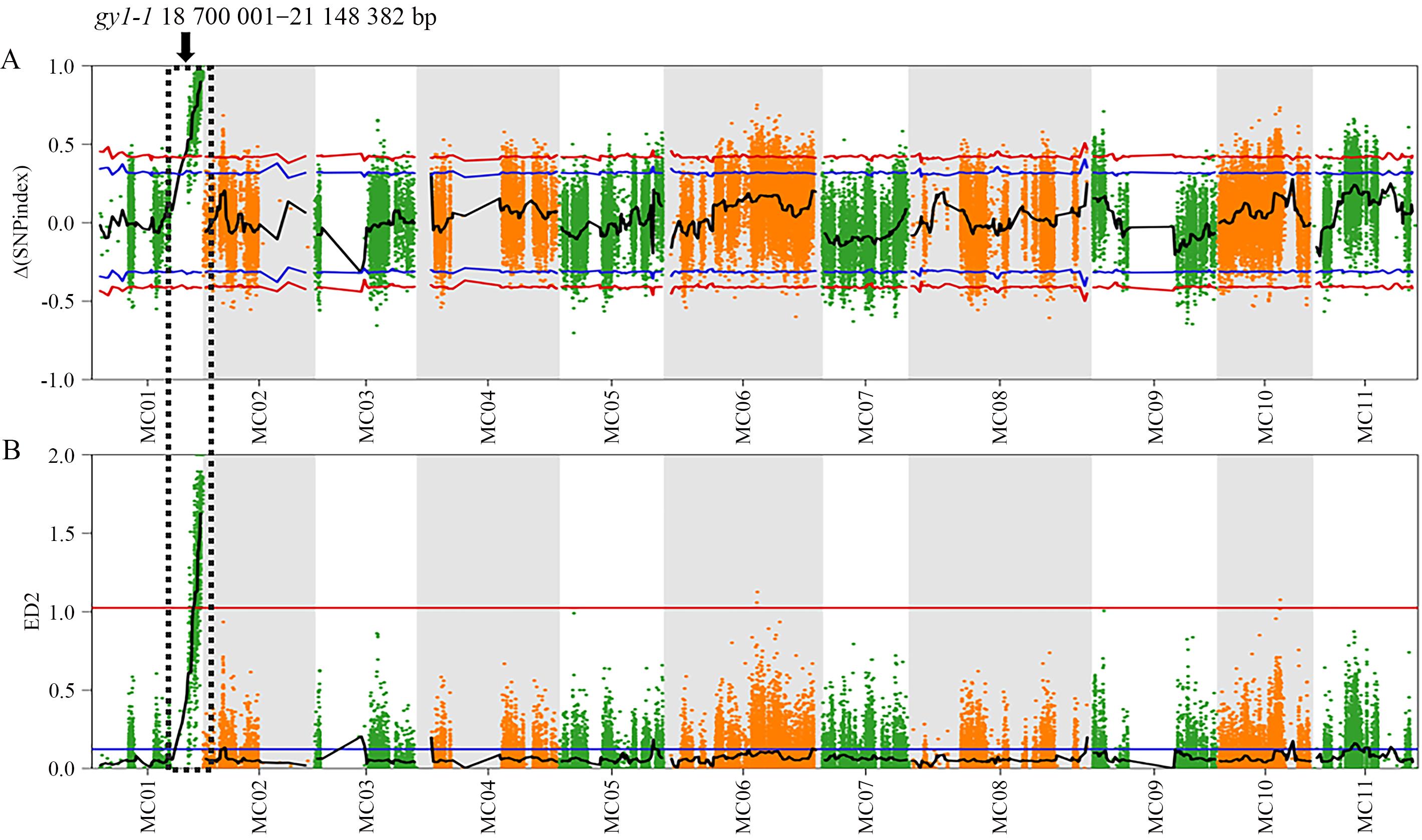
图1 基于BSA-Seq预测对苦瓜全雌基因gy1-1的定位A:Δ(SNP-index)值的分布图;B:ED值的全基因组分布图;散点图为原始值,黑色曲线为拟合值,蓝线和红线分别为95%和99%置信水平阈值线。横坐标表示染色体的位置
Fig. 1 Localization of gynoecious gene gy1-1 based on BSA-Seq predictionA: Δ(SNP-index) distribution map. B: Whole-genome distribution map of ED values. The scatter plot represents the original values, the black curve represents the corresponding fitted values, the blue and red lines represent the threshold lines for 95% and 99% confidence level respectively. The horizontal axis represents the position of chromosomes
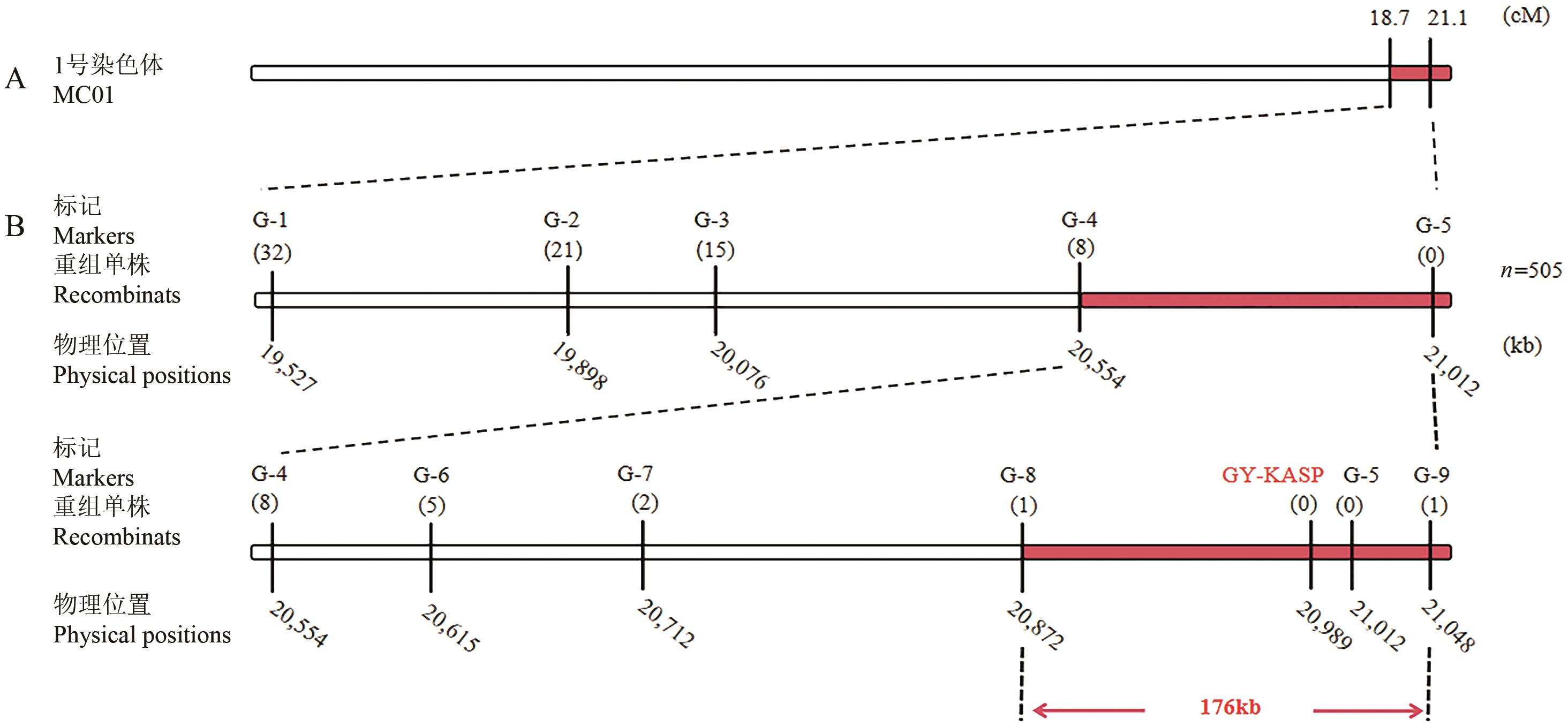
图2 苦瓜全雌基因gy1-1的物理图谱A:gy1-1初定位于1号染色体18.7‒21.1 cM之间;B:利用505个单株精细定位gy1-1于G-8和G-9标记约176 kb范围内,标记下面的数字代表交换单株数
Fig. 2 Physical map of gynoecious gene gy1-1A: The gy1-1 gene is located on chromosome 1 between markers 18.7 cM and 21.1 cM. B: The gy1-1 gene was mapped to a 176 kb region between markers G-8 and G-9, number of recombinant individuals are shown below the markers
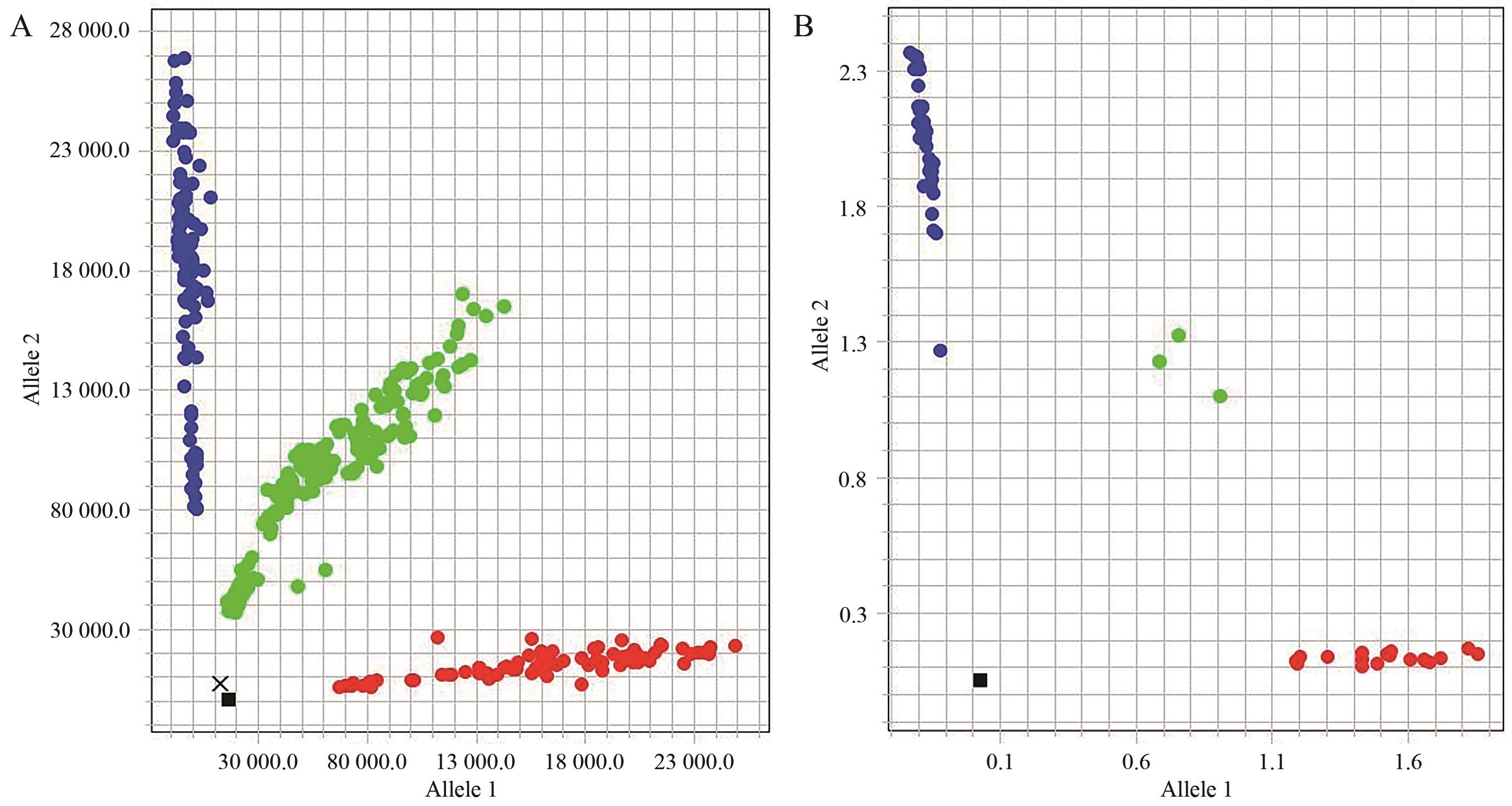
图3 GY-KASP标记在部分F2代群体(A)和54份苦瓜材料(B)中的基因分型结果蓝色信号:全雌型,基因型为C︰C;红色信号:雌雄同株型,基因型为G︰G;绿色:雌雄同株型,基因型为G︰C
Fig. 3 Genotyping results of the GY-KASP marker in some F2 populations (A) and 54 bitter gourd materials (B)Blue signal: Gynoecious type with genotype C:C. Red signal: Monoecious type with genotype G:G. Green: Monoecious type with genotype G:C
编号 No. | 材料名称 Material name | 花性型 Sexual phenotype | 基因型 Genotype | 编号 No. | 材料名称 Material name | 花性型 Sexual phenotype | 基因型 Genotype |
|---|---|---|---|---|---|---|---|
| 1 | MC52 | 全雌型 | C:C | 29 | GY-27 | 全雌型 | C:C |
| 2 | K8 | 雌雄同株型 | G:G | 30 | GY-28 | 全雌型 | C:C |
| 3 | GY-1 | 全雌型 | C:C | 31 | GY-29 | 全雌型 | C:C |
| 4 | GY-2 | 全雌型 | C:C | 32 | GY-30 | 全雌型 | C:C |
| 5 | GY-3 | 全雌型 | C:C | 33 | GY-31 | 全雌型 | C:C |
| 6 | GY-4 | 全雌型 | C:C | 34 | GY-32 | 全雌型 | C:C |
| 7 | GY-5 | 全雌型 | C:C | 35 | GY-33 | 全雌型 | C:C |
| 8 | GY-6 | 全雌型 | C:C | 36 | GY-34 | 全雌型 | C:C |
| 9 | GY-7 | 全雌型 | C:C | 37 | GY-35 | 全雌型 | C:C |
| 10 | GY-8 | 全雌型 | C:C | 38 | GY-36 | 全雌型 | C:C |
| 11 | GY-9 | 全雌型 | C:C | 39 | GY-37 | 全雌型 | C:C |
| 12 | GY-10 | 全雌型 | C:C | 40 | K1 | 雌雄同株型 | G:G |
| 13 | GY-11 | 全雌型 | C:C | 41 | K2 | 雌雄同株型 | G:G |
| 14 | GY-12 | 全雌型 | C:C | 42 | K3 | 雌雄同株型 | G:G |
| 15 | GY-13 | 全雌型 | C:C | 43 | K4 | 雌雄同株型 | G:G |
| 16 | GY-14 | 全雌型 | C:C | 44 | K5 | 雌雄同株型 | G:G |
| 17 | GY-15 | 全雌型 | C:C | 45 | K6 | 雌雄同株型 | G:G |
| 18 | GY-16 | 全雌型 | C:C | 46 | K7 | 雌雄同株型 | G:C |
| 19 | GY-17 | 全雌型 | C:C | 47 | K8 | 雌雄同株型 | G:G |
| 20 | GY-18 | 全雌型 | C:C | 48 | K9 | 雌雄同株型 | G:G |
| 21 | GY-19 | 全雌型 | C:C | 49 | K10 | 雌雄同株型 | G:G |
| 22 | GY-20 | 全雌型 | C:C | 50 | K11 | 雌雄同株型 | G:G |
| 23 | GY-21 | 全雌型 | C:C | 51 | K12 | 雌雄同株型 | G:C |
| 24 | GY-22 | 全雌型 | C:C | 52 | K13 | 雌雄同株型 | G:G |
| 25 | GY-23 | 全雌型 | C:C | 53 | K14 | 雌雄同株型 | G:G |
| 26 | GY-24 | 全雌型 | C:C | 54 | K15 | 雌雄同株型 | G:G |
| 27 | GY-25 | 全雌型 | C:C | 55 | K16 | 雌雄同株型 | G:C |
| 28 | GY-26 | 全雌型 | C:C | 56 | K17 | 雌雄同株型 | G:G |
表2 供试苦瓜材料表型和基因型鉴定
Table 2 Phenotypic and genotypic identification of bitter gourd materials
编号 No. | 材料名称 Material name | 花性型 Sexual phenotype | 基因型 Genotype | 编号 No. | 材料名称 Material name | 花性型 Sexual phenotype | 基因型 Genotype |
|---|---|---|---|---|---|---|---|
| 1 | MC52 | 全雌型 | C:C | 29 | GY-27 | 全雌型 | C:C |
| 2 | K8 | 雌雄同株型 | G:G | 30 | GY-28 | 全雌型 | C:C |
| 3 | GY-1 | 全雌型 | C:C | 31 | GY-29 | 全雌型 | C:C |
| 4 | GY-2 | 全雌型 | C:C | 32 | GY-30 | 全雌型 | C:C |
| 5 | GY-3 | 全雌型 | C:C | 33 | GY-31 | 全雌型 | C:C |
| 6 | GY-4 | 全雌型 | C:C | 34 | GY-32 | 全雌型 | C:C |
| 7 | GY-5 | 全雌型 | C:C | 35 | GY-33 | 全雌型 | C:C |
| 8 | GY-6 | 全雌型 | C:C | 36 | GY-34 | 全雌型 | C:C |
| 9 | GY-7 | 全雌型 | C:C | 37 | GY-35 | 全雌型 | C:C |
| 10 | GY-8 | 全雌型 | C:C | 38 | GY-36 | 全雌型 | C:C |
| 11 | GY-9 | 全雌型 | C:C | 39 | GY-37 | 全雌型 | C:C |
| 12 | GY-10 | 全雌型 | C:C | 40 | K1 | 雌雄同株型 | G:G |
| 13 | GY-11 | 全雌型 | C:C | 41 | K2 | 雌雄同株型 | G:G |
| 14 | GY-12 | 全雌型 | C:C | 42 | K3 | 雌雄同株型 | G:G |
| 15 | GY-13 | 全雌型 | C:C | 43 | K4 | 雌雄同株型 | G:G |
| 16 | GY-14 | 全雌型 | C:C | 44 | K5 | 雌雄同株型 | G:G |
| 17 | GY-15 | 全雌型 | C:C | 45 | K6 | 雌雄同株型 | G:G |
| 18 | GY-16 | 全雌型 | C:C | 46 | K7 | 雌雄同株型 | G:C |
| 19 | GY-17 | 全雌型 | C:C | 47 | K8 | 雌雄同株型 | G:G |
| 20 | GY-18 | 全雌型 | C:C | 48 | K9 | 雌雄同株型 | G:G |
| 21 | GY-19 | 全雌型 | C:C | 49 | K10 | 雌雄同株型 | G:G |
| 22 | GY-20 | 全雌型 | C:C | 50 | K11 | 雌雄同株型 | G:G |
| 23 | GY-21 | 全雌型 | C:C | 51 | K12 | 雌雄同株型 | G:C |
| 24 | GY-22 | 全雌型 | C:C | 52 | K13 | 雌雄同株型 | G:G |
| 25 | GY-23 | 全雌型 | C:C | 53 | K14 | 雌雄同株型 | G:G |
| 26 | GY-24 | 全雌型 | C:C | 54 | K15 | 雌雄同株型 | G:G |
| 27 | GY-25 | 全雌型 | C:C | 55 | K16 | 雌雄同株型 | G:C |
| 28 | GY-26 | 全雌型 | C:C | 56 | K17 | 雌雄同株型 | G:G |
| [1] | Behera TK, Dey SS, Sirohi PS. DBGy-201 and DBGy-202: two gynoecious lines in bitter gourd (Momordica charantia L.) isolated from indigenous source [J]. Indian J Genet Plant Breed, 2006, 66(1): 61-62. |
| [2] | Kumar S, Stecher G, Tamura K. MEGA7: molecular evolutionary genetics analysis version 7.0 for bigger datasets [J]. Mol Biol Evol, 2016, 33(7): 1870-1874. |
| [3] | 汪俏梅, 曾广文, 蒋有条. 苦瓜性别表现研究概况及展望 [J]. 中国蔬菜, 1995(4): 50-53. |
| Wang QM, Zeng GW, Jiang YT. General situation and prospect of research on sex expression of Momordica charantia [J]. China Veg, 1995(4): 50-53. | |
| [4] | Dey SS, Behera TK, Munshi AD, et al. Gynoecious inbred with better combining ability improves yield and earliness in bitter gourd (Momordica charantia L.) [J]. Euphytica, 2010, 173(1): 37-47. |
| [5] | 丁国庆, 贺心茹, 费永俊. 苦瓜育种研究进展 [J]. 中国瓜菜, 2023, 36(7): 1-7. |
| Ding GQ, He XR, Fei YJ. Research progress on the breeding of bitter gourd [J]. China Cucurbits Veg, 2023, 36(7): 1-7. | |
| [6] | Matsumura H, Miyagi N, Taniai N, et al. Mapping of the gynoecy in bitter gourd (Momordica charantia) using RAD-seq analysis [J]. PLoS One, 2014, 9(1): e87138. |
| [7] | Cui JJ, Luo SB, Niu Y, et al. A RAD-based genetic map for anchoring scaffold sequences and identifying QTLs in bitter gourd (Momordica charantia) [J]. Front Plant Sci, 2018, 9: 477. |
| [8] | Aryal R, Ming R. Sex determination in flowering plants: Papaya as a model system [J]. Plant Sci, 2014, 217: 56-62. |
| [9] | Mishra S, Behera TK, Munshi AD, et al. Identification of RAPD marker associated with gynoecious trait (gy-1 gene) in bitter gourd (Momordica charantia L.) [J]. Aust J Crop Sci, 2014, 8(5): 706-710. |
| [10] | 周利娟. 苦瓜全雌性连锁标记筛选及转录组分析 [D]. 武汉: 华中农业大学, 2018. |
| Zhou LJ. Screening of molecular markers linked to gynoecious locus and transcriptome analysis in bitter gourd [D]. Wuhan: Huazhong Agricultural University, 2018. | |
| [11] | 王伟孪. 苦瓜全雌基因定位及硝酸银诱导两性花形成的机理研究 [D]. 武汉: 华中农业大学, 2022. |
| Wang WL. Mapping the loci governing gynoecious and research of the mechanism of bisexual flower development induced by silver nitrate in bitter gourd [D]. Wuhan: Huazhong Agricultural University, 2022. | |
| [12] | Zhong J, Cui JJ, Liu J, et al. Fine-mapping and candidate gene analysis of the Mcgy1 locus responsible for gynoecy in bitter gourd (Momordica spp.) [J]. Theor Appl Genet, 2023, 136(4): 81. |
| [13] | 王鹏, 田哲娟, 康忱, 等. 番茄5个抗病基因KASP分型技术体系的建立与应用 [J]. 园艺学报, 2021, 48(11): 2211-2226. |
| Wang P, Tian ZJ, Kang C, et al. Establishment and application of a tomato KASP genotyping system based on five disease resistance genes [J]. Acta Hortic Sin, 2021, 48(11): 2211-2226. | |
| [14] | 杨青青, 唐家琪, 张昌泉, 等. KASP标记技术在主要农作物中的应用及展望 [J]. 生物技术通报, 2022, 38(4): 58-71. |
| Yang QQ, Tang JQ, Zhang CQ, et al. Application and prospect of KASP marker technology in main crops [J]. Biotechnol Bull, 2022, 38(4): 58-71. | |
| [15] | 任海龙, 许东林, 张晶, 等. 菜薹KASP-SNP指纹图谱构建及品种鉴定 [J]. 园艺学报, 2023, 50(2): 307-318. |
| Ren HL, Xu DL, Zhang J, et al. Establishment of SNP fingerprinting and identification of Chinese flowering cabbage varieties based on KASP genotyping [J]. Acta Hortic Sin, 2023, 50(2): 307-318. | |
| [16] | Cui JJ, Yang Y, Luo SB, et al. Whole-genome sequencing provides insights into the genetic diversity and domestication of bitter gourd (Momordica spp.) [J]. Hortic Res, 2020, 7(1): 85. |
| [17] | Boualem A, Fergany M, Fernandez R, et al. A conserved mutation in an ethylene biosynthesis enzyme leads to andromonoecy in melons [J]. Science, 2008, 321(5890): 836-838. |
| [18] | Chen HM, Sun JJ, Li S, et al. An ACC oxidase gene essential for cucumber carpel development [J]. Mol Plant, 2016, 9(9): 1315-1327. |
| [19] | Aamir M, Karmakar P, Singh VK, et al. A novel insight into transcriptional and epigenetic regulation underlying sex expression and flower development in melon (Cucumis melo L.) [J]. Physiol Plant, 2021, 173(4): 1729-1764. |
| [20] | Zhang SQ, Tan FQ, Chung CH, et al. The control of carpel determinacy pathway leads to sex determination in cucurbits [J]. Science, 2022, 378(6619): 543-549. |
| [21] | Zheng JK, Xia R. Flower development and sex determination in horticultural crops [J]. Fruit Res, 2022, 2(1): 1-9. |
| [22] | Zhang HM, Li S, Yang L, et al. Gain-of-function of the 1-aminocyclopropane-1-carboxylate synthase gene ACS1G induces female flower development in cucumber gynoecy [J]. Plant Cell, 2021, 33(2): 306-321. |
| [23] | Mach J. Copious cucurbits coming up! Function of the Female locus in cucumber gynoecy [J]. Plant Cell, 2021, 33(2): 173-174. |
| [24] | Feng BM, Lu DH, Ma X, et al. Regulation of the Arabidopsis anther transcriptome by DYT1 for pollen development [J]. Plant J, 2012, 72(4): 612-624. |
| [25] | Tao QY, Niu HH, Wang ZY, et al. Ethylene responsive factor ERF110 mediates ethylene-regulated transcription of a sex determination-related orthologous gene in two Cucumis species [J]. J Exp Bot, 2018, 69(12): 2953-2965. |
| [26] | Wang R, Lin YE, Jin QM, et al. RNA-Seq analysis of gynoecious and weak female cucumber revealing the cell cycle pathway may regulate sex determination in cucumber [J]. Gene, 2019, 687: 289-297. |
| [27] | 蒋金金, 苏汉东, 洪登峰, 等. 植物生物技术研究进展 [J]. 植物生理学报, 2023, 59(8): 1436-1462. |
| Jiang JJ, Su HD, Hong DF, et al. Advances and perspectives in plant biotechnology [J]. Plant Physiol J, 2023, 59(8): 1436-1462. | |
| [28] | Zang R, Zhao Y, Guo KD, et al. Population genetic variation analysis of bitter gourd wilt caused by Fusarium oxysporum f. sp. momordicae in China using inter simple sequence repeats (ISSR) molecular markers [J]. J Plant Pathol, 2021, 103(3): 787-797. |
| [29] | 于仁波, 牛玉, 王笑一, 等. 苦瓜MAP30基因序列多态性与苦瓜瓜形连锁分析 [J]. 分子植物育种, 2021, 19(18): 6064-6073. |
| Yu RB, Niu Y, Wang XY, et al. Linkage analysis between the polymorphism of MAP30 gene sequences and fruit phenotype in bitter gourd [J]. Mol Plant Breed, 2021, 19(18): 6064-6073. | |
| [30] | 徐云碧, 王冰冰, 张健, 等. 应用分子标记技术改进作物品种保护和监管 [J]. 作物学报, 2022, 48(8): 1853-1870. |
| Xu YB, Wang BB, Zhang J, et al. Enhancement of plant variety protection and regulation using molecular marker technology [J]. Acta Agron Sin, 2022, 48(8): 1853-1870. | |
| [31] | 崔竣杰, 程蛟文, 曹毅, 等. 基于SSR标记和表型性状构建苦瓜核心种质的研究 [J]. 中国蔬菜, 2022(2): 25-32. |
| Cui JJ, Cheng JW, Cao Y, et al. Studies on construction of bitter gourd core collection based on SSR markers and phenotypic traits [J]. China Veg, 2022(2): 25-32. | |
| [32] | Devran Z, Göknur A, Mesci L. Development of molecular markers for the Mi-1 gene in tomato using the KASP genotyping assay [J]. Hortic Environ Biotechnol, 2016, 57(2): 156-160. |
| [1] | 刘倩, 王宗燕, 罗浚豪, 吴张璋, 胡振, 吕建珍, 姜亮. 基于BSA-Seq谷子落粒主效基因的定位与候选基因分析[J]. 生物技术通报, 2026, 42(7): 138-147. |
| [2] | 吴夏明, 周陈平, 杨敏, 徐泽, 邝瑞彬, 刘传和, 贺涵, 魏岳荣. 基于BSA-seq的番木瓜株高候选基因定位[J]. 生物技术通报, 2025, 41(9): 54-61. |
| [3] | 王腾辉, 葛雯冬, 罗雅方, 范震宇, 王玉书. 基于极端混合池(BSA)全基因组重测序的羽衣甘蓝白色叶基因定位[J]. 生物技术通报, 2023, 39(9): 176-182. |
| [4] | 周诗晨, 仪治本, 王馨翊, 杨晓颖, 孙丽娜, 栾维江, 梁闪闪. 高粱双粒突变体Dgs的遗传分析与基因定位[J]. 生物技术通报, 2022, 38(7): 171-177. |
| [5] | 孙平勇, 张武汉, 舒服, 何强, 张莉, 彭志荣, 邓华凤. 香稻品种OsBADH2突变位点分析及其功能标记的开发[J]. 生物技术通报, 2021, 37(4): 1-7. |
| [6] | 韩立杰, 才宏伟. 高粱粒重遗传研究进展[J]. 生物技术通报, 2019, 35(5): 15-27. |
| [7] | 董斌, 李荣喜, 黄永芳, 洪文泓, 谭莎. 分子标记在油茶研究中的应用[J]. 生物技术通报, 2015, 31(6): 74-80. |
| [8] | 王建军,杨慧珍,刘佼. cryIAc基因在转基因玉米中的遗传规律及对抗虫性影响[J]. 生物技术通报, 2015, 31(1): 122-130. |
| [9] | 刘子记, 詹园凤, 杨衍. 利用SSR标记鉴定热研二号油绿苦瓜杂交种纯度[J]. 生物技术通报, 2014, 0(2): 75-78. |
| [10] | 甘仪梅,曾凡云,张树珍,杨本鹏. BAC-FISH在植物基因组研究中的应用[J]. 生物技术通报, 2013, 29(10): 58-65. |
| [11] | 王日升,张曼,黄如葵,刘文君,董文斌,车江旅,方锋学,李杨瑞. 全雌系苦瓜ACC氧化酶基因cDNA克隆及序列分析[J]. 生物技术通报, 2013, 29(10): 76-80. |
| [12] | 王日升;张曼;方锋学;黄如葵;刘文君;杨丽涛;李杨瑞;. 全雌系苦瓜ACC合成酶基因cDNA克隆及序列分析[J]. , 2012, 0(06): 54-58. |
| [13] | 胡裕清;赵树进;. RAPD技术及其在植物研究中的应用[J]. , 2010, 0(05): 74-77. |
| [14] | 钟鸣;裴铁浓;李浩戈;陈丽静;马慧;郭志富;张丽;. 环羟基化双加氧酶α亚基保守序列的克隆及基因定位[J]. , 2009, 0(05): 69-70. |
| [15] | 蔡春苗;施碧红;赵明富;黄招德;. 水稻光温敏不育基因研究概况[J]. , 2008, 0(02): 23-27. |
| 阅读次数 | ||||||
|
全文 |
|
|||||
|
摘要 |
|
|||||
