







生物技术通报 ›› 2026, Vol. 42 ›› Issue (9): 128-136.doi: 10.13560/j.cnki.biotech.bull.1985.2026-0339
• 植物发育生物学专题 • 上一篇
刘娜威, 钱孟英, 张洪映, 王召军, 崔红, 闫筱筱( )
)
收稿日期:2026-03-26
出版日期:2026-09-26
发布日期:2026-09-16
通讯作者:
闫筱筱xiaoxyan@henau.edu.cn基金资助:
LIU Na-wei, QIAN Meng-ying, ZHANG Hong-ying, WANG Zhao-jun, CUI Hong, YAN Xiao-xiao()
Received:2026-03-26
Published:2026-09-26
Online:2026-09-16
摘要:
目的 探究茉莉酸(jasmonic acid, JA)介导下NtWUN转录因子的作用模式,明确该转录因子调控烟草表皮毛生长发育的内在机理,为深入解析茉莉酸调控植物表皮结构发育的分子机制奠定数据与理论支撑。 方法 在普通烟草K326中通过同源克隆、生物信息学分析、亚细胞定位、实时荧光定量PCR等方法,解析NtWUN基因的序列特征、蛋白结构与亚细胞定位特征,明确该基因在烟草不同组织中的表达差异及在不同浓度MeJA处理条件下的表达模式;通过创制NtWUN基因过表达与基因敲除植株,开展该基因的功能验证。 结果 NtWUN有2条同源序列NtWUN-1和NtWUN-2,NtWUN-1编码区全长630 bp,NtWUN-2编码区全长636 bp,分别编码209、211个氨基酸。进化树分析结果表明,NtWUN-1与林烟草高度同源,NtWUN-2与绒毛烟草高度同源,二者与枸杞中的同源基因亲缘关系较近。表达模式分析发现,NtWUN-1与NtWUN-2均在叶中表达量最高,随后依次为表皮毛、茎和花,在根中表达量最低。不同浓度MeJA处理下,NtWUN-1与NtWUN-2的相对表达量均呈先上升后下降趋势,NtWUN-1与NtWUN-2在24 h后受MeJA强烈诱导,表达量分别上调10.2倍和11.8倍。亚细胞定位结果显示,NtWUN-1与NtWUN-2都定位在细胞核。腺毛形态与密度观察发现,NtWUN过表达株系(OE8)长柄腺毛和短柄腺毛分别减少了37.5%和35.7%;敲除株系(KO2)分别增加50.0%和57.1%;上述2种转基因烟草的腺毛类型不受影响。 结论 NtWUN负调控JA介导的烟草长柄腺毛和短柄腺毛的生长发育。
刘娜威, 钱孟英, 张洪映, 王召军, 崔红, 闫筱筱. NtWUN负调控烟草表皮毛发育[J]. 生物技术通报, 2026, 42(9): 128-136.
LIU Na-wei, QIAN Meng-ying, ZHANG Hong-ying, WANG Zhao-jun, CUI Hong, YAN Xiao-xiao. NtWUN Negatively Regulates Tobacco Trichome Development[J]. Biotechnology Bulletin, 2026, 42(9): 128-136.
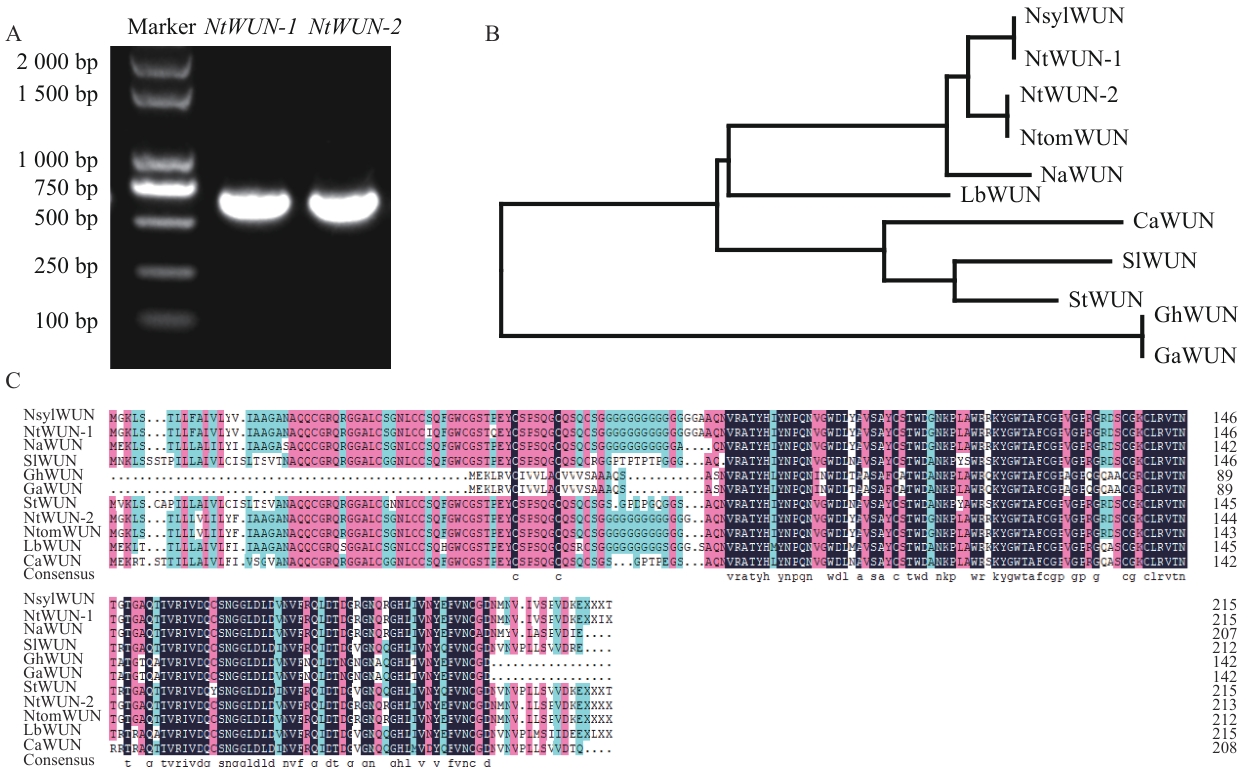
图1 NtWUN的克隆及生物信息学分析A:NtWUN克隆PCR电泳图;B:NtWUN及其同源蛋白系统进化树;C:NtWUN与近缘物种同源蛋白序列多重比对分析,Nt:普通烟草;Nsyl:林烟草;Ntom:绒毛烟草;Na:渐狭叶烟草;Lb:枸杞;Ca:辣椒;Sl:番茄;St:马铃薯;Gh:陆地棉;Ga:树棉
Fig. 1 Cloning and bioinformatics analysis of NtWUNA: PCR electrophoresis of NtWUN cloning. B: Phylogenetic tree of NtWUN and its homologous proteins. C: Multiple sequence alignment of NtWUN homologous proteins from closely related species. Nt: Nicotiana tabacum. Nsyl: N. sylvestris. Ntom: N. tomentosiformis. Na: N. attenuata. Lb: Lycium barbarum. Ca: Capsicum annuum. Sl: Solanum lycopersicum. St: Solanum tuberosum. Gh: Gossypium hirsutum. Ga: Gossypium arboreum
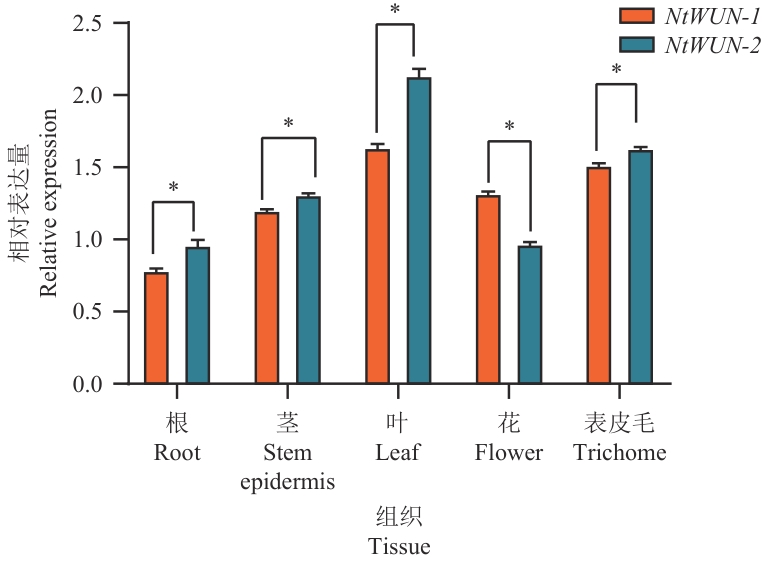
图2 NtWUN在不同组织中的表达模式*P<0.05. The same below
Fig. 2 Expression pattern of NtWUN in different tissues
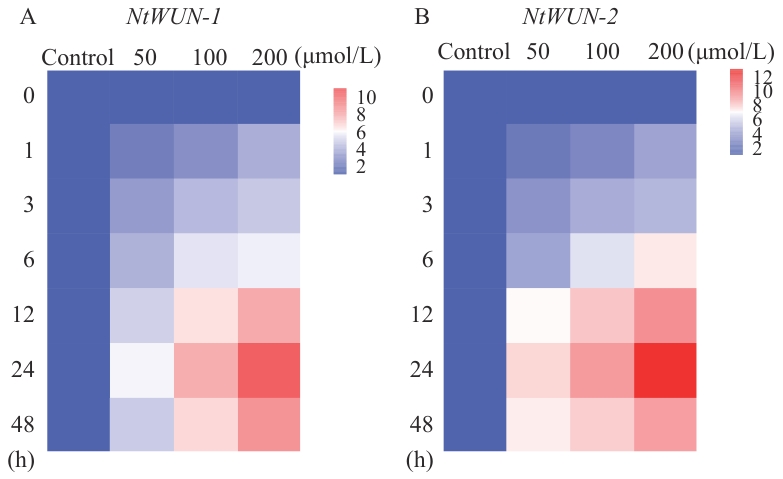
图3 NtWUN响应不同浓度MeJA处理的表达分析
Fig. 3 Expression analysis of NtWUN in response to treatments with different concentrations of MeJA
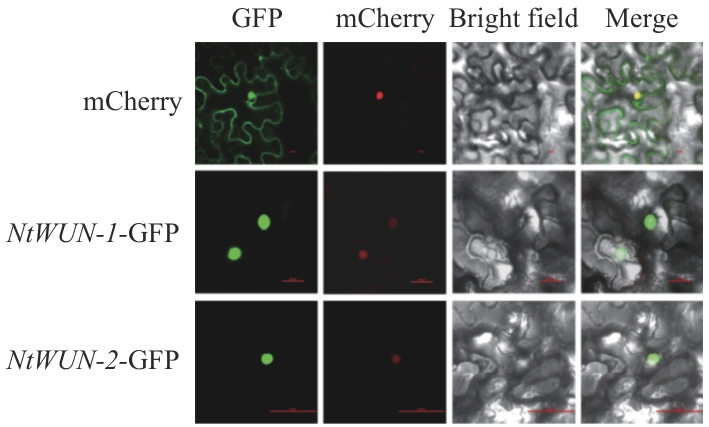
图4 NtWUN蛋白的亚细胞定位
Fig. 4 Subcellular localization of the NtWUN protein
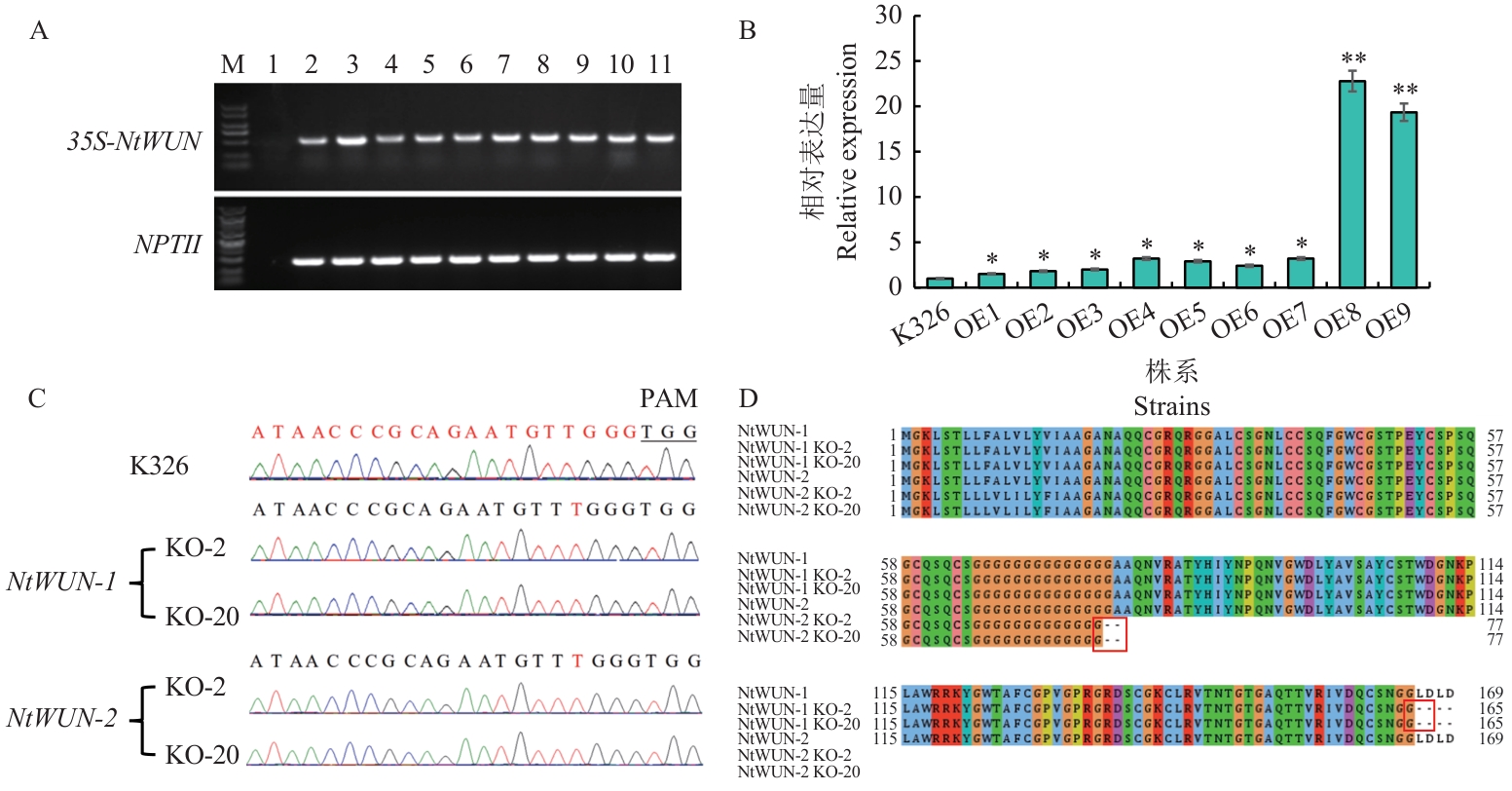
图5 NtWUN过表达植株及敲除纯合株系鉴定A:NtWUN过表达阳性株系PCR鉴定(M:DNA marker 2 000,1:ddH2O,2:NtWUN过表达质粒,3-11:9个转基因阳性单株);B:NtWUN-2过表达阳性植株基因表达水平(**P<0.01,以K326中的表达量为参比1);C:敲除纯合单株sgRNA区域测序分析;D:纯合突变单株中NtWUN蛋白翻译情况;红色方框标注的短横线代表蛋白翻译提前终止
Fig. 5 Identification of NtWUN-overexpressing plants and homozygous knockout linesA: PCR identification of NtWUN overexpression positive lines (M: DNA marker 2 000; 1: ddH₂O; 2: NtWUN overexpression plasmid; 3-11: nine individual transgenic positive plants). B: Gene expression levels in NtWUN-2 overexpression positive plants (**P<0.01, with the expression level in K326 as reference 1). C: Sequencing analysis of the sgRNA region in homozygous knockout plants. D: Protein translation of NtWUN in homozygous mutant plants. Short horizontal lines within red boxes indicate premature translation termination
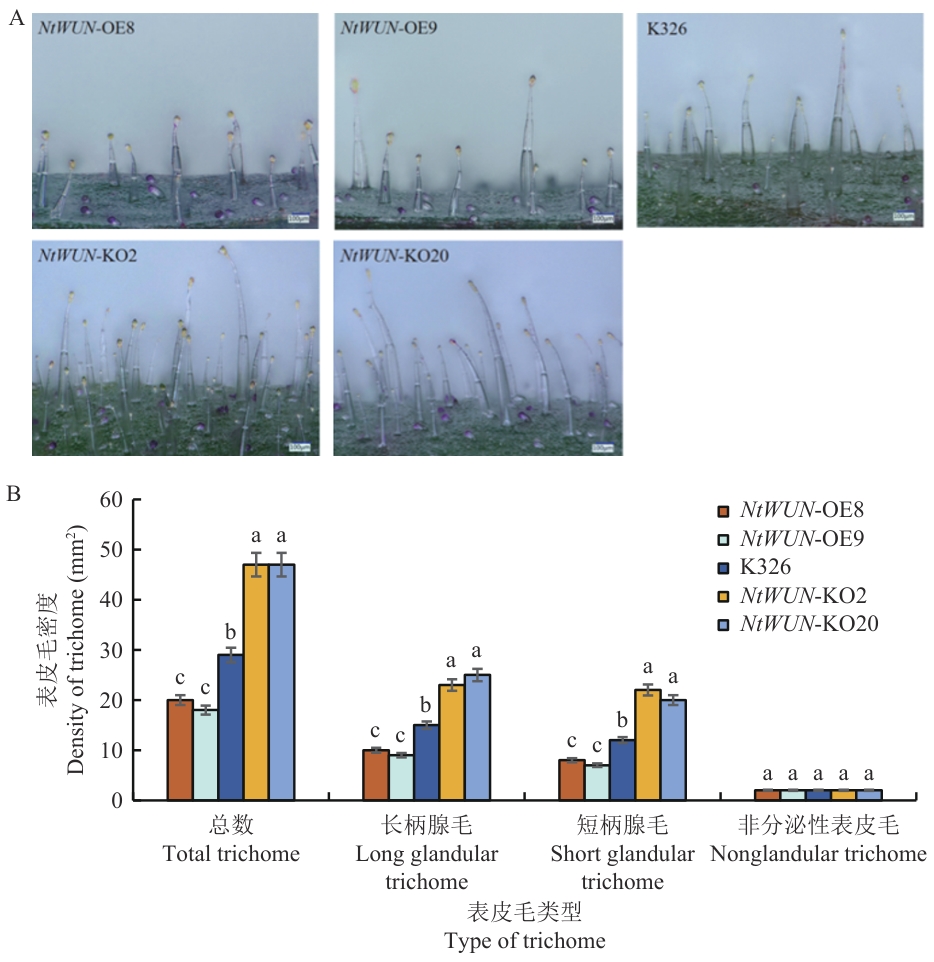
图6 叶面表皮毛形态观察(A)与密度分析(B)同组柱形图上标有不同小字母表示0.05水平差异显著
Fig. 6 Morphological observation (A) and density analysis (B) of trichomes on the leaf surfaceDifferent lowercase letters above the bars within the same group indicate significant differences at the 0.05 level
| [1] | Iwase A, Mitsuda N, Koyama T, et al. The AP2/ERF transcription factor WIND1 controls cell dedifferentiation in Arabidopsis [J]. Curr Biol, 2011, 21(6): 508-514. |
| [2] | 裴丹, 尚俏俏, 李佳琦, 等. AP2/ERF转录因子介导植物抗病反应研究进展 [J]. 植物病理学报, 2025, 55(6): 1181-1194. |
| Pei D, Shang QQ, Li JQ, et al. Progress on AP2/ERF transcription factor in regulating plant disease [J]. Acta Phytopathol Sin, 2025, 55(6): 1181-1194. | |
| [3] | 毛可欣, 李健, 吕巍, 等. 猕猴桃AP2/ERF家族成员鉴定与分析 [J]. 分子植物育种, 2025(2): 402-414. |
| Mao KX, Li J, Lü W, et al. Identification and analysis of AP2/ERF family members in Actinidia chinensis [J]. Mol Plant Breed, 2025(2): 402-414. | |
| [4] | Kuo A, Hla T. Regulation of cellular and systemic sphingolipid homeostasis [J]. Nat Rev Mol Cell Biol, 2024, 25(10): 802-821. |
| [5] | 邓江霞, 张国良, 李边豪, 等. WRKY类转录因子在植物激素ABA、SA和JA信号转导中的作用 [J]. 黑龙江农业科学, 2023(10): 138-144. |
| Deng JX, Zhang GL, Li BH, et al. Role of WRKY transcription factors in plant hormone ABA, SA and JA signal transduction [J]. Heilongjiang Agric Sci, 2023(10): 138-144. | |
| [6] | Dhatterwal P, Basu S, Mehrotra S, et al. Genome wide analysis of W-box element in Arabidopsis thaliana reveals TGAC motif with genes down regulated by heat and salinity [J]. Sci Rep, 2019, 9: 1681. |
| [7] | Zhang Y, Xia PG. The DREB transcription factor, a biomacromolecule, responds to abiotic stress by regulating the expression of stress-related genes [J]. Int J Biol Macromol, 2023, 243: 125231. |
| [8] | Rafik B, Ramsey Matthew R. Understanding transcriptional networks regulating initiation of cutaneous wound healing [J]. Yale J Biol Med, 93(1): 161-173. |
| [9] | 钱孟英, 李丽华, 宋正熊, 等. 洛阳烟区不同烤烟品种腺毛形态及分泌物特性比较分析 [J]. 江西农业学报, 2026(2): 17-24. |
| Qian MY, Li LH, Song ZX, et al. Comparison analysis of glandular trichomes morphology and secretion characteristics among different flue-cured tobacco varieties in Luoyang tobacco-planting area [J]. Acta Agric Jiangxi, 2026(2): 17-24. | |
| [10] | Ahmad M, Li S, Dong YM, et al. Nature’s shield: exploring nonglandular trichomes (NGT) as key players in plant defense mechanisms [J]. Plant Direct, 2025, 9(11): e70118. |
| [11] | Hao N, Kamiya T, Wu T. Morphology of glandular trichome and lignin-based structure for its function [J]. Fundam Res, 2026, 6(2): 834-836. |
| [12] | Ryu SM, Kim K, Jeon Y, et al. Integrative chemotaxonomic and micromorphological insights into Peucedanum (Apiaceae) [J]. Sci Rep, 2026, 16(1): 8762. |
| [13] | Dong MM, Xue SD, Bartholomew ES, et al. Transcriptomic and functional analysis provides molecular insights into multicellular trichome development [J]. Plant Physiol, 2022, 189(1): 301-314. |
| [14] | Liu LS, Campoli C, McKim SM. Transcriptional control of cuticle formation during development [J]. J Exp Bot, 2026, 77(11): 3410-3425. |
| [15] | 李晓佩, 王思宁, 史晶晶, 等. 植物表皮蜡质合成及调控因子WIN/SHN的研究进展 [J]. 生物技术通报, 2020, 36(12): 129-136. |
| Li XP, Wang SN, Shi JJ, et al. Progress of plant cuticular wax synthesis and its regulatory factor WIN/SHN [J]. Biotechnol Bull, 2020, 36(12): 129-136. | |
| [16] | Khoudi H. SHINE clade of ERF transcription factors: a significant player in abiotic and biotic stress tolerance in plants [J]. Plant Physiol Biochem, 2023, 195: 77-88. |
| [17] | Liu N, Chen J, Wang TH, et al. Overexpression of WAX INDUCER1/SHINE1 gene enhances wax accumulation under osmotic stress and oil synthesis in Brassica napus [J]. Int J Mol Sci, 2019, 20(18): 4435. |
| [18] | Chang J, Wu SR, You T, et al. Spatiotemporal formation of glands in plants is modulated by MYB-like transcription factors [J]. Nat Commun, 2024, 15: 2303. |
| [19] | Li JJ, Tang B, Li YX, et al. Rice SPL10 positively regulates trichome development through expression of HL6 and auxin-related genes [J]. J Integr Plant Biol, 2021, 63(8): 1521-1537. |
| [20] | Vanneste S, Pei YR, Friml J. Mechanisms of auxin action in plant growth and development [J]. Nat Rev Mol Cell Biol, 2025, 26(9): 648-666. |
| [21] | Liu H, Yao XH, Fan JW, et al. Cell wall invertase 3 plays critical roles in providing sugars during pollination and fertilization in cucumber [J]. Plant Physiol, 2024, 195(2): 1293-1311. |
| [22] | 张桂林, 唐伟林, 康琴, 等. 薄荷茉莉酸信号抑制子McJAZ8基因的鉴定与功能分析 [J]. 中国中药杂志, 2024, 49(3): 691-701. |
| Zhang GL, Tang WL, Kang Q, et al. Identification and functional analysis of jasmonic acid signaling repressor McJAZ8 gene in Mentha canadensis [J]. China J Chin Mater Med, 2024, 49(3): 691-701. | |
| [23] | 赵青平, 周索. 茉莉酸调节植物表皮毛发育的分子机理研究进展 [J]. 南阳师范学院学报, 2021, 20(6): 51-57. |
| Zhao QP, Zhou S. Research progress on molecular mechanism of jasmonate acid-mediated plant trichome development [J]. J Nanyang Norm Univ, 2021, 20(6): 51-57. | |
| [24] | Cao ZY, Li N. Genome-wide identification of the JAZ gene family in garlic (Allium sativum L.) and the functional role of AsJAZ17 in salt tolerance [J]. Plants, 2026, 15(10): 1543. |
| [25] | Chen TT, Liu H, Li YP, et al. AaSEPALLATA1 integrates jasmonate and light-regulated glandular secretory trichome initiation in Artemisia annua [J]. Plant Physiol, 2023, 192(2): 1483-1497. |
| [26] | Hua B, Chang J, Han XQ, et al. H and HL synergistically regulate jasmonate-triggered trichome formation in tomato [J]. Hortic Res, 2022, 9: uhab080. |
| [27] | 刘向阳, 张新要, 郑淑心, 等. NtJAZ1基因敲除对烟草MeJA应答反应的影响研究 [J]. 中国烟草学报, 2023, 29(3): 66-73. |
| Liu XY, Zhang XY, Zheng SX, et al. Effect of NtJAZ1 knockout on MeJA response in tobacco [J]. Acta Tabacaria Sin, 2023, 29(3): 66-73. | |
| [28] | 朱文奇, 张新要, 裴文毅, 等. NtJAZ9基因参与调控烟草腺毛发生的功能研究 [J]. 中国烟草学报, 2024, 30(4): 95-104. |
| Zhu WQ, Zhang XY, Pei WY, et al. Functional study on the role of NtJAZ9 gene in regulating the formation of tobacco glandular trichomes [J]. Acta Tabacaria Sin, 2024, 30(4): 95-104. | |
| [29] | 常思敏, 韦凤杰. 烟草集约化育苗理论与技术 [M]. 北京: 中国农业出版社, 2010. |
| Chang SM, Wei FJ. Theory and technology of tobacco intensive seedling raising [M]. Beijing: China Agriculture Press, 2010. | |
| [30] | Arocho A, Chen BY, Ladanyi M, et al. Validation of the 2-ΔΔCt calculation as an alternate method of data analysis for quantitative PCR of BCR-ABL P210 transcripts [J]. Diagn Mol Pathol, 2006, 15(1): 56-61. |
| [31] | 段史江, 陈小龙, 梁周虹, 等. NtLTP2基因在烟草根系发育中的功能分析 [J]. 烟草科技, 2023, 56(6): 1-7. |
| Duan SJ, Chen XL, Liang ZH, et al. Functional characterization of NtLTP2 in regulating tobacco root development [J]. Tob Sci Technol, 2023, 56(6): 1-7. | |
| [32] | 孟盈, 闫筱筱, 王召军, 等. NtCycB2基因表达对烟草腺毛发生的影响 [J]. 中国烟草学报, 2019, 25(2): 85-92, 98. |
| Meng Y, Yan XX, Wang ZJ, et al. Effects of NtCycB2 expression on tobacco trichomes [J]. Acta Tabacaria Sin, 2019, 25(2): 85-92, 98. | |
| [33] | 潘影, 张振远, 滕环瑜, 等. 烟草腺毛生物反应器材料的创制与性状分析 [J]. 烟草科技, 2023, 56(7): 1-7. |
| Pan Y, Zhang ZY, Teng HY, et al. Creation and characterization of tobacco glandular trichome bioreactor material [J]. Tob Sci Technol, 2023, 56(7): 1-7. | |
| [34] | 王奇, 李晓旭, 郭存, 等. 普通烟草NtNAC055基因的克隆、鉴定及表达分析 [J]. 中国烟草科学, 2021, 42(4): 50-57. |
| Wang Q, Li XX, Guo C, et al. Cloning, characterization and expression analysis of NtNAC055 in Nicotiana tabacum L [J]. Chin Tob Sci, 2021, 42(4): 50-57. | |
| [35] | Yan XX, Guan YY, Liu XY, et al. NtCycB2 gene knockout enhances resistance to high salinity stress in Nicotiana tabacum [J]. Ind Crops Prod, 2021, 171: 113886. |
| [36] | 季盈彤, 高嘉宁, 钱孟英, 等. 烟草NtJAZ11参与调控表皮毛发育的影响研究 [J]. 中国农业科技导报, 2026, 28(3): 63-73. |
| Ji YT, Gao JN, Qian MY, et al. Effects of NtJAZ11 on tobacco trichomes development [J]. J Agric Sci Technol, 2026, 28(3): 63-73. | |
| [37] | 李艳华, 张洪映, 魏跃伟, 等. 典型烤烟品种腺毛形态及分泌特性比较分析 [J]. 中国烟草学报, 2017, 23(2): 84-91. |
| Li YH, Zhang HY, Wei YW, et al. Comparison analysis of trichome morphology and secretion of typical flue-cured tobacco varieties [J]. Acta Tabacaria Sin, 2017, 23(2): 84-91. | |
| [38] | 高嘉宁, 王召军, 季盈彤, 等. NtWo基因对烟草表皮毛发育的影响研究 [J]. 中国烟草学报, 2025, 31(5): 48-59. |
| Gao JN, Wang ZJ, Ji YT, et al. Study on the effect of NtWo gene on epidermal hair development in tobacco [J]. Acta Tabacaria Sin, 2025, 31(5): 48-59. | |
| [39] | 闫美琦, 王琦, 李玉娥, 等. 林烟草与绒毛状烟草叶面表皮毛表型分化及分子基础的比较 [J]. 烟草科技, 2026, 59(1): 20-29. |
| Yan MQ, Wang Q, Li YE, et al. Phenotypic differentiations of leaf trichome of Nicotiana sylvestris and Nicotiana tomentosiformis and their molecular basis [J]. Tob Sci Technol, 2026, 59(1): 20-29. | |
| [40] | Hu HY, He X, Tu LL, et al. GhJAZ2 negatively regulates cotton fiber initiation by interacting with the R2R3-MYB transcription factor GhMYB25-like [J]. Plant J, 2016, 88(6): 921-935. |
| [41] | 吴致君,黎星辉,房婉萍,等.茶树CsRAV2转录因子基因的克隆与表达特性分析[J].茶叶科学, 2014, 34(3): 297-306. |
| Wu ZJ, Li XH, Fang WP, et al. Cloning and expression characteristic analysis of transcription factor gene CsRAV2 in Camellia sinensis [J]. J Tea Sci, 2014, 34(3): 297-306. | |
| [42] | Gao Y, Guo JQ, Zhao JF. Molecular mechanisms of Arabidopsis trichome development [J]. Chin Bull Bot, 2011, 46(1): 119-127. |
| [43] | Wang Y, Li Y, He SP, et al. The transcription factor ERF108 interacts with AUXIN RESPONSE FACTORs to mediate cotton fiber secondary cell wall biosynthesis [J]. Plant Cell, 2023, 35(11): 4133-4154. |
| [44] | 张麒, 陈静, 李俐, 等. 植物AP2/ERF转录因子家族的研究进展 [J]. 生物技术通报, 2018, 34(8): 1-7. |
| Zhang Q, Chen J, Li L, et al. Research progress on plant AP2/ERF transcription factor family [J]. Biotechnol Bull, 2018, 34(8): 1-7. | |
| [45] | Zhang JY, Zhang YT, Song SW, et al. Supplementary red light results in the earlier ripening of tomato fruit depending on ethylene production [J]. Environ Exp Bot, 2020, 175: 104044. |
| [46] | Wang ML, Wang YD, Li XZ, et al. Integration of metabolomics and transcriptomics reveals the regulation mechanism of the phenylpropanoid biosynthesis pathway in insect resistance traits in Solanum habrochaites [J]. Hortic Res, 2024, 11(2): uhad277. |
| [47] | Qin W, Xie LH, Li YP, et al. An R2R3-MYB transcription factor positively regulates the glandular secretory trichome initiation in Artemisia annua L [J]. Front Plant Sci, 2021, 12: 657156. |
| [1] | 郑晓雨, 汪忆雪, 赵晓敏, 吴君章, 任洁馨, 钱亚新, 肖志亮, 刘正文, 潘晓薇, 李依婷. 烟草倍半萜合成酶基因NtEAS的体外功能鉴定[J]. 生物技术通报, 2026, 42(8): 197-206. |
| [2] | 金曼, 龚奕杭, 潘文波, 罗培润, 高伟, 李平东, 唐晓艳. 基因编辑技术在创制抗除草剂水稻中的研究进展[J]. 生物技术通报, 2026, 42(8): 8-21. |
| [3] | 张仲文, 王卫民, 肖志亮, 史久长, 郝贤伟, 王威, 谢鹏岗, 许佳丹, 赵炯平, 杨爱国. NtPLA2A介导激素信号通路增强烟草青枯病抗性的机制[J]. 生物技术通报, 2026, 42(8): 207-216. |
| [4] | 曾亚丹, 毕佳俊, 李兴龙, 常悦, 角德灵, 魏红江, 赵恒. Cas12a介导的猪细胞定点插入体系构建与效率评估[J]. 生物技术通报, 2026, 42(8): 72-80. |
| [5] | 何婧婧, 朋毛拉专, 姚晓华, 姚有华, 吴昆仑, 崔永梅. 青稞HvNAC53的克隆及功能分析[J]. 生物技术通报, 2026, 42(8): 142-152. |
| [6] | 范帆, 李梦娇, 杨贤鹏, 崔莉莉. 拟南芥耐受磷酸三苯酯毒性突变体的筛选及相关基因的功能分析[J]. 生物技术通报, 2026, 42(7): 226-235. |
| [7] | 段雅馨, 李成晨, 潘玉玲, 王丽, 安康, 李小波, 祝光涛, 刘计涛. 马铃薯LEA_2基因家族鉴定及响应低温与激素功能分析[J]. 生物技术通报, 2026, 42(6): 40-52. |
| [8] | 翟莹, 高双, 计俊杰, 于海伟, 赵艳, 马天意, 张梅娟, 李珊珊. 工业大麻转录因子CsMYB12抗旱功能的研究[J]. 生物技术通报, 2026, 42(6): 294-303. |
| [9] | 顾恒, 郑栋, 宰舟颖, 陈贡伟, 岳远征, 王良桂, 杨秀莲. 桂花OfSVB1响应盐胁迫的功能研究[J]. 生物技术通报, 2026, 42(5): 332-339. |
| [10] | 董亚茹, 聂玉霞, 朱红, 王照红, 刘惠芬, 郭光. 过表达桑树MnERF2增强拟南芥抗旱性[J]. 生物技术通报, 2026, 42(4): 182-189. |
| [11] | 刘青媛, 吴洪启, 陈秀娥, 陈剑, 姜远泽, 何燕子, 喻奇伟, 刘仁祥. 转录因子NtMYB96a调控烟草耐旱性的功能研究[J]. 生物技术通报, 2026, 42(4): 239-250. |
| [12] | 郭道祥, 苏全, 李奥婷, 王燕, 陈清, 王小蓉, 何文. 柚MYB基因家族的鉴定及其在砧穗不亲和叶片黄化中的功能分析[J]. 生物技术通报, 2026, 42(4): 170-181. |
| [13] | 朱志炎, 宋芷薇, 何珊, 张德清, 何勇, 田志宏. 烟草靶斑病拮抗菌的鉴定及其防治特性[J]. 生物技术通报, 2026, 42(4): 310-320. |
| [14] | 彭朝凤, 夏琳, 刘瑞霞, 闫新可, 牧杨威, 刘梦茹, 杨军, 武明珠. 基于VIGS和CRISPR/Cas9技术的烟草NtPPO5基因功能分析[J]. 生物技术通报, 2026, 42(4): 251-262. |
| [15] | 袁梦博, 赵光伟, 贺玉花, 黄祥, 徐永阳, 张健, 孔维虎, 田小琴, 户克云, 唐伶俐. CmCRC基因影响甜瓜性别分化的功能研究[J]. 生物技术通报, 2026, 42(3): 294-301. |
| 阅读次数 | ||||||
|
全文 |
|
|||||
|
摘要 |
|
|||||
