







生物技术通报 ›› 2026, Vol. 42 ›› Issue (5): 5-15.doi: 10.13560/j.cnki.biotech.bull.1985.2026-0429
杨兴盛1,2( ), 伍绍龙3(), 冯凯1,2, 王尚1,2, 彭玺1,2, 赵博1,2, 刘明倩1,2, 顾松松1,2, 何晴1, 李春格1, 胡秋龙4, 邓晔1,2()
收稿日期:2026-04-15
出版日期:2026-05-26
发布日期:2026-06-10
通讯作者:
伍绍龙,男,博士,高级农艺师,研究方向 :烟草智慧农业;E-mail: slwuhnyc@126.com作者简介:杨兴盛,男,博士研究生,研究方向 :微生物组和宏代谢组;E-mail: yangxingsheng18@mails.ucas.ac.cn
基金资助:
YANG Xing-sheng1,2(), Wu Shao-long3(), FENG Kai1,2, WANG Shang1,2, PENG Xi1,2, ZHAO Bo1,2, LIU Ming-qian1,2, GU Song-song1,2, HE Qing1, LI Chun-ge1, Hu Qiu-long4, DENG Ye1,2()
Received:2026-04-15
Published:2026-05-26
Online:2026-06-10
摘要:
深入揭示微生物代谢的调控机制与生态功能,对理解有机物地球化学循环、预测碳-气候反馈以及工程应用中调控碳流具有重要意义。微生物宏代谢组学将有机分子视为“分子群落”,从群落水平整体考察代谢产物的组成与动态。高分辨率质谱技术为大规模解析有机代谢物分子信息提供了有力手段,得到的分子指纹可以借鉴生态学分析方法进行深入挖掘。然而,该领域仍面临代谢物-功能关联障碍及过程归因困难。本综述系统梳理了宏代谢组学的最新方法进展,包括生态学机制的扩展应用、分子生态网络构建及多维度分子特征分析,并剖析了当前技术局限性。最后,从发展多组学时空耦合分析、关键代谢角色识别及生态理论拓展等方面对未来研究方向进行了展望,以推动该领域成为解析生态系统功能与碳调控研究的前沿支撑。
杨兴盛, 伍绍龙, 冯凯, 王尚, 彭玺, 赵博, 刘明倩, 顾松松, 何晴, 李春格, 胡秋龙, 邓晔. 基于高分辨率质谱的微生物宏代谢组解析方法研究进展[J]. 生物技术通报, 2026, 42(5): 5-15.
YANG Xing-sheng, Wu Shao-long, FENG Kai, WANG Shang, PENG Xi, ZHAO Bo, LIU Ming-qian, GU Song-song, HE Qing, LI Chun-ge, Hu Qiu-long, DENG Ye. Progress in High-resolution Mass Spectrometry‑based Approaches for Microbial Meta‑metabolomics[J]. Biotechnology Bulletin, 2026, 42(5): 5-15.
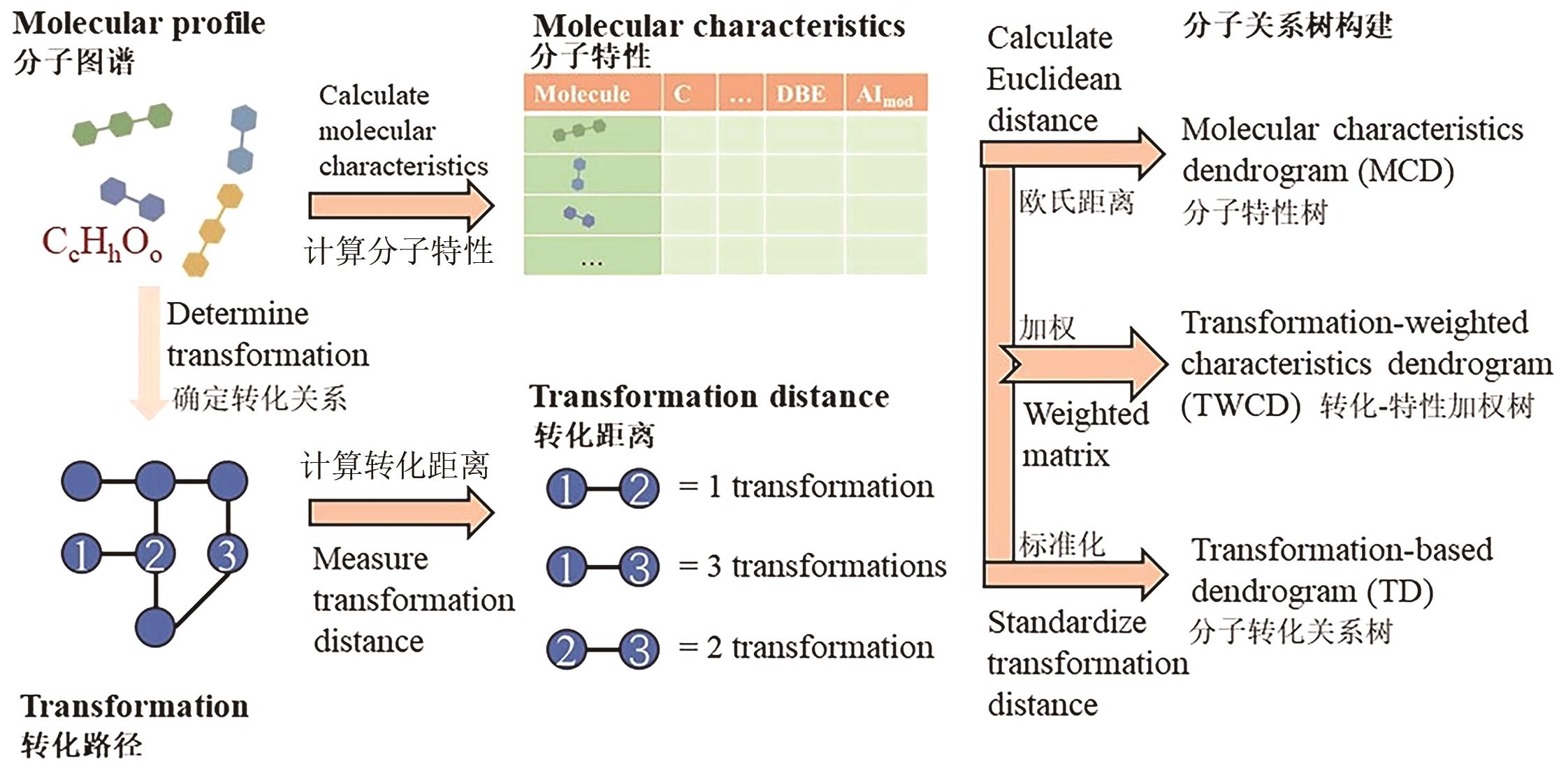
图1 基于分子化学属性构建代谢物分子关系树的三种方法:分子特性树、分子转化关系树与转化-特性加权树(改自文献[17])
Fig. 1 Three methods for constructing metabolite molecular relationship trees based on molecular chemical properties: molecular characteristic dendrogram (MCD), transformation-based dendrogram (TD), and transformation-weighted characteristic dendrogram (TWCD) (modified from reference[17])
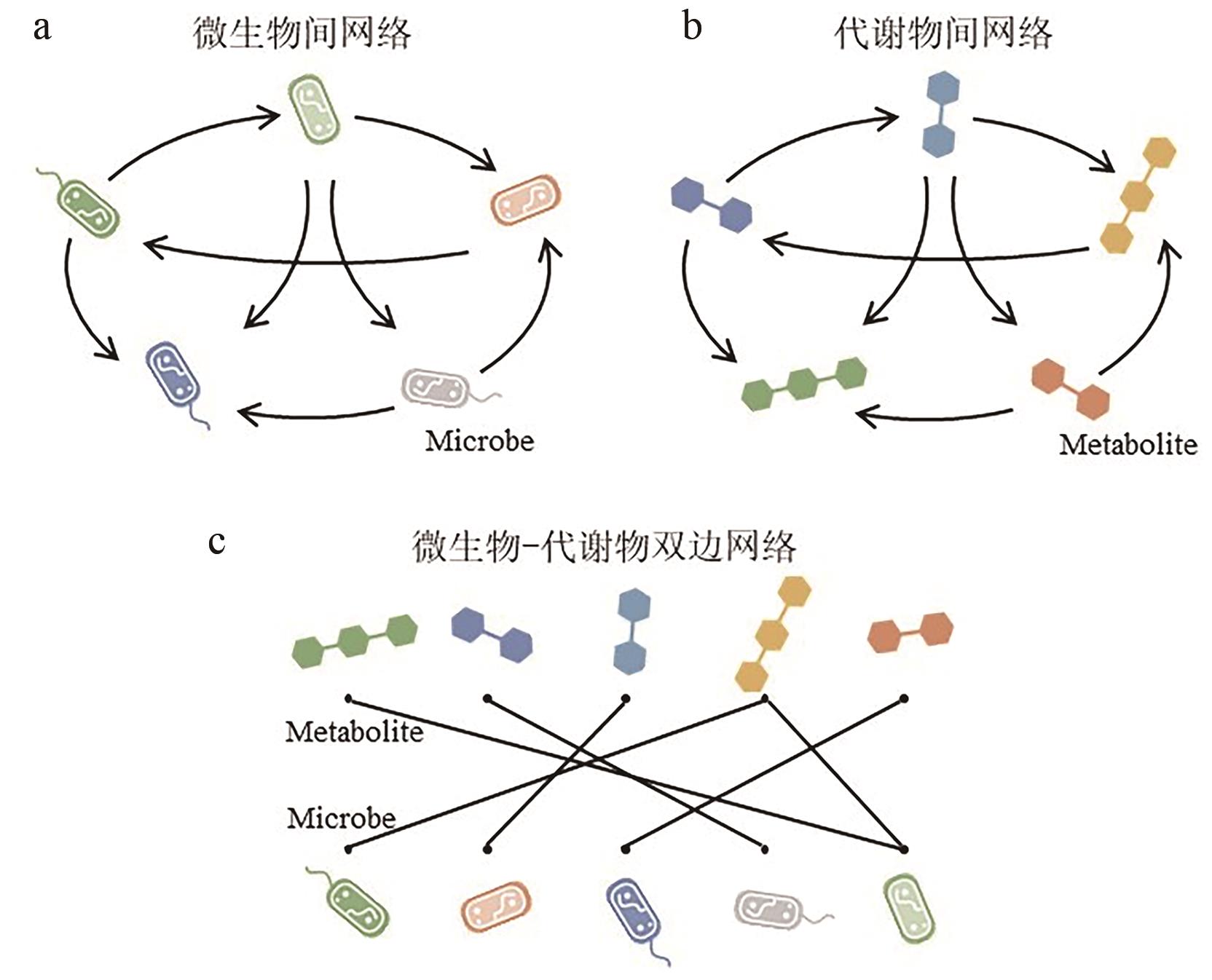
图2 研究微生物代谢机制的3种分子生态网络a:微生物间网络;b:代谢物间网络;c:微生物-代谢物双边网络
Fig. 2 Three types of molecular ecological networks for studying microbial metabolic mechanismsa: Microbe-microbe network; b: metabolite-metabolite network; c: microbe-metabolite bipartite network
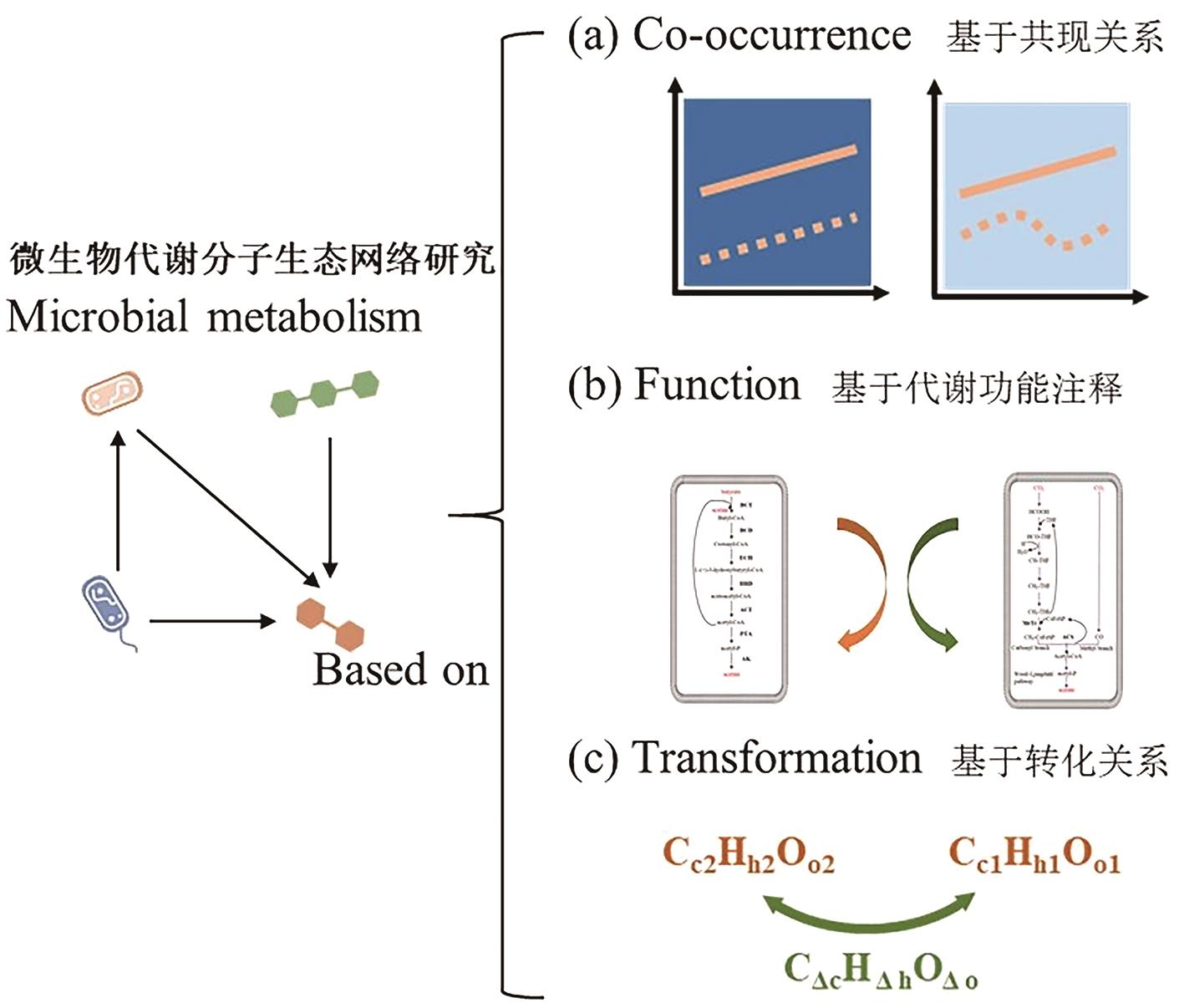
图3 微生物代谢研究中构建分子生态网络的三种基本策略a:基于数量共现关系;b:基于代谢功能注释;c:基于转化关系
Fig. 3 Three basic strategies for constructing molecular ecological networks in microbial metabolism researcha: Co-occurrence-based; b: metabolic function annotation-based; c: transformation-based
研究体系 Research system | 实验设计 Experimental design | 核心数据 Core data | 数据分析方法 Data analysis methods | 参考文献 References |
|---|---|---|---|---|
| 冻土 | 冻土融化梯度;3个深度采样 | 12T FTICR 负离子采集;100-1 200 m/z;<1 ppm;分子14432; 宏基因组1402MAGs | 微生物和代谢物在群落和个体水平的生态构建过程;共现网络 | [ |
| 土壤 | 生物圈2号热带雨林;模拟干旱环境;同位素标记 | 12T FTICR 负离子采集;100-1 000 m/z;<1 ppm;分子数未报道; 宏基因组和转录组 | 代谢功能注释和关联 | [ |
| 土壤 | 施肥处理 | 9.4T FTICR 负离子采集;150-800 m/z;分子 7682 | 转化网络;应用机器学习基于分子特性预测转化潜力 | [ |
| 热融湖塘 | 青藏高原1 100 km多年冻土带沿线10个热熔湖塘;阳光和微生物降解实验 | 15T FTICR 负离子采集;100-800 m/z;<1 ppm;分子数未报道; 扩增子测序 | 对分子组成和分子的特征分析 | [ |
| 基于湖泊水体的微宇宙实验 | 中国和挪威的2座山,5个不同海拔 | 15T FTICR 负离子采集;150-1 200 m/z;<1 ppm;分子19538; 扩增子测序 | 代谢物的生态构建过程;分子持久性和转化活性分析 | [ |
| 滩涂沉积物 | 沿海岸线采样 | 15T FTICR 负离子采集;200-800 m/z;<1 ppm;分子20980; 扩增子测序 | 微生物和有机分子组成在生态模式上的比较 | [ |
| 厌氧发酵罐 | 7个城市,6个时间序列 | 15T FTICR 负离子采集;100-800 m/z;<1 ppm;分子28925; 宏基因组413MAGs; 扩增子测序2960OTUs | 加权分子特性;转化识别;共现网络 | [ |
表1 基于FT-ICR MS的微生物宏代谢组代表性研究
Table 1 Representative studies of microbial meta-metabolomics based on FT‑ICR MS
研究体系 Research system | 实验设计 Experimental design | 核心数据 Core data | 数据分析方法 Data analysis methods | 参考文献 References |
|---|---|---|---|---|
| 冻土 | 冻土融化梯度;3个深度采样 | 12T FTICR 负离子采集;100-1 200 m/z;<1 ppm;分子14432; 宏基因组1402MAGs | 微生物和代谢物在群落和个体水平的生态构建过程;共现网络 | [ |
| 土壤 | 生物圈2号热带雨林;模拟干旱环境;同位素标记 | 12T FTICR 负离子采集;100-1 000 m/z;<1 ppm;分子数未报道; 宏基因组和转录组 | 代谢功能注释和关联 | [ |
| 土壤 | 施肥处理 | 9.4T FTICR 负离子采集;150-800 m/z;分子 7682 | 转化网络;应用机器学习基于分子特性预测转化潜力 | [ |
| 热融湖塘 | 青藏高原1 100 km多年冻土带沿线10个热熔湖塘;阳光和微生物降解实验 | 15T FTICR 负离子采集;100-800 m/z;<1 ppm;分子数未报道; 扩增子测序 | 对分子组成和分子的特征分析 | [ |
| 基于湖泊水体的微宇宙实验 | 中国和挪威的2座山,5个不同海拔 | 15T FTICR 负离子采集;150-1 200 m/z;<1 ppm;分子19538; 扩增子测序 | 代谢物的生态构建过程;分子持久性和转化活性分析 | [ |
| 滩涂沉积物 | 沿海岸线采样 | 15T FTICR 负离子采集;200-800 m/z;<1 ppm;分子20980; 扩增子测序 | 微生物和有机分子组成在生态模式上的比较 | [ |
| 厌氧发酵罐 | 7个城市,6个时间序列 | 15T FTICR 负离子采集;100-800 m/z;<1 ppm;分子28925; 宏基因组413MAGs; 扩增子测序2960OTUs | 加权分子特性;转化识别;共现网络 | [ |
| [1] | Worden AZ, Follows MJ, Giovannoni SJ, et al. Rethinking the marine carbon cycle: Factoring in the multifarious lifestyles of microbes [J]. Science, 2015, 347(6223): 1257594. |
| [2] | Jiao NZ, Herndl GJ, Hansell DA, et al. Microbial production of recalcitrant dissolved organic matter: long-term carbon storage in the global ocean [J]. Nat Rev Microbiol, 2010, 8(8): 593-599. |
| [3] | Kravchenko AN, Guber AK, Razavi BS, et al. Microbial spatial footprint as a driver of soil carbon stabilization [J]. Nat Commun, 2019, 10: 3121. |
| [4] | Patoine G, Eisenhauer N, Cesarz S, et al. Drivers and trends of global soil microbial carbon over two decades [J]. Nat Commun, 2022, 13: 4195. |
| [5] | Zhou ZH, Ren CJ, Wang CK, et al. Global turnover of soil mineral-associated and particulate organic carbon [J]. Nat Commun, 2024, 15: 5329. |
| [6] | Moran MA, Kujawinski EB, Schroer WF, et al. Microbial metabolites in the marine carbon cycle [J]. Nat Microbiol, 2022, 7(4): 508-523. |
| [7] | Lehmann J, Hansel CM, Kaiser C, et al. Persistence of soil organic carbon caused by functional complexity [J]. Nat Geosci, 2020, 13(8): 529-534. |
| [8] | Tao F, Huang YY, Hungate BA, et al. Microbial carbon use efficiency promotes global soil carbon storage [J]. Nature, 2023, 618(7967): 981-985. |
| [9] | Davidson EA, Janssens IA. Temperature sensitivity of soil carbon decomposition and feedbacks to climate change [J]. Nature, 2006, 440(7081): 165-173. |
| [10] | Xue K, Yuan MM, Shi ZJ, et al. Tundra soil carbon is vulnerable to rapid microbial decomposition under climate warming [J]. Nature Clim Change, 2016, 6(6): 595-600. |
| [11] | Lyu Z, Shao NN, Akinyemi T, et al. Methanogenesis [J]. Curr Biol, 2018, 28(13): R727-R732. |
| [12] | Braguglia CM, Gallipoli A, Gianico A, et al. Anaerobic bioconversion of food waste into energy: a critical review [J]. Bioresour Technol, 2018, 248: 37-56. |
| [13] | Uçkun Kiran E, Trzcinski AP, Ng WJ, et al. Bioconversion of food waste to energy: a review [J]. Fuel, 2014, 134: 389-399. |
| [14] | Zhou L, Zhou YQ, Hu Y, et al. Microbial production and consumption of dissolved organic matter in glacial ecosystems on the Tibetan Plateau [J]. Water Res, 2019, 160: 18-28. |
| [15] | Hu J, Liu CG, Zhang WK, et al. Decomposing the molecular complexity and transformation of dissolved organic matter for innovative anaerobic bioprocessing [J]. Nat Commun, 2025, 16: 4859. |
| [16] | Liu JB, Wang CL, Hao ZN, et al. Comprehensive understanding of DOM reactivity in anaerobic fermentation of persulfate-pretreated sewage sludge via FT-ICR mass spectrometry and reactomics analysis [J]. Water Res, 2023, 229: 119488. |
| [17] | Danczak RE, Chu RK, Fansler SJ, et al. Using metacommunity ecology to understand environmental metabolomes [J]. Nat Commun, 2020, 11: 6369. |
| [18] | Hu A, Jang KS, Meng FF, et al. Microbial and environmental processes shape the link between organic matter functional traits and composition [J]. Environ Sci Technol, 2022, 56(14): 10504-10516. |
| [19] | Zhu QZ, Yin XR, Taubner H, et al. Secondary production and priming reshape the organic matter composition in marine sediments [J]. Sci Adv, 2024, 10(20): eadm8096. |
| [20] | Kuhlisch C, Schleyer G, Shahaf N, et al. Viral infection of algal blooms leaves a unique metabolic footprint on the dissolved organic matter in the ocean [J]. Sci Adv, 2021, 7(25): eabf4680. |
| [21] | Yang XS, Feng K, Wang S, et al. Unveiling the deterministic dynamics of microbial meta-metabolism: a multi-omics investigation of anaerobic biodegradation [J]. Microbiome, 2024, 12: 166. |
| [22] | Bauermeister A, Mannochio-Russo H, Costa-Lotufo LV, et al. Mass spectrometry-based metabolomics in microbiome investigations [J]. Nat Rev Microbiol, 2022, 20(3): 143-160. |
| [23] | Zheng JF, Ge QW, Yan YC, et al. dbCAN3: automated carbohydrate-active enzyme and substrate annotation [J]. Nucleic Acids Res, 2023, 51(W1): W115-W121. |
| [24] | Hu J, Kang LY, Li ZL, et al. Photo-produced aromatic compounds stimulate microbial degradation of dissolved organic carbon in thermokarst lakes [J]. Nat Commun, 2023, 14: 3681. |
| [25] | Ma K, Li YY, Song W, et al. Disentangling drivers of mudflat intertidal DOM chemodiversity using ecological models [J]. Nat Commun, 2024, 15: 6620. |
| [26] | Bahureksa W, Tfaily MM, Boiteau RM, et al. Soil organic matter characterization by Fourier transform ion cyclotron resonance mass spectrometry (FTICR MS): a critical review of sample preparation, analysis, and data interpretation [J]. Environ Sci Technol, 2021, 55(14): 9637-9656. |
| [27] | Koch BP, Kattner G, Witt M, et al. Molecular insights into the microbial formation of marine dissolved organic matter: recalcitrant or labile? [J]. Biogeosciences, 2014, 11(15): 4173-4190. |
| [28] | LaRowe DE, Van Cappellen P. Degradation of natural organic matter: a thermodynamic analysis [J]. Geochim Cosmochim Acta, 2011, 75(8): 2030-2042. |
| [29] | Yang XS, Zhao B, Feng K, et al. Microbial synthesis structures organic compound composition in anaerobic digestion [J]. ISME J, 2026, 20(1): wrag036. |
| [30] | Stegen JC, Lin XJ, Fredrickson JK, et al. Quantifying community assembly processes and identifying features that impose them [J]. ISME J, 2013, 7(11): 2069-2079. |
| [31] | Freire-Zapata V, Holland-Moritz H, Cronin DR, et al. Microbiome-metabolite linkages drive greenhouse gas dynamics over a permafrost thaw gradient [J]. Nat Microbiol, 2024, 9(11): 2892-2908. |
| [32] | Dini-Andreote F, Stegen JC, van Elsas JD, et al. Disentangling mechanisms that mediate the balance between stochastic and deterministic processes in microbial succession [J]. Proc Natl Acad Sci U S A, 2015, 112(11): E1326-E1332. |
| [33] | Ning DL, Yuan MT, Wu LW, et al. A quantitative framework reveals ecological drivers of grassland microbial community assembly in response to warming [J]. Nat Commun, 2020, 11: 4717. |
| [34] | Zhou JZ, Ning DL. Stochastic community assembly: does it matter in microbial ecology? [J]. Microbiol Mol Biol Rev, 2017, 81(4): e00002-e00017. |
| [35] | Xia MM, Li PF, Liu J, et al. Long-term fertilization promotes the microbial-mediated transformation of soil dissolved organic matter [J]. Commun Earth Environ, 2025, 6: 114. |
| [36] | Wu M, Li PF, Li GL, et al. Using potential molecular transformation to understand the molecular trade-offs in soil dissolved organic matter [J]. Environ Sci Technol, 2022, 56(16): 11827-11834. |
| [37] | Peng X, Feng K, Yang XS, et al. iNAP 2.0: Harnessing metabolic complementarity in microbial network analysis [J]. iMeta, 2024, 3(5): e235. |
| [38] | Hu A, Choi M, Tanentzap AJ, et al. Ecological networks of dissolved organic matter and microorganisms under global change [J]. Nat Commun, 2022, 13: 3600. |
| [39] | Yang XS, Peng X, Feng K, et al. Organic molecular network analysis reveals transformation signatures of dissolved organic matter during anaerobic digestion process [J]. Water Res, 2025, 282: 123777. |
| [40] | Meng FF, Hu A, Jang KS, et al. iDOM: Statistical analysis of dissolved organic matter characterized by high-resolution mass spectrometry [J]. mLife, 2025, 4(3): 319-331. |
| [41] | Deng Y, Jiang YH, Yang YF, et al. Molecular ecological network analyses [J]. BMC Bioinform, 2012, 13: 113. |
| [42] | Friedman J, Alm EJ. Inferring correlation networks from genomic survey data [J]. PLoS Comput Biol, 2012, 8(9): e1002687. |
| [43] | Morton JT, Aksenov AA, Nothias LF, et al. Learning representations of microbe-metabolite interactions [J]. Nat Methods, 2019, 16(12): 1306-1314. |
| [44] | Reshef DN, Reshef YA, Finucane HK, et al. Detecting novel associations in large data sets [J]. Science, 2011, 334(6062): 1518-1524. |
| [45] | Peng X, Wang S, Wang MX, et al. Metabolic interdependencies in thermophilic communities are revealed using co-occurrence and complementarity networks [J]. Nat Commun, 2024, 15: 8166. |
| [46] | Zelezniak A, Andrejev S, Ponomarova O, et al. Metabolic dependencies drive species co-occurrence in diverse microbial communities [J]. Proc Natl Acad Sci U S A, 2015, 112(20): 6449-6454. |
| [47] | Giordano N, Gaudin M, Trottier C, et al. Genome-scale community modelling reveals conserved metabolic cross-feedings in epipelagic bacterioplankton communities [J]. Nat Commun, 2024, 15: 2721. |
| [48] | Mataigne A, Vannier N, Vandenkoornhuyse P, et al. Multi-genome metabolic modeling predicts functional inter-dependencies in the Arabidopsis root microbiome [J]. Microbiome, 2022, 10: 217. |
| [49] | Graham EB, Tfaily MM, Crump AR, et al. Carbon inputs from riparian vegetation limit oxidation of physically bound organic carbon via biochemical and thermodynamic processes [J]. JGR Biogeosciences, 2017, 122(12): 3188-3205. |
| [50] | Hernandez LK, Pugliese G, Ingrisch J, et al. Drought re-routes soil microbial carbon metabolism towards emission of volatile metabolites in an artificial tropical rainforest [J]. Nat Microbiol, 2023, 8(8): 1480-1494. |
| [51] | Ayala-Ortiz C, Graf-Grachet N, Freire-Zapata V, et al. MetaboDirect: an analytical pipeline for the processing of FT-ICR MS-based metabolomic data [J]. Microbiome, 2023, 11: 28. |
| [1] | 赵杰, 李安, 梁刚, 靳欣欣, 潘立刚. 植物环状RNA的研究新进展[J]. 生物技术通报, 2022, 38(10): 1-9. |
| [2] | 徐海冬, 冷奇颖, PATRICIAAdu-Asiamah, 王章, 李婷, 张丽. 环状RNA的特征及其在畜禽中的研究进展[J]. 生物技术通报, 2018, 34(11): 56-69. |
| [3] | 邓帅,张婷婷,王茹茹,刘宇,张元湖. 植物非细胞自主性小RNA分子研究进展[J]. 生物技术通报, 2015, 31(10): 16-23. |
| [4] | |相兴伟,周宇芳. 昆虫包涵体衍生型病毒经口感染相关蛋白的研究进展[J]. 生物技术通报, 2014, 30(11): 40-47. |
| [5] | 崔馨元;薛良义;. 大黄鱼肝细胞肿瘤相关抗原-127基因克隆及分子特征分析[J]. , 2011, 0(11): 125-129. |
| [6] | 牛京京;张守纯;金谷;于宁;. 线粒体基因及其Cyt b基因与昆虫分子系统学研究[J]. , 2011, 0(04): 52-55. |
| [7] | 于天飞;朱红标;孙天国;张健;蔡雅璐;庞后琴;史小飞;. 猪传染性胃肠炎病毒S蛋白抗原位点分子特征分析[J]. , 2010, 0(03): 135-138. |
| 阅读次数 | ||||||
|
全文 |
|
|||||
|
摘要 |
|
|||||
