







生物技术通报 ›› 2026, Vol. 42 ›› Issue (5): 16-26.doi: 10.13560/j.cnki.biotech.bull.1985.2026-0038
• 微生物组学专题 • 上一篇
张理1,2,3( ), 李凯旋1,4, 马志远1, 姜美彤1, 张佳宝1,2,3, 梁玉婷1,2,3()
收稿日期:2026-01-11
出版日期:2026-05-26
发布日期:2026-06-10
通讯作者:
梁玉婷,女,博士,研究员,研究方向 :土壤生物过程与耕地质量提升;E-mail: ytliang@issas.ac.cn作者简介:张理,男,博士研究生,研究方向 :植物-微生物互作;E-mail: zhangli@issas.ac.cn
基金资助:
ZHANG Li1,2,3(), LI Kai-xuan1,4, MA Zhi-yuan1, JIANG Mei-tong1, ZHANG Jia-bao1,2,3, LIANG Yu-ting1,2,3()
Received:2026-01-11
Published:2026-05-26
Online:2026-06-10
摘要:
全球耕地退化与粮食需求持续增长之间的矛盾日益突出,农田土壤健康已成为保障粮食安全与农业可持续发展的关键因素。根际微生物通过驱动养分循环、维持土壤结构稳定及增强作物抗逆能力,在农田土壤健康调控中发挥重要作用。近年来,合成微生物组(synthetic microbiome)作为一种可控的微生物群落工程策略,为定向调控根际微生物功能提供了新的研究思路。本文围绕农田土壤健康调控中的关键根际互作过程,梳理植物与微生物在养分循环、环境胁迫响应及病害抑制等方面的作用。系统总结构建合成微生物组的工程路径,包括功能模块筛选和组合、群落协同设计和田间稳定性调控等关键环节。在此基础上,归纳其在农业生产中的应用研究,重点讨论合成微生物组在提高养分利用效率、缓解退化土壤胁迫、修复污染土壤以及病害防控方面的作用。进一步分析其在实际应用中面临的田间适应性不足、生态风险评估体系不完善、规模化应用成本较高及评价标准缺乏等问题,并对未来研究方向进行了展望,旨在为合成微生物组在农田土壤健康调控中的理论研究与实践应用提供依据。
张理, 李凯旋, 马志远, 姜美彤, 张佳宝, 梁玉婷. 合成微生物组在农田土壤健康调控中的研究进展[J]. 生物技术通报, 2026, 42(5): 16-26.
ZHANG Li, LI Kai-xuan, MA Zhi-yuan, JIANG Mei-tong, ZHANG Jia-bao, LIANG Yu-ting. Research Progress of Synthetic Microbiome in the Regulation of Agricultural Soil Health[J]. Biotechnology Bulletin, 2026, 42(5): 16-26.
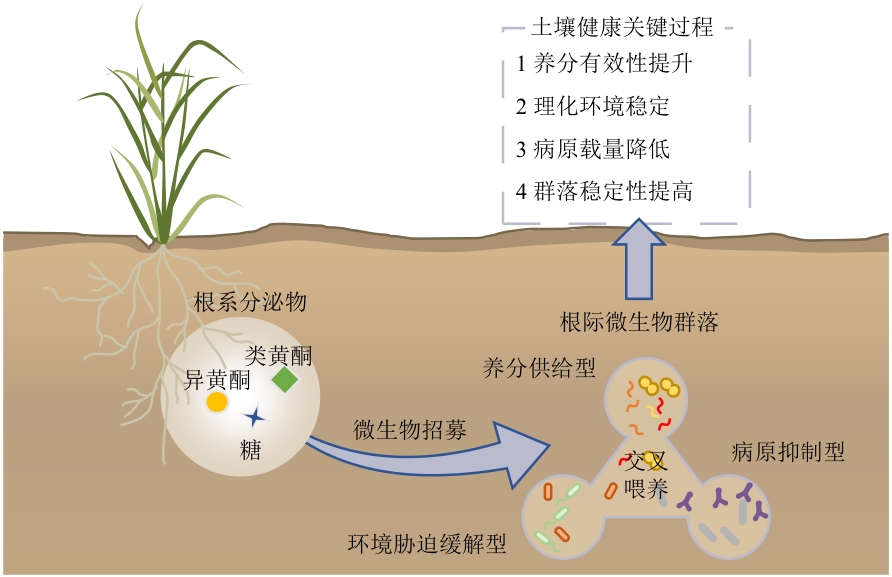
图1 植物-根际微生物的根际代谢互作过程及改善土壤健康的靶点
Fig. 1 Rhizosphere interaction process between plants and rhizosphere microorganisms and the targets for improving soil health
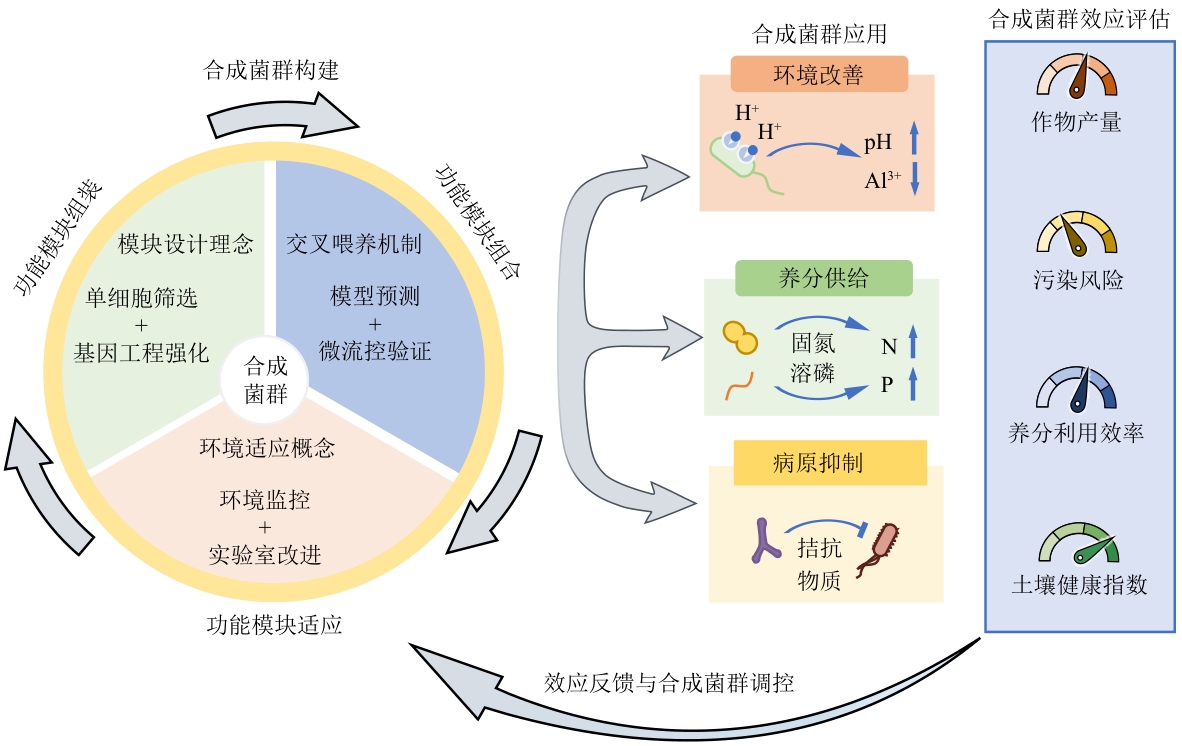
图2 合成微生物组构建、应用与反馈路径
Fig. 2 Construction, application, and feedback pathways of synthetic microbiomes
| [1] | Chen M. Food security or climate action [J]. Nat Clim Chang, 2025, 15(4): 354-355. |
| [2] | Food and Agriculture Organization (FAO). Global assessment of soil pollution [R]. Rome: FAO, 2021. |
| [3] | Montgomery DR. Soil security and global food security [J]. Front Agr Sci Eng, 2024, 11(2): 297-302. |
| [4] | Niu KY, Li MY, Lenzen M, et al. Impacts of global trade on cropland soil-phosphorus depletion and food security [J]. Nat Sustain, 2024, 7(9): 1128-1140. |
| [5] | Zhang X, Zou T, Lassaletta L, et al. Quantification of global and national nitrogen budgets for crop production [J]. Nat Food, 2021, 2(7): 529-540. |
| [6] | Zou T, Zhang X, Davidson EA. Global trends of cropland phosphorus use and sustainability challenges [J]. Nature, 2022, 611(7934): 81-87. |
| [7] | Hartmann M, Six J. Soil structure and microbiome functions in agroecosystems [J]. Nat Rev Earth Environ, 2023, 4(1): 4-18. |
| [8] | Guerrieri E, Rasmann S. Exposing belowground plant communication [J]. Science, 2024, 384(6693): 272-273. |
| [9] | Zhang LY, Zhang ML, Huang SY, et al. A highly conserved core bacterial microbiota with nitrogen-fixation capacity inhabits the xylem sap in maize plants [J]. Nat Commun, 2022, 13: 3361. |
| [10] | Zhou YY, Liu DH, Li FQ, et al. Superiority of native soil core microbiomes in supporting plant growth [J]. Nat Commun, 2024, 15: 6599. |
| [11] | Jiang MT, Delgado-Baquerizo M, Yuan MM, et al. Home-based microbial solution to boost crop growth in low-fertility soil [J]. New Phytol, 2023, 239(2): 752-765. |
| [12] | Yue H, Yue WJ, Jiao S, et al. Plant domestication shapes rhizosphere microbiome assembly and metabolic functions [J]. Microbiome, 2023, 11: 70. |
| [13] | Kuypers MMM, Marchant HK, Kartal B. The microbial nitrogen-cycling network [J]. Nat Rev Microbiol, 2018, 16(5): 263-276. |
| [14] | Bais HP, Weir TL, Perry LG, et al. The role of root exudates in rhizosphere interactions with plants and other organisms [J]. Annu Rev Plant Biol, 2006, 57: 233-266. |
| [15] | Faller L, Leite MFA, Kuramae EE. Enhancing phosphate-solubilising microbial communities through artificial selection [J]. Nat Commun, 2024, 15: 1649. |
| [16] | Yang XR, Yang TJ, Zhang ZR, et al. Substrate utilization and cross-feeding synergistically determine microbiome resistance to pathogen invasion [J]. Nat Ecol Evol, 2026, 10(2): 211-220. |
| [17] | Weller DM, Raaijmakers JM, Gardener BBM, et al. Microbial populations responsible for specific soil suppressiveness to plant pathogens [J]. Annu Rev Phytopathol, 2002, 40: 309-348. |
| [18] | Liu Y, Shi AQ, Chen Y, et al. Beneficial microorganisms: Regulating growth and defense for plant welfare [J]. Plant Biotechnol J, 2025, 23(3): 986-998. |
| [19] | Gu SH, Wei Z, Shao ZY, et al. Competition for iron drives phytopathogen control by natural rhizosphere microbiomes [J]. Nat Microbiol, 2020, 5(8): 1002-1010. |
| [20] | Molina-Santiago C, Pearson JR, Navarro Y, et al. The extracellular matrix protects Bacillus subtilis colonies from Pseudomonas invasion and modulates plant co-colonization [J]. Nat Commun, 2019, 10: 1919. |
| [21] | Lee KS, Landry Z, Pereira FC, et al. Raman microspectroscopy for microbiology [J]. Nat Rev Meth Primers, 2021, 1: 80. |
| [22] | Xie X, Gan LZ, Wang CY, et al. Salt-tolerant plant growth-promoting bacteria as a versatile tool for combating salt stress in crop plants [J]. Arch Microbiol, 2024(8): 21. |
| [23] | Fan XY, Ge AH, Qi SS, et al. Root exudates and microbial metabolites: signals and nutrients in plant-microbe interactions [J]. Sci China Life Sci, 2025, 68(8): 2290-2302. |
| [24] | Ruan YT, Dong SZ, Jiang SY, et al. The molecular basis of the binding and specific activation of rhizobial NodD by flavonoids [J]. Science, 2026, 391(6781): 184-189. |
| [25] | Wu JB, Hu SL, Chen J, et al. Soil microbial legacy mediated by buckwheat flavonoids enhances cabbage resistance to clubroot disease [J]. Microbiome, 2025, 13: 176. |
| [26] | Hu LF, Robert CAM, Cadot S, et al. Root exudate metabolites drive plant-soil feedbacks on growth and defense by shaping the rhizosphere microbiota [J]. Nat Commun, 2018, 9: 2738. |
| [27] | Zhalnina K, Louie KB, Hao Z, et al. Dynamic root exudate chemistry and microbial substrate preferences drive patterns in rhizosphere microbial community assembly [J]. Nat Microbiol, 2018, 3(4): 470-480. |
| [28] | Yang XS, Feng K, Wang S, et al. Unveiling the deterministic dynamics of microbial meta-metabolism: a multi-omics investigation of anaerobic biodegradation [J]. Microbiome, 2024, 12: 166. |
| [29] | Clegg T, Gross T. Cross-feeding creates tipping points in microbiome diversity [J]. Proc Natl Acad Sci U S A, 2025, 122(19): e2425603122. |
| [30] | Ma ZY, Jiang MT, Liu CY, et al. Quinolone-mediated metabolic cross-feeding develops aluminium tolerance in soil microbial consortia [J]. Nat Commun, 2024, 15: 10148. |
| [31] | Niu GQ, Liu WY, Zhang TJ, et al. Deciphering conserved rhizosphere metabolite-microbiome interactions for crop drought resistance [J]. Glob Change Biol, 2025, 31(12): e70652. |
| [32] | Palmieri D, Vitale S, Lima G, et al. A bacterial endophyte exploits chemotropism of a fungal pathogen for plant colonization [J]. Nat Commun, 2020, 11: 5264. |
| [33] | Li B, Li YY, Wu HM, et al. Root exudates drive interspecific facilitation by enhancing nodulation and N2 fixation [J]. Proc Natl Acad Sci U S A, 2016, 113(23): 6496-6501. |
| [34] | Liao JX, Li ZH, Xiong D, et al. Quorum quenching by a type IVA secretion system effector [J]. ISME J, 2023, 17(10): 1564-1577. |
| [35] | Gao YX, Wu YT, Chang PF, et al. Mycorrhizal network and symbiotic N-fixer jointly enhance the interplant nitrogen sharing [J]. Ecol Lett, 2025, 28(9): e70204. |
| [36] | Pang F, Li Q, Solanki MK, et al. Soil phosphorus transformation and plant uptake driven by phosphate-solubilizing microorganisms [J]. Front Microbiol, 2024, 15: 1383813. |
| [37] | Xie JY, Sun XL, Wen T, et al. Metabolite interactions mediate beneficial alliances between Bacillus and Trichoderma for effective Fusarium wilt control [J]. ISME J, 2026, 20(1): wraf283. |
| [38] | Zhang YX, Jing MY, Lyu LH, et al. Principles for rigorous design and application of synthetic microbial communities [J]. Adv Sci, 2026, 13(10): e14750. |
| [39] | Zhang YR, Chang K, Ogunlade B, et al. From genotype to phenotype: Raman spectroscopy and machine learning for label-free single-cell analysis [J]. ACS Nano, 2024, 18(28): 18101-18117. |
| [40] | Liu CY, Jiang MT, Yuan MM, et al. Root microbiota confers rice resistance to aluminium toxicity and phosphorus deficiency in acidic soils [J]. Nat Food, 2023, 4(10): 912-924. |
| [41] | Xu L, Cao HL, Li CN, et al. The importance of rare versus abundant phoD-harboring subcommunities in driving soil alkaline phosphatase activity and available P content in Chinese steppe ecosystems [J]. Soil Biol Biochem, 2022, 164: 108491. |
| [42] | Shivram H, Cress BF, Knott GJ, et al. Controlling and enhancing CRISPR systems [J]. Nat Chem Biol, 2021, 17, 10-19. |
| [43] | Ma Y, Chen SH, Liu S, et al. Phosphate solubilizing fungi enhance insoluble phosphate dissolution via organic acid production: mechanisms and applications [J]. Front Microbiol, 2025, 16: 1600231. |
| [44] | Liu H, Gao XH, Fan WS, et al. Optimizing carbon and nitrogen metabolism in plants: From fundamental principles to practical applications [J]. J Integr Plant Biol, 2025, 67(6): 1447-1466. |
| [45] | Henry LP, Bergelson J. Applying ecological principles to microbiome engineering [J]. Nat Microbiol, 2025, 10(9): 2111-2121. |
| [46] | Peng X, Wang S, Wang MX, et al. Metabolic interdependencies in thermophilic communities are revealed using co-occurrence and complementarity networks [J]. Nat Commun, 2024, 15: 8166. |
| [47] | Amarnath K, Narla AV, Pontrelli S, et al. Stress-induced metabolic exchanges between complementary bacterial types underly a dynamic mechanism of inter-species stress resistance [J]. Nat Commun, 2023, 14: 3165. |
| [48] | Schäfer M, Pacheco AR, Künzler R, et al. Metabolic interaction models recapitulate leaf microbiota ecology [J]. Science, 2023, 381(6653): eadf5121. |
| [49] | Wilken SE, Monk JM, Leggieri PA, et al. Experimentally validated reconstruction and analysis of a genome-scale metabolic model of an anaerobic neocallimastigomycota fungus [J]. mSystems, 2021, 6: e00002-e00021. |
| [50] | Jiang W, Wang SM, Gu F, et al. Advances in synthetic microbial ecosystems approach for studying ecological interactions and their influencing factors [J]. Eng Microbiol, 2025, 5(2): 100205. |
| [51] | Fu LH, Guo EP, Zhang JZ, et al. Towards one sample per second for mass spectrometric screening of engineered microbial strains [J]. Curr Opin Biotechnol, 2022, 76: 102725. |
| [52] | Li HZ, Bi QF, Yang K, et al. D2O-isotope-labeling approach to probing phosphate-solubilizing bacteria in complex soil communities by single-cell Raman spectroscopy [J]. Anal Chem, 2019, 91(3): 2239-2246. |
| [53] | Crowther TW, Rappuoli R, Corinaldesi C, et al. Scientists’ call to action: Microbes, planetary health, and the Sustainable Development Goals [J]. Cell, 2024, 187(19): 5195-5216. |
| [54] | Ge C, Yu Z, Sheng HK, et al. Redesigning regulatory components of quorum-sensing system for diverse metabolic control [J]. Nat Commun, 2022, 13: 2182. |
| [55] | Hewedy OA, Ali MG, El-Meihy RM, et al. The dual role of ethylene in plant growth and abiotic stress: Mechanisms, regulation, and mitigation through ACC deaminase [J]. Plant Sci, 2026, 362: 112858. |
| [56] | Li JY, Liu HW, Wang JT, et al. Drought-induced plant microbiome and metabolic enrichments improve drought resistance [J]. Cell Host Microbe, 2025, 33(6): 882-900.e7. |
| [57] | Hren A, Lollini N, Carper DL, et al. High-density CRISPRi screens reveal diverse routes to improved acclimation in cyanobacteria [J]. Proc Natl Acad Sci U S A, 2025, 122(12): e2412625122. |
| [58] | Abonyi A, Fornberg J, Rasconi S, et al. The chytrid insurance hypothesis: integrating parasitic chytrids into a biodiversity-ecosystem functioning framework for phytoplankton-zooplankton population dynamics [J]. Oecologia, 2024, 204(2): 279-288. |
| [59] | Yu XA, McLean C, Hehemann JH, et al. Low-level resource partitioning supports coexistence among functionally redundant bacteria during successional dynamics [J]. ISME J, 2024, 18(1): wrad013. |
| [60] | Ramond P, Galand PE, Logares R. Microbial functional diversity and redundancy: moving forward [J]. FEMS Microbiol Rev, 2025, 49: fuae031. |
| [61] | Li M, Hu J, Wei Z, et al. Synthetic microbial communities: Sandbox and blueprint for soil health enhancement [J]. iMeta, 2024, 3: e172. |
| [62] | Zhou Q, Gao XS, Wu Q, et al. Cross-Kingdom synthetic microbiota suppresses wheat Fusarium crown rot by remodeling the rhizosphere microbiome and metabolome [J]. J Agric Food Chem, 2026, 74(2): 2418-2437. |
| [63] | Liu Y, Jia BL, Ren Y, et al. Bacterial social interactions in synthetic Bacillus consortia enhance plant growth [J]. iMeta, 2025, 4(4): e70053. |
| [64] | Sveen TR, Viketoft M, Bengtsson J, et al. Functional diversity of soil microbial communities increases with ecosystem development [J]. Nat Commun, 2025, 16: 10408. |
| [65] | Wang MX, Ge AH, Ma XZ, et al. Dynamic root microbiome sustains soybean productivity under unbalanced fertilization [J]. Nat Commun, 2024, 15: 1668. |
| [66] | Li YJ, Li RR, Liu R, et al. A simplified SynCom based on core-helper strain interactions enhances symbiotic nitrogen fixation in soybean [J]. J Integr Plant Biol, 2025, 67(6): 1582-1598. |
| [67] | Chen SS, Liu QM, Li DJ. Engineering the composting microbiome with a synthetic microbial community to accelerate lignocellulose degradation and humus synthesis [J]. J Environ Manag, 2025, 396: 128088. |
| [68] | Zhang L, Jiang MT, Yuan MM, et al. Bacterial modification of the root cell wall facilitates rice aluminum resistance in acidic soils [J]. Cell Rep, 2025, 44(12): 116597. |
| [69] | Schmitz L, Yan ZC, Schneijderberg M, et al. Synthetic bacterial community derived from a desert rhizosphere confers salt stress resilience to tomato in the presence of a soil microbiome [J]. ISME J, 2022, 16(8): 1907-1920. |
| [70] | Li L, Cheng KX, Du Y, et al. Rhizosphere microbes from Populus euphratica conferred salt stress resistance to Populus alba × Populus glandulosa [J]. Plant Cell Environ, 2025, 48(12): 8743-8755. |
| [71] | Ruan ZP, Tan JL, Feng QY, et al. Potentiators empower synthetic microbiomes as silent guardians against co-contamination [J]. Nat Commun, 2026, 17: 1185. |
| [72] | Wang X, Teng Y, Wang XM, et al. Nitrogen transfer and cross-feeding between Azotobacter chroococcum and Paracoccus aminovorans promotes pyrene degradation [J]. ISME J, 2023, 17(12): 2169-2181. |
| [73] | Wang XX, Hou JY, Ling H, et al. Enhancing petroleum hydrocarbon degradation by a synthetic bacterial consortium: Insights into functional complementarity and regulatory coordination [J]. Chem Eng J, 2026, 527: 171992. |
| [74] | Huang LK, Fan ZY, Hu ZP, et al. Synthetic communities derived from the core endophytic microbiome of hyperaccumulators and their role in cadmium phytoremediation [J]. Microbiome, 2024, 12: 236. |
| [75] | Zhang HY, Zhang JQ, Tang SJ, et al. Exopolysaccharide-producing strains alter heavy metal fates and bacterial communities in soil aggregates to reduce metal uptake by pakchoi [J]. Front Microbiol, 2025, 16: 1595142. |
| [76] | Paasch BC, Sohrabi R, Kremer JM, et al. A critical role of a eubiotic microbiota in gating proper immunocompetence in Arabidopsis [J]. Nat Plants, 2023, 9(9): 1468-1480. |
| [77] | La SK, Li JF, Ma S, et al. Protective role of native root-associated bacterial consortium against root-knot nematode infection in susceptible plants [J]. Nat Commun, 2024, 15: 6723. |
| [78] | Cao LH, Shi XT, Li T, et al. Fusaric acid detoxification mediates interspecies interactions for sustainable Fusarium wilt disease management [J]. Cell Rep, 2025, 44(11): 116531. |
| [79] | Zhou X, Wang JT, Liu F, et al. Cross-Kingdom synthetic microbiota supports tomato suppression of Fusarium wilt disease [J]. Nat Commun, 2022, 13: 7890. |
| [80] | Hiis EG, Vick SHW, Molstad L, et al. Unlocking bacterial potential to reduce farmland N2O emissions [J]. Nature, 2024, 630(8016): 421-428. |
| [81] | Vannette RL, Fukami T. Historical contingency in species interactions: towards niche-based predictions [J]. Ecol Lett, 2014, 17(1): 115-124. |
| [82] | Wang W, Xia YW, Zhang PP, et al. Narrow-spectrum resource-utilizing bacteria drive the stability of synthetic communities through enhancing metabolic interactions [J]. Nat Commun, 2025, 16: 6088. |
| [83] | Goh YX, Anupoju SMB, Nguyen A, et al. Evidence of horizontal gene transfer and environmental selection impacting antibiotic resistance evolution in soil-dwelling Listeria [J]. Nat Commun, 2024, 15: 10034. |
| [84] | Junker RR, Farwig N. Microbial conservation is essential for sustaining ecosystem functions and services [J]. Proc Natl Acad Sci U S A, 2025, 122(38): e2503013122. |
| [85] | Singh A, Nair D. Antibiotics production from lignocellulosic waste materials [J]. Int. J. Inn. Eng. Res. Tech., 2021, 8, 1, 45-50 |
| [86] | Jia JY, de Goede R, Li YZ, et al. Unlocking soil health: Are microbial functional genes effective indicators? [J]. Soil Biol Biochem, 2025, 204: 109768. |
| [1] | 陈才锭, 宋云洁, 田梦青. 四大主粮作物不同生育期根际微生物菌群变化研究进展[J]. 生物技术通报, 2025, 41(6): 49-60. |
| [2] | 叶柳健, 蒙健宗, 覃福方, 何双, 朱绮霞, 王小虎, 韦圣博, 周礼芹. 古茶树林菌株D2的鉴定、酶学特性及基因组学分析[J]. 生物技术通报, 2025, 41(5): 267-279. |
| [3] | 於莉军, 王桥美, 彭文书, 严亮, 杨瑞娟. 景迈山古茶园与现代有机茶园根际土壤微生物群落研究[J]. 生物技术通报, 2024, 40(5): 237-247. |
| [4] | 王颢杰, 常栋, 李俊营, 孟颢光, 蒋士君, 周硕野, 崔江宽. 不同生境下烤烟三段式育苗微生物群落变化及抗逆酶活分析[J]. 生物技术通报, 2024, 40(4): 242-254. |
| [5] | 刘佳宁, 李梦, 杨新森, 吴伟, 裴新梧, 袁潜华. 不同水分管理栽培方式对山栏稻根际土壤细菌群落的影响[J]. 生物技术通报, 2024, 40(3): 242-250. |
| [6] | 王雨晴, 马子奇, 侯嘉欣, 宗钰琪, 郝晗睿, 刘国元, 魏辉, 连博琳, 陈艳红, 张健. 盐胁迫下植物根系分泌物的成分分析与生态功能研究进展[J]. 生物技术通报, 2024, 40(1): 12-23. |
| [7] | 赵林艳, 徐武美, 王豪吉, 王昆艳, 魏富刚, 杨绍周, 官会林. 施用生物炭对连作三七根际真菌群落与存活率的影响[J]. 生物技术通报, 2023, 39(7): 219-227. |
| [8] | 孙卓, 王妍, 韩忠明, 王云贺, 赵淑杰, 杨利民. 防风根际真菌的分离鉴定及其生防潜力评价[J]. 生物技术通报, 2023, 39(1): 264-273. |
| [9] | 王宁, 李蕙秀, 李季, 丁国春. 堆肥调控作物根际微生物组抑制植物病害的研究进展[J]. 生物技术通报, 2022, 38(5): 4-12. |
| [10] | 杨露, 辛建攀, 田如男. 根际微生物对植物重金属胁迫的缓解作用及其机理研究进展[J]. 生物技术通报, 2022, 38(3): 213-225. |
| [11] | 陆玉芳, 施卫明. 根际化学信号物质与土壤养分转化[J]. 生物技术通报, 2020, 36(9): 14-24. |
| [12] | 孙雨, 常晶晶, 田春杰. 作物根际微生物组重组构建技术体系探讨[J]. 生物技术通报, 2020, 36(9): 25-30. |
| [13] | 许来鹏, 万鲜花, 孙向丽, 曹艳芳, 李慧, 田亚东, 刘小军, 康相涛, 王彦彬. 畜禽粪肥和秸秆还田对玉米根际微生物群落结构的影响[J]. 生物技术通报, 2020, 36(9): 137-146. |
| [14] | 张卓, 刘茂炎, 王培, 黄文坤, 刘二明, 彭焕, 彭德良. 抗草甘膦转基因大豆AG5601对根际微生物群落功能多样性的影响[J]. 生物技术通报, 2019, 35(7): 17-24. |
| [15] | 王端, 姚香梅, 叶健. 根际微生物-植物-病毒-介体昆虫多元互作研究进展[J]. 生物技术通报, 2018, 34(2): 54-65. |
| 阅读次数 | ||||||
|
全文 |
|
|||||
|
摘要 |
|
|||||
