







生物技术通报 ›› 2026, Vol. 42 ›› Issue (6): 107-115.doi: 10.13560/j.cnki.biotech.bull.1985.2025-1425
• 薯类生物技术专题 •
王冰冰1,2( ), 朱迪1, 杨生龙1, 李艺林2, 杨琪1, 贺苗苗1()
收稿日期:2025-12-26
出版日期:2026-06-26
发布日期:2026-07-11
通讯作者:
贺苗苗,女,副研究员,研究方向 :马铃薯遗传育种;E-mail: hemm0505@126.com作者简介:王冰冰,女,硕士研究生,研究方向 :马铃薯抗病育种;E-mail: 18520715590@163.com
基金资助:
WANG Bing-bing1,2(), ZHU Di1, YANG Sheng-long1, LI Yi-lin2, YANG Qi1, HE Miao-miao1()
Received:2025-12-26
Published:2026-06-26
Online:2026-07-11
摘要:
目的 褪黑素(melatonin, MT)作为植物应对生物和非生物胁迫的重要信号分子,其生理效应呈现显著的“量效关系”,探究外源MT对马铃薯晚疫病的影响,寻找外源MT对马铃薯晚疫病抑制的最佳浓度,为MT的田间应用提供理论依据。 方法 以马铃薯‘青薯9号’为材料,叶面连续3 d早中晚喷施不同浓度MT(0、300、650、1 300、1 650、2 000 μmol/L),接种致病疫霉后对马铃薯植株进行防效鉴定、抗氧化酶检测、防御酶及防卫基因表达分析。 结果 外源MT能够有效抑制晚疫病菌菌丝的生长,MT浓度在300-2 000 μmol/L均能提高马铃薯对晚疫病的抗性,结合DAB和台盼蓝染色确定最佳浓度为1 300 μmol/L。与对照相比,1 300 μmol/LMT预处理能够提高超氧化物歧化酶(SOD)、过氧化物酶(POD)、抗坏血酸过氧化物酶(APX)活性,清除过量积累的活性氧和丙二醛(MDA)。同时提高几丁质酶(CHT)、多酚氧化酶(PPO)、过氧化物酶(POD)、苯丙氨酸解氨酶(PAL)等防御酶活性,并显著诱导防卫基因(StPR1、StPR5、StPOD和StPPO)的表达。 结论 晚疫病菌胁迫下,MT通过限制病原菌菌丝生长、提高植株抗氧化能力、激活防御酶活性并诱导防卫基因表达,增强马铃薯对晚疫病的抗性。
王冰冰, 朱迪, 杨生龙, 李艺林, 杨琪, 贺苗苗. 外源褪黑素对晚疫病胁迫下马铃薯抗病性的影响[J]. 生物技术通报, 2026, 42(6): 107-115.
WANG Bing-bing, ZHU Di, YANG Sheng-long, LI Yi-lin, YANG Qi, HE Miao-miao. Effects of Exogenous Melatonin on Disease Resistance of Potato under Late Blight Stress[J]. Biotechnology Bulletin, 2026, 42(6): 107-115.
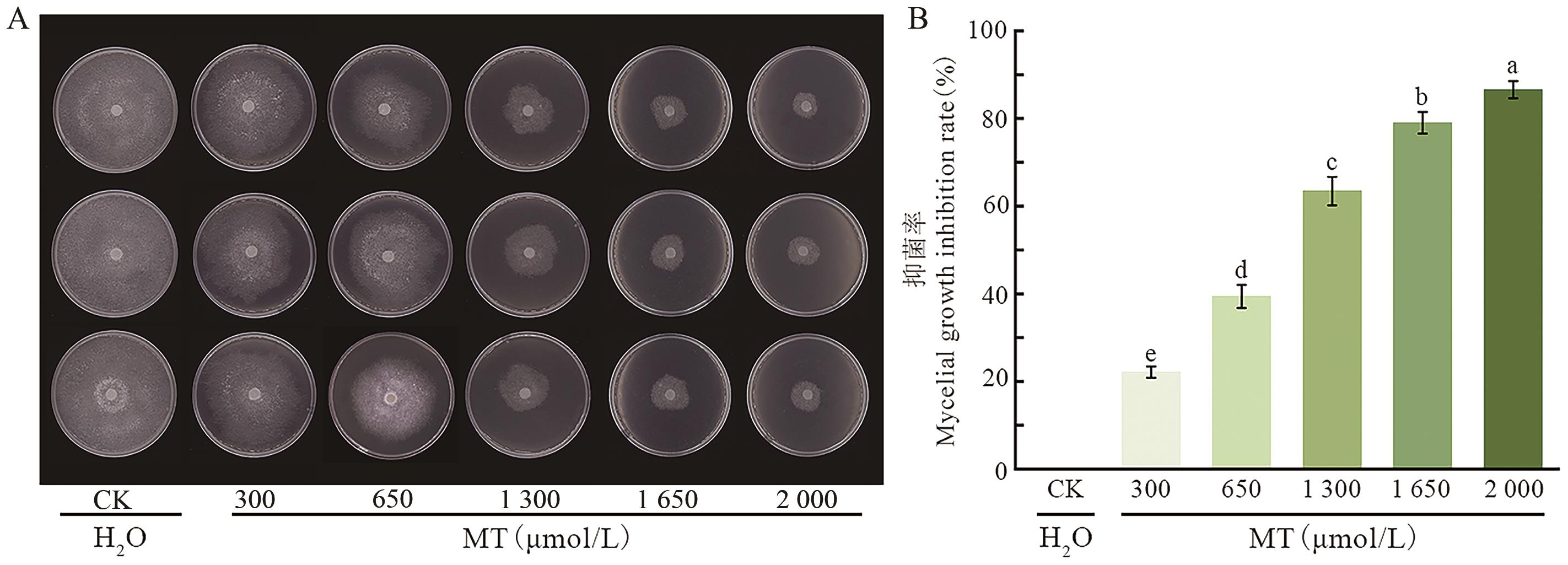
图1 不同浓度MT对P. infestans生长的影响A:P. infestans菌丝生长表型;B:菌丝生长抑制率。CK:对照;MT:褪黑素;不同小写字母表示在0.05水平差异显著。下同
Fig. 1 Effects of different concentrations of MT on the growth of P. infestansA: P. infestans mycelial growth phenotype. B: Mycelium growth inhibition rate. CK: Control; MT: Melatonin; Different lowercase letters indicate significant differences at the 0.05 level. The same below
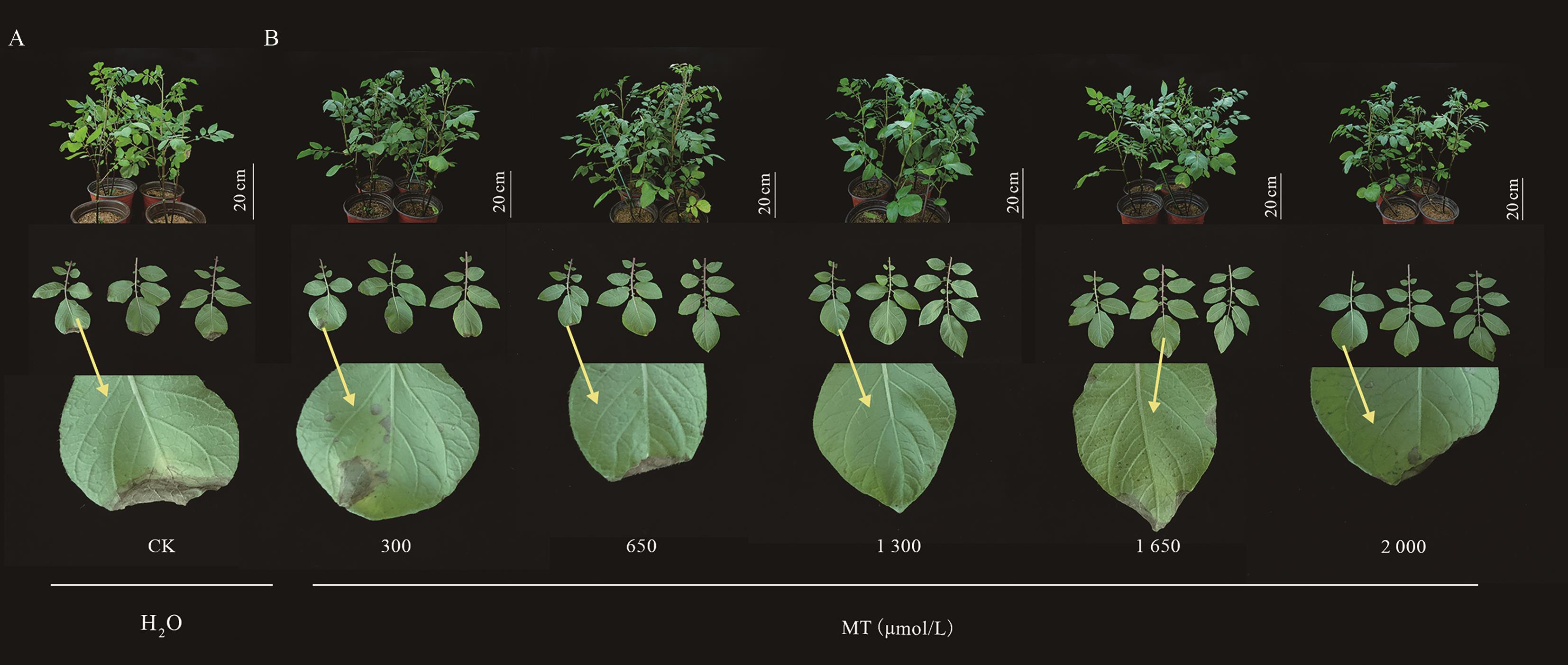
图2 不同浓度MT对马铃薯晚疫病的室内防效测定A:对照组;B:褪黑素预处理组
Fig. 2 Indoor efficacy of different concentrations of MT against potato late blightA: Control group. B: Melatonin-pretreated group
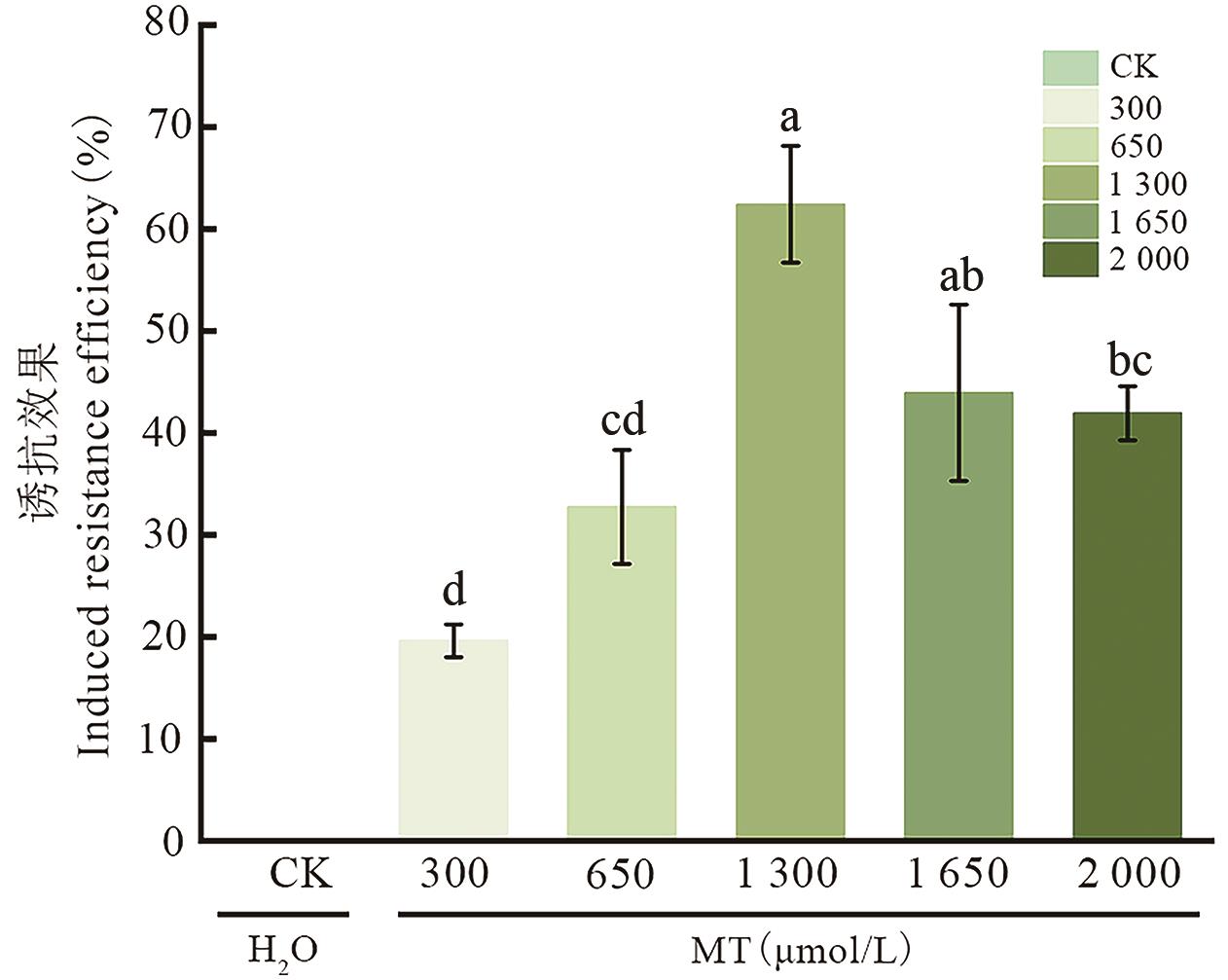
图3 不同浓度MT处理马铃薯植株接种晚疫病菌7 d后的诱抗效果
Fig. 3 Induced resistance effect of potato plants to P. infestans 7 days after inoculation with different concentrations of MT
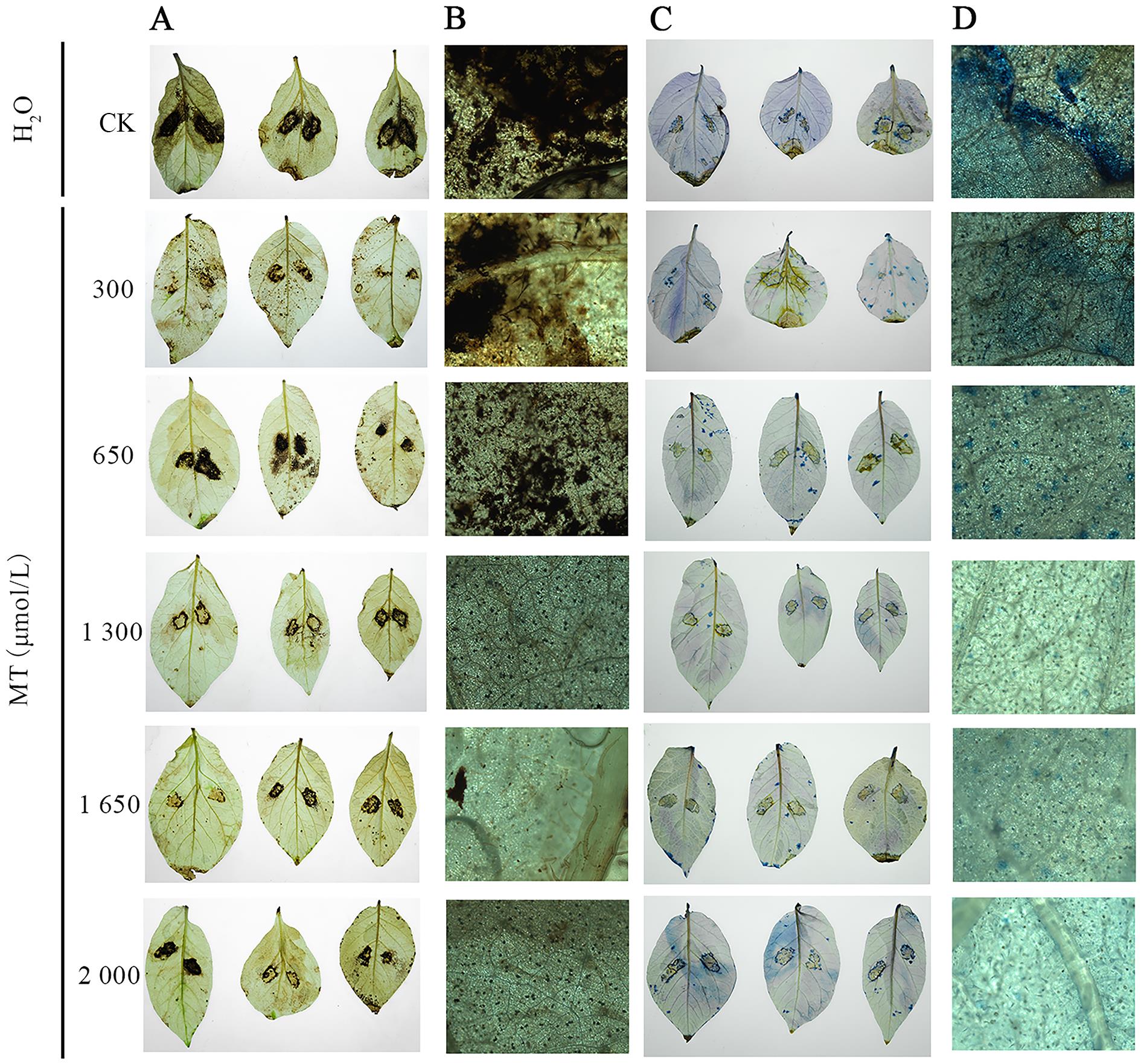
图4 DAB和台盼蓝的活体组织化学染色表型图A:叶片DAB染色;B:电子显微镜下发病部位DAB染色;C:叶片台盼蓝染色;D:电子显微镜下发病部位台盼蓝染色
Fig. 4 In vivo histochemical staining phenotypes of DAB and trypan blueA: DAB staining of leaves. B: DAB staining of infected sites under electron microscopy. C: Trypan blue staining of leaves. D: Trypan blue staining of infected sites under electron microscopy
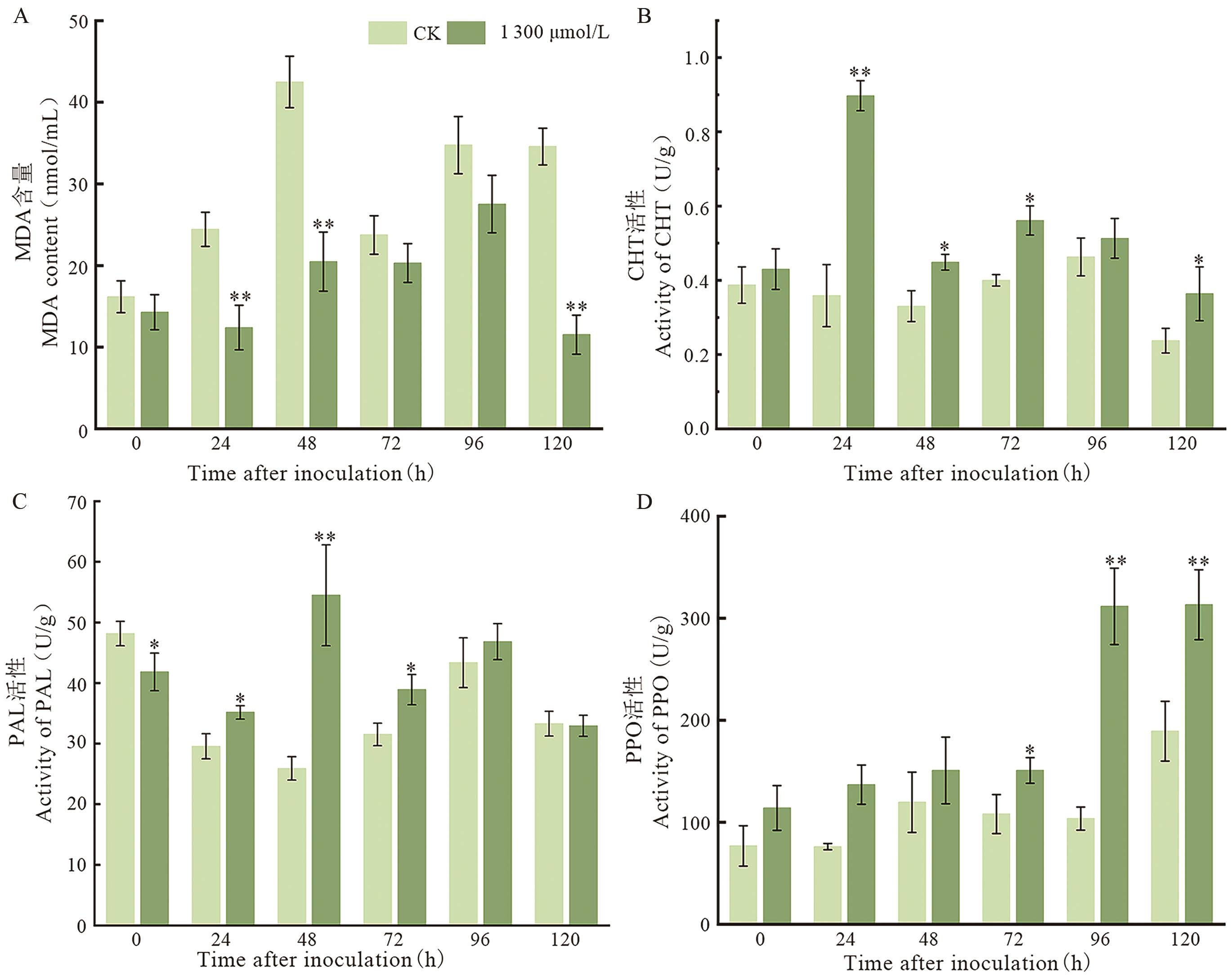
图5 MT预处理对接种晚疫病菌后马铃薯防御酶活性和丙二醛含量的影响*P0.05,**P0.01, the same below
Fig. 5 Effect of melatonin pretreatment on defense enzyme activities and malondialdehyde content in potato following inoculation with P. infestans
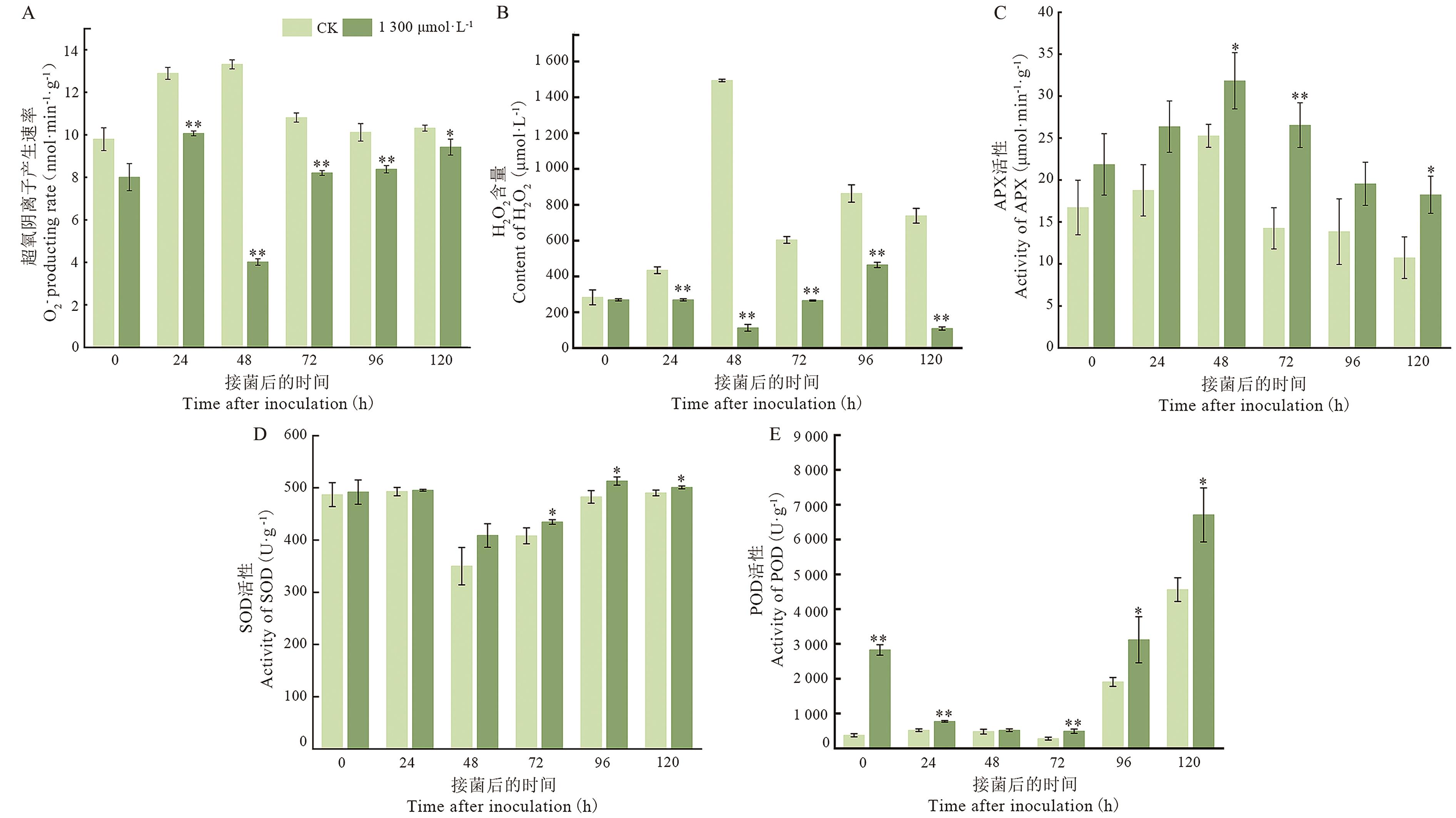
图6 MT预处理对接种晚疫病菌后马铃薯抗氧化系统的影响
Fig. 6 Effect of melatonin pretreatment on the antioxidant system of potato after inoculation with P. infestans
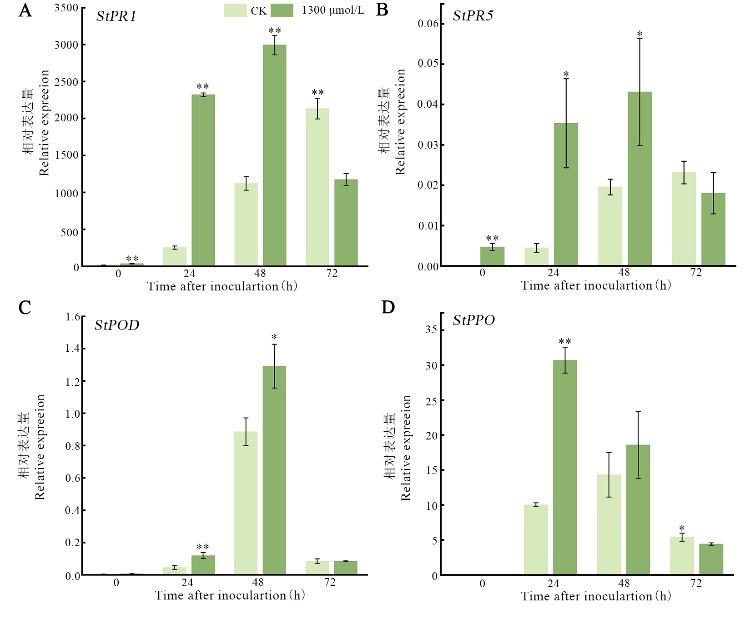
图7 MT预处理对接种晚疫病菌后马铃薯防卫基因表达的影响
Fig. 7 Effect of MT pretreatment on defense gene expression in potato following inoculation with P. infestans
| [1] | Diao YZ, Fan JR, Wang ZW, et al. First report of Colletotrichum boninense causing anthracnose on pepper in China [J]. Plant Dis, 2013, 97(1): 138. |
| [2] | 池婧, 周卉卉, 赵瑞璇, 等. 马铃薯块茎发芽与休眠调控机制及抑芽技术研究进展 [J]. 保鲜与加工, 2026, 26(2): 127-137. |
| Chi J, Zhou HH, Zhao RX, et al. Research progress on the regulatory mechanism of potato tuber sprouting and dormancy and sprout suppression techniques [J]. Storage Process, 2026, 26(2): 127-137. | |
| [3] | Berindean IV, Taoutaou A, Rida S, et al. Modern breeding strategies and tools for durable late blight resistance in potato [J]. Plants, 2024, 13(12): 1711. |
| [4] | Tian YQ, Wang JL, Lan QQ, et al. Biocontrol mechanisms of three plant essential oils against Phytophthora infestans causing potato late blight [J]. Phytopathology, 2024, 114(7): 1502-1514. |
| [5] | 李艺林. miR158a介导植物感寄生疫霉的机制研究 [D]. 杨凌: 西北农林科技大学, 2025. |
| Li YL. Characterization of miR158a in mediating plant susceptibility to Phytophthora parasitica [D]. Yangling: Northwest A F University, 2025. | |
| [6] | 王薇薇, 沈峰, 吴永成, 等. 褪黑素生物合成及其在植物逆境胁迫中的作用综述 [J]. 江苏农业科学, 2022, 50(1): 1-6. |
| Wang WW, Shen F, Wu YC, et al. Bio synthesis of melatonin and its role in plant stress: a review [J]. Jiangsu Agric Sci, 2022, 50(1): 1-6. | |
| [7] | Arnao MB, Hernández-Ruiz J. Functions of melatonin in plants: a review [J]. J Pineal Res, 2015, 59(2): 133-150. |
| [8] | 徐向东, 孙艳, 孙波, 等. 高温胁迫下外源褪黑素对黄瓜幼苗活性氧代谢的影响 [J]. 应用生态学报, 2010, 21(5): 1295-1300. |
| Xu XD, Sun Y, Sun B, et al. Effects of exogenous melatonin on active oxygen metabolism of cucumber seedlings under high temperature stress [J]. Chin J Appl Ecol, 2010, 21(5): 1295-1300. | |
| [9] | 张梦珂. 褪黑素提高番茄对灰霉病抗性的生理机理研究 [D]. 洛阳: 河南科技大学, 2022. |
| Zhang MK. Study on the physiological mechanisms of melatonin-induced disease resistance to Botrytis cinerea in tomato [D]. Luoyang: Henan University of Science and Technology, 2022. | |
| [10] | 杨陈玉. 月季响应褪黑素对灰霉病抗性的影响 [D]. 扬州: 扬州大学, 2024. |
| Yang CY. Effects of Rosa chinensis response to melatonin against Botrytis cinerea on the resistance [D]. Yangzhou: Yangzhou University, 2024. | |
| [11] | 朱金成, 杨洋, 娄慧, 等. 外源褪黑素调控棉花枯萎病抗性研究 [J]. 生物技术通报, 2023, 39(1): 243-252. |
| Zhu JC, Yang Y, Lou H, et al. Regulation of Fusarium wilt resistance in cotton by exogenous melatonin [J]. Biotechnol Bull, 2023, 39(1): 243-252. | |
| [12] | 严静怡. 褪黑素调控西瓜枯萎病抗性的作用机制解析 [D]. 杨凌: 西北农林科技大学, 2022. |
| Yan JY. Melatonin mediated Fusarium wilt resistance mechanism in watermelon [D]. Yangling: Northwest A F University, 2022. | |
| [13] | Jiang LH, Yuan ZK, Yan WT, et al. Transcriptomic and metabolomic analyses unveil TaASMT3-mediated wheat resistance against stripe rust by promoting melatonin biosynthesis [J]. Plant J, 2025, 122(2): e70182. |
| [14] | Lu RF, Liu ZY, Shao YD, et al. Melatonin is responsible for rice resistance to rice stripe virus infection through a nitric oxide-dependent pathway [J]. Virol J, 2019, 16: 141. |
| [15] | Zhang ZK, Wang T, Liu GS, et al. Inhibition of downy blight and enhancement of resistance in Litchi fruit by postharvest application of melatonin [J]. Food Chem, 2021, 347: 129009. |
| [16] | 刘芳洁, 韩旭娟, 王宇轩. 外源褪黑素对采后苹果轮纹病的防效及作用机制 [J]. 河南农业科学, 2026, 55(1): 110-117. |
| Liu FJ, Han XJ, Wang YX. Control efficiency and mechanism of exogenous melatonin on postharvest apple ring rot [J]. J Henan Agric Sci, 2026, 55(1): 110-117. | |
| [17] | 李磊, 陆杰, 包亚洲, 等. 四种化合物诱导马铃薯抗晚疫病的效果及其相关防御基因表达分析 [J]. 植物保护学报, 2020, 47(6): 1277-1286. |
| Li L, Lu J, Bao YZ, et al. Resistant effects of potato against late blight and expression analysis of potato-related defense genes induced by four kinds of compounds [J]. J Plant Prot, 2020, 47(6): 1277-1286. | |
| [18] | 肖庆红, 陈学明, 蔡冬清, 等. 施用新型农药控失剂对马铃薯晚疫病的防治效果和产量的影响 [J]. 中国马铃薯, 2017, 31(3): 160-164. |
| Xiao QH, Chen XM, Cai DQ, et al. Effect of novel fungicide loss-control agent on potato late blight and yield [J]. Chin Potato J, 2017, 31(3): 160-164. | |
| [19] | 苗向阳. Sly-miRNA1919c在番茄晚疫病抗性中的功能解析 [D]. 新乡: 河南科技学院, 2025. |
| Miao XY. Functional analysis of sly-miRNA1919c in tomato resistance to late blight [D]. Xinxiang: Henan Institute of Science and Technology, 2025. | |
| [20] | Wang P, Yin LH, Liang D, et al. Delayed senescence of apple leaves by exogenous melatonin treatment: toward regulating the ascorbate-glutathione cycle [J]. J Pineal Res, 2012, 53(1): 11-20. |
| [21] | 贺苗苗. 马铃薯抗晚疫病资源的评价和青薯9号响应晚疫病菌侵染的转录组分析 [D]. 杨凌: 西北农林科技大学, 2020. |
| He MM. Evaluation of potato germplasm for late blight resistance and transcriptome analysis of Qingshu9 in response to Phytophthora infestans infection [D]. Yangling: Northwest A F University, 2020. | |
| [22] | 李俊辰, 赵湘媛, 汪福东, 等. 野生稻内生菌Enterobacter hormaechei QT2在盐碱地水稻增产中的应用 [J]. 生物技术通报, 2025, 41(12): 106-113. |
| Li JC, Zhao XY, Wang FD, et al. Boosting rice yield in saline-alkali lands using Enterobacter hormaechei QT2: a wild rice endophytic bacterium [J]. Biotechnol Bull, 2025, 41(12): 106-113. | |
| [23] | 朱迪, 王冰冰, 贺苗苗. StCCR在马铃薯抗晚疫病中的功能解析 [J/OL]. 植物病理学报, 2025: 1-14. . |
| Zhu D, Wang BB, He MM. Functional analysis of StCCR in potato resistance to late blight [J/OL]. Acta Phytopathol Sin, 2025: 1-14. . | |
| [24] | Sun YK, Liu ZY, Lan GP, et al. Effect ofexogenous melatonin on resistance of cucumber to downy mildew [J]. Sci Hortic, 2019, 255: 231-241. |
| [25] | Yin LH, Wang P, Li MJ, et al. Exogenous melatonin improves Malus resistance to Marssonina apple blotch [J]. J Pineal Res, 2013, 54(4): 426-434. |
| [26] | 李生娥. 外源褪黑素诱导采后番茄果实抗病机制的研究 [D]. 杭州: 浙江工商大学, 2021. |
| Li SE. Exogenous melatonin induces disease resistance against pathogen infection in cherry tomato fruit during postharvest storage [D]. Hangzhou: Zhejiang Gongshang University, 2021. | |
| [27] | 孙子荀, 倪照君, 高志红, 等. 外源褪黑素提高草莓黑斑病抗性的效果和作用机制初探 [J]. 西北植物学报, 2020, 40(10): 1679-1687. |
| Sun ZX, Ni ZJ, Gao ZH, et al. Effect and mechanism of exogenous melatonin on improvement of black rot disease resistance in strawberry [J]. Acta Bot Boreali Occidentalia Sin, 2020, 40(10): 1679-1687. | |
| [28] | 夏铭. 褪黑素对萝卜黑斑病调控的影响 [D]. 贵阳: 贵州大学, 2021. |
| Xia M. Effect of melatonin on the regula tion of radish (Raphanus sativus L.) black spot [D]. Guiyang: Guizhou University, 2021. | |
| [29] | Weeda S, Zhang N, Zhao XL, et al. Arabidopsis transcriptome analysis reveals key roles of melatonin in plant defense systems [J]. PLoS One, 2014, 9(3): e93462. |
| [30] | 张娜. 褪黑素处理对渗透胁迫下黄瓜种子萌发及幼苗生长的影响及其分子机制 [D]. 北京: 中国农业大学, 2014. |
| Zhang N. Regulation of melatonin on germination and seedling growth under osmotic stress in cucumber [D]. Beijing: China Agricultural University, 2014. | |
| [31] | 张飞. 褪黑素缓解萝卜幼苗镉胁迫的分子机理 [D]. 南京: 南京农业大学, 2017. |
| Zhang F. The molecular mechanism of melatonin mitigating cadmium phytotoxicity in radish (Raphanus sativus L.) [D]. Nanjing: Nanjing Agricultural University, 2017. | |
| [32] | Parmar P, Limson J, Nyokong T, et al. Melatonin protects against copper-mediated free radical damage [J]. J Pineal Res, 2002, 32(4): 237-242. |
| [33] | 张有为, 赵乐, 温昊, 等. 盐胁迫下外源褪黑素对苦豆子种子萌发及幼苗生长的影响 [J]. 北方园艺, 2025(11): 56-66. |
| Zhang YW, Zhao L, Wen H, et al. Physiological response of exogenous melatonin to seed germination and seedling growth of bitter bean seedling under salt stress [J]. North Hortic, 2025(11): 56-66. | |
| [34] | 刘亚萍. 外源褪黑素对大白菜根肿病抗性的生理机制研究 [D]. 杨凌: 西北农林科技大学, 2021. |
| Liu YP. Physiological mechanism of exogenous melatonin inducing resistance to clubroot in Chinese cabbage [D]. Yangling: Northwest A F University, 2021. | |
| [35] | 陈玲, 赵骞, 董坤, 等. 苯甲酸和肉桂酸促进蚕豆枯萎病发生的生理生化机制 [J]. 植物保护学报, 2019, 46(2): 298-304. |
| Chen L, Zhao Q, Dong K, et al. Physiological mechanism of faba bean Fusarium wilt promoted by benzoic acid and cinnamic acid [J]. J Plant Prot, 2019, 46(2): 298-304. | |
| [36] | 孟璐璐, 于春蕾, 薛德胜, 等. BHT对苹果采后灰霉病的防效及防御酶活性和丙二醛含量的影响 [J]. 植物保护学报, 2019, 46(3): 686-692. |
| Meng LL, Yu CL, Xue DS, et al. Control efficiency of BHT against postharvest apple grey mold and its influence on the activity of defensive enzymes and content of malondialdehyde [J]. J Plant Prot, 2019, 46(3): 686-692. | |
| [37] | Chen JP, Zou X, Liu Q, et al. Combination effect of chitosan and methyl jasmonate on controlling Alternaria alternata and enhancing activity of cherry tomato fruit defense mechanisms [J]. Crop Prot, 2014, 56: 31-36. |
| [38] | 董小盼, 汤静, 丁娇, 等. 褪黑素处理对桃果实采后软腐病的影响及其机理 [J]. 食品科学, 2024, 45(11): 243-249. |
| Dong XP, Tang J, Ding J, et al. Effect and underlying mechanism of melatonin treatment on Rhizopus rot in postharvest peach fruit [J]. Food Sci, 2024, 45(11): 243-249. |
| [1] | 阳涛, 曾繁城, 曾宇笑, 陶瑞岩, 薛志红, 陶茜, 仲阳, 江帆, 熊兴耀, 程旭. 复合菌群的构建及其对马铃薯生长的影响[J]. 生物技术通报, 2026, 42(5): 89-100. |
| [2] | 李亚妮, 韩鸿宇, 耿梦爽, 米若兰, 王韦琪, 于文静, 孟宪文, 李传友. ChiC基因调控番茄灰霉病抗性的机制研究[J]. 生物技术通报, 2026, 42(3): 255-262. |
| [3] | 陈静欢, 房国楠, 朱文豪, 叶广继, 苏旺, 贺苗苗, 杨生龙, 周云. 马铃薯种质资源淀粉表征及相关基因表达分析[J]. 生物技术通报, 2026, 42(1): 170-183. |
| [4] | 巩慧玲, 邢玉洁, 马俊贤, 蔡霞, 冯再平. 马铃薯LAC基因家族的鉴定及盐胁迫下表达分析[J]. 生物技术通报, 2025, 41(9): 82-93. |
| [5] | 卢瑶, 袁平平, 金鑫, 毛向红, 范向斌, 白小东. 基于SSR标记的马铃薯野生种和地方种遗传多样性分析和指纹图谱构建[J]. 生物技术通报, 2025, 41(9): 94-104. |
| [6] | 林佳怡, 陈强, 张磊, 刘宏鑫, 郑晓明, 逄洪波. 褪黑素在植物低温胁迫中的研究进展[J]. 生物技术通报, 2025, 41(7): 37-48. |
| [7] | 黄丹丹, 吴云翼, 邹建华, 俞婷, 朱炎辉, 杨梅宏, 董文丽, 高冬丽. 马铃薯StPTST2a基因的克隆及互作分析[J]. 生物技术通报, 2025, 41(7): 172-180. |
| [8] | 李霞, 张泽伟, 刘泽军, 王楠, 郭江波, 辛翠花, 张彤, 简磊. 马铃薯转录因子StMYB96的克隆及功能研究[J]. 生物技术通报, 2025, 41(7): 181-192. |
| [9] | 罗稷林, 栗锦烨, 贾玉鑫. 马铃薯中重力响应调节基因鉴定及功能分析[J]. 生物技术通报, 2025, 41(6): 109-118. |
| [10] | 许慧珍, SHANTWANA Ghimire, RAJU Kharel, 岳云, 司怀军, 唐勋. 马铃薯SUMO E3连接酶基因家族分析及StSIZ1基因的克隆与表达模式分析[J]. 生物技术通报, 2025, 41(6): 119-129. |
| [11] | 段永红, 杨欣, 于冠群, 夏俊俊, 宋陆帅, 白小东, 彭锁堂. 125份马铃薯种质资源遗传多样性及主成分分析[J]. 生物技术通报, 2025, 41(6): 130-143. |
| [12] | 宋慧洋, 苏宝杰, 李京昊, 梅超, 宋倩娜, 崔福柱, 冯瑞云. 马铃薯StAS2-15基因的克隆及盐胁迫下功能分析[J]. 生物技术通报, 2025, 41(5): 119-128. |
| [13] | 文博霖, 万敏, 胡建军, 王克秀, 景晟林, 王心悦, 朱博, 唐铭霞, 李兵, 何卫, 曾子贤. 马铃薯川芋50遗传转化及基因编辑体系的建立[J]. 生物技术通报, 2025, 41(4): 88-97. |
| [14] | 刘涛, 王志淇, 吴文博, 石文婷, 王超楠, 杜崇, 杨中敏. 马铃薯GRAM基因家族鉴定与表达分析[J]. 生物技术通报, 2025, 41(4): 145-155. |
| [15] | 张益瑄, 马宇, 王童童, 盛苏奥, 宋家凤, 吕钊彦, 朱晓彪, 侯华兰. 马铃薯DIR家族全基因组鉴定及表达模式分析[J]. 生物技术通报, 2025, 41(3): 123-136. |
| 阅读次数 | ||||||
|
全文 |
|
|||||
|
摘要 |
|
|||||
