







生物技术通报 ›› 2025, Vol. 41 ›› Issue (4): 145-155.doi: 10.13560/j.cnki.biotech.bull.1985.2024-0804
• 研究报告 • 上一篇
刘涛1( ), 王志淇1, 吴文博1, 石文婷1, 王超楠1, 杜崇1,2, 杨中敏1,2()
收稿日期:2024-08-20
出版日期:2025-04-26
发布日期:2025-04-25
通讯作者:
杨中敏,女,博士,讲师,研究方向 :马铃薯分子遗传育种;E-mail: yangzhongmin161220@126.com作者简介:刘涛,男,硕士研究生,研究方向 :马铃薯分子遗传育种;E-mail: 2258845061@qq.com
基金资助:
LIU Tao1(), WANG Zhi-qi1, WU Wen-bo1, SHI Wen-ting1, WANG Chao-nan1, DU Chong1,2, YANG Zhong-min1,2()
Received:2024-08-20
Published:2025-04-26
Online:2025-04-25
摘要:
目的 GRAM(Glucosyltransferases, Rab-like GTPase activators and Myotubularins)是普遍存在于动、植物蛋白中的结构域,在植物生长发育及响应逆境胁迫等过程中发挥着重要功能。在马铃薯全基因组中鉴定GRAM基因家族成员,分析马铃薯GRAM家族基因在盐胁迫下的表达模式,探究GRAM家族在马铃薯盐胁迫过程中的作用。 方法 采用生物信息学方法鉴定马铃薯中GRAM家族成员,并对蛋白理化性质、染色体定位、亚细胞定位、基因结构、motif及共线性等方面进行分析。利用转录组测序和荧光定量PCR(RT-qPCR)对该家族成员在盐胁迫下的表达模式进行研究。 结果 在马铃薯中共鉴定到26个GRAM家族基因,不均匀地分布于7条染色体上;理化性质分析显示StGRAM全部为亲水性蛋白,大部分为碱性蛋白;亚细胞定位预测StGRAM蛋白大部分存在于叶绿体和细胞核;根据系统进化分析可将StGRAM家族分为3个亚族,同一亚族成员具有相似的基因结构及motif分布;通过马铃薯物种内共线性分析发现StGRAM仅有一对同源基因,物种间共线性显示StGRAM在水稻和拟南芥中分别存在5对和3对同源基因;在StGRAM基因启动子区发现大量的激素响应元件和逆境胁迫响应元件;转录组测序分析和RT-qPCR分析显示,StGRAM基因受盐胁迫的诱导表达,可能参与了马铃薯对盐胁迫的响应过程,StGRAM25基因可能对中性盐和碱性盐有不同的响应模式。 结论 StGRAM基因家族在马铃薯盐胁迫响应和信号转导过程中发挥着重要作用。
刘涛, 王志淇, 吴文博, 石文婷, 王超楠, 杜崇, 杨中敏. 马铃薯GRAM基因家族鉴定与表达分析[J]. 生物技术通报, 2025, 41(4): 145-155.
LIU Tao, WANG Zhi-qi, WU Wen-bo, SHI Wen-ting, WANG Chao-nan, DU Chong, YANG Zhong-min. Identification and Expression Analysis of the GRAM Gene Family in Potato[J]. Biotechnology Bulletin, 2025, 41(4): 145-155.
| 基因名称 Gene name | 上游引物 Forward primer(5'-3') | 下游引物 Reverse primer(5'-3') |
|---|---|---|
| Actin | GGATCTTGCTGGTCGTGATTTAAC | CATAGGCAAGCTTTTCCTTCATGT |
| TCTTTCCACTGCAACTGGTCCTG | ATGGGCGATCACTGCAAAAAGC |
表1 RT-qPCR 引物
Table 1 Primers for RT-qPCR
| 基因名称 Gene name | 上游引物 Forward primer(5'-3') | 下游引物 Reverse primer(5'-3') |
|---|---|---|
| Actin | GGATCTTGCTGGTCGTGATTTAAC | CATAGGCAAGCTTTTCCTTCATGT |
| TCTTTCCACTGCAACTGGTCCTG | ATGGGCGATCACTGCAAAAAGC |
基因名称 Gene name | 基因ID Gene ID | 蛋白长度 Amino acid length/aa | 分子量 Molecular mass/Da | 等电点 pI | 不稳定系数 Instability index | Aliphatic index | 亲水性 Hydropathicity | 亚细胞定位 Subcellular location |
|---|---|---|---|---|---|---|---|---|
| Soltu.DM.01G007240 | 叶绿体Chloroplast | |||||||
| Soltu.DM.01G030910 | 叶绿体Chloroplast | |||||||
| Soltu.DM.03G018700 | 细胞核Nuclear | |||||||
| Soltu.DM.03G025920 | 叶绿体Chloroplast | |||||||
| Soltu.DM.04G004990 | 细胞核Nuclear | |||||||
| Soltu.DM.04G005060 | 叶绿体Chloroplast | |||||||
| Soltu.DM.04G005070 | 叶绿体Chloroplast | |||||||
| Soltu.DM.04G005080 | 叶绿体Chloroplast | |||||||
| Soltu.DM.04G005090 | 叶绿体Chloroplast | |||||||
| Soltu.DM.04G005100 | 叶绿体Chloroplast | |||||||
| Soltu.DM.04G005110 | 细胞核Nuclear | |||||||
| Soltu.DM.04G005120 | 叶绿体Chloroplast | |||||||
| Soltu.DM.04G005130 | 叶绿体Chloroplast | |||||||
| Soltu.DM.04G005140 | 叶绿体Chloroplast | |||||||
| Soltu.DM.04G005150 | 叶绿体Chloroplast | |||||||
| Soltu.DM.04G005160 | 叶绿体Chloroplast | |||||||
| Soltu.DM.04G005170 | 叶绿体Chloroplast | |||||||
| Soltu.DM.04G005180 | 叶绿体Chloroplast | |||||||
| Soltu.DM.04G005190 | 叶绿体Chloroplast | |||||||
| Soltu.DM.04G008560 | 细胞核Nuclear | |||||||
| Soltu.DM.04G010140 | 叶绿体Chloroplast | |||||||
| Soltu.DM.06G014320 | 叶绿体Chloroplast | |||||||
| Soltu.DM.07G009230 | 细胞核Nuclear | |||||||
| Soltu.DM.08G005660 | 线粒体Mitochondrial | |||||||
| Soltu.DM.08G024750 | 细胞核Nuclear | |||||||
| Soltu.DM.11G003200 | 细胞质Cytoplasmic |
表2 马铃薯GRAM家族蛋白性质分析
Table 2 Analysis of the properties of the GRAM family proteins in potato
基因名称 Gene name | 基因ID Gene ID | 蛋白长度 Amino acid length/aa | 分子量 Molecular mass/Da | 等电点 pI | 不稳定系数 Instability index | Aliphatic index | 亲水性 Hydropathicity | 亚细胞定位 Subcellular location |
|---|---|---|---|---|---|---|---|---|
| Soltu.DM.01G007240 | 叶绿体Chloroplast | |||||||
| Soltu.DM.01G030910 | 叶绿体Chloroplast | |||||||
| Soltu.DM.03G018700 | 细胞核Nuclear | |||||||
| Soltu.DM.03G025920 | 叶绿体Chloroplast | |||||||
| Soltu.DM.04G004990 | 细胞核Nuclear | |||||||
| Soltu.DM.04G005060 | 叶绿体Chloroplast | |||||||
| Soltu.DM.04G005070 | 叶绿体Chloroplast | |||||||
| Soltu.DM.04G005080 | 叶绿体Chloroplast | |||||||
| Soltu.DM.04G005090 | 叶绿体Chloroplast | |||||||
| Soltu.DM.04G005100 | 叶绿体Chloroplast | |||||||
| Soltu.DM.04G005110 | 细胞核Nuclear | |||||||
| Soltu.DM.04G005120 | 叶绿体Chloroplast | |||||||
| Soltu.DM.04G005130 | 叶绿体Chloroplast | |||||||
| Soltu.DM.04G005140 | 叶绿体Chloroplast | |||||||
| Soltu.DM.04G005150 | 叶绿体Chloroplast | |||||||
| Soltu.DM.04G005160 | 叶绿体Chloroplast | |||||||
| Soltu.DM.04G005170 | 叶绿体Chloroplast | |||||||
| Soltu.DM.04G005180 | 叶绿体Chloroplast | |||||||
| Soltu.DM.04G005190 | 叶绿体Chloroplast | |||||||
| Soltu.DM.04G008560 | 细胞核Nuclear | |||||||
| Soltu.DM.04G010140 | 叶绿体Chloroplast | |||||||
| Soltu.DM.06G014320 | 叶绿体Chloroplast | |||||||
| Soltu.DM.07G009230 | 细胞核Nuclear | |||||||
| Soltu.DM.08G005660 | 线粒体Mitochondrial | |||||||
| Soltu.DM.08G024750 | 细胞核Nuclear | |||||||
| Soltu.DM.11G003200 | 细胞质Cytoplasmic |
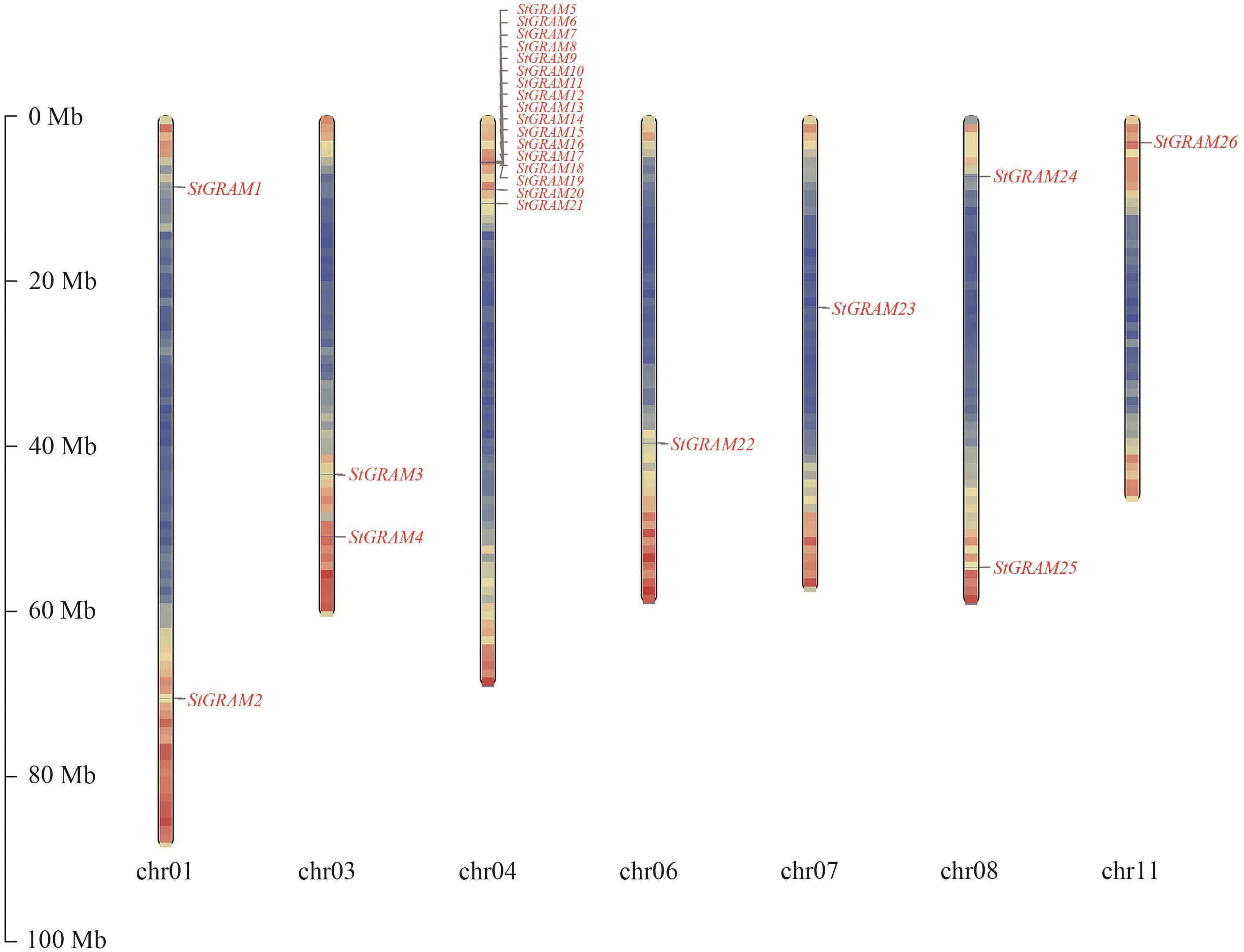
图1 马铃薯GRAM基因染色体定位
Fig. 1 Chromosome localization of GRAM genes in potato
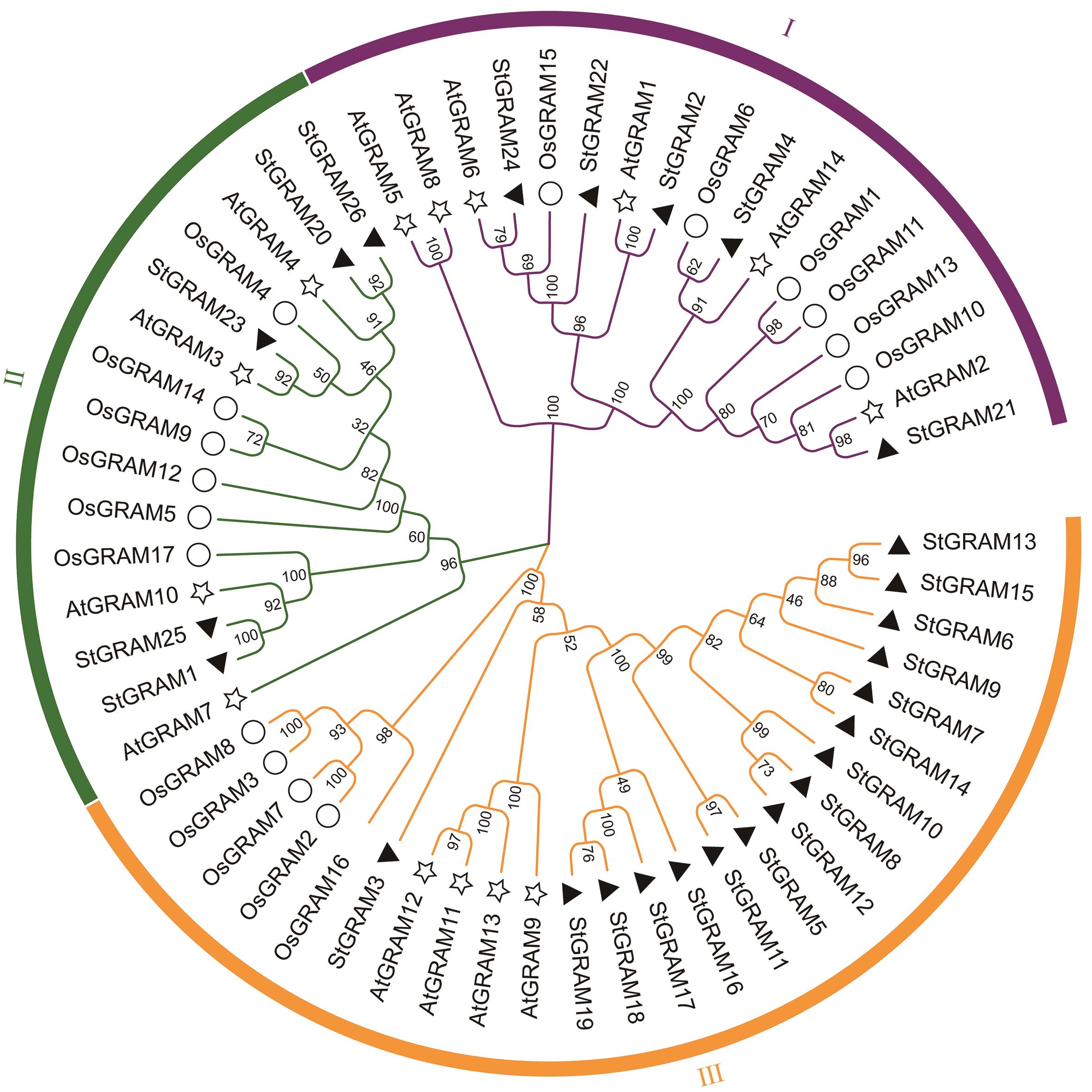
图2 马铃薯、拟南芥和水稻GRAM蛋白的系统进化树
Fig. 2 Phylogenetic tree of GRAM proteins in Solanum tuberosum, Arabidopsis thaliana, and Oryza sativa

图3 马铃薯GRAM家族基因的共线性分析(A)以及多物种间GRAM基因共线性分析(B)图A中外侧方框代表染色体骨架,中间和内侧方框表示基因密度,每个基因在染色体骨架上的大致分布用短黑线标出,长黑线表示复制基因对
Fig. 3 Collinearity analysis of potato GRAM family genes(A)and collinearity analysis of GRAM genes across multiple species(B)In Figure A, the outer box indicates the chromosome skeleton, and the middle and inner boxes represent the gene density. The approximate distribution of each gene on the chromosome skeleton is marked by a short black line, and the long black line indicates the copy gene pair

图4 StGRAM基因家族系统进化树(A)、基因结构(B)和蛋白保守基序(C)
Fig. 4 Phylogenetic tree (A), gene structure (B), and protein conserved motif (C) of StGRAM gene family

图5 启动子区顺式作用元件分析
Fig. 5 Analysis of cis-acting elements in the promoter region
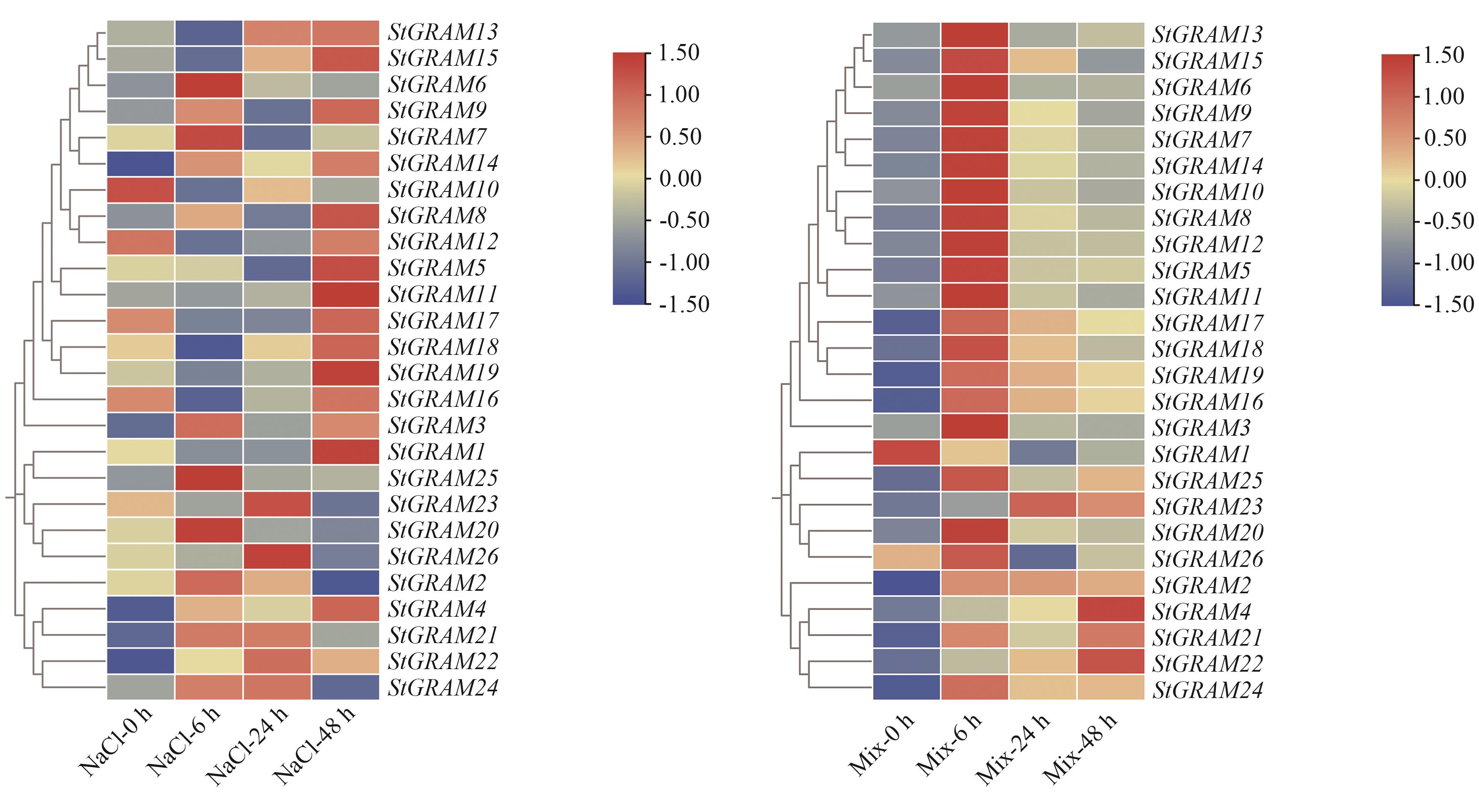
图6 不同时长NaCl与Mix处理后的StGRAM的表达情况
Fig. 6 Expressions of StGRAM after NaCl and Mix treatment at different time durations

图7 StGRAM25在不同盐胁迫下随时间的表达量变化不同小写字母表示在P<0.05水平差异显著
Fig. 7 Changes in the expressions of StGRAM25 over time under different salt stressesDifferent lower letters indicate significant differences at P<0.05 level
| 1 | Tiwari S, Gupta SC, Chauhan PS, et al. An OsNAM gene plays important role in root rhizobacteria interaction in transgenic Arabidopsis through abiotic stress and phytohormone crosstalk [J]. Plant Cell Rep, 2021, 40(1): 143-155. |
| 2 | Doerks T, Strauss M, Brendel M, et al. GRAM, a novel domain in glucosyltransferases, myotubularins and other putative membrane-associated proteins [J]. Trends Biochem Sci, 2000, 25(10): 483-485. |
| 3 | Jiang SY, Ramamoorthy R, Ramachandran S. Comparative transcriptional profiling and evolutionary analysis of the GRAM domain family in eukaryotes [J]. Dev Biol, 2008, 314(2): 418-432. |
| 4 | Liu JH, Luo M, Cheng KJ, et al. Identification and characterization of a novel barley gene that is ABA-inducible and expressed specifically in embryo and aleurone [J]. J Exp Bot, 1999, 50(334): 727-728. |
| 5 | Ye ZX, Qiao L, Luo XY, et al. Genome-wide identification of cotton GRAM family proteins reveals that GRAM31 regulates fiber length [J]. J Exp Bot, 2021, 72(7): 2477-2490. |
| 6 | Jiang SY, Cai MN, Ramachandran S. The Oryza sativa no pollen (Osnop) gene plays a role in male gametophyte development and most likely encodes a C2-GRAM domain-containing protein [J]. Plant Mol Biol, 2005, 57(6): 835-853. |
| 7 | Mauri N, Fernández-Marcos M, Costas C, et al. GEM, a member of the GRAM domain family of proteins, is part of the ABA signaling pathway [J]. Sci Rep, 2016, 6: 22660. |
| 8 | Caro E, Castellano MM, Gutierrez C. A chromatin link that couples cell division to root epidermis patterning in Arabidopsis [J]. Nature, 2007, 447(7141): 213-217. |
| 9 | Templeton GW, Johnson JJ, Sieben NA, et al. GL2 EXPRESSION MODULATOR, a plant specific protein phosphatase one interactor that binds phosphoinositides [J]. Biochem Biophys Res Commun, 2020, 528(3): 607-611. |
| 10 | Fujii H, Zhu JK. Arabidopsis mutant deficient in 3 abscisic acid-activated protein kinases reveals critical roles in growth, reproduction, and stress [J]. Proc Natl Acad Sci USA, 2009, 106(20): 8380-8385. |
| 11 | Liu LY, Li N, Yao CP, et al. Functional analysis of the ABA-responsive protein family in ABA and stress signal transduction in Arabidopsis [J]. Chin Sci Bull, 2013, 58(31): 3721-3730. |
| 12 | Zheng CK, Zhou JJ, Zhang F, et al. OsABAR1, a novel GRAM domain-containing protein, confers drought and salt tolerance via an ABA-dependent pathway in rice [J]. Plant Physiol Biochem, 2020, 152: 138-146. |
| 13 | Tiwari S, Shweta S, Prasad M, et al. Genome-wide investigation of GRAM-domain containing genes in rice reveals their role in plant-rhizobacteria interactions and abiotic stress responses [J]. Int J Biol Macromol, 2020, 156: 1243-1257. |
| 14 | Choi DS, Hwang BK. Proteomics and functional analyses of pepper abscisic acid-responsive 1 (ABR1), which is involved in cell death and defense signaling [J]. Plant Cell, 2011, 23(2): 823-842. |
| 15 | Rowland O, Ludwig AA, Merrick CJ, et al. Functional analysis of Avr9/Cf-9 rapidly elicited genes identifies a protein kinase, ACIK1 that is essential for full Cf-9-dependent disease resistance in tomato [J]. Plant Cell, 2005, 17(1): 295-310. |
| 16 | Lorrain S, Lin BQ, Auriac MC, et al. Vascular associated death1, a novel GRAM domain-containing protein, is a regulator of cell death and defense responses in vascular tissues [J]. Plant Cell, 2004, 16(8): 2217-2232. |
| 17 | Khafif M, Balagué C, Huard-Chauveau C, et al. An essential role for the VASt domain of the Arabidopsis VAD1 protein in the regulation of defense and cell death in response to pathogens [J]. PLoS One, 2017, 12(7): e0179782. |
| 18 | Baron KN, Schroeder DF, Stasolla C. GEm-Related 5 (GER5), an ABA and stress-responsive GRAM domain protein regulating seed development and inflorescence architecture [J]. Plant Sci, 2014, 223: 153-166. |
| 19 | Lutaladio N, Castaldi L. Potato: the hidden treasure [J]. J Food Compos Anal, 2009, 22: 491-493. |
| 20 | Andrivon D. Potato facing global challenges: how, how much, how well? [J]. Potato Res, 2017, 60(3): 389-400. |
| 21 | Devaux A, Kromann P, Ortiz O. Potatoes for sustainable global food security [J]. Potato Res, 2014, 57(3): 185-199. |
| 22 | Hijmans RJ. The effect of climate change on global potato production [J]. Am J Potato Res, 2003, 80(4): 271-279. |
| 23 | Aghaei K, Ehsanpour AA, Komatsu S. Proteome analysis of potato under salt stress [J]. J Proteome Res, 2008, 7(11): 4858-4868. |
| 24 | Tiwari S, Muthamilarasan M, Lata CR. Genome-wide identification and expression analysis of Arabidopsis GRAM-domain containing gene family in response to abiotic stresses and PGPR treatment [J]. J Biotechnol, 2021, 325: 7-14. |
| 25 | Hoth S, Morgante M, Sanchez JP, et al. Genome-wide gene expression profiling in Arabidopsis thaliana reveals new targets of abscisic acid and largely impaired gene regulation in the abi1-1 mutant [J]. J Cell Sci, 2002, 115(Pt 24): 4891-4900. |
| 26 | Yazaki J, Shimatani Z, Hashimoto A, et al. Transcriptional profiling of genes responsive to abscisic acid and gibberellin in rice: phenotyping and comparative analysis between rice and Arabidopsis [J]. Physiol Genomics, 2004, 17(2): 87-100. |
| 27 | Blanc G, Wolfe KH. Widespread paleopolyploidy in model plant species inferred from age distributions of duplicate genes [J]. Plant Cell, 2004, 16(7): 1667-1678. |
| 28 | Cannon SB, Mitra A, Baumgarten A, et al. The roles of segmental and tandem gene duplication in the evolution of large gene families in Arabidopsis thaliana [J]. BMC Plant Biol, 2004, 4: 10. |
| 29 | Cao JJ, Li MY, Chen J, et al. Effects of MeJA on Arabidopsis metabolome under endogenous JA deficiency [J]. Sci Rep, 2016, 6: 37674. |
| 30 | Wang Y, Mostafa S, Zeng W, et al. Function and mechanism of jasmonic acid in plant responses to abiotic and biotic stresses [J]. Int J Mol Sci, 2021, 22(16): 8568. |
| [1] | 张益瑄, 马宇, 王童童, 盛苏奥, 宋家凤, 吕钊彦, 朱晓彪, 侯华兰. 马铃薯DIR家族全基因组鉴定及表达模式分析[J]. 生物技术通报, 2025, 41(3): 123-136. |
| [2] | 俞婷, 黄丹丹, 朱炎辉, 杨梅宏, 艾菊, 高冬丽. 马铃薯Stpatatin 05基因转录调控因子筛选及互作验证[J]. 生物技术通报, 2025, 41(3): 137-145. |
| [3] | 覃悦, 杨妍, 张磊, 卢丽丽, 李先平, 蒋伟. 二倍体和四倍体马铃薯StGAox基因鉴定与比较分析[J]. 生物技术通报, 2025, 41(3): 146-160. |
| [4] | 王琛, 刘国梅, 陈畅, 张晋龙, 姚琳, 孙璇, 杜春芳. 白菜型油菜CCDs家族全基因组鉴定及表达分析[J]. 生物技术通报, 2025, 41(3): 161-170. |
| [5] | 韩江涛, 张帅博, 秦雅蕊, 韩硕洋, 张雅康, 王吉庆, 杜清洁, 肖怀娟, 李猛. 甜瓜β-淀粉酶基因家族的鉴定及对非生物胁迫的响应[J]. 生物技术通报, 2025, 41(3): 171-180. |
| [6] | 宋姝熠, 蒋开秀, 刘欢艳, 黄亚成, 刘林娅. ‘红阳’猕猴桃TCP基因家族鉴定及其在果实中的表达分析[J]. 生物技术通报, 2025, 41(3): 190-201. |
| [7] | 彭婷, 林颖, 谭圆圆, 饶英, 黄覃, 张文娥, 汪波, 田瑞丰, 刘国锋. 多星韭AwANSs基因的克隆与表达分析[J]. 生物技术通报, 2025, 41(3): 230-239. |
| [8] | 马天意, 许家佳, 路文婧, 吴艳, 沙伟, 张梅娟, 彭疑芳. ‘金小童’大白菜BrcGASA3基因在盐碱胁迫下的表达分析及抗性鉴定[J]. 生物技术通报, 2025, 41(2): 127-138. |
| [9] | 许圆梦, 毛娇, 王梦瑶, 王数, 任江陵, 刘宇涵, 刘思辰, 乔治军, 王瑞云, 曹晓宁. 糜子PmDEP1和PmEP3基因的克隆与表达特征分析[J]. 生物技术通报, 2025, 41(2): 150-162. |
| [10] | 贾子健, 王宝强, 陈立飞, 王义真, 魏小红, 赵颖. 响应NO的藜麦CHX基因家族在盐碱胁迫下的表达模式[J]. 生物技术通报, 2025, 41(2): 163-174. |
| [11] | 颜伟, 陈慧婷, 叶青, 刘广超, 刘新, 侯丽霞. 葡萄HCT基因家族鉴定及其对低温胁迫的响应[J]. 生物技术通报, 2025, 41(2): 175-186. |
| [12] | 匡健华, 程志鹏, 赵永晶, 杨洁, 陈润乔, 陈龙清, 胡慧贞. 激素和非生物胁迫下荷花GH3基因家族的表达分析[J]. 生物技术通报, 2025, 41(2): 221-233. |
| [13] | 钱政毅, 吴绍芳, 曹舒怡, 宋雅欣, 潘鑫峰, 李兆伟, 范凯. 睡莲NAC转录因子的鉴定及其表达分析[J]. 生物技术通报, 2025, 41(2): 234-247. |
| [14] | 黄颖, 遇文婧, 刘雪峰, 刁桂萍. 山新杨谷胱甘肽转移酶基因的生物信息学与表达模式分析[J]. 生物技术通报, 2025, 41(2): 248-256. |
| [15] | 杨涌, 袁国梅, 康肖肖, 刘亚明, 王东升, 张海娥. 板栗SWEET基因家族成员的鉴定及表达分析[J]. 生物技术通报, 2025, 41(2): 257-269. |
| 阅读次数 | ||||||
|
全文 |
|
|||||
|
摘要 |
|
|||||
