







生物技术通报 ›› 2025, Vol. 41 ›› Issue (6): 229-242.doi: 10.13560/j.cnki.biotech.bull.1985.2025-0005
• 研究报告 • 上一篇
安昌1( ), 徐文波2, 陆琳1, 李登麟1, 姚艺新3, 林彦翔4, 杨成梓4, 秦源1(), 郑平1()
收稿日期:2025-01-03
出版日期:2025-06-26
发布日期:2025-06-30
通讯作者:
郑平,副教授,硕士生导师,研究方向:多组学分析和组学大数据挖掘;E-mail: zhengping13@mails.ucas.ac.cn作者简介:安昌,博士研究生,研究方向:药用植物资源学及基因组学;E-mail: ancher0928@163.com
基金资助:
AN Chang1(), XU Wen-bo2, LU Lin1, LI Deng-lin1, YAO Yi-xin3, LIN Yan-xiang4, YANG Cheng-zi4, QIN Yuan1(), ZHENG Ping1()
Received:2025-01-03
Published:2025-06-26
Online:2025-06-30
摘要:
目的 研究不同产地珊瑚菜(Glehnia littoralis)的叶绿体基因组的特征及其系统发育关系,从细胞器基因组角度揭示珊瑚菜物种内的遗传变异和群体分化,为其新品种选育和种质资源保护提供遗传学基础。 方法 对产自福建的珊瑚菜叶绿体基因组进行了组装和注释,随后对6个来自不同产地样本的叶绿体基因组进行比较分析,研究其基因组结构、重复序列分布、密码子使用偏好、核苷酸多态性、基因组边界特征以及系统发育关系,探讨不同产地珊瑚菜之间的遗传多样性和适应性进化特征。 结果 6个叶绿体基因组均呈典型的双链环状四分体结构,基因组长度为147 445-147 552 bp,GC含量为37.51%-37.52%,结构高度保守。均注释出129个基因,包括85个蛋白编码基因,8个核糖体RNA和36个转运RNA。SSR数量在77-79之间,共包含6种类型,以A/T类型为主。密码子使用分析表明,编码精氨酸的密码子中福建和中国台湾产地的珊瑚菜倾向于使用的CGA,而深圳和浙江产地的珊瑚菜更偏好CGT。基因组边界特征基因具有一定的保守性,差异主要位于JLB和JLA边界。核苷酸多态性分析共检测出24个的多态性区域。系统发育分析表明,产于韩国的珊瑚菜在演化上独立于其他样本,中国台湾产地与其余地区样本分化最早,显示出独特的遗传特征;福建产地随后分化,深圳和浙江样本形成一个小分支。 结论 不同产地珊瑚菜在叶绿体基因组结构特征保守,但在密码子使用、基因组边界及核苷酸多态性等方面存在一定变异,系统发育分析表明其群体间存在遗传分化,反映了其适应性进化特征。
安昌, 徐文波, 陆琳, 李登麟, 姚艺新, 林彦翔, 杨成梓, 秦源, 郑平. 不同产地珊瑚菜叶绿体基因组特征的差异性研究[J]. 生物技术通报, 2025, 41(6): 229-242.
AN Chang, XU Wen-bo, LU Lin, LI Deng-lin, YAO Yi-xin, LIN Yan-xiang, YANG Cheng-zi, QIN Yuan, ZHENG Ping. Comparative Analysis of Glehnia littoralis from Different Geographic Regions Based on the Characteristics of Chloroplast Genome[J]. Biotechnology Bulletin, 2025, 41(6): 229-242.
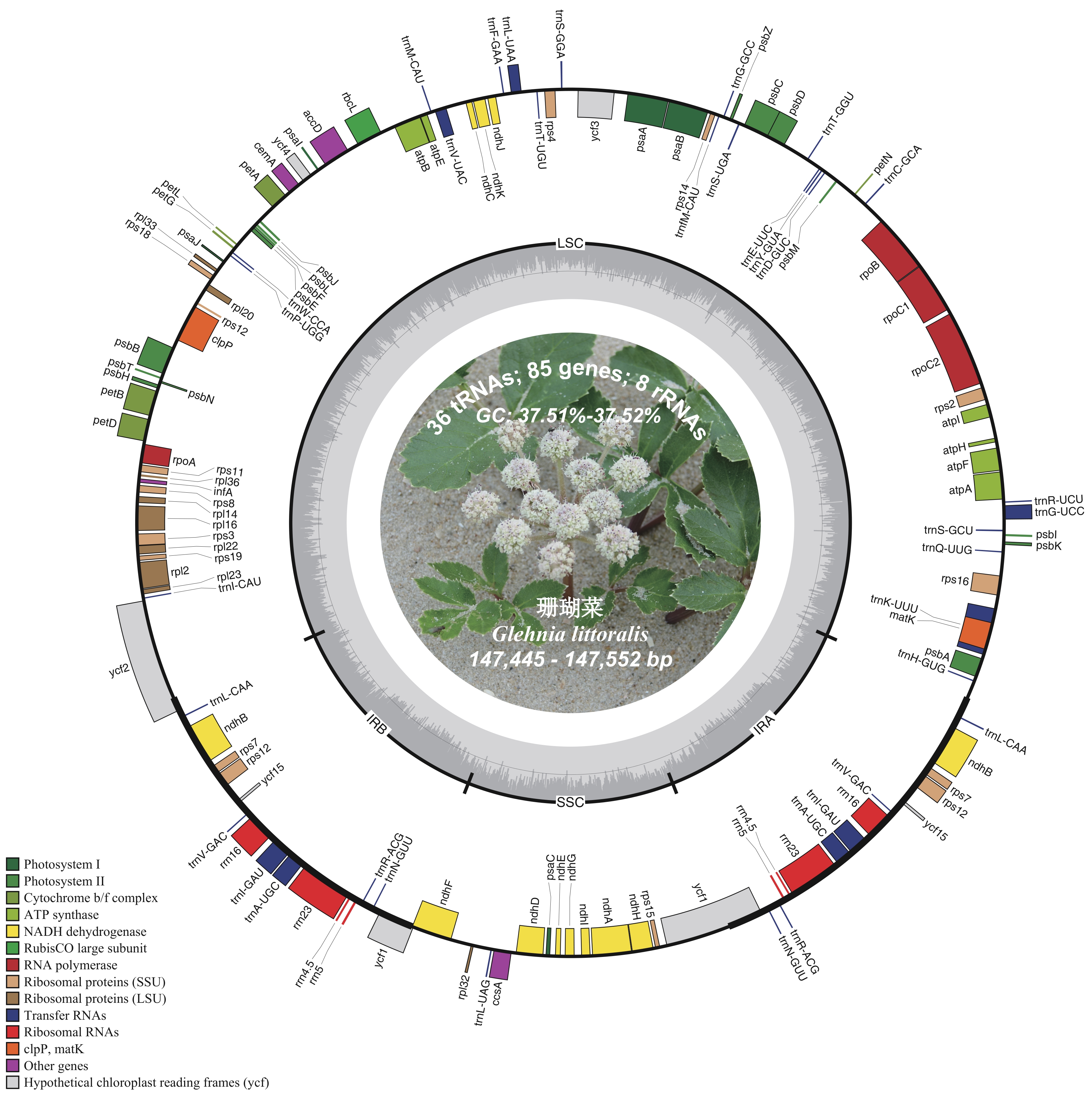
图1 6个珊瑚菜叶绿体基因组结构图
Fig. 1 Chloroplast genome structural map of six chloroplast genomes of G. littoralis
| 类别 Category | 分组 Gene group | 基因 Gene |
|---|---|---|
光合作用 Photosynthesis | 光系统I亚基 Subunits of photosystem I | psaA, psaB, psaC, psaI, psaJ |
光系统II亚基 Subunits of photosystem II | psbA, psbB, psbC, psbD, psbE, psbF, psbH, psbI, psbJ, psbK, psbL, psbM, psbN, psbT, psbZ | |
NADH脱氢酶亚基 Subunits of NADH dehydrogenase | ndhA*, ndhB*(2), ndhC, ndhD, ndhE, ndhF, ndhG, ndhH, ndhI, ndhJ, ndhK | |
细胞色素b/f 复合体亚基 Subunits of cytochrome b/f complex | petA, petB*, petD*, petG, petL, petN | |
ATP合酶亚基 Subunits of ATP synthase | atpA, atpB, atpE, atpF*, atpH, atpI | |
Rubisco大亚基 Large subunit of rubisco | rbcL | |
自我复制 Self-replication | 大核糖体亚基蛋白 Proteins of large ribosomal subunit | rpl14, rpl16*, rpl2*, rpl20, rpl22, rpl23, rpl32, rpl33, rpl36 |
小核糖体亚基蛋白 Proteins of small ribosomal subunit | rps11, rps12**(2), rps14, rps15, rps16*, rps18, rps19, rps2, rps3, rps4, rps7(2), rps8 | |
RNA聚合酶的亚基 Subunits of RNA polymerase | rpoA, rpoB, rpoC1*, rpoC2 | |
核糖体RNA Ribosomal RNAs | rrn16(2), rrn23(2), rrn4.5(2), rrn5(2) | |
转运RNA Transfer RNAs | trnA-UGC*(2), trnC-GCA, trnD-GUC, trnE-UUC, trnF-GAA, trnG-GCC, trnG-UCC*, trnH-GUG, trnI-CAU, trnI-GAU*(2), trnK-UUU*, trnL-CAA(2), trnL-UAA*, trnL-UAG, trnM-CAU, trnN-GUU(2), trnP-UGG, trnQ-UUG, trnR-ACG(2), trnR-UCU, trnS-GCU, trnS-GGA, trnS-UGA, trnT-GGU, trnT-UGU, trnV-GAC(2), trnV-UAC*, trnW-CCA, trnY-GUA, trnfM-CAU | |
其他基因 Other genes | 成熟酶 Maturase | matK |
蛋白酶 Protease | clpP** | |
包膜膜蛋白 Envelope membrane protein | cemA | |
乙酰辅酶A羧化酶 Acetyl-CoA carboxylase | accD | |
c型细胞色素合成基因 c-type cytochrome synthesis gene | ccsA | |
翻译起始因子 Translation initiation factor | infA | |
功能未知 Genes of unknown function | 保守的假定叶绿体开放阅读框ORF Conserved hypothetical chloroplast ORF | ycf1(2), ycf15(2), ycf2, ycf3**, ycf4 |
表1 珊瑚菜叶绿体基因组基因功能注释与分类
Table 1 Functional annotation and classification of genes in the chloroplast genome of G. littoralis
| 类别 Category | 分组 Gene group | 基因 Gene |
|---|---|---|
光合作用 Photosynthesis | 光系统I亚基 Subunits of photosystem I | psaA, psaB, psaC, psaI, psaJ |
光系统II亚基 Subunits of photosystem II | psbA, psbB, psbC, psbD, psbE, psbF, psbH, psbI, psbJ, psbK, psbL, psbM, psbN, psbT, psbZ | |
NADH脱氢酶亚基 Subunits of NADH dehydrogenase | ndhA*, ndhB*(2), ndhC, ndhD, ndhE, ndhF, ndhG, ndhH, ndhI, ndhJ, ndhK | |
细胞色素b/f 复合体亚基 Subunits of cytochrome b/f complex | petA, petB*, petD*, petG, petL, petN | |
ATP合酶亚基 Subunits of ATP synthase | atpA, atpB, atpE, atpF*, atpH, atpI | |
Rubisco大亚基 Large subunit of rubisco | rbcL | |
自我复制 Self-replication | 大核糖体亚基蛋白 Proteins of large ribosomal subunit | rpl14, rpl16*, rpl2*, rpl20, rpl22, rpl23, rpl32, rpl33, rpl36 |
小核糖体亚基蛋白 Proteins of small ribosomal subunit | rps11, rps12**(2), rps14, rps15, rps16*, rps18, rps19, rps2, rps3, rps4, rps7(2), rps8 | |
RNA聚合酶的亚基 Subunits of RNA polymerase | rpoA, rpoB, rpoC1*, rpoC2 | |
核糖体RNA Ribosomal RNAs | rrn16(2), rrn23(2), rrn4.5(2), rrn5(2) | |
转运RNA Transfer RNAs | trnA-UGC*(2), trnC-GCA, trnD-GUC, trnE-UUC, trnF-GAA, trnG-GCC, trnG-UCC*, trnH-GUG, trnI-CAU, trnI-GAU*(2), trnK-UUU*, trnL-CAA(2), trnL-UAA*, trnL-UAG, trnM-CAU, trnN-GUU(2), trnP-UGG, trnQ-UUG, trnR-ACG(2), trnR-UCU, trnS-GCU, trnS-GGA, trnS-UGA, trnT-GGU, trnT-UGU, trnV-GAC(2), trnV-UAC*, trnW-CCA, trnY-GUA, trnfM-CAU | |
其他基因 Other genes | 成熟酶 Maturase | matK |
蛋白酶 Protease | clpP** | |
包膜膜蛋白 Envelope membrane protein | cemA | |
乙酰辅酶A羧化酶 Acetyl-CoA carboxylase | accD | |
c型细胞色素合成基因 c-type cytochrome synthesis gene | ccsA | |
翻译起始因子 Translation initiation factor | infA | |
功能未知 Genes of unknown function | 保守的假定叶绿体开放阅读框ORF Conserved hypothetical chloroplast ORF | ycf1(2), ycf15(2), ycf2, ycf3**, ycf4 |
登录号 GenBank ID | 产地 Distribution | 大小 Size (bp) | 蛋白编码基因 PCG | 转运RNA tRNA | 核糖体RNA rRNA | 基因数 Genes | GC (%) | 长度 Length (bp) | ||
|---|---|---|---|---|---|---|---|---|---|---|
| LSC | SSC | IRb/a | ||||||||
| KT153022.1 | 韩国1 | 147 467 | 85 | 36 | 8 | 129 | 37.51 | 93 493 | 17 546 | 18 214 |
| NC_034645.1 | 韩国2 | 147 477 | 85 | 36 | 8 | 129 | 37.51 | 93 496 | 17 555 | 18 213 |
| OR004233.1 | 中国台湾 | 147 445 | 85 | 36 | 8 | 129 | 37.52 | 92 373 | 17 548 | 18 762 |
| PQ563254.1 | 福建 | 147 493 | 85 | 36 | 8 | 129 | 37.51 | 93 218 | 17 545 | 18 365 |
| MH142518.1 | 深圳 | 147 552 | 85 | 36 | 8 | 129 | 37.51 | 93 277 | 17 545 | 18 365 |
| OQ863734.1 | 浙江 | 147 507 | 85 | 36 | 8 | 129 | 37.51 | 93 231 | 17 546 | 18 365 |
表2 6个产地珊瑚菜叶绿体基因组的特征
Table 2 Characteristics of chloroplast genomes of G. littoralis from 6 different geographic distributions
登录号 GenBank ID | 产地 Distribution | 大小 Size (bp) | 蛋白编码基因 PCG | 转运RNA tRNA | 核糖体RNA rRNA | 基因数 Genes | GC (%) | 长度 Length (bp) | ||
|---|---|---|---|---|---|---|---|---|---|---|
| LSC | SSC | IRb/a | ||||||||
| KT153022.1 | 韩国1 | 147 467 | 85 | 36 | 8 | 129 | 37.51 | 93 493 | 17 546 | 18 214 |
| NC_034645.1 | 韩国2 | 147 477 | 85 | 36 | 8 | 129 | 37.51 | 93 496 | 17 555 | 18 213 |
| OR004233.1 | 中国台湾 | 147 445 | 85 | 36 | 8 | 129 | 37.52 | 92 373 | 17 548 | 18 762 |
| PQ563254.1 | 福建 | 147 493 | 85 | 36 | 8 | 129 | 37.51 | 93 218 | 17 545 | 18 365 |
| MH142518.1 | 深圳 | 147 552 | 85 | 36 | 8 | 129 | 37.51 | 93 277 | 17 545 | 18 365 |
| OQ863734.1 | 浙江 | 147 507 | 85 | 36 | 8 | 129 | 37.51 | 93 231 | 17 546 | 18 365 |
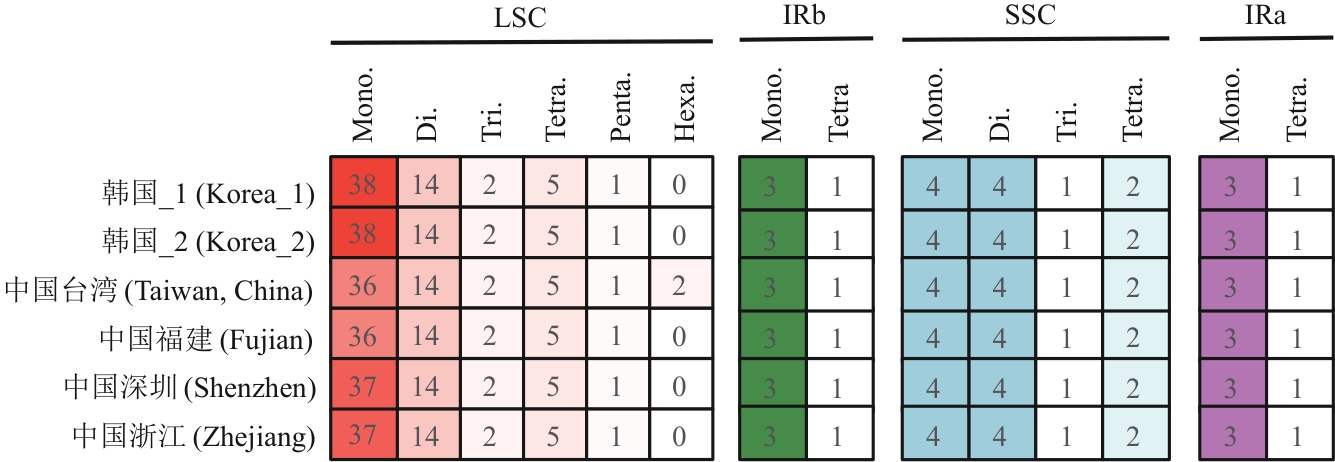
图2 6个产地珊瑚菜叶绿体基因组中简单重复序列(SSRs)的分布图Mono:单核苷酸重复;Di:二核苷酸重复;Tri:三核苷酸重复;Tera:四核苷酸重复;Penta:五核苷酸重复;Hexa:六核苷酸重复
Fig. 2 Comparison of SSRs in the chloroplast genomes of G. littoralis from 6 different geographic distributionsMono: Mononucleotide repeat. Di: Dinucleotide repeat. Tri: Trinucleotide repeat. Tera: Tetranucleotide repeat. Penta: Pentanucleotide repeat. Hexa: Hexanucleotide repeat
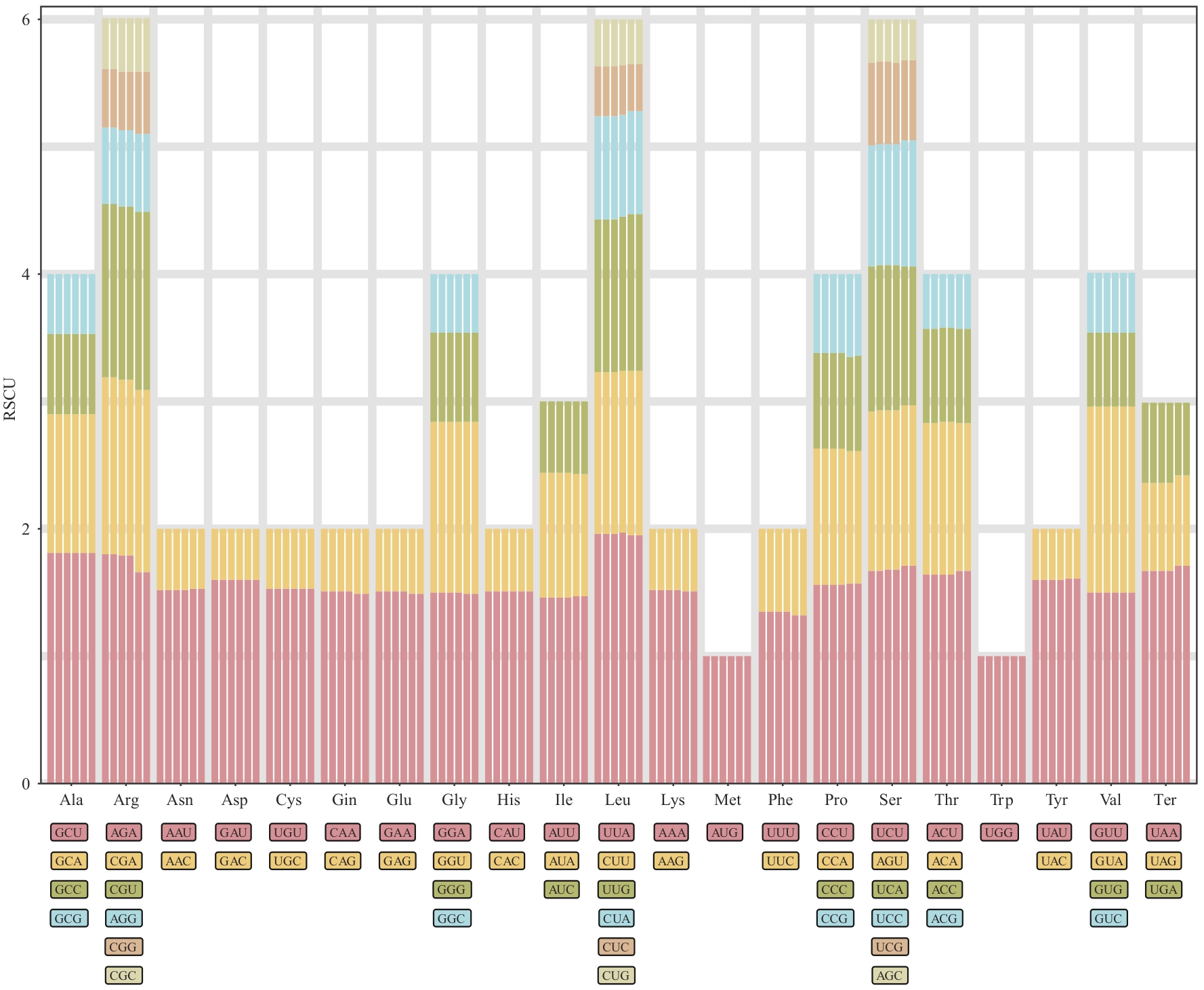
图3 6个产地珊瑚菜叶绿体基因组中相对同义密码子使用度从左到右产地分别为:韩国_1、韩国_2、中国台湾、福建、深圳和浙江
Fig. 3 Relative synonymous codon usage in the chloroplast genomes of G. littoralis from 6 different geographic distributionsFrom left to right, the geographic regions are: Korea_1, Korea_2, Taiwan (China), Fujian, Shenzhen, and Zhejiang
氨基酸 Amino acid | 密码子 Codon | 数量 Count | 同义密码子频率 RSCU | 氨基酸 Amino acid | 密码子 Codon | 数量 Count | 同义密码子频率 RSCU |
|---|---|---|---|---|---|---|---|
| Ala | GCA | 303-312 | 1.09 | Leu | CTT | 426-457 | 1.27-1.29 |
| Ala | GCC | 175-180 | 0.63 | Leu | CTC | 124-140 | 0.37-0.39 |
| Ala | GCG | 129-133 | 0.46-0.47 | Leu | CTG | 117-133 | 0.35-0.37 |
| Ala | GCT | 504-515 | 1.81 | Lys | AAG | 216-266 | 0.48-0.49 |
| Arg | AGG | 113-123 | 0.6-0.61 | Lys | AAA | 670-835 | 1.51-1.52 |
| Arg | CGA | 260-284 | 1.38-1.4 | Met | ATG | 435-467 | 1.00 |
| Arg | AGA | 309-368 | 1.66-1.8 | Phe | TTT | 681-781 | 1.32-1.35 |
| Arg | CGC | 78-81 | 0.4-0.42 | Phe | TTC | 351-373 | 0.65-0.68 |
| Arg | CGG | 91-95 | 0.46-0.49 | Pro | CCT | 312-338 | 1.56-1.57 |
| Arg | CGT | 266-278 | 1.36-1.43 | Pro | CCG | 128-135 | 0.62-0.64 |
| Asn | AAC | 200-235 | 0.47-0.48 | Pro | CCA | 207-231 | 1.04-1.07 |
| Asn | AAT | 648-753 | 1.52-1.53 | Pro | CCC | 148-163 | 0.74-0.75 |
| Asp | GAT | 619-673 | 1.60 | Ser | AGC | 73-85 | 0.31-0.33 |
| Asp | GAC | 154-167 | 0.40 | Ser | AGT | 293-321 | 1.25-1.26 |
| Cys | TGT | 155-164 | 1.53 | Ser | TCT | 397-428 | 1.67-1.71 |
| Cys | TGC | 47-50 | 0.47 | Ser | TCG | 147-165 | 0.63-0.65 |
| Gin | CAA | 512-570 | 1.49-1.51 | Ser | TCA | 253-290 | 1.09-1.14 |
| Gin | CAG | 177-185 | 0.49-0.51 | Ser | TCC | 230-243 | 0.95-0.99 |
| Glu | GAA | 714-815 | 1.49-1.51 | Thr | ACC | 182-198 | 0.74 |
| Glu | GAG | 246-265 | 0.49-0.51 | Thr | ACA | 285-320 | 1.16-1.2 |
| Gly | GGT | 469-485 | 1.34-1.35 | Thr | ACG | 104-114 | 0.42-0.43 |
| Gly | GGG | 245-253 | 0.70 | Thr | ACT | 409-439 | 1.64-1.67 |
| Gly | GGA | 518-542 | 1.49-1.5 | Trp | TGG | 339-370 | 1.00 |
| Gly | GGC | 160-168 | 0.46 | Tyr | TAC | 139-159 | 0.39-0.4 |
| His | CAT | 353-380 | 1.51 | Tyr | TAT | 566-636 | 1.6-1.61 |
| His | CAC | 115-123 | 0.49 | Val | GTA | 398-418 | 1.46 |
| Ile | ATC | 298-327 | 0.56-0.57 | Val | GTC | 125-134 | 0.46-0.47 |
| Ile | ATA | 506-571 | 0.96-0.98 | Val | GTG | 159-167 | 0.58 |
| Ile | ATT | 773-850 | 1.46-1.47 | Val | GTT | 409-430 | 1.50 |
| Leu | TTG | 406-435 | 1.2-1.23 | Ter | TAG | 12-12 | 0.69-0.71 |
| Leu | TTA | 646-708 | 1.95-1.97 | Ter | TGA | 10-11 | 0.59-0.63 |
| Leu | CTA | 269-290 | 0.8-0.81 | Ter | TAA | 29-29 | 1.67-1.71 |
表3 6个珊瑚菜叶绿体基因组蛋白编码序列的密码子偏好性分析
Table 3 Codon usage bias analysis of protein-coding sequences in 6 G. littoralis chloroplast genomes
氨基酸 Amino acid | 密码子 Codon | 数量 Count | 同义密码子频率 RSCU | 氨基酸 Amino acid | 密码子 Codon | 数量 Count | 同义密码子频率 RSCU |
|---|---|---|---|---|---|---|---|
| Ala | GCA | 303-312 | 1.09 | Leu | CTT | 426-457 | 1.27-1.29 |
| Ala | GCC | 175-180 | 0.63 | Leu | CTC | 124-140 | 0.37-0.39 |
| Ala | GCG | 129-133 | 0.46-0.47 | Leu | CTG | 117-133 | 0.35-0.37 |
| Ala | GCT | 504-515 | 1.81 | Lys | AAG | 216-266 | 0.48-0.49 |
| Arg | AGG | 113-123 | 0.6-0.61 | Lys | AAA | 670-835 | 1.51-1.52 |
| Arg | CGA | 260-284 | 1.38-1.4 | Met | ATG | 435-467 | 1.00 |
| Arg | AGA | 309-368 | 1.66-1.8 | Phe | TTT | 681-781 | 1.32-1.35 |
| Arg | CGC | 78-81 | 0.4-0.42 | Phe | TTC | 351-373 | 0.65-0.68 |
| Arg | CGG | 91-95 | 0.46-0.49 | Pro | CCT | 312-338 | 1.56-1.57 |
| Arg | CGT | 266-278 | 1.36-1.43 | Pro | CCG | 128-135 | 0.62-0.64 |
| Asn | AAC | 200-235 | 0.47-0.48 | Pro | CCA | 207-231 | 1.04-1.07 |
| Asn | AAT | 648-753 | 1.52-1.53 | Pro | CCC | 148-163 | 0.74-0.75 |
| Asp | GAT | 619-673 | 1.60 | Ser | AGC | 73-85 | 0.31-0.33 |
| Asp | GAC | 154-167 | 0.40 | Ser | AGT | 293-321 | 1.25-1.26 |
| Cys | TGT | 155-164 | 1.53 | Ser | TCT | 397-428 | 1.67-1.71 |
| Cys | TGC | 47-50 | 0.47 | Ser | TCG | 147-165 | 0.63-0.65 |
| Gin | CAA | 512-570 | 1.49-1.51 | Ser | TCA | 253-290 | 1.09-1.14 |
| Gin | CAG | 177-185 | 0.49-0.51 | Ser | TCC | 230-243 | 0.95-0.99 |
| Glu | GAA | 714-815 | 1.49-1.51 | Thr | ACC | 182-198 | 0.74 |
| Glu | GAG | 246-265 | 0.49-0.51 | Thr | ACA | 285-320 | 1.16-1.2 |
| Gly | GGT | 469-485 | 1.34-1.35 | Thr | ACG | 104-114 | 0.42-0.43 |
| Gly | GGG | 245-253 | 0.70 | Thr | ACT | 409-439 | 1.64-1.67 |
| Gly | GGA | 518-542 | 1.49-1.5 | Trp | TGG | 339-370 | 1.00 |
| Gly | GGC | 160-168 | 0.46 | Tyr | TAC | 139-159 | 0.39-0.4 |
| His | CAT | 353-380 | 1.51 | Tyr | TAT | 566-636 | 1.6-1.61 |
| His | CAC | 115-123 | 0.49 | Val | GTA | 398-418 | 1.46 |
| Ile | ATC | 298-327 | 0.56-0.57 | Val | GTC | 125-134 | 0.46-0.47 |
| Ile | ATA | 506-571 | 0.96-0.98 | Val | GTG | 159-167 | 0.58 |
| Ile | ATT | 773-850 | 1.46-1.47 | Val | GTT | 409-430 | 1.50 |
| Leu | TTG | 406-435 | 1.2-1.23 | Ter | TAG | 12-12 | 0.69-0.71 |
| Leu | TTA | 646-708 | 1.95-1.97 | Ter | TGA | 10-11 | 0.59-0.63 |
| Leu | CTA | 269-290 | 0.8-0.81 | Ter | TAA | 29-29 | 1.67-1.71 |

图4 6个产地珊瑚菜叶绿体基因组中LSC、IRs和SSC边界区域比较
Fig. 4 Comparison of LSC, IRs, and SSC border regions in the chloroplast genomes of G. littoralis from 6 different geographic distributions

图5 6个产地珊瑚菜叶绿体基因组核苷酸多态性
Fig. 5 The nucleotide diversity in the chloroplast genomes of G. littoralis from 6 different geographic distributions
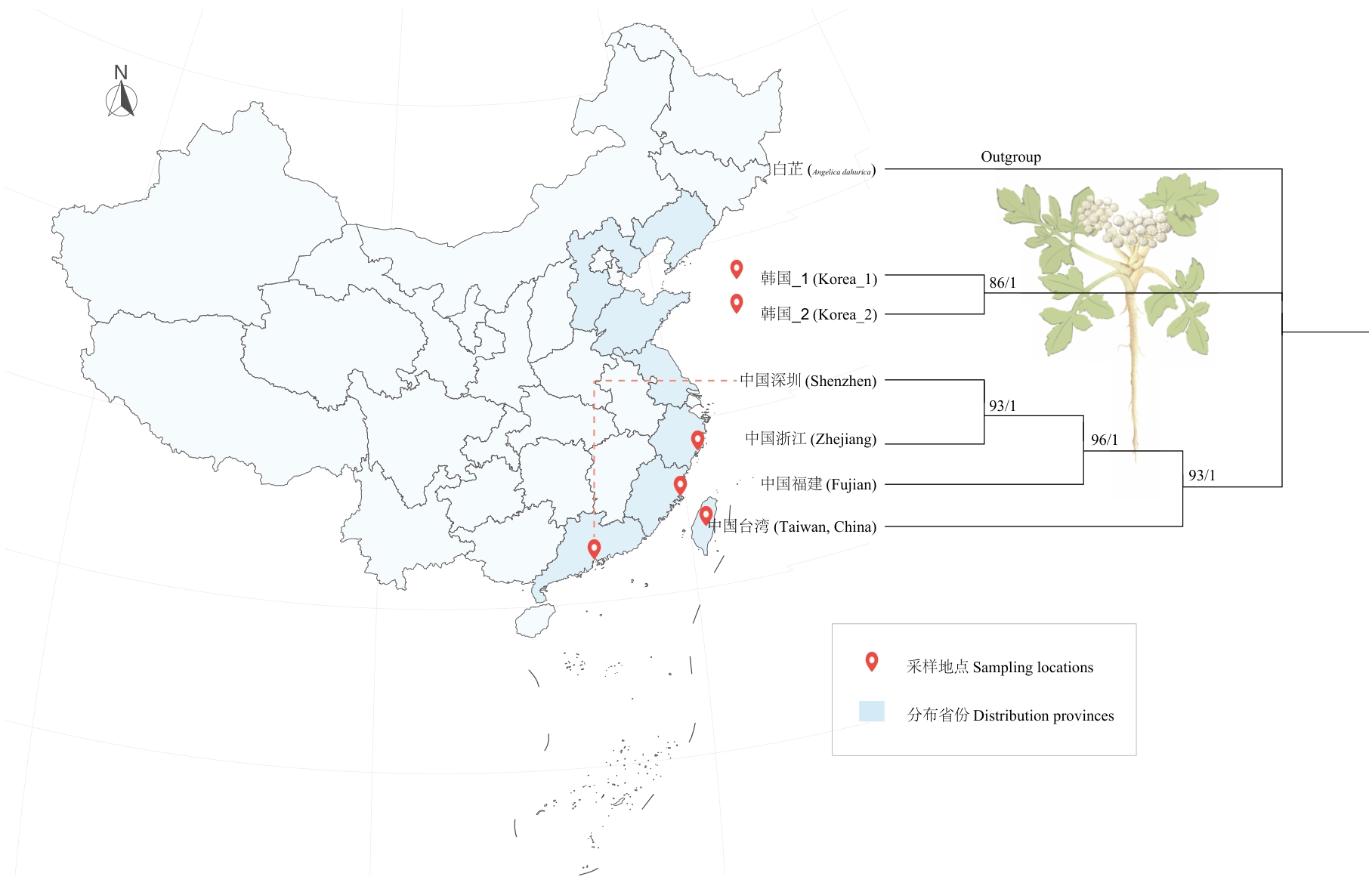
图6 最大似然法(ML)、贝叶斯法(BI)推定的6个产地珊瑚菜系统发育关系分支上的数字分别为ML法和BI法的支持值(BP,PP),中国地图数据来源于自然资源部官网(http://www.mnr.gov.cn),审图号:GS(2024)0650号
Fig. 6 Phylogenetic relationships of G. littoralis from 6 different geographic distributions inferred using Maximum Likelihood (ML) and Bayesian Inference (BI) methodsThe numbers on the branches indicate the support values from the ML method (BP) and the BI method (PP), respectively. The map of China is sourced from the Ministry of Natural Resources website (http://www.mnr.gov.cn), with the review number GS(2024) 0650
| 1 | 屠鹏飞, 冷青松, 徐国钧, 等. 莱阳参的生药鉴定 [J]. 中药材, 1999, 22(4): 174-176. |
| Tu PF, Leng QS, Xu GJ, et al. Pharmacognostical studies on Radix glehniae (Glehnia littoralis) [J]. J Chin Med Mater, 1999, 22(4): 174-176. | |
| 2 | 安莹, 张姗姗, 张云, 等. 北沙参化学成分、药理作用研究进展及质量标志物(Q-Marker)预测 [J]. 中草药, 2024, 55(2): 640-656. |
| An Y, Zhang SS, Zhang Y, et al. Research progress on chemical constituents, pharmacological effects and quality marker prediction of Glehniae radix [J]. Chin Tradit Herb Drugs, 2024, 55(2): 640-656. | |
| 3 | Li SY, Xu N, Fang QQ, et al. Glehnia littoralis Fr. schmidtex miq.: a systematic review on ethnopharmacology, chemical composition, pharmacology and quality control [J]. J Ethnopharmacol, 2023, 317: 116831. |
| 4 | Chen Y, Lei LJ, Bi YQ, et al. Quality control of glehniae Radix, the root of Glehnia littoralis Fr. Schmidt ex miq., along its value chains [J]. Front Pharmacol, 2021, 12: 729554. |
| 5 | 李宝国, 李军, 欧阳兵. 不同产地北沙参的氨基酸检测分析 [J]. 山东中医药大学学报, 2013, 37(5): 444-445. |
| Li BG, Li J, Ouyang B. Amino acid detection and analysis of radix glehniae from different sources [J]. J Shandong Univ Tradit Chin Med, 2013, 37(5): 444-445. | |
| 6 | 叶国华, 张钦德, 许一平, 等. 不同产地北沙参中重金属含量的测定 [J]. 中药新药与临床药理, 2013, 24(4): 407-410. |
| Ye GH, Zhang QD, Xu YP, et al. Determination of heavy metals in Radix glehniae from different producing areas [J]. Tradit Chin Drug Res Clin Pharmacol, 2013, 24(4): 407-410. | |
| 7 | 郑旭光, 陈钟, 项峰, 等. 河北道地药材北沙参HPLC - PDA指纹图谱研究 [J]. 药物分析杂志, 2011, 31(9): 1683-1688. |
| Zheng XG, Chen Z, Xiang F, et al. Study on HPLC-PDA fingerprints of Radix glehniae from Hebei Province [J]. Chin J Pharm Anal, 2011, 31(9): 1683-1688. | |
| 8 | 刘小芬, 赖冰, 宋秀碧, 等. HPLC法分析闽产北沙参3种香豆素含量 [J]. 中国中医药现代远程教育, 2020, 18(10): 107-110. |
| Liu XF, Lai B, Song XB, et al. Content analysis of three coumarins in glehniae Radix from Fujian Province by HPLC [J]. Chin Med Mod Distance Educ China, 2020, 18(10): 107-110. | |
| 9 | 张晴. 不同种源北沙参表型特征、香豆素类化合物含量及IPT基因表达差异研究 [D]. 烟台: 烟台大学, 2023. |
| Zhang Q. Differences in phenotypic identificarion、coumarin content and expression of key enzyme genes in Glehnia littoralis from different origins [D]. Yantai: Yantai University, 2023. | |
| 10 | 张敏, 杨洪晓. 滨海沙滩珊瑚菜种群的空间格局及其对岸垄的响应 [J]. 生态学杂志, 2015, 34(1): 47-52. |
| Zhang M, Yang HX. Spatial patterns of Glehnia littoralis population on sandy seashore and their responses to artificial beach ridge [J]. Chin J Ecol, 2015, 34(1): 47-52. | |
| 11 | 刘小芬, 张明孝, 陈勇, 等. 福建省长江澳珊瑚菜样地调查与群落特征 [J]. 中国野生植物资源, 2017, 36(6): 57-64. |
| Liu XF, Zhang MX, Chen Y, et al. Sample plot investigation and community characteristics of Glehnia littoralis in changjiang'ao bay, Fujian Province [J]. Chin Wild Plant Resour, 2017, 36(6): 57-64. | |
| 12 | An C, Ye KZ, Jiang RF, et al. Cytological analysis of flower development, insights into suitable growth area and genomic background: implications for Glehnia littoralis conservation and sustainable utilization [J]. BMC Plant Biol, 2024, 24(1): 895. |
| 13 | 陈梓媛, 华中一, 袁媛. 全球物种数量最多的叶绿体基因组数据库的建立及应用进展 [J]. 中国中药杂志, 2024, 49(23): 6257-6263. |
| Chen ZY, Hua ZY, Yuan Y. Establishment and application of chloroplast genome database with the largest number of species in world [J]. China J Chin Mater Med, 2024, 49(23): 6257-6263. | |
| 14 | 韩建萍, 宋经元, 姚辉, 等. 中药材DNA条形码鉴定的基因序列比较 [J]. 中国中药杂志, 2012, 37(8): 1056-1061. |
| Han JP, Song JY, Yao H, et al. Comparison of DNA barcoders in identifying medicinal materials [J]. China J Chin Mater Med, 2012, 37(8): 1056-1061. | |
| 15 | Chen SL, Yin XM, Han JP, et al. DNA barcoding in herbal medicine: Retrospective and prospective [J]. J Pharm Anal, 2023, 13(5): 431-441. |
| 16 | Lee SC, Lee HO, Kim K, et al. The complete chloroplast genome sequence of the medicinal plant Glehnia littoralis F.Schmidt ex Miq. (Apiaceae) [J]. Mitochondrial DNA A Part A, 2016, 27(5): 3674-3675. |
| 17 | Zhou YF, Geng ML, Li MM. The complete chloroplast genome of Glehnia littoralis, an Endangered medicinal herb of Apiaceae family [J]. Mitochondrial DNA B Resour, 2018, 3(2): 1013-1014. |
| 18 | 孙月琪, 李密密, 周义峰. 珊瑚菜叶绿体基因组密码子使用偏性分析 [J]. 植物资源与环境学报, 2023, 32(6): 1-10. |
| Sun YQ, Li MM, Zhou YF. Analysis on Codon usage bias of chloroplast genome of Glehnia littoralis [J]. J Plant Resour Environ, 2023, 32(6): 1-10. | |
| 19 | Li WW, Liu SL, Wang SM, et al. A single origin and high genetic diversity of cultivated medicinal herb Glehnia littoralis subsp. littoralis (Apiaceae) deciphered by SSR marker and phenotypic analysis [J]. PLoS One, 2024, 19(8): e0308369. |
| 20 | Li WW, Li B, Zhang P, et al. Potential biological mechanisms underlying the endangered status of Glehnia littoralis revealed by nrDNA ITS and RAPD analyses [J]. Biotechnol Biotechnol Equip, 2020, 34(1): 1243-1251. |
| 21 | Robbins EHJ, Kelly S. The evolutionary constraints on angiosperm chloroplast adaptation [J]. Genome Biol Evol, 2023, 15(6): evad101. |
| 22 | Daniell H, Lin CS, Yu M, et al. Chloroplast genomes: diversity, evolution, and applications in genetic engineering [J]. Genome Biol, 2016, 17(1): 134. |
| 23 | Jin JJ, Yu WB, Yang JB, et al. GetOrganelle: a fast and versatile toolkit for accurate de novo assembly of organelle genomes [J]. Genome Biol, 2020, 21(1): 241. |
| 24 | Tillich M, Lehwark P, Pellizzer T, et al. GeSeq - versatile and accurate annotation of organelle genomes [J]. Nucleic Acids Res, 2017, 45(W1): W6-W11. |
| 25 | Greiner S, Lehwark P, Bock R. OrganellarGenomeDRAW (OGDRAW) version 1.3.1: expanded toolkit for the graphical visualization of organellar genomes [J]. Nucleic Acids Res, 2019, 47(W1): W59-W64. |
| 26 | Huang LJ, Yu HX, Wang Z, et al. CPStools: a package for analyzing chloroplast genome sequences [J]. iMetaOmics, 2024, 1(2): e25. |
| 27 | Beier S, Thiel T, Münch T, et al. MISA-web: a web server for microsatellite prediction [J]. Bioinformatics, 2017, 33(16): 2583-2585. |
| 28 | 兰朝辉, 田徐芳, 师玉华, 等. 五月艾Artemisia indica叶绿体基因组结构及系统发育分析 [J]. 中国中药杂志, 2022, 47(22): 6058-6065. |
| Lan CH, Tian XF, Shi YH, et al. Chloroplast genome structure characteristics and phylogenetic analysis of Artemisia indica [J]. China J Chin Mater Med, 2022, 47(22): 6058-6065. | |
| 29 | 胡健鹏, 蒋露, 徐睿, 等. 安徽岳西野生茅苍术叶绿体全基因组测序及系统发育研究 [J]. 中国中药杂志, 2023, 48(1): 52-59. |
| Hu JP, Jiang L, Xu R, et al. Complete chloroplast genome sequencing and phylogeny of wild Atractylodes lancea from Yuexi, Anhui province [J]. China J Chin Mater Med, 2023, 48(1): 52-59. | |
| 30 | Li HE, Guo QQ, Xu L, et al. CPJSdraw: analysis and visualization of junction sites of chloroplast genomes [J]. PeerJ, 2023, 11: e15326. |
| 31 | Katoh K, Standley DM. MAFFT multiple sequence alignment software version 7: improvements in performance and usability [J]. Mol Biol Evol, 2013, 30(4): 772-780. |
| 32 | Minh BQ, Schmidt HA, Chernomor O, et al. IQ-TREE 2: new models and efficient methods for phylogenetic inference in the genomic era [J]. Mol Biol Evol, 2020, 37(5): 1530-1534. |
| 33 | Ronquist F, Teslenko M, van der Mark P, et al. MrBayes 3.2: efficient Bayesian phylogenetic inference and model choice across a large model space [J]. Syst Biol, 2012, 61(3): 539-542. |
| 34 | Plunkett GM, Downie SR. Expansion and contraction of the chloroplast inverted repeat in Apiaceae subfamily apioideae [J]. Syst Bot, 2000, 25(4): 648. |
| 35 | Zhu AD, Guo WH, Gupta S, et al. Evolutionary dynamics of the plastid inverted repeat: the effects of expansion, contraction, and loss on substitution rates [J]. New Phytol, 2016, 209(4): 1747-1756. |
| 36 | 国家药典委员会. 中华人民共和国药典-一部: 2020年版 [M]. 北京: 中国医药科技出版社, 2020: 103. |
| Pharmacopoeia Commission of the People's Republic of China. Pharmacopoeia of the People's Republic of China - Volume I: 2020 Edition [M]. Beijing: China Medical Science Press, 2020: 103. | |
| 37 | 鲁兆莉, 覃海宁, 金效华, 等. 《国家重点保护野生植物名录》调整的必要性、原则和程序 [J]. 生物多样性, 2021, 29(12): 1577-1582. |
| Lu ZL, Qin HN, Jin XH, et al. On the necessity, principle, and process of updating the List of National Key Protected Wild Plants [J]. Biodivers Sci, 2021, 29(12): 1577-1582. | |
| 38 | Guo YY, Yang JX, Bai MZ, et al. The chloroplast genome evolution of Venus slipper (Paphiopedilum): IR expansion, SSC contraction, and highly rearranged SSC regions [J]. BMC Plant Biol, 2021, 21(1): 248. |
| 39 | Wei N, Pérez-Escobar OA, Musili PM, et al. Plastome evolution in the hyperdiverse genus Euphorbia (Euphorbiaceae) using phylogenomic and comparative analyses: large-scale expansion and contraction of the inverted repeat region [J]. Front Plant Sci, 2021, 12: 712064. |
| 40 | 王爱兰, 王贵琳, 李维卫. 濒危物种珊瑚菜遗传多样性的ISSR分析 [J]. 西北植物学报, 2015, 35(8): 1541-1546. |
| Wang AL, Wang GL, Li WW. Genetic diversity of Glehnia littoralis populations revealed by ISSR molecular markers [J]. Acta Bot Boreali Occidentalia Sin, 2015, 35(8): 1541-1546. |
| [1] | 李斌, 苏香萍, 刘畅, 王玉兵, 张勇洪, 周超, 徐青. 玄参科植物叶绿体基因组特征及系统发育分析[J]. 生物技术通报, 2025, 41(3): 240-254. |
| [2] | 杨雨青, 谭娟, 汪芳, 彭顺利, 陈婕, 谭明燕, 吕美艳, 周富裕, 刘声传. 茶树叶绿体基因组的研究与应用进展[J]. 生物技术通报, 2024, 40(2): 20-30. |
| [3] | 尹明华, 余锾媛, 肖心怡, 王玉婷. 江西铅山红芽芋叶绿体基因组特征及系统发育分析[J]. 生物技术通报, 2023, 39(6): 233-247. |
| [4] | 刘雄伟, 刘畅, 曾宪法, 杨小英, 俸婷婷, 赵杰宏, 周英. 朱砂根叶绿体全基因组解析及系统发育分析[J]. 生物技术通报, 2023, 39(1): 232-242. |
| [5] | 钱方, 高作敏, 胡利娟, 王洪程. 海甘蓝(Crambe abyssinica)叶绿体基因组特征及其系统发育研究[J]. 生物技术通报, 2022, 38(6): 174-186. |
| [6] | 朱斌, 甘晨晨, 王洪程. 球花石斛(Dendrobium thyrsiflorum)叶绿体基因组特征及亲缘关系解析[J]. 生物技术通报, 2021, 37(5): 38-47. |
| [7] | 李裕华, 任永康, 赵兴华, 刘江, 韩斌, 王长彪, 唐朝晖. 禾本科主要农作物叶绿体基因组研究进展[J]. 生物技术通报, 2020, 36(11): 112-121. |
| [8] | 罗静初. 实用生物信息技术课程教学实例[J]. 生物技术通报, 2015, 31(11): 102-111. |
| [9] | Johu D. Williamson;张虎平;陈萍. 植物生物技术的现状及展望[J]. , 2003, 0(04): 42-43. |
| [10] | 苏宁;吴燕民;孙丙耀;沈桂芳. 植物基因工程新途径:叶绿体转化[J]. , 2001, 0(04): 9-13. |
| [11] | 邹竹荣;沈桂芳;范云六;. 叶绿体遗传转化[J]. , 1997, 0(03): 16-20. |
| [12] | 沈燕新;张中林;沈桂芳. 叶绿体基因组及其编码的基因[J]. , 1996, 0(06): 1-4. |
| [13] | 马建忠. 叶绿体基因组的模式基因—光系统Ⅱ32kDa蛋白基因(psbA)的研究[J]. , 1994, 0(04): 5-10. |
| [14] | . 植物遗传工程[J]. , 1994, 0(04): 90-96. |
| [15] | 程奇;沈桂芳;. 叶绿体基因组的改造和利用[J]. , 1993, 0(03): 2-3. |
| 阅读次数 | ||||||
|
全文 |
|
|||||
|
摘要 |
|
|||||
