







生物技术通报 ›› 2026, Vol. 42 ›› Issue (11): 297-308.doi: 10.13560/j.cnki.biotech.bull.1985.2026-0197
• 研究报告 • 上一篇
樊子铭1, 邹宇1, 叶荣泰1, 白仲虎1,2, 刘秀霞1,2( )
收稿日期:2026-02-09
出版日期:2026-11-26
发布日期:2026-11-03
通讯作者:
刘秀霞liuxiuxia@jiangnan.edu.cn基金资助:
FAN Zi-ming1, ZOU Yu1, YE Rong-tai1, BAI Zhong-hu1,2, LIU Xiu-xia1,2()
Received:2026-02-09
Published:2026-11-26
Online:2026-11-03
摘要:
目的 探索谷氨酸棒状杆菌工程菌利用玉米秸秆酸解液的可行性,为木质纤维素废弃物低成本利用提供新思路。 方法 通过单因素实验筛选出有助于酸解液利用的成分,过表达谷氨酸棒状杆菌内源的肌醇-3-磷酸合酶基因ino-1和甲硫氨酸亚砜还原酶基因msrA提高宿主抗氧化能力。通过更换启动子的方式提高基因组反向转运蛋白Mrp1的表达,结合适应性实验室进化与过表达来自酿酒酵母的二联体蛋白ADY2基因提高宿主乙酸利用能力,最后通过模式蛋白mCherry、来自枯草芽胞杆菌的α-淀粉酶,以及骆驼抗体片段VHH,验证工程菌利用酸解液表达外源蛋白的可行性。 结果 野生型菌株无法直接利用酸解液生长,向水解液中补充氮源或1 mmol/L MgSO4和0.1 mmol/L CaCl2可实现菌株生长。过表达ino-1与msrA基因使宿主在酸解液中生长的最大细胞密度分别提高66.98%和73.18%。进化菌株Evo90在添加0.8 g/L葡萄糖+70 g/L乙酸钠的培养基中的生长状况优于野生型,结合mrp1、ino-1与ADY2的过表达,工程菌在水解液中达到生长稳定期的时间缩短约40%。最终,工程菌成功利用水解液分泌表达3种外源蛋白,其中mCherry产量相当于利用35 g/L葡萄糖发酵,单位细胞密度的荧光强度最高可达到利用50 g/L葡萄糖发酵的10.18倍左右。 结论 向酸解液中添加氮源或Mg2+、Ca2+可使菌株在酸解液中正常生长;结合菌株抗氧化及乙酸利用能力的工程改造,可实现谷氨酸棒状杆菌工程菌利用酸解液表达异源蛋白。
樊子铭, 邹宇, 叶荣泰, 白仲虎, 刘秀霞. 构建可利用酸解液表达外源蛋白的谷氨酸棒状杆菌工程菌[J]. 生物技术通报, 2026, 42(11): 297-308.
FAN Zi-ming, ZOU Yu, YE Rong-tai, BAI Zhong-hu, LIU Xiu-xia. Construction of Engineered Corynebacterium glutamicum for Heterologous Protein Expression Using Acid Hydrolysate[J]. Biotechnology Bulletin, 2026, 42(11): 297-308.
菌株和质粒 Strains and plasmids | 特征Feature |
|---|---|
| 菌株 | |
| E. coli DH5α | 野生型,用于质粒克隆 |
| C. glutamicum ATCC13032 | 野生型 |
| Evo90 | C. glutamicum ATCC13032衍生菌株,针对乙酸钠与葡萄糖混合碳源进行适应性实验室进化得到的菌株 |
| Evo90-H36M | Evo90衍生菌株,在Evo90基因组中用H36启动子[ |
| 质粒 | |
| pXMJ19 | C. glutamicum/E. coli穿梭载体,氯霉素 |
| pXMJ19-Control | pXMJ19,含有Ptac-RBS-T1-T2表达盒 |
| pXMJ19-ino-1 | pXMJ19-Control,含有ino-1 |
| pXMJ19-msrA | pXMJ19-Control,含有msrA |
| pEC-XK99E | 大肠杆菌-谷氨酸棒杆菌穿梭质粒,卡那霉素 |
| pEC-Control | pEC-XK99E,含有H36-RBS-T1-T2表达盒 |
| pEC-G1 | pEC-Control,含有ack-pta基因序列 |
| pEC-G2 | pEC-Control,含有ADY2基因序列 |
| pEC-G3 | pEC-Control,含有ATO2基因序列 |
| pEC-G4 | pEC-G1,含有RBS-ADY2基因序列 |
| pEC-G5 | pEC-G1,含有RBS-ATO2基因序列 |
| pEC-G2-mCherry | pEC-G2,含有RBS、CspB信号肽和mCherry基因序列 |
| pEC-G2-amyE | pEC-G2,含有RBS、CspB信号肽和amyE基因序列 |
| pEC-G2-VHH | pEC-G2,含有RBS、CspB信号肽和VHH基因序列 |
| pK18mobsacB | C. glutamicum/E. coli穿梭载体(oriV E. coli, sacB, lacZα, KanR) |
| pK18-H36M | pK18mobsacB包含H36启动子插入同源臂序列 |
表1 本研究中使用的菌株和质粒
Table 1 Strains and plasmids used in this study
菌株和质粒 Strains and plasmids | 特征Feature |
|---|---|
| 菌株 | |
| E. coli DH5α | 野生型,用于质粒克隆 |
| C. glutamicum ATCC13032 | 野生型 |
| Evo90 | C. glutamicum ATCC13032衍生菌株,针对乙酸钠与葡萄糖混合碳源进行适应性实验室进化得到的菌株 |
| Evo90-H36M | Evo90衍生菌株,在Evo90基因组中用H36启动子[ |
| 质粒 | |
| pXMJ19 | C. glutamicum/E. coli穿梭载体,氯霉素 |
| pXMJ19-Control | pXMJ19,含有Ptac-RBS-T1-T2表达盒 |
| pXMJ19-ino-1 | pXMJ19-Control,含有ino-1 |
| pXMJ19-msrA | pXMJ19-Control,含有msrA |
| pEC-XK99E | 大肠杆菌-谷氨酸棒杆菌穿梭质粒,卡那霉素 |
| pEC-Control | pEC-XK99E,含有H36-RBS-T1-T2表达盒 |
| pEC-G1 | pEC-Control,含有ack-pta基因序列 |
| pEC-G2 | pEC-Control,含有ADY2基因序列 |
| pEC-G3 | pEC-Control,含有ATO2基因序列 |
| pEC-G4 | pEC-G1,含有RBS-ADY2基因序列 |
| pEC-G5 | pEC-G1,含有RBS-ATO2基因序列 |
| pEC-G2-mCherry | pEC-G2,含有RBS、CspB信号肽和mCherry基因序列 |
| pEC-G2-amyE | pEC-G2,含有RBS、CspB信号肽和amyE基因序列 |
| pEC-G2-VHH | pEC-G2,含有RBS、CspB信号肽和VHH基因序列 |
| pK18mobsacB | C. glutamicum/E. coli穿梭载体(oriV E. coli, sacB, lacZα, KanR) |
| pK18-H36M | pK18mobsacB包含H36启动子插入同源臂序列 |
| 引物名称 Primers | 序列 Sequence (5′-3′) | 用途 Description |
|---|---|---|
| pXMJ19-F | GGATCCCCGGGTACC | pXMJ19-Control载体线性化 |
| pXMJ19-R | TCCTGGAGAGTCGACCTG | |
| ino-F | GTCGACTCTCCAGGAGGACATACAATGAGCACGTCCACCA | 构建pXMJ19-ino-1质粒 |
| ino-R | GGTACCCGGGGATCCTTACGCCTCGATGATGAATG | |
| msrA-F | GTCGACTCTCCAGGAGGACATACAATGGCATGGTTTTTCGCA | 构建pXMJ19-msrA质粒 |
| msrA-R | GGTACCCGGGGATCCTTAAGCTTCTACCCCGCAC | |
| 99k-F | CCATGCGAGAGTAGGGAACTGC | pEC-Control载体线性化 |
| 99k-R | TTTTTTTCCTCCTTTTCTCGAGG | |
| Ack-F | AAAGGAGGAAAAAAAATGAGCGCCGAACTCTTTG | 构建pEC-G1质粒 |
| Ack-R | CCTACTCTCGCATGGTTAAGCGAACTTCACCGCGTA | |
| ADY-F | AAAGGAGGAAAAAAAATGTCTGACAAGGAACAAACGAGC | 构建pEC-G2质粒 |
| ADY-R | CCTACTCTCGCATGGTTAAAAGATTACCCTTTCAGTAGATGGTAATGGG | |
| ATO-F | AAAGGAGGAAAAAAAATGTCTGACAGAGAACAAAGCAG | 构建pEC-G3质粒 |
| ATO-R | CCTACTCTCGCATGGTTAGAAGAACACCTTATCATTGCTAGGT | |
| 1229-HR-ack-F | CCATGCGAGAGTAGGGAACTG | pEC-G1载体线性化 |
| 1229-HR-ack-R | TTAAGCGAACTTCACCGCGTACC | |
| 1229-ADY-F | GTGAAGTTCGCTTAACCAGGAGGACATACACTAATGTCTGACAAGGAACAAACG | 构建pEC-G4质粒 |
| 1229-ADY-R | CCTACTCTCGCATGGTTAAAAGATTACCCTTTCAGTAGATGGTAATGGG | |
| 1229-ATO-F | GTGAAGTTCGCTTAACCAGGAGGACATACACTAATGTCTGACAGAGAACAAAG | 构建pEC-G5质粒 |
| 1229-ATO-R | CCTACTCTCGCATGGTTAGAAGAACACCTTATCATTGCTAGGTAATGC | |
| HR-99k-ADY-F | CCATGCGAGAGTAGGGAACTGC | pEC-G2载体线性化 |
| HR-99k-ADY-R | TGTATGTCCTCCTGGTAAAAGATTACCCTTTCAGTAGATGGTAATGGG | |
| CspB-F | CCAGGAGGACATACAATGTTTAACAATCGTATCCGC | 扩增CspB片段 |
| CspB-R | TTCCTGAGCGAATGCTG | |
| 1115-mChe-F | GCATTCGCTCAGGAAGTGAGCAAGGGCGAGGAG | 构建pEC-G2-mCherry质粒 |
| 1115-mChe-R | CCTACTCTCGCATGGTTACTTGTACAGCTCGTCCATGCC | |
| 1115-AL-F | GCATTCGCTCAGGAAGAAACGGCGAACAAATCGA | 构建pEC-G2-amyE质粒 |
| 1115-AL-R | CCTACTCTCGCATGGTTAATGGGGAAGAGAACCGC | |
| 1115-VHH-F | GCATTCGCTCAGGAACAGGTCCAACTGCAAGAAAGC | 构建pEC-G2-VHH质粒 |
| 1115-VHH-R | CCTACTCTCGCATGGTTATGAAGAGACGGTCACCTGGG | |
| Mrp1-1-F | CATGATTACGAATTCCGTAGTTGATCGAGTTGGTC | 构建pK18-H36M质粒,Mrp1启动子替换的上游同源臂 |
| Mrp1-1-R | CTGGGCCCGTTAATAGCTAAACCTCGAAACAATAAC | |
| Mrp1-2-F | GTAGCATGGGATCCAAGGAGGAAAAAAAATGAGTTTGCTATTTGTTGTGGCGCTTGC | 构建pK18-H36M质粒,Mrp1启动子替换的下游同源臂 |
| Mrp1-2-R | GTGCCAAGCTTGCATTACCCATGCCGACGATAATCAGC | |
| H36-F | TATTAACGGGCCCAGGGTGG | 构建pK18-H36M质粒,扩增H36片段 |
| H36-R | TTTTTTTCCTCCTTGGATCCCATGCTACTCCTACC |
表2 本研究中使用的引物
Table 2 Primers used in this study
| 引物名称 Primers | 序列 Sequence (5′-3′) | 用途 Description |
|---|---|---|
| pXMJ19-F | GGATCCCCGGGTACC | pXMJ19-Control载体线性化 |
| pXMJ19-R | TCCTGGAGAGTCGACCTG | |
| ino-F | GTCGACTCTCCAGGAGGACATACAATGAGCACGTCCACCA | 构建pXMJ19-ino-1质粒 |
| ino-R | GGTACCCGGGGATCCTTACGCCTCGATGATGAATG | |
| msrA-F | GTCGACTCTCCAGGAGGACATACAATGGCATGGTTTTTCGCA | 构建pXMJ19-msrA质粒 |
| msrA-R | GGTACCCGGGGATCCTTAAGCTTCTACCCCGCAC | |
| 99k-F | CCATGCGAGAGTAGGGAACTGC | pEC-Control载体线性化 |
| 99k-R | TTTTTTTCCTCCTTTTCTCGAGG | |
| Ack-F | AAAGGAGGAAAAAAAATGAGCGCCGAACTCTTTG | 构建pEC-G1质粒 |
| Ack-R | CCTACTCTCGCATGGTTAAGCGAACTTCACCGCGTA | |
| ADY-F | AAAGGAGGAAAAAAAATGTCTGACAAGGAACAAACGAGC | 构建pEC-G2质粒 |
| ADY-R | CCTACTCTCGCATGGTTAAAAGATTACCCTTTCAGTAGATGGTAATGGG | |
| ATO-F | AAAGGAGGAAAAAAAATGTCTGACAGAGAACAAAGCAG | 构建pEC-G3质粒 |
| ATO-R | CCTACTCTCGCATGGTTAGAAGAACACCTTATCATTGCTAGGT | |
| 1229-HR-ack-F | CCATGCGAGAGTAGGGAACTG | pEC-G1载体线性化 |
| 1229-HR-ack-R | TTAAGCGAACTTCACCGCGTACC | |
| 1229-ADY-F | GTGAAGTTCGCTTAACCAGGAGGACATACACTAATGTCTGACAAGGAACAAACG | 构建pEC-G4质粒 |
| 1229-ADY-R | CCTACTCTCGCATGGTTAAAAGATTACCCTTTCAGTAGATGGTAATGGG | |
| 1229-ATO-F | GTGAAGTTCGCTTAACCAGGAGGACATACACTAATGTCTGACAGAGAACAAAG | 构建pEC-G5质粒 |
| 1229-ATO-R | CCTACTCTCGCATGGTTAGAAGAACACCTTATCATTGCTAGGTAATGC | |
| HR-99k-ADY-F | CCATGCGAGAGTAGGGAACTGC | pEC-G2载体线性化 |
| HR-99k-ADY-R | TGTATGTCCTCCTGGTAAAAGATTACCCTTTCAGTAGATGGTAATGGG | |
| CspB-F | CCAGGAGGACATACAATGTTTAACAATCGTATCCGC | 扩增CspB片段 |
| CspB-R | TTCCTGAGCGAATGCTG | |
| 1115-mChe-F | GCATTCGCTCAGGAAGTGAGCAAGGGCGAGGAG | 构建pEC-G2-mCherry质粒 |
| 1115-mChe-R | CCTACTCTCGCATGGTTACTTGTACAGCTCGTCCATGCC | |
| 1115-AL-F | GCATTCGCTCAGGAAGAAACGGCGAACAAATCGA | 构建pEC-G2-amyE质粒 |
| 1115-AL-R | CCTACTCTCGCATGGTTAATGGGGAAGAGAACCGC | |
| 1115-VHH-F | GCATTCGCTCAGGAACAGGTCCAACTGCAAGAAAGC | 构建pEC-G2-VHH质粒 |
| 1115-VHH-R | CCTACTCTCGCATGGTTATGAAGAGACGGTCACCTGGG | |
| Mrp1-1-F | CATGATTACGAATTCCGTAGTTGATCGAGTTGGTC | 构建pK18-H36M质粒,Mrp1启动子替换的上游同源臂 |
| Mrp1-1-R | CTGGGCCCGTTAATAGCTAAACCTCGAAACAATAAC | |
| Mrp1-2-F | GTAGCATGGGATCCAAGGAGGAAAAAAAATGAGTTTGCTATTTGTTGTGGCGCTTGC | 构建pK18-H36M质粒,Mrp1启动子替换的下游同源臂 |
| Mrp1-2-R | GTGCCAAGCTTGCATTACCCATGCCGACGATAATCAGC | |
| H36-F | TATTAACGGGCCCAGGGTGG | 构建pK18-H36M质粒,扩增H36片段 |
| H36-R | TTTTTTTCCTCCTTGGATCCCATGCTACTCCTACC |
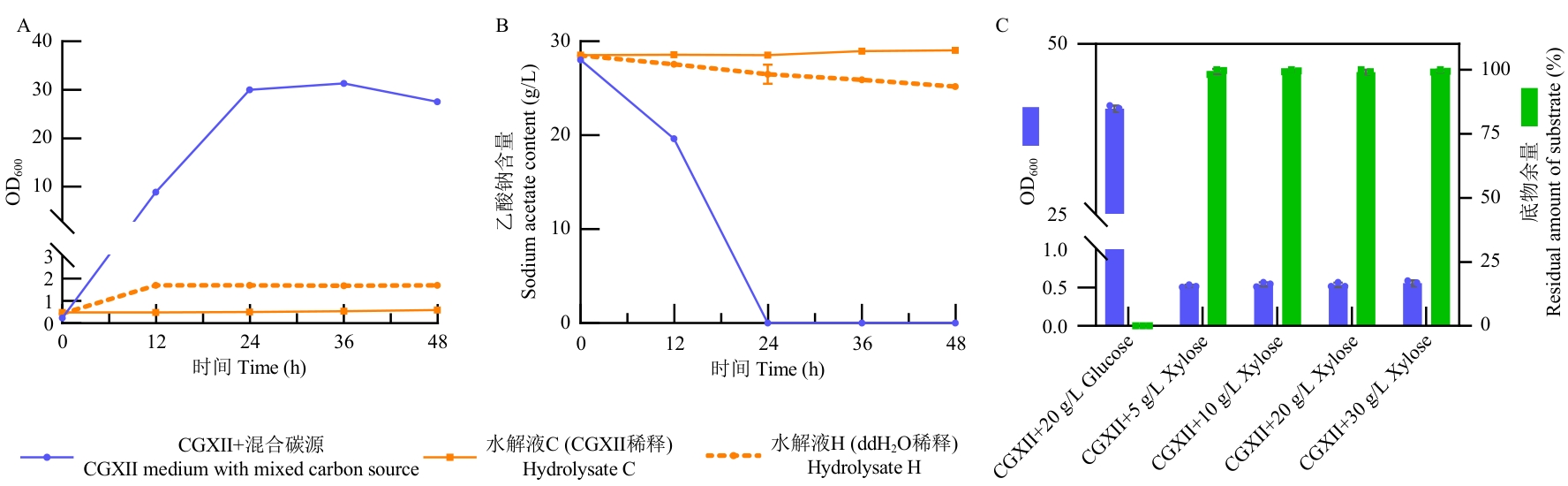
图1 野生型菌株WT在水解液中的生长情况A, B:WT在不同培养基中的生长及底物消耗情况;C:WT在含有不同碳源的CGXII培养基中培养不同时长(葡萄糖组与木糖组分别在24 h与120 h取样)的细胞密度与底物余量
Fig. 1 Growth of the wild-type strain WT in hydrolysateA, B: Growth and substrate consumption of the wild‑type (WT) strain in different medium. C: Cell density and residual substrate of the WT strain cultivated in CGXII medium containing different carbon sources for varied durations (samples were taken at 24 h for the glucose group and at 120 h for the xylose group)
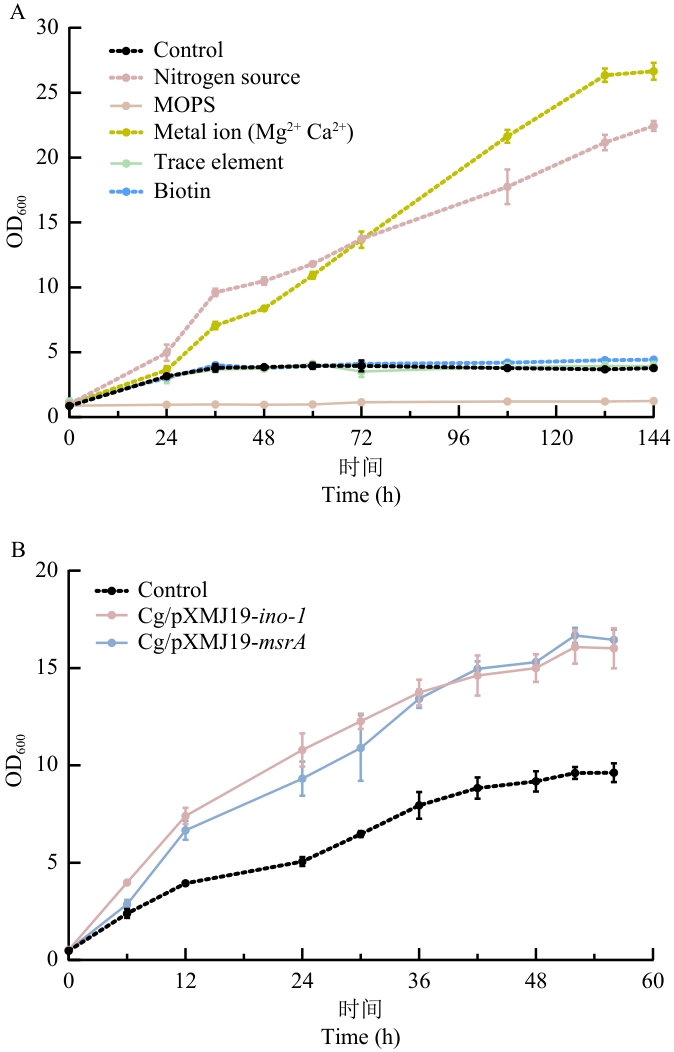
图2 关键成分与抗氧化基因的筛选A:WT在添加不同成分的水解液H中的生长情况;B:工程菌Cg/pXMJ19-ino-1与Cg/pXMJ19-msrA在水解液H+中生长情况
Fig. 2 Screening of key ingredients and antioxidant genesA: Growth of the wild-type (WT) strain in hydrolysate H supplemented with different components. B: Growth of engineered strains Cg/pXMJ19-ino-1 and Cg/pXMJ19-msrA in hydrolysate H+
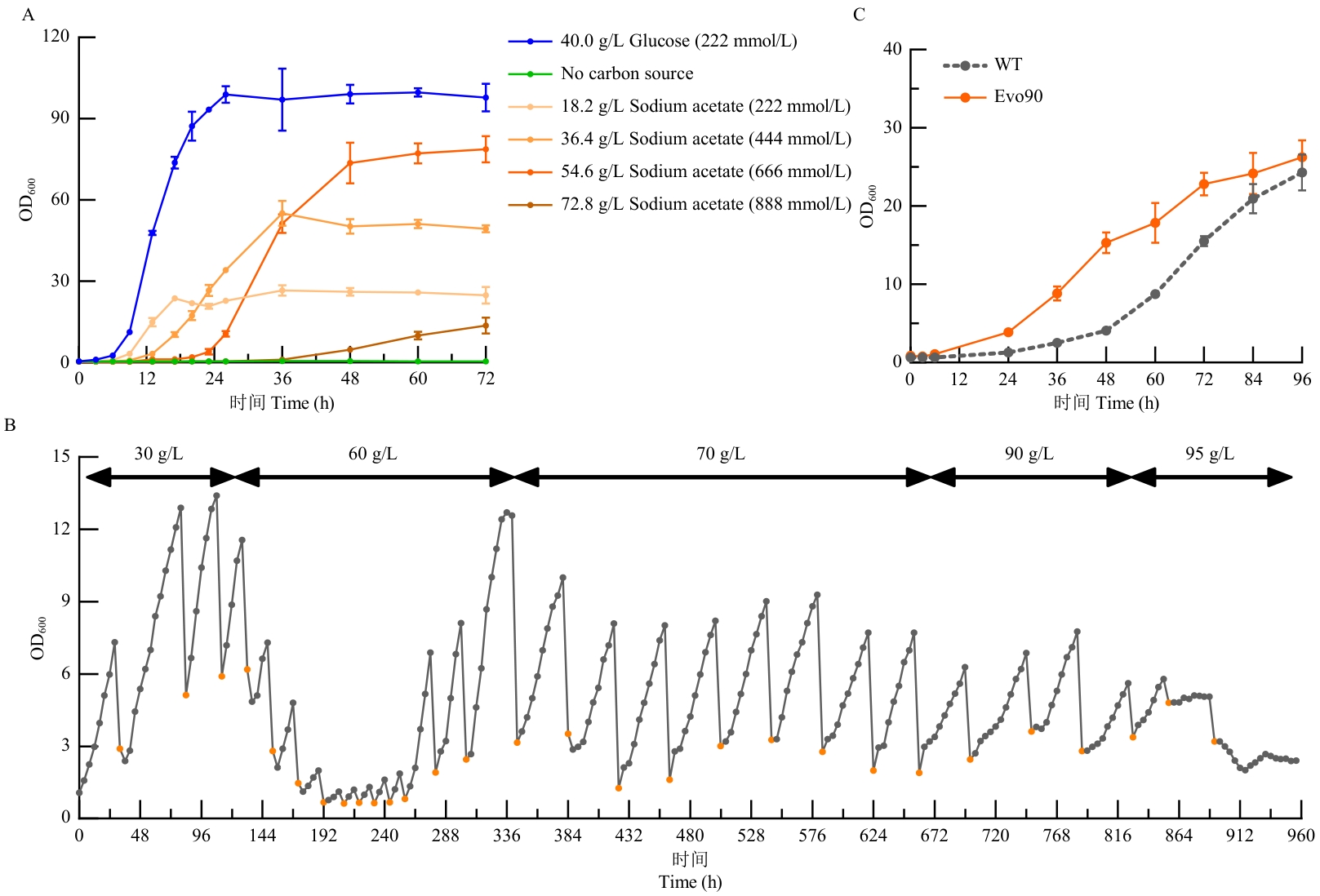
图3 适应性实验室进化及进化菌株Evo90性能验证A:WT在添加不同碳源的CGXII培养基中的生长情况;B:传代培养过程中细胞生长情况;C:Evo90与WT的生长对比
Fig. 3 Adaptive laboratory evolution and performance validation of the evolved strain Evo90A: Growth of the wild‑type (WT) strain in CGXII medium supplemented with different carbon sources. B: Cell growth during serial subculturing. C: Growth comparison between Evo90 and the WT strain
| 类型 Type | 位点 Site | 突变 Mutation | 氨基酸变化 Change of amino acid | 基因 Gene | 蛋白名称 Protein |
|---|---|---|---|---|---|
| 单碱基突变 | 32141 | C→T | - | Cgl0031 | ABC-type transporter, permease components |
| 274977 | T→C | - | Cgl0255 | Catalase | |
| 364652 | A→G | K→E | Cgl0344 | ATPases involved in chromosome partitioning | |
| 364912 | A→C | E→D | Cgl0344 | ATPases involved in chromosome partitioning | |
| 387460 | T→C | - | Cgl0365 | Hypothetical protein | |
| 736480 | T→C | V→A | Cgl0716 | Hypothetical protein | |
| 770809 | G→A | L→F | Cgl0738 | Type II restriction enzyme, methylase subunits | |
| 1279070 | T→G | D→E | Cgl1212 | F0F1-type ATP synthase beta subunit | |
| 1751737 | G→A | V→I | Cgl1651 | Hypothetical protein | |
| 2036724 | A→C | - | Cgl1928 | Predicted transcriptional regulator, consists of a Zn-ribbon and ATP-cone domains | |
| 2041951 | G→T | G→V | Cgl1934 | Transcriptional regulators of sugar metabolism | |
| 2058943 | A→G | S→P | Cgl1949 | 2-methylthioadenine synthetase | |
| 2060507 | C→T | - | Cgl1951 | ABC-type transporter, periplasmic component (glutamate) | |
| 2083859 | T→A | - | Cgl1975 | Polyribonucleotide nucleotidyltransferase (polynucleotide phosphorylase) | |
| 2160737 | C→T | P→L | Cgl2047 | Hypothetical protein | |
| 2425773 | G→A | - | Cgl2457 | Alkaline phosphatase | |
| 2602951 | C→T | - | Cgl2460 | ABC-type transporter, permease components | |
| 2605561 | C→T | - | Cgl2505 | Hypothetical membrane protein | |
| 2655586 | C→T | A→T | Cgl2575 | ABC-type transporter, periplasmic component | |
| 2737632 | T→C | - | Cgl2587 | Predicted membrane proteins, hemolysin III homologs | |
| 3156189 | T→G | - | Cgl3077 | Hypothetical membrane protein | |
| 3286754 | G→A | - | Cgl0344 | ATPases involved in chromosome partitioning | |
| 碱基缺失 | 364006 | G→- | - | Cgl0657 | Uncharacterized protein involved in propionate catabolism |
| 671706 | A→- | - | Cgl1992 | ABC-type transporter, permease components | |
| 2296630 | C→- | - | Cgl2457 | Alkaline phosphatase | |
| 碱基插入 | 2103241 | GGCCCTTCCGGTTTTGGGGTACATCACAGAACCTGGGCTAGCGGTGTAGACCCGAAAATAAACGAGCCTT | - | Cgl2168 | Hypothetical membrane protein |
表3 Evo90与WT样品全基因组重测序结果
Table 3 Whole-genome resequencing results of Evo90 and WT
| 类型 Type | 位点 Site | 突变 Mutation | 氨基酸变化 Change of amino acid | 基因 Gene | 蛋白名称 Protein |
|---|---|---|---|---|---|
| 单碱基突变 | 32141 | C→T | - | Cgl0031 | ABC-type transporter, permease components |
| 274977 | T→C | - | Cgl0255 | Catalase | |
| 364652 | A→G | K→E | Cgl0344 | ATPases involved in chromosome partitioning | |
| 364912 | A→C | E→D | Cgl0344 | ATPases involved in chromosome partitioning | |
| 387460 | T→C | - | Cgl0365 | Hypothetical protein | |
| 736480 | T→C | V→A | Cgl0716 | Hypothetical protein | |
| 770809 | G→A | L→F | Cgl0738 | Type II restriction enzyme, methylase subunits | |
| 1279070 | T→G | D→E | Cgl1212 | F0F1-type ATP synthase beta subunit | |
| 1751737 | G→A | V→I | Cgl1651 | Hypothetical protein | |
| 2036724 | A→C | - | Cgl1928 | Predicted transcriptional regulator, consists of a Zn-ribbon and ATP-cone domains | |
| 2041951 | G→T | G→V | Cgl1934 | Transcriptional regulators of sugar metabolism | |
| 2058943 | A→G | S→P | Cgl1949 | 2-methylthioadenine synthetase | |
| 2060507 | C→T | - | Cgl1951 | ABC-type transporter, periplasmic component (glutamate) | |
| 2083859 | T→A | - | Cgl1975 | Polyribonucleotide nucleotidyltransferase (polynucleotide phosphorylase) | |
| 2160737 | C→T | P→L | Cgl2047 | Hypothetical protein | |
| 2425773 | G→A | - | Cgl2457 | Alkaline phosphatase | |
| 2602951 | C→T | - | Cgl2460 | ABC-type transporter, permease components | |
| 2605561 | C→T | - | Cgl2505 | Hypothetical membrane protein | |
| 2655586 | C→T | A→T | Cgl2575 | ABC-type transporter, periplasmic component | |
| 2737632 | T→C | - | Cgl2587 | Predicted membrane proteins, hemolysin III homologs | |
| 3156189 | T→G | - | Cgl3077 | Hypothetical membrane protein | |
| 3286754 | G→A | - | Cgl0344 | ATPases involved in chromosome partitioning | |
| 碱基缺失 | 364006 | G→- | - | Cgl0657 | Uncharacterized protein involved in propionate catabolism |
| 671706 | A→- | - | Cgl1992 | ABC-type transporter, permease components | |
| 2296630 | C→- | - | Cgl2457 | Alkaline phosphatase | |
| 碱基插入 | 2103241 | GGCCCTTCCGGTTTTGGGGTACATCACAGAACCTGGGCTAGCGGTGTAGACCCGAAAATAAACGAGCCTT | - | Cgl2168 | Hypothetical membrane protein |
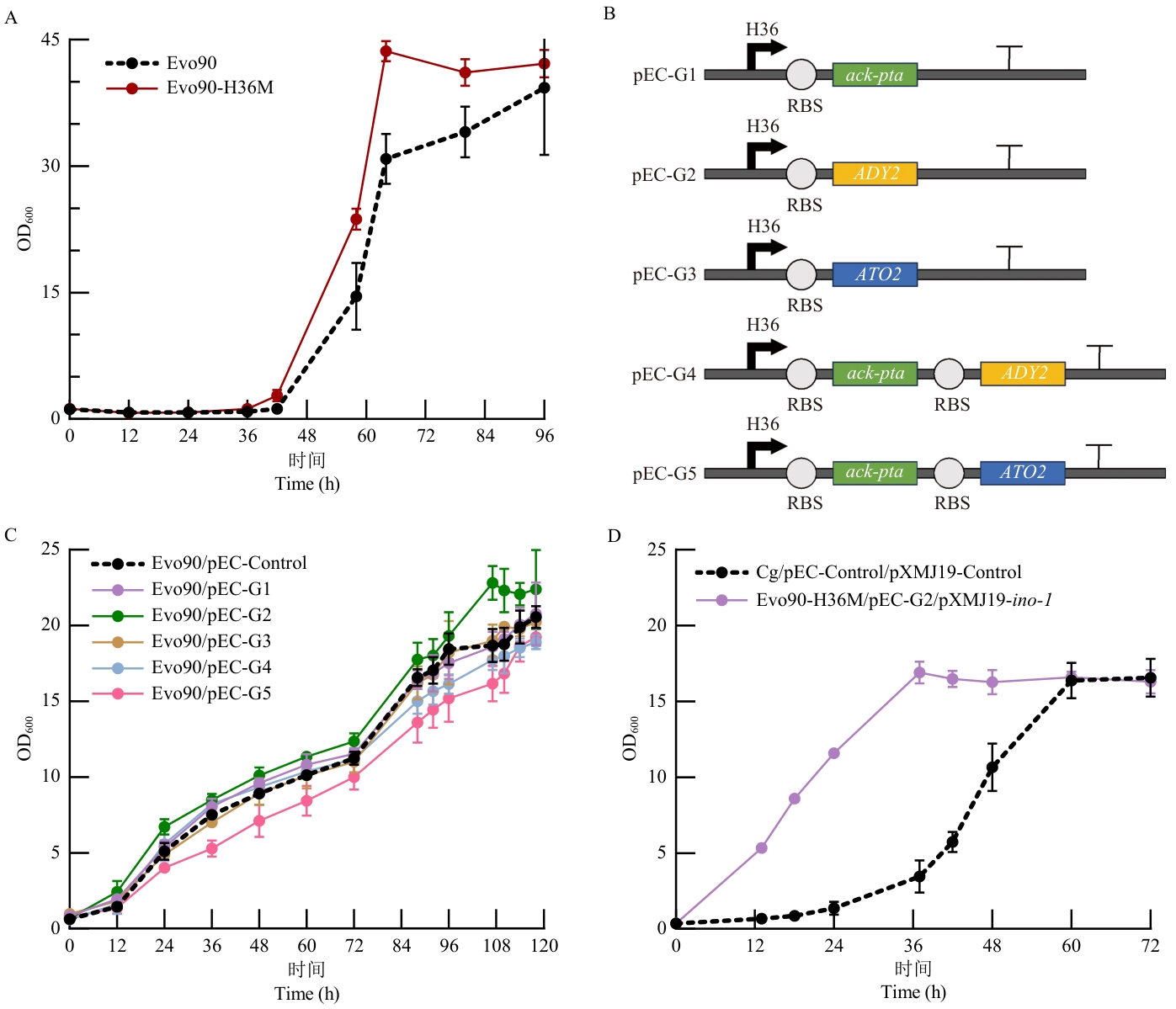
图4 过表达乙酸利用相关基因的结果A:Evo90-H36M与Evo90的生长情况对比;B:pEC-G1-pEC-G5质粒构建示意图;C:Evo90/pEC-G1-pEC-G5的生长情况对比;D:优势菌与对照组的生长情况对比
Fig. 4 Results of overexpression of acetic acid utilization-related genesA: Growth comparison between Evo90-H36M and Evo90. B: Schematic diagram of the construction of pEC-G1 to pEC-G5 plasmids. C: Growth comparison of Evo90/pEC-G1 to G5. D: Growth comparison between the superior strain and the control
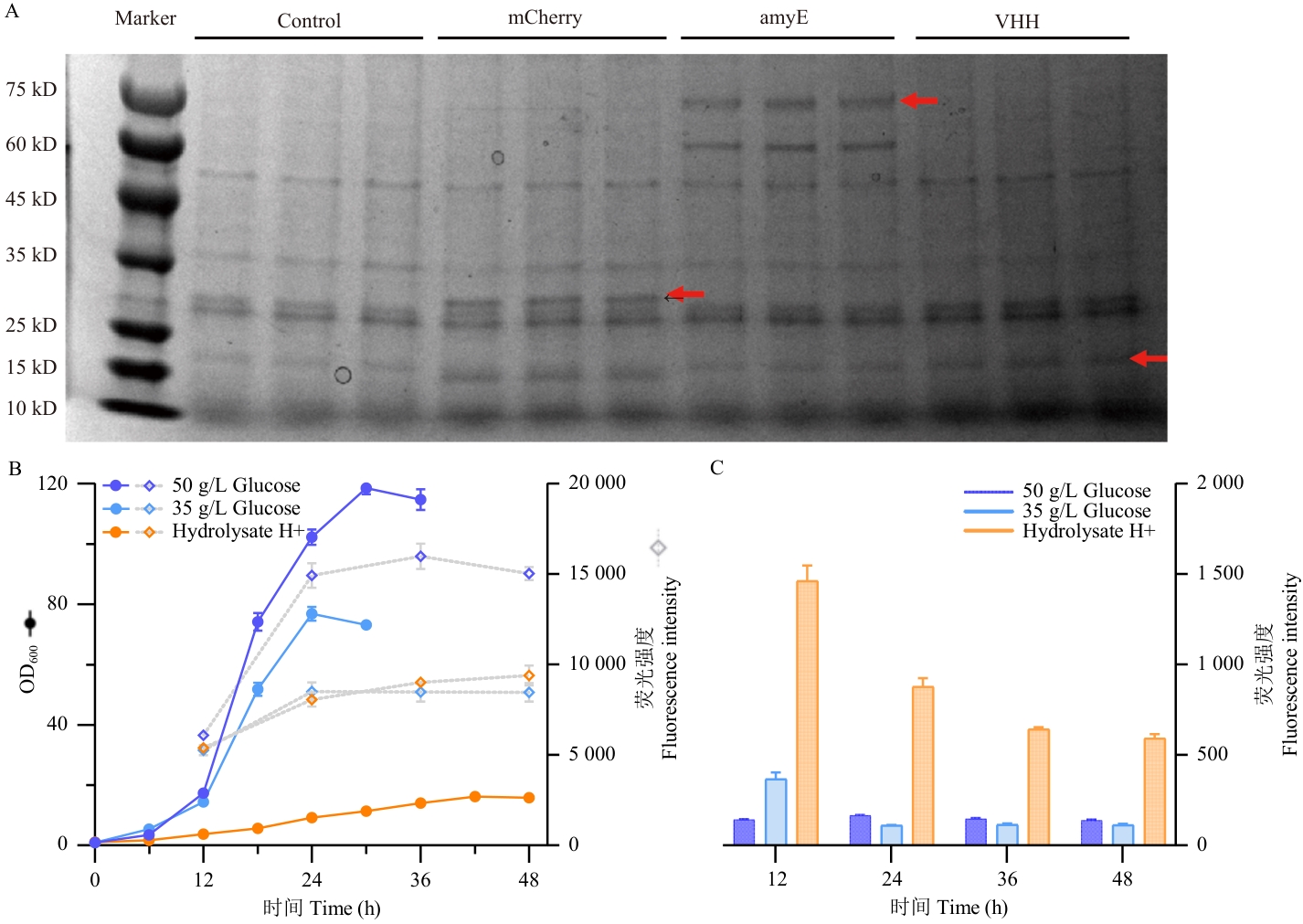
图5 工程菌分泌表达蛋白的SDS-PAGE分析(A)与胞外荧光强度(B和C)
Fig. 5 SDS-PAGE (A) and the extracellular fluorescence intensity analysis (B and C) of secreted expressed proteins by the engineered strain
| [1] | Gu PF, Li FF, Huang ZS, et al. Application of acetate as a substrate for the production of value-added chemicals in Escherichia coli [J]. Microorganisms, 2024, 12(2): 309. |
| [2] | Taha M, Foda M, Shahsavari E, et al. Commercial feasibility of lignocellulose biodegradation: possibilities and challenges [J]. Curr Opin Biotechnol, 2016, 38: 190-197. |
| [3] | Yang H, Huang B, Lai NY, et al. Metabolic engineering of Escherichia coli carrying the hybrid acetone-biosynthesis pathway for efficient acetone biosynthesis from acetate [J]. Microb Cell Fact, 2019, 18: 6. |
| [4] | Woo HM, Park JB. Recent progress in development of synthetic biology platforms and metabolic engineering of Corynebacterium glutamicum [J]. J Biotechnol, 2014, 180: 43-51. |
| [5] | Filina A, Jemaa N, Saulnier-Bellemare T, et al. Techno-economic analysis (TEA) and life-cycle assessment (LCA) methodology as a tool for biorefining technology benchmarking and iterative process design [J]. Biomass Bioenergy, 2026, 204: 108390. |
| [6] | 程怡雯. 木质纤维素水解液中主要抑制物分析及Candida glycerinogenes抗性基因挖掘应用 [D]. 无锡: 江南大学, 2025. |
| Cheng YW. Analysis of main inhibitors in lignocellulose hydrolysate and application of Candida glycerinogenes resistance gene mining [D]. Wuxi: Jiangnan University, 2025. | |
| [7] | Pinhal S, Ropers D, Geiselmann J, et al. Acetate metabolism and the inhibition of bacterial growth by acetate [J]. J Bacteriol, 2019, 201(13): 1-166. |
| [8] | Zhang YW, Yang JJ, Qian FH, et al. Engineering a xylose fermenting yeast for lignocellulosic ethanol production [J]. Nat Chem Biol, 2025, 21(3): 443-450. |
| [9] | Gerstmeir R, Wendisch VF, Schnicke S, et al. Acetate metabolism and its regulation in Corynebacterium glutamicum [J]. J Biotechnol, 2003, 104(1/2/3): 99-122. |
| [10] | Kiefer D, Merkel M, Lilge L, et al. High cell density cultivation of Corynebacterium glutamicum on bio-based lignocellulosic acetate using pH-coupled online feeding control [J]. Bioresour Technol, 2021, 340: 125666. |
| [11] | Kiefer D, Tadele LR, Lilge L, et al. High-level recombinant protein production with Corynebacterium glutamicum using acetate as carbon source [J]. Microb Biotechnol, 2022, 15(11): 2744-2757. |
| [12] | Shi XY, Chang J, Kim M, et al. Isopropanol production using engineered Corynebacterium glutamicum from waste rice straw biomass [J]. Bioresour Technol, 2024, 396: 130416. |
| [13] | Schmollack M, Werner F, Huber J, et al. Metabolic engineering of Corynebacterium glutamicum for acetate-based itaconic acid production [J]. Biotechnol Biofuels, 2022, 15: 139. |
| [14] | Lee DS, Cho EJ, Nguyen DT, et al. Succinic acid production from softwood with genome-edited Corynebacterium glutamicum using the CRISPR-Cpf1 system [J]. Biotechnol J, 2024, 19: 2300309. |
| [15] | Zou Y, Fan ZM, Liu XX, et al. Engineering MtrAB two-component system enhances protein and glutamate export in Corynebacterium glutamicum through cell wall remodeling [J]. Bioresour Technol, 2025, 436: 133024. |
| [16] | 尚进, 平清伟, 盛雪茹, 等. 玉米秸秆乙酸法水解液对盐碱土的改良效果研究 [J]. 中国造纸学报, 2025, 40(2): 17-25. |
| Shang J, Ping QW, Sheng XR, et al. Study on the effect of acetic acid hydrolysate of corn stalk on the improvement of saline-sodic soil [J]. Trans China Pulp Pap, 2025, 40(2): 17-25. | |
| [17] | Chen Z, Chen XJ, Li QY, et al. Transcriptome analysis reveals potential mechanisms of L-serine production by Escherichia coli fermentation in different carbon-nitrogen ratio medium [J]. Foods, 2022, 11(14): 2092. |
| [18] | Merkel M, Kiefer D, Schmollack M, et al. Acetate-based production of itaconic acid with Corynebacterium glutamicum using an integrated pH-coupled feeding control [J]. Bioresour Technol, 2022, 351: 126994. |
| [19] | Guo TF, Herman JK. Magnesium modulates Bacillus subtilis cell division frequency [J]. J Bacteriol, 2023, 205: e00375-e00322. |
| [20] | Groisman EA. The ins and outs of virulence gene expression: Mg2+ as a regulatory signal [J]. BioEssays, 1998, 20(1): 96-101. |
| [21] | Kröse JL, de Baaij JHF. Magnesium biology [J]. Nephrol Dial Transplant, 2024, 39(12): 1965-1975. |
| [22] | Pokorzynski ND, Jones KA, Campagna SR, et al. Cytoplasmic Mg2+ supersedes carbon source preference to dictate Salmonella metabolism [J]. Proc Natl Acad Sci U S A, 2025, 122(13): e2424337122. |
| [23] | Pinton P, Romagnoli A, Rizzuto R, et al. Ca2+ signaling, mitochondria and cell death [J]. Curr Mol Med, 2008, 8(2): 119-130. |
| [24] | Chen C, Chen KQ, Su T, et al. Myo-inositol-1-phosphate synthase (Ino-1) functions as a protection mechanism in Corynebacterium glutamicum under oxidative stress [J]. MicrobiologyOpen, 2019, 8(5): e00721. |
| [25] | Si MR, Zhang L, Chaudhry MT, et al. Corynebacterium glutamicum methionine sulfoxide reductase a uses both mycoredoxin and thioredoxin for regeneration and oxidative stress resistance [J]. Appl Environ Microbiol, 2015, 81(8): 2781-2796. |
| [26] | Wang Y, Hu LT, Huang H, et al. Eliminating the capsule-like layer to promote glucose uptake for hyaluronan production by engineered Corynebacterium glutamicum [J]. Nat Commun, 2020, 11: 3120. |
| [27] | Mengi B, Ikeda S, Murayama D, et al. Factors affecting decreasing viscosity of the culture medium during the stationary growth phase of exopolysaccharide-producing Lactobacillus fermentum MTCC 25067 [J]. Biosci Microbiota Food Health, 2020, 39(3): 160-168. |
| [28] | Jiang XY, Whitehead KA, Arneborg N, et al. Understanding bacterial surface and adhesion properties and the implications for Pickering stabilization of colloidal structures [J]. Curr Opin Colloid Interface Sci, 2024, 69: 101767. |
| [29] | Xu N, Zheng YY, Wang XC, et al. The lysine 299 residue endows the multisubunit Mrp1 antiporter with dominant roles in Na+ resistance and pH homeostasis in Corynebacterium glutamicum [J]. Appl Environ Microbiol, 2018, 84(10): e00110-e00118. |
| [30] | Mutyala S, Kim JR. Recent advances and challenges in the bioconversion of acetate to value-added chemicals [J]. Bioresour Technol, 2022, 364: 128064. |
| [31] | Ribas D, Soares-Silva I, Vieira D, et al. The acetate uptake transporter family motif “NPAPLGL(M/S)” is essential for substrate uptake [J]. Fungal Genet Biol, 2019, 122: 1-10. |
| [32] | Song P, Ma N, Dong SK, et al. Enhancing acetate utilization in Phaeodactylum tricornutum through the introduction of acetate transport protein [J]. Biomolecules, 2024, 14(7): 822. |
| [33] | Liu XX, Li GY, Cui SN, et al. Combinatorial tuning of 5′UTR and N-terminal coding sequences for enhanced recombinant protein expression in Corynebacterium glutamicum [J]. ACS Synth Biol, 2025, 14(8): 3105-3115. |
| [34] | Cai WF, Wang XF, Zhu Z, et al. Synergetic effects in the co-pyrolysis of lignocellulosic biomass and plastic waste for renewable fuels and chemicals [J]. Fuel, 2023, 353: 129210. |
| [35] | Claes WA, Pühler A, Kalinowski J. Identification of two prpDBC gene clusters in Corynebacterium glutamicum and their involvement in propionate degradation via the 2-methylcitrate cycle [J]. J Bacteriol, 2002, 184(10): 2728-2739. |
| [36] | Watanabe A, Hiraga K, Suda M, et al. Functional characterization of Corynebacterium alkanolyticum β-xylosidase and xyloside ABC transporter in Corynebacterium glutamicum [J]. Appl Environ Microbiol, 2015, 81(12): 4173-4183. |
| [1] | 刘修平, 朱星宇, 汪光义. 梭菌属(Clostridium)产乙酸菌代谢工程改造与合成气定向转化研究现状[J]. 生物技术通报, 2026, 42(2): 65-76. |
| [2] | 周瑾洁, 李猛. 甲烷八叠球菌和甲烷丝菌的能量代谢与胞外电子传递[J]. 生物技术通报, 2026, 42(2): 17-29. |
| [3] | 王晶, 朱伟民, 张兴泽, 李朋, 邢德峰. 木质纤维素生物质厌氧消化产甲烷强化策略研究进展[J]. 生物技术通报, 2026, 42(2): 30-40. |
| [4] | 曹园园, 周舒浩, 张海荣, 崔晓娜. 未折叠蛋白反应通过调控色氨酸代谢提高植物抗病性[J]. 生物技术通报, 2025, 41(8): 155-164. |
| [5] | 贾承霖, 郭晓鹏, 陆栋, 张苗苗. 增强酿酒酵母对木质纤维素水解液抑制剂耐受性的研究进展[J]. 生物技术通报, 2025, 41(4): 61-75. |
| [6] | 武威, 马秋刚, 朱选, 王健. 蒸汽爆破对木质纤维素高值化利用的研究进展[J]. 生物技术通报, 2024, 40(5): 23-37. |
| [7] | 高志伟, 魏明, 于祖隆, 伍国强, 魏俊龙. 耐盐植物促生菌W-1鉴定及其对红豆草耐盐性的影响[J]. 生物技术通报, 2024, 40(4): 217-227. |
| [8] | 陈金行, 张逸, 张军涛, 未本美, 王宏勋, 郑明明. 固定化脂肪酶的创制及其在乙酸肉桂酯无溶剂制备中的应用[J]. 生物技术通报, 2023, 39(9): 97-104. |
| [9] | 罗义, 张丽娟, 黄伟, 王宁, 吾尔丽卡·买提哈斯木, 施宠, 王玮. 一株耐铀菌株的鉴定及其促生特性研究[J]. 生物技术通报, 2023, 39(5): 286-296. |
| [10] | 唐瑞琪, 赵心清, 朱笃, 汪涯. 大肠杆菌对木质纤维素水解液抑制物的胁迫耐受性[J]. 生物技术通报, 2023, 39(11): 205-216. |
| [11] | 王文韬, 冯颀, 刘晨光, 白凤武, 赵心清. 氧化还原敏感型基因元件增强酵母木质纤维素水解液抑制物胁迫耐受性[J]. 生物技术通报, 2023, 39(11): 360-372. |
| [12] | 马艳琴, 邱益彬, 李莎, 徐虹. 透明质酸的生物合成及其代谢工程的研究进展[J]. 生物技术通报, 2022, 38(2): 252-262. |
| [13] | 杜佳慧, 徐伟芳, 杨晓冬, 谭松, 尹登科, 刘园旭. 多花黄精产吲哚乙酸内生菌的分离筛选及其对黄精种子萌发的影响[J]. 生物技术通报, 2022, 38(12): 223-232. |
| [14] | 翟旭航, 李霞, 元英进. 木质纤维素预处理及高值化技术研究进展[J]. 生物技术通报, 2021, 37(3): 162-174. |
| [15] | 胡芳, 董旭, 史长伟, 吴学栋. 超声波强化木质纤维素酶解的研究进展[J]. 生物技术通报, 2021, 37(10): 234-244. |
| 阅读次数 | ||||||
|
全文 |
|
|||||
|
摘要 |
|
|||||
