







生物技术通报 ›› 2026, Vol. 42 ›› Issue (5): 332-339.doi: 10.13560/j.cnki.biotech.bull.1985.2025-0980
• 研究报告 • 上一篇
顾恒1,2,3( ), 郑栋1,2, 宰舟颖1,2, 陈贡伟1,2, 岳远征1,2, 王良桂1,2,3(), 杨秀莲1,2()
收稿日期:2025-09-11
出版日期:2026-05-26
发布日期:2026-06-10
通讯作者:
杨秀莲,女,博士,教授,研究方向 :园林植物生理和栽培应用;E-mail: xly@njfu.edu.cn作者简介:顾恒,男,博士研究生,研究方向 :园林植物遗传与育种;E-mail: guheng2021@163.com
基金资助:
GU Heng1,2,3(), ZHENG Dong1,2, ZAI Zhou-ying1,2, CHEN Gong-wei1,2, YUE Yuan-zheng1,2, WANG Liang-gui1,2,3(), YANG Xiu-lian1,2()
Received:2025-09-11
Published:2026-05-26
Online:2026-06-10
摘要:
目的 SVB(smaller with variable branches)基因在植物生长发育和响应逆境过程中发挥关键作用。探究OfSVB1基因的功能为解析桂花响应盐胁迫的分子机制奠定基础。 方法 根据课题组前期桂花盐胁迫转录组数据中FPKM水平的变化筛选出关键候选基因OfSVB1,利用生物信息学工具对其理化性质进行分析,以桂花‘日香桂’叶片的cDNA为模板克隆OfSVB1基因,通过注射烟草叶片进行亚细胞定位分析,对瞬时侵染烟草进行盐胁迫后测定相对电导率、脯氨酸、丙二醛、过氧化物酶(POD)、过氧化氢酶(CAT)和超氧化物歧化酶(SOD)等6个生理指标的变化,对转化后的烟草叶片组织进行氮蓝四唑(NBT)、二氨基联苯胺(DAB)和过碘酸希夫(Schiff)化学染色,同时对5个可能参与响应盐胁迫的功能基因(NbNHX1、NbCAT、NbSOD、NbAPX和NbP5CS)进行实时荧光定量PCR(RT-qPCR)分析。 结果 OfSVB1基因在盐处理72 h时的FPKM值最高,与其他6个处理组之间存在显著差异。该基因拥有全长为597 bp的完整阅读框,编码199个氨基酸,属于DUF538家族成员。基因OfSVB1定位于细胞膜上。与转空载体(empty vector, EV)相比,转基因烟草叶片中相对电导率、脯氨酸含量和POD活性显著上升;而丙二醛含量、CAT活性和SOD活性与EV相比无显著差异。此外,叶片化学染色中观察到OfSVB1烟草叶片的颜色明显比EV深且分布范围广。最后,与EV相比,OfSVB1过表达后未引起5个响应盐胁迫相关基因的表达量发生显著变化。 结论 OfSVB1基因具有降低桂花耐盐性的功能。
顾恒, 郑栋, 宰舟颖, 陈贡伟, 岳远征, 王良桂, 杨秀莲. 桂花OfSVB1响应盐胁迫的功能研究[J]. 生物技术通报, 2026, 42(5): 332-339.
GU Heng, ZHENG Dong, ZAI Zhou-ying, CHEN Gong-wei, YUE Yuan-zheng, WANG Liang-gui, YANG Xiu-lian. Functional Study of Osmanthus fragransOfSVB1 in Response to Salt Stress[J]. Biotechnology Bulletin, 2026, 42(5): 332-339.
基因名 Gene name | 引物名 Primer name | 引物序列 Primer sequence (5′‒3′) |
|---|---|---|
| OfSVB1 | OfSVB1-F | caaatcgactcttagaaagcttATGTACAGAAACTCTTTACTCTCTGTACTCC |
| OfSVB1-R | tatttaaatgtcgaccccgggCATCTGATTCAAAGAAGAGAAVACG | |
| pSuper1300 | 1300-F | AACGCTTTACAGCAAGAACGGAATG |
| 1300-R | TAGGTCAGGGTGGTCACGAGGGT | |
| Nbactin | Nbactin-F | ATCCTCACAGAGCGTGGTTAC |
| Nbactin-R | CACTGAGCACTATGTTTCCGT | |
| NbNHX1 | NbNHX1-F | AACTGGGCTCTTTGGGTA |
| NbNHX1-R | AGGGCGGTAATAGACTCA | |
| NbP5CS | NbP5CS-F | ATCTTGATGGCAAGGCTTGTGCTG |
| NbP5CS-R | AAGCTGAGCTGAGGTTACGTCCAA | |
| NbCAT | NbCAT-F | GTATCGTCCGTCAAGTGCCT |
| NbCAT-R | CGGGAGCTCGAAGGAAATCA | |
| NbSOD | NbSOD-F | AAAGGGCACCACAGAATTAAAGTA |
| NbSOD-R | GCTCCAGTGCTCCATAGTCGTA | |
| NbAPX | NbAPX-F | CTCCTCCATATCCACAACAGAACTA |
| NbAPX-R | GCAGAGTGCCATGCTAAACG |
表1 基因引物序列
Table 1 Primer sequences of genes
基因名 Gene name | 引物名 Primer name | 引物序列 Primer sequence (5′‒3′) |
|---|---|---|
| OfSVB1 | OfSVB1-F | caaatcgactcttagaaagcttATGTACAGAAACTCTTTACTCTCTGTACTCC |
| OfSVB1-R | tatttaaatgtcgaccccgggCATCTGATTCAAAGAAGAGAAVACG | |
| pSuper1300 | 1300-F | AACGCTTTACAGCAAGAACGGAATG |
| 1300-R | TAGGTCAGGGTGGTCACGAGGGT | |
| Nbactin | Nbactin-F | ATCCTCACAGAGCGTGGTTAC |
| Nbactin-R | CACTGAGCACTATGTTTCCGT | |
| NbNHX1 | NbNHX1-F | AACTGGGCTCTTTGGGTA |
| NbNHX1-R | AGGGCGGTAATAGACTCA | |
| NbP5CS | NbP5CS-F | ATCTTGATGGCAAGGCTTGTGCTG |
| NbP5CS-R | AAGCTGAGCTGAGGTTACGTCCAA | |
| NbCAT | NbCAT-F | GTATCGTCCGTCAAGTGCCT |
| NbCAT-R | CGGGAGCTCGAAGGAAATCA | |
| NbSOD | NbSOD-F | AAAGGGCACCACAGAATTAAAGTA |
| NbSOD-R | GCTCCAGTGCTCCATAGTCGTA | |
| NbAPX | NbAPX-F | CTCCTCCATATCCACAACAGAACTA |
| NbAPX-R | GCAGAGTGCCATGCTAAACG |
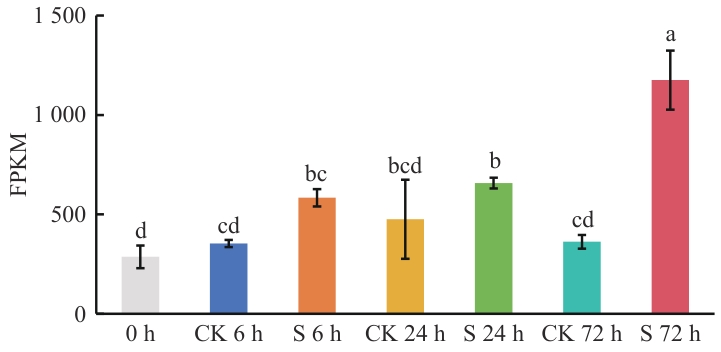
图1 基因OfSVB1的FPKM值水平变化CK表示对照组,S表示NaCl处理组,数字表示处理时间。不同小写字母表示差异显著(P<0.05)。下同
Fig. 1 The level changes of FPKM values for the gene OfSVB1CK indicates the control group, S indicates the NaCl treatment group, and numbers indicate treatment time. Different lowercase letters indicate significant differences(P<0.05). The same below
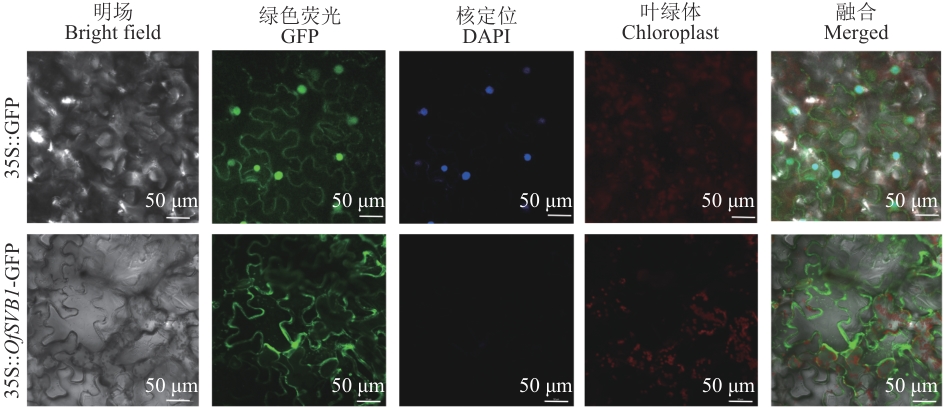
图2 OfSVB1基因亚细胞定位
Fig. 2 Subcellular localization of OfSVB1 gene
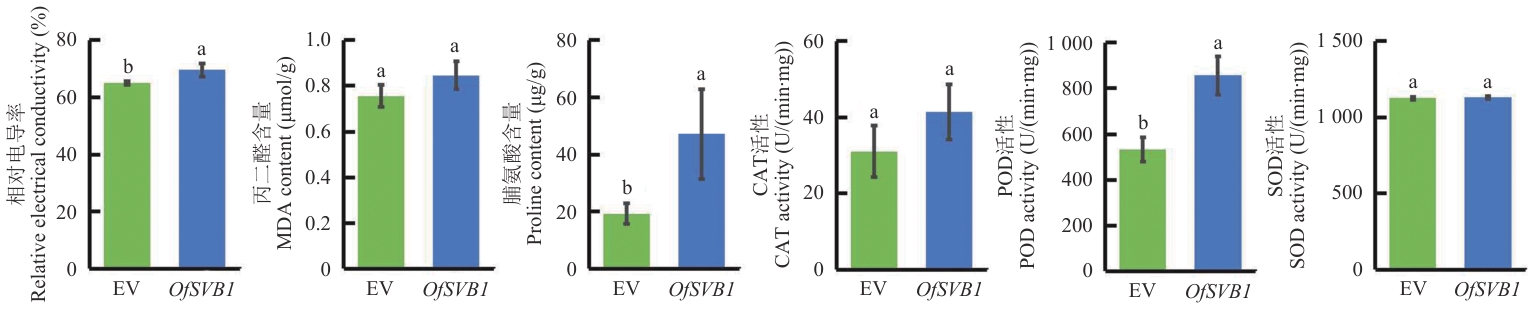
图3 转基因烟草盐胁迫后相关生理指标EV表示瞬时转化空载体的本氏烟草,OfSVB1表示瞬时转化桂花OfSVB1基因的本氏烟草
Fig. 3 Related physiological indexes of transgenic tobacco after salt stressEV indicates the instantaneous conversion of N. benthamiana into empty vector, and OfSVB1 indicates the instantaneous transformation OfSVB1 gene of O. fragrans
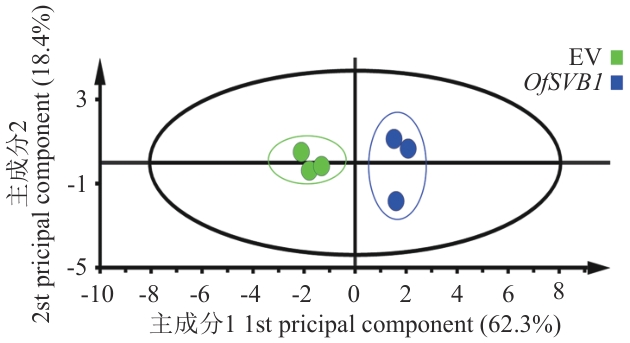
图4 转基因烟草盐胁迫后6个生理指标的正交偏最小二乘判别分析
Fig. 4 Orthogonal partial least squares discriminant analysis of 6 physiological indexes of transgenic tobacco after salt stress
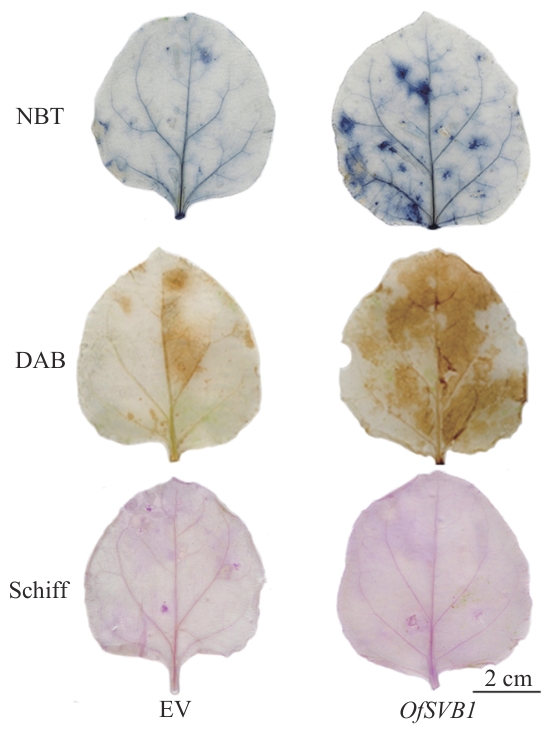
图5 NBT、DAB和Schiff溶液对盐处理后本氏烟草叶片染色
Fig. 5 NBT, DAB, and Schiff solution staining of N. benthamiana leaves after salt treatment
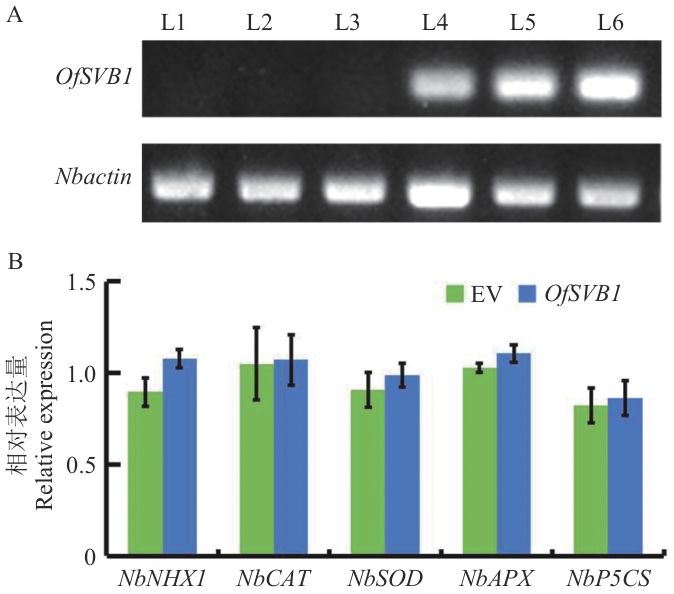
图6 OfSVB1瞬时转化烟草检测(A)及5个盐胁迫相关基因的RT-qPCR(B)Nbaction为本氏烟草的内参基因,L1‒3和L4‒6分别表示注射了pSuper1300空载(EV)和pSuper1300-OfSVB1的3株烟草
Fig. 6 OfSVB1 transient conversion for tobacco detection (A) and RT-qPCR of five salt stress-related genes (B)The Nbaction is the internal reference gene of N. benthamiana, and the distribution of L1-3 and L4-6 refers to three tobacco plants injected with pSuper1300 empty vector (EV) and pSuper1300-OfSVB1, respectively
| [1] | 宋子荷, 甄艳. 植物干旱和盐胁迫响应相关miRNA研究进展 [J]. 南京林业大学学报: 自然科学版, 2024, 48(4): 1-11. |
| Song ZH, Zhen Y. Advancements in the research of miRNAs associated with plant drought and salt stress responses [J]. J Nanjing For Univ Nat Sci Ed, 2024, 48(4): 1-11. | |
| [2] | Zhang L, Zhang ZJ, Fang SZ, et al. Integrative analysis of metabolome and transcriptome reveals molecular regulatory mechanism of flavonoid biosynthesis in Cyclocarya paliurus under salt stress [J]. Ind Crops Prod, 2021, 170: 113823. |
| [3] | 顾恒, 李玲, 欧阳绮霞, 等. 盐胁迫对3个桂花品种生长和生理特性的影响 [J]. 中国野生植物资源, 2020, 39(10): 28-34. |
| Gu H, Li L, Ouyang QX, et al. Effects of salt stress on the growth and physiological characteristics of three sweet Osmanthus fragrans varieties [J]. Chin Wild Plant Resour, 2020, 39(10): 28-34 | |
| [4] | Liang XY, Li JF, Yang YQ, et al. Designing salt stress-resilient crops: Current progress and future challenges [J]. J Integr Plant Biol, 2024, 66(3): 303-329. |
| [5] | 杜艳霞, 王艺光, 肖政, 等. 桂花OfNCED3调控转基因烟草叶片类胡萝卜素和叶绿素的合成 [J]. 园艺学报, 2023, 50(6): 1284-1294. |
| Du YX, Wang YG, Xiao Z, et al. Ectopic overexpression of OfNCED3 regulates the synthesis of carotenoids and chlorophylls in transgenic tobacco leaves [J]. Acta Hortic Sin, 2023, 50(6): 1284-1294. | |
| [6] | Gu H, Ding WJ, Shi TT, et al. Integrated transcriptome and endogenous hormone analysis provides new insights into callus proliferation in Osmanthus fragrans [J]. Sci Rep, 2022, 12: 7609. |
| [7] | Qin Y, Yu HX, Cheng SY, et al. Genome-wide analysis of the WRKY gene family in Malus domestica and the role of MdWRKY70L in response to drought and salt stresses [J]. Genes, 2022, 13(6): 1068. |
| [8] | Xu HY, Shi XX, He L, et al. Arabidopsis thaliana trihelix transcription factor AST1 mediates salt and osmotic stress tolerance by binding to a novel AGAG-box and some GT motifs [J]. Plant Cell Physiol, 2018, 59(5): 946-965. |
| [9] | Li Q, Wu Q, Wang AH, et al. Tartary buckwheat transcription factor FtbZIP83 improves the drought/salt tolerance of Arabidopsis via an ABA-mediated pathway [J]. Plant Physiol Biochem, 2019, 144: 312-323. |
| [10] | Zhu ML, Bin J, Ding HF, et al. Insights into the trihelix transcription factor responses to salt and other stresses in Osmanthus fragrans [J]. BMC Genomics, 2022, 23(1): 334. |
| [11] | 宰舟颖, 王柳, 丁卉芬, 等. 桂花OfWRKY120基因鉴定及盐胁迫响应功能研究 [J]. 西北农林科技大学学报: 自然科学版, 2024, 52(5): 144-154. |
| Zai ZY, Wang L, Ding HF, et al. Identification and salt stress response of OfWRKY120 gene in Osmanthus fragrans [J]. J Northwest A F Univ Nat Sci Ed, 2024, 52(5): 144-154. | |
| [12] | Hussain S, Zhang N, Wang W, et al. Involvement of ABA responsive SVB genes in the regulation of trichome formation in Arabidopsis [J]. Int J Mol Sci, 2021, 22(13): 6790. |
| [13] | Yu FY, Du Y, Shen YB. Physiological characteristics changes of Aesculus chinensis seeds during natural dehydration [J]. J For Res, 2006, 17(2): 103-106. |
| [14] | Borgohain P, Saha B, Agrahari R, et al. SlNAC2 overexpression in Arabidopsis results in enhanced abiotic stress tolerance with alteration in glutathione metabolism [J]. Protoplasma, 2019, 256(4): 1065-1077. |
| [15] | Nguyen HTT, Das Bhowmik S, Long H, et al. Rapid accumulation of proline enhances salinity tolerance in Australian wild rice Oryza australiensis domin [J]. Plants, 2021, 10(10): 2044. |
| [16] | Ji XY, Tang JL, Zhang JP. Effects of salt stress on the morphology, growth and physiological parameters of Juglansmicrocarpa L. seedlings [J]. Plants, 2022, 11(18): 2381. |
| [17] | Turan M, Ekinci M, Kul R, et al. Mitigation of salinity stress in cucumber seedlings by exogenous hydrogen sulfide [J]. J Plant Res, 2022, 135(3): 517-529. |
| [18] | Chen J, Zhong YM, Zhang HQ, et al. Nitrate reductase-dependent nitric oxide production is involved in microcystin-LR-induced oxidative stress in Brassica rapa [J]. Water Air Soil Pollut, 2012, 223(7): 4141-4152. |
| [19] | Shi J, Fu XZ, Peng T, et al. Spermine pretreatment confers dehydration tolerance of Citrus in vitro plants via modulation of antioxidative capacity and stomatal response [J]. Tree Physiol, 2010, 30(7): 914-922. |
| [20] | Bin J, Zhu ML, Ding HF, et al. New insights into the roles of Osmanthus fragrans heat-shock transcription factors in cold and other stress responses [J]. Horticulturae, 2022, 8(1): 80. |
| [21] | Liu JW, Hu HM, Shen HM, et al. Insights into the cytochrome P450 monooxygenase superfamily in Osmanthus fragrans and the role of OfCYP142 in linalool synthesis [J]. Int J Mol Sci, 2022, 23(20): 12150. |
| [22] | Chen X, Yang XL, Xie J, et al. Biochemical and comparative transcriptome analyses reveal key genes involved in major metabolic regulation related to colored leaf formation in Osmanthus fragrans 'yinbi Shuanghui' during development [J]. Biomolecules, 2020, 10(4): 549. |
| [23] | 燕佳琦, 李萍, 张鹤, 等. 甘蓝型油菜BnaSVB基因的克隆及DUF538基因家族的鉴定 [J]. 分子植物育种, 2022, 20(8): 2437-2447. |
| Yan JQ, Li P, Zhang H, et al. Cloning of BnaSVB gene and identification of DUF538 gene family in Brassica napus L. [J]. Mol Plant Breed, 2022, 20(8): 2437-2447. | |
| [24] | Li YL, Li L, Ding WJ, et al. Genome-wide identification of Osmanthus fragrans bHLH transcription factors and their expression analysis in response to abiotic stress [J]. Environ Exp Bot, 2020, 172: 103990. |
| [25] | Ding WJ, Ouyang QX, Li YL, et al. Genome-wide investigation of WRKY transcription factors in sweet Osmanthus and their potential regulation of aroma synthesis [J]. Tree Physiol, 2020, 40(4): 557-572. |
| [26] | Chen ZL, Galli M, Gallavotti A. Mechanisms of temperature-regulated growth and thermotolerance in crop species [J]. Curr Opin Plant Biol, 2022, 65: 102134. |
| [27] | Choudhury FK, Rivero RM, Blumwald E, et al. Reactive oxygen species, abiotic stress and stress combination [J]. Plant J, 2017, 90(5): 856-867. |
| [28] | Yang JL, La Y, He TC, et al. Variations of salt stress responses and functional identification of TgPYR1-like8 in Tulipa gesneriana [J]. Sci Hortic, 2024, 330: 113104. |
| [29] | Li C, Cui J, Shen YR, et al. BrERF109 positively regulates the tolerances of drought and salt stress in Chinese cabbage [J]. Environ Exp Bot, 2024, 223: 105794. |
| [30] | 罗春燕, 耿红凯, 王秀军, 等. NaCl胁迫下外源水杨酸对银杏生长和光合作用的影响 [J]. 南京林业大学学报: 自然科学版, 2024, 48(6): 91-101. |
| Luo CY, Geng HK, Wang XJ, et al. Effects of exogenous salicylic acid on growth and photosynthesis of Ginkgo biloba under NaCl stress [J]. J Nanjing For Univ Nat Sci Ed, 2024, 48(6): 91-101. | |
| [31] | Sun YM, Jiang CX, Jiang RQ, et al. A novel NAC transcription factor from Eucalyptus, EgNAC141, positively regulates lignin biosynthesis and increases lignin deposition [J]. Front Plant Sci, 2021, 12: 642090. |
| [32] | Zhao SS, Zhang QK, Liu MY, et al. Regulation of plant responses to salt stress [J]. Int J Mol Sci, 2021, 22(9): 4609. |
| [33] | Laxmi, Kamal A, Kumar V, et al. Morphological indicators of salinity stress and their relation with osmolyte associated redox regulation in mango cultivars [J]. J Plant Biochem Biotechnol, 2021, 30(4): 918-929. |
| [34] | Wang XJ, Song ZQ, Ti YJ, et al. Physiological response and transcriptome analysis of Prunus mume to early salt stress [J]. J Plant Biochem Biotechnol, 2022, 31(2): 330-342. |
| [35] | 孙志娟, 刘文杰, 郑晓东, 等. 褪黑素对盐碱胁迫下平邑甜茶幼苗生长的影响及其机制 [J]. 园艺学报, 2023, 50(8): 1697-1710. |
| Sun ZJ, Liu WJ, Zheng XD, et al. Effects and functional mechanism of melatonin on the growth of Malus hupehensis seedlings under saline-alkali stress [J]. Acta Hortic Sin, 2023, 50(8): 1697-1710. | |
| [36] | 彭玲, 冯璐, 宋爱云, 等. 不同浓度盐和氮处理对冬枣果实品质形成的交互作用 [J]. 园艺学报, 2023, 50(10): 2192-2206. |
| Peng L, Feng L, Song AY, et al. Interaction of different concentrations of salt and nitrogen treatment on fruit quality formation of Ziziphus jujuba 'Dongzao' [J]. Acta Hortic Sin, 2023, 50(10): 2192-2206. | |
| [37] | Liu GH, Gu H, Cai HY, et al. Integrated transcriptome and biochemical analysis provides new insights into the leaf color change in Acer fabri [J]. Forests, 2023, 14(8): 1638. |
| [38] | Zhang ZJ, Jin HY, Fang J, et al. Effects of nanoparticle application on Cyclocarya paliurus growth: Mechanisms underlying the particle- and dose-dependent response [J]. Ind Crops Prod, 2024, 209: 117942. |
| [1] | 廖艳婷, 王灿琴, 韦娇君, 赵承刚, 黄世旅, 罗阳兰, 阎勇. 羊肚菌连作对土壤理化性质、微生物群落变化的影响及其关联机制[J]. 生物技术通报, 2026, 42(5): 134-146. |
| [2] | 张建霞, 姜成英, 吴文俊, 金高明, 张聪聪, 姚玉芳, 张荣, 戚建莉. 不同土壤条件下油橄榄园根际土壤理化性质及细菌群落特征[J]. 生物技术通报, 2026, 42(4): 287-296. |
| [3] | 刘青媛, 吴洪启, 陈秀娥, 陈剑, 姜远泽, 何燕子, 喻奇伟, 刘仁祥. 转录因子NtMYB96a调控烟草耐旱性的功能研究[J]. 生物技术通报, 2026, 42(4): 239-250. |
| [4] | 朱志炎, 宋芷薇, 何珊, 张德清, 何勇, 田志宏. 烟草靶斑病拮抗菌的鉴定及其防治特性[J]. 生物技术通报, 2026, 42(4): 310-320. |
| [5] | 彭朝凤, 夏琳, 刘瑞霞, 闫新可, 牧杨威, 刘梦茹, 杨军, 武明珠. 基于VIGS和CRISPR/Cas9技术的烟草NtPPO5基因功能分析[J]. 生物技术通报, 2026, 42(4): 251-262. |
| [6] | 殷亚龙, 张明洋, 王洁敏, 苗雪雪, 陈劲, 王伟平. 水稻非生物胁迫协同耐受机制研究进展[J]. 生物技术通报, 2026, 42(4): 26-37. |
| [7] | 徐玉娇, 孙玉帅, 刘道奇, 张丽, 张志昌, 姚玉新. VvHSP18.2过表达调节葡萄盐碱抗性的功能分析[J]. 生物技术通报, 2026, 42(4): 161-169. |
| [8] | 刘保财, 胡学博, 张武君, 赵云青, 黄颖桢, 陈菁瑛. 石仙桃内参基因筛选与应用[J]. 生物技术通报, 2026, 42(2): 158-168. |
| [9] | 董亚茹, 朱红, 王照红, 赵东晓, 刘惠芬. 桑树MnDREB6E的克隆及耐盐抗旱性分析[J]. 生物技术通报, 2026, 42(2): 306-316. |
| [10] | 王亚乐, 李雪君, 孙计平, 孙焕. 烟草豫浓香201对低温胁迫的生理响应及转录组分析[J]. 生物技术通报, 2026, 42(2): 228-238. |
| [11] | 张驰昊, 刘晋囡, 董家乐, 晁跃辉. 紫花苜蓿酵母表达文库的构建及候选耐盐基因的筛选与鉴定[J]. 生物技术通报, 2026, 42(2): 239-249. |
| [12] | 李勒松, 张金金, 贺佳蝶, 梁艳丽, 杨生超, 栗孟飞, 赵艳. 当归4-香豆酸∶辅酶A连接酶基因家族的鉴定与功能表征[J]. 生物技术通报, 2026, 42(2): 293-305. |
| [13] | 刘梦茹, 夏琳, 刘瑞霞, 闫新可, 杨军, 张菁华, 武明珠. 烟草多酚氧化酶NtPPO1-2基因克隆及功能分析[J]. 生物技术通报, 2026, 42(2): 218-227. |
| [14] | 张驰昊, 刘晋囡, 晁跃辉. 蒺藜苜蓿bZIP转录因子MtbZIP29的克隆及功能分析[J]. 生物技术通报, 2026, 42(1): 241-250. |
| [15] | 任云儿, 伍国强, 成斌, 魏明. 甜菜BvATGs基因家族全基因组鉴定及盐胁迫下表达模式分析[J]. 生物技术通报, 2026, 42(1): 184-197. |
| 阅读次数 | ||||||
|
全文 |
|
|||||
|
摘要 |
|
|||||
