







Biotechnology Bulletin ›› 2026, Vol. 42 ›› Issue (10): 47-54.doi: 10.13560/j.cnki.biotech.bull.1985.2025-1470
PENG Wen-hui1,2,3, LI Guan-chu2,3, LIU Yong-min2,3, MA Wen-jian1( ), GUO Xiao-xian3()
Received:2026-01-02
Online:2026-10-26
Published:2026-06-10
Contact:
MA Wen-jian, GUO Xiao-xian
E-mail:ma_wj@tust.edu.cn;guoxx@tib.cas.cn
PENG Wen-hui, LI Guan-chu, LIU Yong-min, MA Wen-jian, GUO Xiao-xian. Synthesis of Circular Full-length Human Mitochondrial DNA Based on Yeast Cloning and Staggered Thermal Cycling Ligation[J]. Biotechnology Bulletin, 2026, 42(10): 47-54.
引物名称 Primer | 引物序列 Primer sequence (5′-3′) | 说明 Notes |
|---|---|---|
| A_F1 | tgagttacctcactcattagTATGTGTTGTCGTGCAGGTAGAGG | 小写字母为pRS415同源序列 (Lowercase letters indicate homologous sequences to the pRS415 vector) |
| D_R4 | acaaggaagtacaggacaattgATGACCCACCAATCACATGCCTATCATATAGT | |
| A_R1 | GGCCATTATCGAAGAATTTACAAAAAACAATAGC | 加粗字母为EcoR I位点内所引入的突变碱基 (Bold characters represent the mutated bases introduced within the EcoR I recognition site) |
| B_F2 | GCTATTGTTTTTTGTAAATTCTTCGATAATGGCC | |
| B_R2 | CCCTGTTCTTATGAATCCGAACAGCATAC | |
| C_F3 | GTATGCTGTTCGGATTCATAAGAACAGGG | |
| C_R3 | GGTCCATCATAGAATTTTCACTGTGATAT | |
| D_F4 | ATATCACAGTGAAAATTCTATGATGGACC | |
| 59F | /5Phos/GGCCCTCTCAGCCCTCCTAATGAC | /5Phos/为5′端磷酸化修饰 (/5Phos/ indicates a 5' phosphorylation modification) |
| 59R | /5Phos/CCTGTTAGGGGTCATGGGCTGGGTTTTACTATATGATAGGCATGTGATTGGTGGGTCATTATGTGTTGTCGTGCAGGTAGAGGC | |
| F40 | /5Phos/AAAACCCAGCCCATGACCCCTAACAGGGGCCCTCTCAGCCCTCCTAATGACCTCCGGCCTAGCCATGTGAT | |
| R41 | /5Phos/ACTATATGATAGGCATGTGATTGGTGGGTCATTATGTGTTGTCGTGCAGGTAGAGGCTTACTAGAAGTGTG |
Table 1 Primers used in this study
引物名称 Primer | 引物序列 Primer sequence (5′-3′) | 说明 Notes |
|---|---|---|
| A_F1 | tgagttacctcactcattagTATGTGTTGTCGTGCAGGTAGAGG | 小写字母为pRS415同源序列 (Lowercase letters indicate homologous sequences to the pRS415 vector) |
| D_R4 | acaaggaagtacaggacaattgATGACCCACCAATCACATGCCTATCATATAGT | |
| A_R1 | GGCCATTATCGAAGAATTTACAAAAAACAATAGC | 加粗字母为EcoR I位点内所引入的突变碱基 (Bold characters represent the mutated bases introduced within the EcoR I recognition site) |
| B_F2 | GCTATTGTTTTTTGTAAATTCTTCGATAATGGCC | |
| B_R2 | CCCTGTTCTTATGAATCCGAACAGCATAC | |
| C_F3 | GTATGCTGTTCGGATTCATAAGAACAGGG | |
| C_R3 | GGTCCATCATAGAATTTTCACTGTGATAT | |
| D_F4 | ATATCACAGTGAAAATTCTATGATGGACC | |
| 59F | /5Phos/GGCCCTCTCAGCCCTCCTAATGAC | /5Phos/为5′端磷酸化修饰 (/5Phos/ indicates a 5' phosphorylation modification) |
| 59R | /5Phos/CCTGTTAGGGGTCATGGGCTGGGTTTTACTATATGATAGGCATGTGATTGGTGGGTCATTATGTGTTGTCGTGCAGGTAGAGGC | |
| F40 | /5Phos/AAAACCCAGCCCATGACCCCTAACAGGGGCCCTCTCAGCCCTCCTAATGACCTCCGGCCTAGCCATGTGAT | |
| R41 | /5Phos/ACTATATGATAGGCATGTGATTGGTGGGTCATTATGTGTTGTCGTGCAGGTAGAGGCTTACTAGAAGTGTG |
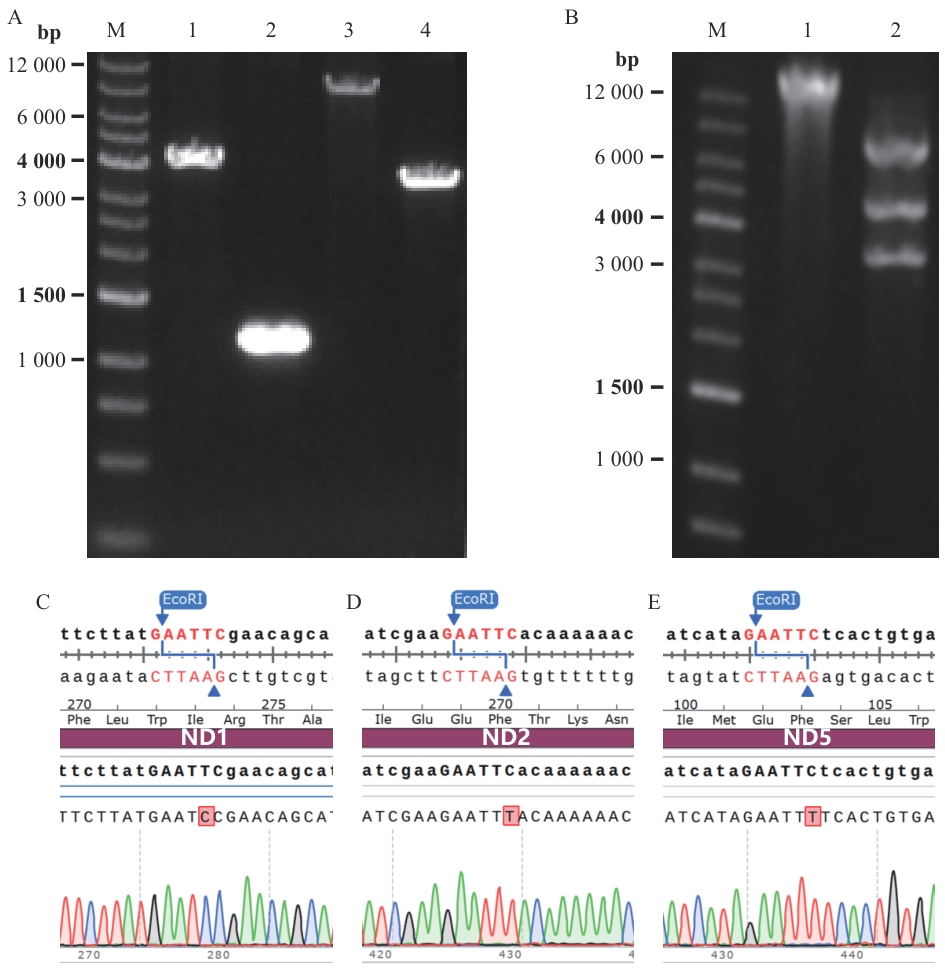
Fig. 1 Construction and verification of recombinant clone of EcoR I-free full-length human mitochondrial genomeA: Gel electrophoresis of the four overlapping PCR fragments used for yeast homologous recombination. M: DNA marker. B: Validation of the assembled mtDNA. Lane 1: Full-length PCR product amplified by primers F40/R41. Lane 2: Restriction digest with ClaI and BamHI showing expected fragments (~8 kb, 5 kb, and 3.5 kb). C-E: Sequencing chromatograms confirming synonymous mutations (red boxes) that eliminate EcoRI sites. C: ND1 (m.4125T>C); D:ND2 (m.5280C>T); E: ND5 (m.12645C>T). Top: Wild-type sequence; bottom: mutated sequence
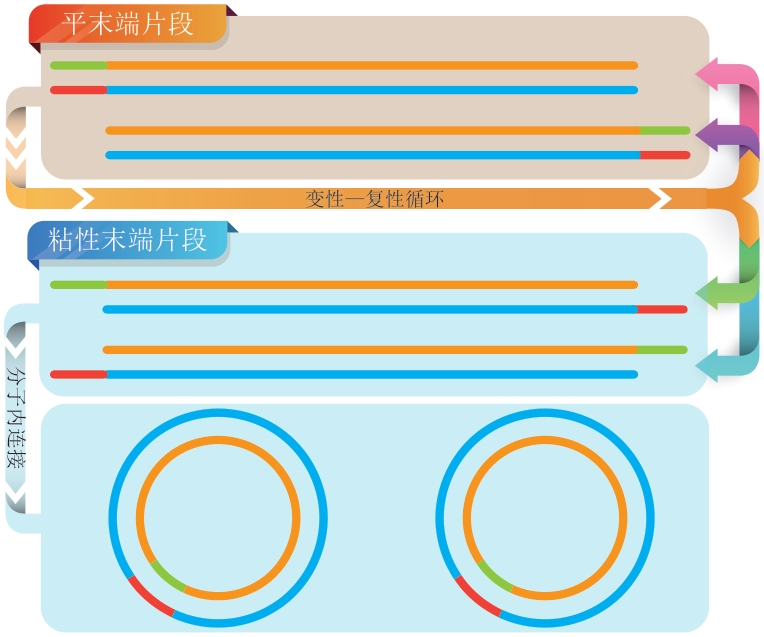
Fig. 2 Schematic illustration of the staggered linear DNA circularization strategyBlunt-ended fragments with staggered termini undergo denaturation-renaturation cycles. Cross-hybridization between complementary strands generates cohesive-ended heteroduplexes (middle panel) that serve as substrates for intramolecular ligation into circular DNA (bottom panel). Blunt-ended homoduplexes (top panel) are recycled through further thermal cycles, shifting the equilibrium toward circular product accumulation
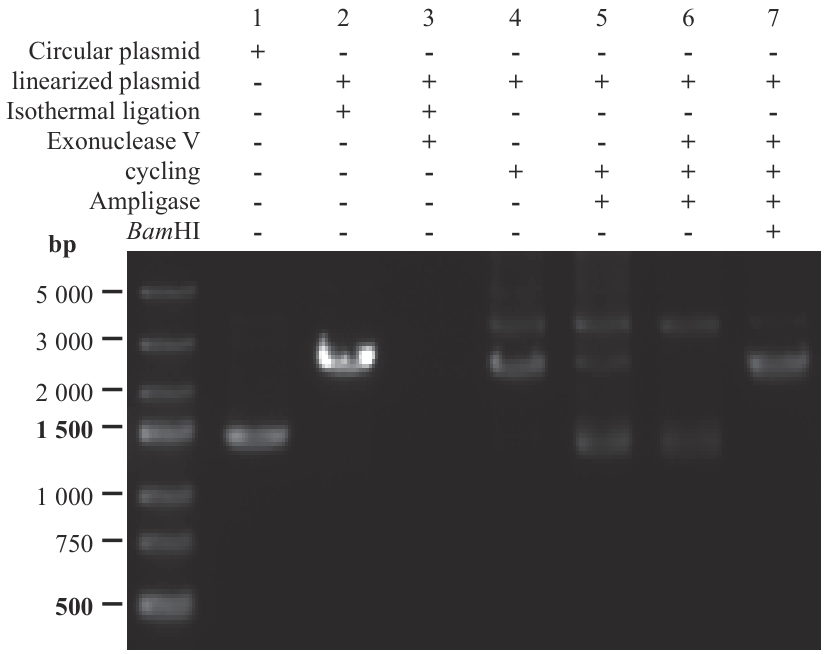
Fig. 3 Detection and validation of pUC19 recircularization via misprimed linearization followed by denaturation-renaturation-ligation cyclingAgarose gel electrophoresis analysis of the reaction products. Lanes 1-3 (Controls): Native circular pUC19 exhibits resistance to Exonuclease V digestion (Lane 1), whereas the staggered linear substrate is completely degraded (Lane 3), confirming the selectivity of the exonuclease. Lane 4: Thermal cycling without Ampligase yields re-annealed complexes (likely nicked or concatenated). Lanes 5-6: The full ligation reaction generates products (Lane 5) that remain detectable after Exonuclease V treatment (Lane 6), confirming the formation of covalently closed circular DNA. Lane 7: Linearization of the Exonuclease V-resistant product with BamHI restores a single band identical in size to the input linear substrate (Lane 2), verifying the correct assembly of the monomeric plasmid
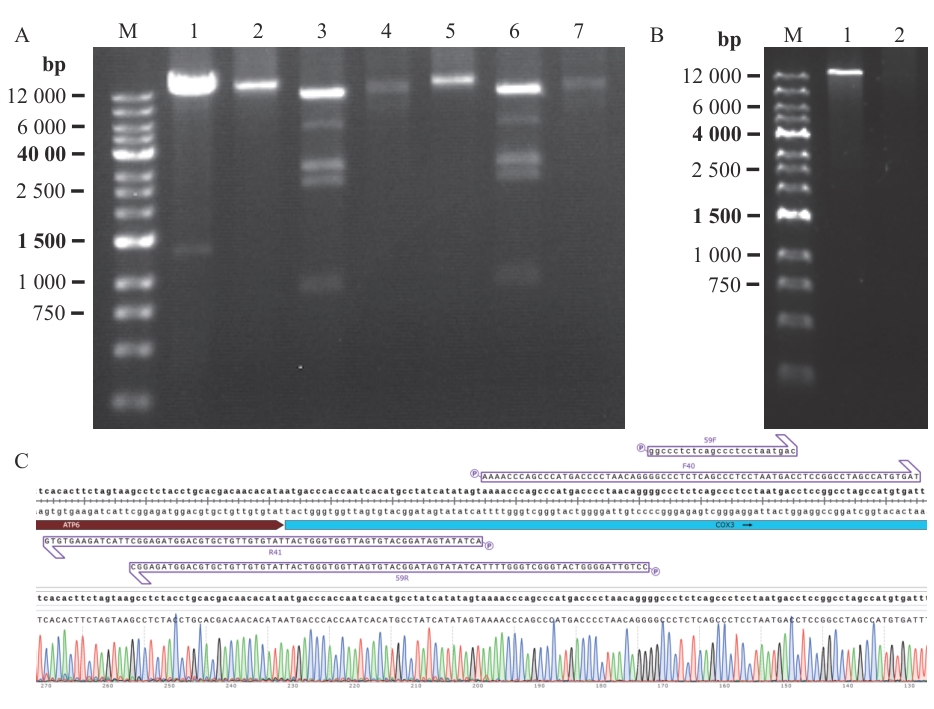
Fig. 4 In vitro circularization and validation of the full-length human mitochondrial genomeA: Electrophoretic analysis of the circularization products. Lane 1: Mixture of overlapping linear mtDNA fragments. Lanes 2 and 5: Products obtained after thermal cycling ligation at 60 ℃ and 70 ℃, respectively. Lanes 3 and 6: Hind III restriction digests of the circularization products. The appearance of a characteristic ~5.5 kb band (fusion of the 3 003 bp and 2 474 bp terminal fragments) confirms successful circularization, distinct from the linear restriction pattern. Lanes 4 and 7: Products treated with Exonuclease V, showing resistant high-molecular-weight bands indicative of circular structure. M: DNA Marker. B: Validation of covalently closed circular (ccc) DNA using T5 Exonuclease. Lane 1: The cyclized product retains a resistant band, confirming the formation of nick-free cccDNA. Lane 2: Linear mtDNA control is completely degraded. M: DNA Marker. C: Sequence verification of the ligation junction. Top: Schematic illustrating the binding sites of the primer pairs (59F/R and F40/R41) at the boundary of the ATP6 and COX3 genes. Bottom: Sanger sequencing chromatogram of the T5 Exonuclease-resistant product, confirming the precise sequence restoration across the ligation site without mutations or deletions
| [1] | Schon EA, DiMauro S, Hirano M. Human mitochondrial DNA: roles of inherited and somatic mutations [J]. Nat Rev Genet, 2012, 13(12): 878-890. |
| [2] | Park J, Baruch-Torres N, Yin YW. Structural and molecular basis for mitochondrial DNA replication and transcription in health and antiviral drug toxicity [J]. Molecules, 2023, 28(4): 1796. |
| [3] | Belousova V, Ignatko I, Bogomazova I, et al. Causes of and solutions to mitochondrial disorders: a literature review [J]. Int J Mol Sci, 2025, 26(14): 6645. |
| [4] | Mei JL, Ding P, Gao C, et al. Mitochondrial diseases: molecular pathogenesis and therapeutic advances [J]. MedComm, 2025, 6(9): e70385. |
| [5] | Tapper DP, Van Etten RA, Clayton DA. Isolation of mammalian mitochondrial DNA and RNA and cloning of the mitochondrial genome [M]//Biomembranes Part K: Membrane Biogenesis: Assembly and Targeting (Prokaryotes, Mitochondria, and Chloroplasts). Amsterdam: Elsevier 1983: 426-434. |
| [6] | Mita S, Monnat RJ, Loeb LA. Direct selection of mutations in the human mitochondrial tRNAThr gene: reversion of an ‘uncloneable’ phenotype [J]. Mutat Res Mutagen Relat Subj, 1988, 199(1): 183-190. |
| [7] | Ruiz E, Talenton V, Dubrana MP, et al. CReasPy-cloning: a method for simultaneous cloning and engineering of megabase-sized genomes in yeast using the CRISPR-Cas9 system [J]. ACS Synth Biol, 2019, 8(11): 2547-2557. |
| [8] | Bigger BW, Liao AY, Sergijenko A, et al. Trial and error: how the unclonable human mitochondrial genome was cloned in yeast [J]. Pharm Res, 2011, 28(11): 2863-2870. |
| [9] | Gammage PA, Rorbach J, Vincent AI, et al. Mitochondrially targeted ZFNs for selective degradation of pathogenic mitochondrial genomes bearing large-scale deletions or point mutations [J]. EMBO Mol Med, 2014, 6(4): 458-466. |
| [10] | Reddy P, Ocampo A, Suzuki K, et al. Selective elimination of mitochondrial mutations in the germline by genome editing [J]. Cell, 2015, 161(3): 459-469. |
| [11] | Lim K. Mitochondrial genome editing: strategies, challenges, and applications [J]. BMB Rep, 2024, 57(1): 19-29. |
| [12] | Guo JY, Chen XX, Liu ZW, et al. DdCBE mediates efficient and inheritable modifications in mouse mitochondrial genome [J]. Mol Ther Nucleic Acids, 2022, 27: 73-80. |
| [13] | Cho SI, Lim K, Hong S, et al. Engineering TALE-linked deaminases to facilitate precision adenine base editing in mitochondrial DNA [J]. Cell, 2024, 187(1): 95-109, e26. |
| [14] | Yamada Y, Fukuda Y, Harashima H. An analysis of membrane fusion between mitochondrial double membranes and MITO-Porter, mitochondrial fusogenic vesicles [J]. Mitochondrion, 2015, 24: 50-55. |
| [15] | Rai PK, Craven L, Hoogewijs K, et al. Advances in methods for reducing mitochondrial DNA disease by replacing or manipulating the mitochondrial genome [J]. Essays Biochem, 2018, 62(3): 455-465. |
| [16] | Sercel AJ, Patananan AN, Man TX, et al. Stable transplantation of human mitochondrial DNA by high-throughput, pressurized isolated mitochondrial delivery [J]. eLife, 2021, 10: e63102. |
| [17] | Kukat A, Kukat C, Brocher J, et al. Generation of rho0 cells utilizing a mitochondrially targeted restriction endonuclease and comparative analyses [J]. Nucleic Acids Res, 2008, 36(7): e44. |
| [1] | JIANG Hong-yan, CHEN Shi-chun, LIAO Shu-ran, CHEN Ting-xu, WANG Xiao-qing. The Complete Sequences and Phylogenetic Analysis of Mitochondrial Genomes in Eocanthecona concinna and Picromerus lewisi [J]. Biotechnology Bulletin, 2025, 41(1): 312-323. |
| [2] | YIN Hao, YOU Liu-chao, HAN Rui, GAO Peng-cheng, FU Lei, CHU Yue-feng. Mechanisms and Application Research Progress of Bacterial Genomic Homologous Recombination Mediated by Single-stranded DNA Annealing Protein [J]. Biotechnology Bulletin, 2025, 41(1): 39-48. |
| [3] | LONG Jing, CHEN Jing-min, LIU Xiao, ZHANG Yi-fan, ZHOU Li-bin, DU Yan. Repair Mechanisms of DNA Double-strand Breaks and Their Roles in Heavy Ion Mutagenesis and Gene Editing in Plants [J]. Biotechnology Bulletin, 2024, 40(7): 55-67. |
| [4] | CHENG Ya-nan, ZHANG Wen-cong, ZHOU Yuan, SUN Xue, LI Yu, LI Qing-gang. Synthetic Pathway Construction of Producing 2'-fucosyllactose by Lactococcus lactis and Optimization of Fermentation Medium [J]. Biotechnology Bulletin, 2023, 39(9): 84-96. |
| [5] | YANG Yu-mei, ZHANG Kun-xiao. Establishing a Stable Cell Line with Site-specific Integration of ERK Kinase Phase-separated Fluorescent Probe Using CRISPR/Cas9 Technology [J]. Biotechnology Bulletin, 2023, 39(8): 159-164. |
| [6] | QU Chun-juan, ZHU Yue, JIANG Chen, QU Ming-jing, WANG Xiang-yu, LI Xiao. Whole Mitochondrial Genome and Phylogeny Analysis of Anomala corpulenta [J]. Biotechnology Bulletin, 2023, 39(2): 263-273. |
| [7] | LIN Xing-yu, SONG Nan. Comparative Mitochondrial Genome and Phylogenetic Analysis of Atteva charopis Turner, 1903 [J]. Biotechnology Bulletin, 2023, 39(12): 300-310. |
| [8] | XUE Qing, DU Hong-rui, XUE Hui-ying, WANG Yi-hao, WANG Xuan, LI Hong-mei. Mitochondrial Genome and Phylogeny of Aphelenchoides medicagus [J]. Biotechnology Bulletin, 2021, 37(7): 98-106. |
| [9] | LI Xiao-yan, LI Ze-qi, WANG Yu-qian, YU Jing, LIN Zhen-ping, LIN Xiang-min. Construction of Aeromonas hydrophila acrA Deficient Strain and Determination of Its Physiological Function [J]. Biotechnology Bulletin, 2020, 36(11): 63-69. |
| [10] | WANG Ping, CONG Ling, WANG Chun-yu, ZHU Zhen-xing, A Ashok KUMAR, ZHANG Li-xia, LU Xiao-chun. Comparison of Mitochondrial Genome Between A1 Cytoplasmic Male Sterile Line and Maintainer Line of Sorghum bicolor [J]. Biotechnology Bulletin, 2019, 35(5): 42-47. |
| [11] | HUANG Fang, LIN Xiang-min. Construction of Mutant Strain bamA,bamB and bamD of Aeromonas hydrophila and Their Effects on the Outer Membrane Protein Transportation [J]. Biotechnology Bulletin, 2018, 34(5): 148-153. |
| [12] | JIN Qiao, LIU Xia, GAN Zhi-Kai. Sequencing and Analyzing Mitochondrial Genome of Cacopsylla coccinea [J]. Biotechnology Bulletin, 2018, 34(11): 127-135. |
| [13] | MAO Ling-qi, LI Cun-zhi ,YAN Da-zhong. A Method for Constructing Unmarked Deletion Mutants of Pseudomonas plecoglossicida NyZ12 [J]. Biotechnology Bulletin, 2016, 32(4): 203-209. |
| [14] | Liu Yongqing, Ren Lin, Zhang Zifeng. The Influence of Knockout of menA Gene in Escherichia coli on the Accumulation of CoQ [J]. Biotechnology Bulletin, 2015, 31(12): 207-213. |
| [15] | Ding Xiaoyun, Gu Jianjian, Wang Yongze, Zhao Jinfang, Wang Jinhua, Zhao Xiao. The Knockout of Gene ptsG of Recombinant Escherichia coli Producing D-lactic Acid and the Simultaneous Fermentation of Mixed Sugars [J]. Biotechnology Bulletin, 2015, 31(12): 221-226. |
| Viewed | ||||||
|
Full text |
|
|||||
|
Abstract |
|
|||||
