







Biotechnology Bulletin ›› 2025, Vol. 41 ›› Issue (3): 202-218.doi: 10.13560/j.cnki.biotech.bull.1985.2024-0755
LI Xu-juan( ), LI Chun-jia, LIU Hong-bo, XU Chao-hua, LIN Xiu-qin, LU Xin, LIU Xin-long()
Received:2024-08-06
Online:2025-03-26
Published:2025-03-20
Contact:
LIU Xin-long
E-mail:lixujuan2011@163.com;lxlgood868@163.com
LI Xu-juan, LI Chun-jia, LIU Hong-bo, XU Chao-hua, LIN Xiu-qin, LU Xin, LIU Xin-long. Transcriptome Analysis of Axillary Bud Formation and Development in Sugarcane[J]. Biotechnology Bulletin, 2025, 41(3): 202-218.

Fig. 1 Stem apex and axillary buds of sugarcane at different developmental stagesBud0: Stem apex. Bud1: Tender axillary bud. Bud2: Semi-large axillary bud. Bud3: Young axillary bud. Bud4: Mature axillary bud
基因ID Gene ID | 基因名 Gene name | 正向引物 Forward primer (5′-3′) | 反向引物 Reverse primer (5′-3′) |
|---|---|---|---|
| CL3565.Contig2_All | ARF7 | TTCGGTTGGAACATTGCTGC | TGTACAGGAGGGCAGACTGA |
| CL1829.Contig12_All | HSP70 | AGCTTGAGGGGATCTGCAAC | TGCAACACCACGTCTAACCA |
| Unigene43477_All | HSF-C2a | CTGTAGCACCGGAGACGAAG | CAGTTGGTGATGAGGGGCAA |
| CL6559.Contig7_All | PRP | CGTCCTCGACATGTGCTTCT | GTGATCATCAACCACGCACG |
| Unigene49447_All | SCL9 | TGGTCAGTCTTCTCAACCGC | GGGATCTGGCCATTCGTGAT |
| CL526.Contig2_All | WRKY48 | GCACTACCAGGAAGGCAGAG | CCTGCAGGTCCATTGGAGAG |
| CL11262.Contig6_All | MYB61 | GCATGTAGCTCGACCTTTTTGT | CCCAAGAGCTACGGACAGAG |
| Unigene48620_All | ATLP3 | TAGCACCGTCAACTTCGTCC | TGCACGCAGGCGTATAATCT |
| CL14664.Contig8_All | SAPK4 | ACCGTTTGTTTGCACTCTGC | TGGAAGAAATGCACACCCGA |
| GAPDH | CACGGCCACTGGAAGCA | TCCTCAGGGTTCCTGATGCC |
Table 1 Primers used for RT-qPCR
基因ID Gene ID | 基因名 Gene name | 正向引物 Forward primer (5′-3′) | 反向引物 Reverse primer (5′-3′) |
|---|---|---|---|
| CL3565.Contig2_All | ARF7 | TTCGGTTGGAACATTGCTGC | TGTACAGGAGGGCAGACTGA |
| CL1829.Contig12_All | HSP70 | AGCTTGAGGGGATCTGCAAC | TGCAACACCACGTCTAACCA |
| Unigene43477_All | HSF-C2a | CTGTAGCACCGGAGACGAAG | CAGTTGGTGATGAGGGGCAA |
| CL6559.Contig7_All | PRP | CGTCCTCGACATGTGCTTCT | GTGATCATCAACCACGCACG |
| Unigene49447_All | SCL9 | TGGTCAGTCTTCTCAACCGC | GGGATCTGGCCATTCGTGAT |
| CL526.Contig2_All | WRKY48 | GCACTACCAGGAAGGCAGAG | CCTGCAGGTCCATTGGAGAG |
| CL11262.Contig6_All | MYB61 | GCATGTAGCTCGACCTTTTTGT | CCCAAGAGCTACGGACAGAG |
| Unigene48620_All | ATLP3 | TAGCACCGTCAACTTCGTCC | TGCACGCAGGCGTATAATCT |
| CL14664.Contig8_All | SAPK4 | ACCGTTTGTTTGCACTCTGC | TGGAAGAAATGCACACCCGA |
| GAPDH | CACGGCCACTGGAAGCA | TCCTCAGGGTTCCTGATGCC |

Fig. 2 Sample correlation analysis (A) and principal component analysis (B)
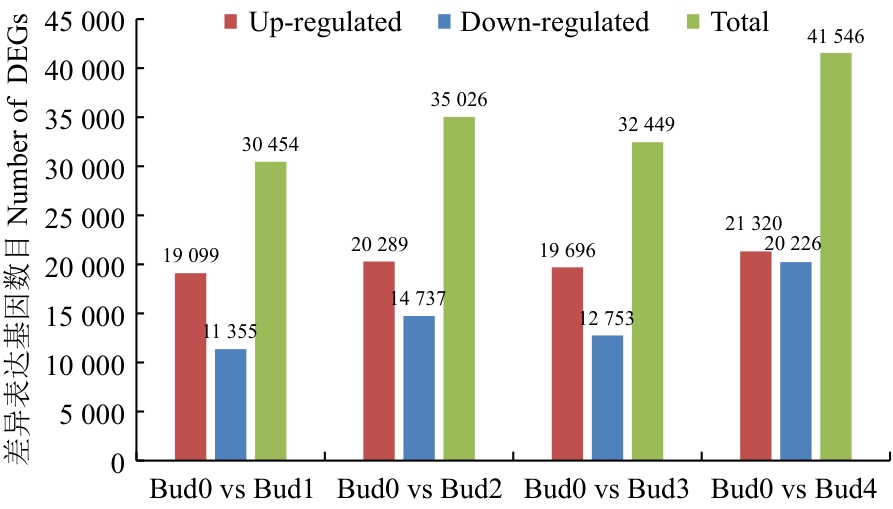
Fig. 3 Statistics of up-down-regulation genes between the sample groups at different stages of sugarcane axillary bud formation and development
| 基因编号 Gene ID | 基因名 Gene name | 基因注释 Gene annotation |
|---|---|---|
| CL3565.Contig2_All | ARF7 | XM_002453947.2:高粱生长素响应因子7,mRNA |
| CL1829.Contig12_All | HSP70 | XP_002456611.1:高粱热激蛋白70 mRNA |
| Unigene43477_All | HSF-C2a | XM_002451780.2:高粱热胁迫转录因子C-2a,转录变体X2,mRNA |
| CL6559.Contig7_All | PRP | CAB65536.1:玉米富含脯氨酸蛋白,mRNA |
| Unigene49447_All | SCL9 | XM_021446388.1:高粱SCL9蛋白(LOC110429790),转录变体X1,mRNA |
| Unigene48620_All | ATLP3 | XM_002450322.2:高粱生长素转运类蛋白3,mRNA |
| CL526.Contig2_All | WRKY48 | XM_002463811.2:高粱转录因子WRKY48 (LOC8086215),mRNA |
| CL11262.Contig6_All | MYB61 | XM_002457641.2:高粱转录因子MYB61 (LOC8078133),转录变体X1,mRNA |
| CL14664.Contig8_All | SAPK4 | XM_021447946.1:高粱丝氨酸/苏氨酸蛋白激酶SAPK4(LOC8058510),转录变体X3,mRNA |
Table 2 Candidate genes for RT-qPCR
| 基因编号 Gene ID | 基因名 Gene name | 基因注释 Gene annotation |
|---|---|---|
| CL3565.Contig2_All | ARF7 | XM_002453947.2:高粱生长素响应因子7,mRNA |
| CL1829.Contig12_All | HSP70 | XP_002456611.1:高粱热激蛋白70 mRNA |
| Unigene43477_All | HSF-C2a | XM_002451780.2:高粱热胁迫转录因子C-2a,转录变体X2,mRNA |
| CL6559.Contig7_All | PRP | CAB65536.1:玉米富含脯氨酸蛋白,mRNA |
| Unigene49447_All | SCL9 | XM_021446388.1:高粱SCL9蛋白(LOC110429790),转录变体X1,mRNA |
| Unigene48620_All | ATLP3 | XM_002450322.2:高粱生长素转运类蛋白3,mRNA |
| CL526.Contig2_All | WRKY48 | XM_002463811.2:高粱转录因子WRKY48 (LOC8086215),mRNA |
| CL11262.Contig6_All | MYB61 | XM_002457641.2:高粱转录因子MYB61 (LOC8078133),转录变体X1,mRNA |
| CL14664.Contig8_All | SAPK4 | XM_021447946.1:高粱丝氨酸/苏氨酸蛋白激酶SAPK4(LOC8058510),转录变体X3,mRNA |

Fig. 4 Relative expressions and FPKM values of the candidate genesThe error line indicates the standard deviation

Fig. 5 Bubble map of differential gene KEGG enrichment metabolic pathway in four stages of axillary bud formation and developmentA: The stage of tender axillary bud development; B: semi-large bud development stage; C: young bud development stage; D: mature bud development stage
模块 Module | 基因号 Gene ID | Nt功能注释 Nt Annotation |
|---|---|---|
| 蓝色 | CL11755.Contig1_All | XM_002437021.2:高粱E3泛素蛋白连接酶7 (LOC8072631),mRNA |
| CL11416.Contig2_All | XM_002467860.2:高粱LRR受体类丝氨酸/苏氨酸蛋白激酶IRK (LOC8082337),mRNA | |
| CL9946.Contig1_All | XM_002459710.2:高粱聚[adp-核糖]聚合酶1 (LOC8057336),mRNA | |
| Unigene27412_All | XM_002451536.2:高粱DNA聚合酶δ催化亚基POLD (LOC8074668),mRNA | |
| CL414.Contig1_All | XM_002437978.2:高粱LRR受体样丝氨酸/苏氨酸蛋白激酶ERECTA (LOC8077321),mRNA | |
| 褐色 | CL9713.Contig1_All | M86717.1:甘蔗核酮糖1,5-二磷酸羧化酶/加氧酶小亚基基因 |
| CL7506.Contig2_All | XM_021463606.1:高粱豌豆蛋白(LOC8064511),转录变体X2,mRNA | |
| CL1675.Contig6_All | XM_021461443.1:高粱LNK1-类蛋白(LOC110435648),mRNA | |
| CL10608.Contig2_All | NM_001153244.1:玉米热胁迫转录因子A-6b (cl30385_1),mRNA | |
| Unigene37307_All | XM_002437010.2:高粱转录因子WRKY19,mRNA | |
| 绿色 | CL11922.Contig2_All | 芒草ARM重复超家族蛋白(NCGR_LOCUS6946),mRNA |
| CL4984.Contig2_All | XM_002456186.2:高粱单myb4组蛋白 (LOC8069770),mRNA | |
| Unigene34707_All | XM_008679969.2:玉米VIN3-类蛋白 (LOC103652991),mRNA | |
| Unigene7438_All | XM_002439022.2:高粱胼胝质合成酶3 (LOC8066386),mRNA | |
| CL6695.Contig6_All | XM_002462606.2:高粱adp核糖化因子gtpase激活蛋白AGD3 (LOC8054803),mRNA | |
| 黑色 | CL471.Contig5_All | XM_002443369.2:高粱二酰基甘油激酶 (LOC8074256),mRNA |
| CL654.Contig6_All | KT891986.1:甘蔗质膜阳离子结合蛋白(pcap1),mRNA | |
| CL5540.Contig5_All | XM_002445052.2:高粱LSD1蛋白,XM_002445052.2,mRNA | |
| CL5050.Contig15_All | XM_002454463.2:高粱水通道蛋白PIP1-2,mRNA | |
| Unigene46867_All | XM_021450410.1:高粱δ(24)-类甾醇还原酶(LOC110431358),mRNA |
Table 3 WGCNA candidate genes and their annotations
模块 Module | 基因号 Gene ID | Nt功能注释 Nt Annotation |
|---|---|---|
| 蓝色 | CL11755.Contig1_All | XM_002437021.2:高粱E3泛素蛋白连接酶7 (LOC8072631),mRNA |
| CL11416.Contig2_All | XM_002467860.2:高粱LRR受体类丝氨酸/苏氨酸蛋白激酶IRK (LOC8082337),mRNA | |
| CL9946.Contig1_All | XM_002459710.2:高粱聚[adp-核糖]聚合酶1 (LOC8057336),mRNA | |
| Unigene27412_All | XM_002451536.2:高粱DNA聚合酶δ催化亚基POLD (LOC8074668),mRNA | |
| CL414.Contig1_All | XM_002437978.2:高粱LRR受体样丝氨酸/苏氨酸蛋白激酶ERECTA (LOC8077321),mRNA | |
| 褐色 | CL9713.Contig1_All | M86717.1:甘蔗核酮糖1,5-二磷酸羧化酶/加氧酶小亚基基因 |
| CL7506.Contig2_All | XM_021463606.1:高粱豌豆蛋白(LOC8064511),转录变体X2,mRNA | |
| CL1675.Contig6_All | XM_021461443.1:高粱LNK1-类蛋白(LOC110435648),mRNA | |
| CL10608.Contig2_All | NM_001153244.1:玉米热胁迫转录因子A-6b (cl30385_1),mRNA | |
| Unigene37307_All | XM_002437010.2:高粱转录因子WRKY19,mRNA | |
| 绿色 | CL11922.Contig2_All | 芒草ARM重复超家族蛋白(NCGR_LOCUS6946),mRNA |
| CL4984.Contig2_All | XM_002456186.2:高粱单myb4组蛋白 (LOC8069770),mRNA | |
| Unigene34707_All | XM_008679969.2:玉米VIN3-类蛋白 (LOC103652991),mRNA | |
| Unigene7438_All | XM_002439022.2:高粱胼胝质合成酶3 (LOC8066386),mRNA | |
| CL6695.Contig6_All | XM_002462606.2:高粱adp核糖化因子gtpase激活蛋白AGD3 (LOC8054803),mRNA | |
| 黑色 | CL471.Contig5_All | XM_002443369.2:高粱二酰基甘油激酶 (LOC8074256),mRNA |
| CL654.Contig6_All | KT891986.1:甘蔗质膜阳离子结合蛋白(pcap1),mRNA | |
| CL5540.Contig5_All | XM_002445052.2:高粱LSD1蛋白,XM_002445052.2,mRNA | |
| CL5050.Contig15_All | XM_002454463.2:高粱水通道蛋白PIP1-2,mRNA | |
| Unigene46867_All | XM_021450410.1:高粱δ(24)-类甾醇还原酶(LOC110431358),mRNA |
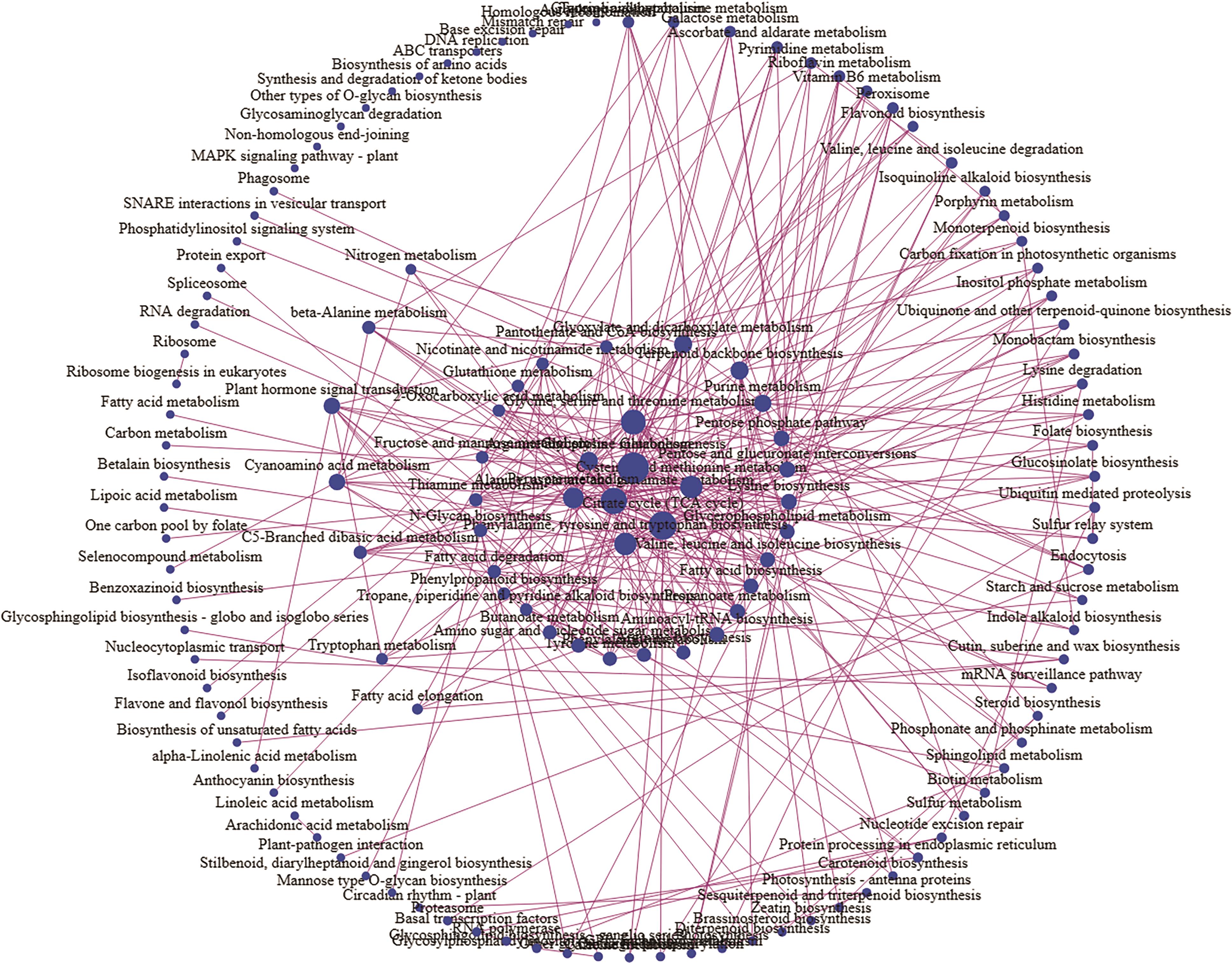
Fig. 6 Network diagram of 132 KEGG pathways involved in differential genes of axillary bud formation and development in sugarcaneThe red arrows are the core pathways in the common and specific enrichment pathways

Fig. 7 Result of gene co-expression network constructionA: The determination of soft threshold. B: Gene clustering and module construction. C: Heat map of the correlation between modules and samples (Red color of each box represents the positive correlation between samples and module. Purple color of each box represents the negative relationships between samples and module. The values inside and outside the brackets in the figure are P-values and correlation coefficients, respectively)

Fig. 8 Gene networks of hub genes of key modulesThe node and label size indicates the gene connectivity. A: Blue module. B: Brown module. C: Green module. D: Black module
| 1 | Islam MS, Yang XP, Sood S, et al. Molecular characterization of genetic basis of Sugarcane Yellow Leaf Virus (SCYLV) resistance in Saccharum spp. hybrid [J]. Plant Breed, 2018, 137(4): 598-604. |
| 2 | Oz MT, Altpeter A, Karan R, et al. CRISPR/Cas9-mediated multi-allelic gene targeting in sugarcane confers herbicide tolerance [J]. Front Genome Ed, 2021, 3: 673566. |
| 3 | 陆鑫, 毛钧, 刘新龙, 等. 甘蔗双腋芽突变体表型鉴定及应用潜力评估 [J]. 植物遗传资源学报, 2020, 21(2): 314-320. |
| Lu X, Mao J, Liu XL, et al. Phenotypic identification and evaluation of application potential in double axillary buds mutant of sugarcane [J]. J Plant Genet Resour, 2020, 21(2): 314-320. | |
| 4 | 张跃彬. 现代甘蔗糖业 [M]. 北京: 科学出版社, 2013. |
| Zhang YB. Modern sugar industry [M]. Beijing: Science Press, 2013. | |
| 5 | Jürgens G. Apical-basal pattern formation in Arabidopsis embryogenesis [J]. EMBO J, 2001, 20(14): 3609-3616. |
| 6 | Long J, Barton MK. Initiation of axillary and floral meristems in Arabidopsis [J]. Dev Biol, 2000, 218(2): 341-353. |
| 7 | Tanaka W, Ohmori Y, Ushijima T, et al. Axillary meristem formation in rice requires the WUSCHEL ortholog TILLERS ABSENT1 [J]. Plant Cell, 2015, 27(4): 1173-1184. |
| 8 | Liu Y, Ding YF, Wang QS, et al. Effect of plant growth regulators on the growth of rice tiller bud and the changes of endogenous hormones [J]. Acta Agron Sin, 2011, 37(4): 670-676. |
| 9 | Ortiz-Morea FA, Vicentini R, Silva GFF, et al. Global analysis of the sugarcane microtranscriptome reveals a unique composition of small RNAs associated with axillary bud outgrowth [J]. J Exp Bot, 2013, 64(8): 2307-2320. |
| 10 | Yan HF, Zhou HW, Luo HM, et al. Characterization of full-length transcriptome in Saccharum officinarum and molecular insights into tiller development [J]. BMC Plant Biol, 2021, 21(1): 228. |
| 11 | Vasantha S, Shekinah DE, Gupta C, et al. Tiller production, regulation and senescence in sugarcane (Saccharum species hybrid) Genotypes [J]. Sugar Tech, 2012, 14(2): 156-160. |
| 12 | 叶燕萍. 乙烯利促进甘蔗有效分蘖的生理生化机理研究 [D]. 南宁: 广西大学, 2006. |
| Ye YP. Studies on the physiological and biochemical mechanism on ethephon promoting effective tillering in sugarcane [D]. Nanning: Guangxi University, 2006. | |
| 13 | 王威豪, 王一丁, 莫云川, 等. 水分胁迫下喷施乙烯利对甘蔗分蘖及农艺性状的影响 [J]. 广西农业科学, 2007, 38(2): 148-151. |
| Wang WH, Wang YD, Mo YC, et al. Effects of ethephon on tillering and agronomic characters in sugarcane under water-stress [J]. Guangxi Agric Sci, 2007, 38(2): 148-151. | |
| 14 | 吴凯朝. 乙烯利促进甘蔗分蘖生理与形态学效应的研究 [D]. 南宁: 广西大学, 2005. |
| Wu KC. Studies on physiological and morphological effects of ethephon on tillering of sugarcane [D]. Nanning: Guangxi University, 2005. | |
| 15 | 李旭娟, 李纯佳, 徐超华, 等. 甘蔗MOC1基因(ScMOC1)的克隆与表达分析 [J]. 植物遗传资源学报, 2017, 18(4): 734-746. |
| Li XJ, Li CJ, Xu CH, et al. Cloning and expression analysis of the MOC1 gene(ScMOC1) in sugarcane(Saccharum officinarum) [J]. J Plant Genet Resour, 2017, 18(4): 734-746. | |
| 16 | 李旭娟, 林秀琴, 刘洪博, 等. 甘蔗TB1基因的克隆与生物信息学分析 [J]. 热带作物学报, 2015, 36(11): 1978-1985. |
| Li XJ, Lin XQ, Liu HB, et al. Cloning and bioinformatics analysis of the TB1 gene in sugarcane [J]. Chin J Trop Crops, 2015, 36(11): 1978-1985. | |
| 17 | 李旭娟, 刘洪博, 林秀琴, 等. 甘蔗KNOX基因(Sckn1)的电子克隆及生物信息学分析 [J]. 基因组学与应用生物学, 2015, 34(1): 136-142. |
| Li XJ, Liu HB, Lin XQ, et al. In silico cloning and bioinformatics analysis of KNOX gene in sugarcane (Sckn1) [J]. Genom Appl Biol, 2015, 34(1): 136-142. | |
| 18 | Wang LK, Feng ZX, Wang X, et al. DEGseq: an R package for identifying differentially expressed genes from RNA-seq data [J]. Bioinformatics, 2010, 26(1): 136-138. |
| 19 | Ling H, Wu QB, Guo JL, et al. Comprehensive selection of reference genes for gene expression normalization in sugarcane by real time quantitative RT-PCR [J]. PLoS One, 2014, 9(5): e97469. |
| 20 | Livak KJ, Schmittgen TD. Analysis of relative gene expression data using real-time quantitative PCR and the 2-ΔΔC T method [J]. Methods, 2001, 25(4): 402-408. |
| 21 | Singh P, Song QQ, Singh RK, et al. Proteomic analysis of the resistance mechanisms in sugarcane during Sporisorium scitamineum infection [J]. Int J Mol Sci, 2019, 20(3): 569. |
| 22 | 钱甫, 张占琴, 陈树宾, 等. 基于GWAS和WGCNA分析挖掘玉米花期相关候选基因 [J]. 作物学报, 2023, 49(12): 3261-3276. |
| Qian F, Zhang ZQ, Chen SB, et al. Mining maize flowering traits related candidate genes based on GWAS and WGCNA data [J]. Acta Agron Sin, 2023, 49(12): 3261-3276. | |
| 23 | Leyser O. The control of shoot branching: an example of plant information processing [J]. Plant Cell Environ, 2009, 32(6): 694-703. |
| 24 | Chen D, Lu X, Wu XY, et al. Transcriptome analysis of axillary bud differentiation in a new dual-axillary bud genotype of sugarcane [J]. Genet Resour Crop Evol, 2020, 67(3): 685-701. |
| 25 | 吴佳, 李惠中, 邓权清, 等. 甘蔗鞭黑粉菌致病力差异菌株转录组分析 [J]. 华中农业大学学报, 2020, 39(3): 54-59. |
| Wu J, Li HZ, Deng QQ, et al. Analyzing transcriptome of Sporisorium scitamineum strains with different pathogenicity [J]. J Huazhong Agric Univ, 2020, 39(3): 54-59. | |
| 26 | 许跃语. 甘蔗响应黄叶病毒侵染的转录组差异表达研究 [D]. 福州: 福建农林大学, 2019. |
| Xu YY. Transcriptomic analysis of differentially expressed genes in sugarcane in response to yellow leaf virus infection [D]. Fuzhou: Fujian Agriculture and Forestry University, 2019. | |
| 27 | 苏亚春. 甘蔗应答黑穗病菌侵染的转录组与蛋白组研究及抗性相关基因挖掘 [D]. 福州: 福建农林大学, 2014. |
| Su YC. Study on transcriptome and proteome of sugarcane in response to Ustilago scitamella infection and gene mining related to resistance [D]. Fuzhou: Fujian Agriculture and Forestry University, 2014. | |
| 28 | 丘立杭, 罗含敏, 陈荣发, 等. 基于RNA-Seq的甘蔗主茎和分蘖茎转录组建立及初步分析 [J]. 基因组学与应用生物学, 2018, 37(3): 1271-1279. |
| Qiu LH, Luo HM, Chen RF, et al. Establishment and preliminary analysis on transcriptome of sugarcane between stalk and tiller based on RNA-seq technology [J]. Genom Appl Biol, 2018, 37(3): 1271-1279. | |
| 29 | Dapanage M, Bhat S. Transcriptome profiling through next-generation sequencing in sugarcane under moisture-deficit stress condition [J]. Sugar Tech, 2020, 22(3): 396-410. |
| 30 | 刘洪博, 刘新龙, 苏火生, 等. 干旱胁迫下割手密根系转录组差异表达分析 [J]. 中国农业科学, 2017, 50(6): 1167-1178. |
| Liu HB, Liu XL, Su HS, et al. Transcriptome difference analysis of Saccharum spontaneum roots in response to drought stress [J]. Sci Agric Sin, 2017, 50(6): 1167-1178. | |
| 31 | 张珂. 甘蔗腋芽萌发相关植物激素代谢分析及促萌发诱导剂的筛选 [D]. 福州: 福建农林大学, 2020. |
| Zhang K. Metabolic analysis of plant hormones related to germination of sugarcane axillary buds and screening of germination inducer [D]. Fuzhou: Fujian Agriculture and Forestry University, 2020. | |
| 32 | Jin JP, Tian F, Yang DC, et al. PlantTFDB 4.0: toward a central hub for transcription factors and regulatory interactions in plants [J]. Nucleic Acids Res, 2017, 45(D1): 1040-1045. |
| 33 | Xiong SF, Zhao YX, Chen YC, et al. Transcriptome and proteome analyses reveal a critical role of the sucrose anabolic pathway in regulating Quercus fabri Hance axillary bud outgrowth [J]. Ind Crops Prod, 2023, 194: 116284. |
| 34 | 胡鑫, 罗正英, 李纯佳, 等. 基于二代和三代转录组测序揭示甘蔗重要亲本对黑穗病菌侵染的响应机制 [J]. 作物学报, 2023, 49(9): 2412-2432. |
| Hu X, Luo ZY, Li CJ, et al. Comparative transcriptome analysis of elite ‘ROC’ sugarcane parents for exploring genes involved in Sporisorium scitamineum infection by using Illumina-and SMRT-based RNA-seq [J]. Acta Agron Sin, 2023, 49(9): 2412-2432. | |
| 35 | 韦婉羚, 杨海霞, 何文, 等. 基于转录组测序的赤苍藤根、茎和叶基因表达分析 [J]. 植物生理学报, 2023, 59(2): 333-344. |
| Wei WL, Yang HX, He W, et al. Transcriptiomic data analysis of roots, stems, and leaves of Erythropalum scandens [J]. Plant Physiol J, 2023, 59(2): 333-344. | |
| 36 | 张海青, 张恒涛, 高启明, 等. 转录组分析筛选调控苹果分枝能力的关键基因 [J]. 中国农业科学, 2024, 57(10): 1995-2009. |
| Zhang HQ, Zhang HT, Gao QM, et al. Transcriptome analysis for screening key genes related to regulating branching ability in apple [J]. Sci Agric Sin, 2024, 57(10): 1995-2009. | |
| 37 | 孙晓琛, 原静静, 栗锦鹏, 等. 干旱胁迫对党参苯丙素及倍半萜和三萜类成分合成相关基因的调控 [J]. 中成药, 2022, 44(12): 3902-3909. |
| Sun XC, Yuan JJ, Li JP, et al. Genetic adaptation under drought stress for the synthesis of phenylpropanoid, sesquiterpenoids and triterpenoids in Codonopsis pilosula [J]. Chin Tradit Pat Med, 2022, 44(12): 3902-3909. | |
| 38 | 郝瑞杰, 邱晨, 耿晓云, 等. 梅花Pm ABCG9在苯甲醇挥发中的功能分析 [J]. 中国农业科学, 2023, 56(13): 2574-2585. |
| Hao RJ, Qiu C, Geng XY, et al. The function of Pm ABCG9 transporter related to the volatilization of benzyl alcohol in Prunus mume [J]. Sci Agric Sin, 2023, 56(13): 2574-2585. | |
| 39 | 荐红举, 张梅花, 尚丽娜, 等. 利用WGCNA筛选马铃薯块茎发育候选基因 [J]. 作物学报, 2022, 48(7): 1658-1668. |
| Jian HJ, Zhang MH, Shang LN, et al. Screening candidate genes involved in potato Tuber development using WGCNA [J]. Acta Agron Sin, 2022, 48(7): 1658-1668. | |
| 40 | 张恒燕, 张木清. 基于WGCNA挖掘外源GA3调节甘蔗节间伸长相关基因 [J]. 分子植物育种,2022:1-21. |
| Zhang HY, Zhang MQ. Mining of genes related to exogenous GA3 regulation of sugarcane internode elongation based on WGCNA [J]. Molecular Plant Breeding, 2022:1-21. | |
| 41 | 李佩婷, 赵振丽, 黄潮华, 等. 基于转录组及WGCNA的甘蔗干旱响应调控网络分析 [J]. 作物学报, 2022, 48(7): 1583-1611. |
| Li PT, Zhao ZL, Huang CH, et al. Analysis of drought responsive regulatory network in sugarcane based on transcriptome and WGCNA [J]. Acta Agron Sin, 2022, 48(7): 1583-1611. | |
| 42 | Barbier FF, Lunn JE, Beveridge CA. Ready, steady, go! A sugar hit starts the race to shoot branching [J]. Curr Opin Plant Biol, 2015, 25: 39-45. |
| 43 | Barbier FF, Dun EA, Kerr SC, et al. An update on the signals controlling shoot branching [J]. Trends Plant Sci, 2019, 24(3): 220-236. |
| 44 | Barbier F, Péron T, Lecerf M, et al. Sucrose is an early modulator of the key hormonal mechanisms controlling bud outgrowth in Rosa hybrida [J]. J Exp Bot, 2015, 66(9): 2569-2582. |
| 45 | Zheng YY, Zhang SS, Luo YQ, et al. Rice OsUBR7 modulates plant height by regulating histone H2B monoubiquitination and cell proliferation [J]. Plant Commun, 2022, 3(6): 100412. |
| 46 | 张晓晶. 拟南芥二酰基甘油激酶AtDGKs在生长发育中的功能分析 [D]. 广州: 华南农业大学, 2017. |
| Zhang XJ. Functional analysis of a DGK gene encoding a diacylglycerol kinase in Arabidopsis [D]. Guangzhou: South China Agricultural University, 2017. | |
| 47 | 童君, 陈景光, 朱静雯, 等. 水稻 C2C2锌指蛋白基因OsLSD2对日本晴品种生长及氮素利用的影响 [J]. 中国水稻科学, 2014, 28(4): 435-441. |
| Tong J, Chen JG, Zhu JW, et al. Effects of rice C2C2 zinc finger protein gene OsLSD2 on the growth and nitrogen utilization of nipponbare [J]. Chin J Rice Sci, 2014, 28(4): 435-441. |
| [1] | YUE Li-xin, WANG Qing-hua, LIU Ze-zhou, KONG Su-ping, GAO Li-min. Screening Genes Related to Male Sterile in Welsh Onion(Allium fistulosum L.) Based on Transcriptomic Profiling and WGCNA [J]. Biotechnology Bulletin, 2024, 40(9): 212-224. |
| [2] | ZHAO Hai-ping, LIU Lin, WANG Xin-lu, YUE Peng-fei, KONG Wei-jun, WANG Meng. Exploring the Protective Effect of Puerarin on Deoxynivalenol-induced C6 Cell Injury Based on WGCNA [J]. Biotechnology Bulletin, 2024, 40(9): 301-310. |
| [3] | ZHANG Zhi-mei, ZHANG Yan-meng, XIE Dong-ming, YANG Xiu-yun, WANG Lang, ZUO Zi-han, WU Zhi-guo. Enrichment of 1, 2-dichloroethane Degrading Bacterial Consortium, and Isolation and Identification of Ancylobacter sp. BL0 of a Key Degrading Bacterial Strain [J]. Biotechnology Bulletin, 2024, 40(8): 288-298. |
| [4] | QIN Jian, LI Zhen-yue, HE Lang, LI Jun-ling, ZHANG Hao, DU Rong. Change of Single-cell Transcription Profile and Analysis of Intercellular Communication in Myogenic Cell Differentiation [J]. Biotechnology Bulletin, 2024, 40(6): 330-342. |
| [5] | WEN Jie, DU Yuan-xin, WU An-bo, YANG Guang-rong, LU Min, AN Hua-ming, NAN Hong. Identification and Expression Pattern Analysis of Rosa roxburghii SOD Gene Family [J]. Biotechnology Bulletin, 2024, 40(5): 153-166. |
| [6] | XIE Qian, JIANG Lai, HE Jin, LIU Ling-ling, DING Ming-yue, CHEN Qing-xi. Regulatory Genes Mining Related to Transcriptome Sequencing and Phenolic Metabolism Pathway of Canarium album Fruit with Different Fresh Food Quality [J]. Biotechnology Bulletin, 2024, 40(3): 215-228. |
| [7] | LOU Hui, ZHU Jin-cheng, YANG Yang, ZHANG Wei. Effects of Root Exudates in Resistant and Susceptible Varieties of Cotton on the Growths and Gene Expressions of Fusarium oxysporum [J]. Biotechnology Bulletin, 2023, 39(9): 156-167. |
| [8] | WU Yuan-ming, LIN Jia-yi, LIU Yu-xi, LI Dan-ting, ZHANG Zong-qiong, ZHENG Xiao-ming, PANG Hong-bo. Identification of Rice Plant Height-associated QTL Using BSA-seq and RNA-seq [J]. Biotechnology Bulletin, 2023, 39(8): 173-184. |
| [9] | YANG Yang, ZHU Jin-cheng, LOU Hui, HAN Ze-gang, ZHANG Wei. Transcriptome Analysis of Interaction Between Gossypium barbadense and Fusarium oxysporum f. sp. vasinfectum [J]. Biotechnology Bulletin, 2023, 39(6): 259-273. |
| [10] | PAN Hu, ZHOU Zi-qiong, TIAN Yun. Screening Identification and Degradation Characteristics of Three Iprodione-degrading Strains [J]. Biotechnology Bulletin, 2023, 39(6): 298-307. |
| [11] | XU Yang, DING Hong, ZHANG Guan-chu, GUO Qing, ZHANG Zhi-meng, DAI Liang-xiang. Metabolomics Analysis of Germinating Peanut Seed Under Salt Stress [J]. Biotechnology Bulletin, 2023, 39(1): 199-213. |
| [12] | GULJAMAL·Aisa , XING Jun, LI An, ZHANG Rui. Non-targeted Metabolomics Analysis of Benzo(α)pyrene by Microorganisms in Kefir Grains [J]. Biotechnology Bulletin, 2022, 38(5): 123-135. |
| [13] | MA Qing-yun, JIANG Xu, LI Qing-qing, SONG Jin-long, ZHOU Yi-qing, RUAN Zhi-yong. Isolation and Identification of Nicosulfuron Degrading Strain Chryseobacterium sp. LAM-M5 and Study on Its Degradation Pathway [J]. Biotechnology Bulletin, 2022, 38(2): 113-122. |
| [14] | KANG Ling-yun, CHEN Jian-sheng, GAN Han-ling, HAN Lu-lu, FENG Hai-xia, DIAO Qi-yu, XING Kai, CUI Kai. Effects of Dietary Protein Deficiency Followed by Realimentation on the Antioxidation of Lamb Based on Transcriptomics Analysis [J]. Biotechnology Bulletin, 2021, 37(6): 171-180. |
| [15] | LI Meng-fan, XIE Yun-xuan, XIE Ning-dong, ZHANG Ai-qing, WANG Guang-yi. Research Status in the Production of Squalene by Thraustochytrids [J]. Biotechnology Bulletin, 2021, 37(4): 234-244. |
| Viewed | ||||||
|
Full text |
|
|||||
|
Abstract |
|
|||||
