







Biotechnology Bulletin ›› 2026, Vol. 42 ›› Issue (2): 77-88.doi: 10.13560/j.cnki.biotech.bull.1985.2025-1382
Previous Articles Next Articles
WANG Xue-meng1( ), DONG Xiu-zhu2, XUE Kai1(), LI Ling-yan2()
Received:2025-12-17
Online:2026-02-26
Published:2026-03-17
Contact:
XUE Kai, LI Ling-yan
E-mail:wangxuemeng22@mails.ucas.ac.cn;xuekai@ucas.ac.cn;lilingyan@im.ac.cn
WANG Xue-meng, DONG Xiu-zhu, XUE Kai, LI Ling-yan. Role of Direct Interspecies Electron Transfer in the Methane Production of the Peatland under Warming[J]. Biotechnology Bulletin, 2026, 42(2): 77-88.
优势植物 Dominating plant | 经纬度 Longitude and latitude | 土壤温度 Soil temperature (℃) | 静水深度 standing water depth (cm) |
|---|---|---|---|
| 刚毛荸荠 E. valleculosa | 33°55′12″ N, 102°49′12″ E | 17.7 | 28.7 |
| 西藏嵩草 K. tibetica | 32°20′37″ N, 102°26′36″ E | 18.3 | 28.7 |
| 木里苔草 C. muliensis | 32°33′6″ N, 102°21′15″ E | 15.5 | 30.4 |
Table 1 Geographic characteristics of the soils sampled from Zoige peatland of the Tibetan Plateau in this study
优势植物 Dominating plant | 经纬度 Longitude and latitude | 土壤温度 Soil temperature (℃) | 静水深度 standing water depth (cm) |
|---|---|---|---|
| 刚毛荸荠 E. valleculosa | 33°55′12″ N, 102°49′12″ E | 17.7 | 28.7 |
| 西藏嵩草 K. tibetica | 32°20′37″ N, 102°26′36″ E | 18.3 | 28.7 |
| 木里苔草 C. muliensis | 32°33′6″ N, 102°21′15″ E | 15.5 | 30.4 |
| 无机元素储液 Inorganic element solution | 维生素储液 Vitamin solution | 微量元素储液 Trace element solution | |||
|---|---|---|---|---|---|
试剂 Reagent | 浓度 Concentration (g/L) | 试剂 Reagent | 浓度 Concentration (g/L) | 试剂 Reagent | 浓度 Concentration (g/L) |
| NH4Cl | 6 | 生物素 | 0.002 | FeCl2·4H2O | 2 |
| NaCl | 6 | 叶酸 | 0.002 | ZnCl2 | 0.05 |
| CaCl2·2H2O | 0.2 | VB6 | 0.01 | MnCl2·4H2O | 0.05 |
| MgCl2·6H2O | 2 | VB2 | 0.005 | CuCl2·2H2O | 0.03 |
| VB1 | 0.005 | (NH4)6Mo7O24·4H2O | 0.05 | ||
| VB3 | 0.005 | AlCl3 | 0.05 | ||
| VB12 | 0.005 | CoCl2·6H2O | 0.2 | ||
| 泛酸 | 0.005 | H3BO3饱和溶液 | 1 mL | ||
| 对氨基苯甲酸 | 0.005 | 浓HCl | 1 mL | ||
Table 2 Inorganic element-vitamin-trace element solution
| 无机元素储液 Inorganic element solution | 维生素储液 Vitamin solution | 微量元素储液 Trace element solution | |||
|---|---|---|---|---|---|
试剂 Reagent | 浓度 Concentration (g/L) | 试剂 Reagent | 浓度 Concentration (g/L) | 试剂 Reagent | 浓度 Concentration (g/L) |
| NH4Cl | 6 | 生物素 | 0.002 | FeCl2·4H2O | 2 |
| NaCl | 6 | 叶酸 | 0.002 | ZnCl2 | 0.05 |
| CaCl2·2H2O | 0.2 | VB6 | 0.01 | MnCl2·4H2O | 0.05 |
| MgCl2·6H2O | 2 | VB2 | 0.005 | CuCl2·2H2O | 0.03 |
| VB1 | 0.005 | (NH4)6Mo7O24·4H2O | 0.05 | ||
| VB3 | 0.005 | AlCl3 | 0.05 | ||
| VB12 | 0.005 | CoCl2·6H2O | 0.2 | ||
| 泛酸 | 0.005 | H3BO3饱和溶液 | 1 mL | ||
| 对氨基苯甲酸 | 0.005 | 浓HCl | 1 mL | ||
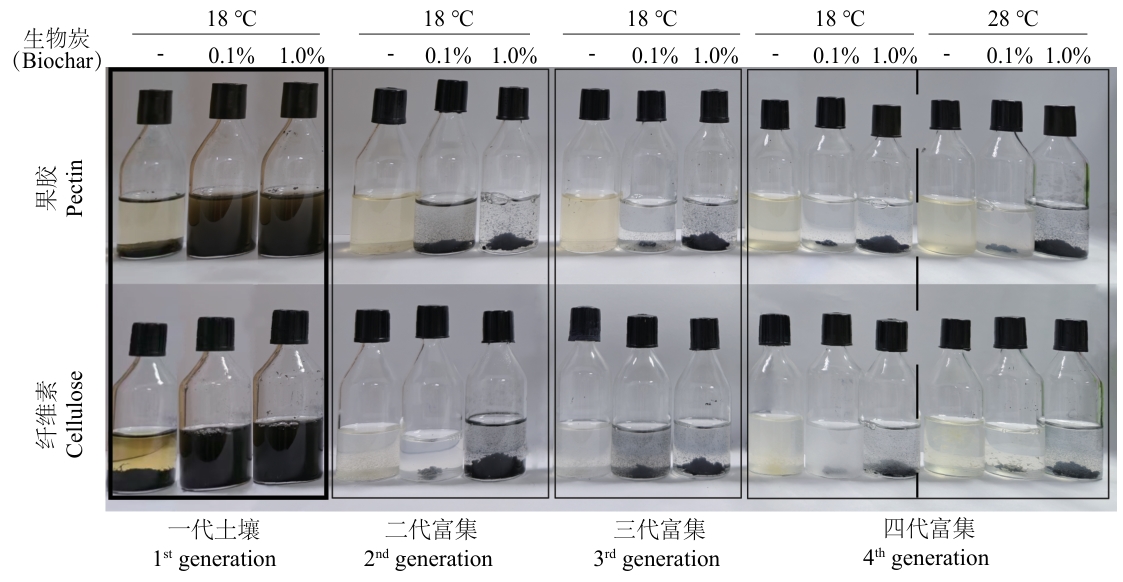
Fig. 1 Anaerobic methanogenesis enrichment and cultures of the soils from Zoige peatlandA total of 2.5 g soils sampled from E. valleculosa, K. tibetica, and C. muliensis were inoculated into 25 mL pre-reduced basic medium (-) and amended with pectin or cellulose plus biochar (0.1% and 1.0%, W/V). The soil enrichments were incubated anaerobically at 18 ℃ for 180 d, CH4 in the headspace was measured. Data presented in the figure was acquired from E. valleculosa soil. About 10% (V/V) of the biochar was transferred from the enrichments of each generation for subculture. The group without biochar amended (0.0%) was subcultured with 10% (V/V) of the enrichment. The 4th generation soil enrichments were incubated anaerobically at 18 ℃ and 28 ℃ respectively. Soil enrichments from each generation were photographed at the 180-day incubation
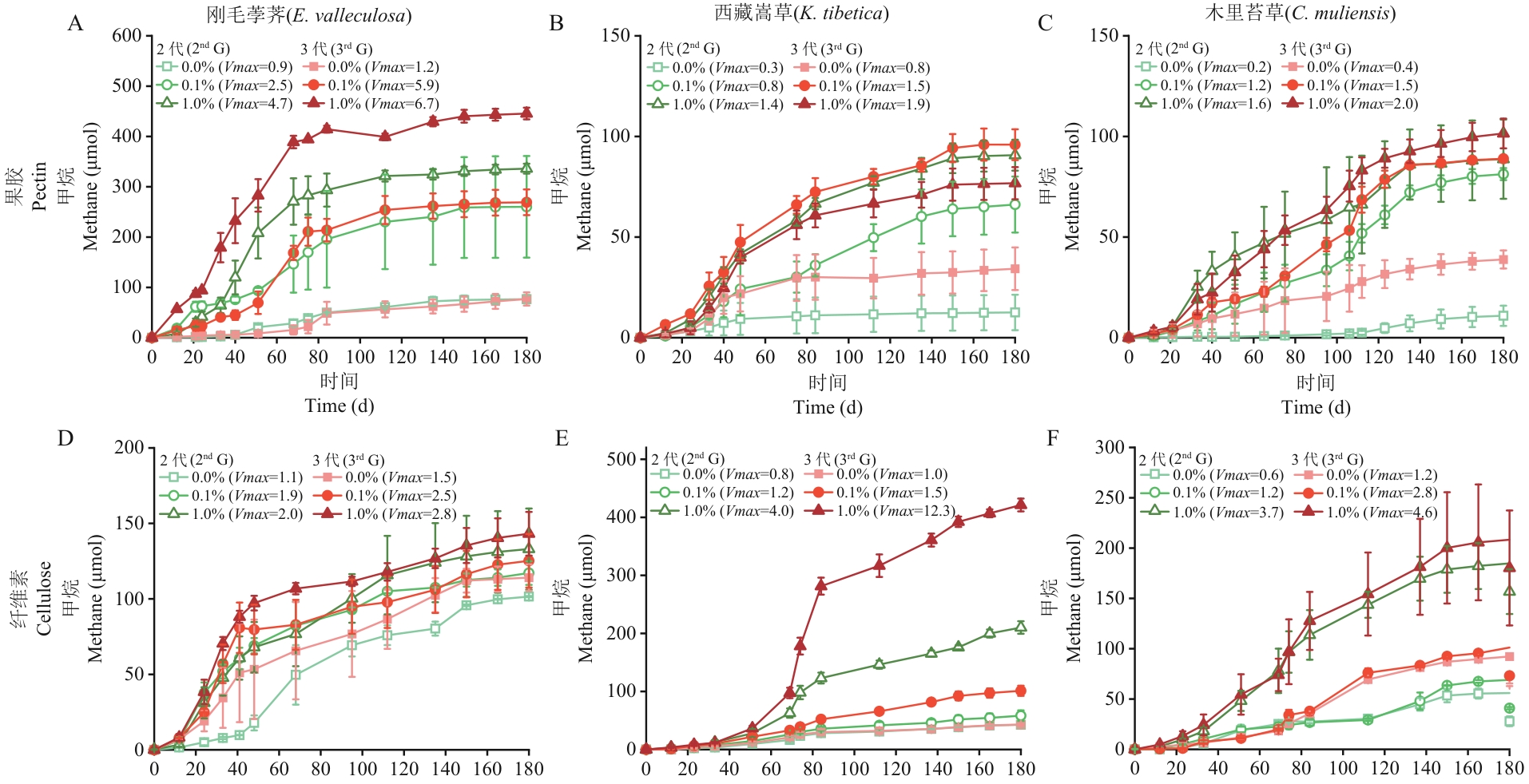
Fig. 2 Effects of biochar on methane production from pectin or cellulose enrichments of peatland soilsAbout 10% (V/V) of the biochar was transferred into fresh medium from the pectin- or cellulose-amended microcosms for subculture. The group without biochar amendment (0.0%) was subcultured with10% (V/V) of the enrichment as the control group. The soil enrichments were incubated anaerobically at 18 ℃ and CH4 in headspace of the soil enrichments from under E. valleculosa (A, D), K. tibetica (B, E), or C. muliensis (C, F) was measured during incubation. The maximum methanogenic rates (Vmax, μmol/d) were calculated from Equation 1. Triplicate cultures were assayed, and the average and standard errors (n=3) are shown
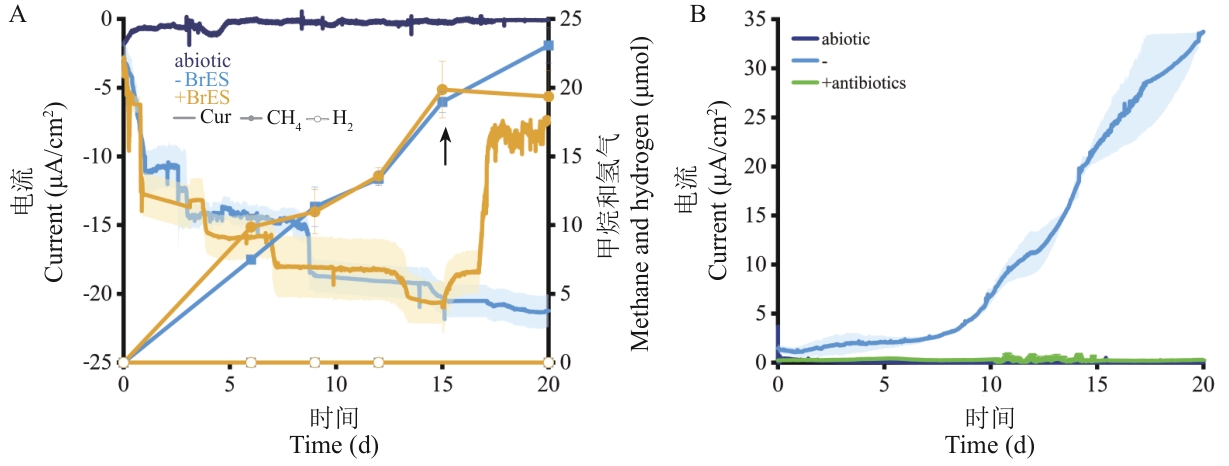
Fig. 3 Electrochemical experiments from peatland soil enrichmentsElectrochemical soil cultures were constructed by inoculating 9 g soil of E. valleculosa into 90 mL pre-reduced basic medium amended with pectin inside H-cells. The electrochemical chambers without soil inoculation were included as an abiotic control, and anaerobically incubated at 18 ℃. A: The cathodic chambers were set at a potential of -0.4 V (vs. Ag/AgCl), 10 mmol/L BrES was added at day 15 of the incubation (black arrow indicated), and none amendment was included as a blank control. B: The anodic chambers were set at a potential of +0.4 V (vs. Ag/AgCl), 1 mg/mL of ampicillin and 2 mg/mL of kanamycin were amended every six days during incubation, and none amendment (-) was included as a blank control. The contents of CH4 and H2 in headspace of enrichments, and current were monitored during the incubation. Triplicate cultures were assayed, and the average and standard errors (n=3) are presentverifying the effects of DIET on methanogenesis
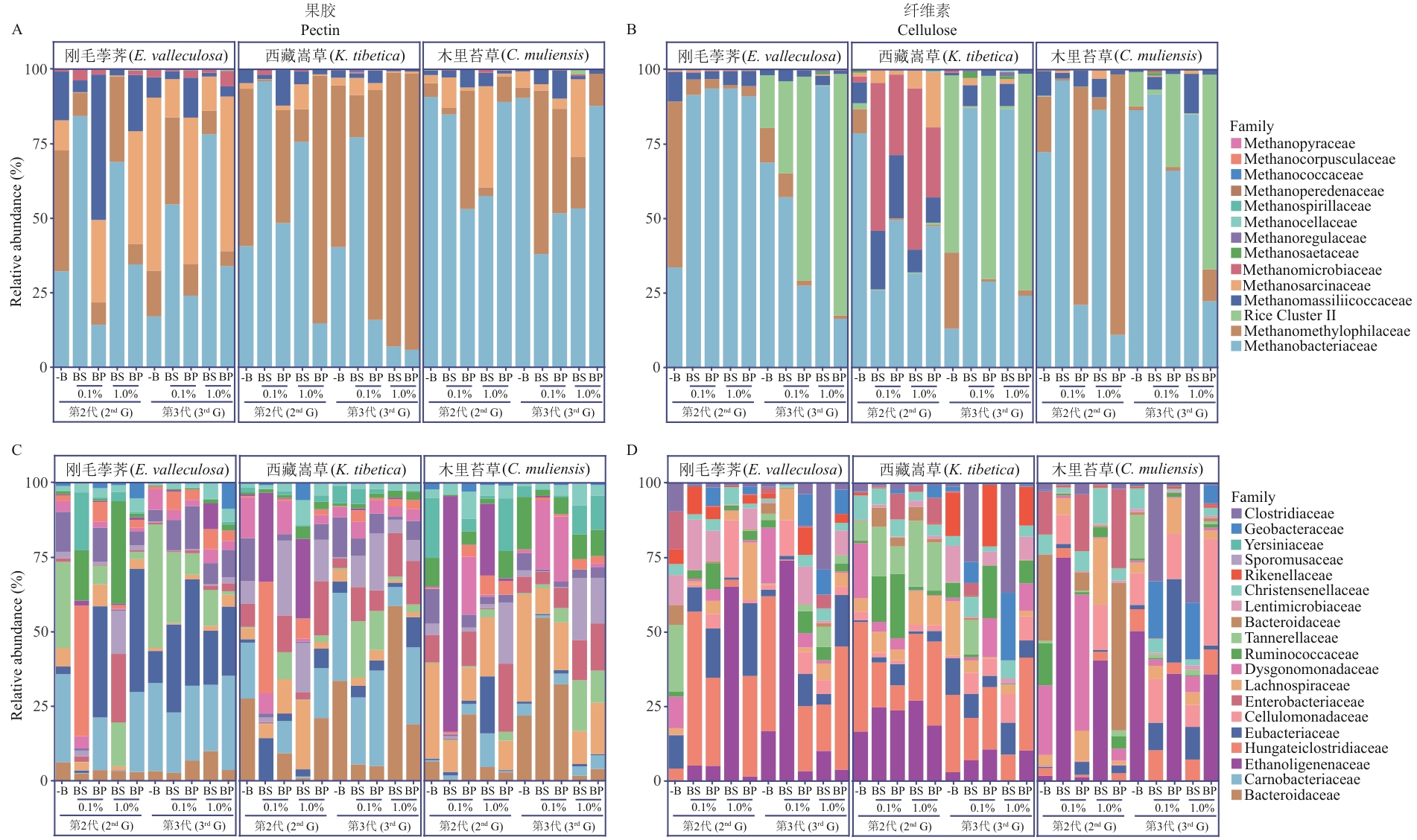
Fig. 4 Relative abundances of methanogenic archaea and bacteria in soil pectin- and cellulose-enrichments of peatland methanogenic archaeaTotal DNA was extracted from the biochar in pectin- and cellulose-amended enrichments with the highest methane production, which were from the 2nd and 3rd generations in Figure 2. 16S rRNA gene amplicons were sequenced, and the relative abundances of methanogens and bacteria were analyzed. The methanogens family (A, B) and top 15 of the most abundant bacterial family (C, D) from the enrichments of E. valleculosa, K. tibetica, or C. muliensis are shown. -B: without biochar amendment; BS: the supernatant of biochar plus pectin soil enrichments; BP: the particle of biochar plus pectin soil enrichments. Triplicate cultures were assayed, and the average (n=3) is shown
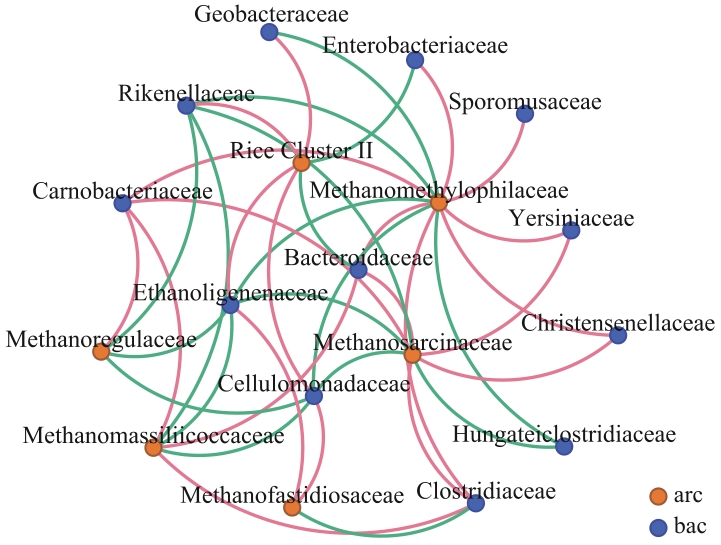
Fig. 5 Co-occurred network analysis of methanogens and bacteria in peatland soilsTotal DNA was extracted from the biochar of pectin or cellulose amended soil enrichments, respectively, and were used for 16S rRNA amplicon sequencing. Co-occurrence network was constructed incorporating the methanogens family and top 15 of the most abundant bacterial family (n=96). Pink lines indicate significant positive correlations, while green lines indicate significant negative correlations
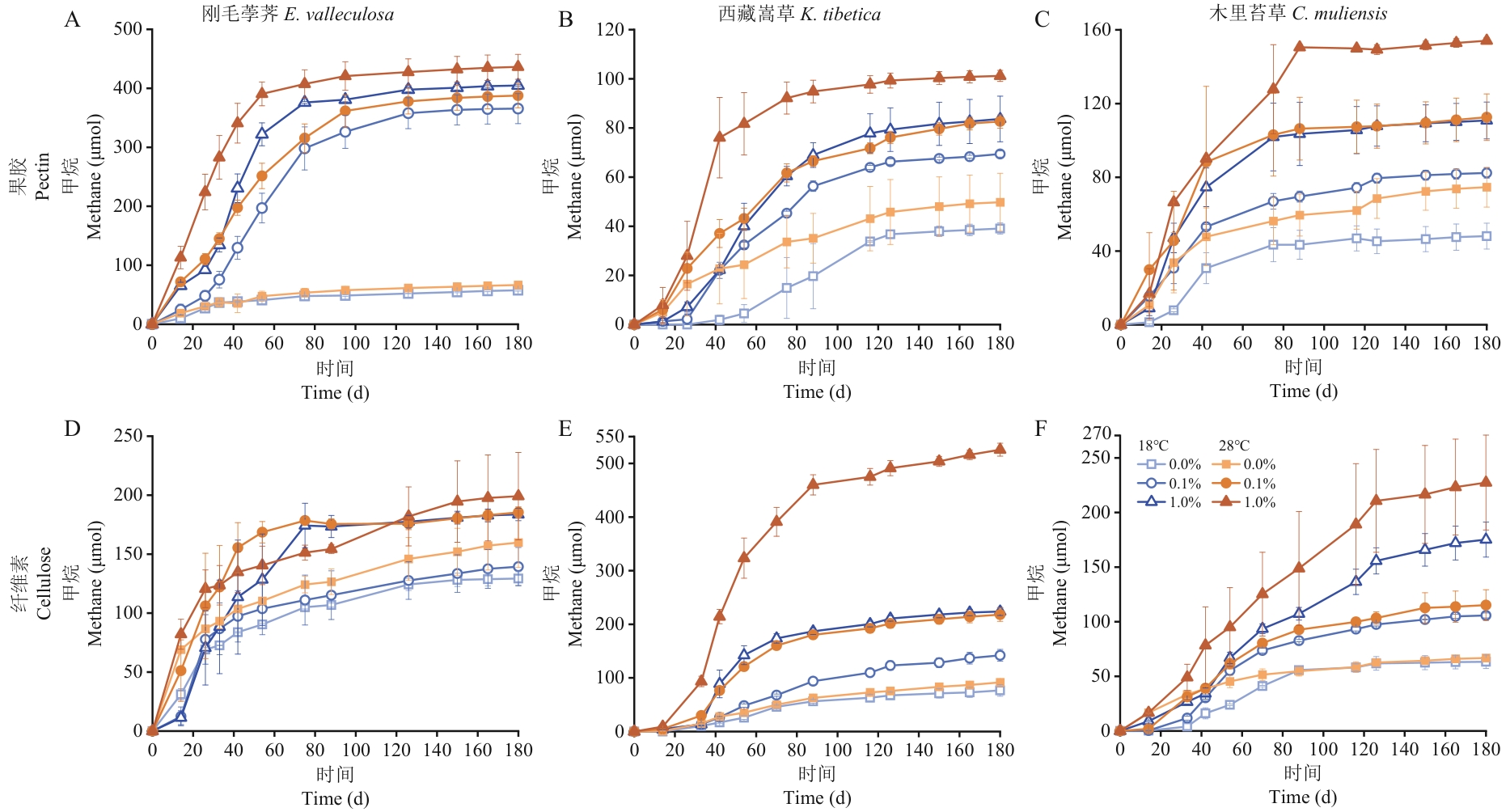
Fig. 6 Effects of temperature increase on biochar-mediated methane production by soil microorganisms in peatlandAbout 10% (V/V) of the biochar extracted from the third-generation soil enrichments of E. valleculosa (A, D), K. tibetica (B, E), and C. muliensis (C, F) were inoculated into fresh methane-producing culture, which then were incubated at 18 ℃ and 28 ℃, respectively. CH4 yield in the headspace of the soil enrichments was measured at given time. The data are present as Mean ± SE (n=3)
土壤富集物 Soil enrichments | 18 ℃ 产甲烷速率 Methanogenic rate at 18 ℃ | 28 ℃ 产甲烷速率 Methanogenic rate at 28 ℃ | ||||
|---|---|---|---|---|---|---|
| - | 0.1% | 1.0% | - | 0.1% | 1.0% | |
| 刚毛荸荠 E. valleculosa | 1.11 | 2.95 | 4.07 | 1.13 | 5.85 | 9.24 |
| 西藏嵩草 K. tibetica | 0.47 | 0.74 | 1.09 | 0.54 | 1.39 | 2.43 |
| 木里苔草 C. muliensis | 1.05 | 1.27 | 2.34 | 1.32 | 2.66 | 4.97 |
Table 3 Effects of biochar on methanogenic rate from pectin amended soil enrichments (μmol/d)
土壤富集物 Soil enrichments | 18 ℃ 产甲烷速率 Methanogenic rate at 18 ℃ | 28 ℃ 产甲烷速率 Methanogenic rate at 28 ℃ | ||||
|---|---|---|---|---|---|---|
| - | 0.1% | 1.0% | - | 0.1% | 1.0% | |
| 刚毛荸荠 E. valleculosa | 1.11 | 2.95 | 4.07 | 1.13 | 5.85 | 9.24 |
| 西藏嵩草 K. tibetica | 0.47 | 0.74 | 1.09 | 0.54 | 1.39 | 2.43 |
| 木里苔草 C. muliensis | 1.05 | 1.27 | 2.34 | 1.32 | 2.66 | 4.97 |
土壤富集物 Soil enrichments | 18 ℃产甲烷速率 Methanogenic rate at 18 ℃ | 28 ℃ 产甲烷速率 Methanogenic rate at 28 ℃ | ||||
|---|---|---|---|---|---|---|
| - | 0.1% | 1.0% | - | 0.1% | 1.0% | |
| 刚毛荸荠 E. valleculosa | 1.67 | 1.92 | 2.67 | 2.82 | 4.57 | 5.86 |
| 西藏嵩草 K. tibetica | 0.97 | 1.47 | 4.33 | 0.97 | 4.34 | 10.95 |
| 木里苔草 C. muliensis | 0.94 | 1.11 | 1.59 | 1.01 | 2.25 | 3.26 |
Table 4 Effects of biochar on methanogenic rate from cellulose amended soil enrichments (μmol/d)
土壤富集物 Soil enrichments | 18 ℃产甲烷速率 Methanogenic rate at 18 ℃ | 28 ℃ 产甲烷速率 Methanogenic rate at 28 ℃ | ||||
|---|---|---|---|---|---|---|
| - | 0.1% | 1.0% | - | 0.1% | 1.0% | |
| 刚毛荸荠 E. valleculosa | 1.67 | 1.92 | 2.67 | 2.82 | 4.57 | 5.86 |
| 西藏嵩草 K. tibetica | 0.97 | 1.47 | 4.33 | 0.97 | 4.34 | 10.95 |
| 木里苔草 C. muliensis | 0.94 | 1.11 | 1.59 | 1.01 | 2.25 | 3.26 |
| [1] | Malyan SK, Bhatia A, Kumar A, et al. Methane production, oxidation and mitigation: a mechanistic understanding and comprehensive evaluation of influencing factors [J]. Sci Total Environ, 2016, 572: 874-896. |
| [2] | Zhang Z, Poulter B, Feldman AF, et al. Recent intensification of wetland methane feedback [J]. Nat Clim Chang, 2023, 13(5): 430-433. |
| [3] | Chen HY, Xu X, Fang CM, et al. Differences in the temperature dependence of wetland CO2 and CH4 emissions vary with water table depth [J]. Nat Clim Chang, 2021, 11(9): 766-771. |
| [4] | Saunois M, Martinez A, Poulter B, et al. Global methane budget 2000-2020[J]. Earth System Science Data, 2025, 17(5):1873-1958. |
| [5] | Wang YF, Xue K. Cold-adaptative methanogens and methanotrophs drive ecosystem feedback [J]. Sci Bull, 2023, 68(13): 1359-1360. |
| [6] | Chen H, Yao SP, Wu N, et al. Determinants influencing seasonal variations of methane emissions from Alpine wetlands in Zoige Plateau and their implications [J]. J Geophys Res, 2008, 113(D12): 2006JD008072. |
| [7] | Chen H, Wu N, Wang YF, et al. Inter-annual variations of methane emission from an open Fen on the Qinghai-Tibetan Plateau: a three-year study [J]. PLoS One, 2013, 8(1): e53878. |
| [8] | Peng HJ, Guo Q, Ding HW, et al. Multi-scale temporal variation in methane emission from an Alpine peatland on the Eastern Qinghai-Tibetan Plateau and associated environmental controls [J]. Agric For Meteor, 2019, 276/277: 107616. |
| [9] | Conrad R. The global methane cycle: recent advances in understanding the microbial processes involved [J]. Environ Microbiol Rep, 2009, 1(5): 285-292. |
| [10] | Schink B. Energetics of syntrophic cooperation in methanogenic degradation [J]. Microbiol Mol Biol Rev MMBR, 1997, 61(2): 262-280. |
| [11] | Yu GL, Chen JD, Wang GL, et al. Recent advances in constructed wetlands methane reduction: Mechanisms and methods [J]. Front Microbiol, 2023, 14: 1106332. |
| [12] | Zhao YY, Bi JF, Yi JY, et al. Pectin and homogalacturonan with small molecular mass modulate microbial community and generate high SCFAs via in vitro gut fermentation [J]. Carbohydr Polym, 2021, 269: 118326. |
| [13] | Schmidt O, Horn MA, Kolb S, et al. Temperature impacts differentially on the methanogenic food web of cellulose-supplemented peatland soil [J]. Environ Microbiol, 2015, 17(3): 720-734. |
| [14] | Hijab Z, Sikander A, Ali RN, et al. From nature to industry: Harnessing the power of pectinase towards potential biotechnological applications[J]. International Journal of Biology and Biotechnology, 2024, 21(1):17-35. |
| [15] | Conrad R, Bak F, Seitz HJ, et al. Hydrogen turnover by psychrotrophic homoacetogenic and mesophilic methanogenic bacteria in anoxic paddy soil and lake sediment [J]. FEMS Microbiol Lett, 1989, 62(5): 285-293. |
| [16] | Sieber JR, McInerney MJ, Gunsalus RP. Genomic insights into syntrophy: the paradigm for anaerobic metabolic cooperation [J]. Annu Rev Microbiol, 2012, 66: 429-452. |
| [17] | Hsieh CC, Cannella D, Jørgensen H, et al. Cellulase inhibition by high concentrations of monosaccharides [J]. J Agric Food Chem, 2014, 62(17): 3800-3805. |
| [18] | Liu X, Tan X, Tang S, et al. Comparative study on the mechanisms of Citrus pectin and polygalacturonic acid in alleviating food allergies [J]. Carbohydr Polym, 2026, 373: 124651. |
| [19] | Rotaru AE, Shrestha PM, Liu FH, et al. Direct interspecies electron transfer between Geobacter metallireducens and Methanosarcina barkeri [J]. Appl Environ Microbiol, 2014, 80(15): 4599-4605. |
| [20] | Rotaru AE, Shrestha PM, Liu FH, et al. A new model for electron flow during anaerobic digestion: direct interspecies electron transfer to Methanosaeta for the reduction of carbon dioxide to methane [J]. Energy Environ Sci, 2014, 7(1): 408-415. |
| [21] | 黄玲艳, 刘星, 周顺桂. 微生物直接种间电子传递: 机制及应用 [J]. 土壤学报, 2018, 55(6): 1313-1324. |
| Huang LY, Liu X, Zhou SG. Direct interspecies electron transfer of microbes: mechanism and application [J]. Acta Pedol Sin, 2018, 55(6): 1313-1324. | |
| [22] | 姜杰, 冯旗, 贺鹏宸, 等. 微生物种间直接电子传递机理及应用研究进展 [J]. 微生物学通报, 2023, 50(10): 4694-4704. |
| Jiang J, Feng Q, He PC, et al. Mechanism and application of direct interspecies electron transfer [J]. Microbiol China, 2023, 50(10): 4694-4704. | |
| [23] | Kraaijenbrink PDA, Stigter EE, Yao TD, et al. Climate change decisive for Asia’s snow meltwater supply [J]. Nat Clim Chang, 2021, 11(7): 591-597. |
| [24] | Ge MY, Laiho R, Korrensalo A, et al. Morphological constraints on plant-mediated methane release and oxidation under experimental warming in a peatland and meadow on the Qinghai-Tibetan Plateau [J]. Funct Ecol, 2025, 39(12): 3571-3585. |
| [25] | Yang G, Chen H, Wu N, et al. Effects of soil warming, rainfall reduction and water table level on CH4 emissions from the Zoige peatland in China [J]. Soil Biol Biochem, 2014, 78: 83-89. |
| [26] | Chen H, Wu N, Gao Y, et al. Spatial variations on methane emissions from Zoige Alpine wetlands of Southwest China [J]. Sci Total Environ, 2009, 407(3): 1097-1104. |
| [27] | Zeng MX, Zhu C, Song YG, et al. Paleoenvironment change and its impact on carbon and nitrogen accumulation in the Zoige wetland, northeastern Qinghai-Tibetan Plateau over the past 14, 000 years [J]. Geochem Geophys Geosyst, 2017, 18(4): 1775-1792. |
| [28] | Cui LJ, Kang XM, Li W, et al. Rewetting decreases carbon emissions from the zoige Alpine peatland on the Tibetan Plateau [J]. Sustainability, 2017, 9(6): 948. |
| [29] | Schwab L, Rago L, Koch C, et al. Identification of Clostridium cochlearium as an electroactive microorganism from the mouse gut microbiome [J]. Bioelectrochemistry, 2019, 130: 107334. |
| [30] | Prévoteau A, Geirnaert A, Arends JBA, et al. Hydrodynamic chronoamperometry for probing kinetics of anaerobic microbial metabolism-case study of Faecalibacterium prausnitzii [J]. Sci Rep, 2015, 5: 11484. |
| [31] | Zhang GS, Jiang N, Liu XL, et al. Methanogenesis from methanol at low temperatures by a novel psychrophilic methanogen, “Methanolobus psychrophilus” sp. nov., prevalent in zoige wetland of the Tibetan Plateau [J]. Appl Environ Microbiol, 2008, 74(19): 6114-6120. |
| [32] | Kayoumu M, Wang HL, Duan GL. Interactions between microbial extracellular polymeric substances and biochar, and their potential applications: a review [J]. Biochar, 2025, 7: 62. |
| [33] | Chen SS, Rotaru AE, Shrestha PM, et al. Promoting interspecies electron transfer with biochar [J]. Sci Rep, 2014, 4: 5019. |
| [34] | Yang Z, Sun TR, Kleindienst S, et al. A coupled function of biochar as geobattery and geoconductor leads to stimulation of microbial Fe(Ⅲ) reduction and methanogenesis in a paddy soil enrichment culture [J]. Soil Biol Biochem, 2021, 163: 108446. |
| [35] | Yu LQ, Tang J, Zhang RD, et al. Effects of biochar application on soil methane emission at different soil moisture levels [J]. Biol Fertil Soils, 2013, 49(2): 119-128. |
| [36] | Biffinger JC, Byrd JN, Dudley BL, et al. Oxygen exposure promotes fuel diversity for Shewanella oneidensis microbial fuel cells [J]. Biosens Bioelectron, 2008, 23(6): 820-826. |
| [37] | Dumas C, Basseguy R, Bergel A. Microbial electrocatalysis with Geobacter sulfurreducens biofilm on stainless steel cathodes [J]. Electrochim Acta, 2008, 53(5): 2494-2500. |
| [38] | Zhao F, Rahunen N, Varcoe JR, et al. Activated carbon cloth as anode for sulfate removal in a microbial fuel cell [J]. Environ Sci Technol, 2008, 42(13): 4971-4976. |
| [39] | Bond DR, Holmes DE, Tender LM, et al. Electrode-reducing microorganisms that harvest energy from marine sediments [J]. Science, 2002, 295(5554): 483-485. |
| [40] | Zuo Y, Xing DF, Regan JM, et al. Isolation of the exoelectrogenic Bacterium Ochrobactrum anthropi YZ-1 by using a U-tube microbial fuel cell [J]. Appl Environ Microbiol, 2008, 74(10): 3130-3137. |
| [41] | Summers ZM, Fogarty HE, Leang C, et al. Direct exchange of electrons within aggregates of an evolved syntrophic coculture of anaerobic bacteria [J]. Science, 2010, 330(6009): 1413-1415. |
| [42] | Li LY, Tian XP, Wang XM, et al. Extracellular electron transfer based methylotrophic methanogenesis in paddy soil and the prevalent Methanomassiliicoccus [J]. Commun Earth Environ, 2025, 6: 297. |
| [43] | Großkopf R, Stubner S, Liesack W. Novel euryarchaeotal lineages detected on rice roots and in the anoxic bulk soil of flooded rice microcosms [J]. Appl Environ Microbiol, 1998, 64(12): 4983-4989. |
| [44] | Mondav R, Woodcroft BJ, Kim EH, et al. Discovery of a novel methanogen prevalent in thawing permafrost [J]. Nat Commun, 2014, 5: 3212. |
| [45] | Kotsyurbenko OR, Chin KJ, Glagolev MV, et al. Acetoclastic and hydrogenotrophic methane production and methanogenic populations in an acidic West-Siberian peat bog [J]. Environ Microbiol, 2004, 6(11): 1159-1173. |
| [46] | Lehmann-Richter, Großkopf, Liesack, et al. Methanogenic Archaea and CO2-dependent methanogenesis on washed rice roots [J]. Environ Microbiol, 1999, 1(2): 159-166. |
| [47] | Lovley DR. Syntrophy goes electric: direct interspecies electron transfer [J]. Annu Rev Microbiol, 2017, 71: 643-664. |
| [48] | Yates MD, Golden JP, Roy J, et al. Thermally activated long range electron transport in living biofilms [J]. Phys Chem Chem Phys, 2015, 17(48): 32564-32570. |
| [1] | ZHOU Jin-jie, LI Meng. Energy Metabolism and Extracellular Electron Transfer of Methanosarcina and Methanothrix [J]. Biotechnology Bulletin, 2026, 42(2): 17-29. |
| [2] | ZHANG Yan-feng, YE Li-dan, YU Hong-wei. Redox Partner Engineering: A Solution to the Low Catalytic Efficiency of P450s [J]. Biotechnology Bulletin, 2023, 39(4): 10-23. |
| [3] | FENG Gao, ZHANG Yu-chen , GOU Min, CHEN Ya-ting. Response of Butyrate-oxidizing Microbial Community to the Co-effects of Antibiotics and Activated Carbon [J]. Biotechnology Bulletin, 2019, 35(8): 64-76. |
| [4] | HE Wen-jun, YANG Tie-zhao, TIAN Pei, DUAN Du-wei, LI Xiao-hui, HE Jia, ZHOU Jian-fei. Effect of Warming After Toping on the Growth and Development of the Upper Leaves of Flue-cured Tobacco [J]. Biotechnology Bulletin, 2019, 35(3): 19-23. |
| [5] | ZHANG Xia, XIAO Ying, ZHOU Qiao-hong, WU Zhen-bin. Research Progress on Electricigens in Microbial Fuel Cell [J]. Biotechnology Bulletin, 2017, 33(10): 64-73. |
| Viewed | ||||||
|
Full text |
|
|||||
|
Abstract |
|
|||||
