









益生菌是“活的微生物,当摄入充足数量时,可以通过改善和维持肠道微生物群的平衡,是对宿主有益的微生物[1]”。目前我国产品标准规定发酵乳制品及活菌型乳酸菌饮料中乳酸菌活菌数不得少于1×10⁶ CFU/g(mL)[2],而益生菌的活菌数水平直接关系到相应产品的质量,影响到乳酸菌的益生作用[3]。影响益生菌菌粉贮存活性稳定性的因素[4],除了其菌株本身特性[5]、生产工艺的影响外,制备得到的益生菌菌粉,从产品质量本身来说受水分、水分活度的影响,除此之外,还受到贮存时的温度/湿度、包装方式、加工方式等环境因素的影响。其中,水分、水分活度(water activity,Aw)对含有益生菌产品中菌体的活性有着十分重要的影响。所谓的水分主要是指产品中的自由水的含量,一般采用直接烘干法进行检测;而水分活度[6],根据现代食品科学研究,是指在一定温度下,溶液状的水分或食品中水分的饱和蒸汽压与相同温度下纯水的饱和蒸汽压的比值。水分、水分活度较高,微生物在食物中繁殖越快,食品就容易变质[7⇓-9],相应地,相关食品中的水分、水分活度也直接影响益生菌产品在贮存过程中的活性及相关的蛋白酶活力[10]。
本研究以双歧杆菌、乳杆菌、球菌菌粉3种类型的益生菌为研究对象,对影响益生菌贮存活性的关键因素(水分、水分活度、贮存温度、封装方式)进行研究分析,以益生菌菌粉储存过程中的存活率为指标,考察其影响因素对益生菌菌粉贮存活性的影响,同时检测益生菌菌粉在贮存前后蛋白酶活力的变化,进一步研究影响因素对益生菌本身的影响,确定其最佳的生产益生菌菌粉水分、水分活度控制指标及产品的贮存条件,为益生菌菌粉生产加工及应用提供指导。
1 材料与方法
1.1 材料
1.1.1 仪器
CP114电子分析天平购自奥豪斯仪器上海有限公司;SW-CJ-IF 型无菌超净工作台购自苏州净化设备有限公司;DNP-9022恒温培养箱购自上海精宏实验设备有限公司; PHS-3E型PH计购自上海雷池仪器厂; LDZX-75KBS型立式压力蒸汽灭菌锅购自上海中安医疗器械厂;XW-80A旋涡混合器购自上海驰唐电子有限公司;厌氧盒和厌氧产气袋购自日本三菱瓦斯化学株式会社;LF1080B型连续式抽气/充气机购自山东鼎冠机械设备有限公司。
1.1.2 益生菌菌粉
乳杆菌类:嗜酸乳杆菌(Lacto-bacillus acidophilus)LA85、植物乳杆菌(Lactobacil-lus plantarum)Lp90、鼠李糖乳杆菌(Lactobacillus rhamnosus)LRa05、干酪乳杆菌(Lactobacillus casei)LC89;双歧杆菌类:乳双歧杆菌(Bifidobacterium lactis)BLa80、长双歧杆菌(Bifidobacterium longum)BL21、短双歧杆菌(Bifidobacterium breve)BBr60、婴儿双歧杆菌(Bifidobacterium infantis)BI45;球菌类:嗜热链球菌(Streptococcus thermophilus)ST81、乳酸片球菌(Pediococcus acidilactici)PA53、戊糖片球菌(Pediococcus pentosaceus)PP06、乳酸乳球菌(Lactococcus lactis)LLa61,均由微康益生菌(苏州)股份有限公司提供。
1.1.3 稀释液与培养基
稀释液按照GB 4789.35-2016中的规定配制及灭菌;MRS琼脂培养基、MC琼脂培养基分别是国标GB4789.35-2016中规定使用的乳酸菌总数计数、嗜热链球菌计数培养基。
1.2 方法
1.2.1 不同水分、水分活度菌粉的准备
在相同配方生产、不同冻干周期的前提下,选择微康益生菌(苏州)股份有限公司生产的不同水分、水分活度的益生菌菌粉,用铝箔袋进行分包,备用(表1)。
表1 不同水分、水分活度的益生菌菌粉
Table 1
| 菌株Strain | 批次1 Batch 1 | 批次2 Batch 2 | 批次3 Batch 3 | 批次4 Batch 4 | 批次5 Batch 5 | ||||||
|---|---|---|---|---|---|---|---|---|---|---|---|
| 水分Moisture/% | 水分活度Water activity(Aw) | 水分Moisture/% | 水分活度Water activity(Aw) | 水分Moisture/% | 水分活度Water activity(Aw) | 水分Moisture/% | 水分活度Water activity(Aw) | 水分 Moisture/% | 水分活度Water activity(Aw) | ||
| 乳杆菌类Lactobacillus | LA85 | 2.70±0.21 | 0.061±0.004 | 3.57±0.22 | 0.093±0.005 | 5.18±0.23 | 0.123±0.006 | 5.68±0.25 | 0.228±0.007 | 6.78±0.26 | 0.292±0.008 |
| Lp90 | 2.97±0.11 | 0.059±0.001 | 3.60±0.12 | 0.078±0.002 | 5.20±0.13 | 0.128±0.003 | 5.80±0.14 | 0.152±0.004 | 6.61±0.15 | 0.180±0.005 | |
| LRa05 | 2.78±0.09 | 0.064±0.003 | 3.86±0.11 | 0.099±0.004 | 5.58±0.13 | 0.131±0.005 | 6.78±0.15 | 0.151±0.006 | 7.04±0.16 | 0.251±0.007 | |
| LC89 | 3.08±0.10 | 0.060±0.004 | 3.44±0.12 | 0.068±0.005 | 5.16±0.13 | 0.126±0.006 | 5.51±0.15 | 0.154±0.007 | 6.56±0.17 | 0.175±0.008 | |
| 双歧杆菌类Bifidobacterium | BLa80 | 3.26±0.13 | 0.057±0.012 | 4.86±0.15 | 0.079±0.013 | 5.00±0.16 | 0.120±0.014 | 5.58±0.17 | 0.140±0.015 | 6.27±0.18 | 0.160±0.016 |
| BL21 | 3.08±0.11 | 0.064±0.008 | 4.65±0.12 | 0.089±0.009 | 5.01±0.13 | 0.121±0.010 | 5.58±0.14 | 0.138±0.011 | 6.86±0.15 | 0.148±0.012 | |
| BBr60 | 3.04±0.16 | 0.067±0.017 | 4.31±0.18 | 0.091±0.018 | 5.08±0.19 | 0.125±0.019 | 5.59±0.20 | 0.130±0.020 | 6.79±0.22 | 0.145±0.022 | |
| BI45 | 3.12±0.17 | 0.070±0.003 | 4.31±0.19 | 0.098±0.005 | 5.07±0.20 | 0.128±0.005 | 5.55±0.21 | 0.131±0.006 | 6.89±0.25 | 0.149±0.007 | |
| 球菌类Cocci | ST81 | 2.52±0.08 | 0.051±0.004 | 3.07±0.09 | 0.085±0.005 | 5.15±0.10 | 0.127±0.006 | 5.55±0.11 | 0.134±0.007 | 6.48±0.13 | 0.143±0.008 |
| PA53 | 2.90±0.09 | 0.058±0.011 | 3.65±0.10 | 0.088±0.012 | 5.18±0.11 | 0.127±0.013 | 5.56±0.12 | 0.138±0.014 | 6.79±0.14 | 0.141±0.015 | |
| PP06 | 2.95±0.18 | 0.070±0.002 | 3.78±0.19 | 0.090±0.003 | 5.38±0.20 | 0.128±0.004 | 5.66±0.21 | 0.130±0.005 | 6.81±0.23 | 0.136±0.006 | |
| LLa61 | 2.62±0.16 | 0.063±0.003 | 3.08±0.18 | 0.089±0.004 | 5.20±0.19 | 0.129±0.005 | 5.79±0.21 | 0.134±0.006 | 6.30±0.23 | 0.139±0.007 | |
1.2.2 水分、水分活性对益生菌菌粉贮存活性影响
将不同水分、水分活度的益生菌菌粉,采用铝薄袋封装后,在-18℃条件下储存2年,检测其菌粉的活菌数,计算存活率,贮存过程中菌体的存活率的高低反映其菌粉的贮存过程中的活性。存活率越高,其益生菌菌粉贮存活性越高。
1.2.3 贮存温度对益生菌菌粉贮存活性影响
将不同的益生菌菌粉,采用铝薄袋封装后,分别放在-18℃、4℃、25℃条件进行储存2年,检测其菌粉的活菌数,计算存活率,考察不同的贮存温度对益生菌菌粉贮存活性的影响。
1.2.4 包装方式对益生菌菌粉贮存活性影响
将不同的益生菌菌粉,采用不同的方式进行封装,即普通封装、抽真空封装、充氮气封装,在-18℃条件下储存2年,检测其菌粉的活菌数,计算存活率,考察不同包装方式对益生菌菌粉贮存活性的影响。
1.2.5 蛋白酶活性的影响
益生菌菌体蛋白酶活力的大小,反映菌体本身与外界进行物质能量交换的能力,蛋白酶活性越高,其菌体活性越高,反之,亦然。考察益生菌菌粉在贮存过程(菌粉水分、水分活度、温度、封装方式)中对其蛋白酶活力的影响,从而计算出蛋白酶活性。
1.2.6 蛋白酶活力测定
参照《GB/T 23527-2009蛋白酶制剂》中蛋白酶活力的测定,采用福林法,每个样品做3个平行,取平均值,蛋白酶活力单位:U/mL。
1.2.7 活菌数检测方法
参照GB 4789.35-2016,称取25 g益生菌菌粉置于225 mL生理盐水的无菌均质袋中,用拍击式均质器拍击1 min,制成1∶10的样品匀液,并做10倍递增样品匀液。选择3个连续的适宜稀释度,每个稀释度分别吸取1 mL样品匀液于2块无菌平皿内,倾注冷却至48℃的培养基,每个平皿约15 mL。球菌的计数培养基采用MC培养基,36℃需氧培养72 h;乳杆菌的计数培养基采用MRS培养基,36℃厌氧(厌氧袋除氧)培养72 h;双歧杆菌的计数培养基采用L-半胱氨酸盐酸盐+MRS培养基,36℃厌氧(厌氧袋除氧)培养72 h。活菌数单位:CFU/g。
1.2.8 水分及水分活度测定
1.2.9 存活率计算
1.2.10 数据统计与分析
以上菌粉样品,每种菌粉分成3等份,采用相同的方法、同一人员进行检测,每种样品重复检测3次。采用SPSS18.0软件对数据进行处理及分析,并进行t 检验。数据结果采用“平均值±标准误差”表示。
2 结果
2.1 益生菌菌粉贮存活性研究
2.1.1 不同水分、水分活度的乳杆菌菌粉贮存存活率
对不同水分、水分活度的益生菌菌粉(LA85、Lp90、LRa05、LC89、BLa80、BL21、BBr60、BI45、ST81、PA53、PP06、LLa61)的贮存存活率进行检测,结果如表2所示,在-18℃条件下储存24个月,随着批次1、批次2、批次3的水分、水分活度越来越高,但是其菌粉的储存稳定性差异不显著(P<0.05),其益生菌菌粉的存活率达到88%以上;当水分>5.58%,水分活度>0.131时,随着批次4、批次5的水分、水分活度越来越高,其菌粉的储存存活率相比之前显著的降低(P<0.05)。水分、水分活度控制得过低,虽然其益生菌的质量保存得很长久,但是其生产成本、加工工艺要求更高;过高,则益生菌活性衰退得很快,保质期越短,产品质量得不到保证,为保证益生菌菌粉在贮存过程中的存活率,控制生产加工过程中的成本,其水分、水分活度宜分别不超过5.58%、0.131。
表2 不同水分、水分活度的益生菌菌粉贮存存活率
Table 2
| 分类Classification | 菌株Strain | 存活率Survival rate/% | |||||
|---|---|---|---|---|---|---|---|
| 批次1 Batch 1 | 批次2 Batch 2 | 批次3 Batch 3 | 批次4 Batch 4 | 批次5 Batch 5 | |||
| 乳杆菌Lactobacillus | LA85 | 93.43±1.43 | 92.23±2.11 | 91.54±1.91 | 85.23±1.31* | 80.43±1.67** | |
| Lp90 | 96.32±1.67 | 95.89±2.01 | 94.43±1.54 | 88.32±1.54* | 83.32±1.34** | ||
| LRa05 | 95.67±1.21 | 94.65±1.81 | 93.87±1.44 | 86.32±1.67* | 81.43±2.34** | ||
| LC89 | 92.54±1.67 | 92.34±1.56 | 91.67±1.89 | 83.44±1.32* | 77.34±1.43** | ||
| 双歧杆菌Bifidobacterium | BLa80 | 97.45±1.35 | 96.41±1.55 | 95.32±1.68 | 90.43±1.11* | 84.32±1.11** | |
| BL21 | 96.65±1.22 | 95.12±1.67 | 95.31±1.44 | 90.32±1.56* | 83.21±1.51** | ||
| BBr60 | 95.44±1.57 | 94.11±1.35 | 93.32±1.68 | 88.32±1.56* | 82.77±1.88** | ||
| BI45 | 93.14±1.01 | 92.35±1.45 | 92.88±1.54 | 86.32±1.58* | 80.55±1.22** | ||
| 球菌 Cocci | ST81 | 92.55±1.65 | 91.78±1.23 | 91.11±1.63 | 85.34±1.51* | 80.69±1.51** | |
| PA53 | 92.67±1.64 | 91.77±1.88 | 90.88±1.13 | 85.99±1.99* | 80.01±1.67** | ||
| PP06 | 92.33±1.54 | 92.11±1.33 | 91.76±2.13 | 86.11±1.78* | 81.35±1.32** | ||
| LLa61 | 88.18±1.48 | 87.44±1.54 | 86.89±1.56 | 80.23±1.65* | 74.67±1.78** | ||
注:* 表示批次之间有显著性差异(P<0.05);“**”表示批次之间有极显著性差异(P<0.01)
Note: * indicates a significant difference between batches(P<0.05);“**”indicates a highly significant difference between batches(P<0.01)
2.1.2 贮存温度对益生菌菌粉贮存活性影响
不同贮存温度对益生菌菌粉(LA85、Lp90、LRa05、LC89、BLa80、BL21、BBr60、BI45、ST81、PA53、PP06、LLa61)的贮存存活率进行检测,结果如表3所示,在-18℃、4℃、25℃条件下储存24个月,随着贮存温度越来越高,菌粉的储存存活率显著性降低(P<0.05)。乳杆菌、双歧杆菌、球菌在25℃条件下,贮存存活率较高的分别是嗜酸乳杆菌LA85、乳双歧杆菌BLa80、戊糖片球菌PP06,分别达到48.56%、49.33%、45.33%。益生菌要保持其活性,一般都是低温贮存,温度、湿度等越高越不利于其活性的保持;结合上述数据结果,其益生菌菌粉要在2年内保持86%以上的存活率,宜放在-18℃条件下进行贮存。
表3 不同贮存温度对益生菌菌粉贮存活性影响
Table 3
| 分类Classification | 菌株Strain | 存活率Survival rate/% | |||
|---|---|---|---|---|---|
| 贮存-18℃Storage at -18℃ | 贮存4℃Storage at 4℃ | 贮存25℃Storage at 25℃ | |||
| 乳杆菌 Lactobacillus | LA85 | 92.23±2.11 | 79.34±1.91** | 48.56±2.67** | |
| Lp90 | 95.12±1.81 | 84.34±1.22** | 44.31±1.79** | ||
| LRa05 | 93.33±1.22 | 83.23±1.87** | 40.36±1.64** | ||
| LC89 | 90.01±1.12 | 82.15±1.85** | 43.43±1.57** | ||
| 双歧杆菌 Bifidobacterium | BLa80 | 94.45±1.32 | 84.54±1.67** | 49.33±1.67** | |
| BL21 | 92.65±1.32 | 78.24±1.86** | 31.35±1.65** | ||
| BBr60 | 92.67±1.33 | 82.34±1.66** | 36.34±2.66** | ||
| BI45 | 94.54±1.45 | 79.11±1.89** | 26.24±1.76** | ||
| 球菌 Cocci | ST81 | 90.45±1.55 | 72.11±2.89** | 43.33±1.67** | |
| PA53 | 91.20±1.01 | 72.45±1.55** | 33.34±1.66** | ||
| PP06 | 90.03±1.06 | 78.13±1.97** | 45.33±1.67** | ||
| LLa61 | 86.78±1.22 | 71.43±1.57** | 43.53±2.47** | ||
注:**表示不同温度之间有极显著性差异(P<0.01)
Note: ** indicates a highly significant difference between temperatures(P<0.01)
2.1.3 封装方式对益生菌菌粉贮存活性影响
不同封装方式对益生菌菌粉(LA85、Lp90、LRa05、LC89、BLa80、BL21、BBr60、BI45、ST81、PA53、PP06、LLa61)的贮存存活率进行检测,结果如表4所示,在-18℃条件下储存24个月,采用抽真空和充氮气进行封装,其益生菌的贮存存活率显著性(P<0.05)的高于普通封装的方式,而抽真空和充氮气两种封装方式,其益生菌存活率差异不显著。目前益生菌主要是乳酸菌,其生长条件是专性厌氧或者兼性厌氧,在有氧气的情况下不利于益生菌活性的维持,为保持益生菌菌粉的活性,目前主要采用铝薄袋进行包装,通过抽真空或者充氮气进行封装,更有利于保持益生菌菌粉贮存过程中的活性,而充氮气封装因其体积较大,影响运输,相比较而言,抽真空优于氮气封装。
表4 不同包装方式对益生菌菌粉贮存活性影响
Table 4
| 分类Classification | 菌株Strain | 存活率Survival rate/% | |||
|---|---|---|---|---|---|
| 普通封装Ordinary encapsulation | 真空封装Vacuum encapsulation | 氮气封装Nitrogen encapsulation | |||
| 乳杆菌 Lactobacillus | LA85 | 91.35±1.81 | 95.01±1.01* | 94.56±1.44* | |
| Lp90 | 93.22±1.81 | 97.12±1.22* | 96.65±1.78* | ||
| LRa05 | 91.11±1.81 | 96.13±1.55* | 96.01±1.32* | ||
| LC89 | 89.78±2.11 | 94.32±1.32* | 93.68±1.33* | ||
| 双歧杆菌Bifidobacterium | BLa80 | 91.67±1.33 | 96.23±1.22* | 96.15±1.22* | |
| BL21 | 90.78±1.22 | 95.32±1.68* | 95.32±1.45* | ||
| BBr60 | 91.67±1.34 | 95.89±1.01* | 95.22±1.11* | ||
| BI45 | 92.32±1.68 | 96.55±1.32* | 95.82±1.22* | ||
| 球菌 Cocci | ST81 | 88.67±1.31 | 93.89±1.11* | 93.43±1.42* | |
| PA53 | 89.89±1.11 | 94.89±1.56* | 94.32±1.66* | ||
| PP06 | 88.11±1.89 | 93.65±1.34* | 93.01±1.32* | ||
| LLa61 | 84.89±1.14 | 89.43±1.32* | 89.21±1.21* | ||
注:*表示与普通封装比较有显著性差异(P<0.05)
Note: * indicates a significant difference compared to normal encapsulation(P<0.05)
2.2 蛋白酶活性的影响
2.2.1 不同水分、水分活度对益生菌贮存过程中蛋白酶活性的影响
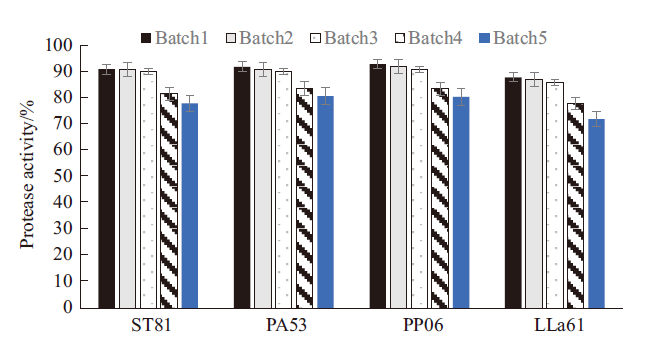
对不同水分、水分活度的益生菌菌粉(LA85、Lp90、LRa05、LC89、BLa80、BL21、BBr60、BI45、ST81、PA53、PP06、LLa61)的贮存蛋白酶活性进行检测,结果如图1-图3所示,在-18℃条件下储存24个月,批次1、批次2、批次3的水分、水分活度对贮存过程中蛋白酶的活性无显著性影响(P<0.05),当水分>5.58%,水分活度>0.131时,随着批次4、批次5的水分、水分活度越来越高,其菌粉的蛋白酶活性相比之前显著的降低(P<0.05)。水在酶促反应中起到反应物的作用、运送介质、水化酶和底物从而活化,低水分活度,可以抑制酶水解反应而发生的卵磷脂、蛋白质的水解[13]。当水分、水分活度超过一定范围时,会显著影响益生菌的存活率及蛋白酶活力[14]。
图1
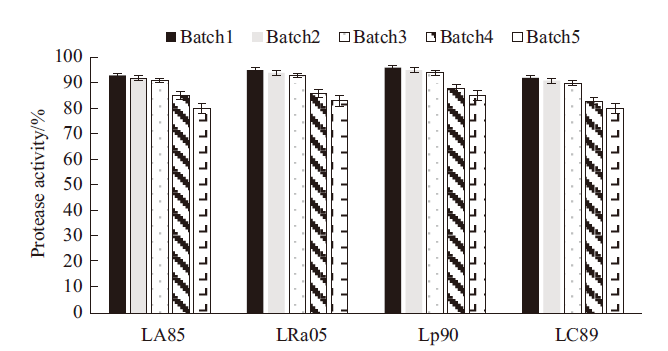
图2
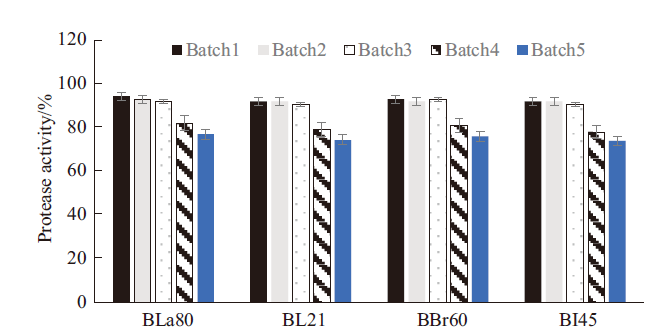
图3
2.2.2 不同温度对益生菌贮存过程中蛋白酶活性的影响
图4
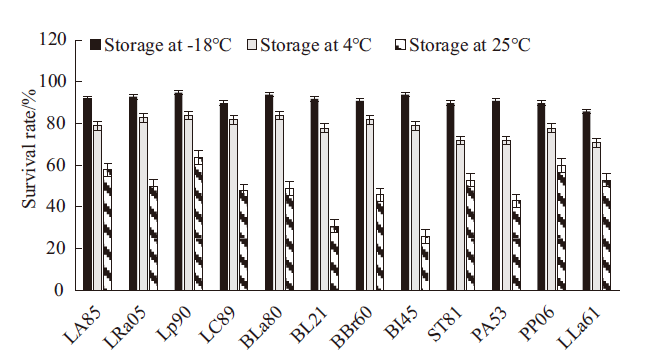
图4
不同温度对蛋白酶活性的影响
Fig. 4
Effects of different temperatures on protease activity
2.2.3 不同封装方式对益生菌贮存过程中蛋白酶活性的影响
图5
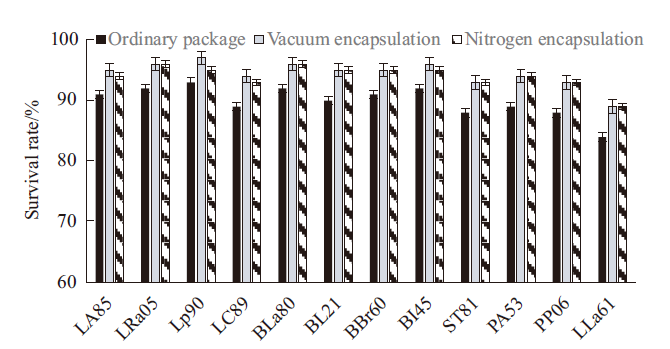
图5
不同封装方式对益生菌贮存过程中蛋白酶活性的影响
Fig. 5
Effects of different encapsulation methods on the prote-ase activity during storage of probiotics
3 讨论
本文以乳杆菌、双歧杆菌、球菌为研究对象,对不同益生菌菌粉的水分、水分活度、温度及封装方式进行储存过程中活性测试,对其储存过程中的菌体存活率及蛋白酶活力进行检测,研究其益生菌菌粉的贮存影响因素,结果发现水分、水分活度在一定的范围内,对菌粉的储存存活率、蛋白酶活力无显著影响,超过一定范围,随着水分、水分活度的提升,其菌粉的储存存活率、蛋白酶活力显著下降;温度对菌体的活性及蛋白酶活力有较大的影响,温度越高,对蛋白酶的活性影响越大,从而影响菌体的存活率;通过隔氧封装更有利于保持贮存过程中菌体的存活率。除了益生菌菌粉的本身质量控制指标(水分、水分活度)、贮存温度及封装方式对其益生菌菌粉的贮存活性有影响外,其益生菌菌粉的生产工艺对其贮存活性仍有影响,如对菌体进行微包埋处理[17],隔绝氧气[18],提升菌体的耐热性[1];对耐热[19]、耐氧菌株[20]的筛选,提升菌体本身的抗逆性,从而提升益生菌菌粉的贮存活性。
目前,国内益生菌厂家对益生菌菌粉的质量控制指标中大部分只是通过控制水分含量,而水分活度也是在生产和储存过程中影响其稳定性的一个重要因素,对干燥或脱水产品的水分活度进行控制能让其保持正确结构、质地、稳定性、密度和再水化性[21]。水分活度过高,会影响其菌体的蛋白酶活力,而菌体的蛋白酶活力的大小反映了菌体对蛋白质分解能力的大小,同时也间接反映了其菌体的存活情况。益生菌菌粉水分、水分活度过低,虽然其食品的质量保存得很长久,但是其生产成本、加工工艺要求更高。
4 结论
通过对益生菌菌粉贮存过程中菌粉的本身质量控制指标(水分、水分活度)、贮存温度及封装方式进行分析研究,得出其菌粉的水分、水分活度分别控制在5.58%、0.131以下,菌粉在低温条件下进行贮存、隔氧方式进行封装,更有利于保持益生菌菌粉贮存过程中的存活率。
参考文献
不同壁材包埋对益生菌性能的影响
[J].
Effects of different wall materials on characteristics of microencapsulated probiotics
[J].
保健食品双歧杆菌和乳酸菌计数方法的优化
[J].
Optimization of enumeration method on Bifidobacteria and lactic bacteria in health food
[J].
Probiotics - the versatile functional food ingredients
[J].
DOI:10.1007/s13197-015-2011-0
PMID:27162372
[本文引用: 1]

Probiotics are live microbes which when administered in adequate amounts as functional food ingredients confer a health benefit on the host. Their versatility is in terms of their usage which ranges from the humans to the ruminants, pigs and poultry, and also in aquaculture practices. In this review, the microorganisms frequently used as probiotics in human and animal welfare has been described, and also highlighted are the necessary criteria required to be fulfilled for their use in humans on the one hand and on the other as microbial feed additives in animal husbandry. Further elaborated in this article are the sources from where probiotics can be derived, the possible mechanisms by which they act, and their future potential role as antioxidants is also discussed.
品质因子和益生菌对草莓品质和贮藏的影响
[J].
Effects of quality factors and probiotics on strawberry quality and storage
[J].
Epigenetics: a new frontier in probiotic research
[J].
DOI:10.1016/j.tim.2020.04.008
PMID:32409146
[本文引用: 1]
Research into the benefits of probiotics has progressed beyond interventional studies to identifying the underlying molecular mechanisms. Health-promoting effector molecules produced by probiotics are well documented and have been linked to specific genes and even individual nucleotides. However, the factors controlling the expression of these molecules are poorly understood and we argue that epigenetic influences likely play an important role in mediating the health-promoting attributes of probiotics. Here, we review established epigenetic regulation of important microbial genetic systems involved in health promotion, safety, and industrialization to provide evidence that the same regulation occurs in probiotic organisms. We advocate for studies combining genomic and meta-epigenomic data to better understand the mode of action of probiotics, their associated microbiomes, and their effects on consumers.Copyright © 2020 The Authors. Published by Elsevier Ltd.. All rights reserved.
低水分活度食品的微生物安全研究进展
[J].
Research progress on microbial safety of low water activity foods
[J].
Evaluating water activity and glass transition concepts for food stability
[J].DOI:10.1016/j.jfoodeng.2005.09.025 URL [本文引用: 1]
In-package inactivation of pathogenic and spoilage bacteria associated with poultry using dielectric barrier discharge-cold plasma treatments
[J].
DOI:10.1007/s00284-016-1158-x
PMID:27885385
[本文引用: 1]
The goal of this study was to test the efficacy of in-package dielectric barrier discharge-cold plasma (DBD-CP) treatment to inactivate poultry-associated spoilage (Pseudomonas fluorescens) and pathogenic (Salmonella enterica Typhimurium, Campylobacter jejuni) bacteria. Liquid cultures of the bacterial isolates were sealed within packages containing ambient air (Trial 1) or modified air (65% O:30% CO:5% N; Trial 2). The packages were subjected to treatment times ranging from 30 to 180 s, and after 24 h incubation at 4 °C, bacterial titers were determined. The DBD-CP system completely inactivated the four isolates tested, although the in-package gas composition and treatment times were isolate-specific. Both C. jejuni isolates were completely inactivated between 30 s (modified air) and 120 s (ambient air), while modified air was required for the complete inactivation of S. typhimurium (90 s) and P. fluorescens (180 s). This DBD-CP system is effective for inactivating major poultry-associated spoilage and pathogenic bacteria in liquid culture, and through this study, system parameters to optimize inactivation were determined. This study demonstrates the potential for DBD-CP treatment to inactivate major bacteria of economic interest to the poultry industry, thus potentially allowing for reduced spoilage (e.g., longer shelf life) and increased safety of poultry products.
低水分活度食品微生物控制技术研究现状
[J].
Research progress in microbiological control of food with low water activity
[J].
豌豆种子萌发时的含水量对子叶中蛋白酶和淀粉酶活性的影响
[J].
The effect of water content in germinating pea seeds on activities of protease and amylase in the cotyledons
[J].
发酵食品源功能活性肽及其应用研究进展
[J].
Research progress on functional active peptides in fermented foods and their application
[J].
充氮包装对乳粉贮存过程中水分、水分活度及益生菌活菌数变化的影响
[J].
Effect of Nitrogen-filled packaging on the moisture content, water activity and viable count of probiotic milk powder during storage
[J].
Preliminary analysis of the efect of water activity on viability and stability of probiotics formulations
[J].
益生菌配方奶粉中水分活度的控制
[J].
Controlling water activity of probiotics formula powder
[J].
Introducing a novel interaction model structure for the combined effect of temperature and pH on the microbial growth rate
[J].
DOI:S0168-1605(16)30304-X
PMID:27393390
[本文引用: 1]
Efficient modelling of the microbial growth rate can be performed by combining the effects of individual conditions in a multiplicative way, known as the gamma concept. However, several studies have illustrated that interactions between different effects should be taken into account at stressing environmental conditions to achieve a more accurate description of the growth rate. In this research, a novel approach for modeling the interactions between the effects of environmental conditions on the microbial growth rate is introduced. As a case study, the effect of temperature and pH on the growth rate of Escherichia coli K12 is modeled, based on a set of computer controlled bioreactor experiments performed under static environmental conditions. The models compared in this case study are the gamma model, the model of Augustin and Carlier (2000), the model of Le Marc et al. (2002) and the novel multiplicative interaction model, developed in this paper. This novel model enables the separate identification of interactions between the effects of two (or more) environmental conditions. The comparison of these models focuses on the accuracy, interpretability and compatibility with efficient modeling approaches. Moreover, for the separate effects of temperature and pH, new cardinal parameter model structures are proposed. The novel interaction model contributes to a generic modeling approach, resulting in predictive models that are (i) accurate, (ii) easily identifiable with a limited work load, (iii) modular, and (iv) biologically interpretable.Copyright © 2016. Published by Elsevier B.V.
高氧气调包装对宰后猪肉蛋白质氧化、钙蛋白酶活性及蛋白质降解的影响
[J].
DOI:10.3864/j.issn.0578-1752.2016.18.017
[本文引用: 1]
【目的】研究高氧气调包装(HiOx,80% O<sub>2</sub>/20% CO<sub>2</sub>)对宰后猪肉蛋白质氧化、钙蛋白酶活性及蛋白质降解的影响,探讨高氧气调包装影响猪肉品质的内在机制。【方法】选取12条冷却(4℃)24 h后的杜洛克×长白×约克夏三元杂交猪背最长肌,分别进行高氧气调包装和真空包装(VP),4℃冷库贮藏,分别在1、4、6 d测定羰基含量及分布、巯基含量、肌节变化、钙蛋白酶活性、肌联蛋白及肌钙蛋白-T降解变化。【结果】高氧气调包装组羰基含量高于真空包装组且贮藏第4和6天差异显著(P<0.05)。贮藏第1和4天,高氧气调包装组肌细胞外围出现羰基氧化荧光信号,荧光以靠近细胞膜处密度更高,并且逐渐向细胞内部扩散;贮藏第6天,高氧气调包装组细胞膜呈高亮荧光圈,胞内荧光增强,而真空包装组荧光信号较弱。贮藏第6天,高氧气调包装组巯基含量显著低于真空包装组(P<0.05)。真空包装组宰后肌节M线弱化、A带模糊、肌原纤维Z线断裂;高氧气调包装组肌节结构相对完整。高氧气调包装组在贮藏第1天钙蛋白酶活性显著低于真空包装组(P<0.05);高氧气调包装抑制了肌联蛋白和肌钙蛋白-T的降解,且在贮藏第4和6天差异显著(P<0.05)。【结论】高氧气调包装能够显著提高宰后猪肉蛋白质氧化程度,抑制钙蛋白酶活性发挥及其底物蛋白质的降解。
Effects of high oxygen modified atmosphere packaging on protein oxidation, calpain activity and protein proteolysis of pork during postmortem refrigerated storage
[J].
DOI:10.3864/j.issn.0578-1752.2016.18.017
[本文引用: 1]
【Objective】 The objective of this study was to investigate the effect of high oxygen modified atmosphere packaging (HiOx, 80% O<sub>2</sub>/20% CO<sub>2</sub>)on protein oxidation, calpain activity and protein proteolysis of pork during refrigerated storage. This could help explaining the mechanism of regulation behind HiOx in pork quality. 【Method】 Twelve <em>longissimus dorsi</em>muscles of Duroc × Landrace × Yorkshire crossbred pork were precooled at 4<span>℃</span> for 24 h, and then randomly assigned to either HiOx or vacuum packaging (VP) and stored for 1, 4 and 6 d at 4<span>℃</span>. The carbonyl content and distribution, sulfhydryl content, sarcomere changes, calpain activity, titin and troponin-T degradation were determined, respectively. 【Result】 Carbonyl content of samples from HiOx was significantly higher than the samples from VP at 4 and 6 d of storage (<em>P</em><0.05). HiOx samples showed fluorescence signal in the peripheral area of cell membrane and then the fluorescence signal spread to the internal cellular environment at 1 and 4 d of postmortem refrigerated storage. At 6 d of postmortem refrigerated storage, samples under HiOx presented a strong fluorescence light, with a glaring fluorescence intensity more pronounced in a peripheral area corresponding to the cell membrane and to a region in close contact with the cell membrane, while VP samples presented weaker fluorescence signal. Sulfhydryl content of HiOx samples was significantly lower compared with VP samples at 6 d of postmortem storage (<em>P</em><0.05). Samples from VP showed weakening M line, blurry A band as well as broken Z line during postmortem refrigerated storage, whereas samples under HiOx remained less affected. μ-Calpain activity was less in samples from HiOx compared with that from VP at 1 d of storage (<em>P</em><0.05). Titin and troponin-T showed less proteolysis in samples from HiOx than that from VP at 4 and 6 d of postmortem refrigerated storage (<em>P</em><0.05). 【Conclusion】 Increased protein oxidation under HiOx could inhibit μ-calpain activity and protein proteolysis of pork during postmortem refrigerated storage.
微包埋技术及其在益生菌中应用现状综述
[J].
Review of microencapsulation technology and its application in probiotics
[J].
Microencapsulation of probiotics for gastrointestinal delivery
[J].DOI:10.1016/j.jconrel.2012.06.003 URL [本文引用: 1]
乳酸菌的热胁迫研究进展
[J].
Research progress on heat stress of lactic acid bacteria
[J].
Application of RBGR—a simple way for screening of oxygen tolerance in probiotic bacteria
[J].DOI:10.1016/S0168-1605(01)00563-3 URL [本文引用: 1]
Effect of heat—moisture treatment on the structure and physicochemical properties of legume starches
[J].DOI:10.1016/S0963-9969(97)86873-1 URL [本文引用: 1]


