







生物技术通报 ›› 2025, Vol. 41 ›› Issue (9): 277-288.doi: 10.13560/j.cnki.biotech.bull.1985.2025-0306
• 研究报告 • 上一篇
苏秀敏1( ), 韩文清1(), 王佼1(), 李鹏2, 王秋兰1, 李万星1(), 曹晋军1
收稿日期:2025-03-21
出版日期:2025-09-26
发布日期:2025-09-24
通讯作者:
李万星,男,研究员,研究方向 :有机旱作技术研究、大豆育种与栽培;E-mail: gzslwx@163.com作者简介:苏秀敏,女,硕士,助理研究员,研究方向 :蔬菜栽培及病虫害防治;E-mail: suxiumin123@163.com基金资助:
SU Xiu-min1(), HAN Wen-qing1(), WANG Jiao1(), LI Peng2, WANG Qiu-lan1, LI Wan-xing1(), CAO Jin-jun1
Received:2025-03-21
Published:2025-09-26
Online:2025-09-24
摘要:
目的 茄链格孢(Alternaria solani)引起的番茄早疫病是番茄的主要病害,从番茄-西葫芦轮作后的西葫芦根际土中分离并鉴定一株对番茄早疫病具有较好拮抗作用的生防菌株。 方法 采用形态学观察、分子生物学技术对拮抗菌株进行鉴定;对其最适碳源、温度、光照及pH值等生物学指标进行试验;采用室内试验及大田防效试验评价其生防效果。 结果 分离到拮抗番茄早疫病的一株优良菌株M408,经形态学观察及ITS序列鉴定菌株M408为哈茨木霉(Trichoderma harzianum),该菌株营养生长和产孢的最适碳源都是葡萄糖;最适生长温度为27 ℃;全黑暗条件下菌丝生长速度最快,全光照条件下产孢数量最大,最适pH为6。室内平板对峙培养法测定该菌株对番茄早疫病抑菌率为100%,对番茄早疫病的拮抗指数达Ⅰ级。孢子浓度108、107、106、105 CFU/mL的M408原菌粉菌剂溶液对番茄早疫病的抑菌率分别为100%、100%、98.51%、93.43%,均高于化学药剂苯甲·醚菌酯(325 g/L)对番茄早疫病的抑菌率89.55%。大田防效试验中,第二次喷药后7 d,哈茨木霉M408原菌粉菌剂溶液对番茄早疫病的防治效果较为明显,喷施孢子浓度108、107、106、105 CFU /mL的哈茨木霉原菌粉M408菌剂溶液对番茄早疫病的防治效果分别为89.44%、87.07%、84.56%和81.01%,均高于喷施325 g/L苯甲·醚菌酯的相对防效76.37%。 结论 分离自番茄-西葫芦轮作后的西葫芦根际土中的菌株哈茨木霉M408,对番茄早疫病具有良好的生防效果,是有较好生防潜力的真菌资源,具有进一步开发利用的价值。
苏秀敏, 韩文清, 王佼, 李鹏, 王秋兰, 李万星, 曹晋军. 哈茨木霉M408的分离鉴定、生物学特性及对番茄早疫病的生防效果[J]. 生物技术通报, 2025, 41(9): 277-288.
SU Xiu-min, HAN Wen-qing, WANG Jiao, LI Peng, WANG Qiu-lan, LI Wan-xing, CAO Jin-jun. Isolation, Identification, Biological Characteristics and Biocontrol Effects of Trichoderma harzianum M408 against Tomato Early Blight[J]. Biotechnology Bulletin, 2025, 41(9): 277-288.

图1 M408菌株的形态学特征A:菌落形态(a: 24 h背面图;b-g:分别为48、72、96、120、144、168 h正面图);B-C:分生孢子梗;D:孢子形态 ;标尺中衸表示微米(μm)A: Colony morphology (a: Rear view at 24 h; b-g: front view at 48, 72, 96, 120, 144, 168 h); B-C: conidiogenous hypha; D: spore morphology. In the ruler, 衸 (Pronounced as jie) refers to micrometers (μm)
Fig. 1 Morphological features of M408
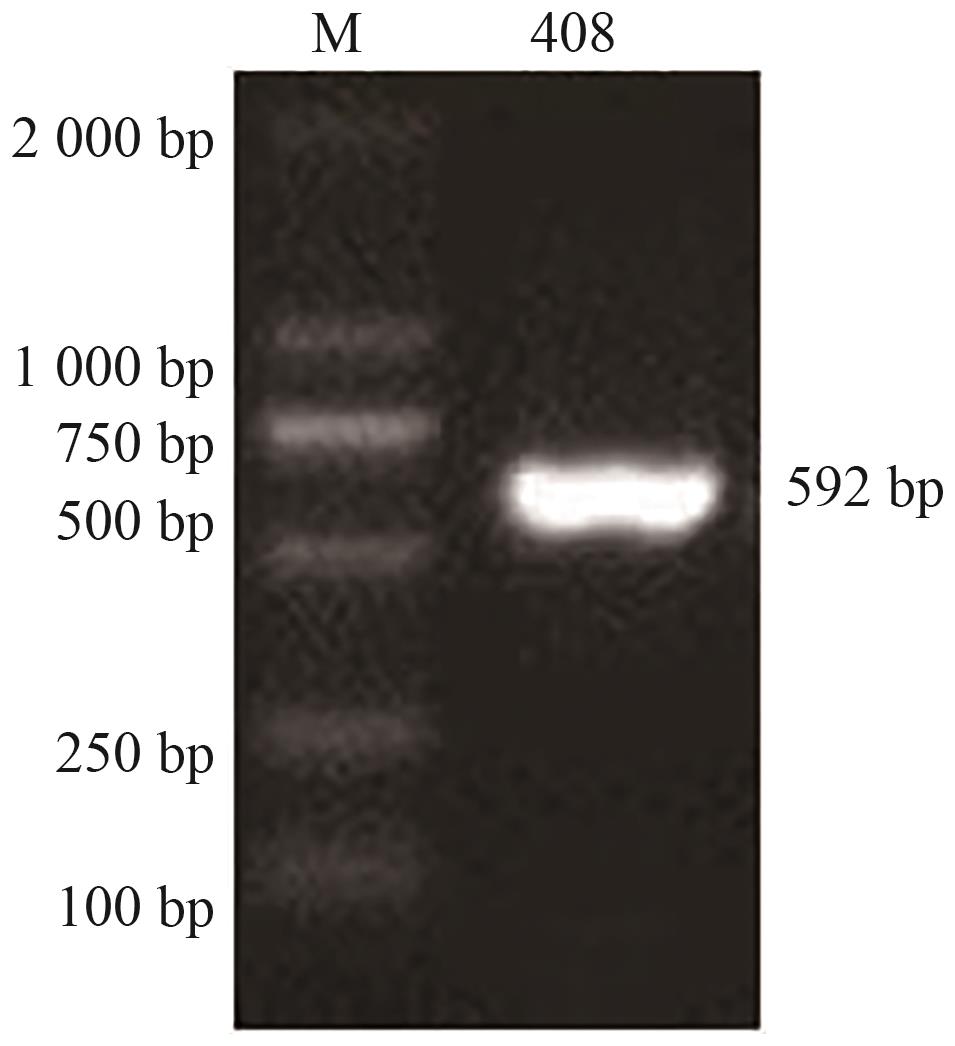
图2 供试菌株M408电泳检测结果
Fig. 2 Electrophoresis analysis result of test strain M408

图3 基于 ITS 序列构建的M408系统发育树
Fig. 3 M408 phylogenetic tree based on ITS sequence
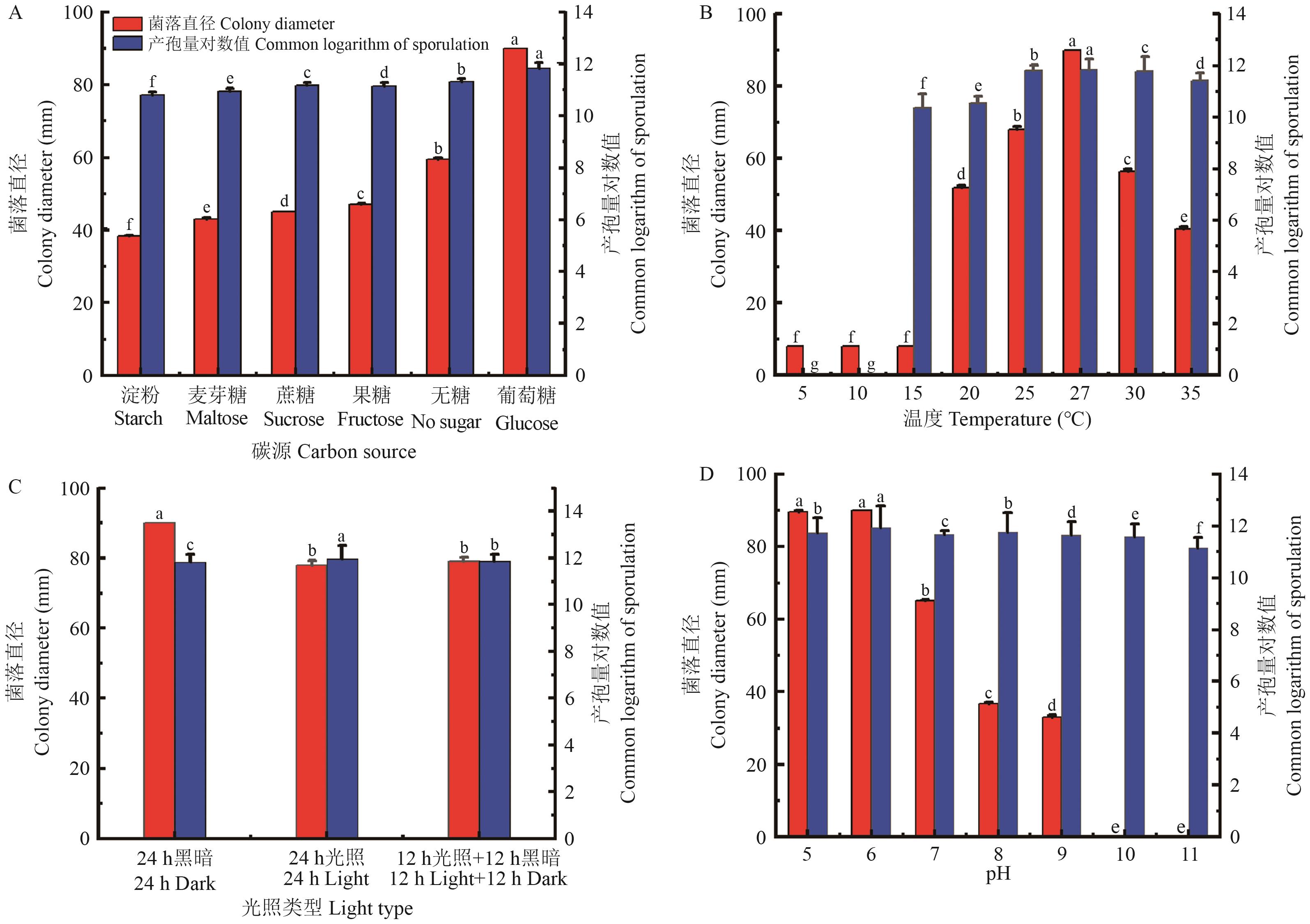
图4 碳源、温度 、光照类型和pH对菌株哈茨木霉M408菌丝生长和产孢的影响图中不同小写字母表示差异显著(P<0.05),下同
Fig. 4 Effects of carbon source, temperature, light type and pH on mycelial growth and sporulation of strain T. harzianum M408Different lowercase letters in the figure indicate significant differences (P<0.05), the same below
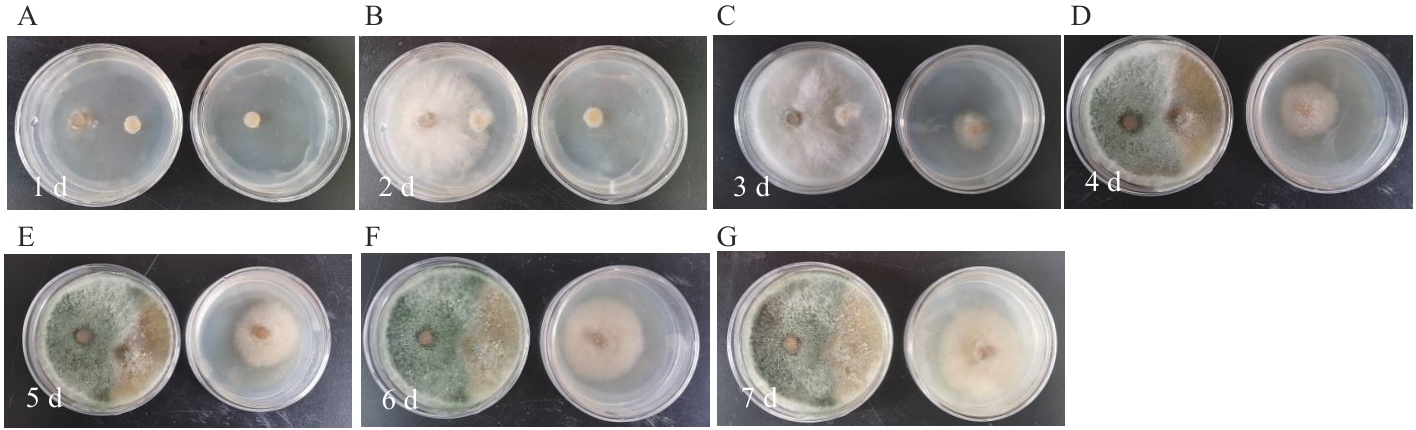
图5 哈茨木霉M408菌丝与茄链格孢菌W5菌丝对峙培养的菌落形态(1-7 d)
Fig. 5 Colony morphology of T. harzianum M408 and A. solani W5 in confrontation culture (1-7 d)
药剂 Agent | 浓度 Concentration | 抑制率 Inhibition (%) |
|---|---|---|
M408原菌粉菌剂 M408 strain original spore powder agent | 108 CFU/mL | 100±0a |
| 107 CFU/mL | 100±0a | |
| 106 CFU/mL | 98.51±0b | |
| 105 CFU/mL | 93.43±0.365c | |
325 g/L苯甲·醚菌酯悬浮剂 325 g/L difenoconazole azoxystrobin SC | 1.0 g/L | 89.55±0d |
| 清水 Water | 0 | --- |
表1 哈茨木霉M408原菌粉菌剂对茄链格孢菌(W5)的室内抑菌率测定结果(7 d)
Table 1 Inhibition rates of T. harzianum M408 strain original spore powder agent on A. solani (W5) (7 d)
药剂 Agent | 浓度 Concentration | 抑制率 Inhibition (%) |
|---|---|---|
M408原菌粉菌剂 M408 strain original spore powder agent | 108 CFU/mL | 100±0a |
| 107 CFU/mL | 100±0a | |
| 106 CFU/mL | 98.51±0b | |
| 105 CFU/mL | 93.43±0.365c | |
325 g/L苯甲·醚菌酯悬浮剂 325 g/L difenoconazole azoxystrobin SC | 1.0 g/L | 89.55±0d |
| 清水 Water | 0 | --- |
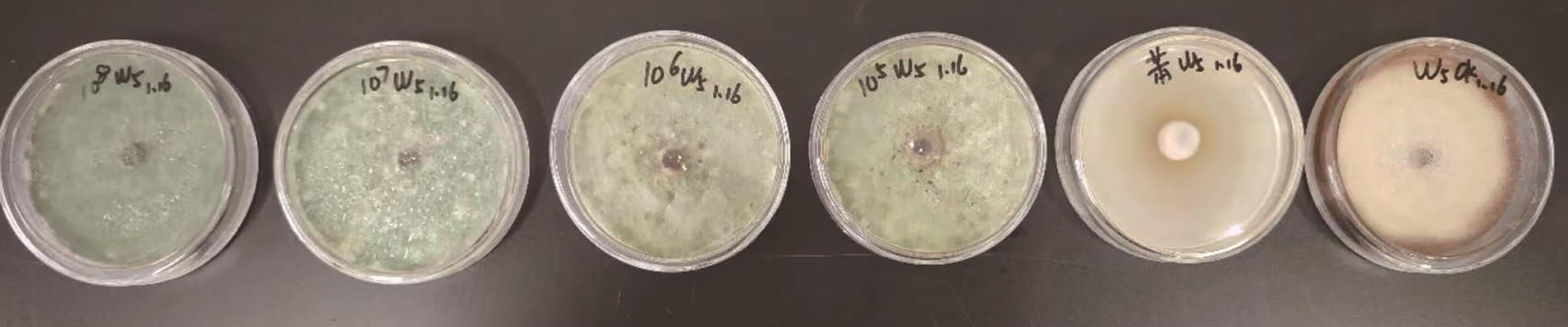
图6 哈茨木霉M408原菌粉菌剂对茄链格孢菌W5菌株抑制效果(7 d)从左到右依次为孢子浓度108、107、106、105 CFU/mL的哈茨木霉M408原菌粉菌剂处理,1.0 g/L的325 g/L苯甲·醚菌酯悬浮剂处理,空白CK
Fig. 6 Inhibitory effects of T. harzianum M408 original spore powder agent on Alternaria solani (W5) (7 d)From left to right, spore concentration are 108, 107, 106, and 105 CFU/mL T. harzianum M408 original spore powder agent, 1.0 g/L of 325 g/L difenoconazole azoxystrobin SC, blank CK
药剂 Agent | 浓度 Concentration | 药前病情指数 Disease index before application | 第一次药后7 d 7 d after the first application | 第二次药后7 d 7 d after the second application | |||
|---|---|---|---|---|---|---|---|
病情指数 Disease index | 相对防效 Relative prevention effect (%) | 病情指数 Disease index | 相对防效 Relative prevention effect (%) | ||||
M408原菌粉菌剂 M408 strain original spore powder agent | 108 CFU/mL | 1.19 | 0.87 | 87.30±2.01a | 2.07 | 89.44±0.55a | |
| 107 CFU/mL | 1.33 | 1.15 | 85.57±1.64ab | 2.85 | 87.07±0.93ab | ||
| 106 CFU/mL | 1.37 | 1.42 | 82.51±1.30ab | 3.48 | 84.56±1.00b | ||
| 105 CFU/mL | 1.22 | 1.48 | 79.71±2.75bc | 3.85 | 81.01±0.67c | ||
325 g/L苯甲·醚菌酯悬浮剂 325 g/L Difenoconazole azoxystrobin SC | 1.0 g/L | 1.26 | 1.87 | 75.63±1.86c | 4.93 | 76.37±1.98d | |
| 清水 Water | 0 | 1.33 | 8.01 | -- | 27.59 | -- | |
表2 哈茨木霉M408原菌粉菌剂对番茄早疫病大田防治效果
Table 2 Field control effect of M408 strain original spore powder agent on tomato early blight
药剂 Agent | 浓度 Concentration | 药前病情指数 Disease index before application | 第一次药后7 d 7 d after the first application | 第二次药后7 d 7 d after the second application | |||
|---|---|---|---|---|---|---|---|
病情指数 Disease index | 相对防效 Relative prevention effect (%) | 病情指数 Disease index | 相对防效 Relative prevention effect (%) | ||||
M408原菌粉菌剂 M408 strain original spore powder agent | 108 CFU/mL | 1.19 | 0.87 | 87.30±2.01a | 2.07 | 89.44±0.55a | |
| 107 CFU/mL | 1.33 | 1.15 | 85.57±1.64ab | 2.85 | 87.07±0.93ab | ||
| 106 CFU/mL | 1.37 | 1.42 | 82.51±1.30ab | 3.48 | 84.56±1.00b | ||
| 105 CFU/mL | 1.22 | 1.48 | 79.71±2.75bc | 3.85 | 81.01±0.67c | ||
325 g/L苯甲·醚菌酯悬浮剂 325 g/L Difenoconazole azoxystrobin SC | 1.0 g/L | 1.26 | 1.87 | 75.63±1.86c | 4.93 | 76.37±1.98d | |
| 清水 Water | 0 | 1.33 | 8.01 | -- | 27.59 | -- | |
| [1] | Grigolli JFJ, Kubota MM, Alves DP, et al. Characterization of tomato accessions for resistance to early blight [J]. Crop Breed Appl Biotechnol, 2011, 11(2): 174-180. |
| [2] | Fry WE, Birch PJ, Judelson HS, et al. Five reasons to consider Phytophthora infestans a reemerging pathogen [J]. Phytopathology, 2015, 105(7): 966-981. |
| [3] | Ji JY, Yang J, Zhang BW, et al. Sodium pheophorbide a controls cherry tomato gray mold (Botrytis cinerea) by destroying fungal cell structure and enhancing disease resistance-related enzyme activities in fruit [J]. Pestic Biochem Physiol, 2020, 166: 104581. |
| [4] | 李丙雪, SIHOMCHANH Bounpheng, 禤子琪, 等. 番茄枯萎病防治药剂的筛选 [J]. 中国瓜菜, 2021, 34(2): 61-64. |
| Li BX, Bounpheng SC, Xuan ZQ, et al. Screening of fungicides on Fusarium wilt of tomato [J]. China Cucurbits and Vegetables, 2021, 34( 2) : 61-64. | |
| [5] | 赵文珺, 葛蓓孛, 刘炳花, 等. 甲基营养型芽胞杆菌NKG-1对番茄白粉病的防病促生作用研究 [J]. 中国农学通报, 2018, 34(23): 104-109. |
| Zhao WJ, Ge BB, Liu BH, et al. Bacillus methylotrophicus strain NKG-1: growth promotion and disease control effect on tomato powdery mildew [J]. Chin Agric Sci Bull, 2018, 34(23): 104-109. | |
| [6] | Rasool M, Akhter A, Soja G, et al. Role of biochar, compost and plant growth promoting rhizobacteria in the management of tomato early blight disease [J]. Sci Rep, 2021, 11(1): 6092. |
| [7] | 葛晓颖, 孙志刚, 李涛, 等. 设施番茄连作障碍与土壤芽孢杆菌和假单胞菌及微生物群落的关系分析 [J]. 农业环境科学学报, 2016, 35(3): 514-523. |
| Ge XY, Sun ZG, Li T, et al. Soil Pseudomonas spp., Bacillus spp., and microbial communities under tomato continuous cropping in greenhouse production [J]. J Agro Environ Sci, 2016, 35(3): 514-523. | |
| [8] | Huang CJ, Wang TK, Chung SC, et al. Identification of an antifungal chitinase from a potential biocontrol agent, Bacillus cereus 28-9 [J]. J Biochem Mol Biol, 2005, 38(1): 82-88. |
| [9] | 孟素玲, 田彦梅, 顾欣, 等. 木霉的协同防病作用研究进展 [J]. 中国生物防治学报, 2022, 38(3): 739-747. |
| Meng SL, Tian YM, Gu X, et al. Research progress on synergistic disease prevention by Trichoderma [J]. Chin J Biol Control, 2022, 38(3): 739-747. | |
| [10] | 翟明娟, 李登辉, 马玉琴, 等. 绿色木霉菌株Tvir-6对黄瓜根结线虫的防治效果研究 [J]. 中国蔬菜, 2017(10): 67-72. |
| Zhai MJ, Li DH, Ma YQ, et al. Studies on biocontrol effect of Trichoderma viride tvir-6 against root knot nematode on cucumber [J]. China Veg, 2017(10): 67-72. | |
| [11] | 陈云云, 李慧霞, 张海英, 等. 萎缩芽胞杆菌 MQ19ST15 鉴定及对甘蓝枯萎病的盆栽防效 [J]. 植物保护, 2021, 47 (5) : 64 -71. |
| Chen YY, Li HX, Zhang HY, et al. Identification of Bacillus ataophaeus MQ19ST15 and its control efficacy against Fusarium wilt on potted cabbage plants [J]. Pant Protection, 2021, 47(5): 64-71. | |
| [12] | 徐艳辉, 李烨, 许向阳. 番茄枯萎病的研究进展 [J]. 东北农业大学学报, 2008, 39(11): 128-134. |
| Xu YH, Li Y, Xu XY. Progress in research on Fusarium wilt of tomato [J]. J Northeast Agric Univ, 2008, 39(11): 128-134. | |
| [13] | 李梅, 田莹, 蒋细良. 植物内生木霉菌研究进展 [J]. 中国生物防治学报, 2020, 36(2): 155-162. |
| Li M, Tian Y, Jiang XL. Advances in research on endophytic Trichoderma in plants [J]. Chin J Biol Control, 2020, 36(2): 155-162. | |
| [14] | Druzhinina IS, Seidl-Seiboth V, Herrera-Estrella A, et al. Trichoderma: the genomics of opportunistic success [J]. Nat Rev Microbiol, 2011, 9(10): 749-759. |
| [15] | 张广志, 张新建, 陈泉, 等. 哈茨木霉复合种内3个中国新记录种的分离和鉴定 [J]. 山东科学, 2015, 28(6): 43-46, 51. |
| Zhang GZ, Zhang XJ, Chen Q, et al. Isolation and identification of three Chinese new records in Trichoderma harzianum species complex [J]. Shandong Sci, 2015, 28(6): 43-46, 51. | |
| [16] | 尤佳琪, 吴明德, 李国庆. 木霉在植物病害生物防治中的应用及作用机制 [J]. 中国生物防治学报, 2019, 35(6): 966-976. |
| You JQ, Wu MD, Li GQ. Application and mechanism of Trichoderma in biological control of plant disease [J]. Chin J Biol Control, 2019, 35(6): 966-976. | |
| [17] | 潘亚妮, 惠有为. 绿色木霉防治温室灰霉病研究 [J]. 安徽农业科学, 2010, 38(15): 7913-7914, 7964. |
| Pan YN, Hui YW. Study on Trichoderma viride strains to control vegetable grey mould in greenhouse [J]. J Anhui Agric Sci, 2010, 38(15): 7913-7914, 7964. | |
| [18] | 危潇, 黎妍妍, 姚经武, 等. 哈茨木霉WF2 菌株鉴定及对烟草黑胫病的防效 [J]. 中南农业科技, 2023, 44(11): 12-15. |
| Wei X, Li YY, Yao JW, et al. Identification of Trichoderma harzianum WF2 strain and its control effect on tobacco black shank [J]. South-Central Agricultural Science and Technology, 2023, 44(11): 12-15. | |
| [19] | 原甜甜, 李宗阳, 陈佳佳, 等. 核桃炭疽病新型生防木霉的筛选及生物学特性研究 [J]. 林产工业, 2023, 60(6): 57-63. |
| Yuan TT, Li ZY, Chen JJ, et al. Selecting and biological characteristics of Trichoderma sp. against walnut anthracnose [J]. China Forest Products Industry, 2023, 60(6): 57-63. | |
| [20] | Rojo FG, Reynoso MM, Ferez M, et al. Biological control by Trichoderma species of Fusarium solani causing peanut brown root rot under field conditions [J]. Crop Prot, 2007, 26(4): 549-555. |
| [21] | 王永阳, 杜佳, 高克祥. 苦瓜枯萎病生防木霉的筛选鉴定及其定殖的qPCR检测 [J]. 山东农业科学, 2018, 50(8) : 110-115. |
| Wang YY, Du J, Gao KX. Screening and identification of biocontrol Trichoderma to wilt of bitter gourd and detection of its colonization by qPCR [J]. Shandong Agricultural Sciences, 2018, 50(8): 110-115. | |
| [22] | 吕黎, 许丽媛, 罗志威, 等. 哈茨木霉生物防治研究进展 [J]. 湖南农业科学, 2013(17): 92-95. |
| Lv L, Xu LY, Luo ZW, et al. Research progress of biocontrol effect of Trichoderma harzianum [J]. Hunan Agric Sci, 2013(17): 92-95. | |
| [23] | 王桂清, 曾路, 马迪, 等. 我国近10年植物致病真菌生物学特性研究综述 [J]. 江苏农业科学, 2018, 46(19): 1-5. |
| Wang GQ, Zeng L, Ma D, et al. Study on biological characteristics of plant pathogenic fungi in China in recent 10 years: a review [J]. Jiangsu Agric Sci, 2018, 46(19): 1-5. | |
| [24] | Bissett J, Gams W, Jaklitsch W, et al. Accepted Trichoderma names in the year 2015 [J]. IMA Fungus, 2015, 6(2): 263-295. |
| [25] | Verma M, Brar SK, Tyagi RD, et al. Antagonistic fungi, Trichoderma spp. panoply of biological control [J]. Biochem Eng J, 2007, 37(1): 1-20. |
| [26] | Harman GE. Myths and dogmas of biocontrol changes in perceptions derived from research on Trichoderma harzinum T-22 [J]. Plant Dis, 2000, 84(4): 377-393. |
| [27] | 尤佳琪, 杜然, 顾卫红, 等. 拟康宁木霉T-51菌株生物学特性及其生物防治潜力 [J]. 植物保护学报, 2022, 49(3): 946-955. |
| You JQ, Du R, Gu WH, et al. Biological characteristics and biological control potential of endophytic fungus Trichoderma koningiopsis strain T-51 [J]. J Plant Prot, 2022, 49(3): 946-955. | |
| [28] | Prather TS, Lanini WT, Orloff S, et al. Interplanting grasses into alfalfa controls weeds in older stands [J]. Cal Ag, 2000, 54(6): 37-41. |
| [29] | 杨合同. 木霉分类与鉴定 [M]. 北京: 中国大地出版社, 2009. |
| Yang HT. Classification and identification of Trichoderma [M]. Beijing: China Land Press, 2009. | |
| [30] | 田淼, 彭玉飞, 吕红, 等. 非洲哈茨木霉LMNS-M9的鉴定、生物学特性及其对藜麦的促生作用 [J]. 微生物学通报, 2023, 50(9): 3848-3865. |
| Tian M, Peng YF, Lü H, et al. Trichoderma afroharzianum LMNS-M9: identification, biological characteristics, and growth-promoting effect on quinoa [J]. Microbiol China, 2023, 50(9): 3848-3865. | |
| [31] | Bell DK. In vitro antagonism ofTrichodermaspecies against six fungal plant pathogens [J]. Phytopathology, 1982, 72(4): 379. |
| [32] | 田桢, 曹传旺, 季世达, 等. 新疆野果林木霉分离鉴定、抑菌作用及固态发酵配方优化 [J]. 微生物学通报, 2021, 48(12): 4696-4709. |
| Tian Z, Cao CW, Ji SD, et al. Isolation and identification of Trichoderma strains, and antifungal effects and solid-state fermentation recipe optimization from Xinjiang wild fruit forest [J]. Microbiol China, 2021, 48(12): 4696-4709. | |
| [33] | 李万星, 李丹, 李小霞, 等. 不同轮作模式对旱地番茄品质、产量及土壤真菌多样性的影响 [J]. 华北农学报, 2022, 37(4): 82-89. |
| Li WX, Li D, Li XX, et al. Effects of different rotation patterns on tomato quality and yield and soil fungi diversity in dryland [J]. Acta Agriculturae Boreali-Sinica, 2022, 37(4): 82-89. | |
| [34] | 罗洋, 滕应, 罗绪强, 等. 里氏木霉FS10-C可湿性粉剂的研制及其促生效果测定 [J]. 生物技术通报, 2016, 32(8): 194-199. |
| Luo Y, Teng Y, Luo XQ, et al. Development of wettable powder of Trichoderma reesei FS10-C and its plant growth-promoting effects [J]. Biotechnol Bull, 2016, 32(8): 194-199. | |
| [35] | 邓龙, 邓勋, 尹大川, 等. 木霉菌株TC-14的生物学特性及rDNA ITS序列测定 [J]. 黑龙江生态工程职业学院学报, 2012, 25(5): 23-25. |
| Deng L, Deng X, Yin DC, et al. Biological characteristics and rDNA ITS sequencing of Trichoderma isolate TC-14 [J]. Journal of Heilongjiang Vocational Institute of Ecological Engineering, 2012, 25(5): 23-25. | |
| [36] | 佟昀铮, 于汇琳, 潘洪玉, 等. 玉米茎腐病生防菌哈茨木霉CCTH-2鉴定及其生物学特性 [J]. 华北农学报, 2022, 37(S1): 309-317. |
| Tong YZ, Yu HL, Pan HY, et al. Identification of Trichoderma harzianum CCTH-2 and its biological characteristics, a biocontrol fungi against corn stalk rot [J]. Acta Agriculturae Boreali-Simica, 2022, 37 (S1): 309-317. | |
| [37] | 梁松, 魏甜甜, 张静蕾, 等. 辣椒枯萎病生防木霉菌 T21 的分离鉴定及其生物学特性研究 [J]. 天津农业科学, 2022, 28(5): 59-66. |
| Liang S, Wei TT, Zhang JL, et al. Isolation, identification, control effect and biological characteristics of Trichoderma biocontrol of pepper Fusarium wilt [J]. Tianjin Agricultural Sciences, 2022, 28(5): 59-66. | |
| [38] | 李梅云, 谭丽华, 方敦煌, 等. 哈茨木霉的培养及其对烟草疫霉生长的抑制研究 [J]. 微生物学通报, 2006, 33(6): 79-83. |
| Li MY, Tan LH, Fang DH, et al. Cultural characteristics of Trichoderma harzianum and its inhibition to Phytophthora nicotianae [J]. Microbiology, 2006, 33(6): 79-83. | |
| [39] | 赵晓彤, 王桂清. 不同培养条件对长枝木霉 SMF2 和哈茨木霉 T39生长与产孢的影响 [J]. 山东农业科学, 2023, 55(8): 56-64. |
| Zhao XT, Wang GQ. Effects of Different Culture Conditions on Growth and Sporulation of Trichoderma Longibrachiatum SMF2 and Trichoderma Harzianum T39 [J]. Shandong Agricultural Sciences, 2023, 55(8): 56-64. | |
| [40] | Chowdappa P, Mohan Kumar SP, Jyothi Lakshmi M, et al. Growth stimulation and induction of systemic resistance in tomato against early and late blight by Bacillus subtilis OTPB1 or Trichoderma harzianum OTPB3 [J]. Biol Control, 2013, 65(1): 109-117. |
| [41] | Fontenelle ADB, Guzzo SD, Lucon CMM, et al. Growth promotion and induction of resistance in tomato plant against Xanthomonas euvesicatoria and Alternaria solani by Trichoderma spp [J]. Crop Prot, 2011, 30(11): 1492-1500. |
| [42] | Marzano M, Gallo A, Altomare C. Improvement of biocontrol efficacy of Trichoderma harzianum vs. Fusarium oxysporum f. sp. lycopersici through UV-induced tolerance to fusaric acid [J]. Biol Control, 2013, 67(3): 397-408. |
| [43] | Malmierca MG, Barua J, McCormick SP, et al. Novel aspinolide production by Trichoderma arundinaceum with a potential role in Botrytis cinerea antagonistic activity and plant defence priming [J]. Environ Microbiol, 2015, 17(4): 1103-1118. |
| [44] | Contreras-Cornejo HA, Macías-Rodríguez L, Herrera-Estrella A, et al. The 4-phosphopantetheinyl transferase of Trichoderma virens plays a role in plant protection against Botrytis cinerea through volatile organic compound emission [J]. Plant Soil, 2014, 379(1): 261-274. |
| [45] | 张晓尘, 张红杰, 李生兵, 等. 哈茨木霉EMF910对宁夏盐碱地区黄芪根腐病致病菌的防治作用 [J]. 微生物学通报, 2024, 51(10): 4162-4180. |
| Zhang XC, Zhang HJ, Li SB, et al. The control effect of Trichoderma harzianum EMF910 on the root rot pathogens of Astragalus membranaceus in Ningxia saline-alkali regions [J]. Microbiol China, 2024, 51(10): 4162-4180. | |
| [46] | 陈凯, 隋丽娜, 赵忠娟, 等. 木霉共培养发酵对黄瓜枯萎病的防治效果 [J]. 中国生物防治学报, 2022, 38(1): 108-114. |
| Chen K, Sui LN, Zhao ZJ, et al. Control effect of co-cultured fermentation of two Trichoderma strains on cucumber Fusarium wilt [J]. Chin J Biol Control, 2022, 38(1): 108-114. | |
| [47] | Reino JL, Guerrero RF, Hernández-Galán R, et al. Secondary metabolites from species of the biocontrol agent Trichoderma [J]. Phytochem Rev, 2008, 7(1): 89-123. |
| [48] | Deacon JW, Berry LA. Modes of action of mycoparasites in relation to biocontrol of soilborne plant pathogens [M]//Biological Control of Plant Diseases. Boston, MA: Springer US, 1992: 157-167. |
| [49] | 陆洪省, 张雪, 高宇婷, 等. 哈茨木霉SKD-ZX-1的鉴定、发酵及其生防效果 [J]. 生物技术通报, 2019, 35(11): 132-140. |
| Lu HS, Zhang X, Gao YT, et al. Identification, fermentation and biocontrol efficiency of Trichoderma harzianum SKD-ZX-1 [J]. Biotechnol Bull, 2019, 35(11): 132-140. | |
| [50] | 曲薇, 伍淼, 王旭东, 等. 哈茨木霉菌株WY-1对番茄的促生防病效果 [J]. 江苏农业科学, 2018, 46(5): 94-96. |
| Qu W, Wu M, Wang XD, et al. Effects of Trichoderma harzianum strain WY-1 on growth and disease control of tomato [J]. Jiangsu Agric Sci, 2018, 46(5): 94-96. |
| [1] | 张茹, 李一鸣, 张桐溪, 孙占斌, 任清, 潘寒姁. 厚朴中1株高产厚朴酚与和厚朴酚菌株的分离鉴定及其“发汗”工艺优化[J]. 生物技术通报, 2025, 41(8): 322-334. |
| [2] | 陈永旗, 李志文, 李鑫, 原若曦, 王春旭, 韩毅强, 高亚梅. 黑土区大豆根际土壤放线菌的分离与功能研究[J]. 生物技术通报, 2025, 41(5): 255-266. |
| [3] | 项波卡, 周钻钻, 冯佳卉, 夏琛, 李奇, 陈春. 一株烟叶霉变真菌的分离鉴定及其致霉因素研究[J]. 生物技术通报, 2025, 41(2): 321-330. |
| [4] | 张亚亚, 李盼盼, 高惠惠, 贾晨波, 徐春燕. 基于根表真菌群落与病原菌鉴定探究‘宁杞5号’枸杞根腐病的发生机制[J]. 生物技术通报, 2024, 40(9): 238-248. |
| [5] | 王芳, 于璐, 齐泽铮, 周长军, 于吉东. 大豆镰刀菌根腐病拮抗菌的筛选及生防效果[J]. 生物技术通报, 2024, 40(7): 216-225. |
| [6] | 周江鸿, 夏菲, 仲丽, 仇兰芬, 李广, 刘倩, 张国锋, 邵金丽, 李娜, 车少臣. 黄栌枯萎病拮抗细菌CCBC3-3-1的全基因组测序及比较基因组分析[J]. 生物技术通报, 2024, 40(7): 235-246. |
| [7] | 饶永斌, 张君丽. 亚紫裸伞的生物学特性及驯化栽培[J]. 生物技术通报, 2024, 40(4): 264-270. |
| [8] | 王璐, 刘梦雨, 张富源, 纪守坤, 王云, 张英杰, 段春辉, 刘月琴, 严慧. 瘤胃源粪臭素降解菌的分离鉴定及其降解特性研究[J]. 生物技术通报, 2024, 40(3): 305-311. |
| [9] | 叶柳健, 贺愉岚, 王小虎, 韦圣博, 何双, 朱绮霞, 卢洁, 周礼芹. 解淀粉芽孢杆菌YK3对沃柑溃疡病的防效及叶际细菌群落相关性的影响[J]. 生物技术通报, 2024, 40(11): 248-258. |
| [10] | 饶紫环, 谢志雄. 一株Olivibacter jilunii 纤维素降解菌株的分离鉴定与降解能力分析[J]. 生物技术通报, 2023, 39(8): 283-290. |
| [11] | 游子娟, 陈汉林, 邓辅财. 鱼皮生物活性肽的提取及功能活性研究进展[J]. 生物技术通报, 2023, 39(7): 91-104. |
| [12] | 车永梅, 郭艳苹, 刘广超, 叶青, 李雅华, 赵方贵, 刘新. 菌株C8和B4的分离鉴定及其耐盐促生效果和机制[J]. 生物技术通报, 2023, 39(5): 276-285. |
| [13] | 王凤婷, 王岩, 孙颖, 崔文婧, 乔凯彬, 潘洪玉, 刘金亮. 耐盐碱土曲霉SYAT-1的分离鉴定及抑制植物病原真菌特性研究[J]. 生物技术通报, 2023, 39(2): 203-210. |
| [14] | 李莹, 宋新颖, 何康, 郭志青, 于静, 张霞. 贝莱斯芽孢杆菌ZHX-7的分离鉴定及抑菌促生效果[J]. 生物技术通报, 2023, 39(12): 229-236. |
| [15] | 董怡华, 王凌潇, 任涵雪, 陈峰. 一株耐低温异养硝化-好氧反硝化菌的分离鉴定及其脱氮特性[J]. 生物技术通报, 2023, 39(12): 237-249. |
| 阅读次数 | ||||||
|
全文 |
|
|||||
|
摘要 |
|
|||||
