







生物技术通报 ›› 2026, Vol. 42 ›› Issue (8): 113-122.doi: 10.13560/j.cnki.biotech.bull.1985.2025-1282
• 研究报告 • 上一篇
杨群1,2,3, 李京1, 符德保3, 许婷婷1( )
)
收稿日期:2025-11-24
出版日期:2026-08-26
发布日期:2026-08-17
通讯作者:
许婷婷xtt8831@163.com基金资助:
YANG Qun1,2,3, LI Jing1, FU De-bao3, XU Ting-ting1()
Received:2025-11-24
Published:2026-08-26
Online:2026-08-17
摘要:
目的 LAX1 (LAX PANICLE 1)-LAX2 (LAX PANICLE 2)复合体是调控水稻穗侧生分生组织发育的关键模块。bHLH(basic helix-loop-helix)转录因子OsbHLH069能与LAX1互作,其功能获得突变体nsp1-D(no spikelet 1-Dominant)呈现稀穗表型。旨在解析三者间的分子互作模式,阐明其调控穗分枝发育的机制。 方法 利用水稻原生质体和酵母系统鉴定OsbHLH069的核定位信号与转录激活域。通过酵母双杂交、双分子荧光互补和体外pull-down实验,探究OsbHLH069与LAX2的互作关系。利用田间杂交技术,构建lax2-4 nsp1-D双突变体,采用实时荧光定量PCR分析其遗传关系。通过截短突变体和酵母双杂交试验确定3个蛋白互作区段。利用荧光素酶互补试验探究互作模型。 结果 OsbHLH069是一个典型的核定位转录激活因子,其核定位信号位于266‒285 aa,转录激活域位于N端1‒120 aa。OsbHLH069与LAX2在体内外互作。OsbHLH069通过bHLH结构域与LAX1互作,又通过C端区域与LAX2互作,其互作区段与LAX1-LAX2互作区段重合。OsbHLH069竞争性抑制LAX1-LAX2的复合体稳定性。lax2-4 nsp1-D双突变体枝梗数和每穗粒数缺失表型强于任一单突变体,与lax1 nsp1-D双突变体表型结果类似。 结论 提出一个阶段性调控模型:在穗侧生分生组织发育早期,LAX1-LAX2复合体促进侧生分生组织起始;随着发育的进行,OsbHLH069通过竞争性拆解LAX1-LAX2复合体,实现对穗侧生分生组织的精细负调控。
杨群, 李京, 符德保, 许婷婷. OsbHLH069通过对LAX1-LAX2复合体的竞争性干扰负调控水稻穗发育[J]. 生物技术通报, 2026, 42(8): 113-122.
YANG Qun, LI Jing, FU De-bao, XU Ting-ting. OsbHLH069 Negatively Regulates Rice Panicle Development by Competitively Interfering with the LAX1-LAX2 Complex[J]. Biotechnology Bulletin, 2026, 42(8): 113-122.
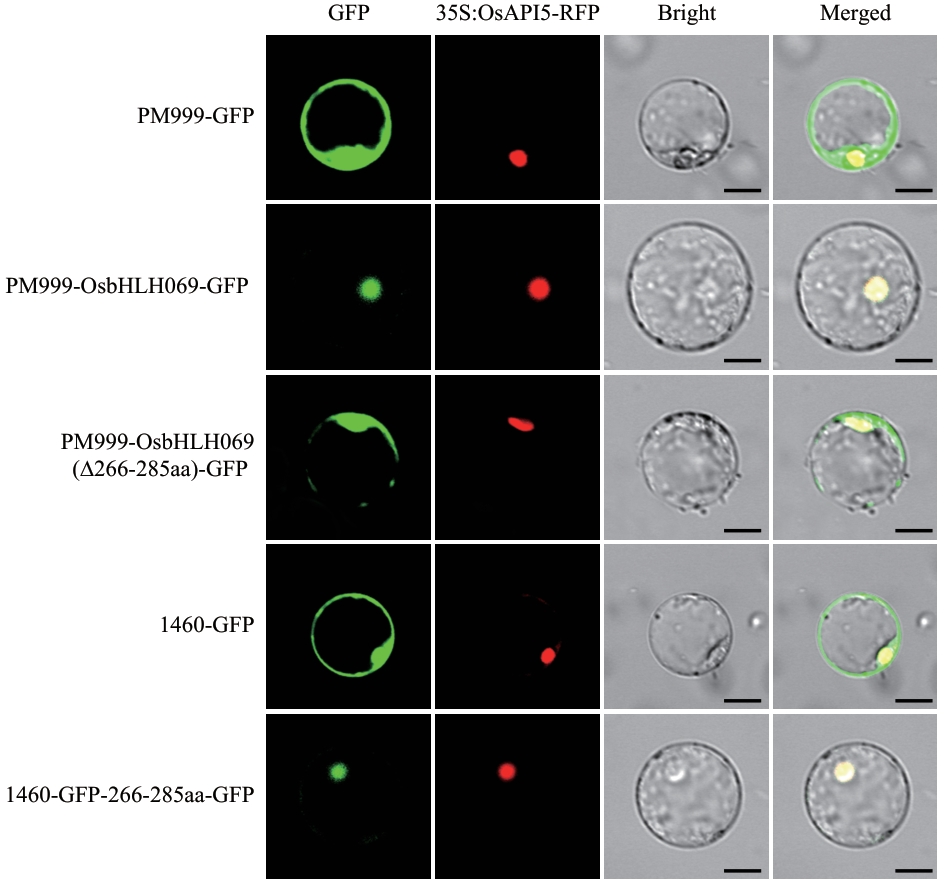
图1 OsbHLH069核定位信号肽分析35S:OsAPI5-RFP为核定位标记蛋白。标尺=10 μm
Fig. 1 Analysis of the nuclear localization signal peptide of OsbHLH06935S:OsAPI5-RFP served as a nuclear localization protein marker. Scale bar=10 μm
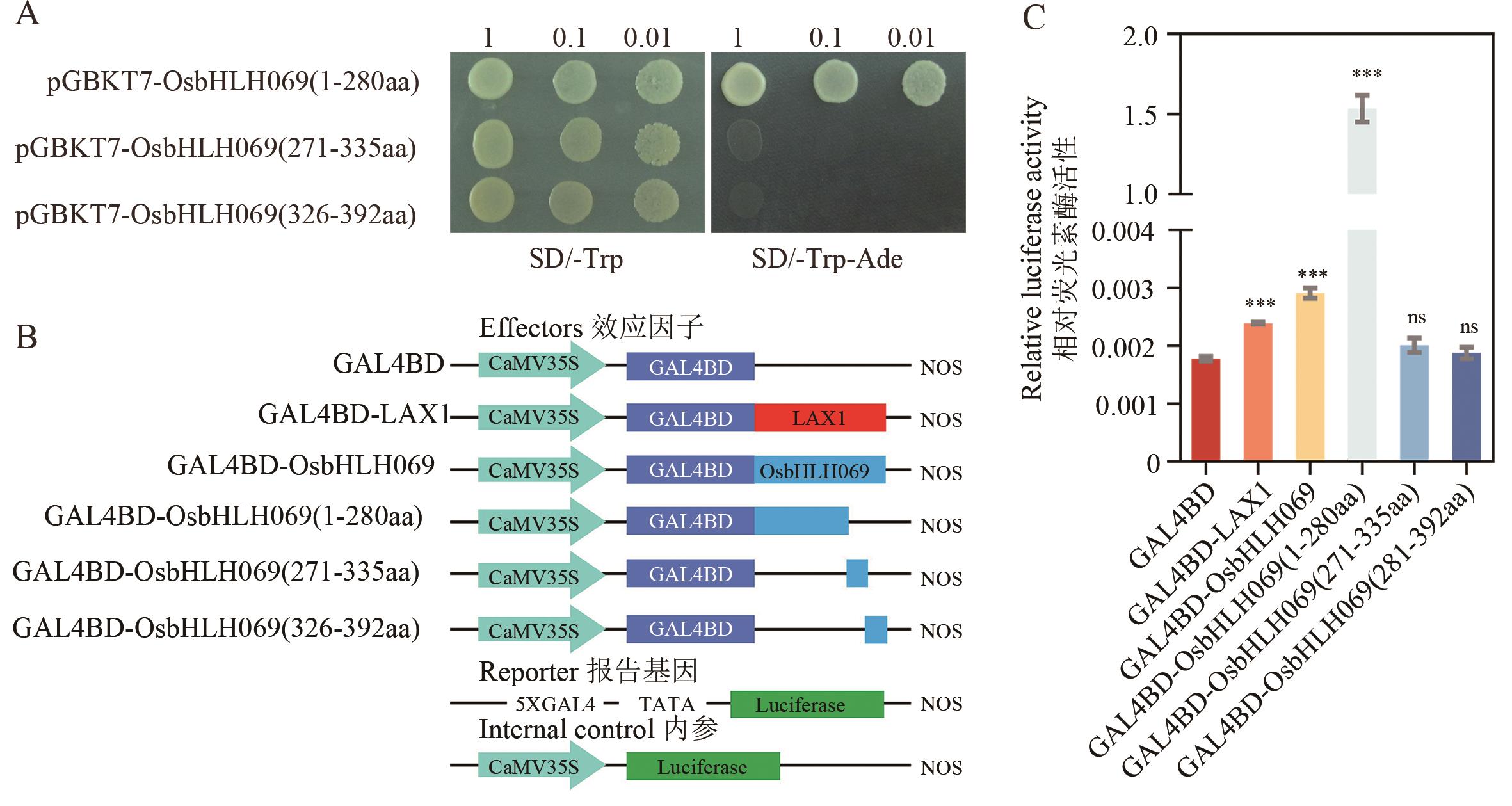
图2 OsbHLH069截短蛋白转录活性分析A:酵母细胞中分析OsbHLH069截短蛋白转录活性;B:载体示意图;C:水稻原生质体中分析OsbHLH069不同截短蛋白转录活性。***:差异极显著(P<0.001),ns:差异不显著(P>0.05)
Fig. 2 Transcriptional activity analysis of OsbHLH069 truncated proteinA: Analysis of the transcriptional activity of truncated OsbHLH069 proteins in yeast cells. B: Schematic diagram of the vectors. C: Analysis of the transcriptional activity of truncated OsbHLH069 proteins in rice protoplasts. ***: A significant difference (P<0.001). ns: No significant difference (P>0.05)
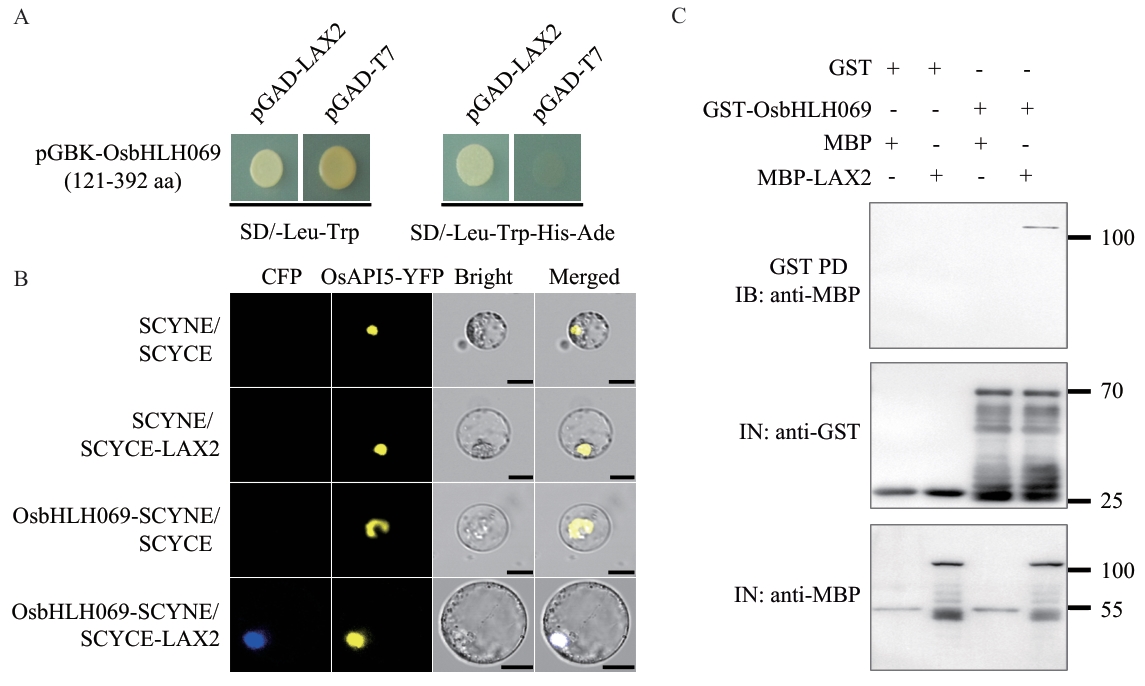
图3 OsbHLH069与LAX2在体内和体外的互作验证A:酵母双杂交试验;B:双分子荧光互补试验;35S:OsAPI5-YFP为细胞核标记物;标尺=10 µm;C:体外pull-down试验
Fig. 3 Validation of the interaction between OsbHLH069 and LAX2 in vivo and in vitroA: Yeast two-hybrid assay. B: Bimolecular fluorescence complementation assay. 35S:OsAPI5-YFP serves as a nuclear marker. Scale bar = 10 µm. C: In vitro pull-down assay
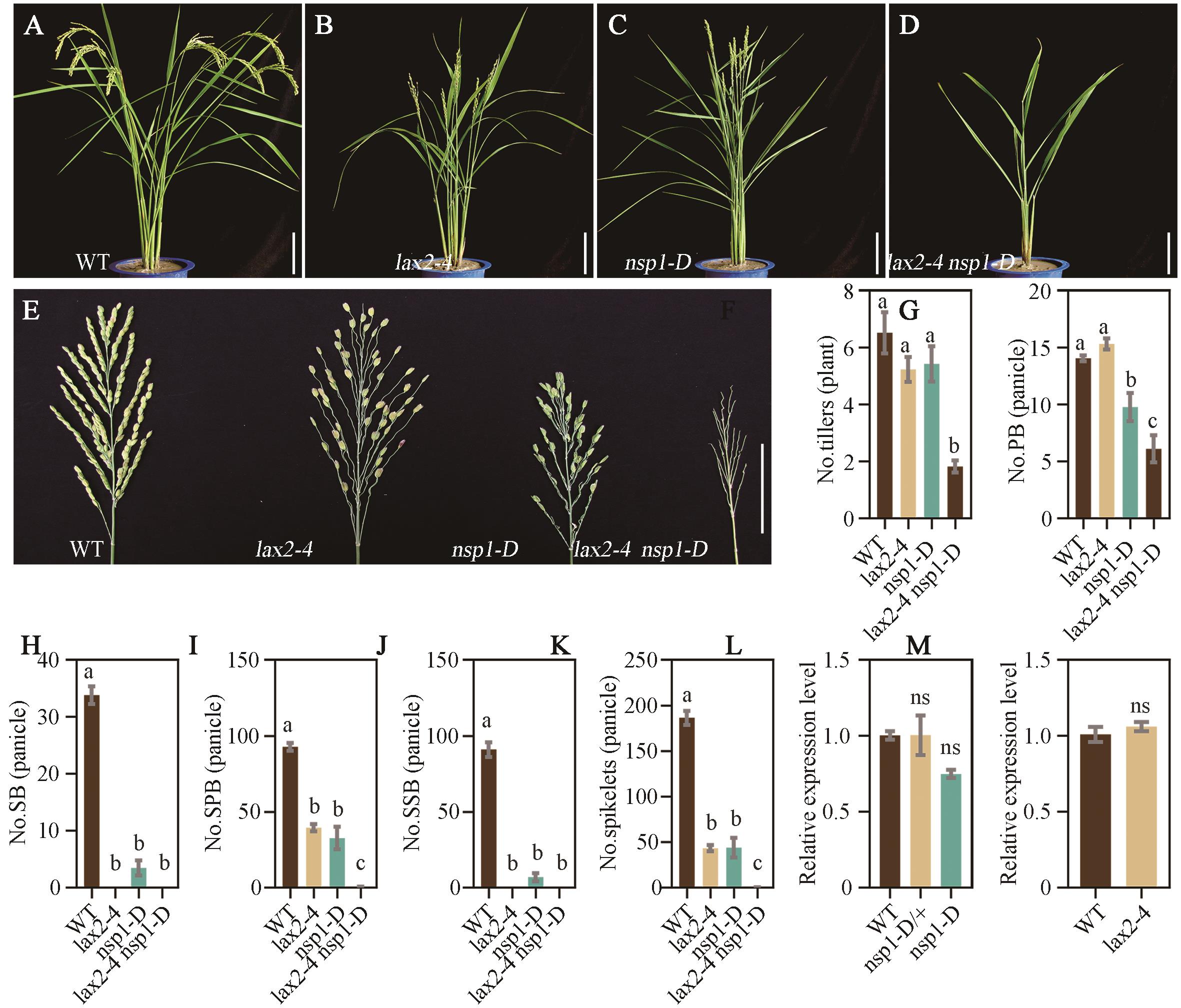
图4 lax2-4 nsp1-D双突变体的表型分析A‒D:株型图,标尺为11 cm;E:穗型图,标尺为6 cm;F:分蘖数;G:一次枝梗数;H:二次枝梗数;I:一次枝梗上的小穗数;J:二次枝梗上的小穗数;K:总穗数;L:实时荧光定量PCR检测LAX2的表达量;M:实时荧光定量PCR检测OsbHLH069的表达量。不同小写字母表示组间差异显著(P<0.05),ns代表差异不显著(P>0.05)
Fig. 4 Phenotypic analysis of lax2-4 nsp1-D double mutantsA‒D: Plant architecture, bars=11 cm. E: Panicle morphology, bar=6 cm. F: Tiller number. G: Primary branch number. H: Secondary branch number. I: Spikelet number per primary branch. J: Spikelets number per secondary branch. K: Total spikelet number per panicle. L: Quantitative real-time PCR detection of LAX2 expression. M: Quantitative real-time PCR detection of OsbHLH069 expression. Different lowercase letters indicate significant differences between groups (P<0.05); ns refers to no significant difference (P>0.05)
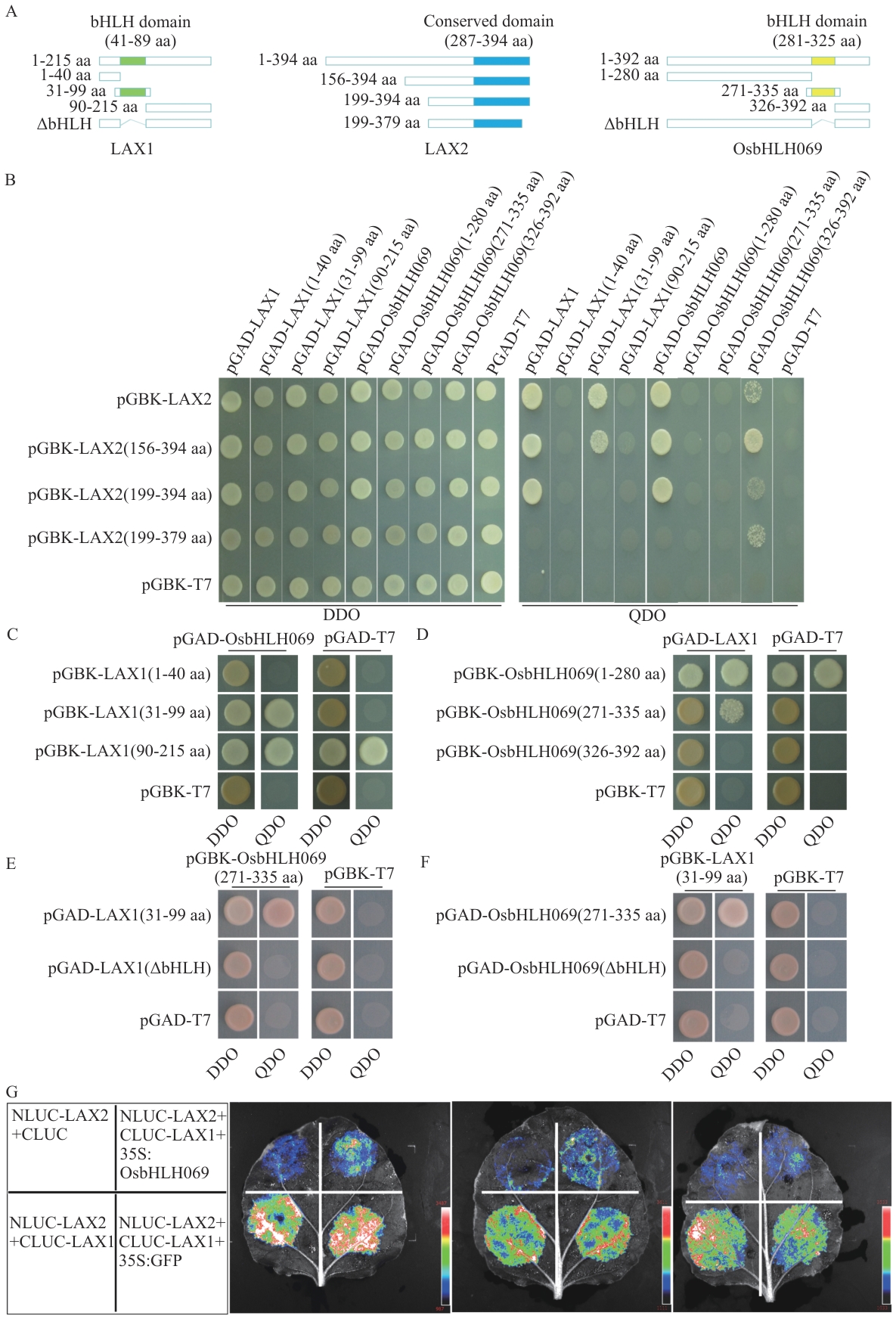
图5 OsbHLH069、LAX1和LAX2互作模式研究A:LAX1、LAX2和OsbHLH069氨基酸截短示意图;B‒F:酵母双杂交分析,DDO:二缺培养基SD/-Leu/-Trp,QDO:四缺培养基SD/-Leu/-Trp/-His/-Ade;G:荧光素酶互补试验
Fig. 5 Study on the interaction modes of OsbHLH069, LAX1, and LAX2A: Schematic diagram of amino acid truncation for LAX1, LAX2, and OsbHLH069. B‒F: Yeast two-hybrid analysis. Double Dropout Medium (DDO) refers to SD/-Leu/-Trp. Quadruple Dropout Medium (QDO) refers to SD/-Leu/-Trp/-His/-Ade. G: Luciferase complementation assay
| [1] | Xing YZ, Zhang QF. Genetic and molecular bases of rice yield [J]. Annu Rev Plant Biol, 2010, 61: 421-442. |
| [2] | 刘园园, 陈析丰, 钱前, 等. 水稻穗发育调控的分子机制研究进展 [J]. 生物技术通报, 2025, 41(5): 1-13. |
| Liu YY, Chen XF, Qian Q, et al. Advances in molecular mechanisms regulating panicle development in rice [J]. Biotechnol Bull, 2025, 41(5): 1-13. | |
| [3] | Komatsu K, Maekawa M, Ujiie S, et al. LAX and SPA: Major regulators of shoot branching in rice [J]. Proc Natl Acad Sci USA, 2003, 100(20): 11765-11770. |
| [4] | Tabuchi H, Zhang Y, Hattori S, et al. LAX PANICLE2 of rice encodes a novel nuclear protein and regulates the formation of axillary meristems [J]. Plant Cell, 2011, 23(9): 3276-3287. |
| [5] | Ritter MK, Padilla CM, Schmidt RJ. The maize mutant barren stalk1 is defective in axillary meristem development [J]. American J Botany, 2002, 89(2): 203-210. |
| [6] | Yao H, Skirpan A, Wardell B, et al. The barren stalk2 gene is required for axillary meristem development in maize [J]. Mol Plant, 2019, 12(3): 374-389. |
| [7] | Greb T, Clarenz O, Schäfer E, et al. Molecular analysis of the LATERAL SUPPRESSOR gene in Arabidopsis reveals a conserved control mechanism for axillary meristem formation [J]. Genes Dev, 2003, 17(9): 1175-1187. |
| [8] | Gälweiler L, Guan CH, Müller A, et al. Regulation of polar auxin transport by AtPIN1 in Arabidopsis vascular tissue [J]. Science, 1998, 282(5397): 2226-2230. |
| [9] | Bennett SRM, Alvarez J, Bossinger G, et al. Morphogenesis in pinoid mutants of Arabidopsis thaliana [J]. Plant J, 1995, 8(4): 505-520. |
| [10] | Li Y, Zhu JS, Wu LL, et al. Functional divergence of PIN1 paralogous genes in rice [J]. Plant Cell Physiol, 2019, 60(12): 2720-2732. |
| [11] | He YB, Yan L, Ge CN, et al. PINOID is required for formation of the stigma and style in rice [J]. Plant Physiol, 2019, 180(2): 926-936. |
| [12] | McSteen P, Hake S. barren inflorescence2 regulates axillary meristem development in the maize inflorescence [J]. Development, 2001, 128(15): 2881-2891. |
| [13] | McSteen P, Malcomber S, Skirpan A, et al. barren inflorescence2 encodes a co-ortholog of the PINOID Serine/threonine kinase and is required for organogenesis during inflorescence and vegetative development in maize [J]. Plant Physiol, 2007, 144(2): 1000-1011. |
| [14] | Skirpan A, Culler AH, Gallavotti A, et al. BARREN INFLORESCENCE2 interaction with ZmPIN1a suggests a role in auxin transport during maize inflorescence development [J]. Plant Cell Physiol, 2009, 50(3): 652-657. |
| [15] | Massari ME, Murre C. Helix-loop-helix proteins: regulators of transcription in eucaryotic organisms [J]. Mol Cell Biol, 2000, 20(2): 429-440. |
| [16] | Poirier BC, Feldman MJ, Lange BM. bHLH093/NFL and bHLH061 are required for apical meristem function in Arabidopsis thaliana [J]. Plant Signal Behav, 2018, 13(7): e1486146. |
| [17] | Jung KH, Han MJ, Lee YS, et al. Rice Undeveloped Tapetum1 is a major regulator of early tapetum development [J]. Plant Cell, 2005, 17(10): 2705-2722. |
| [18] | Gallavotti A, Zhao Q, Kyozuka J, et al. The role of barren stalk1 in the architecture of maize [J]. Nature, 2004, 432(7017): 630-635. |
| [19] | Dong HJ, Zhao H, Li SL, et al. Genome-wide association studies reveal that members of bHLH subfamily 16 share a conserved function in regulating flag leaf angle in rice (Oryza sativa) [J]. PLoS Genet, 2018, 14(4): e1007323. |
| [20] | Gonzalez A, Zhao MZ, Leavitt JM, et al. Regulation of the anthocyanin biosynthetic pathway by the TTG1/bHLH/Myb transcriptional complex in Arabidopsis seedlings [J]. Plant J, 2008, 53(5): 814-827. |
| [21] | Friedrichsen DM, Nemhauser J, Muramitsu T, et al. Three redundant brassinosteroid early response genes encode putative bHLH transcription factors required for normal growth [J]. Genetics, 2002, 162(3): 1445-1456. |
| [22] | Uji Y, Taniguchi S, Tamaoki D, et al. Overexpression of OsMYC in the up-regulation of early JA-rresponsive genes and bacterial blight resistance in rice [J]. Plant Cell Physiol, 2016, 57(9): 1814-1827. |
| [23] | Wang YJ, Zhang ZG, He XJ, et al. A rice transcription factor OsbHLH1 is involved in cold stress response [J]. Theor Appl Genet, 2003, 107(8): 1402-1409. |
| [24] | Yi KK, Wu ZC, Zhou J, et al. OsPTF1, a novel transcription factor involved in tolerance to phosphate starvation in rice [J]. Plant Physiol, 2005, 138(4): 2087-2096. |
| [25] | Liu WW, Tai HH, Li SS, et al. bHLH122 is important for drought and osmotic stress resistance in Arabidopsis and in the repression of ABA catabolism [J]. New Phytol, 2014, 201(4): 1192-1204. |
| [26] | Ikeda M, Fujiwara S, Mitsuda N, et al. A triantagonistic basic helix-loop-helix system regulates cell elongation in Arabidopsis [J]. Plant Cell, 2012, 24(11): 4483-4497. |
| [27] | Górska AM, Gouveia P, Borba AR, et al. ZmbHLH80 and ZmbHLH90 transcription factors act antagonistically and contribute to regulate PEPC1 cell-specific gene expression in maize [J]. Plant J, 2019, 99(2): 270-285. |
| [28] | Cui J, You CJ, Zhu EG, et al. Feedback regulation of DYT1 by interactions with downstream bHLH factors promotes DYT1 nuclear localization and anther development [J]. Plant Cell, 2016, 28(5): 1078-1093. |
| [29] | Ko SS, Li MJ, Sun-Ben Ku M, et al. The bHLH142 transcription factor coordinates with TDR1 to modulate the expression of EAT1 and regulate pollen development in rice [J]. Plant Cell, 2014, 26(6): 2486-2504. |
| [30] | Dubos C, Le Gourrierec J, Baudry A, et al. MYBL2 is a new regulator of flavonoid biosynthesis in Arabidopsis thaliana [J]. Plant J, 2008, 55(6): 940-953. |
| [31] | Bello BK, Hou YX, Zhao J, et al. NF-YB1-YC12-bHLH144 complex directly activates Wx to regulate grain quality in rice (Oryza sativa L.) [J]. Plant Biotechnol J, 2019, 17(7): 1222-1235. |
| [32] | Wen CK, Chang CR. Arabidopsis RGL1 encodes a negative regulator of gibberellin responses [J]. Plant Cell, 2002, 14(1): 87-100. |
| [33] | Abbai R, Singh VK, Nachimuthu VV, et al. Haplotype analysis of key genes governing grain yield and quality traits across 3K RG panel reveals scope for the development of tailor-made rice with enhanced genetic gains [J]. Plant Biotechnol J, 2019, 17(8): 1612-1622. |
| [34] | Huang XH, Yang SH, Gong JY, et al. Genomic architecture of heterosis for yield traits in rice [J]. Nature, 2016, 537(7622): 629-633. |
| [35] | Oikawa T, Kyozuka J. Two-step regulation of LAX PANICLE1 protein accumulation in axillary meristem formation in rice [J]. Plant Cell, 2009, 21(4): 1095-1108. |
| [36] | Lv YP, Zhang XF, Hu YJ, et al. BOS1 is a basic helix-loop-helix transcription factor involved in regulating panicle development in rice [J]. Front Plant Sci, 2023, 14: 1162828. |
| [37] | Zheng Y, Fu DB, Yang ZN. OsDPE2 regulates rice panicle morphogenesis by modulating the content of starch [J]. Rice, 2023, 16: 5. |
| [38] | Gallavotti A, Malcomber S, Gaines C, et al. BARREN STALK FASTIGIATE1 is an AT-hook protein required for the formation of maize ears[J]. Plant Cell, 2011, 23(5): 1756-1771. |
| [39] | Dai DQ, Zhang HL, He L, et al. Panicle apical abortion 7 regulates panicle development in rice (Oryza sativa L.) [J]. Int J Mol Sci, 2022, 23(16): 9487. |
| [40] | Zhang ZY, Li JJ, Tang ZS, et al. Gnp4/LAX2, a RAWUL protein, interferes with the OsIAA3-OsARF25 interaction to regulate grain length via the auxin signaling pathway in rice [J]. J Exp Bot, 2018, 69(20): 4723-4737. |
| [41] | Xu TT, Fu DB, Xiong XH, et al. OsbHLH067, OsbHLH068, and OsbHLH069 redundantly regulate inflorescence axillary meristem formation in rice [J]. PLoS Genet, 2023, 19(4): e1010698. |
| [42] | 冯志赟, 符德保, 张亚芳, 等. 一个控制水稻侧生小穗形成基因的遗传定位分析 [J]. 分子植物育种, 2015, 13(3): 483-490. |
| Feng ZY, Fu DB, Zhang YF, et al. Genetic mapping of a gene that determines the formation of lateral spikelets in rice [J]. Mol Plant Breed, 2015, 13(3): 483-490. | |
| [43] | Li XW, Gao XQ, Wei Y, et al. Rice APOPTOSIS INHIBITOR5 coupled with two DEAD-box adenosine 5′-triphosphate-dependent RNA helicases regulates tapetum degeneration[J]. Plant Cell, 2011, 23(4): 1416-1434. |
| [44] | Bart R, Chern M, Park CJ, et al. A novel system for gene silencing using siRNAs in rice leaf and stem-derived protoplasts [J]. Plant Meth, 2006, 2: 13. |
| [45] | 张彩霞. 水稻株型相关基因的定位及LAX互作蛋白的筛选 [D]. 武汉: 华中农业大学, 2014. |
| Zhang CX. Gentic mapping of the rice plant architecture genes and screening proteins interacting with LAX [D]. Wuhan: Huazhong Agricultural University, 2014. | |
| [46] | Pufall MA, Graves BJ. Autoinhibitory domains: modular effectors of cellular regulation [J]. Annu Rev Cell Dev Biol, 2002, 18: 421-462. |
| [47] | Eastwood K, Yin C, Bandyopadhyay M, et al. New insights into the orange domain of E(spl)-M8, and the roles of the C-terminal domain in autoinhibition and Groucho recruitment [J]. Mol Cell Biochem, 2011, 356(1/2): 217-225. |
| [1] | 陈义焰, 张冬儿, 张涛, 刘育灏, 唐杰, 盛夏冰, 胡远艺, 艾治勇, 李应将, 刘小林. 水稻OsSULTR2;2基因功能及调控苗期耐盐性分析[J]. 生物技术通报, 2026, 42(7): 116-125. |
| [2] | 彭彦, 安晨, 韶也, 毛毕刚, 张学文, 赵炳然. 植物重金属响应可视化系统的构建与验证[J]. 生物技术通报, 2026, 42(7): 105-115. |
| [3] | 王荟洁, 刀文静, 张贝妮, 付艳鸿, 黄娅楠, 王洪洋. 致病疫霉效应蛋白Pi07555功能研究及其寄主靶标筛选[J]. 生物技术通报, 2026, 42(6): 139-148. |
| [4] | 苏燕竹, 李达, 张爱爱, 刘永光, 张秀荣, 薛其勤. 大豆CAD基因家族的鉴定及表达分析[J]. 生物技术通报, 2026, 42(4): 101-113. |
| [5] | 殷亚龙, 张明洋, 王洁敏, 苗雪雪, 陈劲, 王伟平. 水稻非生物胁迫协同耐受机制研究进展[J]. 生物技术通报, 2026, 42(4): 26-37. |
| [6] | 曲航, 张准, 张叶卓, 刘锡霖, 李晔. 分子模拟技术在植物体系的前沿应用与进展[J]. 生物技术通报, 2026, 42(2): 136-148. |
| [7] | 王程程, 黄天宇, 张晴, 史来权, 方慧敏, 张龙. 一个水稻粉质胚乳突变体的表型分析和基因定位[J]. 生物技术通报, 2026, 42(2): 169-177. |
| [8] | 杨跃琴, 邢英, 仲子荷, 田维军, 杨雪清, 王建旭. 甲基汞胁迫下水稻OsMATE34的表达及功能分析[J]. 生物技术通报, 2026, 42(1): 86-94. |
| [9] | 杨娟, 冯慧, 吉乃喆, 孙丽萍, 王赟, 张佳楠, 赵世伟. 月季AP2/ERF转录因子RcERF4和RcRAP2-12的克隆及功能分析[J]. 生物技术通报, 2026, 42(1): 150-160. |
| [10] | 费思恬, 侯鹰翔, 李兰, 张超. 水稻赤霉素信号负调控因子SLR1的生物学功能及其调控网络[J]. 生物技术通报, 2026, 42(1): 13-30. |
| [11] | 王芳, 邵会茹, 吕林龙, 赵点, 胡振, 吕建珍, 姜亮. 植物和细菌TurboID邻近蛋白标记方法的建立[J]. 生物技术通报, 2025, 41(9): 44-53. |
| [12] | 邓美壁, 严浪, 詹志田, 朱敏, 和玉兵. RUBY辅助的水稻高效CRISPR基因编辑[J]. 生物技术通报, 2025, 41(8): 65-73. |
| [13] | 康琴, 汪霞, 谌明洋, 徐静天, 陈诗兰, 廖平杨, 许文志, 吴卫, 徐东北. 薄荷UV-B受体基因McUVR8的克隆与表达分析[J]. 生物技术通报, 2025, 41(8): 255-266. |
| [14] | 侯鹰翔, 费思恬, 黎妮, 李兰, 宋松泉, 王伟平, 张超. 水稻miRNAs响应生物胁迫研究进展[J]. 生物技术通报, 2025, 41(7): 69-80. |
| [15] | 王从欢, 伍国强, 魏明. 植物CBL调控逆境胁迫响应的作用机制[J]. 生物技术通报, 2025, 41(7): 1-16. |
| 阅读次数 | ||||||
|
全文 |
|
|||||
|
摘要 |
|
|||||
