







• 研究报告 • 下一篇
陈稷翀1,2, 王娟1, 刘剑光2, 赵亮2, 王新1, 董承光1( ), 赵君1,2,3()
收稿日期:2026-01-11
出版日期:2026-08-24
通讯作者:
董承光dcg318@163.com基金资助:
CHEN Ji-Chong1,2, WANG Juan1, LIU Jian-guang2, ZHAO Liang2, WANG Xin1, DONG Cheng-guang1(), ZHAO Jun1,2,3()
Received:2026-01-11
Published:2026-08-24
摘要:
目的 通过对达尔文氏棉导入系群体的产量和纤维品质性状进行系统鉴定,从中筛选综合性状优良的种质,评估达尔文氏棉改良陆地棉的育种利用价值。并利用筛选获得的强结铃性种质,初步定位源自达尔文氏棉控制结铃性的位点,为解析达尔文氏棉优异性状的遗传基础提供依据。 方法 以野生棉达尔文氏棉5-7与陆地棉品种泗棉3号为亲本构建的包含1 970份达尔文氏棉导入系为材料,利用描述性分析、相关性分析、主成分分析和聚类分析等方法对其产量和纤维品质相关的8个主要性状指标进行分析,筛选优良种质。以筛选获得的强结铃性导入系为材料,利用BSA-seq方法,定位源自达尔文氏棉控制结铃性的位点。 结果 3个产量性状的变异系数为10.36%‒39.12%,遗传多样性指数为2.02‒2.05;5个纤维品质性状的变异系数为1.97%‒13.49%,遗传多样性指数为1.84‒2.08。相关性分析表明,14对性状存在极显著正相关性,6对性状存在极显著负相关性,1对性状存在显著负相关性。经聚类分析得到4个类群,其中,第Ⅰ类群材料单株结铃数表现较优;第Ⅱ类群材料马克隆值表现较优;第Ⅲ类群材料断裂比强度表现较优;第Ⅳ类群材料整体表现与轮回亲本泗棉3号相似,单铃重和衣分较高,但纤维品质表现较差。主成分分析中前3个主成分累计贡献率为69.71%,其中纤维断裂比强度、马克隆值和单株结铃数分别在3个主成分中具有最大特征向量。利用主成分权重计算得到综合评价D值,以轮回亲本泗棉3号的D值为标准筛选获得236份综合表现较好的材料。以筛选获得的强结铃性导入系为材料,利用BSA-seq方法获得3个与棉花结铃性关联的区间,Chr.A01(755 344‒1 948 818)、Chr.A07 (4 640 843‒5 739 396)和Chr.D13(34 703 709‒37 715 686),其中,Chr.A01和Chr.D13的关联区域来源于达尔文氏棉基因组渐渗。 结论 达尔文氏棉在改良棉花纤维断裂比强度、马克隆值和单株结铃数等性状方面具有较大潜力。从筛选的强结铃性种质中获得2个源自达尔文氏棉控制结铃性的候选区域。
陈稷翀, 王娟, 刘剑光, 赵亮, 王新, 董承光, 赵君. 达尔文氏棉导入系优良种质筛选及结铃性性状的定位[J]. 生物技术通报, doi: 10.13560/j.cnki.biotech.bull.1985.2026-0035.
CHEN Ji-Chong, WANG Juan, LIU Jian-guang, ZHAO Liang, WANG Xin, DONG Cheng-guang, ZHAO Jun. Screening of Elite Germplasm and Localization of Boll-setting Trait Using Gossypium darwinii Introgression Line Population[J]. Biotechnology Bulletin, doi: 10.13560/j.cnki.biotech.bull.1985.2026-0035.
性状 Traits | 最小值 Min | 最大值 Max | 平均值 Avg | 标准差 SD | 变异系数 CV (%) | 多样性指数 H' |
|---|---|---|---|---|---|---|
| 单株结铃数 BNP | 3.00 | 58.00 | 18.11 | 7.09 | 39.12 | 2.02 |
| 单铃重 BW (g) | 1.28 | 7.90 | 3.89 | 0.87 | 22.30 | 2.03 |
| 衣分 LP (%) | 20.50 | 49.60 | 36.05 | 3.74 | 10.36 | 2.05 |
表1 达尔文氏棉导入系群体的产量性状统计及遗传变异系数和遗传多样性分析
Table 1 Statistics and genetic variation coefficient and diversity analysis for yield traits in a Gossypium darwinii introgression line population
性状 Traits | 最小值 Min | 最大值 Max | 平均值 Avg | 标准差 SD | 变异系数 CV (%) | 多样性指数 H' |
|---|---|---|---|---|---|---|
| 单株结铃数 BNP | 3.00 | 58.00 | 18.11 | 7.09 | 39.12 | 2.02 |
| 单铃重 BW (g) | 1.28 | 7.90 | 3.89 | 0.87 | 22.30 | 2.03 |
| 衣分 LP (%) | 20.50 | 49.60 | 36.05 | 3.74 | 10.36 | 2.05 |
性状 Traits | 最小值 Min | 最大值 Max | 平均值 Avg | 标准差 SD | 变异系数 CV (%) | 多样性指数 H' |
|---|---|---|---|---|---|---|
| 纤维上半部平均长度 UHML (mm) | 19.48 | 31.65 | 25.46 | 1.83 | 7.20 | 2.08 |
| 整齐度 UI (%) | 75.80 | 87.60 | 81.88 | 1.62 | 1.97 | 2.06 |
| 马克隆值 Mic | 2.18 | 6.78 | 4.94 | 0.67 | 13.49 | 2.03 |
| 断裂比强度 Str (cN/tex) | 16.40 | 39.90 | 25.91 | 2.92 | 11.27 | 2.02 |
| 伸长率 Elg (%) | 5.70 | 7.00 | 6.25 | 0.16 | 2.55 | 1.84 |
表2 纤维品质性状的遗传变异系数和遗传多样性分析
Table 2 Genetic variation coefficient and diversity analysis for fiber quality traits
性状 Traits | 最小值 Min | 最大值 Max | 平均值 Avg | 标准差 SD | 变异系数 CV (%) | 多样性指数 H' |
|---|---|---|---|---|---|---|
| 纤维上半部平均长度 UHML (mm) | 19.48 | 31.65 | 25.46 | 1.83 | 7.20 | 2.08 |
| 整齐度 UI (%) | 75.80 | 87.60 | 81.88 | 1.62 | 1.97 | 2.06 |
| 马克隆值 Mic | 2.18 | 6.78 | 4.94 | 0.67 | 13.49 | 2.03 |
| 断裂比强度 Str (cN/tex) | 16.40 | 39.90 | 25.91 | 2.92 | 11.27 | 2.02 |
| 伸长率 Elg (%) | 5.70 | 7.00 | 6.25 | 0.16 | 2.55 | 1.84 |
| 性状 Traits | 单株结铃数 BNP | 单铃重 BW | 衣分 LP | 上半部平均长度 UMHL | 整齐度 UI | 马克隆值 Mic | 断裂比强度 Str | 伸长率 Elg |
|---|---|---|---|---|---|---|---|---|
| 单株结铃数 BNP | 1 | |||||||
| 单铃重 BW | -0.344** | 1 | ||||||
| 衣分 LP | 0.070** | 0.085** | 1 | |||||
| 上半部平均长度 MHL | 0.008 | -0.002 | -0.252** | 1 | ||||
| 整齐度 UI | 0.024 | 0.034 | -0.045* | 0.270** | 1 | |||
| 马克隆值 Mic | 0.067** | 0.104** | 0.412** | -0.364** | 0.106** | 1 | ||
| 断裂比强度 Str | 0.029 | -0.024 | -0.250** | 0.578** | 0.634** | -0.220** | 1 | |
| 伸长率 Elg | 0.061** | -0.027 | -0.113** | 0.524** | 0.490** | 0.097** | 0.680** | 1 |
表3 达尔文氏棉导入系群体产量性状和纤维品质性状的相关性分析
Table 3 Correlation analysis between yield traits and fiber quality traits in a G. darwinii introgression line population
| 性状 Traits | 单株结铃数 BNP | 单铃重 BW | 衣分 LP | 上半部平均长度 UMHL | 整齐度 UI | 马克隆值 Mic | 断裂比强度 Str | 伸长率 Elg |
|---|---|---|---|---|---|---|---|---|
| 单株结铃数 BNP | 1 | |||||||
| 单铃重 BW | -0.344** | 1 | ||||||
| 衣分 LP | 0.070** | 0.085** | 1 | |||||
| 上半部平均长度 MHL | 0.008 | -0.002 | -0.252** | 1 | ||||
| 整齐度 UI | 0.024 | 0.034 | -0.045* | 0.270** | 1 | |||
| 马克隆值 Mic | 0.067** | 0.104** | 0.412** | -0.364** | 0.106** | 1 | ||
| 断裂比强度 Str | 0.029 | -0.024 | -0.250** | 0.578** | 0.634** | -0.220** | 1 | |
| 伸长率 Elg | 0.061** | -0.027 | -0.113** | 0.524** | 0.490** | 0.097** | 0.680** | 1 |
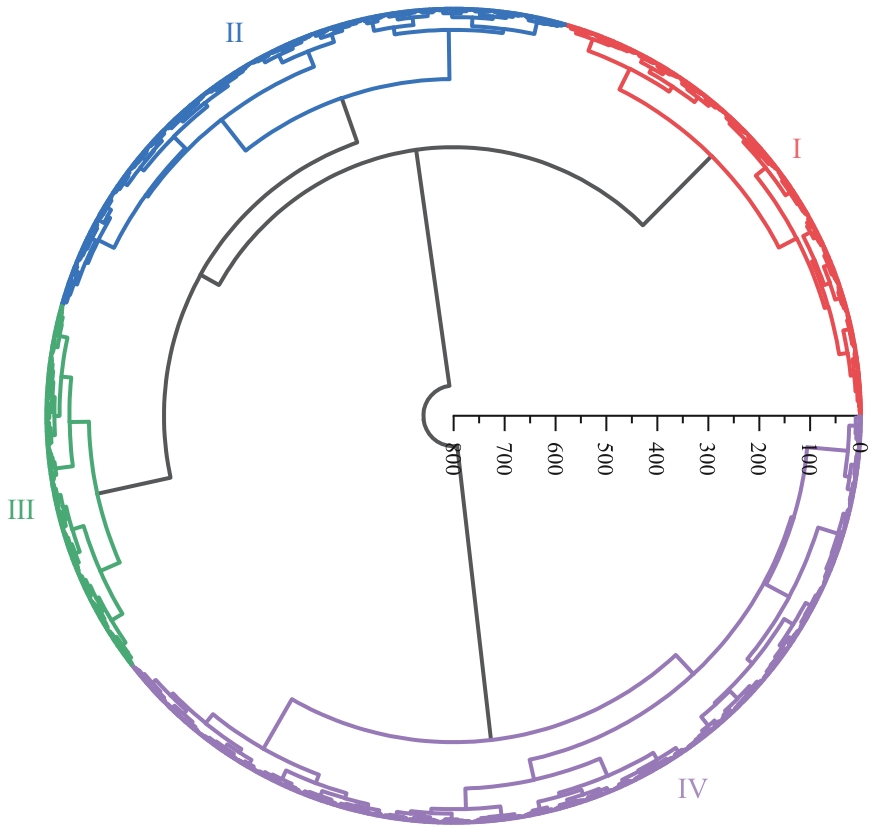
图1 1 970份达尔文氏棉导入系材料系统聚类图
Fig. 1 Cluster dendrogram of 1 970 G. darwinii introgression lines
聚类类群 Clustering results | 数量 Number | 单株结铃数 BNP | 单铃重 BW (g) | 衣分 LP (%) | 纤维上半部平均长度 UMHL (mm) | I (%) 整齐度 U | 马克隆值 Mic | 断裂比强度 Str (cN/tex) | 伸长率 Elg (%) |
|---|---|---|---|---|---|---|---|---|---|
| Ⅰ | 405 | 21.58 | 3.70 | 37.36 | 25.13 | 82.19 | 5.30 | 25.80 | 6.31 |
| Ⅱ | 494 | 16.17 | 4.01 | 33.97 | 26.72 | 82.02 | 4.38 | 27.49 | 6.29 |
| Ⅲ | 294 | 18.72 | 3.70 | 35.36 | 26.97 | 83.93 | 5.10 | 29.65 | 6.45 |
| Ⅳ | 777 | 17.32 | 3.99 | 36.88 | 24.25 | 80.86 | 5.04 | 23.55 | 6.12 |
表4 不同类群8个主要性状表现
Table 4 Performance of eight main traits in different clusters
聚类类群 Clustering results | 数量 Number | 单株结铃数 BNP | 单铃重 BW (g) | 衣分 LP (%) | 纤维上半部平均长度 UMHL (mm) | I (%) 整齐度 U | 马克隆值 Mic | 断裂比强度 Str (cN/tex) | 伸长率 Elg (%) |
|---|---|---|---|---|---|---|---|---|---|
| Ⅰ | 405 | 21.58 | 3.70 | 37.36 | 25.13 | 82.19 | 5.30 | 25.80 | 6.31 |
| Ⅱ | 494 | 16.17 | 4.01 | 33.97 | 26.72 | 82.02 | 4.38 | 27.49 | 6.29 |
| Ⅲ | 294 | 18.72 | 3.70 | 35.36 | 26.97 | 83.93 | 5.10 | 29.65 | 6.45 |
| Ⅳ | 777 | 17.32 | 3.99 | 36.88 | 24.25 | 80.86 | 5.04 | 23.55 | 6.12 |
性状 Traits | 第一主成分 PC1 | 第二主成分 PC2 | 第三主成分 PC3 |
|---|---|---|---|
| 单株结铃数 BNP | 0.043 | 0.106 | 0.827 |
| 单铃重 BW | -0.055 | 0.219 | -0.804 |
| 衣分 LP | -0.372 | 0.640 | 0.055 |
| 纤维上半部平均长度 UMHL | 0.765 | -0.217 | -0.057 |
| 整齐度 UI | 0.674 | 0.446 | -0.031 |
| 马克隆值 Mic | -0.279 | 0.825 | 0.051 |
| 断裂比强度 Str | 0.910 | 0.085 | -0.016 |
| 伸长率 Elg | 0.795 | 0.333 | 0.041 |
| 特征值 Eigenvalue | 2.721 | 1.513 | 1.342 |
| 贡献率 Contribution rate (%) | 34.014 | 18.917 | 16.776 |
| 累计贡献率 Cumulative contribution rate (%) | 34.014 | 52.931 | 69.707 |
表5 8个主要性状的主成分分析
Table 5 Principal component analysis of eight main traits
性状 Traits | 第一主成分 PC1 | 第二主成分 PC2 | 第三主成分 PC3 |
|---|---|---|---|
| 单株结铃数 BNP | 0.043 | 0.106 | 0.827 |
| 单铃重 BW | -0.055 | 0.219 | -0.804 |
| 衣分 LP | -0.372 | 0.640 | 0.055 |
| 纤维上半部平均长度 UMHL | 0.765 | -0.217 | -0.057 |
| 整齐度 UI | 0.674 | 0.446 | -0.031 |
| 马克隆值 Mic | -0.279 | 0.825 | 0.051 |
| 断裂比强度 Str | 0.910 | 0.085 | -0.016 |
| 伸长率 Elg | 0.795 | 0.333 | 0.041 |
| 特征值 Eigenvalue | 2.721 | 1.513 | 1.342 |
| 贡献率 Contribution rate (%) | 34.014 | 18.917 | 16.776 |
| 累计贡献率 Cumulative contribution rate (%) | 34.014 | 52.931 | 69.707 |
聚类类群 Clustering results | D值 D vaulue | 数量 Number | 单株结铃数 BNP | 单铃重 BW (g) | 衣分 LP (%) | 纤维上半部平均长度UMHL (mm) | 整齐度 UI (%) | 马克隆值 Mic | 断裂比强度 Str (cN/tex) | 伸长率 Elg (%) |
|---|---|---|---|---|---|---|---|---|---|---|
| Ⅰ | 1.98 | 15 | 32.80 | 3.47 | 36.71 | 26.24 | 82.96 | 5.35 | 27.91 | 6.44 |
| Ⅱ | 2.10 | 24 | 19.75 | 3.75 | 31.70 | 28.00 | 83.29 | 4.00 | 31.19 | 6.40 |
| Ⅲ | 2.61 | 197 | 19.98 | 3.67 | 35.15 | 27.59 | 84.07 | 4.99 | 30.64 | 6.49 |
| 泗棉3号Simian 3 | 1.71 | 25.30 | 5.94 | 40.46 | 26.50 | 84.40 | 5.33 | 28.32 | 6.40 |
表6 236份材料及轮回亲本的8个主要性状表现
Table 6 Performance of eight main traits in 236 accessions and the recurrent parent
聚类类群 Clustering results | D值 D vaulue | 数量 Number | 单株结铃数 BNP | 单铃重 BW (g) | 衣分 LP (%) | 纤维上半部平均长度UMHL (mm) | 整齐度 UI (%) | 马克隆值 Mic | 断裂比强度 Str (cN/tex) | 伸长率 Elg (%) |
|---|---|---|---|---|---|---|---|---|---|---|
| Ⅰ | 1.98 | 15 | 32.80 | 3.47 | 36.71 | 26.24 | 82.96 | 5.35 | 27.91 | 6.44 |
| Ⅱ | 2.10 | 24 | 19.75 | 3.75 | 31.70 | 28.00 | 83.29 | 4.00 | 31.19 | 6.40 |
| Ⅲ | 2.61 | 197 | 19.98 | 3.67 | 35.15 | 27.59 | 84.07 | 4.99 | 30.64 | 6.49 |
| 泗棉3号Simian 3 | 1.71 | 25.30 | 5.94 | 40.46 | 26.50 | 84.40 | 5.33 | 28.32 | 6.40 |
样品 Samples | 过滤读段 Clean reads | 过滤碱基数 Clean data | GC含量 GC content (%) | 碱基质量Q30 (%) | 平均基因组覆盖深度 Ave_depth | 读段数量 No. of Read | 比对读段 Mapped reads (%) | SNP数量 No. of SNPs |
|---|---|---|---|---|---|---|---|---|
| 泗棉3号Simian3 | 268 871 934 | 80 817 828 130 | 35.89 | 97.84 | 34.93 | 537 743 868 | 99.35 | 2 789 686 |
| 多铃混池 DL | 401 985 230 | 120 595 569 000 | 35.69 | 97.80 | 52.12 | 803 970 460 | 99.33 | 4 532 608 |
| 少铃混池 SL | 447 703 022 | 134 310 906 600 | 35.11 | 96.56 | 58.01 | 895 406 044 | 99.27 | 4 396 675 |
表7 测序质量及SNP数量统计
Table 7 Statistics on sequencing quality and SNP count
样品 Samples | 过滤读段 Clean reads | 过滤碱基数 Clean data | GC含量 GC content (%) | 碱基质量Q30 (%) | 平均基因组覆盖深度 Ave_depth | 读段数量 No. of Read | 比对读段 Mapped reads (%) | SNP数量 No. of SNPs |
|---|---|---|---|---|---|---|---|---|
| 泗棉3号Simian3 | 268 871 934 | 80 817 828 130 | 35.89 | 97.84 | 34.93 | 537 743 868 | 99.35 | 2 789 686 |
| 多铃混池 DL | 401 985 230 | 120 595 569 000 | 35.69 | 97.80 | 52.12 | 803 970 460 | 99.33 | 4 532 608 |
| 少铃混池 SL | 447 703 022 | 134 310 906 600 | 35.11 | 96.56 | 58.01 | 895 406 044 | 99.27 | 4 396 675 |
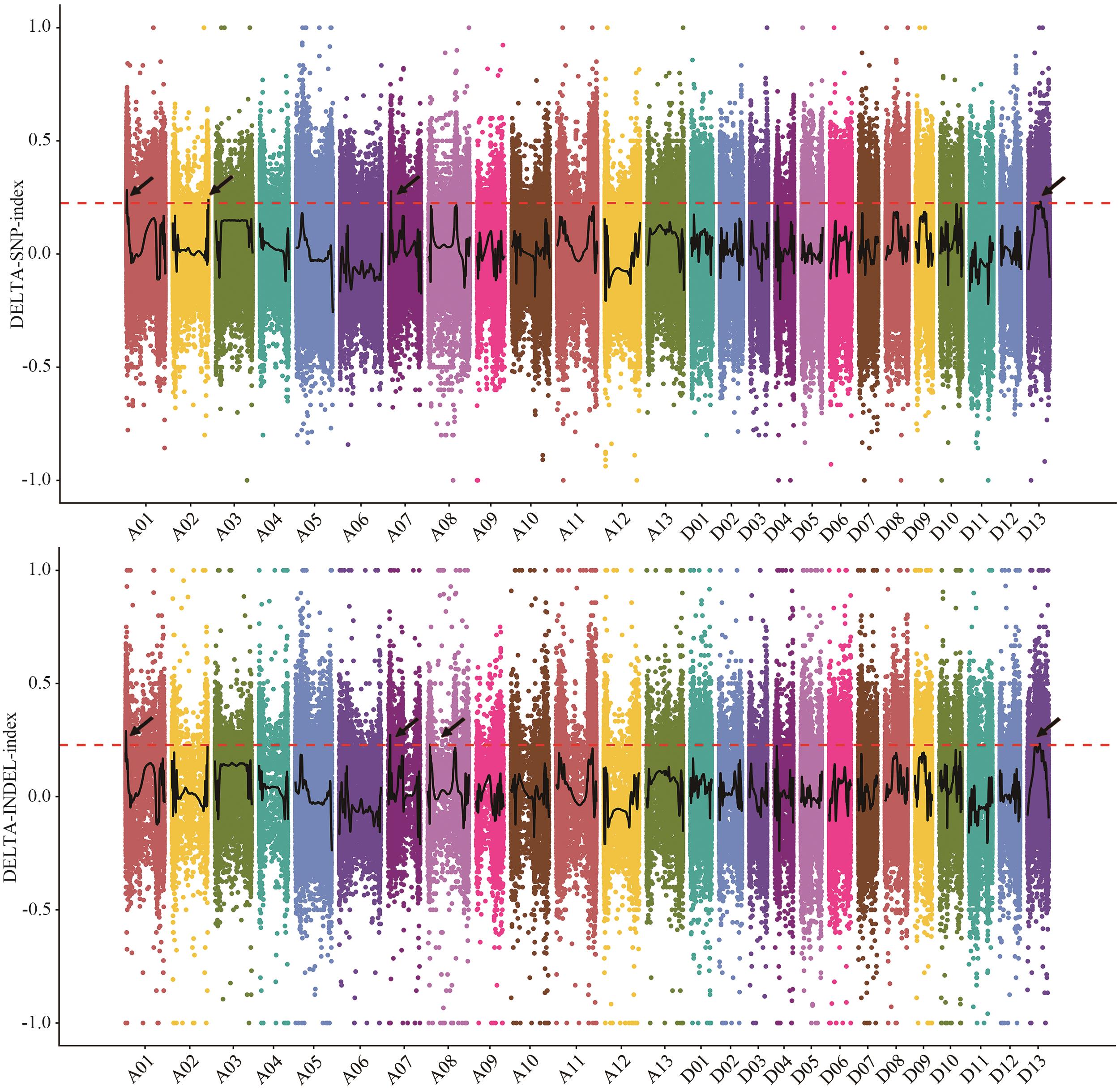
图2 达尔文氏棉导入系群体结铃性性状的SNP、InDel关联分析结果图中散点表示计算得到的SNP或InDel位点的ED值:曲线表示ED的拟合值;虚线表示LOESS拟合值为99%的阈值线
Fig. 2 Association analysis results of SNP and InDel markers for boll-setting traits in a G. darwinii introgression line populationThe spots represent the calculated ED values of SNPs or InDels. The curves represent the LOESS-fitted ED values. The dashed line represents the 99% confidence threshold of LOESS-fitted ED values
检测方法 Method | 染色体 Chromosome | 起始位置 Start (bp) | 结束位置 End (bp) | 片段长度 Size (Mb) | 基因数量 Genes | 变异基因数量 Mutant gene number |
|---|---|---|---|---|---|---|
| SNP关联 | A01 | 712 851 | 2 053 292 | 1.34 | 144 | 85 |
| A02 | 108 185 870 | 108 272 430 | 0.09 | 9 | 0 | |
| A07 | 4 640 220 | 5 781 090 | 1.14 | 100 | 39 | |
| D13 | 34 601 491 | 37 715 686 | 3.11 | 58 | 40 | |
| InDel关联 | A01 | 755 344 | 1 948 818 | 1.19 | 128 | 1 |
| A07 | 4 640 843 | 5 739 396 | 1.10 | 97 | 1 | |
| A08 | 7 275 411 | 7 310 729 | 0.04 | 1 | 0 | |
| D13 | 34 703 709 | 38 038 275 | 3.33 | 65 | 4 |
表8 结铃性性状的SNP和InDel关联区域统计
Table 8 Statistics of SNP and InDel association regions for boll-setting traits
检测方法 Method | 染色体 Chromosome | 起始位置 Start (bp) | 结束位置 End (bp) | 片段长度 Size (Mb) | 基因数量 Genes | 变异基因数量 Mutant gene number |
|---|---|---|---|---|---|---|
| SNP关联 | A01 | 712 851 | 2 053 292 | 1.34 | 144 | 85 |
| A02 | 108 185 870 | 108 272 430 | 0.09 | 9 | 0 | |
| A07 | 4 640 220 | 5 781 090 | 1.14 | 100 | 39 | |
| D13 | 34 601 491 | 37 715 686 | 3.11 | 58 | 40 | |
| InDel关联 | A01 | 755 344 | 1 948 818 | 1.19 | 128 | 1 |
| A07 | 4 640 843 | 5 739 396 | 1.10 | 97 | 1 | |
| A08 | 7 275 411 | 7 310 729 | 0.04 | 1 | 0 | |
| D13 | 34 703 709 | 38 038 275 | 3.33 | 65 | 4 |
| [1] | 喻树迅. 中国棉花产业百年发展历程[J]. 农学学报, 2018, 8(1): 93-99. |
| Yu SX. The development of cotton production in the recent hundred years of China [J]. J Agric, 2018, 8(1): 93-99. | |
| [2] | 肖松华, 狄佳春, 刘剑光, 等. 我国棉花品种纤维品质的现状及发展对策 [J]. 科技导报, 2002, 20(12): 49-52. |
| Xiao SH, Di JC, Liu JG, et al. Present state on the fiber Q uality of C Hina'S cotton variety and its developm ental strategies [J]. Sci Technol Rev, 2002, 20(12): 49-52. | |
| [3] | Fang L, Wang Q, Hu Y, et al. Genomic analyses in cotton identify signatures of selection and loci associated with fiber quality and yield traits [J]. Nat Genet, 2017, 49(7): 1089-1098. |
| [4] | Zhang Z, Li JW, Jamshed M, et al. Genome-wide quantitative trait loci reveal the genetic basis of cotton fibre quality and yield-related traits in a Gossypium hirsutum recombinant inbred line population [J]. Plant Biotechnol J, 2020, 18(1): 239-253. |
| [5] | Li SQ, Kong LL, Xiao XH, et al. Genome-wide artificial introgressions of Gossypium barbadense into G. hirsutum reveal superior loci for simultaneous improvement of cotton fiber quality and yield traits [J]. J Adv Res, 2023, 53: 1-16. |
| [6] | 黄莎, 张正圣, 王文文, 等. 陆地棉RIL群体产量与纤维品质性状QTL定位 [J]. 西南大学学报: 自然科学版, 2023, 45(1): 55-65. |
| Huang S, Zhang ZS, Wang WW, et al. QTL mapping of yield and fiber quality traits in an upland cotton RIL population [J]. J Southwest Univ Nat Sci Ed, 2023, 45(1): 55-65. | |
| [7] | 王娟, 董承光, 刘丽, 等. 陆地棉主要产量相关性状的SSR标记关联分析 [J]. 植物遗传资源学报, 2017, 18(4): 720-727. |
| Wang J, Dong CG, Liu L, et al. Association analysis of yield-related traits with SSR markers in upland cotton (Gossypium hirsutum) [J]. J Plant Genet Resour, 2017, 18(4): 720-727. | |
| [8] | 刘剑光, 赵君, 徐剑文, 等. 200份陆地棉种质资源的遗传多样性分析 [J]. 江苏农业科学, 2021, 49(14): 66-69. |
| Liu JG, Zhao J, Xu JW, et al. Genetic diversity analysis on 200 upland cotton germplasm resources [J]. Jiangsu Agric Sci, 2021, 49(14): 66-69. | |
| [9] | 田艺心, 曹鹏鹏, 高凤菊. 基于主成分、隶属函数和聚类分析的大豆耐盐性综合评价 [J]. 山东农业科学, 2020, 52(4): 16-22. |
| Tian YX, Cao PP, Gao FJ. Comprehensive evaluation on soybean salt tolerance based on principal component, membership function and cluster analyses [J]. Shandong Agric Sci, 2020, 52(4): 16-22. | |
| [10] | 尹会会, 李秋芝, 李海涛, 等. 134份国外陆地棉种质主要农艺性状与纤维品质性状的遗传多样性分析 [J]. 植物遗传资源学报, 2017, 18(6): 1105-1115. |
| Yin HH, Li QZ, Li HT, et al. Analysis of genetic diversity of the main agronomic and fibre quality characters of 134 foreign upland cotton germplasms [J]. J Plant Genet Resour, 2017, 18(6): 1105-1115. | |
| [11] | 牛若宇, 高瞻, 熊显鹏, 等. 棉花野生种质资源的育种应用研究与前景 [J]. 生物技术通报, 2025, 41(4): 21-32. |
| Niu RY, Gao Z, Xiong XP, et al. Breeding applications and prospects of wild cotton germplasm resources [J]. Biotechnol Bull, 2025, 41(4): 21-32. | |
| [12] | 董占鹏, 汪赛月, 李珂鑫, 等. 366份长绒陆地棉种质资源表型多样性分析[J]. 植物遗传资源学报, 2025, 26(5): 878-890. |
| Dong ZP, Wang SY, Li KX, et al. Phenotypic diversity analysis of 366 germplasm resources of long staple upland cotton[J]. J Plant Gene Res, 2025, 26(5): 878-890. | |
| [13] | Wang JC, Hu J, Xu HM, et al. A strategy on constructing core collections by least distance stepwise sampling [J]. Theor Appl Genet, 2007, 115(1): 533. |
| [14] | Paterson AH, Brubaker CL, Wendel JF. A rapid method for extraction of cotton (Gossypium spp.) genomic DNA suitable for RFLP or PCR analysis [J]. Plant Mol Biol Rep, 1993, 11(2): 122-127. |
| [15] | 邓泱泱, 荔建琦, 吴松锋, 等. nr数据库分析及其本地化 [J]. 计算机工程, 2006, 32(5): 71-73, 76. |
| Deng YY, Li JQ, Wu SF, et al. Integrated nr database in protein annotation system and its localization [J]. Comput Eng, 2006, 32(5): 71-73, 76. | |
| [16] | Hill J T, Demarest B L, Bisgrove B W, et al. MMAPPR: mutation mapping analysis pipeline for pooled RNA-seq[J]. Genome research, 2013, 23(4): 687-697. |
| [17] | 肖松华, 刘剑光, 赵君, 等. 棉花远缘杂交创制抗黄萎病新种质 [J]. 棉花学报, 2015, 27(6): 524-533. |
| Xiao SH, Liu JG, Zhao J, et al. Creation of a new resistant germplasm to Verticillium wilt by distant hybridization in upland cotton [J]. Cotton Sci, 2015, 27(6): 524-533. | |
| [18] | Wang S, Chen JD, Zhang WP, et al. Sequence-based ultra-dense genetic and physical maps reveal structural variations of allopolyploid cotton genomes [J]. Genome Biol, 2015, 16: 108. |
| [19] | Wang B, Nie YC, Lin ZX, et al. Molecular diversity, genomic constitution, and QTL mapping of fiber quality by mapped SSRs in introgression lines derived from Gossypium hirsutum × G. darwinii Watt [J]. Theor Appl Genet, 2012, 125(6): 1263-1274. |
| [20] | 刘方, 朱芸, 王坤波. 加勒帕戈斯群岛野生棉考察初报 [J]. 中国棉花, 2016, 43(1): 1-2, 7. |
| Liu F, Zhu Y, Wang KB. A preliminary survey report on wild cotton in Galapagos Islands [J]. China Cotton, 2016, 43(1): 1-2, 7. | |
| [21] | 周忠丽, 王星星, 王坤波, 等. 加勒帕戈斯群岛野生棉第二次考察简报 [J]. 中国棉花, 2017, 44(5): 1-3, 17. |
| Zhou ZL, Wang XX, Wang KB, et al. Report of the second investigation on wild cotton in Galapagos Islands, Ecuador [J]. China Cotton, 2017, 44(5): 1-3, 17. | |
| [22] | Chen HD, Khan MKR, Zhou ZL, et al. A high-density SSR genetic map constructed from a F2 population of Gossypium hirsutum and Gossypium darwinii [J]. Gene, 2015, 574(2): 273-286. |
| [23] | Chen ZJ, Sreedasyam A, Ando A, et al. Genomic diversifications of five Gossypium allopolyploid species and their impact on cotton improvement [J]. Nat Genet, 2020, 52(5): 525-533. |
| [24] | Grover CE, Gallagher JP, Jareczek JJ, et al. Re-evaluating the phylogeny of allopolyploid Gossypium L. [J]. Mol Phylogenet Evol, 2015, 92: 45-52. |
| [25] | 李建斌, 冯小康, 何赵杰, 等. 313份陆地棉种质资源的综合性评价与分析 [J]. 江苏农业科学, 2025, 53(3): 113-120. |
| Li JB, Feng XK, He ZJ, et al. Comprehensive evaluation and analysis of 313 land cotton germplasm resources [J]. Jiangsu Agric Sci, 2025, 53(3): 113-120. | |
| [26] | 崔建强, 马丽, 胡宝, 等. 基于主成分和聚类分析的棉花品种(系)性状综合评价 [J]. 农业科技通讯, 2024(12): 82-85. |
| Cui JQ, Ma L, Hu B, et al. Comprehensive evaluation of cotton varieties (lines) based on principal component analysis and cluster analysis [J]. Bull Agric Sci Technol, 2024(12): 82-85. | |
| [27] | 董承光, 王娟, 周小凤, 等. 基于表型性状的陆地棉种质资源遗传多样性分析 [J]. 植物遗传资源学报, 2016, 17(3): 438-446. |
| Dong CG, Wang J, Zhou XF, et al. Evaluation on genetic diversity of cotton germplasm resources (Gossypium hirsutum L.) on morphological characters [J]. J Plant Genet Resour, 2016, 17(3): 438-446. | |
| [28] | 杜玉倍, 芦振华, 常明娟, 等. 45份早熟棉品系性状综合分析评价 [J]. 中国棉花, 2025, 52(8): 28-36. |
| Du YB, Lu ZH, Chang MJ, et al. Comprehensive analysis and evaluation of 45 early-maturing cotton lines [J]. China Cotton, 2025, 52(8): 28-36. | |
| [29] | 刘军杰. 陆地棉×达尔文氏棉后代种质系产量、纤维品质和抗黄萎病特性研究 [D]. 武汉: 华中农业大学, 2011. |
| Liu JJ. Study of the yield, quality and resistance to Verticillium in germplasm lines of G . hirsutum L × G. Darwinii watt [D]. Wuhan: Huazhong Agricultural University, 2011. | |
| [30] | 兰倩倩. 陆地棉和达尔文氏棉种间遗传图谱构建及优异材料创制 [D]. 南京: 南京农业大学, 2014. |
| Lan QQ. Linkage mapping and germplasm enhancement for superior fiber quality using interspecific hybrid of G . hirsutum × G. darwinii [D]. Nanjing: Nanjing Agricultural University, 2014. | |
| [31] | Said JI, Lin ZX, Zhang XL, et al. A comprehensive meta QTL analysis for fiber quality, yield, yield related and morphological traits, drought tolerance, and disease resistance in tetraploid cotton [J]. BMC Genom, 2013, 14: 776. |
| [32] | Xia Z, Zhang X, Liu YY, et al. Major gene identification and quantitative trait locus mapping for yield-related traits in upland cotton (Gossypium hirsutum L.) [J]. J Integr Agric, 2014, 13(2): 299-309. |
| [1] | 陈静欢, 房国楠, 朱文豪, 叶广继, 苏旺, 贺苗苗, 杨生龙, 周云. 马铃薯种质资源淀粉表征及相关基因表达分析[J]. 生物技术通报, 2026, 42(1): 170-183. |
| [2] | 张晓英, 毛咪, 王洪凤, 丁新华, 朱树伟, 石磊. 免疫诱抗剂ZNC对小麦赤霉病防治和产量的影响[J]. 生物技术通报, 2024, 40(8): 95-105. |
| [3] | 刘灿, 闫晓阳, 曾焱, 欧祥龙, 廖永洪. 增加革兰阴性菌外膜囊泡产量的研究进展[J]. 生物技术通报, 2024, 40(3): 100-108. |
| [4] | 徐扬, 张瑞英, 戴良香, 张冠初, 丁红, 张智猛. 盐胁迫下氮素对花生种子萌发和种子际细菌菌群结构的调控[J]. 生物技术通报, 2024, 40(2): 253-265. |
| [5] | 常泸尹, 王中华, 李凤敏, 高梓源, 张辉红, 王祎, 李芳, 韩燕来, 姜瑛. 玉米根际多功能促生菌的筛选及其对冬小麦-夏玉米轮作体系产量提升效果[J]. 生物技术通报, 2024, 40(1): 231-242. |
| [6] | 张道磊, 甘雨军, 乐亮, 普莉. 玉米产量性状的表观遗传调控机制和育种应用[J]. 生物技术通报, 2023, 39(8): 31-42. |
| [7] | 江美彦, 周杨, 刘仁浪, 姚菲, 杨云舒, 侯凯, 冯冬菊, 吴卫. 白芷根际促生菌的筛选及其促生效果研究[J]. 生物技术通报, 2022, 38(8): 167-178. |
| [8] | 李毅丹, 单晓辉. 赤霉素代谢调控与绿色革命[J]. 生物技术通报, 2022, 38(2): 195-204. |
| [9] | 山琦, 贾惠舒, 姚文博, 刘伟灿, 李海燕. 植物miR396-GRF模块的生物学功能及其潜在应用价值[J]. 生物技术通报, 2022, 38(10): 34-44. |
| [10] | 李和平, 李积铭, 李爱国, 武军艳, 宋聪敏, 申彦平, 杨莉. 播期对河北省超采水区白菜型冬油菜越冬率及产量的影响[J]. 生物技术通报, 2021, 37(4): 35-46. |
| [11] | 宫伟, 余健源, 张曦, 单晓昳. 硝酸根调控植物开花和产量分子机制的研究进展[J]. 生物技术通报, 2020, 36(8): 162-172. |
| [12] | 田露, 薛仁政, 张志敏, 薛春仙, 沈兰芳, 龚国利. 抗癌药物埃博霉素的生产及工艺发展[J]. 生物技术通报, 2019, 35(10): 198-204. |
| [13] | 王文秀, 王磊. 玉米矮杆基因研究进展[J]. 生物技术通报, 2018, 34(11): 22-26. |
| [14] | 闫栋,罗振华,胡有良,汪军成,司二静,任盼荣,姚立蓉,李葆春,马小乐,孟亚雄,王化俊,. 不同除草剂对青稞田野燕麦的防除及对青稞生长的影响[J]. 生物技术通报, 2017, 33(9): 166-171. |
| [15] | 王俊刚, 赵婷婷, 杨本鹏, 蔡文伟, 张树珍. 甘蔗脱毒健康种苗中单糖转运蛋白基因差异表达分析[J]. 生物技术通报, 2015, 31(3): 115-120. |
| 阅读次数 | ||||||
|
全文 |
|
|||||
|
摘要 |
|
|||||
