







生物技术通报 ›› 2026, Vol. 42 ›› Issue (10): 282-292.doi: 10.13560/j.cnki.biotech.bull.1985.2025-1295
• 研究报告 • 上一篇
王超1,2, 杨钰超1, 郭思宇1, 贾瑶镟1, 陈艳霞1, 赵钰1,2, 乔星星1,2, 肖璐洁1,2, 冯美臣1,2, 杨武德1,2( )
收稿日期:2025-11-27
出版日期:2026-10-26
发布日期:2026-10-15
通讯作者:
杨武德sxauywd@126.com基金资助:
WANG Chao1,2, YANG Yu-chao1, GUO Si-yu1, JIA Yao-xuan1, CHEN Yan-xia1, ZHAO Yu1,2, QIAO Xing-xing1,2, XIAO Lu-jie1,2, FENG Mei-chen1,2, YANG Wu-de1,2()
Received:2025-11-27
Published:2026-10-26
Online:2026-10-15
摘要:
目的 为解决自然环境中绿豆叶片病害检测场景复杂、检测精度不足、小目标检测能力较弱等问题,提出一种YOLOv8-EMA-CARAFE-Layer的深度学习算法。 方法 在主干网络中引入了高效多尺度注意力机制(efficient multi-scale attention, EMA),提升模型对病害特征的提取与筛选能力;在颈部网络中采用CARAFE(Content-Aware ReAssembly of FEatures)上采样模块,通过动态生成上采样核增强全局信息聚合能力,从而提高特征重建精度;在Neck和Head网络中添加一个小目标检测层,提升对细小病害目标的检测性能。 结果 改进后的模型在mAP@50、精确度和召回率等关键指标上分别达到了91.0%、86.9%、83.4%,且与主流目标检测模型YOLOv3、YOLOv5、YOLOv6和YOLOv11相比,平均精度mAP@50分别提升了6.8%、0.3%、13.5%和1.6%,在包含复杂田间背景的混合数据集上,表现出较强的绿豆叶片病害检测性能;此外,模型通过轻量化设计保持了较低的参数量,仅为5.95 Mb。 结论 YOLOv8-EMA-CARAFE-Layer模型能够满足无人机、智能农机等移动终端的部署需求,在现有的田间混合数据集上,对提高绿豆叶片主要病害的快速、高效、精准检测水平具有实际应用借鉴价值。
王超, 杨钰超, 郭思宇, 贾瑶镟, 陈艳霞, 赵钰, 乔星星, 肖璐洁, 冯美臣, 杨武德. 基于改进YOLOv8的绿豆叶片主要病害检测研究[J]. 生物技术通报, 2026, 42(10): 282-292.
WANG Chao, YANG Yu-chao, GUO Si-yu, JIA Yao-xuan, CHEN Yan-xia, ZHAO Yu, QIAO Xing-xing, XIAO Lu-jie, FENG Mei-chen, YANG Wu-de. Research on Detection of Major Diseases in Mung Bean Leaves Based on an Improved YOLOv8[J]. Biotechnology Bulletin, 2026, 42(10): 282-292.
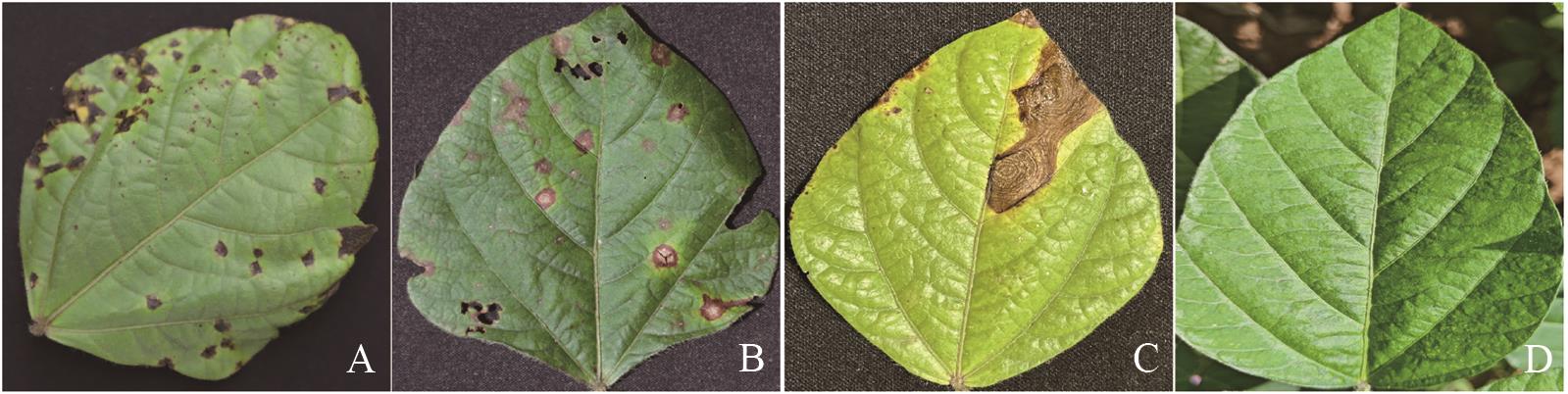
图1 绿豆病害图A:细菌性疫病;B:叶斑病;C:轮纹病;D:健康
Fig. 1 Images of mung bean leavesA: Bacterial blight; B: Leaf spot; C: Ring spot; D: Healthy
| 病害名称 Disease types | 病害特征 Disease characters |
|---|---|
| 细菌性疫病 Bacterial blight | 初期叶片表面出现小的水浸斑,变成淡黄色到棕褐色;后期病斑在叶片上扩展,病斑呈黑色 |
| 轮纹病 Ring spot | 初期叶片产生小的、褐色圆形病斑;后期发展成大的具有同心环的圆形或不规则的深褐斑 |
| 叶斑病 Leaf spot | 初期叶片上出现小型不规则或圆形褐色斑点,边缘清晰;后期病斑扩展,形成大的不规则坏死区域 |
| 健康 Health | 叶片呈深绿色,叶形卵状,叶脉清晰可见,质地柔软薄嫩,表面光滑 |
表1 绿豆叶片病害种类及特征
Table 1 Types and characteristics of mung bean leaf diseases
| 病害名称 Disease types | 病害特征 Disease characters |
|---|---|
| 细菌性疫病 Bacterial blight | 初期叶片表面出现小的水浸斑,变成淡黄色到棕褐色;后期病斑在叶片上扩展,病斑呈黑色 |
| 轮纹病 Ring spot | 初期叶片产生小的、褐色圆形病斑;后期发展成大的具有同心环的圆形或不规则的深褐斑 |
| 叶斑病 Leaf spot | 初期叶片上出现小型不规则或圆形褐色斑点,边缘清晰;后期病斑扩展,形成大的不规则坏死区域 |
| 健康 Health | 叶片呈深绿色,叶形卵状,叶脉清晰可见,质地柔软薄嫩,表面光滑 |
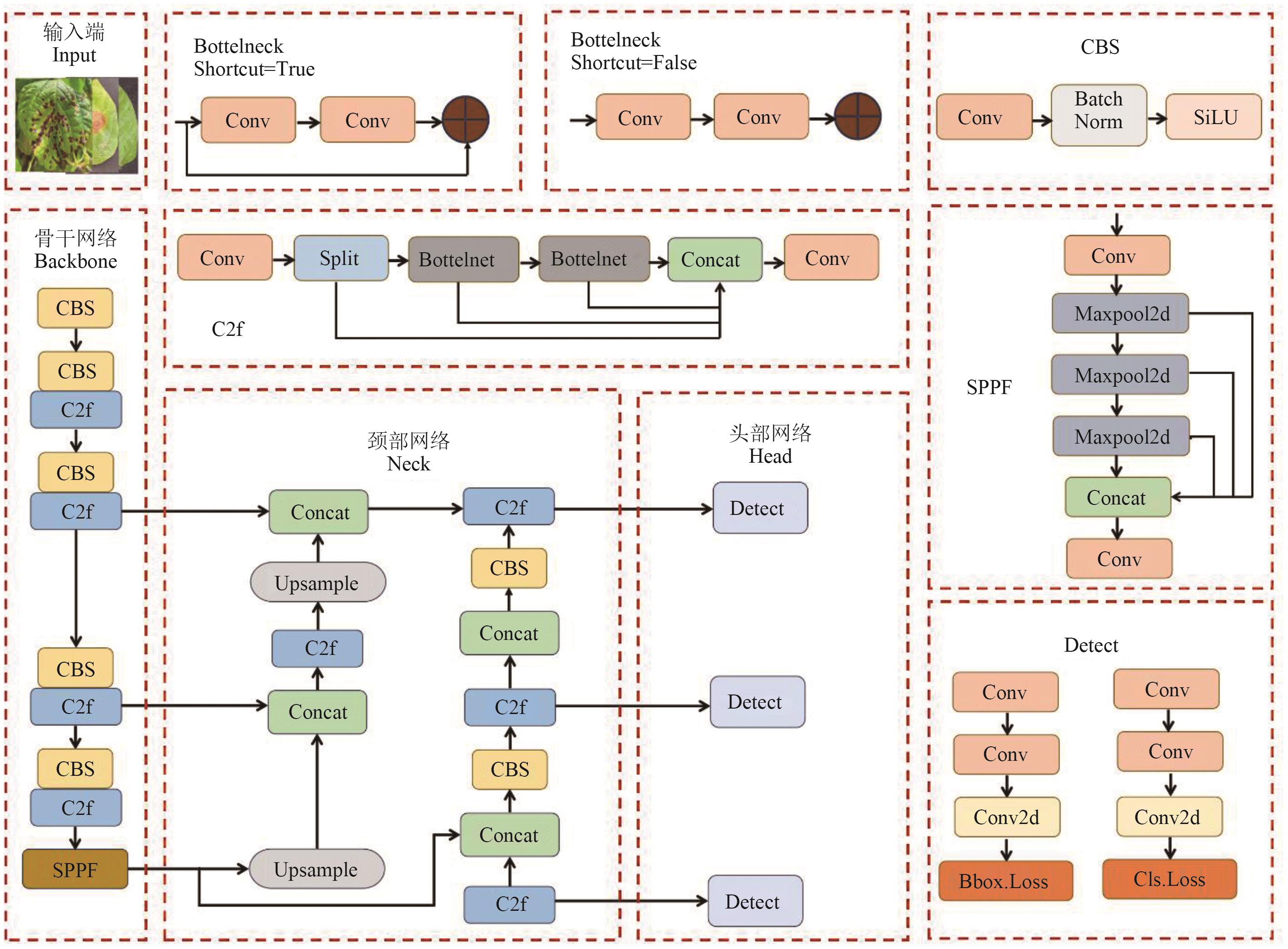
图2 YOLOv8模型网络结构
Fig. 2 YOLOv8 model network architecture
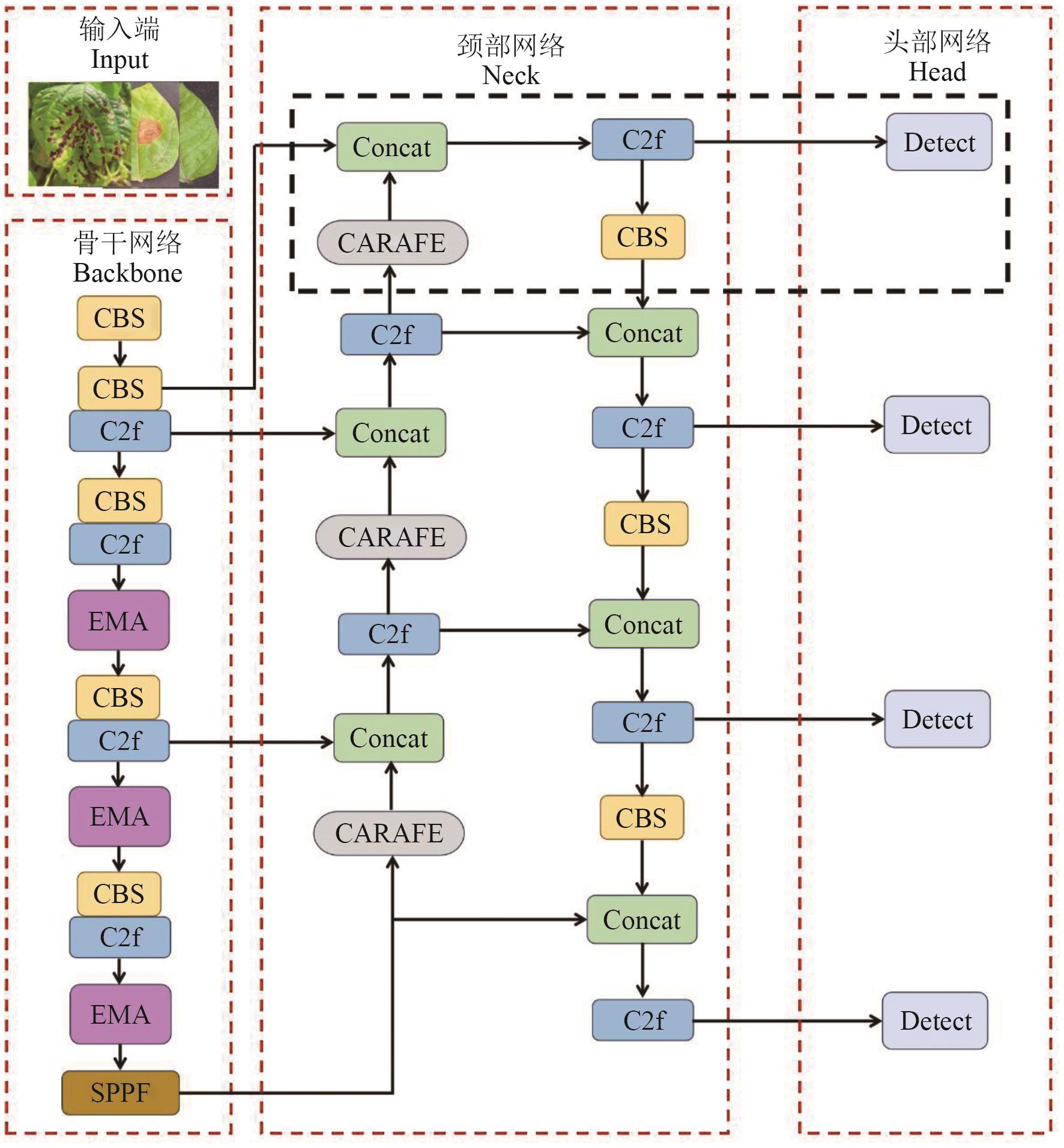
图3 YOLOv8-EMA-CARAFE-Layer网络结构
Fig. 3 YOLOv8-EMA-CARAFE-Layer network architecture
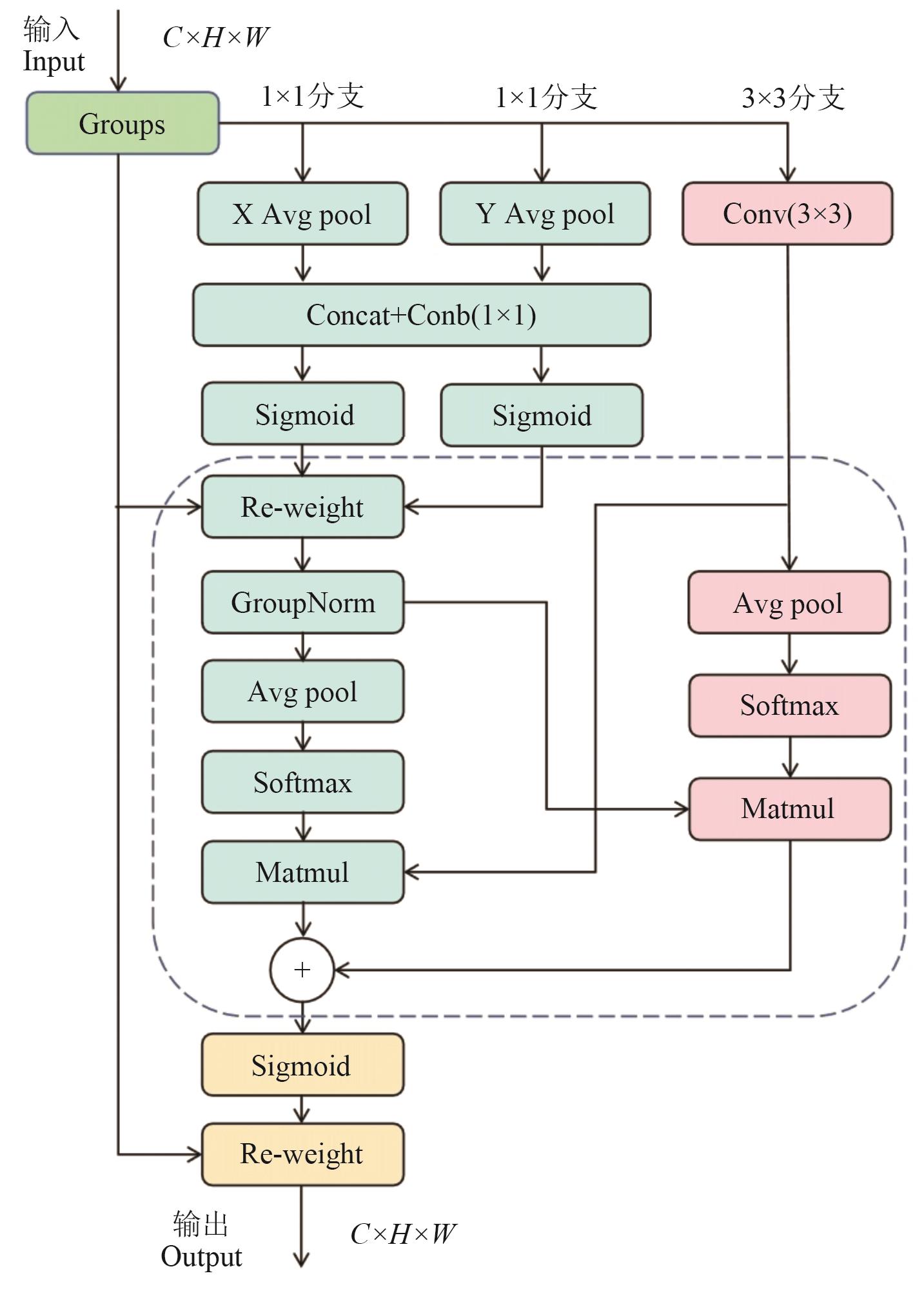
图4 EMA注意力机制模块网络结构
Fig. 4 EMA attention mechanism module network architecture
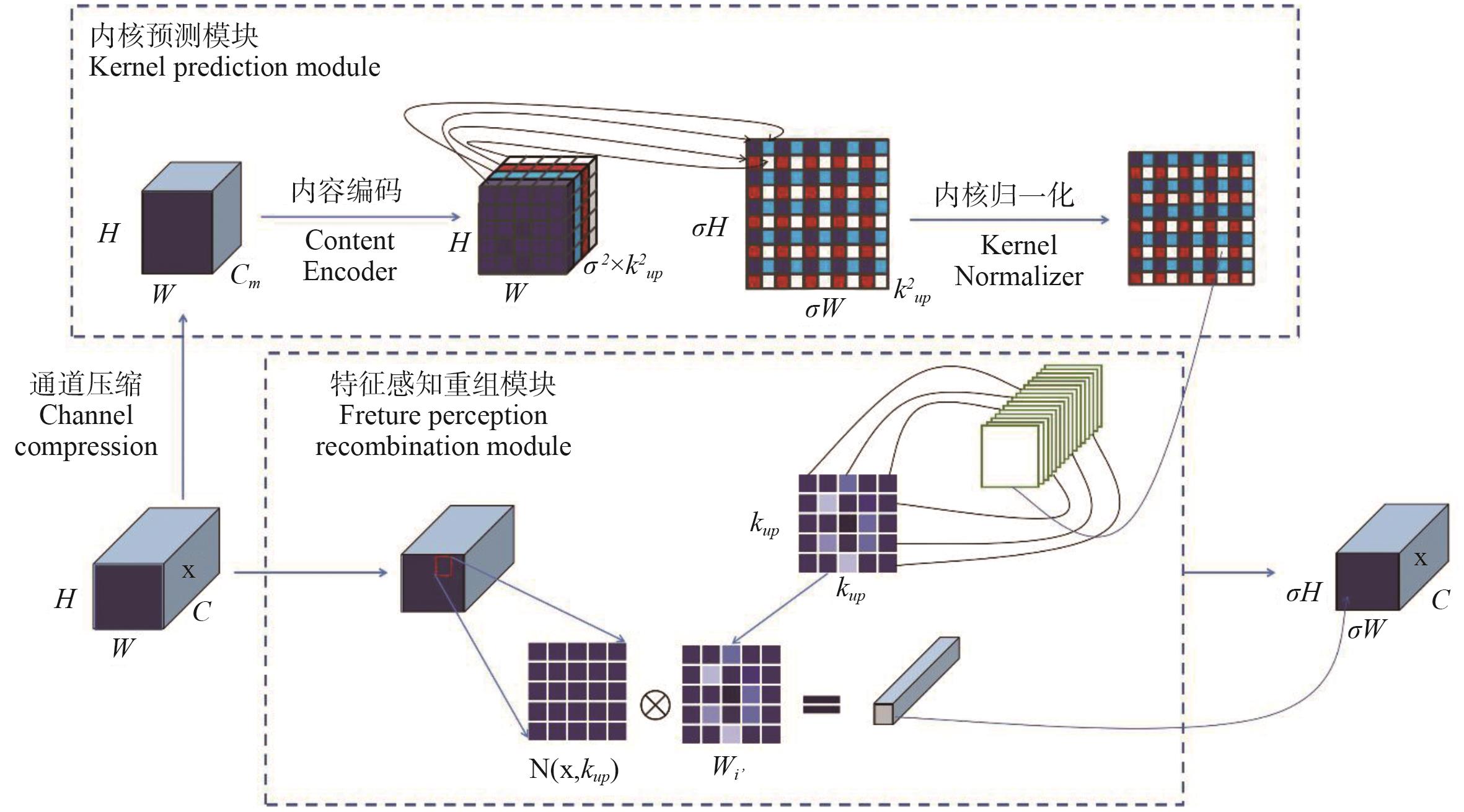
图5 CARAFE的整体框架
Fig. 5 Overall framework of CARAFE
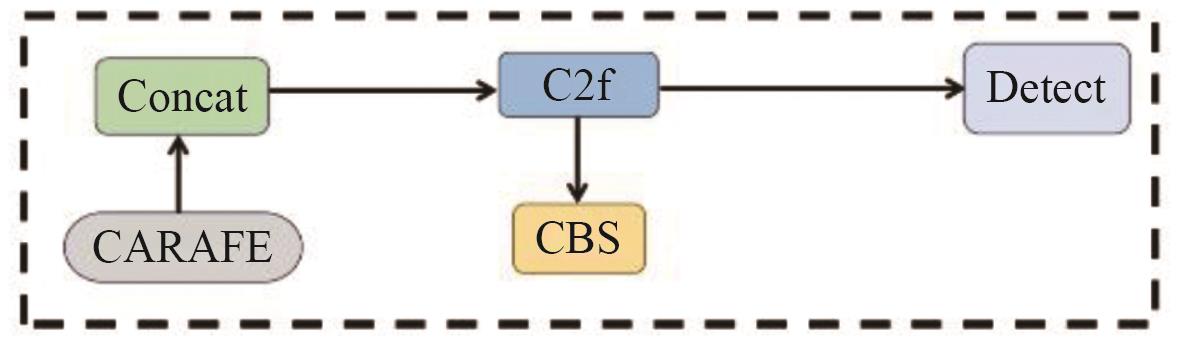
图6 小目标检测层
Fig. 6 Small object detection layer
| 模型 | 精确度 Precision(%) | 召回率 Recall(%) | mAP@50(%) | mAP@50-95(%) | 参数量 Params(MB) |
|---|---|---|---|---|---|
| YOLOv8n | 85.5 | 81.1 | 86.2 | 62.8 | 5.73 |
| YOLOv8-EMA-CARAFE-Layer | 86.9 | 83.4 | 91.0 | 67.5 | 5.95 |
表2 改进前后模型性能对比
Table 2 Model performance comparison before and after improvement
| 模型 | 精确度 Precision(%) | 召回率 Recall(%) | mAP@50(%) | mAP@50-95(%) | 参数量 Params(MB) |
|---|---|---|---|---|---|
| YOLOv8n | 85.5 | 81.1 | 86.2 | 62.8 | 5.73 |
| YOLOv8-EMA-CARAFE-Layer | 86.9 | 83.4 | 91.0 | 67.5 | 5.95 |
| 模型 Model | 精确度 Precision(%) | 召回率 Recall(%) | mAP@50(%) | mAP@50-95(%) | 参数量 Params (MB) |
|---|---|---|---|---|---|
| YOLOv8_CBAM | 84.5 | 78.6 | 86.8 | 64.3 | 5.86 |
| YOLOv8_CA | 87.4 | 80.3 | 86.7 | 64.0 | 5.75 |
| YOLOv8_EMA | 83.1 | 81.2 | 87.4 | 64.0 | 5.73 |
表3 添加不同注意力机制的模型对比试验
Table 3 Experimental comparison of models with different attention mechanisms
| 模型 Model | 精确度 Precision(%) | 召回率 Recall(%) | mAP@50(%) | mAP@50-95(%) | 参数量 Params (MB) |
|---|---|---|---|---|---|
| YOLOv8_CBAM | 84.5 | 78.6 | 86.8 | 64.3 | 5.86 |
| YOLOv8_CA | 87.4 | 80.3 | 86.7 | 64.0 | 5.75 |
| YOLOv8_EMA | 83.1 | 81.2 | 87.4 | 64.0 | 5.73 |
| 消融试验组Ablation study group | EMA | CARAFE | Layer | 精确度Precision(%) | 召回率Recall(%) | mAP@50(%) | mAP@50-95(%) | 参数量 Params (MB) |
|---|---|---|---|---|---|---|---|---|
| 0 | - | - | - | 85.5 | 81.1 | 86.2 | 62.8 | 5.73 |
| 1 | √ | - | - | 83.1 | 81.2 | 87.4 | 64.0 | 5.73 |
| 2 | √ | √ | - | 87.2 | 80.5 | 87.9 | 63.8 | 6.00 |
| 3 | √ | √ | √ | 86.9 | 83.4 | 91.0 | 67.5 | 5.95 |
表4 YOLOv8n不同消融方法试验表现
Table 4 Performance of different ablation methods for YOLOv8n
| 消融试验组Ablation study group | EMA | CARAFE | Layer | 精确度Precision(%) | 召回率Recall(%) | mAP@50(%) | mAP@50-95(%) | 参数量 Params (MB) |
|---|---|---|---|---|---|---|---|---|
| 0 | - | - | - | 85.5 | 81.1 | 86.2 | 62.8 | 5.73 |
| 1 | √ | - | - | 83.1 | 81.2 | 87.4 | 64.0 | 5.73 |
| 2 | √ | √ | - | 87.2 | 80.5 | 87.9 | 63.8 | 6.00 |
| 3 | √ | √ | √ | 86.9 | 83.4 | 91.0 | 67.5 | 5.95 |
模型 Model | 精确度 Precision(%) | 召回率 Recall(%) | mAP@50(%) | mAP@50-95(%) | 参数量 Params(MB) | FLOPs(G) | 推理延迟Latency(ms) | FPS |
|---|---|---|---|---|---|---|---|---|
| Yolov3 | 82.5 | 76.8 | 84.2 | 56.7 | 16.55 | 65.9 | 15.2 | 65.8 |
| Yolov5 | 84.7 | 85.3 | 90.7 | 66.1 | 13.38 | 32.5 | 6.8 | 147.1 |
| Yolov6 | 76.2 | 72.7 | 77.5 | 56.3 | 8.07 | 18.4 | 4.9 | 204.1 |
| Yolov8n | 85.5 | 81.1 | 86.2 | 62.8 | 5.73 | 8.7 | 2.1 | 476.2 |
| Yolov11 | 88.7 | 81.5 | 89.4 | 65.6 | 4.93 | 7.2 | 1.8 | 555.6 |
| YOLOv8-EMA-CARAFE-Layer | 86.9 | 83.4 | 91.0 | 67.5 | 5.95 | 12.4 | 2.8 | 357.1 |
表5 改进模型与传统目标检测模型的表现
Table 5 Performance comparison between the improved model and classical models
模型 Model | 精确度 Precision(%) | 召回率 Recall(%) | mAP@50(%) | mAP@50-95(%) | 参数量 Params(MB) | FLOPs(G) | 推理延迟Latency(ms) | FPS |
|---|---|---|---|---|---|---|---|---|
| Yolov3 | 82.5 | 76.8 | 84.2 | 56.7 | 16.55 | 65.9 | 15.2 | 65.8 |
| Yolov5 | 84.7 | 85.3 | 90.7 | 66.1 | 13.38 | 32.5 | 6.8 | 147.1 |
| Yolov6 | 76.2 | 72.7 | 77.5 | 56.3 | 8.07 | 18.4 | 4.9 | 204.1 |
| Yolov8n | 85.5 | 81.1 | 86.2 | 62.8 | 5.73 | 8.7 | 2.1 | 476.2 |
| Yolov11 | 88.7 | 81.5 | 89.4 | 65.6 | 4.93 | 7.2 | 1.8 | 555.6 |
| YOLOv8-EMA-CARAFE-Layer | 86.9 | 83.4 | 91.0 | 67.5 | 5.95 | 12.4 | 2.8 | 357.1 |
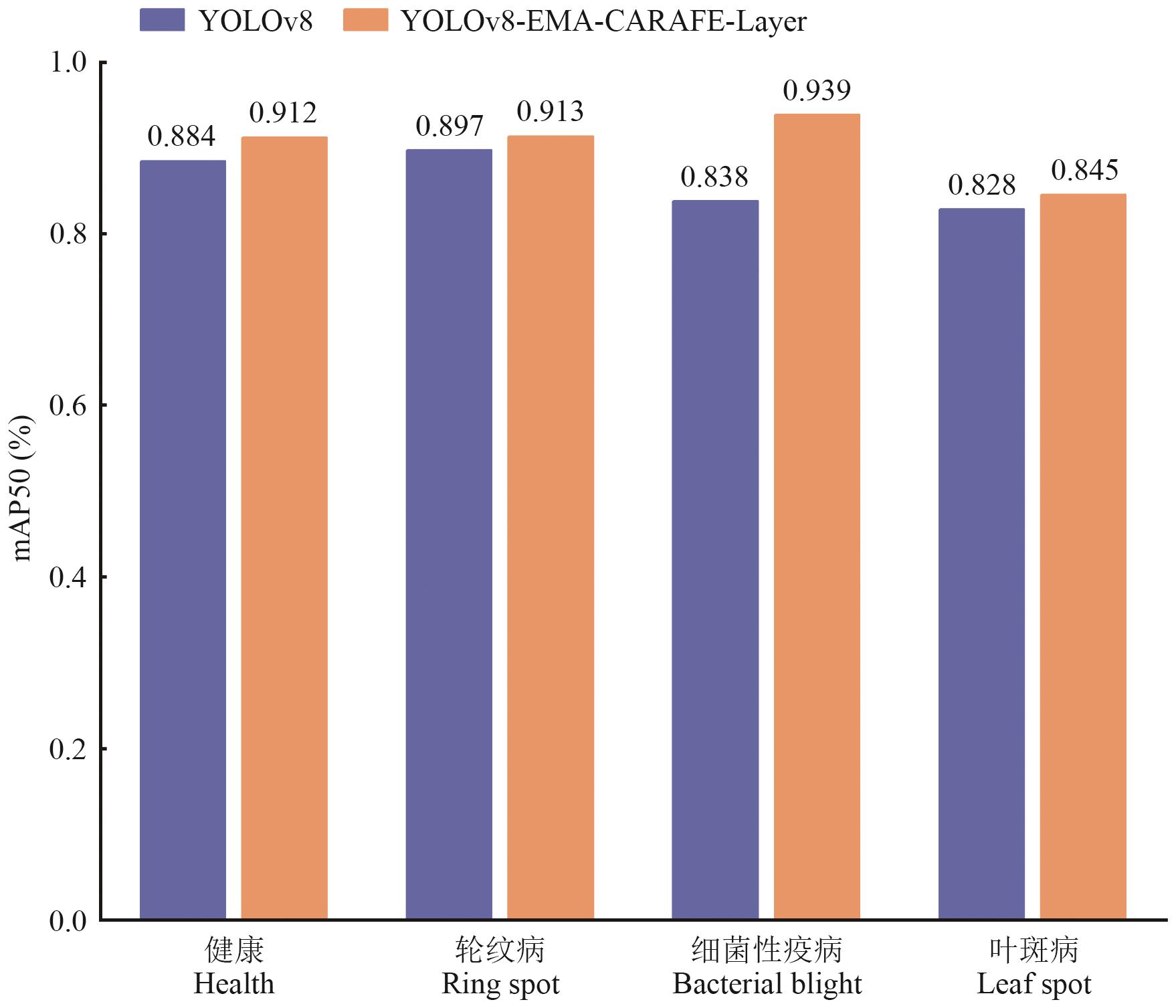
图7 对比分析YOLOv8和改进模型对绿豆各类病害检测精度
Fig. 7 Comparison of mung bean disease detection accuracy between YOLOv8 model and its improved model (YOLOv8-EMA-CARAFE-Layer)
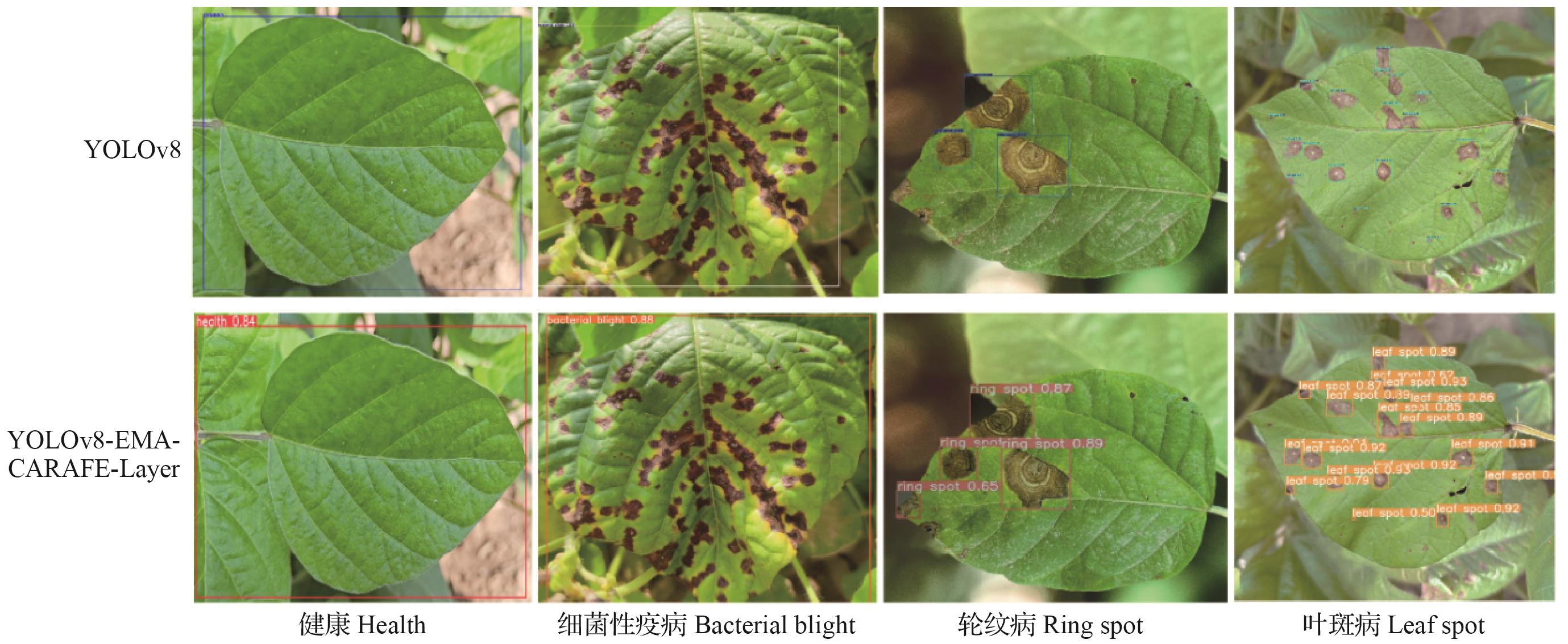
图8 对比分析YOLOv8和改进模型对绿豆各类病害检测可视化表现
Fig. 8 Comparison of visualization performance for mung bean disease detection between YOLOv8 and its improved model (YOLOv8-EMA-CARAFE-Layer)
| [1] | 戴高星. 发展绿豆生产大有可为 [J]. 四川农业科技, 2011(6): 18-19. |
| Dai GX. Developing mung bean production is promising [J]. Sichuan Agric Sci Technol, 2011(6): 18-19. | |
| [2] | Maiti D, Majumdar M. Impact of bioprocessing on phenolic content and antioxidant activity of soy seed to improve hypoglycemic functionality [J]. Asian J Plant Sci Res, 2012, 2(2): 924-931. |
| [3] | 孙瑞卿, 秦曙, 李晋栋, 等. 我国绿豆病虫害化学防治现状及质量安全问题分析 [J]. 农产品质量与安全, 2017(3): 91-94. |
| Sun RQ, Qin S, Li JD, et al. Current situation of chemical control of mung bean diseases and insect pests in China and analysis of quality and safety problems [J]. Qual Saf Agro Prod, 2017(3): 91-94. | |
| [4] | 赵玉梅. 农业信息化在蔬菜病虫害防治技术上的应用分析 [J]. 农业工程技术, 2022, 42(27): 31-32. |
| Zhao YM. Analysis on the application of agricultural informatization in vegetable pest control technology [J]. Agric Eng Technol, 2022, 42(27): 31-32. | |
| [5] | 梁斯佳, 李雷, 顾月, 等. 基于改进YOLO v8n的甘蔗叶片病害识别算法 [J]. 农业机械学报, 2025, 56(10): 567-574. |
| Liang SJ, Li L, Gu Y, et al. Sugarcane leaf disease recognition algorithm based on improved YOLO v8n [J]. Trans Chin Soc Agric Mach, 2025, 56(10): 567-574. | |
| [6] | Kumar Sahu S, Pandey M. An optimal hybrid multiclass SVM for plant leaf disease detection using spatial Fuzzy C-Means model [J]. Expert Syst Appl, 2023, 214: 118989. |
| [7] | 黄林生, 江静, 黄文江, 等. Sentinel-2影像和BP神经网络结合的小麦条锈病监测方法 [J]. 农业工程学报, 2019, 35(17): 178-185. |
| Huang LS, Jiang J, Huang WJ, et al. Wheat yellow rust monitoring method based on Sentinel-2 image and BPNN model [J]. Trans Chin Soc Agric Eng, 2019, 35(17): 178-185. | |
| [8] | 朱锐, 张家瑜, 黄继超, 等. 基于卷积神经网络的农作物叶片病害检测研究进展 [J]. 农业工程学报, 2025, 41(17): 15-28. |
| Zhu R, Zhang JY, Huang JC, et al. Research progress of crop leaf disease detection based on convolutional neural network [J]. Trans Chin Soc Agric Eng, 2025, 41(17): 15-28. | |
| [9] | 徐洪丽, 安凤, 史宇轩. 基于改进YOLO v8的苹果叶片病害检测研究 [J]. 农业机械学报, 2025, 56(10): 530-538. |
| Xu HL, An F, Shi YX. Apple leaf disease detection method based on improved YOLO v8 [J]. Trans Chin Soc Agric Mach, 2025, 56(10): 530-538. | |
| [10] | 苗荣慧, 李志伟, 武锦龙. 基于改进YOLO v7的轻量化樱桃番茄成熟度检测方法 [J]. 农业机械学报, 2023, 54(10): 225-233. |
| Miao RH, Li ZW, Wu JL. Lightweight maturity detection of cherry tomato based on improved YOLO v7 [J]. Trans Chin Soc Agric Mach, 2023, 54(10): 225-233. | |
| [11] | 郑俊键, 兰玉彬, 熊万杰, 等. 基于YOLOv5s改进模型的小白菜虫害识别方法 [J]. 农业工程学报, 2024, 40(13): 124-133. |
| Zheng JJ, Lan YB, Xiong WJ, et al. Method for identification of Pak choi pests and diseases based on improved YOLOv5s [J]. Trans Chin Soc Agric Eng, 2024, 40(13): 124-133. | |
| [12] | 祝诗平, 张越, 唐茂杰, 等. 基于改进YOLO v10n的百香果成熟果实检测方法 [J]. 农业机械学报, 2025, 56(10): 549-557, 595. |
| Zhu SP, Zhang Y, Tang MJ, et al. Ripe fruit detection model of passion fruit based on improved YOLO v10n [J]. Trans Chin Soc Agric Mach, 2025, 56(10): 549-557, 595. | |
| [13] | Khalid M, Sarfraz M, Iqbal U, et al. Real-time plant health detection using deep convolutional neural networks [J]. Agriculture, 2023, 13(2): 510. |
| [14] | 公徐路, 张淑娟. 基于改进YOLOv5s的苹果叶片小目标病害轻量化检测方法 [J]. 农业工程学报, 2023, 39(19): 175-184. |
| Gong XL, Zhang SJ. Lightweight detection of small target diseases in apple leaf using improved YOLOv5s [J]. Trans Chin Soc Agric Eng, 2023, 39(19): 175-184. | |
| [15] | 袁杰, 谢霖伟, 郭旭, 等. 基于改进YOLOv7的苹果叶片病害检测方法 [J]. 农业机械学报, 2024, 55(11): 68-74. |
| Yuan J, Xie LW, Guo X, et al. Apple leaf disease detection method based on improved YOLOv7 [J]. Trans Chin Soc Agric Mach, 2024, 55(11): 68-74. | |
| [16] | 毛锐, 张宇晨, 王泽玺, 等. 利用改进Faster-RCNN识别小麦条锈病和黄矮病 [J]. 农业工程学报, 2022, 38(17): 176-185. |
| Mao R, Zhang YC, Wang ZX, et al. Recognizing stripe rust and yellow dwarf of wheat using improved Faster-RCNN [J]. Trans Chin Soc Agric Eng, 2022, 38(17): 176-185. | |
| [17] | 王会征, 孙良晨, 李新龙, 等. 基于改进YOLOv7-tiny的番茄叶片病虫害检测方法 [J]. 农业工程学报, 2024, 40(10): 194-202. |
| Wang HZ, Sun LC, Li XL, et al. Detecting tomato leaf pests and diseases using improved YOLOv7-tiny [J]. Trans Chin Soc Agric Eng, 2024, 40(10): 194-202. | |
| [18] | 甘雨, 郭庆文, 王春桃, 等. 基于改进EfficientNet模型的作物害虫识别 [J]. 农业工程学报, 2022, 38(1): 203-211. |
| Gan Y, Guo QW, Wang CT, et al. Recognizing crop pests using an improved EfficientNet model [J]. Trans Chin Soc Agric Eng, 2022, 38(1): 203-211. | |
| [19] | 刘诗怡, 胡滨, 赵春. 基于改进YOLOv7的黄瓜叶片病虫害检测与识别 [J]. 农业工程学报, 2023, 39(15): 163-171. |
| Liu SY, Hu B, Zhao C. Detection and identification of cucumber leaf diseases based improved YOLOv7 [J]. Trans Chin Soc Agric Eng, 2023, 39(15): 163-171. | |
| [20] | 孙丰刚, 王云露, 兰鹏, 等. 基于改进YOLOv5s和迁移学习的苹果果实病害识别方法 [J]. 农业工程学报, 2022, 38(11): 171-179. |
| Sun FG, Wang YL, Lan P, et al. Identification of apple fruit diseases using improved YOLOv5s and transfer learning [J]. Trans Chin Soc Agric Eng, 2022, 38(11): 171-179. | |
| [21] | Arnal Barbedo JG. Plant disease identification from individual lesions and spots using deep learning [J]. Biosyst Eng, 2019, 180: 96-107. |
| [22] | 罗志聪, 何陈涛, 陈登捷, 等. 基于轻量化YOLOv8s-GD的自然环境下百香果快速检测模型 [J]. 农业机械学报, 2024, 55(8): 291-300. |
| Luo ZC, He CT, Chen DJ, et al. Passion fruit rapid detection model based on lightweight YOLOv8s-GD [J]. Trans Chin Soc Agric Mach, 2024, 55(8): 291-300. | |
| [23] | 李嘉诚, 陈中举, 许浩然. 基于改进YOLOv8n的真实场景下草莓病害检测方法 [J]. 中国农机化学报, 2024, 45(12): 267-274. |
| Li JC, Chen ZJ, Xu HR. A method for strawberry disease detection in real scenarios based on improved YOLOv8n [J]. J Chin Agric Mech, 2024, 45(12): 267-274. | |
| [24] | Zhang YP, Liu J, Li SZ, et al. ESM-YOLOv11: a lightweight deep learning framework for real-time peanut leaf spot disease detection and precision severity quantification in field conditions [J]. Comput Electron Agric, 2025, 238: 110801. |
| [25] | Chen SY, Li YX, Zhang YD, et al. Soft X-ray image recognition and classification of maize seed cracks based on image enhancement and optimized YOLOv8 model [J]. Comput Electron Agric, 2024, 216: 108475. |
| [26] | Liu S, Qi L, Qin HF, et al. Path aggregation network for instance segmentation [C]//2018 IEEE/CVF Conference on Computer Vision and Pattern Recognition. June 18-23, 2018, Salt Lake City, UT, USA. Piscataway, NJ: IEEE, 2018: 8759-8768. |
| [27] | 于营, 王春平, 付强, 等. 语义分割评价指标和评价方法综述 [J]. 计算机工程与应用, 2023, 59(6): 57-69. |
| Yu Y, Wang CP, Fu Q, et al. Survey of evaluation metrics and methods for semantic segmentation [J]. Comput Eng Appl, 2023, 59(6): 57-69. | |
| [28] | Deng H, Chen YY, Xu YL. ALD-YOLO: a lightweight attention detection model for apple leaf diseases [J]. Front Plant Sci, 2025, 16: 1616224. |
| [29] | Liu F, Wang SD, Pang SC, et al. Detection and recognition of tea buds by integrating deep learning and image-processing algorithm [J]. Food Measure, 2024, 18(4): 2744-2761. |
| [30] | 杨锋, 姚晓通. 基于改进YOLOv8的小麦叶片病虫害检测轻量化模型 [J]. 智慧农业, 2024, 6(1): 147-157. |
| Yang F, Yao XT. Lightweighted wheat leaf diseases and pests detection model based on improved YOLOv8 [J]. Smart Agric, 2024, 6(1): 147-157. |
| [1] | 万瑞恒, 李晓艳, 李莹莹, 郭扬, 刘应红, 张军杰, 胡育峰, 李炀平, 黄玉碧, 刘汉梅. 基于YOLOv10的玉米籽粒淀粉粒识别与粒径分析系统的开发[J]. 生物技术通报, 2026, 42(6): 208-217. |
| [2] | 夏士轩, 耿泽栋, 祝光涛, 张春芝, 李大伟. 基于深度学习的马铃薯花粉活力快速检测[J]. 生物技术通报, 2024, 40(9): 123-130. |
| 阅读次数 | ||||||
|
全文 |
|
|||||
|
摘要 |
|
|||||
