







生物技术通报 ›› 2026, Vol. 42 ›› Issue (6): 208-217.doi: 10.13560/j.cnki.biotech.bull.1985.2025-0957
• 技术与方法 • 上一篇
万瑞恒1,2( ), 李晓艳3, 李莹莹1, 郭扬4, 刘应红3, 张军杰1, 胡育峰4, 李炀平4, 黄玉碧4(), 刘汉梅1()
收稿日期:2025-09-08
出版日期:2026-06-26
发布日期:2026-07-11
通讯作者:
黄玉碧,男,博士,教授,研究方向 :玉米种质资源收集与育种;E-mail: yubihuang@sohu.com作者简介:万瑞恒,男,研究方向 :作物籽粒发育与调控;E-mail: ryan@stu.sicau.edu.cn
基金资助:
WAN Rui-heng1,2(), LI Xiao-yan3, LI Ying-ying1, GUO Yang4, LIU Ying-hong3, ZHANG Jun-jie1, HU Yu-feng4, LI Yang-ping4, HUANG Yu-bi4(), LIU Han-mei1()
Received:2025-09-08
Published:2026-06-26
Online:2026-07-11
摘要:
目的 针对玉米成熟籽粒淀粉粒粒径检测传统方法(如激光衍射粒度分析等)存在的制样繁琐、效率低、准确性差等问题,开发一种高效、准确的玉米胚乳淀粉粒粒径自动分析工具,以满足玉米产量、品质改良及特用玉米淀粉生产中的淀粉粒粒径测定需求。 方法 基于YOLOv10目标检测算法,建立并训练玉米籽粒淀粉粒自动检测模型,并基于Django框架开发粒径分析系统。选取6个代表性玉米自交系(B73、B104、KN5585、MO17、RP125、W22)的成熟籽粒,获取其胚乳扫描电镜(SEM)图片,利用该系统对6个玉米自交系胚乳淀粉粒的粒径进行分析。 结果 模型评价表明,所构建的淀粉粒检测模型精确率为0.812,召回率为0.843,平均准确率(AP)达0.895。开发的系统支持用户批量上传籽粒胚乳SEM图片,利用训练好的模型自动识别图片中的淀粉粒,并分析计算每个识别出的淀粉粒的粒径数据,最终结果以Excel文件格式输出。对6个玉米自交系胚乳淀粉粒的分析结果显示,不同自交系淀粉粒平均粒径存在显著差异,MO17的淀粉粒平均直径最大(15.46 μm),RP125的最小(10.61 μm)。与扫描电镜图片的手工测量粒径法对比,该系统生成的粒径数据可靠,在省工节时方面具有巨大优势,工作效率大幅提升。 结论 开发了一个基于YOLOv10目标检测和Django框架的玉米籽粒淀粉粒粒径分析系统,该系统能够快速、批量、准确地自动识别玉米胚乳扫描电镜图片中的淀粉粒并分析其粒径,有效克服了传统方法的局限性,是一个便捷、高效、准确的粒径分析工具。
万瑞恒, 李晓艳, 李莹莹, 郭扬, 刘应红, 张军杰, 胡育峰, 李炀平, 黄玉碧, 刘汉梅. 基于YOLOv10的玉米籽粒淀粉粒识别与粒径分析系统的开发[J]. 生物技术通报, 2026, 42(6): 208-217.
WAN Rui-heng, LI Xiao-yan, LI Ying-ying, GUO Yang, LIU Ying-hong, ZHANG Jun-jie, HU Yu-feng, LI Yang-ping, HUANG Yu-bi, LIU Han-mei. Development of a YOLOv10-based System for the Starch Granules Recognition and Size Analysis of Maize Kernels[J]. Biotechnology Bulletin, 2026, 42(6): 208-217.
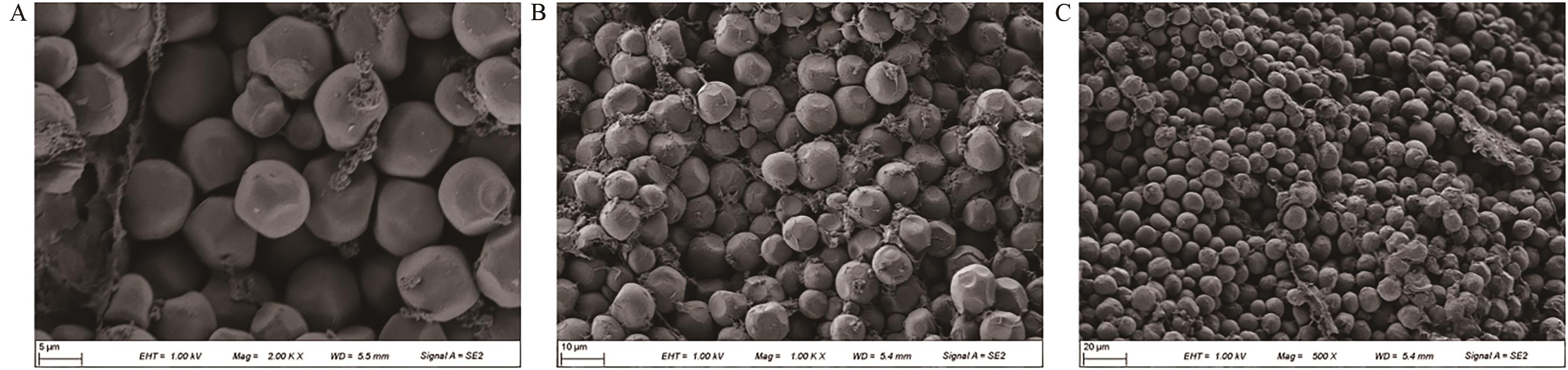
图1 数据集原始图像概览A:放大2 000倍;B:放大1 000倍;C:放大500倍
Fig. 1 Overview of the original images of the datasetA: Enlarge 2 000 times. B: Enlarge 1 000 times. C: Enlarge 500 times
配置 Configuration | 参数 Parameter |
|---|---|
| CPU | 16vCPU AMD EPYC 9654 96-Core Processor |
| 内存 Memory | 60 GB |
| GPU | RTX 4090(24 GB) × 1 |
| 训练工具 Training tools | Cuda 12.1 |
| 操作系统 Operating system | Ubuntu22.04 |
| 开发环境 Development environment | PyTorch 2.1.0 Python 3.10 |
表1 训练环境
Table 1 Training environment
配置 Configuration | 参数 Parameter |
|---|---|
| CPU | 16vCPU AMD EPYC 9654 96-Core Processor |
| 内存 Memory | 60 GB |
| GPU | RTX 4090(24 GB) × 1 |
| 训练工具 Training tools | Cuda 12.1 |
| 操作系统 Operating system | Ubuntu22.04 |
| 开发环境 Development environment | PyTorch 2.1.0 Python 3.10 |
类型 Type | 软件/版本 Software/Version |
|---|---|
| 操作系统 Operating system | Windows10 |
| 开发语言 Development language | Python |
| 后端开发框架 Backend development framework | Django |
| 后端开发工具 Backend development tool | PyCharm |
| 前端开发语言 Frontend development language | HTML、CSS、JS |
表2 系统开发软件配置
Table 2 Software configuration for system development
类型 Type | 软件/版本 Software/Version |
|---|---|
| 操作系统 Operating system | Windows10 |
| 开发语言 Development language | Python |
| 后端开发框架 Backend development framework | Django |
| 后端开发工具 Backend development tool | PyCharm |
| 前端开发语言 Frontend development language | HTML、CSS、JS |
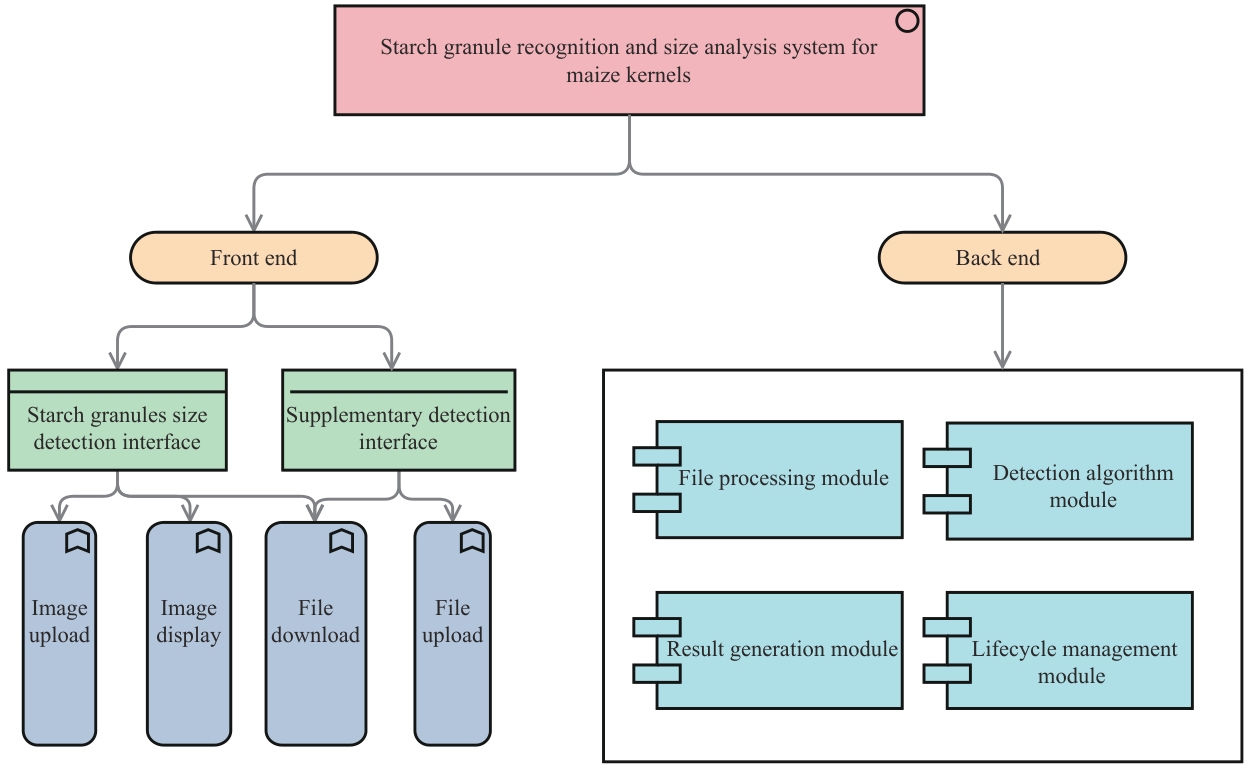
图2 系统功能模块图
Fig. 2 Modules of system functions
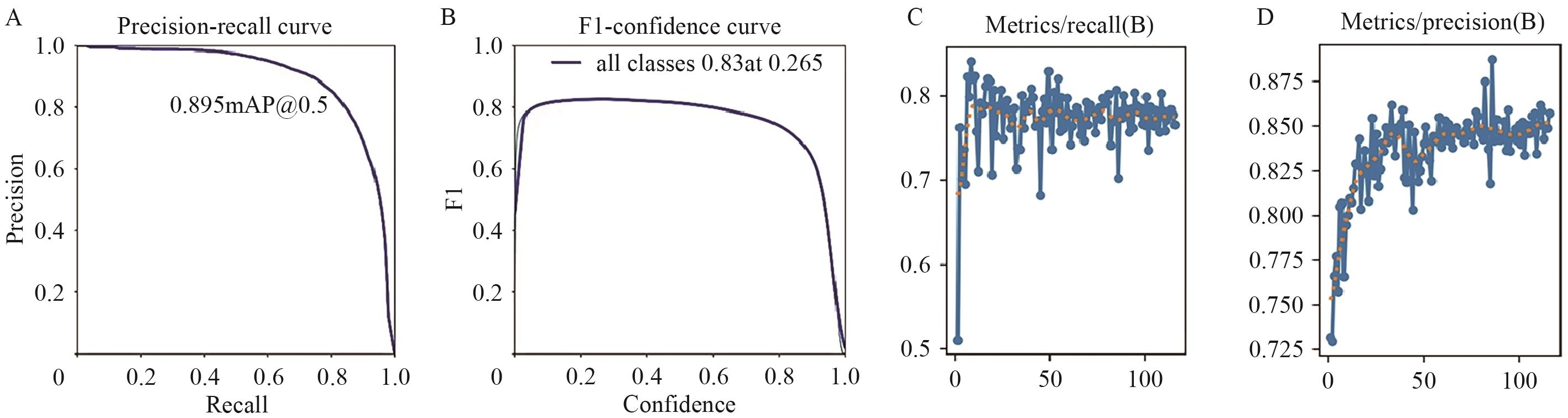
图3 模型性能评估A:精确率‒召回率曲线;B:F1-置信度曲线;C:召回率变化曲线;D:精确率变化曲线
Fig. 3 Assessment on model performanceA: Precision-Recall curve. B: F1-confidence curve. C: Recall change curve. D: Precision change curve
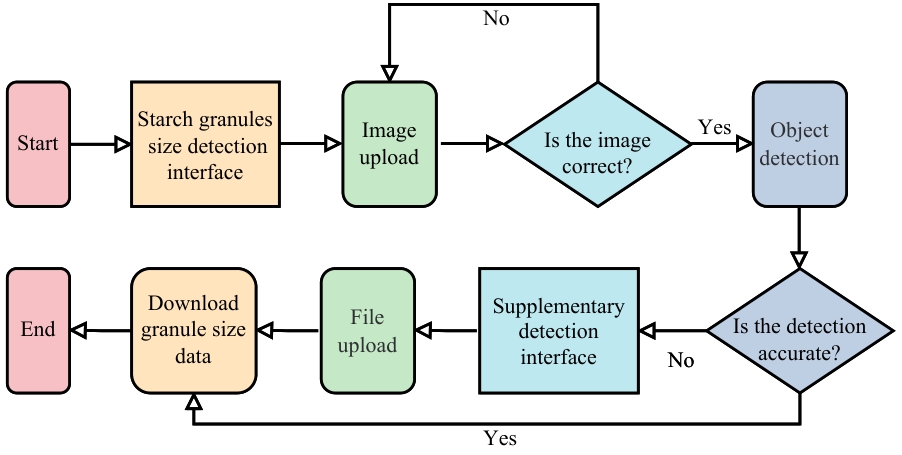
图4 系统操作流程图
Fig. 4 The operation flowchart of the system
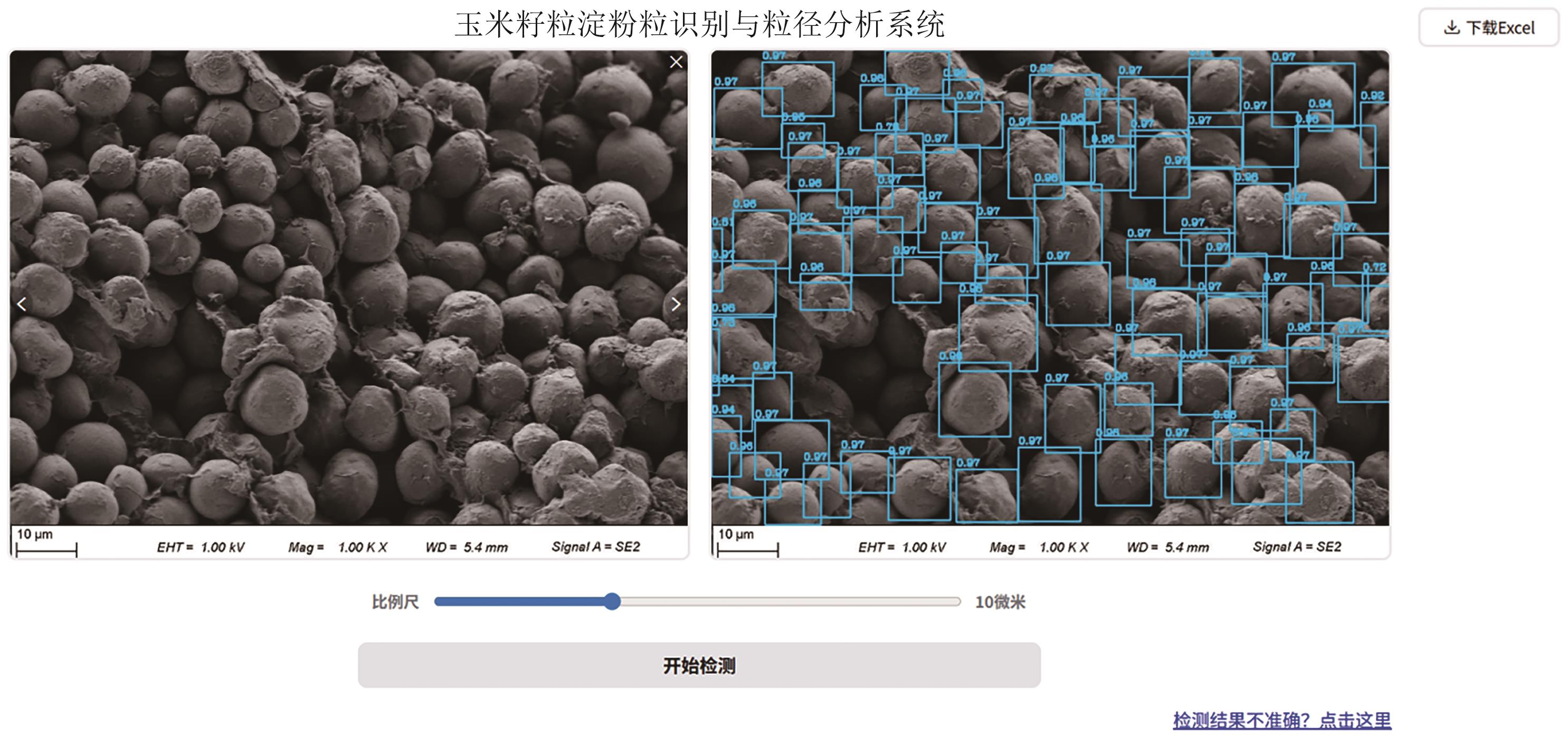
图5 淀粉粒粒径检测界面
Fig. 5 Detection interface of starch granules size
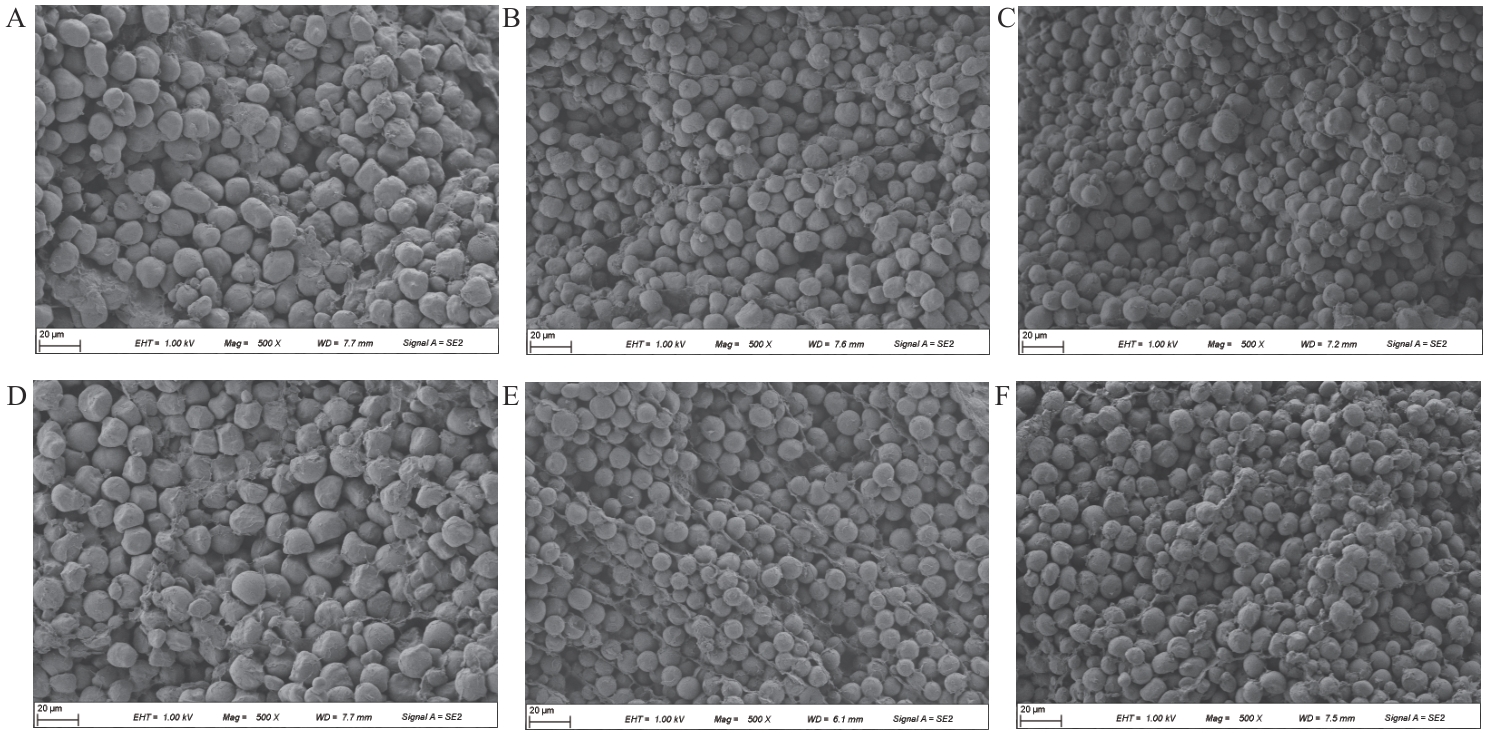
图6 六个玉米自交系胚乳淀粉粒的扫描电镜图像A: B73; B: B104; C: KN5585; D: MO17; E: RP125; F: W22
Fig. 6 Original SEM images of endosperm starch granules for six maize inbred lines
自交系 Inbred lines | 人工检测 | 自动化检测 | 人工与自动化检测粒径的差异 Difference in granules diameter between manual and automated detection (μm) | ||||
|---|---|---|---|---|---|---|---|
图片数量 Number of images | 识别的淀粉粒总数 Total number of identified starch granules | 淀粉粒平均直径 Average diameter of starch granules (μm) | 图片数量 Number of images | 识别的淀粉粒总数 Total number of identified starch granules | 淀粉粒平均直径 Average diameter of starch granules (μm) | ||
| B73 | 1 | 30 | 16.12 | 5 | 297 | 15.31 | 0.81 |
| B104 | 1 | 71 | 13.30 | 5 | 468 | 11.99 | 1.31 |
| KN5585 | 1 | 64 | 12.24 | 5 | 561 | 10.80 | 1.44 |
| MO17 | 1 | 63 | 14.89 | 5 | 263 | 15.46 | 0.57 |
| RP125 | 1 | 55 | 10.92 | 5 | 565 | 10.61 | 0.31 |
| W22 | 1 | 49 | 11.03 | 5 | 419 | 12.20 | 1.17 |
表3 六个玉米自交系粒径的人工和自动化检测
Table 3 The manual and automated measurement of starch granule diameter for six maize inbred lines
自交系 Inbred lines | 人工检测 | 自动化检测 | 人工与自动化检测粒径的差异 Difference in granules diameter between manual and automated detection (μm) | ||||
|---|---|---|---|---|---|---|---|
图片数量 Number of images | 识别的淀粉粒总数 Total number of identified starch granules | 淀粉粒平均直径 Average diameter of starch granules (μm) | 图片数量 Number of images | 识别的淀粉粒总数 Total number of identified starch granules | 淀粉粒平均直径 Average diameter of starch granules (μm) | ||
| B73 | 1 | 30 | 16.12 | 5 | 297 | 15.31 | 0.81 |
| B104 | 1 | 71 | 13.30 | 5 | 468 | 11.99 | 1.31 |
| KN5585 | 1 | 64 | 12.24 | 5 | 561 | 10.80 | 1.44 |
| MO17 | 1 | 63 | 14.89 | 5 | 263 | 15.46 | 0.57 |
| RP125 | 1 | 55 | 10.92 | 5 | 565 | 10.61 | 0.31 |
| W22 | 1 | 49 | 11.03 | 5 | 419 | 12.20 | 1.17 |
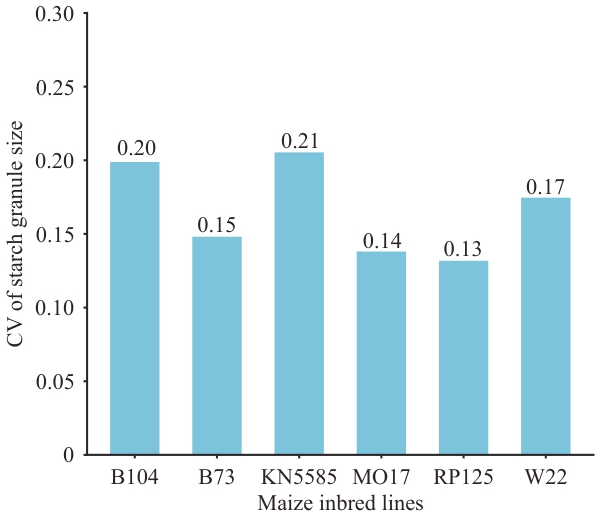
图7 不同玉米自交系的粒径变异系数
Fig. 7 Coefficient of variation for granule diameter in different maize inbred lines
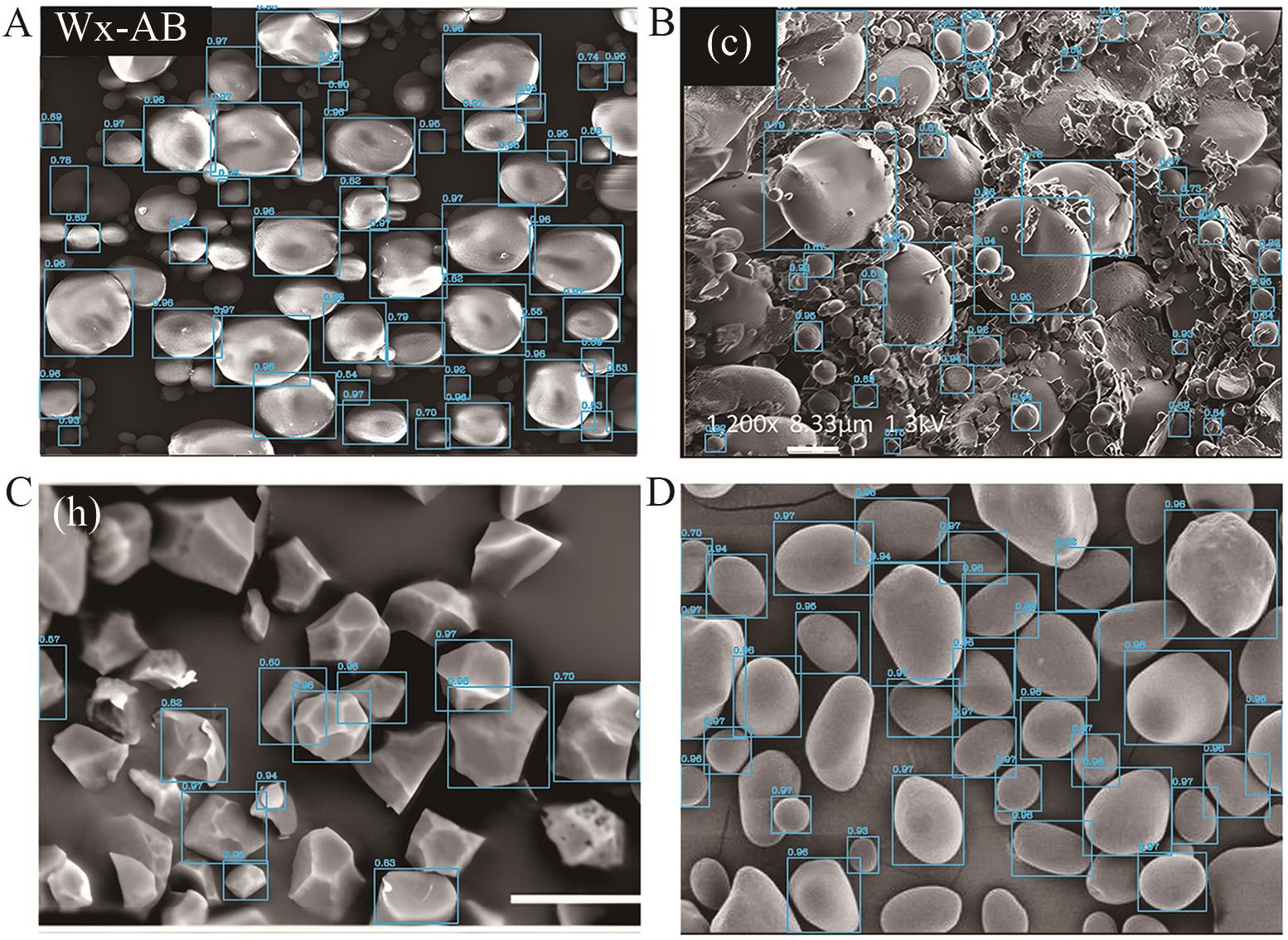
图8 不同作物淀粉粒的模型识别结果A:小麦;B:大麦;C:水稻;D:马铃薯
Fig. 8 Model recognition results of starch granules in different cropsA: Triticum aestivum. B: Hordeum vulgare. C: Oryza sativa. D: Solanum tuberosum
| [1] | Bertoft E. Understanding starch structure: recent progress [J]. Agronomy, 2017, 7(3): 56. |
| [2] | Smith AM. The biosynthesis of starch granules [J]. Biomacromolecules, 2001, 2(2): 335-341. |
| [3] | 余平, 石彦忠. 淀粉与淀粉制品工艺学 [M]. 北京: 中国轻工业出版社, 2011: 7-26. |
| Yu P, Shi YZ. Technology of starch and derived products [M]. Beijing: China Light Industry Press, 2011: 7-26. | |
| [4] | Zhu F. Starch based Pickering emulsions: Fabrication, properties, and applications [J]. Trends Food Sci Technol, 2019, 85: 129-137. |
| [5] | Myburgh JA, Finfer S, Bellomo R, et al. Hydroxyethyl starch or saline for fluid resuscitation in intensive care [J]. N Engl J Med, 2012, 367(20): 1901-1911. |
| [6] | Hebeish A, Aly AA, El-Shafei AM, et al. Innovative starch derivatives as textile auxiliaries for application in sizing, finishing and flocculation [J]. Starch Stärke, 2008, 60(2): 97-109. |
| [7] | Mohd Asharuddin S, Othman N, Ali Hamood Altowayti W, et al. Recent advancement in starch modification and its application as water treatment agent [J]. Environ Technol Innov, 2021, 23: 101637. |
| [8] | 侯汉学, 董海洲, 宋晓庆, 等. 不同品种玉米淀粉的理化性质及相关性研究 [J]. 中国粮油学报, 2009, 24(1): 60-64. |
| Hou HX, Dong HZ, Song XQ, et al. Correlations among physico-chemical properties of starches from different maize cultivars [J]. J Chin Cereals Oils Assoc, 2009, 24(1): 60-64. | |
| [9] | 张雅婷, 路梦莉, 余梦奇, 等. 种植密度对沿淮玉米籽粒淀粉粒度分布与糊化特性的影响 [J]. 粮油食品科技, 2024, 32(1): 66-76. |
| Zhang YT, Lu ML, Yu MQ, et al. Effects of planting density on starch particle size distribution and pasting properties of maize kernels along Huaihe River [J]. Sci Technol Cereals Oils Foods, 2024, 32(1): 66-76. | |
| [10] | 李晓艳. 玉米淀粉合酶Ⅳ、Ⅴ(ZmSSⅣ、ZmSSⅤ)对淀粉粒形成的影响研究 [D]. 雅安: 四川农业大学, 2024. |
| Li XY. Effect of maize starch synthase Ⅳ, Ⅴ (ZmSSⅣ, ZmSSⅤ) on the formation of starch granules [D]. Ya’an: Sichuan Agricultural University, 2024. | |
| [11] | 陈海花. 玉米淀粉合酶Ⅳ(ZmSSⅣ)、Ⅴ(ZmSSⅤ)过表达对淀粉合成的影响 [D]. 雅安: 四川农业大学, 2021. |
| Chen HH. Effects of overexpression of starch synthase Ⅳ (ZmSSⅣ) and Ⅴ (ZmSSⅤ) on starch synthesis in maize [D]. Ya’an: Sichuan Agricultural University, 2021. | |
| [12] | Seung D. Amylose in starch: towards an understanding of biosynthesis, structure and function [J]. New Phytol, 2020, 228(5): 1490-1504. |
| [13] | Chia T, Chirico M, King R, et al. A carbohydrate-binding protein, B-GRANULE CONTENT 1, influences starch granule size distribution in a dose-dependent manner in polyploid wheat [J]. J Exp Bot, 2020, 71(1): 105-115. |
| [14] | Lv XX, Hong Y, Gu ZB, et al. Effect of solution on starch structure: New separation approach of amylopectin fraction from gelatinized native corn starch [J]. Carbohydr Polym, 2024, 329: 121770. |
| [15] | Zhang J, Li JW, Fan LP. Effect of starch granule size on the properties of dough and the oil absorption of fried potato crisps [J]. Int J Biol Macromol, 2024, 268(Pt 2): 131844. |
| [16] | Cui LN, Dong ST, Zhang JW, et al. Starch granule size distribution and morphogenesis in maize (Zea mays L.) grains with different endosperm types [J]. Aust J Crop Sci, 2014, 8(11): 1560-1565. |
| [17] | Murphy KM, Ludwig E, Gutierrez J, et al. Deep learning in image-based plant phenotyping [J]. Annu Rev Plant Biol, 2024, 75(1): 771-795. |
| [18] | Huang YN, Qian YR, Wei HY, et al. A survey of deep learning-based object detection methods in crop counting [J]. Comput Electron Agric, 2023, 215: 108425. |
| [19] | Liu RY. Enhanced motorbike helmet detection using YOLOv10 with attention-based modifications [C]//2024 4th International Conference on Computer Science and Blockchain (CCSB). September 6-8, 2024, Shenzhen, China. Piscataway, NJ: IEEE, 2024: 114-118. |
| [20] | An JY, Dong SY, Wang XL, et al. Research on UAV aerial imagery detection algorithm for Mining-Induced surface cracks based on improved YOLOv10 [J]. Sci Rep, 2025, 15: 30101. |
| [21] | Bellout A, Zarboubi M, Elhoseny M, et al. LT-YOLOv10n: a lightweight IoT-integrated deep learning model for real-time tomato leaf disease detection and management [J]. Internet Things, 2025, 33: 101663. |
| [22] | Guan ST, Lin YM, Lin GY, et al. Real-time detection and counting of wheat spikes based on improved YOLOv10 [J]. Agronomy, 2024, 14(9): 1936. |
| [23] | Saito M, Tanaka T, Sato K, et al. A single nucleotide polymorphism in the “Fra” gene results in fractured starch granules in barley [J]. Theor Appl Genet, 2018, 131(2): 353-364. |
| [24] | Peng C, Wang YH, Liu F, et al. FLOURY ENDOSPERM6 encodes a CBM48 domain-containing protein involved in compound granule formation and starch synthesis in rice endosperm [J]. Plant J, 2014, 77(6): 917-930. |
| [25] | 郎双静, 刘诗琳, 侯越, 等. 微细化马铃薯淀粉制备工艺优化及颗粒性质研究 [J]. 黑龙江八一农垦大学学报, 2020, 32(6): 61-69. |
| Lang SJ, Liu SL, Hou Y, et al. Study on processing optimization and particle properties of micronized potato starch [J]. J Heilongjiang Bayi Agric Univ, 2020, 32(6): 61-69. | |
| [26] | Sun Y, Li MQ, Liu ML, et al. A statistical method for high-throughput emergence rate calculation for soybean breeding plots based on field phenotypic characteristics [J]. Plant Methods, 2025, 21(1): 40. |
| [27] | 李思进, 李金阳, 张伟. 基于改进YOLOv5s的大豆冠层叶片识别方法研究 [J]. 中国农机化学报, 2025, 46(5): 100-105, 140. |
| Li SJ, Li JY, Zhang W. Research on soybean canopy leaf recognition method based on improved YOLOv5s [J]. J Chin Agric Mech, 2025, 46(5): 100-105, 140. | |
| [28] | Feng J, Li ZT, Zhang SZ, et al. A microimage-processing-based technique for detecting qualitative and quantitative characteristics of plant cells [J]. Agriculture, 2023, 13(9): 1816. |
| [29] | 朱怡航, 张小斌, 沈颖越, 等. 基于图像识别技术的金针菇表型高通量采集与分析 [J]. 菌物学报, 2021, 40(3): 626-640. |
| Zhu YH, Zhang XB, Shen YY, et al. High-throughput phenotyping collection and analysis of Flammulina filiformis based on image recognition technology [J]. Mycosystema, 2021, 40(3): 626-640. | |
| [30] | 陈佳玮, 李庆, 谭巧行, 等. 结合轻量级麦穗检测模型和离线Android软件开发的田间小麦测产 [J]. 农业工程学报, 2021, 37(19): 156-164. |
| Chen JW, Li Q, Tan QX, et al. Combining lightweight wheat spikes detecting model and offline Android software development for in-field wheat yield prediction [J]. Trans Chin Soc Agric Eng, 2021, 37(19): 156-164. |
| [1] | 彭善麟, 廖卓诚, 王涛, 刘志宇, 刘海忆, 王婷婷, 杨琴, 王哲, 邰欢欢. 不同玉米茎腐病抗性品种根际微生物群落多样性及功能差异[J]. 生物技术通报, 2026, 42(5): 76-88. |
| [2] | 王晶, 刘卓艳, 张晓磊, 刘宝海, 关海涛, 温洪涛. 基于LAMP-CRISPR/Cas12a技术快速检测转基因玉米DBN9501转化体特异性[J]. 生物技术通报, 2026, 42(2): 149-157. |
| [3] | 张冬岭, 张寅生, 王建军, 叶飞宇, 卢子涵, 马晨晨, 柳华峰, 胡德升, 邓亚洲, 曹丽茹. 玉米HSFs转录因子家族在干旱胁迫下的表达特性及功能[J]. 生物技术通报, 2026, 42(2): 178-187. |
| [4] | 胡璐, 王凯, 徐婧仪, 叶丽慧, 王永飞, 王丽华, 李杰勤. 玉米和高粱遗传转化技术研究进展[J]. 生物技术通报, 2025, 41(9): 32-43. |
| [5] | 刘彤彤, 李肖慧, 杨骏龙, 陈旺, 玉猛, 王超凡, 王凤茹, 客绍英. ZmSTART1调控玉米维管束建成的功能研究[J]. 生物技术通报, 2025, 41(4): 115-122. |
| [6] | 李文兰, 侯辛未, 李燕, 赵瑞君, 孟昭东, 岳润清. 转基因抗虫耐除草剂玉米LD05纯杂合植株的鉴定及抗性检测[J]. 生物技术通报, 2025, 41(4): 123-133. |
| [7] | 王涛, 胡社伟, 张宇, 邓文文, 尚春缘, 王婉艺. 玉米籽粒淀粉生物合成及调控因素研究进展[J]. 生物技术通报, 2025, 41(3): 1-13. |
| [8] | 任鑫茹, 赵宏璐, 李雅静, 刘荣军, 曾凡力, 王钦宏, 王震. 混菌低温发酵对玉米秸秆黄贮饲料品质的影响[J]. 生物技术通报, 2025, 41(3): 330-342. |
| [9] | 王中杰, 孙虎, 刘朋, 高洪增, 崔建东. 玉米多肽的制备及其抗氧化、抗疲劳功效[J]. 生物技术通报, 2025, 41(11): 201-211. |
| [10] | 夏士轩, 耿泽栋, 祝光涛, 张春芝, 李大伟. 基于深度学习的马铃薯花粉活力快速检测[J]. 生物技术通报, 2024, 40(9): 123-130. |
| [11] | 任晓敏, 云岚, 艾芊, 赵乔. 新麦草异戊烯基转移酶PjIPT基因的功能验证[J]. 生物技术通报, 2024, 40(7): 207-215. |
| [12] | 胡锦锦, 李素贞, 马旭辉, 柳小庆, 谢珊珊, 江海洋, 陈茹梅. 玉米花青素生物合成代谢调控[J]. 生物技术通报, 2024, 40(6): 34-44. |
| [13] | 王秋月, 段鹏亮, 李海笑, 刘宁, 曹志艳, 董金皋. 玉米大斑病菌cDNA文库的构建及转录因子StMR1互作蛋白的筛选[J]. 生物技术通报, 2024, 40(6): 281-289. |
| [14] | 孙亚楠, 王春雪, 王欣, 杜秉海, 刘凯, 汪城墙. 萎缩芽孢杆菌CNY01的生防特性及其对玉米的抗盐促生作用[J]. 生物技术通报, 2024, 40(5): 248-260. |
| [15] | 王佳玮, 李晨, 刘建利, 周世杰, 易嘉敏, 杨谨源, 康鹏. 内生真菌接种方式对青贮玉米幼苗生长的影响[J]. 生物技术通报, 2024, 40(4): 189-202. |
| 阅读次数 | ||||||
|
全文 |
|
|||||
|
摘要 |
|
|||||
