







生物技术通报 ›› 2026, Vol. 42 ›› Issue (5): 193-202.doi: 10.13560/j.cnki.biotech.bull.1985.2025-1453
• 微生物组学专题 • 上一篇
马金慧1( ), 王晓妮2, 祁保霞2, 张适3, 吴琼3, 徐均钊2, 吴白乙拉2, 胡宗福2, 牛化欣2()
收稿日期:2025-12-30
出版日期:2026-05-26
发布日期:2026-06-10
通讯作者:
牛化欣,男,博士,教授,研究方向 :肉牛营养与饲料科学;E-mail: niuhx@imun.edu.cn作者简介:马金慧,女,博士,讲师,研究方向 :青贮饲草种植与利用;E-mail: majinhui@imun.edu.cn
基金资助:
MA Jin-hui1(), WANG Xiao-ni2, QI Bao-xia2, ZHANG Shi3, WU Qiong3, XU Jun-zhao2, WU Bai-yi-la2, HU Zong-fu2, NIU Hua-xin2()
Received:2025-12-30
Published:2026-05-26
Online:2026-06-10
摘要:
目的 阐明短乳杆菌DN-1对全株玉米-大豆混合青贮(whole-plant corn-soybean mixed silage, WPCS)有氧变质期间青贮品质、有氧稳定性、霉菌毒素和微生物多样性的影响。 方法 将全株玉米和全株大豆按1∶1比例混合,分为对照组(CK组)和短乳杆菌DN-1组(LB组),每组4个重复,青贮发酵60 d后,再有氧变质0、3、5 d取样,测定WPCS的营养成分、发酵品质、有氧稳定性、霉菌毒素含量和微生物群落变化。 结果 有氧变质期间,与CK组相比,LB组0、3 d粗蛋白质(CP)、pH、乳酸菌含量差异不显著(P>0.05),而5 d时显著升高(P<0.05),且5 d时酸性洗涤纤维(ADF)、氨态氮(NH3-N)、霉菌、呕吐毒素(deoxynivalenol, DON)含量显著降低(P<0.05);LB组3、5 d的乙酸(acetic acid, AA)含量显著升高(P<0.05),而玉米赤霉烯酮(zearalenone, ZEA)和伏马菌素B1(fumonisin B1, FB1)含量显著降低(P<0.05)。LB组的有氧稳定性显著高于对照组(P<0.05)。变形菌门(Proteobacteria)和厚壁菌门(Firmicutes)是所有样品中的优势门;乳杆菌属(Lactobacillus)和明串珠菌属(Leuconostoc)相对丰度随着有氧变质时间的延长而降低,而芽胞杆菌属(Bacillus)相对丰度随着有氧变质时间的延长而增加。相关性分析表明,pH、黄曲霉毒素B1(AFB1)、DON、ZEA、FB1、丙酸(PA)、丁酸(BA)和NH3-N与乳杆菌属、明串珠菌属和魏斯氏菌属(Weissella)呈负相关;乳酸(LA)和AA与乳杆菌属呈极显著正相关(P<0.001),与芽胞杆菌属呈负相关性(P<0.01)。 结论 短乳杆菌DN-1在一定程度上可减少WPCS有氧变质期间营养物质损失,提高乳杆菌属相对丰度,延缓pH升高和乳酸、乙酸降低,提高有氧稳定性,抑制霉菌及其毒素的积累,改善有氧变质青贮发酵品质。
马金慧, 王晓妮, 祁保霞, 张适, 吴琼, 徐均钊, 吴白乙拉, 胡宗福, 牛化欣. 短乳杆菌对全株玉米-大豆混合青贮变质期间霉菌毒素和微生物群落的影响[J]. 生物技术通报, 2026, 42(5): 193-202.
MA Jin-hui, WANG Xiao-ni, QI Bao-xia, ZHANG Shi, WU Qiong, XU Jun-zhao, WU Bai-yi-la, HU Zong-fu, NIU Hua-xin. Effects of Lactobacillus brevis on Mycotoxins and Microbial Community in Whole-plant Corn-soybean Mixed Silage during Aerobic Deterioration[J]. Biotechnology Bulletin, 2026, 42(5): 193-202.
| 项目 Item | 全株玉米 Whole-plant corn | 全株大豆 Whole-plant soybean | 混合 Mix |
|---|---|---|---|
| 干物质DM (% FM) | 32.50±0.11 | 31.52±0.16 | 32.43±0.05 |
| pH | 5.73±0.53 | 5.85±0.34 | 5.84±0.16 |
| 粗蛋白质CP (% DM) | 8.56±0.35 | 18.46±0.35 | 10.71±0.27 |
| 中性洗涤纤维NDF (% DM) | 42.28±0.37 | 52.69±0.22 | 48.58±0.52 |
| 酸性洗涤纤维ADF(% DM) | 24.34±1.05 | 40.01±1.53 | 28.96±0.45 |
| WSC (% DM) | 11.88±0.05 | 3.63±0.16 | 5.82±0.06 |
| 乳酸菌 (lg CFU/g FM) | 4.55±0.14 | 5.56±0.36 | 5.21±0.20 |
| 酵母菌 (lg CFU/g FM) | 5.13±0.13 | 5.23±0.37 | 6.65±0.15 |
| 霉菌 (lg CFU/g FM) | ND | ND | ND |
表1 青贮前全株玉米和大豆成分
Table 1 Composition of whole-plant corn and soybean before silage
| 项目 Item | 全株玉米 Whole-plant corn | 全株大豆 Whole-plant soybean | 混合 Mix |
|---|---|---|---|
| 干物质DM (% FM) | 32.50±0.11 | 31.52±0.16 | 32.43±0.05 |
| pH | 5.73±0.53 | 5.85±0.34 | 5.84±0.16 |
| 粗蛋白质CP (% DM) | 8.56±0.35 | 18.46±0.35 | 10.71±0.27 |
| 中性洗涤纤维NDF (% DM) | 42.28±0.37 | 52.69±0.22 | 48.58±0.52 |
| 酸性洗涤纤维ADF(% DM) | 24.34±1.05 | 40.01±1.53 | 28.96±0.45 |
| WSC (% DM) | 11.88±0.05 | 3.63±0.16 | 5.82±0.06 |
| 乳酸菌 (lg CFU/g FM) | 4.55±0.14 | 5.56±0.36 | 5.21±0.20 |
| 酵母菌 (lg CFU/g FM) | 5.13±0.13 | 5.23±0.37 | 6.65±0.15 |
| 霉菌 (lg CFU/g FM) | ND | ND | ND |
项目 Items | 处理 Treatment | 有氧变质天数 Aerobic exposure days (d) | SEM | P-value | ||||
|---|---|---|---|---|---|---|---|---|
| 0 | 3 | 5 | T | D | T×D | |||
| DM (% FM) | CK | 31.39b | 30.25b | 27.62a | 0.881 | NS | ** | ** |
| LB | 32.32a | 31.42a | 29.08a | |||||
| CP (% DM) | CK | 10.17a | 9.26ab | 7.72Ab | 0.994 | ** | * | NS |
| LB | 12.31a | 11.56bc | 9.90Bc | |||||
| NDF (% DM) | CK | 45.12b | 49.56a | 51.11a | 1.173 | ** | *** | *** |
| LB | 44.96b | 49.72a | 50.25a | |||||
| ADF (% DM) | CK | 29.71b | 33.63a | 35.44Aa | 1.492 | *** | ** | NS |
| LB | 25.40a | 27.12a | 28.39Ba | |||||
| WSC (% DM) | CK | 15.50a | 13.83a | 11.90b | 1.054 | *** | ** | ** |
| LB | 12.02a | 11.06a | 10.78a | |||||
表2 WPCS有氧变质期间的营养成分
Table 2 Nutritional components of WPCS during aerobic deterioration
项目 Items | 处理 Treatment | 有氧变质天数 Aerobic exposure days (d) | SEM | P-value | ||||
|---|---|---|---|---|---|---|---|---|
| 0 | 3 | 5 | T | D | T×D | |||
| DM (% FM) | CK | 31.39b | 30.25b | 27.62a | 0.881 | NS | ** | ** |
| LB | 32.32a | 31.42a | 29.08a | |||||
| CP (% DM) | CK | 10.17a | 9.26ab | 7.72Ab | 0.994 | ** | * | NS |
| LB | 12.31a | 11.56bc | 9.90Bc | |||||
| NDF (% DM) | CK | 45.12b | 49.56a | 51.11a | 1.173 | ** | *** | *** |
| LB | 44.96b | 49.72a | 50.25a | |||||
| ADF (% DM) | CK | 29.71b | 33.63a | 35.44Aa | 1.492 | *** | ** | NS |
| LB | 25.40a | 27.12a | 28.39Ba | |||||
| WSC (% DM) | CK | 15.50a | 13.83a | 11.90b | 1.054 | *** | ** | ** |
| LB | 12.02a | 11.06a | 10.78a | |||||
项目 Items | 处理 Treatment | 有氧变质天数 Aerobic exposure days (d) | SEM | P-value | ||||
|---|---|---|---|---|---|---|---|---|
| 0 | 3 | 5 | T | D | T×D | |||
| pH | CK | 4.1Bb | 4.55b | 5.33Aa | 0.084 | ** | ** | ** |
| LB | 3.85Ab | 4.41b | 5.06Ba | |||||
| LA (% DM) | CK | 10.37a | 7.77b | 6.40b | 0.507 | NS | *** | * |
| LB | 12.98a | 9.10b | 8.67b | |||||
| AA (% DM) | CK | 1.64Ba | 0.83Bb | 0.73Bb | 0.432 | *** | *** | *** |
| LB | 8.54Aa | 7.59Aa | 6.61Aa | |||||
| PA (% DM) | CK | 2.88b | 3.56a | 3.82a | ND | ND | ND | ND |
| LB | ND | ND | ND | |||||
| BA (% DM) | CK | 0.5bc | 0.88a | 1.11a | ND | ND | ND | ND |
| LB | ND | ND | 0.10 | |||||
| NH3-N (%) | CK | 3.18c | 4.76b | 5.67Ba | 0.474 | *** | *** | *** |
| LB | 2.01b | 3.56a | 3.66Aa | |||||
表3 WPCS有氧变质期间的发酵成分
Table 3 Fermentation components of WPCS during aerobic deterioration
项目 Items | 处理 Treatment | 有氧变质天数 Aerobic exposure days (d) | SEM | P-value | ||||
|---|---|---|---|---|---|---|---|---|
| 0 | 3 | 5 | T | D | T×D | |||
| pH | CK | 4.1Bb | 4.55b | 5.33Aa | 0.084 | ** | ** | ** |
| LB | 3.85Ab | 4.41b | 5.06Ba | |||||
| LA (% DM) | CK | 10.37a | 7.77b | 6.40b | 0.507 | NS | *** | * |
| LB | 12.98a | 9.10b | 8.67b | |||||
| AA (% DM) | CK | 1.64Ba | 0.83Bb | 0.73Bb | 0.432 | *** | *** | *** |
| LB | 8.54Aa | 7.59Aa | 6.61Aa | |||||
| PA (% DM) | CK | 2.88b | 3.56a | 3.82a | ND | ND | ND | ND |
| LB | ND | ND | ND | |||||
| BA (% DM) | CK | 0.5bc | 0.88a | 1.11a | ND | ND | ND | ND |
| LB | ND | ND | 0.10 | |||||
| NH3-N (%) | CK | 3.18c | 4.76b | 5.67Ba | 0.474 | *** | *** | *** |
| LB | 2.01b | 3.56a | 3.66Aa | |||||
项目 Items | 处理 Treatment | 有氧变质天数 Aerobic exposure days (d) | SEM | P-value | ||||
|---|---|---|---|---|---|---|---|---|
| 0 | 3 | 5 | T | D | T×D | |||
| 乳酸菌 | CK | 5.51a | 4.27a | 0.11Ab | 0.647 | ** | *** | *** |
| LB | 6.65a | 5.35a | 3.21Bb | |||||
| 酵母菌 | CK | 2.60Bc | 4.99b | 6.53a | 0.322 | * | ** | ** |
| LB | 1.57Ac | 3.46b | 5.54a | |||||
| 霉菌 | CK | ND | 2.40 | 3.65B | ND | ND | ND | ND |
| LB | ND | ND | 1.23A | |||||
表4 WPCS有氧变质期间的微生物数量
Table 4 Microbial population during aerobic deterioration of WPCS
项目 Items | 处理 Treatment | 有氧变质天数 Aerobic exposure days (d) | SEM | P-value | ||||
|---|---|---|---|---|---|---|---|---|
| 0 | 3 | 5 | T | D | T×D | |||
| 乳酸菌 | CK | 5.51a | 4.27a | 0.11Ab | 0.647 | ** | *** | *** |
| LB | 6.65a | 5.35a | 3.21Bb | |||||
| 酵母菌 | CK | 2.60Bc | 4.99b | 6.53a | 0.322 | * | ** | ** |
| LB | 1.57Ac | 3.46b | 5.54a | |||||
| 霉菌 | CK | ND | 2.40 | 3.65B | ND | ND | ND | ND |
| LB | ND | ND | 1.23A | |||||
项目 Items | 处理 Treatment | 有氧变质天数 Aerobic exposure days (d) | SEM | P-value | ||||
|---|---|---|---|---|---|---|---|---|
| 0 | 3 | 5 | T | D | T×D | |||
| AFB1 (µg/kg DM) | CK | 4.39b | 8.81b | 12.99a | 0.657 | *** | *** | *** |
| LB | 4.33b | 5.70b | 7.28a | |||||
| DON (µg/kg DM) | CK | 17.26b | 30.42b | 46.95Aa | 0.227 | *** | *** | *** |
| LB | 15.29c | 22.40b | 29.91Ba | |||||
| ZEA (µg/kg DM) | CK | 5.98c | 13.61Ab | 25.85Aa | 0.295 | *** | *** | *** |
| LB | 4.95b | 6.89Bb | 11.15Ba | |||||
| FB1 (µg/kg DM) | CK | 33.47Ab | 40.45Ab | 58.00Aa | 0.310 | *** | *** | *** |
| LB | 19.34Bc | 26.38Bb | 36.49Ba | |||||
表5 WPCS有氧变质期间的霉菌毒素浓度
Table 5 Mycotoxin concentration during aerobic deterioration of WPCS
项目 Items | 处理 Treatment | 有氧变质天数 Aerobic exposure days (d) | SEM | P-value | ||||
|---|---|---|---|---|---|---|---|---|
| 0 | 3 | 5 | T | D | T×D | |||
| AFB1 (µg/kg DM) | CK | 4.39b | 8.81b | 12.99a | 0.657 | *** | *** | *** |
| LB | 4.33b | 5.70b | 7.28a | |||||
| DON (µg/kg DM) | CK | 17.26b | 30.42b | 46.95Aa | 0.227 | *** | *** | *** |
| LB | 15.29c | 22.40b | 29.91Ba | |||||
| ZEA (µg/kg DM) | CK | 5.98c | 13.61Ab | 25.85Aa | 0.295 | *** | *** | *** |
| LB | 4.95b | 6.89Bb | 11.15Ba | |||||
| FB1 (µg/kg DM) | CK | 33.47Ab | 40.45Ab | 58.00Aa | 0.310 | *** | *** | *** |
| LB | 19.34Bc | 26.38Bb | 36.49Ba | |||||
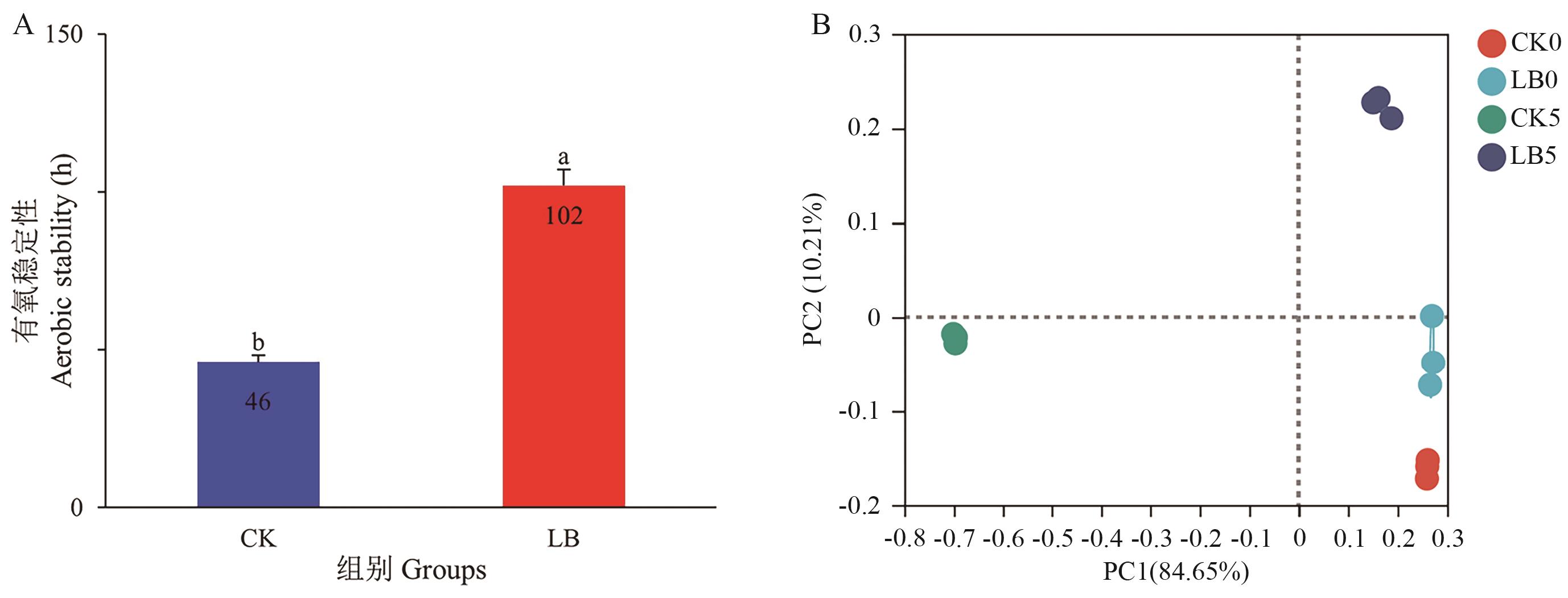
图1 有氧变质期间WPCS的有氧稳定性(A)和细菌群落的β多样性图(B)CK0:未加菌组有氧变质0 d;LB0:加短乳杆菌组有氧变质0 d;CK5:未加菌组有氧变质5 d;LB5:加短乳杆菌组有氧变质5 d
Fig. 1 Aerobic stability (A) and β diversity diagram (B) of WPCS bacterial community during aerobic deteriorationCK0: Uninoculated group at 0 d of aerobic deterioration; LB0: L. brevis-inoculated group at day 0 of aerobic deterioration; CK5: Uninoculated group at 5 d of aerobic deterioration; LB5: L. brevis-inoculated group at day 5 of aerobic deterioration
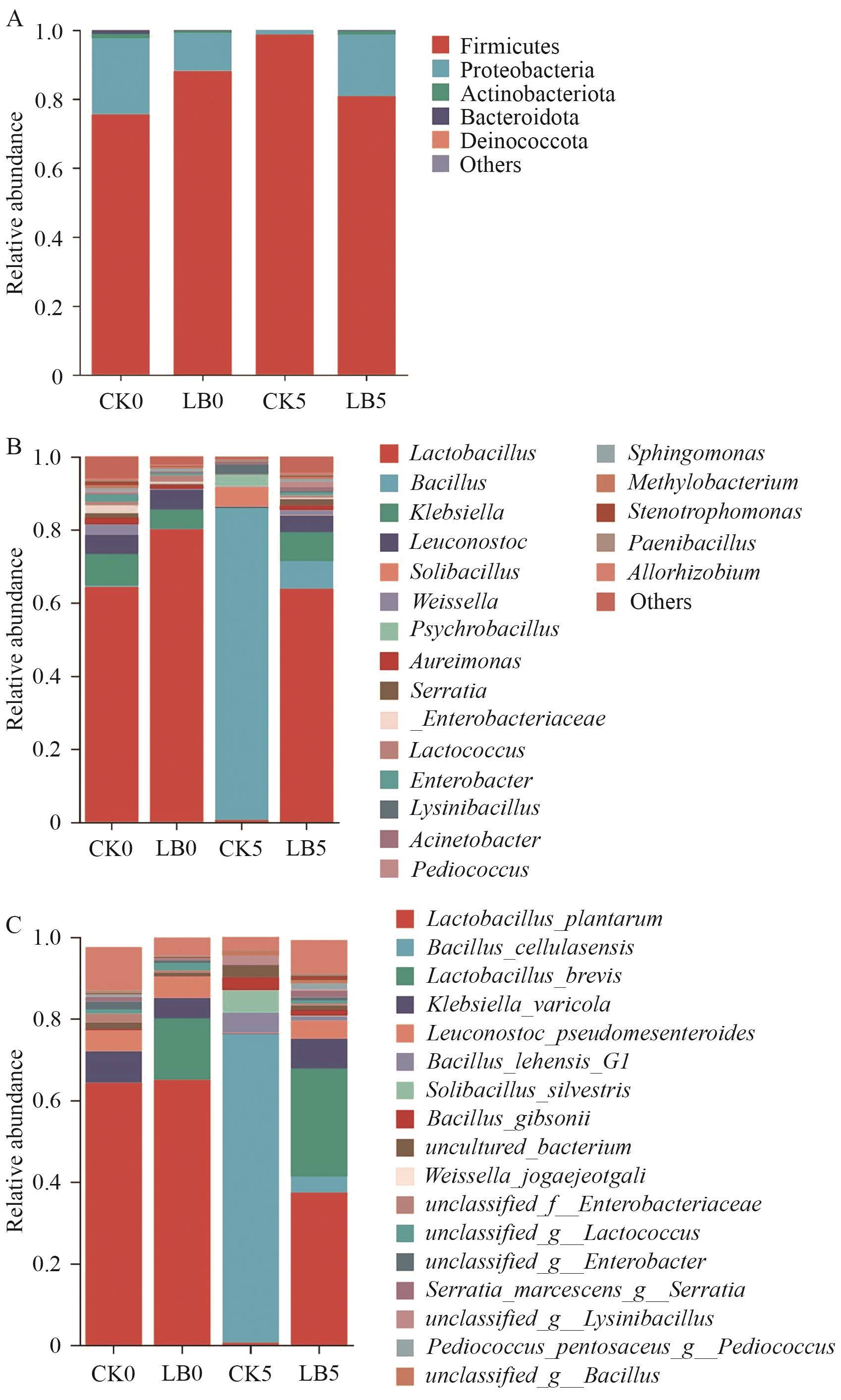
图2 有氧变质期间WPCS细菌群落分析A:门水平;B:属水平;C:种水平
Fig. 2 Bacterial community analysis of WPCS during aerobic deteriorationA: Phylum level; B: genus level; C: species level
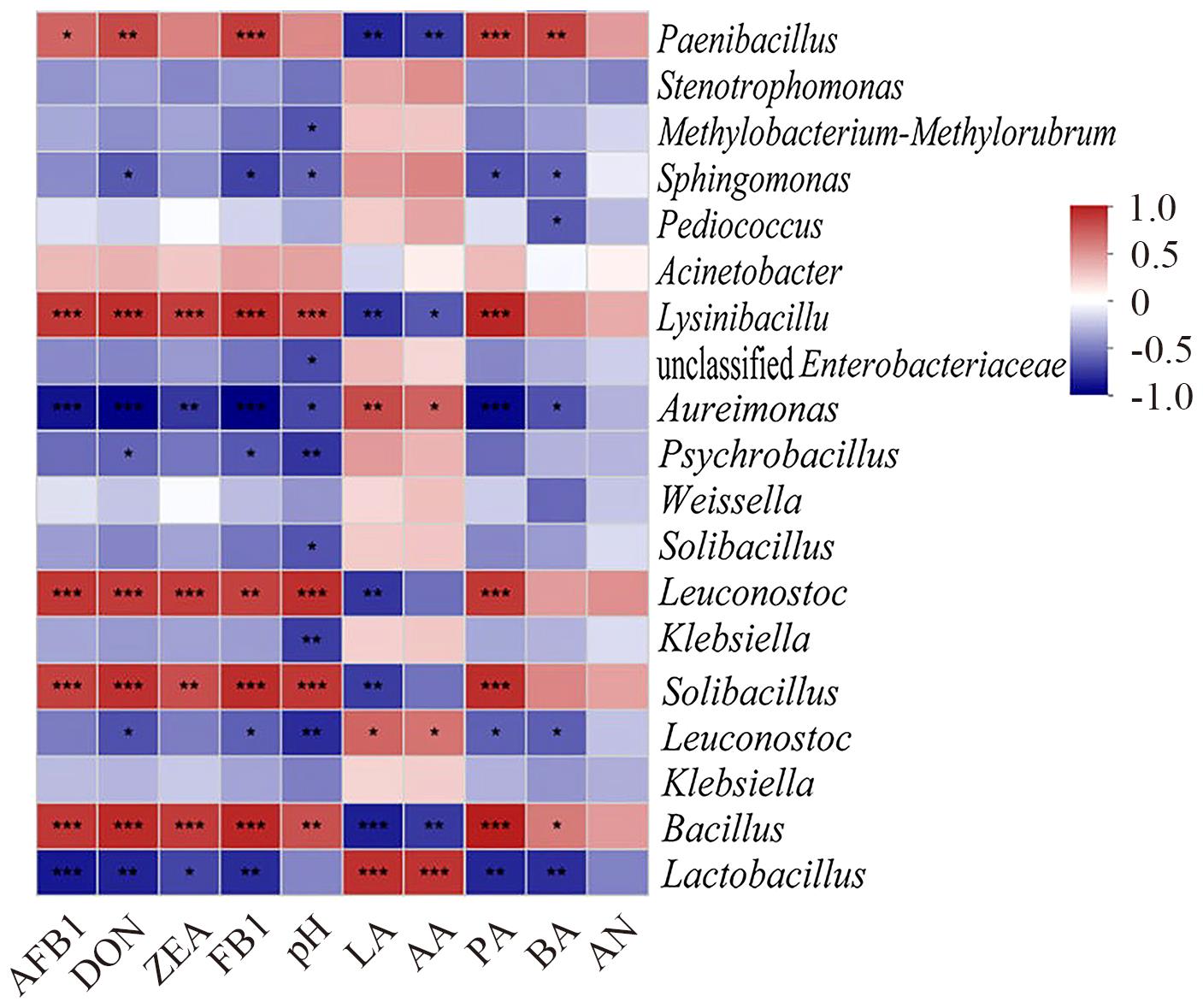
图3 细菌群落与发酵特性的相关性分析
Fig. 3 Correlation analysis between bacterial community and fermentation characteristics
| [1] | Ni KK, Zhao JY, Zhu BG, et al. Assessing the fermentation quality and microbial community of the mixed silage of forage soybean with crop corn or sorghum [J]. Bioresour Technol, 2018, 265: 563-567. |
| [2] | Yang M, Wang FD, Xu W, et al. Effects of the fermentation quality and microbial community of waxy maize mixed with fodder soybean silage [J]. Front Microbiol, 2024, 15: 1405018. |
| [3] | Li QY, Zeng TR, Hu Y, et al. Effects of soybean density and sowing time on the yield and the quality of mixed silage in corn-soybean strip intercropping system [J]. Fermentation, 2022, 8(4): 140. |
| [4] | 丁婉, 郝爱静, 冯钰, 等. 布氏乳杆菌对大豆与青贮玉米混合发酵品质、微生物数量、有氧稳定性及瘤胃降解率的影响 [J]. 动物营养学报, 2025, 37(7): 4810-4822. |
| Ding W, Hao AJ, Feng Y, et al. Effects of Lactobacillus buchneri on fermentation quality, microbial population, aerobic stability and ruminal degradation rate of soybean and silage maize mixed-ensilage [J]. Chin J Anim Nutr, 2025, 37(7): 4810-4822. | |
| [5] | Xia GH, Huang Y, Wu CR, et al. Characterization of mycotoxins and microbial community in whole-plant corn ensiled in different Silo types during aerobic exposure [J]. Front Microbiol, 2023, 14: 1136022. |
| [6] | Tuovinen OH, Niemelä SI, Rajala-Schultz PJ. The role of microbes in ensiling [J]. Microorganisms, 2025, 13(10): 2237. |
| [7] | Driehuis F, Wilkinson JM, Jiang Y, et al. Silage review: Animal and human health risks from silage [J]. J Dairy Sci, 2018, 101(5): 4093-4110. |
| [8] | Muck RE, Nadeau EMG, McAllister TA, et al. Silage review: Recent advances and future uses of silage additives [J]. J Dairy Sci, 2018, 101(5): 3980-4000. |
| [9] | Tahir M, Wang TW, Liu ZQ, et al. Heterofermentative lactic acid bacteria enhance the aerobic stability of sweet sorghum silage [J]. Microb Biotechnol, 2025, 18(11): e70262. |
| [10] | Xiao YZ, Sun L, Xin XP, et al. Physicochemical characteristics and microbial community succession during oat silage prepared without or with Lactiplantibacillus plantarum or Lentilactobacillus buchneri [J]. Microbiol Spectr, 2023, 11(6): e02228-e02223. |
| [11] | Benjamim da Silva É, Costa DM, Santos EM, et al. The effects of Lactobacillus hilgardii 4785 and Lactobacillus buchneri 40788 on the microbiome, fermentation, and aerobic stability of corn silage ensiled for various times [J]. J Dairy Sci, 2021, 104(10): 10678-10698. |
| [12] | 王琦, 武之绚, 陈钟玲, 等. 副干酪乳杆菌对青贮苜蓿有氧暴露品质和细菌多样性的影响 [J]. 生物技术通报, 2021, 37(9): 77-85. |
| Wang Q, Wu ZX, Chen ZL, et al. Effects of Lactobacillus paracasei on the quality and bacterial diversity of silage alfalfa after aerobic exposure [J]. Biotechnol Bull, 2021, 37(9): 77-85. | |
| [13] | Xu JZ, Ma JF, Sa RL, et al. Effects of lactic acid bacteria inoculants on the nutrient composition, fermentation quality, and microbial diversity of whole-plant soybean-corn mixed silage [J]. Front Microbiol, 2024, 15: 1347293. |
| [14] | Wang XN, Wang SY, Xu JZ, et al. Isolation, characterization, and biopreservation of Lactobacillus brevis DN-1 to inhibit mold and remove aflatoxin B1 in peanut and sunflower cakes [J]. Agriculture, 2024, 14(5): 698. |
| [15] | 牛化欣, 王晓妮, 胡宗福, 等. 一种抑制霉菌和吸附降解黄曲霉毒素B1的短乳杆菌及其应用: CN117431171B [P]. 2024-09-13. |
| Niu HX, Wang XN, Hu ZF, et al. A Lactobacillus brevis inhibits mold and adsorbs and degrades aflatoxin B1 and its application: CN117431171B [P]. 2024-09-13. | |
| [16] | Van Soest PJ, Robertson JB, Lewis BA. Methods for dietary fiber, neutral detergent fiber, and no starch polysaccharides in relation to animal nutrition [J]. J Dairy Sci, 1991,74(10): 3583-3597. |
| [17] | Hu ZF, Niu HX, Tong Q, et al. The microbiota dynamics of alfalfa silage during ensiling and after air exposure, and the metabolomics after air exposure are affected by Lactobacillus casei and cellulase addition [J]. Front Microbiol, 2020, 11: 519121. |
| [18] | Yu Y, Guo XJ, Li HE, et al. Ferulic acid esterase-producing inoculant improves fiber degradation and modulates microbial diversity in corn bran silage and whole-plant corn silage [J]. Microorganisms, 2025, 13(11): 2439. |
| [19] | Bai J, Franco M, Ding ZT, et al. Effect of Bacillus amyloliquefaciens and Bacillus subtilis on fermentation, dynamics of bacterial community and their functional shifts of whole-plant corn silage [J]. J Animal Sci Biotechnol, 2022, 13: 7. |
| [20] | Ferrero F, Prencipe S, Spadaro D, et al. Increase in aflatoxins due to Aspergillus section Flavi multiplication during the aerobic deterioration of corn silage treated with different bacteria inoculate [J]. J Dairy Sci, 2019, 102(2): 1176-1193. |
| [21] | Ma J, Zhang J, Guo XS. Harnessing CRISPR-Cas9 for Lactobacillus improvement in silage production: current knowledge and future perspectives [J]. J Animal Sci Biotechnol, 2025, 16: 150. |
| [22] | Wang ZY, Tan ZF, Wu GF, et al. Microbial community and fermentation characteristic of whole-crop wheat silage treated by lactic acid bacteria and Artemisia argyi during ensiling and aerobic exposure [J]. Front Microbiol, 2022, 13: 1004495. |
| [23] | 武祎, 赵红玉, 唐云梦, 等. 添加短乳杆菌对紫花苜蓿半干青贮品质及微生物群落组成的影响 [J]. 中国畜牧杂志, 2024, 60(2): 328-333. |
| Wu Y, Zhao HY, Tang YM, et al. Effects of Lactobacillus brevis on the quality and microbial community composition of alfalfa semi-dry silage [J]. Chin J Anim Sci, 2024, 60(2): 328-333. | |
| [24] | Wu B, Ai J, Li T, et al. Fermentation quality, aerobic stability, and microbiome structure and function of Caragana korshinskii silage inoculated with/without Lactobacillus rhamnosus or Lactobacillus buchneri [J]. Front Sustain Food S, 2023, 7: 7:1255936.. |
| [25] | Wang QD, Kuang SS, Wang CY, et al. The synergistic effect between sodium selenite and Pediococcus acidilactici on fermentation quality and aerobic stability of alfalfa silage [J]. Int Microbiol, 2025, 28(8): 2641-2655. |
| [26] | Silva YA, Cardoso MVSB, Carvalho BF, et al. Lactic acid bacteria strains isolated from rehydrated corn grain silage enhance the chemical and microbiological characteristics and aerobic stability of these silages [J]. J Appl Microbiol, 2025, 136(8): lxaf185. |
| [27] | Chai JK, Gong WL, Bai J, et al. Dry matter recovery, ensiling characteristics and aerobic stability of oat silage treated with microbial inoculants at different temperatures [J]. Arch Anim Nutr, 2022, 76(3-6): 175-190. |
| [28] | Su Y, Yu Q, Xi YL, et al. Role of laccase and xylanase, with or without ferulic acid esterase-producing Lactiplantibacillus plantarum, on the aerobic stability, microbial composition and in vitro degradability of mulberry silage [J]. BMC Microbiol, 2025, 25: 439. |
| [29] | 廖一漠. 短乳杆菌与马克斯克鲁维酵母菌混合发酵乳品质分析及代谢组学研究 [D]. 雅安: 四川农业大学, 2023. |
| Liao YM. Study on the quality and metabolomics of mixed fermented milk by Lactobacillus brevis and Kluyveromyces marxianus [D]. Yaan: Sichuan Agricultural University, 2023. | |
| [30] | 周燚, 张娟, 刘一佳, 等. 丙酸对杂交狼尾草青贮品质及微生物区系的影响 [J]. 动物营养学报, 2023, 35(8): 5404-5417. |
| Zhou Y, Zhang J, Liu YJ, et al. Effects of propionic acid on silage quality and microbial community of hybrid Pennisetum silage [J]. Chin J Anim Nutr, 2023, 35(8): 5404-5417. | |
| [31] | Wang ZY, Tan ZF, Wu GF, et al. Investigation on fermentation characteristics and microbial communities of wheat straw silage with different proportion Artemisia argyi [J]. Toxins, 2023, 15(5): 330. |
| [32] | Teller RS, Schmidt RJ, Whitlow LW, et al. Effect of physical damage to ears of corn before harvest and treatment with various additives on the concentration of mycotoxins, silage fermentation, and aerobic stability of corn silage [J]. J Dairy Sci, 2012, 95(3): 1428-1436. |
| [33] | Huang FQ, Wang TW, Zhang JQ, et al. Exploring the bacterial community succession and metabolic profiles of Lonicera japonica Thunb. residues during anaerobic fermentation [J]. Bioresour Technol, 2023, 367: 128264. |
| [34] | Wang WB, Cai XY, Shao T, et al. Effects of bacterial inoculants on the microbial community, mycotoxin contamination, and aerobic stability of corn silage infected in the field by toxigenic fungi [J]. Chem Biol Technol Agric, 2022, 9: 93. |
| [35] | Javed A, Ajmal M, Hanif NQ, et al. Effects of inoculation of corn silage with Saccharomyces cerevisiae on silage fermentation characteristics, nutrient digestibility, mycoflora and aflatoxin production [J]. Nat Prod Res, 2024, 38(20): 3488-3497. |
| [1] | 彭善麟, 廖卓诚, 王涛, 刘志宇, 刘海忆, 王婷婷, 杨琴, 王哲, 邰欢欢. 不同玉米茎腐病抗性品种根际微生物群落多样性及功能差异[J]. 生物技术通报, 2026, 42(5): 76-88. |
| [2] | 张英英, 吴之涛, 常浩, 徐志鹏, 杨小龙, 杨克泽, 魏玉杰. 连作年限对黄芪根际土壤性质及微生物群落结构的影响[J]. 生物技术通报, 2026, 42(5): 174-184. |
| [3] | 廖艳婷, 王灿琴, 韦娇君, 赵承刚, 黄世旅, 罗阳兰, 阎勇. 羊肚菌连作对土壤理化性质、微生物群落变化的影响及其关联机制[J]. 生物技术通报, 2026, 42(5): 134-146. |
| [4] | 何莛莛, 李玲娟. 合成微生物群落增强植物抗旱性的研究进展[J]. 生物技术通报, 2026, 42(5): 51-62. |
| [5] | 张津浩, 邓辉, 张清壮, 陶禹, 周池, 李鑫. 贝莱斯芽胞杆菌XY40-1对百合球茎生长、品质及镉含量的调控作用[J]. 生物技术通报, 2025, 41(7): 281-291. |
| [6] | 弥春霞, 许澍, 王守现, 刘宇, 宋庆港, 宋爽. 糙皮侧耳覆土栽培对土壤中抗生素抗性基因的影响[J]. 生物技术通报, 2025, 41(6): 335-343. |
| [7] | 宋奋奋, 段艳雪, 桑愉, 王继朋, 彭锐, 孙年喜, 李勇. 患病和健康羊肚菌菌丝际土壤微生物群落特征[J]. 生物技术通报, 2025, 41(4): 323-334. |
| [8] | 苗昊翔, 张颖, 郭世鹏, 张健. 一株高产γ-氨基丁酸短乳杆菌TCCC13007全基因组测序及比较基因组分析[J]. 生物技术通报, 2025, 41(11): 166-176. |
| [9] | 温绍福, 江润海, 朱城强, 张梅, 余小琴, 杨杰惠, 杨小容, 侯秀丽. 铅污染土壤中解磷菌对玉米根际土壤性质和微生物群落结构的影响[J]. 生物技术通报, 2024, 40(9): 225-237. |
| [10] | 高玉坤, 张建东, 杨溥原, 陈东明, 王志博, 田颐瑾, Zakey Eldinn.E.A.Khlid, 崔江慧, 常金华. 高粱根际土壤细菌群落对盐胁迫的响应[J]. 生物技术通报, 2024, 40(4): 203-216. |
| [11] | 赵志祥, 王殿东, 周亚林, 王培, 严婉荣, 严蓓, 罗路云, 张卓. 枯草芽孢杆菌Ya-1对辣椒枯萎病的防治及其对根际真菌群落的影响[J]. 生物技术通报, 2023, 39(9): 213-224. |
| [12] | 赵林艳, 官会林, 王克书, 卢燕磊, 向萍, 魏富刚, 杨绍周, 徐武美. 土壤含水量对三七连作土壤微生物群落的影响[J]. 生物技术通报, 2022, 38(7): 215-223. |
| [13] | 赵林艳, 官会林, 向萍, 李泽诚, 柏雨龙, 宋洪川, 孙世中, 徐武美. 白及根腐病植株根际土壤微生物群落组成特征分析[J]. 生物技术通报, 2022, 38(2): 67-74. |
| [14] | 高惠惠, 贾晨波, 韩琴, 苏建宇, 徐春燕. 宁杞7号枸杞根腐病发生的微生物学机制[J]. 生物技术通报, 2022, 38(12): 244-251. |
| [15] | 严聪文, 苏代发, 代庆忠, 张振荣, 田云霞, 董琼娥, 周文星, 陈杉艳, 童江云, 崔晓龙. 草莓病害的生物防治研究进展[J]. 生物技术通报, 2022, 38(12): 73-87. |
| 阅读次数 | ||||||
|
全文 |
|
|||||
|
摘要 |
|
|||||
