







生物技术通报 ›› 2026, Vol. 42 ›› Issue (7): 105-115.doi: 10.13560/j.cnki.biotech.bull.1985.2025-0804
• 技术与方法 • 上一篇
彭彦1, 安晨2, 韶也1, 毛毕刚1,2, 张学文3( ), 赵炳然1,2()
收稿日期:2025-07-26
出版日期:2026-07-26
发布日期:2026-07-20
通讯作者:
赵炳然brzhao652@hhrrc.ac.cn基金资助:
PENG Yan1, AN Chen2, SHAO Ye1, MAO Bi-gang1,2, ZHANG Xue-wen3(), ZHAO Bing-ran1,2()
Received:2025-07-26
Published:2026-07-26
Online:2026-07-20
摘要:
目的 开发植物体内重金属离子可视化监测系统,实现水稻重金属离子快速检测。 方法 基于金属响应转录因子(MTF-1)特异性结合金属响应元件(MREs)从而激活转录这一原理,构建了以β-葡萄糖醛酸酶(GUS)或增强绿色荧光蛋白(EGFP)为报告基因的重金属响应植物表达载体,利用农杆菌介导法导入水稻及拟南芥中;通过对转基因植株进行不同浓度重金属离子处理,观察其GUS染色或荧光信号强度;利用RNA-seq分析转基因水稻及野生型对照重金属处理前后的差异基因表达;通过抗氧化酶活性测定和表型验证,分析转基因水稻及野生型对照的金属耐受性。 结果 经不同浓度的As3+、Cd2+、Cu2+溶液处理后,转基因拟南芥或水稻可观察到明显的GUS染色或绿色荧光信号。此外,转基因水稻中重金属解毒相关基因的表达量显著高于对照,超氧化物歧化酶(SOD)和过氧化物酶(POD)活性增强。 结论 在水稻及拟南芥中初步构建了响应重金属离子的可视化系统,为实现水稻体内重金属快速检测提供技术支撑。
彭彦, 安晨, 韶也, 毛毕刚, 张学文, 赵炳然. 植物重金属响应可视化系统的构建与验证[J]. 生物技术通报, 2026, 42(7): 105-115.
PENG Yan, AN Chen, SHAO Ye, MAO Bi-gang, ZHANG Xue-wen, ZHAO Bing-ran. Construction and Validation of a Visualization System for Plants Heavy Metal Response[J]. Biotechnology Bulletin, 2026, 42(7): 105-115.
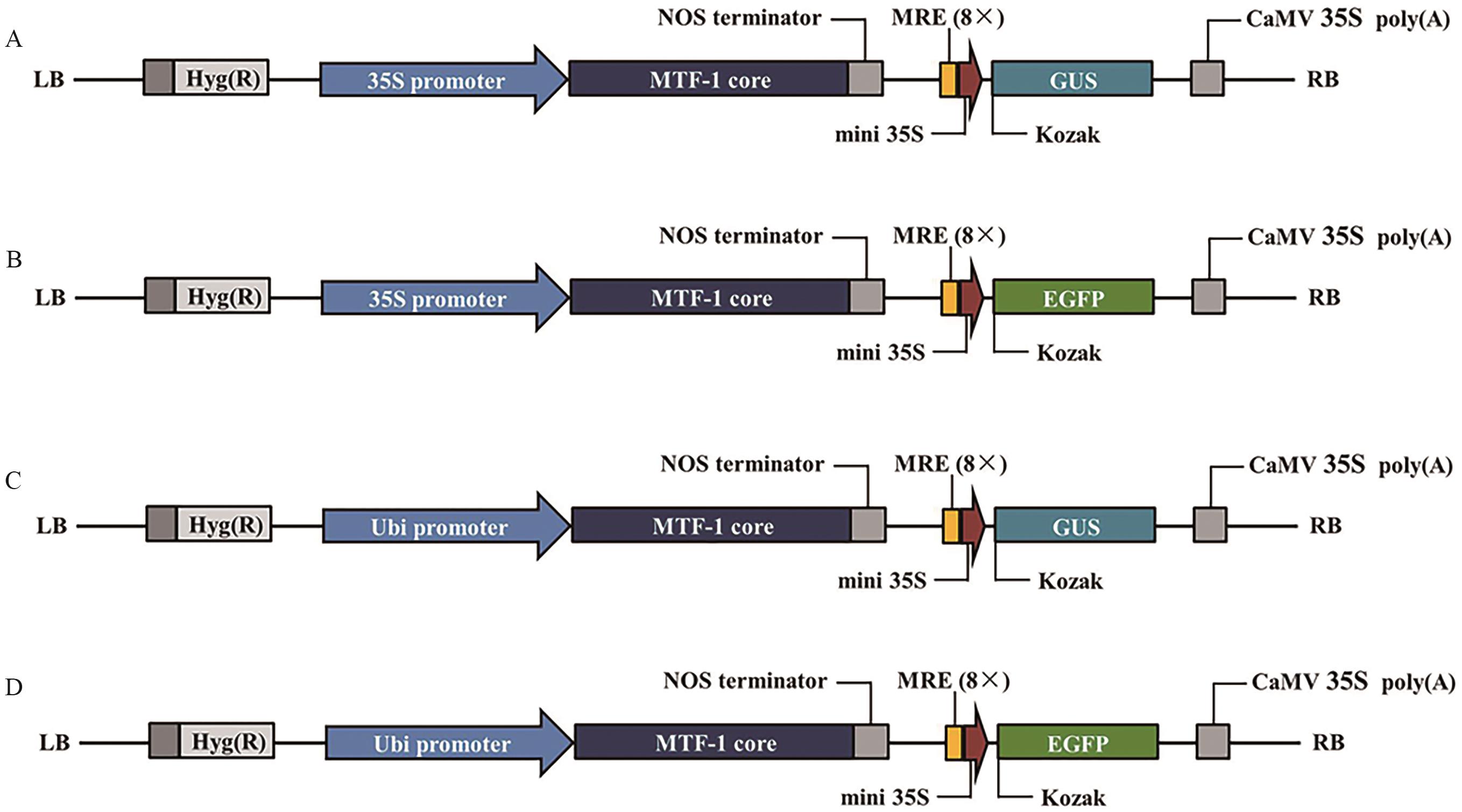
图1 重金属响应植物表达载体的构建A-D分别代表35S: MTF1-MRE8-mini35S: GUS、35S: MTF1-MRE8-mini35S: EGFP、Ubi: MTF1-MRE8-mini35S: GUS和Ubi: MTF1-MRE8-mini35S: EGFP载体示意图;Hyg(R)代表潮霉素抗性基因,MTF-1 core代表金属响应转录因子MTF-1核心序列,MRE(8×)代表8个拷贝的金属响应元件MRE,MRE(8×)与mini 35S启动子连接成金属响应人工启动子
Fig. 1 Construction of heavy-metal-responsive plant expression vectorsA-D refers to schematic diagrams of the 35S: MTF1-MRE8-mini35S: GUS, 35S: MTF1-MRE8-mini35S: EGFP, Ubi: MTF1-MRE8-mini35S: GUS,and Ubi: MTF1-MRE8-mini35S: EGFP vectors, respectively. Hyg (R) indicates the hygromycin resistance gene, MTF-1 core indicates the core sequence of the metal-responsive transcription factor MTF-1, and MRE (8×) indicates eight copies of the metal response element MRE. MRE (8×) is linked to the mini 35S promoter to form a metal-responsive synthetic promoter
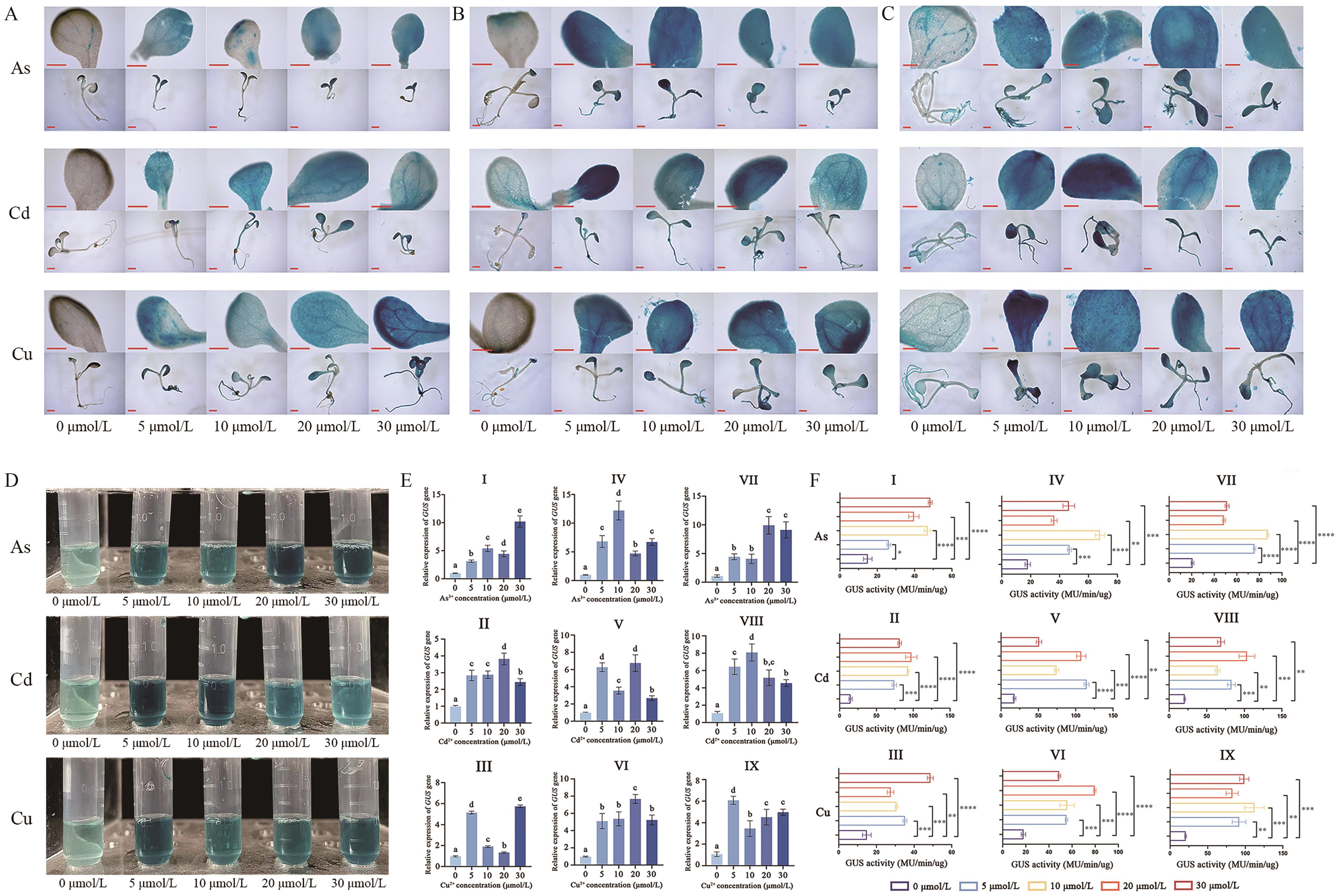
图2 转基因拟南芥的GUS表达分析A-C: As3+、Cd2+和Cu2+分别处理7 d(A)、10 d(B)及12 d(C)的转基因拟南芥GUS染色,叶片比例尺500 μm,植株比例尺1 mm;D:As3+、Cd2+和Cu2+分别处理12 d的转基因拟南芥GUS染色液颜色强度;E:As3+、Cd2+和Cu2+分别处理7 d(I-III)、10 d(IV-VI)及12 d(VII-IX)的转基因拟南芥GUS基因相对表达量,柱状图表示平均值±标准差,n=3,柱状图上不同字母表示在0.05水平上存在显著差异; F:As3+、Cd2+和Cu2+分别处理7 d(I-III)、10 d(IV-VI)及12 d(VII-IX)的转基因拟南芥GUS活性,*P<0.05, **P<0.01,***P<0.001,****P<0.000 1, 下同
Fig. 2 GUS expression analysis in transgenic A. thalianaA-C: GUS staining in transgenic A. thaliana at 7 d (A), 10 d (B), and 12 d (C)) after treated with As3+, Cd2+and Cu2+. Scale bars: 500 μm (leaf), and 1 mm (plant). D: The color intensity of the GUS staining solution at 12 d after treated with As3+, Cd2+and Cu2+. E: The relative expressions of the GUS gene in transgenic A. thaliana at 7 d (I-III), 10 d (IV-VI) and 12 d (VII-IX) after treated with As3+, Cd2+and Cu2+, respectively. The bar graph indicates the mean ± standard deviation (n = 3), the different letters on the bars indicate a statistically significant difference. F: GUS activity in transgenic A. thaliana at 7 (I-III), 10 (IV-VI), and 12 d (VII-IX) after treated with As3+, Cd2+and Cu2+, respectively. *P < 0.05, **P < 0.01, ***P < 0.001, ****P < 0.000 1. The same below
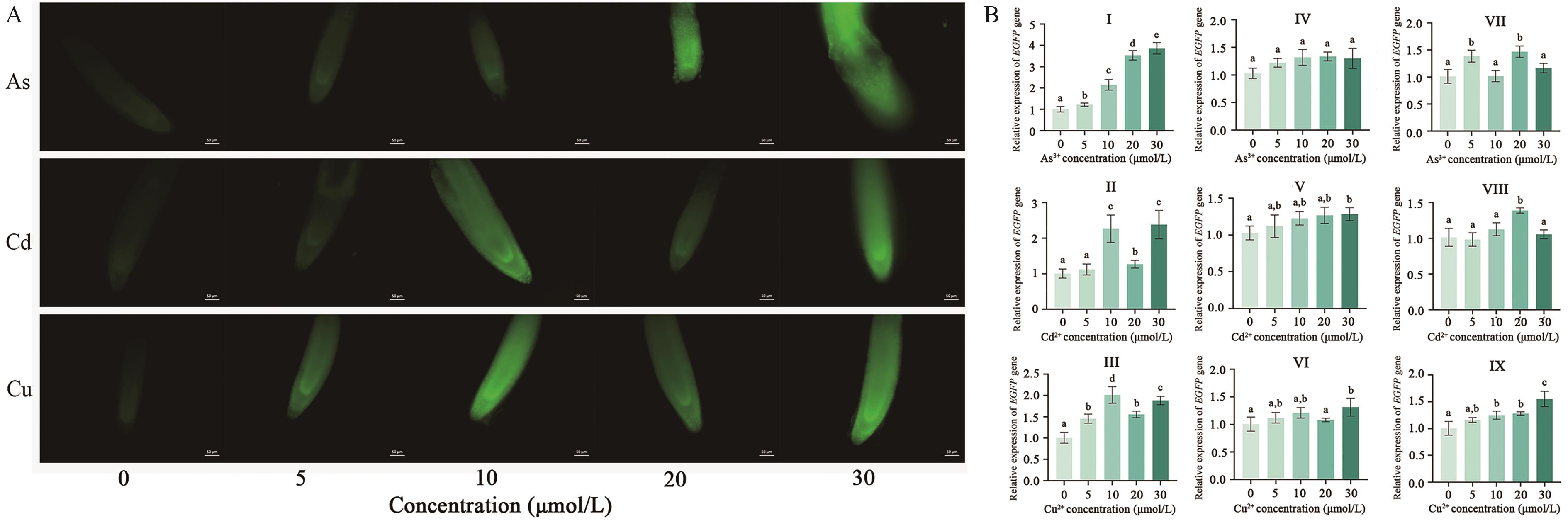
图3 转基因拟南芥的EGFP表达分析A: As3+、Cd2+和Cu2+分别处理7 d后的转基因拟南芥根尖绿色荧光强度,比例尺50 μm;B:As3+、Cd2+和Cu2+分别处理7 d(I-III)、10 d(IV-VI)及12 d(VII-IX)的转基因拟南芥EGFP基因相对表达量
Fig. 3 EGFP expression analysis in transgenic A. thalianaA: Green fluorescence intensity in the root tips of transgenic A. thaliana at 7 d after treated with As³⁺, Cd²⁺, and Cu²⁺, respectively. Scale bar = 50 μm. B: Relative expression of the EGFP gene in transgenic A. thaliana at 7 d (I-III), 10 d (IV-VI), and 12 d (VII-IX) after treated with As³⁺, Cd²⁺, and Cu²⁺, respectively
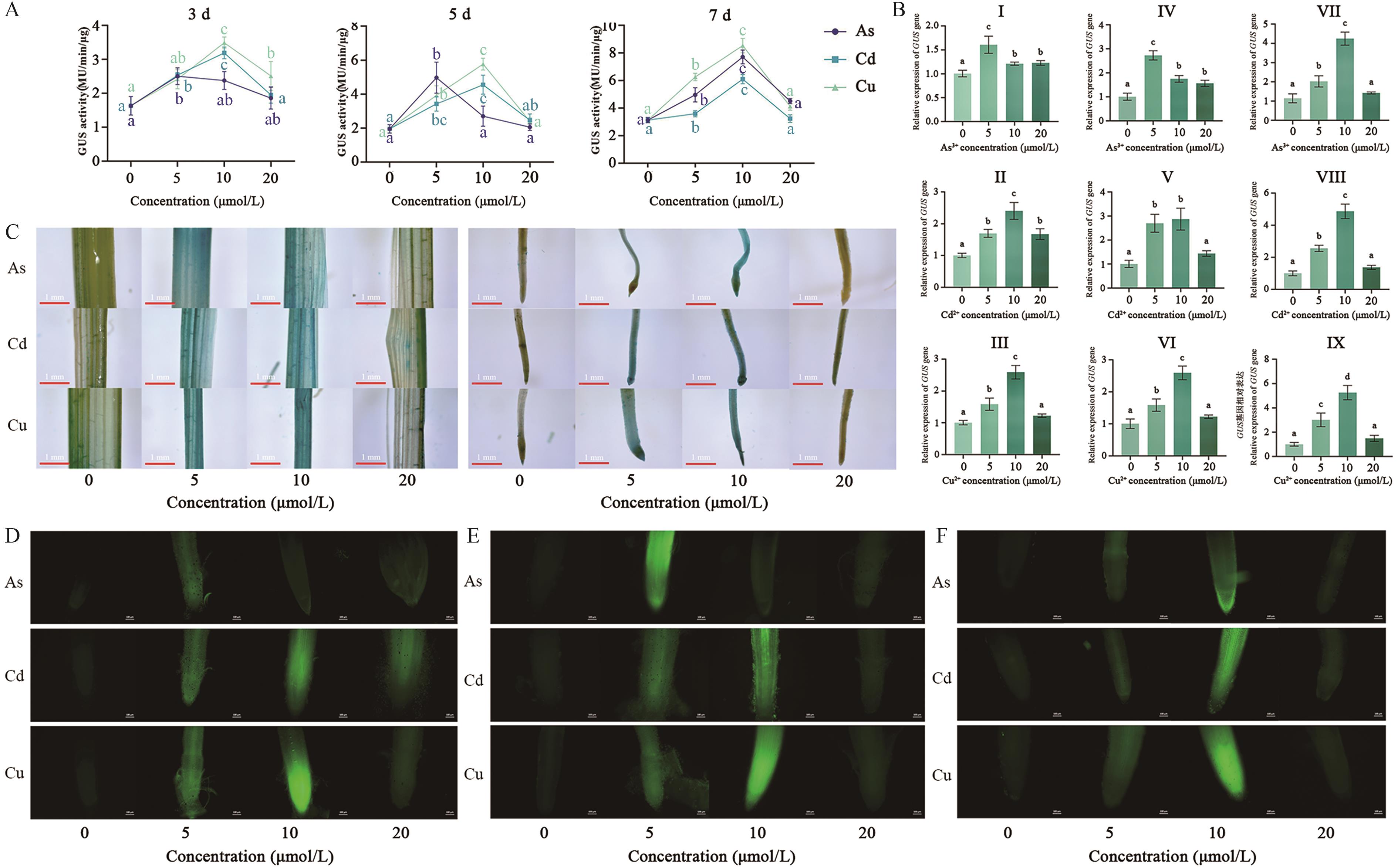
图4 重金属响应植物表达载体在水稻中表达验证A: 重金属处理7 d的转基因水稻GUS活性;B: 重金属处理3 d(I-III)、5 d(IV-VI)和7 d(VII-IX)的转基因水稻EGFP基因相对表达量;C: 重金属处理7 d的转基因水稻GUS染色,比例尺1 mm;D-F: 重金属处理3 d(D)、5 d(E)和7 d(F)的转基因水稻根尖绿色荧光强度,比例尺100 μm
Fig. 4 Verification of the expressions of heavy metal-responsive plant expression vectors inriceA: GUS activity of transgenic rice exposed to heavy metals for 7 d. B: Relative expression of the EGFP gene in transgenic rice exposed to heavy metals for 3 d (I-III), 5 d (IV-VI), and 7 d (VII-IX). C: GUS staining of transgenic rice exposed to heavy metals for 7 d, scale bars: 1 mm. D-F: Green fluorescence intensity emitted by the root tips of transgenic rice exposed to heavy metals for 3 d (D), 5 d (E), and 7 d (F), scale bars: 100 μm
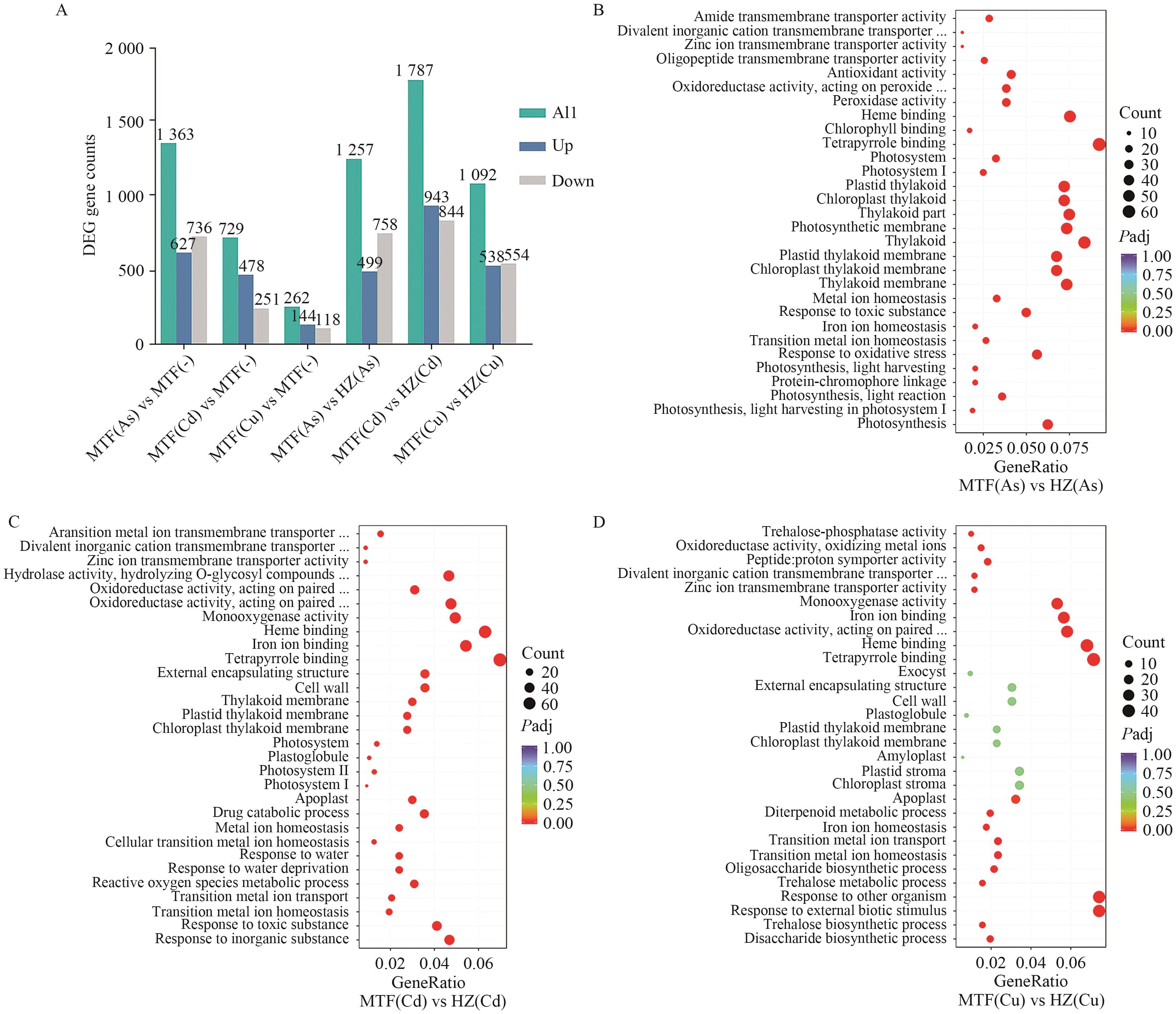
图5 差异表达及GO聚类分析A: 不同组之间的差异表达基因数量。MTF(As)、MTF(Cd)和MTF(Cu)分别代表As3+、Cd2+和Cu2+处理3 d的转基因水稻,MTF(-)代表未处理转基因水稻,WT(As)、WT(Cd)和WT(Cu)分别代表As3+、Cd2+和Cu2+处理3 d的野生型水稻,All指所有差异表达基因的集合,Up和Down分别代表显著上调基因和下调基因的数量。B-D: 代表相同条件下野生型与转基因水稻之间差异表达基因GO聚类,横坐标GeneRatio表示差异基因数与差异基因总数的比值,气泡大小代表富集到对应通路的基因数量,气泡的颜色代表多重假设检验校正后的P值,Padj <0.05为显著富集
Fig. 5 Differential expression and GO clustering analysisA: Number of differentially expressed genes (DEGs) among different groups. MTF(As), MTF(Cd), and MTF(Cu) refer to transgenic rice treated with As³⁺, Cd²⁺, and Cu²⁺ for 3 d, respectively. MTF(-) refers to untreated transgenic rice. WT(As), WT(Cd), and WT(Cu) refer to wild-type rice treated with As³⁺, Cd²⁺, and Cu²⁺ for 3 d, respectively. “All” refers to the total set of DEGs. “Up” and “Down” indicate the number of significantly up-regulated and down-regulated genes, respectively. B-D: GO clustering of DEGs between wild-type and transgenic rice under the same conditions. The X-axis “GeneRatio” is the ratio of the number of DEGs to the total number of DEGs. The bubble size indicates the number of genes enriched in the corresponding pathway, and the bubble color indicates the P-value adjusted for multiple hypothesis testing, with Padj < 0.05 considered significantly enriched
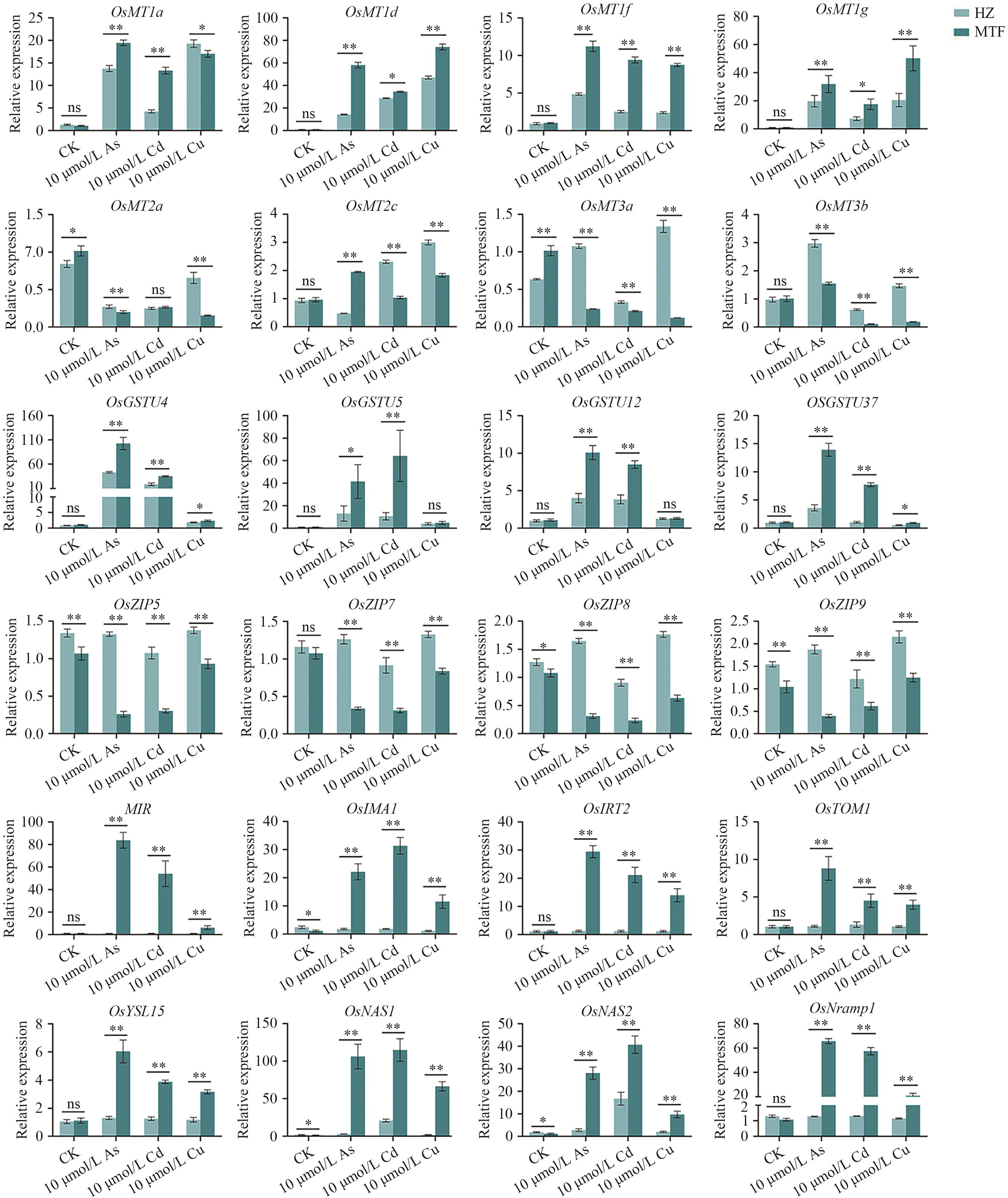
图6 重金属解毒相关基因表达验证HZ: 野生型水稻,MTF: 转基因水稻;数据以均值±标准差表示,n=3;*和**分别表示野生型水稻和转基因水稻在0.05和0.01水平上差异显著(t检验)
Fig. 6 Verification of gene expression related to heavy metal detoxificationHZ: Wild-type rice. MTF: Transgenic rice. Data are expressed as mean ± standard deviation, n = 3; * and ** indicate significant differences between wild-type rice and transgenic rice at 0.05 and 0.01 levels, respectively (t-test)
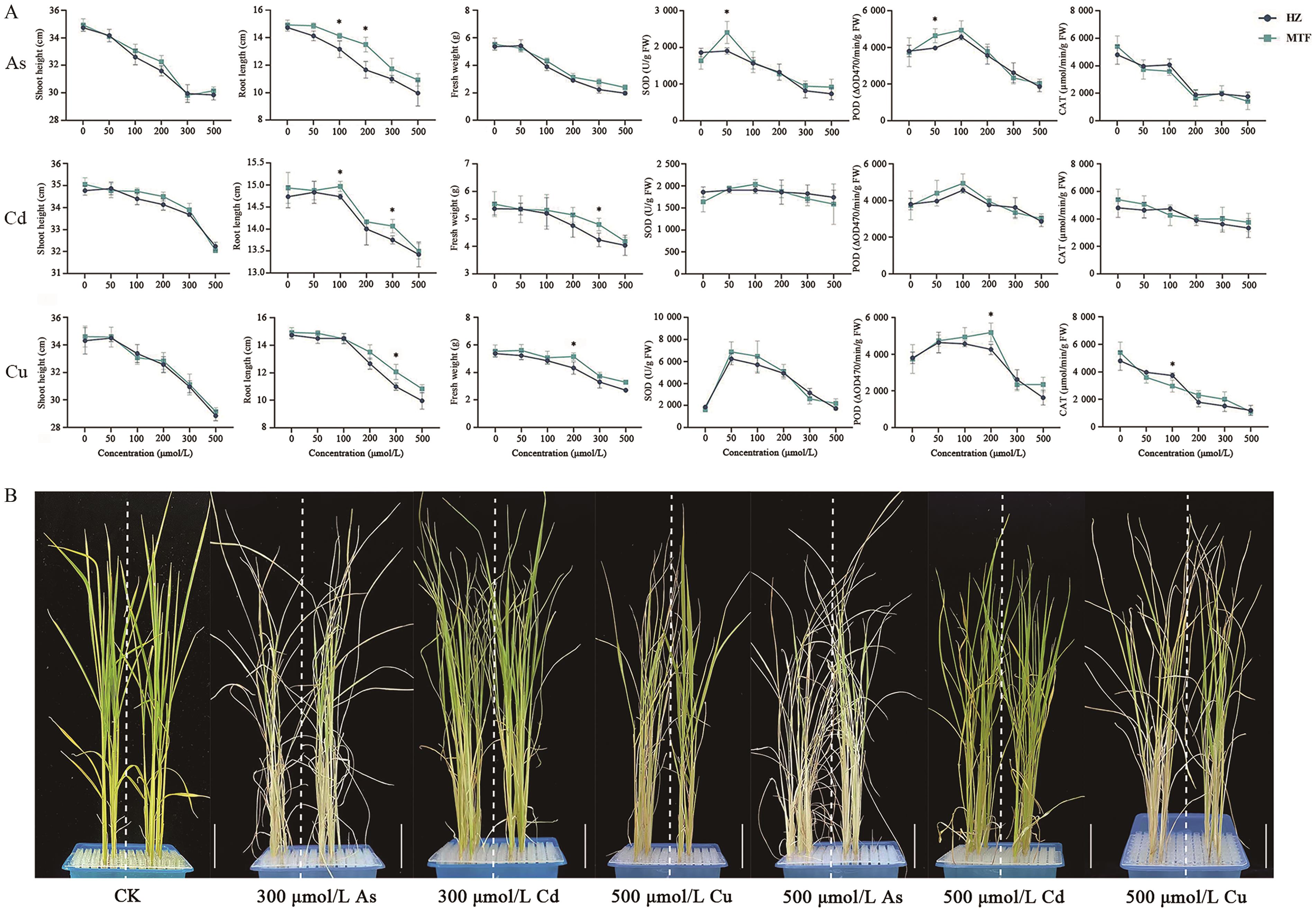
图7 不同重金属胁迫下野生型和转基因水稻生理和表型特征A: 野生型(HZ)和转基因水稻(MTF)在As、Cd或Cu胁迫下的株高、根长、鲜重、抗氧化酶(SOD、POD和CAT)活性,浓度梯度为0、50、100、200、300和500 µmol/L,均值±标准差,n=3,*表示野生型(HZ)和转基因水稻(MTF)在0.05水平上差异显著(t 检验)。B:野生型(白色虚线左侧)和转基因水稻(白色虚线右侧)表型性状,标尺=4 cm
Fig. 7 Physiological characteristics and phenotypic traits of wild-type and transgenic rice exposed to different heavy metalsA: Plant height, root length, fresh weight, and antioxidant enzyme (SOD, POD, and CAT) activities of wild-type (HZ) and transgenic rice (MTF) under As, Cd, or Cu stress. Concentration gradients are 0, 50, 100, 200, 300, and 500 µmol/L. Data are presented as mean ± standard deviation, n = 3. * indicates a significant difference between wild-type (HZ) and transgenic rice (MTF) at 0.05 level (t-test). B: Phenotypic traits of wild-type (left of the white dashed line) and transgenic rice (right of the white dashed line). Scale bar = 4 cm
| [1] | 环境保护部, 国土资源部. 全国土壤污染状况调查公报[EB/OL]. (2014-04-17). . |
| Ministry of Environmental Protection, Ministry of Land and Resources. Report on the National General Survey of Soil Contamination[EB/OL]. (2014-04-17). . | |
| [2] | Qin GW, Niu ZD, Yu JD, et al. Soil heavy metal pollution and food safety in China: Effects, sources and removing technology [J]. Chemosphere, 2021, 267: 129205. |
| [3] | Yuan XH, Xue ND, Han ZG. A meta-analysis of heavy metals pollution in farmland and urban soils in China over the past 20 years [J]. J Environ Sci, 2021, 101: 217-226. |
| [4] | Zhao FJ, Wang P. Arsenic and cadmium accumulation in rice and mitigation strategies [J]. Plant Soil, 2020, 446(1/2): 4374. |
| [5] | Wen MY, Ma ZQ, Gingerich DB, et al. Heavy metals in agricultural soil in China: a systematic review and meta-analysis [J]. Eco Environ Health, 2022, 1(4): 219-228. |
| [6] | Yang MH, Yang YH, Liu B, et al. Amperometric glucose biosensor based on chitosan with improved selectivity and stability [J]. Sens Actuat B Chem, 2004, 101(3): 269-276. |
| [7] | Wang XY, Watanabe H, Uchiyama S. Amperometric l-ascorbic acid biosensors equipped with enzyme micelle membrane [J]. Talanta, 2008, 74(5): 1681-1685. |
| [8] | Chen JH, Chen MJ, Tong H, et al. Fluorescence biosensor for ultrasensitive detection of the available lead based on target biorecognition-induced DNA cyclic assembly [J]. Sci Total Environ, 2023, 905: 167253. |
| [9] | 郑亚楠, 王丹. 金属调控蛋白的结构、性质及应用 [J]. 化学进展, 2019, 31(10): 1372-1383. |
| Zheng YN, Wang D. Structures, properties, and applications of metalloregulatory proteins [J]. Prog Chem, 2019, 31(10): 1372-1383. | |
| [10] | Ravikumar S, Ganesh I, Yoo IK, et al. Construction of a bacterial biosensor for zinc and copper and its application to the development of multifunctional heavy metal adsorption bacteria [J]. Process Biochem, 2012, 47(5): 758-765. |
| [11] | Liu XC, Hu QY, Yang JM, et al. Selective cadmium regulation mediated by a cooperative binding mechanism in CadR [J]. Proc Natl Acad Sci U S A, 2019, 116(41): 20398-20403. |
| [12] | Wan XY, Volpetti F, Petrova E, et al. Cascaded amplifying circuits enable ultrasensitive cellular sensors for toxic metals [J]. Nat Chem Biol, 2019, 15(5): 540-548. |
| [13] | Khan SS, Shen Y, Fatmi MQ, et al. Design and prototyping of genetically encoded arsenic biosensors based on transcriptional regulator AfArsR [J]. Biomolecules, 2021, 11(9): 1276. |
| [14] | Chen XJ, Yao H, Song D, et al. A novel antimony-selective ArsR transcriptional repressor and its specific detection of antimony trioxide in environmental samples via bacterial biosensor [J]. Biosens Bioelectron, 2023, 220: 114838. |
| [15] | Giedroc DP, Chen XH, Apuy JL. Metal response element (MRE)-binding transcription factor-1 (MTF-1): structure, function, and regulation [J]. Antioxid Redox Signal, 2001, 3(4): 577-596. |
| [16] | Laity JH, Andrews GK. Understanding the mechanisms of zinc-sensing by metal-response element binding transcription factor-1 (MTF-1) [J]. Arch Biochem Biophys, 2007, 463(2): 201-210. |
| [17] | Günther V, Lindert U, Schaffner W. The taste of heavy metals: Gene regulation by MTF-1 [J]. Biochim Biophys Acta, 2012, 1823(9): 1416-1425. |
| [18] | Koen E, Besson-Bard A, Duc C, et al. Arabidopsis thaliana nicotianamine synthase 4 is required for proper response to iron deficiency and to cadmium exposure [J]. Plant Sci, 2013, 209: 1-11. |
| [19] | Chen SN, Zhang M, Feng Y, et al. Nicotianamine Synthase Gene 1 from the hyperaccumulator Sedum alfredii Hance is associated with Cd/Zn tolerance and accumulation in plants [J]. Plant Soil, 2019, 443(1/2): 413-427. |
| [20] | Tiwari M, Kidwai M, Dutta P, et al. A tau class glutathione-S-transferase (OsGSTU5) confers tolerance against arsenic toxicity in rice by accumulating more arsenic in root [J]. J Hazard Mater, 2022, 426: 128100. |
| [21] | Yang Y, Li J, Li H, et al. OsGSTU5 and OsGSTU37 encoding glutathione reductases are required for cadmium tolerance in rice [J]. Int J Environ Sci Technol, 2023, 20(9): 10253-10260. |
| [22] | Yang M, Li YT, Liu ZH, et al. A high activity zinc transporter OsZIP9 mediates zinc uptake in rice [J]. Plant J, 2020, 103(5): 1695-1709. |
| [23] | Tan LT, Qu MM, Zhu YX, et al. ZINC TRANSPORTER5 and ZINC TRANSPORTER9 function synergistically in zinc/cadmium uptake [J]. Plant Physiol, 2020, 183(3): 1235-1249. |
| [24] | Tan LT, Zhu YX, Fan T, et al. OsZIP7 functions in xylem loading in roots and inter-vascular transfer in nodes to deliver Zn/Cd to grain in rice [J]. Biochem Biophys Res Commun, 2019, 512(1): 112-118. |
| [25] | 张妮娜, 上官周平, 陈娟. 植物应答缺铁胁迫的分子生理机制及其调控 [J]. 植物营养与肥料学报, 2018, 24(5): 1365-1377. |
| Zhang NN, Shangguan ZP, Chen J. Molecular physiological mechanism and regulation of plant responses to iron deficiency stress [J]. Plant Nutr Fert Sci, 2018, 24(5): 1365-1377. | |
| [26] | Kobayashi T, Nagano AJ, Nishizawa NK. Iron deficiency-inducible peptide-coding genes OsIMA1 and OsIMA2 positively regulate a major pathway of iron uptake and translocation in rice [J]. J Exp Bot, 2021, 72(6): 2196-2211. |
| [27] | Nakanishi H, Ogawa I, Ishimaru Y, et al. Iron deficiency enhances cadmium uptake and translocation mediated by the Fe2+ transporters OsIRT1 and OsIRT2 in rice [J]. Soil Sci Plant Nutr, 2006, 52(4): 464-469. |
| [28] | 彭凤, 路承凯, 梁岗. OsIMA1增强水稻对镉逆境的适应性 [J]. 广西植物, 2023, 43(6): 1097-1104. |
| Peng F, Lu CK, Liang G. OsIMA1 enhances tolerance to cadmium stress in rice [J]. Guihaia, 2023, 43(6): 1097-1104. | |
| [29] | Li ZM, Liang Y, Hu HW, et al. Speciation, transportation, and pathways of cadmium in soil-rice systems: a review on the environmental implications and remediation approaches for food safety [J]. Environ Int, 2021, 156: 106749. |
| [30] | Sims HI, Chirn GW, Marr MT II. Single nucleotide in the MTF-1 binding site can determine metal-specific transcription activation [J]. Proc Natl Acad Sci U S A, 2012, 109(41): 16516-16521. |
| [1] | 殷亚龙, 张明洋, 王洁敏, 苗雪雪, 陈劲, 王伟平. 水稻非生物胁迫协同耐受机制研究进展[J]. 生物技术通报, 2026, 42(4): 26-37. |
| [2] | 王程程, 黄天宇, 张晴, 史来权, 方慧敏, 张龙. 一个水稻粉质胚乳突变体的表型分析和基因定位[J]. 生物技术通报, 2026, 42(2): 169-177. |
| [3] | 杨跃琴, 邢英, 仲子荷, 田维军, 杨雪清, 王建旭. 甲基汞胁迫下水稻OsMATE34的表达及功能分析[J]. 生物技术通报, 2026, 42(1): 86-94. |
| [4] | 费思恬, 侯鹰翔, 李兰, 张超. 水稻赤霉素信号负调控因子SLR1的生物学功能及其调控网络[J]. 生物技术通报, 2026, 42(1): 13-30. |
| [5] | 王芳, 邵会茹, 吕林龙, 赵点, 胡振, 吕建珍, 姜亮. 植物和细菌TurboID邻近蛋白标记方法的建立[J]. 生物技术通报, 2025, 41(9): 44-53. |
| [6] | 邓美壁, 严浪, 詹志田, 朱敏, 和玉兵. RUBY辅助的水稻高效CRISPR基因编辑[J]. 生物技术通报, 2025, 41(8): 65-73. |
| [7] | 李亚, 蒋林, 徐闯, 王苏慧, 马曌, 王亮. 莱茵衣藻响应重金属胁迫的分子防御机制研究进展[J]. 生物技术通报, 2025, 41(8): 53-64. |
| [8] | 侯鹰翔, 费思恬, 黎妮, 李兰, 宋松泉, 王伟平, 张超. 水稻miRNAs响应生物胁迫研究进展[J]. 生物技术通报, 2025, 41(7): 69-80. |
| [9] | 吴浩, 董伟峰, 贺子天, 李艳肖, 谢辉, 孙明哲, 沈阳, 孙晓丽. 水稻BXL基因家族的全基因组鉴定及表达分析[J]. 生物技术通报, 2025, 41(6): 87-98. |
| [10] | 杜量衡, 唐黄磊, 张治国. 控制水稻光响应基因ELM1的图位克隆[J]. 生物技术通报, 2025, 41(5): 82-89. |
| [11] | 刘园园, 陈析丰, 钱前, 高振宇. 水稻穗发育调控的分子机制研究进展[J]. 生物技术通报, 2025, 41(5): 1-13. |
| [12] | 陈晓军, 惠建, 马洪文, 白海波, 钟楠, 李稼润, 樊云芳. 利用单碱基基因编辑技术创制OsALS抗除草剂水稻种质资源[J]. 生物技术通报, 2025, 41(4): 106-114. |
| [13] | 李欣芃, 张武汉, 张莉, 舒服, 何强, 郭杨, 邓华凤, 王悦, 孙平勇. γ射线诱变创制水稻突变体及其分子鉴定[J]. 生物技术通报, 2025, 41(3): 35-43. |
| [14] | 方慧敏, 顾艺枢, 张晶, 张龙. 水稻叶片淀粉的分离与理化性质分析[J]. 生物技术通报, 2025, 41(2): 51-57. |
| [15] | 范艳飞, 叶露幻, 李雨桐, 王钏跞, 张瑞, 罗建华, 王鹏. 运用小麦杂交株系挖掘环式光合电子传递调控基因并应用于作物高光效改造[J]. 生物技术通报, 2025, 41(10): 72-86. |
| 阅读次数 | ||||||
|
全文 |
|
|||||
|
摘要 |
|
|||||
