







生物技术通报 ›› 2026, Vol. 42 ›› Issue (8): 263-275.doi: 10.13560/j.cnki.biotech.bull.1985.2025-1452
• 研究报告 • 上一篇
吕红珍1,2, 徐莉莉3,4, 张琳2, 高敏2, 谭镇炜2, 王亚雯2, 张秀格5, 王硕6, 马爱军1, 王承民2,3,4( )
)
收稿日期:2025-12-30
出版日期:2026-08-26
发布日期:2026-08-17
通讯作者:
王承民wangchm@giz.gd.cn基金资助:LYU Hong-zhen1,2, XU Li-li3,4, ZHANG Lin2, GAO Min2, TAN Zhen-wei2, WANG Ya-wen2, ZHANG Xiu-ge⁵ WANG Shuo⁶ MA Ai-jun5, WANG Cheng-min6
Received:2025-12-30
Published:2026-08-26
Online:2026-08-17
摘要:
目的 针对弱碱性土壤磷素固化严重、植物利用率低的问题,筛选高效解磷菌株并优化培养条件,阐明其解磷机制,验证其土壤磷活化及小麦促生效应。 方法 以7个属26株菌株为材料,通过平板透明圈法初筛与液体培养法复筛获得高效解磷菌株;通过单因素试验与响应面法优化培养条件;采用HPLC分析有机酸组分,结合相关性分析揭示解磷机制;通过小麦盆栽试验评估菌株的土壤应用效果。 结果 筛选获得阿氏肠杆菌(Enterobacter asburiae)N4129-2AT,该菌株在15 ℃低温及pH 10高碱环境下仍保持稳定溶磷能力;经响应面优化(35 ℃、pH 6、接种量7.2%)后,72 h溶磷量达823.471 mg/L,较优化前提升23.7%,培养周期缩短96 h。该菌株可稳定分泌6种小分子有机酸,其解磷核心机制为有机酸介导的酸化作用,溶磷效能依赖强关联的有机酸而非含量占比,且总有机酸含量仅起辅助作用。小麦盆栽试验中,各处理组均显著提升土壤有效溶磷量以及小麦植株生长指标,其中优化后菌全液中剂量处理效果最优,土壤有效磷含量提升376.76%,小麦地下部干重提升157.4%,根冠比降低22.69%,土壤有效磷与小麦生长指标呈极显著正相关。 结论 阿氏肠杆菌N4129-2AT兼具耐低温、耐高碱及高效解磷能力,其基于强关联有机酸主导的酸谱定向优化解磷机制为同类菌株改良提供理论参考,该菌株及优化培养方案可为弱碱性土壤磷素活化与小麦高产提供技术支撑。
吕红珍, 徐莉莉, 张琳, 高敏, 谭镇炜, 王亚雯, 张秀格, 王硕, 马爱军, 王承民. 高效解磷菌筛选优化及其对弱碱土小麦促生效应[J]. 生物技术通报, 2026, 42(8): 263-275.
LYU Hong-zhen, XU Li-li, ZHANG Lin, GAO Min, TAN Zhen-wei, WANG Ya-wen, ZHANG Xiu-ge⁵ WANG Shuo⁶ MA Ai-jun, WANG Cheng-min. Screening and Optimization of High-efficiency Phosphate-solubilizing Bacteria and Wheat Growth Promotion in Slightly Alkaline Soil[J]. Biotechnology Bulletin, 2026, 42(8): 263-275.
水平编码 Level code | 因素 Factors | ||
|---|---|---|---|
A温度 A Temperature (℃) | B pH B pH | C接种量 C Inoculum size (%) | |
| -1 | 25 | 6 | 5 |
| 0 | 30 | 8 | 7 |
| 1 | 35 | 10 | 9 |
表1 响应面分析因素与水平
Table 1 Factors and levels for response surface analysis
水平编码 Level code | 因素 Factors | ||
|---|---|---|---|
A温度 A Temperature (℃) | B pH B pH | C接种量 C Inoculum size (%) | |
| -1 | 25 | 6 | 5 |
| 0 | 30 | 8 | 7 |
| 1 | 35 | 10 | 9 |
编号 Number | A 温度 A Temperature (℃) | B pH | C 接种量 C Inoculum size (%) | 可溶性磷含量 Soluble phosphorus content (mg/L) |
|---|---|---|---|---|
| 1 | 25 | 6 | 7 | 641.026 |
| 2 | 35 | 6 | 7 | 813.609 |
| 3 | 25 | 10 | 7 | 433.925 |
| 4 | 35 | 10 | 7 | 510.355 |
| 5 | 25 | 8 | 5 | 599.112 |
| 6 | 35 | 8 | 5 | 608.974 |
| 7 | 25 | 8 | 9 | 493.097 |
| 8 | 35 | 8 | 9 | 692.801 |
| 9 | 30 | 6 | 5 | 714.990 |
| 10 | 30 | 10 | 5 | 436.390 |
| 11 | 30 | 6 | 9 | 653.353 |
| 12 | 30 | 10 | 9 | 483.235 |
| 13 | 30 | 8 | 7 | 641.026 |
| 14 | 30 | 8 | 7 | 643.491 |
| 15 | 30 | 8 | 7 | 663.215 |
| 16 | 30 | 8 | 7 | 658.284 |
| 17 | 30 | 8 | 7 | 663.215 |
表2 响应面实验设计方案及响应值
Table 2 Experimental design and response values for response surface methodology
编号 Number | A 温度 A Temperature (℃) | B pH | C 接种量 C Inoculum size (%) | 可溶性磷含量 Soluble phosphorus content (mg/L) |
|---|---|---|---|---|
| 1 | 25 | 6 | 7 | 641.026 |
| 2 | 35 | 6 | 7 | 813.609 |
| 3 | 25 | 10 | 7 | 433.925 |
| 4 | 35 | 10 | 7 | 510.355 |
| 5 | 25 | 8 | 5 | 599.112 |
| 6 | 35 | 8 | 5 | 608.974 |
| 7 | 25 | 8 | 9 | 493.097 |
| 8 | 35 | 8 | 9 | 692.801 |
| 9 | 30 | 6 | 5 | 714.990 |
| 10 | 30 | 10 | 5 | 436.390 |
| 11 | 30 | 6 | 9 | 653.353 |
| 12 | 30 | 10 | 9 | 483.235 |
| 13 | 30 | 8 | 7 | 641.026 |
| 14 | 30 | 8 | 7 | 643.491 |
| 15 | 30 | 8 | 7 | 663.215 |
| 16 | 30 | 8 | 7 | 658.284 |
| 17 | 30 | 8 | 7 | 663.215 |
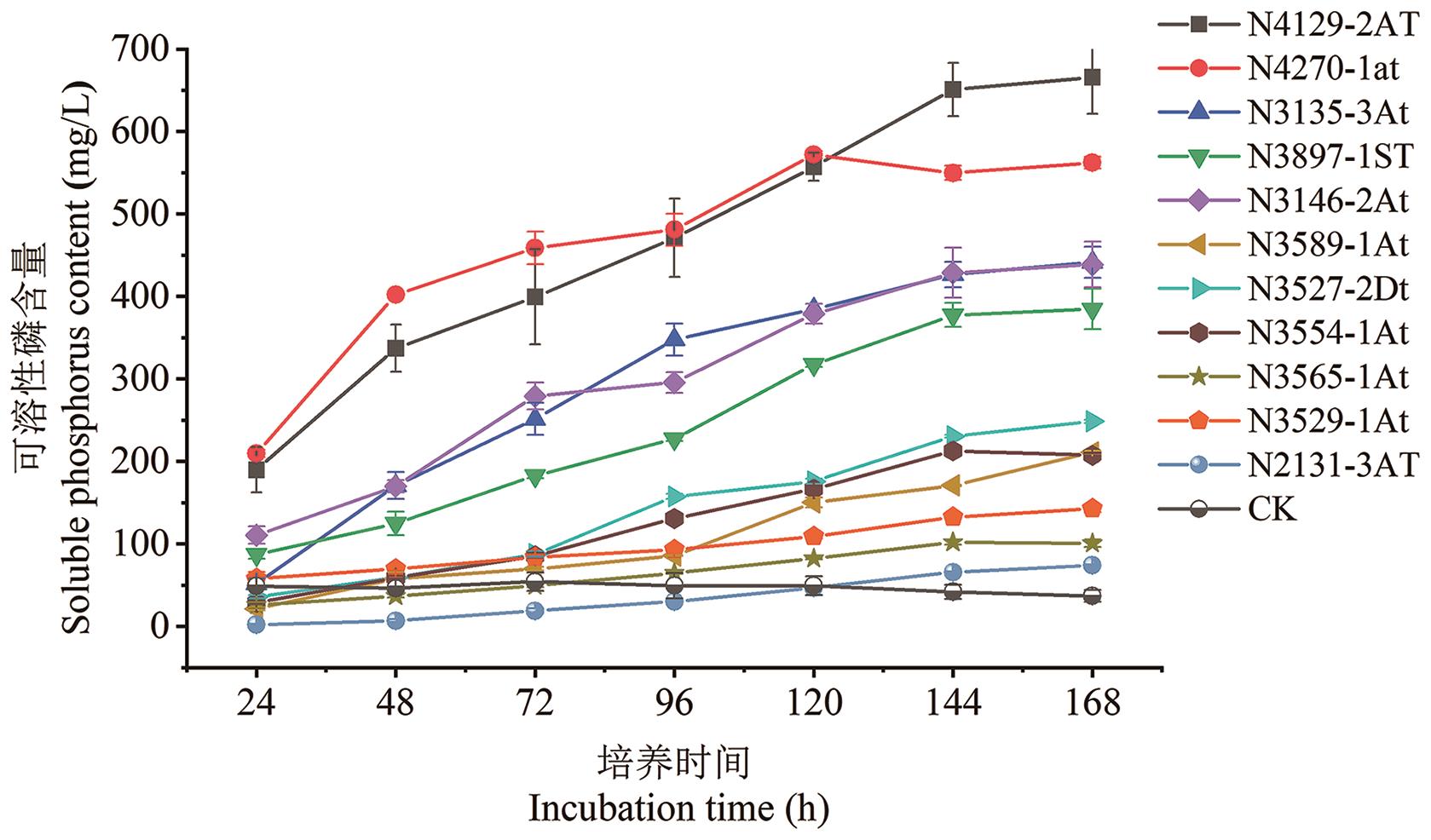
图1 不同解磷菌株在培养过程中可溶性磷含量的动态变化
Fig. 1 Dynamic changes in soluble phosphate content during the cultivation of different phosphate-solubilizing strains
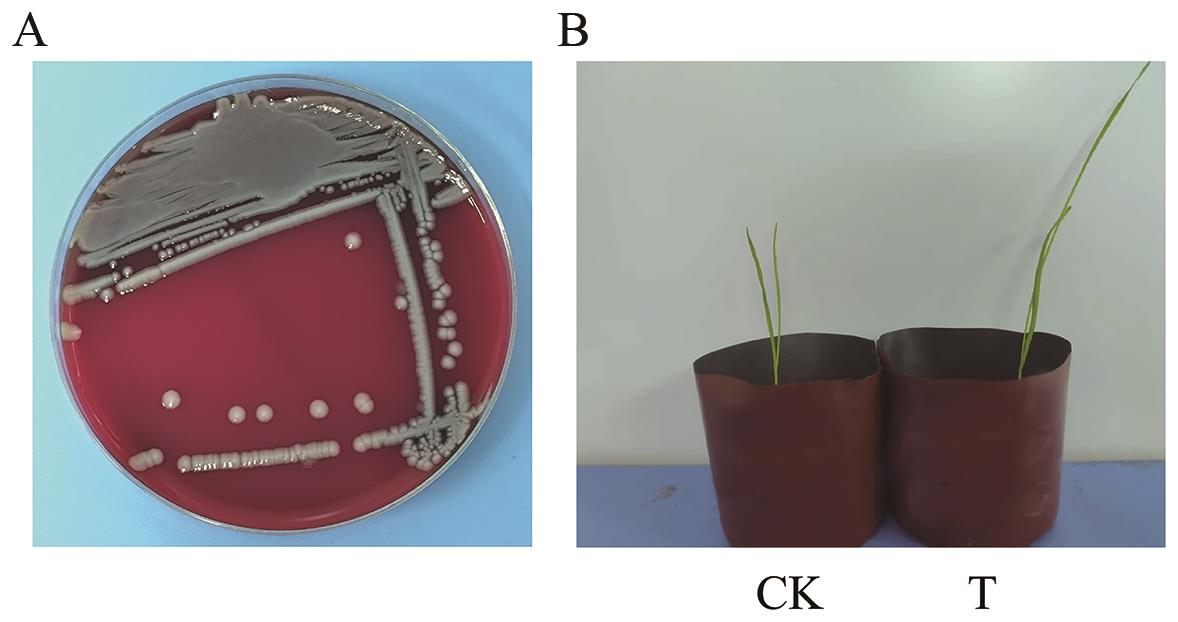
图2 菌株N4129-2AT的溶血性测定(A)与植物致病性观察(B)CK:空白对照;T:接种菌株N4129-2AT
Fig. 2 Hemolytic activity test (A) and phytopathogenicity assay (B) of strain N4129-2ATCK: blank control; T: inoculated with strain N4129-2AT
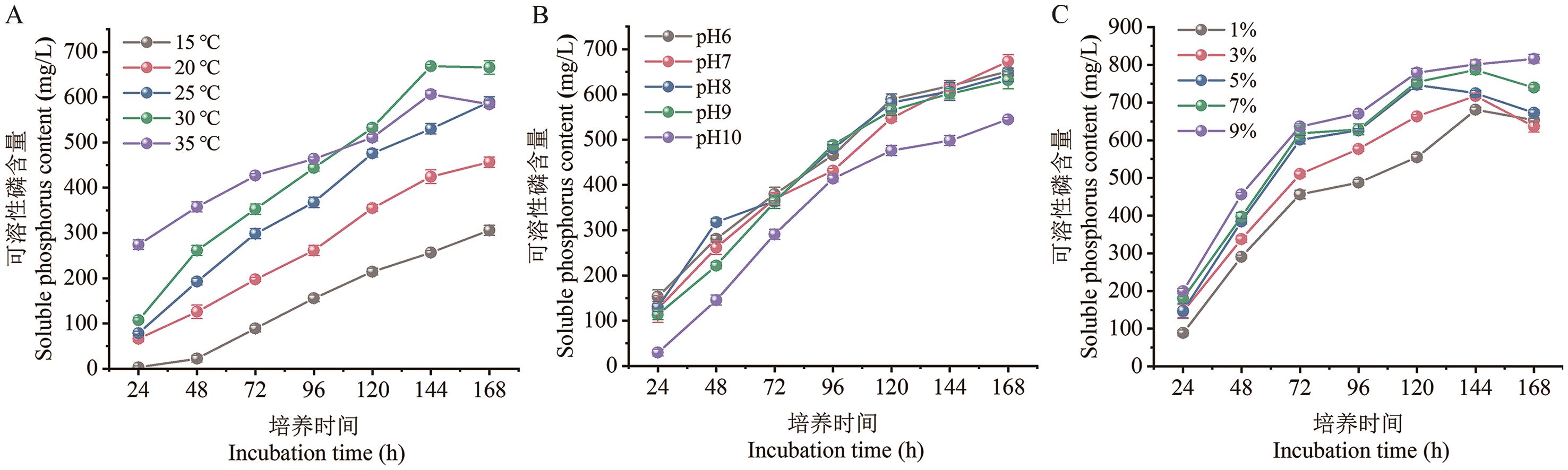
图3 不同单因素对N4129-2AT溶磷量的影响
Fig. 3 Effects of single factors on P-solubilizing capacity of N4129-2AT
来源 Source | 平方和 Sum of squares | 自由度 Degree of freedom | 均方 Mean square | F值 F value | P值 P value |
|---|---|---|---|---|---|
| 模型 Model | 1.720E+05 | 9 | 19 113.08 | 117.05 | <0.001 |
| A-温度 Temperature | 26 286.91 | 1 | 26 286.91 | 160.98 | <0.001 |
| B-pH | 1.150E+05 | 1 | 1.150E+05 | 704.11 | <0.001 |
| C-接种量 Inoculum size | 170.96 | 1 | 170.96 | 1.05 | 0.340 3 |
| AB | 2 311.37 | 1 | 2 311.37 | 14.15 | 0.007 1 |
| AC | 9 010.03 | 1 | 9 010.03 | 55.18 | 0.000 1 |
| BC | 2 942.05 | 1 | 2 942.05 | 18.02 | 0.003 8 |
| A² | 802.63 | 1 | 802.63 | 4.92 | 0.062 1 |
| B² | 6 841.92 | 1 | 6 841.92 | 41.90 | 0.000 3 |
| C² | 7 266.73 | 1 | 7 266.73 | 44.50 | 0.000 3 |
| 残差Residual | 1 143.06 | 7 | 163.29 | ||
| 失拟项Lack of fit | 676.23 | 3 | 225.41 | 1.93 | 0.266 2 |
| 纯误差Pure error | 466.83 | 4 | 116.71 | ||
| 总和 Total | 1.732E+05 | 16 |
表3 方差分析表
Table 3 Analysis of variance (ANOVA) table
来源 Source | 平方和 Sum of squares | 自由度 Degree of freedom | 均方 Mean square | F值 F value | P值 P value |
|---|---|---|---|---|---|
| 模型 Model | 1.720E+05 | 9 | 19 113.08 | 117.05 | <0.001 |
| A-温度 Temperature | 26 286.91 | 1 | 26 286.91 | 160.98 | <0.001 |
| B-pH | 1.150E+05 | 1 | 1.150E+05 | 704.11 | <0.001 |
| C-接种量 Inoculum size | 170.96 | 1 | 170.96 | 1.05 | 0.340 3 |
| AB | 2 311.37 | 1 | 2 311.37 | 14.15 | 0.007 1 |
| AC | 9 010.03 | 1 | 9 010.03 | 55.18 | 0.000 1 |
| BC | 2 942.05 | 1 | 2 942.05 | 18.02 | 0.003 8 |
| A² | 802.63 | 1 | 802.63 | 4.92 | 0.062 1 |
| B² | 6 841.92 | 1 | 6 841.92 | 41.90 | 0.000 3 |
| C² | 7 266.73 | 1 | 7 266.73 | 44.50 | 0.000 3 |
| 残差Residual | 1 143.06 | 7 | 163.29 | ||
| 失拟项Lack of fit | 676.23 | 3 | 225.41 | 1.93 | 0.266 2 |
| 纯误差Pure error | 466.83 | 4 | 116.71 | ||
| 总和 Total | 1.732E+05 | 16 |
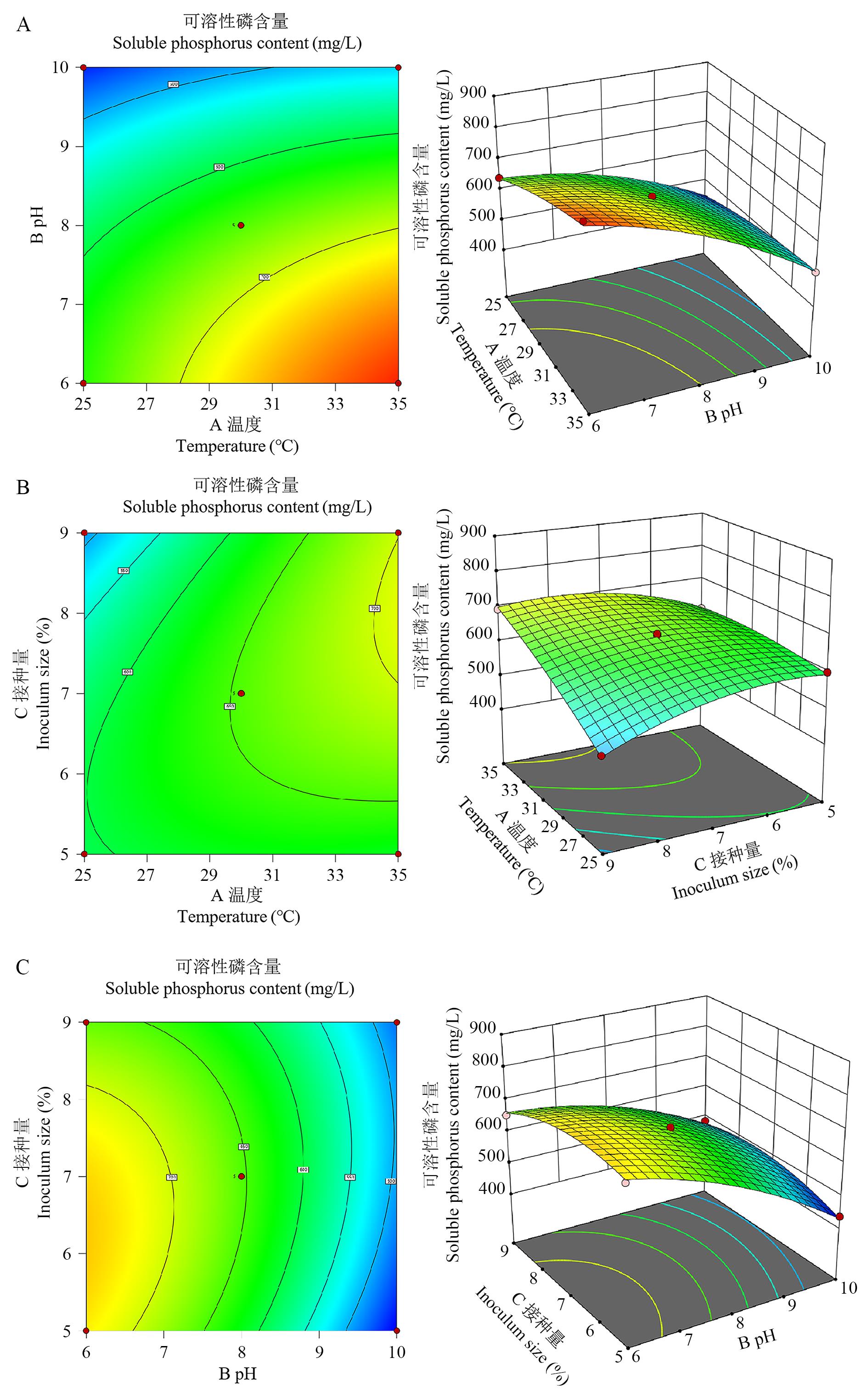
图4 不同因素两两交互影响解磷菌解磷能力的曲面图和等高线图
Fig. 4 Response surface and contour plots for pairwise interactions of factors affecting P-solubilizing capacity of phosphate-solubilizing bacteria
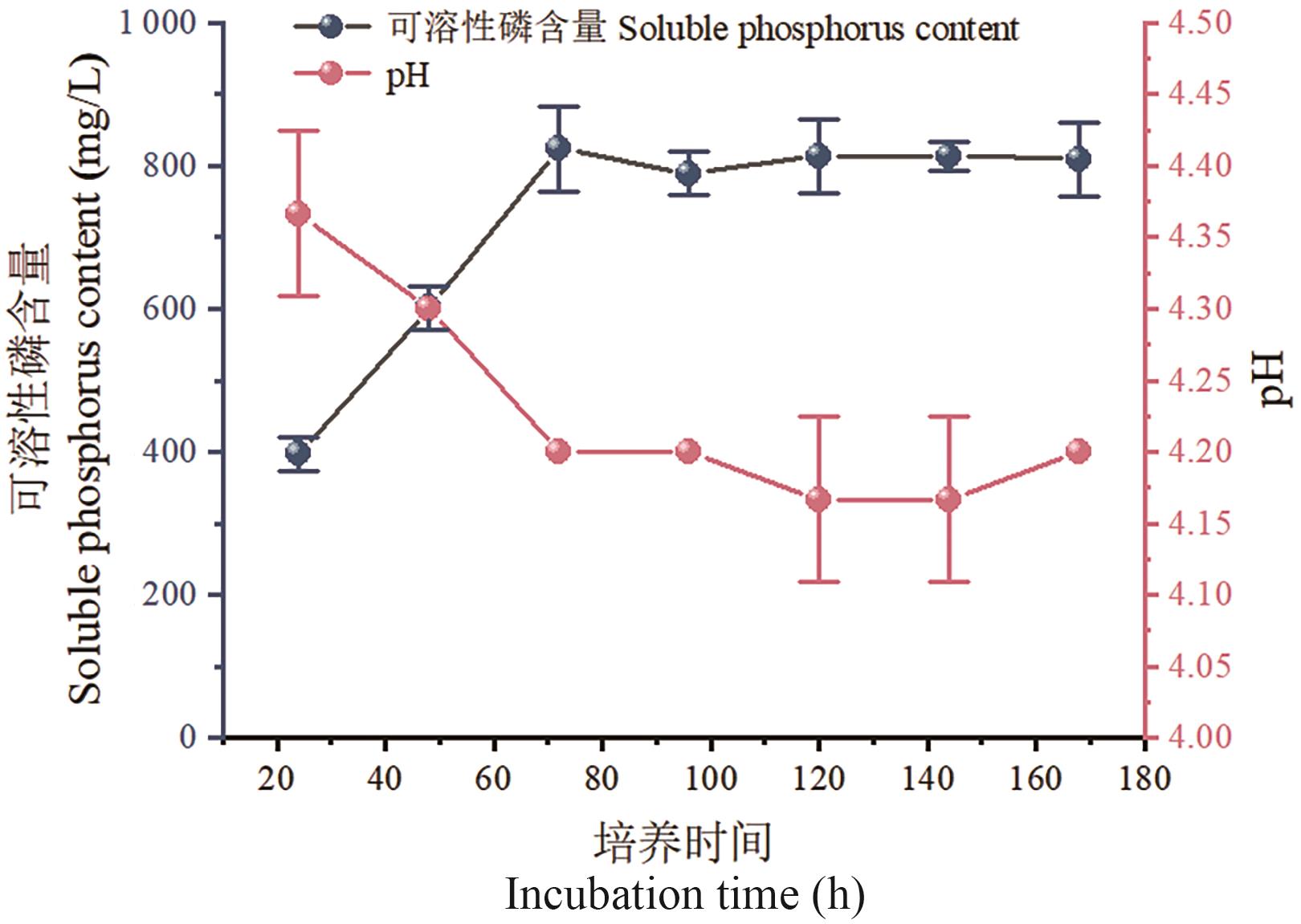
图5 最优条件下N4129-2AT培养过程中可溶性磷含量与pH的动态变化
Fig. 5 Dynamic changes in soluble phosphate content and pH during incubation of N4129-2AT under optimal conditions
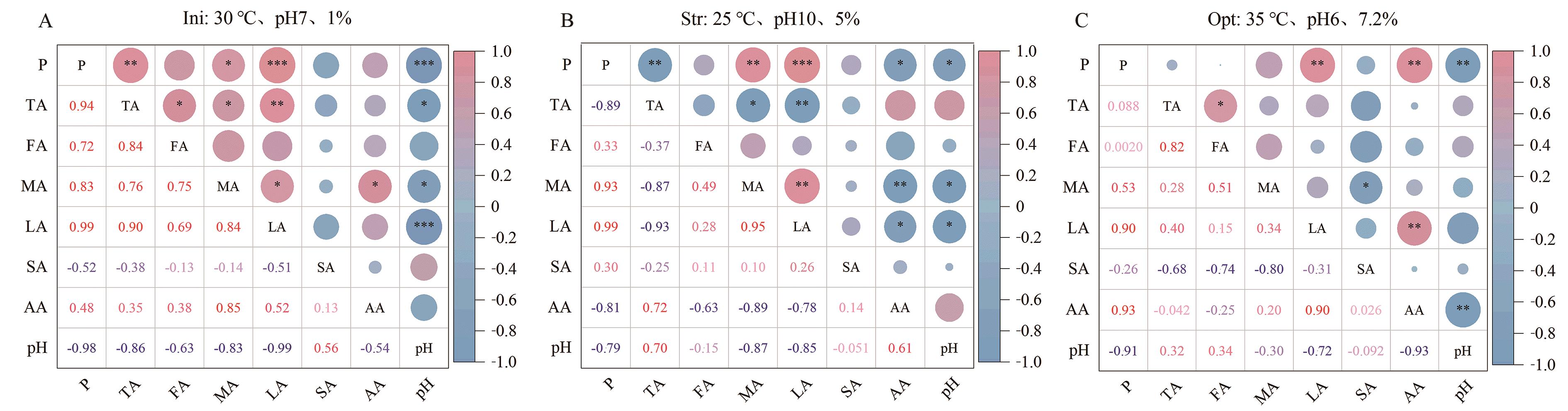
图6 N4129-2AT在不同条件下有机酸与pH、动态溶磷量的相关性热图Ini:初始条件;Str:逆境条件;Opt:最优条件;P:可溶性磷含量;TA:酒石酸;FA:甲酸;MA:苹果酸;LA:乳酸;SA:琥珀酸;AA:乙酸。*P<0.05,**P<0.01,***P<0.001,下同
Fig. 6 Correlation heatmap of organic acids, pH, and P-solubilization of N4129-2AT under different conditionsIni: Initial condition; Str: stress condition; Opt: optimal condition; P: soluble phosphorus content; TA: tartaric acid; FA: formic acid; MA: malic acid; LA: lactic acid; SA: succinic acid; AA: acetic acid. *P<0.05, **P<0.01, ***P<0.001, The same below
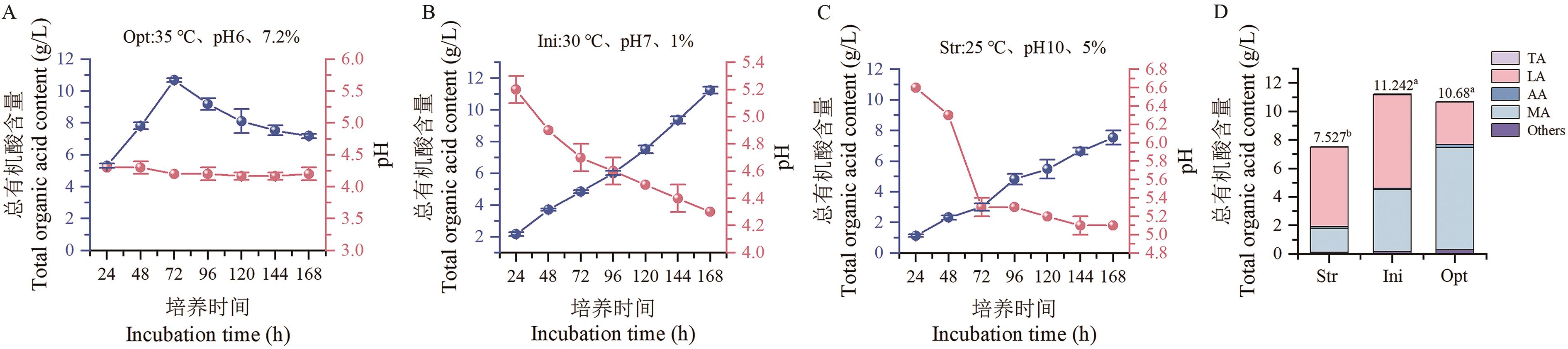
图7 不同培养条件下总有机酸与pH的动态变化及核心有机酸占比
Fig. 7 Dynamic changes of total organic acids and pH under different culture conditions as well as the proportion of core organic acids
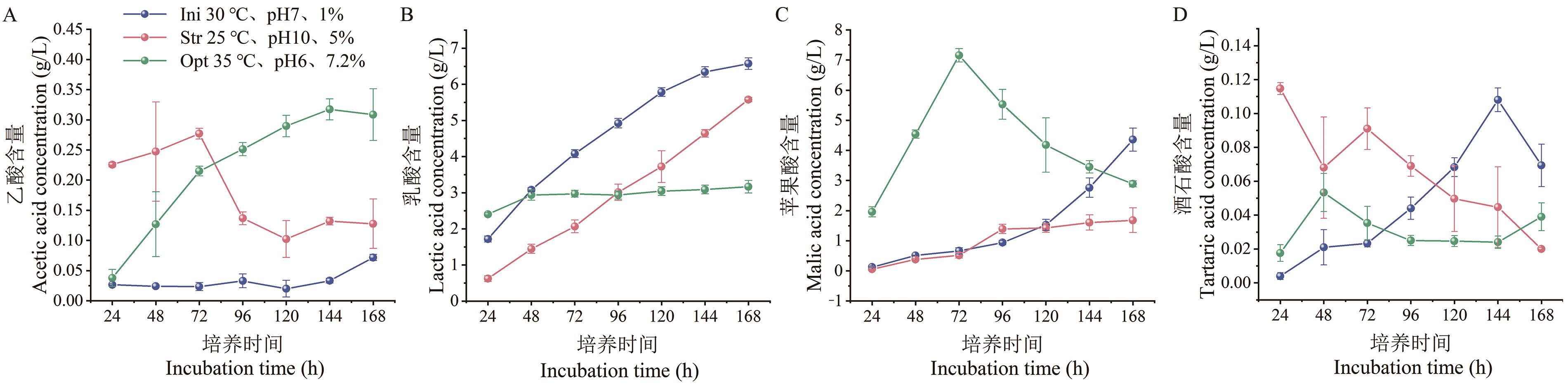
图8 不同条件下7 d培养期内不同核心溶磷有机酸含量的动态变化
Fig. 8 Dynamic changes in content of core phosphate-solubilizing organic acids during the 7-day incubation period under different conditions
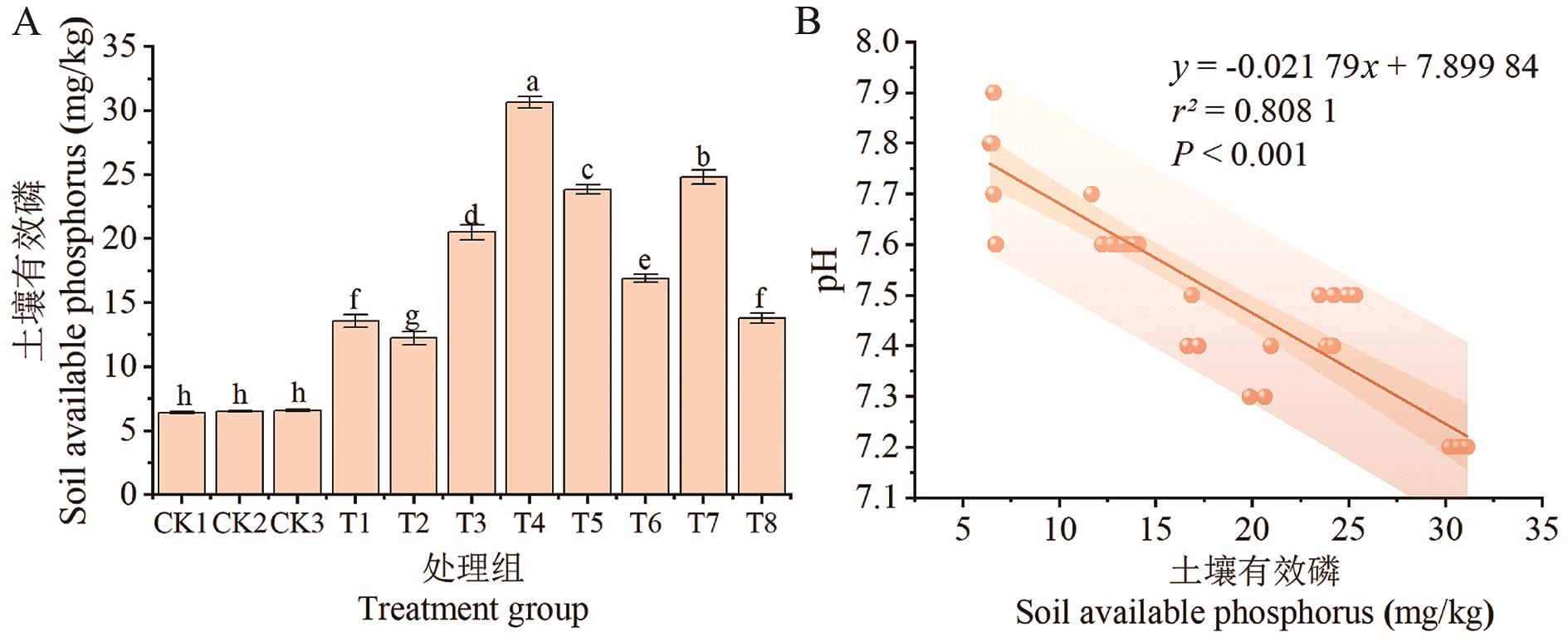
图9 不同处理对土壤有效磷含量的影响及土壤有效磷与pH的相关性
Fig. 9 Effects of different treatments on soil available P content and its correlation with pH

图10 不同处理对小麦幼苗生长指标的影响
Fig. 10 Effects of different treatments on growth indicators of wheat seedlings
关联指标组合 Indicator combination | 相关系数 Correlation coefficient | P-value |
|---|---|---|
| AP-株高 AP-Plant height | 0.855** | <0.001 |
| AP-主根长 AP-Taproot length | 0.752** | <0.001 |
| AP-地上部干重 AP-Shoot dry weight | 0.965** | <0.001 |
| AP-地下部干重 AP-Root dry weight | 0.665** | <0.001 |
| AP-根冠比 AP-Root-shoot ratio | -0.701** | <0.001 |
表4 土壤有效磷与小麦幼苗生长指标的相关性
Table 4 Correlation between soil available phosphorus and wheat seedling growth indices
关联指标组合 Indicator combination | 相关系数 Correlation coefficient | P-value |
|---|---|---|
| AP-株高 AP-Plant height | 0.855** | <0.001 |
| AP-主根长 AP-Taproot length | 0.752** | <0.001 |
| AP-地上部干重 AP-Shoot dry weight | 0.965** | <0.001 |
| AP-地下部干重 AP-Root dry weight | 0.665** | <0.001 |
| AP-根冠比 AP-Root-shoot ratio | -0.701** | <0.001 |
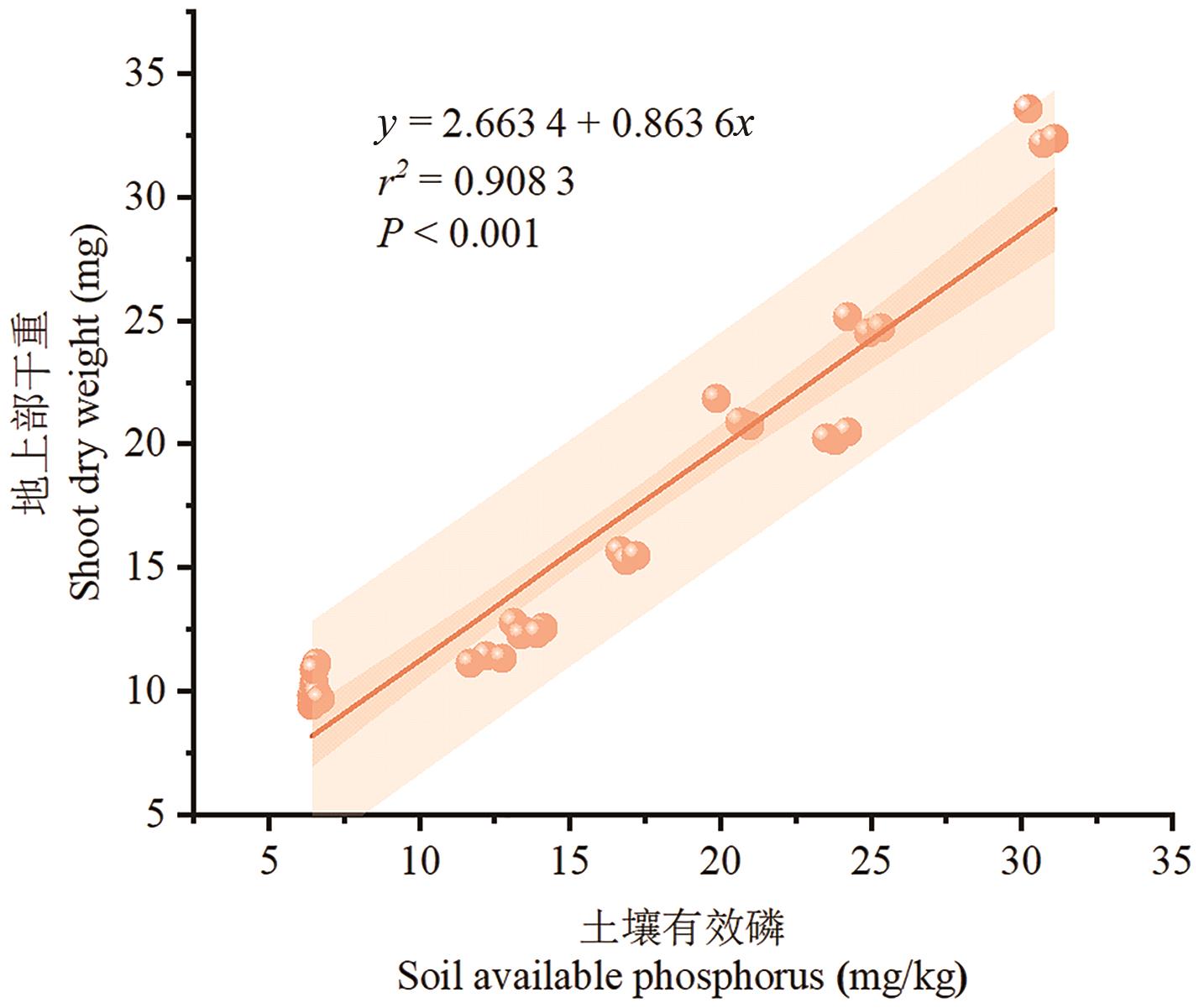
图11 土壤有效磷与小麦地上部干重的相关性
Fig. 11 Correlation between soil available phosphorus and wheat shoot dry weight
| [1] | 杨晓晗. 液体牛粪与氮肥配施对氮素迁移转化及玉米幼苗生长的影响 [D]. 哈尔滨: 东北农业大学, 2025. |
| Yang XH. Effect of liquid cattle manure and nitrogen fertilizer co-application on nitrogen migration transformation and maize seedling growth [D]. Harbin: Northeast Agricultural University, 2025. | |
| [2] | 缪新宇. 油茶根际土壤微生物多样性分析及合成菌群构建 [D]. 长沙: 中南林业科技大学, 2025. |
| Miao XY. Analysis of rhizosphere soil microbial diversity and construction of synthetic microbial communities in Camellia oleifera [D]. Changsha: Central South University of Forestry & Technology, 2025. | |
| [3] | 陈思沅, 苟展, 林文槿, 等. 乳酸菌菌剂对玉米幼苗的促生作用研究 [J]. 中国饲料, 2022(24): 52-56. |
| Chen SY, Gou Z, Lin WJ, et al. Study on the growth-promoting effect of Lactic acid bacteria agent on maize seedlings [J]. China Feed, 2022(24): 52-56. | |
| [4] | 许健楠. 河北省农业绿色发展水平评价及影响因素研究 [D]. 哈尔滨: 东北农业大学, 2025. |
| Xu JN. Research on the evaluation of agricultural green development level and influencing factors in Hebei Province [D]. Harbin: Northeast Agricultural University, 2025. | |
| [5] | 张庆格, 徐乐言, 张奇, 等. 解磷菌对土壤有效磷影响及机制研究 [J]. 青岛理工大学学报, 2025, 46(5): 82-88, 103. |
| Zhang QG, Xu LY, Zhang Q, et al. Effect of phosphorus solubilizing bacteria on effective phosphorus in soil and its mechanism [J]. J Qingdao Technol Univ, 2025, 46(5): 82-88, 103. | |
| [6] | Pan L, Cai BY. Phosphate-solubilizing bacteria: advances in their physiology, molecular mechanisms and microbial community effects [J]. Microorganisms, 2023, 11(12): 2904. |
| [7] | Prabhu N, Borkar S, Garg S. Phosphate solubilization mechanisms in alkaliphilic bacterium Bacillus marisflavi FA7 [J]. Curr Sci, 2018, 114(4): 845. |
| [8] | 赵小蓉, 林启美. 微生物解磷的研究进展 [J]. 土壤肥料, 2001(3): 7-11. |
| Zhao XR, Lin QM. A review of phosphate-dissolving microorganisms [J]. Soils Fertil, 2001(3): 7-11. | |
| [9] | 杜雷, 王素萍, 陈钢, 等. 一株高效解磷细菌的筛选、鉴定及其溶磷能力的研究 [J]. 中国土壤与肥料, 2017(3): 136-141. |
| Du L, Wang SP, Chen G, et al. Isolation and identidication of efficient phosphate-solubilizing bacterial strain and its phosphate-solubilizing capacity [J]. Soils Fertil Sci China, 2017(3): 136-141. | |
| [10] | 王舒, 张林平, 张扬, 等. 红壤区油茶根际解磷细菌的筛选、鉴定及其解磷能力 [J]. 林业科学研究, 2015, 28(3): 409-416. |
| Wang S, Zhang LP, Zhang Y, et al. Screening, identification and phosphate solubilizing capability of phosphate solubilizing bacteria in rhizosphere of Camellia oleifera Abel at red soil region [J]. For Res, 2015, 28(3): 409-416. | |
| [11] | Kundu BS, Nehra K, Yadav R, et al. Biodiversity of phosphate solubilizing bacteria in rhizosphere of chickpea, mustard and wheat grown in different regions of Haryana [J]. Indian J Microbiol, 2009, 49(2): 120-127. |
| [12] | 国家环境保护总局. 水质 总磷的测定 钼酸铵分光光度法: [S]. 北京: 中国标准出版社,1989. |
| State Environmental Protection Administration of the People’s Republic of China. Water quality-Determination of total phosphorus-Ammonium molybdate spectrophotometric method: [S]. Beijing: Standards Press of China, 1989. | |
| [13] | 盛定红, 李小军, 张景宁, 等. 一株新型解磷菌的筛选鉴定及其制备煤矸石烟草复合肥料 [J]. 中国土壤与肥料, 2023(11): 241-247. |
| Sheng DH, Li XJ, Zhang JN, et al. Screening and identification of a new phosphate solubilizing bacterium and preparation of tobacco compound fertilizer from coal gangue [J]. Soils Fertil Sci China, 2023(11): 241-247. | |
| [14] | 马永强, 邓倩, 范洪臣, 等. 高效液相色谱法测定发酵液中有机酸的优化研究 [J]. 中国调味品, 2019, 44(10): 18-25. |
| Ma YQ, Deng Q, Fan HC, et al. Study on optimization of determination of organic acids in fermentation broth by high performance liquid chromatography [J]. China Condiment, 2019, 44(10): 18-25. | |
| [15] | 韦杏花. 一株解磷菌的筛选及其培养条件优化 [D]. 杭州: 浙江大学, 2015. |
| Wei XH. Screening of a phosphate dissolving bacteria strain and it’s culture conditions optimization [D]. Hangzhou: Zhejiang University, 2015. | |
| [16] | 国家技术监督局. 石灰性土壤有效磷测定方法: [S].北京:中国标准出版社, 1990. |
| The State Bureau of Quality and Technical Supervision. Method for the determination of available phosphorus in calcareous soil: [S]. Beijing: China Standard Press, 1990. | |
| [17] | 中华人民共和国农业部. 土壤检测 第2部分:土壤pH的测定: [S]. 北京: 中国标准出版社, 2006. |
| Ministry of Agriculture of the People’s Republic of China. Soil Testing Part 2: Method for determination of soil pH: [S]. Beijing: China Standard Press, 2006. | |
| [18] | 黄海洲, 罗旦, 陈吉祥, 等. 溶磷菌对番茄幼苗生长及土壤磷素的影响 [J]. 农业环境科学学报, 2025, 44(12): 3181-3189. |
| Huang HZ, Luo D, Chen JX, et al. Effects of phosphorus-solubilizing bacteria on tomato seedling growth and soil phosphorus availability [J]. J Agro Environ Sci, 2025, 44(12): 3181-3189. | |
| [19] | 李锐霞, 黄思源, 陈文镪, 等. 解磷微生物的解磷机制及应用进展 [J]. 江苏农业科学, 2024, 52(24): 23-29. |
| Li RX, Huang SY, Chen WQ, et al. Mechanism and application progress of phosphorus solubilizing microorganisms [J]. Jiangsu Agric Sci, 2024, 52(24): 23-29. | |
| [20] | 钟传青, 黄为一. 不同种类解磷微生物的溶磷效果及其磷酸酶活性的变化 [J]. 土壤学报, 2005, 42(2): 286-294. |
| Zhong CQ, Huang WY. Comparison in P-solubilizing effects between different P-solubilizing microbes and variation of activities of their phosphatases [J]. Acta Pedol Sin, 2005, 42(2): 286-294. | |
| [21] | 房翠莲, 曹婷婷, 尹语申, 等. 毛竹根际多功能解磷菌zafu-111的分离及全基因组解析 [J]. 应用生态学报, 2025, 36(10): 3175-3186. |
| Fang CL, Cao TT, Yin YS, et al. Isolation and whole-genome analysis of a multifunctional strain zafu-111 for phosphate-solubilizing in the rhizosphere of Phyllostachys edulis [J]. Chin J Appl Ecol, 2025, 36(10): 3175-3186. | |
| [22] | 葛紫怡, 王思宇, 苏旭, 等. 低温耐盐碱解磷菌的筛选及其作用分析 [J]. 微生物学报, 2025, 65(12): 5573-5589. |
| Ge ZY, Wang SY, Su X, et al. Isolation and function analysis of phosphate-solubilizing bacteria with psychrotolerance and saline-alkaline tolerance [J]. Acta Microbiol Sin, 2025, 65(12): 5573-5589. | |
| [23] | Zhu L, Zhao M, Yan YT, et al. Characteristics of isolated lactic acid bacteria at low temperature and their effects on the silage quality [J]. Microbiol Spectr, 2025, 13(5): e03194-e03124. |
| [24] | 朱德旋, 杜春梅, 董锡文, 等. 一株寒地高效解无机磷细菌发酵条件优化 [J]. 北方园艺, 2020(10): 45-50. |
| Zhu DX, Du CM, Dong XW, et al. Optimization of fermentation conditions for a inorganic-phosphorous- solubilizing bacterium isolated from cold region [J]. North Hortic, 2020(10): 45-50. | |
| [25] | 葛立刚. 高效解磷菌株P3与解钾菌株K1的分离筛选及其初步应用 [D]. 南京: 南京农业大学, 2021. |
| Ge LG. Isolation, screening and preliminary application of efficient phosphate-solubilizing strain P3 and potassium-solubilizing strain K1 [D]. Nanjing: Nanjing Agricultural University, 2021. | |
| [26] | Della Mónica IF, Godoy MS, Godeas AM, et al. Fungal extracellular phosphatases: their role in P cycling under different pH and P sources availability [J]. J Appl Microbiol, 2018, 124(1): 155-165. |
| [27] | 潘林, 弥春霞, 徐青山, 等. 解磷细菌解磷机制研究进展及其在水稻上的应用 [J]. 中国稻米, 2024, 30(3): 1-9. |
| Pan L, Mi CX, Xu QS, et al. Research prog ress on phosphorus solubilization mechanism of phosphorus solubilizing bacteria and its application in rice production [J]. China Rice, 2024, 30(3): 1-9. | |
| [28] | 池景良, 郝敏, 王志学, 等. 解磷微生物研究及应用进展 [J]. 微生物学杂志, 2021, 41(1): 1-7. |
| Chi JL, Hao M, Wang ZX, et al. Advances in research and application of phosphorus-solubilizing microorganism [J]. J Microbiol, 2021, 41(1): 1-7. | |
| [29] | 杨维, 马振林, 闫刚, 等. 药用植物卷叶黄精根际解磷细菌的筛选鉴定及培养条件的优化 [J]. 草地学报, 2026, 34(4): 1510-1523. |
| Yang W, Ma ZL, Yan G, et al. Screening, identification and optimization of culture conditions of phosphate-solubilizing bacteria in the rhizosphere of medicinal plant Polygonatum cirrhifolium [J]. Acta Agrestia Sin, 2026, 34(4): 1510-1523. | |
| [30] | 苌豹. 多种解磷、解钾、固氮菌混合发酵制备菌糠菌肥的研究 [D]. 天津: 天津大学, 2014. |
| Chang B. Producing biofertilizer with spent mushroom substrate using co-inoculation of various of phosphate-solubilizing, potassium solubilizing and nitrogen fixing bacteria [D]. Tianjin: Tianjin University, 2014. | |
| [31] | 顾炽明, 李越, 李银水, 等. 绿肥腐解液中有机酸组成对铝磷和铁磷活化能力的影响 [J]. 植物营养与肥料学报, 2021, 27(9): 1627-1635. |
| Gu CM, Li Y, Li YS, et al. Effects of organic acid composition in the decomposed liquid of green manure crops on the activation level of AlPO4 and FePO4·2H2O [J]. Plant Nutr Fert Sci, 2021, 27(9): 1627-1635. | |
| [32] | 满华丽. 解磷菌P34培养条件优化及其对番茄枯萎病拮抗作用和植株促生效果评价 [D]. 兰州: 甘肃农业大学, 2025. |
| Man HL. Optimization of phosphate-solubilizing bacteria strain P34 culture conditions and evaluation of resistance on Fusarium Wilt of tomato and the plant growth promotion [D]. Lanzhou: Gansu Agricultural University, 2025. | |
| [33] | 刘浩蓝, 丁珊珊, 包小春, 等. 3株解磷菌的解磷机理及其对杉木幼苗的促生效应 [J]. 生态与农村环境学报, 2025, 41(3): 378-388. |
| Liu HL, Ding SS, Bao XC, et al. The phosphate-solubilizing mechanism of three phosphate-solubilizing bacteria and their promoting effect on Cunninghamia lanceolata [J]. J Ecol Rural Environ, 2025, 41(3): 378-388. | |
| [34] | 孙金华. AM真菌对模拟采煤沉陷根系损伤生理生化影响及修复效应 [D]. 北京: 中国矿业大学(北京), 2017. |
| Sun JH. The physiology biochemistry and remediation effect of AM fungi on damage roots in simulated mining subsidence [D]. Beijing: China University of Mining & Technology, Beijing, 2017. | |
| [35] | 江润海, 温绍福, 朱城强, 等. 铅污染矿区中耐铅解磷菌对玉米的促生及根际铅的固化效应 [J]. 生态环境学报, 2024, 33(2): 291-300. |
| Jiang RH, Wen SF, Zhu CQ, et al. Research on the promotion of maize growth and immobilization of Pb in the rhizosphere by Pb-tolerant phosphate solubilizing bacteria in Pb-contaminated mining areas [J]. Ecol Environ Sci, 2024, 33(2): 291-300. | |
| [36] | 赵晶晶, 郭冬琴, 杨敏, 等. 不同剂量解磷菌对滇重楼生长发育的影响 [J]. 环境化学, 2022, 41(2): 761-769. |
| Zhao JJ, Guo DQ, Yang M, et al. Effect of different dosage of dissolving phosphorus bacteria on growth and development in Paris polyphylla var. yunnanensis [J]. Environ Chem, 2022, 41(2): 761-769. | |
| [37] | 芦月, 杨静, 李仕辉, 等. 黄河三角洲不同经济林土壤有机碳分布特征及改良土壤效应 [J]. 中国水土保持科学, 2025, 23(2): 180-189. |
| Lu Y, Yang J, Li SH, et al. Distribution characteristics of soil organic carbon and soil improvement effects of different economic forests in the Yellow River Delta [J]. Sci Soil Water Conserv, 2025, 23(2): 180-189. | |
| [38] | 黄晨晨, 宋晓, 黄绍敏, 等. 不同磷效率小麦根系形态、磷素转运及产量的差异分析 [J]. 华北农学报, 2021, 36(2): 169-175. |
| Huang CC, Song X, Huang SM, et al. Analysis of differences in root morphology, phosphorus transport and yield of wheat with different phosphorus efficiency [J]. Acta Agric Boreali Sin, 2021, 36(2): 169-175. |
| [1] | 夏馨媛, 薛道晟, 李鑫静, 龙俊杰, 陆开形, 丁沃娜, 李梦莎. 稻油轮作土壤多功能促生菌的鉴定及其对油菜生长和根际细菌群落的影响[J]. 生物技术通报, 2025, 41(4): 289-301. |
| [2] | 刘爽, 江洲, 赵帅, 赵雷真, 黄峰, 周佳, 屈建航. 一株产蛋白酶细菌的筛选、鉴定及发酵工艺优化[J]. 生物技术通报, 2025, 41(4): 335-344. |
| [3] | 罗明凯, 张豪杰, 石晖琴, 李亚楠, 封瑞超, 沈硕. 三株马铃薯炭疽病生防菌的分离鉴定及其高抑菌活性培养物发酵参数优化[J]. 生物技术通报, 2025, 41(12): 313-327. |
| [4] | 张严化, 曲文龙, 戴文静, 张睿宁, 刘羽鸿, 王德培, 薛鲜丽. 一株高产维生素B13不动杆菌鉴定及发酵条件优化[J]. 生物技术通报, 2025, 41(11): 153-165. |
| [5] | 温绍福, 江润海, 朱城强, 张梅, 余小琴, 杨杰惠, 杨小容, 侯秀丽. 铅污染土壤中解磷菌对玉米根际土壤性质和微生物群落结构的影响[J]. 生物技术通报, 2024, 40(9): 225-237. |
| [6] | 常海霞, 李明源, 麦日艳古·亚生, 周茜, 王继莲. 产胞外多糖多功能促生菌的筛选鉴定及促生评价[J]. 生物技术通报, 2024, 40(3): 273-285. |
| [7] | 余金岂, 邬柯奕, 陈正睿, 王婧涵, 张鑫, 王春月. 珊瑚状猴头菌多糖超声辅助提取工艺优化及抗结直肠癌活性研究[J]. 生物技术通报, 2024, 40(11): 78-87. |
| [8] | 平怀磊, 郭雪, 余潇, 宋静, 杜春, 王娟, 张怀璧. 滇牡丹PdANS的克隆、表达及与花青素含量的相关性[J]. 生物技术通报, 2023, 39(3): 206-217. |
| [9] | 涂晓媛, 褚路路, 王冕, 陈炳智, 江玉姬. 珊瑚状猴头菇多糖的提取及其体外抗氧化活性分析[J]. 生物技术通报, 2023, 39(12): 276-286. |
| [10] | 张秀民, 马绍英, 杨洁, 包金玉, 张晓玲, 田鹏, 路亚琦, 李胜. 以次生代谢物产量为目标的西兰花毛状根培养技术体系优化[J]. 生物技术通报, 2021, 37(8): 75-84. |
| [11] | 郭玉峰, 汪乔, 王祥锋, 周婷, 杨晓君, 王庆佶, 王丽. 泰山野生蛹虫草优良菌株的筛选[J]. 生物技术通报, 2021, 37(11): 125-133. |
| [12] | 李文, 王陶. 解磷菌JL-1对磷矿粉降解性能的研究[J]. 生物技术通报, 2020, 36(8): 34-44. |
| [13] | 唐岷宸, 李文静, 宋天顺, 谢婧婧. 一株高效解磷菌的筛选及其解磷效果验证[J]. 生物技术通报, 2020, 36(6): 102-109. |
| [14] | 罗素亚, 郑豆豆, 何广正, 张琳琳, 徐书景, 鞠建松. 响应面法优化脯氨酸羟化酶转化反应工艺条件[J]. 生物技术通报, 2020, 36(6): 157-164. |
| [15] | 张芮瑞, 邱树毅, 周少奇, 王雪郦. 丢糟和磷矿粉高温堆肥中耐高温解磷菌的筛选及性能分析[J]. 生物技术通报, 2020, 36(5): 110-119. |
| 阅读次数 | ||||||
|
全文 |
|
|||||
|
摘要 |
|
|||||
