







生物技术通报 ›› 2025, Vol. 41 ›› Issue (6): 355-366.doi: 10.13560/j.cnki.biotech.bull.1985.2024-1180
• 研究报告 • 上一篇
安苗苗( ), 蔺祥淏, 梁瑞娜, 赵国柱()
收稿日期:2024-12-05
出版日期:2025-06-26
发布日期:2025-06-30
通讯作者:
赵国柱,男,博士,研究方向 :资源与环境微生物;E-mail: zhaogz@bjfu.edu.cn作者简介:安苗苗,女,博士研究生,研究方向 :厌氧消化的生物强化;E-mail: anmiao315418@163.com
基金资助:
AN Miao-miao(), LIN Xiang-hao, LIANG Rui-na, ZHAO Guo-zhu()
Received:2024-12-05
Published:2025-06-26
Online:2025-06-30
摘要:
目的 产甲烷菌是厌氧消化产甲烷过程的关键功能菌群。为了获得高效的产甲烷菌群,探究不同碳源对菌群产甲烷潜力的调控作用,以及对产甲烷菌丰度和群落结构的影响。 方法 设计A组(CH3COONa和CH3OH)、B组(CH3COONa)和C组(CH3COONa和HCOONa)3组不同碳源培养基,分别以厨余垃圾厌氧消化液(FW)和污泥悬浮液(SS)为接种物富集产甲烷菌。采用气相色谱、实时荧光定量PCR、荧光显微观察和高通量扩增子测序技术,分析产甲烷菌群的性能及其多样性组成。 结果 同一接种物下,A、B、C三组碳源富集的菌群产甲烷能力呈递减趋势。其中,A组的1A-2在49 d内累积CH4产量最高,单位体积(L)培养基中,每克可用碳元素(C)产生的CH4达到35.9 mL。mcrA基因拷贝数和荧光显微观察表明,产甲烷菌的丰度总体呈现A组˃B组˃C组。A组碳源对甲基营养型产甲烷菌具有定向富集作用;B组碳源的添加使乙酸营养型Methanothrix的相对丰度显著高于其他两组;而C组碳源则显著增加了氢营养型产甲烷菌的相对丰度。 结论 碳源种类显著影响富集菌群中产甲烷菌和细菌的多样性、丰富度及群落结构。以CH3COONa和CH3OH(A组)为碳源富集的菌群中产甲烷菌的丰度最高,主要包括Methanothrix、Methanoculleus、Methanomethylovorans、Candidatus Methanoplasma和Methanosarcina,且产甲烷能力最强。A组碳源通过富集互营细菌,协调产甲烷菌的代谢途径分配,促进直接种间电子传递(DIET)过程,显著提升CH4产量。
安苗苗, 蔺祥淏, 梁瑞娜, 赵国柱. 碳源对产甲烷菌群调控及产甲烷能力的影响[J]. 生物技术通报, 2025, 41(6): 355-366.
AN Miao-miao, LIN Xiang-hao, LIANG Rui-na, ZHAO Guo-zhu. Effect of Carbon Source in Methanogenic Communities Regulation and Methane Production Capacity[J]. Biotechnology Bulletin, 2025, 41(6): 355-366.
富集代数 Enrichment algebra | 接种FW(代号1) Inoculated FW (code 1) | 接种SS(代号2) Inoculated SS (code 2) | ||||
|---|---|---|---|---|---|---|
碳源A Carbon source A | 碳源B Carbon source B | 碳源C Carbon source C | 碳源A Carbon source A | 碳源B Carbon source B | 碳源C Carbon source C | |
第一代(代号-1) First generation (code-1) | 1A-1 | 1B-1 | 1C-1 | 2A-1 | 2B-1 | 2C-1 |
第二代(代号-2) Second generation (code-2) | 1A-2 | 1B-2 | 1C-2 | 2A-2 | 2B-2 | 2C-2 |
第三代(代号-3) Third generation (code-3) | 1A-3 | 1B-3 | 1C-3 | 2A-3 | 2B-3 | 2C-3 |
表1 产甲烷菌群富集培养物编号
Table 1 Identification numbers of methanogenic microbial community enrichment cultures
富集代数 Enrichment algebra | 接种FW(代号1) Inoculated FW (code 1) | 接种SS(代号2) Inoculated SS (code 2) | ||||
|---|---|---|---|---|---|---|
碳源A Carbon source A | 碳源B Carbon source B | 碳源C Carbon source C | 碳源A Carbon source A | 碳源B Carbon source B | 碳源C Carbon source C | |
第一代(代号-1) First generation (code-1) | 1A-1 | 1B-1 | 1C-1 | 2A-1 | 2B-1 | 2C-1 |
第二代(代号-2) Second generation (code-2) | 1A-2 | 1B-2 | 1C-2 | 2A-2 | 2B-2 | 2C-2 |
第三代(代号-3) Third generation (code-3) | 1A-3 | 1B-3 | 1C-3 | 2A-3 | 2B-3 | 2C-3 |
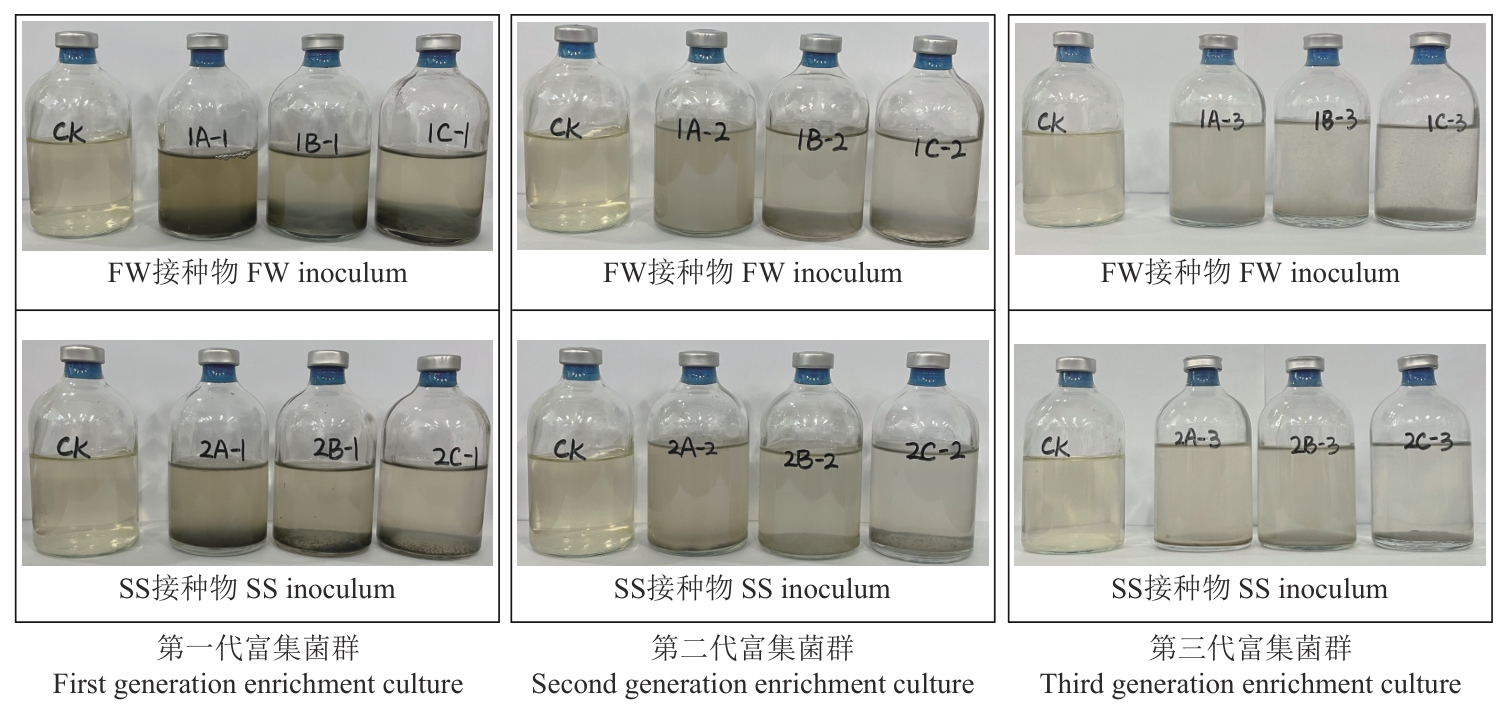
图1 产甲烷菌群富集培养物FW:厨余垃圾厌氧消化液;SS:污泥悬浮液
Fig. 1 Enrichment cultures of methanogenic microbial communityFW: Anaerobic digestion liquid from kitchen waste. SS: Suspension from activated sludge

图2 富集菌群的累积CH4产量mL/(g∙L-1 C):单位体积(L)培养基中,每克可用碳元素(C)对应的CH4产量(mL)
Fig. 2 Cumulative methane yields by enriched methanogenic microbial communitymL/(g∙L-1 C): The methane yield (mL) per gram of available carbon (C) in a unit volume (mL) of culture medium
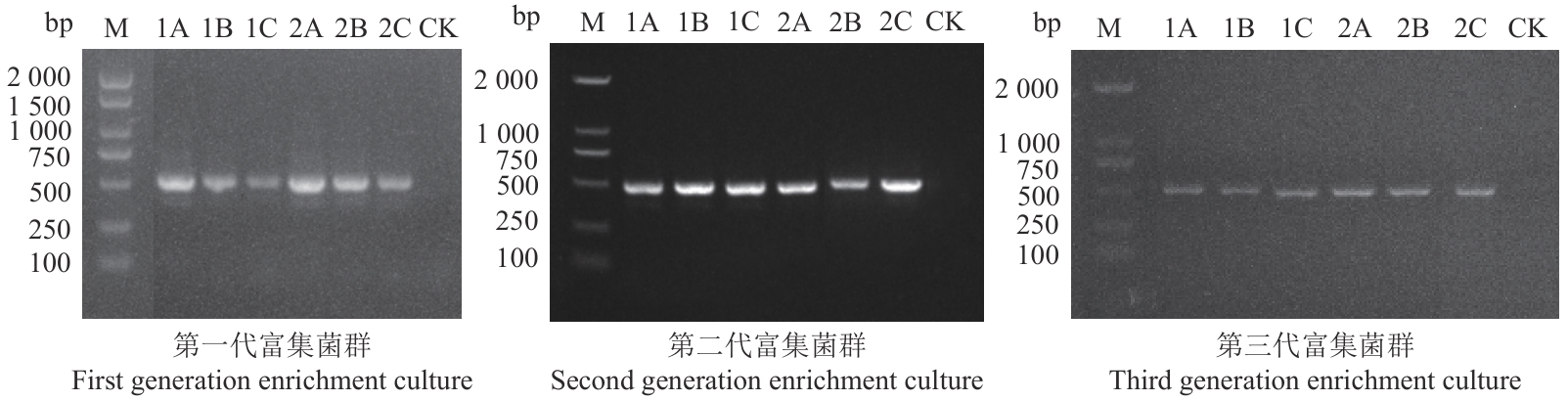
图3 富集菌群mcrA基因PCR扩增结果
Fig. 3 PCR amplification results of mcrA gene in methanogenic microbial community

图4 富集菌群的mcrA基因定量分析A:重组质粒的阳性克隆筛选;B:基于mcrA基因的荧光定量PCR标准曲线;C:第二代富集菌群mcrA基因拷贝数copies/(g∙L-1 C);copies/(g∙L-1 C):单位体积(L)培养基中,每克可用碳元素(C)对应的mcrA基因拷贝数(copies)
Fig. 4 Quantitative analysis of mcrA gene in enriched methanogenic microbial communityA: Positive clone screening of recombinant plasmid. B: Standard curve of fluorescence quantitative PCR based on mcrA gene. C: Copy number of mcrA gene in the second generation of methanogenic microbial community enrichment cultures, i.e., copies/(g∙L-1 C). copies/(g∙L-1 C): The copy number of mcrA gene per gram of available carbon (C) in a unit volume (L) of culture medium
| 稀释倍数 Dilution ratio | 拷贝数 Copy number | Ct值(mean ± SD) Cycle threshold | 变异系数 Coefficient of variation (%) |
|---|---|---|---|
| 1.00×10⁻⁷ | 6.53×10³ | 31.70 ± 0.70 | 2.21 |
| 1.00×10⁻⁶ | 6.53×10⁴ | 27.65 ± 0.29 | 1.05 |
| 1.00×10⁻⁵ | 6.53×10⁵ | 23.24 ± 0.66 | 2.84 |
| 1.00×10⁻⁴ | 6.53×10⁶ | 17.96 ± 0.25 | 1.40 |
| 1.00×10⁻³ | 6.53×10⁷ | 13.92 ± 0.19 | 1.36 |
| 1.00×10⁻² | 6.53×10⁸ | 10.78 ± 0.26 | 2.39 |
| 1.00×10⁻¹ | 6.53×10⁹ | 6.00 ± 0.00 | 0.00 |
表2 不同稀释倍数下标准质粒的实时荧光定量PCR检测精度
Table 2 Real-time PCR detection precision of standard plasmids at different dilution ratios
| 稀释倍数 Dilution ratio | 拷贝数 Copy number | Ct值(mean ± SD) Cycle threshold | 变异系数 Coefficient of variation (%) |
|---|---|---|---|
| 1.00×10⁻⁷ | 6.53×10³ | 31.70 ± 0.70 | 2.21 |
| 1.00×10⁻⁶ | 6.53×10⁴ | 27.65 ± 0.29 | 1.05 |
| 1.00×10⁻⁵ | 6.53×10⁵ | 23.24 ± 0.66 | 2.84 |
| 1.00×10⁻⁴ | 6.53×10⁶ | 17.96 ± 0.25 | 1.40 |
| 1.00×10⁻³ | 6.53×10⁷ | 13.92 ± 0.19 | 1.36 |
| 1.00×10⁻² | 6.53×10⁸ | 10.78 ± 0.26 | 2.39 |
| 1.00×10⁻¹ | 6.53×10⁹ | 6.00 ± 0.00 | 0.00 |

图5 富集菌群在420 nm波长下的荧光显微观察结果
Fig. 5 Fluorescence microscopy-observed results of enriched methanogenic microbial community at 420 nm
| Category | Sample | Observed_species | Shannon | Simpson | Pielou | Chao1 | ACE | Goods_coverage |
|---|---|---|---|---|---|---|---|---|
产甲烷菌 Methanogens | 1A-2 | 219 | 4.303 | 0.911 | 0.553 | 291.163 | 315.584 | 0.999 |
| 1B-2 | 204 | 3.631 | 0.844 | 0.483 | 231.841 | 254.647 | 0.999 | |
| 1C-2 | 235 | 3.709 | 0.794 | 0.461 | 290.724 | 304.491 | 0.999 | |
细菌 Bacteria | 1A-2 | 1 644 | 6.622 | 0.905 | 0.620 | 1 646.686 | 1 664.078 | 0.999 |
| 1B-2 | 1 010 | 4.234 | 0.731 | 0.424 | 1 028.896 | 1 062.259 | 0.997 | |
| 1C-2 | 975 | 5.925 | 0.944 | 0.597 | 1 046.697 | 1 079.658 | 0.995 |
表3 不同碳源富集菌群中产甲烷菌和细菌的Alpha多样性指数
Table 3 Alpha diversity indexes of methanogenic archaea and bacteria in microbial community enriched by different carbon sources
| Category | Sample | Observed_species | Shannon | Simpson | Pielou | Chao1 | ACE | Goods_coverage |
|---|---|---|---|---|---|---|---|---|
产甲烷菌 Methanogens | 1A-2 | 219 | 4.303 | 0.911 | 0.553 | 291.163 | 315.584 | 0.999 |
| 1B-2 | 204 | 3.631 | 0.844 | 0.483 | 231.841 | 254.647 | 0.999 | |
| 1C-2 | 235 | 3.709 | 0.794 | 0.461 | 290.724 | 304.491 | 0.999 | |
细菌 Bacteria | 1A-2 | 1 644 | 6.622 | 0.905 | 0.620 | 1 646.686 | 1 664.078 | 0.999 |
| 1B-2 | 1 010 | 4.234 | 0.731 | 0.424 | 1 028.896 | 1 062.259 | 0.997 | |
| 1C-2 | 975 | 5.925 | 0.944 | 0.597 | 1 046.697 | 1 079.658 | 0.995 |

图6 不同碳源富集菌群中产甲烷菌和细菌的物种组成基于Bray-Curtis距离的产甲烷菌(A)和细菌(B)群落PCoA分析;C:产甲烷菌群落在属水平的组成;D:细菌群落在门水平的组成;E:细菌相对丰度前100属的物种组成和系统发育树分析
Fig. 6 Species composition of methanogenic archaea and bacteria in microbial community enriched by different carbon sourcesPrincipal coordinate analysis (PCoA) of the methanogenic archaeal community (A) and bacterial community (B) based on Bray-Curtis dissimilarity. C: Distribution of methanogenic archaeal communities at the genus level. D: Distribution of bacterial communities at the phylum level. E: Cladogram describing the taxonomic community composition and relative abundances of bacteria at the level of the top 100 genera
产甲烷菌营养类型 Methanogens trophic types | 产甲烷菌 Methanogens | 相对丰度 Relative abundance | ||
|---|---|---|---|---|
| 1A-2 | 1B-2 | 1C-2 | ||
| 乙酸营养型 Aceticlastic type | Methanothrix | 0.358 | 0.448 | 0.141 |
| 占比 Proportion (%) | 35.8 | 44.8 | 14.1 | |
| 氢营养型 Hydrogenotrophic type | Methanoculleus | 0.108 | 0.296 | 0.282 |
| Methanobacterium | 0.006 | 0.081 | 0.223 | |
| Methanobrevibacter | 0 | 0 | 0.197 | |
| Methanospirillum | 0.033 | 0.063 | 0.041 | |
| Candidatus Methanogranum | 0.023 | 0 | 0 | |
| Methanothermobacter | 0 | 0 | 0.009 | |
| 占比 Proportion (%) | 17.0 | 44.0 | 75.1 | |
| 甲基营养型 Methylotrophic type | Candidatus Methanoplasma | 0.107 | 0.016 | 0.066 |
| Methanomethylovorans | 0.171 | 0.010 | 0.003 | |
| Methanomethylophilus | 0.012 | 0.003 | 0.001 | |
| Methanomassiliicoccus | 0.001 | 0 | 0 | |
| 占比 Proportion (%) | 29.2 | 2.9 | 7.0 | |
| 多营养型 Multitrophic types | Methanosarcina | 0.082 | 0 | 0 |
| 占比 Proportion (%) | 8.2 | 0 | 0 | |
表4 不同碳源富集菌群中产甲烷菌的相对丰度和营养类型占比
Table 4 Relative abundances and trophic type proportions of methanogenic archaea in microbial community enriched by different carbon sources
产甲烷菌营养类型 Methanogens trophic types | 产甲烷菌 Methanogens | 相对丰度 Relative abundance | ||
|---|---|---|---|---|
| 1A-2 | 1B-2 | 1C-2 | ||
| 乙酸营养型 Aceticlastic type | Methanothrix | 0.358 | 0.448 | 0.141 |
| 占比 Proportion (%) | 35.8 | 44.8 | 14.1 | |
| 氢营养型 Hydrogenotrophic type | Methanoculleus | 0.108 | 0.296 | 0.282 |
| Methanobacterium | 0.006 | 0.081 | 0.223 | |
| Methanobrevibacter | 0 | 0 | 0.197 | |
| Methanospirillum | 0.033 | 0.063 | 0.041 | |
| Candidatus Methanogranum | 0.023 | 0 | 0 | |
| Methanothermobacter | 0 | 0 | 0.009 | |
| 占比 Proportion (%) | 17.0 | 44.0 | 75.1 | |
| 甲基营养型 Methylotrophic type | Candidatus Methanoplasma | 0.107 | 0.016 | 0.066 |
| Methanomethylovorans | 0.171 | 0.010 | 0.003 | |
| Methanomethylophilus | 0.012 | 0.003 | 0.001 | |
| Methanomassiliicoccus | 0.001 | 0 | 0 | |
| 占比 Proportion (%) | 29.2 | 2.9 | 7.0 | |
| 多营养型 Multitrophic types | Methanosarcina | 0.082 | 0 | 0 |
| 占比 Proportion (%) | 8.2 | 0 | 0 | |
| 1 | 杨兴盛, 王尚, 何晴, 等. 典型有机固废厌氧消化微生物研究现状与发展方向 [J]. 生物工程学报, 2021, 37(10): 3425-3438. |
| Yang XS, Wang S, He Q, et al. Microorganisms in the typical anaerobic digestion system of organic solid wastes: a review [J]. Chin J Biotechnol, 2021, 37(10): 3425-3438. | |
| 2 | 李思琦, 臧昆鹏, 宋伦. 湿地甲烷代谢微生物产甲烷菌和甲烷氧化菌的研究进展 [J]. 海洋环境科学, 2020, 39(3): 488-496. |
| Li SQ, Zang KP, Song L. Review on methanogens and methanotrophs metabolised by methane in wetland [J]. Mar Environ Sci, 2020, 39(3): 488-496. | |
| 3 | Mayumi D, Mochimaru H, Tamaki H, et al. Methane production from coal by a single methanogen [J]. Science, 2016, 354(6309): 222-225. |
| 4 | Zhou Z, Zhang CJ, Liu PF, et al. Non-syntrophic methanogenic hydrocarbon degradation by an archaeal species [J]. Nature, 2022, 601(7892): 257-262. |
| 5 | 方晓瑜, 李家宝, 芮俊鹏, 等. 产甲烷生化代谢途径研究进展 [J]. 应用与环境生物学报, 2015, 21(1): 1-9. |
| Fang XY, Li JB, Rui JP, et al. Research progress in biochemical pathways of methanogenesis [J]. Chin J Appl Environ Biol, 2015, 21(1): 1-9. | |
| 6 | 易悦, 周卓, 黄艳, 等. 我国产甲烷古菌研究进展与展望 [J]. 微生物学报, 2023, 63(5): 1796-1814. |
| Yi Y, Zhou Z, Huang Y, et al. Methanogen research in China: current status and prospective [J]. Acta Microbiol Sin, 2023, 63(5): 1796-1814. | |
| 7 | 程国玲, 李巧燕, 李永峰. 产甲烷菌细菌学原理与应用 [M]. 哈尔滨: 哈尔滨工业大学出版社, 2013. |
| Cheng GL, Li QY, Li YF. Bacteriological principle and application of methanogenic bacteria [M]. Harbin: Harbin Institute of Technology Press, 2013. | |
| 8 | 刘春, 李亮, 马俊科, 等. 基于mcrA基因的厌氧颗粒污泥产甲烷菌群分析 [J]. 环境科学, 2011, 32(4): 1114-1119. |
| 42 | Ma SC, Peng CH, Deng Y, et al. Recent developments in Phylum Thermotoga [J]. China Biogas, 2022, 40(5): 3-17. |
| 43 | Ritalahti KM, Justicia-Leon SD, Cusick KD, et al. Sphaerochaeta globosa gen. nov., sp. nov. and Sphaerochaeta pleomorpha sp. nov., free-living, spherical spirochaetes [J]. Int J Syst Evol Microbiol, 2012, 62(1): 210-216. |
| 44 | Shao MS, Zhang C, Wang X, et al. Co-digestion of food waste and hydrothermal liquid digestate: Promotion effect of self-generated hydrochars [J]. Environ Sci Ecotechnol, 2023, 15: 100239. |
| 45 | An MM, Shen L, Liang RN, et al. Microbial diagnostics unveil key driver bacteria and methanogens associated with system stability and biogas production in food waste anaerobic digestion systems [J]. J Environ Chem Eng, 2024, 12(6): 114435. |
| 8 | Liu C, Li L, Ma JK, et al. Analysis of methanogenic community of anaerobic granular sludge based on mcrA gene [J]. Environ Sci, 2011, 32(4): 1114-1119. |
| 9 | Kundu K, Bergmann I, Hahnke S, et al. Carbon source—a strong determinant of microbial community structure and performance of an anaerobic reactor [J]. J Biotechnol, 2013, 168(4): 616-624. |
| 10 | Chen Z, Khan A, Zhang W, et al. Metabolic pathway analysis of methane from methanol as substrate in microbial consortium [J]. Bioresour Technol, 2024, 413: 131517. |
| 11 | Kouzuma A, Tsutsumi M, Ishii S, et al. Non-autotrophic methanogens dominate in anaerobic digesters [J]. Sci Rep, 2017, 7(1): 1510. |
| 12 | 刘璐, 刘星, 靖宪月, 等. 地杆菌: 驱动厌氧生物地球化学循环的“多面手” [J]. 微生物学报, 2022, 62(6): 2277-2288. |
| Liu L, Liu X, Jing XY, et al. Geoabcter: the "generalist" driving anaerobic biogeochemical cycles [J]. Acta Microbiol Sin, 2022, 62(6): 2277-2288. | |
| 13 | 马佳麟. 碳源与氨氮对厌氧菌群的影响及其产甲烷机制研究 [D]. 济南: 山东建筑大学, 2021. |
| Ma JL. Effects of carbon source and ammonia nitrogen on anaerobic bacteria and its methane production mechanism [D]. Jinan: Shandong Jianzhu University, 2021. | |
| 14 | DSMZ. DSMZ 120 Methanosarcina medium[EB/OL]. [2022-01-12]. . |
| 15 | DSMZ. DSMZ 334 Methanothrix medium[EB/OL]. [2022-09-21]. . |
| 16 | DSMZ. DSMZ 119 Methanobacterium medium[EB/OL]. [2022-09-15]. . |
| 17 | 李莹. 滨海河流沉积物中产甲烷分离物的获得及其电化学特征 [D]. 北京: 中国科学院大学, 2016. |
| Li Y. Acquisition and electrochemical characteristics of methane-producing isolates from coastal river sediments [D]. Beijing: University of Chinese Academy of Sciences, 2016. | |
| 18 | DSMZ. DSMZ 320 Clostridium cellulovorans medium[EB/OL]. [2022-03-31]. . |
| 19 | Wang PX, Yang YD, Wang XQ, et al. Manure amendment increased the abundance of methanogens and methanotrophs but suppressed the type I methanotrophs in rice paddies [J]. Environ Sci Pollut Res Int, 2020, 27(8): 8016-8027. |
| 20 | 陈悦, 罗明没, 李尚磷, 等. 基于荧光定量PCR技术分析滇池沉积物产甲烷菌空间分布特征 [J]. 云南农业大学学报: 自然科学, 2021, 36(1): 132-139. |
| Chen Y, Luo MM, Li SL, et al. The spatial distribution characteristics of methanogens in the sediments of Dianchi Lake by fluorescence quantitative PCR [J]. J Yunnan Agric Univ Nat Sci, 2021, 36(1): 132-139. | |
| 21 | Bokulich NA, Subramanian S, Faith JJ, et al. Quality-filtering vastly improves diversity estimates from Illumina amplicon sequencing [J]. Nat Methods, 2013, 10(1): 57-59. |
| 22 | Edgar RC, Haas BJ, Clemente JC, et al. UCHIME improves sensitivity and speed of Chimera detection [J]. Bioinformatics, 2011, 27(16): 2194-2200. |
| 23 | Qiu LP, Zhang Q, Zhu HS, et al. Erosion reduces soil microbial diversity, network complexity and multifunctionality [J]. ISME J, 2021, 15(8): 2474-2489. |
| 24 | Letunic I, Bork P. Interactive tree of life (iTOL) v5: an online tool for phylogenetic tree display and annotation [J]. Nucleic Acids Res, 2021, 49(W1): W293-W296. |
| 25 | Okonechnikov K, Golosova O, Fursov M, et al. Unipro UGENE: a unified bioinformatics toolkit [J]. Bioinformatics, 2012, 28(8): 1166-1167. |
| 26 | Wang P, Wang HT, Qiu YQ, et al. Microbial characteristics in anaerobic digestion process of food waste for methane production-a review [J]. Bioresour Technol, 2018, 248(Pt A): 29-36. |
| 27 | Dong N, Zeng ZH, Russenberger M, et al. Investigating cake layer development and functional genes in formate- and acetate-driven heterotrophic denitrifying AnMBRs [J]. Chem Eng J, 2024, 485: 149623. |
| 28 | Guan RL, Yuan HR, Zhang L, et al. Combined pretreatment using CaO and liquid fraction of digestate of rice straw: Anaerobic digestion performance and electron transfer [J]. Chin J Chem Eng, 2021, 36: 223-232. |
| 29 | Wang SW, Ma F, Ma WW, et al. Influence of temperature on biogas production efficiency and microbial community in a two-phase anaerobic digestion system [J]. Water, 2019, 11(1): 133. |
| 30 | Chen H, Yuan JC, Xu QF, et al. Swine wastewater treatment using combined up-flow anaerobic sludge blanket and anaerobic membrane bioreactor: Performance and microbial community diversity [J]. Bioresour Technol, 2023, 373: 128606. |
| 31 | Dyksma S, Gallert C. Candidatus Syntrophosphaera thermopropionivorans: a novel player in syntrophic propionate oxidation during anaerobic digestion [J]. Environ Microbiol Rep, 2019, 11(4): 558-570. |
| 32 | Zhang F, Zhang W, Qian DK, et al. Synergetic alginate conversion by a microbial consortium of hydrolytic bacteria and methanogens [J]. Water Res, 2019, 163: 114892. |
| 33 | Choi YJ, Ryu JW, et al. Effect of inoculum and carbon sources difference on characteristics of anaerobic digestion [J]. J Korea Soc Waste Manag, 2017, 34(5): 474-481. |
| 34 | Ni LF, Wu JP, Dang HY, et al. Stand age-related effects of mangrove on archaeal methanogenesis in sediments: Community assembly and co-occurrence patterns [J]. Sci Total Environ, 2024, 954: 176596. |
| 35 | Zhuang GC, Elling FJ, Nigro LM, et al. Multiple evidence for methylotrophic methanogenesis as the dominant methanogenic pathway in hypersaline sediments from the Orca Basin, Gulf of Mexico [J]. Geochim Cosmochim Acta, 2016, 187: 1-20. |
| 36 | Ao ZP, Li Y, Li Y, et al. Facilitating direct interspecies electron transfer in anaerobic digestion via speeding up transmembrane transport of electrons and CO2 reduction in methanogens by Na+ adjustment [J]. Waste Manag, 2023, 170: 252-260. |
| 37 | Louca S, Polz MF, Mazel F, et al. Function and functional redundancy in microbial systems [J]. Nat Ecol Evol, 2018, 2(6): 936-943. |
| 38 | Wang MX, Chen XL, Fang Y, et al. The trade-off between individual metabolic specialization and versatility determines the metabolic efficiency of microbial communities [J]. Cell Syst, 2024, 15(1): 63-74.e5. |
| 39 | Zhang Y, Li CX, Yuan ZW, et al. Syntrophy mechanism, microbial population, and process optimization for volatile fatty acids metabolism in anaerobic digestion [J]. Chem Eng J, 2023, 452: 139137. |
| 40 | Mandra Harahap B, Ahring BK. Caproic acid production from short-chained carboxylic acids produced by arrested anaerobic digestion of green waste: Development and optimization of a mixed caproic acid producing culture [J]. Bioresour Technol, 2024, 414: 131573. |
| 41 | Dong WL, Zhou JJ, Zhang CJ, et al. Methylotrophic substrates stimulated higher methane production than competitive substrates in mangrove sediments [J]. Sci Total Environ, 2024, 951: 175677. |
| 42 | 马诗淳, 彭成慧, 邓宇, 等. 热袍菌门最新研究进展 [J]. 中国沼气, 2022, 40(5): 3-17. |
| [1] | 余慧, 王静, 梁昕昕, 辛亚平, 周军, 赵会君. 宁夏枸杞铁镉响应基因的筛选及其功能验证[J]. 生物技术通报, 2023, 39(7): 195-205. |
| [2] | 姚姿婷, 曹雪颖, 肖雪, 李瑞芳, 韦小妹, 邹承武, 朱桂宁. 火龙果溃疡病菌实时荧光定量PCR内参基因的筛选[J]. 生物技术通报, 2023, 39(5): 92-102. |
| [3] | 宋海娜, 吴心桐, 杨鲁豫, 耿喜宁, 张华敏, 宋小龙. 葱鳞葡萄孢菌诱导下韭菜RT-qPCR内参基因的筛选和验证[J]. 生物技术通报, 2023, 39(3): 101-115. |
| [4] | 穆德添, 万凌云, 章瑶, 韦树根, 陆英, 付金娥, 田艺, 潘丽梅, 唐其. 钩藤管家基因筛选及生物碱合成相关基因的表达分析[J]. 生物技术通报, 2023, 39(2): 126-138. |
| [5] | 曹英芳, 赵新, 刘双, 李瑞环, 刘娜, 徐石勇, 高芳瑞, 马卉, 兰青阔, 檀建新, 王永. 抗除草剂大豆GE-J12实时荧光定量PCR检测方法的建立[J]. 生物技术通报, 2022, 38(7): 146-152. |
| [6] | 徐圆圆, 赵国春, 郝颖颖, 翁学煌, 陈仲, 贾黎明. 无患子RT-qPCR内参基因的筛选与验证[J]. 生物技术通报, 2022, 38(10): 80-89. |
| [7] | 陈建军, 赵怡迪, 曹香林. 脂多糖对鲤肠上皮细胞转录组模式的调控分析[J]. 生物技术通报, 2021, 37(8): 213-220. |
| [8] | 袁源, 黄海辰, 李琳, 刘国辉, 傅俊生, 吴小平. 石灰对灵芝覆土连作障碍的防控作用及其微生物群落分析[J]. 生物技术通报, 2021, 37(4): 70-84. |
| [9] | 王欢禹, 常昊宛, 章崇祺, 金卫林, 魏芳. 五种检测嵌合抗原受体表达方法的比较[J]. 生物技术通报, 2021, 37(12): 265-273. |
| [10] | 章妮, 暴涵, 左弟召, 陈克龙. 降水变化驱动下的高寒湿地产甲烷菌群落特征变化[J]. 生物技术通报, 2021, 37(11): 276-284. |
| [11] | 李恬静薇, 邹潇潇, 朱军, 鲍时翔. 长茎葡萄蕨藻胁迫条件下RT-qPCR内参基因的筛选与验证[J]. 生物技术通报, 2021, 37(10): 266-276. |
| [12] | 庞鹏湘, 常燕楠, 尉瑞敏, 郜刚. 马铃薯StSRP1的克隆、表达及生物信息学分析[J]. 生物技术通报, 2019, 35(7): 10-16. |
| [13] | 孔春艳, 陈永坤, 王莎莎, 郝大海, 杨宇, 龚明. 小桐子低温胁迫下microRNA实时荧光定量PCR内参的筛选与比较[J]. 生物技术通报, 2019, 35(7): 25-32. |
| [14] | 朱锐, 叶雨情, 王雅欣, 杨晨茹, 王红伟, 孙晓晴, 张研, 李尚琪, 李炯棠. 鲤两种孕激素受体基因克隆、表达及比较分析[J]. 生物技术通报, 2019, 35(7): 46-53. |
| [15] | 侯岚菲, 杨洪, 邓治, 代龙军, 门中华, 李德军. 橡胶树ADC1的克隆、表达及生物信息学分析[J]. 生物技术通报, 2018, 34(11): 111-119. |
| 阅读次数 | ||||||
|
全文 |
|
|||||
|
摘要 |
|
|||||
