







生物技术通报 ›› 2025, Vol. 41 ›› Issue (5): 165-174.doi: 10.13560/j.cnki.biotech.bull.1985.2024-1066
• 研究报告 • 上一篇
周志国( ), 樊双虎, 邓晨, 冯雪()
收稿日期:2024-11-06
出版日期:2025-05-26
发布日期:2025-06-05
通讯作者:
冯雪,女,副教授,研究方向 :蔬菜栽培;E-mail: fengxue1978@126.com作者简介:周志国,男,博士,副教授,研究方向 :蔬菜学;E-mail: zhiguo__zhou@163.com
基金资助:
ZHOU Zhi-guo(), FAN Shuang-hu, DENG Chen, FENG Xue()
Received:2024-11-06
Published:2025-05-26
Online:2025-06-05
摘要:
目的 分析不同浓度的2,4-表油菜素内酯(2,4-EBR)对镉胁迫下胡萝卜幼苗的生长特性、生理指标及镉吸收转运相关基因表达的影响,为胡萝卜对镉抗性的相关研究提供理论支撑。 方法 以胡萝卜‘红芯四号’为试验材料,采用实验室水培的方法,研究不同浓度(0.1、0.5、1和1.5 μmol/L)2,4-EBR对CdCl2胁迫下胡萝卜幼苗生长特性、光合作用、抗氧化酶活性以及镉吸收转运相关基因表达的影响。 结果 胡萝卜幼苗在0.1 mmol/L镉胁迫条件下生长受到显著抑制,外源施加1 μmol/L 2,4-EBR可以抑制镉离子的吸收和转运,促进胡萝卜幼苗根长和株高的增加,提高叶片SOD、POD、CAT和APX的活性,增加光合色素含量并提高叶片光合效率,抑制镉吸收转运相关基因DcHMA3、DcHMA4、DcCAX2、DcCAX4的表达,维持植物体氧化还原代谢途径平衡。 结论 2,4-EBR可促进胡萝卜根茎生长,增强抗氧化酶活性,提高光合效率,调节GSH-PCs代谢途径以及调控相关基因表达量,从而缓解胡萝卜幼苗在镉胁迫下的伤害,而且最适宜的2,4-EBR处理浓度为1 μmol/L。
周志国, 樊双虎, 邓晨, 冯雪. 2,4-表油菜素内酯对镉胁迫下胡萝卜幼苗生理特性的影响[J]. 生物技术通报, 2025, 41(5): 165-174.
ZHOU Zhi-guo, FAN Shuang-hu, DENG Chen, FENG Xue. Effects of Exogenous 2,4-Epibrassinolide on Physiological Characteristics of Daucus carota L. Seedlings under Cadmium Stress[J]. Biotechnology Bulletin, 2025, 41(5): 165-174.
| 试剂 Reagent | 体积 Volume (μL) |
|---|---|
| cDNA模板 cDNA template | 1 |
| 正向引物 Forward primer | 0.5 |
| 反向引物 Reverse primer | 0.5 |
| 2xGreen qPCR混合物 2xGreen qPCR Mixture | 10 |
| DEPC-ddH2O | 8 |
表1 PCR反应体系
Table 1 PCR reaction system
| 试剂 Reagent | 体积 Volume (μL) |
|---|---|
| cDNA模板 cDNA template | 1 |
| 正向引物 Forward primer | 0.5 |
| 反向引物 Reverse primer | 0.5 |
| 2xGreen qPCR混合物 2xGreen qPCR Mixture | 10 |
| DEPC-ddH2O | 8 |
| 基因 Gene | 正向引物 Forward primer (5′‒3′) | 反向引物 Reverse primer (5′‒3′) |
|---|---|---|
| DcHMA3 | CAATGGAGCCACTCTCTAACTC | GACCTGCCTTACTTCTGAACTT |
| DcHMA4 | ATTGGGCATCATCACCTACTC | GCAACACTCCTTGCTCAAAC |
| DcCAX2 | GTGAGTCGAAAGCCTCAGAAA | CTTGATCTCCACTCGTTCATCC |
| DcCAX4 | GCCATGGCAAATGGAGAATG | CAACGACGAGGCCGAAATA |
| DcActin | CGGTATTGTGTTGGACTCTGGTGAT | CAGCAAGGTCAAGACGGAGTAGG |
表2 引物设计
Table 2 Primers design
| 基因 Gene | 正向引物 Forward primer (5′‒3′) | 反向引物 Reverse primer (5′‒3′) |
|---|---|---|
| DcHMA3 | CAATGGAGCCACTCTCTAACTC | GACCTGCCTTACTTCTGAACTT |
| DcHMA4 | ATTGGGCATCATCACCTACTC | GCAACACTCCTTGCTCAAAC |
| DcCAX2 | GTGAGTCGAAAGCCTCAGAAA | CTTGATCTCCACTCGTTCATCC |
| DcCAX4 | GCCATGGCAAATGGAGAATG | CAACGACGAGGCCGAAATA |
| DcActin | CGGTATTGTGTTGGACTCTGGTGAT | CAGCAAGGTCAAGACGGAGTAGG |
处理 Treatment | 地上部镉含量 Cd content in aerial parts (mg/kg) | 地下部镉含量 Cd content in underground (mg/kg) | 地上部富集系数 Overground enrichment coefficient | 地下部富集系数 Underground enrichment coefficient | 转运系数 Transfer coefficient |
|---|---|---|---|---|---|
| CK2 | 65.18±2.80a | 319.00±1.78a | 2.61±0.11a | 12.76±0.07a | 0.20±0.01a |
| T1 | 56.81±0.91b | 267.80±2.07b | 2.27±0.04b | 10.71±0.08b | 0.21±0.00a |
| T2 | 45.81±0.93c | 250.60±3.75c | 1.83±0.04c | 10.02±0.15c | 0.18±0.00b |
| T3 | 31.67±1.62e | 233.17±3.73d | 1.27±0.06e | 9.33±0.15d | 0.14±0.01c |
| T4 | 41.17±0.90d | 246.53±0.95c | 1.65±0.04d | 9.86±0.04c | 0.17±0.00b |
表3 2,4-表油菜素内酯对镉胁迫下胡萝卜幼苗各部分镉含量的影响
Table 3 Effects of exogenous 2,4-EBR on cadmium content of different parts in carrot under cadmium stress
处理 Treatment | 地上部镉含量 Cd content in aerial parts (mg/kg) | 地下部镉含量 Cd content in underground (mg/kg) | 地上部富集系数 Overground enrichment coefficient | 地下部富集系数 Underground enrichment coefficient | 转运系数 Transfer coefficient |
|---|---|---|---|---|---|
| CK2 | 65.18±2.80a | 319.00±1.78a | 2.61±0.11a | 12.76±0.07a | 0.20±0.01a |
| T1 | 56.81±0.91b | 267.80±2.07b | 2.27±0.04b | 10.71±0.08b | 0.21±0.00a |
| T2 | 45.81±0.93c | 250.60±3.75c | 1.83±0.04c | 10.02±0.15c | 0.18±0.00b |
| T3 | 31.67±1.62e | 233.17±3.73d | 1.27±0.06e | 9.33±0.15d | 0.14±0.01c |
| T4 | 41.17±0.90d | 246.53±0.95c | 1.65±0.04d | 9.86±0.04c | 0.17±0.00b |
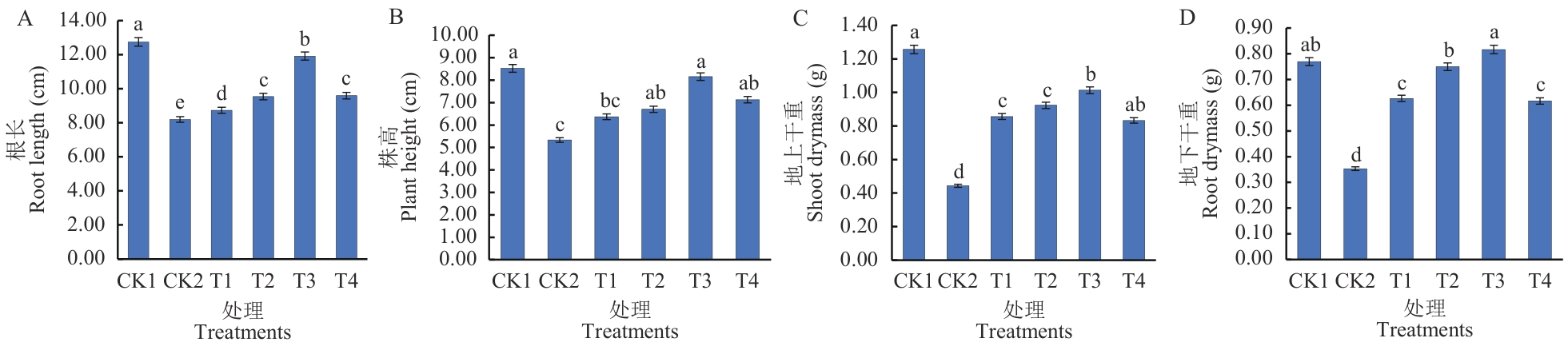
图1 2,4-表油菜素内酯对镉胁迫下胡萝卜幼苗生长指标的影响图中不同小写字母表示在0.05水平差异显著;CK1为清水对照组,下同
Fig. 1 Effects of exogenous 2,4-EBR on growth index of carrot under cadmium stressDifferent lowercase letters indicate significant differences between groups (P<0.05); CK1 was the water control group. The same below

图2 2, 4-表油菜素内酯对镉胁迫下胡萝卜根系活力和硝酸还原酶活性的影响
Fig. 2 Effects of exogenous 2,4-EBR on the root activities and NR activities of carrot under cadmium stress

图3 2,4-表油菜素内酯对镉胁迫下胡萝卜抗氧化酶活性的影响
Fig. 3 Effects of exogenous 2,4-EBR on the antioxidant enzyme activities of carrot under cadmium stress

图4 2,4-表油菜素内酯对镉胁迫下胡萝卜色素含量的影响
Fig. 4 Effects of exogenous 2,4-EBR on the pigment contents of carrot under cadmium stress
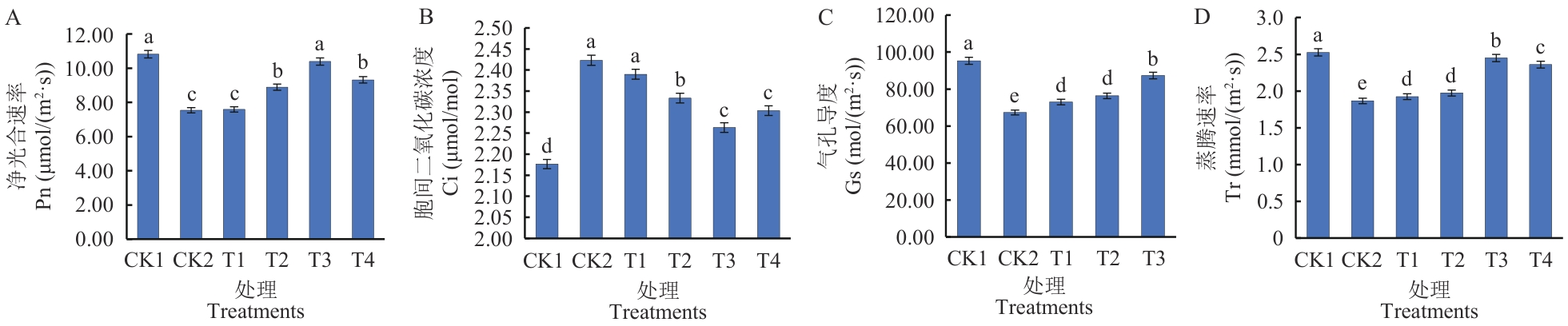
图5 2,4-表油菜素内酯对镉胁迫下胡萝卜光合参数的影响
Fig. 5 Effects of exogenous 2,4-EBR on the photosynthetic parameters of carrot under cadmium stress

图6 2,4-表油菜素内酯对镉胁迫下胡萝卜GSH-PCs代谢途径的影响
Fig. 6 Effects of exogenous 2,4-EBR on the GSH-PCs metabolic pathways of carrot under cadmium stress
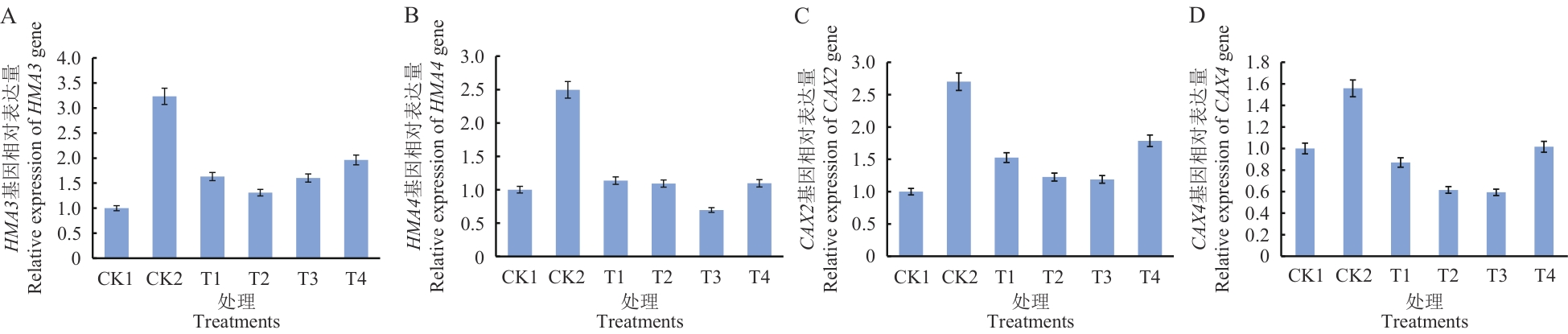
图7 胡萝卜叶片基因相对表达量
Fig. 7 Relative expressions of gene in carrot leaves
| 1 | 谢元, 杨春, 路润峰, 等. 镉污染土壤(农田)原位钝化修复材料研究进展 [J/OL] . 环境科学,2024. DOI: 10.13227/j.hjkx.202404175 . |
| Xie Y, Yang C, Lu RF, et al. Research progress of in-situ passivation remediation materials for cadmium-contaminated soil (farmland) [J/OL] . Environmental Science, 2024. DOI: 10.13227/j.hjkx.202404175 . | |
| 2 | Li YS, Tang H, Hu YX, et al. Enrofloxacin at environmentally relevant concentrations enhances uptake and toxicity of cadmium in the earthworm Eisenia fetida in farm soils [J]. J Hazard Mater, 2016, 308: 312-320. |
| 3 | Méndez-Armenta M, Ríos C. Cadmium neurotoxicity [J]. Environ Toxicol Pharmacol, 2007, 23(3): 350-358. |
| 4 | 余俊琪, 徐一峰, 郭瑶, 等. 沉积物镉污染下苦草与根际微生物群落响应特征 [J]. 水生生物学报, 2023, 47(11): 1787-1797. |
| Yu JQ, Xu YF, Guo Y, et al. Response characteristics of Vallisneria natans and rhizosphere microbial community under sediment-cadmium pollution [J]. Acta Hydrobiol Sin, 2023, 47(11): 1787-1797. | |
| 5 | 李孟盈, 胡龙兴, 向佐湘. 镉胁迫对南方苋种子萌发及幼苗生长和生理的影响 [J]. 草地学报, 2024, 32(3): 754-762. |
| Li MY, Hu LX, Xiang ZX. Effect of cadmium on the germination, growth and physiology of seedlings of Amaranthus australis [J]. Acta Agrestia Sin, 2024, 32(3): 754-762. | |
| 6 | Wang SQ, Zhao HH, Zhao LM, et al. Application of brassinolide alleviates cold stress at the booting stage of rice [J]. J Integr Agric, 2020, 19(4): 975-987. |
| 7 | 王洁, 华一帆, 秦际远, 等. 表油菜素内酯喷施时期对宽幅播种小麦产量和氮素利用率的影响 [J]. 应用生态学报, 2023, 34(1): 99-106. |
| Wang J, Hua YF, Qin JY, et al. Effects of the timing of epibrassinolide spraying on yield and nitrogen use efficiency of wide-belt sowing wheat [J]. Chin J Appl Ecol, 2023, 34(1): 99-106. | |
| 8 | 石欣隆, 薛娴, 杨月琴, 等. 2, 4-表油菜素内酯对低温胁迫下花生幼苗生长及生理特性的影响 [J]. 中国油料作物学报, 2023, 45(2): 341-348. |
| Shi XL, Xue X, Yang YQ, et al. Effects of 2, 4-epibrassinolide on growth and physiological characteristics of peanut seedlings under low temperature stress [J]. Chin J Oil Crop Sci, 2023, 45(2): 341-348. | |
| 9 | 袁博. 外源表油菜素内酯(2, 4-EBL)对镉(Cd)胁迫下番茄(Lycopersicon esculentum mill.)幼苗的缓解效应 [D]. 哈尔滨: 哈尔滨师范大学, 2018. |
| Yuan B. Alleviating effect of exogenous epibrassinolide (2, 4-EBL) on tomato (Lycopersicon esculentum mill.) seedlings under Cd stress [D]. Harbin: Harbin Normal University, 2018. | |
| 10 | Que F, Hou XL, Wang GL, et al. Advances in research on the carrot, an important root vegetable in the Apiaceae family [J]. Hortic Res, 2019, 6: 69. |
| 11 | 张宇光. 胡萝卜杂交品系选育与性状鉴定 [D]. 太谷: 山西农业大学, 2022. |
| Zhang YG. Breeding and character identification of carrot hybrid lines [D]. Taigu: Shanxi Agricultural University, 2022. | |
| 12 | 何凌枫, 陈晨, 邓元杰, 等. 基质配比对胡萝卜根系生长及生理特性的影响 [J]. 中国农学通报, 2023, 39(16): 12-19. |
| He LF, Chen C, Deng YJ, et al. Effects of substrate ratio on root growth and physiological characteristics of carrot [J]. Chin Agric Sci Bull, 2023, 39(16): 12-19. | |
| 13 | 王葆生, 张艳萍, 刘晓蕊, 等. 胡萝卜根腐病病原菌鉴定及品种抗病性评价 [J]. 蔬菜, 2024(4): 54-58. |
| Wang BS, Zhang YP, Liu XR, et al. Identification of the pathogen of root rot and evaluation of disease resistant varieties of carrot [J]. Vegetables, 2024(4): 54-58. | |
| 14 | 王涛, 黄语燕, 陈永快, 等. 镉胁迫对生菜生长、生理特性及镉富集转运特征的影响 [J]. 西北农林科技大学学报: 自然科学版, 2024, 52(7): 115-124. |
| Wang T, Huang YY, Chen YK, et al. Effects of cadmium stress on growth, physiological characteristics and cadmium enrichment and transport of lettuce [J]. J Northwest A&F Univ Nat Sci Ed, 2024, 52(7): 115-124. | |
| 15 | 王学奎. 植物生理生化实验原理和技术 [M]. 2版. 北京: 高等教育出版社, 2006. |
| Wang XK. Principles and techniques of plant physiological biochemical experiment [M]. 2nd ed. Beijing: Higher Education Press, 2006. | |
| 16 | 刘萍, 李明军. 植物生理学实验 [M]. 2版. 北京: 科学出版社, 2016. |
| Liu P, Li MJ. Plant physiology experiment [M]. 2nd ed. Beijing: Science Press, 2016. | |
| 17 | 郝建军, 康宗利, 于洋. 植物生理学实验技术[M]. 北京:化学工业出版社, 2007. |
| Hao JJ, Kang ZL, Yu Y. Plant Physiology Experiment Technology[M]. Beijing: Chemical Industry Press, 2007. | |
| 18 | 王国帅, 赵嘉诺, 魏昊泰, 等. 硅对盐胁迫下西葫芦幼苗水分代谢及光合特性的影响 [J]. 西北植物学报, 2024, 44(5): 681-690. |
| Wang GS, Zhao JN, Wei HT, et al. Effects of silicon on water metabolism and photosynthetic characteristics of Cucurbita pepo L. seedlings under salt stress [J]. Acta Bot Boreali Occidentalia Sin, 2024, 44(5): 681-690. | |
| 19 | 陈晨, 陈虹, 倪铭, 等. 油菜素内酯调控植物生长发育的研究进展 [J]. 林业科学, 2022, 58(7): 144-155. |
| Chen C, Chen H, Ni M, et al. Research progress of brassinolide in regulating plant growth and development [J]. Sci Silvae Sin, 2022, 58(7): 144-155. | |
| 20 | Fan TT, Long T, Lu YY, et al. Meta-analysis of Cd input-output fluxes in agricultural soil [J]. Chemosphere, 2022, 303: 134974. |
| 21 | 陈镔, 谭淑端, 董方旭, 等. 重金属对植物的毒害及植物对其毒害的解毒机制 [J]. 江苏农业科学, 2019, 47(4): 34-38. |
| Chen B, Tan SD Dong FX, et al. Toxic effects of heavy metals on plants and detoxification mechanism of plants [J]. Jiangsu Agric Sci, 2019, 47(4): 34-38. | |
| 22 | 李晓科, 武玉珍, 张义贤. 2, 4-表油菜素内酯对镉胁迫下大麦幼苗生长的影响 [J]. 福建农业学报, 2018, 33(12): 1251-1256. |
| Li XK, Wu YZ, Zhang YX. Effect of 2, 4-brassinosteroid on growth of Hordeum vulgare seedlings under Cd-stress [J]. Fujian J Agric Sci, 2018, 33(12): 1251-1256. | |
| 23 | 冯文静. 24-表油菜素内酯对小麦生长及镉吸收、转运和积累的影响 [D]. 郑州: 河南农业大学, 2022. |
| Feng WJ. Effects of 24- epibrassinolide on wheat growth and cadmium absorption, transport and accumulation [D]. Zhengzhou: Henan Agricultural University, 2022. | |
| 24 | 关昕昕, 严重玲, 刘景春, 等. 钙对镉胁迫下小白菜生理特性的影响 [J]. 厦门大学学报: 自然科学版, 2011, 50(1): 132-137. |
| Guan XX, Yan CL, Liu JC, et al. Effect of calcium on physiological property of Brassica chinensis L. under cadmium stress [J]. J Xiamen Univ Nat Sci, 2011, 50(1): 132-137. | |
| 25 | 闫雷, 孙小贺, 李威, 等. 外源2, 4-表油菜素内酯对镉胁迫下黄瓜幼苗生长及光合生理特性的影响 [J]. 东北农业大学学报, 2022, 53(6): 10-19. |
| Yan L, Sun XH, Li W, et al. Effects of exogenous 2, 4-epibrassinolide on growth and photosynthetic physiological characteristics of cucumber seedlings under cadmium stress [J]. J Northeast Agric Univ, 2022, 53(6): 10-19. | |
| 26 | 吴月莹, 邓思情, 刘松芹, 等. 镉胁迫对不同品种玉米幼苗生长及生理特性的影响 [J]. 湖南农业大学学报: 自然科学版, 2023, 49(5): 509-515. |
| Wu YY, Deng SQ, Liu SQ, et al. Effects of cadmium stress on the growth and physiological characteristics of maize seedlings from different varieties [J]. J Hunan Agric Univ Nat Sci, 2023, 49(5): 509-515. | |
| 27 | 王芳, 彭云玲, 方永丰, 等. 外源油菜素内酯对玉米幼苗镉毒害耐受性的影响 [J]. 干旱地区农业研究, 2018, 36(5): 21-27. |
| Wang F, Peng YL, Fang YF, et al. Effects of exogenous brassinolide on tolerance to cadmium toxicity in maize seedlings [J]. Agric Res Arid Areas, 2018, 36(5): 21-27. | |
| 28 | 王金香, 张阿良, 秦敏, 等. 镉胁迫对玉米幼苗光合特性及活性氧代谢的影响 [J]. 天津农业科学, 2023, 29(1): 1-6. |
| Wang JX, Zhang AL, Qin M, et al. Effects of cadmium stress on photosynthetic characteristics and active oxygen metabolism of maize seedling [J]. Tianjin Agric Sci, 2023, 29(1): 1-6. | |
| 29 | 钟文, 张珊, 王传方, 等. 油菜素内酯调控植物生长发育的研究进展 [J]. 山东农业科学, 2024, 56(8): 173-180. |
| Zhong W, Zhang S, Wang CF, et al. Research progress on regulatory roles of brassinosteroids in plant growth and development [J]. Shandong Agric Sci, 2024, 56(8): 173-180. | |
| 30 | 鲜靖苹. 外源MeJA对镉胁迫下波斯菊生长及抗氧化系统的影响 [J]. 西北植物学报, 2019, 39(9): 1627-1635. |
| Xian JP. Effect of exogenous methyl jasmonate on growth and antioxidant system of Coreopsis under cadmium stress [J]. Acta Bot Boreali Occidentalia Sin, 2019, 39(9): 1627-1635. | |
| 31 | 孙舒畅. 褪黑素在番茄镉胁迫抗性中的功能研究 [D]. 杭州: 浙江大学, 2020. |
| Sun SC. Study on the function of melatonin in the resistance of tomato to cadmium stress [D]. Hangzhou: Zhejiang University, 2020. | |
| 32 | Lu CN, Zhang LX, Tang Z, et al. Producing cadmium-free indica rice by overexpressing OsHMA3 [J]. Environ Int, 2019, 126: 619-626. |
| 33 | 陈江坡. 拟南芥Ca2+/H+反向转运体家族(CAXs)相互作用蛋白的筛选及解析 [D]. 哈尔滨: 东北林业大学, 2016. |
| Chen JP. Screening and analysis of interacting proteins of Arabidopsis thaliana Ca2+/H+ reverse transporter family (CAXs) [D]. Harbin: Northeast Forestry University, 2016. |
| [1] | 彭绍智, 王登科, 张祥, 戴雄泽, 徐昊, 邹学校. 辣椒CaFD1基因克隆、表达特征及功能验证[J]. 生物技术通报, 2025, 41(5): 153-164. |
| [2] | 马利花, 侯梦娟, 朱新霞. 陆地棉GhNFD4在棉花干旱响应中的功能[J]. 生物技术通报, 2025, 41(3): 104-111. |
| [3] | 王斌, 王玉昆, 肖艳辉. 丁香罗勒(Ocimum gratissimum)叶片响应镉胁迫的比较转录组学分析[J]. 生物技术通报, 2025, 41(3): 255-270. |
| [4] | 黄颖, 遇文婧, 刘雪峰, 刁桂萍. 山新杨谷胱甘肽转移酶基因的生物信息学与表达模式分析[J]. 生物技术通报, 2025, 41(2): 248-256. |
| [5] | 张曼玉, 董嘉诚, 苟福凡, 弓朝晖, 刘倩, 孙文良, 孔臻, 郝捷, 王敏, 田朝光. 嗜热毁丝霉果胶酯酶MtCE12-1的克隆表达及其酶学性质和应用研究[J]. 生物技术通报, 2024, 40(9): 291-300. |
| [6] | 王茜, 周家燕, 王倩, 邓玉萍, 张敏慧, 陈静, 杨军, 邹建. 向日葵YABBY基因家族鉴定及表达分析[J]. 生物技术通报, 2024, 40(8): 199-211. |
| [7] | 杨巍, 赵丽芬, 唐兵, 周麟笔, 杨娟, 莫传园, 张宝会, 李飞, 阮松林, 邓英. 芥菜SRO基因家族全基因组鉴定与表达分析[J]. 生物技术通报, 2024, 40(8): 129-141. |
| [8] | 胡雅丹, 伍国强, 刘晨, 魏明. MYB转录因子在调控植物响应逆境胁迫中的作用[J]. 生物技术通报, 2024, 40(6): 5-22. |
| [9] | 秦健, 李振月, 何浪, 李俊玲, 张昊, 杜荣. 肌源性细胞分化的单细胞转录谱变化及细胞间通讯分析[J]. 生物技术通报, 2024, 40(6): 330-342. |
| [10] | 孔小平, 陈利文, 刘思思, 严湘萍. 胡萝卜抽薹相关性状全基因组关联分析[J]. 生物技术通报, 2024, 40(5): 120-130. |
| [11] | 吴迪, 游小凤, 郑亦铮, 林楠, 张燕燕, 魏艺聪. 草珊瑚中类胡萝卜素合成的内源激素调控机制分析[J]. 生物技术通报, 2024, 40(5): 203-214. |
| [12] | 陈春林, 李白雪, 李金玲, 杜清洁, 李猛, 肖怀娟. 甜瓜CmEPF基因家族的鉴定及表达分析[J]. 生物技术通报, 2024, 40(4): 130-138. |
| [13] | 陈强, 黄馨慧, 张峥, 张冲, 柳叶飞. 褪黑素对薄皮甜瓜采后软化和乙烯合成的影响[J]. 生物技术通报, 2024, 40(4): 139-147. |
| [14] | 张玉, 石磊, 巩檑, 聂峰杰, 杨江伟, 刘璇, 杨文静, 张国辉, 颉瑞霞, 张丽. 马铃薯WOX基因家族的鉴定及在离体再生和非生物胁迫中的表达分析[J]. 生物技术通报, 2024, 40(3): 170-180. |
| [15] | 吴星星, 洪海波, 甘志承, 李瑞宁, 黄先忠. 辣椒CaPI的克隆与功能分析[J]. 生物技术通报, 2024, 40(3): 193-201. |
| 阅读次数 | ||||||
|
全文 |
|
|||||
|
摘要 |
|
|||||
