







生物技术通报 ›› 2026, Vol. 42 ›› Issue (4): 38-52.doi: 10.13560/j.cnki.biotech.bull.1985.2025-0911
何俊杰( ), 何阳, 禹唯, 关桦楠()
收稿日期:2025-08-23
出版日期:2026-04-26
发布日期:2026-04-30
通讯作者:
关桦楠,男,博士,教授,研究方向 :农产品危害物检测分析;E-mail: guanhn@just.edu.cn作者简介:何俊杰,男,研究方向 :农产品生物传感分析;E-mail: 222241821323@stu.just.edu.cn
基金资助:
HE Jun-jie(), HE Yang, YU Wei, GUAN Hua-nan()
Received:2025-08-23
Published:2026-04-26
Online:2026-04-30
摘要:
柔性可穿戴生物传感器兼具高灵敏度、稳定性、柔韧性与可拉伸性,可与作物表皮共形贴合,实时将生理信号转换为电信号,实现作物生理变化的动态监测。近些年来,柔性可穿戴生物传感器在农作物健康监测与胁迫预警领域发展迅速,为生长状态、病虫害及非生物胁迫的实时诊断提供了新范式。然而,其大规模应用仍受限于传感器的长期稳定贴附性、环境耐受性、多信号集成能力及成本效益等关键因素。本文综述了植物可穿戴柔性传感器在农作物健康监测与胁迫预警领域的最新研究进展,聚焦其核心特性、主要分类及其传感性能,并从病虫害早期识别、水分状况、代谢变化、农药残留及其形态应变等多维度剖析了柔性可穿戴传感器在农业生产技术转化中的核心瓶颈,展望其与人工智能、纳米技术及先进材料交叉融合的未来路径,为智慧农业背景下作物健康管理的理论突破与技术落地提供重要参考。
何俊杰, 何阳, 禹唯, 关桦楠. 柔性可穿戴生物传感器在农作物胁迫及病虫害预警中的研究进展[J]. 生物技术通报, 2026, 42(4): 38-52.
HE Jun-jie, HE Yang, YU Wei, GUAN Hua-nan. Advances in Flexible Wearable Biosensors for Early Warning of Crop Stress and Disease-pest Infestation: A Comprehensive Review[J]. Biotechnology Bulletin, 2026, 42(4): 38-52.
传感器构成 Sensor composition | 传感对象 Sensing object | 检测对象 Detecting object | 检测指标 Testing index | 检测范围 Detection range | 响应时间 Response time | 传感方式 Detecting means | 传感器安装部位 Sensor installation site | 参考文献 Reference |
|---|---|---|---|---|---|---|---|---|
| 聚酰亚胺、丝网印刷银、激光诱导石墨烯、ZnIn2S4(ZIS)纳米片 | 瓜栗 | 蒸腾作用 | 光照、水分 | 相对湿度30%-90% | <4 ms | 非接触式 | 植物叶片下表面 | [ |
| 碳化丝绸乔其纱(CSG) | 番茄、西瓜、大豆、菜豆 | 蒸腾作用 | 水分 | 6 cm传感器相对湿度响应范围≥0.17%、12 cm传感器相对湿度响应范围≥0.08%、30 cm传感器相对湿度响应范围≥0.03% | <70 ms | 非侵入式 | 茎与果实 | [ |
| PI、激光诱导石墨烯(LIG)、氧化石墨烯(GO) | 绿萝 | 蒸腾作用 | 水分 | 相对湿度响应范围10%-90% | 15.8 s | 非侵入式 | 植物叶片的下表面 | [ |
| 聚酰亚胺、氧化石墨烯 | 玉米 | 蒸腾作用、光合作用 | 水分、光照 | 相对湿度响应范围11%-95% | 20.3 s | 非侵入式 | 植物叶片的下表面 | [ |
| COFMOP-TAPB、COFPDA-TAPPy、COFBPDA-TAPPy、MXene、银纳米线、聚二甲基硅氧烷(PDMS) | 番茄 | 叶片表面湿度 | 微环境 | 相对湿度响应范围10%-98% | 5 s | 非侵入式 | 茎、植物叶片的下表面 | [ |
| 激光诱导石墨烯(LIG)、MXene、二硫化钼纳米片、丝网印刷电极SPE | 草莓 | 没食子酸 | 植物代谢物 | ≥625 nmol/L | 0.5 s | 侵入式 | 叶片 | [ |
| 激光诱导石墨烯(LIG)、银电极、聚酰亚胺(PI)基底 | 鳄梨 | 水杨酸 | 植物代谢物 | ≥8 200 nmol/L | 20 s | 非侵入式 | 叶片 | [ |
| MIL-88B(Fe)、MIL-53(Fe)、DUT-8(Ni)、Cd(PNMI)、Co(5-NH2-bdc)(bpy)、[Cu2(bdc)2(bpy)]n、[Cu2(bdc)2(bpe)]n | 番茄 | (E)-2-己烯醇、1-己醛、(E)-2-己烯醛、水杨酸甲酯、苯甲醛、4-乙基愈创木酚 | 挥发性有机化合物 | 未提及 | 3 600 s | 非侵入式 | 无接触 | [ |
| Au@AgNWs、多壁碳纳米管(MWCNTs)、疏水溶胶-凝胶层、PDMS | 番茄 | 叶醛类、酮类和醛类 | 挥发性有机化合物、温度、湿度 | ≥100 ppm | 120 s | 非侵入式 | 叶片下表皮 | [ |
| 氧化还原石墨烯(rGO)、AgNW、ITP [碘硫酚]、BPT [溴硫酚]、CTP [氯硫酚]和FTP [氟硫酚] | 番茄 | (E)-2-己烯醛和2-苯乙醇、(Z)-3-己烯醛、1-己烯醛、(E)-2-己烯醇和(E)-2-乙酸己烯酯、茉莉酸甲酯和水杨酸甲酯、苯甲醛、4-乙基愈创木酚、4-乙基苯酚、吲哚和苯并噻唑 | 挥发性有机化合物 | ITP-AuNP@rGO:≥0.17 ppm、 BTP-AuNP@rGO:≥0.55 ppm CTP-AuNP@rGO:≥2.0 ppm NTP-AuNP@rGO:≥3.9 ppm | 100 s | 非侵入式 | 叶片或茎 | [ |
| nanoMIP微丝传感器、nanoMIP纤维丝传感器 | 番茄 | D-葡萄糖 | 代谢产物 | nanoMIP微丝传感器:≥79.4 nmol/L nanoMIP纤维丝传感器:≥251 000 nmol/L | 300 s | 侵入式 | 茎 | [ |
| 激光诱导石墨烯(LIG)、金纳米颗粒(AuNPs)和黑磷纳米片(BP) | 草莓、苹果 | 槲皮素 | 代谢产物 | ≥650 nmol/L | 未提及 | 侵入式 | 叶片、果实表皮 | [ |
| 碳纳米管纳米带(IONCs-CNR)、明胶水凝胶 | 芝麻、生菜、番茄、苹果 | N-(1,3-二甲基丁基)-N'-苯基对苯二胺(6-PPD) | 污染物 | ≥2.93 nmol/L | 1 800 s | 非侵入式 | 叶片、果实 | [ |
| 醋酸纤维素、丙酮、水 | 番茄、生菜 | 多菌灵、百草枯 | 农药残留 | 多菌灵:≥54.9 nmol/L 百草枯:≥19.8 nmol/L | 50 s | 非侵入式 | 表皮 | [ |
| 聚酰亚胺(PI)、PDMS、激光诱导石墨烯-金纳米颗粒(LIG-Au) | 绿萝、生菜 | 甲基对硫磷 | 农药残留 | ≥0.646 nmol/L | 38.65 s | 非侵入式 | 叶片 | [ |
表1 不同类别的农作物柔性可穿戴生物传感器的性能和功效
Table 1 Performance and efficacy of different types of crop flexible wearable biosensors
传感器构成 Sensor composition | 传感对象 Sensing object | 检测对象 Detecting object | 检测指标 Testing index | 检测范围 Detection range | 响应时间 Response time | 传感方式 Detecting means | 传感器安装部位 Sensor installation site | 参考文献 Reference |
|---|---|---|---|---|---|---|---|---|
| 聚酰亚胺、丝网印刷银、激光诱导石墨烯、ZnIn2S4(ZIS)纳米片 | 瓜栗 | 蒸腾作用 | 光照、水分 | 相对湿度30%-90% | <4 ms | 非接触式 | 植物叶片下表面 | [ |
| 碳化丝绸乔其纱(CSG) | 番茄、西瓜、大豆、菜豆 | 蒸腾作用 | 水分 | 6 cm传感器相对湿度响应范围≥0.17%、12 cm传感器相对湿度响应范围≥0.08%、30 cm传感器相对湿度响应范围≥0.03% | <70 ms | 非侵入式 | 茎与果实 | [ |
| PI、激光诱导石墨烯(LIG)、氧化石墨烯(GO) | 绿萝 | 蒸腾作用 | 水分 | 相对湿度响应范围10%-90% | 15.8 s | 非侵入式 | 植物叶片的下表面 | [ |
| 聚酰亚胺、氧化石墨烯 | 玉米 | 蒸腾作用、光合作用 | 水分、光照 | 相对湿度响应范围11%-95% | 20.3 s | 非侵入式 | 植物叶片的下表面 | [ |
| COFMOP-TAPB、COFPDA-TAPPy、COFBPDA-TAPPy、MXene、银纳米线、聚二甲基硅氧烷(PDMS) | 番茄 | 叶片表面湿度 | 微环境 | 相对湿度响应范围10%-98% | 5 s | 非侵入式 | 茎、植物叶片的下表面 | [ |
| 激光诱导石墨烯(LIG)、MXene、二硫化钼纳米片、丝网印刷电极SPE | 草莓 | 没食子酸 | 植物代谢物 | ≥625 nmol/L | 0.5 s | 侵入式 | 叶片 | [ |
| 激光诱导石墨烯(LIG)、银电极、聚酰亚胺(PI)基底 | 鳄梨 | 水杨酸 | 植物代谢物 | ≥8 200 nmol/L | 20 s | 非侵入式 | 叶片 | [ |
| MIL-88B(Fe)、MIL-53(Fe)、DUT-8(Ni)、Cd(PNMI)、Co(5-NH2-bdc)(bpy)、[Cu2(bdc)2(bpy)]n、[Cu2(bdc)2(bpe)]n | 番茄 | (E)-2-己烯醇、1-己醛、(E)-2-己烯醛、水杨酸甲酯、苯甲醛、4-乙基愈创木酚 | 挥发性有机化合物 | 未提及 | 3 600 s | 非侵入式 | 无接触 | [ |
| Au@AgNWs、多壁碳纳米管(MWCNTs)、疏水溶胶-凝胶层、PDMS | 番茄 | 叶醛类、酮类和醛类 | 挥发性有机化合物、温度、湿度 | ≥100 ppm | 120 s | 非侵入式 | 叶片下表皮 | [ |
| 氧化还原石墨烯(rGO)、AgNW、ITP [碘硫酚]、BPT [溴硫酚]、CTP [氯硫酚]和FTP [氟硫酚] | 番茄 | (E)-2-己烯醛和2-苯乙醇、(Z)-3-己烯醛、1-己烯醛、(E)-2-己烯醇和(E)-2-乙酸己烯酯、茉莉酸甲酯和水杨酸甲酯、苯甲醛、4-乙基愈创木酚、4-乙基苯酚、吲哚和苯并噻唑 | 挥发性有机化合物 | ITP-AuNP@rGO:≥0.17 ppm、 BTP-AuNP@rGO:≥0.55 ppm CTP-AuNP@rGO:≥2.0 ppm NTP-AuNP@rGO:≥3.9 ppm | 100 s | 非侵入式 | 叶片或茎 | [ |
| nanoMIP微丝传感器、nanoMIP纤维丝传感器 | 番茄 | D-葡萄糖 | 代谢产物 | nanoMIP微丝传感器:≥79.4 nmol/L nanoMIP纤维丝传感器:≥251 000 nmol/L | 300 s | 侵入式 | 茎 | [ |
| 激光诱导石墨烯(LIG)、金纳米颗粒(AuNPs)和黑磷纳米片(BP) | 草莓、苹果 | 槲皮素 | 代谢产物 | ≥650 nmol/L | 未提及 | 侵入式 | 叶片、果实表皮 | [ |
| 碳纳米管纳米带(IONCs-CNR)、明胶水凝胶 | 芝麻、生菜、番茄、苹果 | N-(1,3-二甲基丁基)-N'-苯基对苯二胺(6-PPD) | 污染物 | ≥2.93 nmol/L | 1 800 s | 非侵入式 | 叶片、果实 | [ |
| 醋酸纤维素、丙酮、水 | 番茄、生菜 | 多菌灵、百草枯 | 农药残留 | 多菌灵:≥54.9 nmol/L 百草枯:≥19.8 nmol/L | 50 s | 非侵入式 | 表皮 | [ |
| 聚酰亚胺(PI)、PDMS、激光诱导石墨烯-金纳米颗粒(LIG-Au) | 绿萝、生菜 | 甲基对硫磷 | 农药残留 | ≥0.646 nmol/L | 38.65 s | 非侵入式 | 叶片 | [ |
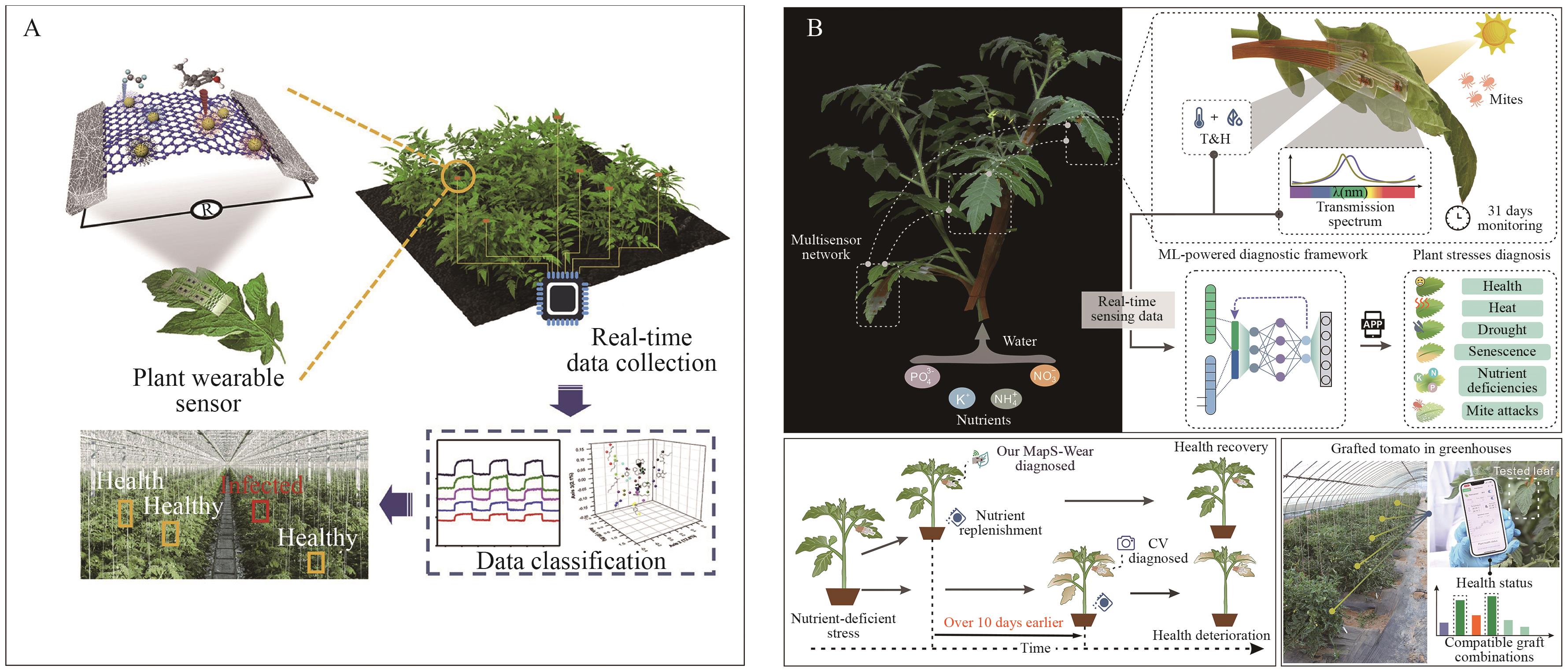
图1 可穿戴化学电阻传感器(A)和MapS-Wear系统(B)
Fig. 1 Wearable chemical resistance sensor (A) and MapS-Wear system(B)
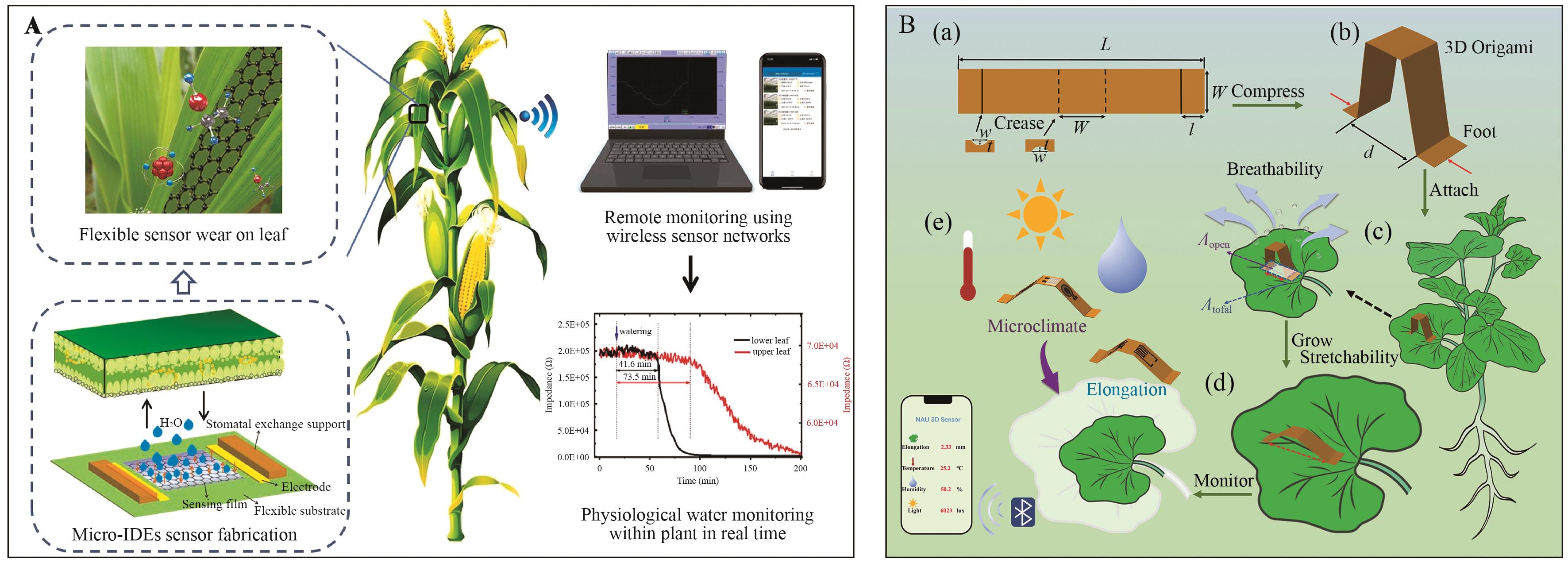
图2 氧化石墨烯可穿戴传感器(A)和折纸启发的3D高拉伸透气可穿戴传感器(B)(a):二维平面基底。(b):三维折纸结构。(c):3D传感器穿戴在植物器官(叶片)上。(d):随植物生长拉伸的三维传感器。(e):集成传感模块的3D传感器用于原位和在线监测植物生长(伸长)和微气候(温度、湿度、光照)
Fig. 2 Graphene oxide wearable sensor (A) and Origami-inspired 3D high stretch breathable wearable sensor (B)(a): 2D planar substrate. (b): 3D origami structure. (c): 3D sensor worn on a plant organ (leaf). (d): 3D sensor stretched with plant growth. (e): 3D sensor with integrated sensing modules for in-situ and online monitoring of plant growth (elongation) and microclimate (temperature, humidity, and light)
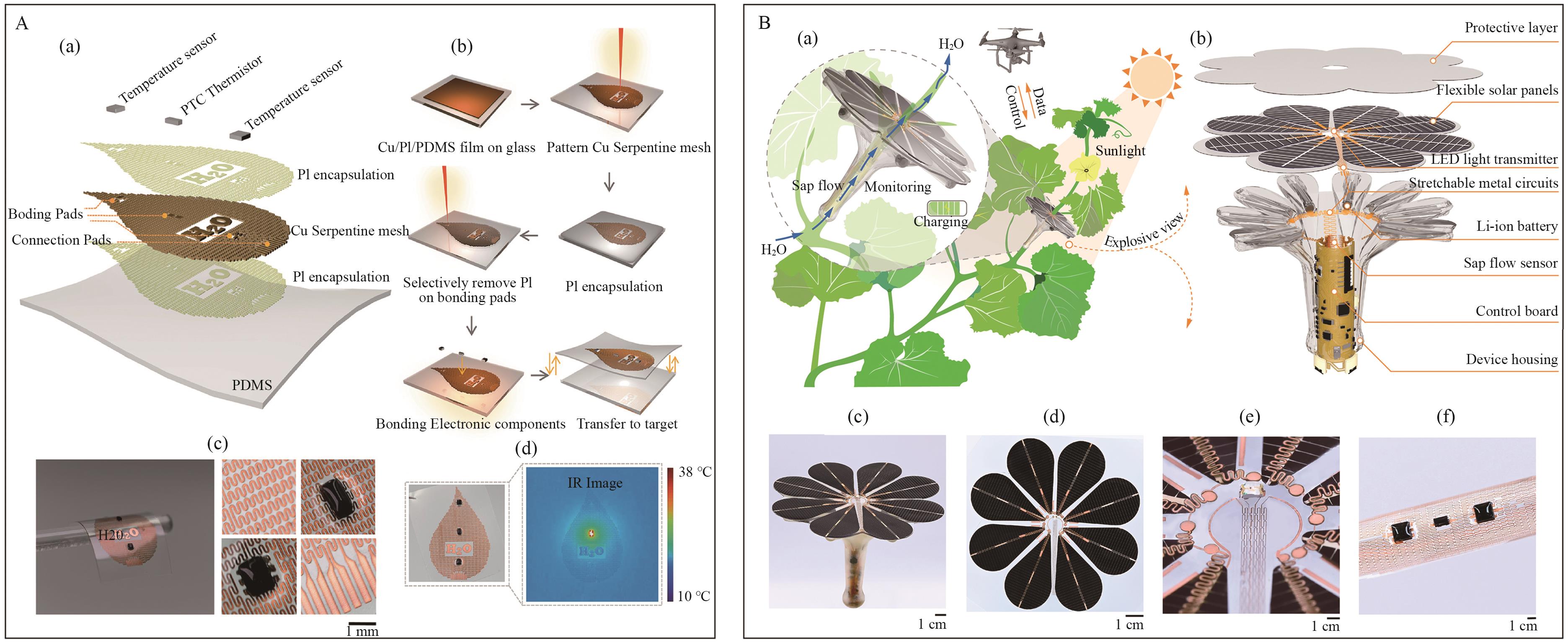
图3 用于树干液流分析的植物穿戴式传感器设计(A)和植物可穿戴自供能传感器(B)A(a):装置的立体装配图;A(b):植物可穿戴式树液流量传感器的制造方法;A(c):装置的光学图像,放大图像展示了蛇形互连、板载温度传感器和热敏电阻;A(d):热敏电阻工作120 s时热像仪通过颜色和对比度增强突出显示的温度空间分布。B(a):传感探头工作原理的示意图;B(b):传感探头集成在一个3D打印的柔性花形外壳内,设计包括用于高效太阳能收集和存储的可折叠的硅太阳能电池板、微型锂离子电池、一个能够监测树液流量的柔性电子传感器、一个用于数据传输的LED光发射器以及一个紧凑的FPCB控制板;B(c):传感探头外观的物理图像;B(d):在光学成像下捕获探针的可折叠太阳能电池板;B(e):光学图像显示将LED光发射器集成到太阳能电池板上,通过可拉伸的蛇形铜导电轨道相互连接;B(f):经过放大的图像中柔性液流传感器的细节
Fig. 3 Design of the plant-wearable sensor for sap flow analysis (A) and plant-wearable self-powered sensor (B)A(a): Exploded view illustration of the device.A(b): Fabrication approaches of the plant-wearable sap flow sensor. A(c): Optical images of the device, with enlarged images showing the serpentine interconnects and on-boarded temperature sensor and thermistor. A(d): IR thermography with color and contrast enhancement highlights the spatial distribution of temperature when the thermistor operates for 120 s. B(a): Schematic illustration depicting the working principle of the sensing probe. B(b): Design of the sensing probe, comprising a foldable silicon solar panel and miniature Li-ion batteries for efficient solar energy harvesting and storage. In addition, the probe includes a flexible electronic sensor capable of monitoring plant sap flow, an LED light transmitter for data transmission, and a compact FPCB control board. All these components are integrated within a 3D printed soft flower-shaped housing. B(c): Physical images of the appearance of the sensing probe. B(d): Foldable solar panel of the probe captured under optical imaging. B(e): Optical image exhibiting the integration of the LED light transmitter onto the solar panel, interconnected by stretchable serpentine copper conductive tracks. B(f): Enlarged image highlighting the flexible sap flow sensor in detail
| [1] | Chen S, Gong BL. Response and adaptation of agriculture to climate change: Evidence from China [J]. J Dev Econ, 2021, 148: 102557. |
| [2] | Zhu XH, Zhang Y, Zhu YY, et al. The shift to plant-based dietary patterns in China would have significant effects on cultivated land resources [J]. Sci Bull, 2024, 69(6): 737-740. |
| [3] | Aygun O, Aygun I, Kaya M. Using aspect-based sentiment analysis to evaluate the global effects of the food security crisis during the Russia-Ukraine war [J]. Glob Food Secur, 2025, 44: 100828. |
| [4] | Yin J, Su Y, Fang XQ. Relationships between temperature change and grain harvest fluctuations in China from 210 BC to 1910 AD [J]. Quat Int, 2015, 355: 153-163. |
| [5] | Tian LX, Han MM, Liang KL, et al. Profiling of farmland microorganisms in maize and minor-grain crops under extreme drought conditions [J]. Appl Soil Ecol, 2024, 204: 105743. |
| [6] | Huang C, Gao Y, Qin AZ, et al. Effects of waterlogging at different stages and durations on maize growth and grain yields [J]. Agric Water Manag, 2022, 261: 107334. |
| [7] | Rao AP, Pradhan AK, Patel J. Transfer of Salmonella enterica, Escherichia coli O157: H7 and Listeria monocytogenes to microgreens and soil from contaminated seeds [J]. J Agric Food Res, 2025, 21: 101761. |
| [8] | Li L, Yin SJ, Kang SS, et al. Comprehensive effects of thiamethoxam from contaminated soil on lettuce growth and metabolism [J]. Environ Pollut, 2024, 343: 123186. |
| [9] | Sahu R, Tripathi P. An intelligent forecasting system in Internet of Agriculture Things sensor network [J]. Ad Hoc Netw, 2025, 169: 103752. |
| [10] | Rajak P, Ganguly A, Adhikary S, et al. Internet of things and smart sensors in agriculture: Scopes and challenges [J]. J Agric Food Res, 2023, 14: 100776. |
| [11] | Hu GS, Zou JH. Tea leaf disease detection using UAV remote sensing images based on low-light aware and spatial reconstruction [J]. Appl Soft Comput, 2025, 185: 114034. |
| [12] | Marins-Gonçalves L, Martins Ferreira M, Rocha Guidi L, et al. Is chemical analysis suitable for detecting mycotoxins in agricultural commodities and foodstuffs? [J]. Talanta, 2023, 265: 124782. |
| [13] | Wang ZH, Wang QY, Li JQ, et al. Non-destructive detection of soluble solids content in Shawo radish with spatial spectra extraction method based on the full transmission near-infrared spectroscopy [J]. J Food Compos Anal, 2025, 148: 108364. |
| [14] | Hosseinzadeh Fakhr M, Lopez Carrasco I, Belyaev D, et al. Recent advances in wearable electrochemical biosensors towards technological and material aspects [J]. Biosens Bioelectron X, 2024, 19: 100503. |
| [15] | Xu WX, Chen L, Hu X, et al. Botanic signal monitor: advanced wearable sensor for plant health analysis [J]. Adv Funct Mater, 2024, 34(51): 2410544. |
| [16] | Koezuka H, Tsumura A, Ando T. Field-effect transistor with polythiophene thin film [J]. Synth Met, 1987, 18(1/2/3): 699-704. |
| [17] | Sekitani T, Yokota T, Zschieschang U, et al. Organic nonvolatile memory transistors for flexible sensor arrays [J]. Science, 2009, 326(5959): 1516-1519. |
| [18] | Gao FP, Liu CX, Zhang LC, et al. Wearable and flexible electrochemical sensors for sweat analysis: a review [J]. Microsyst Nanoeng, 2023, 9: 1. |
| [19] | Bu F, Liu K, Liang ZH, et al. From micro-motion to joint monitoring: Fiber-based strain sensors with unmatched sensitivity for flexible wearables [J]. Chem Eng J, 2025, 524: 169119. |
| [20] | Li HG, Liu HZ, Sun MZ, et al. 3D interfacing between soft electronic tools and complex biological tissues [J]. Adv Mater, 2021, 33(3): 2004425. |
| [21] | Zeng H, Ma HH, Xu LN, et al. Tough, highly conductive and frost-resistant chitosan based hydrogel for flexible sensor [J]. Int J Biol Macromol, 2025, 297: 139847. |
| [22] | He T, Wang JG, Hu DH, et al. Epidermal electronic-tattoo for plant immune response monitoring [J]. Nat Commun, 2025, 16: 3244. |
| [23] | Wang LN, Chen WN, Li H, et al. Ultrasoft, anti-dehydrated, and highly stretchable carboxymethylcellulose-based organohydrogel strain sensors for non-invasive real-time plant growth monitoring [J]. Carbohydr Polym, 2025, 364: 123753. |
| [24] | Zhao DK, Wang HP, Chen SY, et al. Phytomelatonin: an emerging regulator of plant biotic stress resistance [J]. Trends Plant Sci, 2021, 26(1): 70-82. |
| [25] | Waadt R, Seller CA, Hsu PK, et al. Plant hormone regulation of abiotic stress responses [J]. Nat Rev Mol Cell Biol, 2022, 23(10): 680-694. |
| [26] | Yan QM, Cao Y, Chen QH, et al. Inspired by plant body frameworks bionics: Fabrication of self-healing polyvinyl alcohol/cellulose nanocrystals composite hydrogels reinforced by polyurethane sponges for flexible supercapacitors [J]. Int J Biol Macromol, 2024, 283: 137795. |
| [27] | Luo YF, Li WL, Lin QY, et al. A morphable ionic electrode based on thermogel for non-invasive hairy plant electrophysiology [J]. Adv Mater, 2021, 33(14): 2007848. |
| [28] | Lan LY, Le XH, Dong HY, et al. One-step and large-scale fabrication of flexible and wearable humidity sensor based on laser-induced graphene for real-time tracking of plant transpiration at bio-interface [J]. Biosens Bioelectron, 2020, 165: 112360. |
| [29] | Wang SQ, Edupulapati B, Hagel JM, et al. Highly stretchable, robust, and resilient wearable electronics for remote, autonomous plant growth monitoring [J]. Device, 2024, 2(4): 100322. |
| [30] | Lee G, Hossain O, Jamalzadegan S, et al. Abaxial leaf surface-mounted multimodal wearable sensor for continuous plant physiology monitoring [J]. Sci Adv, 2023, 9(15): eade2232. |
| [31] | Wang S, Chai YF, Sa HW, et al. Sunflower-like self-sustainable plant-wearable sensing probe [J]. Sci Adv, 2024, 10(49): eads1136. |
| [32] | Steeneken PG, Kaiser E, Verbiest GJ, et al. Sensors in agriculture: towards an Internet of plants [J]. Nat Rev Meth Primers, 2023, 3: 60. |
| [33] | Ganapathysubramanian B, Sarkar S, Singh A, et al. Digital twins for the plant sciences [J]. Trends Plant Sci, 2025, 30(5): 576-577. |
| [34] | Pasala R, Pandey BB. Plant phenomics: High-throughput technology for accelerating genomics [J]. J Biosci, 2020, 45(1): 111. |
| [35] | Chai YF, Chen CY, Luo X, et al. Cohabiting plant-wearable sensor in situ monitors water transport in plant [J]. Adv Sci, 2021, 8(10): 2003642. |
| [36] | Lu YY, Xu KC, Zhang LS, et al. Multimodal plant healthcare flexible sensor system [J]. ACS Nano, 2020, 14(9): 10966-10975. |
| [37] | Huang YY, Huang Y, Gao MY, et al. Wearable plant sensors based on nanometer-thick Ag films on polyethylene glycol terephthalate substrates for real-time monitoring of plant growth [J]. ACS Appl Nano Mater, 2023, 6(20): 19010-19017. |
| [38] | Sun T, Lu CZ, Shi Z, et al. PlantRing: a high-throughput wearable sensor system for decoding plant growth, water relations, and innovating irrigation [J]. Plant Commun, 2025, 6(5): 101322. |
| [39] | Teixeira SC, Gomes NO, Calegaro ML, et al. Sustainable plant-wearable sensors for on-site, rapid decentralized detection of pesticides toward precision agriculture and food safety [J]. Biomater Adv, 2023, 155: 213676. |
| [40] | Ibrahim H, Moru S, Schnable P, et al. Wearable plant sensor for in situ monitoring of volatile organic compound emissions from crops [J]. ACS Sens, 2022, 7(8): 2293-2302. |
| [41] | Liu K, Luo B, Zhang L, et al. Flexible and wearable sensor for in situ monitoring of gallic acid in plant leaves [J]. Food Chem, 2024, 460: 140740. |
| [42] | Wang Y, Zhai JW, Duan AX, et al. A highly sensitive flexible pressure sensor based on nanoarchitectonics with biomimetic petal structure [J]. Appl Phys A, 2025, 131(4): 256. |
| [43] | Li DH, Li GQ, Li JZ, et al. Wearable crop sensor based on nano-graphene oxide for noninvasive real-time monitoring of plant water [J]. Membranes, 2022, 12(4): 358. |
| [44] | Huang L, He XY, Hu JM, et al. Wearable sensor based on covalent organic framework humidity films for long-term monitoring of tomato physiology under abiotic stress [J]. ACS Nano, 2024, 18(48): 33105-33118. |
| [45] | Perdomo SA, Valencia DP, Velez GE, et al. Advancing abiotic stress monitoring in plants with a wearable non-destructive real-time salicylic acid laser-induced-graphene sensor [J]. Biosens Bioelectron, 2024, 255: 116261. |
| [46] | Chen HY, You ZH, Wang X, et al. An artificial olfactory sensor based on flexible metal-organic frameworks for sensing VOCs [J]. Chem Eng J, 2022, 446: 137098. |
| [47] | Li Z, Liu YX, Hossain O, et al. Real-time monitoring of plant stresses via chemiresistive profiling of leaf volatiles by a wearable sensor [J]. Matter, 2021, 4(7): 2553-2570. |
| [48] | Vurro F, Dembech E, Manfredi R, et al. Glucose selective textile OECT based on molecularly imprinted nanoparticles functionalized channel for in vivo plants monitoring [J]. Sens Actuat B Chem, 2025, 436: 137640. |
| [49] | Wei HJ, Liu K, Zhang H, et al. Smart wearable flexible sensor based on laser-induced graphene/gold nanoparticles/black phosphorus nanosheets for in situ quercetin detection [J]. Chem Eng J, 2024, 497: 154271. |
| [50] | Manavalan S, Cho G, Seul K, et al. High-performance wearable sensor for non-destructive, real-time detection of 6-PPD on living plants using Fe2O3 nanocube-carbon nanotube nanoribbon hybrid electrocatalyst [J]. J Hazard Mater, 2025, 491: 137981. |
| [51] | Zhang Q, Ma SS, Meng WH, et al. Smartphone-based plant-wearable microfluidic sensor with self driven electrolyte for in situ detection of methyl parathion [J]. Sens Actuat B Chem, 2024, 418: 136254. |
| [52] | Wang G, Laga H, Jia JY, et al. Statistical analysis and modeling of the geometry and topology of plant roots [J]. J Theor Biol, 2020, 486: 110108. |
| [53] | Xu H, Blonder B, Jodra M, et al. Automated and accurate segmentation of leaf venation networks via deep learning [J]. New Phytol, 2021, 229(1): 631-648. |
| [54] | Sousa‐Baena MS, Hernandes-Lopes J, Van Sluys MA. Reaching the top through a tortuous path: helical growth in climbing plants [J]. Curr Opin Plant Biol, 2021, 59: 101982. |
| [55] | Xu XY, Liu HY, Praat M, et al. Stomatal opening under high temperatures is controlled by the OST1-regulated TOT3-AHA1 module [J]. Nat Plants, 2025, 11(1): 105-117. |
| [56] | Su NN, Zhu AQ, Tao X, et al. Structures and mechanisms of the Arabidopsis auxin transporter PIN3 [J]. Nature, 2022, 609(7927): 616-621. |
| [57] | Kim DH, Ahn JH, Choi WM, et al. Stretchable and foldable silicon integrated circuits [J]. Science, 2008, 320(5875): 507-511. |
| [58] | Zhang C, Kong JJ, Wang ZR, et al. Origami-inspired highly stretchable and breathable 3D wearable sensors for in situ and online monitoring of plant growth and microclimate [J]. Biosens Bioelectron, 2024, 259: 116379. |
| [59] | Zhang C, Zhang C, Wu XY, et al. An integrated and robust plant pulse monitoring system based on biomimetic wearable sensor [J]. NPJ Flex Electron, 2022, 6: 43. |
| [60] | Yuan WJ, Yang K, Peng HF, et al. A flexible VOCs sensor based on a 3D Mxene framework with a high sensing performance [J]. J Mater Chem A, 2018, 6(37): 18116-18124. |
| [61] | Jiang Q, Zhao X, Zhao TY, et al. A machine-learning-powered spectral-dominant multimodal soft wearable system for long-term and early-stage diagnosis of plant stresses [J]. Sci Adv, 2025, 11(26): eadw7279. |
| [62] | Knapp BD, Huang KC. The effects of temperature on cellular physiology [J]. Annu Rev Biophys, 2022, 51: 499-526. |
| [63] | Ahmadzai AS, Hu CM, Zhang CW, et al. Mechanisms of anthocyanin-mediated salt stress alleviation and cellular homeostasis in plants [J]. Plant Growth Regul, 2025, 105(3): 655-673. |
| [64] | Gupta A, Rico-Medina A, Caño-Delgado AI. The physiology of plant responses to drought [J]. Science, 2020, 368(6488): 266-269. |
| [65] | Didaran F, Kordrostami M, Ghasemi-Soloklui AA, et al. The mechanisms of photoinhibition and repair in plants under high light conditions and interplay with abiotic stressors [J]. J Photochem Photobiol B Biol, 2024, 259: 113004. |
| [66] | Mostofa MG, Rahman MM, Ansary MMU, et al. Silicon in mitigation of abiotic stress-induced oxidative damage in plants [J]. Crit Rev Biotechnol, 2021, 41(6): 918-934. |
| [67] | Maurel C, Nacry P. Root architecture and hydraulics converge for acclimation to changing water availability [J]. Nat Plants, 2020, 6(7): 744-749. |
| [68] | Oren S, Ceylan H, Schnable PS, et al. High-resolution patterning and transferring of graphene-based nanomaterials onto tape toward roll-to-roll production of tape-based wearable sensors [J]. Adv Mater Technol, 2017, 2(12): 1700223. |
| [69] | Park S, Choi KS, Kim S, et al. Graphene oxide-assisted promotion of plant growth and stability [J]. Nanomaterials, 2020, 10(4): 758. |
| [70] | Shi L, Ying ZX, Xu A, et al. Unraveling the water-mediated proton conduction mechanism along the surface of graphene oxide [J]. Chem Mater, 2020, 32(14): 6062-6069. |
| [71] | Chen L, Shi GS, Shen J, et al. Ion sieving in graphene oxide membranes via cationic control of interlayer spacing [J]. Nature, 2017, 550(7676): 380-383. |
| [72] | Zeng SW, Pan QB, Huang ZJ, et al. Ultrafast response of self-powered humidity sensor of flexible graphene oxide film [J]. Mater Des, 2023, 226: 111683. |
| [73] | Gong CH, Liu HL, Wu SJ, et al. Structurally programmed bioderived polyimide for foldable humidity sensors with ultrafast response and recovery times [J]. Chem Eng J, 2024, 500: 157172. |
| [74] | Ding YL, Yang SH. Surviving and thriving: How plants perceive and respond to temperature stress [J]. Dev Cell, 2022, 57(8): 947-958. |
| [75] | Li SP, Zhang JQ, He J, et al. Functional PDMS elastomers: bulk composites, surface engineering, and precision fabrication [J]. Adv Sci, 2023, 10(34): 2304506. |
| [76] | Ariati R, Sales F, Souza A, et al. Polydimethylsiloxane composites characterization and its applications: a review [J]. Polymers, 2021, 13(23): 4258. |
| [77] | Wang ZJ, Xiang CP, Yao X, et al. Stretchable materials of high toughness and low hysteresis [J]. Proc Natl Acad Sci U S A, 2019, 116(13): 5967-5972. |
| [78] | Wang Q, Wang CY, Chen ZW, et al. Mechanical analysis of PDMS films based on different hyperelastic numerical constitutive models [J]. J Phys Conf Ser, 2024, 2740(1): 012057. |
| [79] | Wang XW, Gu Y, Xiong ZP, et al. Silk-molded flexible, ultrasensitive, and highly stable electronic skin for monitoring human physiological signals [J]. Adv Mater, 2014, 26(9): 1336-1342. |
| [80] | Fattahimoghaddam H, Kim IH, Dhandapani K, et al. Copper-nanoparticle-decorated hydrothermal carbonaceous carbon-polydimethylsiloxane nanocomposites: unveiling potential in simultaneous light-driven interfacial water evaporation and power generation [J]. Small, 2024, 20(37): 2403565. |
| [81] | Dong KR, Wang YC, Zhang RP, et al. Flexible and shape-morphing plant sensors designed for microenvironment temperature monitoring of irregular surfaces [J]. Adv Mater Technol, 2023, 8(4): 2201204. |
| [82] | Yang YQ, He T, Ravindran P, et al. All-organic transparent plant e-skin for noninvasive phenotyping [J]. Sci Adv, 2024, 10(7): eadk7488. |
| [83] | Qian WJ, Zhu YX, Chen QS, et al. Comprehensive metabolomic and lipidomic alterations in response to heat stress during seed germination and seedling growth of Arabidopsis [J]. Front Plant Sci, 2023, 14: 1132881. |
| [84] | Shi H, Zhu Y, Wu XT, et al. CropMetabolome: a comprehensive metabolome database for major crops cross eight categories [J]. Plant J, 2024, 119(3): 1613-1626. |
| [85] | Diacci C, Abedi T, Lee JW, et al. Diurnal in vivo xylem sap glucose and sucrose monitoring using implantable organic electrochemical transistor sensors [J]. iScience, 2021, 24(1): 101966. |
| [86] | Son WK, Choi YS, Han YW, et al. In vivo surface-enhanced Raman scattering nanosensor for the real-time monitoring of multiple stress signalling molecules in plants [J]. Nat Nanotechnol, 2023, 18(2): 205-216. |
| [87] | Chen Y, Hu YL, Li GK. A review on non-noble metal substrates for surface-enhanced Raman scattering detection [J]. Chemosensors, 2023, 11(8): 427. |
| [88] | Li MH, Zhou PC, Wang XQ, et al. Development of a simple disposable laser-induced porous graphene flexible electrode for portable wireless intelligent votammetric nanosensing of salicylic acid in agro-products [J]. Comput Electron Agric, 2021, 191: 106502. |
| [89] | Li Y, Feng FY, Mu QE, et al. Foliar spraying of chlorpyrifos triggers plant production of linolenic acid recruiting rhizosphere bacterial Sphingomonas sp. [J]. Environ Sci Technol, 2023, 57(45): 17312-17323. |
| [90] | Martins TS, Machado SAS, Oliveira ON, et al. Optimized paper-based electrochemical sensors treated in acidic media to detect carbendazim on the skin of apple and cabbage [J]. Food Chem, 2023, 410: 135429. |
| [91] | Zhang W, Kalulu M, Wang XH, et al. Reverse hydrophobic PDMS surface to hydrophilic by 1-step hydrolysis reaction [J]. Polym Adv Technol, 2018, 29(7): 2103-2109. |
| [92] | Wan Y, Wei Q, Sun H, et al. Machine learning assisted biomimetic flexible SERS sensor from seashells for pesticide classification and concentration prediction [J]. Chem Eng J, 2025, 507: 160813. |
| [93] | Xu HY, Wu H, Jia N, et al. A plant-friendly wearable sensor for reducing interfacial abiotic stress effects and growth monitoring [J]. J Mater Chem A, 2024, 12(43): 30012-30021. |
| [94] | Cheng Y, Wang RR, Chan KH, et al. A biomimetic conductive tendril for ultrastretchable and integratable electronics, muscles, and sensors [J]. ACS Nano, 2018, 12(4): 3898-3907. |
| [95] | 金琰, 蔡凡凡, 王立功, 等. 生物可降解塑料在不同环境条件下的降解研究进展 [J]. 生物工程学报, 2022, 38(5): 1784-1808. |
| Jin Y, Cai FF, Wang LG, et al. Advance in the degradation of biodegradable plastics in different environments [J]. Chin J Biotechnol, 2022, 38(5): 1784-1808. | |
| [96] | Yang XJ, Rong C, Zhang L, et al. Mechanistic insights into C-C coupling in electrochemical CO reduction using gold superlattices [J]. Nat Commun, 2024, 15: 720. |
| [97] | Guo XH, Li YN, Hong WQ, et al. Bamboo-inspired, environmental friendly PDMS/plant fiber composites-based capacitive flexible pressure sensors by origami for human-machine interaction [J]. ACS Sustainable Chem Eng, 2024, 12(12): 4835-4845. |
| [98] | Li JQ, Li M, Chen ZF, et al. Large area roll-to-roll printed semiconducting carbon nanotube thin films for flexible carbon-based electronics [J]. Nanoscale, 2023, 15(11): 5317-5326. |
| [1] | 黄雯婧, 任思潮, 林俐, 王幼平, 吴健. RNA干扰在植物功能基因组学和遗传改良中的应用研究进展[J]. 生物技术通报, 2025, 41(9): 1-21. |
| [2] | 马赛买, 李同源, 马燕军, 韩富军, 彭海, 孔维宝. 几丁质酶在农作物病虫害生物防治中的研究进展[J]. 生物技术通报, 2023, 39(10): 29-40. |
| [3] | 邵文靖, 石洁, 张普, 郎明林. ERF转录因子调控生物胁迫反应的研究进展[J]. 生物技术通报, 2021, 37(3): 136-143. |
| [4] | 张岩;汤定钦;周明兵;. 植物生氰糖苷研究进展[J]. , 2009, 0(04): 12-15. |
| [5] | 何礼远. 植物病虫害生物学国家重点实验室[J]. , 1997, 0(02): 45-46. |
| [6] | 陶冶;. CIBA-Geigy开发蝎毒控制虫害[J]. , 1992, 0(06): 14-15. |
| [7] | 孙国凤;. 决定稻米味质的基因的克隆[J]. , 1991, 0(07): 5-5. |
| [8] | 孙国凤;. 开发抗病虫害的玉米[J]. , 1991, 0(01): 10-10. |
| [9] | . 农业其他[J]. , 1990, 0(11): 86-90. |
| [10] | 王旭宁;. DNA植物技术公司出售真菌病害现场检测工具箱[J]. , 1990, 0(04): 8-9. |
| [11] | 王旭宁;. 三井集团成立了植物生物技术研究所[J]. , 1990, 0(04): 24-25. |
| 阅读次数 | ||||||
|
全文 |
|
|||||
|
摘要 |
|
|||||
