







生物技术通报 ›› 2026, Vol. 42 ›› Issue (4): 26-37.doi: 10.13560/j.cnki.biotech.bull.1985.2025-0791
殷亚龙1,2( ), 张明洋1,2, 王洁敏3,4, 苗雪雪3,4, 陈劲3, 王伟平2,3,4()
收稿日期:2025-07-23
出版日期:2026-04-26
发布日期:2026-02-09
通讯作者:
王伟平,男,博士,研究员,研究方向 :水稻遗传育种;E-mail: wangweiping@hhrrc.ac.cn作者简介:殷亚龙,男,硕士,研究方向 :农艺与种业;E-mail: Yinyalong1997@outlook.com
基金资助:
YIN Ya-long1,2(), ZHANG Ming-yang1,2, WANG Jie-min3,4, MIAO Xue-xue3,4, CHEN Jin3, WANG Wei-ping2,3,4()
Received:2025-07-23
Published:2026-04-26
Online:2026-02-09
摘要:
全球气候变化加剧了水稻盐-旱、旱-热、盐-热以及盐-热-旱等复合非生物胁迫风险,严重威胁全球粮食安全生产。定向改良可有效改善水稻等粮食作物单一非生物胁迫耐受性,但因遗传的复杂性与多胁迫间的非线性互作等因素,导致作物复合非生物胁迫抗性难以实现系统性提升,解析多重非生物胁迫下的植物协同耐受机制是复合胁迫下的作物耐受性提升的关键。本文系统梳理了水稻应对盐、旱、热等单一非生物胁迫,以及盐-旱、旱-热和盐-热等复合胁迫的主要响应机制;明确了离子稳态、渗透调节等单一胁迫防御基础以及通过信号传导、转录调控、代谢途径和表观遗传修饰等为基础的复合胁迫响应机制;同时指出目前非生物复合胁迫研究中存在田间环境适配性低、多组学数据整合标准缺失及多重胁迫非线性互作机制解析不足等问题,并提出了强化田间表型与分子机制关联的跨尺度验证、构建多组学数据标准化整合平台及优化抗逆与生长发育平衡的遗传改良等解决思路。本文为复合胁迫抗性的育种改良提供了理论框架基础,对培育广适高效抗逆水稻新品种具有重要指导意义。
殷亚龙, 张明洋, 王洁敏, 苗雪雪, 陈劲, 王伟平. 水稻非生物胁迫协同耐受机制研究进展[J]. 生物技术通报, 2026, 42(4): 26-37.
YIN Ya-long, ZHANG Ming-yang, WANG Jie-min, MIAO Xue-xue, CHEN Jin, WANG Wei-ping. Advances in Coordinated Tolerance Mechanisms to Abiotic Stresses in Rice[J]. Biotechnology Bulletin, 2026, 42(4): 26-37.
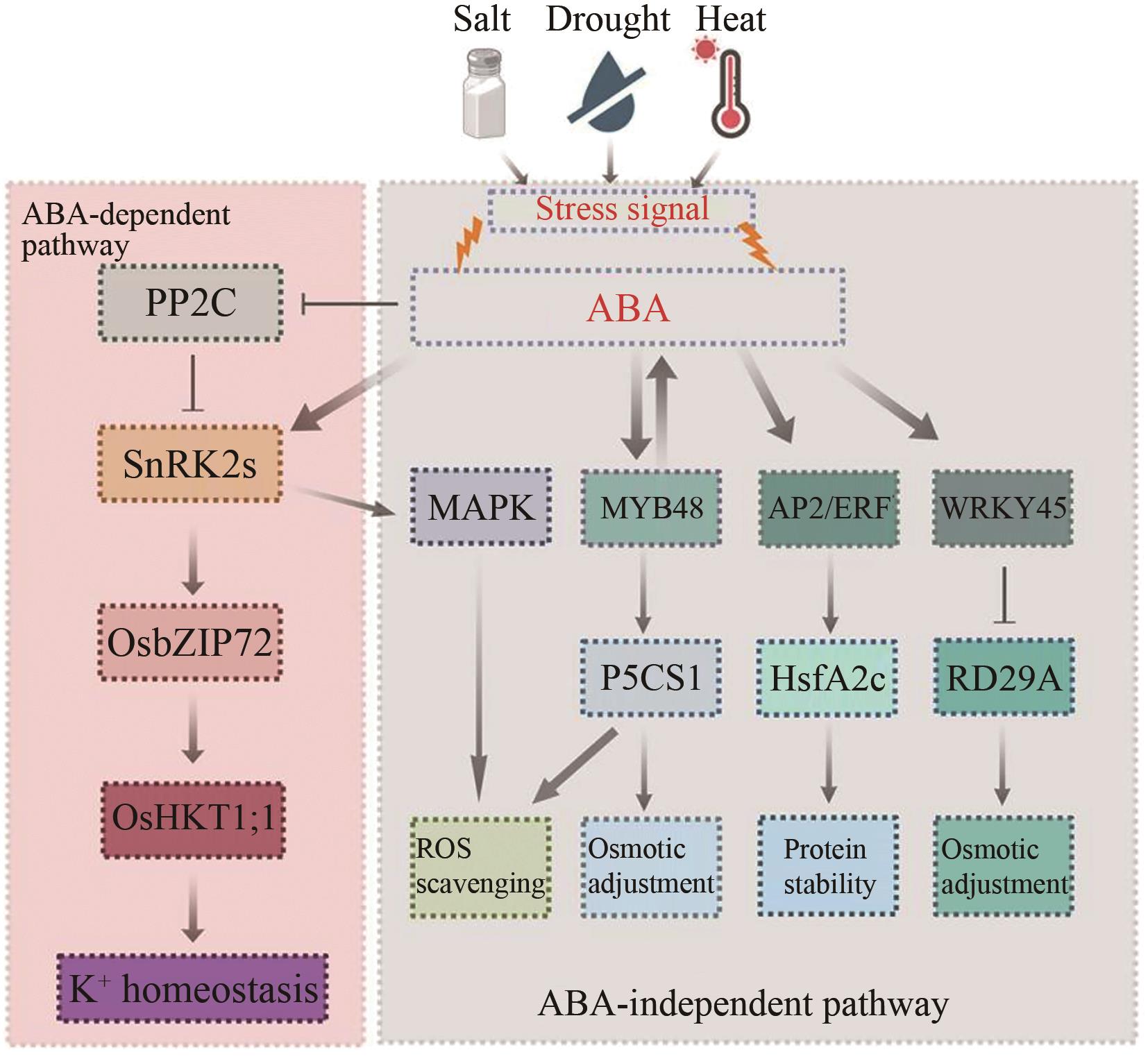
图1 盐-旱-热多重胁迫协同调控机制示意图
Fig. 1 Schematic representation of the coordinated regulatory mechanism underlying combined salinity, drought and heat stress
| [1] | Lu M. Impact of climate change on rice and adaptation strategies: A review [J]. Advances in Resources Research, 2024, 4(2): 252-262. |
| [2] | Liu CT, Mao BG, Yuan DY, et al. Salt tolerance in rice: Physiological responses and molecular mechanisms [J]. Crop J, 2022, 10(1): 13-25. |
| [3] | Chen K, Li GJ, Bressan RA, et al. Abscisic acid dynamics, signaling, and functions in plants [J]. J Integr Plant Biol, 2020, 62(1): 25-54. |
| [4] | Ohama N, Sato H, Shinozaki K, et al. Transcriptional regulatory network of plant heat stress response [J]. Trends Plant Sci, 2017, 22(1): 53-65. |
| [5] | Fujita M, Fujita Y, Noutoshi Y, et al. Crosstalk between abiotic and biotic stress responses: a current view from the points of convergence in the stress signaling networks [J]. Curr Opin Plant Biol, 2006, 9(4): 436-442. |
| [6] | Chang Y, Liu JH, Guo MR, et al. Drought-responsive dynamics of H3K9ac-marked 3D chromatin interactions are integrated by OsbZIP23-associated super-enhancer-like promoter regions in rice [J]. Genome Biol, 2024, 25: 262. |
| [7] | Wei H, Xu H, Su C, et al. Rice circadian clock associated 1 transcriptionally regulates Aba signaling to confer multiple abiotic stress tolerance [J]. Plant Physiol, 2022, 190(2): 1057-1073. |
| [8] | Quintero FJ, Ohta M, Shi HZ, et al. Reconstitution in yeast of the Arabidopsis SOS signaling pathway for Na+ homeostasis [J]. Proc Natl Acad Sci U S A, 2002, 99(13): 9061-9066. |
| [9] | Ren ZH, Gao JP, Li LG, et al. A rice quantitative trait locus for salt tolerance encodes a sodium transporter [J]. Nat Genet, 2005, 37(10): 1141-1146. |
| [10] | Wang TT, Ren ZJ, Liu ZQ, et al. SbHKT1;4, a member of the high-affinity potassium transporter gene family from Sorghum bicolor, functions to maintain optimal Na+/K+ balance under Na+ stress [J]. J Integr Plant Biol, 2014, 56(3): 315-332. |
| [11] | Suzuki N, Miller G, Morales J, et al. Respiratory burst oxidases: the engines of ROS signaling [J]. Curr Opin Plant Biol, 2011, 14(6): 691-699. |
| [12] | Mittler R, Vanderauwera S, Suzuki N, et al. ROS signaling: the new wave? [J]. Trends Plant Sci, 2011, 16(6): 300-309. |
| [13] | Noctor G, Mhamdi A, Foyer CH. The roles of reactive oxygen metabolism in drought: not so cut and dried [J]. Plant Physiol, 2014, 164(4): 1636-1648. |
| [14] | Apel K, Hirt H. REACTIVE OXYGEN SPECIES: metabolism, oxidative stress, and signal transduction [J]. Annu Rev Plant Biol, 2004, 55: 373-399. |
| [15] | Deinlein U, Stephan AB, Horie T, et al. Plant salt-tolerance mechanisms [J]. Trends Plant Sci, 2014, 19(6): 371-379. |
| [16] | Yang YQ, Guo Y. Elucidating the molecular mechanisms mediating plant salt-stress responses [J]. New Phytol, 2018, 217(2): 523-539. |
| [17] | Zhang MJ, Chen Z, Yuan F, et al. Integrative transcriptome and proteome analyses provide deep insights into the molecular mechanism of salt tolerance in Limonium bicolor [J]. Plant Mol Biol, 2022, 108(1/2): 127-143. |
| [18] | Satrio RD, Fendiyanto MH, Supena EDJ, et al. Mapping and identification of QTL for agro-physiological traits in rice (Oryza sativa L.) under drought stress [J]. Plant Gene, 2023, 33: 100397. |
| [19] | Sakuma Y, Maruyama K, Osakabe Y, et al. Functional analysis of an Arabidopsis transcription factor, DREB2A involved in drought-responsive gene expression [J]. Plant Cell, 2006, 18(5): 1292-1309. |
| [20] | Mallikarjuna G, Mallikarjuna K, Reddy MK, et al. Expression of OsDREB2A transcription factor confers enhanced dehydration and salt stress tolerance in rice (Oryza sativa L.) [J]. Biotechnol Lett, 2011, 33(8): 1689-1697. |
| [21] | Jia HY, Zhang SJ, Ruan MY, et al. Analysis and application of RD29 genes in abiotic stress response [J]. Acta Physiol Plant, 2012, 34(4): 1239-1250. |
| [22] | Dubouzet JG, Sakuma Y, Ito Y, et al. OsDREB genes in rice, Oryza sativa L., encode transcription activators that function in drought-, high-salt- and cold-responsive gene expression [J]. Plant J, 2003, 33(4): 751-763. |
| [23] | Xia H, Ma XS, Xu K, et al. Temporal transcriptomic differences between tolerant and susceptible genotypes contribute to rice drought tolerance [J]. BMC Genom, 2020, 21: 776. |
| [24] | Tiwari P, Srivastava D, Chauhan AS, et al. Root system architecture, physiological analysis and dynamic transcriptomics unravel the drought-responsive traits in rice genotypes [J]. Ecotoxicol Environ Saf, 2021, 207: 111252. |
| [25] | Yoshida R, Hobo T, Ichimura K, et al. ABA-activated SnRK2 protein kinase is required for dehydration stress signaling in Arabidopsis [J]. Plant Cell Physiol, 2002, 43(12): 1473-1483. |
| [26] | Zhong RL, Wang YX, Gai RN, et al. Rice SnRK protein kinase OsSAPK8 acts as a positive regulator in abiotic stress responses [J]. Plant Sci, 2020, 292: 110373. |
| [27] | Hincha DK, Hagemann M. Stabilization of model membranes during drying by compatible solutes involved in the stress tolerance of plants and microorganisms [J]. Biochem J, 2004, 383(2): 277-283. |
| [28] | Huijser C, Kortstee A, Pego J, et al. The Arabidopsis sucrose uncoupled-6 gene is identical to ABSCISIC acid insensitive-4: involvement of abscisic acid in sugar responses [J]. Plant J, 2000, 23(5): 577-585. |
| [29] | Szabados L, Savouré A. Proline: a multifunctional amino acid [J]. Trends Plant Sci, 2010, 15(2): 89-97. |
| [30] | Close TJ. Dehydrins: Emergence of a biochemical role of a family of plant dehydration proteins [J]. Physiol Plant, 1996, 97(4): 795-803. |
| [31] | Ingram J, Bartels D. The molecular basis of dehydration tolerance in plants [J]. Annu Rev Plant Physiol Plant Mol Biol, 1996, 47: 377-403. |
| [32] | Guan QM, Lu XY, Zeng HT, et al. Heat stress induction of miR398 triggers a regulatory loop that is critical for thermotolerance in Arabidopsis [J]. Plant J, 2013, 74(5): 840-851. |
| [33] | Wu HC, Jinn TL. Oscillation regulation of Ca2+/calmodulin and heat-stress related genes in response to heat stress in rice (Oryza sativa L.) [J]. Plant Signal Behav, 2012, 7(9): 1056-1057. |
| [34] | Kim JM, Sasaki T, Ueda M, et al. Chromatin changes in response to drought, salinity, heat, and cold stresses in plants [J]. Front Plant Sci, 2015, 6: 114. |
| [35] | Suzuki N, Bassil E, Hamilton JS, et al. ABA is required for plant acclimation to a combination of salt and heat stress [J]. PLoS One, 2016, 11(1): e0147625. |
| [36] | Chan KX, Phua SY, Crisp P, et al. Learning the languages of the chloroplast: retrograde signaling and beyond [J]. Annu Rev Plant Biol, 2016, 67: 25-53. |
| [37] | Zhang H, Zhou JF, Kan Y, et al. A genetic module at one locus in rice protects chloroplasts to enhance thermotolerance [J]. Science, 2022, 376(6599): 1293-1300. |
| [38] | Cui YM, Lu S, Li Z, et al. CYCLIC NUCLEOTIDE-GATED ION CHANNELs 14 and 16 promote tolerance to heat and chilling in rice [J]. Plant Physiol, 2020, 183(4): 1794-1808. |
| [39] | 邹修为, 岳佳妮, 李志宇, 等. 水稻热激转录因子HsfA2b调控非生物胁迫抗性的功能分析 [J]. 生物技术通报, 2024, 40(2): 90-98. |
| Zou XW, Yue JN, Li ZY, et al. Functional analysis of rice heat shock transcription factor HsfA2b regulating the resistance to abiotic stresses [J]. Biotechnol Bull, 2024, 40(2): 90-98. | |
| [40] | Sarkar NK, Kim YK, Grover A. Rice sHsp genes: genomic organization and expression profiling under stress and development [J]. BMC Genom, 2009, 10: 393. |
| [41] | Liu HC, Liao HT, Charng YY. The role of class A1 heat shock factors (HSFA1s) in response to heat and other stresses in Arabidopsis [J]. Plant Cell Environ, 2011, 34(5): 738-751. |
| [42] | Yokotani N, Ichikawa T, Kondou Y, et al. Expression of rice heat stress transcription factor OsHsfA2e enhances tolerance to environmental stresses in transgenic Arabidopsis [J]. Planta, 2008, 227(5): 957-967. |
| [43] | Mittal D, Madhyastha DA, Grover A. Genome-wide transcriptional profiles during temperature and oxidative stress reveal coordinated expression patterns and overlapping regulons in rice [J]. PLoS One, 2012, 7(7): e40899. |
| [44] | Shi L, Cui XY, Shen Y. The roles of histone methylation in the regulation of abiotic stress responses in plants [J]. Plant Stress, 2024, 11: 100303. |
| [45] | Qiao B, Zhang Q, Liu DL, et al. A calcium-binding protein, rice annexin OsANN1, enhances heat stress tolerance by modulating the production of H2O2 [J]. J Exp Bot, 2015, 66(19): 5853-5866. |
| [46] | Li XM, Chao DY, Wu Y, et al. Natural alleles of a proteasome α2 subunit gene contribute to thermotolerance and adaptation of African rice [J]. Nat Genet, 2015, 47(7): 827-833. |
| [47] | Cao GH, Huang H, Yang YJ, et al. Analysis of drought and heat stress response genes in rice [J]. Plant Molecular Biology, 2024, 108(1): 127-143. |
| [48] | Cabiscol E, Bellı́ G, Tamarit J, et al. Mitochondrial Hsp60, resistance to oxidative stress, and the labile iron pool are closely connected in Saccharomyces cerevisiae [J]. J Biol Chem, 2002, 277(46): 44531-44538. |
| [49] | Kan Y, Lin HX. Molecular regulation and genetic control of rice thermal response [J]. Crop J, 2021, 9(3): 497-505. |
| [50] | Wang P, Qi SJ, Wang XH, et al. The OPEN STOMATA1-SPIRAL1 module regulates microtubule stability during abscisic acid-induced stomatal closure in Arabidopsis [J]. Plant Cell, 2023, 35(1): 260-278. |
| [51] | Shi XX, Wang LY, Wang YC, et al. Building gene regulatory networks to uncover tolerance mechanisms to salt and drought in Tamarix hispida [J]. Plant Physiol Biochem, 2025, 228: 110307. |
| [52] | Koramutla MK, Negi M, Ayele BT. Roles of glutathione in mediating abscisic acid signaling and its regulation of seed dormancy and drought tolerance [J]. Genes, 2021, 12(10): 1620. |
| [53] | Fujita Y, Nakashima K, Yoshida T, et al. Three SnRK2 protein kinases are the main positive regulators of abscisic acid signaling in response to water stress in Arabidopsis [J]. Plant Cell Physiol, 2009, 50(12): 2123-2132. |
| [54] | Umezawa T, Sugiyama N, Mizoguchi M, et al. Type 2C protein phosphatases directly regulate abscisic acid-activated protein kinases in Arabidopsis [J]. Proc Natl Acad Sci U S A, 2009, 106(41): 17588-17593. |
| [55] | Yuan XP, Zhao Y. SnRK2 kinases sense molecular crowding and form condensates to disrupt ABI1 inhibition [J]. Sci Adv, 2025, 11(5): eadr8250. |
| [56] | Yoshida T, Mogami J, Yamaguchi-Shinozaki K. ABA-dependent and ABA-independent signaling in response to osmotic stress in plants [J]. Curr Opin Plant Biol, 2014, 21: 133-139. |
| [57] | Wei SY, Hu W, Deng XM, et al. A rice calcium-dependent protein kinase OsCPK9 positively regulates drought stress tolerance and spikelet fertility [J]. BMC Plant Biol, 2014, 14: 133. |
| [58] | Asano T, Hayashi N, Kobayashi M, et al. A rice calcium-dependent protein kinase OsCPK12 oppositely modulates salt-stress tolerance and blast disease resistance [J]. Plant J, 2012, 69(1): 26-36. |
| [59] | Asano T, Hakata M, Nakamura H, et al. Functional characterisation of OsCPK21, a calcium-dependent protein kinase that confers salt tolerance in rice [J]. Plant Mol Biol, 2011, 75(1/2): 179-191. |
| [60] | Li Y, Zhang F, Chen B, et al. Identification of MFS gene family in tomato and functional characterization of SlZIF1/SlMFS4 under salt stress [J]. Plant Physiol Biochem, 2025, 229: 110554. |
| [61] | Rizhsky L, Liang HJ, Mittler R. The combined effect of drought stress and heat shock on gene expression in tobacco [J]. Plant Physiol, 2002, 130(3): 1143-1151. |
| [62] | Zandalinas SI, Mittler R, Balfagón D, et al. Plant adaptations to the combination of drought and high temperatures [J]. Physiol Plant, 2018, 162(1): 2-12. |
| [63] | Luo AN, Yang C, Yao ZW, et al. Transcription factors ERF74/77/108/125 enhance thermotolerance in rice by regulating common and distinct heat-responsive gene expression [J]. Plant Biotechnol J, 2025, 23(10): 4539-4551. |
| [64] | Slot M, Rifai SW, Eze CE, et al. The stomatal response to vapor pressure deficit drives the apparent temperature response of photosynthesis in tropical forests [J]. New Phytol, 2024, 244(4): 1238-1249. |
| [65] | Caine RS, Yin XJ, Sloan J, et al. Rice with reduced stomatal density conserves water and has improved drought tolerance under future climate conditions [J]. New Phytol, 2019, 221(1): 371-384. |
| [66] | Suzuki N, Miller G, Salazar C, et al. Temporal-spatial interaction between reactive oxygen species and abscisic acid regulates rapid systemic acclimation in plants [J]. Plant Cell, 2013, 25(9): 3553-3569. |
| [67] | Fang Y, Liao HC, Wei YJ, et al. OsCDPK24 and OsCDPK28 phosphorylate heat shock factor OsHSFA4d to orchestrate abiotic and biotic stress responses in rice [J]. Nat Commun, 2025, 16: 6485. |
| [68] | Schramm F, Larkindale J, Kiehlmann E, et al. A cascade of transcription factor DREB2A and heat stress transcription factor HsfA3 regulates the heat stress response of Arabidopsis [J]. Plant J, 2008, 53(2): 264-274. |
| [69] | Jin R, Wang YP, Liu RJ, et al. Physiological and metabolic changes of purslane (Portulaca oleracea L.) in response to drought, heat, and combined stresses [J]. Front Plant Sci, 2016, 6: 1123. |
| [70] | Nahar L, Aycan M, Hanamata S, et al. Impact of single and combined salinity and high-temperature stresses on agro-physiological, biochemical, and transcriptional responses in rice and stress-release [J]. Plants, 2022, 11(4): 501. |
| [71] | Guo SQ, Chen YX, Ju YL, et al. Fine-tuning gibberellin improves rice alkali-thermal tolerance and yield [J]. Nature, 2025, 639(8053): 162-171. |
| [72] | Blumwald E. Sodium transport and salt tolerance in plants [J]. Curr Opin Cell Biol, 2000, 12(4): 431-434. |
| [73] | Benlloch R, Lois LM. Sumoylation in plants: mechanistic insights and its role in drought stress [J]. J Exp Bot, 2018, 69(19): 4539-4554. |
| [74] | Xie W, Liu H, Ren DY, et al. A K+-efflux antiporter is vital for tolerance to salt stress in rice [J]. Rice, 2025, 18: 57. |
| [75] | Fang CY, Fernie AR, Luo J. Exploring the diversity of plant metabolism [J]. Trends Plant Sci, 2019, 24(1): 83-98. |
| [76] | Ahmad Anjum S, Tanveer M, Ashraf U, et al. Effect of progressive drought stress on growth, leaf gas exchange, and antioxidant production in two maize cultivars [J]. Environ Sci Pollut Res, 2016, 23(17): 17132-17141. |
| [77] | Hussain HA, Hussain S, Khaliq A, et al. Chilling and drought stresses in crop plants: implications, cross talk, and potential management opportunities [J]. Front Plant Sci, 2018, 9: 393. |
| [78] | Hussain S, Khan F, Cao WD, et al. Seed priming alters the production and detoxification of reactive oxygen intermediates in rice seedlings grown under sub-optimal temperature and nutrient supply [J]. Front Plant Sci, 2016, 7: 439. |
| [79] | Singh K, Chandra A. DREBs-potential transcription factors involve in combating abiotic stress tolerance in plants [J]. Biologia, 2021, 76(10): 3043-3055. |
| [80] | Liu Q, Kasuga M, Sakuma Y, et al. Two transcription factors, DREB1 and DREB2 with an EREBP/AP2 DNA binding domain separate two cellular signal transduction pathways in drought- and low-temperature-responsive gene expression, respectively, in Arabidopsis [J]. Plant Cell, 1998, 10(8): 1391-1406. |
| [81] | Li MP, Kim C. Chloroplast ROS and stress signaling [J]. Plant Commun, 2022, 3(1): 100264. |
| [82] | Zhang JZ, Lee KP, Liu YL, et al. Temperature-driven changes in membrane fluidity differentially impact FILAMENTATION TEMPERATURE-SENSITIVE H2-mediated photosystem II repair [J]. Plant Cell, 2024, 37(1): koae323. |
| [83] | Golldack D, Li C, Mohan H, et al. Tolerance to drought and salt stress in plants: Unraveling the signaling networks [J]. Front Plant Sci, 2014, 5: 151. |
| [84] | Zhang JH, Peng D, Gao SS, et al. Enhancing rice salt tolerance: Mechanisms of compound functional liquid in alleviating salt stress during the seedling stage [J]. Plant Physiol Biochem, 2025, 229: 110273. |
| [85] | Sato H, Mizoi J, Shinozaki K, et al. Complex plant responses to drought and heat stress under climate change [J]. Plant J, 2024, 117(6): 1873-1892. |
| [86] | 陆海芹, 李娜, 蒋凯旋, 等. NAC转录因子调控植物生长发育和胁迫应答的研究进展 [J]. 植物生理学报, 2024, 60(2): 271-283. |
| Lu HQ, Li N, Jiang KX, et al. Research advances on NAC transcription factors regulating plant development and stress responses [J]. Plant Physiol J, 2024, 60(2): 271-283. | |
| [87] | Bawa G, Kong RW, Chen X, et al. Signalling networks underlying cell wall responses to salinity stress [J]. Plant Cell Environ, 2026, 49(1): 18-31. |
| [88] | Wang B, Zhong ZH, Wang X, et al. Knockout of the OsNAC006 transcription factor causes drought and heat sensitivity in rice [J]. Int J Mol Sci, 2020, 21(7): 2288. |
| [89] | Shen JB, Lv B, Luo LQ, et al. The NAC-type transcription factor OsNAC2 regulates ABA-dependent genes and abiotic stress tolerance in rice [J]. Sci Rep, 2017, 7: 40641. |
| [90] | Wang Q, Zhao LW, Shao TT, et al. Salt-responsive SSN1 condensation in nucleus facilitates PIF4 degradation to regulate Arabidopsis salt tolerance [J]. Plant J, 2025, 123(2): e70389. |
| [91] | Li BS, Sun C, Li JY, et al. Targeted genome-modification tools and their advanced applications in crop breeding [J]. Nat Rev Genet, 2024, 25(9): 603-622. |
| [92] | Sun C, Lei Y, Li BS, et al. Precise integration of large DNA sequences in plant genomes using PrimeRoot editors [J]. Nat Biotechnol, 2024, 42(2): 316-327. |
| [93] | Li XH, Xu SY, Fuhrmann-Aoyagi MB, et al. CRISPR/Cas9 technique for temperature, drought, and salinity stress responses [J]. Curr Issues Mol Biol, 2022, 44(6): 2664-2682. |
| [94] | Angon PB, Mondal S, Akter S, et al. Roles of CRISPR to mitigate drought and salinity stresses on plants [J]. Plant Stress, 2023, 8: 100169. |
| [95] | Kumar M, Prusty MR, Pandey MK, et al. Application of CRISPR/Cas9-mediated gene editing for abiotic stress management in crop plants [J]. Front Plant Sci, 2023, 14: 1157678. |
| [96] | Marè C, Zampieri E, Cavallaro V, et al. Marker-assisted introgression of the salinity tolerance locus saltol in temperate Japonica rice [J]. Rice, 2023, 16: 2. |
| [97] | Vikram P, Swamy BM, Dixit S, et al. qDTY1.1, a major QTL for rice grain yield under reproductive-stage drought stress with a consistent effect in multiple elite genetic backgrounds [J]. BMC Genet, 2011, 12: 89. |
| [98] | Mishra KK, Vikram P, Yadaw RB, et al. qDTY12.1: a locus with a consistent effect on grain yield under drought in rice [J]. BMC Genet, 2013, 14: 12. |
| [99] | Muthu V, Abbai R, Nallathambi J, et al. Pyramiding QTLs controlling tolerance against drought, salinity, and submergence in rice through marker assisted breeding [J]. PLoS One, 2020, 15(1): e0227421. |
| [100] | Biswas PS, Ahmed MME, Afrin W, et al. Enhancing genetic gain through the application of genomic selection in developing irrigated rice for the favorable ecosystem in Bangladesh [J]. Front Genet, 2023, 14: 1083221. |
| [101] | Muvunyi BP, Zou WL, Zhan JH, et al. Multi-trait genomic prediction models enhance the predictive ability of grain trace elements in rice [J]. Front Genet, 2022, 13: 883853. |
| [102] | Suzuki N, Rivero RM, Shulaev V, et al. Abiotic and biotic stress combinations [J]. New Phytol, 2014, 203(1): 32-43. |
| [103] | Atkinson NJ, Lilley CJ, Urwin PE. Identification of genes involved in the response of Arabidopsis to simultaneous biotic and abiotic stresses [J]. Plant Physiol, 2013, 162(4): 2028-2041. |
| [104] | Yang YX, Yu JP, Qian Q, et al. Enhancement of heat and drought stress tolerance in rice by genetic manipulation: a systematic review [J]. Rice, 2022, 15: 67. |
| [105] | Roychowdhury R, Das SP, Gupta A, et al. Multi-omics pipeline and omics-integration approach to decipher plant’s abiotic stress tolerance responses [J]. Genes, 2023, 14(6): 1281. |
| [106] | Huang LY, Wang YX, Wang WS, et al. Characterization of transcription factor gene OsDRAP1 conferring drought tolerance in rice [J]. Front Plant Sci, 2018, 9: 94. |
| [107] | Zaidi SS, Mahas A, Vanderschuren H, et al. Engineering crops of the future: CRISPR approaches to develop climate-resilient and disease-resistant plants [J]. Genome Biol, 2020, 21: 289. |
| [108] | Weckwerth W, Ghatak A, Bellaire A, et al. PANOMICS meets germplasm [J]. Plant Biotechnol J, 2020, 18(7): 1507-1525. |
| [1] | 徐玉娇, 孙玉帅, 刘道奇, 张丽, 张志昌, 姚玉新. VvHSP18.2过表达调节葡萄盐碱抗性的功能分析[J]. 生物技术通报, 2026, 42(4): 161-169. |
| [2] | 刘青媛, 吴洪启, 陈秀娥, 陈剑, 姜远泽, 何燕子, 喻奇伟, 刘仁祥. 转录因子NtMYB96a调控烟草耐旱性的功能研究[J]. 生物技术通报, 2026, 42(4): 239-250. |
| [3] | 董亚茹, 朱红, 王照红, 赵东晓, 刘惠芬. 桑树MnDREB6E的克隆及耐盐抗旱性分析[J]. 生物技术通报, 2026, 42(2): 306-316. |
| [4] | 张冬岭, 张寅生, 王建军, 叶飞宇, 卢子涵, 马晨晨, 柳华峰, 胡德升, 邓亚洲, 曹丽茹. 玉米HSFs转录因子家族在干旱胁迫下的表达特性及功能[J]. 生物技术通报, 2026, 42(2): 178-187. |
| [5] | 王程程, 黄天宇, 张晴, 史来权, 方慧敏, 张龙. 一个水稻粉质胚乳突变体的表型分析和基因定位[J]. 生物技术通报, 2026, 42(2): 169-177. |
| [6] | 任云儿, 伍国强, 成斌, 魏明. 甜菜BvATGs基因家族全基因组鉴定及盐胁迫下表达模式分析[J]. 生物技术通报, 2026, 42(1): 184-197. |
| [7] | 杨跃琴, 邢英, 仲子荷, 田维军, 杨雪清, 王建旭. 甲基汞胁迫下水稻OsMATE34的表达及功能分析[J]. 生物技术通报, 2026, 42(1): 86-94. |
| [8] | 费思恬, 侯鹰翔, 李兰, 张超. 水稻赤霉素信号负调控因子SLR1的生物学功能及其调控网络[J]. 生物技术通报, 2026, 42(1): 13-30. |
| [9] | 张月, 戴月华, 张莹莹, 李奥辉, 李楚慧, 薛金爱, 秦慧彬, 陈妍, 聂萌恩, 张海平. 大豆烯酰辅酶A还原酶ECR14基因的克隆与功能分析[J]. 生物技术通报, 2026, 42(1): 95-104. |
| [10] | 巩慧玲, 邢玉洁, 马俊贤, 蔡霞, 冯再平. 马铃薯LAC基因家族的鉴定及盐胁迫下表达分析[J]. 生物技术通报, 2025, 41(9): 82-93. |
| [11] | 王芳, 邵会茹, 吕林龙, 赵点, 胡振, 吕建珍, 姜亮. 植物和细菌TurboID邻近蛋白标记方法的建立[J]. 生物技术通报, 2025, 41(9): 44-53. |
| [12] | 邓美壁, 严浪, 詹志田, 朱敏, 和玉兵. RUBY辅助的水稻高效CRISPR基因编辑[J]. 生物技术通报, 2025, 41(8): 65-73. |
| [13] | 李开杰, 吴瑶, 李丹丹. 红花CtbHLH128基因克隆及调控干旱胁迫应答功能研究[J]. 生物技术通报, 2025, 41(8): 234-241. |
| [14] | 李雅琼, 格桑拉毛, 陈启迪, 杨宇环, 何花转, 赵耀飞. 异源过表达高粱SbSnRK2.1增强拟南芥对盐胁迫的抗性[J]. 生物技术通报, 2025, 41(8): 115-123. |
| [15] | 程雪, 付颖, 柴晓娇, 王红艳, 邓欣. 谷子LHC基因家族鉴定及非生物胁迫表达分析[J]. 生物技术通报, 2025, 41(8): 102-114. |
| 阅读次数 | ||||||
|
全文 |
|
|||||
|
摘要 |
|
|||||
