







Biotechnology Bulletin ›› 2025, Vol. 41 ›› Issue (9): 159-167.doi: 10.13560/j.cnki.biotech.bull.1985.2025-0147
SHI Fa-chao( ), JIANG Yong-hua, LIU Hai-lun, WEN Ying-jie, YAN Qian()
Received:2025-02-13
Online:2025-09-26
Published:2025-09-24
Contact:
YAN Qian
E-mail:shifachao@126.com;yanqian@gdaas.cn
SHI Fa-chao, JIANG Yong-hua, LIU Hai-lun, WEN Ying-jie, YAN Qian. Cloning and Functional Analysis of LcTFL1 Gene in Litchi chinensis Sonn.[J]. Biotechnology Bulletin, 2025, 41(9): 159-167.
用途 Usage | 引物名称 Prime name | 序列 Sequence (5′-3′) |
|---|---|---|
克隆 Clone | LcTFL1-F | ATGACAGAAACACTATCT |
| LcTFL1-R | TCATCTTCTTCTAGCAGC | |
定位 Location | LcTFL1-F | CAGTGGTCTCACAACATGACAGAAACACTATCTGTGGGAAGAGTTG |
| LcTFL1-R | CAGTGGTCTCATACATCTTCTTCTAGCAGCGGTTTCTCTTTGG | |
过表达 Over-expression | LcTFL1-F | AACACGGGGGACTTTGCAACATGACAGAAACACTATC |
| LcTFL1-R | CCGTCGTGGTCTTTGTAATCTCTTCTTCTAGCAGCGG | |
内参 Actin GAPDH | Actin-F | ACCGTATGAGCAAGGAAATCACTG |
| Actin-R | TCGTCGTACTCACCCTTTGAAATC | |
荧光定量 RT-qPCR | LcTFL1-F | ATGGCCTCAGAGCTGCTTAT |
| LcTFL1-R | GTGGTGCCAGGAATGTTTGT |
Table 1 Primer list
用途 Usage | 引物名称 Prime name | 序列 Sequence (5′-3′) |
|---|---|---|
克隆 Clone | LcTFL1-F | ATGACAGAAACACTATCT |
| LcTFL1-R | TCATCTTCTTCTAGCAGC | |
定位 Location | LcTFL1-F | CAGTGGTCTCACAACATGACAGAAACACTATCTGTGGGAAGAGTTG |
| LcTFL1-R | CAGTGGTCTCATACATCTTCTTCTAGCAGCGGTTTCTCTTTGG | |
过表达 Over-expression | LcTFL1-F | AACACGGGGGACTTTGCAACATGACAGAAACACTATC |
| LcTFL1-R | CCGTCGTGGTCTTTGTAATCTCTTCTTCTAGCAGCGG | |
内参 Actin GAPDH | Actin-F | ACCGTATGAGCAAGGAAATCACTG |
| Actin-R | TCGTCGTACTCACCCTTTGAAATC | |
荧光定量 RT-qPCR | LcTFL1-F | ATGGCCTCAGAGCTGCTTAT |
| LcTFL1-R | GTGGTGCCAGGAATGTTTGT |
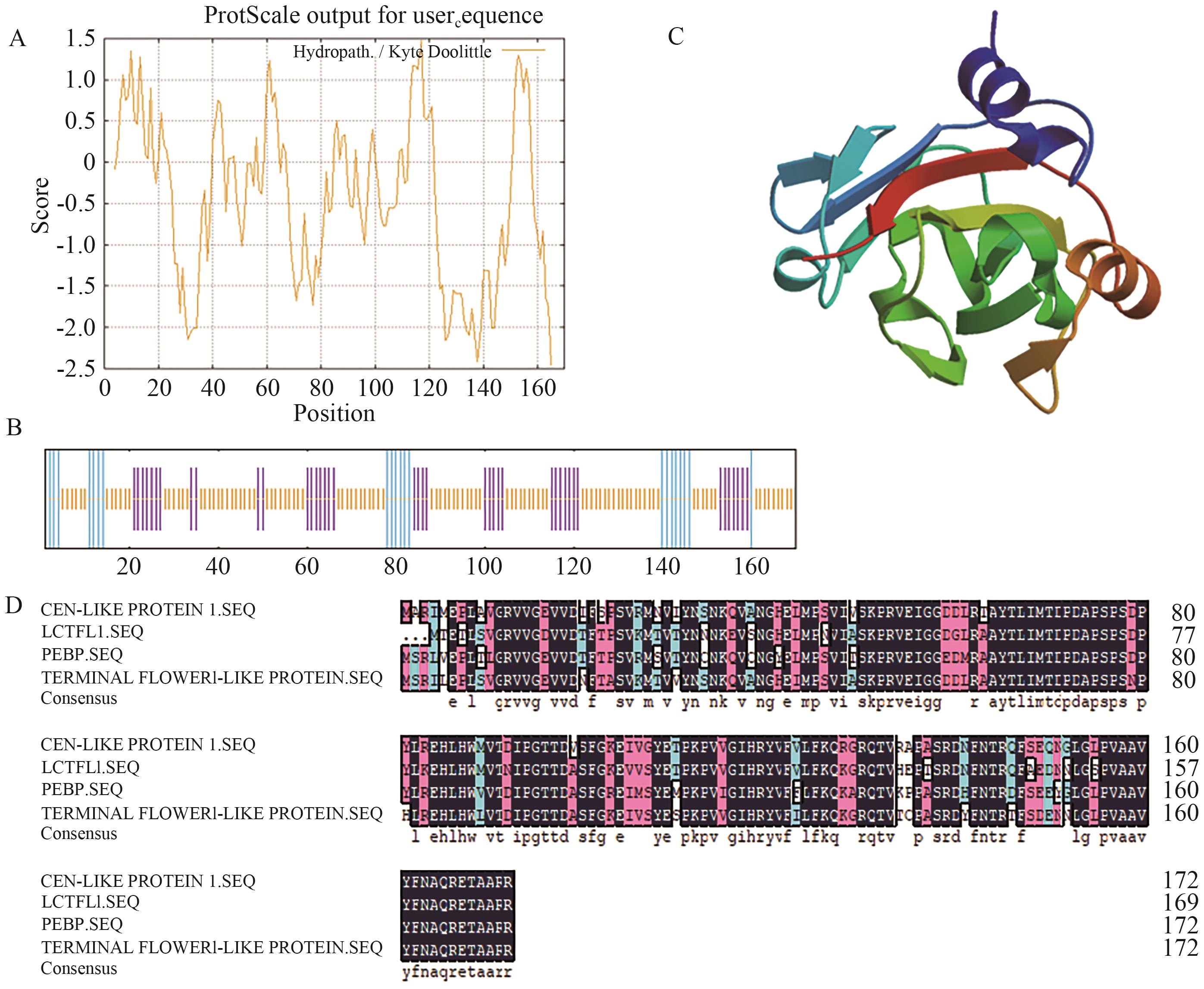
Fig. 1 Bioinformation analysis of LcTFL1A: Hydrophilic and hydrophobic prediction of protein. B: Secondary structure prediction of protein. C: Tertiary structure prediction of protein. D: Protein sequence alignment
| 元件类型 Type | 相关元件 Structure | 数量 Number | 序列 Sequence | 功能注释 Function annotation |
|---|---|---|---|---|
| 光响应元件 Light response element | TCT-motif | 1 | TCTTAC | Part of a light responsive element |
| TCCC-motif | 1 | TCTCCCT | Part of a light responsive element | |
| GATA-motif | 1 | AAGGATAAGG | Part of a light responsive element | |
| G-box | 1 | CACGTC | Part of a light responsive element | |
| G-Box | 1 | CACGTT | Part of a light responsive element | |
| Box 4 | 3 | ATTAAT | Part of a light responsive element | |
| ARE | 1 | AAACCA | Part of a light responsive element | |
| ACE | 1 | GACACGTATG | Part of a light responsive element | |
| circadian | 1 | CAAAGATATC | Involved in circadian control | |
| 激素响应元件 Hormone response element | ABRE | 2 | ACGTG | In the abscisic acid responsive |
| 胁迫响应元件Stress response element | TC-rich repeats | 2 | GTTTTCTTAC | Involved in defense and stress responsiveness |
| ARE | 1 | AAACCA | Anaerobic responsive element |
Table 2 Regulatory element analysis of LcTFL1 promoter
| 元件类型 Type | 相关元件 Structure | 数量 Number | 序列 Sequence | 功能注释 Function annotation |
|---|---|---|---|---|
| 光响应元件 Light response element | TCT-motif | 1 | TCTTAC | Part of a light responsive element |
| TCCC-motif | 1 | TCTCCCT | Part of a light responsive element | |
| GATA-motif | 1 | AAGGATAAGG | Part of a light responsive element | |
| G-box | 1 | CACGTC | Part of a light responsive element | |
| G-Box | 1 | CACGTT | Part of a light responsive element | |
| Box 4 | 3 | ATTAAT | Part of a light responsive element | |
| ARE | 1 | AAACCA | Part of a light responsive element | |
| ACE | 1 | GACACGTATG | Part of a light responsive element | |
| circadian | 1 | CAAAGATATC | Involved in circadian control | |
| 激素响应元件 Hormone response element | ABRE | 2 | ACGTG | In the abscisic acid responsive |
| 胁迫响应元件Stress response element | TC-rich repeats | 2 | GTTTTCTTAC | Involved in defense and stress responsiveness |
| ARE | 1 | AAACCA | Anaerobic responsive element |

Fig. 2 Phylogenetic tree analysis of LcTFL1 protein
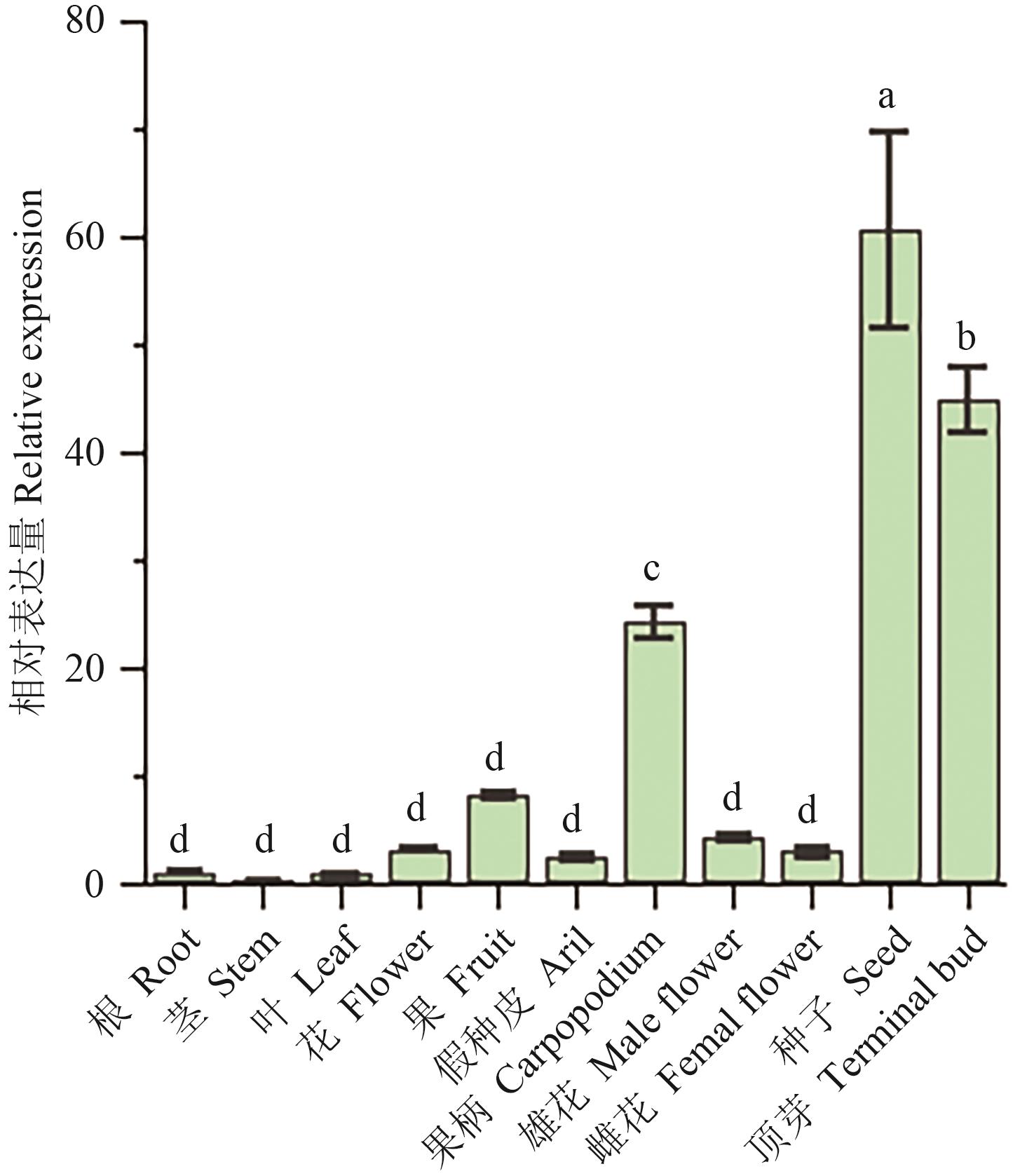
Fig. 3 Expressions of LcTFL1 gene in different tissues in litchi (Litchi chinensis Sonn.)Different letters indicate significant difference (P<0.05)

Fig. 4 Subcellular localization of LcTFL1The pBWA(V)HS-TFL1--GLosgfp is expressed as green fluorescent proteinin Arabidopsis thaliana protoplasts, the nuclear marker is expressed as red fluorescent protein, and purple is the purple fluorescence displayed by chloroplasts under specific wavelengths

Fig. 5 Plant phenotype of transgenic ArabidopsisA, B: Phenotypic in tansgenic and wild-type Arabidopsis of flowering time. C: Number and morphology of leaves at bolting. D: Leaf number at bolting. E: Leaf length. F: Leaf width. * indicates significant difference at P<0.05. WT indicates wild type, OE (4-2), OE (3-1) and OE (4-1) indicate transgenic lines
| [1] | 李建国. 荔枝学 [M]. 北京: 中国农业出版社, 2008. |
| Li JG. The Litchi [M]. Beijing: China Agriculture Press, 2008. | |
| [2] | 文英杰, 欧良喜, 史发超, 等. 国家荔枝香蕉种质资源圃(广州)的荔枝资源保存现状及创新利用 [J]. 植物遗传资源学报, 2023, 24(5): 1205-1214. |
| Wen YJ, Ou LX, Shi FC, et al. Conservation status and innovative utilization of Litchi resources in the national Litchi and banana germplasm repository (Guangzhou) [J]. J Plant Genet Resour, 2023, 24(5): 1205-1214. | |
| [3] | Maple R, Zhu P, Hepworth J, et al. Flowering time: From physiology, through genetics to mechanism [J]. Plant Physiol, 2024, 195(1): 190-212. |
| [4] | Cao SH, Luo XM, Xu DA, et al. Genetic architecture underlying light and temperature mediated flowering in Arabidopsis, rice, and temperate cereals [J]. New Phytol, 2021, 230(5): 1731-1745. |
| [5] | Surkova SY, Samsonova MG. Mechanisms of vernalization-induced flowering in legumes [J]. Int J Mol Sci, 2022; 23(17):9889. |
| [6] | 齐仙惠, 巫东堂, 李改珍, 等. 拟南芥成花调控途径的研究进展 [J]. 山西农业大学学报: 自然科学版, 2018, 38(9): 1-7, 36. |
| Qi XH, Wu DT, Li GZ, et al. Regulation pathways of flowering in Arabidopsis thaliana [J]. J Shanxi Agric Univ Nat Sci Ed, 2018, 38(9): 1-7, 36. | |
| [7] | Zhu P, Lister C, Dean C. Cold-induced Arabidopsis FRIGIDA nuclear condensates for FLC repression [J]. Nature, 2021, 599(7886): 657-661. |
| [8] | Surkova SY, Samsonova MG. Mechanisms of vernalization-induced flowering in legumes [J]. Int J Mol Sci, 2022, 23(17): 9889. |
| [9] | Li ZC, He YH. Roles of brassinosteroids in plant reproduction [J]. Int J Mol Sci, 2020, 21(3): 872. |
| [10] | Gibbs DJ, Theodoulou FL, Bailey-Serres J. Primed to persevere: Hypoxia regulation from epigenome to protein accumulation in plants [J]. Plant Physiol, 2024, 197(1): kiae584. |
| [11] | Nielsen M, Menon G, Zhao YS, et al. COOLAIR and PRC2 function in parallel to silence FLC during vernalization [J]. Proc Natl Acad Sci USA, 2024, 121(4): e2311474121. |
| [12] | Zhang XP, Wang W, Zhu WD, et al. Mechanisms and functions of long non-coding RNAs at multiple regulatory levels [J]. Int J Mol Sci, 2019, 20(22): 5573. |
| [13] | Quiroz S, Yustis JC, Chávez-Hernández EC, et al. Beyond the genetic pathways, flowering regulation complexity in Arabidopsis thaliana [J]. Int J Mol Sci, 2021, 22(11): 5716. |
| [14] | Takagi H, Hempton AK, Imaizumi T. Photoperiodic flowering in Arabidopsis: Multilayered regulatory mechanisms of CONSTANS and the florigen FLOWERING LOCUS T [J]. Plant Commun, 2023, 4(3): 100552. |
| [15] | Shannon S, Meeks-Wagner DR. A mutation in the Arabidopsis TFL1 gene affects inflorescence meristem development [J]. Plant Cell, 1991, 3(9): 877-892. |
| [16] | Parcy F, Bomblies K, Weigel D. Interaction of LEAFY, AGAMOUS and TERMINAL FLOWER1 in maintaining floral meristem identity in Arabidopsis [J]. Development, 2002, 129(10): 2519-2527. |
| [17] | Lembinen S, Cieslak M, Zhang T, et al. Diversity of woodland strawberry inflorescences arises from heterochrony regulated by TERMINAL FLOWER 1 and FLOWERING LOCUS T [J]. Plant Cell, 2023, 35(6): 2079-2094. |
| [18] | Iwata H, Gaston A, Remay A, et al. The TFL1 homologue KSN is a regulator of continuous flowering in rose and strawberry [J]. Plant J, 2012, 69(1): 116-125. |
| [19] | Koskela EA, Mouhu K, Albani MC, et al. Mutation in TERMINAL FLOWER1 reverses the photoperiodic requirement for flowering in the wild strawberry Fragaria vesca [J]. Plant Physiol, 2012, 159(3): 1043-1054. |
| [20] | Mimida N, Kotoda N, Ueda T, et al. Four TFL1/CEN-like genes on distinct linkage groups show different expression patterns to regulate vegetative and reproductive development in apple (Malus × domestica Borkh.) [J]. Plant Cell Physiol, 2009, 50(2): 394-412. |
| [21] | Flachowsky H, Szankowski I, Waidmann S, et al. The MdTFL1 gene of apple (Malus × domestica Borkh.) reduces vegetative growth and generation time [J]. Tree Physiol, 2012, 32(10): 1288-1301. |
| [22] | Freiman A, Shlizerman L, Golobovitch S, et al. Development of a transgenic early flowering pear (Pyrus communis L.) genotype by RNAi silencing of PcTFL1-1 and PcTFL1-2 [J]. Planta, 2012, 235(6): 1239-1251. |
| [23] | Mohamed R, Wang CT, Ma C, et al. Populus CEN/TFL1 regulates first onset of flowering, axillary meristem identity and dormancy release in Populus [J]. Plant J, 2010, 62(4): 674-688. |
| [24] | Wang Z, Yang JC, Gao Q, et al. The transcription factor NtERF13a enhances abiotic stress tolerance and phenylpropanoid compounds biosynthesis in tobacco [J]. Plant Science, 2023, 334: 111772. |
| [25] | Livak KJ, Schmittgen TD. Analysis of relative gene expression data using real-time quantitative PCR and the 2-ΔΔC T method [J]. Methods, 2001, 25(4): 402-408. |
| [26] | Serrazina S, Machado H, Costa RL, et al. Expression of Castanea crenata allene oxide synthase in Arabidopsis improves the defense to Phytophthora cinnamomi [J]. Front Plant Sci, 2021, 12: 628697. |
| [27] | Bellinazzo F, Nadal Bigas J, Hogers RAH, et al. Evolutionary origin and functional investigation of the widely conserved plant pebp gene stepmother of ft and tfl1 (smft) [J]. Plant J, 2024, 120(4): 1410-1420. |
| [28] | Lu XY, Lü PT, Liu H, et al. Identification of chilling accumulation-associated genes for Litchi flowering by transcriptome-based genome-wide association studies [J]. Front Plant Sci, 2022, 13: 819188. |
| [29] | Varkonyi-Gasic E, Moss SMA, Voogd C, et al. Homologs of FT, CEN and FD respond to developmental and environmental signals affecting growth and flowering in the perennial vine kiwifruit [J]. New Phytol, 2013, 198(3): 732-746. |
| [30] | 赵建文. 受激素和干旱调控的PhePEBP家族基因与毛竹笋芽萌发相关 [D]. 杭州: 浙江农林大学, 2019. |
| Zhao JW. PhePEBP family genes regulated by hormones and drought are related to bamboo shoot bud germination [D]. Hangzhou: Zhejiang A & F University, 2019. | |
| [31] | 王寻, 高凝, 张富军, 等. 苹果磷脂酰乙醇胺结合蛋白PEBP家族基因的鉴定与比较分析 [J]. 植物生理学报, 2021, 57(10): 1996-2010. |
| Wang X, Gao N, Zhang FJ, et al. Identification and comparative analysis of phosphatidyl ethanolamine binding protein (PEBP) family gene in apple [J]. Plant Physiol J, 2021, 57(10): 1996-2010. | |
| [32] | Kotoda N, Wada M. MdTFL1, a TFL1-like gene of apple, retards the transition from the vegetative to reproductive phase in transgenic Arabidopsis [J]. Plant Sci, 2005, 168(1): 95-104. |
| [33] | Wang YH, He XH, Yu HX, et al. Overexpression of four MiTFL1 genes from mango delays the flowering time in transgenic Arabidopsis [J]. BMC Plant Biol, 2021, 21(1): 407. |
| [34] | Esumi T, Kitamura Y, Hagihara C, et al. Identification of a TFL1 ortholog in Japanese apricot (Prunus mume Sieb. et Zucc.) [J]. Sci Hortic, 2010, 125(4): 608-616. |
| [35] | Zeng HY, Lu YT, Yang XM, et al. Ectopic expression of the BoTFL1-like gene of Bambusa oldhamii delays blossoming in Arabidopsis thaliana and rescues the tfl1 mutant phenotype [J]. Genet Mol Res, 2015, 14(3): 9306-9317. |
| [36] | Patil HB, Chaurasia AK, Azeez A, et al. Characterization of two TERMINAL FLOWER1 homologs PgTFL1 and PgCENa from pomegranate (Punica granatum L.) [J]. Tree Physiol, 2018, 38(5): 772-784. |
| [37] | Kotoda N, Iwanami H, Takahashi S, et al. Antisense expression of MdTFL1, a TFL1-like gene, reduces the juvenile phase in apple [J]. Jashs, 131(1): 74-81. |
| [38] | Imamura T, Nakatsuka T, Higuchi A, et al. The gentian orthologs of the FT/TFL1 gene family control floral initiation in Gentiana [J]. Plant Cell Physiol, 2011, 52(6): 1031-1041. |
| [39] | Boss PK, Sreekantan L, Thomas MR. A grapevine TFL1 homologue can delay flowering and alter floral development when overexpressed in heterologous species [J]. Funct Plant Biol, 2006, 33(1): 31-41. |
| [1] | DONG Xiang-xiang, MIAO Bai-ling, XU He-juan, CHEN Juan-juan, LI Liang-jie, GONG Shou-fu, ZHU Qing-song. Bioinformatics Analysis and Flowering Regulation Function of FveBBX20 Gene in Woodland Strawberry [J]. Biotechnology Bulletin, 2025, 41(9): 115-123. |
| [2] | LIU Jia-li, SONG Jing-rong, ZHAO Wen-yu, ZHANG Xin-yuan, ZHAO Zi-yang, CAO Yi-bo, ZHANG Ling-yun. Identification of the R2R3-MYB Gene and Expression Analysis of Flavonoid Regulatory Genes in Blueberry [J]. Biotechnology Bulletin, 2025, 41(9): 124-138. |
| [3] | HUANG Shi-yu, TIAN Shan-shan, YANG Tian-wei, GAO Man-rong, ZHANG Shang-wen. Genome-wide Identification and Expression Pattern Analysis of WRI1 Gene Family in Erythropalum scandens [J]. Biotechnology Bulletin, 2025, 41(8): 242-254. |
| [4] | KANG Qin, WANG Xia, SHEN Ming-yang, XU Jing-tian, CHEN Shi-lan, LIAO Ping-yang, XU Wen-zhi, WU Wei, XU Dong-bei. Cloning and Expression Analysis of the UV-B Receptor Gene McUVR8 in Mentha canadensis L. [J]. Biotechnology Bulletin, 2025, 41(8): 255-266. |
| [5] | WANG Fang, QIAO Shuai, SONG Wei, CUI Peng-juan, LIAO An-zhong, TAN Wen-fang, YANG Song-tao. Genome-wide Identification of the IbNRT2 Gene Family and Its Expression in Sweet Potato [J]. Biotechnology Bulletin, 2025, 41(7): 193-204. |
| [6] | XU Hui-zhen, SHANTWANA Ghimire, RAJU Kharel, YUE Yun, SI Huai-jun, TANG Xun. Analysis of the Potato SUMO E3 Ligase Gene Family and Cloning and Expression Pattern of StSIZ1 [J]. Biotechnology Bulletin, 2025, 41(6): 119-129. |
| [7] | GUO Tao, AI Li-jiao, ZOU Shi-hui, ZHOU Ling, LI Xue-mei. Functional Study of CjRAV1 from Camellia japonica in Regulating Flowering Delay [J]. Biotechnology Bulletin, 2025, 41(6): 208-217. |
| [8] | CHENG Shan, WANG Hui-wei, CHEN Chen, ZHU Ya-jing, LI Chun-xin, BIE Hai, WANG Shu-feng, CHEN Xian-gong, ZHANG Xiang-ge. Cloning of MYB Transcription Factor Gene CeMYB154 and Analysis of Salt Tolerance Function in Cyperus esculentus [J]. Biotechnology Bulletin, 2025, 41(6): 218-228. |
| [9] | PENG Shao-zhi, WANG Deng-ke, ZHANG Xiang, DAI Xiong-ze, XU Hao, ZOU Xue-xiao. Cloning, Expression Characteristics and Functional Verification of the Pepper CaFD1 Gene [J]. Biotechnology Bulletin, 2025, 41(5): 153-164. |
| [10] | WANG Tian-xi, YANG Bing-song, PAN Rong-jun, GAI Wen-xian, LIANG Mei-xia. Identification of the Apple PLATZ Gene Family and Functional Study of the MdPLATZ9 Gene [J]. Biotechnology Bulletin, 2025, 41(4): 176-187. |
| [11] | SONG Jia-yi, SU Yun-li, ZHENG Xing-yan, XIA Wen-nian, YANG Dong-mei, HU Hui-zhen. Identification of the Snapdragon Expansin Gene Family and Screening of Its Genes Related to Resistance to Sclerotinia sclerotiorum [J]. Biotechnology Bulletin, 2025, 41(4): 227-242. |
| [12] | SONG Shu-yi, JIANG Kai-xiu, LIU Huan-yan, HUANG Ya-cheng, LIU Lin-ya. Identification of the TCP Gene Family in Actinidia chinensis var. Hongyang and Their Expression Analysis in Fruit [J]. Biotechnology Bulletin, 2025, 41(3): 190-201. |
| [13] | KUANG Jian-hua, CHENG Zhi-peng, ZHAO Yong-jing, YANG Jie, CHEN Run-qiao, CHEN Long-qing, HU Hui-zhen. Expression Analysis of the GH3 Gene Family in Nelumbo nucifera underHormonal and Abiotic Stresses [J]. Biotechnology Bulletin, 2025, 41(2): 221-233. |
| [14] | HUANG Ying, YU Wen-jing, LIU Xue-feng, DIAO Gui-ping. Bioinformatics and Expression Pattern Analysis of Glutathione S-transferase in Populus davidiana × P. bolleana [J]. Biotechnology Bulletin, 2025, 41(2): 248-256. |
| [15] | YANG Yong, YUAN Guo-mei, KANG Xiao-xiao, LIU Ya-ming, WANG Dong-sheng, ZHANG Hai-e. Identification and Expression Analysis of Members of the SWEET Gene Family in Chinese Chestnut [J]. Biotechnology Bulletin, 2025, 41(2): 257-269. |
| Viewed | ||||||
|
Full text |
|
|||||
|
Abstract |
|
|||||
