







Biotechnology Bulletin ›› 2026, Vol. 42 ›› Issue (10): 134-141.doi: 10.13560/j.cnki.biotech.bull.1985.2025-1061
WANG Jia-yu1( ), WANG Chen2
Received:2025-10-05
Online:2026-10-26
Published:2026-10-15
Contact:
WANG Jia-yu
E-mail:jiayuw123@163.com
WANG Jia-yu, WANG Chen. Mechanism of GhWRKY21 Transcription Factor in Regulating Cotton High Temperature Resistance[J]. Biotechnology Bulletin, 2026, 42(10): 134-141.
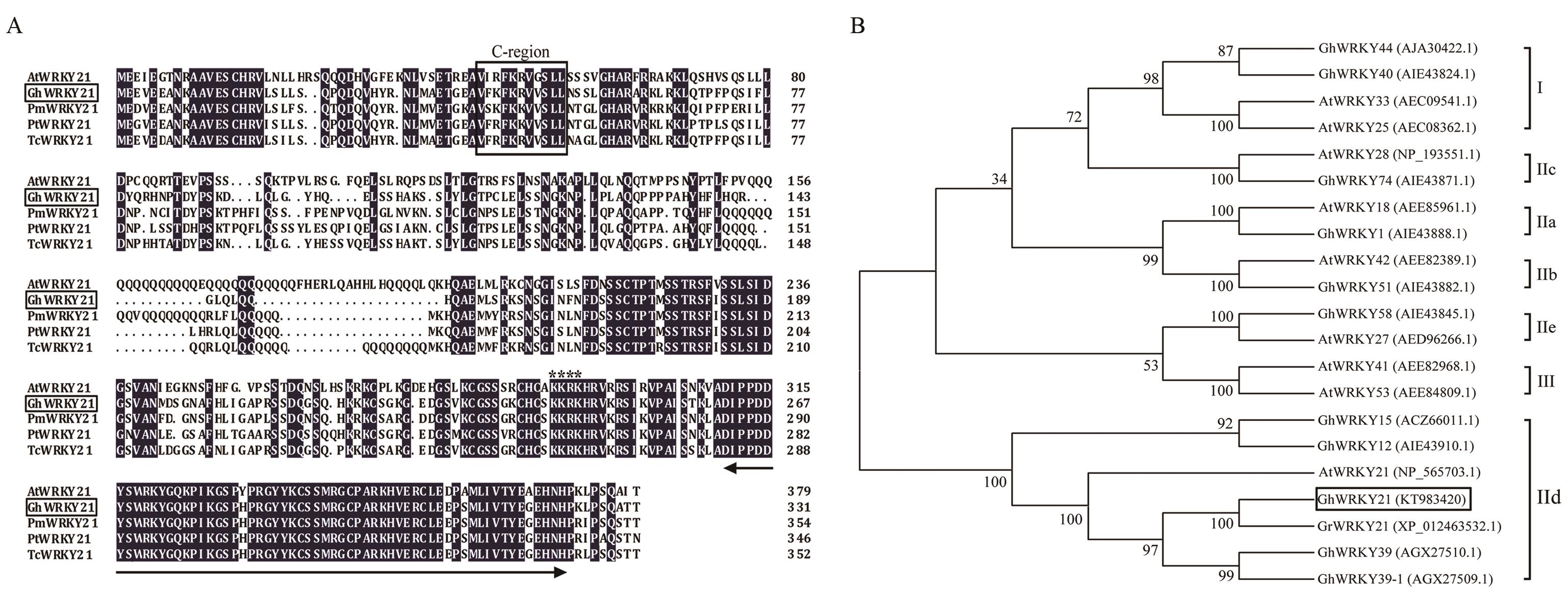
Fig. 1 Amino acid sequence alignment (A) and phylogenetic analysis (B) of WRKY21 from different speciesA: Amino acid sequence homology comparison of GhWRKY21 from Gossypium hirsutum, AtWRKY21 from Arabidopsis thaliana, PmWRKY21 from pine, PtWRKY21 from poplar, and TcWRKY21 from Taxus chinensis. The black regions indicate the same amino acids, where the 60-amino-acid WRKY domain is marked by a double-headed arrow. The boxed sequences are the highly conserved amino-acid sequence WRKYGQK and the conserved C-terminal motif. The putative nuclear localization signal, KKRK, is marked by asterisks (****). B: The phylogenetic tree shows the seven subgroups of the WRKY family. The position of GhWRKY21 is marked with a black rectangular box. The tree was constructed using MEGA 5.0
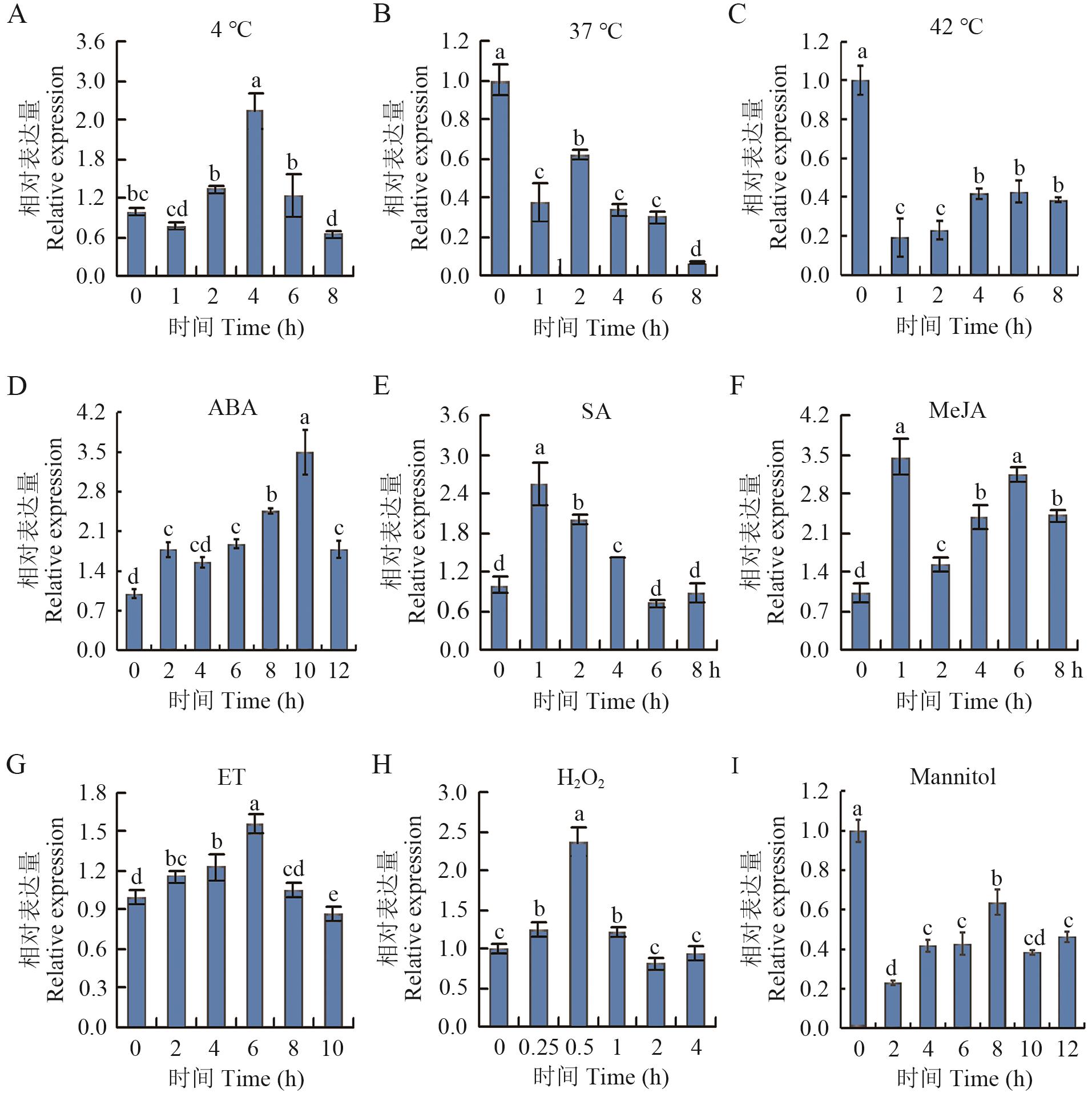
Fig. 2 Expression pattern analysis of GhWRKY21 in cottonData are presented as the mean±standard error (SE) of three independent experiments. Different letters above the error bars indicate statistically significant differences among groups (P<0.05) based on Tukey’s HSD test. The same below
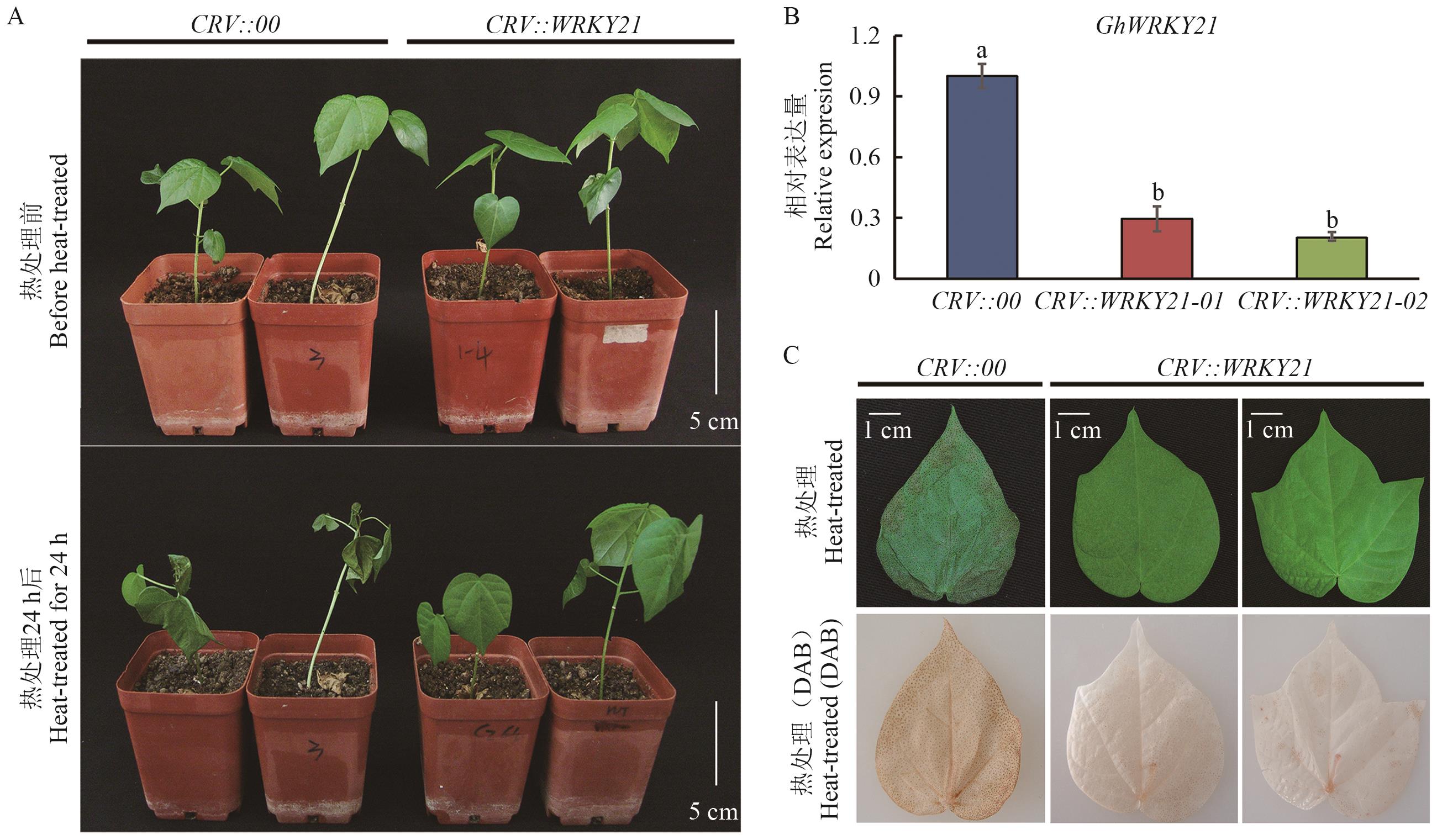
Fig. 3 Silencing of GhWRKY21 enhances heat tolerance in cottonA: Representative phenotypes of GhWRKY21-silenced cotton plants after heat stress (42 ℃, 24 h). B: Relative expression of GhWRKY21 in GhWRKY21-silenced cotton. C: Representative leaf phenotypes of GhWRKY21-silenced cotton plants after heat treatment (42 ℃, 24 h)
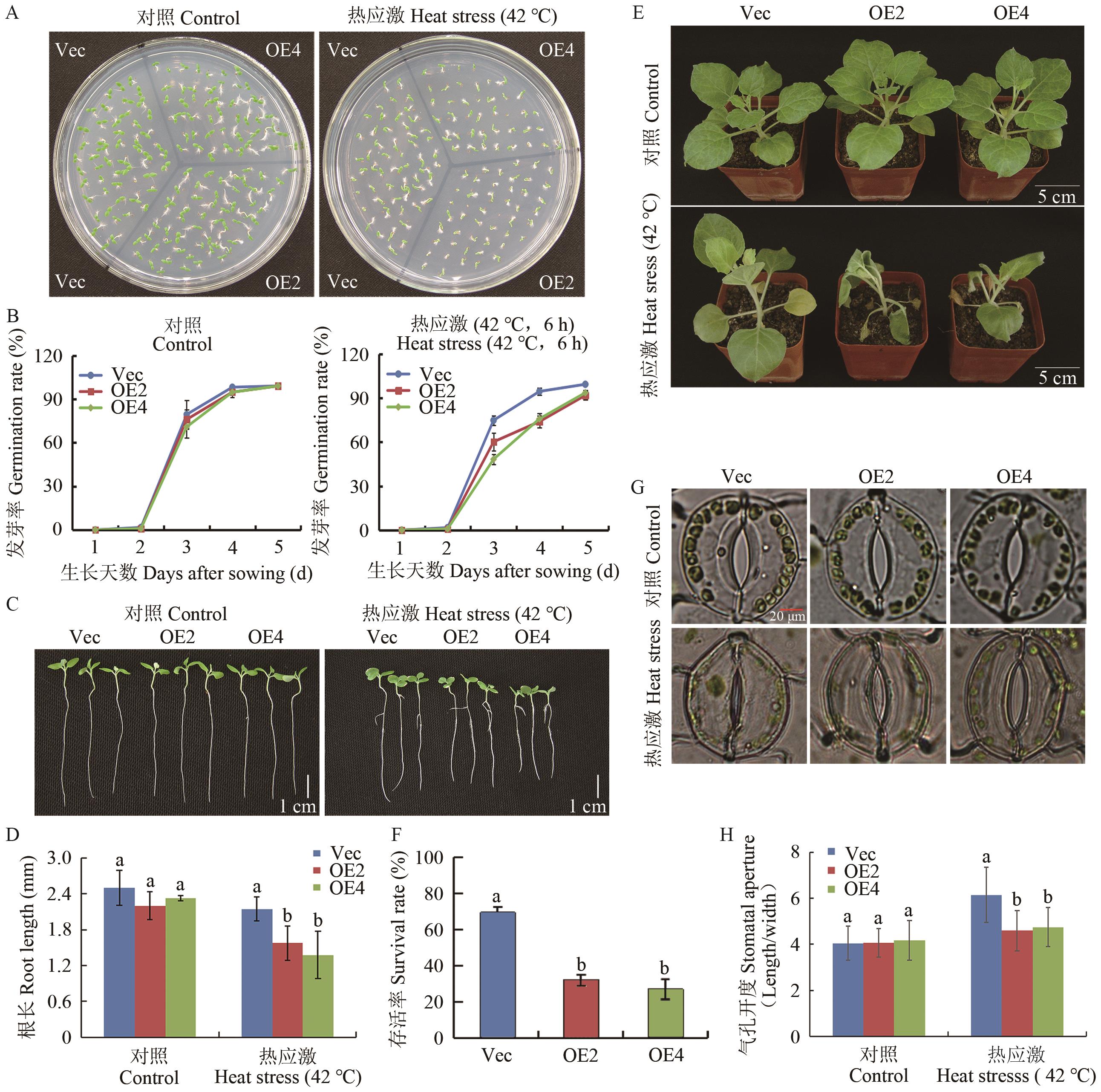
Fig. 4 Overexpression of GhWRKY21 increases the sensitivity to heat stress in transgenic plantsA, B: Seed germination phenotype and germination rates of Vec and OE tobacco lines exposed to heat stress (42 ℃, 6 h). C, D: Root length phenotype and statistical analysis of empty vector control and transgenic seeds after germination, exposed to heat stress (42 ℃) for 6 days. E: Phenotypes of Vec and OE plants grown to 8 weeks after 12 h high-temperature treatment (42 ℃). F: Survival rates of 8-week-old Vec and OE after a 12 h high-temperature treatment (42 ℃) followed by recovery under normal growth conditions. G, H: Stomatal closure degree of Vec and OE lines under heat stress (42 ℃, 12 h)
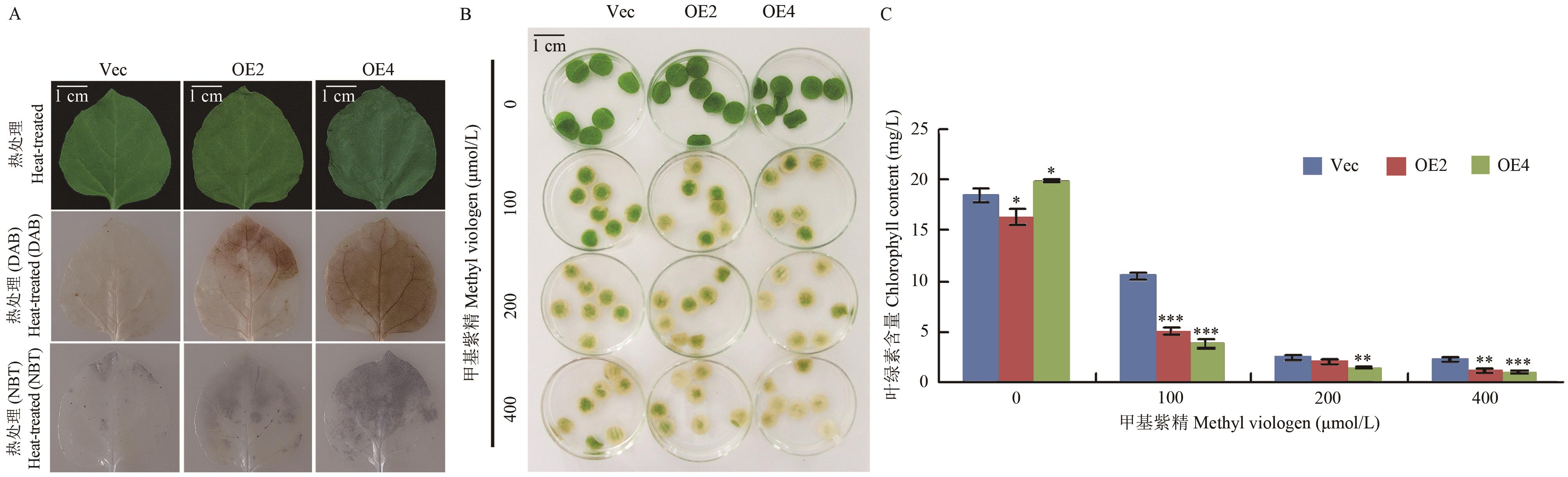
Fig. 5 Overexpression of GhWRKY21 increases the sensitivity of transgenic tobacco plants to oxidative stressA: Representative phenotypes of leaves from Vec and OE plants showing DAB and NBT staining after heat treatment. B: Phenotypes of leaf discs obtained from Vec and OE plants after being incubated in different concentrations of MV. C: The chlorophyll content of tobacco leaf discs from empty vector control and transgenic plants under different concentrations was quantified in Fig. B. Tukey’s HSD test, * P<0.05, ** P<0.01, and *** P<0.001
| [1] | Yamasaki K, Kigawa T, Inoue M, et al. Structures and evolutionary origins of plant-specific transcription factor DNA-binding domains [J]. Plant Physiol Biochem, 2008, 46(3): 394-401. |
| [2] | Eulgem T, Rushton PJ, Robatzek S, et al. The WRKY superfamily of plant transcription factors [J]. Trends Plant Sci, 2000, 5(5): 199-206. |
| [3] | Jiang YJ, Liang G, Yu DQ. Activated expression of WRKY57 confers drought tolerance in Arabidopsis [J]. Mol Plant, 2012, 5(6): 1375-1388. |
| [4] | Yan HR, Jia HH, Chen XB, et al. The cotton WRKY transcription factor GhWRKY17 functions in drought and salt stress in transgenic Nicotiana benthamiana through ABA signaling and the modulation of reactive oxygen species production [J]. Plant Cell Physiol, 2014, 55(12): 2060-2076. |
| [5] | Yan Y, Jia HH, Wang F, et al. Overexpression of GhWRKY27a reduces tolerance to drought stress and resistance to Rhizoctonia solani infection in transgenic Nicotiana benthamiana [J]. Front Physiol, 2015, 6: 265. |
| [6] | 胡启瑞, 宋桂成, 王雪姣, 等. 高温对陆地棉花粉萌发及棉铃发育的影响 [J]. 新疆农业大学学报, 2017, 40(1): 1-7. |
| Hu QR, Song GC, Wang XJ, et al. Effects of high temperature on pollen germination and boll development in upland cotton [J]. J Xinjiang Agric Univ, 2017, 40(1): 1-7. | |
| [7] | 刘群, 陈振, 张巨松, 等. 高温胁迫对海岛棉光合生理及棉铃发育的影响 [J]. 西北植物学报, 2020(9): 1574-1581. |
| Liu Q, Chen Z, Zhang JS, et al. Effect of high temperature stress on photosynthetic physiology and boll development of island cotton [J]. Acta Bot Boreali Occidentalia Sin, 2020(9): 1574-1581. | |
| [8] | Cottee NS, Tan DKY, Bange MP, et al. Multi-level determination of heat tolerance in cotton (Gossypium hirsutum L.) under field conditions [J]. Crop Sci, 2010, 50(6): 2553-2564. |
| [9] | Song GC, Wang MM, Zeng B, et al. Anther response to high-temperature stress during development and pollen thermotolerance heterosis as revealed by pollen tube growth and in vitro pollen vigor analysis in upland cotton [J]. Planta, 2015, 241(5): 1271-1285. |
| [10] | Min L, Li YY, Hu Q, et al. Sugar and auxin signaling pathways respond to high-temperature stress during anther development as revealed by transcript profiling analysis in cotton [J]. Plant Physiol, 2014, 164(3): 1293-1308. |
| [11] | Pettigrew WT. The effect of higher temperatures on cotton lint yield production and fiber quality [J]. Crop Sci, 2008, 48(1): 278-285. |
| [12] | 王佳玉. 棉花转录因子GhWRKY21调控植株抗旱和耐高温的分子机理研究 [D]. 泰安: 山东农业大学, 2020. |
| Wang JY. Moleculor mechanism of cotton GhWRKY21 transcription factor regulating plant drought and high temperature resistance [D]. Tai’an: Shandong Agricultural University, 2020. | |
| [13] | Journot-Catalino N, Somssich IE, Roby D, et al. The transcription factors WRKY11 and WRKY17 act as negative regulators of basal resistance in Arabidopsis thaliana [J]. Plant Cell, 2006, 18(11): 3289-3302. |
| [14] | Cai RH, Zhao Y, Wang YF, et al. Overexpression of a maize WRKY58 gene enhances drought and salt tolerance in transgenic rice [J]. Plant Cell Tiss Organ Cult, 2014, 119(3): 565-577. |
| [15] | Wang CT, Ru JN, Liu YW, et al. Maize WRKY transcription factor ZmWRKY106 confers drought and heat tolerance in transgenic plants [J]. Int J Mol Sci, 2018, 19(10): 3046. |
| [16] | Ma JL, Wang YY, Hong YH, et al. SlWRKY55 coordinately acts with SlVQ11 to enhance tomato thermotolerance by activating SlHsfA2 [J]. Plant J, 2024, 119(6): 2904-2918. |
| [17] | Zhang ZJ, Yang C, Xi J, et al. The MdHSC70-MdWRKY75 module mediates basal apple thermotolerance by regulating the expression of heat shock factor genes [J]. Plant Cell, 2024, 36(9): 3631-3653. |
| [18] | Shi WN, Hao LL, Li J, et al. The Gossypium hirsutum WRKY gene GhWRKY39-1 promotes pathogen infection defense responses and mediates salt stress tolerance in transgenic Nicotiana benthamiana [J]. Plant Cell Rep, 2014, 33(3): 483-498. |
| [19] | Wang JY, Wang LJ, Yan Y, et al. GhWRKY21 regulates ABA-mediated drought tolerance by fine-tuning the expression of GhHAB in cotton [J]. Plant Cell Rep, 2021, 40(11): 2135-2150. |
| [20] | Mittler R, Zandalinas SI, Fichman Y, et al. Reactive oxygen species signalling in plant stress responses [J]. Nat Rev Mol Cell Biol, 2022, 23(10): 663-679. |
| [21] | Averill-Bates D. Reactive oxygen species and cell signaling. Review [J]. Biochim Biophys Acta BBA Mol Cell Res, 2024, 1871(2): 119573. |
| [22] | Li SH, Liu S, Zhang Q, et al. The interaction of ABA and ROS in plant growth and stress resistances [J]. Front Plant Sci, 2022, 13: 1050132. |
| [23] | Waszczak C, Carmody M, Kangasjärvi J. Reactive oxygen species in plant signaling [J]. Annu Rev Plant Biol, 2018, 69: 209-236. |
| [24] | Miller G, Suzuki N, Ciftci-Yilmaz S, et al. Reactive oxygen species homeostasis and signalling during drought and salinity stresses [J]. Plant Cell Environ, 2010, 33(4): 453-467. |
| [1] | ZHU Yun-tao, DU Yi-fan, ZUO Shi-min, XIONG Ye-hui. Research Progress in the Regulation of Plant Growth, Development, and Stress Responses by Small Peptide Hormones EPFs/EPFLs [J]. Biotechnology Bulletin, 2026, 42(9): 82-92. |
| [2] | LIU Yang, BAI Yi-fan, CHEN Wei, ZHOU Jing-jing, CAI Hua, SI Hong-qi. Screening for TaXI-Ⅳ Interacting Proteins in Wheat and Validation of Its Interaction with TaHRLI-4D [J]. Biotechnology Bulletin, 2026, 42(9): 286-296. |
| [3] | CHEN Ning-yi, WU Wen-tong, ZHAO Guo-chun, JIA Li-ming, CHEN Zhong. Functional Study of SmHD-ZIP25 and SmHD-ZIP29 Genes in Flower Development of Sapindus mukorossi [J]. Biotechnology Bulletin, 2026, 42(9): 210-220. |
| [4] | LIU Na-wei, QIAN Meng-ying, ZHANG Hong-ying, WANG Zhao-jun, CUI Hong, YAN Xiao-xiao. NtWUN Negatively Regulates Tobacco Trichome Development [J]. Biotechnology Bulletin, 2026, 42(9): 128-136. |
| [5] | LIU Yang, Xu Zuo-peng, ZHANG Hong-gen, Liu Qiao-quan, Tang Shu-zhu. Research Progress on Cytoplasmic Male Sterility and Fertility Restoration in Rice [J]. Biotechnology Bulletin, 2026, 42(9): 29-41. |
| [6] | LIU Jia, MENG Yu, JING Xiao-yan. Single-cell Raman Spectroscopy Reveals the Inorganic Carbon Source Utilization Preference of Synechocystis sp. PCC7942 [J]. Biotechnology Bulletin, 2026, 42(8): 331-340. |
| [7] | LYU Hong-zhen, XU Li-li, ZHANG Lin, GAO Min, TAN Zhen-wei, WANG Ya-wen, ZHANG Xiu-ge⁵ WANG Shuo⁶ MA Ai-jun, WANG Cheng-min. Screening and Optimization of High-efficiency Phosphate-solubilizing Bacteria and Wheat Growth Promotion in Slightly Alkaline Soil [J]. Biotechnology Bulletin, 2026, 42(8): 263-275. |
| [8] | LYU Zheng, LIAN Ru-ying, LIU Yi-de, LIU Yi-ke, NING Qiang, WANG Shu-ping. Wheat HD-Zip Gene Family: Identification and Response to Fusarium graminearum [J]. Biotechnology Bulletin, 2026, 42(8): 123-132. |
| [9] | ZHANG Zhong-wen, WANG Wei-min, XIAO Zhi-liang, SHI Jiu-chang, HAO Xian-wei, WANG Wei, XIE Peng-gang, XU Jia-dan, ZHAO Jiong-ping, YANG Ai-guo. Mechanism of NtPLA2A-mediated Hormone Signaling Pathway in Enhancing Tobacco Resistance to Bacterial Wilt [J]. Biotechnology Bulletin, 2026, 42(8): 207-216. |
| [10] | CHEN Yi-yan, ZHANG Dong-er, ZHANG Tao, LIU Yu-hao, TANG Jie, SHENG Xia-bing, HU Yuan-yi, AI Zhi-yong, LI Ying-jiang, LIU Xiao-lin. Analysis on Function of Rice OsSULTR2;2 and Regulation of Seedling Tolerance to Salt [J]. Biotechnology Bulletin, 2026, 42(7): 116-125. |
| [11] | YOU Xin, WANG Xi, ZHANG Xin-yu, WEI Xu-ying, CHENG Hua, CAI Jun-huo. Analysis of Response of Lycoris radiata Leaves to Heat Stress Revealed by Untargeted Metabolomics [J]. Biotechnology Bulletin, 2026, 42(7): 173-181. |
| [12] | ZHAO Wen-juan, LI Hui, YANG Xue-ying, WANG Zhao-lu, ZHU Jian-bo. Establishment of a Genetic Transformation System for Potato ‘Xinjiang No. 2’ [J]. Biotechnology Bulletin, 2026, 42(6): 87-97. |
| [13] | ZHAI Ying, GAO Shuang, JI Jun-jie, YU Hai-wei, ZHAO Yan, MA Tian-yi, ZHANG Mei-juan, LI Shan-shan. Study on the Drought Resistance Function of the Transcription Factor CsMYB12 Gene in Industrial Hemp [J]. Biotechnology Bulletin, 2026, 42(6): 294-303. |
| [14] | WU Xia-ming, LIU Chuan-he, HE Han, ZHOU Chen-ping, YANG Min, KUANG Rui-bin, XU Ze, WEI Yue-rong. Research Progress in Molecular Response Mechanisms of Strawberry to High-Temperature Stress [J]. Biotechnology Bulletin, 2026, 42(6): 175-185. |
| [15] | WANG Jiang-qing, ZHANG Die, WANG Hui-jie, YUAN Zhu-dong, FU Yan-hong, HUANG Ya-nan, WANG Hong-yang. Identification of the AP2/ERF Gene Family in Potato and Expression Analysis in Response to Phytophthora infestans Stress [J]. Biotechnology Bulletin, 2026, 42(6): 116-127. |
| Viewed | ||||||
|
Full text |
|
|||||
|
Abstract |
|
|||||
