







Biotechnology Bulletin ›› 2026, Vol. 42 ›› Issue (8): 239-250.doi: 10.13560/j.cnki.biotech.bull.1985.2025-1432
LIU Rou-zhi, WU Jia-qi, WU Hui-ye, YUAN Jing-yi, CHENG Tang-ren, ZHANG Qi-xiang, YUAN Cun-quan( )
)
Received:2025-12-28
Online:2026-08-26
Published:2026-08-17
Contact:
YUAN Cun-quan
E-mail:yuancunquan@bjfu.edu.cn
LIU Rou-zhi, WU Jia-qi, WU Hui-ye, YUAN Jing-yi, CHENG Tang-ren, ZHANG Qi-xiang, YUAN Cun-quan. Comparative Analysis of Chloroplast Genome Characteristics among Three Cultivated Types of Chrysanthemum Varieties[J]. Biotechnology Bulletin, 2026, 42(8): 239-250.
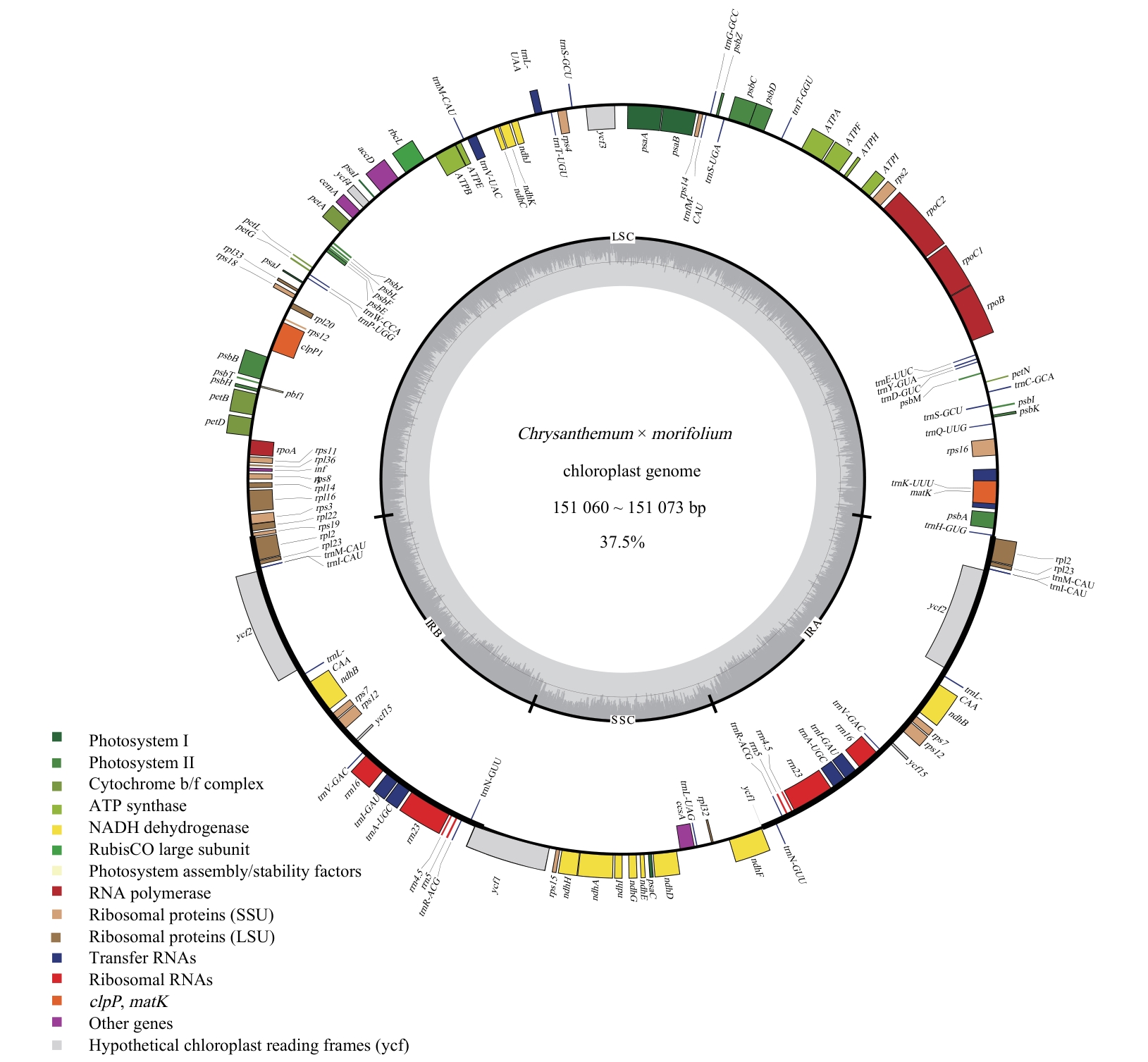
Fig. 1 Chloroplast genome structural map of three chloroplast genomes of C. morifolium
品种名 Cultivar | 栽培类型 Cultivated type | 登录号 GenBank accession No. | 碱基长度 Base length (bp) | LSC length (bp) | SSC length (bp) | IR length (bp) | GC含量 GC content (%) | tRNA | rRNA | 蛋白编码 基因 PCGs | 基因数 No. of genes |
|---|---|---|---|---|---|---|---|---|---|---|---|
| C. morifolium ‘Bei Lin Qiu Yun’ | 地被菊 Groundcover chrysanthemum | PX591007 | 151 073 | 82 843 | 18 324 | 49 906 | 37.5 | 37 | 8 | 86 | 131 |
| C.morifolium ‘Sheng Xue’ | 单头切花菊 Single-headed cut chrysanthemum | PX662740 | 151 060 | 82 858 | 18 294 | 49 908 | 37.5 | 37 | 8 | 86 | 131 |
| C. morifolium ‘Fen Shi Ba’ | 传统大菊 Traditional large-flowered chrysanthemum | PX635362 | 151 060 | 82 858 | 18 294 | 49 908 | 37.5 | 37 | 8 | 86 | 131 |
Table 1 Chloroplast genome information of C. morifolium
品种名 Cultivar | 栽培类型 Cultivated type | 登录号 GenBank accession No. | 碱基长度 Base length (bp) | LSC length (bp) | SSC length (bp) | IR length (bp) | GC含量 GC content (%) | tRNA | rRNA | 蛋白编码 基因 PCGs | 基因数 No. of genes |
|---|---|---|---|---|---|---|---|---|---|---|---|
| C. morifolium ‘Bei Lin Qiu Yun’ | 地被菊 Groundcover chrysanthemum | PX591007 | 151 073 | 82 843 | 18 324 | 49 906 | 37.5 | 37 | 8 | 86 | 131 |
| C.morifolium ‘Sheng Xue’ | 单头切花菊 Single-headed cut chrysanthemum | PX662740 | 151 060 | 82 858 | 18 294 | 49 908 | 37.5 | 37 | 8 | 86 | 131 |
| C. morifolium ‘Fen Shi Ba’ | 传统大菊 Traditional large-flowered chrysanthemum | PX635362 | 151 060 | 82 858 | 18 294 | 49 908 | 37.5 | 37 | 8 | 86 | 131 |
功能 Functions | 基因分组 Gene grouping | 基因名 Gene name |
|---|---|---|
自我复制 Self-replication | 核糖体大亚基 Large ribosomal subunit | rpl32, rpl23(2), rpl2*(2), rpl22, rpl16, rpl14, rpl36, rpl20, rpl33 |
| 核糖体小亚基 Small ribosomal subunit | rps15, rps12, rps12-5end*, rps12-3end*, rps7(2), rps19, rps3, rps8, rps11, rps18, rps4, rps14, rps2, rps16* | |
| RNA聚合酶 RNA polymerase | rpoA, rpoC2, rpoC1, rpoB | |
| 核糖体RNA Ribosomal RNA | rrn5(2), rrn4.5(2), rrn23(2), rrn16(2) | |
| 转运RNA Transfer RNA | trnL-UAG, trnN-GUU(2), trnR-ACG(2), trnA-UGC*(2), trnI-GAU(2)*, trnI-CAU(2), trnV-GAC(2), trnL-CAA(2), trnM-CAU(2), trnP-UGG, trnW-CCA, trnV-UAC*, trnF-GAA, trnL-UAA*, trnT-UGU, trnS-GGA, trnG-GCC, trnS-UGA, trnT-GGU, trnG-UCC*, trnR-UCU, trnE-UUC, trnY-GUA, trnD-GUC, trnC-GCA, trnS-GCU, trnQ-UUG, trnK-UUU*, trnH-GUG | |
光合作用 Photosynthesis | 光系统I基因 Photosystem I gene | psaC, psaJ, psaI, psaA, psaB |
| 光系统II基因 Photosystem II gene | psbH,,psbT, psbB, psbE, psbF, psbL, psbJ, psbZ, psbC, psbD, psbM, psbI, psbK, psbA | |
NADH氧化还原酶 NADH dehydrogenase | ndhH, ndhA, ndhI, ndhG, ndhE, ndhD, ndhF, ndhB*(2), ndhC, ndhK, ndhJ | |
细胞色素复合物基因 Cytochrome complex gene | petB*, petG, petL, petA, petN | |
| ATP合酶 ATP synthase | atpB, atpE, atpA, atpF*, atpH, atpI | |
| Rubisco大亚基 Large subunit of Rubisco | rbcL | |
其他基因 Other gene | 成熟酶 Maturase | matK |
翻译起始因子 Translational initiation factor | infA | |
| 蛋白酶 Protease | clpP1** | |
| 被膜蛋白 Envelop membrane protein | cemA | |
乙酰辅酶A亚基 Acetyl-CoA carboxylase subunit | accD | |
C型细胞色素合成基因 C-type cytochrome synthesis gene | ccsA | |
| 功能未知基因Genes of unknown function | 保守的假定叶绿体开放阅读框ORF Conserved hypothetical chloroplast ORF | ycf1, φycf1, ycf15(2), ycf2(2), ycf3**, ycf4 |
Table 2 Functional annotation and classification of genes in the chloroplast genome of C. morifolium
功能 Functions | 基因分组 Gene grouping | 基因名 Gene name |
|---|---|---|
自我复制 Self-replication | 核糖体大亚基 Large ribosomal subunit | rpl32, rpl23(2), rpl2*(2), rpl22, rpl16, rpl14, rpl36, rpl20, rpl33 |
| 核糖体小亚基 Small ribosomal subunit | rps15, rps12, rps12-5end*, rps12-3end*, rps7(2), rps19, rps3, rps8, rps11, rps18, rps4, rps14, rps2, rps16* | |
| RNA聚合酶 RNA polymerase | rpoA, rpoC2, rpoC1, rpoB | |
| 核糖体RNA Ribosomal RNA | rrn5(2), rrn4.5(2), rrn23(2), rrn16(2) | |
| 转运RNA Transfer RNA | trnL-UAG, trnN-GUU(2), trnR-ACG(2), trnA-UGC*(2), trnI-GAU(2)*, trnI-CAU(2), trnV-GAC(2), trnL-CAA(2), trnM-CAU(2), trnP-UGG, trnW-CCA, trnV-UAC*, trnF-GAA, trnL-UAA*, trnT-UGU, trnS-GGA, trnG-GCC, trnS-UGA, trnT-GGU, trnG-UCC*, trnR-UCU, trnE-UUC, trnY-GUA, trnD-GUC, trnC-GCA, trnS-GCU, trnQ-UUG, trnK-UUU*, trnH-GUG | |
光合作用 Photosynthesis | 光系统I基因 Photosystem I gene | psaC, psaJ, psaI, psaA, psaB |
| 光系统II基因 Photosystem II gene | psbH,,psbT, psbB, psbE, psbF, psbL, psbJ, psbZ, psbC, psbD, psbM, psbI, psbK, psbA | |
NADH氧化还原酶 NADH dehydrogenase | ndhH, ndhA, ndhI, ndhG, ndhE, ndhD, ndhF, ndhB*(2), ndhC, ndhK, ndhJ | |
细胞色素复合物基因 Cytochrome complex gene | petB*, petG, petL, petA, petN | |
| ATP合酶 ATP synthase | atpB, atpE, atpA, atpF*, atpH, atpI | |
| Rubisco大亚基 Large subunit of Rubisco | rbcL | |
其他基因 Other gene | 成熟酶 Maturase | matK |
翻译起始因子 Translational initiation factor | infA | |
| 蛋白酶 Protease | clpP1** | |
| 被膜蛋白 Envelop membrane protein | cemA | |
乙酰辅酶A亚基 Acetyl-CoA carboxylase subunit | accD | |
C型细胞色素合成基因 C-type cytochrome synthesis gene | ccsA | |
| 功能未知基因Genes of unknown function | 保守的假定叶绿体开放阅读框ORF Conserved hypothetical chloroplast ORF | ycf1, φycf1, ycf15(2), ycf2(2), ycf3**, ycf4 |
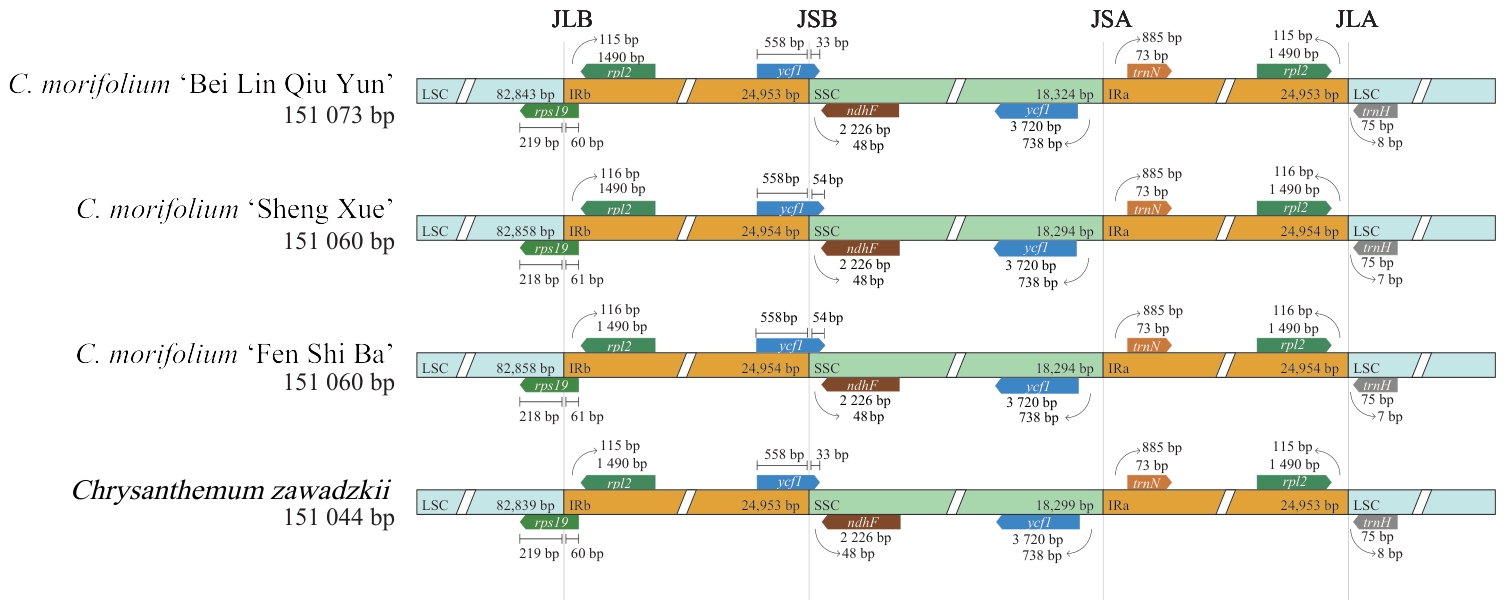
Fig. 2 IR/SC boundary analysis of the chloroplast genome of C. morifolium
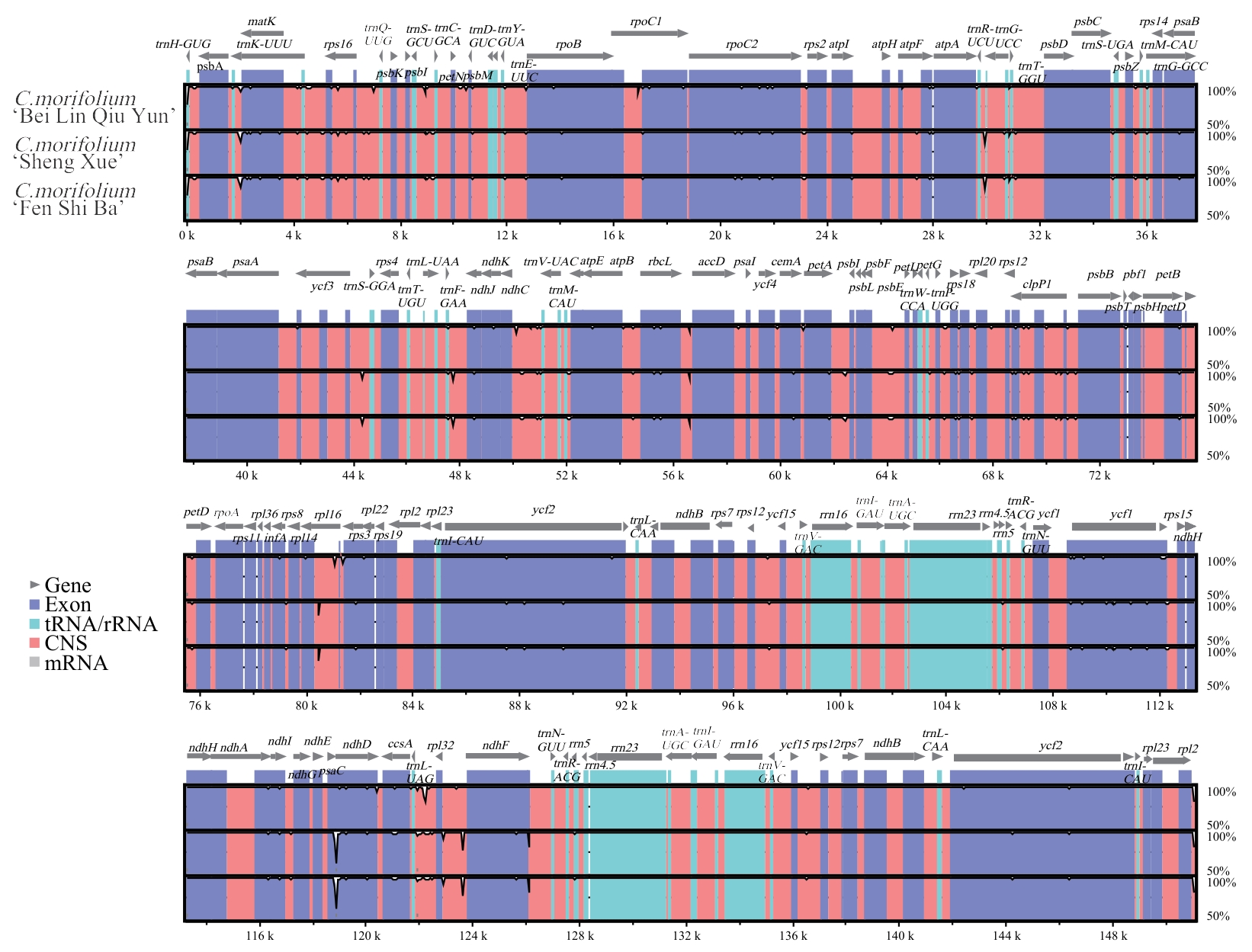
Fig. 3 Global alignment analysis of chloroplast genomes of C. morifolium
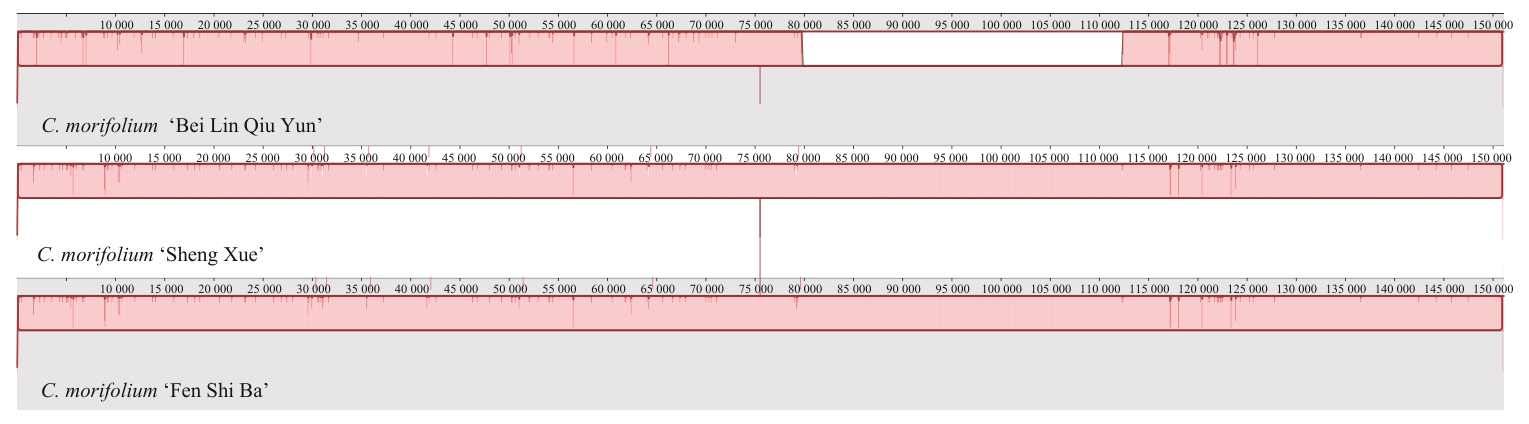
Fig. 4 Collinearity analysis of the chloroplast genome of C. morifolium
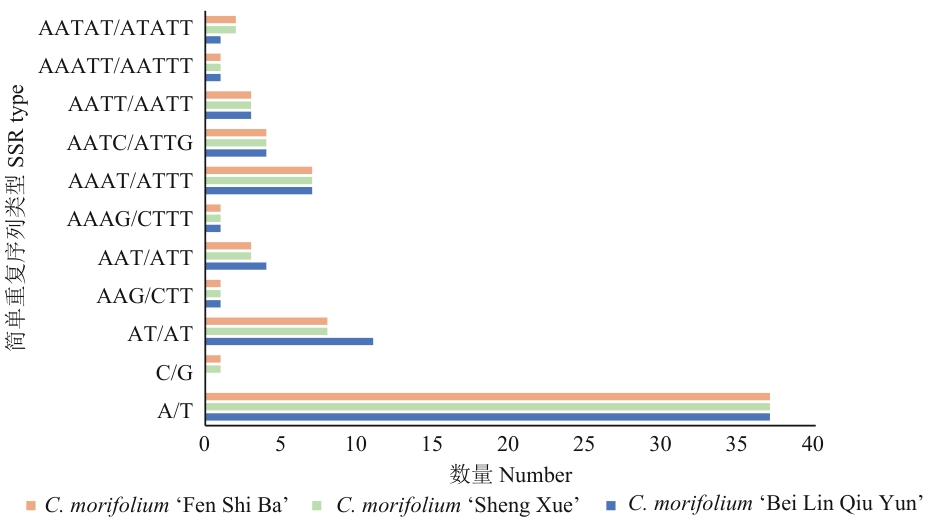
Fig. 5 Types of simple sequence repeats in the chloroplast genome of C. morifolium
| 品种名 Cultivar | 密码子适应指数CAI | 密码子偏性指数CBI | 有效密码子数ENC | GC1 (%) | GC2 (%) | GC3 (%) |
|---|---|---|---|---|---|---|
| C. morifolium ‘Bei Lin Qiu Yun’ | 0.168 | -0.107 | 49.127 | 45.95 | 38.05 | 29.08 |
| C. morifolium ‘Sheng Xue’ | 0.169 | -0.102 | 49.420 | 46.64 | 38.70 | 29.46 |
| C. morifolium ‘Fen Shi Ba’ | 0.169 | -0.103 | 49.407 | 46.89 | 38.88 | 29.44 |
Table 3 Basic parameters of codon in the chloroplast genome of C. morifolium
| 品种名 Cultivar | 密码子适应指数CAI | 密码子偏性指数CBI | 有效密码子数ENC | GC1 (%) | GC2 (%) | GC3 (%) |
|---|---|---|---|---|---|---|
| C. morifolium ‘Bei Lin Qiu Yun’ | 0.168 | -0.107 | 49.127 | 45.95 | 38.05 | 29.08 |
| C. morifolium ‘Sheng Xue’ | 0.169 | -0.102 | 49.420 | 46.64 | 38.70 | 29.46 |
| C. morifolium ‘Fen Shi Ba’ | 0.169 | -0.103 | 49.407 | 46.89 | 38.88 | 29.44 |
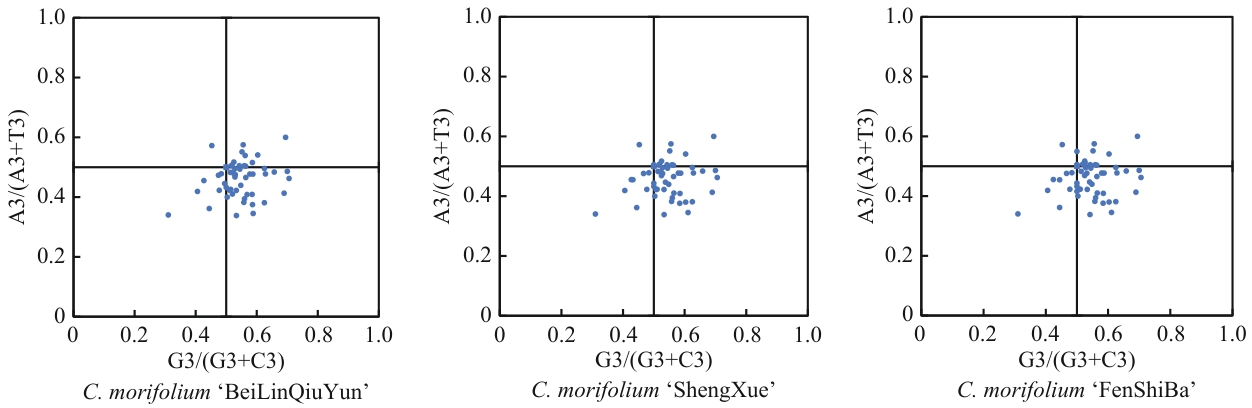
Fig. 6 Analysis of PR2-plot
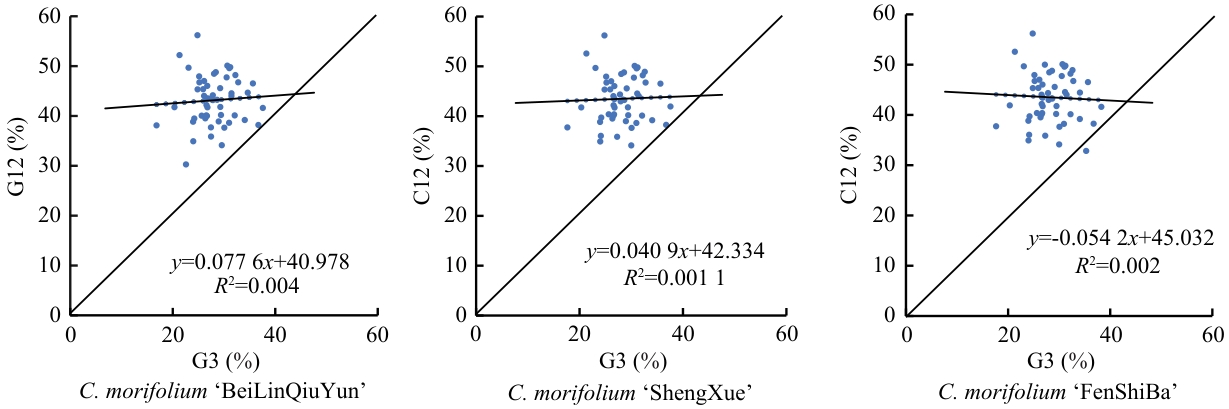
Fig. 7 Analysis of neutrality plot
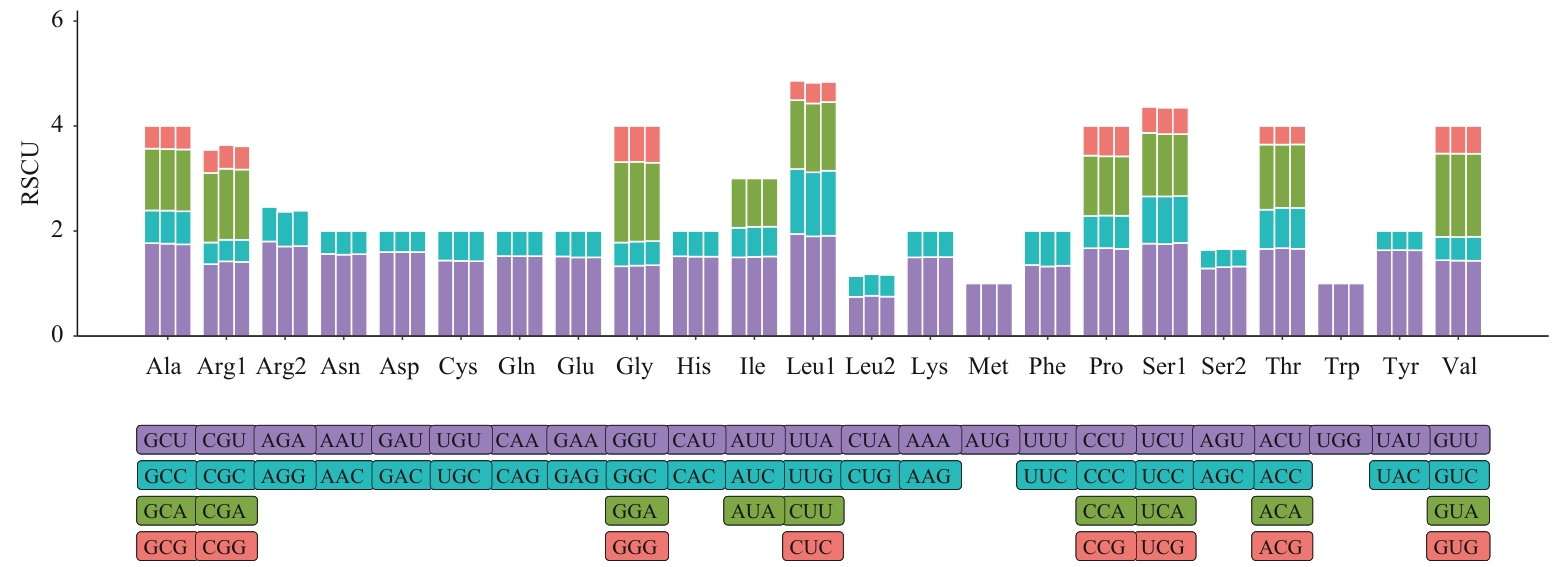
Fig. 8 Relative synonymous codon usage (RSCU) analysisFrom left to right, the bars for each amino acid represent C. morifolium ‘Bei Lin Qiu Yun’, C. morifolium ‘Sheng Xue’, and C. morifolium ‘Fen Shi Ba’
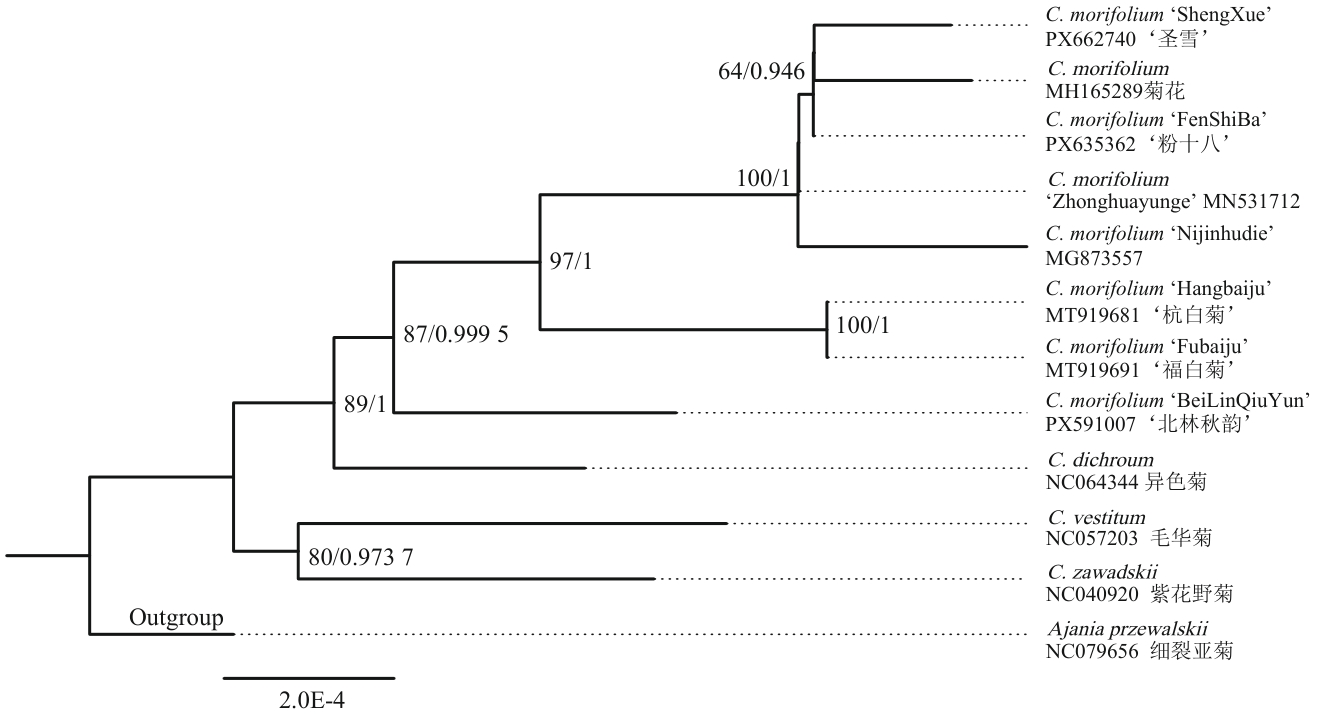
Fig. 9 Phylogenetic relationships of 12 Asteraceae species inferred by maximum likelihood (ML) and Bayesian inference (BI) methodsThe numbers on the branches indicate the support values from the ML and BI methods (BP and PP), respectively
| [1] | Yuan HW, Jiang S, Liu YK, et al. The flower head of Chrysanthemum morifolium Ramat. (Juhua): a paradigm of flowers serving as Chinese dietary herbal medicine [J]. J Ethnopharmacol, 2020, 261: 113043. |
| [2] | Hu J, Ma W, Li N, et al. Antioxidant and anti-inflammatory flavonoids from the flowers of chuju, a medical cultivar of Chrysanthemum morifolim Ramat [J]. J Mex Chem Soc, 2018, 61(4): 282-289. |
| [3] | Pan B, Du YX, Chen QB, et al. China’s Chrysanthemum in the global market: evaluating the international competitiveness and influencing factors [J]. Front Sustain Food Syst, 2025, 9: 1521709. |
| [4] | Van Huylenbroeck J. Ornamental Crops [M]. Cham: Springer International Publishing, 2018. |
| [5] | 李鸿渐, 邵健文. 中国菊花品种资源的调查收集与分类 [J]. 南京农业大学学报, 1990, 13(1): 30-36. |
| Li HJ, Shao JW. Investigation, collection and classification of Chrysanthemum cultivars in China [J]. J Nanjing Agric Univ, 1990, 13(1): 30-36. | |
| [6] | Zhang Y, Luo XY, Zhu J, et al. A classification study for chrysanthemum (Chrysanthemum × grandiflorum Tzvelv.) cultivars based on multivariate statistical analyses [J]. J Sytematics Evolution, 2014, 52(5): 612-628. |
| [7] | Yang YY, Wen C, Ma N, et al. Heterosis and genetic analysis of branching in cut-flower chrysanthemums [J]. Euphytica, 2015, 205(3): 915-925. |
| [8] | 韩勇. 切花菊品质综合评价体系的构建及性状遗传分析 [D]. 南京: 南京农业大学, 2011. |
| Han Y. Study on comprehensive evaluation system of cut chrysanthemum and genetic analysis of main characters [D]. Nanjing: Nanjing Agricultural University, 2011. | |
| [9] | Sun MX, Zhang JY, Lu JS, et al. Intelligent evaluation of ornamental characteristics of garden chrysanthemums using unmanned aerial vehicle (UAV)-based RGB imagery [J]. Sci Hortic, 2025, 350: 114374. |
| [10] | Kirchhoff H. Chloroplast ultrastructure in plants [J]. New Phytol, 2019, 223(2): 565-574. |
| [11] | Li MM, Geng ML, Zhou YF, et al. Integrative chloroplast genomics unravels phylogenetic discordance in Glehnia (Apiaceae) [J]. Ind Crops Prod, 2025, 236: 121978. |
| [12] | Zhao CH, Li XY, Lan X, et al. Cytotype classification and genetic diversity of Platostoma palustre revealed by rDNA localization and chloroplast genome [J]. BMC Genom, 2025, 26: 937. |
| [13] | Yin DM, Wang Y, Zhang XG, et al. Development of chloroplast genome resources for peanut (Arachis hypogaea L.) and other species of Arachis [J]. Sci Rep, 2017, 7: 11649. |
| [14] | Zhu AD, Guo WH, Gupta S, et al. Evolutionary dynamics of the plastid inverted repeat: the effects of expansion, contraction, and loss on substitution rates [J]. New Phytol, 2016, 209(4): 1747-1756. |
| [15] | Park SK, Kwon SJ, Park J, et al. Chloroplast genome of white wild Chrysanthemum, Dendranthema sp. K247003, as genetic barcode [J]. J Species Res, 2015, 4(2): 152-158. |
| [16] | Tyagi S, Jung JA, Kim JS, et al. The complete chloroplast genome of an economic plant, Chrysanthemum morifolium ‘Baekma’ [J]. Mitochondrial DNA Part B, 2019, 4(2): 3133-3134. |
| [17] | Zeng T, Li JW, Fu Q, et al. The complete chloroplast of Chrysanthemum × morifolium ‘fubaiju’ [J]. Mitochondrial DNA Part B, 2021, 6(10): 3062-3063. |
| [18] | Xu YF, Liao BR, Ostevik KL, et al. The maternal donor of Chrysanthemum cultivars revealed by comparative analysis of the chloroplast genome [J]. Front Plant Sci, 2022, 13: 923442. |
| [19] | Parvathy ST, Udayasuriyan V, Bhadana V. Codon usage bias [J]. Mol Biol Rep, 2022, 49(1): 539-565. |
| [20] | 刘慧, 王梦醒, 岳文杰, 等. 糜子叶绿体基因组密码子使用偏性的分析 [J]. 植物科学学报, 2017, 35(3): 362-371. |
| Liu H, Wang MX, Yue WJ, et al. Analysis of codon usage in the chloroplast genome of broomcorn millet (Panicum miliaceum L.) [J]. Plant Sci J, 2017, 35(3): 362-371. | |
| [21] | Jin JJ, Yu WB, Yang JB, et al. GetOrganelle: a fast and versatile toolkit for accurate de novo assembly of organelle genomes [J]. Genome Biol, 2020, 21: 241. |
| [22] | Liu C, Shi LC, Zhu YJ, et al. CpGAVAS, an integrated web server for the annotation, visualization, analysis, and GenBank submission of completely sequenced chloroplast genome sequences [J]. BMC Genom, 2012, 13(1): 715. |
| [23] | Kearse M, Moir R, Wilson A, et al. Geneious Basic: an integrated and extendable desktop software platform for the organization and analysis of sequence data [J]. Bioinformatics, 2012, 28(12): 1647-1649. |
| [24] | Greiner S, Lehwark P, Bock R. OrganellarGenomeDRAW (OGDRAW) version 1.3.1: expanded toolkit for the graphical visualization of organellar genomes [J]. Nucleic Acids Res, 2019, 47(W1): W59-W64. |
| [25] | Li HE, Guo QQ, Xu L, et al. CPJSdraw: analysis and visualization of junction sites of chloroplast genomes [J]. PeerJ, 2023, 11: e15326. |
| [26] | Frazer KA, Pachter L, Poliakov A, et al. VISTA: computational tools for comparative genomics [J]. Nucleic Acids Res, 2004, 32(): W273-W279. |
| [27] | Darling ACE, Mau B, Blattner FR, et al. Mauve: multiple alignment of conserved genomic sequence with rearrangements [J]. Genome Res, 2004, 14(7): 1394-1403. |
| [28] | Thiel T, Michalek W, Varshney R, et al. Exploiting EST databases for the development and characterization of gene-derived SSR-markers in barley (Hordeum vulgare L.) [J]. Theor Appl Genet, 2003, 106(3): 411-422. |
| [29] | Wang ZJ, Cai QW, Wang Y, et al. Comparative analysis of codon bias in the chloroplast genomes of Theaceae species [J]. Front Genet, 2022, 13: 824610. |
| [30] | Sharp PM, Li WH. An evolutionary perspective on synonymous codon usage in unicellular organisms [J]. J Mol Evol, 1986, 24(1/2): 28-38. |
| [31] | 尚明照, 刘方, 华金平, 等. 陆地棉叶绿体基因组密码子使用偏性的分析 [J]. 中国农业科学, 2011, 44(2): 245-253. |
| Shang MZ, Liu F, Hua JP, et al. Analysis on codon usage of chloroplast genome of Gossypium hirsutum [J]. Sci Agric Sin, 2011, 44(2): 245-253. | |
| [32] | 秦政, 郑永杰, 桂丽静, 等. 樟树叶绿体基因组密码子偏好性分析 [J]. 广西植物, 2018, 38(10): 1346-1355. |
| Qin Z, Zheng YJ, Gui LJ, et al. Codon usage bias analysis of chloroplast genome of Camphora tree (Cinnamomum camphora) [J]. Guihaia, 2018, 38(10): 1346-1355. | |
| [33] | Fu LF, Xin ZB, Wen F, et al. Complete chloroplast genome sequence of Elatostema dissectum (Urticaceae) [J]. Mitochondrial DNA Part B, 2019, 4(1): 838-839. |
| [34] | Zhang D, Gao FL, Jakovlić I, et al. PhyloSuite: an integrated and scalable desktop platform for streamlined molecular sequence data management and evolutionary phylogenetics studies [J]. Mol Ecol Resour, 2020, 20(1): 348-355. |
| [35] | Ronquist F, Teslenko M, van der Mark P, et al. MrBayes 3.2: efficient Bayesian phylogenetic inference and model choice across a large model space [J]. Syst Biol, 2012, 61(3): 539-542. |
| [36] | Suchard MA, Lemey P, Baele G, et al. Bayesian phylogenetic and phylodynamic data integration using BEAST 1.10 [J]. Virus Evol, 2018, 4(1): vey016. |
| [37] | Khade YP, Mainkar P, Chandanshive A, et al. Harnessing chloroplast SSRs to decipher genetic diversity in underutilized Allium species [J]. Front Plant Sci, 2025, 16: 1645145. |
| [38] | Xia Y, Hu ZG, Li XW, et al. The complete chloroplast genome sequence of Chrysanthemum indicum [J]. Mitochondrial DNA Part A, 2016, 27(6): 4668-4669. |
| [39] | Baek J, Park S, Lee J, et al. The complete chloroplast genome of Chrysanthemum zawadskii Herbich (Asteraceae) isolated in Korea [J]. Mitochondrial DNA Part B, 2021, 6(7): 1956-1958. |
| [40] | Guo YY, Yang JX, Li HK, et al. Chloroplast genomes of two species of Cypripedium: expanded genome size and proliferation of AT-biased repeat sequences [J]. Front Plant Sci, 2021, 12: 609729. |
| [41] | Ma YP, Chen MM, Wei JX, et al. Origin of Chrysanthemum cultivars—Evidence from nuclear low-copy LFY gene sequences [J]. Biochem Syst Ecol, 2016, 65: 129-136. |
| [42] | Yang Z, Ma WX, Yang XH, et al. Plastome phylogenomics provide new perspective into the phylogeny and evolution of Betulaceae (Fagales) [J]. BMC Plant Biol, 2022, 22: 611. |
| [43] | Meng XX, Xian YF, Xiang L, et al. Complete chloroplast genomes from Sanguisorba: identity and variation among four species [J]. Molecules, 2018, 23(9): 2137. |
| [44] | Zhang L, Zhang CP, Zhang ED, et al. Hybridization of Lycium qingshuiheense and L. ningxiaense revealed using morphological, SSR markers, and chloroplast genomic data [J]. BMC Genom, 2025, 26: 965. |
| [45] | Gong YH, Qin YL, Luo T, et al. Complete chloroplast genome sequence and phylogenetic analysis of Lactuca sativa var. ramosa hort [J]. Genet Resour Crop Evol, 2025, 72(6): 7531-7546. |
| [46] | Liu X, Zhou BY, Yang HY, et al. Sequencing and analysis of Chrysanthemum carinatum schousb and Kalimeris indica. The complete chloroplast genomes reveal two inversions and rbcL as barcoding of the vegetable [J]. Molecules, 2018, 23(6): 1358. |
| [47] | Wu CW, Liu R, Li CH, et al. Comparative analysis of codon usage bias and phylogenetic relationships in chloroplast genomes across 49 Dendrobium species [J]. BMC Plant Biol, 2025, 25: 1411. |
| [48] | Xie P, Wu JR, Lu MY, et al. Assembly and comparative analysis of the complete mitochondrial genome of Fritillaria ussuriensis Maxim. (Liliales: Liliaceae), an endangered medicinal plant [J]. BMC Genom, 2024, 25: 773. |
| [49] | Yengkhom S, Uddin A, Chakraborty S. Deciphering codon usage patterns and evolutionary forces in chloroplast genes of Camellia sinensis var. assamica and Camellia sinensis var. sinensis in comparison to Camellia pubicosta [J]. J Integr Agric, 2019, 18(12): 2771-2785. |
| [50] | Li RX, Wang B, Xiao SQ, et al. Characterization of the complete chloroplast genome and comparative analysis of the phylogeny and codon usage bias of three Yunnan wild rice species [J]. Front Plant Sci, 2025, 16: 1555104. |
| [51] | Yang R, Xue Y, He XF, et al. Comprehensive analysis of chloroplast genomes in leguminous forage species: codon usage, phylogenetic relationships, and evolutionary insights [J]. Agronomy, 2025, 15(4): 765. |
| [52] | Shi NX, Yuan YW, Huang RJ, et al. Analysis of codon usage patterns in complete plastomes of four medicinal Polygonatum species (Asparagaceae) [J]. Front Genet, 2024, 15: 1401013. |
| [53] | Yao ZL, Miao JS, Xu WD, et al. The complete chloroplast genome sequence of a cultivar of Chrysanthemum, Chrysanthemum × morifolium ‘Hangbaiju’ (Asteraceae) [J]. Mitochondrial DNA Part B, 2024, 9(3): 403-407. |
| [54] | Duan YY, Wang YQ, Ding WY, et al. Comparative and phylogenetic analysis of the chloroplast genomes of four commonly used medicinal cultivars of Chrysanthemums morifolium [J]. BMC Plant Biol, 2024, 24: 992. |
| [55] | Chong XR, Zhang F, Wu YY, et al. A SNP-enabled assessment of genetic diversity, evolutionary relationships and the identification of candidate genes in Chrysanthemum [J]. Genome Biol Evol, 2016, 8(12): 3661-3671. |
| [1] | WANG Zhi, HU Guang-ming, LUO Xuan, GAO Lei, YE Li-xia, HUANG Qiong, XIAO Tao, ZHANG Lei. Chloroplast Genome Characteristics and Phylogenetic Analysis of Actinidia rubricaulis var. coriacea [J]. Biotechnology Bulletin, 2026, 42(8): 173-187. |
| [2] | MENG Hong-yu, LIU Ya-nan, WU Jun-xin, SHEN Qiong. Identification and Analysis of the NAC Transcription Factors Gene Family in Cucurbita moschata Duch. [J]. Biotechnology Bulletin, 2026, 42(6): 237-249. |
| [3] | YANG Dong-sheng, NIU Yu-chi, LU Qian-qian, FAN Jing-yong, LIU Yu-lei, LIU Quan, GUO Li-ping, HAO Shui-yuan. Construction and Analysis of SSR Fingerprint for 29Sorghum sudanense Germplasm Materials [J]. Biotechnology Bulletin, 2026, 42(6): 198-207. |
| [4] | LIANG Hui-qi, CHEN Yi-cun, WANG Yang-dong, ZHAO Yun-xiao, GAO Ming. Identification and Expression Analysis of the PAT1 Gene Subfamily in Litsea cubeba during Graft Union Healing [J]. Biotechnology Bulletin, 2026, 42(5): 302-311. |
| [5] | LI Yu-zhen, LI Meng-dan, ZHANG Wei, PENG Ting. Functional Study of RmEXPB2 Genein Rosa multiflora Based on the Identification of the Expansin Gene Family in Rosa sp. [J]. Biotechnology Bulletin, 2025, 41(9): 182-194. |
| [6] | LU Yao, YUAN Ping-ping, JIN Xin, MAO Xiang-hong, FAN Xiang-bin, BAI Xiao-dong. Genetic Diversity Analysis and Fingerprinting of Wild Potato and Landraces Based on SSR Markers [J]. Biotechnology Bulletin, 2025, 41(9): 94-104. |
| [7] | PEI Hong-xia, WANG Lu-yao, LI Sheng-mei, GAO Jing-xia. Genetic Diversity of 220 Pepper Germplasm Resources Using SCoT, SRAP, and SSR Molecular Markers [J]. Biotechnology Bulletin, 2025, 41(8): 165-174. |
| [8] | WEI Yao, ZHANG Jing-jing, CUI Yun-xiao, LIU Yu, LIU Hai-rui. Phylogenetic Analysis of Lonicera Sect. Nintooa Based on Chloroplast Genomes Data [J]. Biotechnology Bulletin, 2025, 41(8): 276-288. |
| [9] | ZHANG Ze, YANG Xiu-li, NING Dong-xian. Identification of 4CL Gene Family in Arachis hypogaea L. and Expression Analysis in Response to Drought and Salt Stress [J]. Biotechnology Bulletin, 2025, 41(7): 117-127. |
| [10] | DUAN Min-jie, LI Yi-fei, WANG Chun-ping, HUANG Ren-zhong, HUANG Qi-zhong, ZHANG Shi-cai. Association Analysis and Fingerprint Map Construction of Fruit Color Traits in Pepper via SSR Markers [J]. Biotechnology Bulletin, 2025, 41(7): 81-94. |
| [11] | DUAN Yong-hong, YANG Xin, YU Guan-qun, XIA Jun-jun, SONG Lu-shuai, BAI Xiao-dong, PENG Suo-tang. Genetic Diversity and Principal Component Analysis of 125 Potato Germplasm Resources [J]. Biotechnology Bulletin, 2025, 41(6): 130-143. |
| [12] | AN Chang, XU Wen-bo, LU Lin, LI Deng-lin, YAO Yi-xin, LIN Yan-xiang, YANG Cheng-zi, QIN Yuan, ZHENG Ping. Comparative Analysis of Glehnia littoralis from Different Geographic Regions Based on the Characteristics of Chloroplast Genome [J]. Biotechnology Bulletin, 2025, 41(6): 229-242. |
| [13] | LI Bin, SU Xiang-ping, LIU Chang, WANG Yu-bing, ZHANG Yong-hong, ZHOU Chao, XU Qing. Chloroplast Genome Characteristics and Phylogenetic Analysis of Scrophulariaceae [J]. Biotechnology Bulletin, 2025, 41(3): 240-254. |
| [14] | YANG Chen-xin, LI Meng-xiu, JIANG Tang, ZHANG Wen-e, PAN Xue-jun. Identification and Expression Analysis of Anthocyanin-associated R2R3-MYB Genes in Canna indica [J]. Biotechnology Bulletin, 2025, 41(12): 201-213. |
| [15] | DU Yu-qing, JIANG Lu-yuan, WANG Yi-heng, WU Chen-wei, YANG Meng-lu, LIU Xu-sheng, WANG Xiao-jun, QIU De-you, FAN Wei, YANG Yan-fang. Genetic Diversity of Taxus chinensis var. mairei in Taihang Mountains Based on SSR Molecular Markers [J]. Biotechnology Bulletin, 2025, 41(12): 214-224. |
| Viewed | ||||||
|
Full text |
|
|||||
|
Abstract |
|
|||||
