







生物技术通报 ›› 2025, Vol. 41 ›› Issue (8): 242-254.doi: 10.13560/j.cnki.biotech.bull.1985.2024-1212
• 研究报告 • 上一篇
黄诗宇( ), 田姗姗, 杨天为, 高曼熔, 张尚文()
收稿日期:2024-12-16
出版日期:2025-08-26
发布日期:2025-08-14
通讯作者:
张尚文,男,硕士,副研究员,研究方向 :特色药用植物种质资源开发与遗传改良;E-mail: 63838114@qq.com作者简介:黄诗宇,女,助理研究员,研究方向 :特色药用植物种质资源开发与遗传改良;E-mail: 304312246@qq.com基金资助:
HUANG Shi-yu(), TIAN Shan-shan, YANG Tian-wei, GAO Man-rong, ZHANG Shang-wen()
Received:2024-12-16
Published:2025-08-26
Online:2025-08-14
摘要:
目的 鉴定赤苍藤WRI1转录因子,为进一步探究WRI1在油脂合成中的作用提供基础。 方法 基于赤苍藤全基因组数据利用生物信息学方法,鉴定赤苍藤中的WRI1转录因子,基于转录组数据分析WRI1在赤苍藤不同组织中的表达模式。 结果 在赤苍藤鉴定出17个含有2个AP2保守结构域的WRI1蛋白(EsWRI1-1-EsWRI1-17),氨基酸数为359-776,平均分子量为56 kD,多为偏酸性不稳定亲水性蛋白。亚细胞定位显示其多位于细胞核,17个EsWRI1s成员不均匀分布在8条染色体上;蛋白序列系统发育分析结果将17个WRI1蛋白分为9个亚家族(Grooup1-Group9),其中Group3成员与拟南芥、大豆亲缘关系较近,EsWRI1-10与拟南芥亲缘关系最近。EsWRI1s基因家族启动子分析显示,含有较多的生物与非生物胁迫、植物激素响应及植物生长发育相关的基序,其中生长发育相关的元件最多。基因表达模式分析显示,EsWRI1-10、EsWRI1-14、EsWRI1-16基因在未成熟种仁中的表达量高于其他组织,其中EsWRI1-10基因在赤苍藤种仁形成中发挥主要作用;EsWRI1-11、EsWRI1-17、EsWRI1-7在赤苍藤的不同组织中均有较高表达。RT-qPCR验证与转录组数据一致。 结论 共鉴定出17个WRI1基因,编码蛋白均具有良好的热稳定性和亲水性且预测主要定位于细胞核;EsWRI1s基因家族与拟南芥、大豆、蒜头果WRI1都具有较高的同源性;特定基因在未成熟种仁特异性表达,暗示其对种仁生长发育有重要作用,可能在赤苍藤油脂合成中发挥着关键作用。
黄诗宇, 田姗姗, 杨天为, 高曼熔, 张尚文. 赤苍藤WRI1基因家族的全基因组鉴定及表达模式分析[J]. 生物技术通报, 2025, 41(8): 242-254.
HUANG Shi-yu, TIAN Shan-shan, YANG Tian-wei, GAO Man-rong, ZHANG Shang-wen. Genome-wide Identification and Expression Pattern Analysis of WRI1 Gene Family in Erythropalum scandens[J]. Biotechnology Bulletin, 2025, 41(8): 242-254.
| 引物名称 Primer name | 引物序列 Primer sequence F (5′-3′) | 引物序列 Primer sequence R (5′-3′) |
|---|---|---|
| EsWRI1-1 | ATCGGCAGGGGACAATGAG | ATAGAGTCACCCGCACAGGC |
| EsWRI1-2 | AGTAAAATCTGAAGCCAGCCCA | CTCAAACCGTCCAGTCCATCTAT |
| EsWRI1-4 | CAAAGCCGCAAGAACACTACTC | GCCAAACACCCTCCCAATC |
| EsWRI1-5 | CCTCCGTGTCTAATGCCGTT | TGGTAGTACATGCTGTCTAAGCTCA |
| EsWRI1-6 | TGCCGCCAAGAACCCTAA | CCCCACATTCACAAAACCGT |
| EsWRI1-7 | GAGAAGGGGATGGATGTGGA | GCAACCGATGAAGCAGTGG |
| EsWRI1-8 | TCACTATGAAAGCAACGGCAG | TGGGTATTGTGGAACCTGAATCT |
| EsWRI1-9 | AGGATTTTCGGGTTCTCGGT | TGCGAAACCTCCGTAGACTT |
| EsWRI1-10 | CCTACACCCTTCTTCCTGCA | GCATCTCCTCCCTGATCGAA |
| EsWRI1-11 | ACGTCAGAACACCCTCCTTT | GAATGAATGGCAGCAGAGGG |
| EsWRI1-13 | TGGGGTCAGTCATTGCTCAT | TGATCATACCCCGCAACCTT |
| EsWRI1-14 | TTGAGATGAGCCGCTACGAT | AGATGGTGGGAATTGGCTGA |
| EsWRI1-15 | CAACGACGAGGCTTCTGATG | GAAATCCCCTCCTCCACCAA |
| EsWRI1-16 | AAAATGCCACCATCAACCC | TTCCATTGCCACTTCCAACG |
| EsWRI1-17 | TACCCCAATGCCATCACTGT | AAGAAGTGTTGGCGGTTGAC |
| EsWRI1-ACTIN | CTGGACTCTGGTGATGGTGT | AGCTGTAGTGGTGAACGAGT |
表1 引物序列
Table 1 Primer sequences
| 引物名称 Primer name | 引物序列 Primer sequence F (5′-3′) | 引物序列 Primer sequence R (5′-3′) |
|---|---|---|
| EsWRI1-1 | ATCGGCAGGGGACAATGAG | ATAGAGTCACCCGCACAGGC |
| EsWRI1-2 | AGTAAAATCTGAAGCCAGCCCA | CTCAAACCGTCCAGTCCATCTAT |
| EsWRI1-4 | CAAAGCCGCAAGAACACTACTC | GCCAAACACCCTCCCAATC |
| EsWRI1-5 | CCTCCGTGTCTAATGCCGTT | TGGTAGTACATGCTGTCTAAGCTCA |
| EsWRI1-6 | TGCCGCCAAGAACCCTAA | CCCCACATTCACAAAACCGT |
| EsWRI1-7 | GAGAAGGGGATGGATGTGGA | GCAACCGATGAAGCAGTGG |
| EsWRI1-8 | TCACTATGAAAGCAACGGCAG | TGGGTATTGTGGAACCTGAATCT |
| EsWRI1-9 | AGGATTTTCGGGTTCTCGGT | TGCGAAACCTCCGTAGACTT |
| EsWRI1-10 | CCTACACCCTTCTTCCTGCA | GCATCTCCTCCCTGATCGAA |
| EsWRI1-11 | ACGTCAGAACACCCTCCTTT | GAATGAATGGCAGCAGAGGG |
| EsWRI1-13 | TGGGGTCAGTCATTGCTCAT | TGATCATACCCCGCAACCTT |
| EsWRI1-14 | TTGAGATGAGCCGCTACGAT | AGATGGTGGGAATTGGCTGA |
| EsWRI1-15 | CAACGACGAGGCTTCTGATG | GAAATCCCCTCCTCCACCAA |
| EsWRI1-16 | AAAATGCCACCATCAACCC | TTCCATTGCCACTTCCAACG |
| EsWRI1-17 | TACCCCAATGCCATCACTGT | AAGAAGTGTTGGCGGTTGAC |
| EsWRI1-ACTIN | CTGGACTCTGGTGATGGTGT | AGCTGTAGTGGTGAACGAGT |
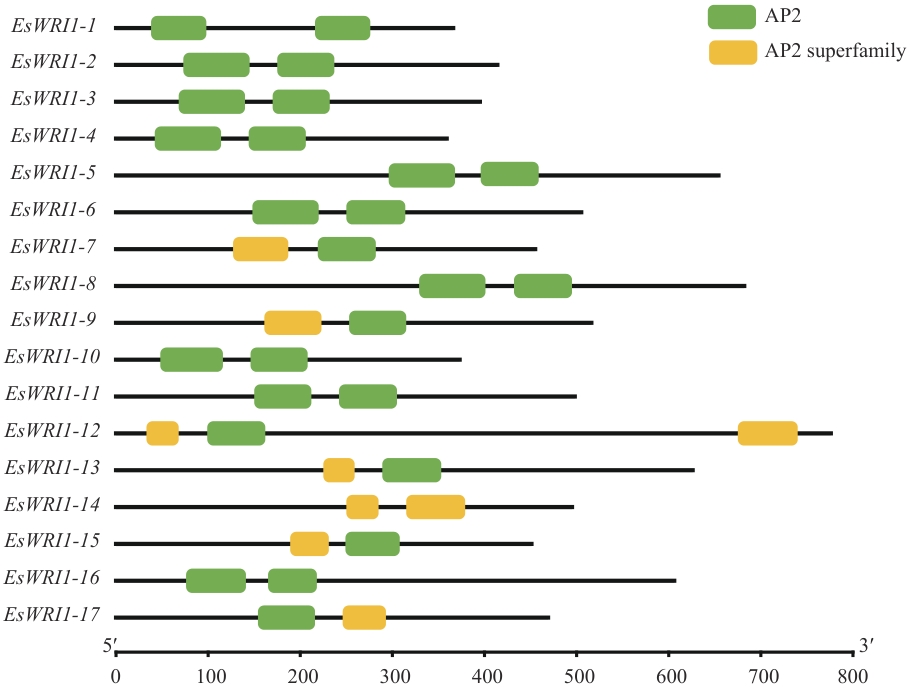
图1 赤苍藤WRI1基因家族结构域分析
Fig. 1 Domain analysis of the E. scandensWRI1 gene family
基因ID Gene ID | 基因名称 Gene name | 氨基酸数量 Number of amino acids | 分子量 Molecular weight (Da) | 理论等电点 Theoretical pI | 不稳定指数 Instability index | 脂肪族氨基酸指数 Aliphatic index | 亲水度 Grand average of hydropathicity | 亚细胞定位预测 Prediction of subcellular localizations |
|---|---|---|---|---|---|---|---|---|
| rna-Esc18949.1 | EsWRI1-1 | 366 | 40 146.65 | 5.63 | 72.25 | 61.45 | -0.684 | 细胞核 |
| rna-Esc20888.1 | EsWRI1-2 | 414 | 46 482.77 | 8.17 | 68.63 | 67.63 | -0.652 | 细胞核 |
| rna-Esc17587.1 | EsWRI1-3 | 395 | 45 425.88 | 8.54 | 56.95 | 67.19 | -0.732 | 细胞核 |
| rna-Esc03120.1 | EsWRI1-4 | 359 | 40 429.59 | 7.25 | 52.93 | 53.93 | -0.845 | 叶绿体 |
| rna-Esc06811.1 | EsWRI1-5 | 654 | 72 603.55 | 6.60 | 49.21 | 58.65 | -0.705 | 细胞核 |
| rna-Esc08324.1 | EsWRI1-6 | 505 | 55 072.66 | 6.68 | 43.03 | 61.31 | -0.590 | 细胞核 |
| rna-Esc21664.1 | EsWRI1-7 | 455 | 49 570.36 | 6.10 | 49.52 | 68.44 | -0.428 | 细胞核 |
| rna-Esc10505.1 | EsWRI1-8 | 682 | 75 623.87 | 6.44 | 64.94 | 56.00 | -0.727 | 细胞核 |
| rna-Esc10658.1 | EsWRI1-9 | 516 | 56 494.17 | 6.26 | 52.68 | 51.65 | -0.784 | 细胞核 |
| rna-Esc09593.1 | EsWRI1-10 | 373 | 41 400.93 | 6.56 | 69.97 | 54.21 | -0.760 | 叶绿体 |
| rna-Esc11447.1 | EsWRI1-11 | 498 | 54 081.18 | 6.11 | 58.43 | 61.75 | -0.541 | 细胞核 |
| rna-Esc07556.1 | EsWRI1-12 | 776 | 86 018.87 | 7.65 | 38.19 | 64.34 | -0.558 | 细胞核 |
| rna-Esc20152.1 | EsWRI1-13 | 626 | 68 403.11 | 5.96 | 43.21 | 57.86 | -0.632 | 细胞外基质 |
| rna-Esc10394.1 | EsWRI1-14 | 495 | 54 505.45 | 5.82 | 46.52 | 66.10 | -0.464 | 细胞核 |
| rna-Esc02568.1 | EsWRI1-15 | 451 | 49 572.57 | 5.06 | 50.92 | 64.32 | -0.610 | 细胞核 |
| rna-Esc07558.1 | EsWRI1-16 | 606 | 66 890.17 | 7.71 | 49.21 | 59.75 | -0.734 | 细胞核 |
| rna-Esc09123.1 | EsWRI1-17 | 469 | 51 678.94 | 8.93 | 48.29 | 61.81 | -0.575 | 细胞核 |
表2 EsWRI1s转录因子的蛋白理化性质分析及细胞定位预测
Table 2 Analysis of protein physicochemical properties of EsWRI1s transcription factors and cellular localization prediction
基因ID Gene ID | 基因名称 Gene name | 氨基酸数量 Number of amino acids | 分子量 Molecular weight (Da) | 理论等电点 Theoretical pI | 不稳定指数 Instability index | 脂肪族氨基酸指数 Aliphatic index | 亲水度 Grand average of hydropathicity | 亚细胞定位预测 Prediction of subcellular localizations |
|---|---|---|---|---|---|---|---|---|
| rna-Esc18949.1 | EsWRI1-1 | 366 | 40 146.65 | 5.63 | 72.25 | 61.45 | -0.684 | 细胞核 |
| rna-Esc20888.1 | EsWRI1-2 | 414 | 46 482.77 | 8.17 | 68.63 | 67.63 | -0.652 | 细胞核 |
| rna-Esc17587.1 | EsWRI1-3 | 395 | 45 425.88 | 8.54 | 56.95 | 67.19 | -0.732 | 细胞核 |
| rna-Esc03120.1 | EsWRI1-4 | 359 | 40 429.59 | 7.25 | 52.93 | 53.93 | -0.845 | 叶绿体 |
| rna-Esc06811.1 | EsWRI1-5 | 654 | 72 603.55 | 6.60 | 49.21 | 58.65 | -0.705 | 细胞核 |
| rna-Esc08324.1 | EsWRI1-6 | 505 | 55 072.66 | 6.68 | 43.03 | 61.31 | -0.590 | 细胞核 |
| rna-Esc21664.1 | EsWRI1-7 | 455 | 49 570.36 | 6.10 | 49.52 | 68.44 | -0.428 | 细胞核 |
| rna-Esc10505.1 | EsWRI1-8 | 682 | 75 623.87 | 6.44 | 64.94 | 56.00 | -0.727 | 细胞核 |
| rna-Esc10658.1 | EsWRI1-9 | 516 | 56 494.17 | 6.26 | 52.68 | 51.65 | -0.784 | 细胞核 |
| rna-Esc09593.1 | EsWRI1-10 | 373 | 41 400.93 | 6.56 | 69.97 | 54.21 | -0.760 | 叶绿体 |
| rna-Esc11447.1 | EsWRI1-11 | 498 | 54 081.18 | 6.11 | 58.43 | 61.75 | -0.541 | 细胞核 |
| rna-Esc07556.1 | EsWRI1-12 | 776 | 86 018.87 | 7.65 | 38.19 | 64.34 | -0.558 | 细胞核 |
| rna-Esc20152.1 | EsWRI1-13 | 626 | 68 403.11 | 5.96 | 43.21 | 57.86 | -0.632 | 细胞外基质 |
| rna-Esc10394.1 | EsWRI1-14 | 495 | 54 505.45 | 5.82 | 46.52 | 66.10 | -0.464 | 细胞核 |
| rna-Esc02568.1 | EsWRI1-15 | 451 | 49 572.57 | 5.06 | 50.92 | 64.32 | -0.610 | 细胞核 |
| rna-Esc07558.1 | EsWRI1-16 | 606 | 66 890.17 | 7.71 | 49.21 | 59.75 | -0.734 | 细胞核 |
| rna-Esc09123.1 | EsWRI1-17 | 469 | 51 678.94 | 8.93 | 48.29 | 61.81 | -0.575 | 细胞核 |

图2 赤苍藤EsWRI1基因结构分析(A)与蛋白保守结构域(B)
Fig. 2 Analysis of conserved domains and gene structure of the EsWRI1 protein in E. scandens
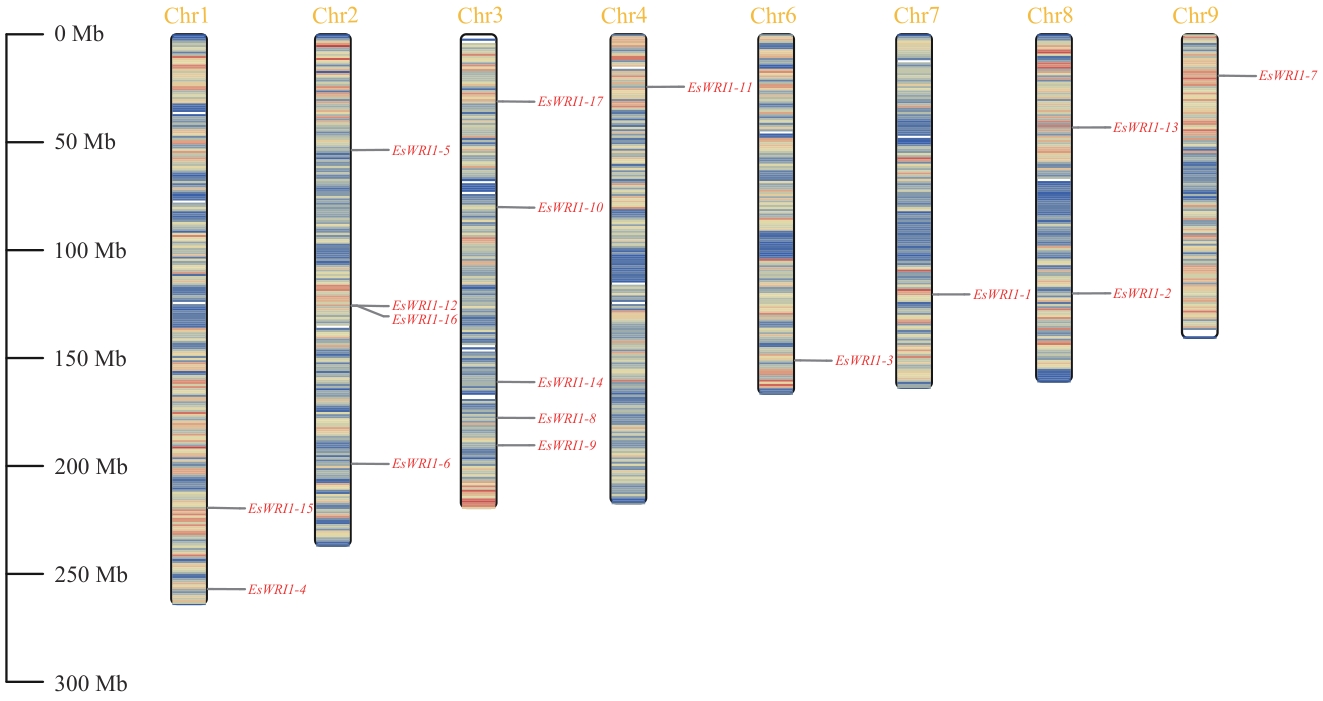
图3 赤苍藤WRI1基因家族成员染色体定位
Fig. 3 Chromosomal localization of WRI1 gene family members in E. scandens

图4 赤苍藤WRI1家族序列比对图蓝色方框:基因家族保守序列
Fig. 4 WRI1 family sequence alignment in E. scandensBlue box: The conserved sequence of the gene family

图5 赤苍藤与拟南芥、大豆、蒜头果WRI1蛋白的系统发育关系
Fig. 5 Phylogenetic relationship based on the amino acid sequence of WRI1 protein among E. giganteum and Arabidopsis thaliana, Glycine max and Malania oleifera

图6 赤苍藤WRI1基因家族启动子区域顺式作用元件分析
Fig. 6 Analysis of cis-acting elements in the promoter region of WRI1 genes family in E. scandens

图7 赤苍藤WRI1基因家族成员组织表达热图TL:幼叶;ML:成熟叶;TS:幼茎;MS:成熟茎;IFK:未成熟种仁;MFK:成熟种仁。1‒3:3个重复。下同
Fig. 7 Heatmap of tissue expression of E. scandens WRI1 gene family memberTL: Tender leave. ML: Mature leave. TS: Tender stem. MS: Mature stem. IFK: Immature kernel. MFK: Mature kernel. 1‒3: Three replicates. The same below
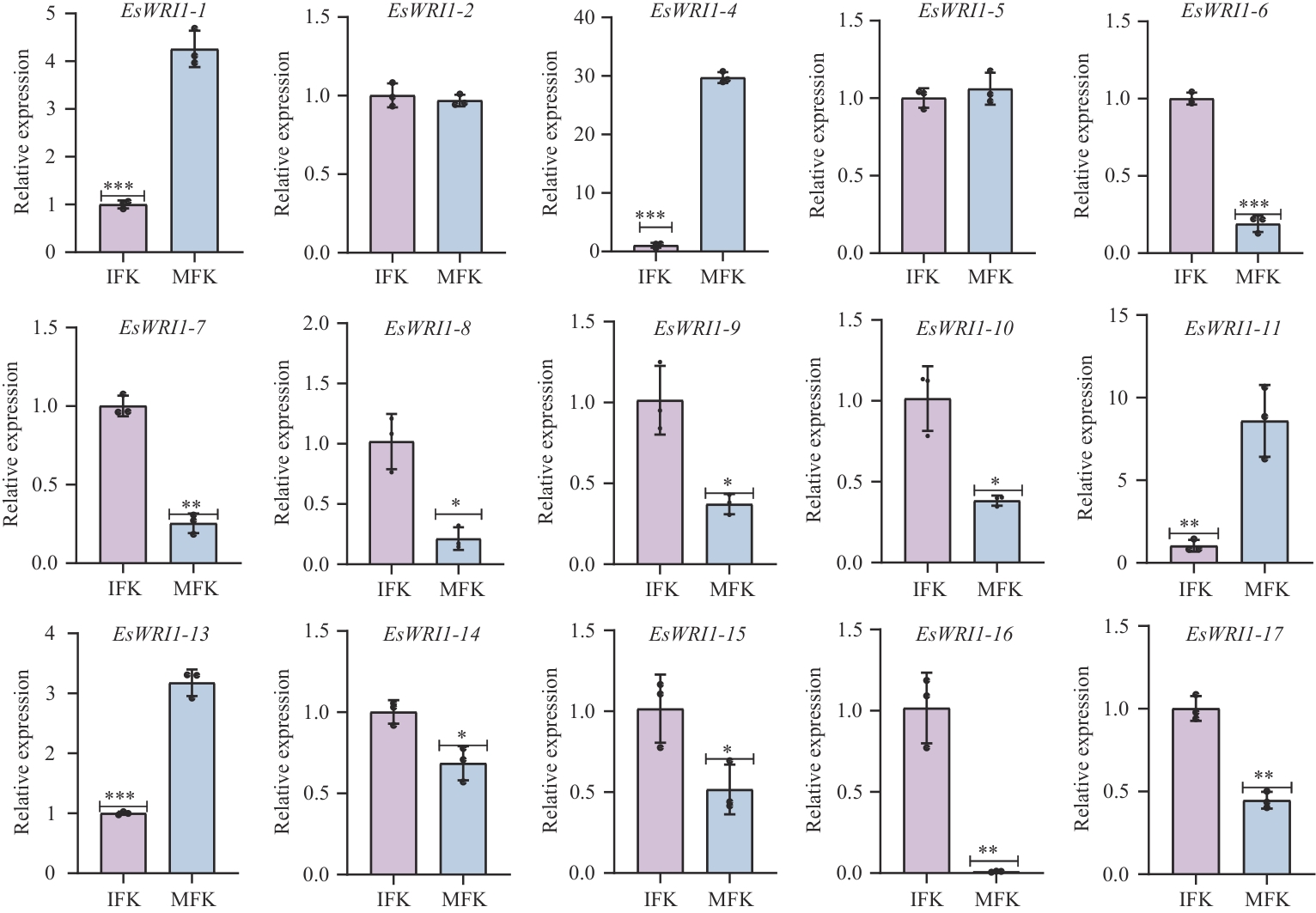
图8 赤苍藤WRI1基因家族部分成员荧光定量验证*P<0.05; **P<0.01; ***P<0.001
Fig. 8 RT-qPCR verification of some E. scandens WRI1 gene family member
| [1] | 黄诗宇, 杨天为, 张向军, 等. 不同品种赤苍藤种仁营养成分及潜在应用价值分析 [J]. 中国油脂, 2025, 50(6): 105-110. |
| Huang SY, Yang TW, Zhang XJ, et al. Analysis of nutritional components and potential application value of seed kernels of Erythropalum scandens of different varieties [J]. China Oils and Fats, 2025, 50(6): 105-110. | |
| [2] | 隆卫革, 黎素平, 安家成, 等. 森林蔬菜赤苍藤营养分析与评价 [J]. 食品研究与开发, 2017, 38(24): 124-127. |
| Long WG, Li SP, An JC, et al. Analysis and evaluation of nutritional components in Erythropalum scandens blume [J]. Food Res Dev, 2017, 38(24): 124-127. | |
| [3] | 中国科学院中国植物志编辑委员会编. 中国植物志 [M]. 北京: 科学出版社, 2004. |
| Editorial Committee of Chinese Academy of Sciences. Chinese Flora [M]. Beijing: Science Press, 2004. | |
| [4] | 张军. 木本油料作物在土壤改良和生态恢复中的效益分析 [J]. 农村科学实验, 2024(7): 37-39. |
| Zhang J. Benefit analysis of woody oil crops in soil improvement and ecological restoration [J]. Rural Sci Exp, 2024(7): 37-39. | |
| [5] | 熊旭东, 于安民, 孙蕊, 等. 高值木本油料植物蒜头果的资源发掘与利用 [J]. 中国野生植物资源, 2023, 42(1): 86-92. |
| Xiong XD, Yu AM, Sun R, et al. Exploitation and utilization of MOC, A high-value oil plant [J]. Chin Wild Plant Resour, 2023, 42(1): 86-92. | |
| [6] | 杨一山, 唐健民, 孙菲菲, 等. 蒜头果不同部位的营养成分分析 [J]. 广西植物, 2023, 43(3): 515-526. |
| Yang YS, Tang JM, Sun FF, et al. Analysis of nutritional components in different parts of Malania oleifera [J]. Guihaia, 2023, 43(3): 515-526. | |
| [7] | 孙小雨, 郭娟, 张丽, 等. 蒜头果种子萌发过程中油脂的变化 [J]. 热带农业科技, 2024, 47(3): 46-52. |
| Sun XY, Guo J, Zhang L, et al. Changes in oil during seed germination of Malania oleifera [J]. Trop Agric Sci Technol, 2024, 47(3): 46-52. | |
| [8] | 许久恒. 文冠果与蒜头果神经酸合成及油脂转录调控的转录组研究 [D]. 北京: 北京林业大学, 2021. |
| Xu JH. Transcriptome study on the synthesis of nervonic acid and the regulation of oil transcription in Xanthoceras sorbifolia Bunge and Malania oleifera Bunge [D]. Beijing: Beijing Forestry University, 2021. | |
| [9] | 黄和, 任波, 孙小曼. ω-3多不饱和脂肪酸健康机制及应用研究进展 [J]. 食品科学技术学报, 2024, 42(5): 1-12. |
| Huang H, Ren B, Sun XM. Research progress on health mechanism and application of omega-3 polyunsaturated fatty acids. [J]. Journal of Food Science and Technology, 2024, 42(5): 1-12. | |
| [10] | Baud S, Mendoza MS, To A, et al. WRINKLED1 specifies the regulatory action of LEAFY COTYLEDON2 towards fatty acid metabolism during seed maturation in Arabidopsis [J]. Plant J, 2007, 50(5): 825-838. |
| [11] | Ma W, Kong Q, Arondel V, et al. Wrinkled1, a ubiquitous regulator in oil accumulating tissues from Arabidopsis embryos to oil palm mesocarp [J]. PLoS One, 2013, 8(7): e68887. |
| [12] | Cernac A, Benning C. WRINKLED1 encodes an AP2/EREB domain protein involved in the control of storage compound biosynthesis in Arabidopsis [J]. Plant J, 2004, 40(4): 575-585. |
| [13] | Focks N, Benning C. wrinkled1: a novel, low-seed-oil mutant of Arabidopsis with a deficiency in the seed-specific regulation of carbohydrate metabolism [J]. Plant Physiol, 1998, 118(1): 91-101. |
| [14] | Marchive C, Nikovics K, To A, et al. Transcriptional regulation of fatty acid production in higher plants: Molecular bases and biotechnological outcomes [J]. Eur J Lipid Sci Technol, 2014, 116(10): 1332-1343. |
| [15] | Ruuska SA, Girke T, Benning C, et al. Contrapuntal networks of gene expression during Arabidopsis seed filling [J]. Plant Cell, 2002, 14(6): 1191-1206. |
| [16] | Zhai ZY, Keereetaweep J, Liu H, et al. The role of sugar signaling in regulating plant fatty acid synthesis [J]. Front Plant Sci, 2021, 12: 643843. |
| [17] | 金龙飞, 周丽霞, 曹红星, 等. WRI1调控植物油脂合成的研究进展 [J]. 中国油料作物学报, 2022, 44(4): 687-698. |
| Jin LF, Zhou LX, Cao HX, et al. Progress on WRI1 regulation of plant oil biosynthesis [J]. Chin J Oil Crop Sci, 2022, 44(4): 687-698. | |
| [18] | Ma W, Kong Q, Grix M, et al. Deletion of a C-terminal intrinsically disordered region of WRINKLED1 affects its stability and enhances oil accumulation in Arabidopsis [J]. Plant J, 2015, 83(5): 864-874. |
| [19] | 叶专, 李小丽, 普永权. 转基因WRI1稻米的脂肪酸基因表达效果 [J]. 中国食品卫生杂志, 2015, 27(4): 367-371. |
| Ye Z, Li XL, Pu YQ. The transgenic rice WRI1 fatty acids gene expression effect [J]. Chin J Food Hyg, 2015, 27(4): 367-371. | |
| [20] | 鲁亚萍. 花生Oleosin启动子和Ara h1启动子功能鉴定及转录因子WRI1基因的in silico分析 [D]. 泰安: 山东农业大学, 2012. |
| Lu YP. Functional identification of oleosin promoter and Ara h1 promoter in peanut and in silico analysis of transcription factor WRI1 gene [D]. Tai'an: Shandong Agricultural University, 2012. | |
| [21] | 王莉莉. 甘蓝型油菜AP2亚家族转录因子及植物中WRI1的基因组学分析 [D]. 杨凌: 西北农林科技大学, 2016. |
| Wang LL. Transcription factors of AP2 subfamily in Brassica napus and genomic analysis of WRI1 in plants [D]. Yangling: Northwest A & F University, 2016. | |
| [22] | 邵宇鹏, 杨明明, 包格格, 等. 大豆GmWRI1a基因启动子克隆及其功能分析 [J]. 中国油料作物学报, 2019, 41(4): 517-523. |
| Shao YP, Yang MM, Bao GG, et al. Cloning and functional analysis of soybean GmWRI1a promoter [J]. Chin J Oil Crop Sci, 2019, 41(4): 517-523. | |
| [23] | 杨红丽, 向旭敏, 曹东, 等. 转录因子GmWRI1b促进大豆油脂合成的功能研究 [J/OL]. 中国油料作物学报, 2024. . |
| Yang HL, Xiang XM, Cao D, et al. Function of transcription factor GmWRI1b promoting soybean oil synthesis [J/OL]. Chin J Oil Crop Sci, 2024. . | |
| [24] | 冯小燕, 王其凤, 岳柯昕, 等. 紫苏AP2基因家族PfWRI1促进植物种子油脂积累 [J]. 中国生物化学与分子生物学报, 2024, 40(8): 1161-1172. |
| Feng XY, Wang QF, Yue KX, et al. Perilla AP2 gene family PfWRI1 promotes oil accumulation in plant seeds [J]. Chinese Journal of Biochemistry and Molecular Biology, 2024, 40(8): 1161-1172. | |
| [25] | Adhikari ND, Bates PD, Browse J. WRINKLED1 rescues feedback inhibition of fatty acid synthesis in hydroxylase-expressing seeds [J]. Plant Physiol, 2016, 171(1): 179-191. |
| [26] | 李佳奇, 任滢蓥, 刘沙, 等. 红花CtWRI1基因克隆与功能分析 [J]. 农业生物技术学报, 2024, 32(5): 1061-1070. |
| Li JQ, Ren YY, Liu S, et al. Cloning and functional analysis of CtWRI1 gene from safflower (Carthamus tinctorius) [J]. J Agric Biotechnol, 2024, 32(5): 1061-1070. | |
| [27] | 李一沛. ‘凤丹’转录因子基因PoWRI1克隆及其牡丹籽油合成功能鉴定 [D]. 北京: 北京林业大学, 2021. |
| Li YP. Cloning of transcription factor gene PoWRI1 from 'Fengdan' and identification of its synthetic function of peony seed oil [D]. Beijing: Beijing Forestry University, 2021. | |
| [28] | 万薇, 武学霞, 焦琬尧, 等. 藜麦WRI1基因家族鉴定与分析 [J]. 分子植物育种, 2025, 23(9): 2826-2834. |
| Wan W, Wu XX, Jiao WY, et al. Identification and analysis of WRI1 gene family in quinoa [J]. Mol Plant Breed, 2025, 23(9): 2826-2834. | |
| [29] | 孙金波, 石素华, 杨利, 等. 花生WRI1基因家族的全基因组与表达谱分析 [J]. 花生学报, 2020, 49(1): 9-18. |
| Sun JB, Shi SH, Yang L, et al. Genome-wide analysis of WRI1 gene family and their expression profiles in peanut [J]. J Peanut Sci, 2020, 49(1): 9-18. | |
| [30] | 刘克鑫, 杨宸, 王俊丽, 等. 亚麻荠WRI1转录因子基因家族的生物信息学分析 [J/OL]. 分子植物育种, 2023. . |
| Liu KX, Yang C, Wang JL, et al. Bioinformatics analysis of WRI1 in Camelina sativa [J/OL]. Mol Plant Breed, 2023. . | |
| [31] | 王巍杰, 吴丹, 王涛. 大豆转录因子WRI1基因的生物信息学分析 [J]. 湖北农业科学, 2016, 55(13): 3482-3485, 3489. |
| Wang WJ, Wu D, Wang T. Bioinformatics analysis of WRI1 transcription factors in soybean [J]. Hubei Agric Sci, 2016, 55(13): 3482-3485, 3489. | |
| [32] | 马倩, 李景滨, 阮成江, 等. 沙棘WRI1转录因子基因的生物信息学分析 [J]. 湖北农业科学, 2016, 55(22): 5972-5975, 5981. |
| Ma Q, Li JB, Ruan CJ, et al. Bioinformatics analysis of WRI1 gene in Hippophae rhamnoides [J]. Hubei Agric Sci, 2016, 55(22): 5972-5975, 5981. | |
| [33] | An D, Kim H, Ju S, et al. Expression of Camelina WRINKLED1 isoforms rescue the seed phenotype of the Arabidopsis wri1 mutant and increase the triacylglycerol content in tobacco leaves [J]. Front Plant Sci, 2017, 8: 34. |
| [34] | 王贵芳, 王文茹, 张淑辉, 等. 核桃油脂合成转录因子JrWRI1基因的克隆及生物信息学分析 [J]. 山东农业科学, 2019, 51(2): 1-6. |
| Wang GF, Wang WR, Zhang SH, et al. Cloning and bioinformatics analysis of transcription factor JrWRI1 gene related with lipids synthesis of walnut [J]. Shandong Agric Sci, 2019, 51(2): 1-6. | |
| [35] | Nakano T, Suzuki K, Fujimura T, et al. Genome-wide analysis of the ERF gene family in Arabidopsis and rice [J]. Plant Physiol, 2006, 140(2): 411-432. |
| [36] | 杨先友, 黄有军, 张通, 等. 拟南芥转录激活因子AtWRI1研究进展 [J]. 生物技术通报, 2016, 32(6): 13-18. |
| Yang XY, Huang YJ, Zhang T, et al. Advances on transcriptional activator AtWRI1 of Arabidopsis [J]. Biotechnol Bull, 2016, 32(6): 13-18. | |
| [37] | 陈贝贝. 大豆二酰甘油酰基转移酶(DGAT)和转录因子WRINKLED1 (WRI1) 功能研究 [D]. 武汉: 华中农业大学, 2019. |
| Chen BB. Study on the function of soybean diacylglycerol acyltransferase (DGAT) and transcription factor WRINKLED1(WRI1) [D]. Wuhan: Huazhong Agricultural University, 2019. | |
| [38] | 王月, 雷培, 季喜梅, 等. 蓖麻RcWRI1基因表达分析及生物信息学分析 [J]. 分子植物育种, 2018, 16(5): 1461-1467. |
| Wang Y, Lei P, Ji XM, et al. Expression analysis and bioinformatics analysis of RcWRI1 gene in Castor [J]. Mol Plant Breed, 2018, 16(5): 1461-1467. | |
| [39] | 李鑫, 王正明, 薛伟, 等. 棉花中一个新型转录因子GhWRI1的表达特征与功能分析 [J]. 生物技术通报, 2013, 29(6): 80-86. |
| Li X, Wang ZM, Xue W, et al. Identification and characterization of a novel gene, GhWRI1, encoding an AP2-type transcription factor in Gossypium hirsutum [J]. Biotechnol Bull, 2013, 29(6): 80-86. | |
| [40] | 莫宗明, 黄银珊, 谭长强. 广西蒜头果可持续发展关键技术措施 [J]. 防护林科技, 2024(3): 83-85. |
| Mo ZM, Huang YS, Tan CQ. Key technical measures for sustainable development of Malania oleifera in Guangxi [J]. Prot For Sci Technol, 2024(3): 83-85. | |
| [41] | 韦贵元, 党桂兰, 胡琦敏, 等. 赤苍藤开发利用研究进展 [J]. 海峡药学, 2023, 35(2): 27-30. |
| Wei GY, Dang GL, Hu QM, et al. Research progress and utilization of Erythropalum scandens [J]. Strait Pharm J, 2023, 35(2): 27-30. |
| [1] | 任睿斌, 司二静, 万广有, 汪军成, 姚立蓉, 张宏, 马小乐, 李葆春, 王化俊, 孟亚雄. 大麦条纹病菌GH17基因家族的鉴定及表达分析[J]. 生物技术通报, 2025, 41(8): 146-154. |
| [2] | 程雪, 付颖, 柴晓娇, 王红艳, 邓欣. 谷子LHC基因家族鉴定及非生物胁迫表达分析[J]. 生物技术通报, 2025, 41(8): 102-114. |
| [3] | 化文平, 刘菲, 浩佳欣, 陈尘. 丹参ADH基因家族的鉴定与表达模式分析[J]. 生物技术通报, 2025, 41(8): 211-219. |
| [4] | 腊贵晓, 赵玉龙, 代丹丹, 余永亮, 郭红霞, 史贵霞, 贾慧, 杨铁钢. 红花质膜H+-ATPase基因家族成员鉴定及响应低氮低磷胁迫的表达分析[J]. 生物技术通报, 2025, 41(8): 220-233. |
| [5] | 李凯月, 邓晓霞, 殷缘, 杜亚彤, 徐元静, 王竞红, 于耸, 蔺吉祥. 蓖麻LEA基因家族的鉴定和铝胁迫响应分析[J]. 生物技术通报, 2025, 41(7): 128-138. |
| [6] | 张泽, 杨秀丽, 宁东贤. 花生4CL基因家族鉴定及对干旱与盐胁迫响应分析[J]. 生物技术通报, 2025, 41(7): 117-127. |
| [7] | 李新妮, 李俊怡, 马雪华, 何卫, 李佳丽, 于佳, 曹晓宁, 乔治军, 刘思辰. 谷子果胶甲酯酶抑制子PMEI基因家族鉴定及其对非生物胁迫的响应分析[J]. 生物技术通报, 2025, 41(7): 150-163. |
| [8] | 黄旭升, 周雅莉, 柴旭东, 闻婧, 王计平, 贾小云, 李润植. 紫苏质体型PfLPAT1B基因的克隆及其在油脂合成中的功能分析[J]. 生物技术通报, 2025, 41(7): 226-236. |
| [9] | 瞿美玲, 周思敏, 张惊宇, 何佳蔚, 朱佳源, 刘笑蓉, 童巧珍, 周日宝, 刘湘丹. 灰毡毛忍冬bHLH转录基因家族的鉴定与表达分析[J]. 生物技术通报, 2025, 41(6): 256-268. |
| [10] | 黄丹, 彭兵阳, 张盼盼, 焦悦, 吕佳斌. 油茶HD-Zip基因家族鉴定及其在非生物胁迫下的表达分析[J]. 生物技术通报, 2025, 41(6): 191-207. |
| [11] | 许慧珍, SHANTWANA Ghimire, RAJU Kharel, 岳云, 司怀军, 唐勋. 马铃薯SUMO E3连接酶基因家族分析及StSIZ1基因的克隆与表达模式分析[J]. 生物技术通报, 2025, 41(6): 119-129. |
| [12] | 吴娅, 姚润, 杨含婷, 刘微, 杨帅, 宋驰, 陈士林. 凤梨薄荷SDR基因家族全基因组鉴定及表达分析[J]. 生物技术通报, 2025, 41(5): 175-185. |
| [13] | 罗嗣芳, 张祖铭, 谢丽芳, 郭紫晶, 陈兆星, 杨月华, 严翔, 张洪铭. 山金柑GATA基因家族全基因组鉴定及在果实发育中的表达分析[J]. 生物技术通报, 2025, 41(5): 218-230. |
| [14] | 何卫, 李俊怡, 李新妮, 马雪华, 邢媛, 曹晓宁, 乔治军, 刘思辰. 谷子泛素连接酶U-box E3基因家族的鉴定及响应非生物胁迫分析[J]. 生物技术通报, 2025, 41(5): 104-118. |
| [15] | 王轶民, 李莹, 董海涛, 张恒瑞, 常璐, 高田甜, 韩德俊, 吴建辉. SRO家族蛋白在小麦多倍化进程中的演化规律[J]. 生物技术通报, 2025, 41(5): 70-81. |
| 阅读次数 | ||||||
|
全文 |
|
|||||
|
摘要 |
|
|||||
