







生物技术通报 ›› 2025, Vol. 41 ›› Issue (6): 191-207.doi: 10.13560/j.cnki.biotech.bull.1985.2024-1146
• 研究报告 • 上一篇
黄丹( ), 彭兵阳, 张盼盼, 焦悦, 吕佳斌()
收稿日期:2024-11-26
出版日期:2025-06-26
发布日期:2025-06-30
通讯作者:
吕佳斌,男,博士,讲师,研究方向 :林木遗传育种;E-mail: lvjiabin@ahau.edu.cn作者简介:黄丹,女,硕士,研究方向 :林木遗传育种;E-mail: 2128948625@qq.com
基金资助:
HUANG Dan(), PENG Bing-yang, ZHANG Pan-pan, JIAO Yue, LYU Jia-bin()
Received:2024-11-26
Published:2025-06-26
Online:2025-06-30
摘要:
目的 鉴定油茶HD-Zip基因家族成员,分析其结构、特性和功能,解析其在盐、干旱、低温和高温等非生物胁迫下的表达模式。 方法 基于六倍体普通油茶全基因组数据,利用生物信息学方法筛选鉴定CoHDZs基因家族成员,对其基因结构、保守基序、顺式作用元件、染色体定位和基因共线性等进行分析;基于转录组数据分析CoHDZs基因在油茶叶、芽、花瓣、雌蕊、种子、花萼、雄蕊和果实不同发育期中的表达模式;利用实时荧光定量PCR方法解析CoHDZs在不同逆境胁迫下的瞬时表达特征。 结果 CoHDZs基因家族包含46个成员(CoHDZ1-CoHDZ46)分布在4个不同的亚家族(HD-Zip Ⅰ,HD-Zip Ⅱ,HD-Zip Ⅲ和HD-Zip Ⅳ)中,且同一亚家族中的CoHDZ基因具有相似的结构特征。顺式作用元件分析表明油茶HD-Zip基因家族成员广泛参与光响应、激素响应以及非生物胁迫响应。染色体定位和共线性分析可知,46个CoHDZs基因不均匀地分布在26条染色体和2条染色体骨架上,全基因组复制(WGD)事件或片段复制可能是CoHDZs基因进化的主要动力;转录组分析表明,CoHDZs基因存在明显的组织特异性表达;实时荧光定量PCR验证实验表明,油茶HD-Zip基因家族成员在盐、干旱、低温和高温胁迫下高度表达,不同CoHDZs基因在同一胁迫下的表达存在差异,且相同基因在不同胁迫下的表达情况也有不同,其中CoHDZ1、CoHDZ3、CoHDZ14、CoHDZ18、CoHDZ20、CoHDZ22、CoHDZ42、CoHDZ44和CoHDZ45这9个基因是油茶HD-Zip家族响应非生物胁迫的关键基因。 结论 CoHDZs基因广泛参与油茶的生长发育、激素信号传导和非生物胁迫响应并发挥着重要的调控作用。
黄丹, 彭兵阳, 张盼盼, 焦悦, 吕佳斌. 油茶HD-Zip基因家族鉴定及其在非生物胁迫下的表达分析[J]. 生物技术通报, 2025, 41(6): 191-207.
HUANG Dan, PENG Bing-yang, ZHANG Pan-pan, JIAO Yue, LYU Jia-bin. Identification of HD-Zip Gene Family in Camellia oleifera and Analysis of Its Expression under Abiotic Stress[J]. Biotechnology Bulletin, 2025, 41(6): 191-207.
| 基因名称 Gene name | 上游引物 Forward primer(5'-3') | 下游引物 Reverse primer(5'-3') |
|---|---|---|
| CoHDZ1 | CATCACCATCACCACCACCAGTTC | TGATACGCCTTCTGTGCATCCAAC |
| CoHDZ3 | CCACCACCACTACCACCACCTC | TCGTCCACCACCGCACTTCC |
| CoHDZ4 | CATCACCATCACCACCACCAGTTC | TGATACGCCTTCTGTGCATCCAAC |
| CoHDZ6 | CCACCACCACTACCACCACCTC | TCGTCCACCACCGCACTTCC |
| CoHDZ7 | CATCACCATCACCACCACCAGTTC | TGATACGCCTTCTGTGCATCCAAC |
| CoHDZ14 | TCTCTGTTCCTCTCTGGCTCTTCC | AATTGGACTTGGTCAGGCGTAAGC |
| CoHDZ18 | TCTCTGTTCCTCTCTGGCTCTTCC | AATTGGACTTGGTCAGGCGTAAGC |
| CoHDZ20 | AAGAGGGAGAGGGAGAGGGAGATC | GGAGAAGGTGACGGAGGAGGAG |
| CoHDZ21 | TCCGCCGATGCCTCCATAGTG | AGCCGTAGCAGCAACCTCTCC |
| CoHDZ22 | CAGAACCACAGGTGCCTTGAGAAG | GCTTGTGTCGGTAGTAGCTGGAG |
| CoHDZ23 | AGCAGCGAGAGGAAGAGGAGATTG | CGGCGATTTTCACCTTTTGCTCTG |
| CoHDZ26 | ACGGTGGAGGAGGAGGAGGAG | GGAACCAAACAGCAACTTGACGAG |
| CoHDZ27 | GGAGGAGGAGGAGGGAATGAGAAG | CGCTTGAGCTGCTTAGCCTTCC |
| CoHDZ30 | CCCTCCAAGCTCAGAACCACAAAC | TTCACCGATCCGCCCTCTGTC |
| CoHDZ42 | AGAACTTGTTGCCTCCTCCTCCTC | ACCCAAAGGCGTGATCTTCAACTG |
| CoHDZ44 | GAAGAGGCGAGTGAGCGTTGC | GTTCCTGAGCGAGCTTCACTTTCC |
| CoHDZ45 | CCACCACCACTACCACCACCTC | TCGTCCACCACCGCACTTCC |
| GAPDH | CTGCTGCCCACTTGAAGG | GACCCTCAACAATGCCAAAC |
表1 CoHDZs基因实时荧光定量PCR引物
Table 1 Primers for the RT-qPCR analysis of CoHDZs
| 基因名称 Gene name | 上游引物 Forward primer(5'-3') | 下游引物 Reverse primer(5'-3') |
|---|---|---|
| CoHDZ1 | CATCACCATCACCACCACCAGTTC | TGATACGCCTTCTGTGCATCCAAC |
| CoHDZ3 | CCACCACCACTACCACCACCTC | TCGTCCACCACCGCACTTCC |
| CoHDZ4 | CATCACCATCACCACCACCAGTTC | TGATACGCCTTCTGTGCATCCAAC |
| CoHDZ6 | CCACCACCACTACCACCACCTC | TCGTCCACCACCGCACTTCC |
| CoHDZ7 | CATCACCATCACCACCACCAGTTC | TGATACGCCTTCTGTGCATCCAAC |
| CoHDZ14 | TCTCTGTTCCTCTCTGGCTCTTCC | AATTGGACTTGGTCAGGCGTAAGC |
| CoHDZ18 | TCTCTGTTCCTCTCTGGCTCTTCC | AATTGGACTTGGTCAGGCGTAAGC |
| CoHDZ20 | AAGAGGGAGAGGGAGAGGGAGATC | GGAGAAGGTGACGGAGGAGGAG |
| CoHDZ21 | TCCGCCGATGCCTCCATAGTG | AGCCGTAGCAGCAACCTCTCC |
| CoHDZ22 | CAGAACCACAGGTGCCTTGAGAAG | GCTTGTGTCGGTAGTAGCTGGAG |
| CoHDZ23 | AGCAGCGAGAGGAAGAGGAGATTG | CGGCGATTTTCACCTTTTGCTCTG |
| CoHDZ26 | ACGGTGGAGGAGGAGGAGGAG | GGAACCAAACAGCAACTTGACGAG |
| CoHDZ27 | GGAGGAGGAGGAGGGAATGAGAAG | CGCTTGAGCTGCTTAGCCTTCC |
| CoHDZ30 | CCCTCCAAGCTCAGAACCACAAAC | TTCACCGATCCGCCCTCTGTC |
| CoHDZ42 | AGAACTTGTTGCCTCCTCCTCCTC | ACCCAAAGGCGTGATCTTCAACTG |
| CoHDZ44 | GAAGAGGCGAGTGAGCGTTGC | GTTCCTGAGCGAGCTTCACTTTCC |
| CoHDZ45 | CCACCACCACTACCACCACCTC | TCGTCCACCACCGCACTTCC |
| GAPDH | CTGCTGCCCACTTGAAGG | GACCCTCAACAATGCCAAAC |
基因名称 Gene name | 基因ID Gene ID | 亚家族 Group | 染色体号 Chr | 蛋白质长度 Protein length (aa) | 分子量 MW (Da) | 等电点 PI | 亚细胞定位 Subcellular localization |
|---|---|---|---|---|---|---|---|
| CoHDZ1 | YCChr1a_018730.1 | Ⅰ | Chr1a | 320 | 35142.84 | 5.7 | 细胞核 |
| CoHDZ2 | YCChr1a_024300.1 | Ⅱ | Chr1a | 225 | 25151.16 | 5.24 | 细胞核 |
| CoHDZ3 | YCChr1a_028340.1 | Ⅰ | Chr1a | 282 | 31781.2 | 4.65 | 细胞核 |
| CoHDZ4 | YCChr1b_015690.1 | Ⅰ | Chr1b | 233 | 25128.64 | 5.34 | 细胞核 |
| CoHDZ5 | YCChr1b_022120.1 | Ⅱ | Chr1b | 191 | 21187.5 | 5.66 | 细胞核 |
| CoHDZ6 | YCChr1b_027440.1 | Ⅰ | Chr1b | 269 | 30716.12 | 4.81 | 细胞核 |
| CoHDZ7 | YCChr1c_029510.1 | Ⅰ | Chr1c | 321 | 35324.02 | 5.75 | 细胞核 |
| CoHDZ8 | YCChr1c_033970.1 | Ⅱ | Chr1c | 229 | 25567.69 | 5.24 | 细胞核 |
| CoHDZ9 | YCChr2a_005360.1 | Ⅱ | Chr2a | 190 | 21142.64 | 6.8 | 细胞核 |
| CoHDZ10 | YCChr2b_004640.1 | Ⅱ | Chr2b | 186 | 20523.57 | 6.05 | 细胞核 |
| CoHDZ11 | YCChr2b_005710.1 | Ⅱ | Chr2b | 307 | 33107.72 | 7.76 | 细胞核 |
| CoHDZ12 | YCChr2c_005960.1 | Ⅱ | Chr2c | 179 | 19654.72 | 5.67 | 细胞核 |
| CoHDZ13 | YCChr2c_008630.1 | Ⅱ | Chr2c | 377 | 41108.66 | 7.56 | 细胞核 |
| CoHDZ14 | YCChr4b_013830.1 | Ⅰ | Chr4b | 328 | 36236.27 | 6.17 | 细胞核 |
| CoHDZ15 | YCChr4b_019640.1 | Ⅳ | Chr4b | 601 | 66874.14 | 6.33 | 细胞核 |
| CoHDZ16 | YCChr4b_019700.1 | Ⅲ | Chr4b | 778 | 85841.14 | 5.93 | 细胞核 |
| CoHDZ17 | YCChr4b_025610.1 | Ⅱ | Chr4b | 162 | 18288.36 | 5.54 | 细胞核 |
| CoHDZ18 | YCChr4c_015970.1 | Ⅰ | Chr4c | 225 | 29217.36 | 4.81 | 细胞核 |
| CoHDZ19 | YCChr4c_027810.1 | Ⅱ | Chr4c | 166 | 18786.98 | 6.19 | 细胞核 |
| CoHDZ20 | YCChr4c_030590.1 | Ⅰ | Chr4c | 279 | 30935.94 | 6.81 | 细胞核 |
| CoHDZ21 | YCChr5a_011690.1 | Ⅰ | Chr5a | 208 | 23163.6 | 4.8 | 叶绿体、细胞核 |
| CoHDZ22 | YCChr7a_015220.1 | Ⅰ | Chr7a | 106 | 12381.09 | 8.47 | 细胞核 |
| CoHDZ23 | YCChr8c_012310.1 | Ⅰ | Chr8c | 177 | 20756.37 | 5.48 | 细胞核 |
| CoHDZ24 | YCChr9a_004470.1 | Ⅳ | Chr9a | 587 | 65387.15 | 6.14 | 细胞核 |
| CoHDZ25 | YCChr9a_017880.1 | Ⅳ | Chr9a | 688 | 75790.99 | 5.47 | 细胞核 |
| CoHDZ26 | YCChr10a_007180.1 | Ⅰ | Chr10a | 126 | 14257.15 | 9.55 | 细胞核 |
| CoHDZ27 | YCChr10b_009490.1 | Ⅰ | Chr10b | 123 | 14239.31 | 9.96 | 细胞核 |
| CoHDZ28 | YCChr11a_017100.1 | Ⅲ | Chr11a | 812 | 88970.68 | 6.31 | 细胞核 |
| CoHDZ29 | YCChr11a_020800.1 | Ⅱ | Chr11a | 308 | 34896.48 | 7.62 | 细胞核 |
| CoHDZ30 | YCChr11b_008940.1 | Ⅰ | Chr11b | 189 | 21602.32 | 6.23 | 细胞核 |
| CoHDZ31 | YCChr11b_015650.1 | Ⅱ | Chr11b | 527 | 60449.42 | 6.59 | 细胞核 |
| CoHDZ32 | YCChr11c_017250.1 | Ⅱ | Chr11c | 281 | 31909.08 | 8.16 | 细胞核 |
| CoHDZ33 | YCChr12a_013940.1 | Ⅲ | Chr12a | 132 | 15639.05 | 9.81 | 细胞核 |
| CoHDZ34 | YCChr12b_016460.1 | Ⅲ | Chr12b | 882 | 97008.44 | 6.11 | 细胞核 |
| CoHDZ35 | YCChr12c_014450.1 | Ⅲ | Chr12c | 718 | 78967.97 | 5.7 | 细胞核 |
| CoHDZ36 | YCChr13a_010080.1 | Ⅱ | Chr13a | 251 | 28136.51 | 8.35 | 细胞核 |
| CoHDZ37 | YCChr13a_014620.1 | Ⅳ | Chr13a | 507 | 56653.47 | 5.4 | 细胞核 |
| CoHDZ38 | YCChr13b_013930.1 | Ⅳ | Chr13b | 653 | 74082.16 | 5.96 | 细胞核 |
| CoHDZ39 | YCChr13c_011380.1 | Ⅱ | Chr13c | 305 | 34301.66 | 8.41 | 细胞核 |
| CoHDZ40 | YCChr13c_013630.1 | Ⅳ | Chr13c | 653 | 74062.17 | 5.96 | 细胞核 |
| CoHDZ41 | YCChr13c_016960.1 | Ⅳ | Chr13c | 481 | 53576 | 5.32 | 细胞核 |
| CoHDZ42 | YCChr14c_017780.1 | Ⅰ | Chr14c | 279 | 31582.16 | 5.1 | 细胞核 |
| CoHDZ43 | YCChr15a_016280.1 | Ⅲ | Chr15a | 707 | 77241.76 | 6.1 | 细胞核 |
| CoHDZ44 | YCChr15c_001540.1 | Ⅰ | Chr15c | 108 | 12482.2 | 6.4 | 细胞核 |
| CoHDZ45 | YCScaffold_003590.1 | Ⅰ | Scaffold8 | 282 | 31780.11 | 4.65 | 细胞核 |
| CoHDZ46 | YCScaffold_018850.1 | Ⅲ | Scaffold184 | 777 | 85065.99 | 5.78 | 细胞核 |
表2 油茶HD-Zip基因家族成员及理化性质分析
Table 2 Analysis of HD-Zip gene family members and physicochemical properties of Camellia oleifera
基因名称 Gene name | 基因ID Gene ID | 亚家族 Group | 染色体号 Chr | 蛋白质长度 Protein length (aa) | 分子量 MW (Da) | 等电点 PI | 亚细胞定位 Subcellular localization |
|---|---|---|---|---|---|---|---|
| CoHDZ1 | YCChr1a_018730.1 | Ⅰ | Chr1a | 320 | 35142.84 | 5.7 | 细胞核 |
| CoHDZ2 | YCChr1a_024300.1 | Ⅱ | Chr1a | 225 | 25151.16 | 5.24 | 细胞核 |
| CoHDZ3 | YCChr1a_028340.1 | Ⅰ | Chr1a | 282 | 31781.2 | 4.65 | 细胞核 |
| CoHDZ4 | YCChr1b_015690.1 | Ⅰ | Chr1b | 233 | 25128.64 | 5.34 | 细胞核 |
| CoHDZ5 | YCChr1b_022120.1 | Ⅱ | Chr1b | 191 | 21187.5 | 5.66 | 细胞核 |
| CoHDZ6 | YCChr1b_027440.1 | Ⅰ | Chr1b | 269 | 30716.12 | 4.81 | 细胞核 |
| CoHDZ7 | YCChr1c_029510.1 | Ⅰ | Chr1c | 321 | 35324.02 | 5.75 | 细胞核 |
| CoHDZ8 | YCChr1c_033970.1 | Ⅱ | Chr1c | 229 | 25567.69 | 5.24 | 细胞核 |
| CoHDZ9 | YCChr2a_005360.1 | Ⅱ | Chr2a | 190 | 21142.64 | 6.8 | 细胞核 |
| CoHDZ10 | YCChr2b_004640.1 | Ⅱ | Chr2b | 186 | 20523.57 | 6.05 | 细胞核 |
| CoHDZ11 | YCChr2b_005710.1 | Ⅱ | Chr2b | 307 | 33107.72 | 7.76 | 细胞核 |
| CoHDZ12 | YCChr2c_005960.1 | Ⅱ | Chr2c | 179 | 19654.72 | 5.67 | 细胞核 |
| CoHDZ13 | YCChr2c_008630.1 | Ⅱ | Chr2c | 377 | 41108.66 | 7.56 | 细胞核 |
| CoHDZ14 | YCChr4b_013830.1 | Ⅰ | Chr4b | 328 | 36236.27 | 6.17 | 细胞核 |
| CoHDZ15 | YCChr4b_019640.1 | Ⅳ | Chr4b | 601 | 66874.14 | 6.33 | 细胞核 |
| CoHDZ16 | YCChr4b_019700.1 | Ⅲ | Chr4b | 778 | 85841.14 | 5.93 | 细胞核 |
| CoHDZ17 | YCChr4b_025610.1 | Ⅱ | Chr4b | 162 | 18288.36 | 5.54 | 细胞核 |
| CoHDZ18 | YCChr4c_015970.1 | Ⅰ | Chr4c | 225 | 29217.36 | 4.81 | 细胞核 |
| CoHDZ19 | YCChr4c_027810.1 | Ⅱ | Chr4c | 166 | 18786.98 | 6.19 | 细胞核 |
| CoHDZ20 | YCChr4c_030590.1 | Ⅰ | Chr4c | 279 | 30935.94 | 6.81 | 细胞核 |
| CoHDZ21 | YCChr5a_011690.1 | Ⅰ | Chr5a | 208 | 23163.6 | 4.8 | 叶绿体、细胞核 |
| CoHDZ22 | YCChr7a_015220.1 | Ⅰ | Chr7a | 106 | 12381.09 | 8.47 | 细胞核 |
| CoHDZ23 | YCChr8c_012310.1 | Ⅰ | Chr8c | 177 | 20756.37 | 5.48 | 细胞核 |
| CoHDZ24 | YCChr9a_004470.1 | Ⅳ | Chr9a | 587 | 65387.15 | 6.14 | 细胞核 |
| CoHDZ25 | YCChr9a_017880.1 | Ⅳ | Chr9a | 688 | 75790.99 | 5.47 | 细胞核 |
| CoHDZ26 | YCChr10a_007180.1 | Ⅰ | Chr10a | 126 | 14257.15 | 9.55 | 细胞核 |
| CoHDZ27 | YCChr10b_009490.1 | Ⅰ | Chr10b | 123 | 14239.31 | 9.96 | 细胞核 |
| CoHDZ28 | YCChr11a_017100.1 | Ⅲ | Chr11a | 812 | 88970.68 | 6.31 | 细胞核 |
| CoHDZ29 | YCChr11a_020800.1 | Ⅱ | Chr11a | 308 | 34896.48 | 7.62 | 细胞核 |
| CoHDZ30 | YCChr11b_008940.1 | Ⅰ | Chr11b | 189 | 21602.32 | 6.23 | 细胞核 |
| CoHDZ31 | YCChr11b_015650.1 | Ⅱ | Chr11b | 527 | 60449.42 | 6.59 | 细胞核 |
| CoHDZ32 | YCChr11c_017250.1 | Ⅱ | Chr11c | 281 | 31909.08 | 8.16 | 细胞核 |
| CoHDZ33 | YCChr12a_013940.1 | Ⅲ | Chr12a | 132 | 15639.05 | 9.81 | 细胞核 |
| CoHDZ34 | YCChr12b_016460.1 | Ⅲ | Chr12b | 882 | 97008.44 | 6.11 | 细胞核 |
| CoHDZ35 | YCChr12c_014450.1 | Ⅲ | Chr12c | 718 | 78967.97 | 5.7 | 细胞核 |
| CoHDZ36 | YCChr13a_010080.1 | Ⅱ | Chr13a | 251 | 28136.51 | 8.35 | 细胞核 |
| CoHDZ37 | YCChr13a_014620.1 | Ⅳ | Chr13a | 507 | 56653.47 | 5.4 | 细胞核 |
| CoHDZ38 | YCChr13b_013930.1 | Ⅳ | Chr13b | 653 | 74082.16 | 5.96 | 细胞核 |
| CoHDZ39 | YCChr13c_011380.1 | Ⅱ | Chr13c | 305 | 34301.66 | 8.41 | 细胞核 |
| CoHDZ40 | YCChr13c_013630.1 | Ⅳ | Chr13c | 653 | 74062.17 | 5.96 | 细胞核 |
| CoHDZ41 | YCChr13c_016960.1 | Ⅳ | Chr13c | 481 | 53576 | 5.32 | 细胞核 |
| CoHDZ42 | YCChr14c_017780.1 | Ⅰ | Chr14c | 279 | 31582.16 | 5.1 | 细胞核 |
| CoHDZ43 | YCChr15a_016280.1 | Ⅲ | Chr15a | 707 | 77241.76 | 6.1 | 细胞核 |
| CoHDZ44 | YCChr15c_001540.1 | Ⅰ | Chr15c | 108 | 12482.2 | 6.4 | 细胞核 |
| CoHDZ45 | YCScaffold_003590.1 | Ⅰ | Scaffold8 | 282 | 31780.11 | 4.65 | 细胞核 |
| CoHDZ46 | YCScaffold_018850.1 | Ⅲ | Scaffold184 | 777 | 85065.99 | 5.78 | 细胞核 |

图1 油茶、水稻和拟南芥HD-Zip基因家族系统进化树
Fig. 1 Phylogenetic tree of HD-Zip gene family in C. oleifera, O. sativa and A. thaliana

图2 油茶HD-Zip基因基序标识
Fig. 2 Motif logo of HD-Zip genes in C. oleifera

图3 CoHDZs基因进化树、保守基序和基因结构
Fig. 3 Evolutionary tree, conserved motifs and gene structure of CoHDZs gene

图4 CoHDZs基因前2 000 bp启动子顺式作用元件分析
Fig. 4 Analysis of cis-acting elements of the first 2 000 bp promoter of CoHDZs gene

图5 CoHDs基因在染色体上的分布
Fig. 5 Distribution of CoHDs genes on chromosomes
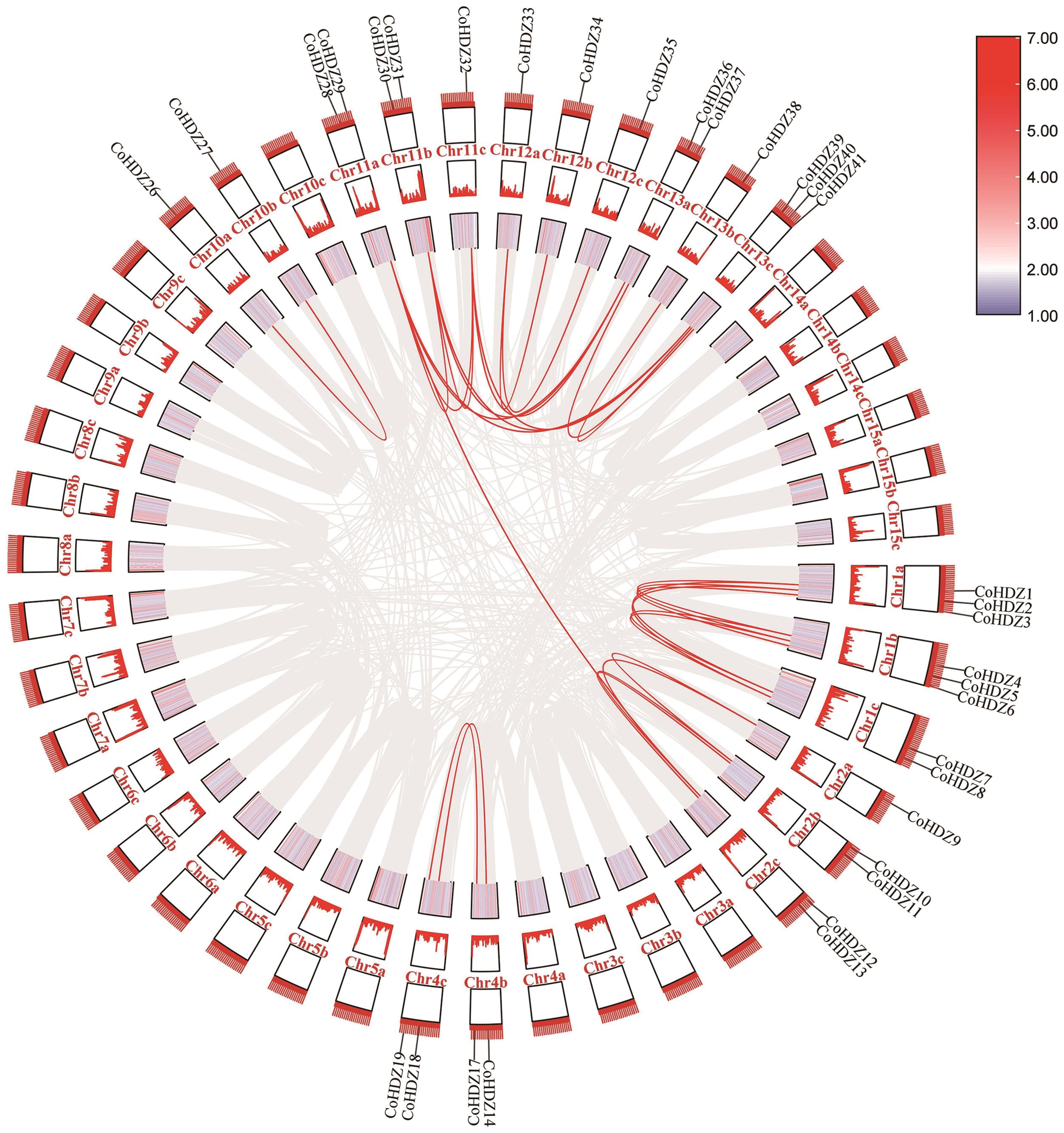
图6 油茶HD-Zip基因家族物种内共线性分析
Fig. 6 Collinearity analysis of the HD-Zip gene family in C. oleifera

图7 油茶和拟南芥HD-Zip基因家族物种间共线性分析
Fig. 7 Inter-species collinearity analysis of the HD-Zip gene family of C. oleifera and A. thaliana

图8 油茶和茶树HD-Zip基因家族物种间共线性分析
Fig. 8 Inter-species collinearity analysis of the HD-Zip gene family of C. oleifera and C. sinensis

图9 油茶CoHDZs在不同组织及果实发育中的表达特性A:CoHDZIPs基因在不同组织部位的表达特性;B:CoHDZIPs基因在果实不同发育期的表达特性
Fig. 9 Expression characteristics of C.oleifera CoHDZs in different tissues and fruit developmenA: Expression characteristics of CoHDZIPs gene in different tissue parts. B: Expression characteristics of CoHDZIPs gene in different fruit development stages

图10 不同胁迫处理下17个CoHDZs基因的表达差异
Fig. 10 Expression differences of 17 CoHDZs genes under different stress treatments
| 1 | Sharif R, Raza A, Chen P, et al. HD-ZIP gene family: potential roles in improving plant growth and regulating stress-responsive mechanisms in plants [J]. Genes, 2021, 12(8): 1256. |
| 2 | Ariel FD, Manavella PA, Dezar CA, et al. The true story of the HD-zip family [J]. Trends Plant Sci, 2007, 12(9): 419-426. |
| 3 | Palena CM, Tron AE, Bertoncini CW, et al. Positively charged residues at the N-terminal arm of the homeodomain are required for efficient DNA binding by homeodomain-leucine zipper proteins [J]. J Mol Biol, 2001, 308(1): 39-47. |
| 4 | Elhiti M, Stasolla C. Structure and function of homodomain-leucine zipper (HD-Zip) proteins [J]. Plant Signal Behav, 2009, 4(2): 86-88. |
| 5 | Söderman E, Mattsson J, Engström P. The Arabidopsis homeobox gene ATHB-7 is induced by water deficit and by abscisic acid [J]. Plant J, 1996, 10(2): 375-381. |
| 6 | Zhang SX, Haider I, Kohlen W, et al. Function of the HD-Zip I gene Oshox22 in ABA-mediated drought and salt tolerances in rice [J]. Plant Mol Biol, 2012, 80(6): 571-585. |
| 7 | 王宏, 李刚波, 张大勇, 等. 植物HD-Zip转录因子的生物学功能 [J]. 遗传, 2013, 35(10): 1179-1188. |
| Wang H, Li GB, Zhang DY, et al. Biological functions of HD-zip transcription factors [J]. Hereditas, 2013, 35(10): 1179-1188. | |
| 8 | Ciarbelli AR, Ciolfi A, Salvucci S, et al. The Arabidopsis homeodomain-leucine zipper Ⅱ gene family: diversity and redundancy [J]. Plant Mol Biol, 2008, 68(4-5): 465-478. |
| 9 | Turchi L, Baima S, Morelli G, et al. Interplay of HD-Zip Ⅱ and Ⅲ transcription factors in auxin-regulated plant development [J]. J Exp Bot, 2015, 66(16): 5043-5053. |
| 10 | Gao J, Chen JY, Feng LY, et al. HD-zip Ⅲ gene family: identification and expression profiles during leaf vein development in soybean [J]. Plants, 2022, 11(13): 1728. |
| 11 | Nakamura M, Katsumata H, Abe M, et al. Characterization of the class Ⅳ homeodomain-leucine zipper gene family in Arabidopsis [J]. Plant Physiol, 2006, 141(4): 1363-1375. |
| 12 | Xie QM, Gao YN, Li J, et al. The HD-Zip IV transcription factor SlHDZIV8 controls multicellular trichome morphology by regulating the expression of Hairless-2 [J]. J Exp Bot, 2020, 71(22): 7132-7145. |
| 13 | 谭晓风. 油茶分子育种研究进展 [J]. 中南林业科技大学学报, 2023, 43(1): 1-24. |
| Tan XF. Advances in the molecular breeding of Camellia oleifera [J]. J Cent South Univ For Technol, 2023, 43(1): 1-24. | |
| 14 | 董斌, 李荣喜, 洪文泓, 等. 油茶干旱胁迫响应机制的研究进展 [J]. 生物技术通报, 2020, 36(1): 144-149. |
| Dong B, Li RX, Hong WH, et al. Research progress on drought stress response mechanism in Camellia oleifera [J]. Biotechnol Bull, 2020, 36(1): 144-149. | |
| 15 | Zhu HG, Wang FQ, Xu ZP, et al. The complex hexaploid oil-Camellia genome traces back its phylogenomic history and multi-omics analysis of Camellia oil biosynthesis [J]. Plant Biotechnol J, 2024, 22(10): 2890-2906. |
| 16 | Wang YX, Liu ZW, Wu ZJ, et al. Transcriptome-wide identification and expression analysis of the NAC gene family in tea plant [Camellia sinensis (L.) O. kuntze] [J]. PLoS One, 2016, 11(11): e0166727. |
| 17 | Horton P, Park KJ, Obayashi T, et al. WoLF PSORT: protein localization predictor [J]. Nucleic Acids Res, 2007, 35(Web Server issue): W585-W587. |
| 18 | Kumar S, Stecher G, Li M, et al. MEGA X: molecular evolutionary genetics analysis across computing platforms [J]. Mol Biol Evol, 2018, 35(6): 1547-1549. |
| 19 | Letunic I, Bork P. Interactive tree of life (iTOL) v5: an online tool for phylogenetic tree display and annotation [J]. Nucleic Acids Res, 2021, 49(W1): W293-W296. |
| 20 | Bailey TL, Boden M, Buske FA, et al. MEME SUITE: tools for motif discovery and searching [J]. Nucleic Acids Res, 2009, 37(Web Server issue): W202-W208. |
| 21 | Chen CJ, Wu Y, Li JW, et al. TBtools-Ⅱ: a “one for all, all for one” bioinformatics platform for biological big-data mining [J]. Mol Plant, 2023, 16(11): 1733-1742. |
| 22 | Lescot M, Déhais P, Thijs G, et al. PlantCARE, a database of plant Cis-acting regulatory elements and a portal to tools for in silico analysis of promoter sequences [J]. Nucleic Acids Res, 2002, 30(1): 325-327. |
| 23 | Gong WF, Song QL, Ji K, et al. Full-length transcriptome from Camellia oleifera seed provides insight into the transcript variants involved in oil biosynthesis [J]. J Agric Food Chem, 2020, 68(49): 14670-14683. |
| 24 | Maren NA, Duduit JR, Huang DB, et al. Stepwise optimization of real-time RT-PCR analysis [J]. Methods Mol Biol, 2023, 2653: 317-332. |
| 25 | Zhao Y, Ma Q, Jin XL, et al. A novel maize homeodomain-leucine zipper (HD-Zip) I gene, Zmhdz10, positively regulates drought and salt tolerance in both rice and Arabidopsis [J]. Plant Cell Physiol, 2014, 55(6): 1142-1156. |
| 26 | Ingram J, Bartels D. The molecular basis of dehydration tolerance in plants [J]. Annu Rev Plant Physiol Plant Mol Biol, 1996, 47: 377-403. |
| 27 | Yamaguchi-Shinozaki K, Shinozaki K. Transcriptional regulatory networks in cellular responses and tolerance to dehydration and cold stresses [J]. Annu Rev Plant Biol, 2006, 57: 781-803. |
| 28 | Kopecká R, Kameniarová M, Černý M, et al. Abiotic stress in crop production [J]. Int J Mol Sci, 2023, 24(7): 6603. |
| 29 | Ahmad S, Chen Y, Shah AZ, et al. The Homeodomain-Leucine zipper genes family regulates the jinggangmycin mediated immune response of Oryza sativa to Nilaparvata lugens, and Laodelphax striatellus [J]. Bioengineering, 2022, 9(8): 398. |
| 30 | Sharif R, Xie C, Wang J, et al. Genome wide identification, characterization and expression analysis of HD-ZIP gene family in Cucumis sativus L. under biotic and various abiotic stresses [J]. Int J Biol Macromol, 2020: S0141-8130(20)32981-0. |
| 31 | Liu K, Han XL, Liang ZL, et al. Genome-wide identification, classification, and expression analysis of the HD-zip transcription factor family in apple (Malus domestica borkh.) [J]. Int J Mol Sci, 2022, 23(5): 2632. |
| 32 | Yang QY, Xiang WB, Li ZH, et al. Genome-wide characterization and expression analysis of HD-ZIP gene family in Dendrobium officinale [J]. Front Genet, 2022, 13: 797014. |
| 33 | Li Z, Gao ZQ, Li RH, et al. Genome-wide identification and expression profiling of HD-ZIP gene family in Medicago truncatula [J]. Genomics, 2020, 112(5): 3624-3635. |
| 34 | Bowers JE, Chapman BA, Rong JK, et al. Unravelling angiosperm genome evolution by phylogenetic analysis of chromosomal duplication events [J]. Nature, 2003, 422: 433-438. |
| 35 | Zhang KM, Lan YG, Shi YN, et al. Systematic analysis and functional characterization of the PLATZ transcription factors in moso bamboo (Phyllostachys edulis) [J]. J Plant Growth Regul, 2023, 42(1): 218-236. |
| 36 | 周佩娜, 党静洁, 邵永芳, 等. 荆芥HD-Zip基因家族的全基因组鉴定及分析 [J]. 浙江农林大学学报, 2023, 40(1): 12-21. |
| Zhou PN, Dang JJ, Shao YF, et al. Genome-wide identification and expression analysis of HD-Zip gene family in Schizonepeta tenuifolia [J]. J Zhejiang A F Univ, 2023, 40(1): 12-21. | |
| 37 | 祁存英, 李媛, 杨成兰, 等. 青稞HD-Zip基因家族鉴定及其在非生物胁迫下的表达特性 [J]. 西北植物学报, 2023, 43(1): 66-78. |
| Qi CY, Li Y, Yang CL, et al. Identification of HD-zip gene family of Tibetan hulless barley and its expression characteristics under abiotic stress [J]. Acta Bot Boreali Occidentalia Sin, 2023, 43(1): 66-78. | |
| 38 | Zhao Y, Zhou YQ, Jiang HY, et al. Systematic analysis of sequences and expression patterns of drought-responsive members of the HD-Zip gene family in maize [J]. PLoS One, 2011, 6(12): e28488. |
| 39 | Hu X, Liang JX, Wang WJ, et al. Comprehensive genome-wide analysis of the DREB gene family in Moso bamboo (Phyllostachys edulis): evidence for the role of PeDREB28 in plant abiotic stress response [J]. Plant J, 2023, 116(5): 1248-1270. |
| 40 | 叶泗洪, 季美君, 陈奇, 等. 陆地棉HD-ZIP_N基因家族的全基因组分析 [J]. 农业生物技术学报, 2023, 31(12): 2454-2465. |
| Ye SH, Ji MJ, Chen Q, et al. Genome-wide analysis of the HD-ZIP_N gene family in Gossypium hirsutum [J]. J Agric Biotechnol, 2023, 31(12): 2454-2465. | |
| 41 | 刘梦梦, 刘晓, 尤倩, 等. 半夏HD-Zip基因家族全基因组鉴定及表达分析 [J]. 农业生物技术学报, 2024, 32(11): 145-152. |
| Liu MM, Liu X, You Q, et al. Genome wide identification and expression analysis of the HD-zip gene family in Pinellia ternata [J]. J Agric Biotechnol, 2024, 32(11): 145-152. | |
| 42 | 邵晨冰, 黄志楠, 白雪滢, 等. 辣椒HD-Zip基因家族鉴定、系统进化及表达分析 [J]. 中国农业科学, 2020, 53(5): 1004-1017. |
| Shao CB, Huang ZN, Bai XY, et al. Identification, systematic evolution and expression analysis of HD-zip gene family in Capsicum annuum [J]. Sci Agric Sin, 2020, 53(5): 1004-1017. | |
| 43 | Zhang XX, Chen ZX, Wang CN, et al. Genome-wide identification of HD-ZIP gene family and screening of genes related to prickle development in Zanthoxylum armatum [J]. Plant Genome, 2023, 16(1): e20295. |
| 44 | Wang Z, Wu XL, Zhang BB, et al. Genome-wide identification, bioinformatics and expression analysis of HD-Zip gene family in peach [J]. BMC Plant Biol, 2023, 23(1): 122. |
| 45 | Wang YJ, Wang HJ, Yu C, et al. Comprehensive bioinformation analysis of homeodomain-leucine zipper gene family and expression pattern of HD-Zip I under abiotic stress in Salix suchowensis [J]. BMC Genomics, 2024, 25(1): 182. |
| 46 | Xu YQ, Liu CL. Genome-wide identification and analysis of the HD-Zip transcription factor family in oats [J]. Front Mol Biosci, 2024, 11: 1475276. |
| 47 | Li SM, Chen N, Li FF, et al. Characterization of wheat homeodomain-leucine zipper family genes and functional analysis of TaHDZ5-6A in drought tolerance in transgenic Arabidopsis [J]. BMC Plant Biol, 2020, 20(1): 50. |
| [1] | 刘源, 赵冉, 卢振芳, 李瑞丽. 植物类胡萝卜素生物代谢途径及其功能研究进展[J]. 生物技术通报, 2025, 41(5): 23-31. |
| [2] | 彭绍智, 王登科, 张祥, 戴雄泽, 徐昊, 邹学校. 辣椒CaFD1基因克隆、表达特征及功能验证[J]. 生物技术通报, 2025, 41(5): 153-164. |
| [3] | 张益瑄, 马宇, 王童童, 盛苏奥, 宋家凤, 吕钊彦, 朱晓彪, 侯华兰. 马铃薯DIR家族全基因组鉴定及表达模式分析[J]. 生物技术通报, 2025, 41(3): 123-136. |
| [4] | 王琛, 刘国梅, 陈畅, 张晋龙, 姚琳, 孙璇, 杜春芳. 白菜型油菜CCDs家族全基因组鉴定及表达分析[J]. 生物技术通报, 2025, 41(3): 161-170. |
| [5] | 韩江涛, 张帅博, 秦雅蕊, 韩硕洋, 张雅康, 王吉庆, 杜清洁, 肖怀娟, 李猛. 甜瓜β-淀粉酶基因家族的鉴定及对非生物胁迫的响应[J]. 生物技术通报, 2025, 41(3): 171-180. |
| [6] | 匡健华, 程志鹏, 赵永晶, 杨洁, 陈润乔, 陈龙清, 胡慧贞. 激素和非生物胁迫下荷花GH3基因家族的表达分析[J]. 生物技术通报, 2025, 41(2): 221-233. |
| [7] | 葛仕杰, 刘怡德, 张华东, 宁强, 朱展望, 王书平, 刘易科. 小麦蛋白质二硫键异构酶基因家族的鉴定与表达[J]. 生物技术通报, 2025, 41(2): 85-96. |
| [8] | 殷缘, 程爽, 刘定豪, 邓晓霞, 李凯月, 王竞红, 蔺吉祥. 外源过氧化氢(H2O2)影响非生物胁迫下植物生长与生理代谢机制的研究进展[J]. 生物技术通报, 2025, 41(1): 1-13. |
| [9] | 武志健, 刘广洋, 林志豪, 盛彬, 陈鸽, 许晓敏, 王军伟, 徐东辉. 蔬菜种子萌发的纳米调控及其机制研究进展[J]. 生物技术通报, 2025, 41(1): 14-24. |
| [10] | 李禹欣, 李苗, 杜晓芬, 韩康妮, 连世超, 王军. 谷子SiSAP基因家族的鉴定与表达分析[J]. 生物技术通报, 2025, 41(1): 143-156. |
| [11] | 申鹏, 高雅彬, 丁红. 马铃薯SAT基因家族的鉴定和表达分析[J]. 生物技术通报, 2024, 40(9): 64-73. |
| [12] | 满全财, 孟姿诺, 李伟, 蔡心汝, 苏润东, 付长青, 高顺娟, 崔江慧. 马铃薯AQP基因家族鉴定及表达分析[J]. 生物技术通报, 2024, 40(9): 51-63. |
| [13] | 李勇慧, 鲍星星, 段一珂, 赵运霞, 于相丽, 陈尧, 张延召. 灵宝杜鹃bZIP家族全基因组鉴定及表达特征分析[J]. 生物技术通报, 2024, 40(8): 186-198. |
| [14] | 崔原瑗, 王昭懿, 白双宇, 任毓昭, 豆飞飞, 刘彩霞, 刘凤楼, 王掌军, 李清峰. 大麦非特异性磷脂酶C基因家族全基因组鉴定及苗期胁迫表达分析[J]. 生物技术通报, 2024, 40(8): 74-82. |
| [15] | 刘丹丹, 王雷刚, 孙明慧, 焦小雨, 吴琼, 王文杰. 茶树海藻糖-6-磷酸合成酶(TPS)基因家族鉴定与表达分析[J]. 生物技术通报, 2024, 40(8): 152-163. |
| 阅读次数 | ||||||
|
全文 |
|
|||||
|
摘要 |
|
|||||
