







生物技术通报 ›› 2026, Vol. 42 ›› Issue (6): 186-197.doi: 10.13560/j.cnki.biotech.bull.1985.2025-0311
• 综述与专论 • 上一篇
冯丽琼( ), 郭焜, 陈梓倩, 葛晓瑾, 陈沛涵, 李艺晶, 詹若挺, 陈立凯()
收稿日期:2025-03-25
出版日期:2026-06-26
发布日期:2026-07-11
通讯作者:
陈立凯,男,教授,博士生导师,研究方向 :南药资源保护、评价与质量遗传调控;E-mail: chenlk@gzucm.edu.cn作者简介:冯丽琼,女,硕士研究生,研究方向 :药用植物胞外囊泡新资源;E-mail: 1253394389@qq.com
基金资助:
FENG Li-qiong(), GUO Kun, CHEN Zi-qian, GE Xiao-jin, CHEN Pei-han, LI Yi-jing, ZHAN Ruo-ting, CHEN Li-kai()
Received:2025-03-25
Published:2026-06-26
Online:2026-07-11
摘要:
药用植物胞外囊泡(Chinese herbal medicine derived extracellular vesicles-like particles, CHM-EVLP)是由药用植物各种细胞分泌的纳米级囊泡的统称,其由脂质双层膜构成,内含核酸、蛋白质、脂质及多种活性小分子等生物活性成分。现多项研究已证明CHM-EVLP具有跨界调控功能,兼具生物相容性好、高稳定性、可透皮吸收、靶向性强、安全性高等特点,使其在药物递送系统和疾病治疗中具有广阔应用前景。本文系统综述了CHM-EVLP的多种提取和纯化技术并比较其优缺点,表征与鉴定方法,并详细分析了其内含的核酸(如具有基因调控功能的miRNA)、蛋白质、脂质及小分子活性成分的组成与功能。进一步地,本文总结了CHM-EVLP在植物生长发育和代谢、胁迫响应、物质信息传递及哺乳动物系统中的多种生物活性,包括抗炎、抗肿瘤和癌症、抗氧化、抗骨质疏松等多种作用活性和机制,并探讨了其作为新型治疗剂和纳米药物载体,在抗癌治疗、炎症性疾病、医疗美容及护肤品等领域的应用潜力。尽管CHM-EVLP研究取得显著进展,但仍面临提取效率低、标准化方法和标志物缺失、作用机制不明确、长期保存困难等挑战。未来研究应聚焦于开发高效、可扩展的制备工艺,建立统一的质量评价体系,深入揭示其跨界调控的分子机制,持续探索以推动其在临床治疗与健康产品中的实际应用和产业化发展,进而促进新的药用植物资源的深度开发利用。
冯丽琼, 郭焜, 陈梓倩, 葛晓瑾, 陈沛涵, 李艺晶, 詹若挺, 陈立凯. 药用植物胞外囊泡的功能分析与应用研究进展[J]. 生物技术通报, 2026, 42(6): 186-197.
FENG Li-qiong, GUO Kun, CHEN Zi-qian, GE Xiao-jin, CHEN Pei-han, LI Yi-jing, ZHAN Ruo-ting, CHEN Li-kai. Advances in Functional Analysis and Application of Chinese Herbal Medicine Derived Extracellular Vesicles-like Particles[J]. Biotechnology Bulletin, 2026, 42(6): 186-197.
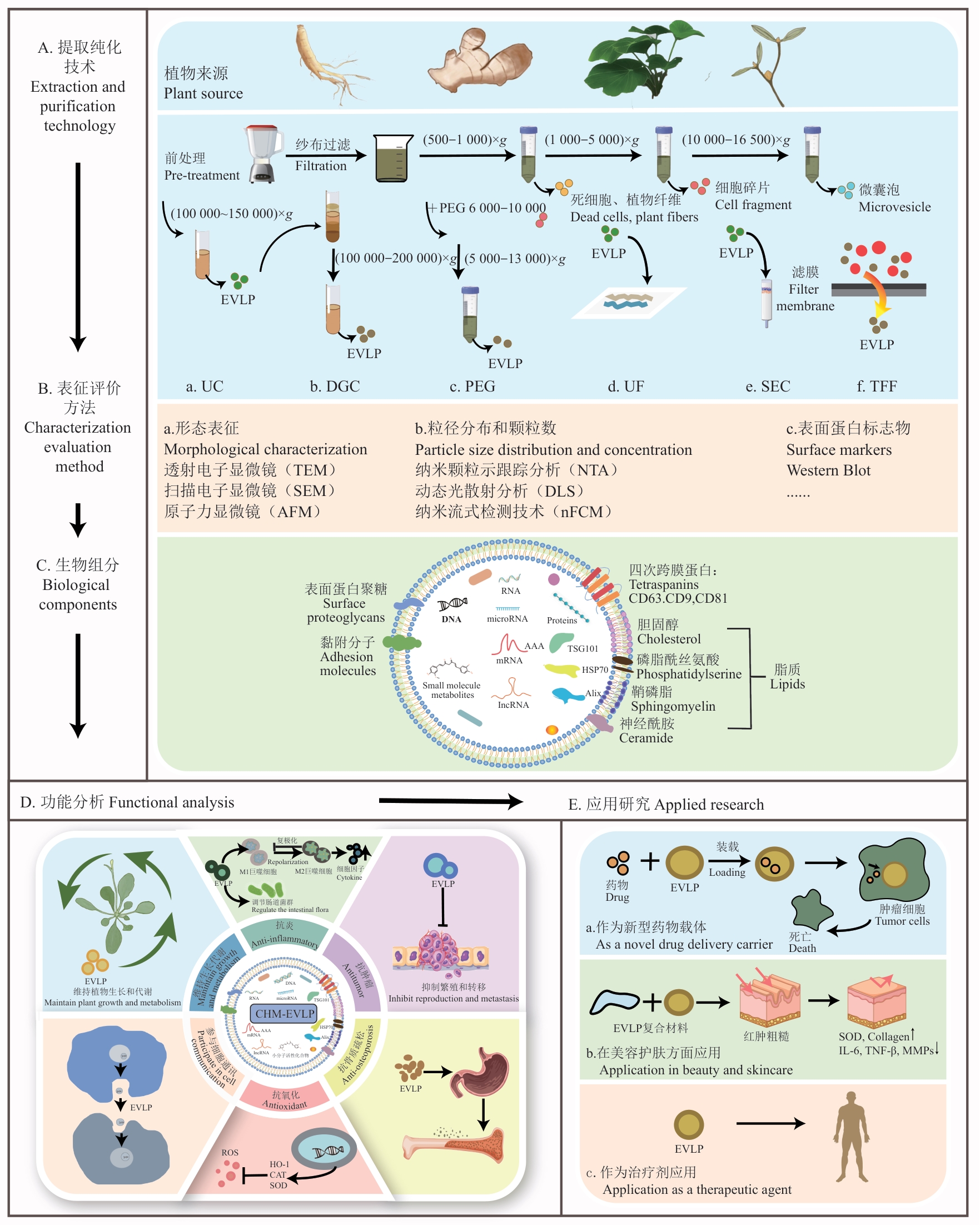
图1 CHM-EVLP的功能分析与应用研究进展图
Fig. 1 Advances in functional analysis and application of CHM-EVLP
分离技术 Separation technique | 原理 Principle | 优点 Advantages | 缺点 Disadvantages | 应用 Applications |
|---|---|---|---|---|
超速离心法 Ultracentrifugation (UC) | 不同物质在离心条件下沉降系数不同 | 具有良好的兼容性,操作较简单 | 设备成本高,时间长,囊泡易聚集,回收率低 | 芦荟[ |
蔗糖密度梯度离心法 Sucrose density gradient centrifugation (DGC) | 基于密度分离 | 纯度较高 | 设备成本高,操作复杂 | 人参[ |
聚乙二醇沉淀法 Polyethylene glycol precipitation (PEG) | 通过PEG改变EVLP溶解度而使其沉淀 | 设备成本低,样品量兼容性强,效率高 | 产物纯度较低,时间长 | 生姜[ |
超滤法 Ultrafiltration (UF) | 溶液通过不同相对分子质量截留值的超细纳米过滤膜而分离 | 缩短时间 | 外压可能导致囊泡破碎,易堵塞 | 积雪草[ |
尺寸排除色谱法 Size exclusion chromatography (SEC) | 不同尺寸的物质通过多孔树脂颗粒而分离 | 纯度高,可保证囊泡的完整度 | 样品处理量小,易堵塞 | 槲寄生[ |
切向流过滤 Tangential flow filtration (TFF) | 错流过滤的原理来浓缩和过滤颗粒 | 适合大体积料液提取,产量和纯度高 | 设备成本较高,操作复杂 | 紫菀[ |
表1 CHM-EVLP分离技术及应用概况
Table 1 CHM-EVLP separation techniques and application overview
分离技术 Separation technique | 原理 Principle | 优点 Advantages | 缺点 Disadvantages | 应用 Applications |
|---|---|---|---|---|
超速离心法 Ultracentrifugation (UC) | 不同物质在离心条件下沉降系数不同 | 具有良好的兼容性,操作较简单 | 设备成本高,时间长,囊泡易聚集,回收率低 | 芦荟[ |
蔗糖密度梯度离心法 Sucrose density gradient centrifugation (DGC) | 基于密度分离 | 纯度较高 | 设备成本高,操作复杂 | 人参[ |
聚乙二醇沉淀法 Polyethylene glycol precipitation (PEG) | 通过PEG改变EVLP溶解度而使其沉淀 | 设备成本低,样品量兼容性强,效率高 | 产物纯度较低,时间长 | 生姜[ |
超滤法 Ultrafiltration (UF) | 溶液通过不同相对分子质量截留值的超细纳米过滤膜而分离 | 缩短时间 | 外压可能导致囊泡破碎,易堵塞 | 积雪草[ |
尺寸排除色谱法 Size exclusion chromatography (SEC) | 不同尺寸的物质通过多孔树脂颗粒而分离 | 纯度高,可保证囊泡的完整度 | 样品处理量小,易堵塞 | 槲寄生[ |
切向流过滤 Tangential flow filtration (TFF) | 错流过滤的原理来浓缩和过滤颗粒 | 适合大体积料液提取,产量和纯度高 | 设备成本较高,操作复杂 | 紫菀[ |
生物活性 Bioactivity | 药用植物 Medicinal plants | 部位 Part used | 生物活性及作用机制 Bioactivity and mechanism of action | 文献 Reference |
|---|---|---|---|---|
| 抗炎 Anti-inflammatory | 生姜 | 根茎 | 通过下调NF-κB、IL-6、IL-8和TNF-α的表达,拮抗LPS诱导的炎症 | [ |
| 马齿苋 | 地上部分 | 有效抑制促炎性细胞因子(TNF-α、IL-6、IL-12和IL-1β)和髓过氧化物酶(MPO)的表达,增加抗炎性细胞因子(IL-10)的水平,并缓解葡聚糖硫酸钠(DSS)诱导的C57小鼠和IL-10-/-小鼠的急性结肠炎 | [ | |
| 葛根 | 根 | 促进M1表型向M2巨噬细胞的转化,从而发挥和增强抗炎作用 | [ | |
| 姜黄 | 根茎 | 促进M1表型向M2巨噬细胞的转化,并恢复受损的肠上皮屏障以发挥抗结肠炎功效 | [ | |
抗肿瘤和癌症 Anti-tumor and anti-cancer | 青蒿 | 地上部分 | 激活哺乳动物免疫细胞内的信号传导途径,从而重新激活抗肿瘤免疫反应而彻底消除肿瘤 | [ |
| 辣木 | 种子 | 可以降低肿瘤细胞的存活率,增加与B细胞淋巴瘤蛋白表达降低相关的凋亡水平,并降低了线粒体膜电位 | [ | |
| 天冬 | 块根 | 通过吞噬作用内化到肿瘤细胞中,显著抑制肿瘤生长且无副作用 | [ | |
| 鸦胆子 | 果实 | 通过EVLP向4T1细胞递送10个功能性miRNA,调节PI3K/Akt/mTOR信号通路和促进ROS/caspase介导的细胞凋亡显著延缓4T1细胞的生长和转移 | [ | |
| 积雪草 | 地上部分 | 通过HepG2细胞对EVLP进行内化,促进活性氧水平增加、线粒体损伤、细胞周期停滞在G1期和细胞凋亡 | [ | |
| 桑叶 | 叶 | 通过半乳糖受体介导的内吞作用被肝脏肿瘤细胞株优先内化,增加细胞内氧化应激,引发线粒体损伤,从而抑制肿瘤细胞的活力、迁移和侵袭 | [ | |
抗骨质疏松 Anti-osteoporosis | 骨碎补 | 根 | 通过人骨髓间充质干细胞内化EVLP,以促进这些细胞的增殖和雌激素受体-α表达水平,成骨分化和骨形成 | [ |
| 巴戟天 | 根 | 通过MAPK通路促进成骨细胞增殖以缓解绝经后骨质疏松症 | [ | |
| 续断 | 根 | 通过激活BMP2/Smads信号通路以促进骨髓间充质干细胞的成骨分化和钙结节的形成,促进成骨分化相关基因(ALP、OCN、RUNX2以及COL1)的表达 | [ | |
| 淫羊藿 | 叶 | 提高血管内皮生长因子VEGF的表达水平,加强血管内皮细胞生成能力以缓解骨质疏松,并且具有体内骨靶向性 | [ | |
| 抗氧化 Antioxidant | 芦荟 | 皮 | 通过Nrf2激活抗氧化防御机制和促进伤口愈合过程 | [ |
| 生姜 | 根茎 | 诱导Nrf2活化,上调肝脏解毒和抗氧化基因的表达,并抑制活性氧的产生 | [ |
表2 CHM-EVLP的生物活性及作用机制
Table 2 Biological activity and mechanism of CHM-EVLP
生物活性 Bioactivity | 药用植物 Medicinal plants | 部位 Part used | 生物活性及作用机制 Bioactivity and mechanism of action | 文献 Reference |
|---|---|---|---|---|
| 抗炎 Anti-inflammatory | 生姜 | 根茎 | 通过下调NF-κB、IL-6、IL-8和TNF-α的表达,拮抗LPS诱导的炎症 | [ |
| 马齿苋 | 地上部分 | 有效抑制促炎性细胞因子(TNF-α、IL-6、IL-12和IL-1β)和髓过氧化物酶(MPO)的表达,增加抗炎性细胞因子(IL-10)的水平,并缓解葡聚糖硫酸钠(DSS)诱导的C57小鼠和IL-10-/-小鼠的急性结肠炎 | [ | |
| 葛根 | 根 | 促进M1表型向M2巨噬细胞的转化,从而发挥和增强抗炎作用 | [ | |
| 姜黄 | 根茎 | 促进M1表型向M2巨噬细胞的转化,并恢复受损的肠上皮屏障以发挥抗结肠炎功效 | [ | |
抗肿瘤和癌症 Anti-tumor and anti-cancer | 青蒿 | 地上部分 | 激活哺乳动物免疫细胞内的信号传导途径,从而重新激活抗肿瘤免疫反应而彻底消除肿瘤 | [ |
| 辣木 | 种子 | 可以降低肿瘤细胞的存活率,增加与B细胞淋巴瘤蛋白表达降低相关的凋亡水平,并降低了线粒体膜电位 | [ | |
| 天冬 | 块根 | 通过吞噬作用内化到肿瘤细胞中,显著抑制肿瘤生长且无副作用 | [ | |
| 鸦胆子 | 果实 | 通过EVLP向4T1细胞递送10个功能性miRNA,调节PI3K/Akt/mTOR信号通路和促进ROS/caspase介导的细胞凋亡显著延缓4T1细胞的生长和转移 | [ | |
| 积雪草 | 地上部分 | 通过HepG2细胞对EVLP进行内化,促进活性氧水平增加、线粒体损伤、细胞周期停滞在G1期和细胞凋亡 | [ | |
| 桑叶 | 叶 | 通过半乳糖受体介导的内吞作用被肝脏肿瘤细胞株优先内化,增加细胞内氧化应激,引发线粒体损伤,从而抑制肿瘤细胞的活力、迁移和侵袭 | [ | |
抗骨质疏松 Anti-osteoporosis | 骨碎补 | 根 | 通过人骨髓间充质干细胞内化EVLP,以促进这些细胞的增殖和雌激素受体-α表达水平,成骨分化和骨形成 | [ |
| 巴戟天 | 根 | 通过MAPK通路促进成骨细胞增殖以缓解绝经后骨质疏松症 | [ | |
| 续断 | 根 | 通过激活BMP2/Smads信号通路以促进骨髓间充质干细胞的成骨分化和钙结节的形成,促进成骨分化相关基因(ALP、OCN、RUNX2以及COL1)的表达 | [ | |
| 淫羊藿 | 叶 | 提高血管内皮生长因子VEGF的表达水平,加强血管内皮细胞生成能力以缓解骨质疏松,并且具有体内骨靶向性 | [ | |
| 抗氧化 Antioxidant | 芦荟 | 皮 | 通过Nrf2激活抗氧化防御机制和促进伤口愈合过程 | [ |
| 生姜 | 根茎 | 诱导Nrf2活化,上调肝脏解毒和抗氧化基因的表达,并抑制活性氧的产生 | [ |
| [1] | Zhao Q, Wang T, Wang HB, et al. Consensus statement on research and application of Chinese herbal medicine derived extracellular vesicles-like particles (2023 edition) [J]. Chin Herb Med, 2024, 16(1): 3-12. |
| [2] | Zarà M, Guidetti GF, Camera M, et al. Biology and role of extracellular vesicles (EVs) in the pathogenesis of thrombosis [J]. Int J Mol Sci, 2019, 20(11): 2840. |
| [3] | Jiang D, Li ZL, Liu HY, et al. Plant exosome-like nanovesicles derived from sesame leaves as carriers for luteolin delivery: Molecular docking, stability and bioactivity [J]. Food Chem, 2024, 438: 137963. |
| [4] | Chen XY, Zhou Y, Yu JJ. Exosome-like nanoparticles from ginger rhizomes inhibited NLRP3 inflammasome activation [J]. Mol Pharmaceutics, 2019, 16(6): 2690-2699. |
| [5] | Chen CX, Wang JL, Sun MD, et al. Toward the next-generation Phyto-nanomedicines: cell-derived nanovesicles (CDNs) for natural product delivery [J]. Biomed Pharmacother, 2022, 145: 112416. |
| [6] | Cong MH, Tan SY, Li SM, et al. Technology insight: Plant-derived vesicles-How far from the clinical biotherapeutics and therapeutic drug carriers [J]. Adv Drug Deliv Rev, 2022, 182: 114108. |
| [7] | Cho EG, Choi SY, Kim H, et al. Panax ginseng-derived extracellular vesicles facilitate anti-senescence effects in human skin cells: an eco-friendly and sustainable way to use ginseng substances [J]. Cells, 2021, 10(3): 486. |
| [8] | Zeng LP, Wang HY, Shi WH, et al. Aloe derived nanovesicle as a functional carrier for indocyanine green encapsulation and phototherapy [J]. J Nanobiotechnology, 2021, 19(1): 439. |
| [9] | Ye LS, Gao YN, Mok SWF, et al. Modulation of alveolar macrophage and mitochondrial fitness by medicinal plant-derived nanovesicles to mitigate acute lung injury and viral pneumonia [J]. J Nanobiotechnology, 2024, 22(1): 190. |
| [10] | Kalarikkal SP, Prasad D, Kasiappan R, et al. A cost-effective polyethylene glycol-based method for the isolation of functional edible nanoparticles from ginger rhizomes [J]. Sci Rep, 2020, 10(1): 4456. |
| [11] | 刘贵龙. 巴戟天小细胞外囊泡提取方法、表征及其生物活性研究 [D]. 广州: 广州中医药大学, 2023. |
| Liu GL. Small extracellular vesicles in Morinda officinalis: isolation method, characterization, and biological active substance [D]. Guangzhou: Guangzhou University of Chinese Medicine, 2023. | |
| [12] | Woith E, Melzig MF. Extracellular vesicles from fresh and dried plants-simultaneous purification and visualization using gel electrophoresis [J]. Int J Mol Sci, 2019, 20(2): 357. |
| [13] | Wu Q, Wu CY, Wu ZY, et al. Multi-omics analyses reveal the differentiation of biochemical constituents from fresh and dry Andrographis paniculata-derived vesicle-like nanoparticles [J]. Curr Plant Biol, 2025, 43: 100497. |
| [14] | Li SY, Zhang R, Wang AN, et al. Panax notoginseng: derived exosome-like nanoparticles attenuate ischemia reperfusion injury via altering microglia polarization [J]. J Nanobiotechnology, 2023, 21(1): 416. |
| [15] | 魏朝治, 靳远祥, 张梦宇, 等. 一种黄精属植物胞外囊泡及其制备方法: CN117025501B [P]. 2025-06-03. |
| Wei CZ, Ji YX, Zhang MY, et al. Extracellular vesicles from polygonatum species and preparation method thereof: CN117025501B [P]. 2023-11-10. | |
| [16] | Kim DK, Kang SJ, Rhee WJ. Perilla-leaf-derived extracellular vesicles selectively inhibit breast cancer cell proliferation and invasion [J]. Int J Mol Sci, 2023, 24(21): 15633. |
| [17] | Park J, Go EB, Oh JS, et al. Multiple-cycle polymeric extracellular vesicle precipitation and its evaluation by targeted mass spectrometry [J]. Int J Mol Sci, 2021, 22(9): 4311. |
| [18] | Zhang XY, Pan Z, Wang YX, et al. Taraxacum officinale-derived exosome-like nanovesicles modulate gut metabolites to prevent intermittent hypoxia-induced hypertension [J]. Biomed Pharmacother, 2023, 161: 114572. |
| [19] | Liu C, Yan XJ, Zhang YJ, et al. Oral administration of turmeric-derived exosome-like nanovesicles with anti-inflammatory and pro-resolving bioactions for murine colitis therapy [J]. J Nanobiotechnology, 2022, 20(1): 206. |
| [20] | 邓盟, 李雪茹. 一种基于超纯固膜技术的植物外泌体复合物的制备方法: CN114540268A [P]. 2022-05-27. |
| Deng M, Li XR. A method for preparing plant exosome complex based on ultra-pure solid-membrane technology: CN114540268A [P]. 2022-05-27. | |
| [21] | Winkler K, Leneweit G, Schubert R. Characterization of membrane vesicles in plant extracts [J]. Colloids Surf B Biointerfaces, 2005, 45(2): 57-65. |
| [22] | Kim WS, Ha JH, Jeong SH, et al. Immunological effects of Aster yomena callus-derived extracellular vesicles as potential therapeutic agents against allergic asthma [J]. Cells, 2022, 11(18): 2805. |
| [23] | Théry C, Witwer KW, Aikawa E, et al. Minimal information for studies of extracellular vesicles 2018 (MISEV2018): a position statement of the international society for extracellular vesicles and update of the MISEV2014 guidelines [J]. J Extracell Vesicles, 2018, 7(1): 1535750. |
| [24] | Chen JC, Wu JH, Mu JF, et al. An antioxidative sophora exosome-encapsulated hydrogel promotes spinal cord repair by regulating oxidative stress microenvironment [J]. Nanomed Nanotechnol Biol Med, 2023, 47: 102625. |
| [25] | Kilasoniya A, Garaeva L, Shtam T, et al. Potential of plant exosome vesicles from grapefruit (Citrus × paradisi) and tomato (Solanum lycopersicum) juices as functional ingredients and targeted drug delivery vehicles [J]. Antioxidants, 2023, 12(4): 943. |
| [26] | Jokhio S, Peng I, Peng CA. Extracellular vesicles isolated from Arabidopsis thaliana leaves reveal characteristics of mammalian exosomes [J]. Protoplasma, 2024, 261(5): 1025-1033. |
| [27] | Xiao J, Feng SY, Wang X, et al. Identification of exosome-like nanoparticle-derived microRNAs from 11 edible fruits and vegetables [J]. PeerJ, 2018, 6: e5186. |
| [28] | Qiu FS, Wang JF, Guo MY, et al. Rgl-exomiR-7972, a novel plant exosomal microRNA derived from fresh Rehmanniae Radix, ameliorated lipopolysaccharide-induced acute lung injury and gut dysbiosis [J]. Biomed Pharmacother, 2023, 165: 115007. |
| [29] | Pocsfalvi G, Turiák L, Ambrosone A, et al. Protein biocargo of citrus fruit-derived vesicles reveals heterogeneous transport and extracellular vesicle populations [J]. J Plant Physiol, 2018, 229: 111-121. |
| [30] | Lu Y, Xu J, Tang R, et al. Edible pueraria lobata-derived exosome-like nanovesicles ameliorate dextran sulfate sodium-induced colitis associated lung inflammation through modulating macrophage polarization [J]. Biomed Pharmacother, 2024, 170: 116098. |
| [31] | Zhang L, He FJ, Gao LN, et al. Engineering exosome-like nanovesicles derived from Asparagus cochinchinensis can inhibit the proliferation of hepatocellular carcinoma cells with better safety profile [J]. Int J Nanomed, 2021, 16: 1575-1586. |
| [32] | Chen QB, Li Q, Liang YQ, et al. Natural exosome-like nanovesicles from edible tea flowers suppress metastatic breast cancer via ROS generation and microbiota modulation [J]. Acta Pharm Sin B, 2022, 12(2): 907-923. |
| [33] | Ou XZ, Wang HR, Tie HL, et al. Novel plant-derived exosome-like nanovesicles from Catharanthus roseus: preparation, characterization, and immunostimulatory effect via TNF-α/NF-κB/PU.1 axis [J]. J Nanobiotechnology, 2023, 21(1): 160. |
| [34] | Choi W, Cho JH, Park SH, et al. Ginseng root-derived exosome-like nanoparticles protect skin from UV irradiation and oxidative stress by suppressing activator protein-1 signaling and limiting the generation of reactive oxygen species [J]. J Ginseng Res, 2024, 48(2): 211-219. |
| [35] | Wang ZS, Zhou XY, Kong QL, et al. Extracellular vesicle preparation and analysis: a state-of-the-art review [J]. Adv Sci, 2024, 11(30): 2401069. |
| [36] | Narang P, Shah M, Beljanski V. Exosomal RNAs in diagnosis and therapies [J]. Non Coding RNA Res, 2022, 7(1): 7-15. |
| [37] | Wachsman G, Zhang JY, Moreno-Risueno MA, et al. Cell wall remodeling and vesicle trafficking mediate the root clock in Arabidopsis [J]. Science, 2020, 370(6518): 819-823. |
| [38] | de la Canal L, Pinedo M. Extracellular vesicles: a missing component in plant cell wall remodeling [J]. J Exp Bot, 2018, 69(20): 4655-4658. |
| [39] | An YY, Lu WY, Li J, et al. ALA inhibits pear pollen tube growth through regulation of vesicle trafficking [J]. Sci Hortic, 2018, 241: 41-50. |
| [40] | Abubakar YS, Sadiq IZ, Aarti A, et al. Interplay of transport vesicles during plant-fungal pathogen interaction [J]. Stress Biol, 2023, 3(1): 35. |
| [41] | Rutter BD, Innes RW. Extracellular vesicles isolated from the leaf apoplast carry stress-response proteins [J]. Plant Physiol, 2017, 173(1): 728-741. |
| [42] | Yun HS, Kang GE, Han G, et al. Multifunctionality of vesicle-associated membrane protein 721 and 722 in plants [J]. J Plant Biol, 2025, 68(2): 107-112. |
| [43] | Cai Q, Qiao LL, Wang M, et al. Plants send small RNAs in extracellular vesicles to fungal pathogen to silence virulence genes [J]. Science, 2018, 360(6393): 1126-1129. |
| [44] | Zhang MZ, Viennois E, Xu CL, et al. Plant derived edible nanoparticles as a new therapeutic approach against diseases [J]. Tissue Barriers, 2016, 4(2): e1134415. |
| [45] | Yeo J. Food-derived extracellular vesicles as multi-bioactive complex and their versatile health effects [J]. Antioxidants, 2023, 12(10): 1862. |
| [46] | Yin LF, Yan L, Yu Q, et al. Characterization of the microRNA profile of ginger exosome-like nanoparticles and their anti-inflammatory effects in intestinal caco-2 cells [J]. J Agric Food Chem, 2022, 70(15): 4725-4734. |
| [47] | Zhu MZ, Xu HM, Liang YJ, et al. Edible exosome-like nanoparticles from Portulaca oleracea L mitigate DSS-induced colitis via facilitating double-positive CD4+CD8+T cells expansion [J]. J Nanobiotechnology, 2023, 21(1): 309. |
| [48] | Wu JQ, Ma XY, Lu Y, et al. Edible pueraria lobata-derived exosomes promote M2 macrophage polarization [J]. Molecules, 2022, 27(23): 8184. |
| [49] | Gao CF, Zhou YY, Chen ZJ, et al. Turmeric-derived nanovesicles as novel nanobiologics for targeted therapy of ulcerative colitis [J]. Theranostics, 2022, 12(12): 5596-5614. |
| [50] | Potestà M, Roglia V, Fanelli M, et al. Effect of microvesicles from Moringa oleifera containing miRNA on proliferation and apoptosis in tumor cell lines [J]. Cell Death Discov, 2020, 6: 43. |
| [51] | Yan G, Xiao QY, Zhao JY, et al. Brucea javanica derived exosome-like nanovesicles deliver miRNAs for cancer therapy [J]. J Control Release, 2024, 367: 425-440. |
| [52] | Liu JF, Xiang JX, Jin CY, et al. Medicinal plant-derived mtDNA via nanovesicles induces the cGAS-STING pathway to remold tumor-associated macrophages for tumor regression [J]. J Nanobiotechnology, 2023, 21(1): 78. |
| [53] | Gao Q, Chen NX, Li BY, et al. Natural lipid nanoparticles extracted from Morus nigra L. leaves for targeted treatment of hepatocellular carcinoma via the oral route [J]. J Nanobiotechnology, 2024, 22(1): 4. |
| [54] | 胡煜祥, 刘勇. 骨质疏松治疗的新靶点研究现状与展望 [J]. 中华实验外科杂志, 2023, 40(7): 1247-1249. |
| Hu YX, Liu Y. Current situation and prospect of new targets for osteoporosis treatment [J]. Chin J Exp Surg, 2023, 40(7): 1247-1249. | |
| [55] | Zhao Q, Feng JJ, Liu FB, et al. Rhizoma Drynariae-derived nanovesicles reverse osteoporosis by potentiating osteogenic differentiation of human bone marrow mesenchymal stem cells via targeting ERα signaling [J]. Acta Pharm Sin B, 2024, 14(5): 2210-2227. |
| [56] | Cao Y, Tan XJ, Shen JW, et al. Morinda Officinalis-derived extracellular vesicle-like particles: Anti-osteoporosis effect by regulating MAPK signaling pathway [J]. Phytomedicine, 2024, 129: 155628. |
| [57] | 赵可伟, 曹越. 续断源性细胞外囊泡样纳米颗粒在制备预防或治疗骨科疾病药物中的应用: CN115414397A [P]. 2023-06-20. |
| Zhao KW, Cao Y. Application of Dipsacus asperoides-derived extracellular vesicle-like nanoparticles in the preparation of drugs for preventing or treating orthopedic diseases: CN115414397A [P]. 2023-06-20. | |
| [58] | 赵可伟, 沈家雯, 徐玉坤, 等. 淫羊藿衍生的细胞外囊泡样纳米颗粒在制备预防或治疗骨科疾病药物中的应用: CN117379468A [P]. 2024-01-12. |
| Zhao KW, Shen JW, Xu YK, et al. Application of Epimedium-derived extracellular vesicle-like nanoparticles in the preparation of drugs for preventing or treating orthopedic diseases: CN117379468A [P]. 2024-01-12. | |
| [59] | Kim MK, Choi YC, Cho SH, et al. The antioxidant effect of small extracellular vesicles derived from Aloe vera peels for wound healing [J]. Tissue Eng Regen Med, 2021, 18(4): 561-571. |
| [60] | Zhuang XY, Deng ZB, Mu JY, et al. Ginger-derived nanoparticles protect against alcohol-induced liver damage [J]. J Extracell Vesicles, 2015, 4(1): 28713. |
| [61] | 林兴栋, 赵可伟, 陈元俊, 等. 金银花源性细胞外囊泡样纳米颗粒在制备抗流感病毒药物中的应用: CN117064931A [P]. 2023-11-17. |
| Lin XD, Zhao KW, Chen YJ, et al. Application of Lonicera japonica-derived extracellular vesicle-like nanoparticles in the preparation of anti-influenza virus drugs: CN117064931A [P]. 2023-11-17. | |
| [62] | Tan SY, Liu ZY, Cong MH, et al. Dandelion-derived vesicles-laden hydrogel dressings capable of neutralizing Staphylococcus aureus exotoxins for the care of invasive wounds [J]. J Control Release, 2024, 368: 355-371. |
| [63] | Zhang SY, Xia JX, Zhu Y, et al. Establishing Salvia miltiorrhiza-derived exosome-like nanoparticles and elucidating their role in angiogenesis [J]. Molecules, 2024, 29(7): 1599. |
| [64] | Huang JY, Cao XY, Wu WF, et al. Investigating the proliferative inhibition of HepG2 cells by exosome-like nanovesicles derived from Centella asiatica extract through metabolomics [J]. Biomed Pharmacother, 2024, 176: 116855. |
| [65] | Bruno SP, Paolini A, D’Oria V, et al. Extracellular vesicles derived from Citrus sinensis modulate inflammatory genes and tight junctions in a human model of intestinal epithelium [J]. Front Nutr, 2021, 8: 778998. |
| [66] | Mu JY, Zhuang XY, Wang QL, et al. Interspecies communication between plant and mouse gut host cells through edible plant derived exosome-like nanoparticles [J]. Mol Nutr Food Res, 2014, 58(7): 1561-1573. |
| [67] | Kim SQ, Kim KH. Emergence of edible plant-derived nanovesicles as functional food components and nanocarriers for therapeutics delivery: potentials in human health and disease [J]. Cells, 2022, 11(14): 2232. |
| [68] | Raimondo S, Giavaresi G, Lorico A, et al. Extracellular vesicles as biological shuttles for targeted therapies [J]. Int J Mol Sci, 2019, 20(8): 1848. |
| [69] | Rome S. Biological properties of plant-derived extracellular vesicles [J]. Food Funct, 2019, 10(2): 529-538. |
| [70] | Sun ZX, Hou XM, Zhang JX, et al. Diagnostic and therapeutic roles of extracellular vesicles in aging-related diseases [J]. Oxid Med Cell Longev, 2022, 2022(1): 6742792. |
| [71] | Szatmári T, Hargitai R, Sáfrány G, et al. Extracellular vesicles in modifying the effects of ionizing radiation [J]. Int J Mol Sci, 2019, 20(22): 5527. |
| [72] | Xu ZJ, Xu YZ, Zhang K, et al. Plant-derived extracellular vesicles (PDEVs) in nanomedicine for human disease and therapeutic modalities [J]. J Nanobiotechnology, 2023, 21(1): 114. |
| [73] | Cao M, Diao NN, Cai XL, et al. Plant exosome nanovesicles (PENs): green delivery platforms [J]. Mater Horiz, 2023, 10(10): 3879-3894. |
| [74] | Zhang MZ, Xiao B, Wang H, et al. Edible ginger-derived nano-lipids loaded with doxorubicin as a novel drug-delivery approach for colon cancer therapy [J]. Mol Ther, 2016, 24(10): 1783-1796. |
| [75] | Ruan HT, Li YF, Wang C, et al. Click chemistry extracellular vesicle/peptide/chemokine nanocarriers for treating central nervous system injuries [J]. Acta Pharm Sin B, 2023, 13(5): 2202-2218. |
| [76] | Gu YP, Han JX, Jiang CP, et al. Biomarkers, oxidative stress and autophagy in skin aging [J]. Ageing Res Rev, 2020, 59: 101036. |
| [77] | Rittié L, Fisher GJ. Natural and Sun-induced aging of human skin [J]. Cold Spring Harb Perspect Med, 2015, 5(1): a015370. |
| [78] | Ishida T, Morisawa S, Jobu K, et al. Atractylodes lancea rhizome derived exosome-like nanoparticles prevent alpha-melanocyte stimulating hormone-induced melanogenesis in B16-F10 melanoma cells [J]. Biochem Biophys Rep, 2023, 35: 101530. |
| [79] | Lee RR, Ko HJ, Kim K, et al. Anti-melanogenic effects of extracellular vesicles derived from plant leaves and stems in mouse melanoma cells and human healthy skin [J]. J Extracell Vesicles, 2020, 9(1): 1703480. |
| [80] | Wang ZZ, Yuan JM, Xu Y, et al. Olea europaea leaf exosome-like nanovesicles encapsulated in a hyaluronic acid/tannic acid hydrogel dressing with dual “defense-repair” effects for treating skin photoaging [J]. Mater Today Bio, 2024, 26: 101103. |
| [81] | Raimondo S, Nikolic D, Conigliaro A, et al. Preliminary results of CitraVesTM effects on low density lipoprotein cholesterol and waist circumference in healthy subjects after 12 weeks: a pilot open-label study [J]. Metabolites, 2021, 11(5): 276. |
| [82] | Dumbuya H, Hafez SY, Oancea E. Cross talk between calcium and ROS regulate the UVA-induced melanin response in human melanocytes [J]. FASEB J, 2020, 34(9): 11605-11623. |
| [83] | Şahin F, Koçak P, Güneş MY, et al. In vitro wound healing activity of wheat-derived nanovesicles [J]. Appl Biochem Biotechnol, 2019, 188(2): 381-394. |
| [84] | Song Y, Wang FY, Xia JH, et al. Bioactivity and multi-omics profiling of purslane-derived nanovesicles with therapeutic implications in diabetic wounds [J]. J Adv Res, 2025, 36(1): 107. |
| [85] | 卢嘉茵, 赵雅婷, 吴迪, 等. 一种白花蛇舌草外泌体样纳米颗粒的制备方法及其应用: CN111035697A [P]. 2025-02-07. |
| Lu JY, Zhao YT, Wu D, et al. A method for preparing exosome-like nanoparticles from Hedyotis diffusa and applications thereof: CN111035697A [P]. 2025-02-07. | |
| [86] | Boccia E, Alfieri M, Belvedere R, et al. Plant hairy roots for the production of extracellular vesicles with antitumor bioactivity [J]. Commun Biol, 2022, 5(1): 848. |
| [87] | Hou JL, Wei W, Geng ZJ, et al. Developing plant exosomes as an advanced delivery system for cosmetic peptide [J]. ACS Appl Bio Mater, 2024, 7(5): 3050-3060. |
| [88] | Subudhi PD, Bihari C, Sarin SK, et al. Emerging role of edible exosomes-like nanoparticles (ELNs) as hepatoprotective agents [J]. Nanotheranostics, 2022, 6(4): 365-375. |
| [89] | Urzì O, Raimondo S, Alessandro R. Extracellular vesicles from plants: current knowledge and open questions [J]. Int J Mol Sci, 2021, 22(10): 5366. |
| [1] | 孙卓, 雷梦苑, 林红梅, 吕泽良, 韩忠明, 杨利民. 根际微生物组防控药用植物病害研究进展[J]. 生物技术通报, 2026, 42(5): 37-50. |
| [2] | 王宇, 廖永琴, 贾健鹏, 刘鑫, 施竹丽, 施竹凤, 普特, 何飞飞, 杨佩文. 酚酸降解菌耐盐芽胞杆菌YNK-FB0022对番茄枯萎病罹病土壤微生物多样性的影响[J]. 生物技术通报, 2026, 42(5): 101-112. |
| [3] | 曲航, 张准, 张叶卓, 刘锡霖, 李晔. 分子模拟技术在植物体系的前沿应用与进展[J]. 生物技术通报, 2026, 42(2): 136-148. |
| [4] | 刘语诗, 李镇, 邹宇琛, 汤维维, 李彬. 药用植物空间代谢组学研究进展[J]. 生物技术通报, 2025, 41(9): 22-31. |
| [5] | 高欣茹, 许文涛. 萝卜硫素纳米颗粒及其生物学应用[J]. 生物技术通报, 2025, 41(1): 62-73. |
| [6] | 蔡楠, 方静平, 陈必链, 何勇锦. 高值化等鞭金藻固碳研究进展[J]. 生物技术通报, 2024, 40(6): 68-80. |
| [7] | 窦金萍, 高维崧, 韦双, 高新桃, 李轶女. 外泌体MicroRNA在抗病毒免疫中的功能分析[J]. 生物技术通报, 2024, 40(5): 48-57. |
| [8] | 王楠, 廖永琴, 施竹凤, 申云鑫, 杨童雨, 冯路遥, 矣小鹏, 唐加菜, 陈齐斌, 杨佩文. 三株无量山森林土壤芽孢杆菌鉴定及其生物活性挖掘[J]. 生物技术通报, 2024, 40(2): 277-288. |
| [9] | 康晓博, 张璟汐, 卢甜甜, 刘亚月, 周龙建, 张翼. 不同盐度培养下海洋真菌Aspergillus unguis DLEP2008001生物活性及次生代谢组变化[J]. 生物技术通报, 2024, 40(11): 296-311. |
| [10] | 赵睿萌, 王梦雨, 吕国英, 宋婷婷, 张作法. 药用真菌桑黄中多酚类成分药用机理研究进展[J]. 生物技术通报, 2024, 40(11): 3-13. |
| [11] | 游子娟, 陈汉林, 邓辅财. 鱼皮生物活性肽的提取及功能活性研究进展[J]. 生物技术通报, 2023, 39(7): 91-104. |
| [12] | 张雪萍, 鲁雨晴, 张月倩, 李晓娟. 植物细胞外囊泡及其分析技术的进展[J]. 生物技术通报, 2023, 39(5): 32-43. |
| [13] | 郑敏敏, 柳洁, 赵清. 药用植物黄芩的生物学研究进展及展望[J]. 生物技术通报, 2023, 39(2): 10-23. |
| [14] | 安昌, 陆琳, 沈梦千, 陈盛圳, 叶康卓, 秦源, 郑平. 植物bHLH基因家族研究进展及在药用植物中的应用前景[J]. 生物技术通报, 2023, 39(10): 1-16. |
| [15] | 张婵, 吴友根, 于靖, 杨东梅, 姚广龙, 杨华庚, 张军锋, 陈萍. 光与茉莉酸信号介导的萜类化合物合成分子机制[J]. 生物技术通报, 2022, 38(8): 32-40. |
| 阅读次数 | ||||||
|
全文 |
|
|||||
|
摘要 |
|
|||||
